
The four books of The Nature of Order constitute the ninth, tenth, eleventh and twelfth in a series of books which describe an entirely new attitude to architecture and building. The books are intended to provide a complete working alternative to our present ideas about architecture, building, and planning — an alternative which will, we hope, gradually replace current ideas and practices.
| Volume 1 | THE TIMELESS WAY OF BUILDING |
|---|---|
| Volume 2 | A PATTERN LANGUAGE |
| Volume 3 | THE OREGON EXPERIMENT |
| Volume 4 | THE LINZ CAFE |
| Volume 5 | THE PRODUCTION OF HOUSES |
| Volume 6 | A NEW THEORY OF URBAN DESIGN |
| Volume 7 | A FORESHADOWING OF 21ST CENTURY ART: |
| THE COLOR AND GEOMETRY OF VERY EARLY TURKISH CARPETS | |
| Volume 8 | THE MARY ROSE MUSEUM |
| Volumes 9 to 12 | THE NATURE OF ORDER: AN ESSAY ON THE ART OF BUILDING |
| AND THE NATURE OF THE UNIVERSE | |
| Book 1 | THE PHENOMENON OF LIFE |
| Book 2 | THE PROCESS OF CREATING LIFE |
| Book 3 | A VISION OF A LIVING WORLD |
| Book 4 | THE LUMINOUS GROUND |
Future volume now in preparation
| Volume 13 | BATTLE: THE STORY OF A HISTORIC CLASH
BETWEEN WORLD SYSTEM A AND WORLD SYSTEM B | | --- | --- |
THE NATURE OF ORDER
An Essay on the Art of Building and the Nature of the Universe
BOOK ONE THE PHENOMENON OF LIFE
BOOK TWO THE PROCESS OF CREATING LIFE
BOOK THREE A VISION OF A LIVING WORLD
BOOK FOUR THE LUMINOUS GROUND
THE CENTER FOR ENVIRONMENTAL STRUCTURE in BERKELEY CALIFORNIA in association with PATTERNLANGUAGE.COM
© 2005 CHRISTOPHER ALEXANDER
PREVIOUS VERSIONS
© 1980, 1983, 1987, 1993, 1995, 1996, 1998, 1999, 2000, 2001, 2002, 2003, 2004 CHRISTOPHER ALEXANDER
Published by The Center for Environmental Structure 2701 Shasta Road, Berkeley, California 94708
CES is a trademark of the Center for Environmental Structure. All rights reserved. No part of this publication may be reproduced, stored in a retrieval system, or transmitted, in any form or by any means, electronic, mechanical, photocopying, recording, or otherwise, without the prior permission of the Center for Environmental Structure.
ISBN 0-9726529-3-0 (Book 3) ISBN 0-9726529-0-6 (Set)
LIBRARY OF CONGRESS CATALOGING-IN-PUBLICATION DATA
Alexander, Christopher. The Nature of Order: An Essay on the Art of Building and the Nature of the Universe / Christopher Alexander, p. cm. (Center for Environmental Structure Series; v. 9–12).
Contents: v.1. The Phenomenon of Life — v.2. The Process of Creating Life v.3. A Vision of a Living World — v.4. The Luminous Ground
- Architecture—Philosophy.
- Science—Philosophy.
- Cosmology
- Geometry in Architecture.
- Architecture—Case studies.
- Community
- Process philosophy.
- Color (Philosophy).
I. Center for Environmental Structure. II. Title. III. Title: A Vision of a Living World. IV. Series: Center for Environmental Structure series ; v. 11.
NA2500 .A444 2002 720’.1—dc21 2002154265 ISBN 0-9726529-3-0 (cloth: alk. paper: v.3)
Typography by Katalin Bende and Richard Wilson Manufactured in China by Everbest Printing Co., Ltd.
BOOK ONE: THE PHENOMENON OF LIFE
PROLOGUE TO BOOKS 1-4
THE ART OF BUILDING AND THE NATURE OF THE UNIVERSE . . . . . 1
PREFACE: ON ORDER . . . . . . . . . . . . . . . . . . . . . . . . . . . . . 5
PART ONE
- THE PHENOMENON OF LIFE . . . . . . . . . . . . . . . . . . . . . . . . 27
- DEGREES OF LIFE . . . . . . . . . . . . . . . . . . . . . . . . . . . . . 63
- WHOLENESS AND THE THEORY OF CENTERS . . . . . . . . . . . . . . . . 79
- HOW LIFE COMES FROM WHOLENESS . . . . . . . . . . . . . . . . . . 109
- FIFTEEN FUNDAMENTAL PROPERTIES . . . . . . . . . . . . . . . . . . 143
- THE FIFTEEN PROPERTIES IN NATURE . . . . . . . . . . . . . . . . . . 243
PART TWO
- THE PERSONAL NATURE OF ORDER . . . . . . . . . . . . . . . . . . . 299
- THE MIRROR OF THE SELF . . . . . . . . . . . . . . . . . . . . . . . . 313
- BEYOND DESCARTES: A NEW FORM OF SCIENTIFIC OBSERVATION . . . . 351
- THE IMPACT OF LIVING STRUCTURE ON HUMAN LIFE . . . . . . . . . . . 371
- THE AWAKENING OF SPACE . . . . . . . . . . . . . . . . . . . . . . . . 403
CONCLUSION . . . . . . . . . . . . . . . . . . . . . . . . . . . . . . . . . 441
APPENDICES:
MATHEMATICAL ASPECTS OF WHOLENESS AND LIVING STRUCTURE . . . 445
BOOK TWO: THE PROCESS OF CREATING LIFE
PREFACE: ON PROCESS . . . . . . . . . . . . . . . . . . . . . . . . . . . . . . . . . . . . . . . . . . . . . . . . . . . . . . . . . . . . . . . . . . . . . . . . . . . . . . . . . . . . . . . . . . . . . . . . . . . . 1
PART ONE: STRUCTURE-PRESERVING TRANSFORMATIONS
- THE PRINCIPLE OF UNFOLDING WHOLENESS . . . . . . . . . . . . . . . . . . . . . . . . . . . . . . . . . . . . . . . . . . . . . . . . . . . . . . . . . . . . . . . . . . . . . . . . . . . . . . . . . . . . . . . . . . . . . . . . . 15
- STRUCTURE-PRESERVING TRANSFORMATIONS . . . . . . . . . . . . . . . . . . . . . . . . . . . . . . . . . . . . . . . . . . . . . . . . . . . . . . . . . . . . . . . . . . . . . . . . . . . . . . . . . . . . . . . . . . . . . . . . . 51
- STRUCTURE-PRESERVING TRANSFORMATIONS IN TRADITIONAL SOCIETY . . . . . . . . . . . . . . . . . . . . . . . . . . . . . . . . . . . . . . . . . . . . . . . . . . . . . . . . . . . . . . . . . . . . . . . . . . . . . . . . . . . . . 85
- STRUCTURE-DESTROYING TRANSFORMATIONS IN MODERN SOCIETY . . . . . . . . . . . . . . . . . . . . . . . . . . . . . . . . . . . . . . . . . . . . . . . . . . . . . . . . . . . . . . . . . . . . . . . . . . . . . . . . . . . . 107
INTERLUDE
- LIVING PROCESS IN THE MODERN ERA: TWENTIETH-CENTURY CASES WHERE LIVING PROCESS DID OCCUR . . . . . . . . . . . . . . . . . . . . . . . . . . . . . . . . . . . . . . . . . . . . . . . . . . . . . . . . . . . . . . . . . . . . . . . . . . . . . . . . . . . . . . . . . . . . . . . . . 137
PART TWO: LIVING PROCESSES
- GENERATED STRUCTURE . . . . . . . . . . . . . . . . . . . . . . . . . . . . . . . . . . . . . . . . . . . . . . . . . . . . . . . . . . . . . . . . . . . . . . . . . . . . . . . . . . . . . . . . . . . . . . . . . . . . 175
- A FUNDAMENTAL DIFFERENTIATING PROCESS . . . . . . . . . . . . . . . . . . . . . . . . . . . . . . . . . . . . . . . . . . . . . . . . . . . . . . . . . . . . . . . . . . . . . . . . . . . . . . . . . . . . . . . . . . . . . . . . . 203
- STEP-BY-STEP ADAPTATION . . . . . . . . . . . . . . . . . . . . . . . . . . . . . . . . . . . . . . . . . . . . . . . . . . . . . . . . . . . . . . . . . . . . . . . . . . . . . . . . . . . . . . . . . . . . . . . . . . . . 229
- EACH STEP IS ALWAYS HELPING TO ENHANCE THE WHOLE . . . . . . . . . . . . . . . . . . . . . . . . . . . . . . . . . . . . . . . . . . . . . . . . . . . . . . . . . . . . . . . . . . . . . . . . . . . . . . . . . . . . . 249
- ALWAYS MAKING CENTERS . . . . . . . . . . . . . . . . . . . . . . . . . . . . . . . . . . . . . . . . . . . . . . . . . . . . . . . . . . . . . . . . . . . . . . . . . . . . . . . . . . . . . . . . . . . . . . . . . . . . 267
- THE SEQUENCE OF UNFOLDING . . . . . . . . . . . . . . . . . . . . . . . . . . . . . . . . . . . . . . . . . . . . . . . . . . . . . . . . . . . . . . . . . . . . . . . . . . . . . . . . . . . . . . . . . . . . . . . . . . . . 299
- EVERY PART UNIQUE . . . . . . . . . . . . . . . . . . . . . . . . . . . . . . . . . . . . . . . . . . . . . . . . . . . . . . . . . . . . . . . . . . . . . . . . . . . . . . . . . . . . . . . . . . . . . . . . . . . . 323
- PATTERNS: GENERIC RULES FOR MAKING CENTERS . . . . . . . . . . . . . . . . . . . . . . . . . . . . . . . . . . . . . . . . . . . . . . . . . . . . . . . . . . . . . . . . . . . . . . . . . . . . . . . . . . . . . . . . . . . . . . . . . 341
- DEEP FEELING . . . . . . . . . . . . . . . . . . . . . . . . . . . . . . . . . . . . . . . . . . . . . . . . . . . . . . . . . . . . . . . . . . . . . . . . . . . . . . . . . . . . . . . . . . . . . . . . . . . . 369
- EMERGENCE OF FORMAL GEOMETRY . . . . . . . . . . . . . . . . . . . . . . . . . . . . . . . . . . . . . . . . . . . . . . . . . . . . . . . . . . . . . . . . . . . . . . . . . . . . . . . . . . . . . . . . . . . . . . . . . 401
- FORM LANGUAGE AND STYLE . . . . . . . . . . . . . . . . . . . . . . . . . . . . . . . . . . . . . . . . . . . . . . . . . . . . . . . . . . . . . . . . . . . . . . . . . . . . . . . . . . . . . . . . . . . . . . . . . . . . 431
- SIMPLICITY . . . . . . . . . . . . . . . . . . . . . . . . . . . . . . . . . . . . . . . . . . . . . . . . . . . . . . . . . . . . . . . . . . . . . . . . . . . . . . . . . . . . . . . . . . . . . . . . . . . . 461
PART THREE: A NEW PARADIGM FOR PROCESS IN SOCIETY
- ENCOURAGING FREEDOM . . . . . . . . . . . . . . . . . . . . . . . . . . . . . . . . . . . . . . . . . . . . . . . . . . . . . . . . . . . . . . . . . . . . . . . . . . . . . . . . . . . . . . . . . . . . . . . . . . . . 495
- MASSIVE PROCESS DIFFICULTIES . . . . . . . . . . . . . . . . . . . . . . . . . . . . . . . . . . . . . . . . . . . . . . . . . . . . . . . . . . . . . . . . . . . . . . . . . . . . . . . . . . . . . . . . . . . . . . . . . . . . 511
- THE SPREAD OF LIVING PROCESSES THROUGHOUT SOCIETY: MAKING THE SHIFT TO THE NEW PARADIGM . . . . . . . . . . . . . . . . . . . . . . . . . . . . . . . . . . . . . . . . . . . . . . . . . . . . . . . . . . . . . . . . . . . . . . . . . . . . . . . . . . . . . 531
- THE ROLE OF THE ARCHITECT IN THE THIRD MILLENIUM . . . . . . . . . . . . . . . . . . . . . . . . . . . . . . . . . . . . . . . . . . . . . . . . . . . . . . . . . . . . . . . . . . . . . . . . . . . . . . . . . . . . . 551
CONCLUSION . . . . . . . . . . . . . . . . . . . . . . . . . . . . . . . . . . . . . . . . . . . . . . . . . . . . . . . . . . . . . . . . . . . . . . . . . . . . . . . . . . . . . . . . . . . . . . . . . . . . 565 APPENDIX: A SMALL EXAMPLE OF A LIVING PROCESS . . . . . . . . . . . . . . . . . . . . . . . . . . . . . . . . . . . . . . . . . . . . . . . . . . . . . . . . . . . . . . . . . . . . . . . . . . . . . . . . . . . . . . . . . . . . . . . . . . . . 571
BOOK THREE: A VISION OF A LIVING WORLD
PREFACE: LIVING PROCESSES REPEATED TEN MILLION TIMES . . . . . 1
PART ONE
- BELONGING AND NOT-BELONGING . . . . . . . . . . . . . . . . 25
- OUR BELONGING TO THE WORLD . . . . . . . . . . . . . . . . 41
PART TWO
- THE HULLS OF PUBLIC SPACE . . . . . . . . . . . . . . . . 67
- LARGE PUBLIC BUILDINGS . . . . . . . . . . . . . . . . 101
- THE POSITIVE PATTERN OF SPACE AND VOLUME IN THREE DIMENSIONS ON THE LAND . . . . . . . . . . . . 153
- POSITIVE SPACE IN ENGINEERING STRUCTURE AND GEOMETRY . . . 191
- THE CHARACTER OF GARDENS . . . . . . . . . . . . . . . . 229
PART THREE
- PEOPLE FORMING A COLLECTIVE VISION FOR THEIR NEIGHBORHOOD . 257
- RECONSTRUCTION OF AN URBAN NEIGHBORHOOD . . . . . . . . 283
- HIGH-DENSITY HOUSING . . . . . . . . . . . . . . . . . 311
- NECESSARY FURTHER DYNAMICS OF ANY NEIGHBORHOOD WHICH COMES TO LIFE . . . . . . . . . . . . . . . . . 333
PART FOUR
- THE UNIQUENESS OF PEOPLE’S INDIVIDUAL WORLDS . . . . . . 361
- THE CHARACTER OF ROOMS . . . . . . . . . . . . . . . 411
PART FIVE
- CONSTRUCTION ELEMENTS AS LIVING CENTERS . . . . . . . . 447
- ALL BUILDING AS MAKING . . . . . . . . . . . . . . . . 481
- CONTINUOUS INVENTION OF NEW MATERIALS AND TECHNIQUES . . 517
- PRODUCTION OF GIANT PROJECTS . . . . . . . . . . . . . 561
PART SIX
- ORNAMENT AS A PART OF ALL UNFOLDING . . . . . . . . . 579
- COLOR WHICH UNFOLDS FROM THE CONFIGURATION . . . . . 615
PART SEVEN . . . . . . . . . 639
CONCLUSION: THE WORLD CREATED AND TRANSFORMED . . . . . 677 APPENDIX ON NUMBER . . . . . . . . . . . . . . . . . . . . 685
BOOK FOUR: THE LUMINOUS GROUND
PREFACE: TOWARD A NEW CONCEPTION OF THE NATURE OF MATTER . . . I
PART ONE
- OUR PRESENT PICTURE OF THE UNIVERSE . . . . . . . . . . . 9
- CLUES FROM THE HISTORY OF ART . . . . . . . . . . . . . 29
- THE EXISTENCE OF AN “I” . . . . . . . . . . . . . . . 49
- THE TEN-THOUSAND BEINGS. . . . . . . . . . . . . . . 73
- THE PRACTICAL MATTER OF FORGING A LIVING CENTER. . . . . III
MID-BOOK APPENDIX: RECAPITULATION OF THE ARGUMENT. . . . . 135
PART TWO
- THE BLAZING ONE . . . . . . . . . . . . . . . . . . . 143
- COLOR AND INNER LIGHT. . . . . . . . . . . . . . . . 157
- THE GOAL OF TEARS . . . . . . . . . . . . . . . . . . 241
- MAKING WHOLENESS HEALS THE MAKER. . . . . . . . . . . 261
- PLEASING YOURSELF . . . . . . . . . . . . . . . . . . 271
- THE FACE OF GOD . . . . . . . . . . . . . . . . . . 301
CONCLUSION TO BOOKS 1-4
A MODIFIED PICTURE OF THE UNIVERSE . . . . . . . . . . . 317 EPILOGUE: EMPIRICAL CERTAINTY AND ENDURING DOUBT . . . . 339 ACKNOWLEDGEMENTS . . . . . . . . . . . . . . . . . . . 345
I DEDICATE THESE FOUR BOOKS TO MY FAMILY:
TO MY BELOVED MOTHER, WHO DIED MANY YEARS AGO;
TO MY DEAR FATHER, WHO HAS ALWAYS HELPED ME AND INSPIRED ME;
TO MY DARLINGS LILY AND SOPHIE;
AND TO MY DEAR WIFE PAMELA WHO GAVE THEM TO ME,
AND WHO SHARES THEM WITH ME.
THESE BOOKS ARE A SUMMARY OF WHAT I HAVE UNDERSTOOD ABOUT
THE WORLD IN THE SIXTY-THIRD YEAR OF MY LIFE.
A VISION OF A LIVING WORLD
PREFACE
LIVING PROCESSES REPEATED TEN MILLION TIMES
1 / MY INTENTION IN BOOK 3
In Book 1, THE PHENOMENON OF LIFE, I have offered a view of the natural and built worlds in which order is seen as underlying all life, and life—visible as living structure—a common and necessary feature of buildings.
In Book 2, THE PROCESS OF CREATING LIFE, I have argued that it is a special kind of adaptive process, not a mechanical or arbitrary application of properties, that creates life. Life in nature, and in the humanly constructed world, is generated by a process of unfolding in which living structure grows in stepwise fashion from a current condition (the system of centers which exists) and takes on greater life by a series of structure-preserving transformations, or adaptations. This life-generating process is, I have argued, knowable and can guide human actions. The process is inherent in nature's infinite complexity and can only be grasped to a first approximation, but my hope is that readers will entertain and use the conception of living process as a reasonable approximation of how the built world comes to life.
Throughout Books 1 and 2, I have not disguised my belief and anger that the modern world—especially with the advent of professional architecture separated from building—has lost touch with life in the world we are making. We live in a world degraded and overwhelmed by construction which is driven by forces very different from, and often oblivious to, what I have been describing as necessary conditions for creating living order.
In this book, A VISION OF A LIVING WORLD, I try to show what happens if living processes are used pervasively, in widespread fashion, in our own era, and what kind of overall environment we may expect to see from their effects. I show examples of large buildings, small buildings, neighborhoods, gardens, public space, wilderness, houses, construction details, color, ornament. Above all, I try to show what
is likely to happen in the large: to show the likely impact on the whole. To build this overall picture, I have used hundreds of examples of buildings, plans, designs, which my colleagues and I have made, supplemented by buildings made by others which seem to derive from similar insights. The examples draw from a large body of ideas and strategies for building which I have been able to develop with many colleagues at the Center for Environmental Structure in Berkeley, California (the Institute which, for the last thirty years, has served as my construction company and my architectural office), and with generations of graduate students in the Department of Architecture at the University of California.
It must be acknowledged that my generous opportunities to publish eight books on these matters with Oxford University Press, to work at the University of California for thirty-five years while working these things through, and to plan and build many real projects in different parts of the world, have not been without opposition and conflict. The views I am advocating on building process are not now widely accepted and they are often at odds with current ways of doing things. Still, I can only be grateful for having had so long and wide-ranging a chance to develop and to try many of my ideas on how to construct a wholesome, life-supporting world around us.
From the experiments and construction projects I have done over the last thirty years—all based, in some degree, on the concept of living process—I have accumulated enough projects to put them together in a way that forms a partial vision of a possible world for our time, as it would be generated by living processes. What is portrayed here, the vision portrayed, is the start of a vision of the kind of world we are likely to get from living processes if we use them today and tomorrow.
I hope to show that this world, because it is generated by repeated application of living processes, is indeed “living.” That means, in particular, I hope it is visible in my examples that such a world is nourishing to human life and to human feeling; that it encompasses what we need, our joys, our sorrows. I would like you to begin to feel, for yourself, that such a world may be (at least in part) a model of the kind of world in which we might wish to live and in which we can live well.
I also mean to construct a picture which is at least partly independent of our era. Although the particular world I show is set in the 20th and 21st centuries, and deals with our immediate world and our immediate society, I mean to portray this world in such a way that some version of the same thing will in all likelihood be valid and relevant in any future period of history, thus equally appropriate (in some future version) to the 24th century or to the 30th century.
I am trying to show that no matter what the world is like, no matter what its style is, no matter its immediate technical character — still, if it is truly generated by adaptation as I define it, then in a deep sense, in one form or another, it will — it must — look something like what I am showing here — if it truly is a living structure. Of course the technology must change — the building materials — and the social habits and culture, those will probably all change, too — but I mean to construct a picture which displays certain ultimate structural invariants — a broad general character that must, within a margin of error, anyway, be present in all worlds made appropriate to the inner life of human beings. And I mean to display this all so concretely that we can at least begin to see how we might build this world on a larger scale, today, tomorrow, and in the future.
You could argue that the contents of Book 3 represent an idiosyncratic personal vision of what a living world might be. But it is not just a personal vision. I believe that what is demonstrated here, what is visible here, are — sui generis — the kinds of places which must inevitably arise whenever living processes are used, by anyone or everyone, to get living structure in the world.
If I am right about this, the personal aspect of what I have done should fade away in comparison to the importance of this material as a demonstration of what living structure, generated by ultra-modern methods, will look like. That is what I hope to have done. If I am right that living structure is a knowable thing, and that the living processes defined in Book 2 are the way to achieve it, this Book 3 should show, by illustration, what such a living world might be like.
Throughout, my intent is not to show a style or a particular way of designing things. It is to show what will happen if we use living processes repeatedly to generate living structure in the world, and what it might be like if this living structure is nearly all that is created.
2 / REPEATED APPLICATION OF LIVING PROCESS IN CITY AND IN COUNTRYSIDE
I propose, then, that the world should be created by adaptive processes which act as nature does, itself. They allow us to create a harmonious whole that embraces nature and creates buildings, streets, and towns, in a fashion which has the same deep structure as nature, and has the same deep effect on us as a result. This, I believe, is how true life in our world has always been formed and must be formed. It is not something I have invented; I am only calling attention to it and trying to suggest that we who build the world must do our work within this framework.
In such a process the land — the Earth — is to be enhanced continuously by adaptive steps that develop and increase its harmony. Gradually, daily, carefully, step by step, the built world
is to be created and recreated constantly in a way that millions of people take part in it. Each process adds one tiny bit of structure, deepens the structure. Each building comes into being as an extension of the land. Each house and street and fence and stair rail becomes a harmonious extension of the land. Each part of every building, too, becomes an enhancement of the town in which it sits, an enhancement of its street and neighborhood. New centers appear thousand-fold each day, and each center that is added increases and deepens harmony.
Like the great historical examples of China, southern England, Japan, this vision anticipates a new "created" land all over the surface of the Earth, which has the characteristics of nature, preserves the aspects of nature which are profound, and yet integrates roads, airports, buildings, gardens, walls into nature so that the human-made and the natural interpenetrate and support each other.
To my mind, the most unexpected aspect of this vision of living structure is that it shows a city or a region created by the repeated application of a single class of processes. One deep class of processes — infinitely varied — does everything. Let me repeat the definition of living processes which I have given in Book 2. The living processes are all those processes of step-by-step adaptation — used in the design and planning and construction of the environment — through which living structure can be made.
I am proposing that in the course of all planning, building, conceiving, designing, landscaping, or making a building, throughout, at every stage, all the processes are composed of millionfold repeated applications and combinations of a single type of unfolding process, governed by certain transformations which make each center help the larger centers and thus keep creating living wholes. I believe all living processes are sequences, or combinations, or combinations of combinations, of this kind of unfolding process.
The core of the matter lies in the way that centers are being formed. The point of all living processes is that the next bit of structure which is injected to transform the existing wholeness must always extend and enhance the wholeness by creating further positive living centers. This process of enhancing wholeness is a process which is, if you like, a kind of universal template for all life-creating processes.
THE FUNDAMENTAL PROCESS
- At each step, the process begins with a perception of the whole. At every step (whether it is conceiving, designing, making, maintaining or repairing) we start by looking at and thinking about the whole of that part of the world where we are working. We look at this whole, absorb it, try to feel its deep structure.
- Within the whole, we consider the latent centers which might be worked on next. These latent centers, are dimly, partially visible, large, medium, and small.
- We choose that one of these latent centers which, if established or strengthened next, will do the most to give the whole an increase of life. We work to intensify that living center, intensifying it in a way which, we judge, does the most good to the whole.
- At the same time that we try to enhance the living quality of this chosen center, we also try to make it intensify the life of some larger center that it belongs to.
- Simultaneously, we also make or strengthen at least one center of the same size as the center we are working on, and make it positive, next to the center we are currently concentrating on.
- Simultaneously, we also start to see, and make, and strengthen smaller centers within the one we are working on — increasing their life, too.
- Once the whole has been modified by this operation, we start again.
All living processes, in my definition, are combinations and sequences of this fundamental process.
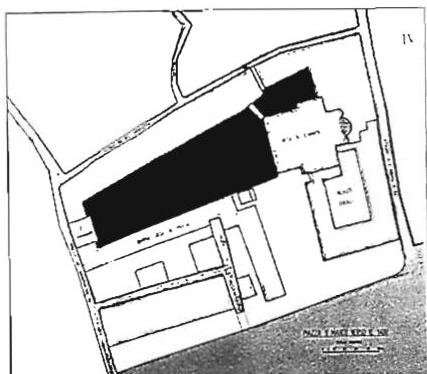
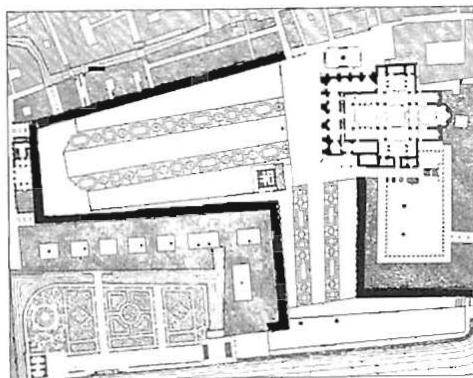
3 / A HISTORICAL EXAMPLE OF A LIVING PROCESS: EVOLUTION OF ST MARK'S SQUARE
You may get a feel for the character and impact of living process from the history of St Mark's Square in Venice. I have discussed this case in detail in Book 2, pages 252-54, but I repeat it here, in summary form, for any reader who has not seen the earlier discussion.
In this particular case, living processes (all repeating versions of the fundamental process) were active for a period of eleven centuries to reach the results we know today. Here are some highlights.
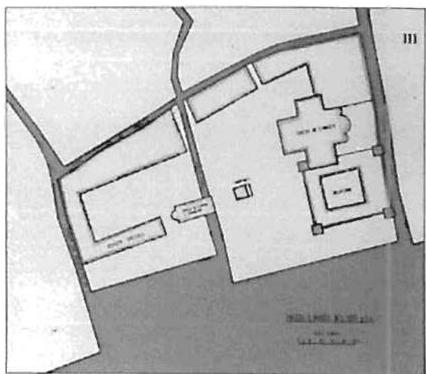
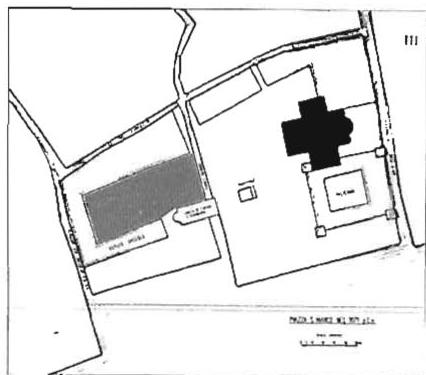
Stage 1, 560 A.D. The process started with a small square island. A small basilica was placed on it, forming an early symmetry, and a powerful center. The basilica was made symmetrical.
The castle of the Doge (lower right on the following pages) was built as a symmetrically square building surrounded by a square canal forming a second, also powerful, center.
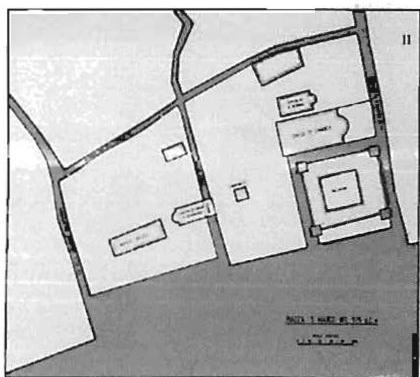
Stage 2, 976 A.D. Two new buildings were added, both forming powerful centers. Both were axially symmetrical (with rough bits to make them fit). Both were added in such a way as to make the space to their left a near-perfect rectangle, itself thus forming a new and powerful center in the space. The land of this rectangle was pushed out into the Grand Canal, strengthening the center still more by its dovetail with the water. A tower was built (yet another center) roughly at the center of the rectangle.
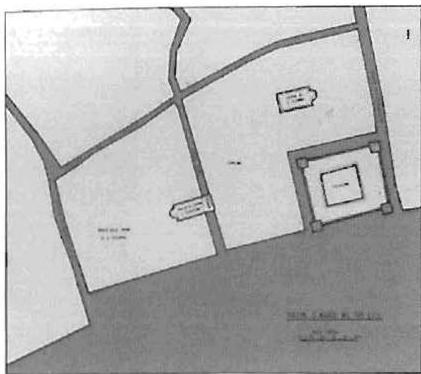
angle (not quite), to form a powerful focus in the most visible place. It is on axis with the church to the left, thus forming yet a further center in the space created between the tower and this left-hand church.
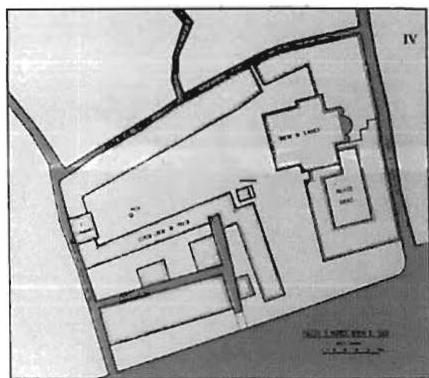
Stage 3, 1071 A.D. to 1309 A.D. An additional rectangular building is built to close and shape
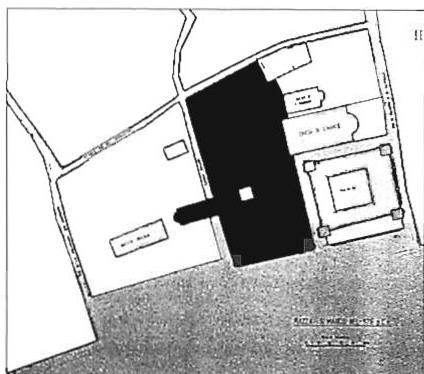
the top end of the square. For the first time the island on the left of the small canal is enclosed by a three-sided building, creating a second square (yet another powerful center) attached like a tail to the first square, focussing attention on the basilica of St Mark's. This created for the first time the enormously powerful center we now know as St Mark's square. The church of St Mark's itself is given cruciform arms (transepts), each one again symmetrical, and therefore working as a center. The land that had earlier been pushed out into the Grand Canal was now extended further to give the whole assembly a kind of apron into the Grand Canal, which gave the complex an approach that was itself a new and stronger, more powerful center when seen from the water.
Stage 4, 1400 A.D. to 1532 A.D. The tower became embedded in a rectangular building which sharpened and narrowed the square and
the view towards St Mark's from the water. St Mark's became further thickened, strengthening its impact on the square, and increasing its strength as a center. The Doge's palace was extended so that together the palace and the offices form a more coherent space which itself was even stronger than before, as a center. The campanile was left in the angle of the new-formed office building so that it still stood clear, forming the most powerful center possible seen from miles around.
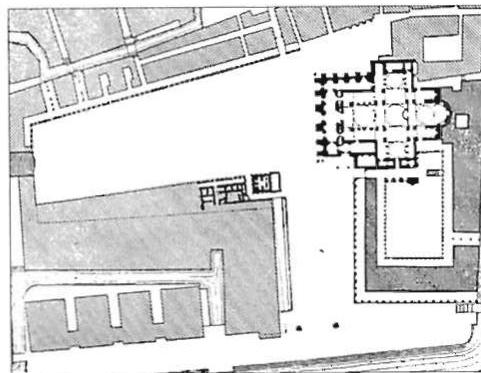
Stage 5, after 1532 A.D. The building on the left was thickened, even more, with office and houses behind, clarifying its own structure as a center and that of the square which it contained. The lower building was rebuilt, pulled away from the tower, given many interior centers in the form of courtyards. The gate at the left-hand end of the square was rebuilt entirely, so that the great arcades around the
long sides of the square formed long centers that focused attention fully on the church.
This particular example is an ancient one and it is very extended: the steps took place over a nine hundred-year period. However, I show it because it is well known, and because of its great historic interest. Please look at the more detailed explanation on pages 252-53 of Book 2. It is fascinating to see it.
What is vital is that this process of building St Mark's square was all made of center-creating actions, all were processes based in one way or another on the fundamental process. Most of the entities that were created there, large and small, were living centers that have unfolded over time to make the whole more and more vibrant, and it is this which gives the place its living character.
In the next section I show other examples of living process which have taken place over a period of a few weeks or months.
4 / EXAMPLES OF LIFE-CREATING PROCESSES FROM OUR ERA
When I write down in protocol language what is happening in a living process, as I have done on page 4, it possibly sounds too much like a formula. Obviously, I am not proposing that we go through life repeating this formula each time we do something, like blind idiots, just so that we can claim we are doing “a” living process.
Nevertheless it is true that the processes required to make a living thing are, at some very deep level, always similar in their essentials.
Even in the manufacture of objects, when it is done right, the fundamental process will appear. I show here a contemporary example of the use of process, lasting a few weeks, during which one of my colleagues and I designed a set of drinking glasses for the Royal Dutch Glass Works of Leerdam, Holland.
Here, in the process of designing a wine-glass, I started with a sketch. Already in this sketch several major centers that were to come were visible. Then we made many turned wooden mockups of the glass, getting the feel of the immensely subtle way that the sensation of the shape changes, even with what look like tiny variations in the curve and profile. Once again, it is living centers that I was judging — this time in relation to my hand as I imagined the glass when it had lemonade or wine in it.
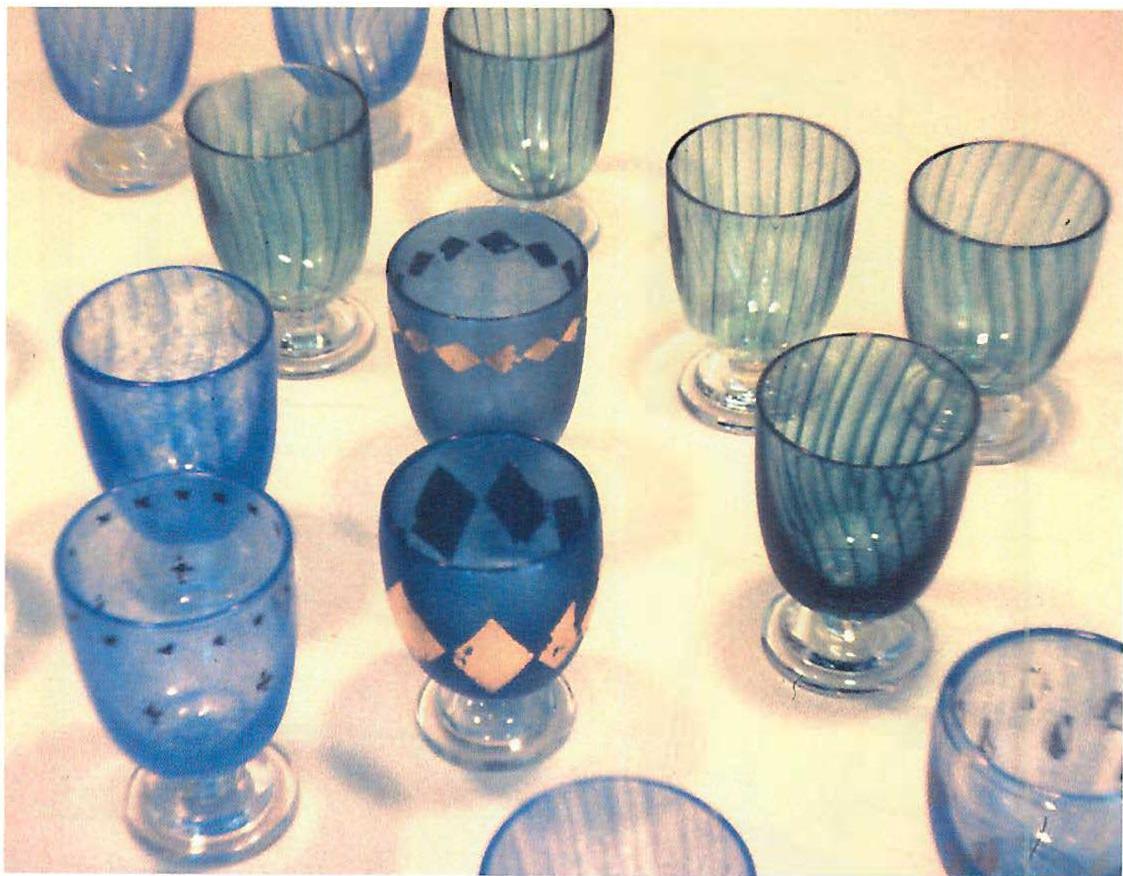
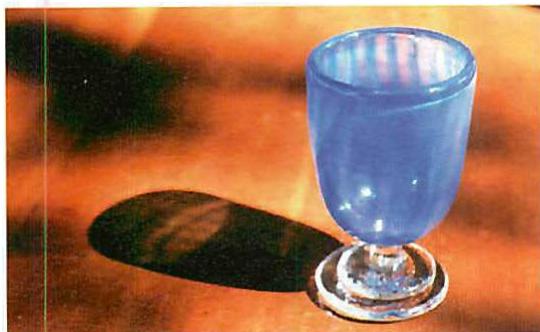
EVOLUTION OF A SET OF DRINKING GLASSES: FOUR STEPS SHOWING A LIFE--CREATING PROCESS EXTENDING OVER A FEW WEEKS
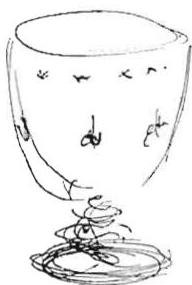
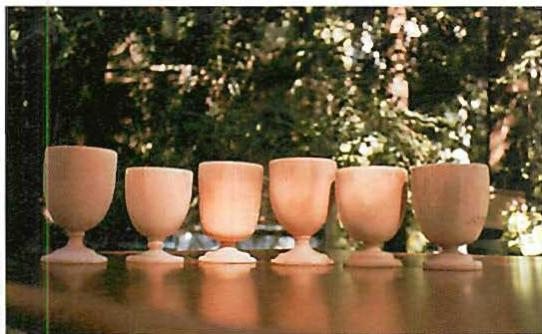
Step 1. A sketch, in which we first tried to identify the main centers of the glass, and to get its resulting form from the general character of these centers. The centers are visible and strongly marked. They form the core of the design: the center of the bowl, of the foot, of the base of the foot, even the ornaments on the glass. All were already roughly defined at this early stage, and serve to accentuate the centered aspect of the form.
Step 2. A series of wooden forms — about 20 — which were turned in my office by my assistant Katalin Bende. Here we tried to find out which of these glasses was most comfortable in the hand, most comfortable in the feeling of its weight, balance, and appearance in three dimensions.
Step 3. A stage in which a single rough glass was blown for us by Dan Reilly in his glass-blowing shop in Oakland. Here we tried to find the glass whose overall feeling, weight, appearance, color, came closest to the impression caught in the wooden molds.
Step 4. A stage in which we made a mold for the glass factory in Leerdam and in which Henk Verweg, the glassblower, blew a number of these glasses to the shapes I asked, using different thickness and layers, and which I then left plain, painted with gold paint, and remade with application of gold leaf (opposite page).
Throughout these steps, I did need to have the reality of centers in my mind while I was working. But I did not have to talk to myself in the jargon of centers to be successful. What actually happens in detail, in different projects, is unendingly varied. I hope that will be clear from the examples in this book.
CONSTRUCTION OF A GATEWAY LEADING TO FIVE LOW-COST HOUSES IN MEXICO: ANOTHER SMALL EXAMPLE OF A LIVING PROCESS
In another instance, an ultra-low-cost housing project where people built houses for themselves, with our help. Cost, $3,500 per house. When we were finished, I encouraged the users to use living processes to build further components of the project, as we had built the houses with them, using living process, paying attention to their feelings, and the way the centers helped support their feelings. They built gates, extensions to the houses, gardens, porches, a barbershop.
One gate they built during this later period is shown below. The families and amateur builders themselves made this rudimentary gateway. Here again, in a modest, even crude form, still the process kept on creating living centers. Crude as it is, we see living centers in the symmetry of the arch, in the ironwork of the gate, in the weight of the big column on the right as a result of their effort to form a boundary there. Because of these touches, the place has life. It may be crude, dirty, but at least for the time being such is the lot of many people. And it does have undeniable feeling—very different from a developer-built project (for all its mechanical cleanliness), much nicer, much closer to the heart. This came about, I believe, because making the gateway they used, more or less, the following simple sequence, and kept their own wishes and their feelings in mind throughout.
- First, after locating the lots and house positions, they chose the POSITION of this gateway.
- It is locally symmetric and leads to the middle of the common land.
- The width and height of the gateway were determined, again making the gate itself symmetrical.
- The family members then decided its chair
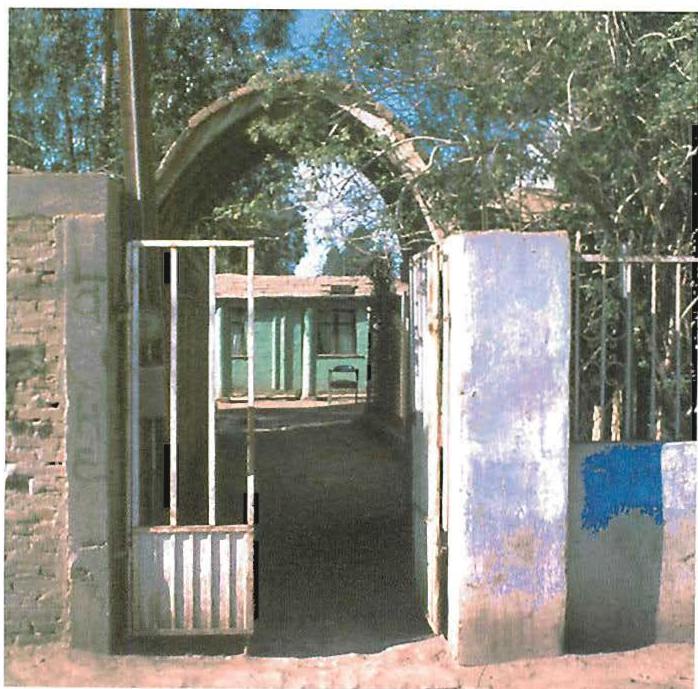
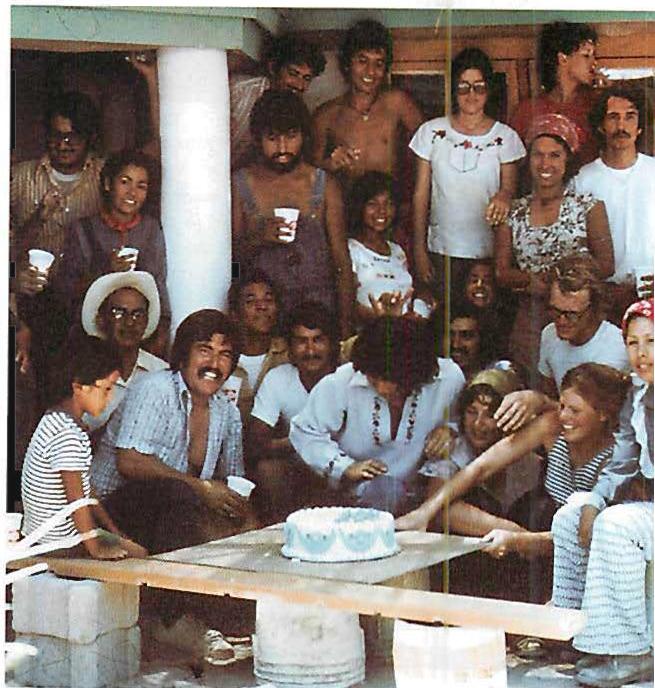
One very ordinary gateway to a small housing project I built in Mexicali, Mexico, 1938. The families, laying out and building their own houses, followed an approximation of the fundamental process. This picture shows the gateway to the five houses, twenty years after the houses were built and occupied, still splendid, in a world where people are very poor. The same five families are still living there. The right-hand picture shows a celebration at the inauguration of the project, when it was first occupied.
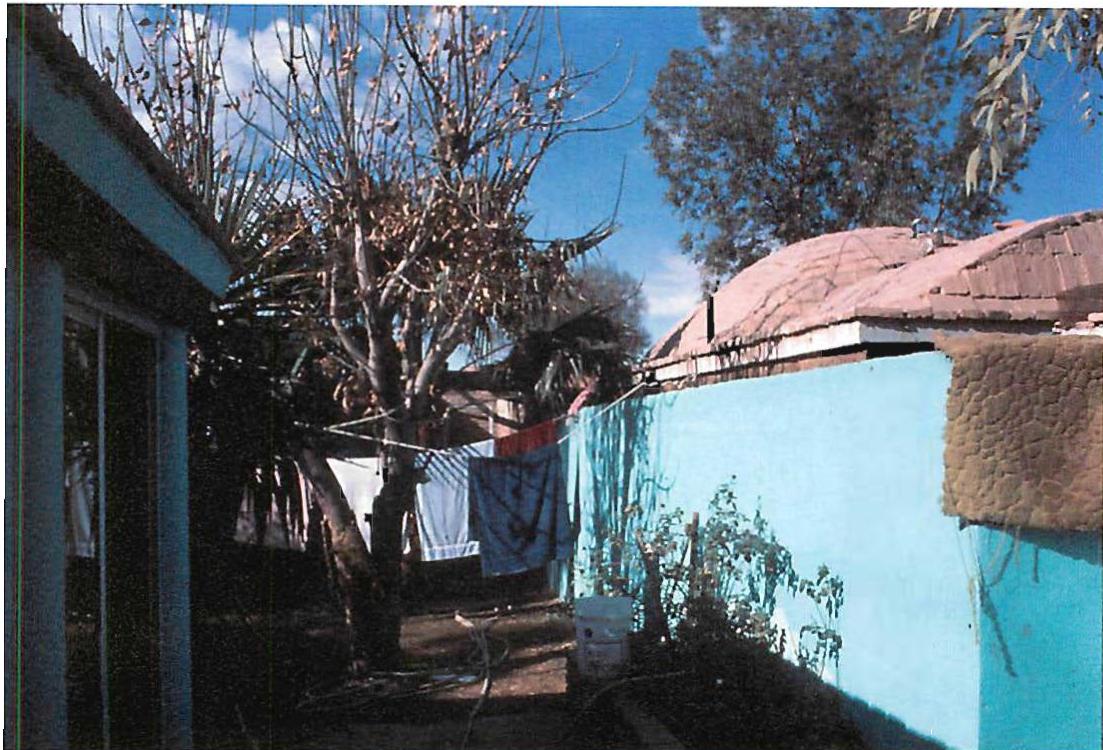
acter, height and width. Students who had worked earlier on the project helped the families to build the gateway.
- Next, columns were built in positions to form a positive space within the gateway itself.
- Then beams were built over the columns,
each beam symmetrical in itself, and a roughly symmetrical vault was woven over the entrance and plastered.
- As years went by, the gateway was painted, patched, and modified by the way the families used the place.
CONSTRUCTION OF AN APARTMENT BUILDING IN DOWNTOWN TOKYO
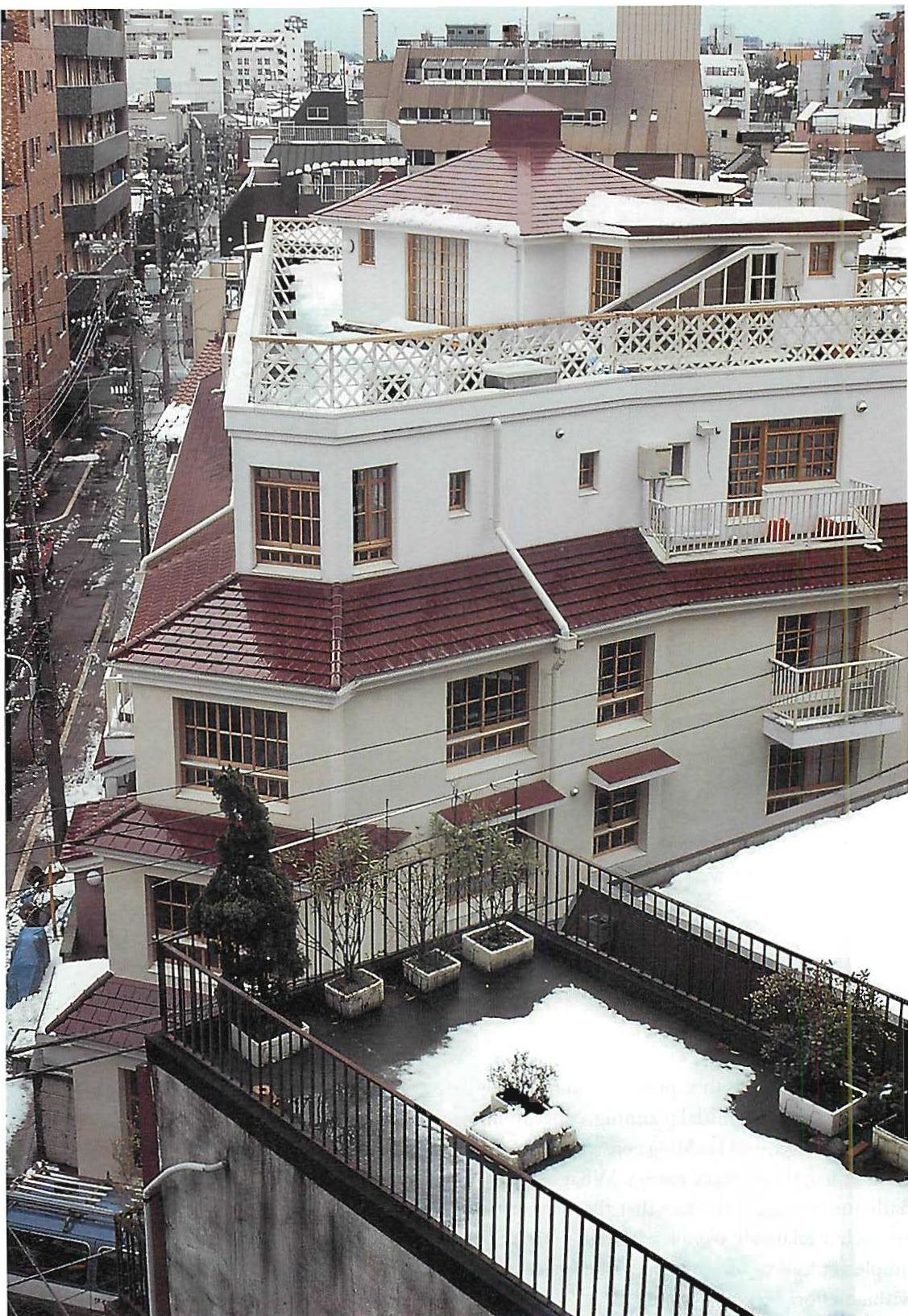
The description of this process—comprising some fifty steps, for initial planning, conception, building design, and building construction—is given at length on pages 166-73. What is especially interesting, is the fact that the steps, even for such a relatively complex building, are very simple yet lead to such a complex design almost without effort.
The first step establishes the building walls as along the street—even though they are at an awkward angle.
The next step decides the orientation of the inner courtyard, towards the sun.
The third step makes terraces step back inside
The fourth fixes the entrance. . .
And so on, for fifty steps, until a simple, but complex arrangement arises from nothing except common sense, and a little bit of structural engineering knowledge.
See the photo on the next page, and the explanation of the unfolding sequence in chapter 5.
A VARIETY OF OTHER PROCESSES, ALL SIMILAR IN FUNDAMENTAL CHARACTER
In yet another instance, I may look at a proposed new bridge we are designing and ask what shape of bridge, what shape of span, what shape of tower, is harmonious with the land-forms and water that it passes over. Analytically, I may well be looking for the center (in the space between the bridge towers) which most enhances the water which the bridge is passing over. Am I thinking about it this way when I do it? Generally not. I try to make the bridge in the best way I can, and I rarely talk to myself explicitly about the centers — unless I feel I am going off the track and need to bring myself back on track.
Another time I may be talking to clients about a room that is to be built, listening to hear what they are really trying to say. That is yet another way I might try to get insight about the living center which they are searching for.
In another case, looking at a new building site for the first time, I drive along, gazing at the trees and the spaces they form, and wondering
what it is about these trees. I could be looking at the trees, thinking about the way they form a structure that is objectively present in the wholeness they help to form, trying to grasp their essence so that I can take new actions which preserve their structure.
Or, if I am painting, I may look at the light on a distant mountain and try, within the painting, to put a patch of color in that place so that the color shines, and lights up the landscape in a way that is reminiscent of the real place's character. Again, if I force myself to be analytical, I can say that I am at that moment trying to construct that flash of light as a center which illuminates and strengthens the center which is the mountain, and that this in turn is being done so as to strengthen the center of that landscape as a whole. But what I am really doing is trying to get that patch of light just right so that the colors work together, concentrating on that. That, too, is an instance of a living process.
DESIGN FOR THE INTERIOR COURTYARD OF A CIVIC CENTER FOR THE CITY OF MOUNTAIN VIEW, CALIFORNIA
The building on the next two pages—a picture of the interior courtyard in a commissioned design for the Civic Center of Mountain View, California—shows an example of a large public project, conceived and designed within the framework of living processes. Again, all the steps needed to reach the design depicted here, depended on having the right sequence: patiently, one step at a time, elements—aspects of the whole—were introduced into the design, until it was complete, always, at each step, asking what fitted best, and what did most to preserve and enhance the structure of the whole that was already there.
Consider the following steps, which occurred during the making of this courtyard.
- The courtyard was located, first, by a vision of a dome arising from the place, the dome hovering over the street, and over the courtyard.
- The courtyard was located, next, in more detail and rough position, by relation to the street and to the park, forming a bridge between the two.
- Next the size and height were fixed: first the size—formed by walking out the proper diameter, standing in that place on the land.
- Then the height, 3 stories, worked out partly by reference to the area of office space needed, but more important, worked out as a height, felt by people in the courtyard, hovering above them, and giving dignity to the green dome.
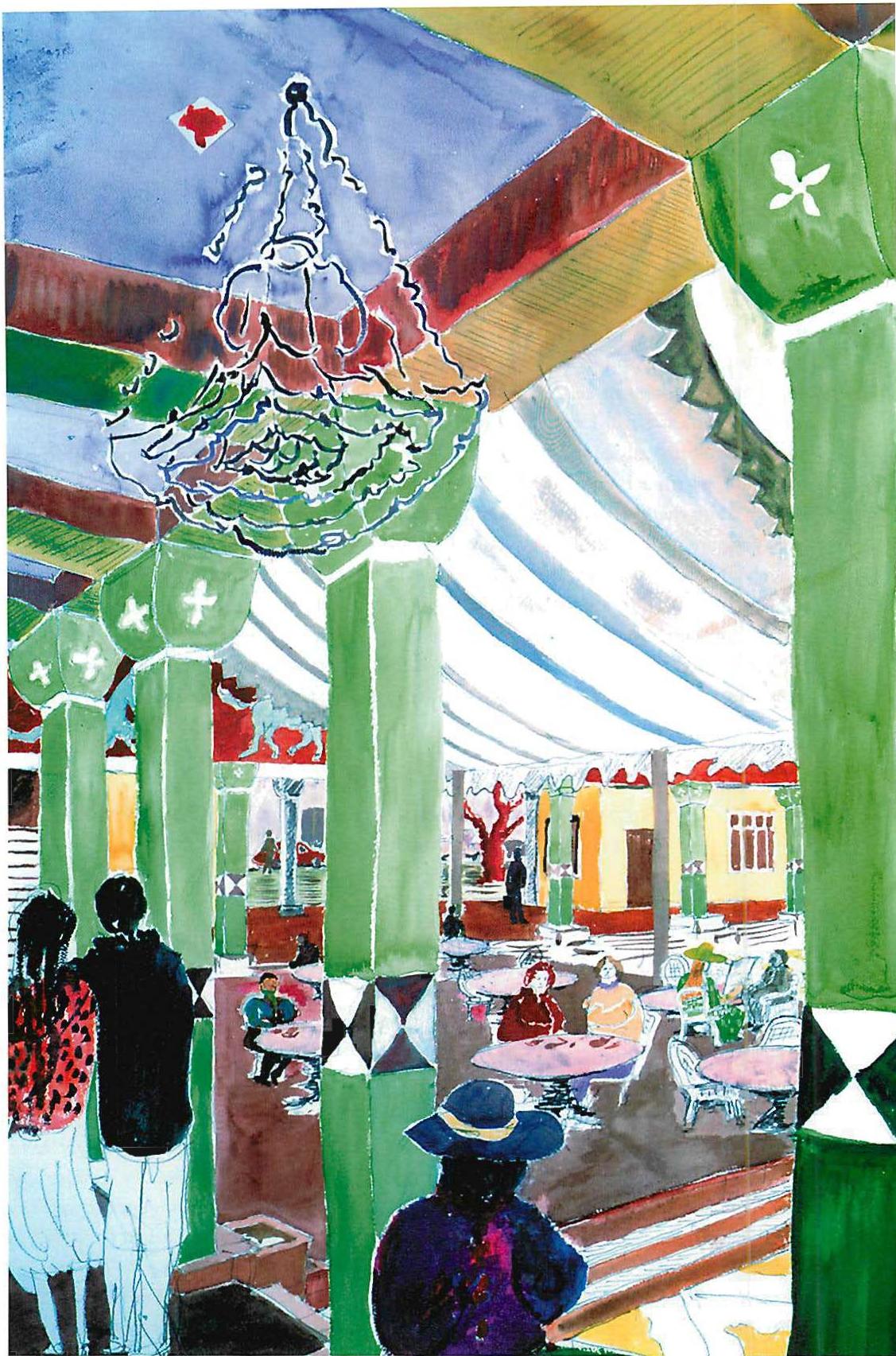
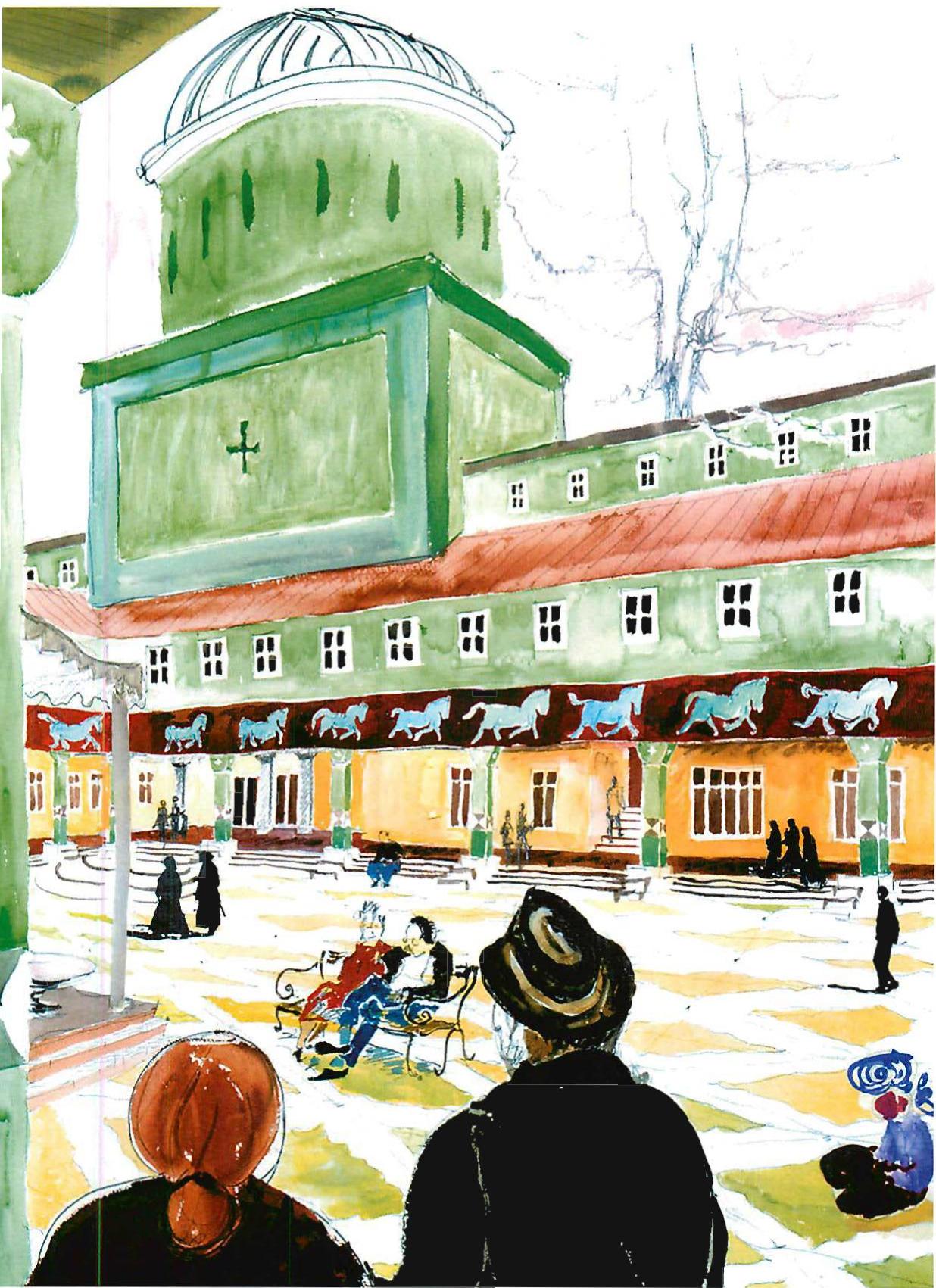
Next the covered arcade, depicted — generous, high and wide, and facing the dome.
Then the color of the whole, its yellow plastered wall.
Then the blue horses, a frieze of huge ceramic horses all around, dominating the feeling, subsidiary to the dome
Then the paving, alternating with grass, worked out on a model, and once again sized by walking in the real place and deciding the 'just-right' size of the bits of lawn and alternating bits of stone and concrete.
Further details of this building and its courtyard are given on pages 109-11.
CONSTRUCTION OF A VISITORS CENTER IN SOUTHERN ENGLAND
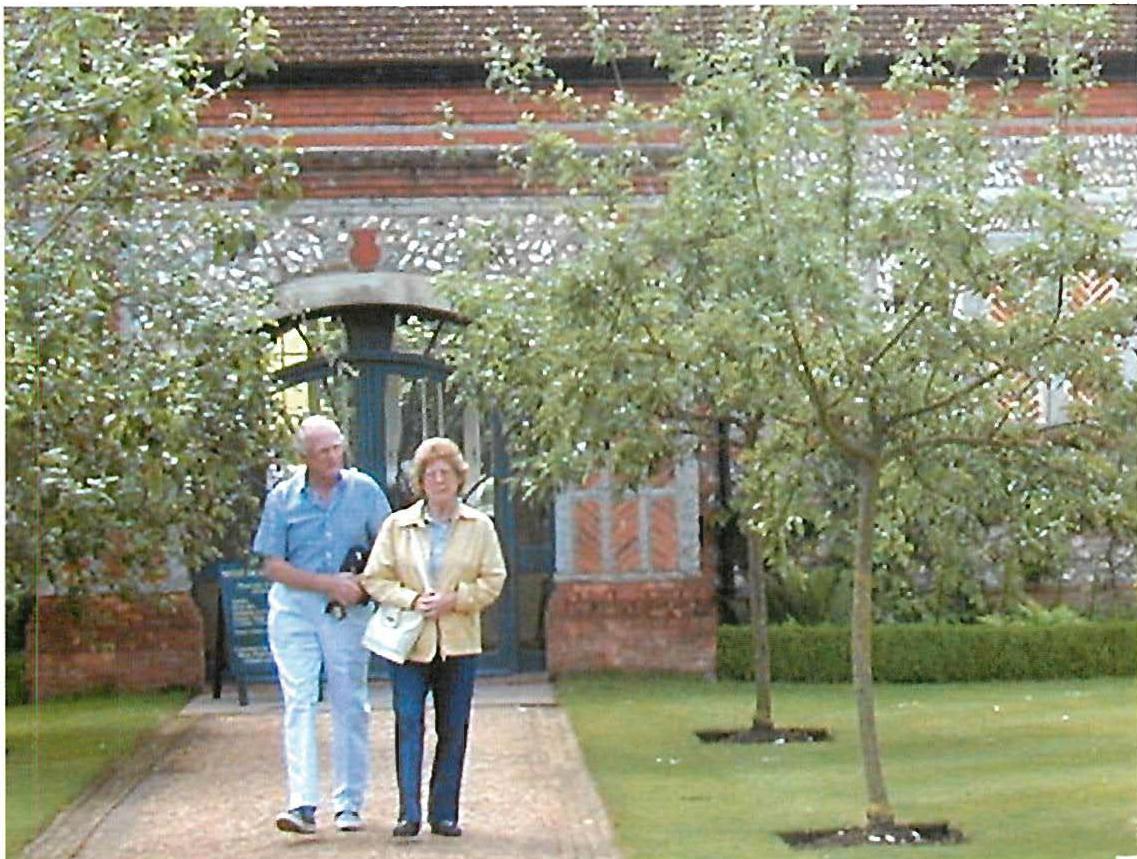
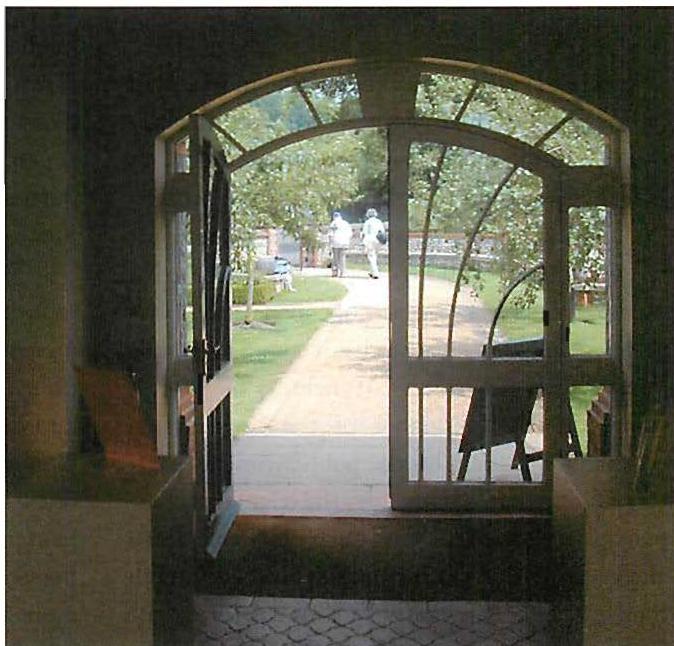
In another instance I built a visitor's center in England (these pages). Every step taken in the building, over a period of many months, defined some subtle condition which was shaped, perfected, and adapted by some further step of observation, measurement, mockup, discussion and construction. The process of designing and constructing that building is described at length in Book 4 (pages 118-29), with discussion of the contracting details in this book (pages 145-47 and 240-41).
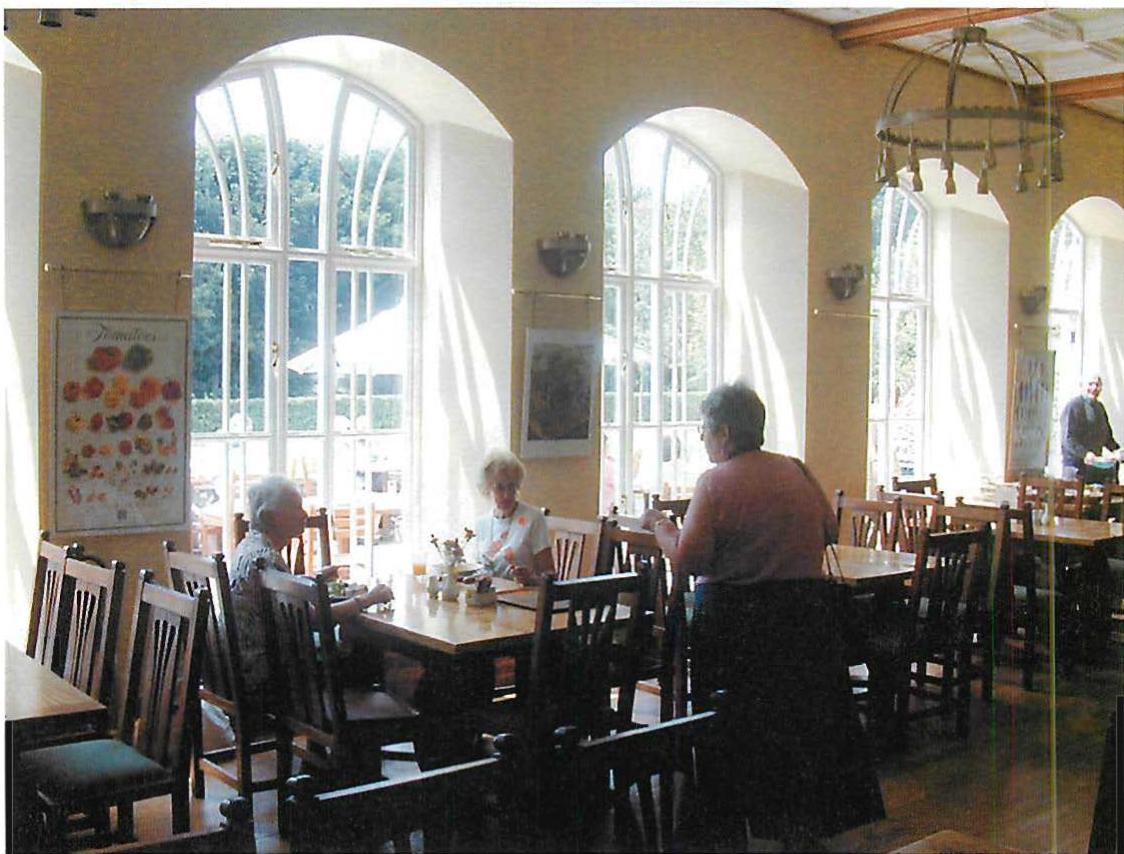
Some of the multitude of centers that were created in the West Down Visitor's Centre, West Sussex. Not only the beautiful windows, their arches, the fan shape of their glazing bars, the splayed reveals, but even the tables in the room, the table legs, the chairs, even the chair backs, all form living centers there — hence the profound harmony of such a scene. This was created by a multitude of living processes over time. Christopher Alexander and John Hewitt.
More generally, chapters 3 to 20 contain descriptions of the kinds of professional, institutional, contractual, and construction processes needed to bring such buildings to fruition. Each process is different. The variety of living processes is literally endless and one must learn to nurture this variety. Deep down, it is true that in all these varied cases we really need to be occupied with the system of centers and with the feeling of the whole — always. But there is nothing formula-like about the actual activity itself. Each living process, for each new project, is fresh and new.
5 / THE CONTINUOUS FLOW OF CREATION IN A REGION OF THE WORLD
Using the concept of living process, we may make a picture of the whole environment, natural and built, as something continually growing, continually developing, continually in flux, yet maintaining itself in a living state. We are familiar with the human body as something which exists in flow, not as a fixed object. The molecules in my body change constantly. After seven years, all the molecules — except those in certain brain cells — have changed. Much the same is true of a city or a neighborhood in the vision I am depicting. The city is being continuously built and un-built, rebuilt, built, destroyed, modified, built, added-to, improved, destroyed, and rebuilt again.
Imagine this single process, this unfolding process, endlessly repeated, always creating centers, always unfolding the existing wholeness. This process, like some imaginary needle carrying a single thread, but in a thousand hands, dipping down, now sewing a seam at the largest level, now dipping down to some detail, now plunging across the thread to stitch the middle-level seams.
What I offer you is a conception in which all of these acts of repair, design, construction planning—all of them, large or small, local or global—are guided by the fundamental process.
Of course a city is built by millions upon millions of acts, by millions of people. If we try to list all the different man-hours of construction labor that continuously create a city, it comes from millions of different sources. It includes the professional construction labor of the construction companies. It includes the public works department fixing roads. It includes the telephone company placing and replacing telephone cable. It includes agriculture. It includes people working in their gardens. It includes someone painting the fence on the weekend. It includes cleaning the house, sweeping the house, rearranging furniture inside a house. Thus the environment is built, and rebuilt, from a colossal number of different kinds of operations working together, continuously, to build and rebuild the city.
What we think of as the city, in its life, is the continuous flowing whole which is created and recreated daily by all these events together.
If the city becomes alive, it is because these processes governing various small bits and pieces — many of them together — are creating life locally. But because the fundamental process has, at its core, the idea that the life of any center only comes about when this center is making life in some larger center, by definition, then, the coherence spreads upwards and outward, from each small act of construction or repair, to the larger entities that are being nourished and created.
The process can be highly variegated. It can include agriculture, road-building, new construction, people repairing and rebuilding their houses, engineers building bridges. It can include someone buying and installing a lamp in the kitchen. It can include someone who paints a picture and hangs it on the wall. It can include the plowing of the fields and the pruning of the trees. It can include installation of highway signs, industrial development, manufacture of tiles, a thousand people painting their front doors.
This vast and variegated process may contain, as sub-processes, thousands of individual processes of thought, design, art and construction. It can include the making of individual buildings. It can include the process of someone planing a board. It can include someone painting or carving an ornament. It can include the human process by which a group of people sit down together and plan their neighborhood: and the more modest process by which they sit down together to decide which tree to plant at the end of the street. It can include, of course, the rather
big and imposing process of building large and important buildings. It can also include the more delicate process of furnishing an individual office or a study in someone's house. It can include the placing and building of a bench by a fish pond. It can include, too, the act of stocking the pond with fish, and the act of planting a bush beside the pond. It can include, even, pruning the bush, fertilizing it, sweeping away the leaves.
And the process also includes, of course,
what we normally think of as destruction. Cutting down a dead tree, breaking out a piece of abandoned roadway, demolishing a derelict building—all have their place. Clearing and building go forward together to create and maintain the world.
This huge process of order-creation contains millions of strands. Yet it is, in the whole, a single process which can move forward to create and maintain the health and structure of the world.
6 / WIDELY SPREAD LIFE-CREATING PROCESSES
From the material presented in this book, I hope that you may get a glimpse of what is possible, a goal, a target, a hopeful sense of our beautiful and comfortable Earth as it may be in the future, and where we may one day more deeply make our home.
It is true that what I have accomplished is modest. But, for nearly forty years, I have been building, planning, making works of art and craft—all efforts, in one form or another, to test the idea of living process in the real world and to see what can be accomplished by it.
I have tried to build a body of evidence, a body of building where people may see a new spirit, a new way, a new atmosphere.
Above all, I hope I can convey to you that what I call living structure not only is more beautiful, more alive. I hope that I can also convey, and sometimes even demonstrate, what I claimed in Book I, namely, that this kind of structure supports human life better than other structures. When human beings are part of a world of living structure, they can sometimes reach the best that they are capable of, sometimes become free to be themselves.
People say that what I propose is difficult to do. But I have been doing these things for a long time, trying as hard as I could, often succeeding, though admittedly often failing.
From thirty years of experiments, some described on the following pages, you may see something of what can be accomplished. The hundreds of completed examples in the pages which follow also show how it can be done. I show six hundred pages of built examples to convey to you that life-creating processes are general, can cover inconceivably many problems and situations that do occur in different cultures and different circumstances, and still create coherent structure as a result. I hope that you can extrapolate from these few hundred pages and invent thousands of new processes of your own.
In each case of a new process that you yourself initiate, the details—what makes it a living process—are likely to be different. That, too, is part of what I want to demonstrate. It is important to understand that one has constantly to be inventive. Life-creating processes take an endless variety of forms; there is no way we could exhaust the forms of all possible processes, and this book is not a catalogue of possible processes. It is only a tiny sample of a universe of very different processes, all in some measure embodying some combination of the fundamental process repeated many times.
Nevertheless, each chapter does show, matter-of-factly, some of the features which are
likely to follow from a general use of living process. In a sense, the nineteen chapters as a group cover the main features of a world generated by living process. I have focused attention on the particular features which follow when living process is applied to them because, together, they
encompass some—not all—of the more important architectural consequences which come inevitably from repeated use of living process.
The examples show why this "new" character is likely to appear whenever living structure is allowed to unfold.
7 / CONCLUSION
I would ask you to come back, for a moment, to the title of this preface. I have called it LIVING PROCESSES REPEATED TEN MILLION TIMES because I want to say with this title that a living region, even a living village, can be created successfully only if many, many, many of the people in that society cooperate to make it happen—many individuals, acting in their own way, yet acting together.
For this to happen in different places of the Earth, for it to happen in the place where you live, it virtually requires that you, too, whoever you are, must play some role in it. So I want to suggest that you, no matter who you are, no matter what your work in daily life may be, if you have the inclination, choose to make yourself part of this process.
It is my hope that the transformation of the Earth, through millions of acts, will come from people acting individually and in small groups—from all of us, from all our hands, from yours and mine and the next person's—all over the world. This is not an empty expression of a romantic ideal. It is, in my view, unlikely that a living world can be created in any other way.
Please note: I do not say that the world which I depict OUGHT to exist. What I wish to say is something more fundamental than a moral lecture. I am simply describing, as matter-of-factly as I can, what kind of living world WILL follow from the widespread and repeated use of adaptive living process to unfold the world IF LIVING AND ADAPTIVE PROCESSES ARE REALLY USED.
AUTHOR'S NOTE
FRESHNESS AND DEEP ADAPTATION: THE CLASS OF LIVING BUILDINGS
What was lost in 20th-century building was the freshness of our buildings. Even when modern development tried as hard as it could to create life, the places built were often far too mechanical, so that the result became rigid, tired, and stiff—sometimes even horrible—and was often lacking, altogether, in the real freshness and sweetness that makes us joyful.
This problem, precisely, is the legacy we have inherited from the 20th century, and it is that problem, above all, which I try to solve in this third book. The solution of the problem, requires that we learn to distinguish two morphological classes, Class 1 and Class 2, that are defined on the opposite page. These have not previously been clearly distinguished. For it is not style that makes a building living or dead, but the freshness of its response to its surroundings; the truthful and spontaneous unfolding of order within its own fabric.
The freshness I refer to may be partly understood by reference to a martial arts discipline which lies far from the discipline of architecture. In Aikido, the martial art in which players fight, wrestle, and dance, it is above all the fluid response of one person's body to the configurations that the two players have reached together that is of the essence. What makes Aikido unique is that this response is non-mechanical, it is not within a system, rather it is always unique to circumstance. It grows out of the previous moment. That is what the players, dancers, fighters of Aikido learn. That, too, or something very much like it, is what makes a building fresh and alive and joyful.
Indeed, the essence of all life in any system at all, lies in the adaptive response of each new development in the system to the previously existing state. And this, too, stands as the foundation of any world where we experience true belonging. It cannot be achieved by a mechanical framework, by any mechanical system, nor by any stereotyped or stylistic response. Rather, it comes about only when the response of each act of building has been fresh, authentic, and autonomous, called into being by previous and present circumstance, shaped only by a detailed and living overall response to the whole.
Very few of the 20th-century architectural systems or procedures were able to approach this aim. Neither the prefabricated but supposedly endlessly open erector sets of the technical wizards, nor the humane procedures of community organizers can do it. Life is not only social but also, necessarily, geometrical. Life will come about only when each response is fresh, and each moment in the responding process truly builds something new and unexpected from a profound response to whatever whole existed just before. This, too, will be visible in the geometry, in the design.
The adaptive processes described in Book 2 (and used throughout this book as the underpinning of all adaptation) are uniquely able to achieve this quality. Similar sequences did achieve it in almost all traditional societies, and the buildings they created are living proof. Similar kinds of sequences can achieve it, now, in our modern and ultra-modern society, because the nature of these sequences is not to impose pre-fashioned order on things, but rather to extract what is new and fresh from the state of the world that exists.
That is the origin of the power of these sequences; that is their target; that is their goal.
And they do it in a surprising way. Although the adaptive sequences are highly ordered, and seem predefined, because they define steps and transformations in a disciplined sequence, it is the character of these sequences to help the user, the artist, the builder RESPOND to what is there, rather than to IMPOSE on what is there. This is the remarkable power of the structure-preserving sequences. It is this which helps people use such
AUTHOR'S NOTE
sequences to fashion true belonging—not fake belonging—for themselves.
Let me now make a key observation about deep adaptation or the lack of it, as distinguishing marks of the buildings we see around us in the world, and as the origin of the two classes I have mentioned.
CLASS 1: THE CLASS OF BUILDINGS THAT ARE DEEPLY ADAPTED. If we consider all the examples of all traditional buildings, built, say, from the third millennium B.C. to sometime about 1900 A.D. (it varies from country to country and culture to culture), they are enormously different from one another. Igloos, African houses from Mali, Chinese palaces, the palace of Knossos, the villages of England, Japanese temples, Turkish cave dwellings ... Indian carvings... they are all enormously and vastly different from one another. They contain shapes, colors, roofs, attitudes, materials, of an unbelievable and rich variety. Yet somehow, too, they are all deeply similar. There is something about them all, which is the same.
CLASS 2: THE CLASS OF BUILDINGS THAT ARE NOT DEEPLY ADAPTED. Now let us put together all the most widely published examples of the buildings of the recent historical era—say, from 1950 to 2000. These high-style examples also show many different shapes, materials, and intentions. They include, too, the fake traditional buildings made by contemporary methods of development. All these buildings, regardless of style, again, in some very deep way, all resemble each other. Once again, they share something deep which is the same in all of them.
The buildings in these two classes—those in Class 1 and those in Class 2—are utterly different, both in artistic substance and in morphological substance. This is fairly obvious. The important question is, What is the nature of the difference? On the face of it, it might appear that the distinction between the two classes is merely historical, referring merely to two eras of history—pre-1900 and post-1900. That observation though, for a scientist, would be far from
the mark. What the difference really has to do with, are two different expressions of the purpose and intent of architecture, two different sets of assumptions and procedures. The difference lies in the structure which results from the assumptions and procedures. The structure of the buildings in Class 1 and the structure of the buildings in Class 2 are quite different, not because of shape, or culture, or climate, but because of the deep, inner nature of their structure-generating assumptions, and specifically because of the way they deal, or do not deal, with adaptation.
What I mean by Class 1 is defined by one set of assumptions, relying on deep adaptation as the ordinary process of production. All the buildings in Class 1 share the deep mathematical structure of adaptation I have drawn attention to in Books 1 and 2 as living structure. It is the structure of those places and buildings which are adapted, deeply, to land and to people, and in which the inner parts of the buildings, down to the smallest elements, are also marked (and made) by continual, patient care and adaptation to the elements around it. The examples of Class 1 exhibit the structure that arises, necessarily, from this kind of adaptive unfolding. This is an invariant structure that may be understood in scientific terms.
What I mean by Class 2 is defined by another set of assumptions (outlined in Book 2, chapter 4). The buildings in Class 2 are not well-adapted structures. They represent a new brand of fantasy, so clearly marked that it is almost a commercial brand, glued on, somehow, to the products of our early first-stage industrial civilization, lacking the benefit of biological or social rigor, lacking the desire to satisfy the human heart, not stemming from the inner voice of ordinary people, but stemming instead (very often) from the ego-hungry voices of architects who desire to be famous—and who wish to promote a product. In other cases similar buildings may be generated by the wrong kinds of mass production, or by crude over-technical processes that are cut off from all possibility of detailed fine adaptation.
The fact that the buildings shown on the following 700 pages resemble buildings in Class
1, and not the buildings in Class 2, is inevitable. It occurs because the buildings shown in this third book come from living processes—that is, from processes and procedures which allow adaptation and which generate, in one form or another, precisely that living structure which these four books are about. They do not resemble the buildings of Class 2, because Class 2—its motives, intentions, images and geometry, and above all its geometric generating system—have nothing essential to do with human life, or with the life of animals or plants.
At present, the architectural images of 1950-2000 have so strongly brainwashed the public, that a person could be forgiven for asking of the buildings in this book, “Why don’t they look ‘modern’?” But the truth is, most of the buildings in Class 2 are not modern in any practical sense at all. They are merely mannered, and infected by a lack of responsibility for the connection of buildings to land and people.
Thus there is an inescapable appearance of the result. The buildings which come from adaptation—continuous, patient adaptation, concern with wholeness and nothing else—have a certain discernible structure. That is because adaptation goes towards certain structural features in a building. The buildings which have these features are not modern, or ancient, or historical: they just happen to form a definable mathematical class (see pages 685-91), and specifically, a definable class of forms (see pages 639-76). This class includes very few of the buildings being praised in our time. That does not mean the products I shall show you are nostalgic or sentimental. It means simply, that, if we have to find our way toward that large class of deeply-adapted structures, we shall find our way towards a new set of buildings and building types. The fact that they vaguely resemble members of the huge class of all buildings built all over the world during a five-thousand year period occurs, not because I desire to imitate them, but simply because for 5000 years those buildings were most often members of just that class which
is reached by careful internal and external adaptation—what I, too, have tried to do—while the buildings of the last fifty years were most often not. That’s all there is to it.
There is no inherent reason why buildings of our era should not be deeply adapted, and should not therefore be Class 1 buildings in their geometric structure. There is no reason, either, why many of them should not be made of ultra-high-tech materials. What matters is their ability to contain and exhibit the intricate deep structure of an adaptively made thing. The Eurostar terminal in London (page 119), or Calatrava’s building in Milwaukee (page 195) are examples which happen to use recently invented materials. They are therefore useful as lessons—since both exhibit some of the qualities of an adapted thing. It is my hope, that many of the Class 1 buildings in this book will provide a model for architects and builders and artists, indeed for all people, who wish to come to terms with the life of the planet, and who view themselves as people whose most pressing undertaking is to maintain the beauty of the Earth.
It is strange that in the recent era of machine society, when we encountered beauty—a living structure—and it aroused deep feeling in us, we often dismissed what we encountered as “only a feeling” and therefore not very important. In fact, the presence or absence of deep feeling, is yet another way we may distinguish between buildings of Class 1 and buildings of Class 2. Buildings of Class 2 generally do not evoke deep feeling. Buildings of Class 1 generally do evoke deep feeling. The difference comes from the different adaptive structures that they have. In this regard, Class 1 buildings are like works of nature—a patch of bluebells in a wood, for instance, or mist in the mountains. There, too, the feeling evoked arises because of the structure of the natural phenomenon, and because of the adaptive process by which it is made. Deep feeling appears in these buildings, as it does in nature, because they emerge through subtle adaptation from the whole, and because at each stage of their unfolding they support the whole.
The first two chapters contain discussion of what is perhaps the most important human issue in the built environment: our sense of ownership, participation, and belonging to the world.
Chapter 1, BELONGING AND NOT-BELONGING, suggests that our belonging to the world works in two ways: the belonging that we feel in public places and the belonging which we feel in individual, private, places. In a world where living processes are working properly, each individual private place (whether private house, apartment, office, workplace, or workshop) will have its own uniqueness that allows its users to belong to it. At the same time, to work well each of these private places are directly attached to some hull of public space, thus giving us — people — participation in the social world at large.
Chapter 2, OUR BELONGING TO THE WORLD, describes with small examples, and with more intensity, just what I mean by belonging. This belonging — the relation through which we human beings are connected to the Earth — a visceral feeling of joy — hinges on the sensation that we have the right to be here, that we belong to the world and it belongs to us.
Only living process can generate belonging. When living processes are working well, our belonging comes about naturally. Then, both in public and in private, our belonging to the Earth is established without effort.
CHAPTER ONE: BELONGING AND NOT-BELONGING
The single photograph on the next two pages describes, vividly, the loss of belonging which has become commonplace in our era. It is a picture of people in Prague, November 1989, receiving the news that the Berlin Wall had come down. The haunted faces of the 20th century. Are these people glad about the onset of "democracy?" Is there a glimmer of hope in their mysterious faces? Or are they simply fearful because they now face the prospect of a money-centered world? I believe it made little difference to them. Belonging, as I have described it, was not available to them in either case. Because of that, like many of us whose belonging is not clear, they are afraid. That, in my mind, is what is written on their faces in this photograph. And we — who ALSO face this, every single day — what are we to do about it?
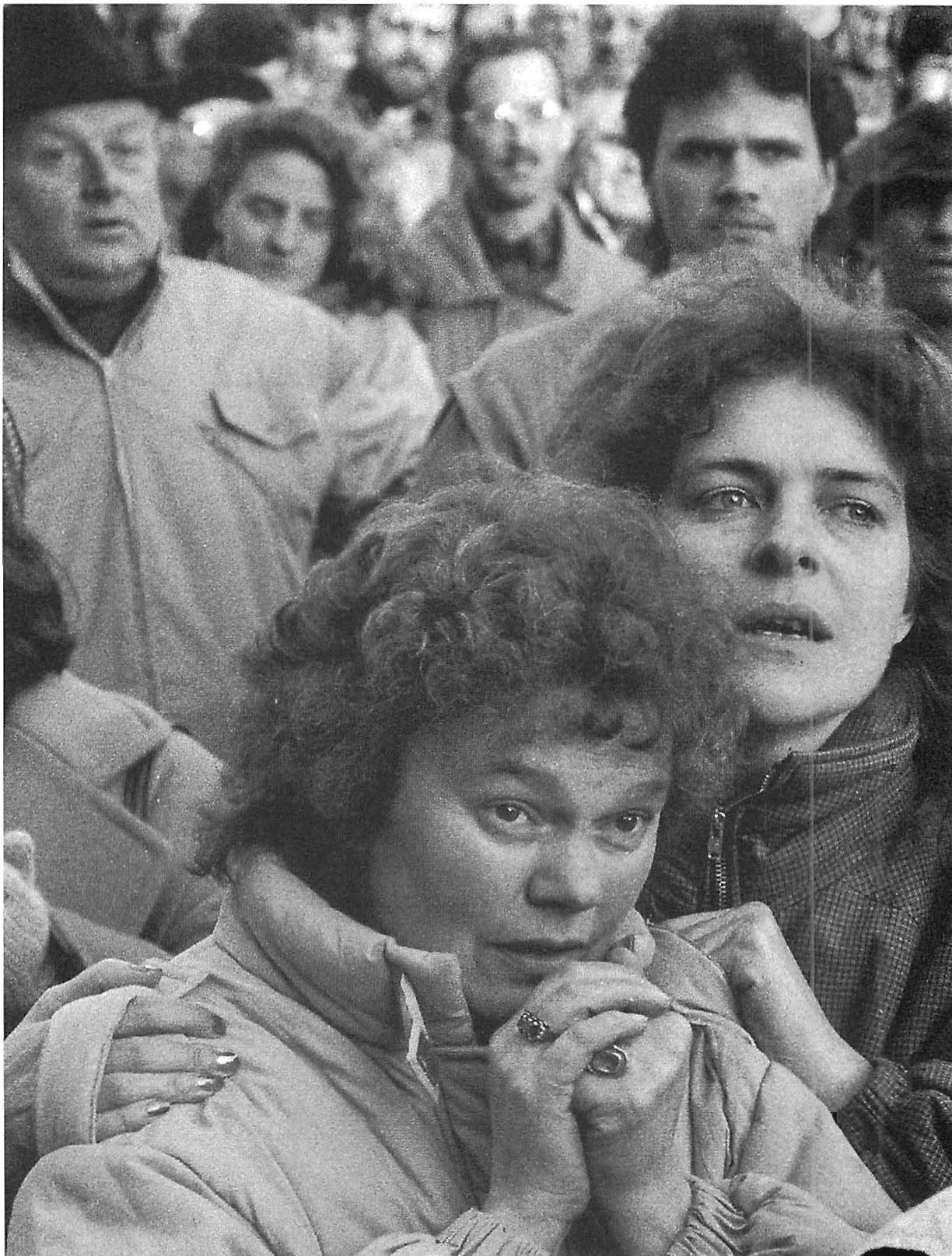
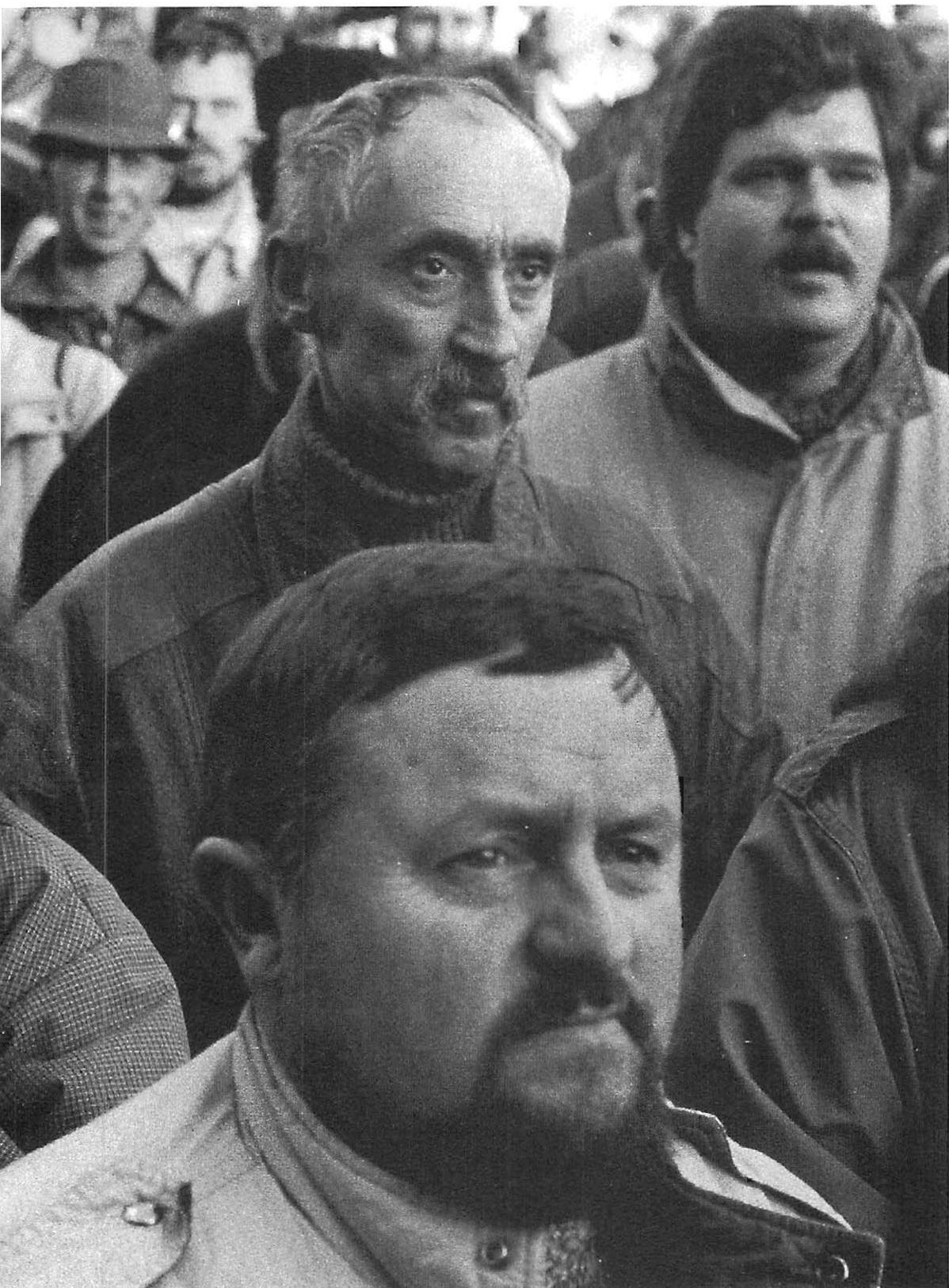
The haunted faces of the 20th century. Are these people glad about the onset of "democracy?" Is there a glimmer of hope in their mysterious faces? Or are they simply fearful because they now face the prospect of a money-centered world? I believe it made little difference to them. Belonging, as I have described it, was not available to them in either case. That, in my mind, is what is written on their faces in this photograph.
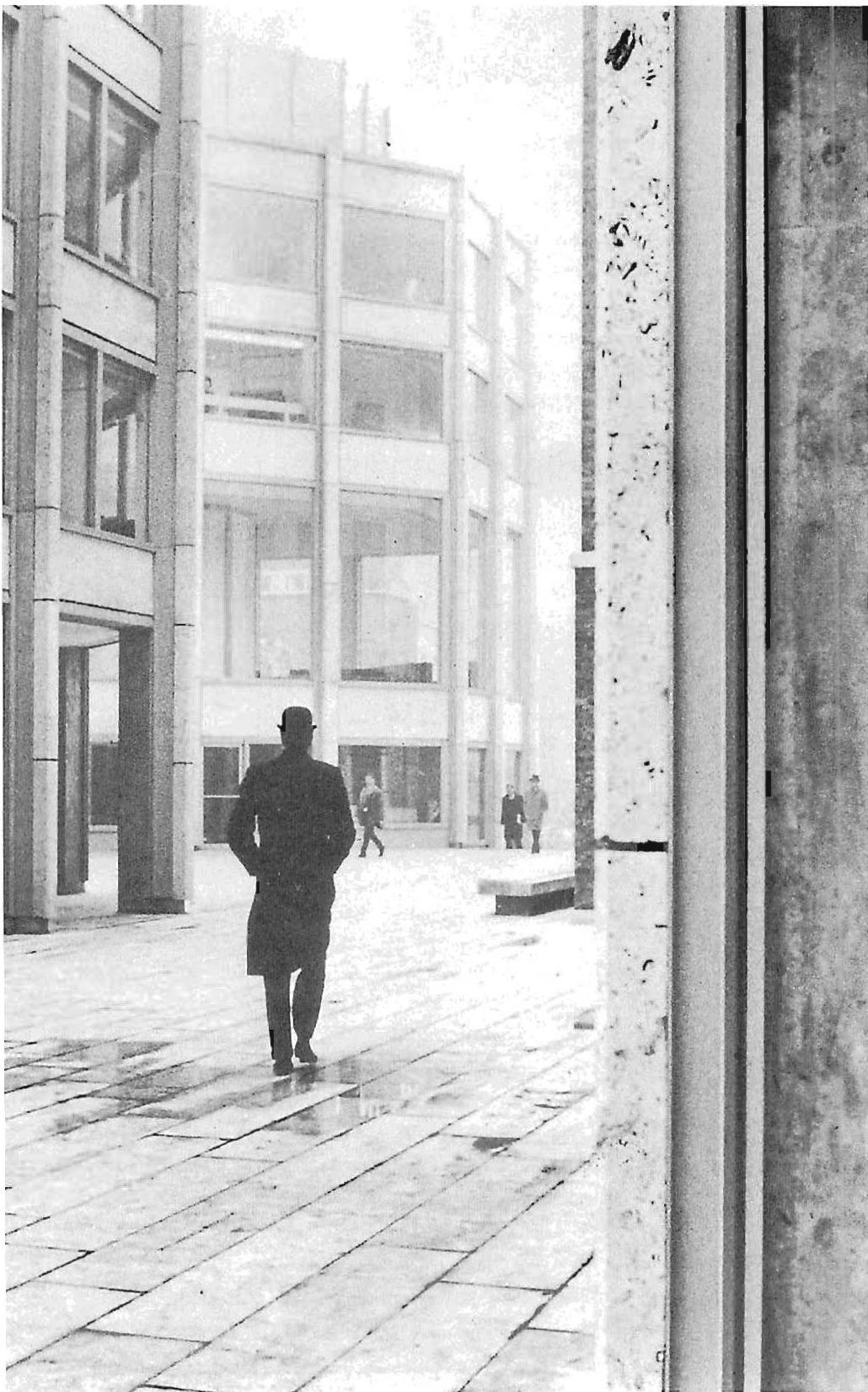
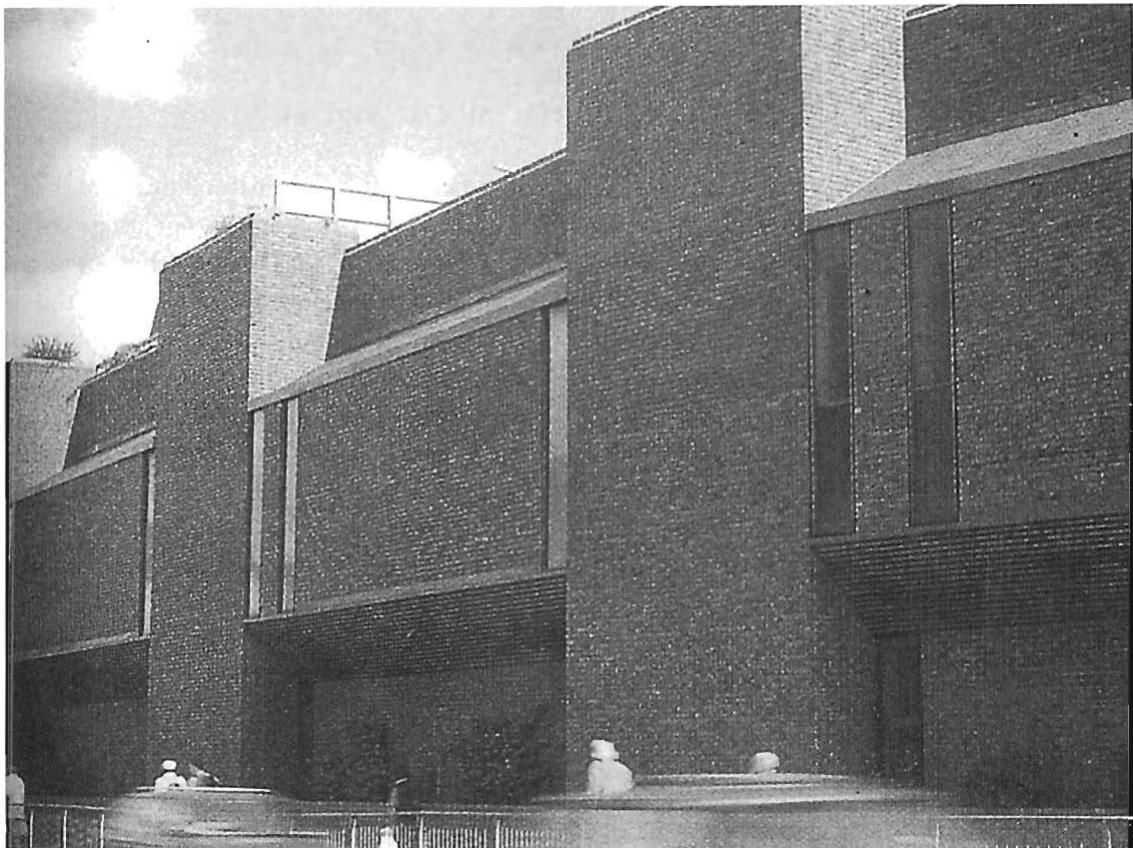
NOT BELONGING: The cold landscape of much late-20th-century city construction. It seems well-designed, but is alien to any feeling of belonging to the Earth. The photograph shows the Economist office building in central London, built about 1980.
1 / WHO, TODAY, CAN TRULY ENJOY BELONGING TO THE EARTH?
How many human beings alive today can truly enjoy belonging to the Earth?
There are about 6,000,000,000 people on Earth. The conditions they live in are getting worse. Though many live in poverty, the prevailing model of existence for them — at least the present ideal which people and their governments strive for — is the model of development, mass housing, condominiums, shopping malls, worker housing in Poland and China and Japan and America. It is the quality of this mass housing, mass office space, mass hotel space, mass retail space — in short, the mass cities created by the builders of these neighborhoods and projects — which we must above all reconsider.
In these cities it is the simple human right of belonging, above all, that I want you to think about and pay attention to.
In chapter 2, I shall discuss belonging as an emotional fact of life, as a necessity. And I shall say something about the way it works. But I would like, if I can, in this chapter first to shock you into a recognition of the truly dreadful meaning of my pleasant-sounding words about belonging — and persuade you that much of the emotional misery of the 20th century was caused by the terrible loss of belonging our contemporary processes inflicted on society.
The loss has been inflicted on us and on our fellow human beings. Belonging, although it was common in traditional towns and villages, is missing in far too much of modern society. The forms of environment we have learned to create in modern times have caused us to lose the sense of true connection to ourselves and our society. That has happened, in large part, because of the nature of space we have created. It has happened because the public space of our present-day cities, both legally and metaphorically, no longer belongs to us to any deep extent. So, of course,
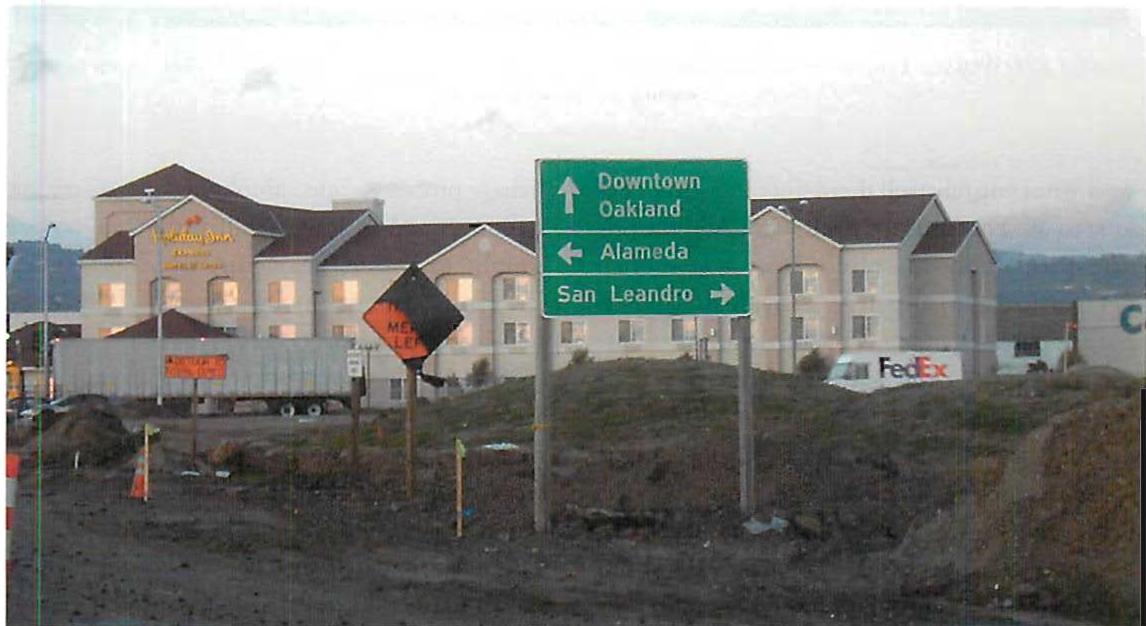
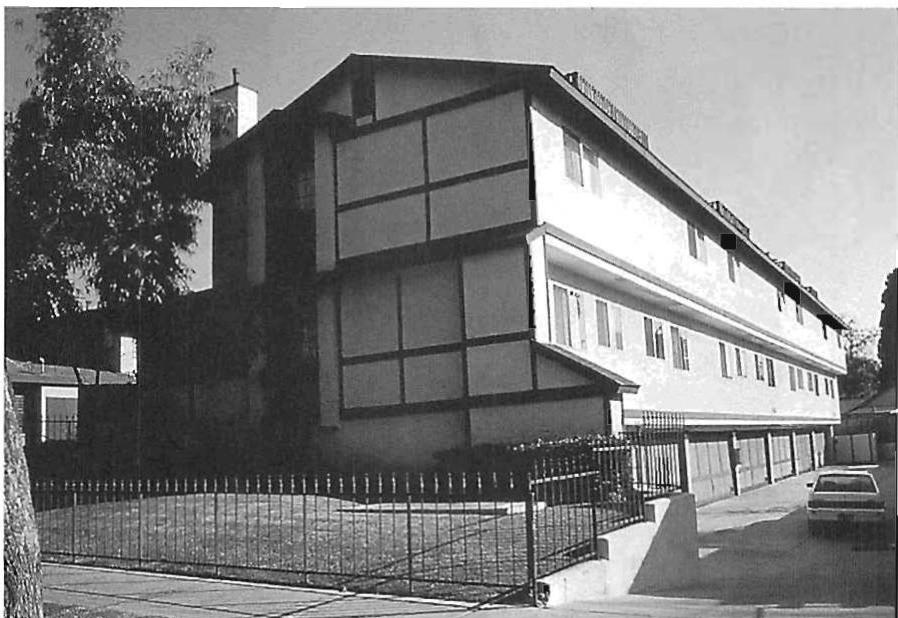
NOT BELONGING: A building in Oakland, California, horrible, but dressed up by the postmodern developer architecture of the 1990's to seem sympathetic. It is just as alienating and unable to support a true sense of belonging as the building in the picture on page 30, only dressed up to seem better. A wolf in sheep's clothing! Our prevailing thought, whenever we see a building like this: "Oh my God, they are doing it here, too, and there is nothing I can do about it."
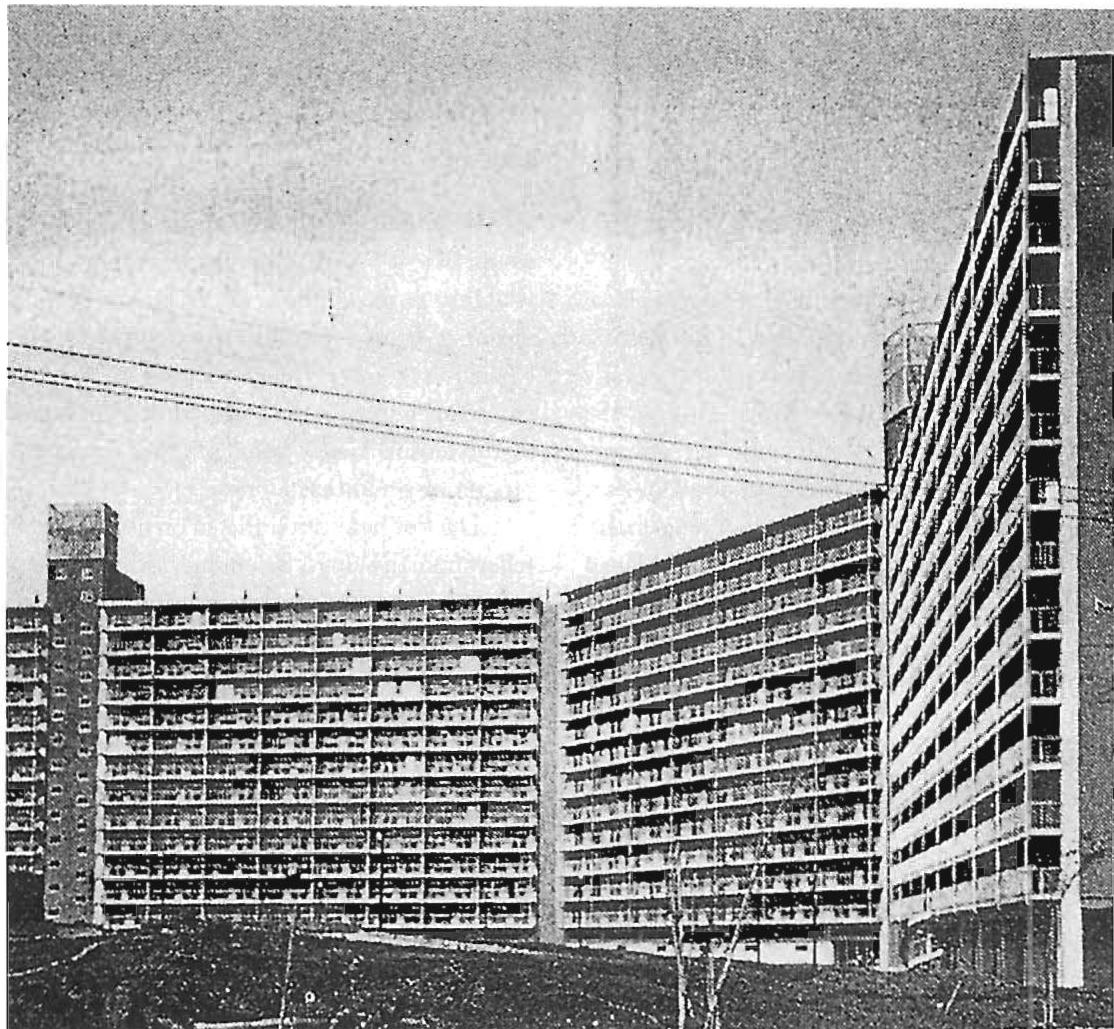
we are not entirely well there since it does not belong to us. That must be dealt with. And the private spaces, individual places, too, are most often not particular to different individuals, and do not support belonging. One of the most frightening aspects of the 20th-century city was its faceless, nameless character. We saw identical apartments, identical offices, identical apartment windows, identical columns, identical bricks. The individual was hardly visible. Cities today do not reflect the idiosyncracies and human characters of people. They do not reflect the multitudes of differences which are the source of our humanity.
I have finally become convinced, after thinking and working for forty years, that
living processes are absolutely necessary in buildings and in towns and in the countryside simply to create belonging, true belonging. Belonging cannot, in my view, be created by non-living process.
In the photographs on these two pages, we see some of the more horrible images of the 20th century. They come from a development process very far from the unfolding process. They do not reflect a living process, but a brutalized process. In almost no detail they contain do they reflect the fundamental process. Because they cannot create uniquely adapted centers, and cannot create "inhabited," "lived-in," positive space, they bespeak the character of not-belonging. That is the anonymous quality our age has created.
2 / THE LIVING ROOM OF SOCIETY
All my life I have been inspired by what happened in traditional society and marveled how much people all over the world knew about essential things. In traditional society, up until the onset of this century, the space that existed between buildings was like the living room of society. It was the place where people did things, got together, felt comfortable. In many traditional urban societies — I'm talking about days that are not too far away from our own time — people didn't even have enough room to entertain in their own houses. It was the natural thing for them to go out in public to entertain, not just go out and have fun as we do today, but something more ordinary; two or three people would go to the cafe or the pub in the same spirit and with the same ordinary feeling and intent that we have a friend over for a cup of coffee in the living room. And everyone felt comfortable about that, out there. The public land was the living room for everyone.
I lived in India at one point in my life, in a small village. The central space in that village
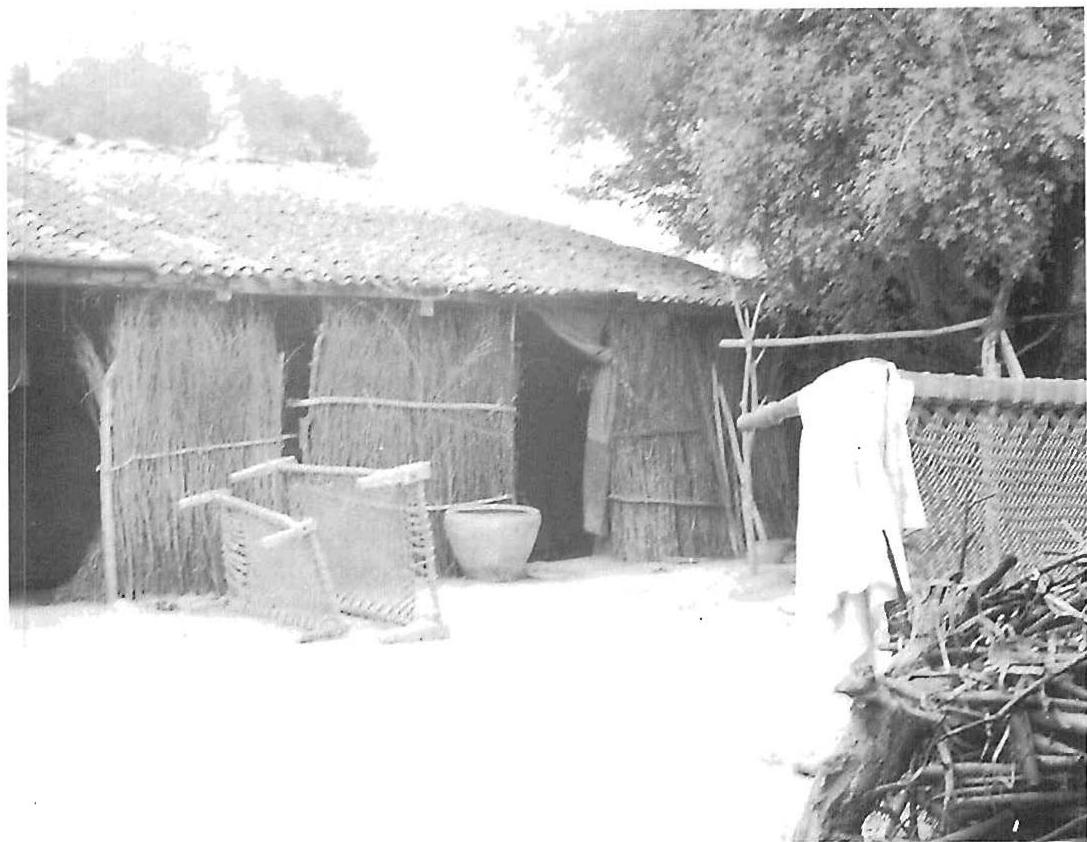
was a compound surrounded by mud huts. At night all the men pulled the cots out that were leaning up against the verandas of the houses, and we lined them up in a long row down the middle of the compound and then lay there smoking as the dusk came down, talked for a couple hours into the dark, and then went to sleep... got up in the morning and brushed our teeth... and out we went. That sense, in which the public space was actually the living room of society, was true in Italy, was true in China, was true in Africa. It has been true in every human society until the 20th century.
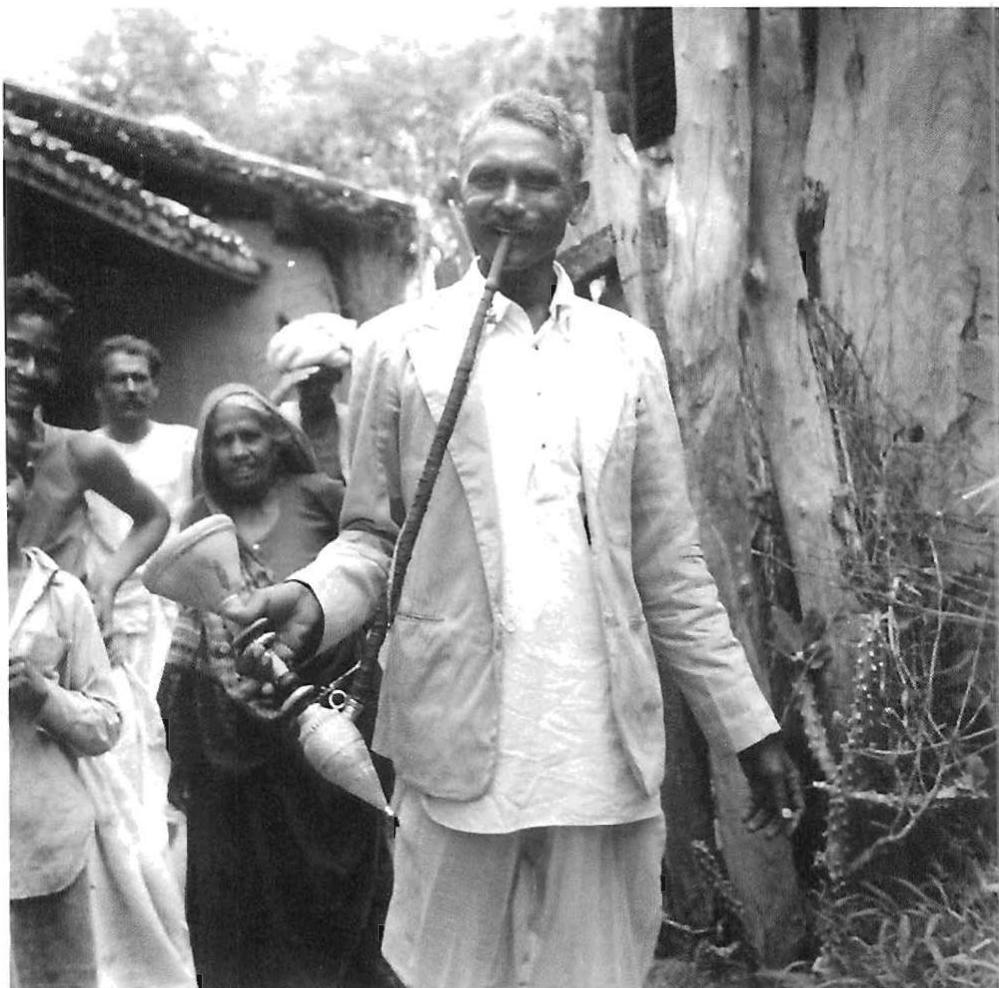
Where does Sakraji get the dignity and joy we see in the picture opposite? He gets it because he belongs, wholly, to this village, and it belongs to him. And how does he get this belonging? He gets it because he and his villagers control everything in their environment. Without that control, you have the situation depicted on pages 32-33.
In our century the loss of control and loss of belonging started with the car. The car of course is a wonderful thing. I, we, almost none of us, would willingly give up our ability to have cars and get what the car can get us because it creates this phenomenal kind of access to everyone and everything, which is so valuable. But at the same time during the last century, because of the car and trucks, nearly all the streets have been taken away from us. And for property reasons, too, as in the picture on page 36, even the common space that is provided for pedestrians, emotionally does not belong to us.
It sounds maybe a little exaggerated for me to say this so strongly, but in the Indian village it is very plain and ordinary, it's not some big fancy thing. In the Indian village, the public place belongs to the people that are moving through it. You can stay there, you can enjoy life when you're there, you can smell a flower or light a cigarette and not worry about the surgeon-general's rules. Just be there, talk to somebody.
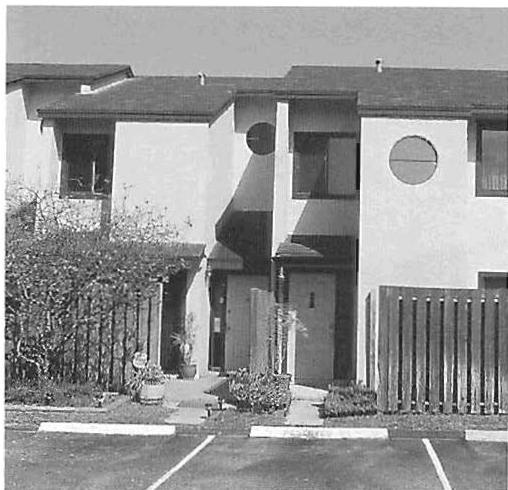
In 20th-century development—even in the best kind where communities and social agencies worked together for the common good—this is what got created. Again it was anonymous, again no belonging, again no useful public space being formed, again no expression of the individual or of the individual family. Twenty years later, this place will be just like the slum which it replaced, because there is no spiritual ownership.
By comparison, let us look again at a typical development of the late 20th century. Look at this public housing project in Florida. You see the problem. With the parking spaces, very little space is actually usable. You may think this is a problem of density, that as density increases you just cannot handle that urban space in a fashion that can become useful. Historically that was never true. It does not have to do with density. It has to do with whether there is a general understanding by people who build, and who pay for buildings, that the public space needs to be made usable, every fifty feet a useful and beautiful place to be, and actually to be the living room of your society.
In a living structure for society, the vital importance of the public room is fundamental. The street is not a thing to drive through, but a series of spaces which are the places where you most want to be. But to get it in meaningful fashion, again, as in the Indian village, people need to be in control—in control of their individual space, and in control of the public space. Design alone cannot accomplish this. It needs a change in the way we make it possible for people to control the world around them.
3 / THE UNIQUENESS OF INDIVIDUALS, FAMILIES, AND BUSINESSES
To get the individual adaptation which is essential for true belonging, we must have a process which allows the city to evolve so that it reflects each individual in his and her individuality. We must learn how to make a city where each one of us feels at home, whether it is yours, mine, his, hers. And once again this must be based on our individual true feeling, our true nature.
What this means is that we ask whether we experience it as ours, whether each bit of the city, of the neighborhood, each door, building, fence, garden, actually reflects human beings, reflects individuals, families, passion, reality. I was talking with somebody in a deteriorating neighborhood about this point, and she was immediately aware of this point. She said to me: "You know, even if somebody has a kind of patch, a bit of concrete in the front of their house, if it's a little scratchy bit of concrete that they did, it may not be perfect, but they know it, they love it, there's the paw print of the cat in it. It doesn't matter that it isn't perfect. What matters is that it has been done by somebody one Saturday afternoon and we see the trace of that imperfect person there."
Our lives work when we have that kind of intimate personal relationship to the environment. It is there of our making. Or it is there from the making of other individual human beings, we can recognize the human touch of it. It makes us feel something. It is ordinary. It isn't fancy, it isn't glitzy, it just makes you feel whole and comfortable.
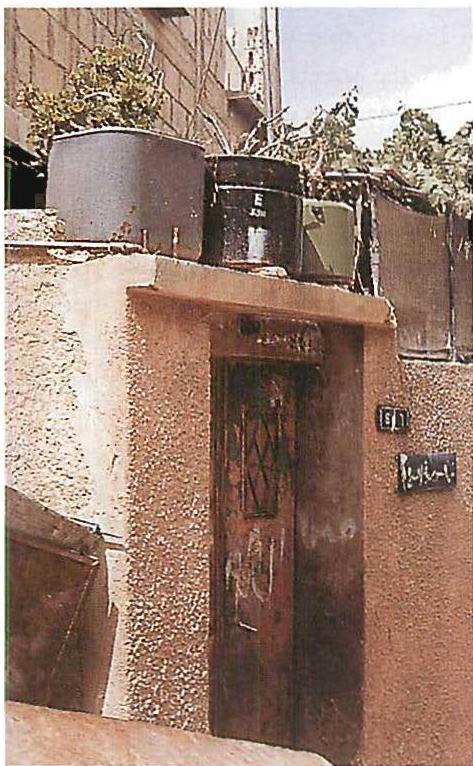
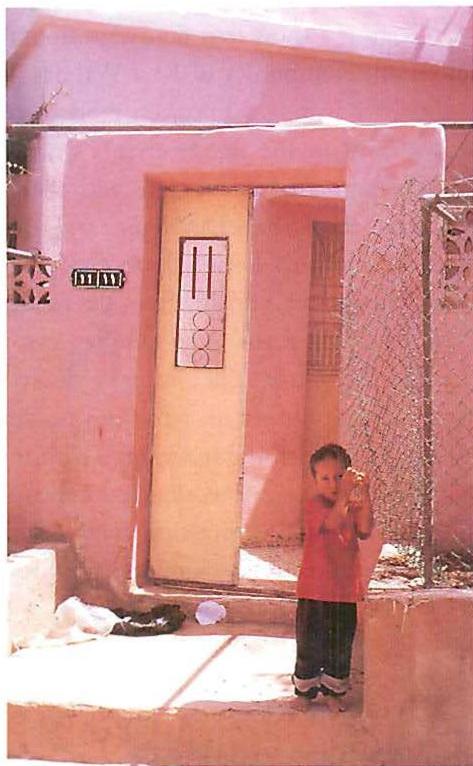
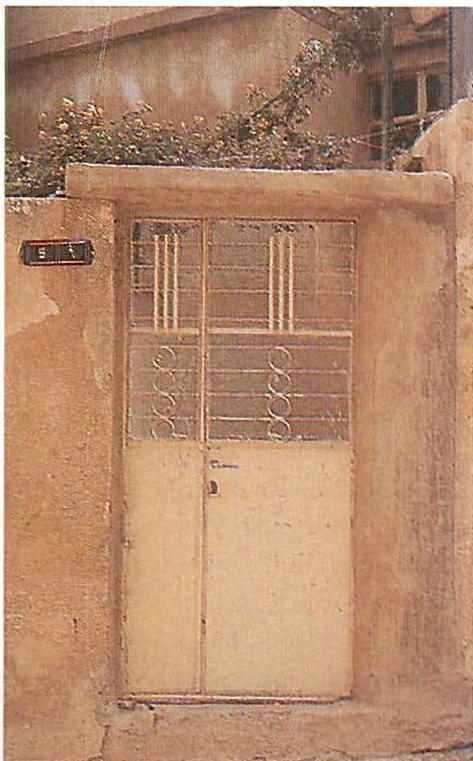
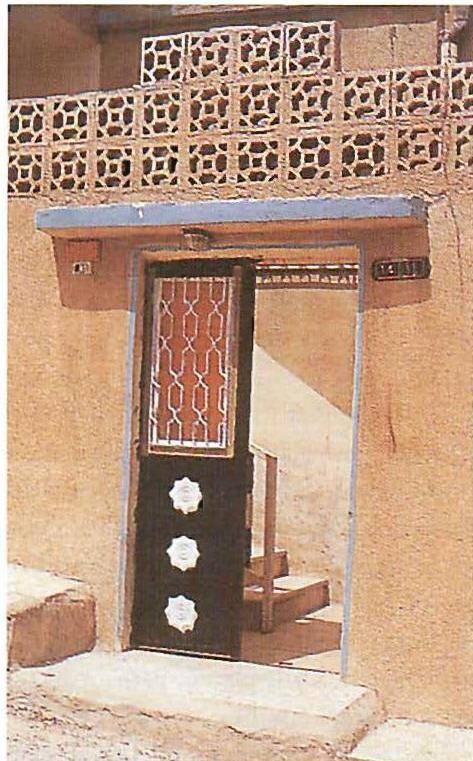
On page 37 I show four doorways from the recently built community of East Wahdat, Jordan. This is a wonderful project, modern construction, built in the last few years by public planners in Amman, Jordan. Here, with the simplest means, the Urban Development Department of Amman has been able to encourage a true unfolding process arising from the residents and families and owners. The families, not the agency, are in control. The ordinary variety of doorways is a testament to what can be done.
It has to do with the individual, with individuality, with the private world, the lovely world of individual people, expressing themselves in their funny, sad, intimate, imperfection, living their lives so that we see the imprint of those lives on the streets and in the neighborhood.
The private or individual space which is created by money, in today's society, is rarely making or fostering belonging. It creates ostentatious things, houses which express wealth and idiosyncracy, individuality for its own sake, the appearance of uniqueness. That is an immensely different thing. That is as far from true belonging as the sterile slums of the low-budget profit-hungry developer.
True belonging—true life—occurs when a penetration of the real into the fabric of the world occurs. This is far simpler. It is almost the very simplest thing a human being needs.
4 / INTERLOCK OF PRIVATE AND PUBLIC, AND CONTINUOUS SPATIAL TOUCHING OF THE TWO
To have true belonging, it is not enough to have uniqueness in the private realm and a living room in the public realm. The two must interlock. Each must touch the other continuously. Then the two can work effectively to complement each other.
This geometry arises naturally from the use of living processes. Let us go back to the concept of a living process as a process which repeatedly uses the fundamental process. How does the fundamental process create uniqueness in the private realm, and how does it create belonging in the public realm so that we feel we belong to both?
Consider what happened to create the village of Bavra illustrated earlier. Individual houses opened off a common area. The common area was shaped by the way people created their houses. What was shaped in the common area was a direct result of symmetries introduced, volumes placed, walls placed, paths marked—by the individual families.
Then as the common land (which started out as a left-over) began to emerge, use of the fundamental process encouraged people to mark it, to shape it, to give it a character of its own. The intensity of use and control encouraged the spaces of the common land to be formed more strongly as living centers; then it encouraged people to create further features of the common land: smaller component centers were developed and formed more strongly as time went on. As a result of this living process, the public space, created first as an offshoot from acts of individual occupancy forming private houses, quickly became a thing that many people together cared for and shaped. Its differentiation proceeded. People, together, considered, step by step, what acts, what local symmetries, what features, would embellish and ennoble it, make it more useful, make it contained enough to express solidarity.
This natural differentiating process created a structure in which each bit of private space opened directly to some bit of public space. And each bit of public space directly touched many bits of private space. The two then became deeply interlocked. They touched at every point.
Of course this kind of process has beneficial human results. A person, withdrawn in a private
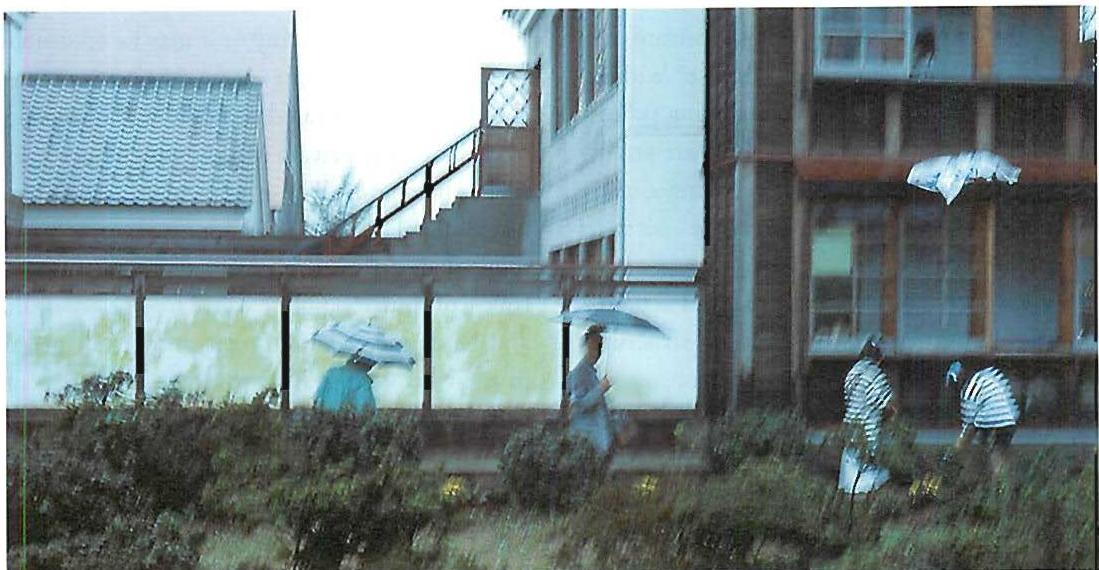
world, is only a step away from the public world of his fellow creatures where they may be together and belong together. A person in the public world is only a step from a private world of family or a private workshop.
The anonymous buildings illustrated on pages 32-33 fail in three ways: (1) There is no individual belonging in the private dwellings and offices; (2) there is no public belonging in the emptiness which they create as a sham of a public world; and (3) the two worlds are not in contact.
In the photograph on this page you may see a version of working solidarity and mutual touching of the two worlds. This example comes from a place on the Eishin campus I built in Japan. The people are walking along a public street, where students hang out, where they be
long together. Just a few feet away is the private classroom of one teacher and his class, with its private garden. The teachers and students first worked with us to establish the pattern of small classroom buildings and gardens, along the homebase street: this pattern was discussed and ratified by all the school, and then adopted. Then, when we began staking out the buildings on the land, these teachers and students, together with us—the architects—placed the actual street, and gave it its design. That is why the school belongs to them, and they belong to it.
The sense of belonging, the trust and confidence which it creates, is visible in this blurry picture I took on a rainy day. Exquisite feelings are visible in this small world where public and private touch each other everywhere.
5 / THE IMPACT OF LIVING PROCESS ON BELONGING
In 20th-century industrial society it seemed almost impossible for people to achieve belonging. People had too little control over their private
worlds, and too little control over the public world. But this needed control can be reintroduced into society. As we shall see, the structures
needed for our belonging—both private and public—can be generated almost without effort, autonomously, by any truly living process allowed to exist in society, and these are attainable today by modern means. What matters above all, is that the people themselves are in control of their environment.
When a system of living processes acts in a human environment, two kinds of structures will appear within reach of every person.
First, new processes will give each person the ability to generate a unique and private world which that person may belong to, which has its own privacy, idiosyncracy, adaptation—a place where each of us can be ourselves. Each of these private worlds is unique and, because unique in a realistic way, not arbitrary, it is capable of being loved and is likely to inspire love. Its size is almost irrelevant. It may be tiny or it may be enormous.
Second, in the presence of living processes, there will be generated a public world attached to each of these private worlds, which once again invites belonging. These public worlds, too, need not be large. In some instances, it may be no more than a thread, or path, or lane. At other times, of course, a public world may be enormous and be connected to a great number of people in their belonging. But what is essential is that it has naturalness, that it belongs to the people who use it most, not to a faceless agency, not to someone distant, ever.
The capacity for everyone to enter either one from anywhere—to be able to reach both of these two “belonged-to” worlds at will, to have them both to hand—is the essence of the structure that living processes will generate in society.
6 / AN INVARIANT MORPHOLOGY WHICH WILL BE GENERATED BY LIVING PROCESS
Two simple truths: First, each particle of the city needs to be individual, particular. We need to have houses, apartments, shops, offices, houses, rooms, windows, doors which truly reflect our multitude of human character, where we enjoy and support our idiosyncracies.
Second, for the general good, we need a city of public places where we can see these differences, where we can become engaged with the multitude of human characters, where we are engaged with our fellow creatures and can enjoy, in all its beauty, the great variety of human beings.
These are two facts of nature. The individuality of every part and every place, is not only necessary as a kindness to all human beings. It is a structural characteristic of all living tissue, in leaves and rocks and water, as in human streets and dwellings if they have their life.
And the focused gathering of human groups in public spaces, the expression of the larger which supports the smaller, is a necessary larger level of structure in all nature—as vital to the dwelling in our habitat as the mother to the baby, or as the river to the stream, or as the ocean to the iceberg.
CHAPTER TWO: HOW LIVING PROCESSES ESTABLISH OUR BELONGING TO THE WORLD
In the last chapter I have given a sketch of belonging, what it is, how important it is, how it is dependent, ultimately, on control of the people who live in a place over their environment.
I have not yet described belonging ITSELF — what it is like, what it looks like, how it is an interdependence of a particular and deep sort between people and the physical geometry of their surroundings. Nor have I yet given much sense of the DEPTH of the phenomenon — how extraordinarily subtle it is. In this chapter I shall attempt these things, to lay a foundation for what follows.
While reading the chapter it may be helpful if you keep in mind a place you know, where you really belonged. Are you sure that there has even been such a place? And if so, what was it like, in detail? Then, as you think of it, and remember it, perhaps, you can use the examples of the chapter as a lens through which to think about that place.
1 / THE LINK OF HUMAN HAPPINESS WITH THE ENVIRONMENT
It seems perhaps naive to assert that there is a connection between ordinary human happiness and the existence of living structure in our physical world. Nevertheless, that is what I do claim.
My experience is that when architectural structure is an unfolded one — that is, when it is created by repeated application of living processes, and by the structure-preserving processes I have described at length — then what comes from it is a world where people are able to feel happy. They can be themselves, more easily. They are more free — free in spirit, free in their emotions.
And I believe, too, that on the contrary, within the dead structure we have become used to as the normal 20th–21st-century environment, this freedom, this blissful state, is almost unattainable.
The extent of our 20th-century misunderstanding about the nature of architecture is so great that the kinds of situations which I show in the next twenty pages — ordinary human life that is running well — have become almost unfamiliar. They simply occur less often in the conceptual and designed modern environment. Indeed, the modern environment is often so alien that we have almost forgotten, in our present world, how even to behave, to some extent forgotten, even, what it means to be a person. And we have forgotten, too, the extent to which our person-ness depends on the actual physical structure of the world.
The world around us requires a special looseness to allow normal human life to run in its normal state. The structure of this looseness, the structure of the environment which can support it, is precisely that one which I have identified as living structure which can be created by living processes. But we are so far from being used to living processes, from even having a feeling for them, from even having knowledge of them any more, that we no longer even recognize the condition itself as normal.
For this reason, in this second chapter, my aim is merely to describe this state in words and pictures, to comment on the fact that the places where it occurs are, morphologically, quite different from the places we have become used to as the products of developed architecture.
I would like to start with the human core of the whole matter. We obviously want an architecture where people can live in a normal state — in something that we might even call a blissful state, at any rate an ordinary state — as human beings.
If you look through the pictures of this Book 3, you may get a hint of the kind of world I have in mind, the kind of world which perhaps could come about from wholesome living processes. Is this world really one where people will have deeper, happier lives that mean something every day? Is the unfolded world the kind of world which could sustain such life?
I hope in the next few hundred pages you will begin to understand well enough what an unfolded world is like to see that it is likely—or at least better able—to contain this blissful, normal, unprepossessing ordinary state in people. This is simply part of its nature, an attribute of the unfolded, generated, world, while it is not an attribute of the planned, designed, developed, world. That is what I want you to think about.
Most important of all, once again throughout all of it, is the relation of belonging, that condition in the world that allows us to exist as free beings, to pass our days and hours in a fashion that we know we are in places that belong to us — so that the world is ours in spirit.
This hinges on a freedom which comes out in people — real freedom, joy, ability to love, ability for a person to follow passions. The ability of each person, within the social context and the culture of community, to be himself, to be herself.
2 / BELONGING AND TRUE COMFORT
What is the character of the kind of world where we experience emotional possession of the places we are in? It is a world in which the fine adaptation between people and their buildings and gardens and streets is so subtle, goes so deeply to the core of human experience, that the people who then live and work and play in that environment feel as if they belong there, as if it belongs to them, as if they are part of it, as if, like an old shoe, it is completely and utterly theirs.
Of course, since we are social creatures this belonging is almost never just individual or idiosyncratic. It is a state in which the whole world, as we create it, has this quality of seeming to belong to us, collectively. It belongs to our deeper self, that self in which we are united with our fellow creatures. It is a state in which we recognize with joy each street, each door, each restaurant, each gate, field, road, and tree. We see each window, and roof, and nook and cranny, as a friend.
Historically, this quality which allows us to possess the Earth came about as a result of a long process—often years, even centuries long. It was a process in which minute adaptations, carried out gradually, created this mutual sense of belonging between people and their buildings and the land.
But in our era, the opportunity for this very long time span is less available. We live in a time where things move quickly, where society evolves at a very great speed, where people are highly mobile, where things change at great speed. The old historical forms of process, which created belongingness in historical society, will not do for us, and we must invent new kinds of process which can do it, again, in some new form, and by different means.
The problem is aggravated by the fact that those building processes which now exist in the late 20th-early 21st-century era—the processes of design, bidding, construction, and financing—all work together to produce an environment in which this state of “belonging” conspicuously does not occur. It is this problem, above all, which is responsible for the callous, mercenary, and indifferent environment which we experience around us most of the time.
Ask yourself, for instance, how you feel about the common area under the French housing project shown on page 44, the designed open space where people walk about underneath the building. It may be theoretically adequate to its function, harsh and clean, and it seems like a very efficient place. But I think it is obvious that you do not feel any sense of deep belonging to this place.
A tragic problem! Because we are so unused to experiencing a sense of belonging with our buildings, that we might say to ourselves, “We have to accept this as an inevitable consequence of the tremendous practical problems involved in making such a big modern project.” But the truth of the matter is that even the houses and apartments that we have now been building for the last half century, including the smallest shops and offices, often have the same problem. It has become rare that a relationship of true belonging exists between the family and the apartment or house they inhabit.
My aim for the last few decades has been, through the use of living process, to construct a situation in our world where a deep, profound belonging can exist, and does exist. This has proved extremely hard to do.
By having people play a very large role in the design, layout, and construction of their own houses and apartments, and by following the fundamental process wherever possible, I have undertaken what have often seemed like radical innovations, together with new kinds of construction contracts that allow a building to evolve and adapt organically during construction. I have tried to show that the meaningful adaptation necessary to create this real home can exist.
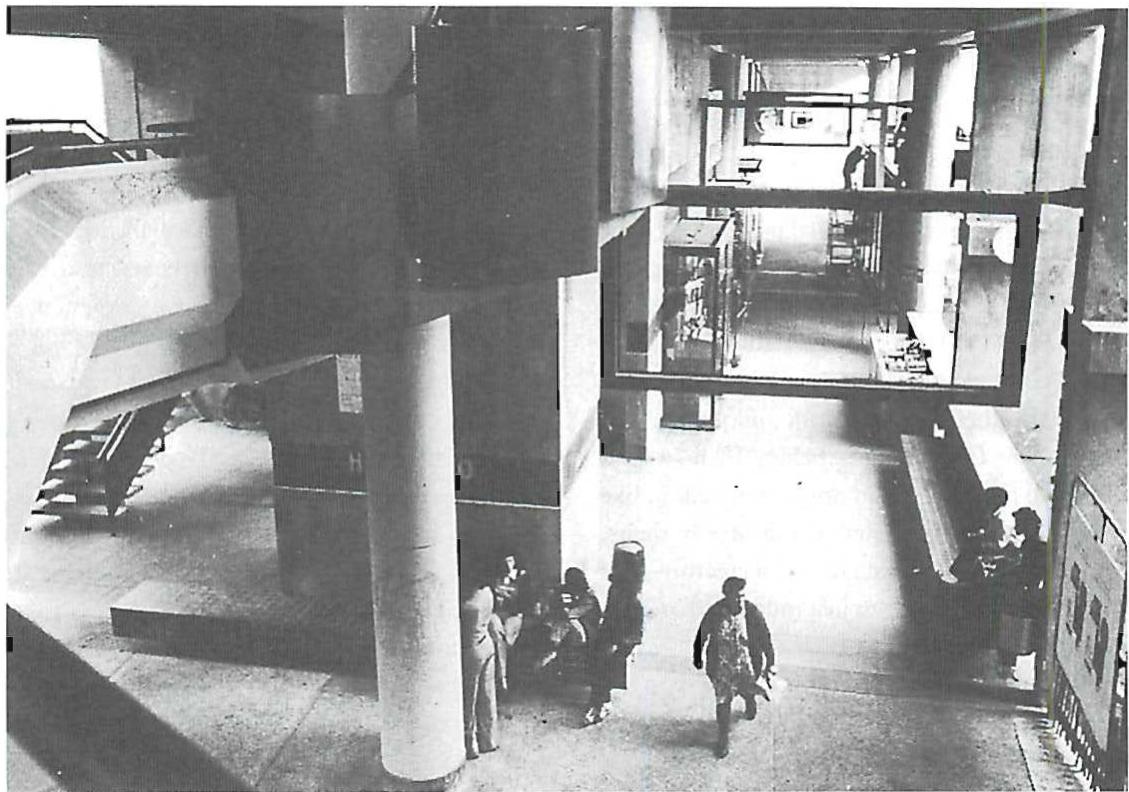
But even with all this, more is needed. The cleverest contracts, the most advanced procedures, are so tainted by the world we have inherited, that it is very, very hard to make places which have a genuine warmth, heartfelt connection with people's humanness. It is still difficult to implement the kind of innovations in construction—administrative, financial, and other processes—that allow fluid adaptational construction contracts and still keep a tight hold on time and money. Increasingly, during the last years, I have become convinced that the projects I have built, and the proposals I have made, are still not radical enough. I gradually came to think that the deep connection that would allow a place to be a real home (public or private) requires innovations I have only now begun to try, a more complete application of the fundamental process at every instant of development, across the board—in ways which change contracts, money, technical processes, even the criteria for success.
To illustrate the revolution I mean, in this chapter I show pictures that will, I hope, point the way to what I am talking about. They are very informal. Many are photographs of my own family, cases where I believe belonging—this very intimate relation between being and place—has actually occurred. I am showing photos of my own family because, without the same kind of intimacy of access, it is rather difficult to take these kinds of photos of other people. Yet we all know these places and their measure.
It might be said that what I show in the pictures is simply comfort. True comfort, and its structure.
3 / THE FIFTEEN PROPERTIES
The purely theoretical analysis of living structure as I have presented it in Books 1 and 2 is not enough to encompass this most ordinary, and yet so sweet, this wonderful everyday reality that our living dreaming substance on this earth is made of.
To express it fully, I use pictures in this chapter to try and show what I mean, and I hope that you will accept what lies in these pictures as a more accurate version of what I have tried to say about life in Books 1 and 2, about our lives, and about the life of the environment.
It is true, I think, to say that the fifteen properties and the living structure of centers which they create have a great deal to say about it. When I show a picture of true life, visible in my daughter lying on a sofa at home (page 55) or in two children running naked along the shallow water at the beach (page 49), when I look at the azaleas and flowers and children smiling happily (page 56), or an old man sitting on the street in Shanghai with a little boy (next page)—in all these cases, I believe it is the fifteen properties, perhaps in their deepest form, which provide the underpinning to this living experience and lovely comfort.
Above all, it is the quality I call NOT-SEPARATENESS, the not-separateness between us and our world, which is visible in these cases and which is the essence of our true belonging. Here already one of the fifteen properties fundamentally comes into play in nearly all these cases.
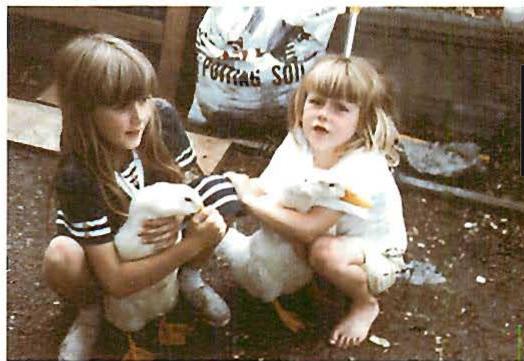
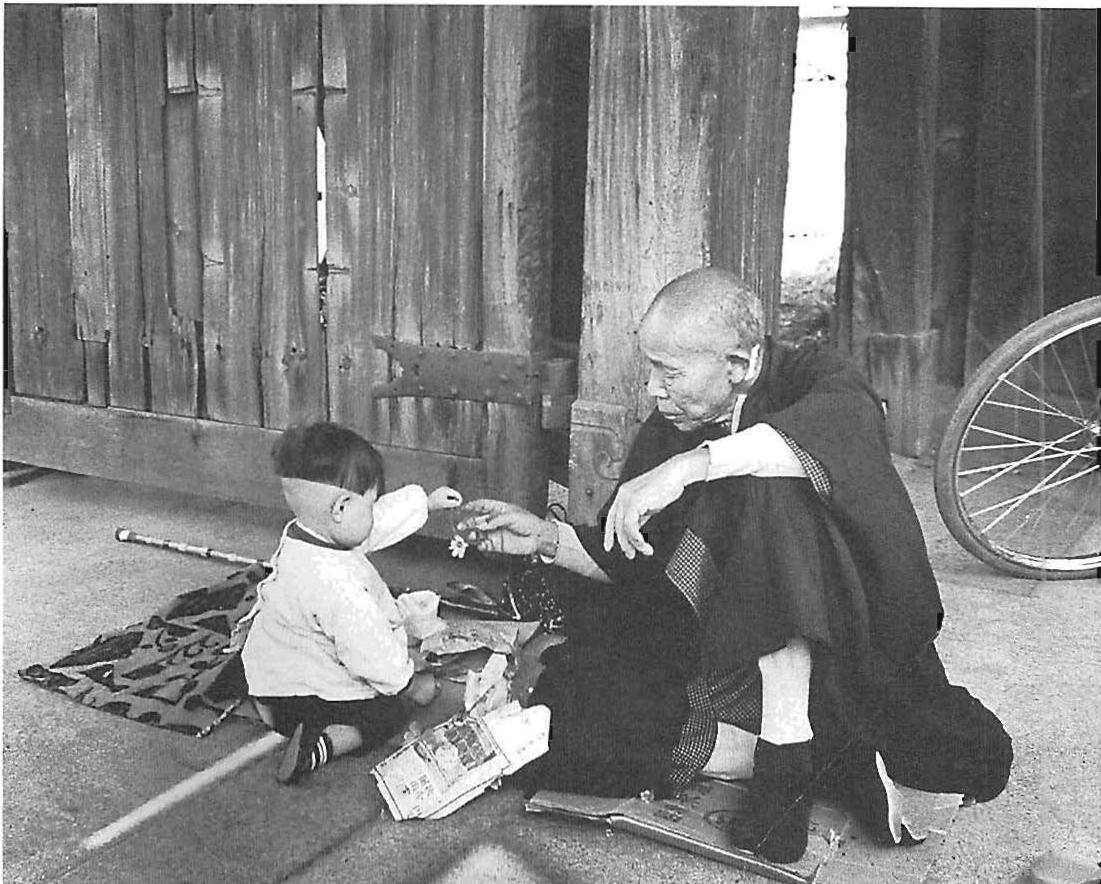
In the picture on page 45 it is the ROUGHNESS embodied in the pile of old building materials which makes the garden a fit place for ducks, and allows the children to hug and kiss the ducks. It is THE VOID, in one of its most basic forms, which provides the expanse, the deep breathing space of the beach on page 49, and even of the lawn on page 44 that encourages cartwheels. It is the SIMPLICITY AND INNER CALM of the place where an old man (my father) sits in his deckchair, on the lawn, surrounded by the calming grass (page 50).
Each of the fifteen properties, in one way or another, comes into play, helping to create true comfort, and giving us the underpinning for this wholesome ordinary existence which makes life worthwhile.
In addition, as I have tried to explain throughout Book 2, it is the structure-preserving
transformations which generate these properties, in real places, and create the possibility of life, and the possibility of our true connection to our surroundings. These transformations preserve the wholeness of the world, inject into it (while preserving it) those fifteen properties which sustain life, and create life, and which provide us with a matrix in which our deeper life may come into being.
But it is best to understand this without too much intellectual baggage. It is above all the feeling of these pictures, the feeling of true belonging on the earth, which I have tried to capture here. That is what matters. And it is that which I have tried to illustrate throughout the next five hundred pages, in my attempted picture of a growing, healing, vision of a modern city with its buildings, streets, rooms and gardens.
O
4 / DEPENDENCE OF THE BLISSFUL STATE OF OUR EXISTENCE ON THE MOST ORDINARY QUALITY IN OUR SURROUNDINGS
The idea that the blissful, ordinary state which makes a person happy, which many of us long for, hope for, dream of, might be dependent on the shape and form of our environment, is startling.
Even the careful analysis I have made in Book 1 of the connection between human feeling and the feeling of the environment does not prepare us for the enormousness of the subtle connection which I want to point to now.
For what I hope will come through in these photographs is that our existence—in its openness, clearness, and limpidity—depends on the structure of the environment. It is a deep harmonious feeling of belonging, something which makes us know that we are part of the Earth, that we are at home—wherever we are—truly at home, and that we are ourselves.
The world supports or does not support—supports in greater or lesser degree—this feeling of belonging. And it is only when it does support it that we may reasonably call it "life" in the environment. So when I say that one doesn't have a sense of belonging in that place under the
French housing project on page 44, I mean much more than merely that. I mean that it is very difficult indeed to be yourself in that place. I dare say that at the moment that picture was taken, not one of the people in that picture truly was himself, herself. Places have the capacity to deny us permission to be ourselves, even an apartment or house we have furnished and where we put our "stuff." Just because we put that stuff there and arrange it does not mean that it will create the potential for the kind of blissful state of being that I am talking about.
Only the adaptation of all kinds of subtle minutiae in the environment allows that wonderful thing—bliss, as I call it here—to emerge in us. And although this adaptation is very subtle, it has a huge effect. The sort of simple happiness you may see in some of the following pictures comes about because of the structure-preserving quality which emerges as the world unfolds—but cannot come about through design in the accepted sense, or through planning in the accepted sense, or through construction in the accepted sense of the 20th century. It is—was for me, when I began this work thirty years ago—something that we architects largely do not know how to attain.
5 / THE SENSE OF BELONGING
Let us explore the true sense of belonging, its intimacy, its everyday life.
Our processes of design and building in architecture, as they were in the 20th century, had very little to do with the creation of this sort of belonging. In a sense, indeed, much modern architecture even actually tried to get away from
this kind of thing. The profession encouraged architects to produce a visual character (see the classic example of the postmodern house in Book 1, page 59, or the commercial building in Book 1, page 379), and pays too little attention to the complex and subtle structure that only living processes create.
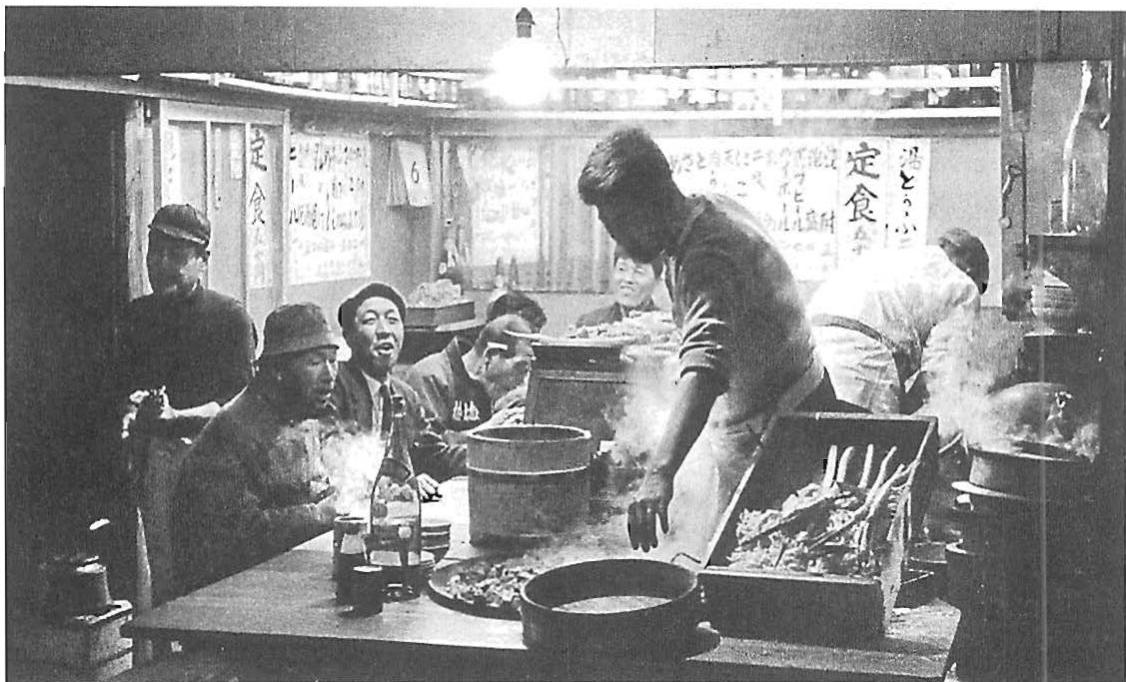
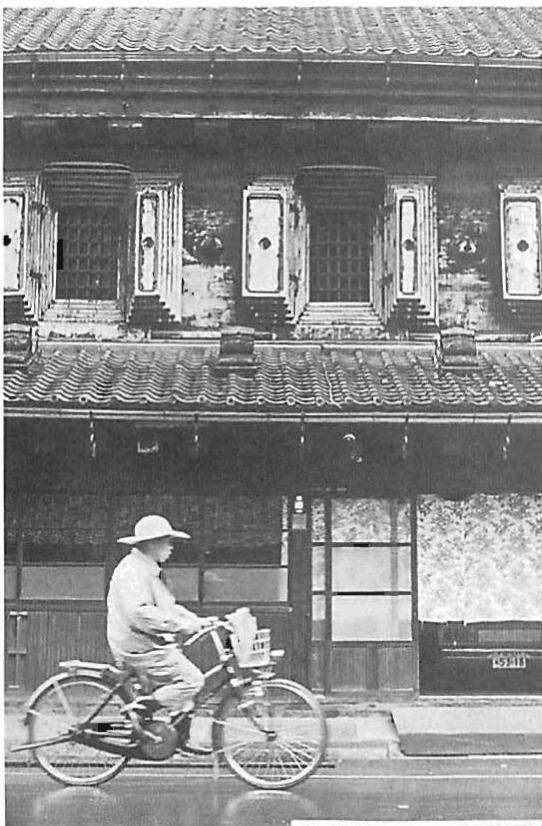
This weakness of professional architecture is not helpful to our everyday lives, nor to our inner lives. Yet it is accepted by thousands of professional architects of the "old school," all over the world, and by hundreds of thousands — perhaps millions — of non-architects whose taste has been shaped to fall in line with such opinions.
In this way the prevailing architectural images in the media have robbed millions of us of our common sense, have taught us to go against our own basic instincts and our knowledge of day-to-day reality as it occurs even in ourselves.
Let us go to the picture of the Japanese restaurant above. What you see there—that is what I call belonging. There, people are comfortable. That is an environment where they are happy, where life is lived, perhaps fights break out, stories are told, sorrow may have its place, hunger, an exchange of feelings, the direct splash of memory as one person listens to another's story. That is the belonging I revere and hope for.
The quality of life you can see in that restaurant could not happen in a McDonald's. It could not happen so easily, either, in a high-end yuppie restaurant with designer cruet stands on every
table, and with a waiter looking for a tip and trying to sell a wine at a price higher than it should be.
In the pictures which follow, the only thing I insist on is that what you see happening in the picture is happening because of WHERE it is happening. The complex circumstance in each of these pictures is an end result of some living process, and as a result has some valuable "owned" structure and appropriate differentiation which makes it feel part of each person, and which makes each person feel part of it. This is true of the students walking to class (page iv, front mat
ter). It is simple enough: we're in the middle of some nice open place. But one cannot dissociate the happiness of these students from the place they are in. This is also true of the children talking and playing on page 52. There it is even more subtle to see what it is about; somehow the room, the furniture, the light which causes this, allows it to exist. Look at the group of people around a table on page 54. Nobody sitting there cares a bit about the table's "design" or what it looks like. They are simply comfortable there. But it is the table, its nature, its simplicity, the way it is placed, the grass, which makes them comfortable.
Here is a place my children used to love: a boat dock north of San Francisco, where my family and I sat, and walked, and played for hours. It has an informal character, which is necessary to the way it works, and the way it allows people to be themselves. What happens here just CANNOT happen so easily within the geometric landscape of our image-full, artificial 20th-century architecture.
6 / MORE ON THE BLISSFUL STATE
The profound connection between people and their world, which allows a spontaneous life to spring forth, also comes from living process.
Look at my father, below, in his late eighties, enjoying life in the deck-chair of his garden, a wonderful combination of a sun hat—chosen in its wild character for its efficiency, not for appearance—a few blankets to warm him in the spring sunshine, and the lawn around him. This is the same lawn that he brought as Downland turf, years before, from the Sussex Downs and where, even now, buttercups, bees, butterflies, and long grasses grow up from the enchanted circle on the lawn near where he is sitting, so that his deck-chair, the place he has chosen to sit, connects him to the past, and evokes the loveliness of summer walks on the Downs.
This blissful state has so much to do with being free (page 51). The pupper theater, piled on books, a free and crazy state of mind, for my daughter Sophie, beginning the theater which she later came to love. Or Lily, dressed in the 1920s costume her aunt Patsy gave her, showing off in such a lovely and innocently forward way.
There are some physical circumstances that give rise to the feelings I am speaking about. They have nothing to do with user design and contracting procedures. The beach is an obvious example of a classic place where people feel that youthful freedom in themselves. Look at my two young children wading in knee-deep water at the beach (page 49).
But it is possible, I believe, for places we make for ourselves consciously to have this quality. I believe it is the characteristics of the actual
My father, 88 years old, sitting in his garden, oblivious to everything but the joy of the moment, his desire to sit in the sun, and the need for his bat to shade his face.

space itself that create a luminous simplicity in which the human spirit can take hold and make it one's own. That quality exists, I think, always as a result of true unfolding, as a result of any truly living process.
As a civilization, we are very uptight. Even my wife gasped when I mentioned that I was going to put the picture of debris laying in our yard into the book (this page). Yet it is part of our house, and part, too, of the blissful state: a young child sitting on a porch above the debris of the previous slide. Look at the cracks in the plaster, the disarray of the stone. But in the child's eyes, character has arisen in that place. It didn't need the perfect, plastic picnic table of the suburban tract, and could not easily have existed in that kind of place. This situation depends for its life on the junk. It depends on the raw roughness of the situation.
Or the family sitting on a pier, on page 49. No 20th-century architect will proudly say: I did this. Yet, this is where that inner something starts to live and breathe.
8 / THE TRUE LANDSCAPE OF ARCHITECTURE
The true landscape of architecture then, architecture as it must be, is that arrangement of material, windows, seats, roofs ... which, as nearly as possible, helps us arrive at this blissful state. It is generated by the free application of a living adaptive process.
When we think of architecture, we see glossy magazines with shiny pictures: a certain glitzy, but intentionally febrile, sterile style of photograph. Have you ever thought how deeply wrong, how strange this is?
After all, the true landscape of architecture is the landscape of people nourished, satisfied, living a full life, being happy, a landscape that shows that happiness derived from the surroundings. A true way of photographing architecture will show the drama of human life nourished, because it is steeped in the sun and shade of building form, photographs where the connection is visible, where the dependence of people's smiles, joy, happiness, is visibly connected with the walls, windows and doors, with the arrangement of the town and of the rooms and of the gardens where they are photographed.
As we may see from the examples, this condition of the world is far from the formal, overgeometric, stylized landscape of modernism and postmodernism — far, too, from the stylized landscape of classicism, ancient or modern, with its too-great emphasis on noble proportions and magnificence.
The true landscape of architecture is just that condition which gently supports, steers into
Even this darmouse, climbing in an out of the teapot in our kitchen, is, I believe, doing it without fear, because of the same easy-going quality which exists in our kitchen, and which, at another time, brought such a special expression to my wife's face (page 58)
Asleep on the sofa
On the Îles des Saintes. French West Indies
existence, this subtle condition, and which is to be judged, entirely, on its actual performance, its actual ability to nourish us — its track record if you like — in helping us to be ourselves.
How different this is, and how different it will be. Here we see mud, sticks, roses, plates, and glasses, books that are being read (not laid empty and shut on coffee tables), glasses of wine half drunk, people standing, leaning, talking, being together, being apart, being quiet, and being raucous; even being touched and hurt by sadness, feeling the pain of existence. Even this pain is better than dead gloss. If the pain of existence is being felt, still it is real and can give way, in its turn, to joy.
On this page, swinging my daughter — the uncalculated landscape is what matters here. The flatness of the lawn, the absence of formalism, the simplicity of it — translating into THE VOID
perhaps, and ROUGHNESS, together, with the BOUNDARIES of what surrounded us — that, all that, is what allowed this state of happiness to exist, this moment to occur.
Or in the picture of the Caribbean path shown opposite, the simply-made curving wall, the colored blossoms, the roughness of the path, the tree, surrounded by unplanted earth — nothing too fancy, no flower beds, the telegraph pole, even its clutter helps to maintain the air of freedom. These again are by-products of living process. It is all this which gave the background to these two girls to be so joyful with one another, easily.
This — the unpredictable dynamic temporary state of life lived — is what we shall expect to see in a true landscape of architecture, and in a true language of architectural photographs.
9 / ATTAINING THE BLISSFUL STATE
How, then, should we expect to find a way to a world where people can attain true comfort?
We need the physical world to be congruent with the smallest indications of what is essential, regardless of appearance. My workstation is a place littered with books and papers. I have the keyboard of my computer on a cardboard box, a packing box from the computer monitor. It is just the right height, sturdy, easy to move. It sits, unbothered, next to my eighteenth-century desk with its beautiful wood and leather. They work together to make me comfortable when I write.
The smile in my wife Pamela's face—does it come from the blue of the kitchen, which she and I chose together, paler and darker, and which she then painted lovingly? Does it come from the cappuccino maker, her favorite, my fiftieth birthday present, just behind her, and in which she takes so much pleasure every morning? Is it the ramshackle garden, just beyond the door, where a few pale blue flowers survive in a hard soil, a difficult stony ground, but where she lavishes attention, keeping water on them?
Our kitchen is small, very unpretentious; there is nothing to look at there — yet somehow it brings that secret smile to her face, and lights it up.
10 / PAINTINGS AND PHOTOGRAPHS OF THE BLISSFUL STATE
Because the blissful state is so mysterious — and because the interaction of this state-in-a-person with this state-in-the-world, the co-dependence of the two is also so mysterious, so difficult to grasp — I have in recent years begun trying to
understand the co-dependence of the two through paintings.
In these paintings — paintings of rooms, places, which I imagine in something as near to the blissful state as I can manage — and in this
state which seems to shimmer, exist between the lines, within the strokes of paint, within the chairs and windows—I have tried to catch the ordinary blissful state in the most extreme, yet also the most ordinary form.
This is a tremendously difficult task. But these paintings—and occasional photographs, too—do shed light on what I mean.
I have spoken of the unfolding process, and the fundamental process, creating STRONG CENTERS. But the unfolding process that I am talking about now—the unfolding of the human spirit within the world, the creation of environment in which people feel free within themselves—is much more profound than that. To create that kind of process is a huge undertaking. After twenty years of building, even though I have achieved something, I feel I am
really now on the beginning of a new journey, one aimed at finding the ways that more conscious process might take place, to create this for everyone.
What appears in this chapter has been a set of pictures and photographs, very easy to describe. But there is almost nothing in our contemporary society that can produce this spiritual, ordinary world. I hope that in some fashion, even though you may not be a builder or an architect, this concern means something to you and may help you in whatever particular thing you are doing.
Part and parcel of the blissful state is the uniqueness of every people culturally, the uniqueness of every land, uniqueness of every corner of the earth, of every human group. In a happy world, it is inevitable that each group of
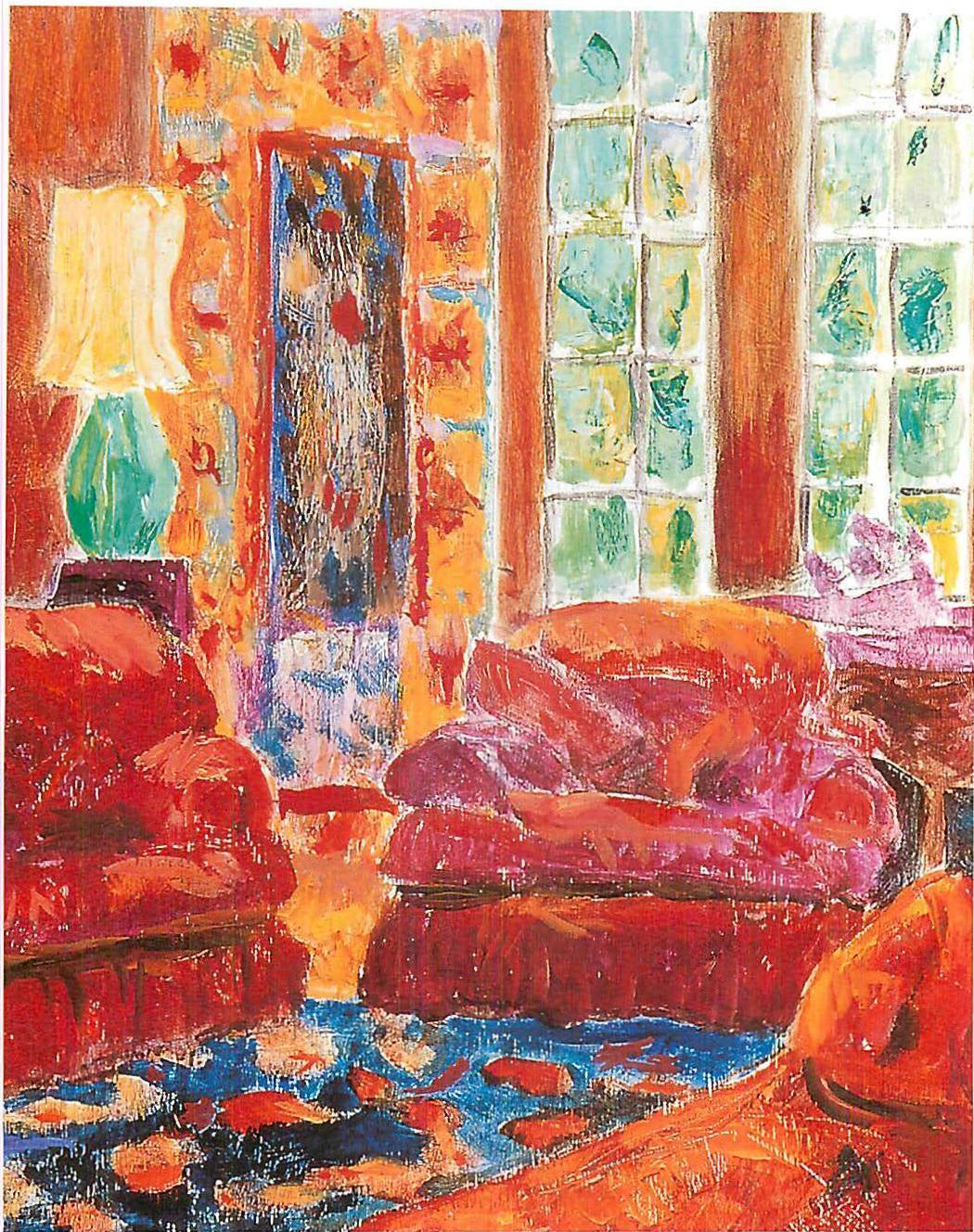
Christopher Alexander, The Living Room, 38cm x 55 cm, oil on board, 1990. The kind of world in which this blissful state exists.
people will experience, and make solid, their own way of life. The mosaic of subcultures, first described thirty years ago in the earliest versions of A PATTERN LANGUAGE, has since become more and more real all over the world in the growing tendency to protect local language, ancient craft and culture, and the division of human civilization into smaller, connected, units of local culture. This process will, I believe, continue in an environment which fosters such variety, and gives dignity to it.
In trying to understand — and reach — this blissful state, painting helps me a great deal. The paintings catch the feeling of these actual rooms
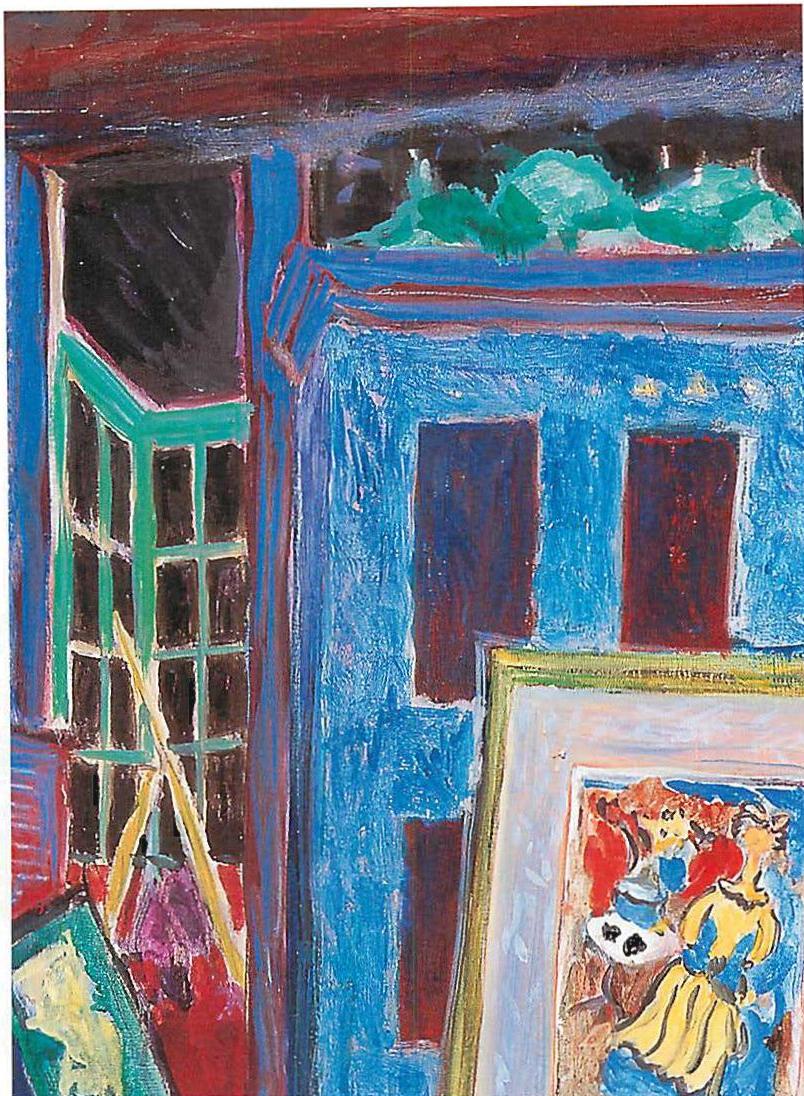
better than photographs. They have an ordinary quality, an ordinariness—luxury of color, soft cloth, paintings, books, flowers—but put together so that people are comfortable there. In the case of our living room (pictured in the painting on page 61) people who come into this room
say, "I am always comfortable here. Here, I can be myself." The inside light comes from the fact that the windows and the fireplace and the walls seem almost like beings. Yet it is rather ordinary. And it is made quite roughly, out of very good materials. It is not expensive.
11 / GEOMETRICAL CONSEQUENCES: STRUCTURAL EFFECTS OF LIVING PROCESS IN THE REALM OF BELONGING
Belonging comes about directly as a result of living process. That is simply because all living process does two things. It pays attention to the centers which exist, and creates new centers which enhance them and embellish them.
As a result, it respects the uniqueness of every place, and works to make new structures — roads, houses, offices, gardens, rooms — which are adapted to the particularity of the place. That kind of adaptation makes them lovable, and possible to love; and when we love them, we belong there.
At the same time, any living process, in its nature, also respects us, the users, the persons who live there, or work there, or care for that place. This second kind of adaptation generates a uniqueness which is particular to the people there, and once again establishes the relation of belonging.
But living process, insofar as it affects belonging, also works because it generates a very particular kind of morphological structure, a graininess, a quality that is far, far removed from the shiny image-driven slickness of contemporary architecture and design.
The places which have this belonging have a rubbed-in, used, quality. The quality is rough and ready, not pristine. It cannot afford to be
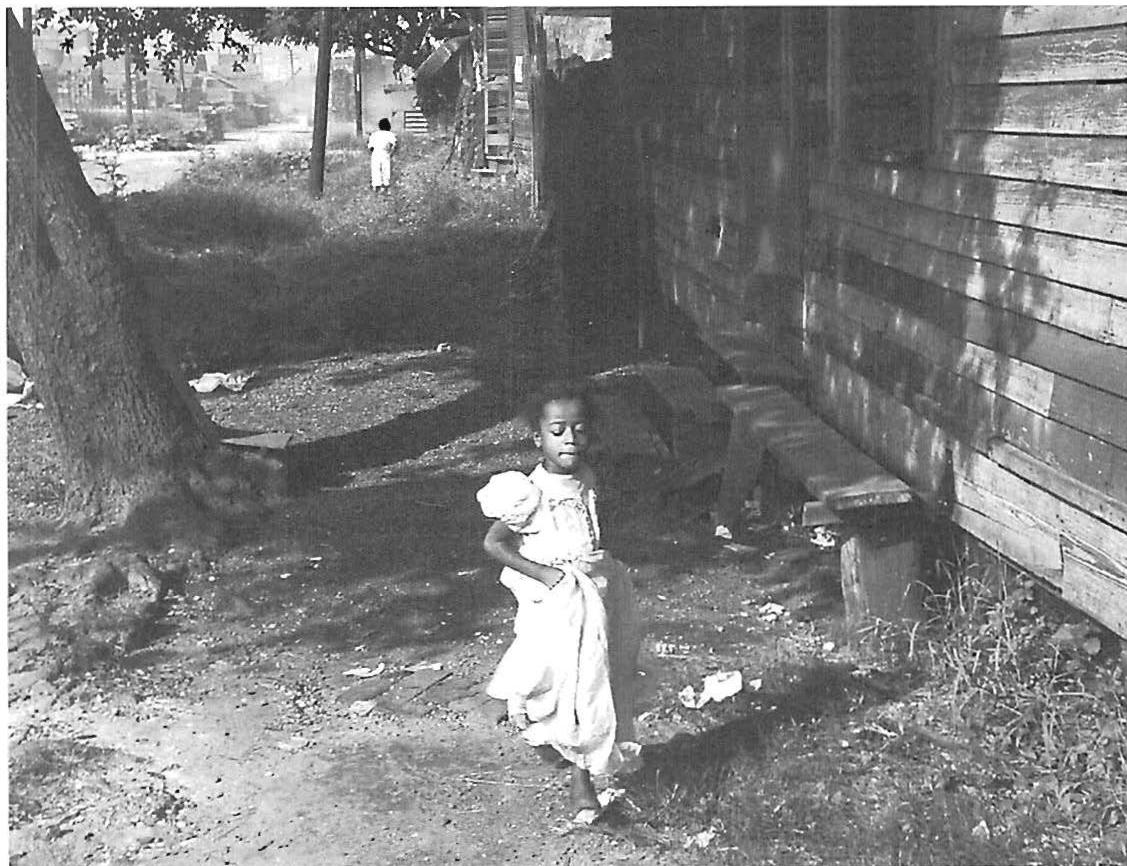
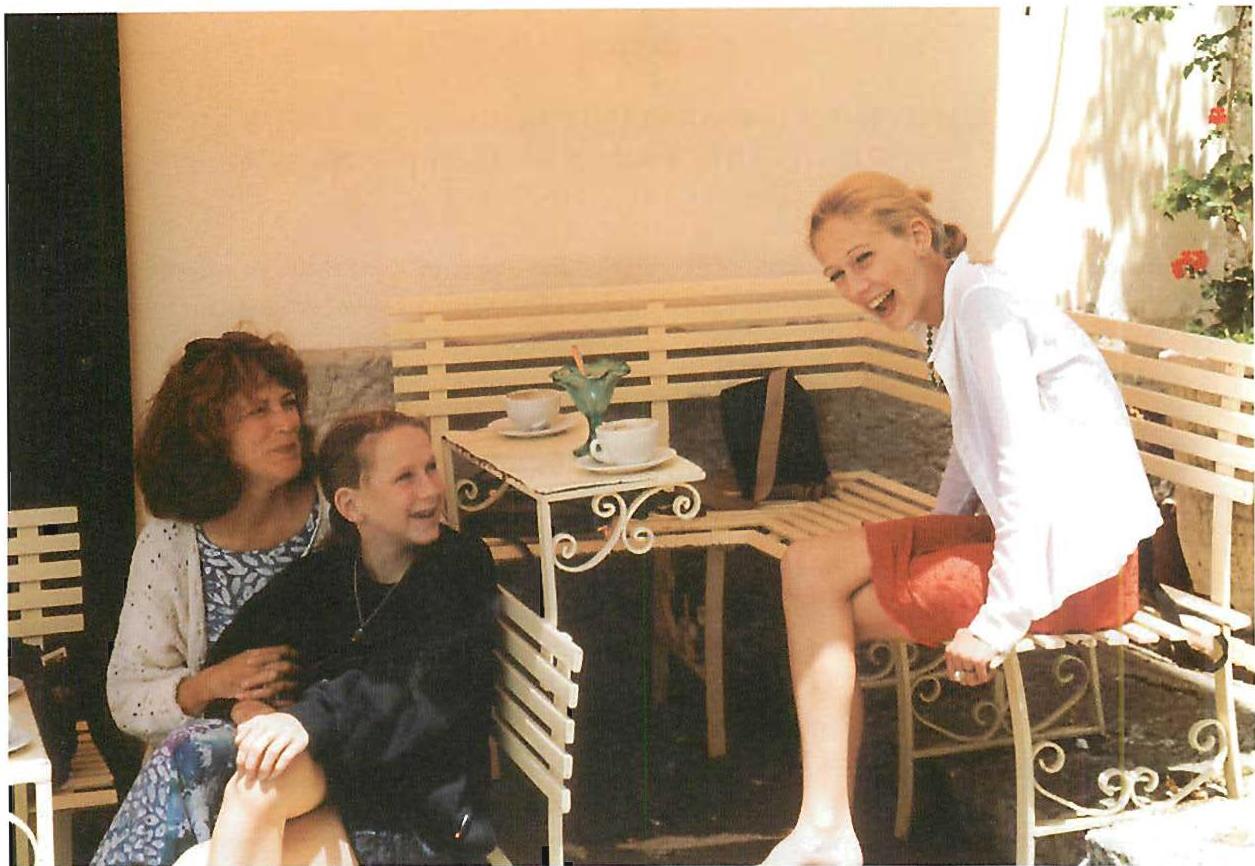
perfect, because life, too, is rough and ready. The Japanese call it "wabi-to-sabi," or rusty beauty. In so far as it is beautiful, it is imperfect too.
It is this quality which is hardest to accomplish in the formal image-ridden framework we call architecture today, this which is most elusive, and which has been most violently trampled, even eradicated, by the present processes we call architecture and design and construction. Yet for human life to be fulfilling it is, in the end, this quality which most desperately needs to be accommodated and created. No building has this quality—exactly—at the time when it is built. But some buildings, some landscapes—invite it, encourage it, foster it.
What are the typical geometric features which these places have? Sometimes, a pure,
gentle system of simple local symmetries, ungoverned by massive symmetries, ungoverned by massive homogeneity, allows further small symmetries and centers to develop. In an old Manhattan loft we have no problem tearing out walls, building other walls, making a hole here, a doorway there, a light where it shines just right. On the other hand, in the homogenous environment of contemporary pristine development, it seems impossible, almost a violation, to undertake such fine adaptation.
Living process which succeeds in making belonging always leads to fine grain, to the fact that the environment is small-textured, and that the local symmetries are in a full hierarchy, and that the material and texture allow small local symmetries to unfold and expand further, according to need.
12 / CONCLUSION
In the paintings on pages 59, 61, and 62, I have tried to paint the blissful state directly: that quality in the environment, in a room, in a window, in a cupboard, which creates a perfect ease that makes a man or woman perfectly themselves.
That, after all, is the goal of our existence. And that, if it can be attained, is the most we can ask of the world: that it support us in this ease.
This something, this state, which makes us free, makes us harmonious beings — that is what all of us, as builders, should search for, must search for.
That is what each one of us must search for, in the little things we do around our houses, done in such a loose way that it can really allow us to reach and touch the existence of our selves.
One of my clients, a nun, who later married and became an artist. Here, going down the slope on skis in her habit, there is that wonderful freedom of spirit, which the blissful state is all about.
Having identified it clearly, its quality, like an autumn afternoon, then we may try to bring this quality into the larger world, the world of roads and parks and hospitals and offices.
This is where I want you to share my understanding of our task as we go forward trying to shape our world. As architects and builders, it is our responsibility to allow these processes to exist in society at large, to show how they can exist on a large scale. So it is not merely the problem of how can it be done on a small scale that I am asking you to carry in your mind and solve. What we have to solve, ultimately, is the problem of giving the whole Earth that structure which will allow all of us — all of us teeming millions — to feel the comfort of belonging to the places where we live and work.
NOTE
Small capital letters, used for NOT-SEPARATENESS and ROUGHNESS on pages 45 and 46, are used throughout Book 3 to refer to the fifteen geometric properties defined in Book 1 (chapters 5 and 6) and to the fifteen corresponding transformations defined in Book 2, chapter 2).
We cannot have our own belonging to the world if the buildings we make do not belong to the land. Their belonging is essential to our belonging, whether in towns or in the country
The next five chapters begin discussion of the form of land and buildings. In these chapters, I show examples of the way buildings, when generated by living processes, will sit in the land, how they may enhance the land, how each building can help other buildings near it, can help the city and neighborhood where it is placed, how, at a smaller scale, the physical volumes of buildings are interlocked with land, and how the solid materials which make the building are similarly interlocked with space.
Throughout these five chapters the basic theme is the positive character of living space and the fact that this positive quality of space is the single most important and most tangible result of living processes at work. It is, also, the one which has the greatest effect on our belonging to the world.
Chapter 3, THE HULLS OF PUBLIC SPACE, gives examples of the creation of coherent structure in what is the now-damaged core of nearly every urban area. It describes a structure of public space — continuous, pleasant, connected, and above all, positive — which forms the backbone of a living city.
Chapter 4, THE FORM OF PUBLIC BUILDINGS, describes the way that the largest buildings conceived within the framework of a living process are likely to take shape: their geometric style and structure.
Chapter 5, A POSITIVE PATTERN OF SPACE AND VOLUME IN THREE DIMENSIONS ON THE LAND, describes the overall pattern of the way that living processes place each building into the fabric of the land to enhance the whole.
Chapter 6, POSITIVE SPACE IN ENGINEERING STRUCTURE AND GEOMETRY, jumps down in scale and shows the impact of living process (hence, of repeated use of the fundamental process) on the interior mass and space of buildings, and especially on the engineering structure of the buildings.
Chapter 7, THE CHARACTER OF GARDENS, shows the way that gardens are made to form positive space between buildings, and their inherent wildness which makes them part of nature, and part of a person's heart desire.
CHAPTER THREE: HOW LIVING PROCESS LAYS THE GROUNDWORK FOR COHERENCE OF A CITY THROUGH THE HULLS OF PUBLIC SPACE
1 / THE UNFOLDING OF PUBLIC SPACE
The human issues of belonging to the Earth, so vast, can only be solved within a system of space and processes which are supportive. In the next seventeen chapters, I shall deal with a large number of different issues, all in one fashion or another technical. Each chapter deals with some aspect of the technical business of architecture, the forming of land, the placing of space and buildings on land, the construction of details drawing inspiration from the land—always in such a way as to create belonging of us to the land, of the land to us. That is our business now. From the largest to the smallest detail, we must ask ourselves: What is it about this technical matter, that must be done so as to support our belonging, our humanness, our capacity for love.
We start with the public space that necessarily lies at the heart of every human community. When living processes are applied systematically to the public space in a human community, they will—because of their emphasis on the formation of strong centers—generate a system of articulated, useful, coherent, and mainly pedestrian spaces.
This will happen in unplanned construction or in a planned form, provided that the planning and layout process is a living process. Living processes will have this effect because they form positively shaped, coherent, strong centers of space, shaped and elaborated through the unfolding of LOCAL SYMMETRIES, BOUNDARIES, and LEVELS OF SCALE. These centers, which carry public functions, have the chance, then, to become highly differentiated living entities, each with its own enclosure, its own character, its response to the people who pass through it and congregate in it, and its dependency on them.
I choose to call these coherent, partly enclosed public spaces that are positively shaped, the HULLS of public space. Each one is like a boat, or like the shell of a nut, what in German is called die Hülle, each one holding and forming a kernel of outdoor space formed to be contained, almost as rooms and other interior spaces are formed and contained. Hulls of this kind are the only spaces which can give communal structure to a town or to a neighborhood.
The word "hull" draws attention to these spaces, it helps to make them more solid in our awareness. Above all it encourages us to remember that public space must always be POSITIVE in its geometric character.
2 / POSITIVE SPACE
What is POSITIVE SPACE? What is it like when space becomes positive? How do you recognize positive space when you see it? The answer is that it depends on the density of STRONG CENTERS in the space.
Outdoor space is positive when it is shaped, just as a room is shaped. It has a contained character; it is bounded by walls, trees, fences, natural vegetation, enclosure of some kind. It looks into other positive spaces, some larger, some smaller. When space is positive, passing through it one moves from space to space, as if one were moving through a series of rooms. Each space, individually, is a strong CENTER, each one has a BOUNDARY, one feels its heart, its substance; and one passes from one of these strong centers, to the next, as one moves around and through the space.
This is entirely different from the space of present-day America—where a loose aggrega-
On this page and the next I show examples of such places. Those on this page are all in London, and show the remarkable work of LIFT, the London International Festival of Theater. Under the chairmanship of Helena Kennedy, LIFT has worked to create public performance, public engagement, public "living" in the streets of London, so that ownership, true ownership of the streets, comes back to people who have been disadvantaged, and removed from public places. To achieve this, they have created drama, fireworks, fantasy, games, theater—all under the general heading of THE FACTORY OF DREAMS.
The photographs of their work, on these pages, shows the extraordinary engagement which they have been able to generate. So far, their work has not yet been connected with a "geometric" living process that then simultaneously creates, modifies, and binds the actual physical space, so that this space is modified and becomes theirs permanently. That has yet to be done.
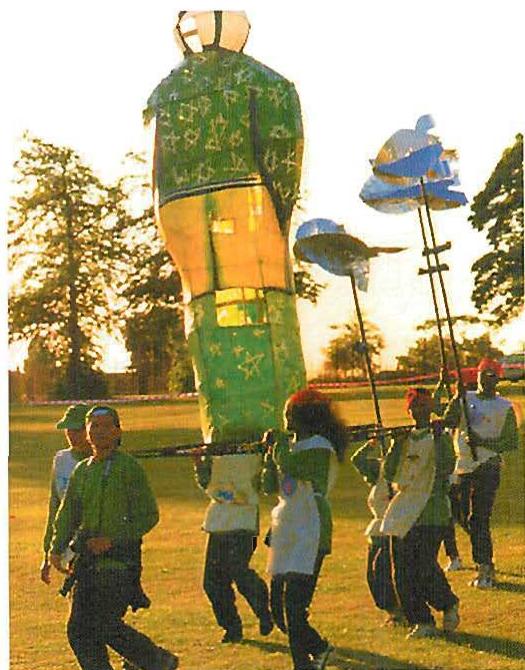
One of the most vital things in the creation of positive space in the city, and in the creation of hulls of public space, is that people enjoy themselves, that the space is active, emotionally—so that people feel happy there, want to be there, and feel that it genuinely belongs to them, as if it were—indeed—a public living room to which they all belong.
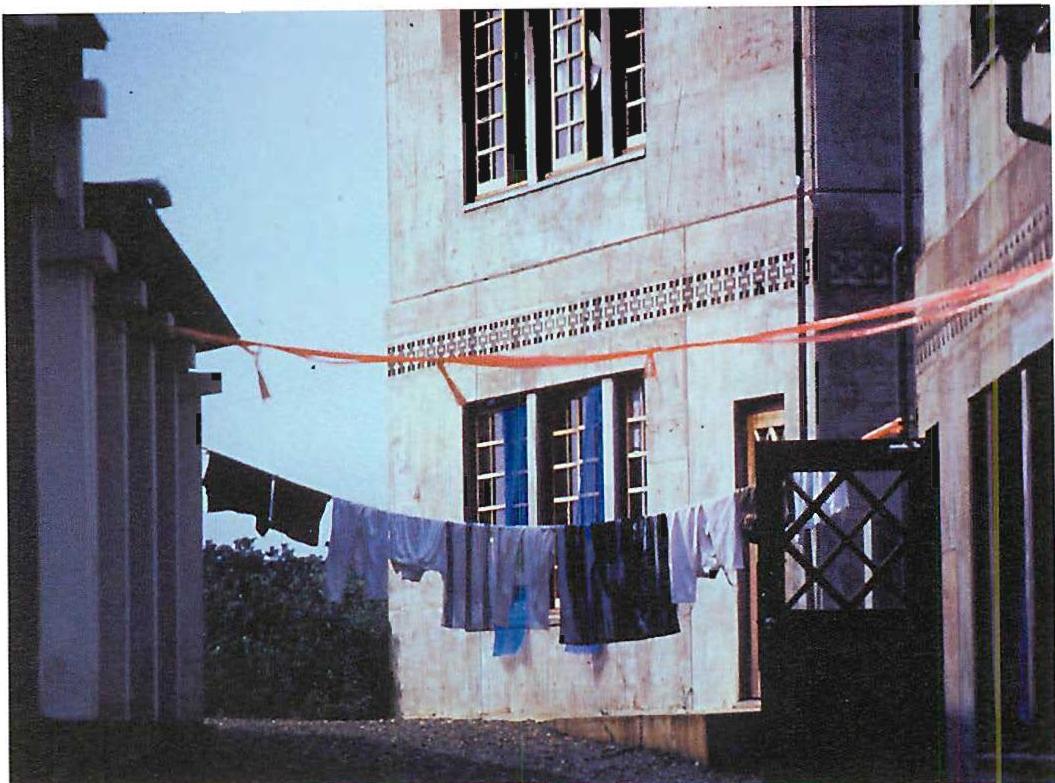
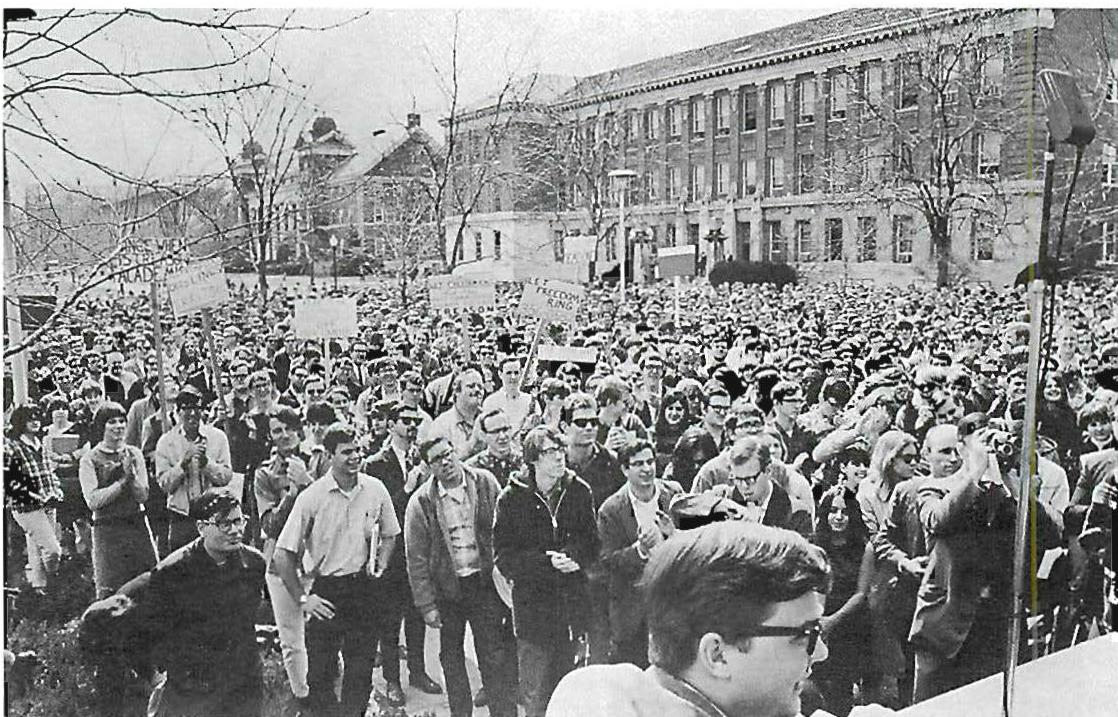
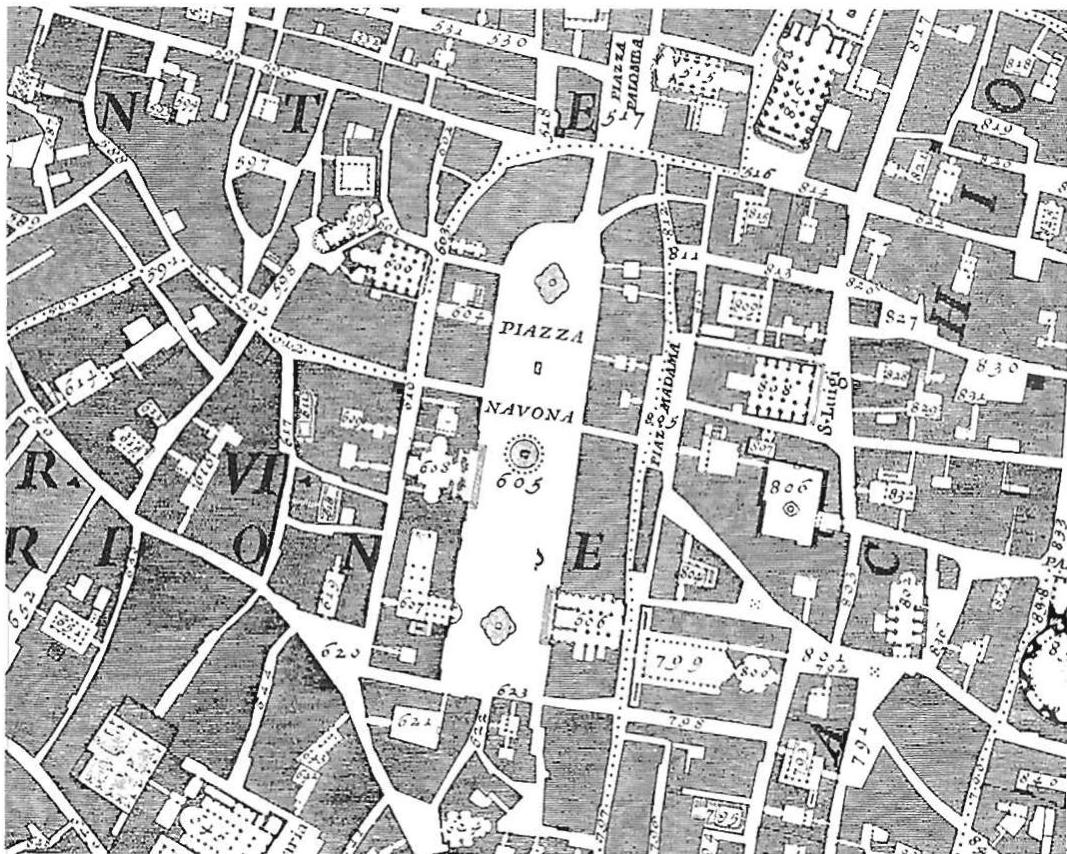
tion of parking lots, asphalt, wide roads, yards without significant meaning and therefore without significant boundaries, causes an amorphous substance to exist.
A great deal of the nature and meaning of positive space may be seen in a plan drawing, with reference to black and white. When we look at a place which has positive space, if we see the plan in which space is drawn white, and the rest black (this page), then the white spaces have a feeling almost as if they are carved out, literally, from the solid rock, like a series of caves, connected by tunnels. When we reverse the black and white (as in the drawing on page 74, by taking the negative of the picture), we see the spaces black, and the buildings white; now, when it is good, the space looks almost like a series of buildings or halls, connected by passages.
In the Nolli plan (drawn c. 1700), the space consists of squares, streets, and churches. These
are the public spaces. The dark part of the drawing refers to all the private buildings, and includes all the private gardens that are not accessible to the public. So one sees with enormous clarity the beautiful hull-like character of the public space.
How do you then, make this positive space? In the case of Rome, we are looking at the trace of a process that went on for nearly 2000 years (the plan was drawn at the beginning of the 18th century). We are looking at the trace of a process by which the inhabitants of Rome, gradually, step by step, made each bit of space more and more positive. This happened because (as explained in Book 2), the traditional process allowed a continuous structure-preserving process to occur, which created and embellished strong centers continuously. As each alley, each plaza was shaped, it was then shaped and re-shaped by insertion and corrections. Most of these will
have created new centers; so, not only the positive shapes of the squares and alleys and churches, but the individual centers, within the space, by being made stronger, then created GOOD SHAPE in every space; so the Piazza Navona is a beautiful shape, the alley gets a thickening at the Y where another alley forks off, the small square that starts amorphous, gets a cafe in one corner . . . when the next modification in the building fronts occurs, this cafe is harbored, nestled, it forms a new strong center, and then, suddenly, the shape of the main square in which it is sitting has received another center (in this one corner) and the shape of the whole square is now more positive.
One by one, all the fifteen properties get unfolded to make the space; ECHOES comes about, in natural similarities which occur at similar places in the whole; GRADIENTS occur as one moves away from the main spaces, and towards them, in the fabric, and in the Nolli plan we see these gradients reflected, for example, in the widening shape of paths that approach the squares. DEEP INTERLOCK AND AMBIGUITY occurs at BOUNDARIES and at the edge of spaces; we see it, in this case in the church porticos visible in the Nolli plan. LOCAL SYMMETRIES occur, of course, and are visible throughout the fabric of the space. To a first approximation, almost every one of the spaces and sub-spaces has symmetries and local symmetries defining it. Subsidiary to the local symmetries we see ROUGHNESS in the shape of almost every piece of urban space, since the influences of tradition, previous construction, topography all modify the whole, and make the simple shapes more complex.
LEVELS OF SCALE occur, of course, in the hierarchy of sizes we see in the exterior space, in the many different-sized centers which are formed through the unfolding, and then is chiefly embodied in the way that many spaces are defined by small spaces opening into them. INNER CALM and NOT SEPARATENESS.
As the formation of positive space matures, all these properties appear, and the space slowly gets its living character, just as buildings and objects can have. It is this living space, endowed with the properties, endowed therefore with living centers, that forms the effective and useful hull of urban space, to support society.
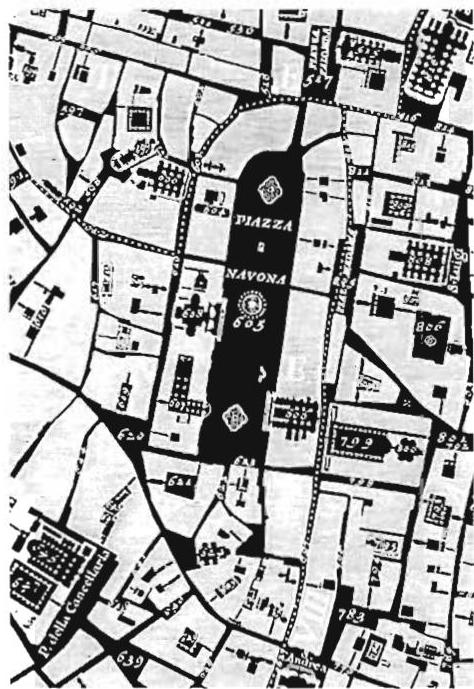
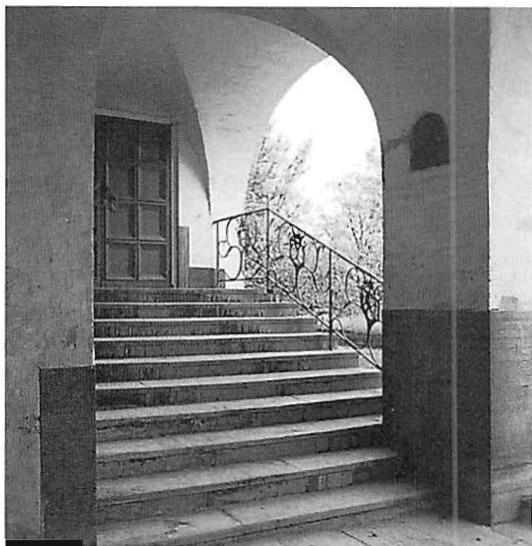
3 / HOW HULLS OF PUBLIC SPACE COME NATURALLY FROM STRUCTURE-PRESERVING TRANSFORMATIONS
Let us now pass to the general case, a part of a town in our time, and the kinds of process through which positive hulls of public space may be formed.
Assume that we have an open attitude to a town, or neighborhood. By that I mean that we are able to consider the wholeness of a given place, as it is, without prejudice about what is or is not possible. We are mentally open to the wholeness, can therefore afford (mentally) to allow unfolding to occur.
There will usually be some rather natural places for social space to be created. These latent centers may arise as a result of a certain density, where there is a natural need for places of congregation: thus, in a fairly natural way, at the center of gravity of a population, there may be a push towards a void to occur, a center, which gathers together the activities of that population into itself.
And there are sometimes naturally occurring spots of natural beauty, which call a hull of space into being, just because they point to the importance of such a particular spot in the land (or in the town) as a natural center which has importance in people's hearts.
Or, if the community has formed a collective vision which has — in addition — identified naturally required generic centers of some particular type, then these generic centers, too, might induce, from within the culture, a natural pressure towards the creation of such space.
Best of all, for the unfolding, is when these processes, all three of them, coincide to identify particular and obvious places, which the people in the community recognize as “Of course, we always felt there should be something there . . .”
The answer comes, again and again, from the fundamental process. Whatever living process is at work, it is made up of repeated application of the fundamental process. The fundamental process strengthens centers. Strong centers, as they form, form positive space.
4 / SHAPED PUBLIC SPACE FORMING LIVING CENTERS
Imagine, then, that we are to embark on a program of construction which makes a part of a town into a system of public places entirely made of POSITIVE SPACE, or think of it as “solid space.” That means, really, that each part of the downtown, and each part of each neighborhood, is to be a strong center. In our ideal city, when we are finished, there are to be no places that are not living centers. This will be true of each part — each center — in the downtown area; there is to be nothing left over.
Some of these solid spaces may be parts of a sidewalk — I do not say sidewalks — because I mean only a single piece of a sidewalk, which is a graspable, felt, solid object of space, where I want to be. When I leave that place, I go to another one.
Obviously there may be avenues, a focal point, a small square, long pieces of sidewalk flanked by shops, a short wide segment of sidewalk or paving where there are pigeons. There are also — perhaps, lawns; there can be a sidewalk cafe — an area of tables and chairs, bounded; there could be an area of umbrellas. And, certainly, there will be less intense parts, but always positive space and THE VOID and BOUNDARIES, forming the background against which the many more intense small volumes of
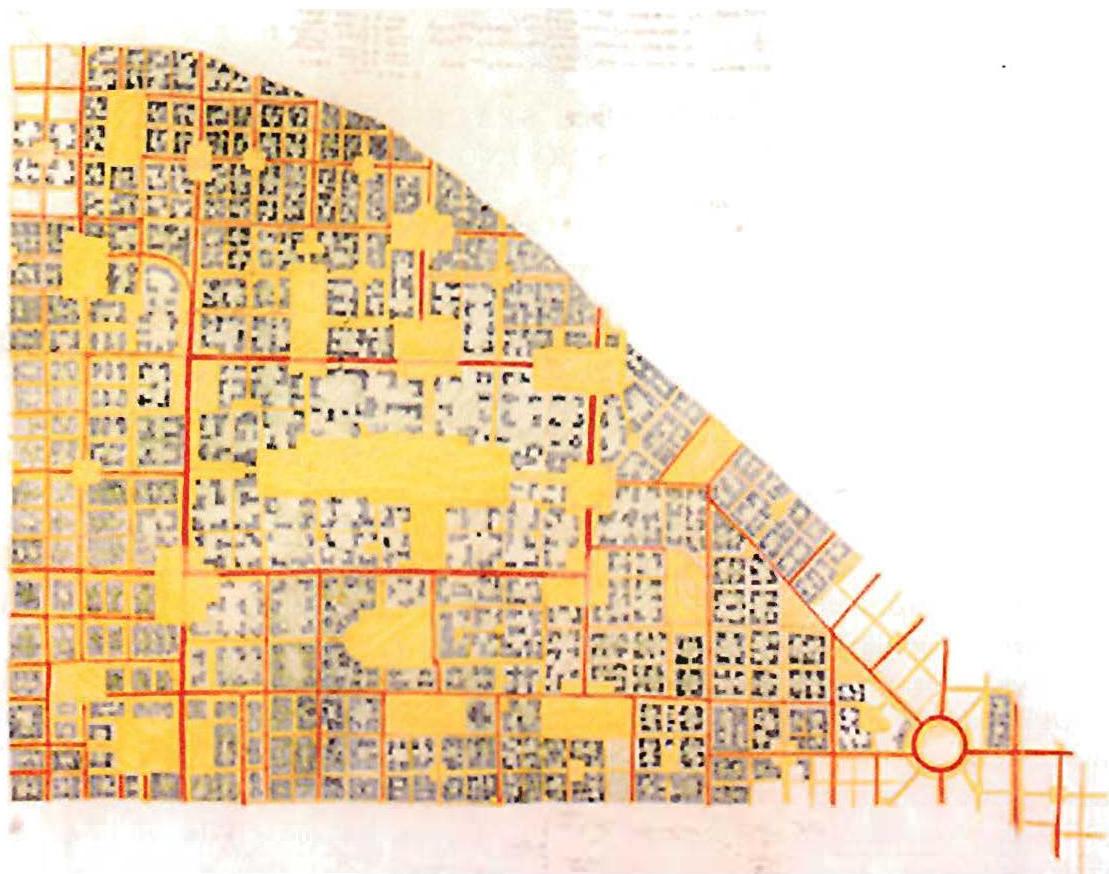
The solid space which forms a town, in a highly visible and coherent form. Streets, squares, even the interior of public buildings, are shown as parts of one continuous swath, in which every part is strongly shaped, and adapted to its immediate use and users. We see here, in rudimentary form, the system of public squares, gardens, and pedestrian streets which might form the hull of the Progresso district. Fort Lauderdale, Progresso, Christopher Alexander, Sand Pichardo, Chris Andrews, Shawn Bradbury, 1996
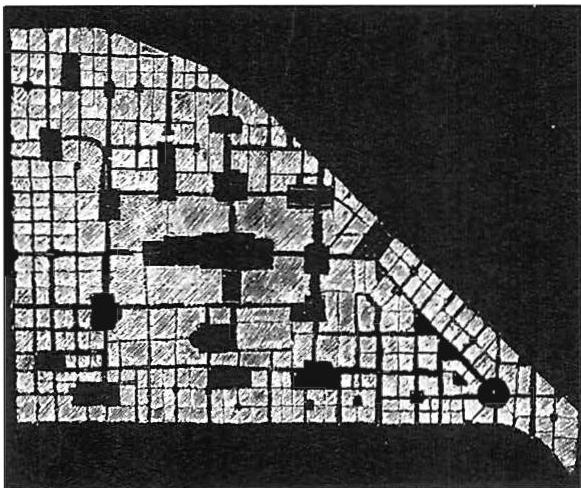
Reverse black-white drawing showing all public hulls of space as black, hence as if they were buildings. Fort Lauderdale, Progresso, Christopher Alexander, 1996
space are a counterpoint. But even the void is itself a place—solid, continuous, empty, bounded, visible, and felt as the void.
Against all this in our process of forming space in the city, we must most carefully make the right kind of space for cars, parking lots, parked cars, moving in and out of parking. Our modern destroyed space has come about largely because with the onset of cars, 2000 years of tradition about forming pedestrian, horse and carriage space, suddenly dissolved—became irrelevant—and we have hardly yet found a new tradition in which the rules of the game—the patterns, the generic types of centers for parking, cars, movement of cars, deliveries, is clear and worked out in relation to the hulls of public pedestrian space.
The temptation to say—keep the cars out, make it all pedestrian—is far too harsh. In many places, it is just the cars which create the life in a place; the freedom of access that they permit which brings vivacity, energy, imagination. But undoubtedly, the pure pedestrian space in which there are no cars is also vital, allowing us to walk, dream, play, unhurried and uninterrupted.
So, in support of the emergent unfolding of the hulls of public space, we need a specific group of patterns, or generic centers, that tell us how the cars are going to work. How are the hulls of space to be managed, so that they are primarily pedestrian in feeling, yet able to contain the speed, and energy and bustle of small cars and trucks? How much parking is there? How visible or invisible is the parking? How is it to be paid for? What density is to be allowed. Possible rules for working through these questions are given, for Fort Lauderdale's Progresso district, on pages 290–305.
5 / THE SPINE STRUCTURE OF THE EISHIN CAMPUS
The Eishin campus, built from 1985 to 1989, is a pedestrian world which really works. It has an atmosphere of calm, one feels oneself there; it is nourishing to the spirit. After it was built, though it is a school and college, the head of the school, instead of head or chairman, started to be called "the mayor." This was a tribute, I think, to the calm and living atmosphere of the place.
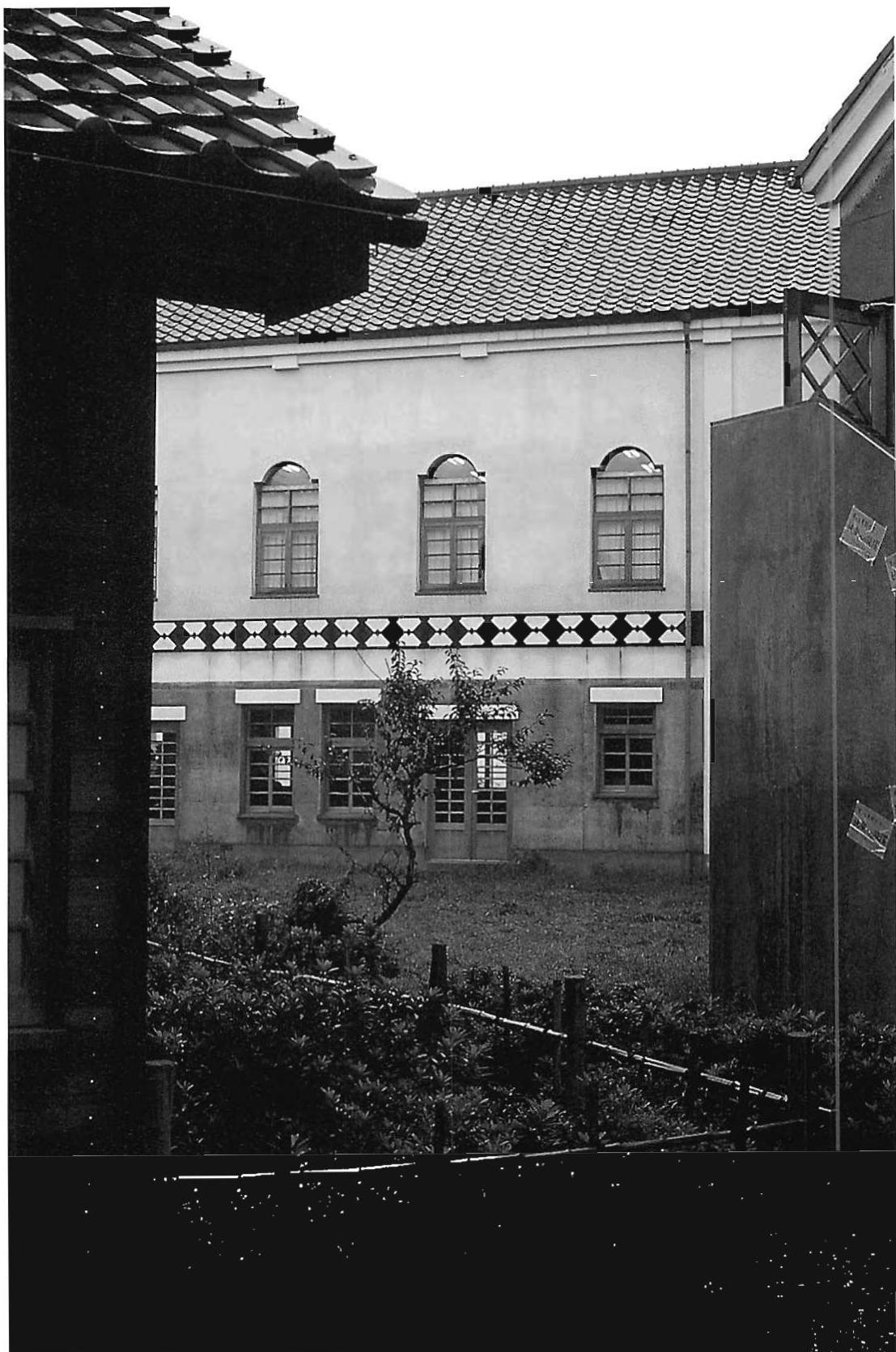
Belonging: the hull of public space formed in the Eishin campus, which we built in 1985 outside Tokyo; Christopher Alexander, Hojo Neix, Ingrid King, Artemis Aminou, Gary Black, and others, 1981–85.
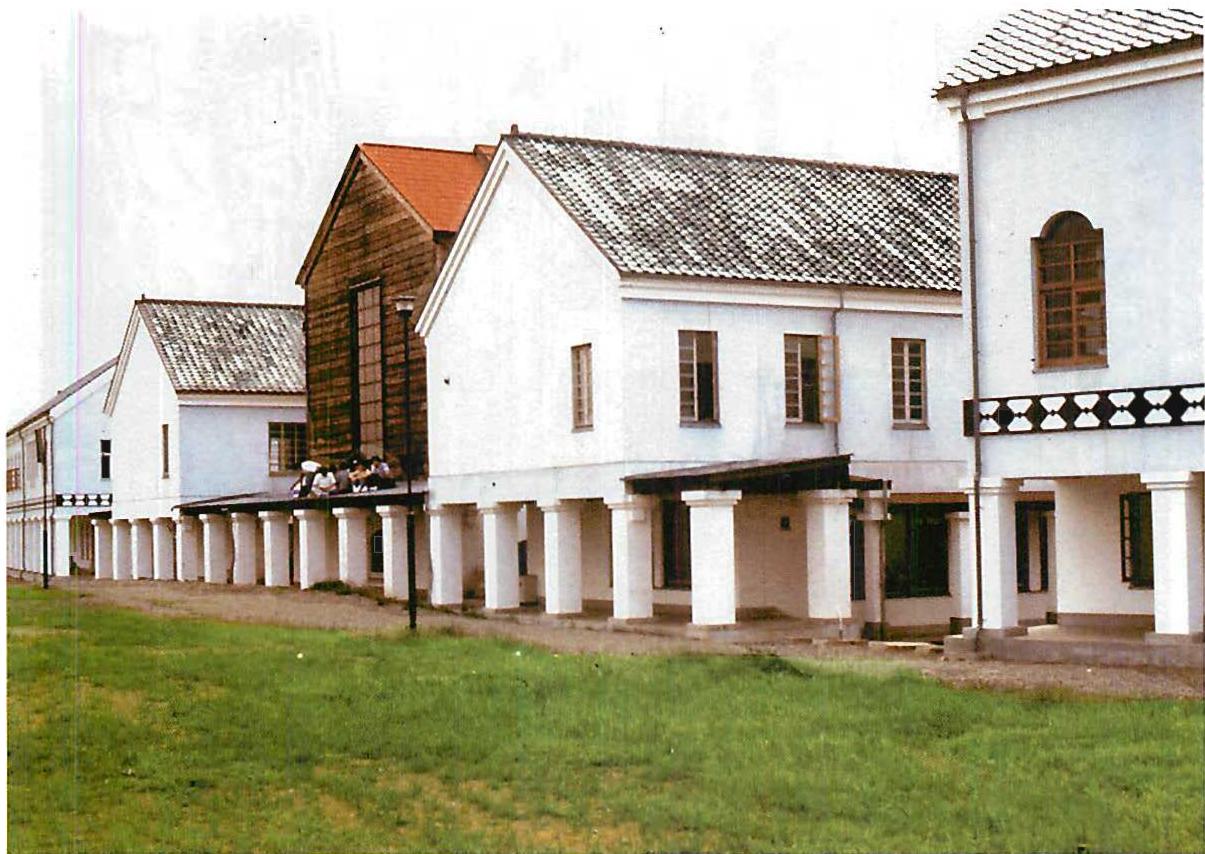
Students, hanging out on a roof forming a much-loved, sunny, public realm that looks onto the main hall of college space on the Eishin campus. Here the individuality of different buildings is visible. Because each occupies a different position on the campus, each also has a different volume, structure, and character, as it responds to its unique position in the whole.
Together, they give the hall of space its character.
Eishin Campus. Tokyo. Christopher Alexander with Hajo Neis. Ingrid King. Artemis Anniou. Gary Black, and others.
At its core are the pedestrian hulls. In this instance, we created such a skeleton of hulls, after a year of discussion with the faculty. It contains streets, gates, a lake, streets around a lake, a bridge. The hulls provide the campus its core, in which people feel at home, and against which, later, they designed and we built, the individual buildings of the campus.
The unfolding which took place in this project was that, first, a system of public space was identified, and then we tried to make sure that every part of the Eishin campus came into being and was related to the land by structure-preserving transformations.
The success of this world is, in my view, entirely given by the beauty of the hulls, the public hulls we identified and built. They create a world where people enjoy walking about: bridges, paths, avenues of trees, gates, gardens, doorways, stairs: it is a connected world, not kept too isolated from cars, but still a protected and peaceful world which works.
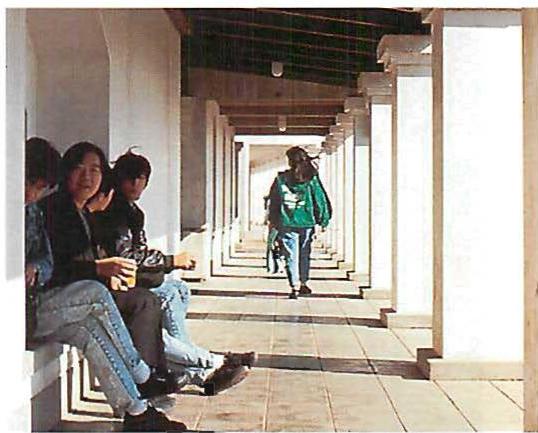
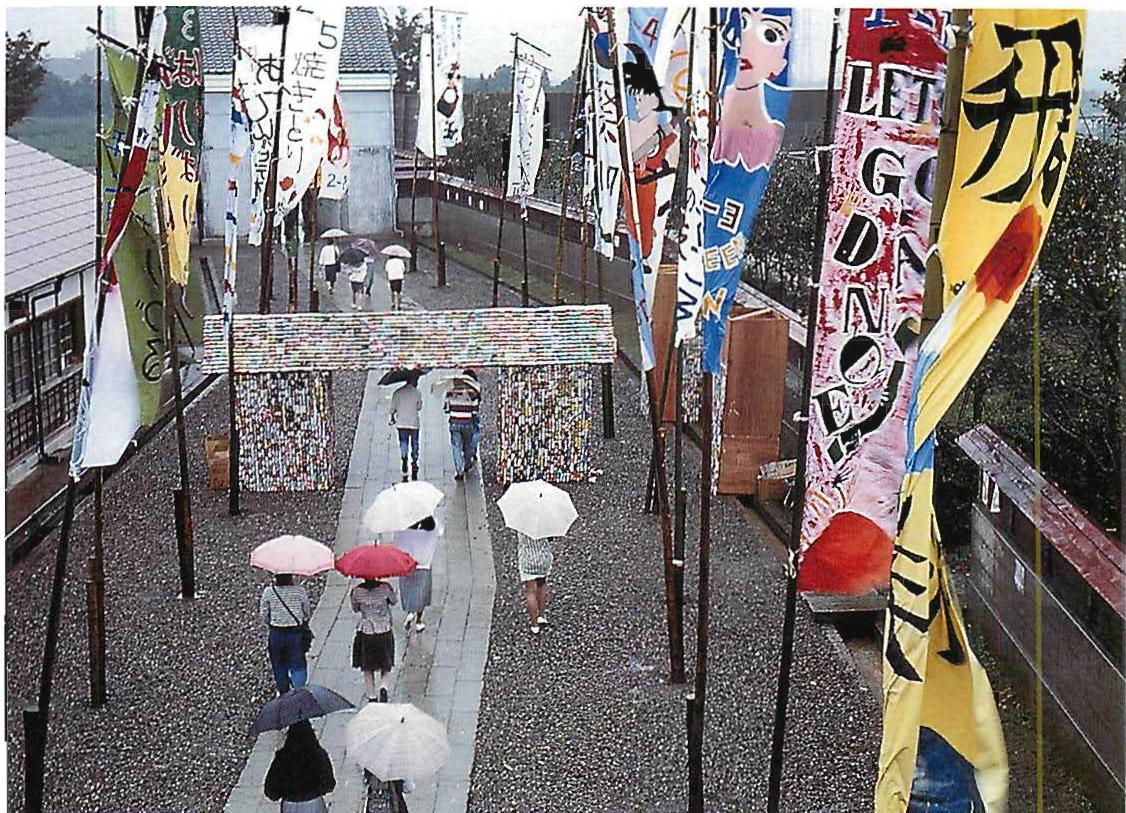
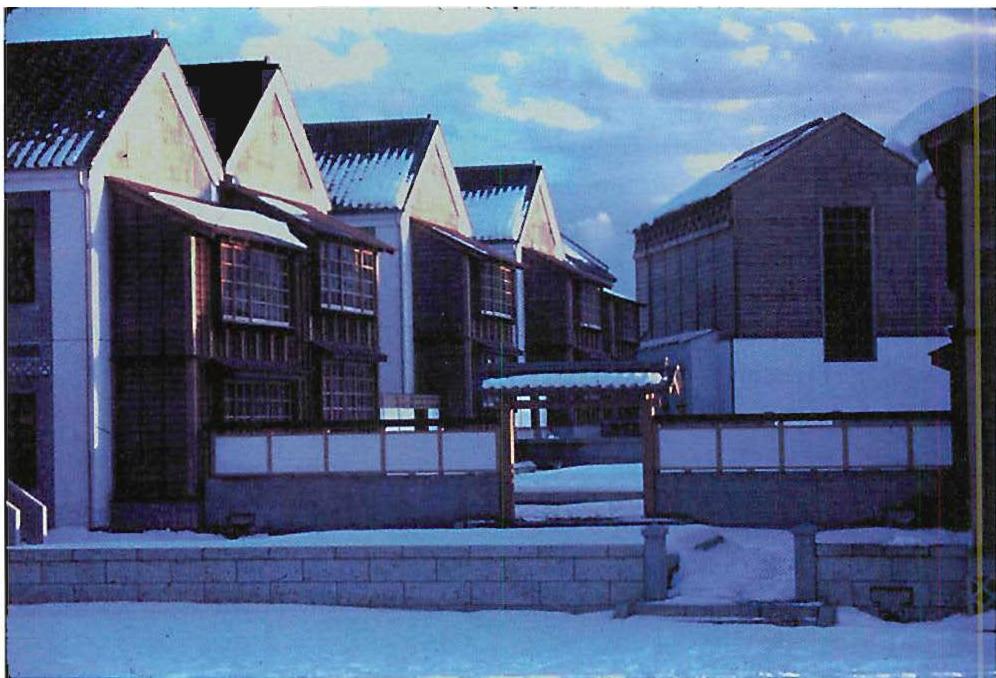
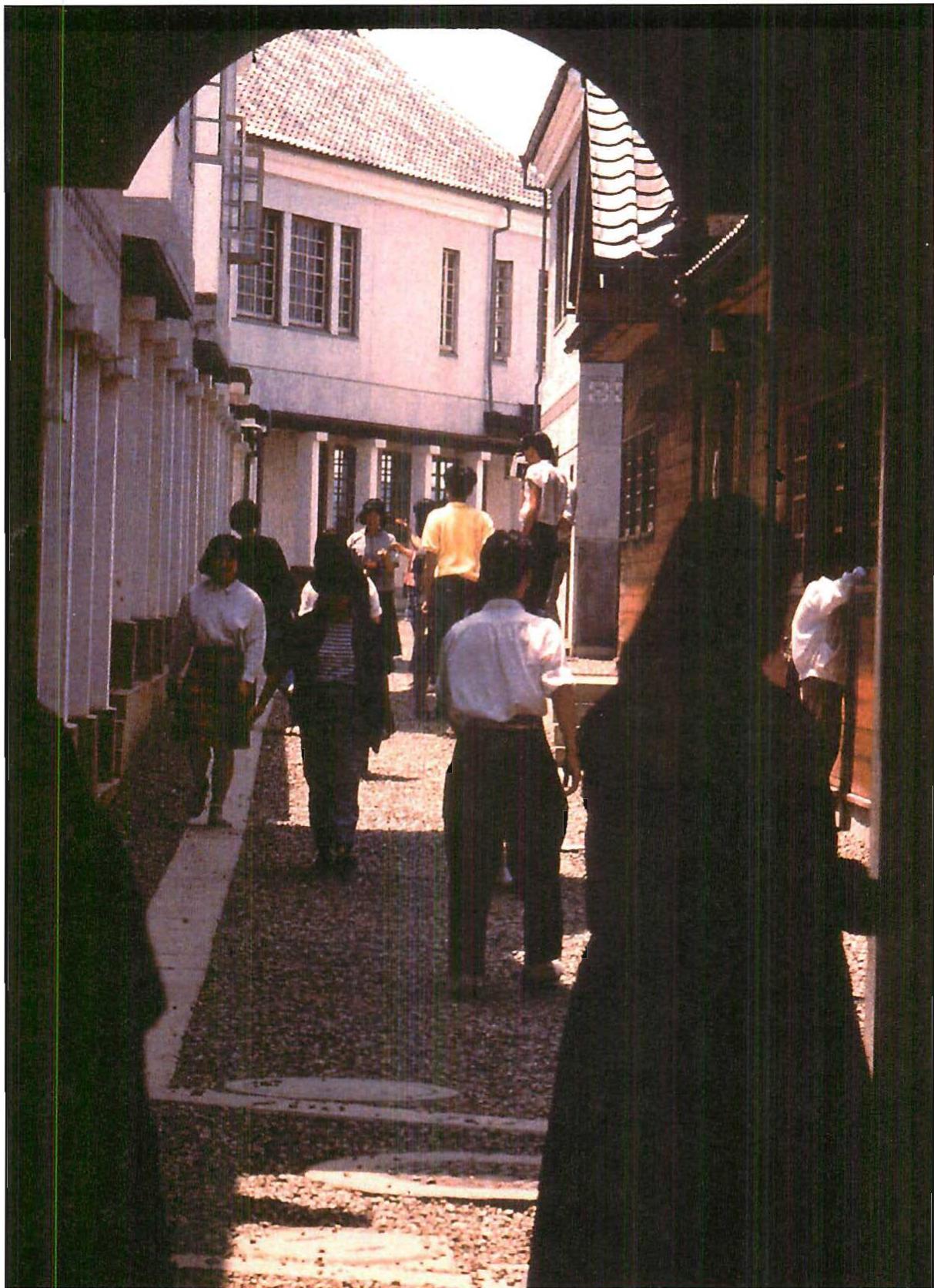
A pedestrian street at the core of a community. An example of the kind of place which can be built today with the necessary life of a pedestrian hall. Christopher Alexander with Hajo Neis and others. Eishin campus. 1985.
8t
6 / THE HULLS OF PUBLIC SPACE FOR A COMMUNITY OF FAMILIES IN TEXAS: UNEXPECTED CENTERS IN A PIECE OF LAND
In this instance the area covered is small: a few acres, designed to serve five houses, with a lot of brush around the edges. However, the formation of public land, and the hull of public space which is formed there, provides, in microcosm, a view of how this works at every scale.
My colleagues and I had just begun work to build five houses on Lake Travis, in Austin, Texas. Almost within minutes of our first seeing the land, a certain structure became visible. This visible structure was the wholeness of the land—as it was then, in 1992. It included a swath of trees running down towards the water, a communal structure, which defined the heart of the land. It had a highly complex shape. My colleagues and I defined it carefully, observed it, marked it with stakes in the land. The next day, we took the families to the land, and showed it to them, explained that it would be best to reinforce this latent communal system of centers that lay in the land, and make the individual houses have their relation to it.
It was a simple idea. Family members were shocked, at first, and described themselves as deeply moved. As we stood under one grove of trees, Linda said that she had seen these trees many times before, but never before noticed that there were these natural centers there: that seeing them completely altered her relation to the land.
Merely defining this structure of land, water and trees, just identifying it and bringing it out into the open, allowed everyone to have a more excited, animated, substantial and feeling-filled relation to the activity of choosing, and placing their houses. Suddenly, instead of merely putting each house in a random arrangement of vegetation on arbitrarily divided pieces of land, the house could be placed in relation to an under-
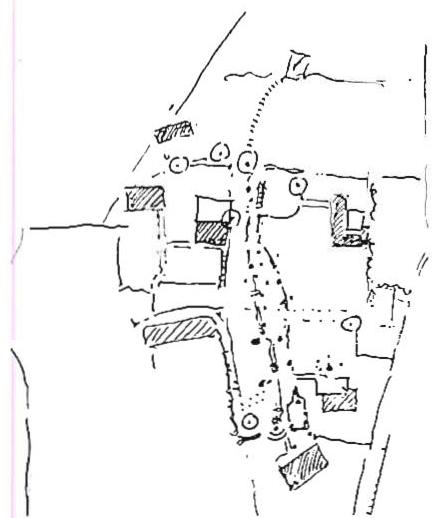
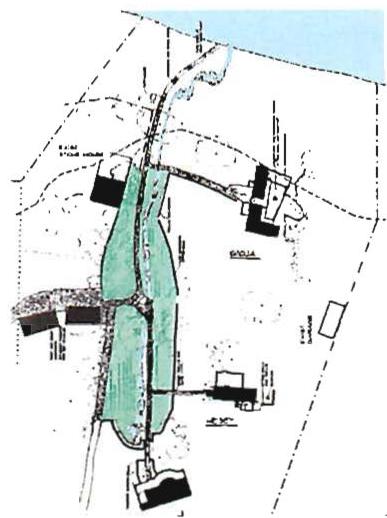
stood and meaningful public structure, which made sense, deeply, and which allowed the act of placing each house to make sense, too.
I taught them the basic principle of all architecture: To leave the structure which exists, to help that structure, to reinforce it—and how mak-
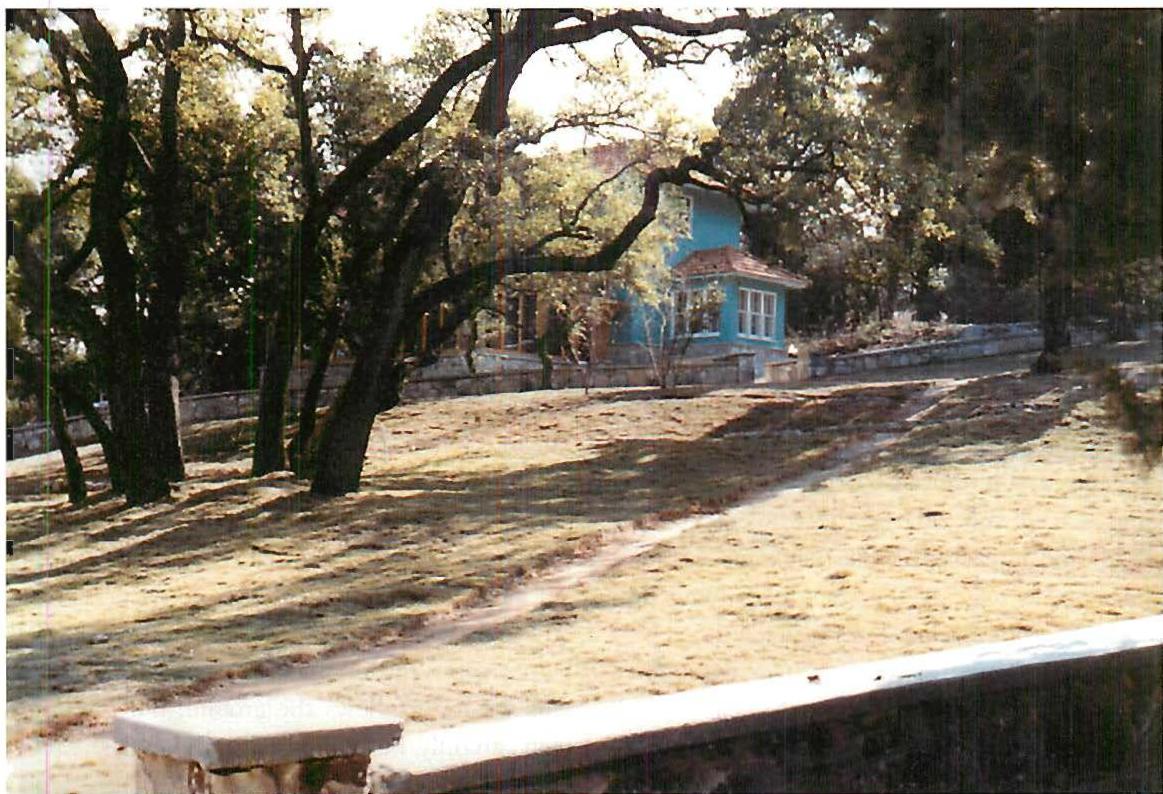
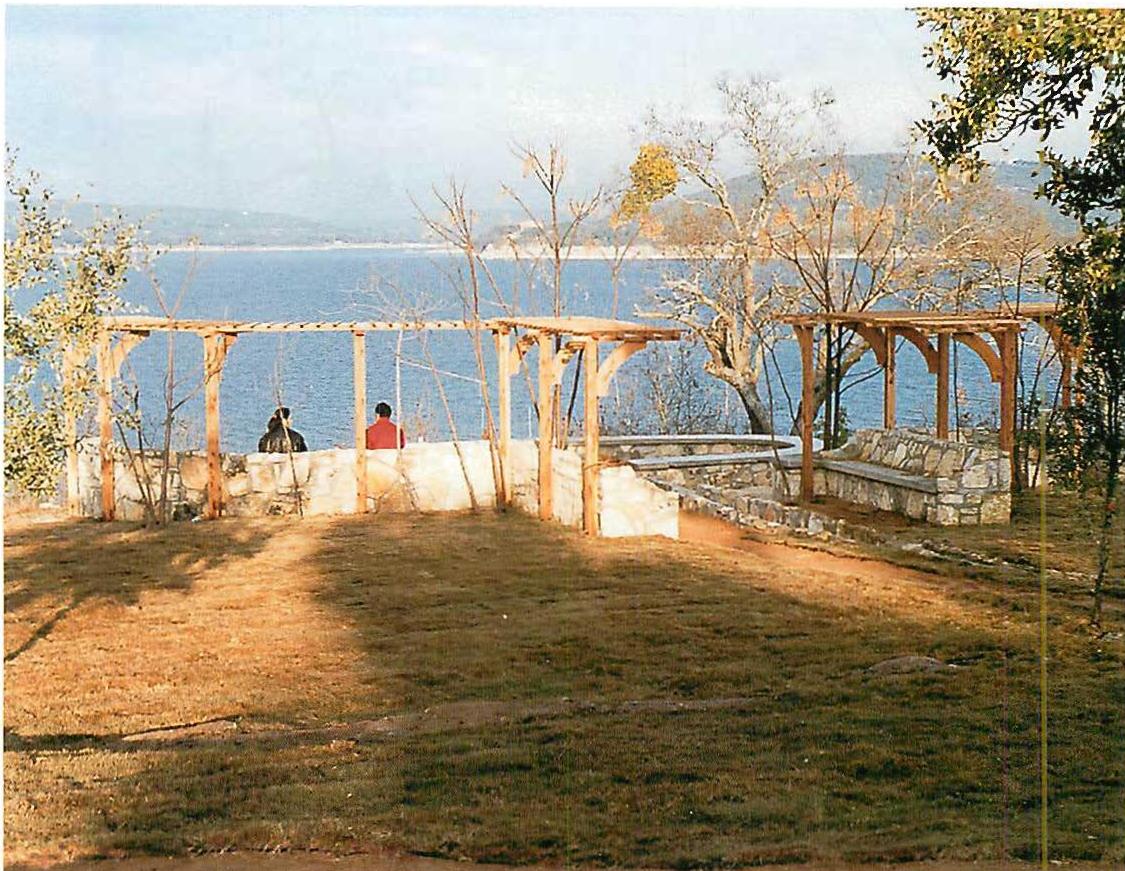
ing even tiny changes too casually can be damaging. It was the wholeness of the land, which already existed there, that guided us. The families spoke often about the way that they were moved by their awareness of this whole, that it corresponded to their intuitive knowledge, but that raising it to the level of a conscious principle was an enormous help to them. Apparently they became deeply moved by the desire to protect and extend and enlarge the wholeness of the land, and by the principle that every act must be done to increase the chance of doing this.
The common land we had identified as a coherent shape, of course then became—through our construction—the public hull which, later, allowed these houses to come to life. We shaped it carefully, gave it a BOUNDARY (in the form of a low stone wall running hun-
dreds of feet around this common land); we gave it STRONG CENTERS (in the form of a seat with a fountain at the upper end, and a trellis, fountain, and bench at the lower end overlooking the lake). We gave the heart of it a powerful feeling of THE VOID (by keeping it uncomplicated, uncluttered). We allowed LEVELS OF SCALE to form there, by making the individual old trees, and the entrances to houses, and the top end and lower end, into smaller centers in their own right. We used LOCAL SYMMETRIES in the formation of local areas like the entrance to the hull, and the paths which we formed within it. We allowed ROUGHNESS to dominate, in the way the wall, for instance, follows the ground, not stepping too carefully, but falling naturally with the terrain. The design of this long egg-shaped land was dominated, too, by GRADIENTS in the land.
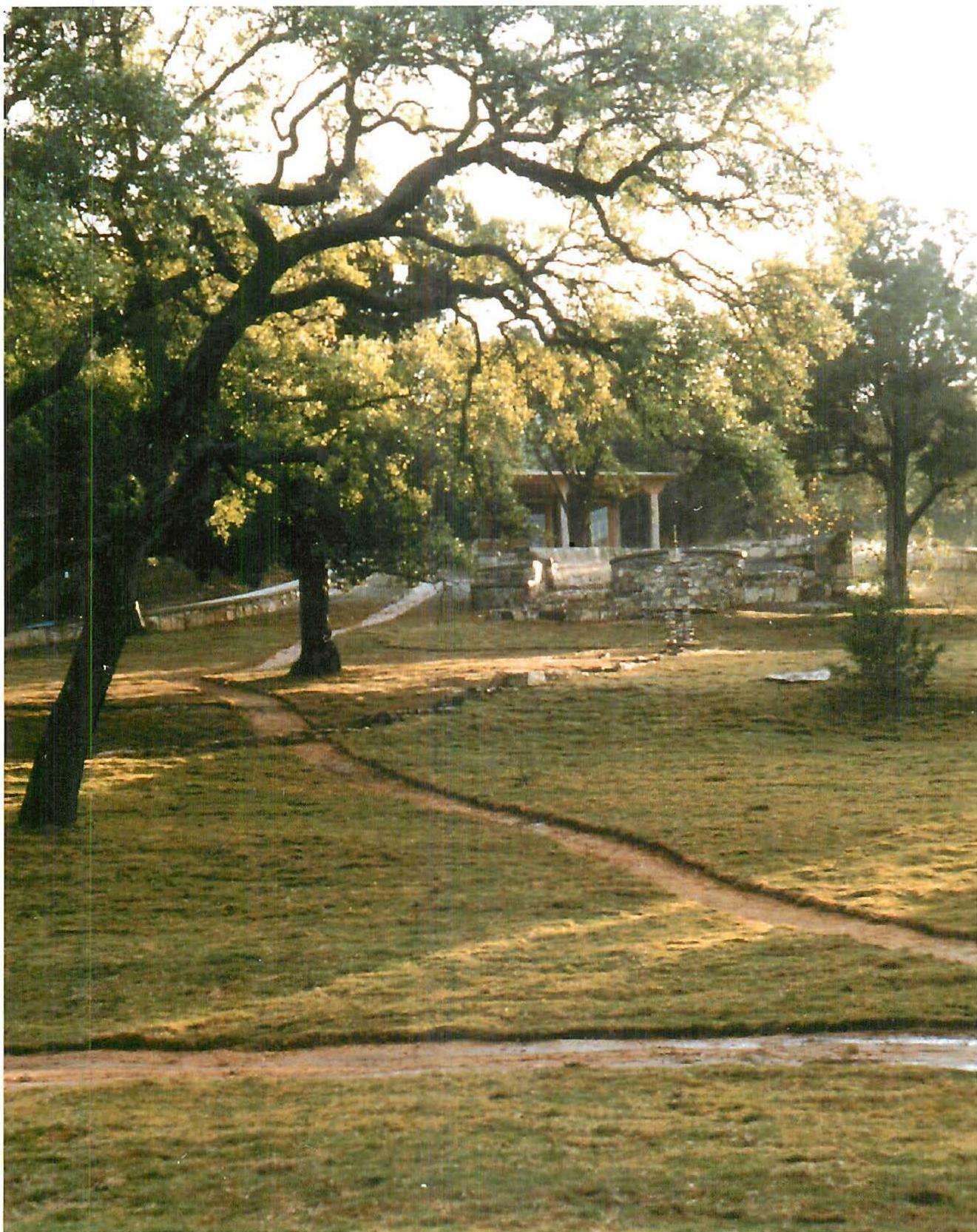
Upper end of the hull of public space in Austin. The fountain, where the top house abuts the common land. Back of the Moon, Austin, Texas: Christopher Alexander, 1996.
7 / SHAPING THE HULLS FOR PART OF A NEW TOWN IN GREATER FRANKFURT
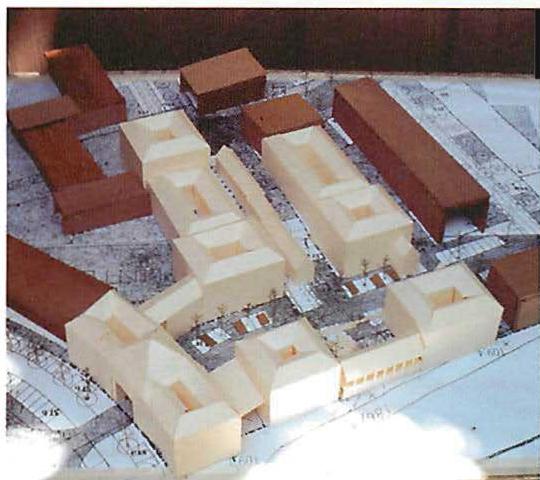
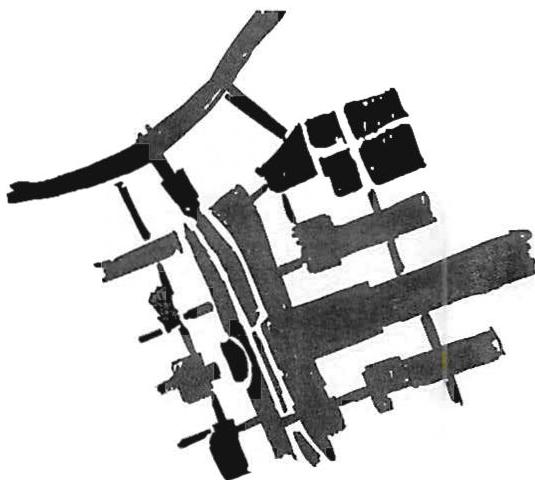
In 1996 I was asked to create a small quarter of a new part of the town of Hoechst, a part of greater Frankfurt. This was a new quarter destined to be worker housing for the factory workers of Hoechst Pharmaceutical, the huge chemical company. Hajo Neis joined me, in this instance, as an independent partner. The land for our part of the town of Hoechst was an area of about two city blocks: we were to lay this out in such a way as to create both the space and the buildings, for 3- and 4-story worker apartments. I will explain how we managed the initial creation of the space.
To start with, we were given two roads forming a T-junction, given by the master plan. We began by asking ourselves how these two roads could become positive space, even while carrying cars and traffic through the area. We asked our assistants and students to form a series of volumes for the buildings, and the volumes were then placed so as to make each of the two main parts of the T as strong as possible (see model above). We see how the space gets shaped: at the entrance we place an archway; at the closing end of the main space there is a narrowing, from each side, making the whole more contained, and so on.
There was one moment in the process where our concentration on the hull-like quality of the urban space reached maximum intensity. I asked our apprentices and students to make a model in which only the space existed. In this model there were no buildings, we used cardboard walls to enclose (hence form) space, and the cardboard represented the edges of buildings which might be capable of forming the space. But we were not tied to building shapes, at this early stage, and did not imagine any actual building volumes.
I asked the students to keep adjusting the walls, until the space — each of the individual spaces, one by one — was really good.
The way this modeling process worked, it allowed us then to react to the quality of the space alone. We did this by looking into the model — which was first made at 1:100, looking through it, as if we were walking through, then modifying it as we worked. I noticed that the
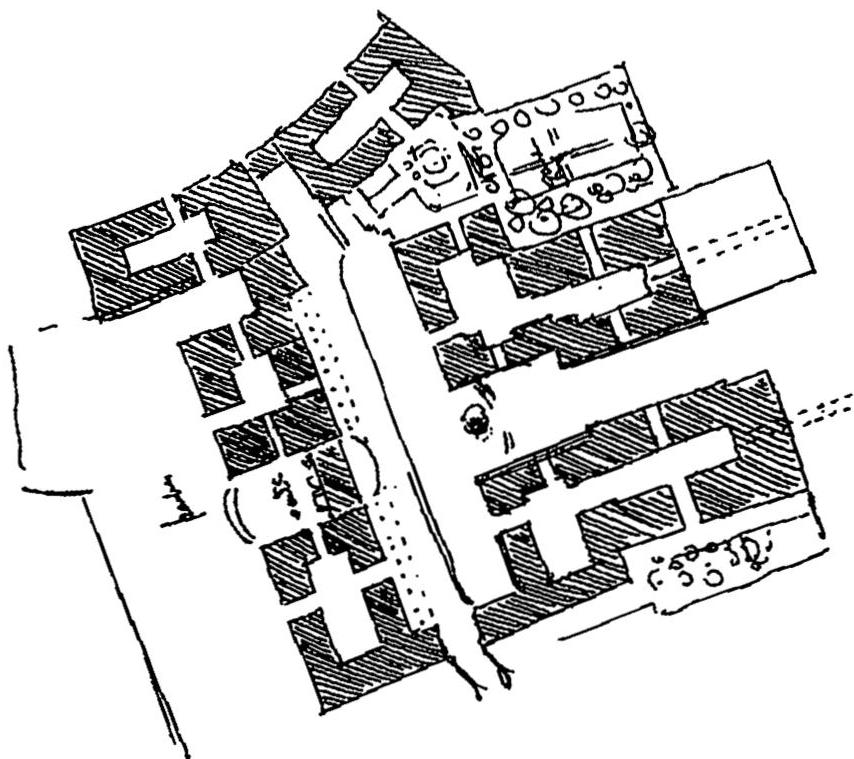
smaller streets—as one experienced them—made everything far more connected.
The most interesting and important thing which emerged from this phase, was the secondary system of narrow paths, which connected courtyards, and formed a secondary grid, thus making the overall patterns of space, coherent, and truly fascinating. When one bent down (to look through the model at a pedestrian's eye level), we could see all the way through these narrow streets, going from courtyard to courtyard, making the whole thing connected, cool in summer, and beautiful. It was the elaboration and ordering of these secondary paths which finally gave the space its most essential form.
When we looked at the space of the project as a whole, and the overall three-dimensional pattern of this space, we could see that the system of secondary narrow streets connecting the courtyards, and functioning as a backup system to the main spaces of the larger streets, enormously increased the life of the thing. Every bit of space became more animated.
It was really only then, once we had that structure in the space, that we began the detailed design of buildings. So, the hulls of space in this case—indeed, nearly all the components of this complex spatial structure—were almost fully formed before we began to design and shape the buildings.
We now began to shape the buildings with an eye to position of entrances, to be sure that the entrances reinforce the overall way in which the space worked. But even then, we worked all the time emphasizing our effort to make the shape and plan of the buildings help make the larger outdoor spaces even more powerful. For example, going back to the wider of the two main streets: it occurred to me that the sidewalk should be wide—not split equally between the two sides of the street, but all concentrated on one side, really wide, perhaps with grass on it.
At first it seemed obvious that the wide sidewalk should be on the north of the street, where the sun would hit it most of the time. However, an experiment in Oakland, California, strongly changed our view.
We found several places in Oakland (where we were working on the project, even though thousands of miles from Germany). Luckily the light conditions were not too different, so we could still imagine the German conditions. We looked hard, to start with, for a street oriented across the light (running east-west, and with a three-story building along the north side) just like the situation in our Frankfurt plan. We set up markers so that we could visualize the length accurately. Then, by standing across the street, to the south, we could imagine how wide the street should be. One had only to step forward, step back, using one's hands, sometimes using other people to mark edges, until one formed a picture of the real thing, as it would be, and could judge the best width for it. It was quite clear that it needed to be about 18 meters; 20 meters was too wide, 16 meters was too narrow.
Then, I noticed that the sun was too bright to look at in this configuration when one was on the north side looking south, and that one felt more comfortable on the south side looking north. It was more comfortable looking at the north building which was illuminated by south light, than looking south staring directly into the sun. That meant we put the wide sidewalk on the south side of the street.
Once the 18-meter width was fixed, we tried to find another place to help us decide the width of the smaller street in Oakland coming in from the south, to form the T. Again we looked for real places (still in Oakland) which approximated the size, height, and orientation to the sun of such a small street coming in from the south into a wider street some 18 to 20 meters wide. From this work we were able to determine that the smaller street coming in should be no more than 9 meters wide: in fact we found out, by these
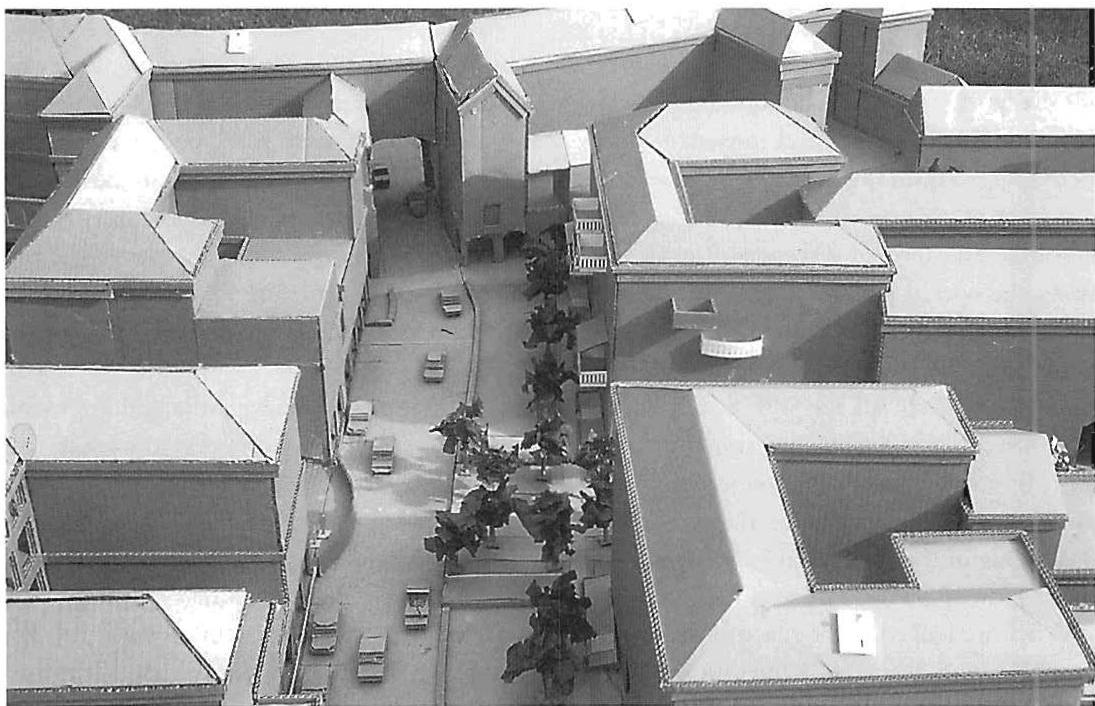
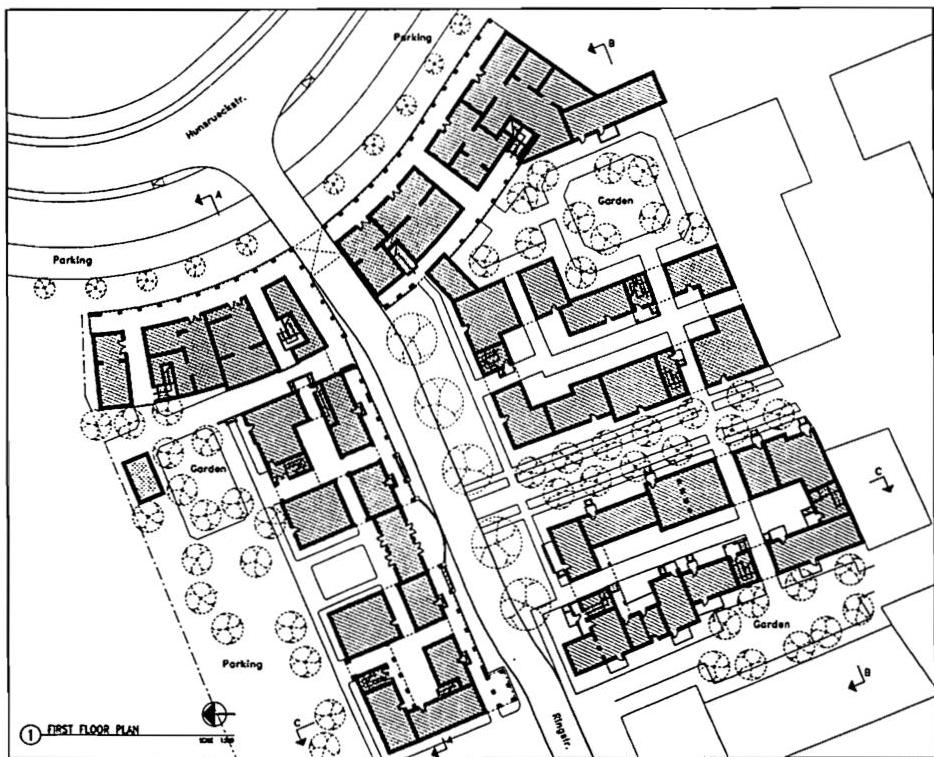
thought-experiments, walking about and using the real place as a kind of simulation, that the street coming in should be wider at the mouth, and then narrower further back to the south. We determined — again by experiments based on feeling, and once again with several people doing it — that this minor one should be no more than 9 meters wide inside, with a slight widening at the mouth (about 11 meters wide).
All this may be described as a process in which we tried to make these two main arms of the T as positive as possible, as living centers.
Following the fundamental process, we began to shape this T-junction in such a way as to intensify the existence of the main centers — by forming partial enclosure. To do this we undertook experiments in real city spaces that approximated the ones we were trying to define.
There were several of us making these judgments, together. That always helped to make our judgment more reliable. With some effort, we could reach agreement of feeling on any given issue. But it is not so easy to do these experiments. Although having several people together helps, because one can then get confirmation, and unity of judgement, it is not something anyone can do. The reason is that it takes quite a lot of concentration to keep on thinking about the real situation (in Frankfurt, and in our evolving cardboard model) while making these judgments in Oakland. One has constantly to realize that it is an experiment about Frankfurt, and an experiment about the evolving design, which does not exist yet. That takes experience, and concentration. But it is possible, and it is tremendously useful. After doing it, one feels more certain about the design, and experience has shown often that this confidence is reliable. After such experiments, the real places which result do have — nearly always — the right feeling, a wonderful feeling. When done right, there is carry-over from the experiment to the real thing one builds.
If I had to define the process we followed as a generalized (and reusable) stepwise process,
New town of Parkstadt-Unterliederbach, elevation of buildings along one street. Frankfurt, Hoechst: Christopher Alexander and Hajo Neis, 1996.
Study model of one wall of one of the Parkstadt buildings, in Frankfurt, showing how the uniqueness of apartments laid out inside by the families is reflected in window arrangement and window size, visible on the outside of the building. Still, the building maintains its order and its discipline. Yet it is friendly, welcoming, and true to what takes place inside. Christopher Alexander and Hajo Neis, 1996.
I might suggest that we follow a sequence of steps something like this:
Identify the main spaces (in this case the T).
Reshape these main spaces to strengthen them.
Work out tentative buildings volumes to make these spaces stronger.
Introduce inner spaces (gardens and courtyards) as the focus of the buildings
Make a model of the space alone.
Add smaller passages, connecting the space and making it alive and varied.
Establish the best orientation of minor centers (like the wide sidewalk, and neck of the smaller street)
Fix the dimensions of the space (in relation to building heights which will be coming)
Reconfigure the buildings so as to intensify the system of spaces.
Grapple with building entrance positions, to support the spaces and the lines of movement. Locate further small centers (the narrow neck, the gate, the wider mouth of the small street).
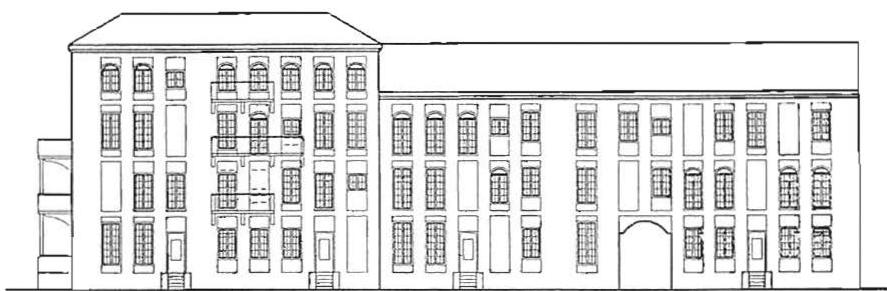
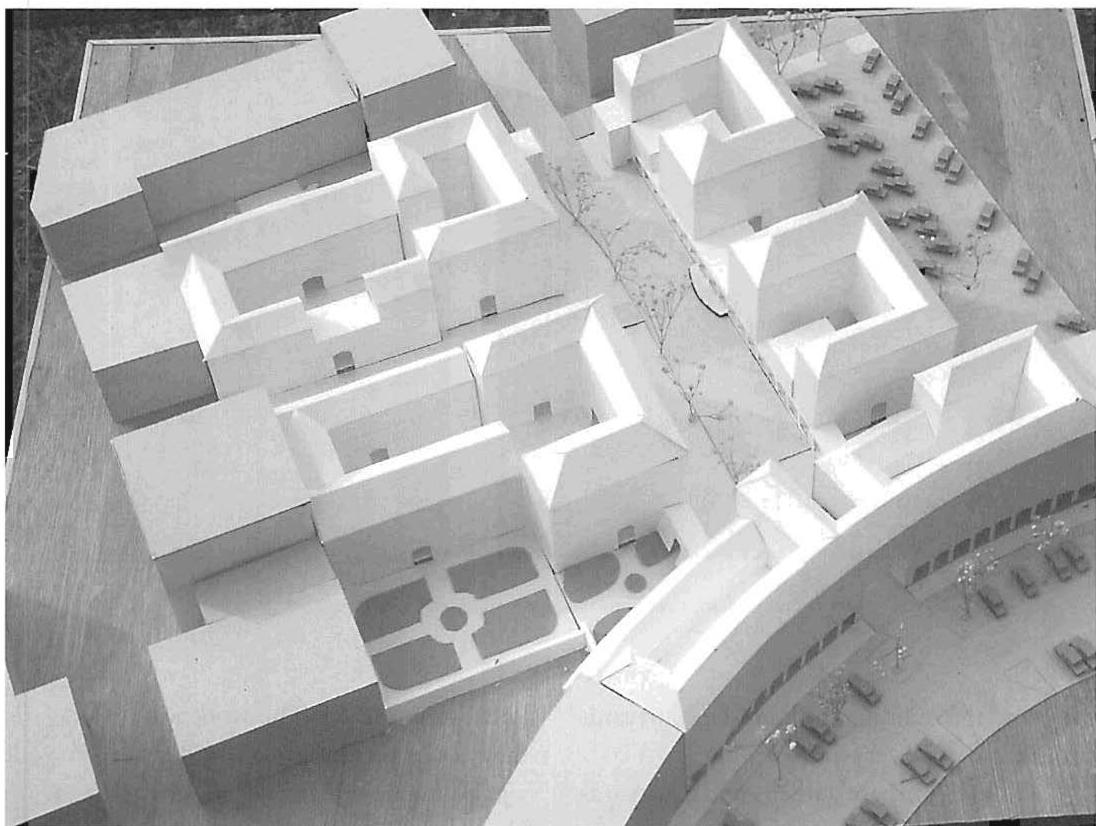
- Make the interior plans of the buildings, fit the profiles and plans that have been evolved to strengthen the spaces.
- Subdivide the interiors, to fit the irregular building plans.
Each of these steps was a structure-preserving step which forms or strengthens centers. We took the steps, very deliberately, concentrating on only one center at a time. At each step we chose, as far as possible, the one thing which did most, at this step, to preserve and deepen the structure of the whole.
Expressed in other language, we worked to try and get each one to do the most to increase the feeling of that place.
In later stages of work, we determined that the buildings were all to be courtyard buildings—necessary to get good light in the build-
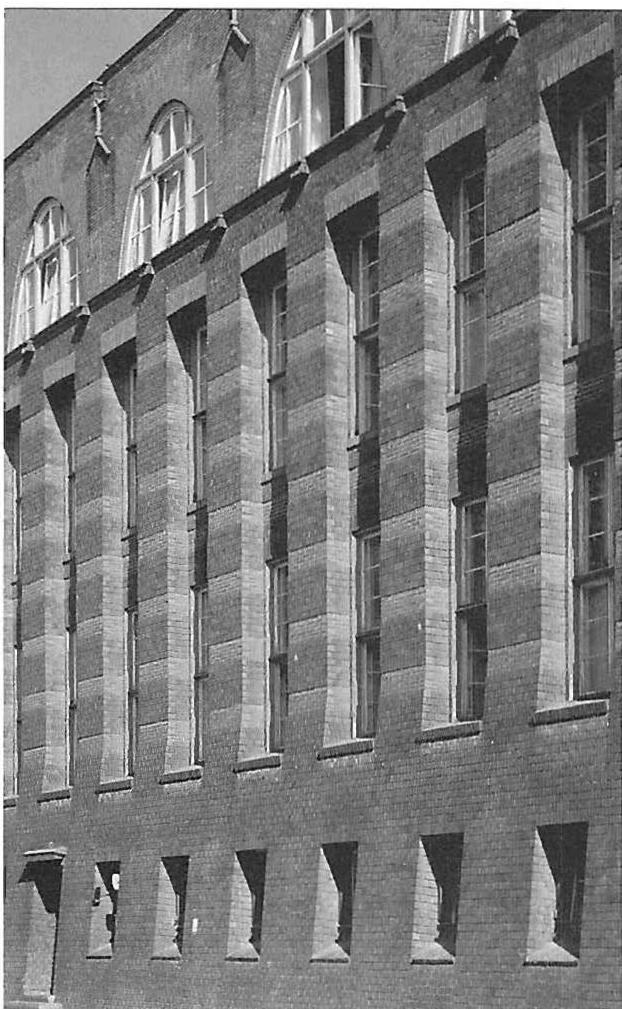
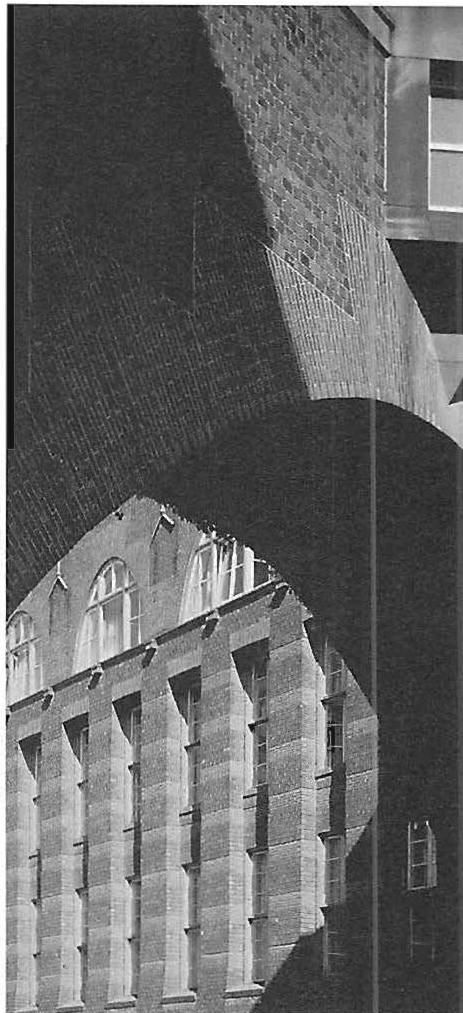
ings — and the buildings around the courtyards had therefore to be very narrow.
Then, each of these gardens and courtyards was shaped to give it a powerful interior shape, without in any way distorting what had been worked out in the buildings and entrances.
On the basis of many discoveries in the detailed design of the buildings, further refinements were made. The exact shape of two upstairs courtyards, the size of courtyard required by fire laws, the position of gates and walkways, were all adjusted to produce the final form. Illustrations on these pages have shown how these
hulls were formed. The work was done against the backdrop of buildings built years ago by Peter Behrens (which in another part of the Hoechst complex had begun to form other, similar hulls of space). In Behrens's building, and in our planned buildings, it is the whole of this structure of space, all the space that is shown black and solid in the diagram on page 80, which forms the hull that is to be built.
Again and again, the definition of the buildings came afterwards, after the space has been defined. The main job the buildings have is to form the space.
8 / A NEW APPROACH TO URBAN SPACE: FIRST FORMING A THREE-DIMENSIONAL PLAN OF HULLS
Let us ask, now, how a system of hulls, the shaped space of a town, might be created in practice.
Since it is true that such space is hard to shape, and that shaping it must come first, before shaping buildings — then there must be some way of giving the creation of this system of hulls the mental and social priority it needs, then using it as a common goal for the town, and getting all the individual acts of construction to participate and complete the geometry of the spaces.
That, in turn, requires a new form of representation, a new form of plan or diagram. It must be something which is three-dimensional, which is flexible (so that it can absorb the variations and local needs of different building projects), yet something which maintains a real handle on the shape of the space, and on the shaped system of spaces, that are required to keep the hulls of space throughout the town in good order.
I used to think that this large-scale structure — the hulls of space for a town — had to be created piecemeal, as a forest is created from the growth and interaction of the trees, without a plan. That is partly true. But I have become convinced, after years of trying to make it work, that it is after all necessary to have some kind of plan. Pure piecemeal growth just does not work well enough to create the structure of the larger wholeness needed in a city. The reason is, that it is the large-scale organization of the space, the actual geometric order of the streets and spaces, which matters most. Even the beautiful and sentimental Italian hill-towns, which look as though they just grew, were sometimes planned, laid out, by the bishop of the local church, or by someone else who cared about the whole (see illustration).
The unfolding process, in the case of a town, is complex and difficult. It cannot always go on, romantically, “by itself.” It needs guidance of a disciplined kind, through which the emerging space is defined, agreed, and visualized in some public and sharable form of a three-dimensional model. Once we have a way of doing this, the whole thing can go forward easily enough.
On the next page I show a kind of diagram which may be useful: a three-dimensional cartoon, which places emphasis on the spaces as solid objects, and allows everything else to support these spaces and related to them.
The principle which creates such hulls for the city as a whole, or for a large part of a city, may also be used repeatedly in local areas to create a similar map, or diagram, for the streets and pedestrian hull within each local area.
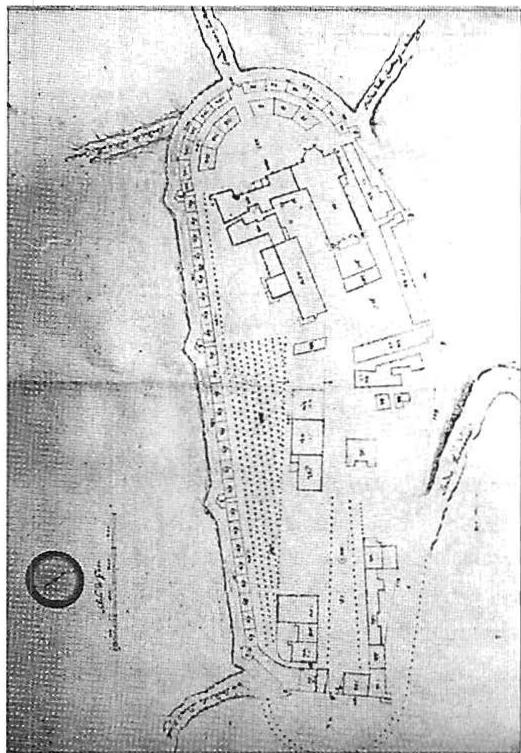
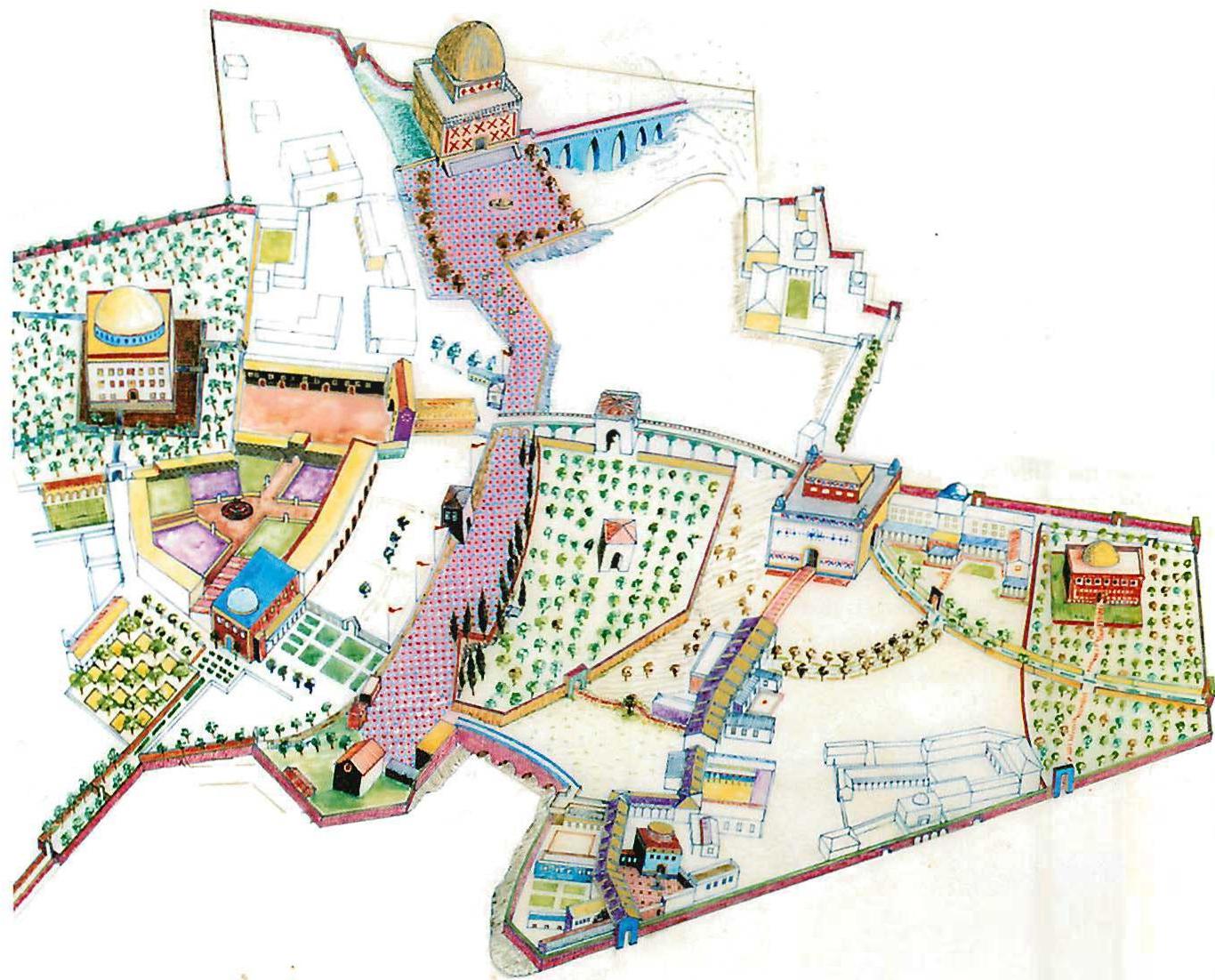
My design for the Aga Kaha competition for a new city center for central Samarkand, to be built on aubailt land. The buildings and spaces in their entirety were designed by us from scratch, to match the important 14th-century buildings all around the site. The drawing might be considered a model of the way that pedestrian bulls could be shown, and specified in a new kind of urban city plan. The drawing shows, in three dimensions, the "bull" or essential spatial envelope for this central section of Samarkand. Unlike a typical plan, the drawing concentrates on the key spaces, their shapes, building volumes, paths, and connections, with their relation to the land and to the rest of the existing city. Such a drawing can allow individual building projects to take their own form within the limits of the drawing, and to contribute in their own ways to the bulls of space that are portrayed.
Christopher Alexander, Bob Walsh, Hajo Neis, and students, 1993.
It is notable that in this example, the centeredness of each hull, making it a living center, is intensified by the powerful center of a powerful and carefully chosen building. Although placing an important building at the "head" of every major public space could hardly be an absolute rule—it is too strict—nevertheless it gives an indication of the kinds of specification that may be needed to be sure that the hulls of urban space are real, and likely to succeed, while retaining flexibility and artistic openness for the builders of the individual buildings.
Once again, though, the builders would need to accept and understand how the shape and organization of each building must somehow work to bring life to the hull it dominates. This needs, yet again, a new form and new conception of urban planning, and a new form of specification.
9 / IMPLEMENTATION
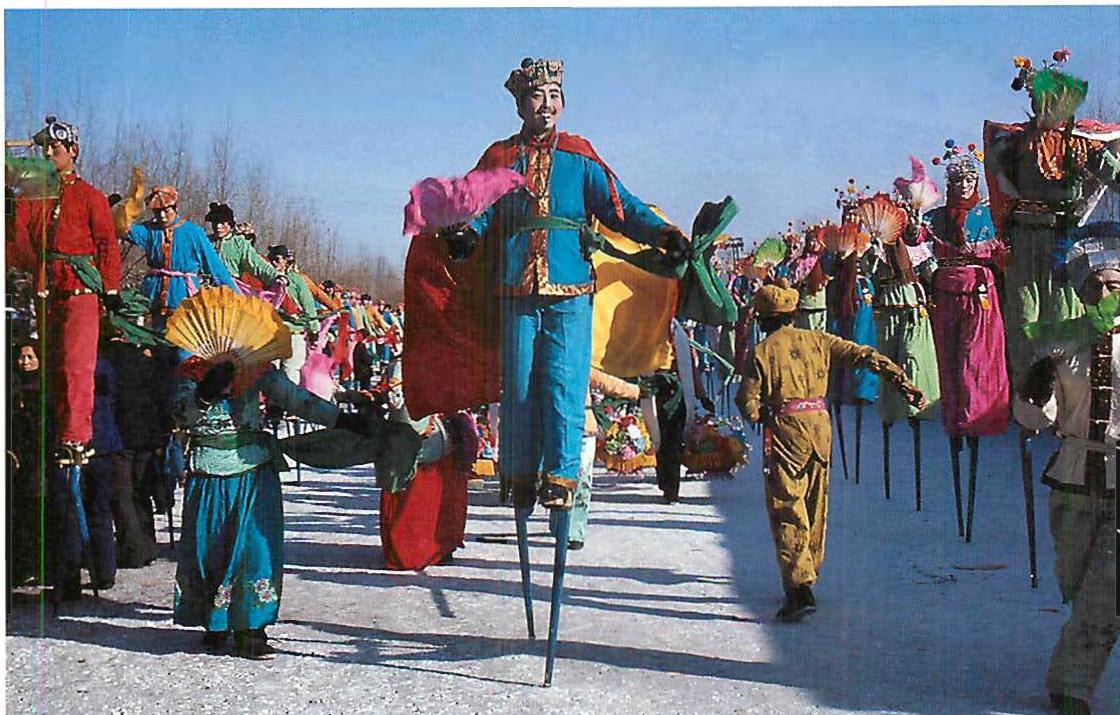
As I have said earlier in this chapter, I have found in all the years of my professional life that the shape of public space needs to be taken as seriously as the shapes of buildings, but this is very hard to implement, because our present consciousness focuses more easily on building-volumes than on spaces.
Above all, it means that our method of visualizing, or agreeing, on what we want to build, has to be thought through again.
In my experience, codes or systems of rules are unlikely ever to be enough. They are too abstract, too conceptual. They seek to be general—in the hope of creating a framework of order in which genuine freedom can exist. But in fact they do not say enough about the space, and do not guarantee the emergence of shaped space with genuine deep feeling—hence life.
This means that plans like zoning ordinances and master plans cannot be enough. They are not physical enough, they do not describe the attributes or necessities of living space, they do not insist with sufficient force and artistic clarity on the actual shape of space. What is needed to support the individual acts of construction that
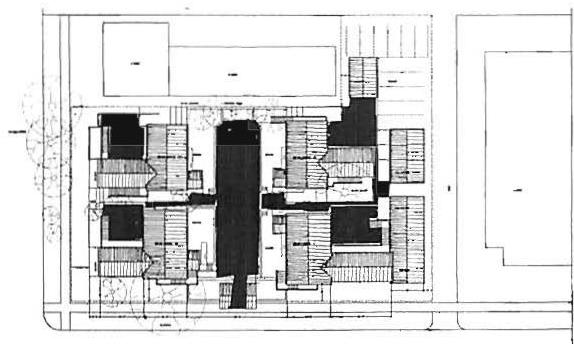
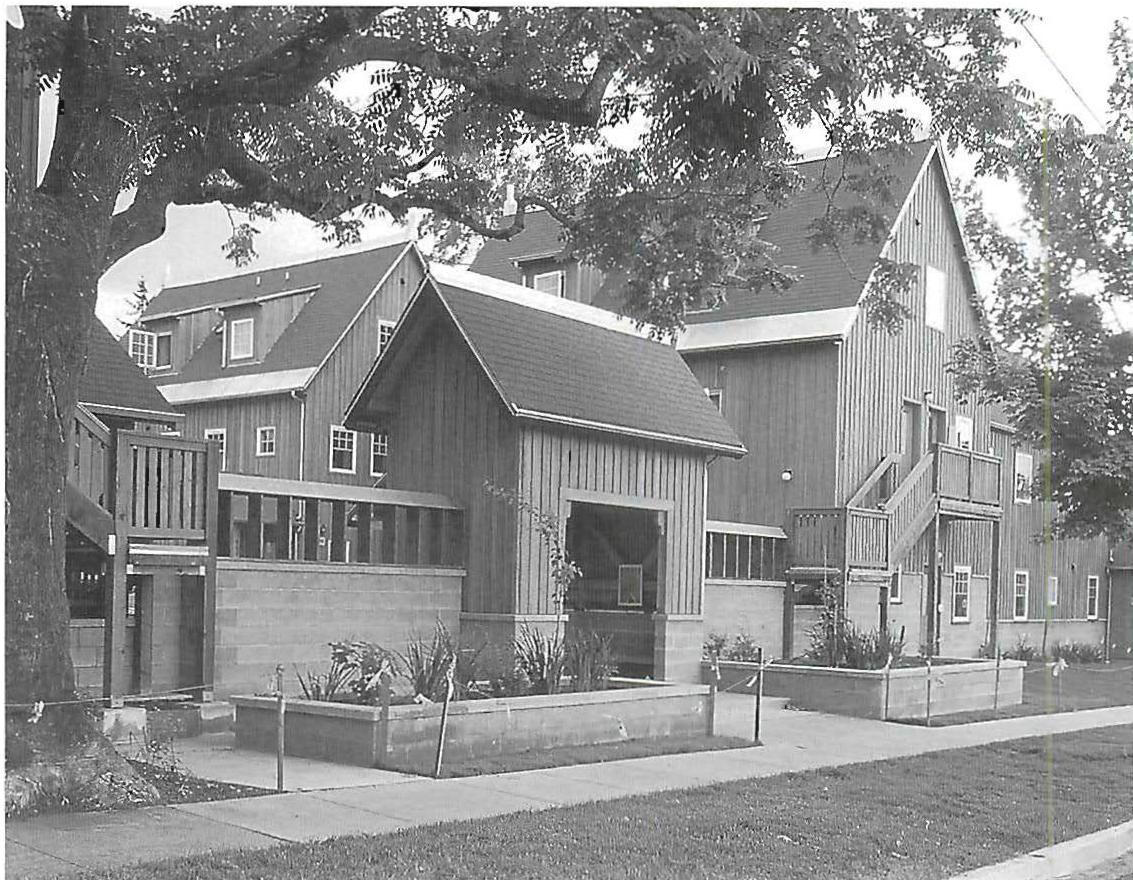
make up the life of the town, is a three-dimensional diagram of the actual shape of the needed space.
A very physical document of the positive space—more physical even than a model—which shows in great detail the connections, shape, subtlety and physical presence of the space which is to be created, the interlock of spaces, the flow of space.
This plan could look like the three dimensional drawing of Samarkand (page 94), or the plan of Eishin, which was staked on the ground, and was therefore understood by everyone (see Hosoi's comment, at the stage when only stakes and flags were in the ground: "We could see . . the buildings . . standing . . there," page 179).
Once we have this diagram—it is an understanding, and agreement, a vision, which each player is then to help embody.
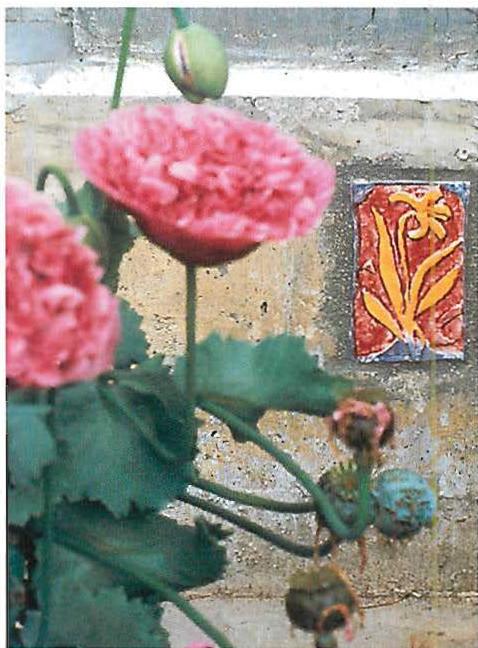
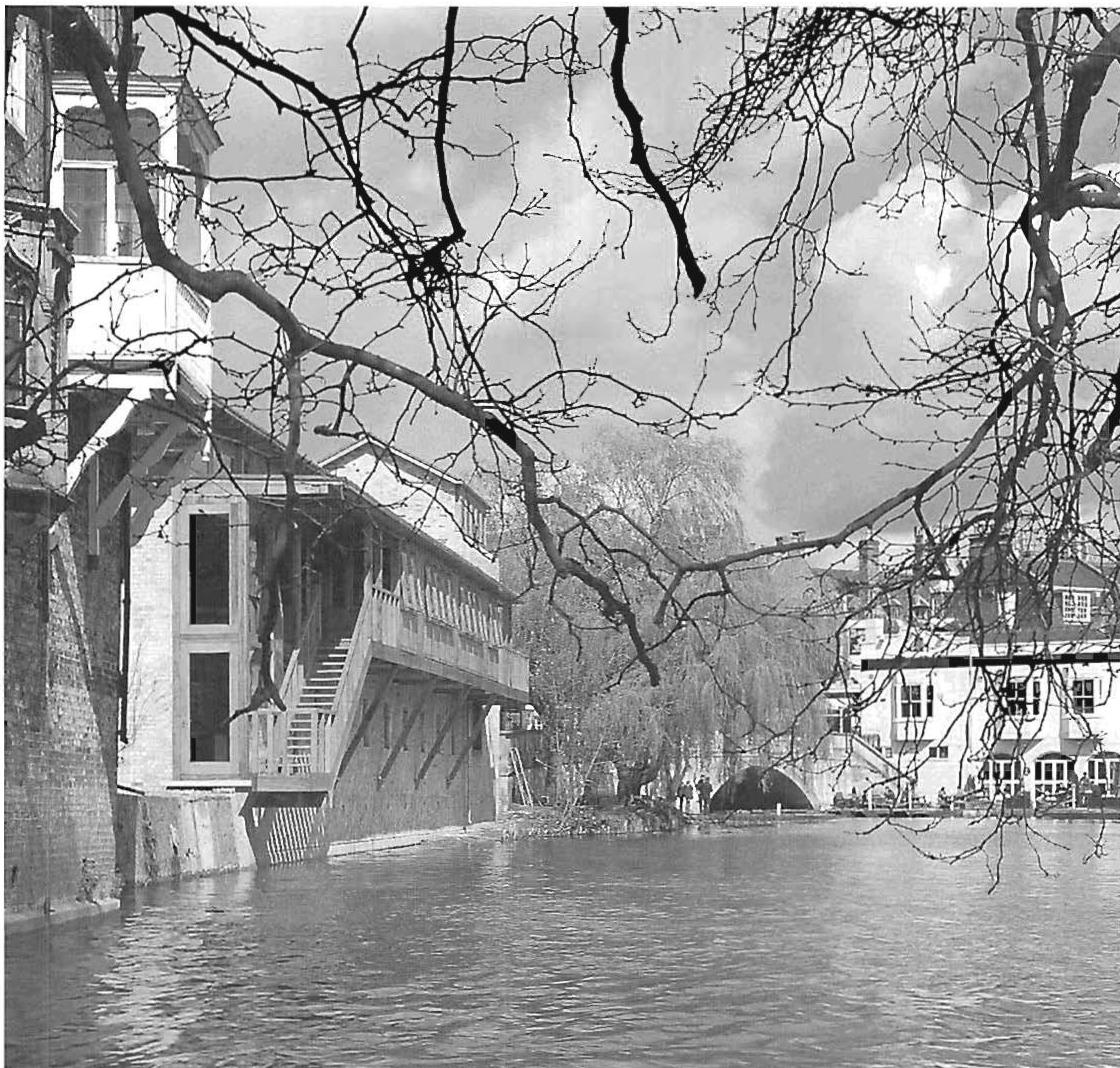
A major change; this process requires wide acceptance, throughout society, of an attitude in which transportation engineers have secondary—not primary—control over the shaping of roads. Transportation engineers must make their work on cars SUBSIDIARY to the work which defines the pedestrian bulls as places which people can use, and own. Even a street becomes a living room. In an unfolded world we find that all living structure is anchored by a hierarchy of circulation and living rooms. The common living rooms are shaped by buildings, by the exterior volumes of buildings. Every space that exists is either a public space, which is a hull, or a private space which forms a positive and useful garden.
We ask, then, that each player makes a contribution to this growing whole.
We cannot legislate this. Rules, laws, restrictions, are too exact, too restrictive. Instead we ask that each individual actor think about it, work within it, contribute to it.
What we understand is a scheme of wholes. The remaining acts of construction are then to be like brush strokes, which will gradually complete the painting. We know that some brush strokes, by virtue of their feeling, or their force, will themselves transform the vision of the whole. Still, though, it is the whole which is being conceived, like a sculpture of living space.
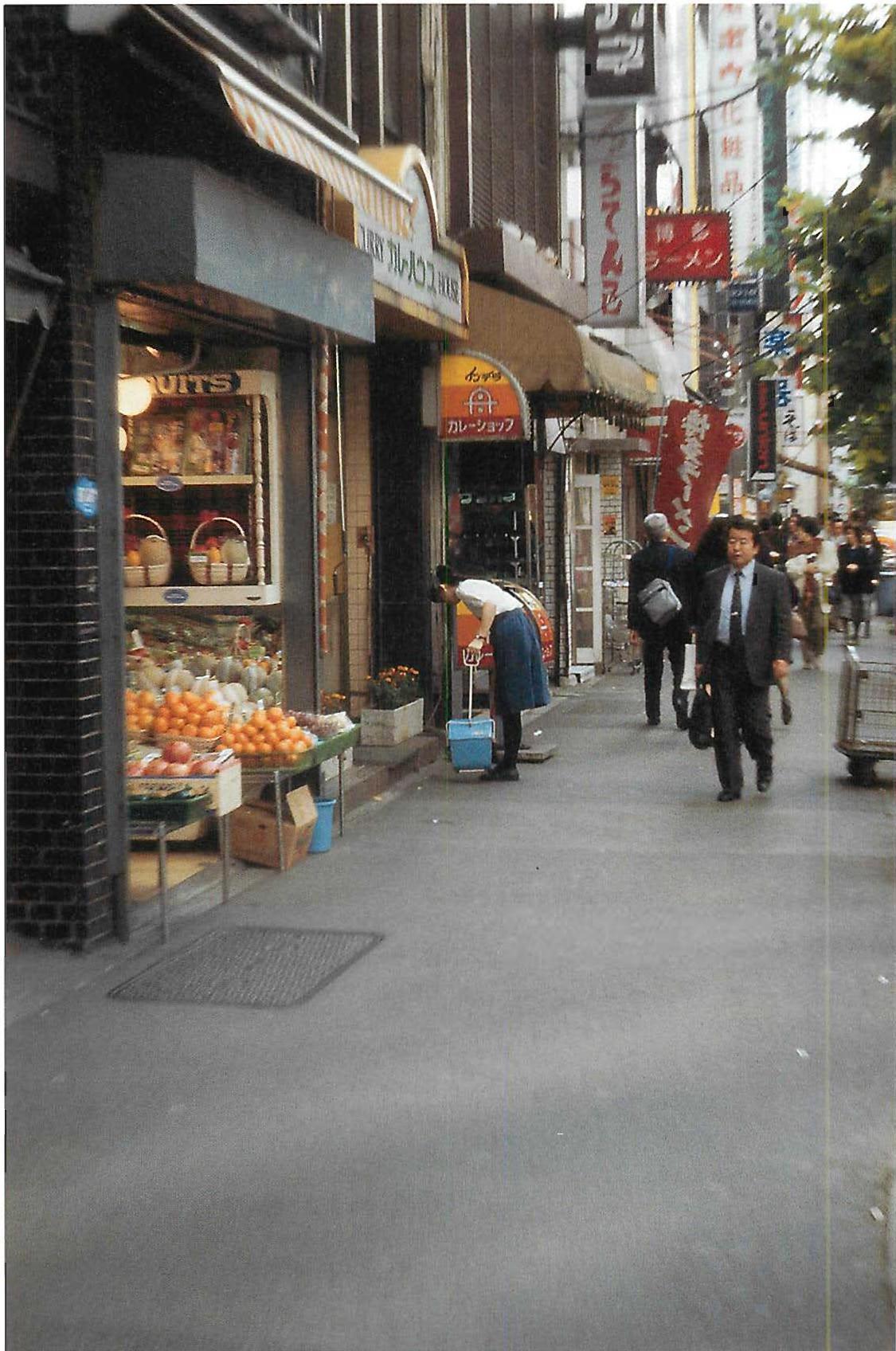
10 / SUMMARY OF THE EFFECTS
I should like to make you understand, in the broadest terms, why this structure — a system of hulls of public space — will inevitably be created by the unfolding of a living process, if it is truly living, and truly allowed to unfold.
Consider the situation. Imagine that at any step in a process of urban growth, we have one positive space which is forming part of the hull. As I have said, these positive spaces have the quality that they open into one another, one into the next. Imagine, then, one step in the unfolding process. One of the places in the growing hull — one center — is to be made better, more living. To accomplish that, it first has to be better shaped itself. At the same time some larger center that it belongs to is to be made stronger also — that will often be the next space, the next
larger space from which this one buds off like a limb-bud.
At the same time, too, the small center we started with is also to be strengthened by the formation of some still smaller center. That means either a smaller symmetrical space—even an arch, gate, or doorway leading into it—or some detailed local symmetrical center which adds to the center that has already been formed: a fountain, a seat, perhaps something very elaborate in the middle, perhaps no more than a stone placed beside an old tree trunk.
Repeating this process, moving from center to center within the hulls of space, we see that with time, inevitably, step by step, just that structure which I have been describing will appear.
11 / MORPHOLOGICAL FEATURES OF PUBLIC SPACE CREATED BY LIVING PROCESSES
So, when public space unfolds under the impact of living process, the following features are likely to emerge: First, the whole thing will emerge from wholeness-preserving transformations. That means, what emerges will be based, in some way, on the natural features in the landscape, or in the townscape, and will expand and deepen the natural character already present. The spaces will enhance, deepen and expand what is there, in the city, or in the land—that which is familiar. Within this geometry, the public spaces are gradually transformed to become a continuous, connected system of distinct centers, well-shaped, partly surrounded, enclosed, positive spaces. The centers include, but are not dominated by, what we now think of as streets—those spaces which allow cars to go in them.
To give the hulls their definition, the boundaries of these public spaces are shaped as a system of living centers surrounded by buildings, by walls, by trees, by natural contours, even by views. Thus, as a center, each of these hulls is visibly contained, so as to MAKE it a hull.
All activity opens from these hulls. The effect of the hulls, then, is rather like what was described in a PATTERN LANGUAGE as CIRCULATION REALMS: a system of partly closed precincts opening off one another, and so arranged that everything important opens off one of them.
When the fundamental process is working properly, the hulls will be more open than courtyards. But they will not be amorphous like modern streets. They will, rather, turn out to be made of pieces of space, EACH PIECE A PLACE WHERE IT IS PLEASANT TO BE.
From the way the spaces develop naturally under the impact of the fundamental process, it will slowly, and naturally, become clear that the spaces belong to everyone — to people. Each one is thought, felt, judged, given its dimensions — in the place itself, by people standing in the place, using their common sense, their instinct, their sense of rightness. For each one, its size, diameter, length, width, edges, height of the edges — these are all formed while people are standing there, from the judgments they make in the actual place as they decide how to make each place strengthen and support the wholeness that exists. It is that, ultimately, which helps each place achieve its centeredness.
These marked, defined centers, form the whole of the system of public space in the environment. We move from one to the next, there is nothing “left over.”
Finally, in geometric terms, what is the shape and character of the hulls that are likely to emerge? There is likely to be an unusual combination of looseness and symmetry. What will strike, above all, are the local symmetries, with attendant complex syncopated smaller symmetries, modifying the larger ones in asymmetric fashion.
All parts of the unfolded public space are shaped, fashioned, treated, as if each were a kind of larger living room. Each seems symmetrical, and yet is not—just as each human face looks symmetrical, and yet is not.
CHAPTER FOUR: HOW DIFFERENTLY A LIVING PROCESS GENERATES LARGE PUBLIC BUILDINGS
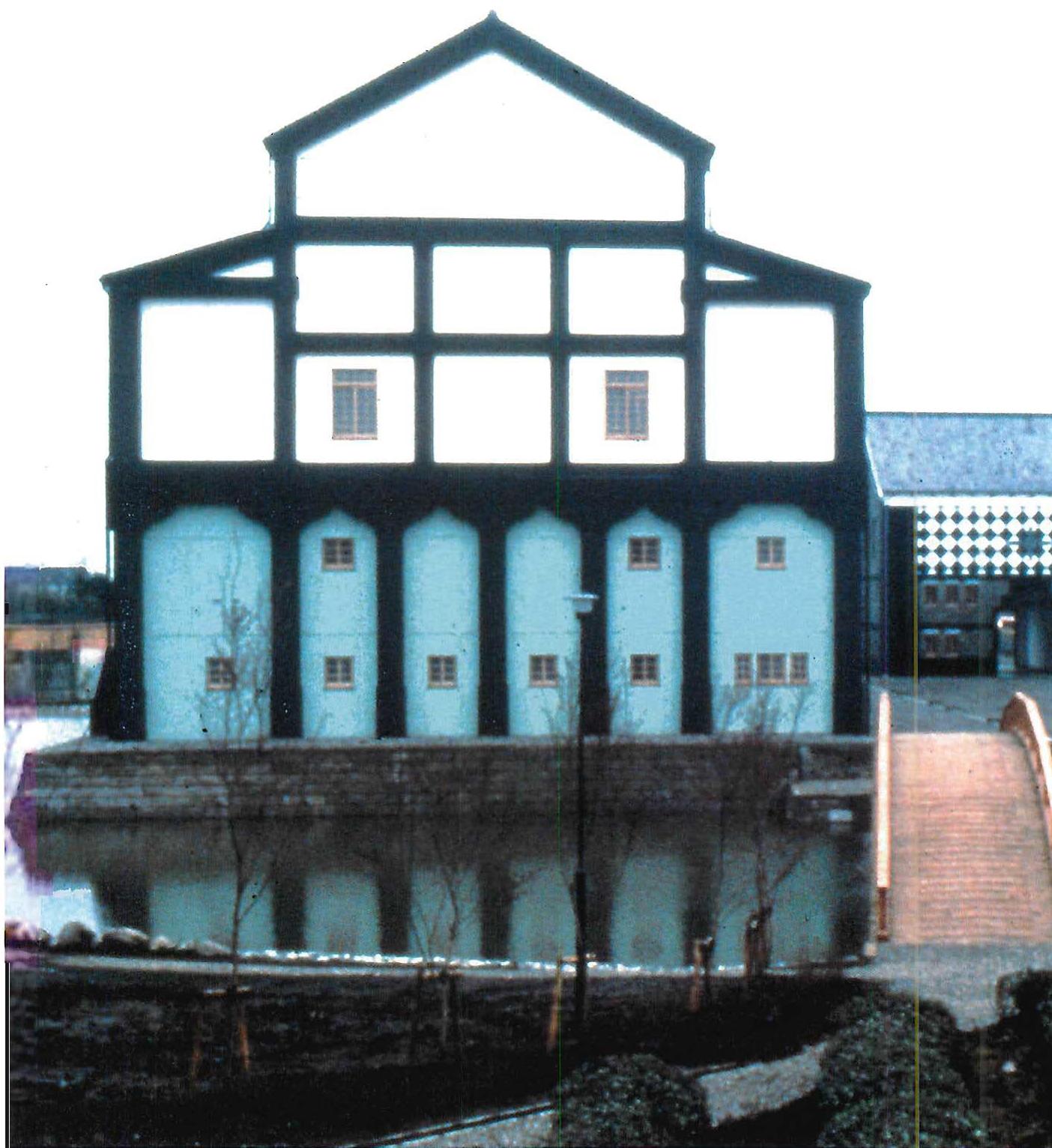
1 / HOW LARGE BUILDINGS MAY BE CREATED BY THE FUNDAMENTAL PROCESS
The most critical thing to unfold from the hulls of public space, are the large buildings — especially the large public buildings. They form the main centers that fix the public space and give it life.
Although the detailed treatment, design, and structure of buildings in general will be taken up later in the book, by examples of other processes, I start with these large buildings because they play such a vital role and do so much to embellish public space.
What happens, typically? An important space, one of the hulls of public space described in chapter 3, existing in rudimentary form, is to be embellished, made stronger, given more life. Usually one building, then, becomes the "head"
of the space. Others, secondary buildings, may also come into play as secondary centers.
Almost without exception, this building is to be a jewel, it is to play a role of a vital center made to animate the public space. The volume of the new building, then, is created by its relation to the public space, by the need to make the space more alive by the insertion, and then differentiation, of this "jewel."
To illustrate the process I shall touch, in this chapter, aspects of six public buildings: The Great Hall at Eishin Campus; the Mountain View Civic Center; the Tokyo International Forum; The Julian Street Inn in San Jose; the Mary Rose Museum in England; and the Nyingma temple, Kathmandu.
2 / THE GREAT HALL: A MULTITUDE OF LIVING CENTERS
The Great Hall at Eishin is illustrated on pages 102-111 in this chapter, on pages 180-81 of chapter 5, and on pages 206-10 of chapter 6. The process of laying out this building, designing its detail, completing the detailing and ornament, and managing construction, is to be described in detail in another book, BATTLE: THE STORY OF A HISTORIC CLASH BETWEEN WORLD SYSTEM A AND WORLD SYSTEM B (in press). The description will give the practical steps that were involved at Eishin, and the practical aspects of design and construction management which were required. In principle, what happened in the Great Hall closely followed the accounts of process given in this chapter for two other large public buildings; the Mary Rose Museum (pages 132-50) and the Julian Street Shelter for the Homeless (pages 120-31).
In order to grasp these detailed points of management—which certainly do require entirely new ways of thinking about the making of a public building—we need to know the essence of it. We need an answer to the question, What is the essence of the way to make a large building in the context of living process?
It may be described, perhaps, in terms that are expressed fully in Book 4 (page 95 and surrounding pages): Everything you make must be a being. A "being" is another way of talking about a living center: it refers to the emotional aspect of a center when it is genuinely endowed with life. If you look at the photograph of the Great Hall on page 102, it seems to have a presence . . . something almost like a living being. That is because the whole building is a living center made of many living centers that have a correspondence with each other. And where is that quality coming from? It comes from the presence of living centers in the columns that are visible; and each one of them has this presence, too. It
comes from the presence of a living center in the shape of each bay between two neighboring columns: and each bay has this living presence, too.
If we examine the photographs of the building interior, on pages 104-111, we see lights as living centers, we see column capitals as living centers, we see the volume of the interior itself as a living center and a being (page 106). The stage, ordinary enough, has taken its shape as a living center. The ornaments themselves, the chevrons on the black columns (page 110-11), and the red quatrefoil in the center of the capital—these have a being-quality, too, because they too are living centers.
The subsidiary buildings which surround the hall, they have this quality, also. The music school attached on one side of the Hall, the small archway which approaches the Hall from the administration building (both shown on page 109); the bridge across the lake that approaches the Great
Hall from the east (page 102), these too, have, within themselves, the quality of beings: and then, the bridge's handrails, its ramp, its shape, those too are shaped and made as living centers.
But the quality of living centers also has a further aspect. It requires the positive-ness and thus the being-ness of each part that lies between two parts. Even the tea bushes by the lake (visible in the foreground of the picture on page 102) have being-like space between the rows of bushes. The spaces underneath each column capital, and between each pair of capitals—they have a being quality (this page). The space between the lights hanging in the hall, and the space inside the ring that bears each light, and the space between the individual lamps themselves—those all have a being quality, also. They, too, are living centers (see page 209).
The way in which a large public building can be given this quality—the presence of living
centers throughout its fabric — requires forms of management, forms of contract administration, forms of construction, which allow the focus of the entire operation to be on this living quality, day-in, day-out, while the building is being made — while it is first conceived, while it is planned in detail, while it is being built. Day-in, day-out, the construction of living centers
is going forward, and the entire management process is focused and arranged to make this possible.
The effect of the living centers, both their profusion and their unity, which makes the largest whole a living center too, is to bring nourishing life — real life — to the community and to its individuals.
3 / INTIMACY OF DESIGN WITHIN THE HUGE
Big buildings of the 20th century most often overwhelm us. We feel insignificant next to them, and unrelated. It is not because of their size. After all, when we are in a mountain valley, against a great rock-wall, say, the wall may be immense, the sheer wall might be thousands of feet high. Yet we do not feel it gross, or crude. It always preserves its scale in relation to ourselves. It feels human, even though it is gigantic.
That is because, quite simply, the LEVELS OF SCALE described in Book 1 are always present. There are planes, fissures, crevices, which bring the scale down, in easy jumps, from the gigantic wall of rock, all the way to small pieces, small clinging plants, and individual hanging boulders.
These two photographs show something of the way the mountain works, to preserve our humanity, in the case of the great hall at Eishin. In the upper photograph, the huge building of which we see only a fragment on the left, is given
its scale by the small music school attached to it. It connects us to the larger building. And,
Columns of the Great Hall. The mirror surface of the columns is polished black plaster known as Shikkui, an ancient Japanese technique (Book 4 page 47 and Book 2 pages 378–83). If you look at the black space between two red chevrons on the face of the leftmost column, you see that this black space is a living center, which is itself composed of two black rhombuses leaning away from each other, themselves also living centers. There are living centers everywhere.
again, in the lower photograph, we see the hall through a tiny archway from a building across the plaza. Again we see only a fragment of the massive hall, emphasizing its great size. Yet still, because of the relationship established by this archway, we are made comfortable, and feel related to the hall, even though it is so huge. It is because of the detailing, and the long hierarchy of scales in the living centers, ranging in comfortable steps from the great size of the building volume, to the smaller building next door, to the bays, then to the columns, and finally all the way down to the smallest ornaments. We feel it all to be related.
4 / MOUNTAIN VIEW CIVIC CENTER: DIFFERENTIATION OF A LARGE BUILDING AS A JEWEL, MADE BY SUCCESSIVE TRANSFORMATIONS OF THE SPACE WHERE IT EXISTS
If we follow a living process to embellish a public space, what must be made to happen is that the various aspects of the building break out from the context in such a way that it has the most magnificent effect on this place. Here we come to the fact that a building must preserve the structure of its surroundings. It should not impose itself, but instead — modestly, in a self-effacing way — creates a brilliant light, a flash of volume, shape, and color which takes the latent centers and symmetries present in that public place, develops, enhances, strengthens them.
The first thing to unfold will usually be the volume itself: actually an arrangement of volumes. In relation to the centers which exist in the public space, it is our task to do the minimum. This means that the volume is most probably established as a primitive rectangular volume — often a principal, single rectangle — often with minor rectangles accompanying it, or “hanging” from it.
To understand this process well, it is necessary to see the rectangles of the building volume as centers, and the rectangles of the space as centers too. Then both space and volume will have equal weight. Subsequently, at a second level, a series of smaller embellishments occur. The main symmetries of volume and space are usually given focus by new centers (again symmetries, again often rectangular) inserted at key points where latent centers are visible in the first-level structure.
This act creates a more elaborate structure, in which simple forms together generate highly complex asymmetries, while yet being simplified and smoothed out to preserve the simplicity of the whole.
At a third level of scale, we shall find the differentiation introducing more detailed structure: articulations in the building volume, segments, divisions, all locally symmetrical as far as possible — and again calculated to have their own, distinct levels of scale. This further encrusting of structure in the whole then begins to create a fabric of nearly sheet-like unity which binds the whole together and gives power to its feeling.
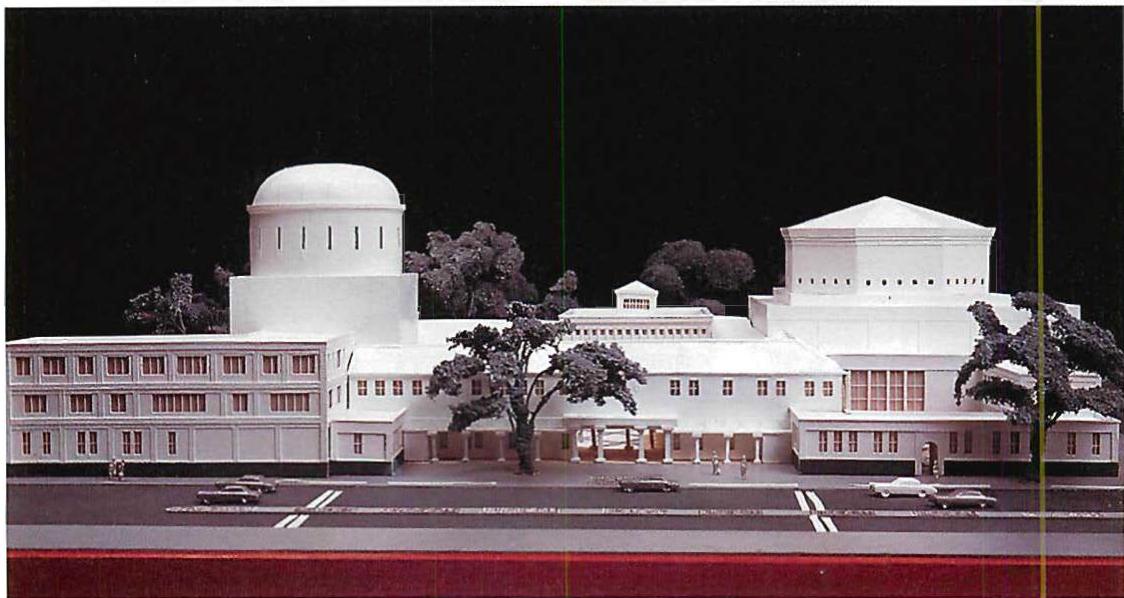
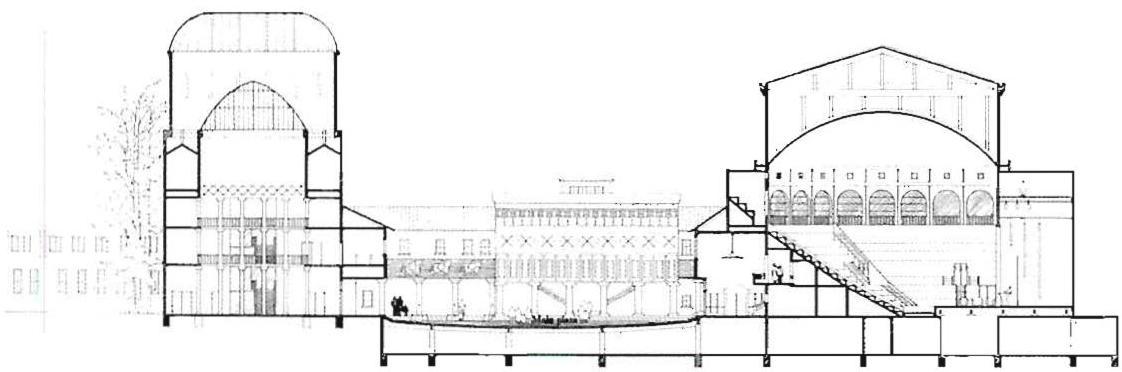
Main cross-section through the city hall lobby and theater. I like this section very much. Though, sadly, never built, it expresses the core of what I mean by a living architecture in form and character. It has no reliance, no echo even, in the buildings of traditional cultures. It arises as pure form, in itself, of the future, and arises pure, from the theory I have presented. Its geometry, articulation, are new and fresh. It carries the features of the fifteen properties and the imprint of the fifteen transformations without historical reference, and so shows what these transformations really mean.
The whole, a carpet of structure at many levels, will then exist as something rich and complex, sometimes immensely large, which yet remains—for all that—simple. If you scan the
examples in this chapter you see six big projects—two built, four not built. What is the quality they have in common?
First, an extended range of scale. They all
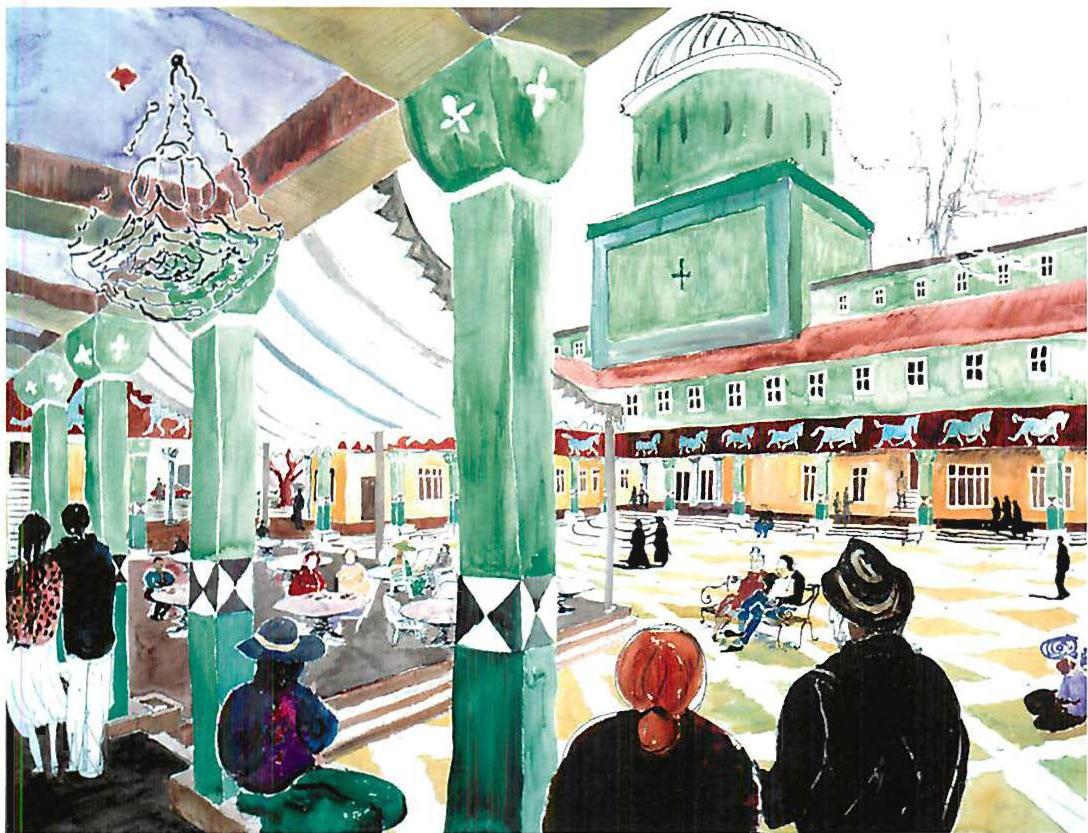
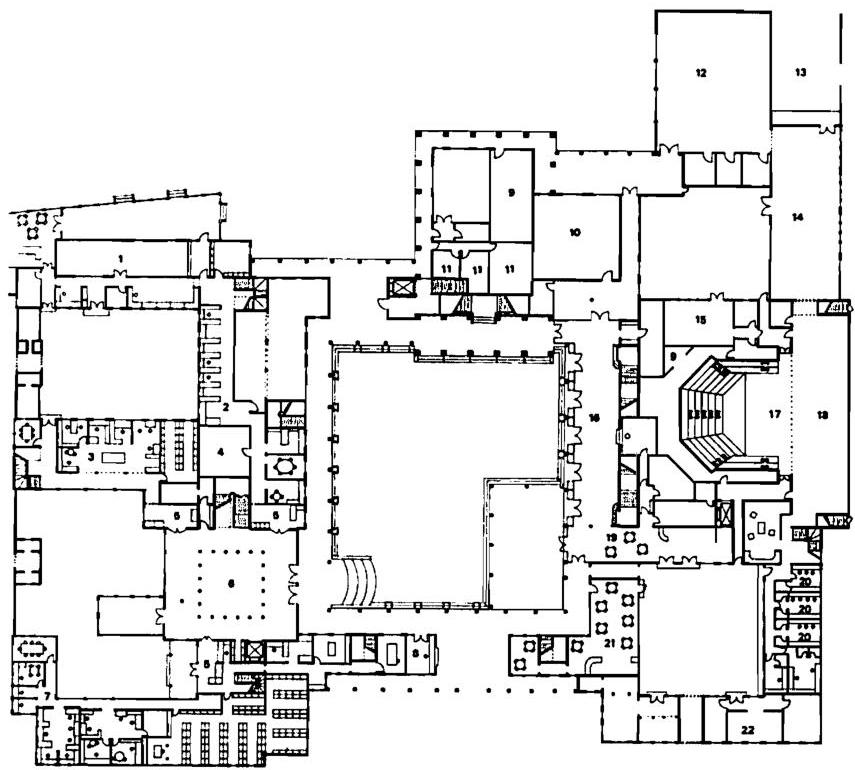
contain pieces which are like pieces of a smaller building. They have well-formed building elements, not too large, ranging from middle-sized to tiny in scale. There is a hierarchy visible so the building is not amorphous. Each of these buildings contains a pyramid of scale, going from the largest shape, in steady steps, down to the smallest details, which are at a comfortable, even intense human scale.
Once the broad structure is laid in—and even that is based directly on feeling, relatively simple and humane—the larger interior spaces then come directly from their location. Engineering structure comes from the larger spaces. Small spaces come from the structure. The detail comes from the structure and the smallest spaces. Above all, there is a careful pure geometry, simple and organized, with high degrees of local symmetries. Shapes have been found, which, within the scheme of unfolding, are able to express the deepest feeling directly.
From the point of view of unfolding, the design of a very large building poses special problems: The location and character of the most important rooms; the flow of movement from entrance to biggest space; the positive character of corridors and movement places, and the centeredness of each one; the position of the building volume in the site; the contribution which the building volume makes to surrounding space; methods of testing the validity of these larger features of the building, through models big enough to anticipate the feeling of the real thing; depth of feeling in the whole; rapid use of models, tearing up stuff, changing, chopping, placing, moving, until a deep feeling appears; major composition in terms of centers; very early involvement of the users; taking the users' notions seriously, whenever they contribute to unfolding, but not otherwise.
Helping to form hulls of public space by strengthening their centeredness is one of the most important of these things. All six of the illustrated projects do it. The Great Hall was conceived, and shaped, to extend the campus plaza (see pages 173-81). The Tokyo Forum is
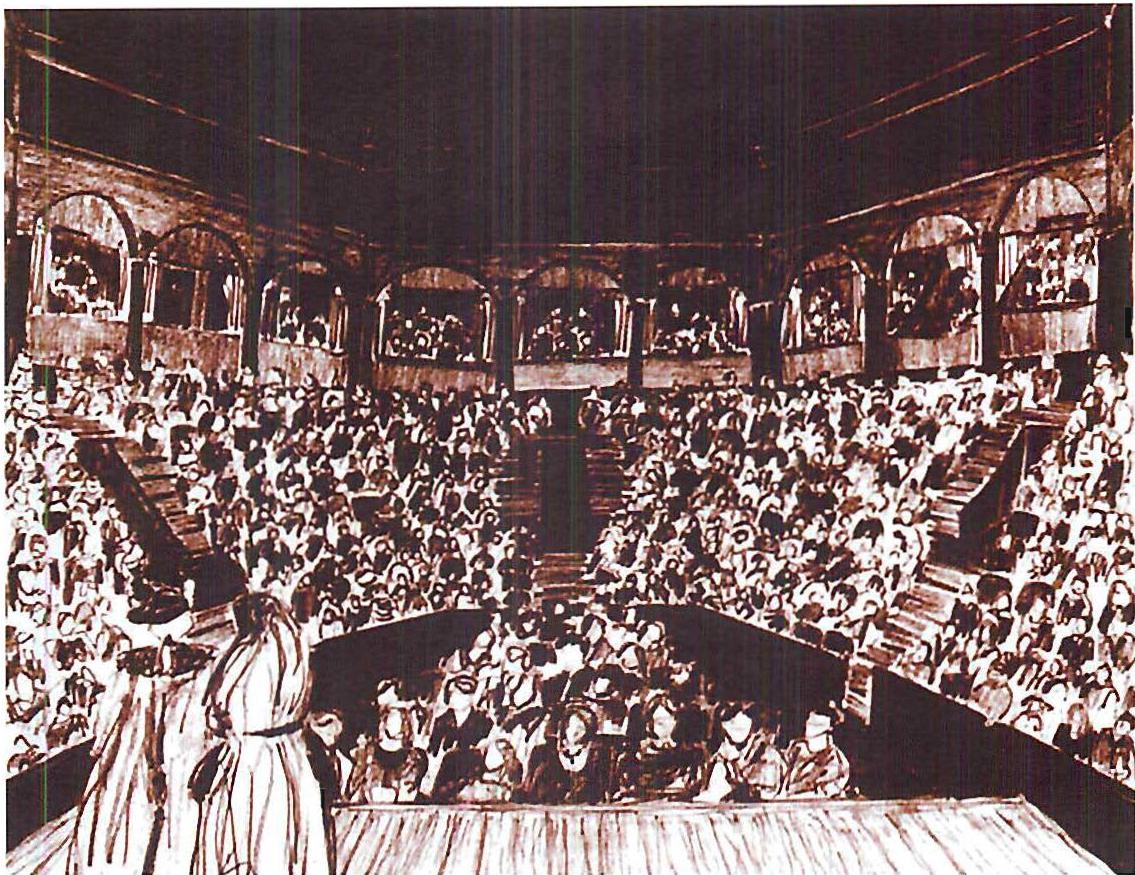
a progression through space, from the street to the enormous Assembly Hall at the top, extending the vector which starts from the street. The Mountain View Civic Center was formed by experiments to find out how best to support and supplement the feeling at that point in Castro Street, the main street of the city of Mountain View (see pages 112-14). The Mary Rose
Museum is shaped to give magnificence and wholeness of form to Victory plaza in Portsmouth, forming a space which helps set off and enhance HMS Victory (page 137). The Julian Street Homeless Shelter was built to give shape to the Julian-Montgomery intersection of San Jose, and to create interior courtyards which are public space (Book 2, pages 283-90).
5 / TOKYO FORUM: UNFOLDING OF A MASSIVE BUILDING
The method of getting the volume from the site appears even in the very largest example, a supermodern convention center in the heart of downtown Tokyo. This building complex was to cost (and did cost — though it was not our design
that was selected for construction) $750,000,000, three-quarters of a billion dollars.
The site was a huge block, in downtown Tokyo, next to the main railroad tracks going west from Tokyo station. Here is another exam-
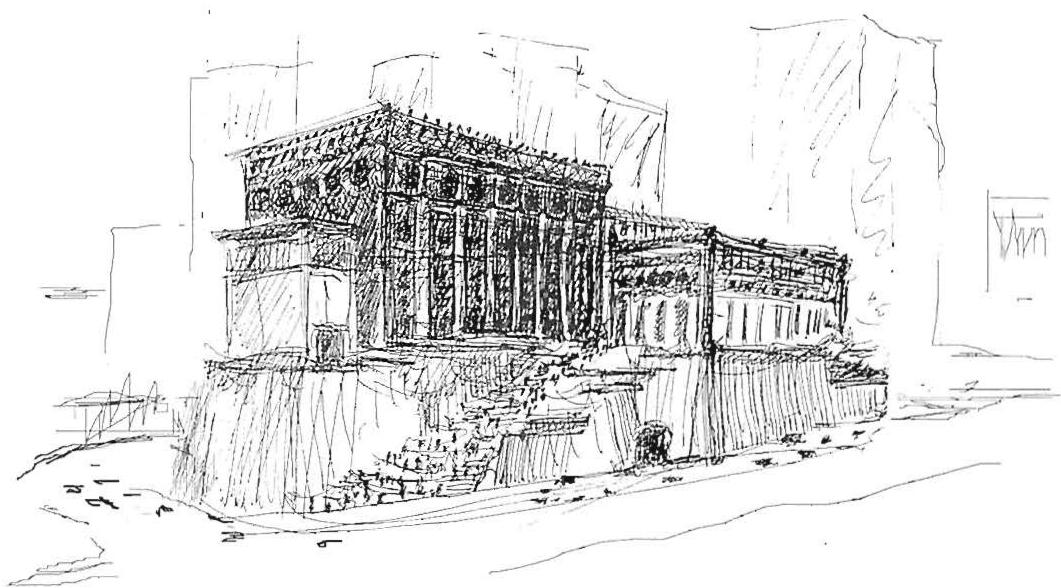
ple of the way that feeling appeared through unfolding, appearing step by step through a series of questions I asked myself as I prepared for the project.
First step As I was walking about the site, by the railroad tracks, a certain feeling gradually began to emerge. This feeling was the wholeness of the site, its overall feeling character as a whole, as it then was. I asked myself what act would intensify that feeling? After walking all four sides of the site, many times, I gradually began to feel a mountain growing there — like a rock: nothing near the ground, and something high on that rock. This sensation arose directly from the site as an answer to the question that I asked myself: What will intensify the feeling here?
Second step Next, I asked myself, Where is the main hall? I began to see an immense hall, at the top of the rock, visible from the outside, visible from the inside.
Third step I began to ask what the approach was to this immense hall. Then I asked myself more — how does one enter the site? What is the approach to the hall? I asked what would intensify the feeling of the site and the emerging rock, and hall, the most. I began to see an immense stair, passing through seven stories: leading to the hall at the top.
Fourth step I asked what the character of the hall itself might be, to intensify the feeling of the emerging building so far. This immense hall, almost the size of a football field — has columns which are themselves the size of rooms.
The use of feeling, in these steps, is not romantic, or arbitrary, or willful. Rather, in each case, the feeling arises as an observation about the existing wholeness, and moves to an observation about some direction of formation which is indicated by the wholeness: it is where the wholeness itself leads the situation.
For example, in step one, the feeling of the building arising out of a rock plinth comes about like this. Part of the fact about existing wholeness, on that site, was that the wholeness itself has a large, slab-like, flat volume of space — a center — which exists in the site as it is today. This virtual slab of space was induced, I think, by the Shinkansen tracks curving around the site. Thus there was, already, a center of this kind in the site. The configuration of a rock or plinth arose from the slab of space, directly, as that which would strengthen this configuration which existed.
In step two, the building itself, high on the rock, arises in the same way. The hall will be felt and seen as a vision from the passing trains only if it rises out of that rock. Again, the move
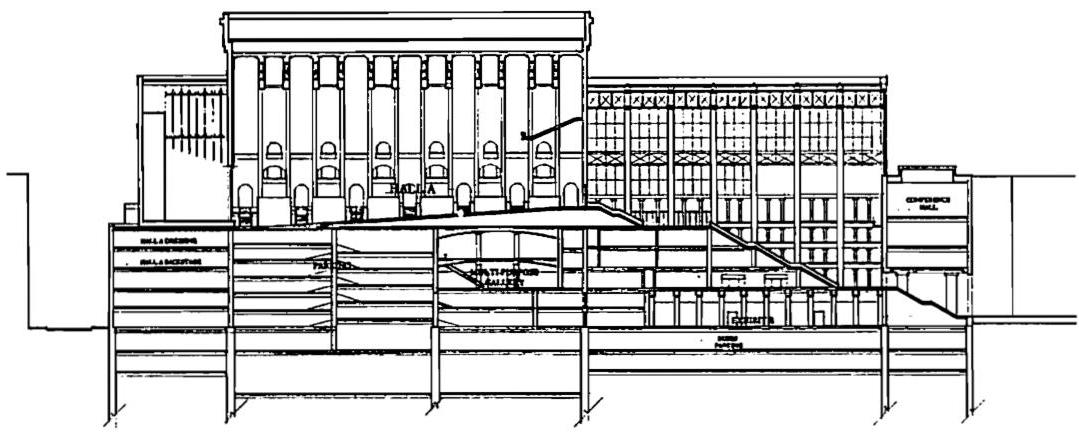
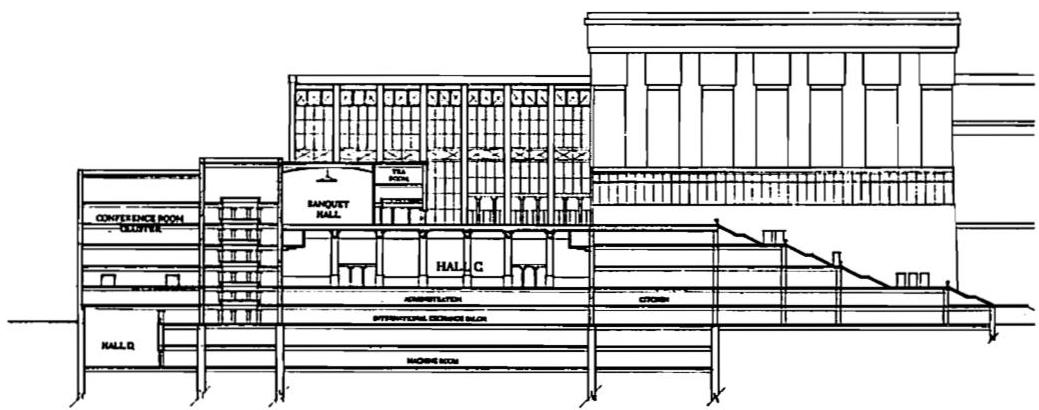
which intensifies the feeling most, is the one which intensifies the configuration as it exists.
In step three, the entrance, starting on the street at the east end of the site and going up towards the citadel-like hall, once again starts with the feeling of the wholeness as it is. This includes the fact that the east end is the major approach to the site: the fact that the site is longer east to west, and that the approach thus naturally goes, from east to west, rising. When this aspect of the wholeness is intensified, we get the great lobby and great stair, leading to the hall at the top. Again, the act which introduces most feeling into the site is the one which solidifies and extends the presently existing wholeness most vividly.
In step four, the Assembly Hall at the top is almost the size of a football field: 70 meters long, 50 meters wide. When one contemplates that immense space, without knowing its detailed structure (to do this, you only need to go out and stand on the street, in a place which is big enough so you can imagine the inside of the hall), you are very conscious of its length and width. The feeling of it which is present in you includes its existence at the top of the long staircase, on the top of the rock, seven stories high, above the city of Tokyo. When you begin to contemplate the feeling of magnificence which might exist in this hall, you become aware, inevitably, of a rhythm of columns and beams. Just the structure alone needed to support the roof
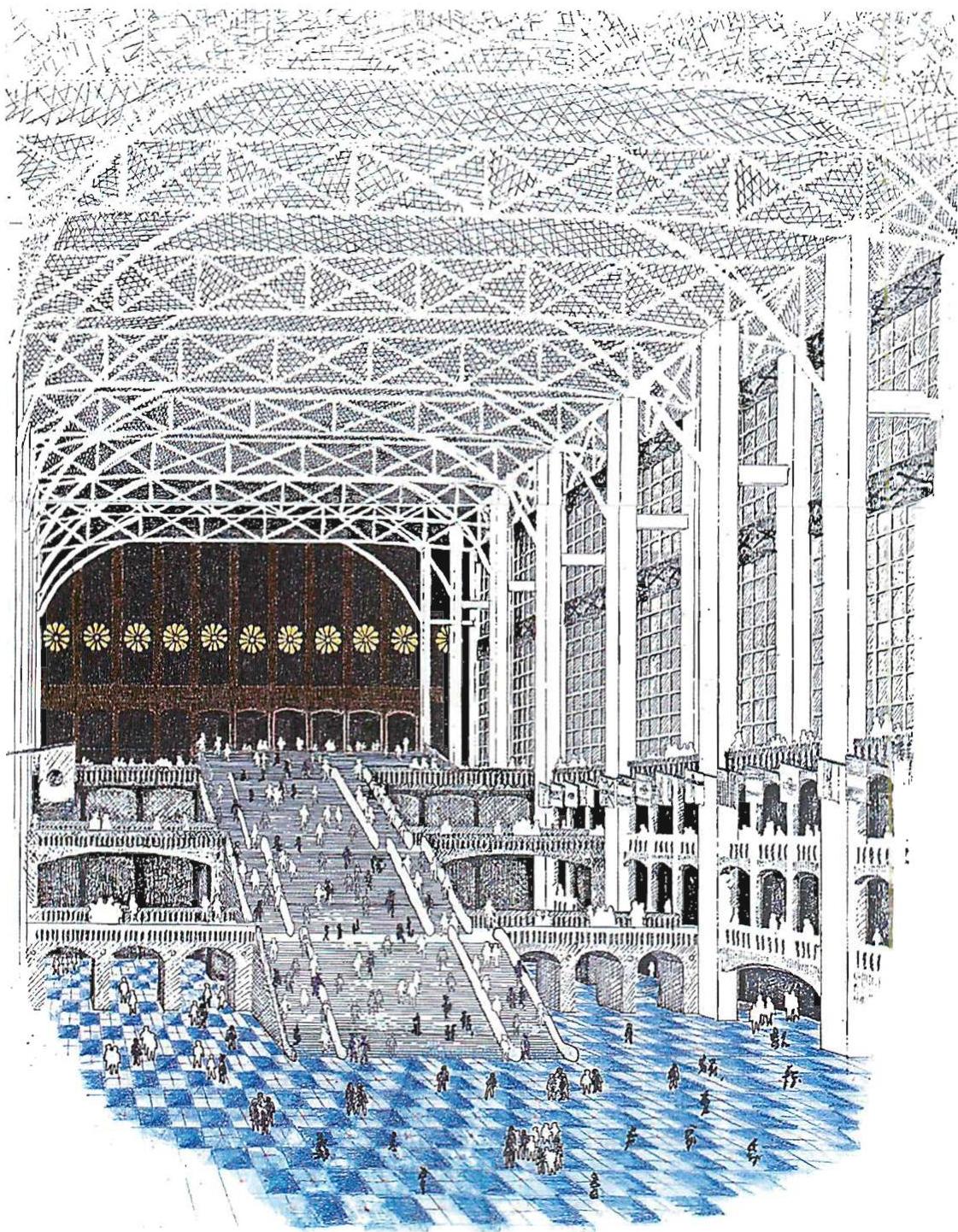
Tokyo International Forum. The main staircase leading to the enormous Assembly Hall, whose chrysanthemum trusses are just visible at the top of the stairs. The interior of the Assembly Hall is illustrated on pages 442–43 of chapter 13.
is immense. When we concentrate on this configuration, which would exist in the finished hall, then what emerges, and what will intensify the feeling most, are massive beams, massive columns, so big that they contain rooms themselves, and ornaments within the beams. The columns need to be this big to contribute effectively, through levels of scale, to the feeling of the room.
The transformation which intensifies the configuration most, arose directly from the wholeness of the configuration itself. The beams, giant Vierendeel trusses, six meters deep, are pierced by huge chrysanthemum-shaped voids to save weight, and to create a play of light within the darkness of the ceiling. The interior of the massive Assembly Hall, as I imagined it, is shown in Annie der Bedrossian's drawing on pages 442-43.

6 / EUROSTAR
It is helpful to look at a similar building, also spanned by huge trusses, and with an ethereal structure overhead, recently built in London for the latest generation of ultra-highspeed trains. Although done in a very spare, technical vocabulary, this building shows something of the results of careful adaptation which can arise in a highly technical idiom. The curving platforms, necessitated by rail layout and minimal space, created a challenge to the lightweight high-strength space frame, which curves in three directions and is able to adapt to the uniqueness of the site, thus creating something approaching a highly adapted canyon wall, or a canopy of tropical forest in Brazil. The technical challenge has been carefully and beautifully met.
I have deliberately introduced this example, which uses a spare, cold arrangement of steel members. Though not based on centers, and somewhat lacking in construction detail that has feeling, still the wholeness of the situation is reinforced and strengthened by the presence of this wonderful roof. It shows—as other buildings illustrated in this book show, too—that the principles which are outlined in Book 3 are not style-specific, and that there is a realm of design where buildings have great simplicity and yet create the adaptive complexity this book is mainly aiming at.
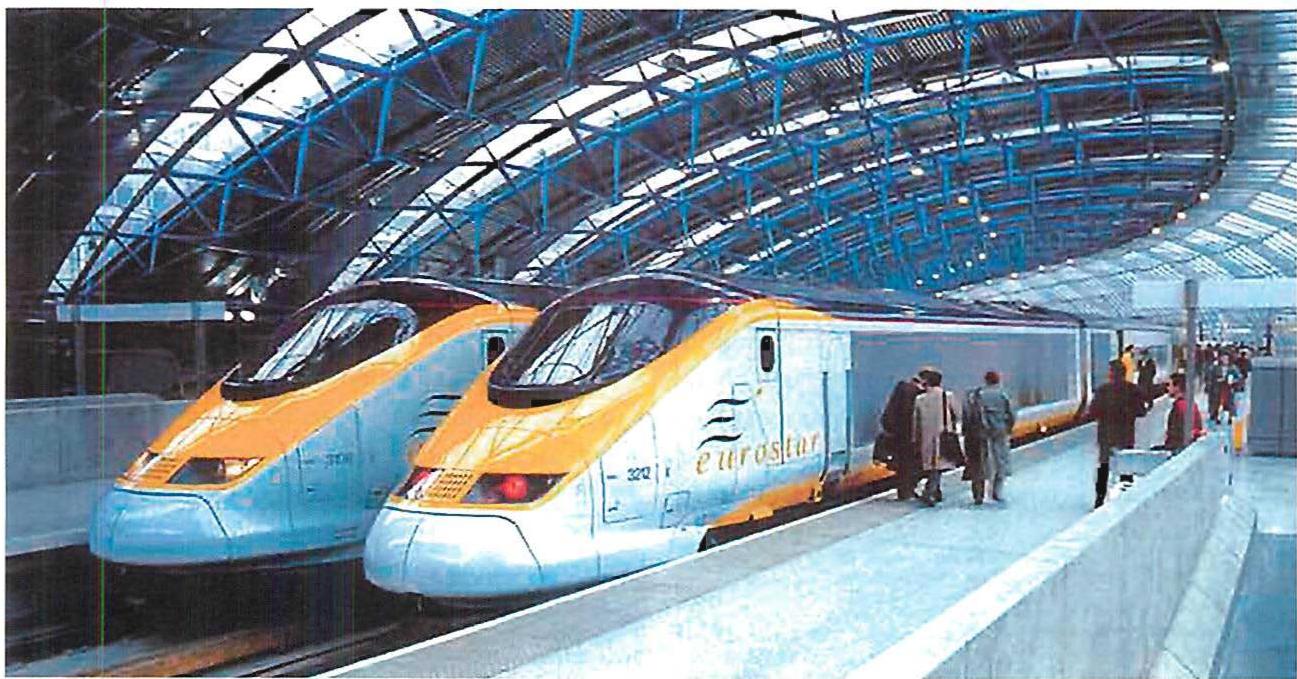
7 / INTRODUCTION TO DISCUSSION OF PROCESS FOR A LARGER BUILDING
Perhaps the most difficult thing about big buildings—especially public buildings—is the fact that the process needed to design them and to build them really has to be remarkable. If we consider the example of the Upham house, given in the appendix of Book 2, we see enormous numbers of changes in design, layout, modification, construction, and special craftsmanship—all happening dynamically, during the various stages of the project.
In a small or medium-sized building—up to one or two million dollars—this is solvable. However, when a building becomes really big, all these tasks are more difficult dynamically, and require feats of administration that may seem almost unsolvable. As a result, in 20th-century projects, the issues of budget, coordination of effort, administration, organization, and construction process, almost inevitably led to mechanization—and then of course to loss of life—for the buildings which resulted.
The creation of great architecture, then—often only to be captured in the largest buildings—requires that we imagine, and succeed in implementing, a new kind of process which makes living process attainable, in the context of contracts, budgets, schedule, and organization of manpower and construction operations, for a project that may comprise hundreds of men on site and tens or hundreds of millions of dollars in construction budget.
I have made middle-sized, large buildings and have in these cases (some illustrated) been able to take a path which lies roughly in the right direction.
However, for the largest buildings we have barely yet even been able to imagine the right kind of process. The contingencies of contract administration coordination and the yearning for an inner life of the building are so far apart that in the largest modern projects, no one, I think, has yet been fully able to put the two together.
8 / EVEN IN THE BIGGEST BUILDING, PEOPLE MUST BE THE CORE. THE BUILDING GENUINELY COMES FROM THE INSPIRATION AND DEEP FEELING OF THE USERS
Anyway, in this chapter I am beginning to suggest how architecture itself—the architecture of a large modern building—can arise from the fundamental process, even for the largest buildings, and how the fundamental process will call into being new social processes, at almost every stage, to embody the development of its structure-preserving, center-making action.
The core of a living process — whether a building is large or small — is that it comes from people,
from their inner desires—and genuinely does so; that it meets their archetypal core, and thereby makes them feel at home; and above all that it follows from, and is drawn out from, their inner wishes, which they make actual through dreams, fantasy, and genuine emotional experience.
In a big building this is, of course, not so easy. It is not easy to administer—that is, to arrange a process in which the people who will use the building can give voice to what is needed there.
I introduce, for the sake of example, the Homeless Shelter I built in San Jose, which be
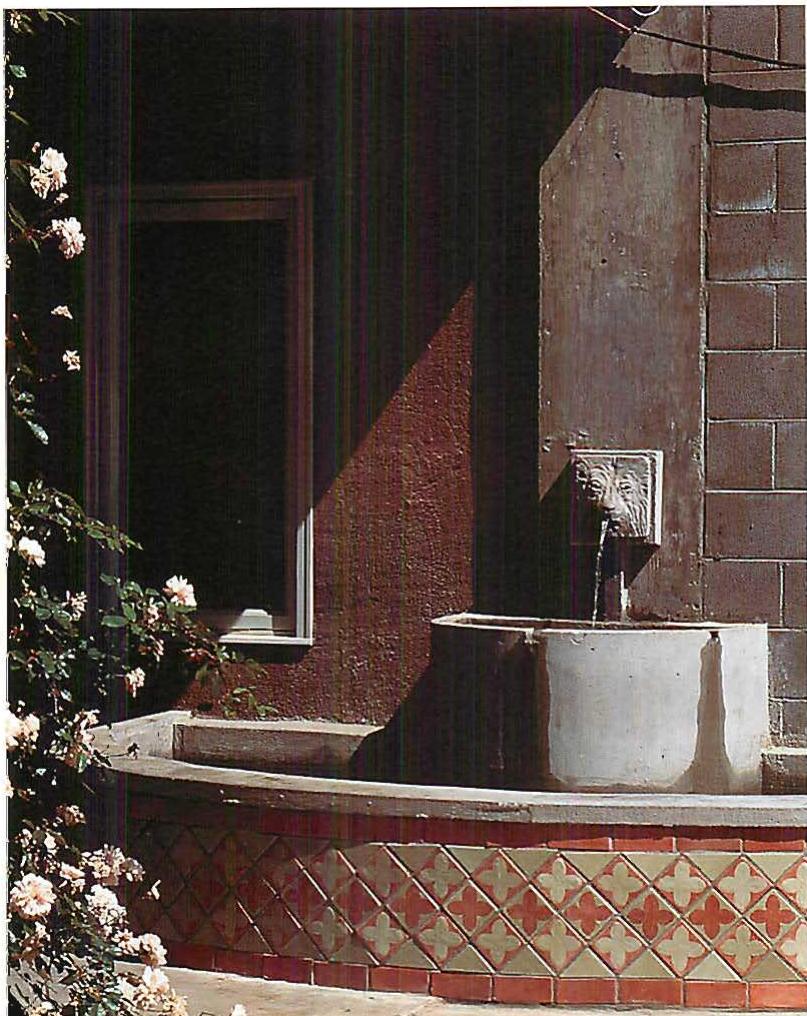
came known as the Julian Street Inn. In the case of this homeless shelter, we began with some of the people in San Jose who were homeless in 1987. We found a group sleeping under bridges, people who were willing to act as representatives of all the homeless people who might one day seek shelter in this building. I sat with them on the empty site — about a dozen of us altogether — and asked them to explain to me the essentials of such a place, and what would matter most to them.
“What matters most,” said one, “... is, Who has the key?” “We need a place which is ours, so long as we are there,” another one said. Gradually these kinds of wishes were taken on.
I worked with them, a number of times, and throughout my time with them I tried at all times
to imagine myself as homeless, too. Thinking of myself as homeless, I knew one thing above everything else: that a person who is homeless is an ordinary person, not different from anyone else, but faced, for a time, with a circumstance where because of lack of money, or food, or work, they have lost their apartment; and that being in that state, I, like them, would want to come to a place that gave me my dignity. In this frame of mind we, they and I, together designed the building.
Their leader, when I first presented the building to our formal clients (the city officials), was present. He interrupted me (very politely) while I was speaking — and said “Really, you know, Mr. Alexander did not design this building — we designed it — we told him what we
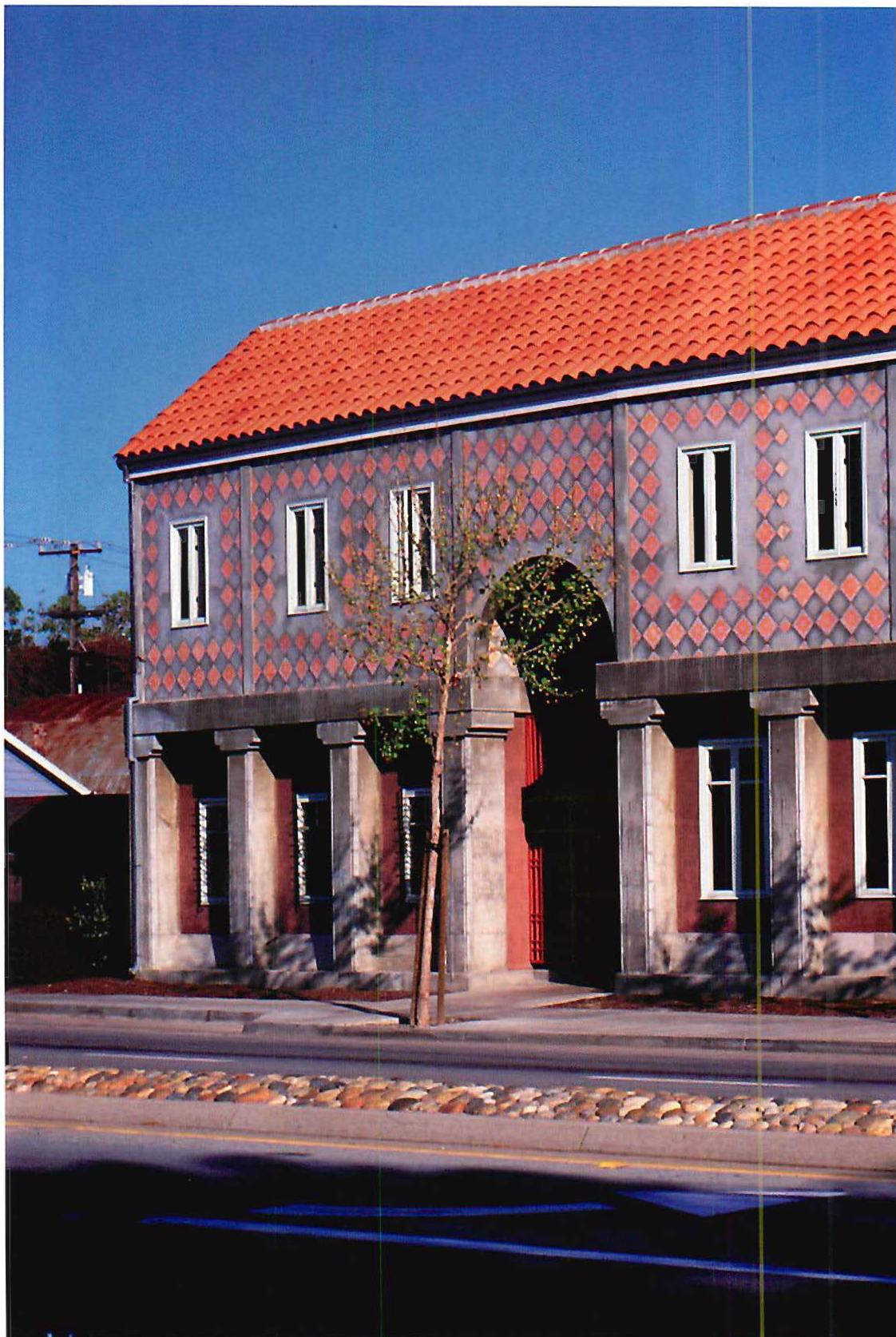
Note the hand-painted tiles on the upper wall surface. Four thousand of these tiles were made for the building in our own workshop. See extensive discussion about the tiles in Book 2, pages 292-95.
I32
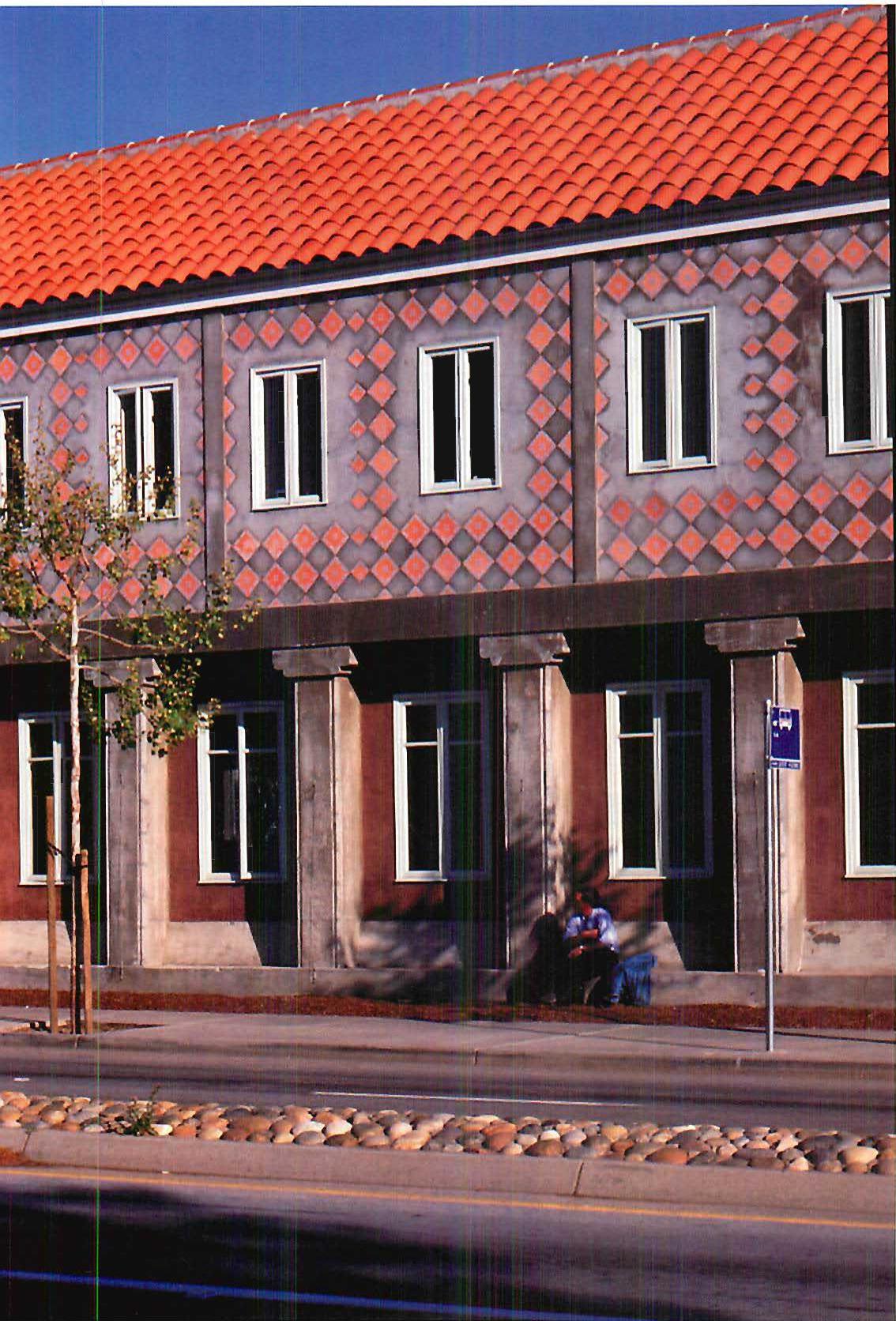
The 100-bed Shelter for the Homeless, San Jose, California, known as the Julian Street Inn, Christopher Alexander, with Artemis Anninou, Gary Black, Carl Lindberg and others, 1989
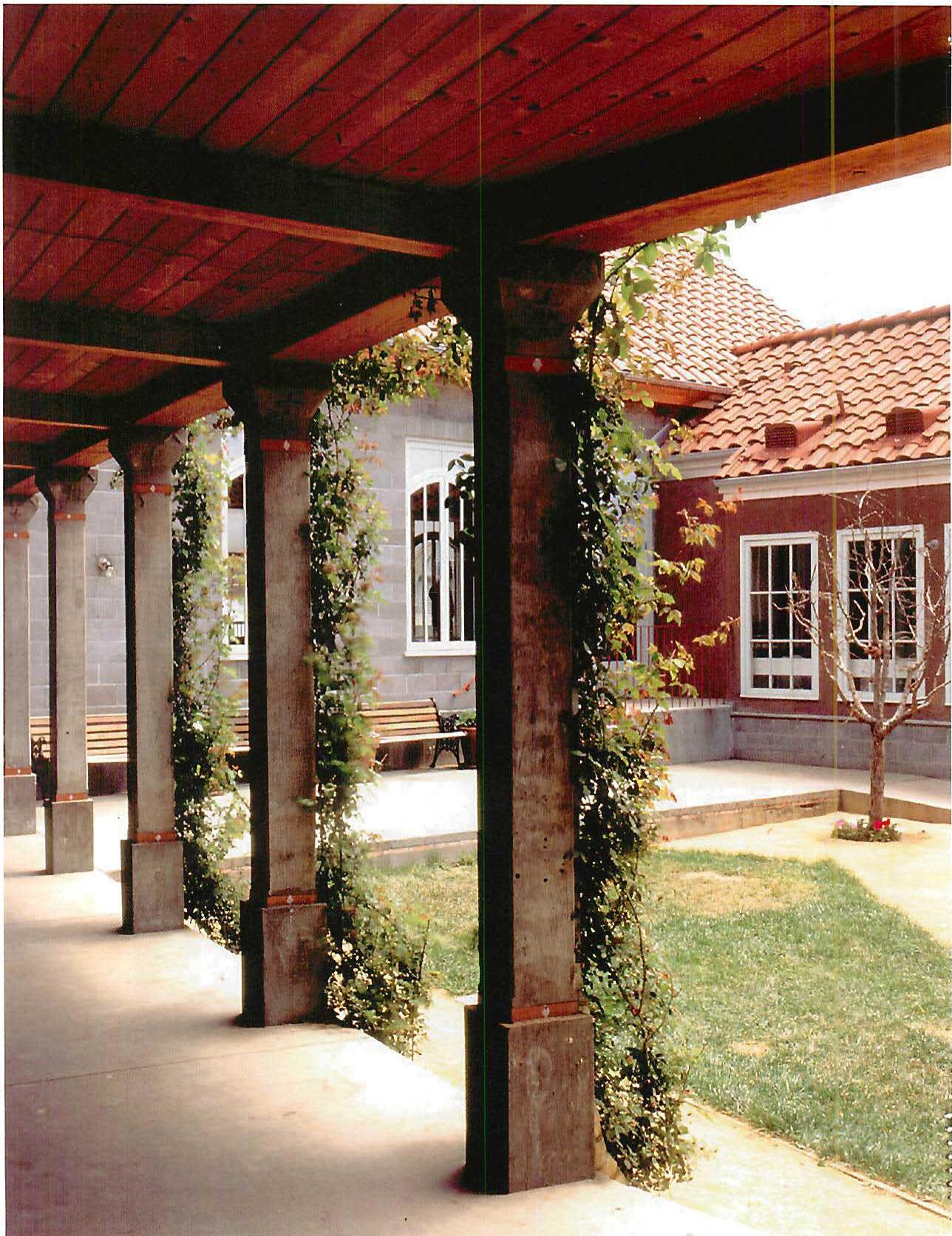
Courtyard of the 100-bed Shelter for the Homeless, San Jose, California, known as the Julian Street Inn. Christopher Alexander with Artemis Anninau, Gary Black, Carl Lindberg and others, 1989
f24
wanted, and he made it for us . . . I know he will forgive me for saying this, but it is just true. . . and that's what makes it good."
Such a process creates places for people in inner gardens, has alcoves for privacy in the sleeping rooms, has benches on the street outside, where these homeless folk could be comfortable, and get warm in the sun . . . all this was very natural.
And if, indeed, the building has this quality at all, it is because those people of San Jose who were, that winter, without homes—gave it to me. I tried to make, from what they gave me,
a geometrical substance which contained their wishes. The process of finding the plan which resulted, the structure, and its details, have been discussed at length in Book 2 (chapter 10) with an emphasis, in that discussion, on the continuous creation of centers as the most essential aspect of the unfolding. In the following pages, I go forward from that discussion to focus on the contractual problems which arise in construction of a large public building, and the ways that living process must introduce very new elements into almost every aspect of procedure and contract administration.
9 / THE CONTRACTING PROBLEM
Big buildings perhaps pose the biggest problem for a way of building that can produce living structure. During the 20th century these big processes were mechanized in such a way as to disrupt the unfolding process almost completely.
As a result, in such projects especially, living structure was almost unattainable in the 20th century. Yet it is our age, the 20th century and beyond, which has given birth to these enormous building projects, and our time which therefore most urgently needs ways of building them well.
The main difficulty in the present architectural scheme, is the absence of engineers and construction managers from the driving process, and the lack of understanding how a large project involving hundreds of construction workers, and massive problems of coordination, can give each individual the liberty needed to create a living center, locally, while still together they create a coherent (structurally safe, on-budget, on-schedule) whole.
For example, when the Shasta dam (at Mount Shasta, California) was built in 1935, the dam wall, 500 feet high and 1500 feet long and with an average thickness of 50 feet, was made by a continuous concrete pour which lasted 24 hrs per day, for 6 months, pouring a total of
1.4 million cubic yards of concrete. The way this was done was that the forms, reinforcing steel, and roads and ramps leading up the sloping exterior wall of the dam face, were changing every day and were built continuously while concrete was poured. Concrete was poured continually, day and night, at the rate of about 400 cubic yards per hour, or some 60 concrete trucks per hour.
Of course, the whole process was dynamic, and was under the control of structural engineers who made on-site adjustments on a continuous basis, to permit the handling of the huge job, and to accommodate, flexibly, whatever problems developed while the dam wall was growing.
Process of this kind is well within the grasp of modern technology and engineering. The reason that architects have not, in recent years, been able to handle large projects dynamically, in a comparable way, is that they have become dissociated from engineers. Given the dress-design approach that was favored by many 20th-century architects, it was impossible for such a firm to be entrusted with a process where large-scale engineering problems were being faced, and solved, dynamically. But, in principle, it is entirely feasible.
10 / EMERGENCE OF NEW MULTI-LEVEL CONTRACTS FOR LARGE BUILDINGS
In Book 2 I have given a picture of the way successful unfolding can proceed in a small building project (See especially the appendix of Book 2). A successful process requires a special kind of contract, a kind of contract which I have evolved in many variations over a period of twenty years. The essence of this new type of architectural construction contract lies in the following points:
- The price is fixed.
- What is agreed is only the building outline and the rough plan.
- Modifications unfold as the construction of the building goes forward. Changes in plan, section, interior space, exterior construction, details and ornaments are made continuously throughout construction by the architect and builder, without change orders.
- The object is to build the best possible building for the given sum.
- This is made possible by holding price fixed, by giving the architect-builder the right to re-distribute the funds continuously within the building operations and changing designs as the building construction and its evolving changes go forward.
- The construction is run under a fixed percentage management contract with open books.
- Since the builder's money is fixed, there is no incentive to reduce quality in order to gain profit.
- The builder has obligation and discretion to discuss with the client as the building unfolds, but the builder's decision is final.
I have used versions of this type of contract continuously since 1976 in many small buildings and in some large ones. For example, using these techniques we managed the site work of the $12,000,000 Eishin campus in this way. We and our colleagues have used versions of the technique in apartment buildings, in public buildings in England, housing in Colombia and India. My Ph.D. student Kyriakos Pontikis ran the construction of a multi-story apartment building in Cyprus, exactly in this way.
But given our current social circumstances, it is not always possible to implement this kind of contract in a large project, in its pure form. More typically, to meet the complex social conditions of a large project, we have to compromise, and use a variety of contract modifications in which the essence of this method can be preserved (meaning that the essence of the fundamental process is preserved as the core of what is going on), while still working to some degree in the framework of normal 20th- and post-20th-century processes.
In all the modified cases, there is still, at the core of the process, a new form of management in which each craftsman and builder is devoted to the making of living structure. This is a new way of designing. It is a new way of imagining the building. It creates a new way of introducing living structure, feeling, even into these gigantic constructions, by relying on archetypal facts, always keeping real human scale in mind, always doing the thing which injects feeling into the structure. It relies, always, on a way of making sure that the building creates positive space near it, around it, next to it.
In one version, which we used in San Jose, we adopted a modified contractual form in which 15% of the work was done by our own craftsmen and subcontractors under our direct control. At the same time, 85% of the construction—the part we thought we could afford to release—was built by conventional procedures. This included foundations, non-specialized framing, roof construction, and services, which were all done by a general contractor with whom we had the conventional architect-contractor re-
relationship. In this practical instance, we decided to keep a normal general contractor for 85% of the work, and we ourselves undertook all the specialty work—heavy wood columns and beams, special concrete castings, manufacture and installation of intricate tile work, and the innovative concrete lacework trusses.
We were able to make beautiful and expensive column capitals.
We made, by hand, in our own workshops, four thousand tiles with a pink and gray design described earlier (Book 2, chapter 10), and ourselves installed these tiles on the upper walls of the building.
We undertook the highly specialized gunite work needed to make the trusses—a very tricky job, since we had years of experience of gunite shooting on delicate form work, and these trusses had a most complex configuration, with extremely difficult mid-air work needed to do the forming and shooting.
Thus, although we only held about $200,000 total of specialty construction contracts, the fifteen percent of the work we did ourselves affected the building deeply, and made an enormous difference—with a far smaller risk and far smaller management problems than if we had taken on the whole responsibility of the building work in our own company. It was an extremely practical compromise, which allowed living processes to act where they mattered most, to the benefit of the building.
The positive consequences are clear enough. In effect, I chose 15% of the work in such a way that it covered 50% or 70% of the building's emotional and artistic impact.
So, in this relatively large project, we came close to controlling the entire construction work by this indirect means.
Of course, in addition we still had normal architectural control over windows, walls, floor surfaces and so on.
All this left the San Jose building with an overall quality of hand-made work, attention to detail, and care for the individuality of each individual element within the building. And yet the building was built at a relatively low square foot price, far from the kind of price which such a carefully detailed building would normally command.
11 / THE INTRICACY OF DETAIL IN A LIVING PROCESS
MEMOS ON CONSTRUCTION METHOD
In order to create a vivid picture of the kind of work which is necessary to make a larger building come out right, I will print, here, an edited form of a memorandum I prepared for our client in the San Jose building. He originally asked for this memorandum to help him solve some political problems of his own and to help get us paid money that was owed to us. I print it though, because it gives graphic insight into the essential intricate and detailed nature of the construction process when the fundamental process is applied to a large building.
Here is what I wrote:
January 29, 1989 Al deLudovico, Housing for Independent People, City of San Jose, California.
Dear Al,
A story in The San Jose Mercury written a few months ago spoke in glowing terms about the Julian Street Inn and its architecture. Further, from the very beginning of the project, the City of San Jose and the Redevelopment Authority saw the building as important because of its position as a gateway to the Redevelopment
Area. They therefore asked us to make a building which was beautiful enough to serve as a gateway to the area.
What is perhaps more vital than these architectural comments, concerns the situation and feelings of the homeless people themselves. I have told you, from the beginning of the project, that this building is intended to give homeless people a renewed sense of dignity, and a faith in themselves... this is being accomplished by their participation and by an unusual level of care and quality in the design and craft of the building.
However, from our discussion, it seems that many politicians in San Jose are unaware of the extraordinary amount of work we have done on the details of the building. Yesterday, you therefore told me that you would like to see a memorandum giving examples of the special care and attention which has been lavished on it.
Let me give you some examples.
1. THE IRON GRILLES
Let's start with the ironwork on four small windows in the entrance court. I first made a rough sketch of the grilles. I then asked James (Maguire) to make a wooden mockup in the actual windows, and tell me what he thought would work. He did so, making a mockup in lathing... and then made a drawing based on his observations.
I looked at the drawing, and felt uncertain if they were quite right. I made some more drawings myself, and then went to San Jose to check them. The design seemed too elaborate, and the earlier drawing seemed more in keeping. I went back, and went through the whole thing again with James, and we then prepared the simple version drawing for you, as being the most elegant. The construction cost of the grilles is in the range of $1000, implying that a design cost of $85 (8.5%) might be reasonable, i.e. less than an hour of paid time. In fact we spent nine hours on this one very small detail.
2. THE IRON GATES
On the gates for the Julian street entrances, we made a long series of sketches. First I made some hand sketches, and gave them to James. He then made a preliminary hard-line drawing. This drawing seemed too harsh to me, and I told him it had to be softer. He made some rough charcoal sketches based on our discussion. Then he made another set of hard-line drawings... but they had
lost the character of the soft charcoal drawing. We checked it on the site, standing with the drawing, and looking at the real thing on the building. Then I suggested to him how to make the final one. He made two versions, . . . and these drawings were then put in hard-line, and sent out to bid.
All in all, we spent two solid days, only refining the design of the gates. In a normal professional office, these gates would probably receive a couple of hour's worth of attention. What we are offering here is really an old style of work . . . the kind of thing that used to be done about 1900 . . . as on the San Francisco City hall . . . with an extreme level of detail, specified carefully, in keeping with the craftsmen. Today's architectural contracts do not provide for these kinds of services, and they are not normally provided at all. Even though we are paid the normal fees, we provide the extra service anyway, because it is the only way to get good results. But, in addition, it is done through mockups and full size studies on the real building, during performance of the construction subcontracts awarded to us — and that is how we pay for the extra effort.
3. THE COLOR AND GLAZES ON THE TILES
This is a case, where I am sure you cannot even begin to imagine the amount of time and energy that was spent. Over a period of more than a year, we made tiles of different designs: some of these you reviewed and rejected; many we ourselves rejected as not good enough. Finally we found a design that we all liked. It was based on a subtle way in which the color and design of the rose and gray tiles makes a harmonious whole with the gray color of the concrete between the tiles.
Oddly enough, it then turned out that the rose/pink/orange color of the tiles was very critical. At different glazing temperatures, the tiles come out at different colors, which balance less well with the gray of the design. The window of temperatures was very critical. We took steps in which we tried literally hundreds of different tiles, individually, in our own kilns here in Martinez, and then in the test kilns of the tile place in San Jose that did the final glazing. Every time we ran a batch, we tried different color formulas, different glazes, to get the colors just right. Towards the end, because of time pressure, we had to make tests in the big kiln, where no less than 600 tiles are fired at once — because this big kiln produces different colors. We thus began our production run, of the 4200 tiles to be produced, and were still running experiments and tests on each batch of 600 tiles that we sent through the kiln.
I used to spend an hour or two, every other day, for a period of months, each time looking at some twenty or thirty different tiles in our Berkeley yard, studying the different levels of color balance, and trying to get them just right.
Finally, to test the last sample batches, I had a crew of three or four people lay them out on the concrete of a building at the UC campus, so that I could see a complete array of several hundred tiles, against raw concrete —
and I then went up to the roof of the fourth story, to look down on these tiles, so that I could see them all, at a distance, roughly comparable to the distance at which the tiles are seen in the real building.
This operation, with a crew laying out several hundred tiles on the ground, was done not once, but about six separate times, before we finally had the tiles calibrated and glazed to my satisfaction.
We considered ourselves making something of permanent value for the people of San Jose.
4. THE CAPITALS OF THE ARCADE COLUMNS
The other day, when Pat Colombe (the planning and zoning officer) saw the finished arcade columns, she said something like: "I had no idea how beautiful this was going to be..." These columns, which were prefabricated in our own workshops, required the design and making of special molds for the capitals. I began this work about a year and a half ago. We built several molds, tested them, changed them... and as you know, we even have three full columns, cast in concrete, with samples of tile on them, standing in our construction yard in Martinez. The total time and energy spent on these columns represent literally hundreds of man-hours.
Of course the design fee paid for the design of the columns does not begin to cover the time spent. The columns themselves (nine columns) were delivered by us to the project, at $12,000 installed. This would imply an architectural fee of some 8.5% of $12,000 as a reasonable amount of design time, about $1000, or perhaps 15 hours of professional time.
But the actual amount of time spent on these columns — on the design, not the production — must have been at least 200 hours... perhaps ten to twenty times what we were paid for. I do not say this in order to make you feel guilty, or to ask you for more money. I do say it in the hope that you will appreciate what you have been given. If some of our time spent on electrical layout was less than you expected, please bear in mind that on many features of the building we have gone far beyond the call of duty, to a level which is almost unknown in present day practice.
5. THE BENCH BACKS ON JULIAN STREET
Recently we have been getting the final shape for the bench backs along Julian. Here again we have something that might be considered a trivial item in many people's vocabulary — because usually there just isn't time or energy to take care of such things. Here is what we did.
First, at the time of our original cardboard mockups of the Julian street bays, I cut cardboard templates to fix the shape. Recently, with the building actually in place, we began the work of revising this template. James began by making two drawings of the possible shape. A downward arc is simple, but leaves something funny and uncomfortable in the corner, where the curve meets the big column. We had one drawing where the curve flattens out to form an S where it meets the column. This is better.
James cut another full sized template and I went to have a look at it. The S-curve was slightly too strong, and created a feeling which was too busy. I got another blank template, and drew a slightly finer curve, which makes a beautiful contact with the column, makes a good space between the benches, and make the back height comfortable all along the length. This tiny detail, of something already specified by normal standards, too several hours of extra work, and a number of visits back and forth.
6. WORK ON THE TRUSSES
The design time we have spent on the concrete trusses for the dining hall would simply boggle your mind. As you know, the delicate curvilinear tracery is a new kind of truss, one which has never been built before with this technique. During the early stages, I spent three whole nights myself, working on the computer analysis of stresses in the truss, and laying out the beautiful tracery. I am really talking about nights — three whole nights from 10 pm until 8 am the next day for mathematics . . . The amount of time that Gary Black our engineer put in, was far beyond what the engineering fee paid for . . he has put in hundreds of hours, at CES expense, not HIP expense, checking details, checking horizontal forces, doing everything that had to be done to make it work, figuring out how to build it . . .
Even when we built the complete full size mockup for you to look at, at your request, we did not charge you. The $800 on your bill was only for materials for the mockup. The time spent, by James and his helpers, to build this full-size, thirty-foot cardboard box truss, which took three people a whole weekend to do, was entirely at our own expense.
I am glad we did it. The trusses are beautiful things. I am sure the dining hall is one of the things which will be remembered about the building.
As you know, we also cast a complete portion of a truss, in concrete, in our Martinez workshop, so that we could get an accurate picture of the size, shape, character of the ribs and tracery... and get an initial handle on the techniques necessary to build the trusses.
7. THE SMALL REVEAL ON THE WEST WIDE OF THE DINING HALL DOOR
Here is a tiny detail. As you know, a decision was made, to make the kitchen jut back, where the dining-hall door opens out, so that this door could be a two-leaf door with a comfortable swing. What you don't know, is that when we considered this matter (even though it is a relatively small thing) we then made a full size mockup in our Berkeley office, and studied the size of the jutting out, in relation to the distance from the door, until we had a situation which felt completely comfortable in three dimensions. After all this study, this is the work that was finally transferred to drawing, and given to Paul Rudy.
It is because so many details were handled with this kind of care, that the building feels so comfortable. The reasons why people respond to it, and so many agree that
it is comfortable and pleasant there, is that this kind of care has been lavished on most of the details in the construction.
Most of this was going on during the work of building itself. The effort involved, vastly exceed the effort that would normally be given to such work, by the contract administration phase of a normal architectural contract.
8. THE ARCHWAYS OF THE TUNNELS
The archways as drawn on the drawings were only a rough approximation of the right feeling. As soon as the building itself was standing, it became possible to gauge the correct size, shape, and height, for the two archways. You told me at some point that you considered this as an error on the part of the architect, and that we were therefore liable for the design time and delay time involved in the extra work.
This is not the right way to look at what happened. I told you, when we began this job, that to do good work, we have a practice of monitoring a building continuously, during construction, and making small modifications as the work proceeds. Any architect who tells you he (she) can predict these things, is simply kidding himself (or you). The whole point, and the whole problem with modern architecture, is that you cannot predict these things, because they only become visible, in their details, when the building is standing there. We could determine the approximate height and diameter of the two entrance archways, at the model stage... and in fact did so with a number of studies in model form, which showed us how the sunlight comes in, what it looks like from the street, and so on. But then, it must be fine-tuned at the framing stage. What happened is that Henry Sterngold, or you, then gave the order to proceed with what was on the drawings, even though I told you that this was not the right thing to do, and that the right height and curve of the tunnel arch would only (and could only) be determined after plywood was in place. When the proper moment arrived, we spent one whole day of my own time, a day of Gary's time, and two days of James's time, making mockups to determine the proper curve, and to get the height right.
When Paul Rudy told me that you would not pay for the extra, I told him to bill the $800 work of moving the plywood to me personally if HIP would not pay—because I care that much about the building, and because I knew how much it would damage the building, for the city, if the arches were left in their higher position. The building got a level of service and design care, not only beyond what was paid for, but, in this instance, far beyond the ordinary. It was a new kind of service, not yet known today!
9. THE DAY ROOM DETAILING
As you know, when I first saw the beautiful shape of the day room, I ordered the two partitions removed from the design, since I saw the effect this room would have, with its rhythm of columns and beams. So we spent time, at
that stage, to re-evaluate the design and make it better. Then, we spent hours in the room, evaluating the best size and shape for windows, and door openings. Most recently, I have shown you how the room will work even better, as a comfortable place, if the two alcoves on the south side, are separated off slightly, by a light wall which makes an opening, and strengthens the shape of the main space. We have also visited the room many times, to make mockups of the best detailing of the trim on the big beams . . . and have finally found a kind of trim which will make the room good, and bring a scale transition so that the roughness of the beams is offset by a delicacy of detailing in the moldings. To get this right, we actually built several example sections, and took them to the room, propped them up, eleven feet overhead (no very easy feat, for a thing that weighs 40 or 50 pounds), and then examined the different ones, from the room, until we had the one which was exactly right.
10. KITCHEN-DINING PASS-THROUGH
I am putting this mundane example in, partly because you were not at first satisfied with the way the problem had been solved, and partly because I want to demonstrate that small practical matters, not only matters affecting the overall harmony and beauty of the building, are being given the same level of care. As you know, CES originally designed a pass-through from kitchen to dining as the only way to solve the level change. Keystone, working directly for you, then unfortunately did a detailed layout for the kitchen which underestimated the difficulty of handling large soup pots. After discussion with you, Gary and I went to Keystone, and using the correct 70 lb soup pot, made physical experiments of the exact height to which it could be lifted, and recorded the results to the nearest inch, so as to fine tune the kitchen layout. The results of this study were then transmitted to you by James in the form of drawings, which represent an unusual level of concern, for a small practical problem ... even though you may consider this problem minor.
11. PAINT COLOR OF BUILDING EXTERIOR
The exterior plaster color, on the ground floor, has a critical role in the building, since it needs to be harmonious with the concrete columns, with the orange of the handmade tiles and colors on the second floor, with the roof tiles and with the street. We had determined, long ago, that something of a grayish rose would be the right color.
In order to specify this color for the plaster company (Speed King) who were going to make up the mix... we started by mixing our own cement wash. We made a series of studies in our workshops in Martinez, tried many different mixes. We finally found a mix which was just right: it required four different pigments, two reds, a yellow and a green, in subtle proportions. We gave this mix to Speed King, and they began trying to match it. In order to get them to match it correctly, we made three visits to Speed King, tried their samples on different batches of rough and smooth brown-coat plaster... The choice of
color, and the exactitude of matching, involved three of our people, for several days work.
We also made samples of possible window enamel, based on these wall colors: tried cream, light cream, off white,... and finally incline towards a very pale green (really a white, with green touches in it), as the thing which is most comfortable with the rose of the tiles, and the grey of the concrete. To get it exactly right, a final round of mockups has been left for later, when the colors are in place on the building.
12. ORIGINAL DESIGN WORK
At one time in our discussion, after I gave you these examples, you made some comment like: "Well, it is true that CES has done a lot during construction, but you paid for it by doing very rough drawings at the original design stage... and didn't put a lot of thought in at that earlier stage." I told you, then, that this was inaccurate, and that during the design stage, as in the construction stage, we undertook a level of care far beyond the norms of present day architectural practice.
Consider, for example, the elaborate column capital mockups described above. These capitals represent perhaps $2000 of construction—meriting some 8.5% of 2000 or $170 in design fees: two or three hours of professional time. In normal architectural practice today, this would buy you the specification of a Simpson connector—and that is exactly what you would get under normal circumstances. From us you got, as I described above, several hundred hours of design time, mockups, studies, molds, and so on.
As another example, when we designed the exterior bays of the building, we built a complete full size mockup of one bay, six feet wide and ten feet high, in cardboard, in our own workshops, so that we could see it, study it, and get the dimensions of its details exactly right. The size, shape of windows, the position and shape of the bench backs, and the thickness of column, and shape of column moldings and capitals, were all set while we were working with this full size cardboard mockup. Almost no other architect or practice in the United States today would take such a level of effort, to work out the overall proportions of a design—of what is, in fact, rather a small part of the design.
This kind of effort went in continuously, to our work at the early design level. Even in that stage, the level of care and thought in the project, was way beyond the usually professionally expected level.
These twelve examples are merely examples. They are examples of a new attitude, and a new level of concern, and a new form of professional practice which has been lavished on virtually every aspect of this building, continuously, from the time design began, up until the present where we are nearing completion of construction. This level of care, which is unique to our organization, and which is possible, in part, only because it could be done within the construction contracts awarded to us, and the dedication of our apprentices and staff. As a professional service, it is not available on the market today, at any price, and remains something we hope to see in future among all kinds of practices, in an emerging new form of professional process. Today, the fee structure of a normal architectural job does not permit it.
As I told you in yesterday's discussion, I believe few people realize that the level of care which has been provided on this job goes far beyond what any other architect would normally be able to provide, and far beyond what we are being paid. I do not say this in order to ask for money. I gladly accept the work which we are doing, and it is our own desire to spend more time than our fee warrants, because we love the building, and we hope to see the building made permanent as a thing of beauty for the people of San Jose. We are doing this out of concern for the building, and because of our own professional pride in the excellence of the building.
I hope this memo gives you the information that you need.
With best wishes
Christopher Alexander
12 / CONCEPTUAL VISION OF A STILL LARGER PROCESS
In a larger project the overall procedures become still more complicated. To illustrate what I mean, I shall briefly summarize my work on the Mary Rose Museum, in England. I shall try to show how my conception of the building, its first sketch design, the plans for construction, organization of construction, the construction operations and management structure, and detailed human organization for the final implementation, went forward.
PROCESS 1: ESTABLISHING THE PROJECT CONTEXT: LORD NELSON'S FLAGSHIP, HMS VICTORY
The Mary Rose Museum, was originally to be built for $16 million, in Portsmouth. It was designed to house the Mary Rose, Henry VIII's warship, which sank 450 years ago, in 1554, off the coast of Portsmouth, with 700 men on board. In 1989 the ship was recovered from the bottom of the sea, and brought to dry dock #3 in Portsmouth dockyard for restoration. Since 1990 the ship has been under continuous conservation under a temporary tent—a task that will not end until about 2020. In 1992, I was commissioned as the architect to build a museum enclosing the ship where it sits today, in dry dock #3.
The task of building the museum in this location is not only inspiring and daunting because of the importance of the archeological remains. It is also a great challenge to place a building hardly more than a few yards from HMS Victory, in such a way as to enhance, not reduce, the emotional impact of the Victory—already one of the most beloved of British naval monuments.
PROCESS 2: THE PROCESS OF DEFINING A WORD-PICTURE OF GENERIC CENTERS
The word-picture was built from a series of interviews with Margaret Rule, the ship's chief archaeologist, and others directly concerned with
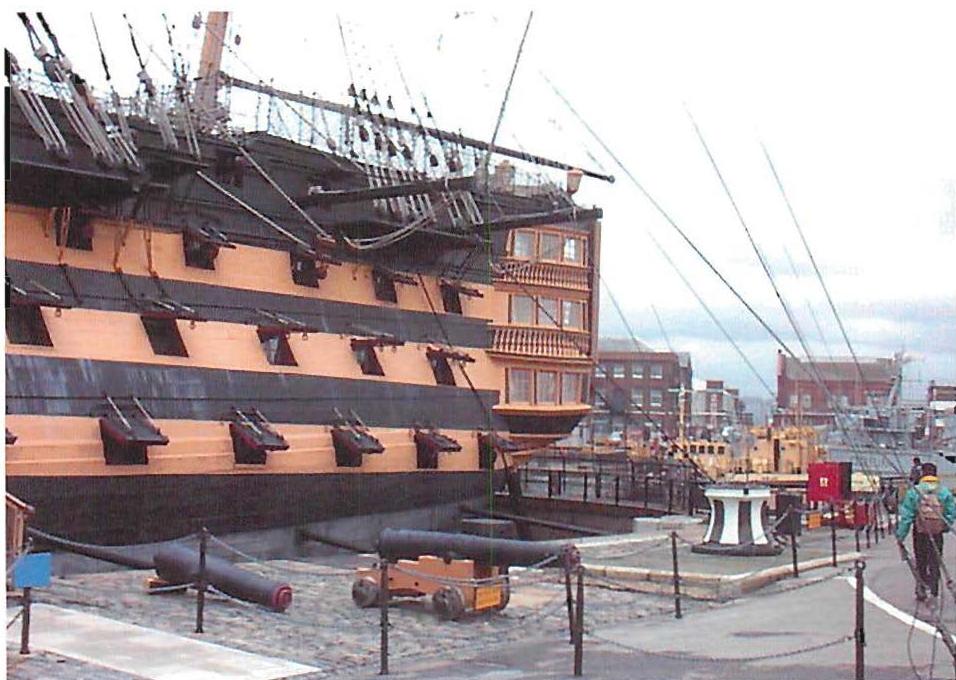
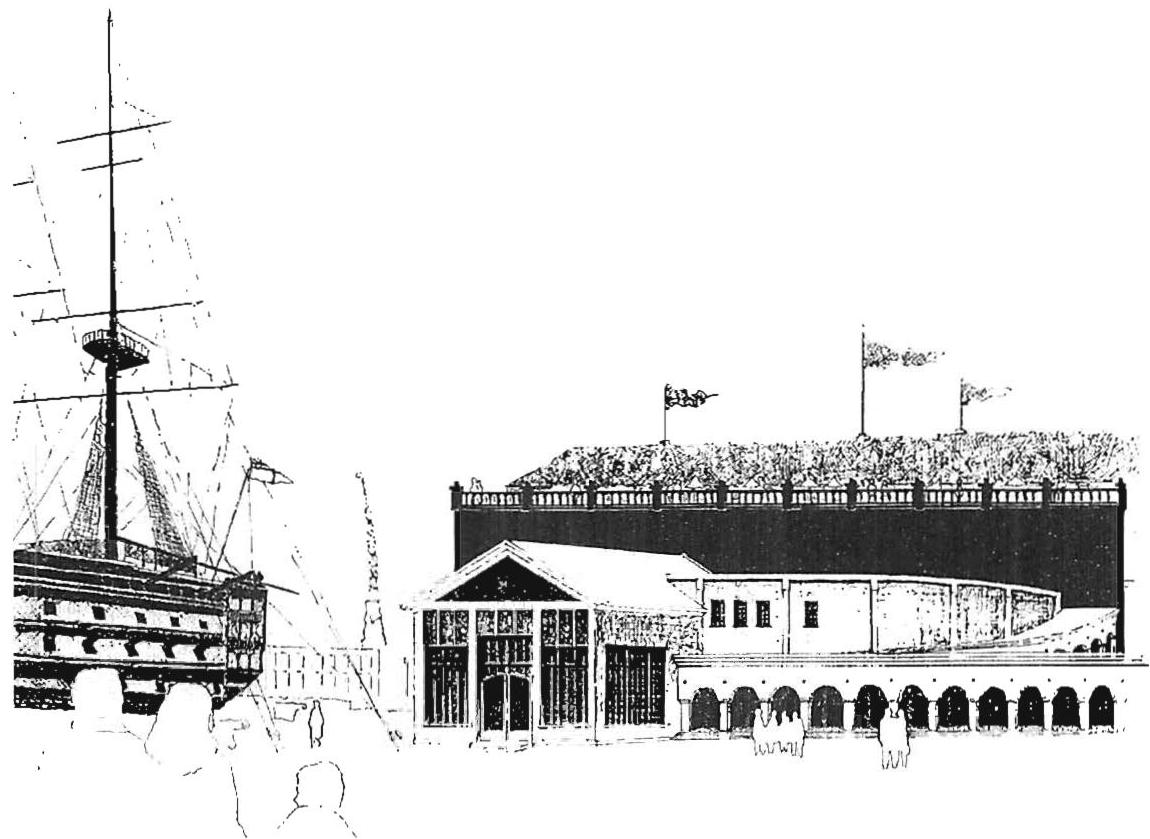
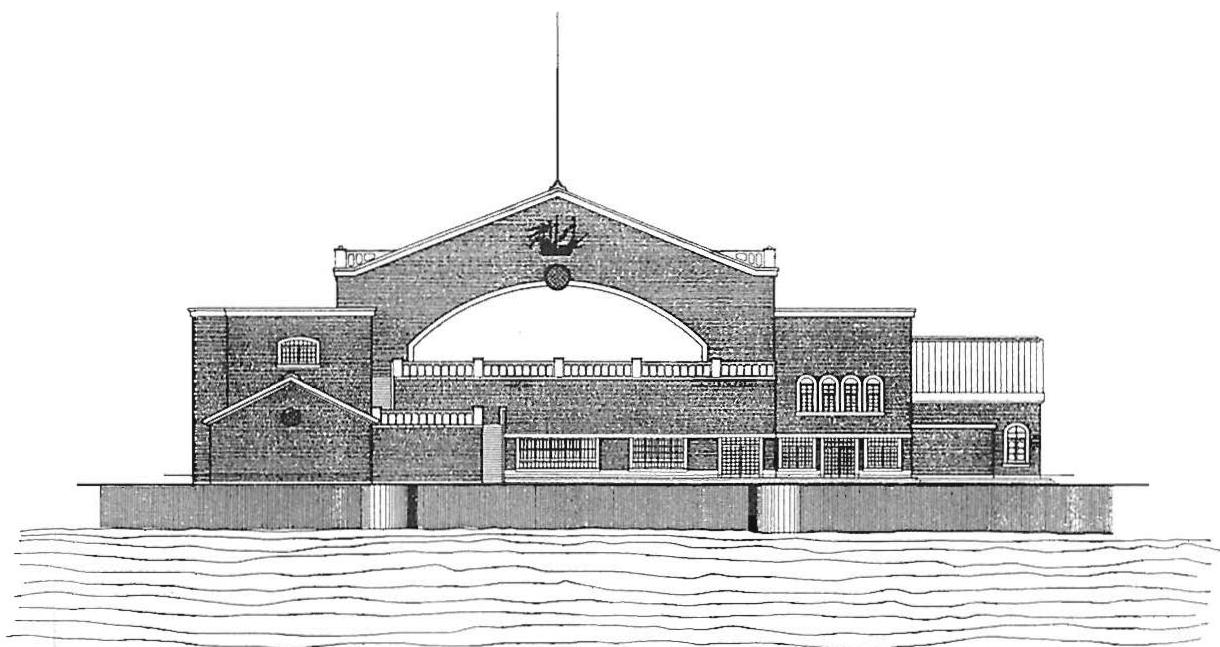
the preservation of the ship, including Prince Charles, the Admiral of the Portsmouth dockyard, and visitors to the museum. It describes the human experience of the new museum, placing emphasis on ordinary, deep feelings which make sense to ordinary people.
Why is this different from the process one would have expected in a large museum of the late 20th century? In answer, consider, for instance, the 700 men who died when the Mary Rose went down. It was Margaret Rule who told me that she had personally found nearly a hundred skeletons and human remains in the underwater mud. I suggested, as you will see in this word picture, that we build 700 stone tablets forming a memorial way into the Museum, to bring the deaths of these men sharply into focus.
Margaret refused. She understood, at once, the emotional impact the 700 stone tablets would make, each with a carving of an archer on it. In the dry consumer-oriented character of 20th-century museums, such a direct appeal to human experience and human feeling — she believed — would have been inconsistent, and out of place. I believe she was wrong.
Using the fundamental process made me focus on the individual centers that arose out of the real situation, hence even on the men who died, their loss, and the knowledge that, having been brought to shore, they needed fitting burial. Throughout the process of constructing the word picture, I made appeal (as far as I was able) to the potential deep feeling of the user, and you may find this attitude in most of the paragraphs which follow.
This word picture is the first necessary step in making something beautiful.
THE MUSEUM FROM A DISTANCE
As you come around the bow of HMS Victory from the south, the Mary Rose Museum stands to the north, directly ahead. The long nave of the ship hall rises high, with the Mary Rose's four masts rising from it. The volume of the nave is 80 meters long, and about 21 meters high. The masts rise to perhaps 30 meters. Although the building is imposing, it is somber and straightforward,
reflecting the atmosphere of the dockyard. This somberness is reflected in dark materials and in a sparseness and simplicity of line.
Visible in the upper part near the roof are windows of colored glass, in which emblems from the Mary Rose, and flags and banners are depicted. One sees these windows from the outside — the sun glistens on them, and shines on the glass. At night especially, the banners and emblems glow darkly.
In front of the main volume, to the left, is the entrance to the building. The entrance rises up high, though not high enough to hide the march of roofs and masts of the building behind. From this entrance, a long colonnaded ramp rises gently toward the right — toward the eastern end — of the museum.
VICTORY ARENA
A SMALL PUBLIC SQUARE BETWEEN THE MARY ROSE MUSEUM AND HMS VICTORY
In the space between the Victory and the Mary Rose Museum is a roughly square open space. This square, filled with seats, cobblestones, and paving, is really itself the main building, as important as the Museum itself. It is a focal point in the dockyard.
In summer weather this square may be filled with people waiting, some eating, some enjoying the sun. There are seats, benches in the shade where people may lie down, rest, sit, children can play, and families can relax between visits to the two ships.
Occasionally there are midsummer concerts there, and other informal performances. The Arena is arranged so that as many as 300 people can sit there to enjoy a concert.
THE SEATS AROUND THE SQUARE
Victory Arena is bounded on two sides (south and east) by a wide colonnade. An iron railing that forms the back of the colonnade separates it from the security area of the dockyard.
The third side of the square is the front of the Mary Rose Museum; it is also approached by a wide colonnade. The fourth side (west) is formed by HMS Victory.
In the middle of the arena is a formal center, a stone meeting place with benches, partly secluded, partly shaded, partly in full sunshine.
The layout of this square is plain, made of straight lines and simple shapes. It is consistent in feeling with the historical dockyard buildings and their plain arrangement.
THE MEMORIAL CHAPEL AND MEMORIAL WALK
On the east side of the square, opening off the colonnade, is a tiny memorial chapel no more than a few square feet in size. This chapel is made in remembrance of the 700 men who died in the Mary Rose. It is dedicated to those who have no known grave other than the sea.
The part of the colonnade leading to this chapel is the Memorial Walk. Seven hundred stone tablets commemorating the 700 men are placed along the wall which forms the back side of the colonnade. One passes these tablets in approaching the Mary Rose Museum. The tablets are carved in low relief with the figures of archers and sailors of the time.
ENTRANCE AND PROCESSION TO THE INTERIOR
As you approach the Museum from the square, you pass into a major entrance building, which stands high, to the west end of the building's south face.
Inside this entrance, while still at ground level, you see a miniature of the Mary Rose: the painting from the Anthony Roll, at actual size, on a parchment.
You then begin to move up a colonnaded ramp which leads to the right. Along this ramp you visit further aspects of Tudor history, in preparation for the shipwreck. You see images of the battle, of the gun battles typical of the time, the ships which were involved — the history of the time, in which the fighting between French and English was continuing.
At the top of the ramp you pass through the Museum and arrive at an outdoor balcony on the north side. The balcony looks down into dry dock #4. As you stand there, looking at dock #4, you grasp the idea and shape of a dry dock, with the complete dock laid out beneath you. It is the clear vista of this dock that prepares the visitor for what will soon be experienced inside the Mary Rose Museum.
From the balcony you go into a film theater where you see a twelve-minute film of the raising of the Mary Rose. After the film you are left with your thoughts, in darkness, while you collect yourself.
You then move down, in a lift, into the bowels of the earth, to a level about five meters below the ground. You are at this moment, in the very heart of dry dock #3.
ENTERING FROM UNDERWATER
You now pass into an exhibit where you are literally under water. For the visitor the experience of diving is recreated, so that you pass through seawater, to enter the space where the Mary Rose herself is seen for the first time.
INTERIOR OF THE MUSEUM NAVE
After going through this underwater experience, you enter the chasm of the dock which holds the ship, by passing through a tunnel in the back of the dock, and coming out inside the dock.
You are at this moment on a stone platform, which has stone walkways to the left and to the right, running the length of the dock. As you look around, you are aware that you are now inside — and within — a dry dock similar to dock #4 which you saw earlier. Stone walls are all around you. You are walking on stone. You are next to the stone walls. The hull of the ship looms above you.
High above, the great curved trusses of the ship hall loom in the mist. Water is pouring off the hull. Mist and cold and wetness are all around. (If it were possible this would be desirable even after 2020, after restoration is completed, since it contributes to the atmosphere of the ship.)
The almost ghostly experience of seeing the Mary Rose itself, wet, glistening, and in the mists of the cold interior, the fact that it lay underwater for four hundred years.
BEGINNING TO GRASP THE NATURE OF THE SHIP
You move forward in the dock, towards the ship, approaching platforms which allow you to get close to the ship itself.
Off to the left there are escalators and stairs which lead to an interior pageant area, a building within a building, where flags are flying, and warmth and light are visible, gleaming in the darkness.
Close to the ship's timbers, you see the physical beauty of the ship, and the blackened individual pieces of wood which form the carcass of the ship. It looms above. You may then pass from the dock to the museum.
THE PAGEANT OF THE MUSEUM
The pageantry of the time (expressed in the tiny miniature from the Anthony Roll), the beautiful and inspiring color and flags, the extraordinary power of the guns, the dress, materials, belongings, are now woven together in a splendid interior, which is black, gold, and red, with touches of other color among the red and gold, that conveys in literal terms the character of this ship in the time and presence of King Henry VIII.
Inside the building there are all kinds of displays — artifacts from the actual ship, reconstructions of interiors like the barber-surgeon's cabin, experiments which show guns, bows, etc., working or partially working, music, musical instruments, dress, clothes-making and so on.
The individual displays are connected by a series of bridges and scaffolding that moves away from the pageant, to hover in space in the black void of the Mary Rose nave. At the end of each bridge there is a small platform that literally hangs in the void, at some position near the ship — in two places it actually passes within the space of the ship itself.
THE SHIP IN THE DOCK
The first approach is to the starboard side. You are at this moment standing high in the interior of the nave, approaching the ship from the stern, looking down the length of the hull. This scaffold is curved, following the curved line of the hull. As you walk along it, you can touch the outside timbers, see in through the open gun ports.
The second approach is high above the ship, looking down the starboard from the stern. From this position you are also able to see the stern of the ship rather close to you, with a full view of the sterncastle.
The third approach is from the port side, amidships, at the level of the main deck, looking at the barber-surgeon's cabin to the left and the carpenter's cabin to the right.
The fourth approach is to the main gun deck, at M4 and M5 positions. Here the emphasis is on the guns themselves. They are on display in the neighboring gallery in the place where access to the ship occurs.
The fifth approach is low, at the hold level, amidships, where you see the stepping of the mast and storage arrays. The visitor's main experience consists of going back and forth between the beautiful items in the pageant building, and the places in the hull of the ship, so that one gradually builds up a picture of the living ship, as it was with its full complement, in 1546.
The idea is that you see not only the dead, glistening hull and timbers of the ship itself, but by the time you have been through all this, you feel as though you have seen the living sixteenth-century ship, as it was, in 1546.
EXHIBITS AND RECONSTRUCTIONS OF THE MARY ROSE
The pageant part of the Museum, in the south building, contains a series of small low-ceiling rooms separated by walls and columns, where the columns, beams, and walls are "illuminated" by paintwork similar to that visible in a sixteenth-century miniature. The spaces are small, and passage from space to space is exciting and pleasant.
The whole feeling in this section is similar to the feeling of sixteenth-century England, in scale, color, space, and detail.
Inside, the exhibits themselves are in small groups. Each one has explanations in sound, film, and written word. In as many cases as possible there is a way of experiencing and touching and manipulating the things, so that you actually experience them, not only look at them through a glass case.
Some of the exhibits are complete reconstructions like the barber-surgeon's cabin. Others are experiments where, for instance, you can flex a bow, or load a breech-loaded gun. Others involve participation of other immediate kinds, in painting, weaving, listening to or playing music. Yet other examples: Exhibits where you can buy food and drink of the period; stowage of barrels, cooking. These exhibits are linked to the orlop deck (the lowest main deck in the ship).
Sailing and navigation are on display high up — a place from which the lines of ship can be appreciated, and where talk of masts and rigging is appropriate. Exhibits showing social material and leisure. This display incorporates sound, light, texture and movement. What was it like between decks when the men weren't fighting? The Museum has good domestic and social material which requires low light to preserve it. The feeling of low light recreates the atmosphere which really did exist in the decks of the Mary Rose at the time it sailed. The men: their health and stature. Putting flesh on the bones of history. Many of the men were carefully selected and of fine physique. They were not social dropouts press-ganged from the nearest pub. The exhibits contain data on physique and general health and some new evidence about bone deformation caused by occupational stress.
How the ship was sailed and navigated. This can be linked to the great voyages of discovery and exploration. War at sea. The weapons and military equipment. Here the visitor will have a full-scale experience. Light will be used to paint the scene. Temperature and air movement (cold, fresh air through gratings and gunports) plus movement of the decks implied by lighting rather than induced by complicated mechanics, can all help. This experience must lead the visitor to a good view of the main gundeck of the ship itself.
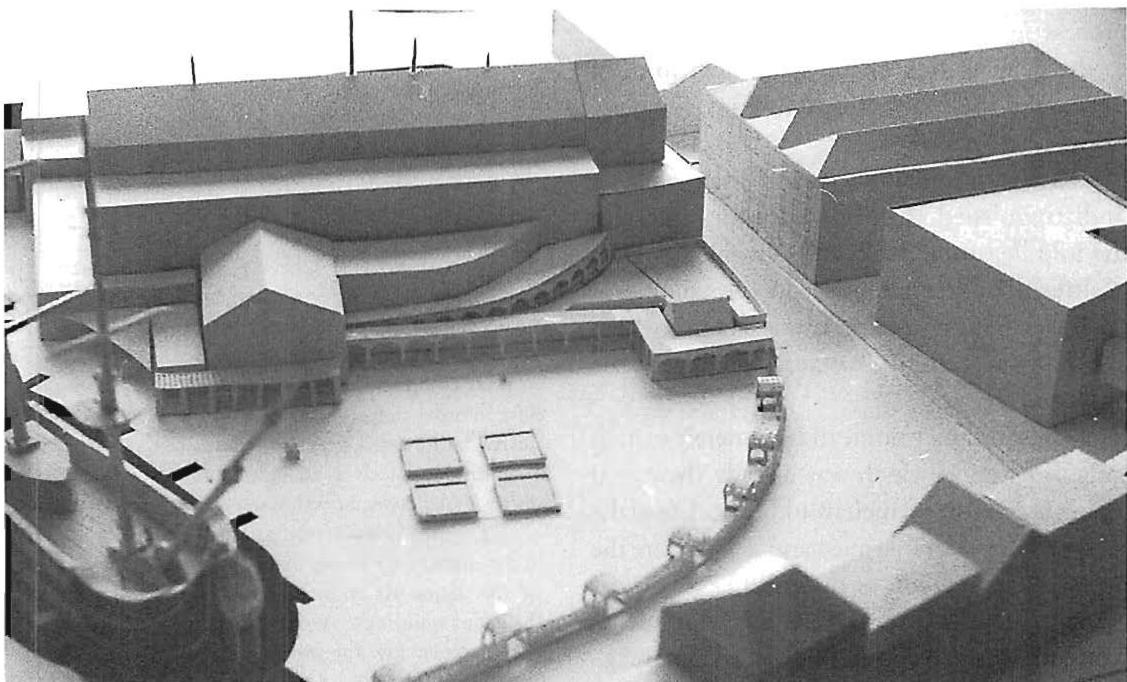
Each time, after one of these experiences, you can pass along the suspended scaffold, and reach some point within the Mary Rose itself where this particular activity actually happened. So you visualize the two combined: a spot in the physical ship as it now is in the dock; the reconstructed detail you have seen in the Museum gallery; and the bridge connecting the two in space, tying together your knowledge of the reconstruction, linking the two.
EXTERIOR MATERIALS AND COLOR
The outside of the Museum is black, dark red, blackish gray, a lighter rose red, light gray. These are the colors of the industrial brick and concrete of the Portsmouth dockyard. They are also reminiscent of the colors which appear in the portrait of Henry VIII's sister, Mary Rose herself, black clothes, red accents, white and grey touches.
The colors are realized in natural masonry materials. Cast stone and concrete are partially blackened, like the mortar mixed with soot that is used in the old dockyard brickwork.
The cast stone is offset with courses of brick; the brick being a deep rose-red. Tiles of soft pink color are also used throughout the walls and facings.
Plaster rendering, in an off-white and light grey, has the same color it has on other brickbuildings of the dockyard. White painted woodwork is used for colonnade details, windows, and doors.
Paving is low budget asphalt, offset with stone paving in ribbons and bands. Roof tiles are heavy grey slate.
Occasional details, bas-reliefs and incisions, are visible in the concrete and brickwork. These reliefs and incisions add to the feeling of detailed work. They are inexpensively produced with concrete casting techniques—and are colored off-white, black, and rose.
INTERIOR MATERIALS
The intricate main trusses which form the interior of the ship hall are made of smoothly surfaced reinforced concrete similar in texture to cast stone. The trusses are lace-like, with arches and Tudor roses cut into the concrete, all working structurally together. Although these trusses are of the highest modern technology, in feeling they may also touch the spirit of works of sixteenth-century architecture like the Henry VII chapel in Westminster Abbey.
Within the museum, the visitor walks on the stonework of the dry dock.
The interior of the pageant area is painted woodwork, mainly red and gold, with accents of light yellow and black.
PROCESS 3: STRUCTURE PRESERVING EMERGENCE OF THE BUILDING VOLUME FROM THE URBAN LANDSCAPE
Most unusual about the volume defining process is the determination—inherent in the
process—to find a volume which contributed to the deep feeling of the space next to it: in the case of the Mary Rose Museum, the place called Victory Arena.
Victory Arena—up until that time an undistinguished and almost formless place in the middle of the dockyard—would be given its life by proper attention to the volume of the Mary Rose Museum. It was just this which also had the capacity to create feeling in the building!
The building volume did not merely sustain something good which was already there—it was an active force which would create life in the space. Its considerable mass and height were the necessary ingredients of the effect.
So, in that place where the Mary Rose Museum was to be built, one could then imagine that the museum—dark, brooding, pink and black—would bring life to the dockyard, to the Victory, to those sullen roads.
Most important of all, it was the space (more than the building) which was being formed. That flies against 20th-century awareness, which places too much emphasis on buildings. What mattered about the building is the contribution it makes to the formation of shaped, coherent, public space. That was where the inspiration came from, and it was that—later—which made it possible to make the building beautiful. At each step in the creation of the volume, a new center was defined: and how, even when I was only groping for the form of the building, progress was being made through the formation of new centers.
Here is the sequence of steps:
- LOOK AT SITE TO GRASP ITS ESSENCE. Understand that the quality of the building itself as a center, rising in relation to Victory, and Victory Plaza, is the main thing.
- GRASP SHIP IN DOCK. Understand the dark center at the core of the whole project: dark, wet, gloomy, like a ghost in a dark cavern.
- GRASP EXTERIOR SPACE OF VICTORY. To embellish Victory Plaza itself, as a center, begin to see this plaza as a surrounded enclosed whole.
- GRASP CHARACTER OF DOCKYARD. Get the darkness of the building. Pink, black, dark grey, red, pink. Related to the soot-blackened brickwork of older dockyard buildings. Hence—a dark thing looming up out of the dockyard.
- HEIGHT OF BUILDING AS JUDGED FROM VICTORY ARENA. Standing in Victory Arena, looking towards the place where the building will be, one senses, and feels, a necessary height of about 19–20 meters.
- HEIGHT, CHARACTER, AS JUDGED FROM ACROSS THE WATER. Check the view from across the water from the security area where the aircraft carriers tie up. Standing over there, one has a clear feeling of the necessary height of the building. I can put my thumb, in front of my eye, at just the height the building must have in order to feel right. When I measure it off against nearby buildings, I again see that it is about 19 meters. In addition, it feels as though it must be a symmetrical entity, high between two lows, seen from across the water.
- THE FORMATION, SHAPE, CHARACTER OF VICTORY ARENA. To fix its shape, a colonnade around part of the arena. Relation to larger space formed by old dockyard buildings. A transparent or semi transparent barrier, to enclose the smaller space.
- MAGNIFICENT FEELING BECAUSE OF THE MARY ROSE SHIP INSIDE. Going back to the Victory Arena, there is a sense of magnificence which I feel, and begin to experience as embellishment of encrusted detail: I think of the small drawing from Henry VIII's book of ships, and try to imagine something with this particular feeling of magnificence.
The work of finding this "magnificent" volume was done on the site, by looking, pacing, holding up one's hands to judge the effect of different possible ridge lines on the Victory plaza. It was also supplemented by the use of rough paper models (mainly at 1:200 scale). Very little of this work was done on drawings, because there is little that a drawing can tell you about such a problem. What drawings were made, were made only to record what had been worked out on the site, or in the models.
PROCESS 4: THE ROUGH SKETCH DESIGN
The first sketches show how the fundamental process drew us—the architects—to an early multi-levelled pattern of centers, capable of containing deep feeling. To have feeling, it had to have a hierarchy of parts, coupled with a simple centeredness in each of the parts.
Unusual was the fact that the search for such a pattern, being a nearly abstract process, was an attempt to create a pure harmony between the building and the place, establishing it in its setting, as a completion of the unfinished form and ambience of the surroundings. This process was—at this early stage, almost separate from functional considerations, bubble diagrams, and
plan features, which would typically have dominated the early design stages of a major building in the late 20th century.
The effect of this "whole-oriented" pattern-awareness was strong, and immediate. Even in the very early sketches, the building looks, in its physical character, like buildings built 2000 years ago, or 200 years ago, or perhaps as buildings may appear in some future era 200 or 2000 years from now. This was not stylistic. It is simply a mark of living structure that a hierarchy of distinct, and well-formed levels must exist in which coherent centers occur at every level of scale. Emphasis on the fundamental process typically brings such a character into existence, because it puts a focus on emerging centers (large, middle-sized, small, and very small). It sounds commonplace. Yet it has the power to create beauty. Today's system of design rarely gives schematic designs this character.
The problem is aggravated because schematic design is too often done by people do not
know how to build with their own hands. If they do not know (with their own hands) how to build, they can have no authentic sense of what hierarchy of details is probable, or possible.
In our case, even the earliest sketches came from a sensibility that relied on use of real materials, on the basis of our construction yard where experiments could be made. Physical and material experiments were made, even in the first three weeks of conceptual design. From the earliest days, we were trying bricks, stones, concrete, building small walls, looking at the real character, or real material, on the site. That changed the mental process — and the actual process — which then led to the creation of these sketches. We began to develop a conception of the building's physical character.
We were concerned with the whole — that means with the impact of the building on the surroundings — not — at this stage — with details of plan or organization.
We looked for the elementary repetitions which could embody the volume that had been defined in relation to the site, and we began to see a continuous interplay, back and forth, between the creation of new centers that established "points" in space, and the differentiation of these centers with further repetition of differentiated pieces, that then established further, and smaller, centers.
This was a pure pattern process, almost like designing a carpet, in which space-filling geometry and color had to enhance the volume structure that was — by now — there in our conception.
First we had a center located at dock #3. This center needed first to establish its size, its extent: that means its rough volumetric mass, height, length, width, and height. This was established according to its impact on the surroundings and on its capacity, therefore, to create a larger living center in the area of Victory Arena.
Next we had the spanning of the dock, a structural task, which would require a certain repetition of members and structural bays—arches, capable of carrying the weight of a further building above.
Next we had some sense of the exterior of the building, showing this structural repetition in a way which established a rhythm of the exterior, harmonious in that place.
Next we had the position of the entrance and the physical character of the entrance, one that would make sense in context with other buildings round about, and with HMS Victory.
Then we had the ramp, the entering path to the exhibit, established by the vision of the way one enters the museum.
Then differentiation of the ramp volume into bays which repeat openings and columns, varying slightly according to their positions in the ramp, and formation of the colonnade itself—white or off-white plastered columns—and its repeating bays.
PROCESS 5: OBTAINING THE STRUCTURAL DESIGN
From the point of view of process, it was highly unusual to bring engineering and architecture together, at such an early stage.
Yet it is, I believe, only when these two work together, that deep feeling or life can be attained in a building. A building is, above all, a configuration of mass, and the distribution of mass which forms the building is almost the most basic thing of all about it. When you also include money, as must be done, it can be seen that the initial conception of the building had to be an engineering-money conception, from the very first day, all the way until completion.
Here the need for an integrated process created some pitfalls. In the conventional profes-
sional approach engineers are hired after the architectural design, and the engineers are not necessarily under the control of the architect. However, in the situation of this building, if we were to build a great museum building, almost inevitably a heavy one, on the Portsmouth mud with its poor foundation soil, the way the foundation was going to work, and the soil's bearing capacity, would very probably determine the design in all its global aspects.
I therefore had to ask our clients to permit full-scale engineering to start right away (even for preliminary sketch design), and that an engineering contract be awarded to an engineer of my choosing, under my direction. It seems a small thing, but it took enormous effort to gain acceptance of this necessary principle. It is an example of a small but rigid aspect of professional practice, which can cause havoc in the proper unfolding of a building design—yet which was nevertheless entrenched in 20th-century procedures.
In the Mary Rose Museum design, in particular, it was necessary—from the first day of sketch design—to have a real understanding of the foundation design. To place arches as huge as those which I envisaged, in a poor-quality mud, next to a 16th-century dock of doubtful condition and strength, even the foundation design was a major issue from the first day.
Even the most general concept of how the building worked could not be thought out without serious attention to aspects of engineering. Gary Black and I began the early engineering design almost at the same time as the first sketches of the building. From the very first day, we thought of the building as a braced lattice structure. The focus was on the arched support to span the 30-meter wide dry-dock where the Mary Rose was permanently housed. The idea that we would suspend a restaurant above this structure, thus creating height and load, over such a flimsy wide-span support, made the conception of the building, as light and strong, fundamental from the first.
The main arches are to be pierced tracery, made of concrete, similar to others we built in San Jose (see pages 211-22), but very much larger. The span of the San Jose trusses was about 9 meters. Here their span is to be 30 meters.
It is unusual to have this level of involvement in engineering and structural design, at this intensity, from the architect. Nor is it usual to have it at such an early stage in the process. Yet it is imperative in order to get real depth of feeling into a completed building.
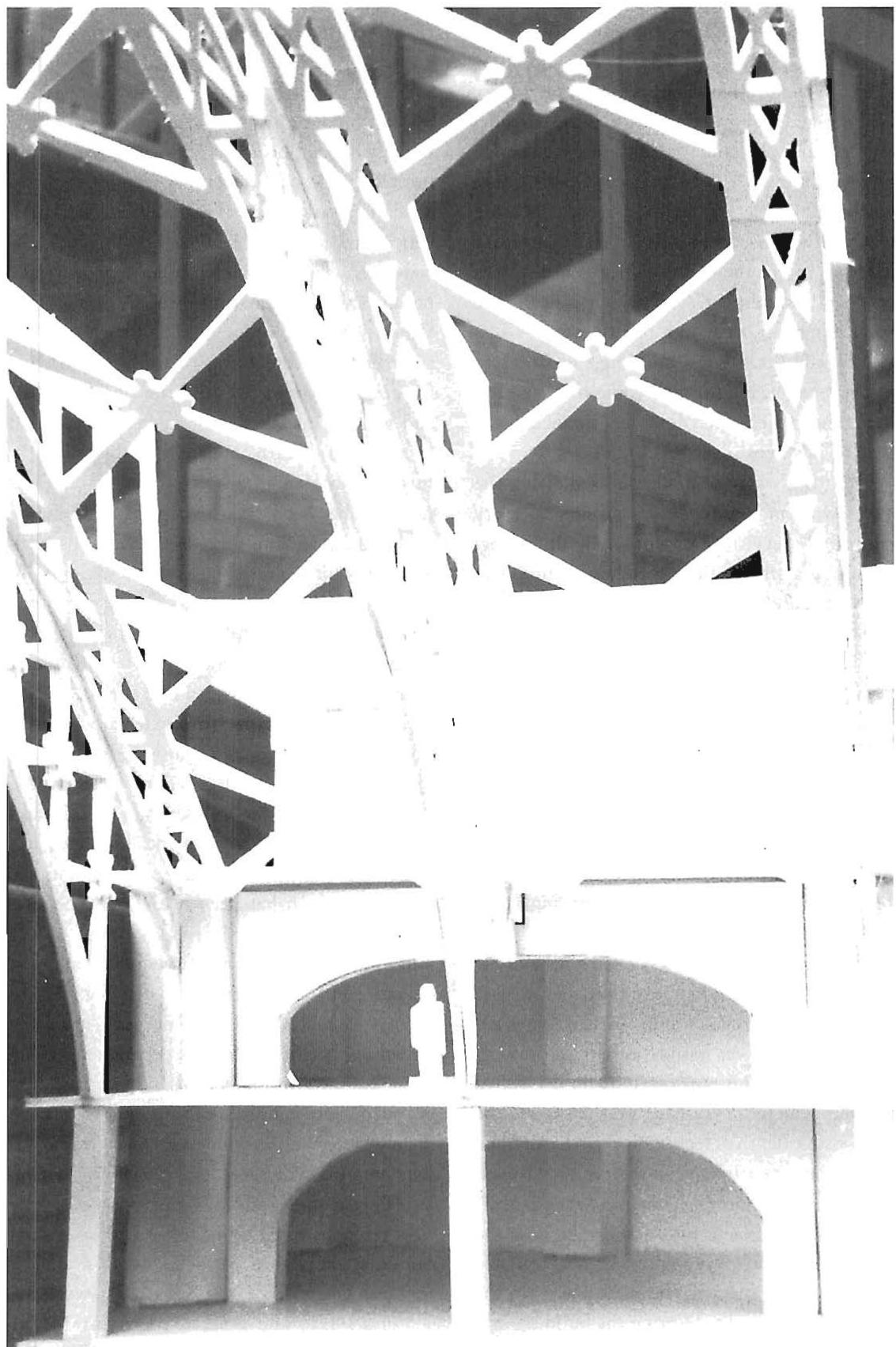
PROCESS 6: MONEY DISTRIBUTION
Money is the life-blood of every building. How it is garnered and spent determines the outcome and the artistic life and soul of the finished building. It is the overall global pattern of expenditure which controls the way feeling can occur, because it is this which controls the overall pattern of material, in quantity and quality—just as it is the overall pattern of color which controls the way feeling can occur in a painting.
Usually, in a large building, attention to money, budget, bidding, all come too late. Too often, the project then founders financially, or leads to huge cost overruns.
Starting with the money, and allowing the overview of money to guide the process every day and at every stage of work, help unfolding, because it is only in this procedural atmosphere that one truly has a grasp of the whole at every stage.
The most unusual feature of the money process which we proposed to use on the Mary Rose Museum, and which we did use successfully at West Dean, was program budgeting. In program budgeting, a cost plan is made starting even before design begins. This cost plan is an assignment of budget amounts allocated to different categories of work. To start with, the cost plan is made intuitively, to capture how much one wants to spend in these categories.
It may seem strange to say that a responsible cost plan was based on intuition, but that is indeed so. One guesses and can feel the result of spending 14% on foundations, 22% on roof structure, etc. The purpose is to find a set of numbers which are realistic, and yet create the best possible depth of feeling that can be attained within the given budget envelope. For a team with experience, numbers like these translate directly and intuitively into a sense of how the building will turn out, and whether available money is being spent in the right places, in the right relative amounts to bring the building into harmony, and is likely to have the overall feeling effect which is desired.
Of course the allocations in the first cost plan are subsequently tested and modified continually, as the work goes forward, and finally made sound by later bidding processes. After receiving bids, to see what can be achieved with the allocation initially proposed, further more refined intuitive allocations are made. These, again, become a benchmark for actual expenditure.
The assumption throughout is that the numbers will remain within the framework set. What floats is the design, not the price. One assumes that "something" can always be done for any sum suggested, and the subcontractors and general manager must make do with that so as not to disturb the whole—the whole, in this instance, being the overall budget distribution that has been allocated in the cost plan.
Thus, as the building design develops, each subcontractor is presented with the opposite of the normal situation. Instead of being shown the drawings and asked to bid the work, he is told the sum allocated, and asked what he can do that is best for the project within that sum of money.
This procedure requires extensive negotiation, and the manager must be flexible in his understanding of the reality faced by the subcontractor, so as to maintain a fair and equitable attitude to the work. However, the benchmark of the process is that the allocation which has been made gives the fail-safe distribution: in the best interest of the building overall, and it is unwise for any one operation to be allowed to drive it out of balance, merely because something has been drawn or specified, which is expensive. Rather, one takes the attitude, let this allocated amount be fixed, and—unless exceptional conditions dictate otherwise—whatever can be done for that amount will serve the project well.
This attitude, and this process have repeatedly given us extraordinary control over what can be accomplished with the money available. In West Dean (for a full description see Book 4, pages 118-29 and Book 2, pages 403-6), it allowed us to gain a great advantage over money and to increase enormously what can be achieved
with a given level of resource. One may see a measure of the effect by remarking that the West Dean building was built, finally, for $\angle 1,213 / \mathrm{m}^2$. Yet experienced people who saw the finished building with all the finesse of brick and concrete, stone and flint that went into it, and the enormous attention to detail—calculated that the building had cost $\angle 1,800$ to $\angle 2,000$ per square meter. Thus the building we delivered was worth about one and a half times what the client paid, if measured by comparison with conventional bidding and construction practice.
All this was achieved by the extraordinarily subtle, careful, and sensitive manipulation of money under the tight control of our construction manager and chief engineer, John Hewitt.
PROCESS 7: DISTRIBUTION OF THE MAIN MASS CONCRETE OF THE BUILDING
Our test-bed for the Mary Rose Museum is the West Dean Visitor's Centre, about 20 miles from the Mary Rose. That is where we worked out techniques of highly innovative brick and concrete combinations (see sample on page 146). It seems a small thing to have made concrete that people felt was beautiful. I think it is not too much to say that, by being made with feeling, and having self-like character, the columns, struts, and arches of concrete in the West Dean building have the same feeling-quality that one recognizes in stone in ancient traditional works.
The feeling of a material does not depend on what it is—it depends on how it is handled. Though modest, the few concrete struts, the occasional concrete arch—all had the internal, careful, felt quality that one has seen in the best ancient stonework. Yet it was cheap to make, and not costly of time, either. It was simply possible, within the process as we administered it, to make the concrete come out like this.
For the clients, the planning officials, and others, it was a revelation that the hated concrete—"that awful stuff" as they felt it to be—in combination with other materials, could have a feeling nearly as precious as linen, or marble.
PROCESS 8: WORKING THROUGH THE FINER MATERIALS, CONCRETE, BRICK, AND STONE, WITH SPECIAL REGARD FOR LIGHT AND COLOR
In the Mary Rose Museum, the brickwork, concrete work, and stonework, are of the essence to the building. The Museum is mainly made of these materials, and it is the organization, and beauty of these materials, which will control the whole.
Although of course, in its broad outline, a building must be understood in advance, the creation of brick and stonework, to be beautiful, is almost like a painting. It has to be done, each piece as a response to the place. In laying the stones or bricks, or pouring small pieces of concrete, one moves, with the lines and pattern of the work, in response to the perceived harmony, the perceived need of the place, as it evolves.
In the West Dean Visitor's Centre we undertook such work. It will be helpful to describe it in a little detail so as to show, by extension, how the Museum will be handled, when it is built.
The dominant feeling in West Dean was of a grayish light, caused by the flint walls predominant in that place, touched with the nearly scarlet red of Midhurst brick. The whole time, throughout the work of building the main walls, we constantly played with the emerging color, and the emerging changing, red-gray harmony, as it evolved.
We made it change by changing, constantly, the balance of light gray (concrete, sand and cement only with a fine Chichester grit); brickwork (Midhurst scarlet reds); stone (a Portland limestone which was a slightly bluish gray); and flint (a warm gray flecked with white and black).
We began the masonry construction with a straight brick plinth—though even there, to increase the gray, I inserted a chase two courses up from the bottom, into which we later inserted a stone filling band, about two inches high, to make a better connection between the inside of the brickwork (red) and the gray of the earth below it (DEEP INTERLOCK, MUTUAL EMBEDDING).
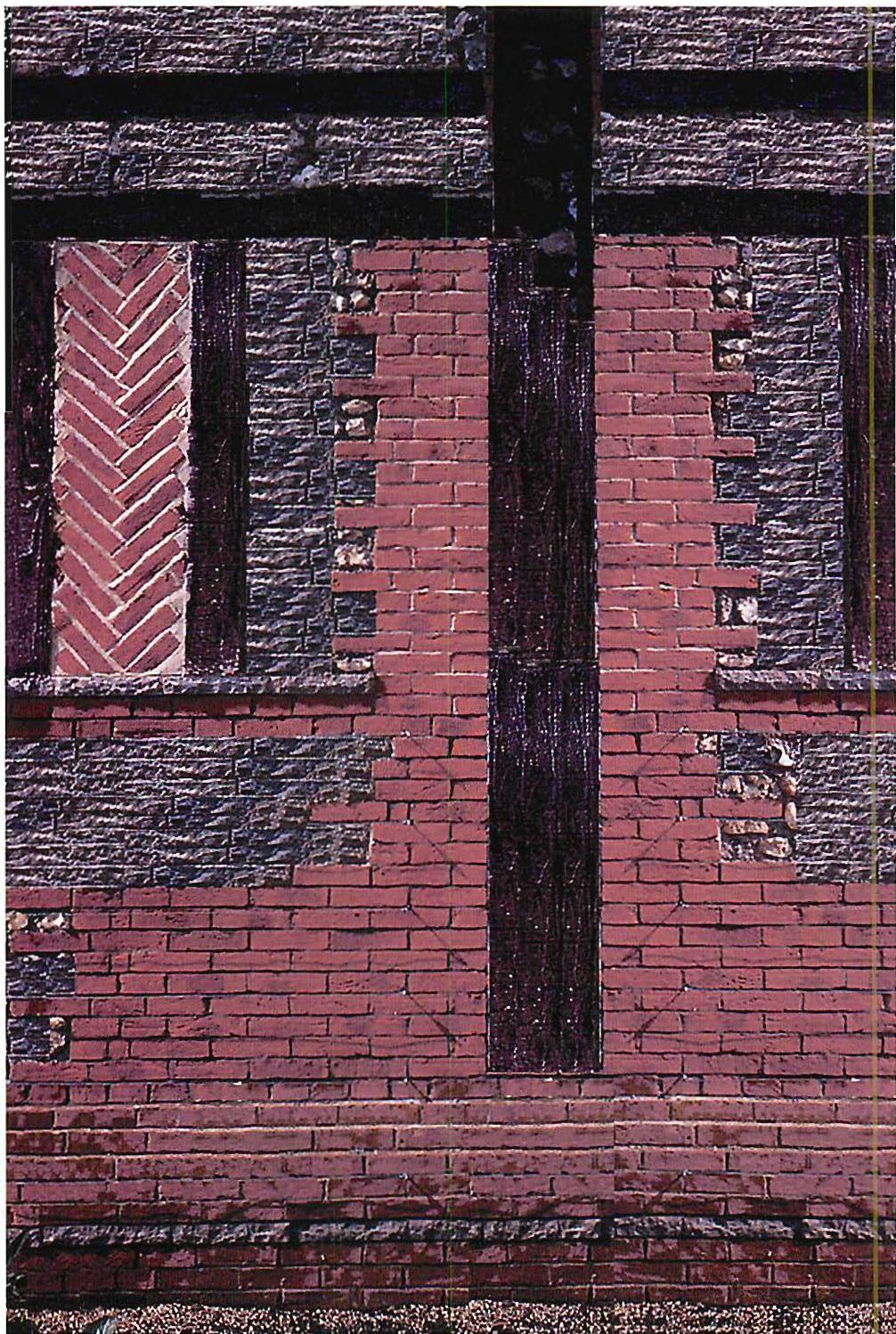
Materials for the Mary Rose Museum. Here we see the handling of Sussex brick, Portland stone, and blackened concrete—a subdued red rose, gray, and blackened gray—that is anticipated for the Mary Rose Museum. What is shown here is a montage for construction that was first worked out at West Dean, only twenty miles from the Mary Rose Museum site, then adjusted in this picture to show changes in brick color, concrete color, portland stone, and configuration. At West Dean it took many experiments, and every course had to be placed by eye, in mock-ups, to make the whole thing come out right.
We then built eight courses of red brick, with some stepping back. We then inserted a stone course. Then, we made a decision — because the windows inside the north wall had been adjusted to an entirely different height because of experiments with views, from the inside — that we now faced a completely different organization of pattern, than originally expected at the time of first drawings.
That, in turn, required a different area of gray panels (flintwork). The concrete was then poured to form the verticals between the bricks.
Here again, it was vital that this concrete be poured by hand. There had been talk of using prefabricated concrete pieces. But I knew from personal experience of working concrete that it would be better, and far more harmonious, if poured. It sounds more expensive, but in fact was very simple, and not expensive to do.
This process of judging, adding a touch of gray, adding a line of pink or red, went on all the way to the top of the wall, and the construction of the cornice, where similar judgments were made, just before the mass of brick and masonry work was completed. It is not too much to say that we understood the vital implications of this process every day throughout the work, and modified our work, every few courses, throughout the whole period of construction of brick and concrete work. All in all the work took five to six months, from foundation to eave: And we made modifications according to what we saw and felt, at least every one to two weeks — thus a dozen to twenty times during the construction.
It is no more possible to create beauty of brickwork without taking such pains, than it would be possible to make a beautiful portrait without looking, and drawing, and looking, and drawing. . .
It depends, absolutely, on the quality of the colors and patterns of brickwork in the light. And it depends on the handmade concrete work, which surprised everyone, because it was beautiful. The original brickwork contract for the West Dean Center was for £58,000. The rough sketches included walls of massive construction, in some
places more than two feet thick. The exterior treatment included brick, stone, concrete, and flint. It was made clear, too, that this was not an ornamental facing, but an integrated system of construction in which these various members would be made to interlock, with block and insulation, forming a highly integrated structural wall of massive weight and high thermal capacity.
When we began showing different subcontractors rough sketches, we had two reactions. The bids were, uniformly, too high—in some cases by 50% or 60%. Further, there was often a lack of cooperation in discussion; Chiverton, for instance, wanted us to talk to their estimator—an architect by training—and would not allow us to talk to the bricklayers themselves. Since the architect did not understand brickwork with his own hands, only as an abstract knowledge, his estimates ran high (because of unfamiliarity), and his discussion ran thin (possibly because of a lack of love or lack of enthusiasm for the craft).
There was also an element of fear. When we explained that on many occasions the process and the contract would depart greatly from what was presently visible on the drawings, and that we would negotiate in good faith to keep quantity of materials, and quantity of work constant, only a few of the bricklayers we interviewed were interested.
A fourth thing was that the larger bricklaying companies, oriented in their thinking towards high-pressure time/money operations, showed us work which was clearly not in keeping with the need for every portion of brickwork to evolve, or for the right and most living thing to be attained. These bricklayers and their companies might be called the wage slaves of corporate high-pressure operations. We could not ask them to help us.
Phil Pye, who finally did the work, was a humble, silent man: aggressive when he felt unfairly treated, but honest, cooperative, and willing to work with us. From the beginning, there was an inherent reasonableness in his attitude, and a sense of excitement to do something valuable.
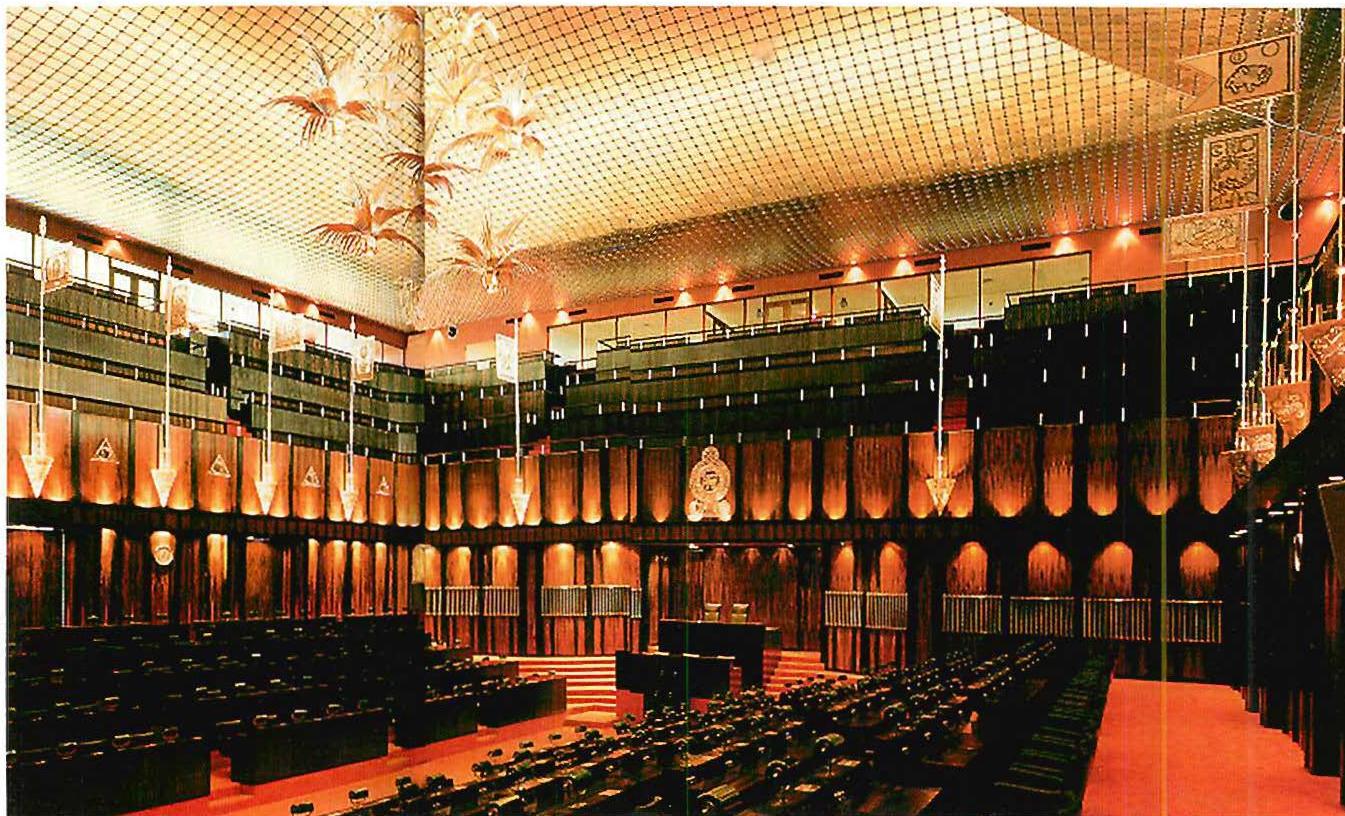
13 / SETTING UP A DESIGN/MANAGEMENT/CONSTRUCTION ORGANIZATION FOR A $16 MILLION BUILDING
What is needed to build such a building? What kind of approach to designing, managing, crafting, a very large building will keep it humane, and make it genuinely beautiful?
Let us imagine a new kind of design/construction/management process for a building of £10 million ($16 million), which allows the building to be conceived, designed, and built so that it comes to life. For the sake of argument, assume that, all in all, some two hundred men and women will be working on the building. How are they to work together? How can each of them put something of themselves into the building? And how can they together, as suggested in Book 2, chapter 14, put their deep feeling into the building, so that it comes to life as one whole?
Success will depend very much on the management structure, the human organization. Repeated use of the fundamental process requires freer adaptation and creation of centers. Such adaptation can only work if the process allows each center to be freely determined within the whole, according to the needs and demands of the whole. Yet, of course, the whole must become a single entity, coherent, not a tower of Babel where each craftsman does what he wants. Not only that, but the craftspeople's free participation and contribution to an emerging whole must be allowed during the earliest stages of design and during heavy construction, when big issues are decided as much as during later stages of design, and during finishing.
Most often, large-volume 20th-century or
ganization of construction work created efficiency by assigning rule-based tasks to categories, and imposing these categories, regardless of the reality which occurs. Instead, to carry out the living process successfully in a larger project, it needs acceptance, from the beginning, that design, engineering, cost control, construction, direct management of subcontractors and communication between architect and craftspeople directly, will all be encouraged and supported as part of a single multifaceted operation of interacting processes.
This kind of management structure did exist fully in the West Dean Visitor's Centre, in the San Jose building, and in the Eishin campus. Contracts expressing this arrangement were in place from the first days of the project. In the Mary Rose Museum, preparations were under way for such a contract.
To grasp the nature of such a new construction management process, let us imagine 50,000 decisions being made during the course of building the Museum or other large public building. The decisions and actions were to evolve over a three-year period, from the time the project is first conceived to the time the Museum was first to be occupied. The total process would require about 50 decisions per day, daily, for 1,000 days.
To be consistent with the living process, and specifically also with the continual repetition of the fundamental process as the living process was carried out, all these decisions have to work in an atmosphere of concern for living, flexible detail, carried out within a vision of an emerging whole—and this conception must be shared by the two hundred men and women doing the work, and by the managing architect and the top construction managers and engineers who are supervising and carrying out the work.
To get all that, the process is to be managed, from the beginning to completion, by an architect-manager—head of a team of architects-construction-engineers—capable of running a large-scale construction job.
While the initial plan and volume are being worked out by this team, the structural scheme
of the building simultaneously makes its appearance. Major public spaces in the building, and smaller social spaces, appear early on the scene.
The team ensures that the neighborhood of the building and the space around the building are going to be improved by the insertion of the building. The building will support the wholeness of the neighborhood, repair it, heal it.
Then a structure appears: a subtle and beautiful kind of repetition, with some syncopation to make spaces positive, and one in which individual columns and beams are able to take their own form. To achieve this syncopated grid, even at the earliest stage of work, computer studies of finite element analysis must accompany the working through of the building. Engineers are cooperating from the outset, not coming in afterwards.
The money allocated to the structure has to be conceived by the architect-manager, from the beginning, in such a way that it makes best use of the available budget. To get this, the building is first and foremost designed as a system of expenditures. From the outset, and every day, financial calculations help to shape the building, as much as design, since this is the way the building evolves successfully as a whole. Indeed, the design first appears, not on the drawing board, but as a cost plan which gives us a picture of budget allocations, each item chosen so that each one makes its maximum contribution to the feeling and experience of the whole.
Consideration of construction management is already involved, from the very earliest stage of work in the initial cost plan. Amounts set aside for different parts of the building are not estimates, but often preliminary bids from selected subcontractors. Thus, even while the building is in the earliest stages of design, allocations of money are based on real experience and real discussion. The materials to be used in the design then evolve in relation to the budget and in relation to real, defined subcontractors.
Construction workers are organized in a decentralized fashion, so that each construction worker has some freedom to contribute to the
formation of the whole. Of course, what is done in any one part of the structure has to work within the budget, and it has to be consistent with the larger plan; nevertheless, there is freedom, locally, within the building, to make each room and part unique, and for each team of construction workers to give the process something that they love and enjoy.
Generic structural considerations are settled early on so that the foundations and major structural skeleton are fixed and safe. Minor structural matters are solved, dynamically, during construction; engineers work with the project as it goes forward, and their insurance allows them to make calculations and modifications, while the building proceeds. Insurance is therefore differently contracted, because it allows construction and design to be intermingled.
The human organization of the job is different from today's construction contract in a number of ways. The job as a whole is performed under a management contract with a fixed budget. A general contract management team is paid a management fee which is fixed in advance. There is no profit beyond the fee. Expenditure of all money beyond this fee is visible to the client, and the builder has the responsibility to deliver the best possible building with the available fixed sum.
Human organization of the work is handled by different craft-based subcontractors. All work is assigned as variable within the job of fitting to existing design, but based on fixed parameters of quantity. Subcontractors and craftsmen are expected to provide variation and quality within the fixed quantity.
Drawings made in advance only show the means of construction, and the approximate form of results, not the detailed plans or execution. Small details of space, materials, ornament, and color are in the hands of the users, craftspeople, and the architect/builder.
At every level of decision, and in each time period, users of the building—both executives of the project and the general public—are involved, with the understanding that their wishes
can be consulted and will be incorporated in an ongoing rhythm throughout construction. Additional cost to the building is not permitted as an outcome of user involvement, nor time delays.
In some parts of the building, users lay out their individual space, sometimes even whole floors, with the help of computer programs that give people the ability to form layouts that are organic and suited to their immediate needs.
Financing of construction is arranged so that not all the money is spent at the outset. The architect-manager works with the building owners to set aside a definite sum for annual modification and repair, for the first ten years, so that the building can be fine-tuned after construction. Compensatory savings are made so that the building, as first built, sometimes appears a little more rudimentary than usual.
The building form itself helps the human organization and new form of management, because it creates a greater feeling of connection between the craftsmen and the building. Structural members are likely to be more massive than is typical, and are used to contain services, storage, and other space-eating elements. Ornament is highly visible in parts of the building; splashes of color and design are visible in subtle quantities to touch the whole with subtle feeling. Size and color generate more intense involvement.
All the architect-managers are personally involved in the making of at least some of the ornaments and details. And at least half of the construction workers on the job have enough responsibility, and freedom, so that their individual mark is left on the building—in the form of initials, or stamped marks, or signature. The shared motive, maintained throughout, and communicated to all who worked on the building, is that the public space which the building creates, is going to be considered as important in the process as the building itself. As the building matures, this space, too, is helped to flower, creating areas for the benefit of the ordinary wishes and desires of ordinary people, and for the nourishment of their feeling.
14 / CONCLUSION
GEOMETRIC FEATURES WHICH FOLLOW FROM THE USE OF LIVING PROCESS IN THE MAKING OF LARGE BUILDINGS
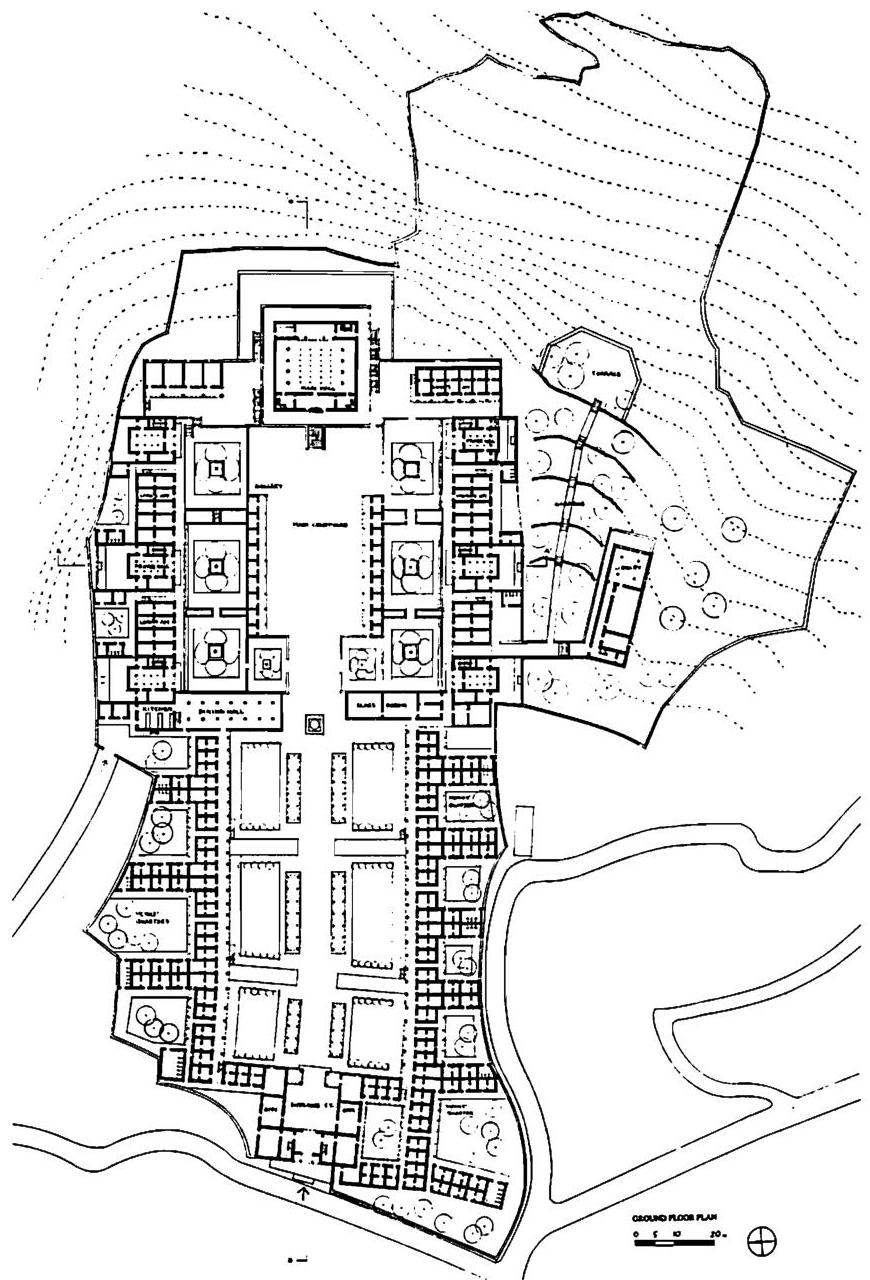
Perhaps the most vital thing about a large public building, and its form, is that it honors and respects the land, grows out of the land in a natural way. The drawings illustrate what I mean with a plan of the Nyingma monastery for a
community of 300 monks, designed for Tarthang Tulku Rinpoche, to be built one day — we still hope — in Kathmandu.
A successful large building will always show the subtle syncopation of regularity of structure combined with subtle, and gentle accomodation to the land and its contours — in the monastery, visible in the plan and in the profile of the model as the building juts out from the hill, almost grows out of it. And at the same time, the larger masses of the building will be offset by a continuous range of scales and levels, going all the way down to the most intimate details of construction, genuinely completing and strengthening the large structure of the whole. In the monastery, the high red wall, built to contain the compound, with blue "eyes" staring and providing detail — this is an example of what I mean.
These qualities, the combination of larger and small, often in a stunning range of scales, will always come about somehow, in combination with love for the land, when a large building emerges from a living process. Within that structure, the entities which exist go down to the tiniest details. The invariant, so described, seems like something from Kubla Khan — huge, yet intimate, studded with gold stars, shimmering with detail.
CHAPTER FIVE: HOW LIVING PROCESS GENERATES THE POSITIVE PATTERN OF SPACE AND VOLUME IN THREE DIMENSIONS ON THE LAND
1 / THE ALL-IMPORTANT RELATIONSHIP BETWEEN BUILDINGS AND THE LAND
Let us come, now, to what is perhaps the very core of the structure-preserving process for buildings and land. I have said a number of times that the essence of a living process lies in the way that each step repairs and extends and completes the whole. For a building process, that means that when a process is working right, it consists of structure-preserving transformations which shape and place buildings to enlarge and deepen the wholeness of city and land. I want to ask you to think about a process which sets position, height, volume, and space of new buildings, as they are created, so as to heal the land, and builds from them the larger geometric texture which can form a living whole in city and community.
2 / EVERY BUILDING IS PLACED AND SHAPED TO FORM A POSITIVE PATTERN OF SPACE
Consider what it means to place buildings according to the fundamental process. It means simply that each act of building—every single act of building—has a positive effect on its surroundings. It completes the surroundings, preserves their structure, makes them deeper, makes them better, by creating strong centers in them and next to them.
When this is done right it means that each new building will be a good neighbor. Instead of harming its surroundings, as so many buildings do today, instead of standing alone in precious isolation, each new building fits into its context, makes the larger area more profound, enlarges it in spirit. Each building—especially in its siting, its location, its volumes, and in the outdoor spaces they create—will be shaped to protect its neighbor buildings, to extend pedestrian canopies, to improve the space in adjacent streets in conjunction with other nearby buildings.
The effect is that each building enlivens and intensifies the land. The land—its valleys, ridges, slopes, its stands of tress, its lanes, its ponds, its pathways—are improved, made more solid, given a more living structure.
3 / A LOCK-AND-KEY PROCESS
Consider any configuration of land, urban land or natural land. It may be a complex of streets, buildings, and nature together. It may be a bit of natural land, unspoiled. It has, in any case, a complex three-dimensional configuration.
Suppose we have the task of introducing a new building into that configuration. There are hundreds of ways of doing it. Among them there are usually a small number which will increase the life of that configuration by most strongly intensifying the life of the existing centers. After studying the possibilities, we often find that there is one which is better than the rest because it does the most to preserve the structure of what
exists and to enliven it. To the extent that it exists, our task is to find that one.
I show, on page 155, a pump-house building built by Otto Wagner on the bank of the Danube about 1900. His building, in the foreground here, is bold, simple, unpretentious. But it fits the situation perfectly. It creates something new, yet leaves the fabric of the city untouched, extended, enhanced.
This relationship of the new volume to the existing structure is almost like the molecular lock-and-key relationship that exists between certain sites in a protein and incoming molecules; they have to fit very exactly, and the fit is very complex, so they are very specific. Whether they fit or not is very definite, though very subtle. What I am talking about has that kind of complexity. It is defined by highly complex features of the wholeness, that is to say, of the system of centers which exists in three dimensions.
4 / THE MILLENNIUM CHURCH
On this page and the next, I show a case of a very large building—the Church of the Holy Trinity—that I was asked to design on the south bank of the Thames. I looked at the site (shown below), from across the river, and tried to imagine what would help the river and what, if it was built there, would help the City of London.
The new church was to be massive, capable of holding 500 people, and capable also of making room for a new approach to church services in which large gatherings alternate with small group seminars. It was to be built on the south bank of the Thames, between the railroad tracks leading out from Victoria Station and Chelsea Bridge. The photograph below shows the site as it looked in early 1997.
Preparing for an early discussion with the client, and after absorbing the briefing I had
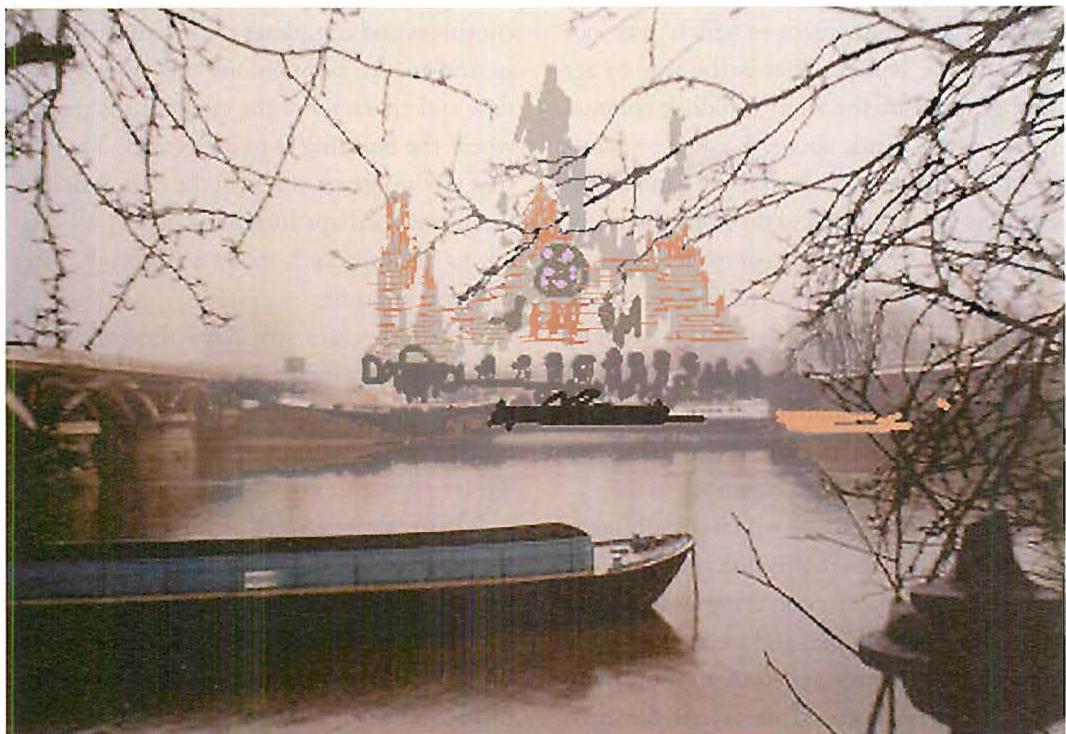
been given, I stood on the north bank of the river, looking across at the site, trying to imagine what kind of large church would both be a great and inspiring monument and would, at the same time, complement, enlarge, and extend the beauty of the site and its position in the overall scheme of things in that part of London.
Thinking about that, I began to see a high building, with many spires, forming a single mass.
To make clear to myself what this was, and what would be structure-preserving in that place, I made a computer image of the photograph below, and drew in the computer, using a simple tool which I had then just recently created for step-by-step unfolding. The resulting sketch (this page) shows, in some degree, what it means to make a thing whose form, and the form of the space which is created, are consistent with, and grow out of, that place.
The sketch process was an informal structure-preserving process, carried out almost
as one might carry out a doodle . . . a small line is drawn, one looks to see if this line helps the site, moves, adds another line, . . . is it preserving the structure of what is there. Does it fit? Does it extend the whole. Does it make the landscape better, more harmonious than before? Where to put the next line? What kind of building, what shape, size, high, low, long, thin, would help to make the land better, if, indeed, I put it in that place? Again we search. The mind races through fifty or a hundred different ways of making that volume. I consider it as five stories high, or as two stories high. I consider it as long and thin, or massive and squat like a cube — then again higher, deeper, further away from us as we are standing. Again, I am aware as I go mentally through many, many cases, that most of them do not help, they make the city worse and less harmonious. But gradually, as the process goes forward, I get a glimpse of the fact that if the new church is high, it will have the effect of
intensifying that one place—which was not much of a place before. That is the way to get the first glimpse of the right building volume.
Whatever I think about, I ask if—genuinely—the latent centers in the site can be preserved. This is not so hard to do when the latent centers are fairly small, say 100 or 150 feet across. But sometimes it is possible to find a way of introducing the new volume, so that it not only strengthens a small center like that, but also, at the same time, some much larger latent center—in this case the river itself, perhaps 500 feet across—is made more beautiful.
This is the kind of action which is really powerful in bringing the configuration to life. But to do it, you can't just sweep everything away. As you introduce the new volume, and make the highly complex three-dimensional configuration more alive, you have to protect and preserve all the small centers—lawns, buildings, walls, seats, trees, bushes, paths, spaces that are loved—all the centers formed by groups of things. Whatever new centers you inject must not cut across these existing centers or destroy them.
How can we specify this nearly lock-and-key relationship of the new volume to the existing configuration? There are no simple rules for finding the best volume. There is not, as far as I know, any algorithm for it. But I would summarize like this: Look at the centers in the configuration. Some are latent, weak, not yet complete. Try to shape and place the new volume in such a way that all the important centers that exist now—especially the larger ones—are preserved; and try to do it so that some of these latent centers are made more beautiful.¹
The effect of the fundamental process is that the site and volume become intertwined, since centers in the mass and centers in the space are developing together.
If the site is mainly natural, then what matters is the way this building sits in the land, complements the lines, contours, hills, trees, dips and hummocks of the terrain. If the site is urban, then what matters most is the way this building
continues and completes the urban structure, sits in and makes harmonious the extended urban flow and character of the street or square or river where the building is to be located. That means that all the latent centers in the city, at that place, in an area perhaps hundreds of feet all around, are to be improved, made a little bit better by the new building.
In both cases, we have the task that the wholeness now existing is somehow to be made more complete, more beautiful, because of what is being added to it, injected into it. That is what we are trying to do.
In my experience, this work must be done on the land itself. One must imagine the building, when standing there, waiting, really, for the form and volume and position of the new building to come to the mind's eye, as if it were already there, and as if you can see it, just by standing there. Usually, after seeing it in this way, we also flag it or mark it with flags or poles or strings, so that we see it more clearly.
In its first moments, the process has a particular visionary and dynamic character. To start with, we look at that land with the eyes of lovers. We see the land, appreciate its good qualities, love what it is; no matter how derelict, still we love what is best in it. And then, as lovers of it, we have to imagine that by putting a building there, we can make the place better. This is often hard to imagine. In a natural landscape, is it really possible that the bushes, the buttercups, the small blue flowers on the hedge are made better by putting a building somewhere? But I persist. Very fast, like a chess player considering moves, I run through twenty, fifty possible places where I might put the building. Most of them I pass by in an instant because I can see that they do not make the place better. But with one or two I begin to see a glimpse of the way that the whole land might become better if I put a building there. There, for instance, a building this long and this high, will repair this street. So for the first time, I get a glimmer of an idea that this land can actually be improved, made better, by placing a building in just that one place.
5 / EMERGENCE OF COMPLEX SPACE AND VOLUME ON A SMALL PIECE OF LAND IN CALIFORNIA
Let us examine another case like this—but smaller—in detail, where we may see the whole pattern and texture of volumes on a site slowly taking shape through a living process. The drawings (on page 160–61) show a house some 80 miles north of San Francisco, the Berryessa house, planned and built about 1986–87.
Here the unfolding, following the fundamental process, went like this: We started by seeing, on the site, the most established latent centers. The main centers, as they existed, were the spaces among the trees. The white oaks, dotted on the slope, made a natural bench, and a natural shelf, where one was inclined most naturally, to sit and gaze at the purple hills in the far distance, across the valley. So, the first step was to establish the main building volume as being
long (stretched across the slope, parallel to contour lines), thin (very narrow down the slope, since the slope was steep), and placed so that it left the wonderful trees intact. We fixed the main volume in this position.
A minor volume, the studio and entrance, came in above it, in another space between oak trees. Two more minor volumes came below it—the master bedroom and the library.
These volumes, connected with exterior and interior stairs running up and down the slope, made the form of the whole. A main terrace with a pergola made still another volume in that part of the open space where the view was most beautiful. The main volume of the house (about 45 feet long, containing living room and kitchen), had a dog-leg in it, because
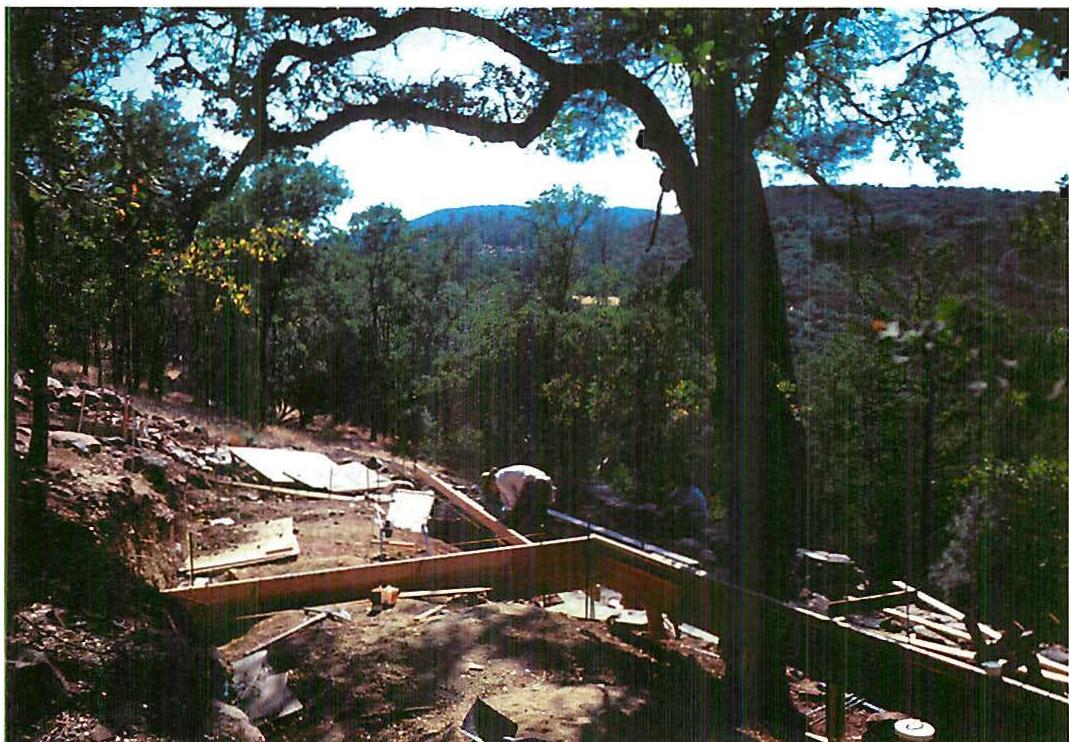
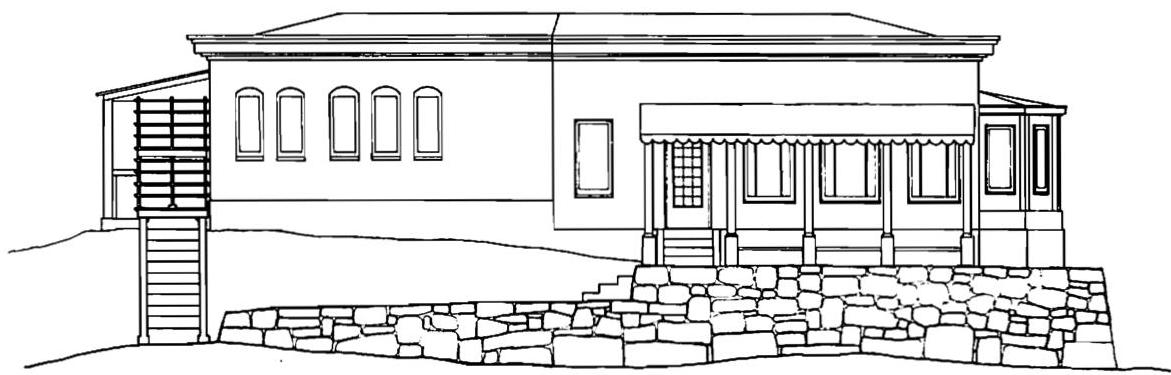
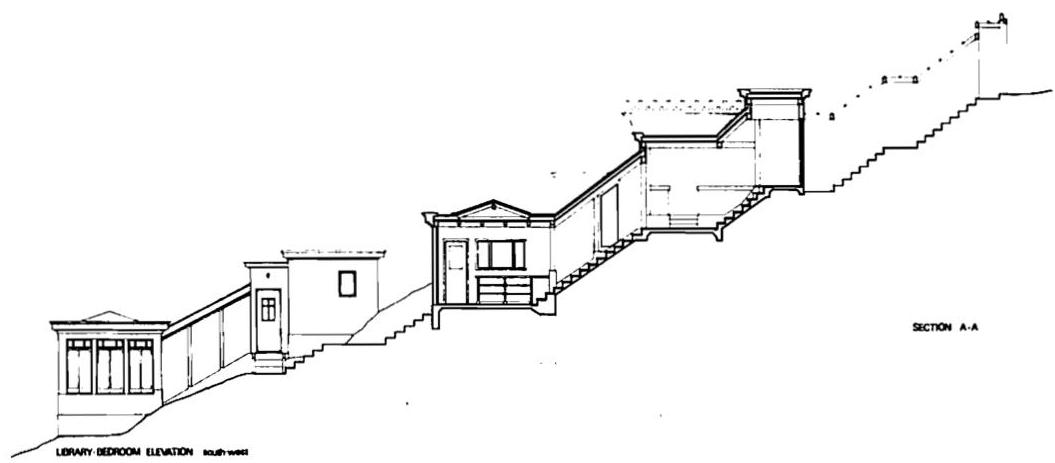
the slope and flat part of the contours made a natural asymmetry and break.
The final system of volumes as built, and the spaces between the volumes defined by the oaks and by the outdoor terraces, together formed the characteristic pattern of volume and space you see in the plan drawing. People called it a small house built like a palace. The result was highly specific to this piece of land, specific to this part of this piece of land, these trees, this view.
The mixture of informality and formality is typical. Projects with living structure will often tend, in some deep fashion, to have an informal-
formal character of volume and space which is morphologically similar to that visible in the plan on page 161.
To establish the final volume positions as accurately as possible, we refined the shape and position of the volumes later, when we excavated the benching, and set the formwork for the foundations. That is visible in the photograph on page 159. The position, volume, space and fine structure induced by the building, add to the character of what was there before, continue it, and strengthen the centers that were there before. The street remains as it was before, but better.
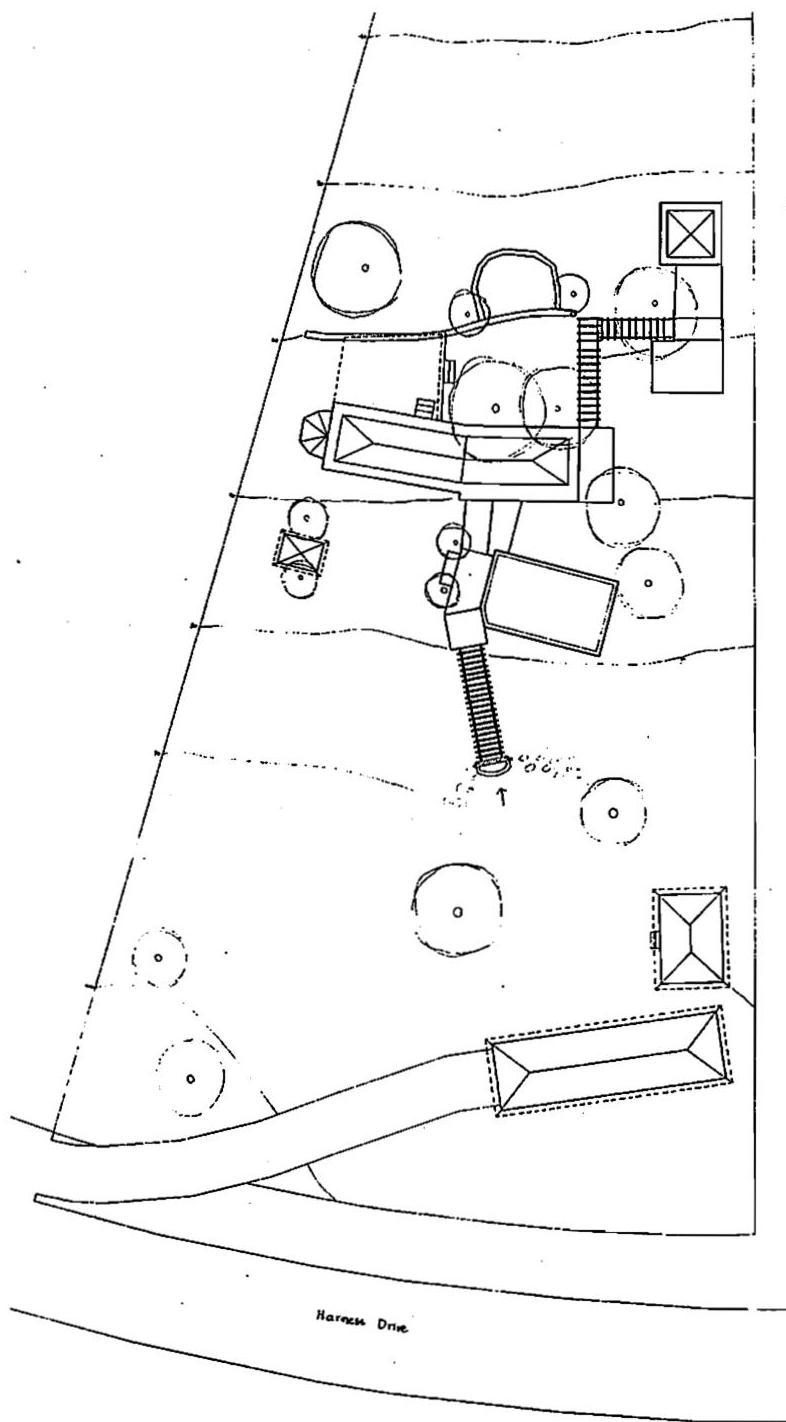
The plan of the house which followed from the kind of process pictured in the photograph on page 159. This plan was not drawn in detail ahead of time, and became known in its final form only after construction of the slabs and retaining walls had actually been finished. West lies at the top of the drawing. The road (subject of an important argument in the text of Book 2, page 514) lies at the bottom. The land is relatively flat near the road, and then begins to fall off steeply to the west. Berryessa house, Christopher Alexander and Artemis Anninou, 1987.
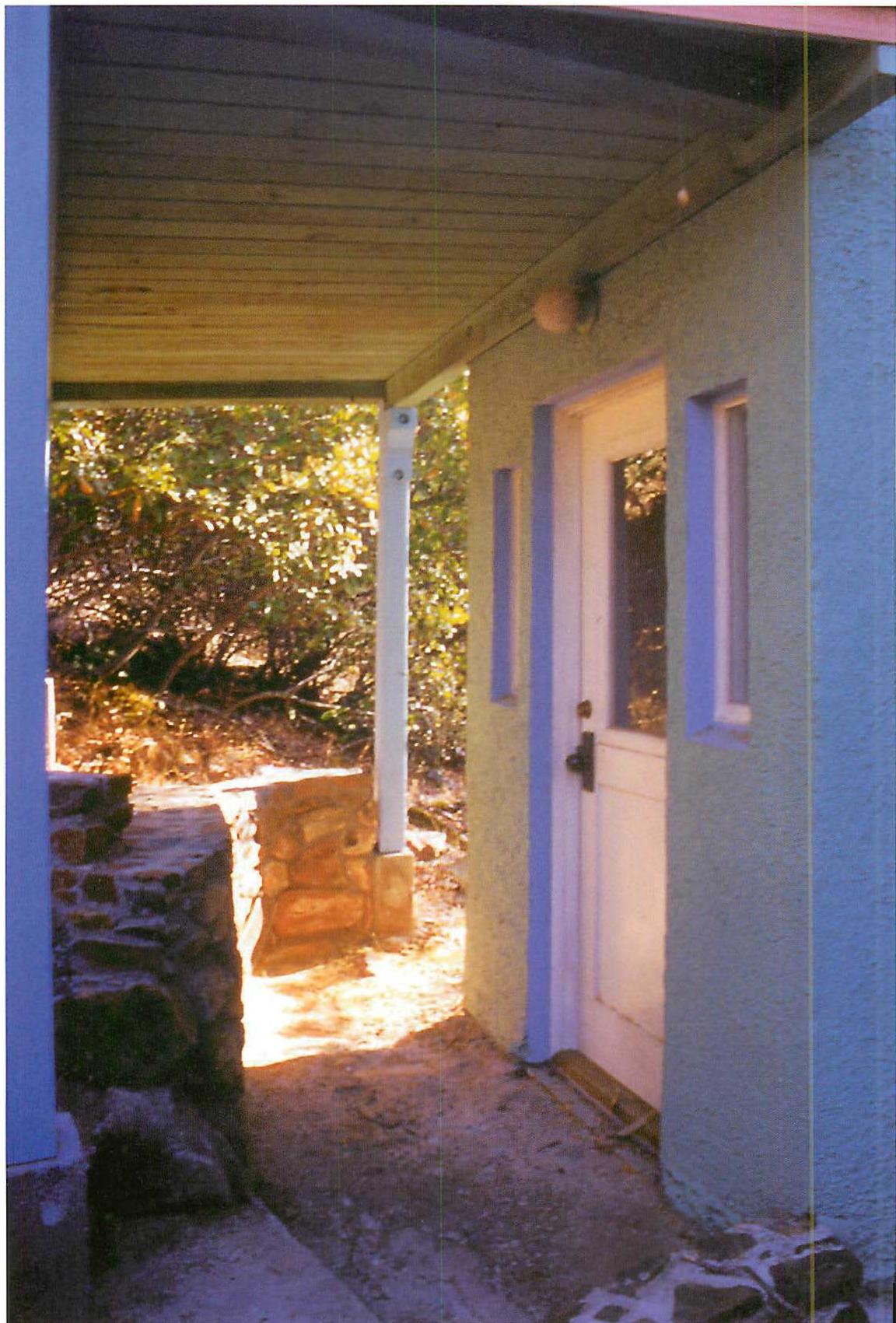
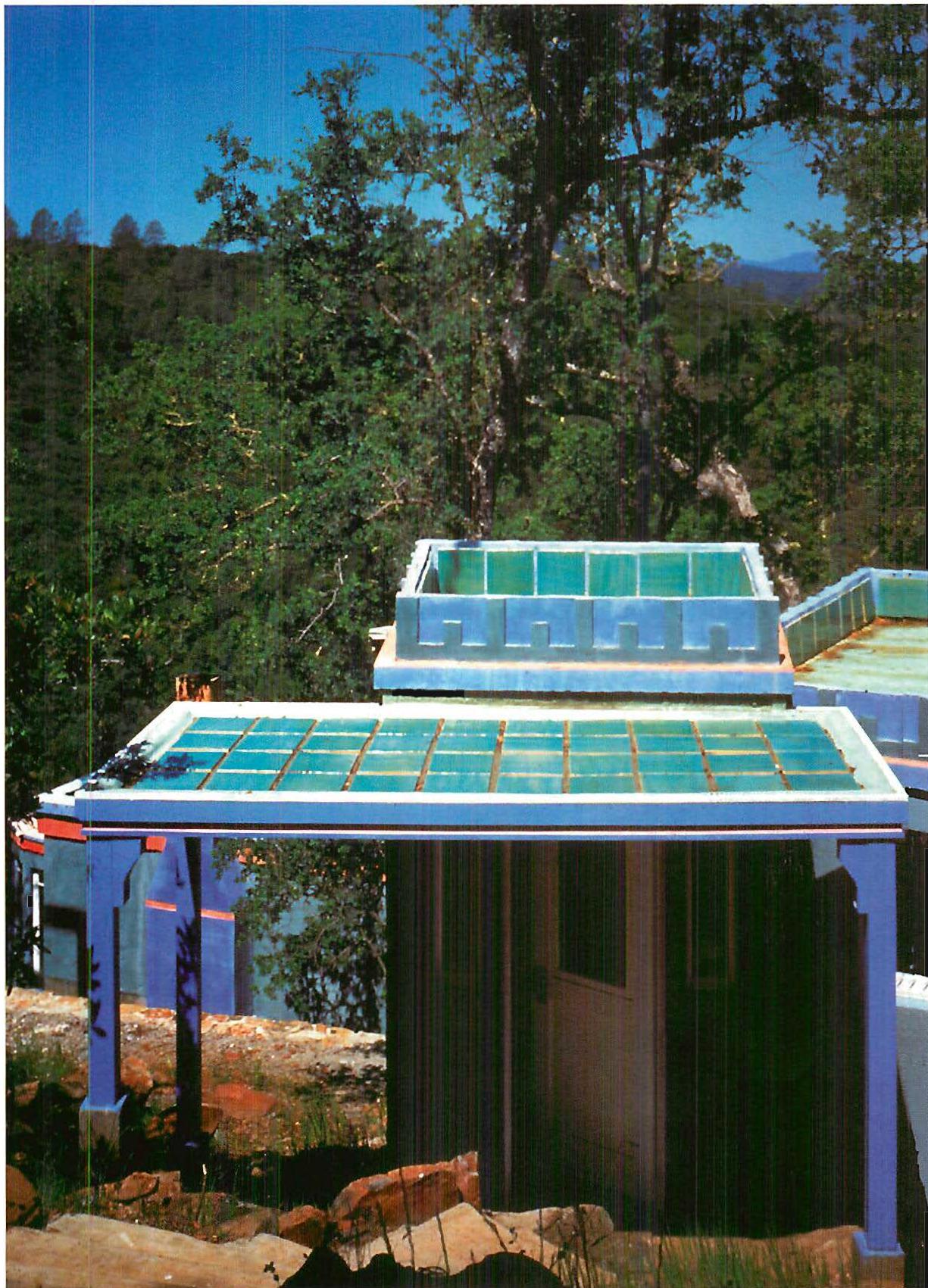
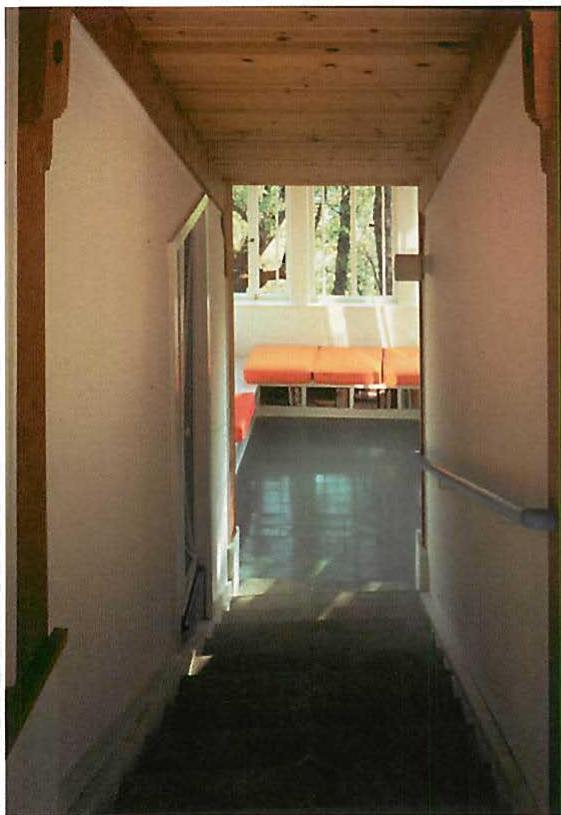
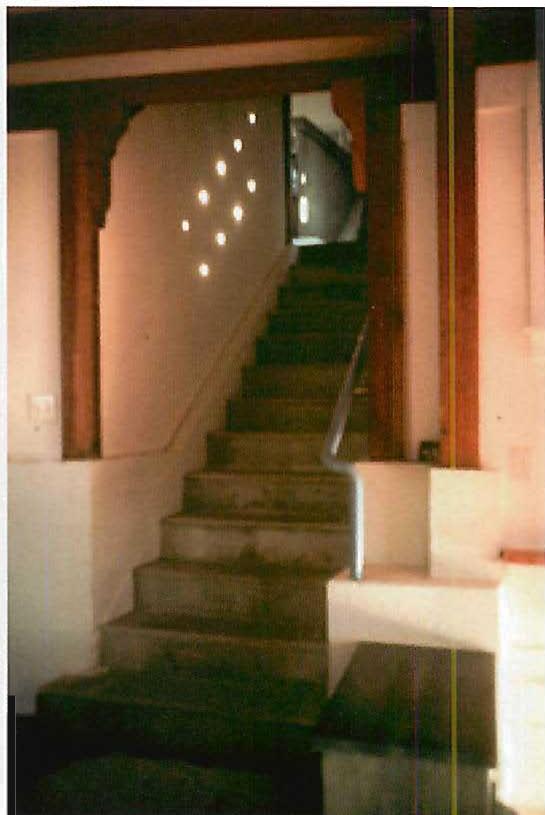
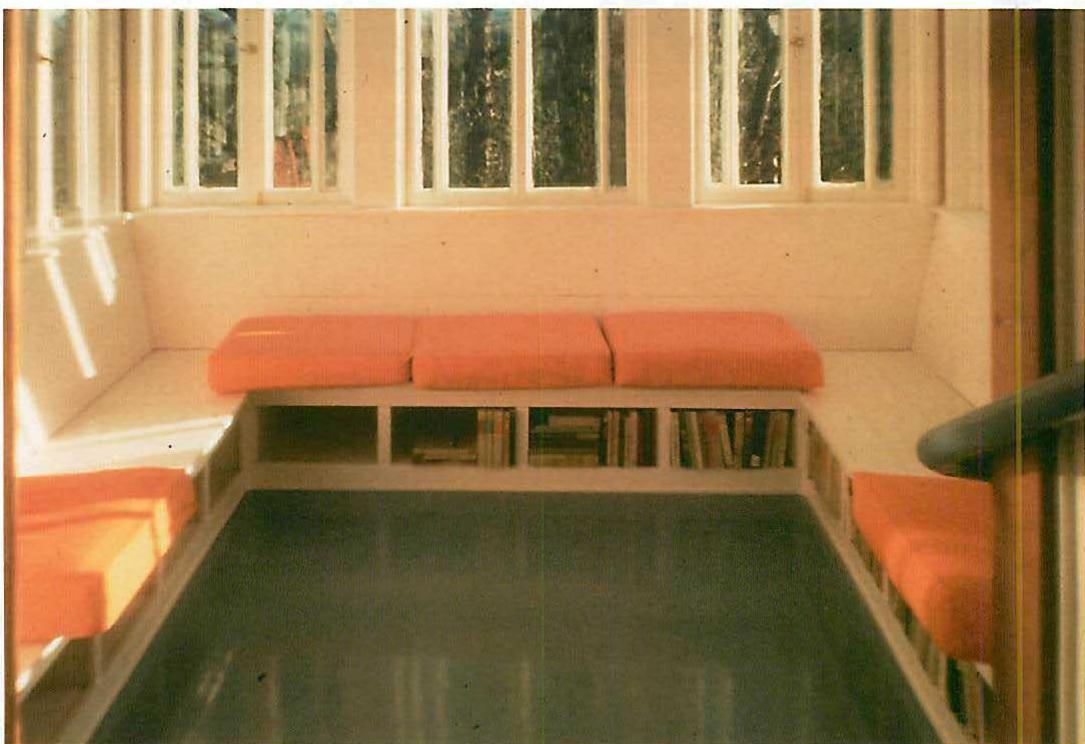
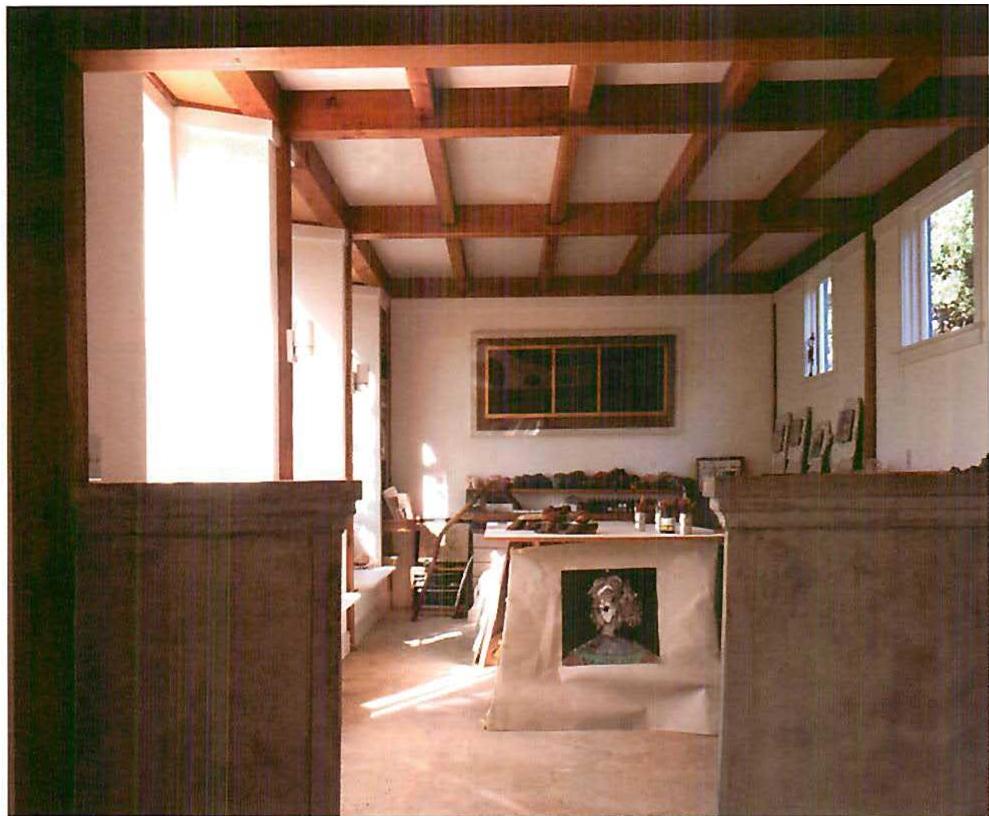
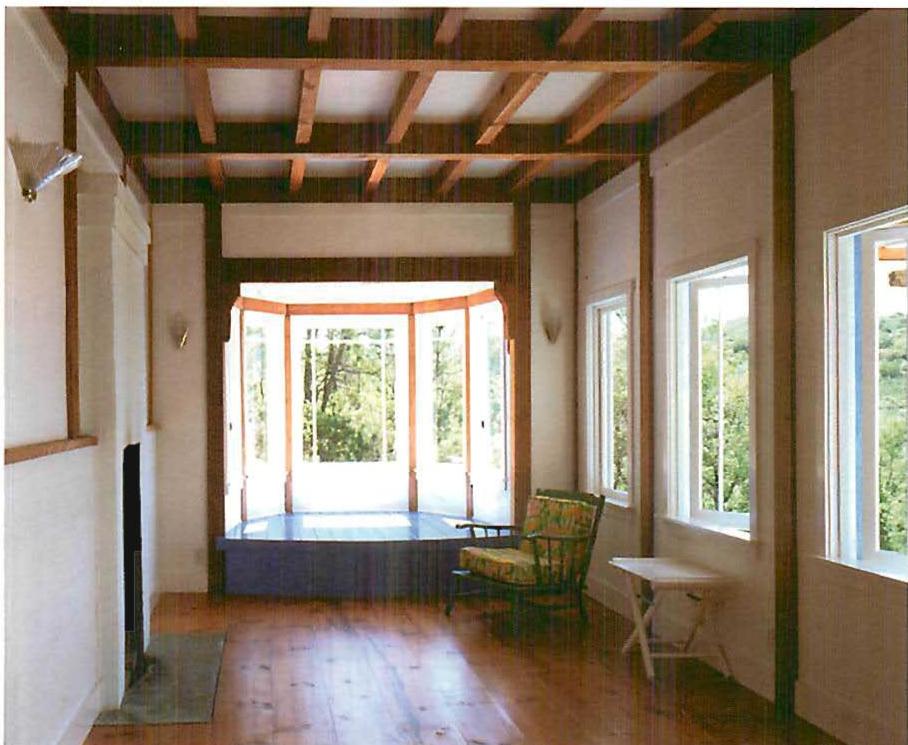
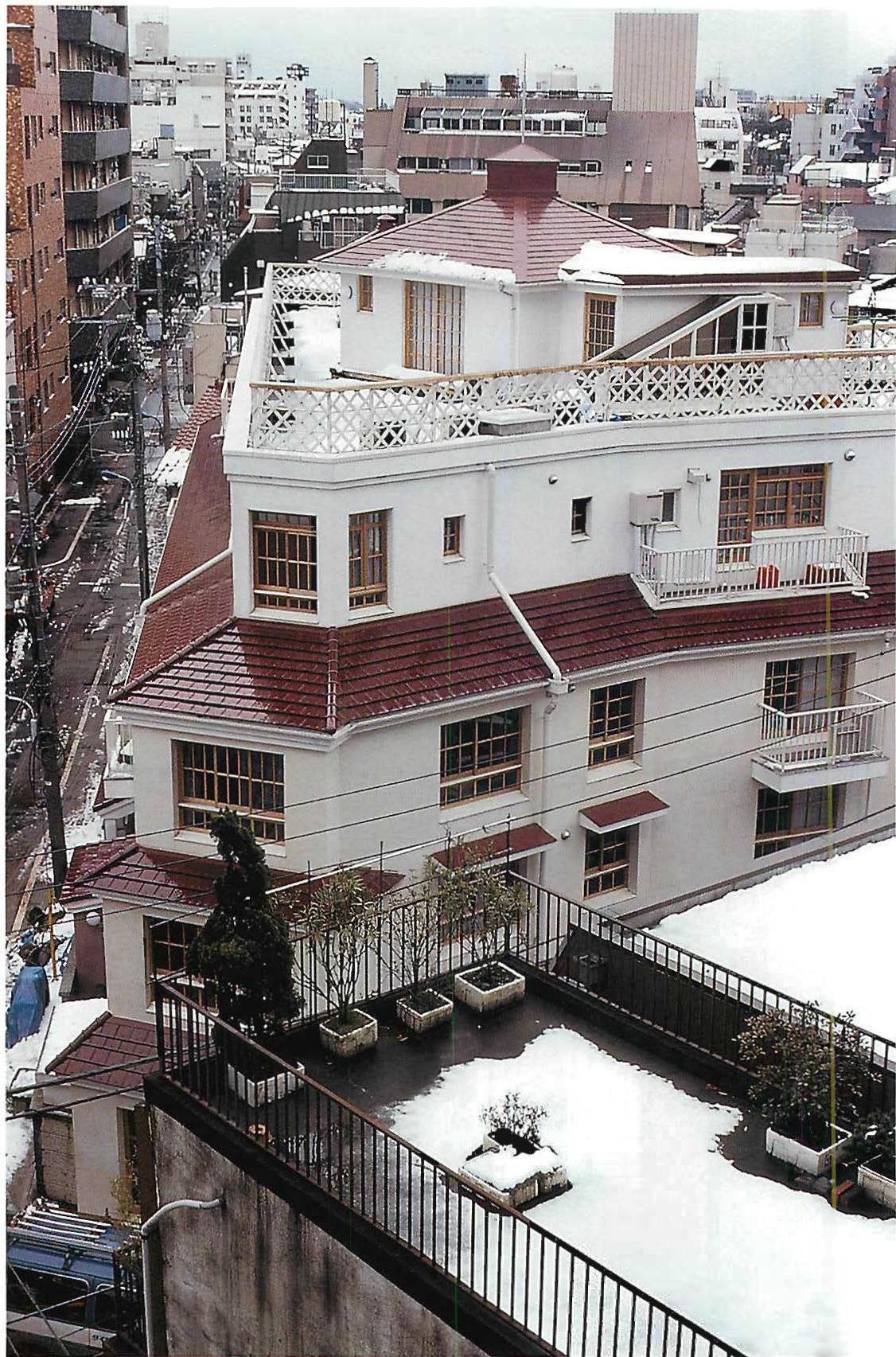
6 / BUILDING A FIVE-STORY BUILDING IN TOKYO TO MAKE HARMONIOUS SPACE AND VOLUME
My next—somewhat larger—example is a five-story apartment building in Tokyo. At the beginning of the project, we made a few initial calculations about the number of apartments, the number of square meters we could build. Then we were ready to fix the overall character of the building volume.
The most essential thing was the fact that the building lot was five-sided, bounded by two streets, with a sharp corner where the two streets meet. The two streets are small and lively. The most natural inclination of a normal development project, would have been to make a building built up of rectangles, in a way which fills the site approximately (left-hand drawing below). But after carefully looking at the streets and their small character, I felt that no matter how strange it seemed, the building must help the streets, help to maintain and strengthen them—and must therefore exactly follow the line of the street edges (see right-hand drawing below). When I combined this idea with the need for a south facing garden in the middle and towards the south, we got the overall volume
character of the building. It is defined, further, by the fact that it steps back gently, from the street, to conform to the zoning ordinance. Along the streets, small gardens are placed just above ground level to make apartments more private, and also to follow setback requirements (see diagram below, right).
To explain the process we followed in shaping the building, I list below the steps we took, one by one.
1. Overall height and volume.
Tokyo zoning code allowed very specific areas and volumes for this building, as a function of lot size. Specifically, the building could have no more than a maximum of $1148\mathrm{m}^2$ of built space, a maximum parking lot of $116\mathrm{m}^2$, and a maximum lot coverage of $322\mathrm{m}^2$. Preliminary calculations showed that the building would be between 4 and 6 stories high, and that the open space could be about $40%$ of the lot. This fundamental arithmetic created the overall size and volume for the main center (the building itself) and thus provided the context for all that followed.
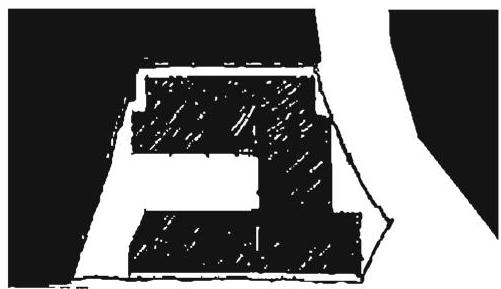
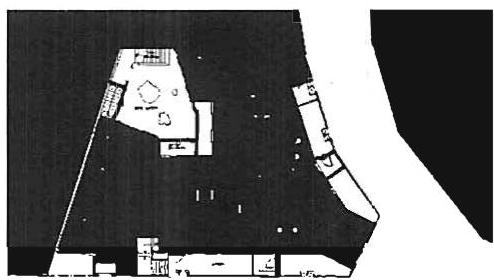

Left: On the left, a first possible site plan, rather conventional in character, which is NOT structure preserving. Although this plan follows typical building and design character for a building in the 1970's or 1980's, the placing of the volumes, the badly formed exterior space, and the lack of structure-preserving impact on the two streets and on the sunshine in the south, are all negative. Right: The building site plan as we actually built it, showing the unusual building configuration caused by the fork, and two bent streets. Christopher Alexander, Ingrid King, Hojo Neis, 1987
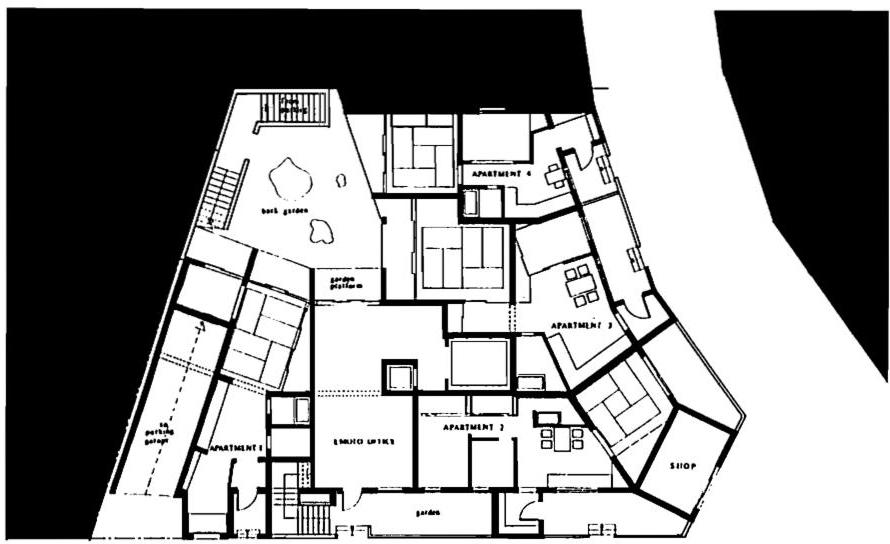
Emoto building, ground floor plan. The plan shows the adaptation of rooms to the unusual configuration caused by the fork and two bent streets. South is upper left.
- Preservation of the streets as centers.
The site occupies a crucial place: the angle between the streets is peculiar. Yet the idea that the centers which the streets form are "sacred" (i.e. inviolable, and may not be destroyed) is fundamental. By placing the exterior walls of the building along the streets, the volume of the streets was guaranteed and preserved.
- Set back given by the building department.
The zoning ordinance requires a set back within a certain angle. Placing the building within this angle, and keeping the good shape of the streets with a reasonable vertical wall, made it necessary to keep a two-meter band between street and building. Later, in order to make this two meters into something positive, small gardens were made for the apartments on ground floor.
- Sunshine and south light.
Since south is at the back-inside corner of the building, it is very hard to orient the building to the south—but still imperative. Japanese people love sunshine, and south light is always better
even when the sun is not shining. This meant the building had to contain a space open to the south light. The courtyard had a very difficult shape. Many attempts were made but, early on, a basic decision to create a south-facing corner courtyard was made. The exact decision about location and shape came gradually.
- Relation to nearby buildings on south side.
The exact position of the south-facing courtyard was partly determined by the position of neighboring building volumes.
- Driveway to parking garage.
We knew there would have to be a parking garage underground. The driveway going down had to be in one corner or the other. We chose the south-west corner because it was easier in the longer wall. This also corresponded to a fengshui desire expressed by the client.
From here on, the following steps 7-50 determined the sequence of centers to be introduced and the unfolding of the design in serial order.
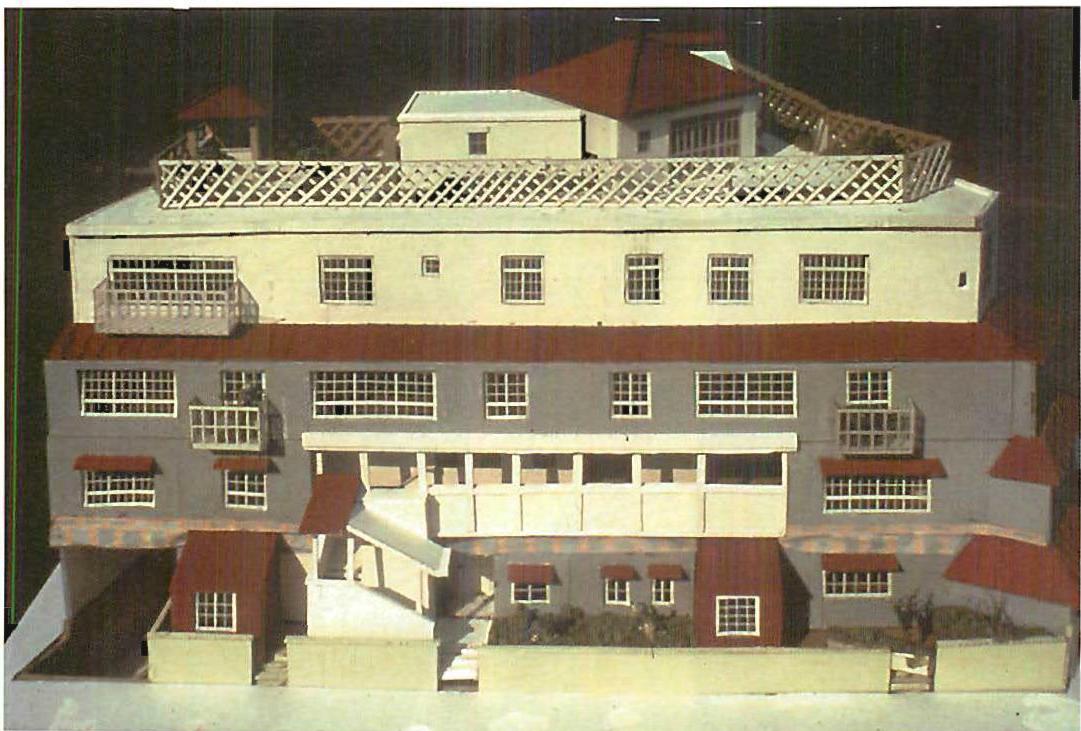
- The need for a communal garden.
- Individual gardens at street level.
- The need for sunshine in the apartments.
- The character of the streets at eye-level.
- The entrances of individual apartments.
- Relation to main direction of approach.
- The position of the main entrance.
- The top of the building and need for a "hat" on the top.
- A shop at the sharp corner.
- Beautiful bay windows in the corner position.
By this stage, the volume and site design had been determined. The process then went on to complete the layout of the building and its structure:
Each apartment has light coming from two sides.
The possibility of one beautiful room in each apartment.
Open arcade along the north side, at second story.
Modest stairs for main entrance.
Lessen the overpowering character of the vertical walls on the exterior side.
Lessen the overpowering character of vertical walls on the courtyard side.
A carp pond in the main back garden.
A garden hedge and fence.
Ground floor platforms looking into garden.
Garden walls.
The total length of shear walls in the building.
Placing shear walls to get a torsion-free system of walls.
The parking garage.
Turning space for parking places.
At least ten parking places.
Room for machinery on the basement floor.
Fire exits from basement.
In each apartment, the main living room is made beautiful, good shape, full of light, and at a peaceful place in the apartment.
The main room really big in contrast with other rooms.
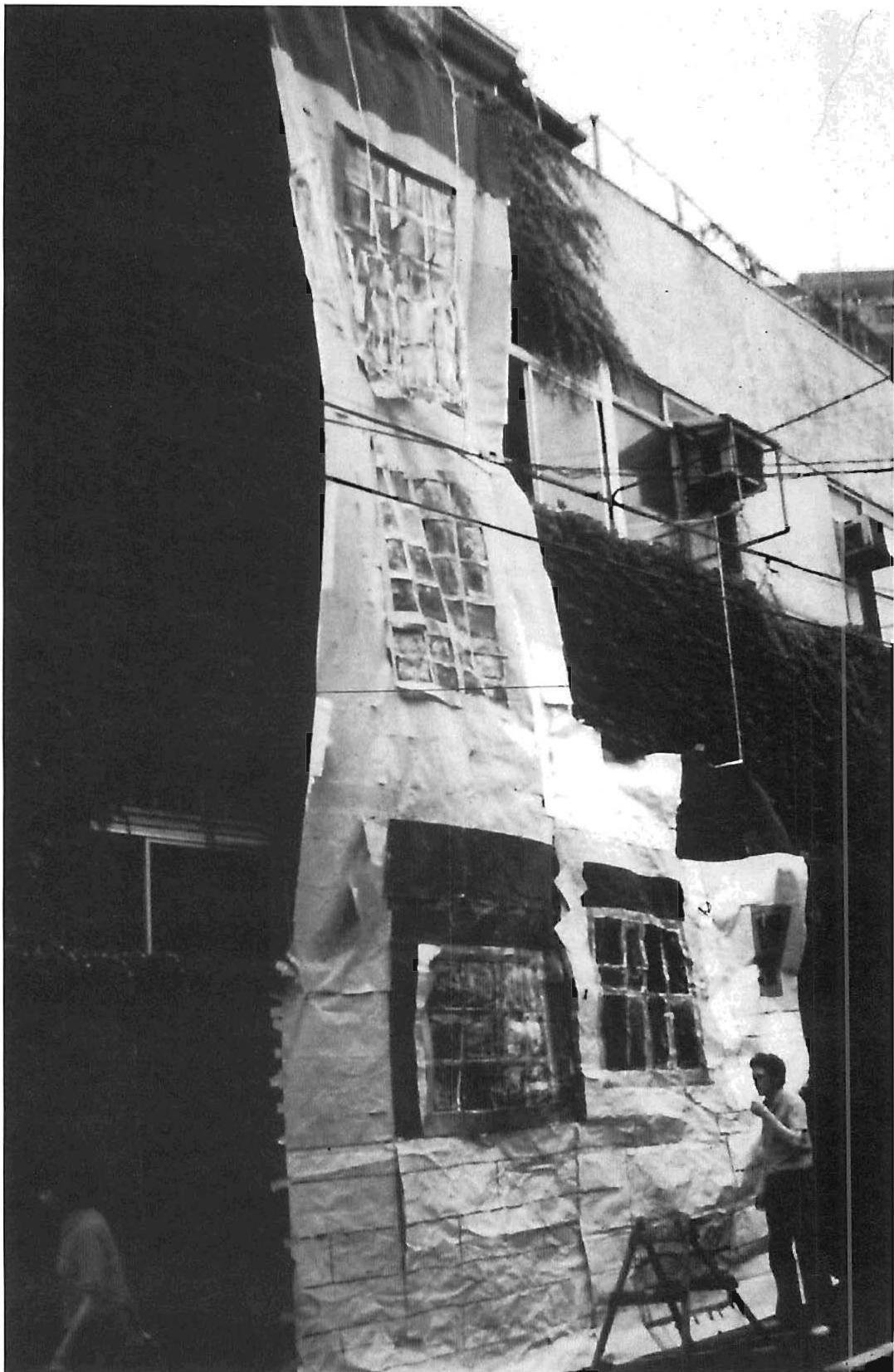
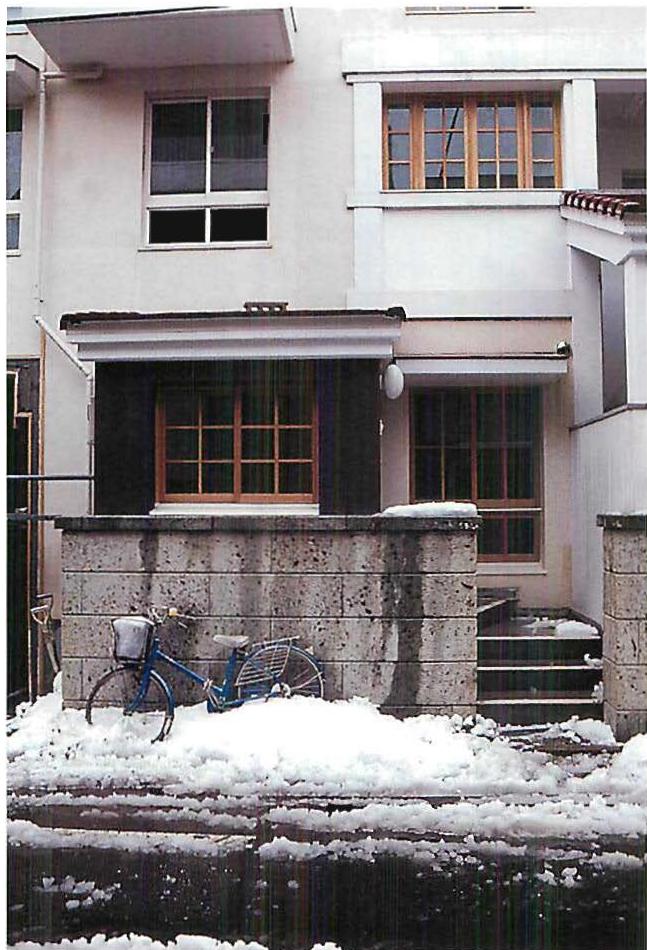
Four-foot interior galleries along the inside of the windows in every apartment.
The tokonoma in the main room.
The kitchen as a place inside the entrance.
Small gardens on interior south-facing balconies.
Thick walls inside the apartments.
Good shape for the apartments, inside an irregular envelope.
Ornament on the exterior of the building.
Small roofs on all the windows.
Red color on the roofs and entrances.
White plaster at the top and on the gallery.
Yellow ornaments in the concrete wall.
One tatami room in each apartment.
Office for Mr. Emoto, where the elevator is.
Bedroom on the fifth floor.
Stairs to fifth floor bedroom very small and low.
This sequence (written while we were working on the project) reflects the actual centers we made and shaped to get the building form and plan, in the order in which we took them.
Since this sequence of centers is natural, and fairly obvious, the reader might miss what is—after all—a rather unusual site plan, which came into being under the impact of this process. The accompanying drawings (page 167) contrast our plan with a plan that might typically have been made by a conventional architect in 1987.
In our building the building hugs the
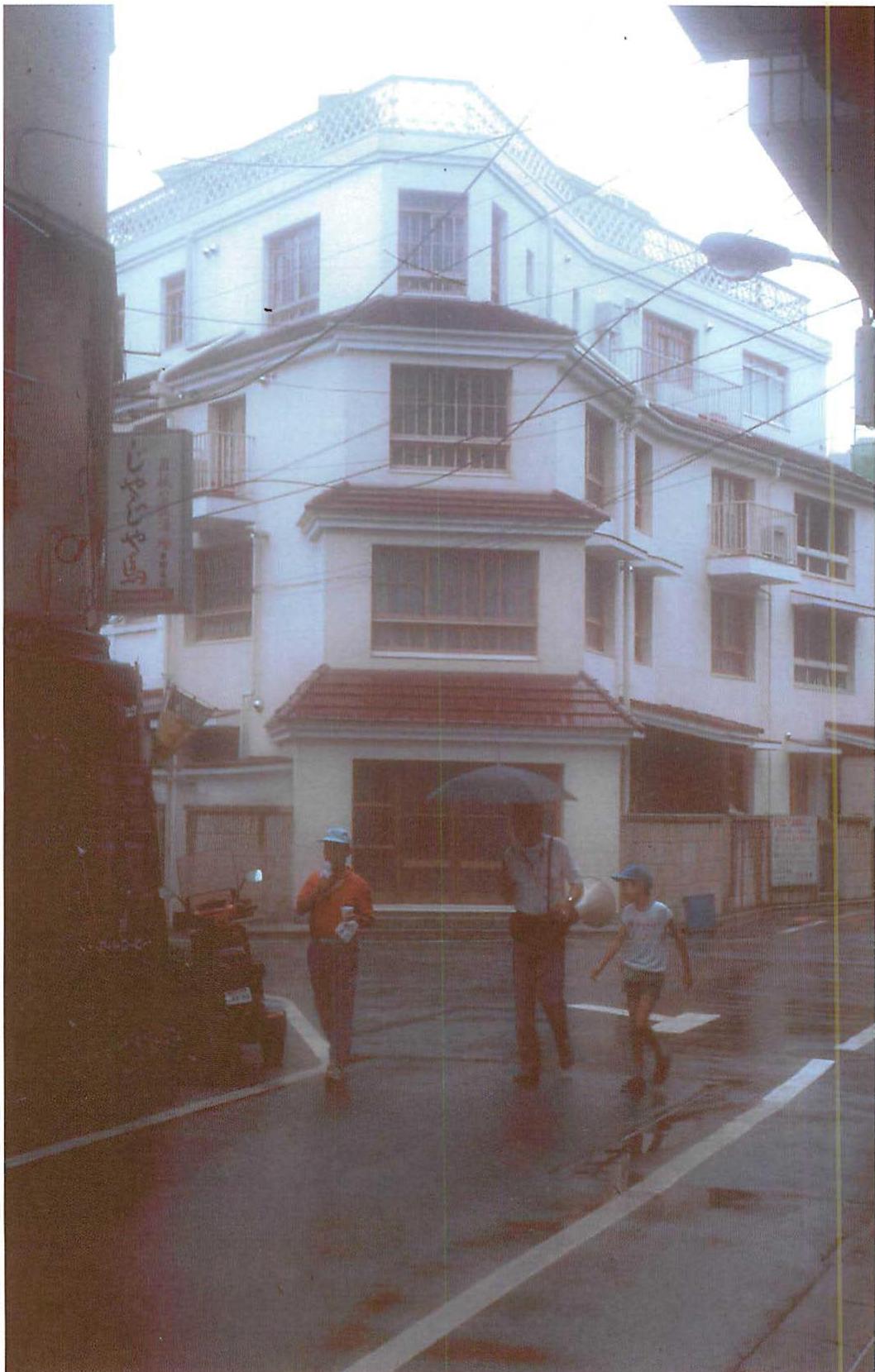
A rainy day in Tokyo: The completed Emoto apartment building. Christopher Alexander, Hajo Neis, Ingrid King, Miyoko Tsutsui, 1987.
streets. Because of the living process, it creates positive space in the streets and in the courtyard. This was only common sense, but it was nevertheless unusual by the standards of 1987.
Throughout the emergence of this building plan, and building form, the steps taken are visibly structure-preserving. It is not only the pro
cess of taking one center at a time which gets results, but the larger fact that every step preserves and enhances the structure which had been reached up to the step before. To the extent that the building has life, it is for this reason. There are plenty of mistakes in the building. But it represents progress towards a new ideal.
7 / LAYING OUT A VERY LARGE BUILDING COMPLEX: THE EISHIN CAMPUS
I shall now show how the creation of the site and volume plan for the Eishin Campus in Japan followed a similar but more complex sequence of structure-preserving transformations. The process had two components.
First system of centers: defined by the pattern language. The first component was a pattern language worked out by our team after extensive interviews with teachers and students, and then approved by the school as a whole in a general assembly meeting. The pattern language defined, in generic terms, which new centers ought to exist in the new campus.² Here are five very important centers defined by our pattern language:
- ENTRANCE The entrance to the inner precinct begins at the outer boundary. At a key point in the outer boundary, there is a gate. This leads to an entrance street.
- YARD Where the entrance street meets the inner boundary, there is a second gate leading to a public yard.
- UNIVERSITY CENTER Beyond the public yard and through a third gate is the essential center of the university.
- HOMEBASE STREET Leading out from the university center, was the high-school street of classrooms: the homebase street. The homebase street is a wide, lively, sunny street formed by the individual home room buildings where the high school students have their classes.
- THE LAKE Opening through gates on another side of the university center is a lawn. This lawn,
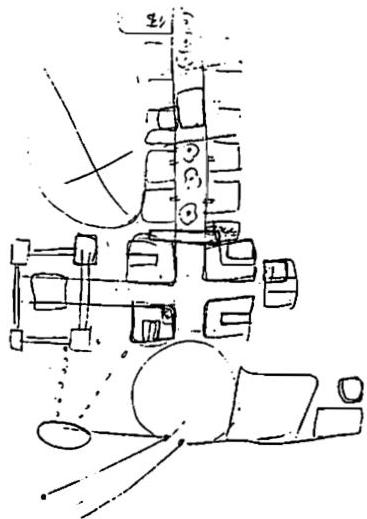
One teacher's diagram showing the major centers defined by the pattern language. In diagrammatic form we see ENTRANCE, YARD, UNIVERSITY CENTER, HOMEBASE STREET, AND LAKE. The diagram shows how this teacher understood the way these main centers might fit together in an imaginary site plan.
especially for the use of college students, is surrounded by the college buildings and leads directly to the lake. The lake is a peaceful place to rest.
Second system of centers: defined by the land. The second component of the process was a system of centers that existed in the land as it was before we started. This system of centers was defined by the site, by the land itself. In 1982, as soon as the pattern language had been approved by the faculty, we began the site plan. The site-planning work was done mainly on the site.
Each time I went to Japan, I went out to the tea fields in Iruma, and walked and walked, just waiting, trying to see how the pattern language might best come to life there. Each time I sat there for hours, trying to understand the structure of the situation. Sometimes I sat there all day.
The wholeness which existed on the land at the time we started (when the land had just been bought from the farmers) included the following five centers: Natural point of entering, Swamp, Flat spot, South ridge, Walk to the South ridge.
- NATURAL POINT OF ENTERING One had a natural desire to enter the site on the southeast corner, and walk towards the northwest.
- SWAMP AND LOW POINT WHERE GROUND WATER ACCUMULATED The lake we were going to build had to be at the low point of the site, and we therefore knew its position from the contours.
- NATURAL FLAT SPOT There was a natural spot, somewhere near the low point and the lake, where the main square might be.
- RIDGE The ridge was the most beautiful center of all. It was the place everyone went to most often, and loved most, because of the view of the distant hills, and the coolness of the breeze in summer, and an inspiring freedom one felt there.
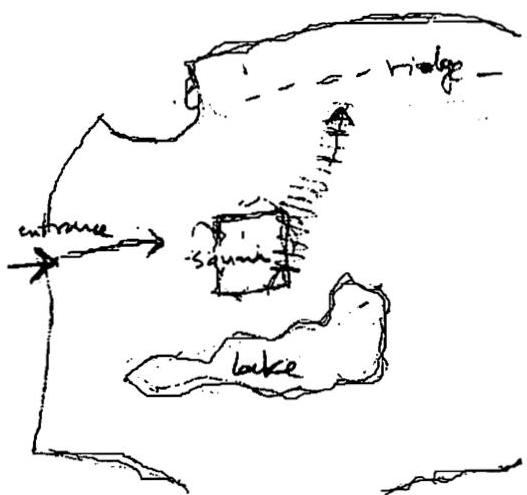
- WALK TO THE SOUTH RIDGE There was also—felt in the land—a natural walk from this low point towards the ridge, a walk from north to south, slightly uphill, and slightly curving. This was also inherent in the site, and could be felt by everyone.
Repeated visits to the site by different members of our team, and by the various teachers of the school, strongly confirmed the reality of these centers. After a few weeks there was no doubt these were the most salient features of the site.
Thus there are two quite different systems of key centers.
First, there is the system of centers which is defined by the pattern language. These major centers are the building blocks of the new project. In the case of Eishin, they included, for instance, the entrance gate, the entrance street, the university center, the high-school homebase street, the main square, the back streets, the judo hall.
Second, there is the system of centers which exists in the land. This system is created by the land forms, by the roads, by directions of access, by natural low spots, natural high spots and by existing trees.
It must be emphasized that both systems of centers always exist at the time one starts a site plan. The first system is generic; it exists in our minds and in the day-to-day experience of the people who are going to have the new school. The second system exists in the land, on the particular site where the project is to be built. Each of the two systems of centers is real.
Together, when fused, they will govern the plan which has to be made. The process of site-planning is the process of, somehow, finding a way to make these two systems of centers become one—a way in which the system of centers defined by the pattern language can be placed, so that it enhances, preserves, and extends, the system of centers which is already in the land. In this specific case, and in general, the crux of the
problem of making the site plan lies in the task of reconciling the two systems of centers—that means finding a new structure which unfolds from the existing wholeness, and which then embodies the centers of the pattern language within the system of centers that exist on the site.
ANOTHER WAY TO PUT THIS IS TO SAY THAT IN ORDER TO PRESERVE THE STRUCTURE OF THE LAND, THE NEW CENTERS COMING FROM THE PATTERN LANGUAGE MUST BE ESTABLISHED IN SUCH A WAY THAT THEY FALL NATURALLY IN PLACES THAT COINCIDE WITH, OR ENHANCE, THE NATURALLY OCCURRING CENTERS OF THE SITE.
In this particular instance it was very hard to find. There seemed to be no natural way of arranging the university center and home-base street, as we had them in the pattern language, in a fashion consistent with these five facts about the site. Indeed, only one part of the relation between pattern language and site was obvious; the lake, demanded by the pattern language, would have to be identified with the low point of the site, that is to say, the swamp. That was uncomplicated and straightforward. In all the plans we tried, the new lake appeared in the position of the swamp. But in other respects the mismatch was difficult. In many of the plans shown in these early diagrams (see for instance diagrams illustrated on page 176), the key centers are in positions different from the existing centers on the site. These diagrammatic site plans look internally coherent on paper, but would have violated the centers on the land and would thus have violated the integrity of the site itself.
Even after several months of work, we still did not know how to place the major centers of the pattern language in such a way as to preserve and enhance the existing centers on the site. Again and again I visited the site, trying to see how the centers of the language might be made to coincide with the real existing centers of the site. We couldn't solve it.
Finally, in Berkeley, we had a breakthrough. In order to think about the problem while away from Japan, we had made a series of topographic
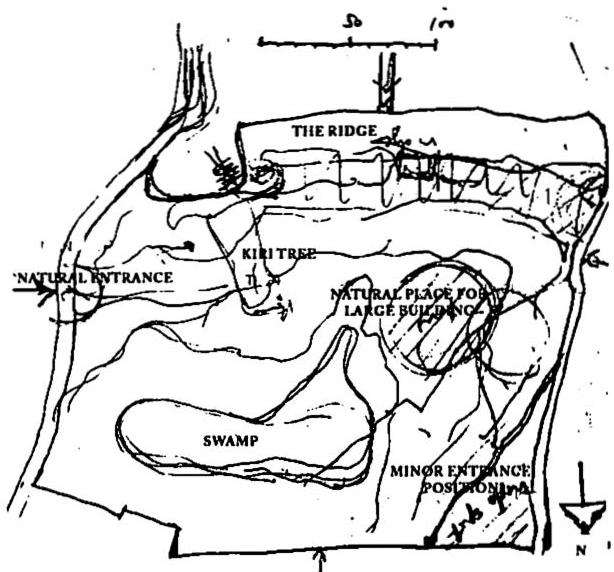
Another view of the system of centers existing on the land before our design emerged: again the main entrance, the ridge, the swamp (which was to become the lake), are visible, together with a beautiful Kiri tree that formed an important place, and a natural spot for a minor entrance in the north-west corner, together with a natural place that later became the spot for the gymnasium.
models of the site. We had one in our office in Japan, at a scale of 1:100. We had two in Berkeley, one at a scale of 1:200, the other at 1:500.
After one of my visits to Japan, all of us in the Berkeley office spent several days playing with the 1:500 model. We had pieces of balsa wood cut roughly to the size and shape of typical buildings or building wings. We played with them on the model, constantly trying the same variations I have shown in the diagrams, trying to reconcile the centers of the pattern language with the five key centers on the site.
Gradually one element emerged: the fact that the home base street might be more powerful as an approach to the university center, than as an entity approached from it. This was hard to see, because it implied reversing the main sequence of centers given by the language. But when we tried it, it was clear that the sequence of centers got much better from doing it. Playing confirmed it strongly. Now the sequence of centers in the language, which we had taken as fixed, was suddenly reversed. Previously we had them arranged in this order: ENTRANCE STREET—UNIVERSITY CEN-
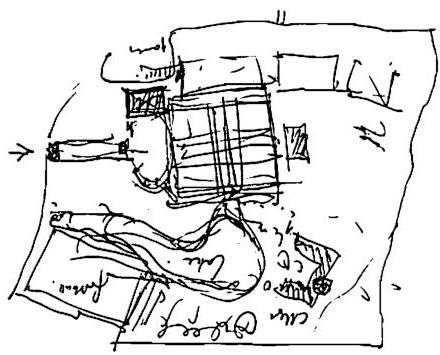
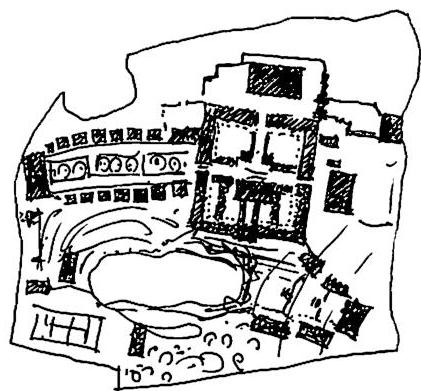
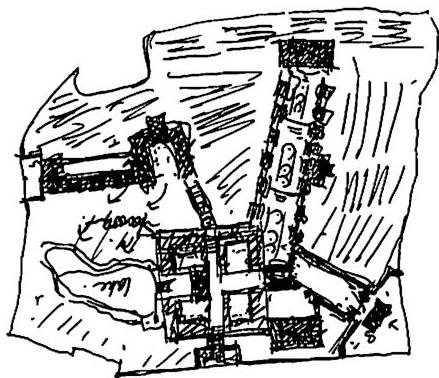
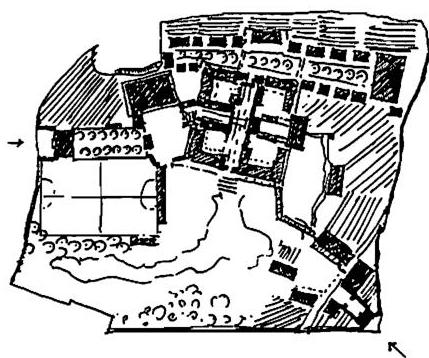
TER—HOME BASE STREET. Now we had this arrangement instead: ENTRANCE STREET—HOME BASE STREET—UNIVERSITY CENTER. This difference of organization seems simple but it dramatically affected the situation.
A few days later we reached the second crucial breakthrough. All the time we had been imagining the university center as square in shape. It had appeared this way from the time of our earliest diagrams and we had continued to imagine it like this.³ But the problem was that the main center on the site “the most beautiful spot” was not square. It was the ridge along the south edge of the property. Suddenly we realized that the university center could actually be this ridge. The moment this second break in perception was made, the whole thing fell into place immediately. Goaded by frustration, and by the mental energy of the group situation, I suddenly
placed all the bits of balsa wood into a new configuration. Everything was in its place. We had the rudiments of an idea.
The model with its precarious bits of balsa wood, just as it was, glued down, was kept for more than a year. It had subtle relationships, curves, lines, caused by the speed and freedom of the moment. They were very hard to draw, but they inspired us. After a few days, we were sure that, at least on the model, everything seemed fine.
Now, of course, I had to go back to the site to see if the site itself told the same story as the small model. I had a great deal of apprehension getting on the plane to fly to Japan to check it out. Would the site confirm this vision? Or would we have to start again?
I got to Japan on November 1, 1982. It was clear at once that, in principle, the new idea of the site plan we had seen for the first
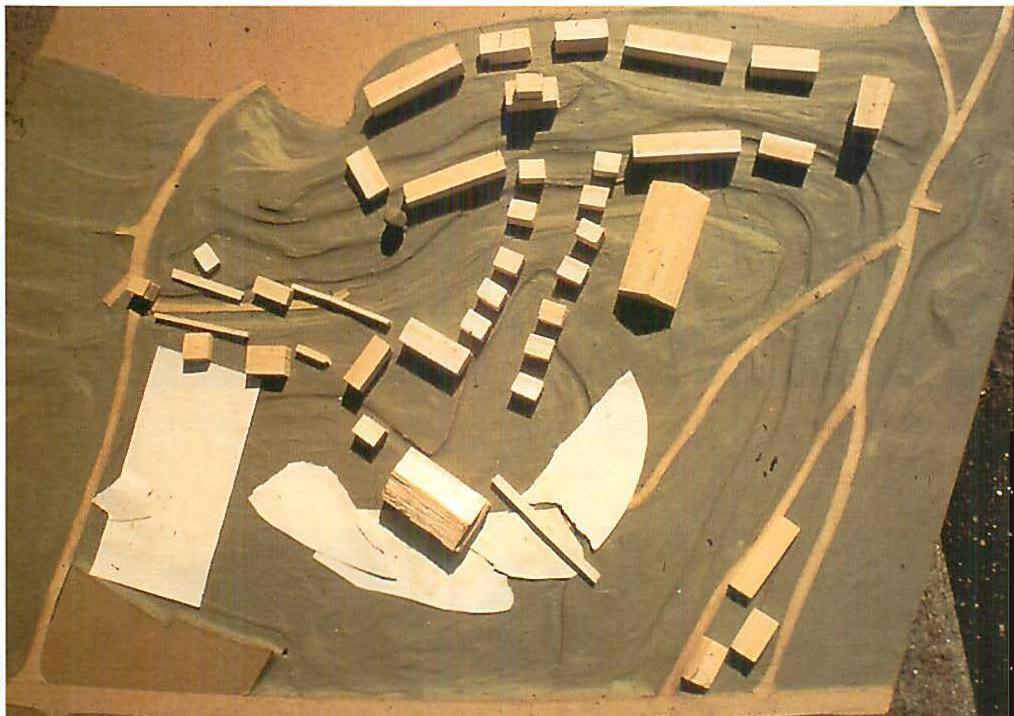
time on the Berkeley model really did resolve the problems, and created a system of centers that was in harmony with the existing centers on the site.
Later phases filled in details, and provided the structure of individual buildings, building locations, connections. But these all took place within the general framework of the layout that has been described. As we worked through these details, paths, streets, lake, bridge, and buildings — all of them — were laid out with flags so that we could judge their rightness or wrongness
with our own eyes, and adjust them until they felt just right. I mean by this phrase that the layout felt just right to a person walking about in the land. To achieve this, we used two hundred flags — yellow, white, red — on six-foot bamboo poles to make the thing become real. Remembering our flags at Eishin, and speaking about the impact the flags made on him, Hisae Hosoi, managing director of the school, told a journalist, many years later in halting, slowly considered language: "We could feel . . . the actual buildings . . . standing . . . there."
7A / COMPLETION OF DESIGN AND CONSTRUCTION ON THE EISHIN CAMPUS
From that point on, the process was straightforward. The important thing is that all designs — building positions, siting, and volumes, and exterior spaces — were decided by what we had done
in the land. The attitude of mind with which we approached design and construction, whether on small models, or bigger models, and the attitude we maintained throughout planning permission
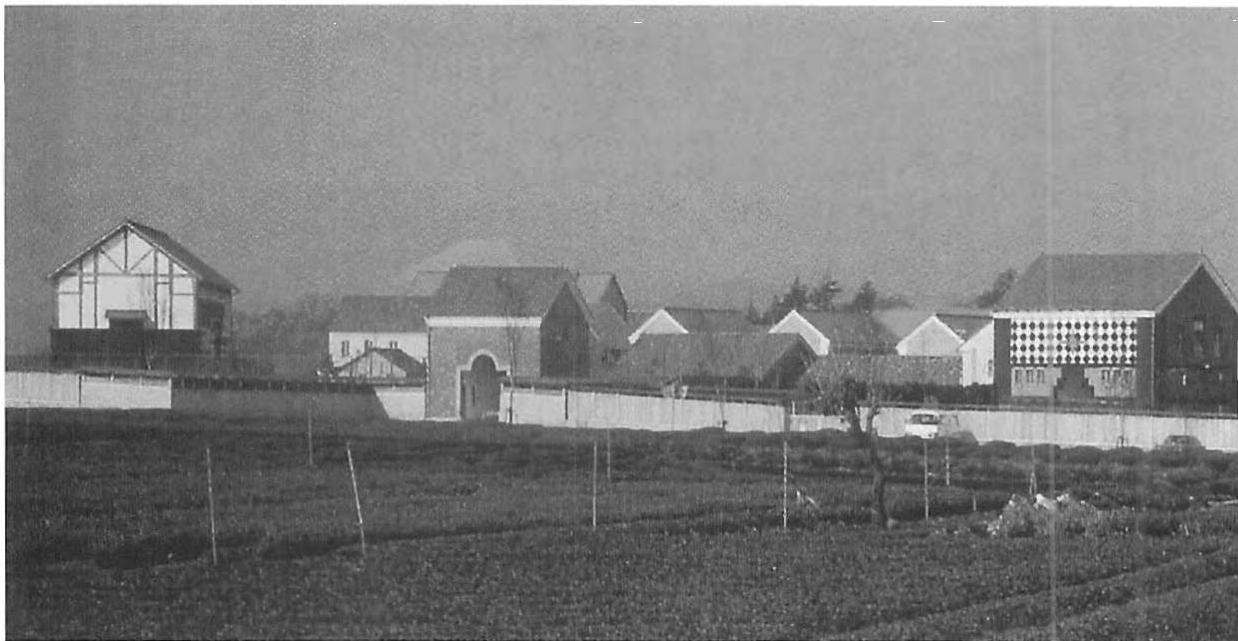
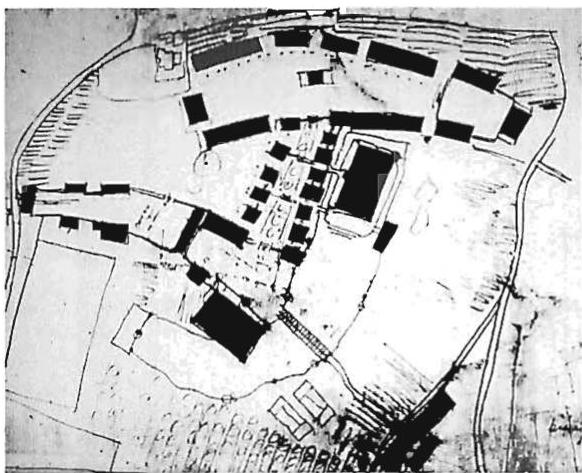
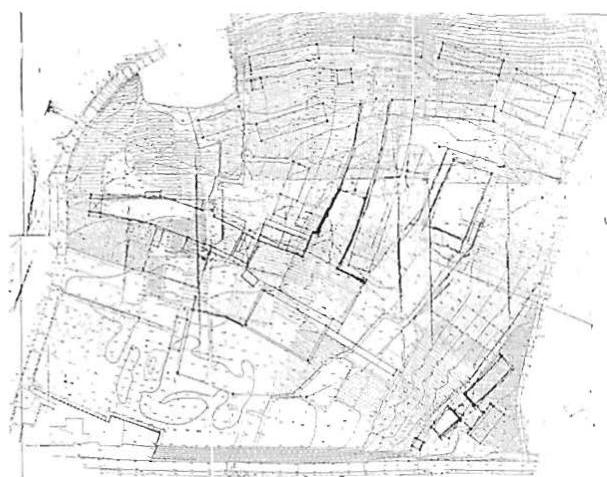
and preparation for construction, and construction itself, kept coming back to the central principle: that the purpose of our work was to create a set of buildings that formed spaces which were positive — and which nourished the land.
What we may claim to have done in that project is to create a complete system of positive space, which protects, and respects, and enhances the land in all its aspects, elevates it,
makes it more alive than it would have been under most other forms of planning and design and management, perhaps even more alive than it was before, when it was covered by teabushes and small agricultural parcels.
It must be noted above that the final plan (right-hand drawing) based on placing stakes, is very different from the schematic plan (left drawing) which does not have the same reality.
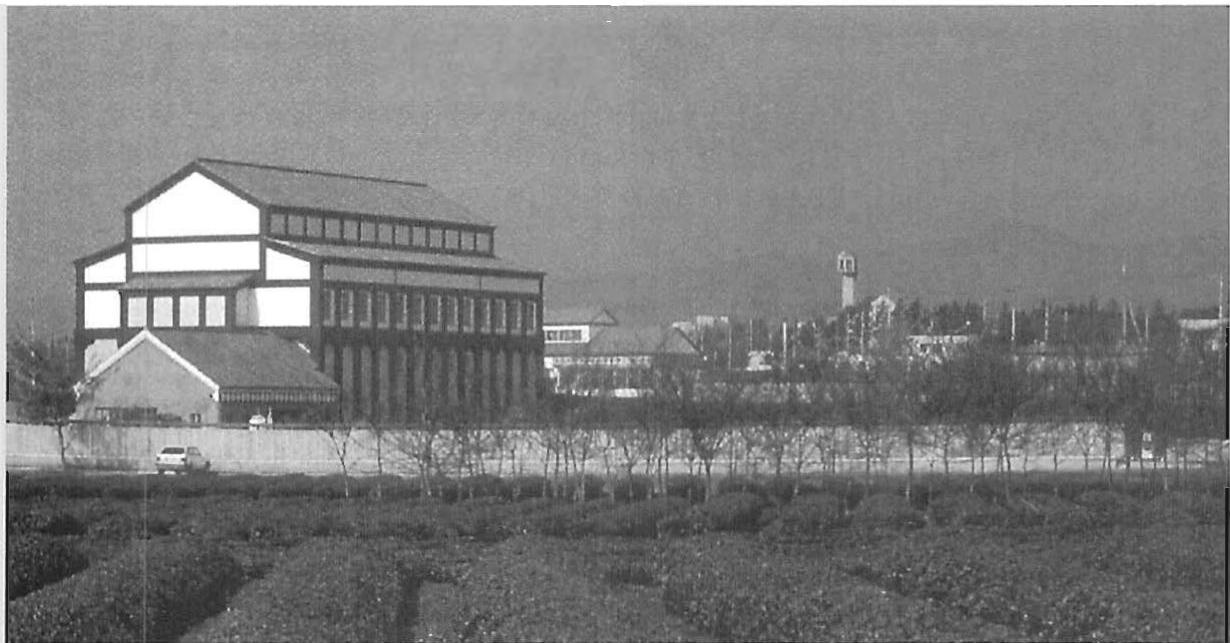
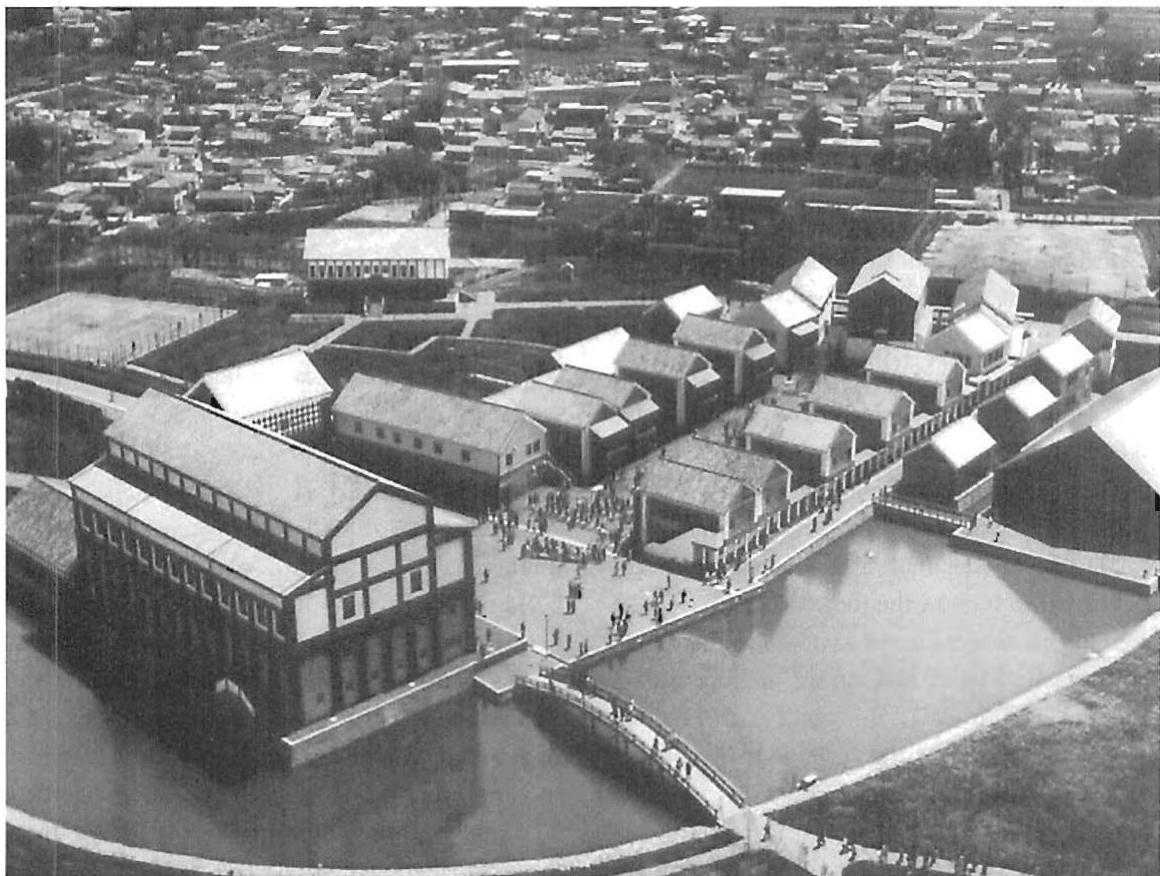
The Eishin campus first stage, completed in 1985, Christopher Alexander with Hojo Neis and others. The atmosphere along the main street shown in the center of this picture may be seen in the photograph on page 39.
8 / A SECONDARY STRUCTURE-ENHANCING PROCESS WHICH FURTHER FORMS THE SHAPE OF SPACES AND VOLUMES
More or less the same process which creates initial layout of buildings on the land also works, at a later stage, to turn a rough schematic plan into a detailed and orderly configuration of buildings.⁶
Here, as an example of this secondary process, I show two cases from the planning and construction of student housing for the University of Oregon. The project started with construction of the Agate complex, a group of apartments shown opposite and on page 186.
In all these examples what is being created is the volume pattern of the buildings and the land. Whether the pattern is urban or rural, the pattern of void and solid, the space and volumes of the built environment, is the fundamental thing which, at its own specific density, defines the texture of our environment. Always, without exception, every building task must be related to this pattern of void and solid, it must always make a contribution to it, it must always make a positive impact on the voids and on the solids so that the whole pattern, black and white, or void and solid, comes to life.
The stage of a living process which I have sketched in this chapter is marked, really, by the fact that when we are done with this phase, a whole project can be seen, in its essentials, in a small paper model made at a scale of 1:200 (metric) or 1/16th inch to the foot. What I have covered in this chapter may be viewed as that phase of work which culminates in the making of such a model at 1:200 scale.
My reference to the scale of this model is meant in earnest. The topography is in modelling clay—not merely layers of cardboard, because they are too crude. It is the feeling of slopes and land which is imperative. Nearby roads and buildings are on the model. The buildings are made in manila-folder material (a light buff-colored card, a little stiffer than paper). Trees are to be on the model, either as crumpled tissue paper, or rough scale bits of cow-parsley.
It may sound absurd for me to be so detailed and to insist on these details as I am doing. But many years of experience have shown me that this combination of scale, material, detail, and absence of detail, gives just what is needed for us to be able to say, “Now we have the volume and site just about right.”
If the model is more detailed (1:100, say), it goes too far. If the model is smaller (1:500, say), we cannot judge the spaces, or slopes, or heights as sufficiently real. If the cardboard that is used is stiffer, it becomes more formal, harder to change. The kind of light card I have mentioned (manila-folder material) is easy to cut and paste. We can be uninhibited in doing surgery on it. If it is stiffer, more formal, like a presentation model, we will not freely cut, paste, glue, change to get it right. If the cardboard is thicker, it will be too crude, and will not feel like a real building at the 1:200 scale—and as a result, then, we cannot judge the actual feeling it produces. When we put our eye down, at base level and look at it, cruder cardboard will not give us a realistic impression of the way the volume of the real building might feel and we shall therefore be less skillful, less able to make accurate judgments about the volume, space, and their effects.
So the target of work, at this stage, is just such a paper model at 1:200, in which we establish the overall feeling of the buildings in the land, their impact on surrounding space, the meaning of the whole, its feeling as a volume. The space is either brought to life, or not. If not, beyond this stage, it is too late to get it right.⁷
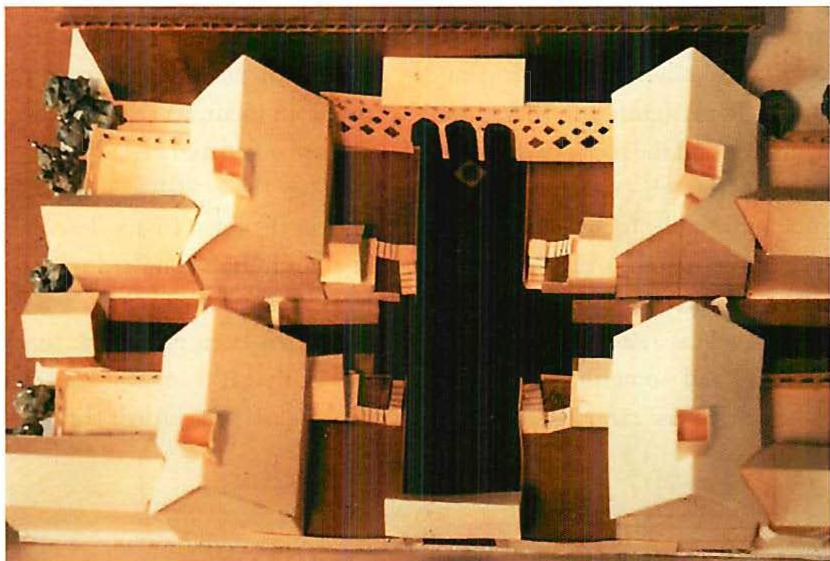
In order to be clear about the practical meaning of volume and site design as a distinct stage in the unfolding of a building, it is helpful to have an operational definition of what you must have in hand by the end of this phase.
Essentially, it is:
You have a complete staking out of the building, on the land, with all building edges and all important exterior centers.
You have a topographic model at 1:200 scale (1/16" to one foot), which shows the land, surrounding buildings, trees, roads and of course the contours of the land. We usually make the land of this model in modelling clay.
On the topographic model you have small paper models of the building volumes. These models are best made in a very light card, the kind of material manila folders are made from; trees and bushes are realistic and to scale.
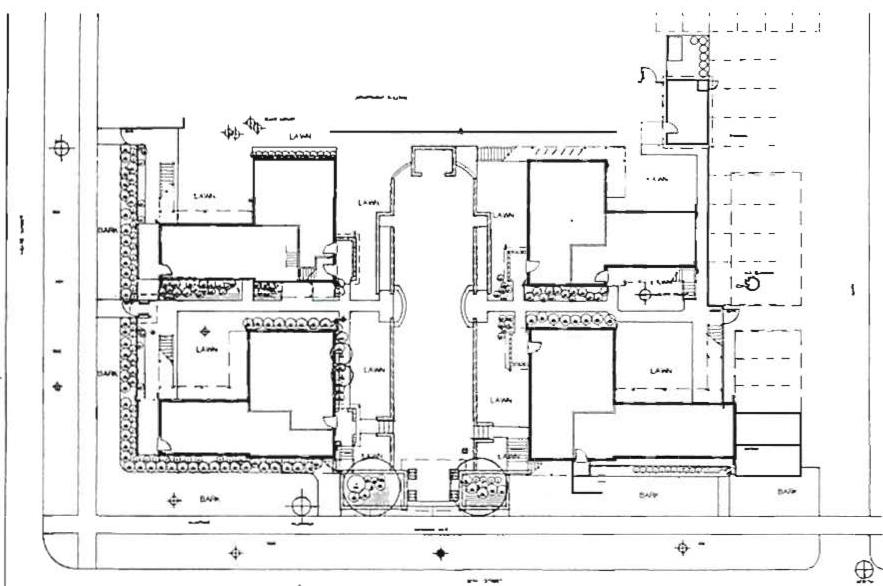
The knowledge that is contained in these three elements is the knowledge which completes this phase.⁸ It is significant that these small informal models and the phase of development they represent, though extremely simple, are entirely different from the “deliverables” normally considered appropriate for early stages of design in current architectural practice. The normal deliverables include a site plan and rough schematic drawings, and sometimes, preliminary drawings. Such items cannot adequately represent a solved problem. They do not contain enough information, and one cannot feel certain, from them, whether the life of the site has been preserved and extended.
The three deliverables mentioned here, made in the form I have described them, different from today’s standard professional deliverables, give a reasonable guarantee that the life of the site has been preserved, that the solution is reliable, that it is intense, and that the building does intensify the city or the land.
9 / EMERGENCE OF BUILDING VOLUMES IN A MORE REPETITIVE PROJECT
Amazon village, a larger housing project of 300 apartments for graduate students, was to be the extension of the Agate student housing and was to occupy an area of about eleven acres on flat land near the university.
The initial plan showed us the existence of a pedestrian street, connecting two parking lots,
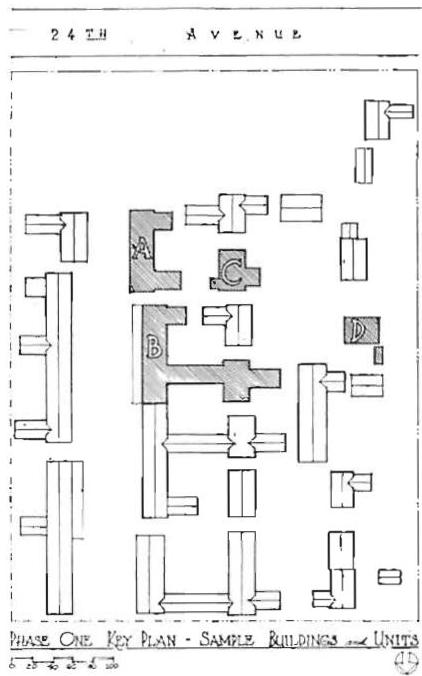
with buildings lining the street, and less and less dense courtyards of buildings, forming a gradient away from the street. There is a latent gradient inherent in the site diagram. Further structure-preserving transformations make this gradient physically real, by height and intensity of buildings, and create small paths leading away from the main street, and create gardens—progressively more and more open as one moves away from the pedestrian street.
Along the street the buildings are three stories high, there are arcades, and all the buildings are connected. Applying structure-preserving transformations to form the small paths, each path is made a series of lines, joining new centers, courtyards, and gardens.
The buildings near the spine are higher and longer, with arcades. The walkways going across form small pathways, not disruptive of the main spine. Each of these paths goes to lower density as one goes away from the spine, leaving a more tranquil atmosphere further away, and a more active atmosphere near to it. All this new structure not only preserves the structure of the land. Here we see how the structure-preserving process also begins to establish volumes and positions on the land, major space, major volumes.
Within the framework of this volumetric structure, detailed volumes and smaller spaces develop like twigs growing off branches, to form
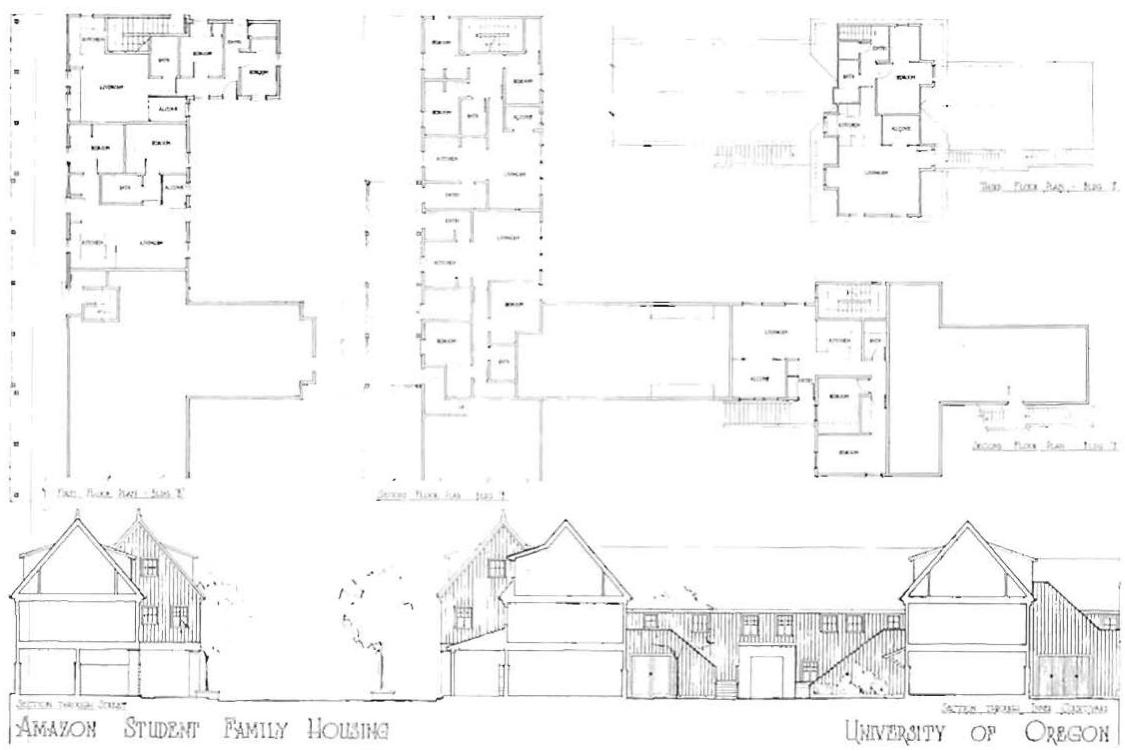
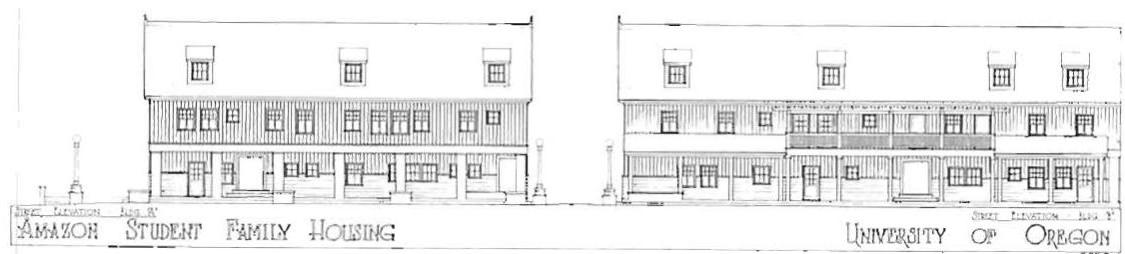
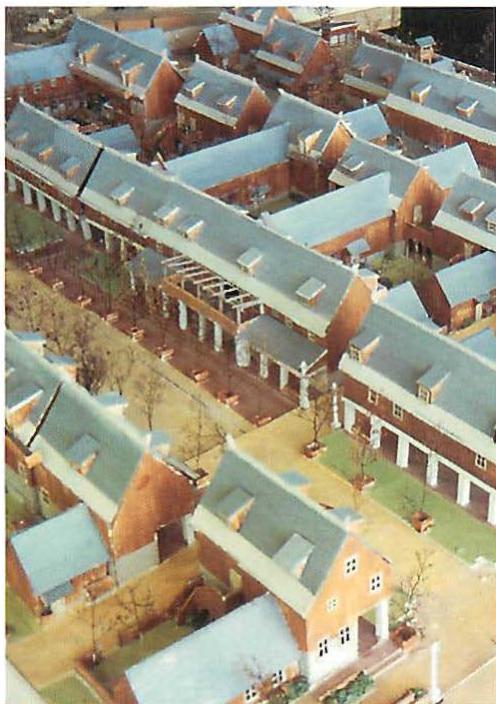
a further system of volume and space, also by preserving the structure and creating a positive space and volumetric texture on the land.
Here the architecture itself, the style of the volumes, the walkways, courtyards, building heights, building thicknesses, all develop by respecting and preserving and continuing the structure which is there, according to the fundamental process.
When combinations of the fundamental process are used to place and shape building volumes, the land always ends with a certain sort of pattern: a combination of nearly rectangular and rectangular volumes, not quite rectilinear in their placing, placed rather in relation to contours, flat places, slight lines of slope, positions of other buildings. Some of the volumes typically end up with roofs that create strong centers; the buildings surround and form courts and terraces and gardens as important as the building volumes, circulation realms, trees and pockets in the land honored by space, steps and terraces.
Subject to these influences, the rectangles are hardly ever perfectly rectangular. Even the building volumes typically have odd excrescences sticking out from them added on, and, occasional departures from the perfect 90 degrees in their corners, all done so that the syncopated and more subtle structure can accommodate the fitness to the contour, to the positive
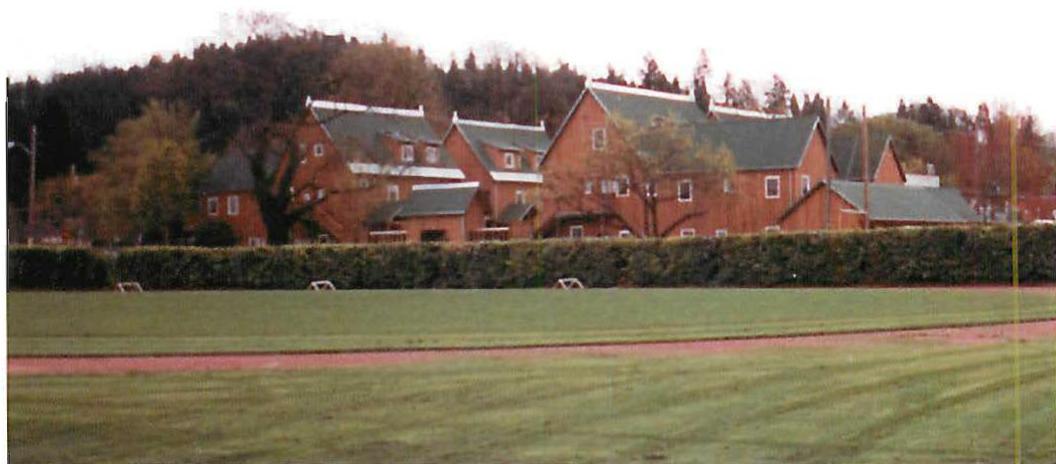
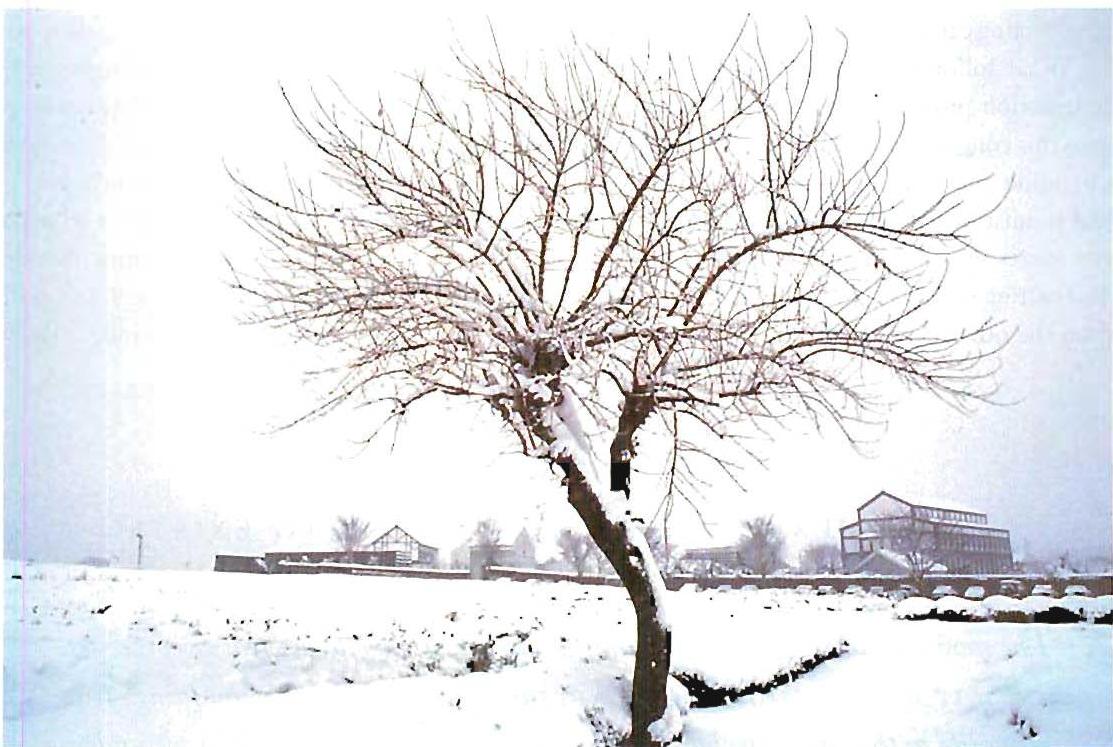
space of neighborhood buildings, to the accidents of a rock, or of a great tree, or of a bridge.
All this follows from the creation of positive centers, under the impact of the fundamental process. The pattern which results, though contemporary and of our time, will also, necessarily, resemble an ancient and universal one. It could as well be Chinese, or Italian, or Peruvian or African. This, more than anything else, belongs to the future, too, because it is the building/land/form which will arise whenever
living processes really have occurred—in the language of pages 21–24, a class-one structure not a class-two structure. Once our obsession with structure-destroying modernity has subsided, and we have stopped blindly destroying valuable structure in cities and landscapes, we may, in a far-distant future, be able to create similar patterns in a new form, again and again, all over the Earth. And the Earth, with such building volumes on it, may then perpetually seem fresh and young.
10 / THE MOST VITAL STEP IN ANY BUILDING PROCESS
Once this work on site and volume design is done, the essential feeling of the coming buildings—their contribution to the world, their structure-preserving character—has been established. It is the most vital single step in the emergence of a new building or a new group of buildings. If the volume is congruent with the wholeness which existed previously in the city or on the land, a profound feeling can often come from its congruence.
What follows, in later stages of design or construction process, must never be allowed to undo this congruence or damage it. If the feeling is genuine and does arise out of the site itself, then it must be thought of as an absolute which later stages of unfolding—detailed design and construction—must only strengthen, deepen. If, on the other hand, the volume that you have
reached at this first crucial stage is in any sense inadequate, then you must fix it now. Any depth of feeling which exists in the thing will hinge on this volume and its placing on the land. You may try to tell yourself that you can fix it later, but you will not be able to. Later will be too late. The deep feeling can never be made essentially different later. If the disposition of volume and space has force in it—magic—now, then you have a chance of keeping it, and enlarging it by later actions of design. But a bad beginning of volume and space can never be set right later.
When it exists only in your mind's eye, or as a tiny cardboard model, your job is to make that feeling so intense that it captures the soul of that place, and fits harmoniously and with intense feeling into that piece of land.
11 / REMEMBER THAT EACH BUILDING EXISTS MAINLY TO ACTIVATE THE LAND
The most crucial thing to understand throughout the volume-creating processes, is that IT IS THE LAND WHICH MATTERS. The purpose of the buildings is to bring life to the land. The building volumes are the tools with which we undertake this task. This is a radical point of view. It puts the building in a humble
position making it a tool, the clay from which we mold the space. But it is the land and its space, as they become activated by this clay, which really matter.
This drastic state of mind can produce the most beautiful results. Once, I was working with a group of students who were helping me to lay out houses for a new town near Sacramento. I lectured to them at length on this topic. I spoke about the fact that the building is not important, that the purpose of the building volume is only to shape and enliven the land. The total building mass — at that stage still amorphous, not yet formed — is like a long sausage of baker's dough, an undifferentiated volume of material for our use. We use it, distribute it, place it, entirely, and only, to bring life to the land, to revere the land.⁹
I managed, in that instance, to communicate this thought successfully (it is not always so easy). The students took it in. The next day their work was indeed beautiful. They showed me about thirty models of houses, made with the relation to the land in mind, where an entirely new level of feeling and subtlety had been reached. Not only the land and space formed by the buildings had become better. The building volumes themselves had become better. The student whose work was most beautiful showed me how every single thing he had done had been guided according to this rule. The land around his project was being improved, honored, and every particle of building volume was conceived, and placed, only to make some improvement, some quickening of life, some peaceful harmony, in the land. The buildings were only the shapers, the tools.
It is remarkable to realize that it is this uncompromising attitude of attention to the land which also makes the building VOLUMES subtle and beautiful. That is truly surprising. The land itself, and our love for it, is enough to give the actual building volumes their shape. If they genuinely help the land, building volumes become more graceful as shapes, more serious, more differentiated.
Like a person who, in being helpful, becomes more graceful, more beautiful as a person, the building volumes become beautiful as they help the land.
NOTES
- The fundamental process, Book 2, chapter 7.
- Part of this pattern language is printed in Book 2, chapter 13 (page 363–64).
- The university center, originally visualized as a square with four quadrants for the four departments, was often referred to as the tanoji center, 'ta' being the japanese character that appears as a square with four quadrants.
- Hisae Hosoi speaking in the film PLACES FOR THE SOUL: THE ARCHITECTURE OF CHRISTOPHER ALEXANDER. Director, Ruth Landy, Producer, Cinema Consultants, San Francisco, 1990.
- There is a vital reason for the emphasis on the real site and on the use of small models. It is not an accident of technique, but an essential feature of an unfolding process. The essence of the unfolding operation is that it operates on the current state of the unfolding wholeness, and does that thing to it which goes furthest to increase its wholeness further. There is, in effect, a feedback process which allows the next step to be determined as a response to the current state of the wholeness. See Book 2, chapter 8.
- This happened, of course, on the Eishin campus. Such details of this project are described, at considerable length in Christopher Alexander and Hajo Neis, BATTLE: THE STORY OF A HISTORIC CLASH BETWEEN WORLD-SYSTEM A AND WORLD-SYSTEM B (forthcoming).
- In an evolving design, there is a fundamental problem. The normal evolution of a design (in an architect’s office) consists of rough sketches of various kinds. But these sketches do not approximate the actual wholeness which they represent. In other words, the sketch of an idea, does not allow you to feel, or experience, or sense, the wholeness which is implied by that sketch. Since you cannot experience the wholeness, you cannot react to it, and effective feedback is impossible.
To solve this problem, it is necessary to do the work in a situation which resembles, as nearly as possible, the real situation of the project. That means, to start with, that a great deal of the design must be done on the actual site, using sticks, stakes, string, a bush, a rock, and so on, to show where the building is to be, how it sits in the land, what the open space next to it feels like, and so on.
- It is also necessary — not merely desirable, necessary — to use models, continuously, and frequently, at every stage. We make rough models, which show, in general outline, what the wholeness is, that is developing. The models we use are intentionally rough. Not finished architect’s models, but rough working models made of paper, plasticine, chewing gum, glue, little bits and pieces — sometimes a tube of glue, or a salt shaker, or an eraser, sometimes a bit of paint, pieces of tape, details quickly cut with a pair of scissors — all find their way into the model. The idea of the model is to give a rough sketch of the three-dimensional wholeness, as it will be — and sufficient in its range and structure so that you can examine it to see what is wrong with it, and also find out, by looking at it, what is the next step which will do the most to intensify the wholeness further.
What is at stake is just that positive volume of space and substance which appears in a 1:200 model, in light cardboard, on a topographic model.
- This “sausage” of volume is typically about 20 feet wide, two stories high, and can be cut into segments of any length. We usually make up lengths from manila folder material, or balsa, often with pitched roof, if that is appropriate, and rapidly start to visualize the volume and space that can be created with this much material. Of course that makes sense for houses, apartments, offices. For other larger or small types of buildings, the building sausage and its section will be different and must be appropriately chosen. What matters is that its overall volume of dough is accurate and that its section makes sense on the average, so that placing the pieces of baker’s dough does, when completed, give a feasible and workable site plan and volume plan.
CHAPTER SIX: HOW LIVING PROCESS GENERATES POSITIVE SPACE IN ENGINEERING STRUCTURE AND GEOMETRY WITHIN THE FABRIC OF A BUILDING
1 / BEAUTY OF STRUCTURE AND POSITIVE SPACE
In this chapter I shall show, by example, how living processes generate engineering structure, how the design of that structure comes directly, step by step, from a repeated application of the fundamental process. Even for an architect this is hard. Using the fundamental process, you must think of the building in a way that it becomes a beautiful pattern of light and dark, solid and empty. This is hard if you don't know much about engineering — because it is an engineering problem. But it is unusually hard, too, because in our era, the process of thinking of interlocking positive and negative space together as a single thing is almost a forgotten art.
To solve the problem, you need to address the alternation of space and solid in the building; and you need to approach this matter almost as if it were a problem of decoration, of playing, making the solid mass of the building so beautiful in its own right that its centers, their volumes, are as massive as possible — and that these centers — arches, columns, beams, walls, vaults — become as pronounced as the centers in the space — the rooms and corridors and doorways.
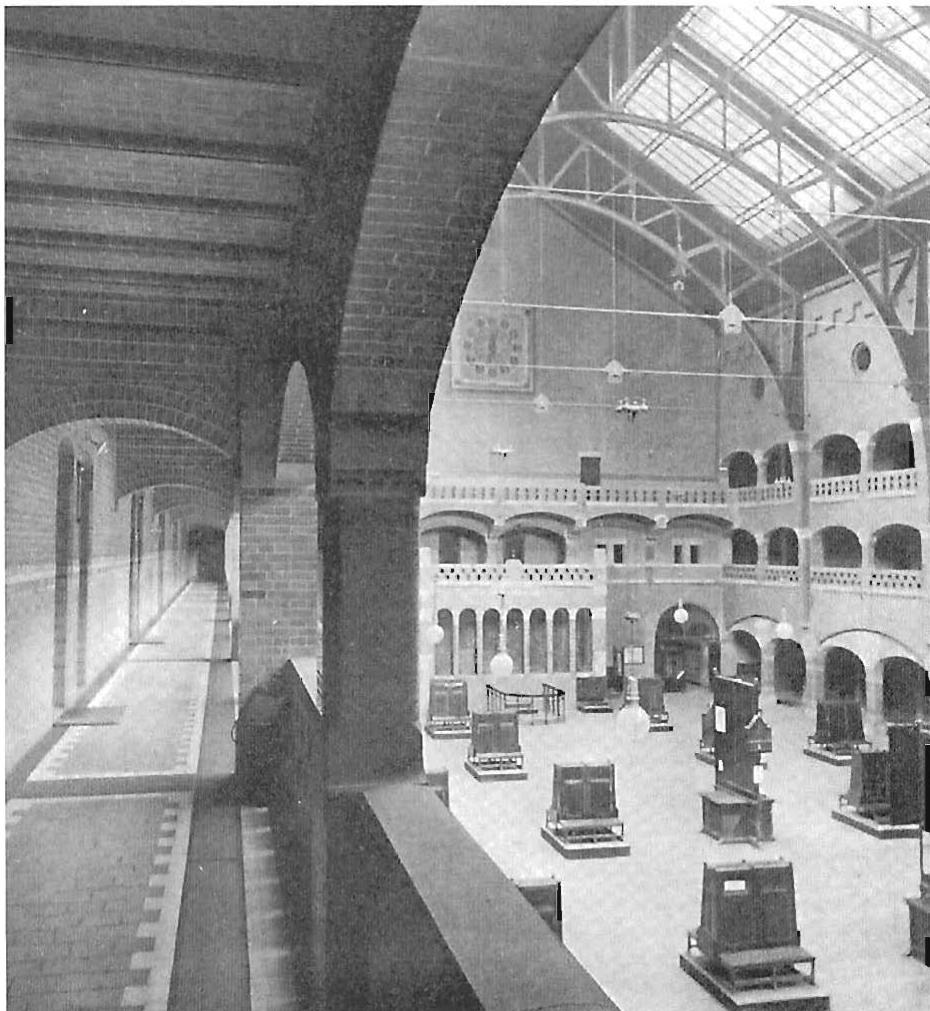
In particular, to understand the impact of living process on building structure, we need to discuss, more deeply than we have so far, the essential idea of positive space—the POSITIVE SPACE property discussed in Book 1 (pages 261 ff.), and the POSITIVE SPACE transformation discussed in Book 2 and repeatedly again in this book in chapters 1 to 5. Again and again, as I have tried to show, the living quality of centers comes, above all, from the formation of POSITIVE SPACE—and this means, essentially, that the spatial elements, and the elements between the elements, and the elements inside the elements, and the smaller interstices between the smaller elements—all these are positive in character—so well-shaped, that the space created by them forms an endless and coherent tapestry.
What I shall show in this chapter, with discussion of examples from structure and structural engineering, is that the qualities which arise in space when it is positive, and the qualities that arise in structure when it is well-behaved structurally, are very closely similar, almost congruent—and that indeed, we may find
our way to good engineering structures most effectively, by relying on our ability to form positive space at many levels, in the members, and in the space.
I will remind the reader, too, of a brief discussion of structure in Book 1, where I showed how multiplicity of function—that is, structure which is well-behaved from an engineering point of view and also well-behaved from the point of view of other vital building functions—will rely on the formation of positive space, because it is this kind of space which has the capacity to have many different functional properties at the same time (see Book 1, pages 417-19).
The same subject was taken up in Book 2 (pages 401-20), where I showed repeatedly how the holistic aspect of a well-behaved structural system can be tamed, and brought into coherence with functional and site-specific necessity by the use of a-periodic grid or tartans, as the basis for column and beam layout, once again relying on the formation of positive space in every element at every scale, without imposing a rigid framework on them.
2 / INTERLOCKING ELEMENTS OF MASS AND ELEMENTS OF SPACE
It is too often forgotten that a building is, above all, a load-bearing structure. The most significant thing about what we call a building is that it is a disposition of material weighing several hundred or several thousand tons. The question is, how do we arrange these thousands of tons to make something with powerful sense, with psychic force?
To do it, we essentially have to think of the structure as big and the space as small. The structure is made of big and massive members (volumetrically, but not necessarily with regard to weight). And the building will be beautiful, or not, according to the pattern of these members in three dimensions.
In many historic buildings, what we experience as "the building" is really almost nothing but the structure: it is that disposition of members which stands in the air, and shouts, cries, to the sky.
For instance, in the structure of Chartres (next page), we see that the members are huge, they form a pattern which occupies the space; it engages the space. The space and the structure interlock, each one is so big. In the structure of Paestum (Book 1, page 131) we see the same. The columns and beams are huge, they occupy almost fifty percent of the building's volume. Because of this the space and mass engage each other, interlock, and produce something which engages us with deep and powerful force.
To create living structure in any building, we must form a powerful interlock of space and mass that intertwine in three dimensions, making (if we are lucky) something inescapable that moves us, imposes its sensation on us, comes to us as a creature that we cannot avoid.
Structural mass is almost always distributed with rhythm. It is a pattern of alternating mass and space whose regularity has the power to resist movement. So, to get it, we first form a rough skeleton of the possible mass, and then begin to ask how this skeleton of mass can be made to resist movement: and what elements of mass we have to add to make it resist movement more effectively.
The process of creating the structure consists mainly of work we do in the centers, trying to make them stronger and more intense. The process of making the centers intense, and the
process of making the structure powerful and able to withstand forces, are the essence of the thing. We master the art of making this structure at that moment when we see the system of load-bearing elements (structure) and the system of rooms (spatial centers) as one and the same problem. That is, when our intuition for the structure (our understanding of its centers) and our intellectual grasp of its structural behavior (knowledge of its movements in failure) become one and the same.
In the end, the making of the design—the integration of building, circulation, rooms and structure—is a creation of pure pattern like an abstract painting or an ornament in which the beauty of the pure pattern is both the ultimate goal and, when it works, the ultimate achievement.
Of course, the building is helped to work by non-structural issues—if light is good, if quiet
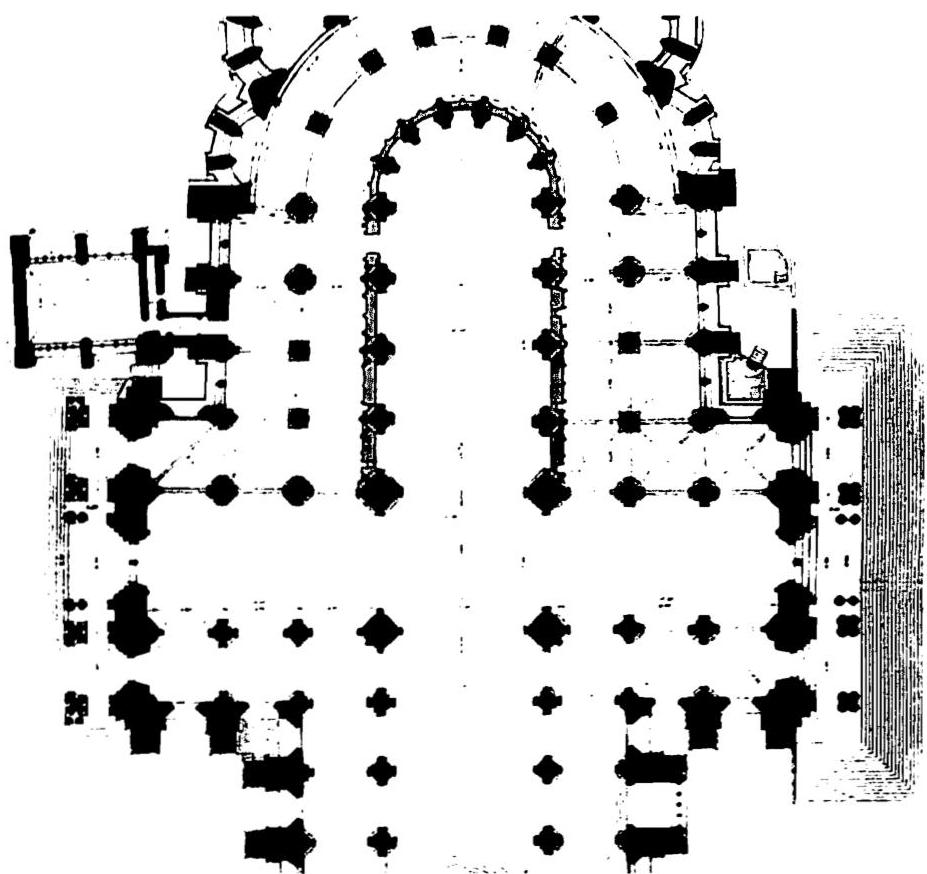
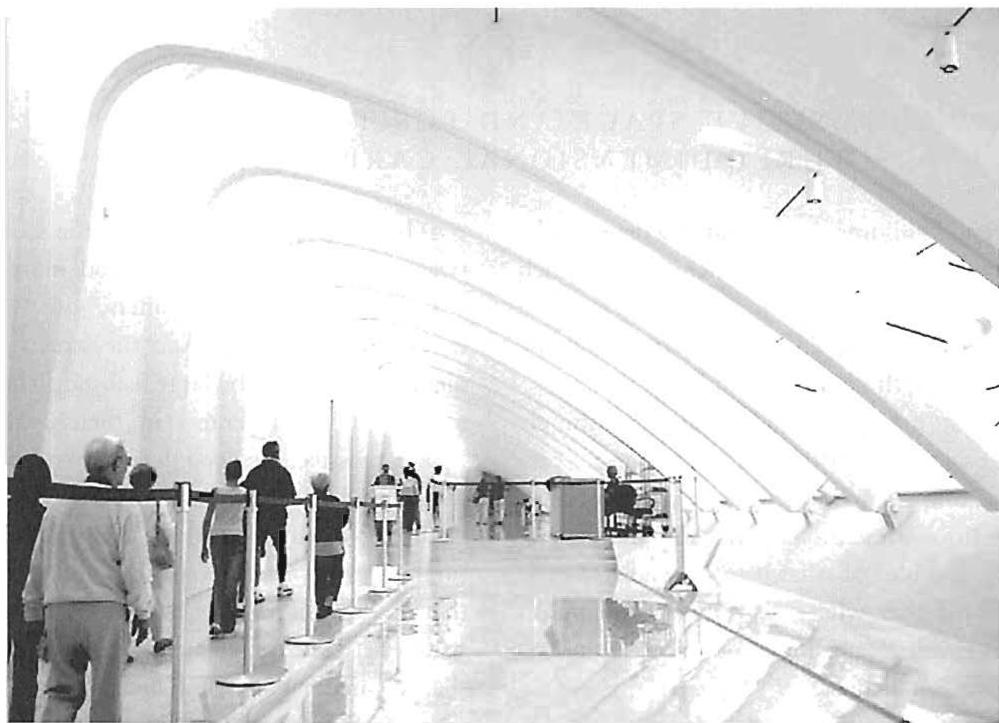
spots are really quiet, if the important centers in the rooms are off the track of doors, circulation and movement paths and have beautiful relationships to light and windows.
But the building as a whole, its feeling, and above all the decision about whether it really works in these important ways, will largely hinge on the way in which it is a beautiful, pure pattern in which solid elements and open elements, volumes, spaces, voids, and solid cores of material, together form a satisfying pattern of centers.
This is virtually pure art. It is not, as people sometimes like to say, a mixture of practical and art. It is pure art. The centers are purely in the configuration alone; and the beauty of the centers works only when they are pure. Of course it also happens that the centers are defined by aspects which are practical — strength, light and so on, together with human and social considerations. But the game that is played by these elements in space, the pure unity which they accomplish, lies purely in the realm of art. Assume that we have a rough outline of an emerging
building design. This means we have a rough disposition of volume, outdoor space, entrances, interior movement and the most important rooms. What happens next—when the sequence of unfolding is right—is often the most important period in the evolution of the building design: the process by which this outline of the building's approximate space and volume is transformed to become a coherent geometric structure. It is during this phase that the building gets its guts, its inner force, establishes its feeling in a meaningful way, and may first become a living creature.
In summary, what the fundamental process does to make a building beautiful, is to make the structure part and parcel of the space. Like negative and positive, the matter and the space become complementary opposites. Each complements the other. The structural elements form a composition in their own right, as do the spaces: two beautiful systems of centers, each with its own weight and substance, each interlocked and interdependent with the other.
3 / POSITIVE SPACE AND POSITIVE STRUCTURE
A THREE-DIMENSIONAL CARPET OF SPACE
So, a good building, in the end, is a dense packing of pure pattern in three dimensions, in which every piece, every part, is positive. This is not so easy to achieve. The old Turkish carpets from the 13th to the 17th centuries can show us something of it: many of them have an astonishingly dense packing of positive space. Of course, a carpet packing is two-dimensional, while a building is three-dimensional. But still the general feeling and idea of what it means, how space is packed together, what it feels like to accomplish this, is visible in ancient carpets as in almost no other human artifact.
In a building, what we are trying to do is to form a complete densely packed system of centers, both in the space (void), and in the solid structure (the material mass of the building). Rooms and structure alternate; space and solid alternate; the rooms of the building and the members that form its mass form ALTERNATING REPETITION.
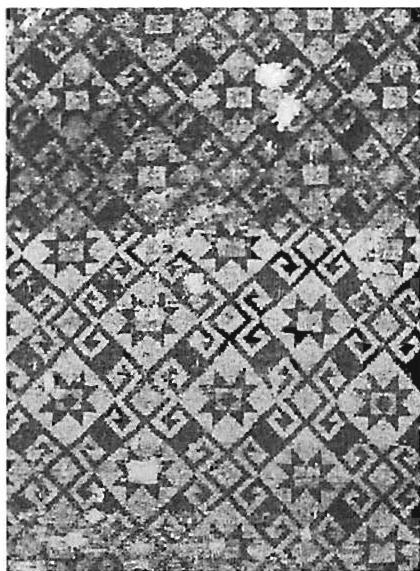
To make the structure live, the spaces between the structural elements, too, must form a beautiful composition of centers, with their own weight and substance. And the structural elements, too, need to be large, substantial enough to exist as solid centers in their own right, square, massive, big enough to have relationship with the human body, to form a significant part of the rooms in which they occur. If the structural elements make a pattern in themselves, then, because of ALTERNATING REPETITION, the spaces between the elements will also be well-shaped, small enough, and beautiful.
The forging of this interlocking fabric of three dimensions, in which each element is positive, is the crux of the architectural problem. The building must be put together so that every space is positive, and so that every building element is positive; that means, each must be a center. It resides in large part in the structure, since the structural bays must be visible, coherent, and solid to
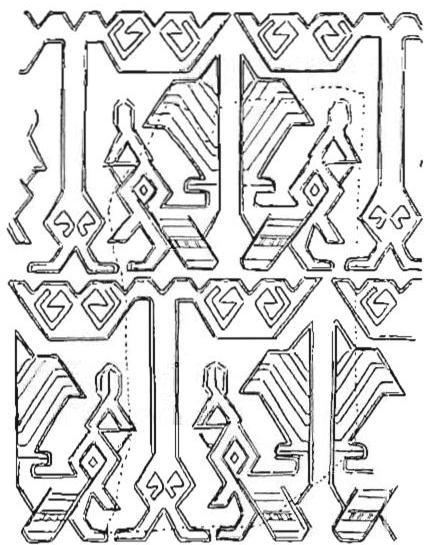

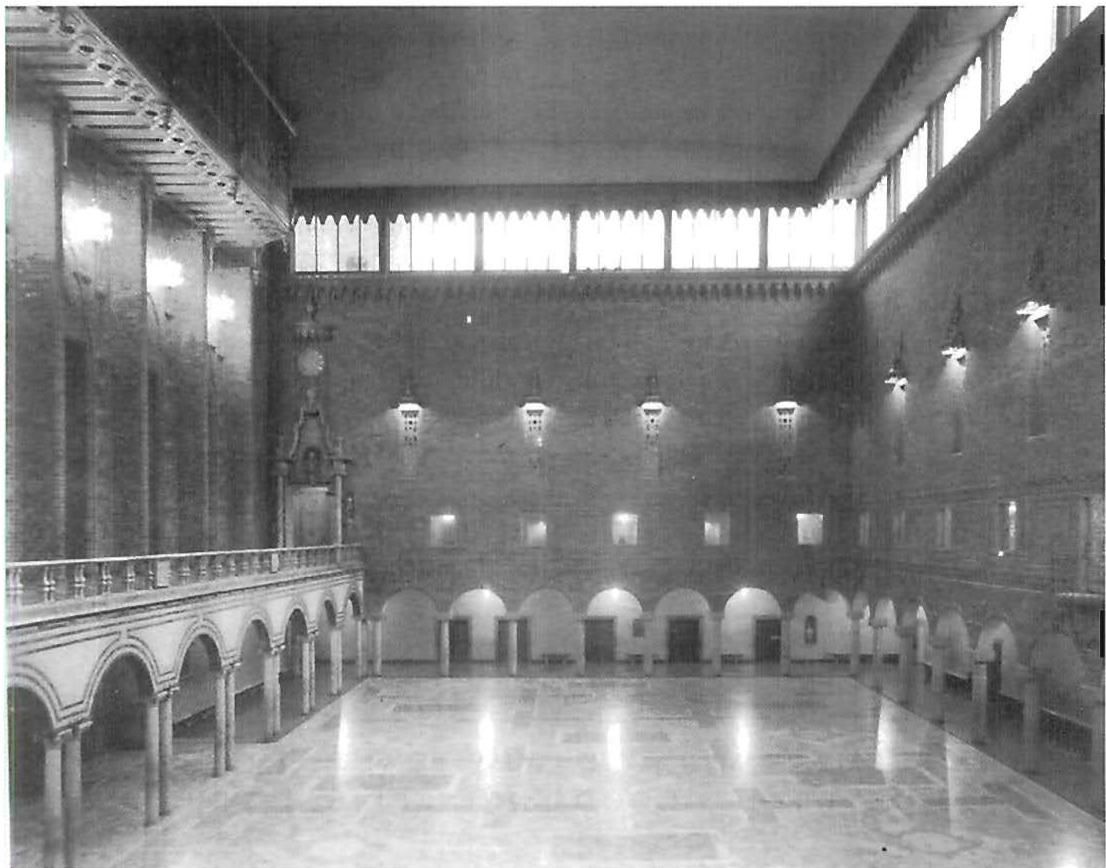
accomplish this. And the core also lies, even at the first gross level, in the positive nature of the smaller building elements. Even when one first conceives rooms, halls, and corridors, the walls, floors, columns, ceilings, and windows are already imagined as positive and solid entities. And for this, even sills, doorsteps, window frames, and cornices, must also appear, already, in the mind's eye as positive entities. It is this positive interlocking nature, and the character of space in three dimensions which is required to carry it out, that is the essence of the problem. In this respect it is, almost exactly, a three-dimensional analog of what is carried out in the great old Turkish carpets.
In chapter 5 we have already encountered a similar process during the phase of volume and site design. I argued that when a living process makes a meaningful volume, we must accomplish a perfect solidity of the land — that means, a disposition of building volume, which makes the land positive. At one or two scales, this is relatively simple. But in the case of the building interior and the mass of the building itself, the interlock of space which is to be positively shaped and mass components which are to be positively shaped is of an unbelievable complexity. This is where the heart of architecture arises.
Effectively, the fundamental process, applied repeatedly, creates a series of nested, layered packings of space. A packing of the main spaces, the largest entities of space. A packing of minor entities of space, rooms, and so on. A packing of the smallest spaces, passages, alcoves, closets, window seats, toilets, stairs. A packing of the main structural bays: bays, beams bays, vaults, units of spanned space. A packing of smaller positive entities: the columns, walls, etc., themselves visible as centers — and thus positive. But the fundamental process achieves, further, a congruence between these systems, so that the space is visible in the structural plan, and the structure is legible in the space plan.
First in the plan we expect to see the rooms take on the character of making every space positive. Then we expect that a structural system will form structural bays that have the same positive nature, and in which one can see the positive space of the rooms, within the framing plan and column plan of the structure. And finally, the actual elements of the structure, individually, stand out as positive solid entities in themselves — like the great columns of Chartres, or the beams and corbels of Peking's Palace of the Emperors. The blue hall in Stockholm (page 197) is a beautiful 20th-century example.
It is vital that in the finished composition, one experiences the structural elements and the space, together. We experience the space, formed by the structural massive elements, as something truly alive in which we feel and breathe. One brings the space to life by giving life to the structural elements. The whole then speaks.
In a complex structure, which has to be analyzed for structural behavior, the same process gives the disposition of the individual elements, and their pattern.
Look, again, at the plan of Chartres. In the plan there is almost as much black as there is white. The huge piers and columns are as big, as significant, as the spaces they create. This is not an accident of Chartres. It must be done, to create the moving, living space: The centers which form the material structure must support and help the centers which form the space.
4 / THE SEEMING MIRACLE: WHY BEAUTY OF SPACE AND MASS GENERATES GOOD ENGINEERING STRUCTURE
What is most remarkable of all, is that the structure which is created by a feeling for centers and by a conscious and deliberate aim towards the feeling of the whole, will often turn out to be an efficient struc
ture. This appears to be true empirically, as I have found in numerous examples. Again and again during the last twenty years I have discovered that if we make a pattern of members which has life according to the geometric centers formed in the space, then just embellishing the system of centers according to its own pattern will turn it into something which is efficient and good from a structural point of view.
Apparently good engineering structure follows, directly or indirectly, from the use of living process. The deep nature of space appears to be so profound that just the geometric unfolding, when it is done properly, leads to results which make sense from an engineering point of view. This is most surprising. A process which places focus on the space, on positive space, positive rhythms of elements, positive shape of members, positive shaping of gaps and spaces and volumes of thin air between the members — all that, governed by what seems like an almost abstract ar
tistic process—does tend to create structures which work as engineering structure. They are efficient, stable, well-behaved, coherent in their deformations. Why this happens is a deep matter, too difficult to analyze here. Mathematically, it is still a mystery.
I believe it occurs for the reasons that I have touched on in Book I, chapter II. There I suggested that function follows from well-ordered space, apparently because the forces we think of as functional are themselves geometric and themselves space-like. That, roughly speaking, is what we also find with engineering. When the process followed in unfolding an engineering structure is a version of the fundamental process, and we use it to create coherent space, the nice behavior and the good engineering qualities of the resulting structure follow naturally. And occasionally this process leads to a structure which has never been invented before, to a structure that is innovative even to an engineer (see page 223).
5 / THREE-DIMENSIONAL FORMATION OF POSITIVE AND NEGATIVE
Let us first examine the creation of a single building, in such a way as to generate this interlocking pattern of mass and space in three dimensions.
I take for my example the process of engineering the structure of the Central Hall, in the Eishin project in Japan. This building was to be a general gathering space for students, owned by them, at the center of gravity of the campus. I started by sketching an upside down horseshoe, embodying my feeling about the space it was to contain, as a social and emotional thing, but already containing the germ of a structural idea. The essence of the idea was that the beautifully shaped space would be formed by the mass in the shaded area above it (diagram, right), thus providing the structural strength, and also making both the space within and the structural volume above, positive in their own right.
First sketch of the space and volume for the Central building. The space below is positive in shape; the volume above, needed for mass elements to provide the structure, is also positive in shape. Both are positive so that, from the beginning, we have a conception of a rectangle-filling pattern in which both void and solid are both made of POSITIVE SPACE.
First came the truss itself (next page). Here we have a structure which produces centers very clearly. It has a major center produced by the arch; and the center is reinforced and intensified, by the way the arch jumps up, in steps, always focussing on the main space down below. Gary Black and I designed the wooden truss members
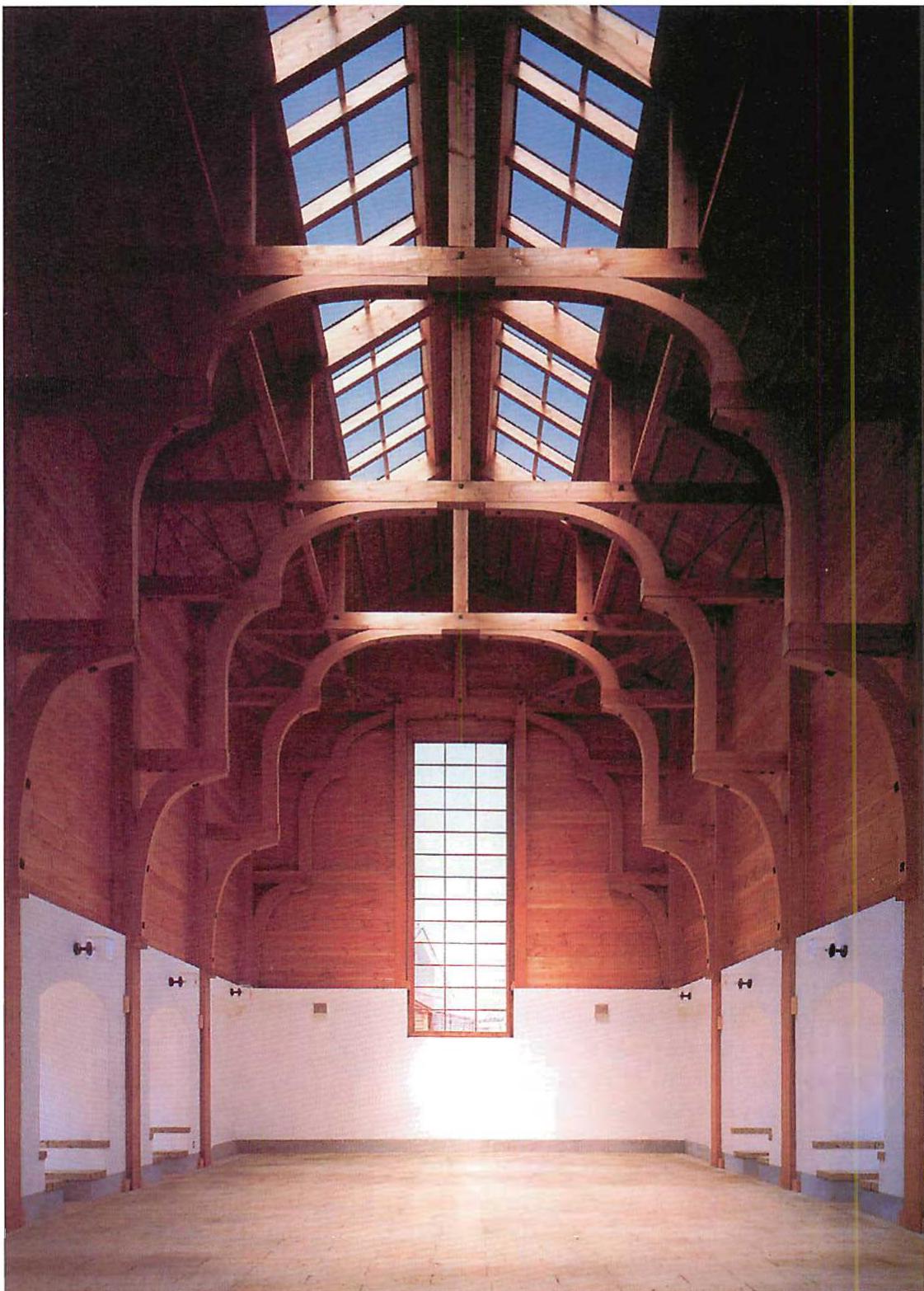
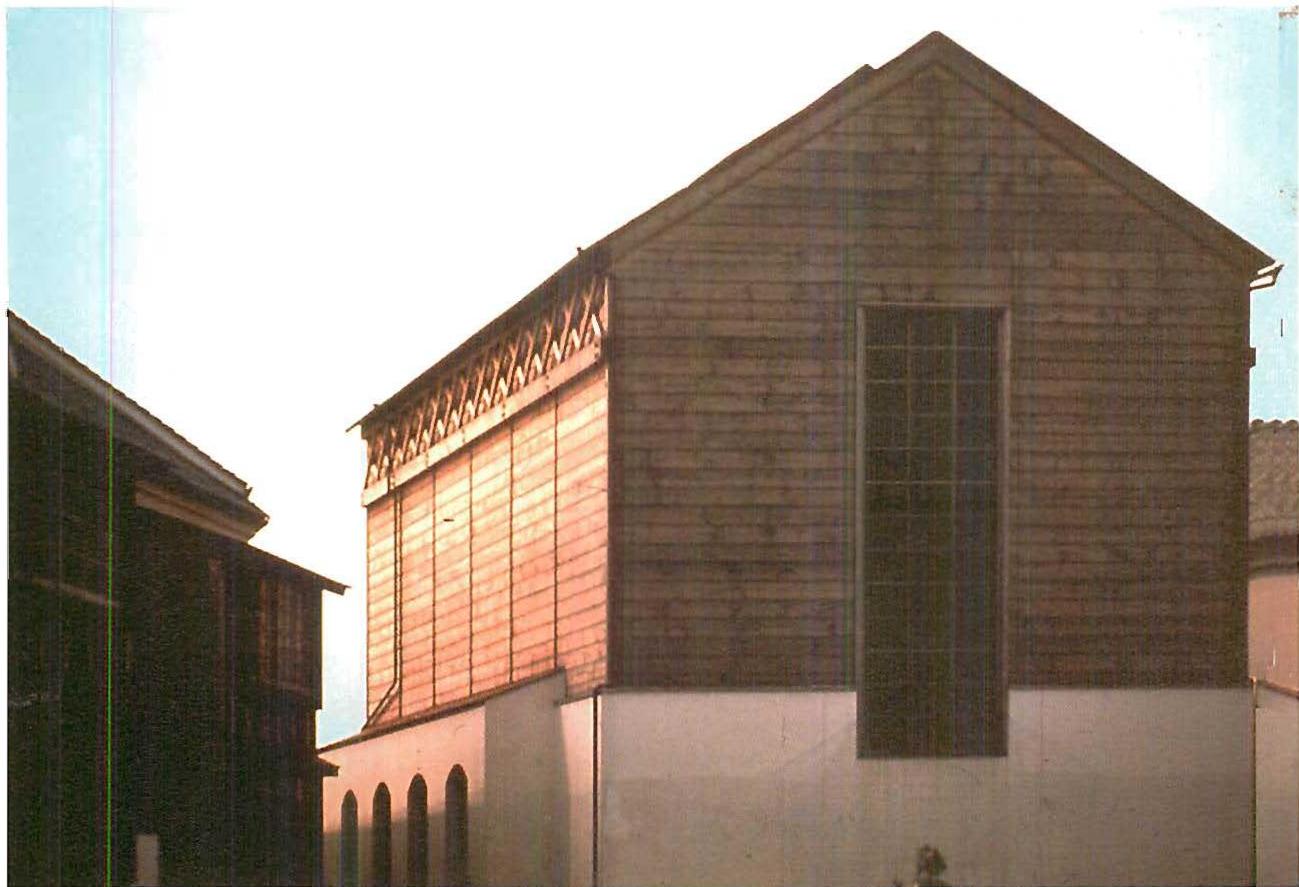
and their connections, in detail, using the finite-element techniques described on pages 210–23.
It should be noted that in the truss itself (opposite) each partition created by the wooden members forms POSITIVE SPACE — and it is this fact above all which gives the truss its beauty. Even more interesting, the very same positive space which creates its beauty also creates its structural stability and good structural behavior.
Let us now move on to the three-dimensional disposition of mass and space within the building as a whole. The base of each column, is a massive pier. This pier is not only a center in itself — the source of the ability of the arches to withstand horizontal forces — but is also a center in a social sense. It creates space next to it, and in front of it. And of course, it creates the beautiful concrete arches between the piers.
When we first laid out this building we did full-scale experiments to calculate, very carefully, just how big each arch with its seat had to be and how big each pier had to be in order to create a system of double centers, both in the space and in the volume of the concrete mass.
In three dimensions, the building had to produce its centers too. The longitudinal wind force was the most difficult thing. It seemed essential to make the strength of the building come from the massive piers. So we made sure that each wooden column was trapped in the pier, thus forming a moment-connection at its base.
But this was not quite enough. To resist longitudinal wind force, we had to make a second X-braced truss running the length of the building, high on the side. This system of X-braces forms a row of centers high along each side, and also leaves the plain side below as a bigger center. If we had made big braces, running across the side, or sheathed the braces so that they func
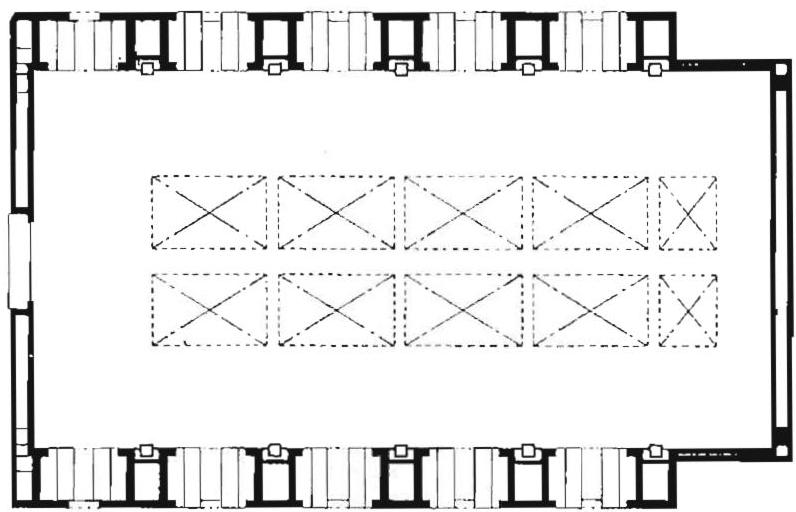
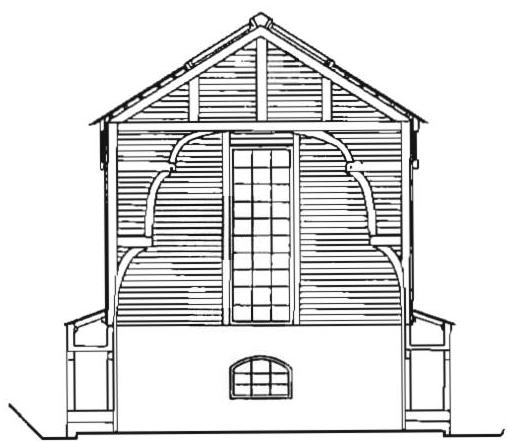
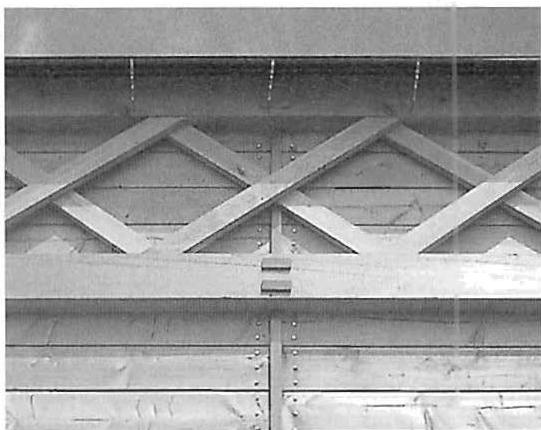
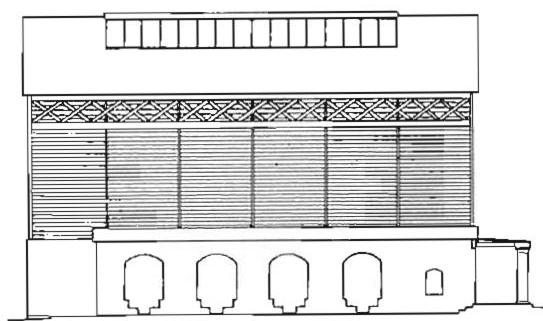
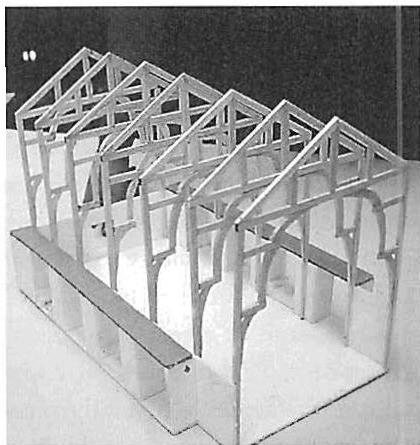
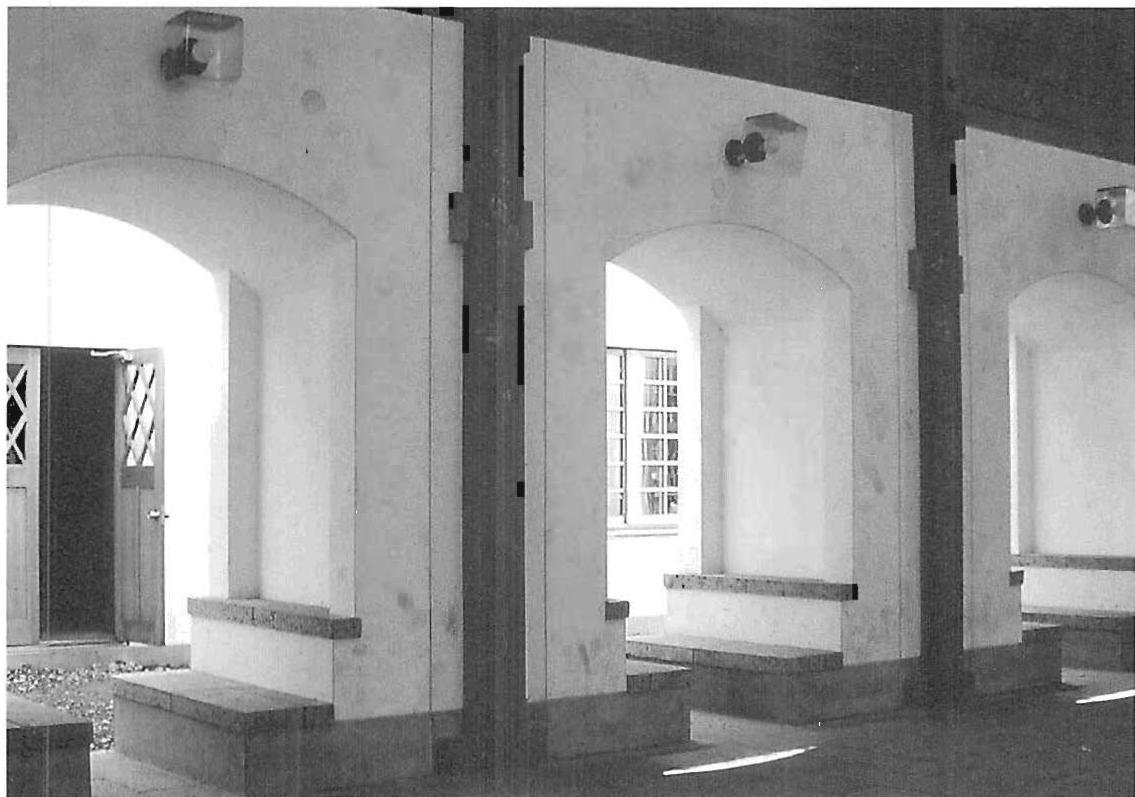
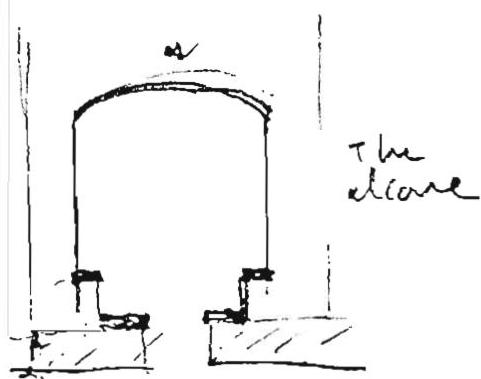
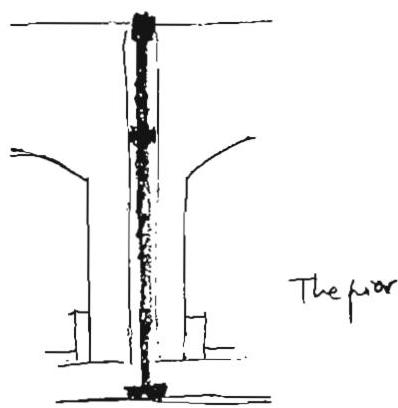
tioned as a shear wall, this would not have produced the character of a powerful center in the long wall. But as we did it, the row of X's along the upper edge makes each long wall into a single massive center, strengthened and intensified by the small system of centers that the X's create.
Finally, the finishing touch in the creation of strong centers: There is a single big window at the northern end to let in light. And at the southern end, a single seat looking in from the arcade above. Doing all this requires a strict adherence to certain principles of order, above all to
When a structure is coherent, it invites life to come to it. Break dancing in the Central building, 1987
the sequence in which these items are created. The crux of the problem is as follows. We are trying to make a system of space in which each part is positive, where the spaces are coherent in their own terms, and where the solid structure of the building as a whole, is orderly, too.
Both the spaces and the solids must form deep centers. This is the volume of the actual physical stuff of which the building is made.
To get both systems of spaces and solids to form beautiful and coherent centers, we must go step by step, from large to small. First we have to get the largest room, in the most beautiful place, just where we want it. Then we have to go gradually to the next largest rooms, then the still smaller ones, each one adjusted perfectly in its proper place. To make this work, there is always some kind of syncopated arrangement. Often there is a little leftover space, tucked in among the big spaces. We cannot get it all to work perfectly. In fact we should not try. What matters is that the big room is perfect, with regard to position, height, volume, view. Get that exactly right. Then adjust others rooms in relation to it, and get them exactly right. To do this, there will always be funny little bits of space left over—forming closets, walls, toilets, rather thick, in between the other spaces as a kind of buffer—allowing the larger spaces to have exactly the right feeling.
At the same time that all this is developing, the structure itself, a syncopated system of grids, columns, beams, floors, walls, and arches, must also form a beautiful and coherent thing, in which these solid elements again have their own perfect shape, and in which moments and shears—with overall stability—work perfectly. Once again, it is the hierarchy of the biggest and most fundamental decisions coming early at the time the largest spaces are formed—then working our way down to the smaller ones, and all the time, keeping the rhythm of repetition, and spaces between the repetition just right—that is crucial.
To get coherent structure, the engineer Antonio Gaudi often used an interesting kind of living process. He hung wires and strings, with weights
on them, to form a rough upside-down model of the building while he was working it out. The wires and strings naturally fell into parabolic curves and catenaries under the impact of pure tension—finding balance with the system of weights. When he turned the configuration discovered by the model upside down, it then formed a system of pure compression arches, one of the most natural ways of using mass material to form a building.²
Here the living process not only created space in a natural way, but also found positions
for compression members that were congruent with the space. Later in the chapter, I shall describe a way that modern finite-element methods can be used in a still more sophisticated fashion, to supplement the use of a living process to elaborate and unfold a structural design. In the next few pages, I shall show, by example, how the unfolding of living structure can be made to work in other, larger situations, how it can actually be done, and why it will work properly only if one repeats the fundamental process again and again.
6 / THE GREAT HALL AT EISHIN
The essence of the problem lies in the process through which we understand solid and void as two balanced opposites.
To explain it, I give the following example of the Great Hall at Eishin (pages 102–110) where the process of working out the solid-void relationship took place in a large but rough-and-ready three-dimensional model. This rough model of the main hall itself, focusing on its interior, was built at a scale of 1:20. It was about 8 feet long, 4 feet wide, and some 2 feet high.³
We began with the overall space, made in paper, getting its shape and feeling right—just as far as space and dimensions and light were concerned. This was done in paper. Then we began introducing columns. These solid wood columns, milled on our table saw, played an important role, since one of the first things to get clear was the size and scale of members that would create profound feeling in the space. After playing with different-sized pieces of wood we were able to determine that the best size for these columns (the one that made the strongest emotional impact) was a square section of about 1 meter by 1 meter: in the model this was a stick of wood 16 inches long, with a square cross section of about 2 inches by 2 inches. Having determined the column-size which had the most
powerful depth of feeling, we made a number of them, and began standing them up in the space to get a clearer understanding of their spacing—the shape of the space between the columns. The space between the columns came to play a crucial role, and we finally settled on a space of two meters clear—i.e., the columns placed at three meters on center. This made the shape of the space between adjacent columns two meters by one meter in plan—a well-shaped rectangle, which had the capacity to form positive space, interlocked with the structure.
All the steps taken so far came from the fundamental process: making the shape, size, of the space, the shape and size of the columns, and shape and size of the space between the columns, making all these work as centers in their own right.
Having done all that, it began to dawn on us—just from looking at the model—that the overwhelming issue was the quality of light created in the space. The overall feeling showed itself mainly through the light that came into the Hall, and the way this subtle light was partially carried into the main space, lingering softly over the aisles. It also had to govern the structure. We then made a more solid model, capable of blocking light so that we weren't
being fooled by the translucent quality of the light coming through the paper walls. We then focused on the size of openings. Surprisingly, it turned out that—once again following a living process—it was necessary that the hall be quite dark inside to preserve the wholeness of the interior. The hall could easily be damaged in its feeling, we found out, by too much light coming in. Under the impact of this observation, the emphasis began to shift to smaller windows and to the way the small openings were framed by the massive structure of the columns. Shortly after that we went
on to the spacing and size and pattern of the beams.
At each moment, as the work went forward, we were thinking primarily of making a system of centers which contributed to the emerging whole. These centers include the structural bays (vertically and horizontally), the columns, the beams, vaults, trusses, buttresses, braces, patterns of bays, foundations, piers, beams, tics and so on. At any state our model was in, one or another of these centers was in some sort of weakened state. As I kept on trying to intensify the structural system of the building as a whole, I was at the same time actively making one of these centers more of a center, a more powerfully living center. The process of making it more of a center (giving it more life) then also played a role structurally, at the same time that the elements and members helped the space.
When I started, all I knew was that there must be a number of columns. As I placed the columns, and as we watched the light develop in the 1:20 model we had in our office, it became
Another interior model in our workshop. In this model we first began to see the quality of light, and the structure, clearly.
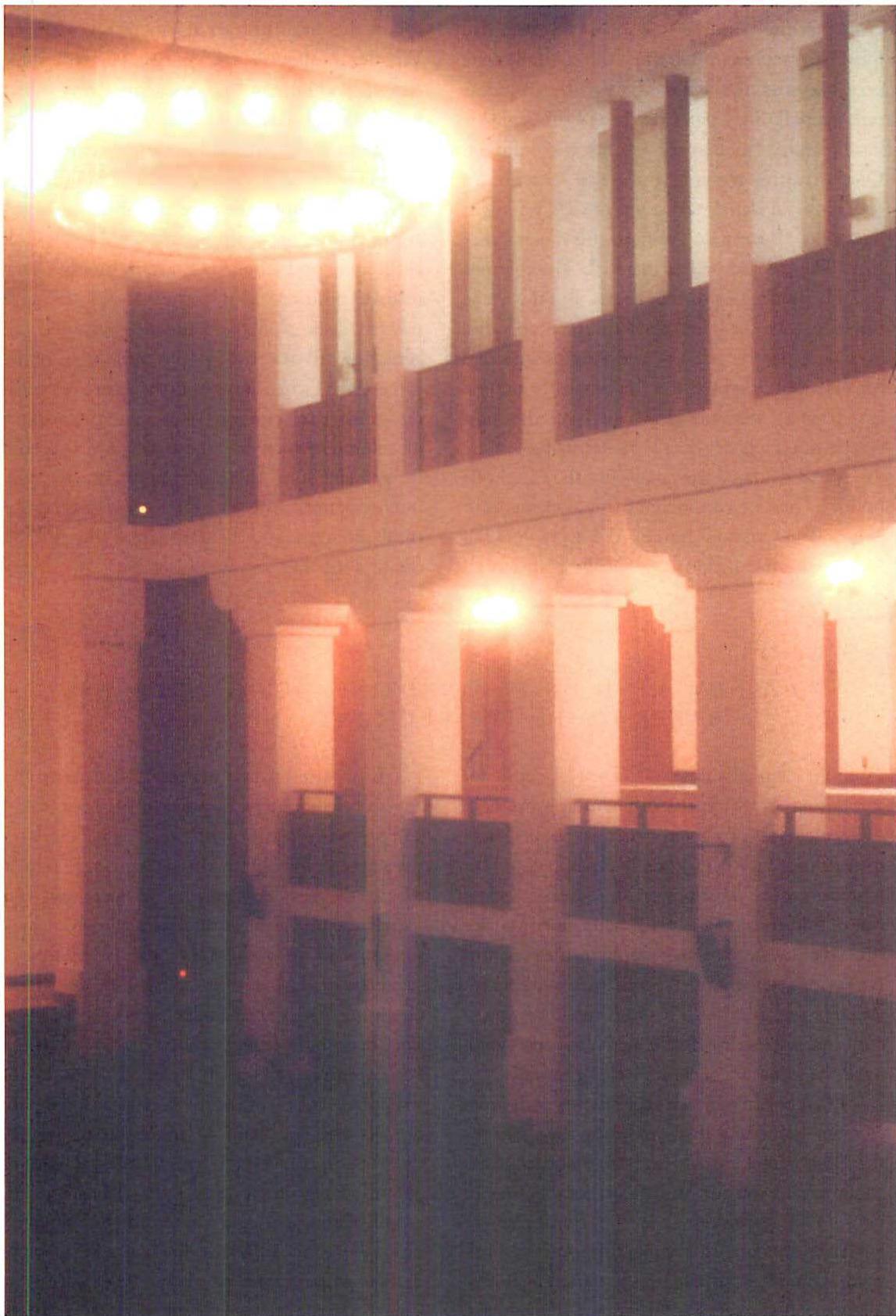
clear that the building was most powerful, had most life in its columns, when the columns were very big, and the space between the columns rather small. So, I put a rhythm of this kind—big columns, small spaces—into the building. Of course this rhythm was useful structurally.
From an elementary point of view we might have said, "But we do not need this much structure. There could be less material. The columns could be smaller, or further apart." But if we take this step, then the life of the building evaporates. So I kept the big columns, and the close spacing, because that is where the life comes from, and asked myself instead: How can I get the most structural efficiency out of this pattern of columns?
We considered the possibility they might be hollow. Then we considered them as elements of a moment-resisting frame. We were looking for a pattern which made the best structural
use of this beautiful arrangement for columns. We never allowed the simple-minded pure-efficiency argument to dictate, since this would have killed the structure. The simple efficiency argument has no more sense, in structure, than allowing any single aspect of the building to rule. For example, the pure plumbing economy argument in an apartment building says all bathrooms and kitchens must be in the same relative position. Obviously, we do not give way to such a silly argument, since it will certainly kill the life of the building. In the same spirit, when designing structure we must recognize that our job is to take the pattern of columns which has the maximum life, and to extract from this maximum life a more intense pattern still, which develops great structural strength and benefits from the life to create a further structural life.
7 / A NEW KIND OF ENGINEERING DESIGN PROCESS BASED ON FINITE ELEMENT ANALYSIS
A finite element model is a form of computer simulation in which the differential movement of the elements of a given structure can be determined, based on the loads it experiences. This has become the most powerful—and easiest—way of finding out what really happens to a structure. It allows you to make rapid tests to see how the various elements of the structure move, in relation to one another. This in turn allows one to correct the structure, test it again, modify again, until the structure becomes well-behaved.4
I first began to make experiments with finite element analysis in 1973, analyzing the shells of the Etna Street cottage and the wood-concrete combinations of our United Nations houses in Peru. The conventional use of finite-element analysis, standard in engineering practice both then and now, normally uses the analysis to size members in an overall configuration of members, when the configuration itself has already been achieved by intuitive design or guesswork.
It occurred to me that one could, with the advent of computers, do something more useful and far more creative with finite-element analysis, namely: To obtain the design itself, that is to say, the best configuration of members, not merely the best sizes of members in a given configuration. One could very quickly examine a sequence of different configurations, each time obtaining the overall forces, tension, compression, bending moments and shear, in the members, observing the badly behaved zones in the structure, and then inserting, or deleting members, or re-sizing them, to improve the behavior, then testing the finite-element program again, obtaining new forces and so on, thus moving rapidly through a sequence of different configurations—hence different designs. After a small number of iterations, which can be examined in a day or two, one is able to arrive at a "best" configuration which has good behavior as a whole. This technique became standard in all
my projects in CES from 1969 onward. Several brilliant and helpful engineers were involved in these experiments, including James Axley in the 70s, Gary Black in the 80s, and John Hewitt in the 90s.⁵
Thus, instead of merely using the finite element analysis to detail sizes and stiffness of members, the method is able to give us the far more exciting unknown configuration, the global organization and design.
In the next section I shall show how detailed structural engineering, too, can be done by the repetition of the fundamental process, using finite-element models that allow a novel and essential approach to member design. We can make a (computer) model of a rough sketch design, apply forces to it (as if the forces were coming on in the real world). Within seconds, the finite element model shows us forces, deformations, stresses, and so on, in every element of the sketch structure. So, we see in the computer which elements take the most force, which ones deform, how the whole configuration stretches, bends, twists and deforms. This allows us to change the design, experiment, see the effects, improve it on the basis of the feedback we are getting. Just as a cardboard model of a building volume on a site gives us excellent feedback about its spatial life within the larger configuration — so the finite element computer model gives us almost instant feedback about the good, or bad, behavior of the structure when forces are applied to it. We are able to correct the structure within minutes, making different elements stiffer, or less stiff, or larger, smaller, differently connected and so on. Then we run the program again, and watch to see how the structure behaves. If the behavior gets better, we have done something useful. If it gets worse, we go back, and try again. Within a few hours it is possible to make many, many iterations of this kind. With care, we may then allow a beautiful and efficient structure to develop.

8 / USING THE FUNDAMENTAL PROCESS TO GET THE DESIGN OF A CONCRETE TRUSS
I shall now describe the detailed working through of one particular structural element in a building. This example comes from the Julian Street Inn, in California (pages 120–31).
At an early stage in its evolution, I reached the idea of a long building, wrapped around the site, with two courtyards in it like donut holes. It was the client's liking for this idea that got us the job (Book 2, pages 283–97).
One notices, right away, that latent in this structure is the center formed by the volume between the two courtyards. You feel this latent center even in the roughest sketch. So now, this center between the courtyards begs for attention. It is a latent center of considerable power.
At the next stage in the evolution of the design, we allowed this center to develop, to strengthen. It became a dining hall. This did not emerge as an "idea" or a "concept." It appeared, organically, in a step by step process, by applying the fundamental process to the building layout as a whole.
At a later stage, this dining hall got bigger, that is, higher. Again the center, having been established, was latent. It was not yet strong enough, and volumetrically, it did not fully take its share of the load or reach the capacity which

this center had for life and intensity. Then the building got higher and formed a more powerful center at the heart of the building complex.
Inside this higher building volume, we used the fundamental process repeatedly to get the detailed engineering structure itself. The hall, a single room, 30 feet wide and 50 feet long, was intended to seat about 100 people. We decided to make beautiful exposed concrete trusses to mark the inside of the hall and to intensify its character.
Before our work on the trusses themselves began, the following things had already been fixed: the shape, length, and width of the building; the height of the building; the slope of the roof; the pattern of movement in and out at the two ends; the movement onto the garden terraces. These decisions themselves had already been fixed by the same methods.
Looking back at the process of designing the trusses themselves, I can identify some twenty distinct stages.⁶
- Overall feeling of the dining hall.
We had a general global feeling in the building of concrete and wood in combination. The building was heavily dominated by concrete and plaster surfaces, with wood beams and ceilings in the main rooms. In order to make the dining hall harmonious, it felt as if use of concrete, not wood, in the trusses, with wood on the floor, would make the thing most harmonious—but with a real delicacy of feeling in the truss itself—something like a Gothic tracery, but floral, and related to the forces with a kind of free delicacy which had not been seen before in a concrete member.
What we had in mind here was a unique type of truss, not previously attempted.
- Decision to use gunite.
It was our intention to make these trusses by shooting them in the air, in gunite, a high-strength dry, air-shot concrete technique I had perfected several years earlier in the Martinez building, where I had developed the ability to make very finely detailed designs in concrete,
without the use of the expensive pressure-resistant forms needed for poured concrete work. Gary and I were greatly interested in the fact that the flexibility of forming concrete in this way would allow us to achieve an optimum design from the point of view of the tracery of the truss, and make it delicate and strong at the same time.
- Spacing of the trusses.
The next thing we did was to settle the number of structural bays.
To get this result we started with a certain wholeness—the wholeness of the exterior wall of the building—and then intensified that wholeness by making the windows as strong as possible as centers. By looking at the building volume and thinking about window shape, we decided that there were going to be five structural bays. This came from looking at the exterior and interior walls, from the point of view of making beautiful windows, and seeing that the bays needed to be about 10 feet on center. This meant that there would have to be either 4 or 6 trusses (depending on whether we used them at the end walls, or not).
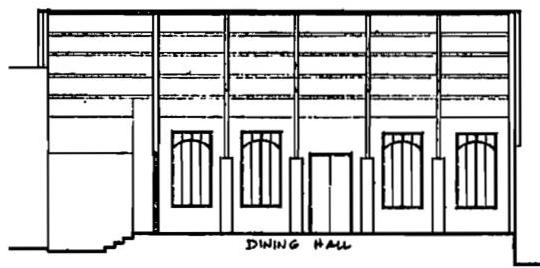
- Overall outline of the truss envelope.
The next thing we did was to get a sense of the most desirable overall shape for the truss, that is, the envelope for the truss along its lower boundary, not including internal structural members. We were concerned here with the effect of the truss on the space and feeling of the dining hall. In order to study it, we first made a series of sketches of possible shapes.
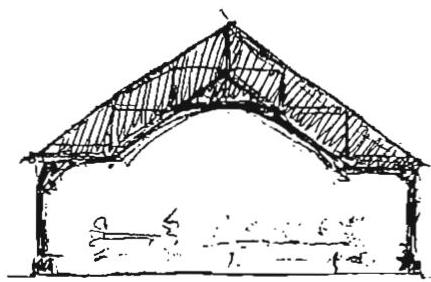
From these drawings alone, it was difficult to find out which shape was best. It was almost impossible to tell what effect the different truss shapes would have on the three-dimensional space of the interior. One couldn't foresee clearly to what extent the under side of the trusses, spaced ten feet apart, would create a "ceiling" with the right feeling.
Since the three-dimensional effect was going to be the main thing one would experience in the building, we decided to make simple paper models and to compare them directly.
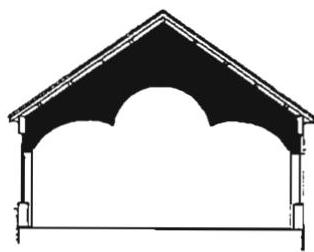
We made paper models of thirteen different shapes. The variables in these models was the perimeter of the truss underside: that part which would later form the virtual "ceiling." We included versions with a flat chord, a single arch, three equal arches, a large arch with two smaller half arches on either side. In each case, we had a full sequence of six truss outlines made of paper by xeroxing and cutting with scissors, over the base model of the hall itself.
When we had them, Gary and I sat in the basement and held them up to our eyes, one by one, independently comparing them. We classified them as beautiful in feeling, so-so, and no good. Only three of them were in the top group for both of us. Of these, after several days of careful thought, we finally chose the one which consistently seemed to score highest on the mirror test: a main arch with two half arches.
5. First sketch of tracery.
We wanted to see next, what it would be like looking "through" the tracery of an open lattice
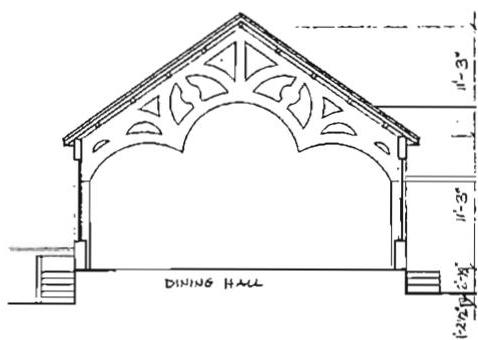
truss, and if this would help us choose which one had the best shape.
At my request, Gary made a rough sketch of curved tracery, following a conventional triangulated format, with curved members, and we made a model with holes cut in the trusses to see the effect of tracery. Although we didn't like the
tracery yet, it gave us enough confidence so that we did fix the lower chord, and its three-arched truss envelope as the final shape of the one we were going to keep.
We knew that its interior tracery was not beautiful yet, and I knew it was far from acceptable for the project — especially judging it on the mirror-of-the-self criterion. However, by this
stage, we had in principle consolidated our decision to try and make a truss with beautiful geometrical tracery, using curved members, and not obviously based on simple truss design. From this point of view, the free form of the first curved tracery was something to start with, even though it was not beautiful. As it turned out, it was not well-behaved structurally either.
9 / GOING ON WITH THE UNFOLDING PROCESS FOR THE TRUSS: FINITE ELEMENT ANALYSIS
6. First finite element model.
Of course we had no idea whether this first tracery would be well-behaved structurally. We therefore made a first finite element model to find out how the forces went. We could immediately see some very bad behavior. The forces were several times over limits in several places, huge shears at the base, and moments too big in some of the curves.
7. First scissors truss.
At this stage I decided to go back to structural behavior, and started by trying to define the most efficient truss which was consistent with the three arch profile we had chosen.
It seemed to me most likely that the arches could be made to work by placing a tension member in the position typical in a classic scissors truss. I sketched this out in rough, and one of our apprentices built a miniature one in concrete, one inch thick, with a span of 3 feet. It was not appealing. The apparent simplicity of the structural lines, when given width, made a mishmash of shapes which was inconsistent, geometrically, with the beauty of the three-arch form. (Two minor points about its ugliness: The sharp points where the arches meet, and its lack of three-dimensional relief—like a slab of chocolate. These problems were solved later.)
I then decided, myself, to test a series of computer models, in rapid succession, and
started an intensive ten-day session of uninterrupted computer work, to try and find a solution which was both beautiful and structurally efficient.
8. Second scissors truss.
In spite of the ugliness of the first scissors truss, I did not give it up right away. Before going ahead, I still wanted to find out what kind of
truss would be structurally efficient for the three-arch envelope we had chosen for the truss. Since the first scissors truss was ugly geometrically, I did not even take time to test it in the computer, and instead decided to try sketching a second scissors truss, and ran a finite-element model to determine its behavior.
I drew what seemed like a perfect triangulation of the curvilinear shape above the three-arch bottom chord (see drawing above). In this drawing, I tried to make all the triangles as neat and similar as possible with good angles, and
each triangle being as near a 60–60–60 triangle as possible, in a way that was consistent with the overall geometry.
Since this model was only for finite element analysis, I kept it as a pure structure of nodes and thin straight lines representing members.
This truss had beautiful structural behavior. Bending moments were low, shears were low. Everything was acting well within its capacity.
9. Thick version of scissors truss.
From a structural point of view, Gary and I were both pleased with the behavior of the efficient truss. The line drawing of the truss looked very nice, so we thought it had excellent promise. It also looked as if there were a good cooperation between its geometric features and its structural features.
When you use nicely shaped triangles, the triangles naturally get smaller where the area of the truss gets tighter over the side arches. This has the feature that where the triangles get
smaller towards the bottom, the shorter members and tighter mesh correspond to the zone with the biggest flow of forces. The arch members thus force a geometry which helps the structure in a natural way. Intuitively, it looked very promising.
But the truss had a very disappointing problem. When I started giving the members real dimension in the computer model, the spindly beauty of the theoretical truss turned into an ugly and squat kind of shape. The truss was beautiful when its members were very thin, but became awkward and ugly when you made each
of the members 6 or 9 inches wide as they would be in reality.
10. Rising-sun truss.
To improve the thick-scissors truss I tried to intensify the centers. This began to make something that had form and being, but it certainly still wasn't beautiful. On the mirror of the self test it was also still poor, indeed so far from the mark that I didn't even run a finite element analysis of it. It didn't seem worth the trouble.
11. Re-evaluation of behavior.
At this stage Gary and I spent some time trying to understand the good behavior of the scissors truss in more detail. We read the output from the finite element analysis very carefully, poring over the tension, compression, bending and shear in every member.
One of the most surprising results of this work, was that we had apparently quite misunderstood the action of the so-called scissors truss. I had assumed that the key feature of the scissors truss was the tension force going in a long diagonal line tangent to the arches. With the three-arch form there could be no tension chord going across the bottom (as in a normal truss) but, somehow, the tension needed to resist the spreading of the roof still had to get taken care of. I had assumed that the scissors tension member tangent to the arches, was the most obvious way to do it. Of course, on this theory this tension member had to be straight line, and I assumed that it had been the lack of this straight line which had made the first curved truss behave badly.
However, when we looked carefully at the distribution of forces in the efficient truss (which
included this straight line) it turned out that there was almost no tension being carried along this line! We had completely misunderstood the reason why the good truss was well-behaved.
What was actually happening was this: The bottom chord (the three-arched line) was acting in tension and bending. The top chord was acting in compression and bending. The members in between were alternating in compression and tension. In short, the truss was acting very much like a classic triangulated truss with tension in the bottom chord, but with the additional feature of bending in the bottom chord members to allow the tension to go round the curves. The major tension was not going above the arches and tangent to them, even though the straight line in the members gave an opportunity for it. It was going around the arch itself.
At this stage, it seemed as though the original idea of a floral truss ought to work after all. What we now knew, that we hadn't known before, was that the top and bottom members were doing most of the work anyway.
- Thick and thin members in the truss.
Our understanding of the fact that the main flow of forces is in the top and bottom, coincided with a physical problem which had been bothering us for some time. Ever since the first concrete model, the flatness of the truss had been bothering me; we had been talking about needing two levels of thickness to create three-dimensional modelling in the surface of the truss.
We decided that from now on, we would use thick members for top and bottom, and thinner members for the struts between. As a result, the hierarchy of scales in the truss became more beautiful, and the truss became more personal feeling more "mirror-of-the-self"-like.
- Knobs at the meeting of the arches.
One of the defects visible in the earliest truss drawings was the pair of strange-looking sharp points at the spots where the half-arches met the main arch. These points made little sense structurally since they created a potential danger of stress concentrations.
We may also see the same problem in deeper geometric terms by looking at the centers which the arches create. In order to intensify the centers formed by the arches, the points where the two arches meet must also become centers. To do this in one of my earlier sketches there had been a pair of sort of lamp-like ornaments hanging from these two points. I now introduced two circular knobs of concrete at the meeting point of the arches, and these became a permanent part of the truss design. In the following sketches, we see various forms of these knobs, and see how one in particular has the greatest ability to be a picture of the self.
- First plant-like truss.
In line with this new understanding we had gained, I now began drawing a truss in which the top and bottom chords played the main role, and in which the in-between stuff was act-
ing as a kind of stitching, just to hang them together.
With the amount of understanding of the forces that I had from the earlier finite-element models, I now drew the nearest thing I could to a perfect system of centers that described the forces correctly. The two levels of thickness are visible in the drawing. This drawing, with its system of radiating curves, seems, for the first time, truly to enhance the wholeness of the three-arched truss shape.
- Finite-element model of the first plant-like truss.
In the next model I introduced different member sizes into the finite element model, since the
differentiations of size had, by now, become an important part of the feeling of the design. Even the relative thicknesses of the top chord (4 inches by 9.5 inches) and the bottom chord (4 inches by 15 inches) compared with the inner members (averaging 3 inches by 5.5 inches) was significant.
These members have roughly the following capacities:
Top chord (4 by 9.5) has 152,000 inch lbs. max bending, and 3,344 lbs. max shear.
Bottom chord (4 by 15) has 346,000 inch lbs. max bending, and 5,280 lbs. max shear.
Middle struts (3 by 5.5) have 47,000 inch lbs. max bending, and 1,452 lbs. max shear.
The finite element analysis showed generally good behavior, well within these limits, except for three problem areas. (a). A shear force of 7,400 lbs. in the top chord members near the peak (twice what the section could bear). (b). High shears in the arch where the tension comes in from above (4-8,000 lbs. — more than twice what the section could bear). (c). High shear in the vertical edge member caused by tension and compression twisting it (8000 lbs. — twice what that member could bear).
- Keeping the split stems in the middle.
The 7,400 lbs. shear near the peak was caused by the fact that the pair of split tension members fails to resolve the compression at the peak. It would have been easy to solve this problem by making a single central tension strut as is typical in most trusses.
However, this change would have destroyed the beauty of the truss. While I was working on it I happened to discuss it with my students, and
told them that I would refuse to make this change, even though it seemed obvious, because it would make the field of centers worse. I had an instinct, somehow, that the design of the truss, as drawn, with the split middle had a field of centers — and a resultant structural meaning — more subtle than that revealed by the finite element analysis. As it turned out later, this hunch was right.
- Trying more members.
To get rid of the three shear problems I decided to try making the truss more like an ordinary truss by placing additional triangulated members to complete the rectangles. This change did slightly improve the behavior at the edge, but shear problems at the peak and main arch remained. In any case, once again, the subtle beauty and harmony of the truss got worse, not better, so we decided not to make these changes.
- Reducing shear at the apex.
In order to reduce the shear at the top, I tried tying back the peak to the two tension struts, with a pure tension member. This didn't work. Most of the tension still went the other route, leaving shears almost as high as before. To solve it, we tried tying them back with another triangle, making a beautiful lily-like shape in the tracery near the peak.
This worked. The shear went down to 5,000 lbs. But now the bending moment in the peak became very high indeed, 114,000 inch lbs. To improve the situation we inserted another member going across horizontally, thinking this might work as a minor tension chord to hold the peak together, and so reduce bending at the

peak. Oddly enough, it did work, but for quite different reasons. Under analysis it turned out to be in compression, which prevented creation of internal torques through the curved tension member and reduced bending and shear through the upper portion of the truss. To make the compression member intensify the field of centers, instead of spoiling it, I had to make it beautiful inside the lily. I tried making it like a shield shape or a dot. In the end a diamond-shaped piece turned to be best of all. It leaves the lily structure unspoiled.
19. Reducing shear at the bearing points.
We made a similar series of changes to reduce shear on the side members. In this case, the crux of the problem was to lead the tension in the arch directly to node #3 so as to resolve the compression coming down the top chord. As we see in the following drawing, this change improves the field of centers in the geometry.
20. Relaxing the tension arch.
Finally, at this stage we made a major breakthrough, almost by accident. In playing with various minor changes, we had begun to notice that the behavior of the truss was very susceptible to rather minor changes in the relative stiffness of different members.
During discussion of this point, I became very worried about the interpretation of the finite element model. In the model we had been assuming these various members were concrete, but in reality, a given concrete member, when in tension, will only realize the tension of its steel reinforcing bars, not of the concrete. This means that the stiffness which the members really have
will be that defined by the configuration of the reinforcing bars, not that defined by the concrete. But the stiffness of the members considered as a configuration of rebars is often less than 20% of the stiffness of the full concrete section. There was a possibility, then, that the overall behavior of the truss might change drastically for the worse if we made this replacement, or might even collapse entirely. To check this worrying point Gary and I decided to try a finite element analysis in which all tension members would be given their steel stiffness, not the concrete stiffness.
The results of this analysis were fascinating. Instead of getting worse the behavior became better. All the shears in the top of the main arch went down to within acceptable limits. Better still the bending moments in the top chords also went down. And finally we noticed one more
thing. In this modified truss the forces in several struts changed from compression to tension.
We now realized that as a whole the modified truss was working in an entirely unexpected way. The arch and struts were all together, working as a kind of tension network which resists the spreading of the rafter beams.
This was a highly unusual design, previously unknown to either of us. The three-arch arrangement which originally arose in response to the spatial configuration of the dining hall had finally been resolved in a form where this particular shape draws its structural strength from a novel way of working through a tension network arch. The oddity of the original configuration, caused by centers in the dining hall, had become a virtue in an entirely new structural design.
10 / EACH STEP USES THE FUNDAMENTAL PROCESS TO UNFOLD AN EARLIER WHOLENESS
At first sight, the various steps we took in the design of the San Jose truss seem very different from one another. In one step, to get the spacing of the trusses, we were looking at the windows to see if they have a beautiful shape. In another step we were looking at the distribution of tension and compression in the truss itself. In another we were concentrating on the shear force at three critical spots. In another, we were looking only at the beauty of the centers in the truss, to make
it beautiful. In another we were looking at the thickness of the truss from the point of view of the steel bars crossing each other. In another, we were trying to find out how to make the formwork give us an offset between the inner members and the big members.
However, every single one of these steps, when interpreted correctly, was a structure-preserving transformation. And indeed, each of these structure preserving transformations was
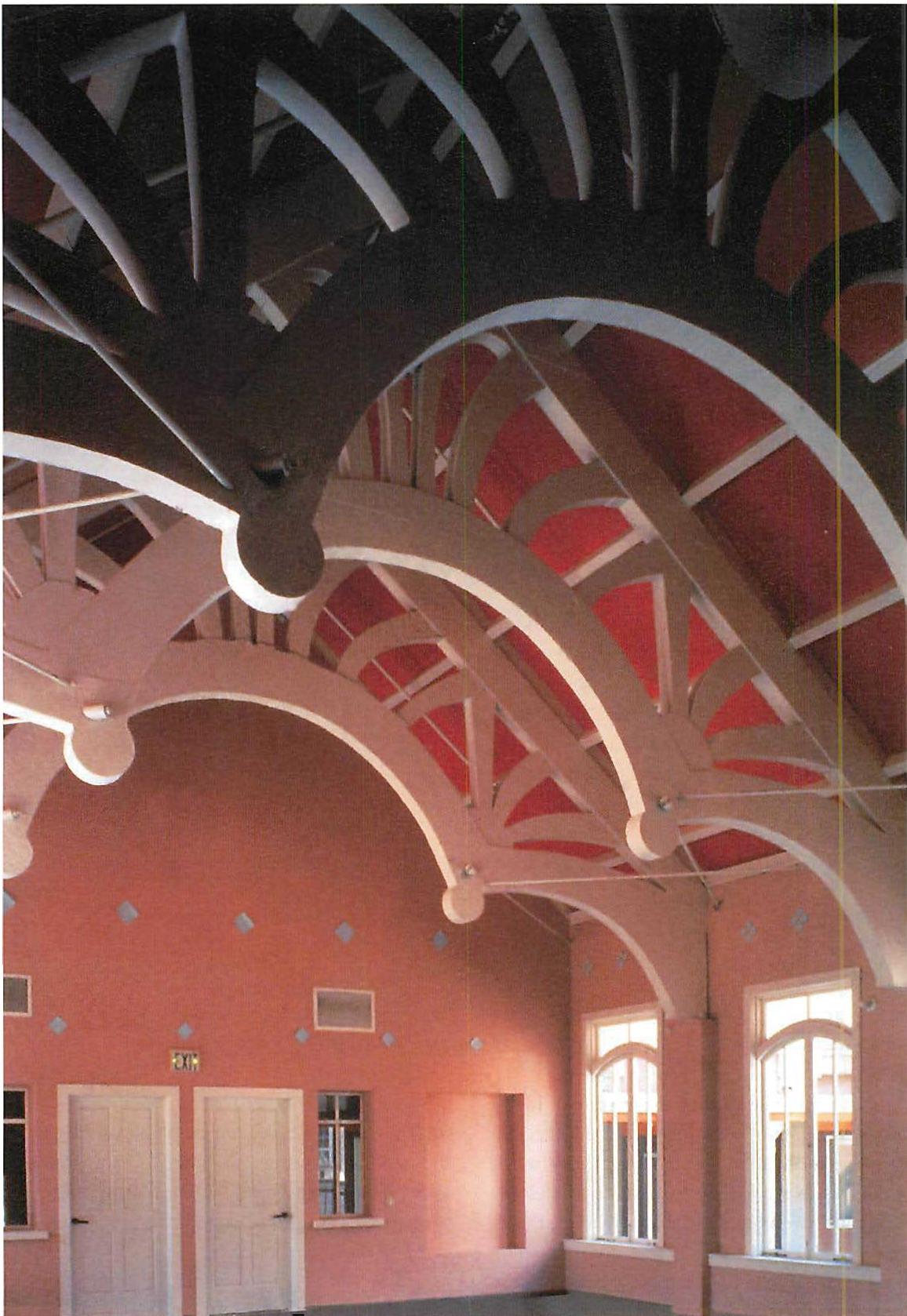
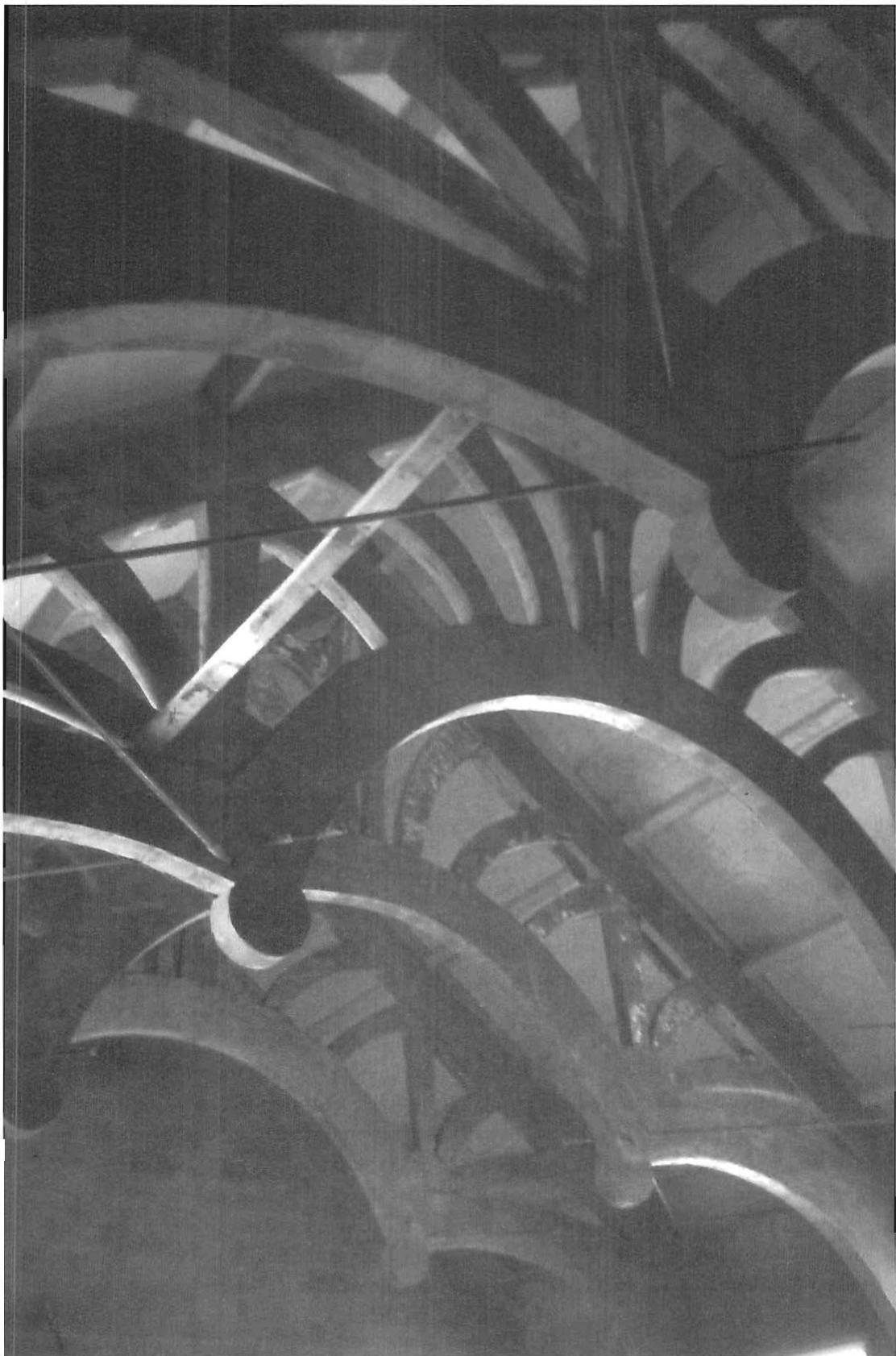
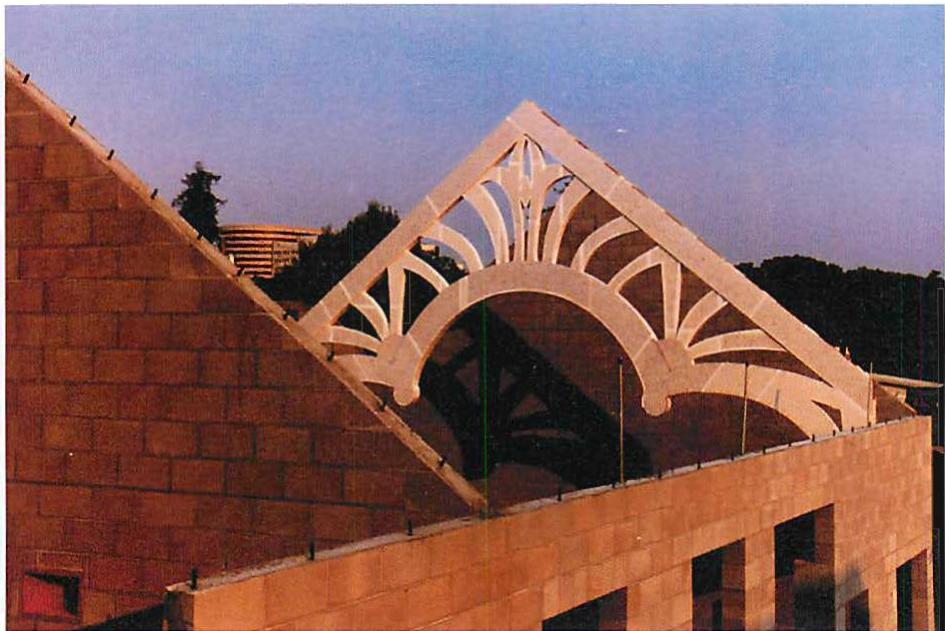
guided by one or another of the fifteen transformations described in Book 2 (especially chapters 2 and 7). Let me give a few examples.
Going from step 3 → 4 we used ECHOES (reflecting the curved shape of the windows in the arch forms of the truss).
Going from 4 → 5 we used LEVELS OF SCALE, GOOD SHAPE AND LOCAL SYMMETRIES.
Going from 8 → 9 we used GOOD SHAPE.
Going from 9 → 10, we used a simplifying process (INNER CALM) with strengthening of CENTERS.
Going from 12 → 13 we used STRONG CENTERS and GOOD SHAPE to form the knobs.
Going from 13 → 14 we used STRONG CENTERS and POSITIVE SPACE in the spaces between members to obtain the arrangement of plant like members going out at right angles to the curves of the arches.
Going from 17 → 18 we used LOCAL SYMMETRIES, GOOD SHAPE to form the lily configuration.
Going from 18 → 19 we used POSITIVE SPACE.
Going from 19 → 20 we used ALTERNATING REPETITION.
Regardless of the particular structure-preserving transformation used, every step is some kind of structure-preserving transformation. Thus, each step uses the fundamental process, repeatedly. Instead of seeing twenty different steps in the process of designing this truss we may, more correctly, see twenty applications of the same step, over and over again.
At each step, progress is made using the transformations to intensify the field of centers reached previously. When the transformations alone were insufficient to guide me, I used the mirror-of-the-self as a more subtle criterion. Of course, the whole process was guided by practical analysis of structural forces. But even the forces themselves are seen as centers, and the process of elaborating and intensifying the field of centers was used to channel and redirect the forces themselves.
In some cases, it took a lot of effort, and trial and error, to find out which differentiation would do most to preserve the field and its centers. Various possibilities had to be examined
and compared. But after hard work at each step it became possible to find out which of the alternatives that could be imagined preserved the wholeness most.
It is perhaps important to emphasize the novelty of the trusses which emerged from this process. In Book 2, I have stated that the fundamental process will produce a unique thing each time that it is used. This may be seen dramatically in the present case. Trusses had never before been built by this technique: They were shot with gunite, in the air. But what is more interesting is that this truss was completely new as a structural configuration—hence as a piece of engineering. A two-dimensional truss in which the tension, compression and bending are distributed in the bootstrap basket fashion we reached in this truss, was a completely new idea. It did not emerge from the intention or desire for a new idea. It followed just from the fact that the latent centers which existed in the wholeness of this emerging
truss design were continuously respected and developed, step by step, while we watched what happened. Thus, what sounds like a conservative, dull process actually led to startling innovations.
The floral plant-like truss which came from this process followed naturally from the unfolding process. Yet it had never been seen before. Of course, two different individuals or groups, faced with the same problem, and taking the same steps, will not get the same result. Even if they find their way to one of the best half-dozen structure-preserving steps at each stage in the process, they will not choose the same ones, and the evolving designs will certainly diverge, in some cases dramatically, after only a few steps. So, of course, different engineers and architects will rarely go in the same direction. As a result, we get unique and beautiful works.
In our case the truss, its concrete, its shape, has a raw, gray, massive energy.
11 / APPROPRIATE STRUCTURAL ORDER FOR A LARGE APARTMENT BUILDING
We are committed to making each place, each room, window, floor, unique within the whole, according to its needs. How is this to be done in a large building?
Nearly all very large buildings are built with the assumption that each floor is structurally identical, and that the upper floors mirror, exactly, lower floors. Plan variation is usually achieved by arranging lightweight non-bearing partitions within the uniform structural grid.
In most 20th-century buildings such perfect floor-to-floor repetition was a fundamental feature of the design, and without this feature most 20th-century large building designs would not work structurally. In addition, the repetition lowers the cost of contract administration. But most important is the fact that it creates a
workable structural design. The columns, beams and shear walls have vertical continuity thus making a well-behaved structure.
But exact repetition does fly in the face of the fundamental principle of unfolding. It requires that each part of a structure become that which is unique and appropriate to its position in the unfolding whole.
If we look for a new kind of large building, in which there is greater freedom from such floor-by-floor constraints, we are then virtually looking for a new order-type, a new kind of structural design which will permit each part of the building to fulfill its own nature, have its own appropriate character, without placing impossible demands on the structural design.
My colleagues and I worked out an example
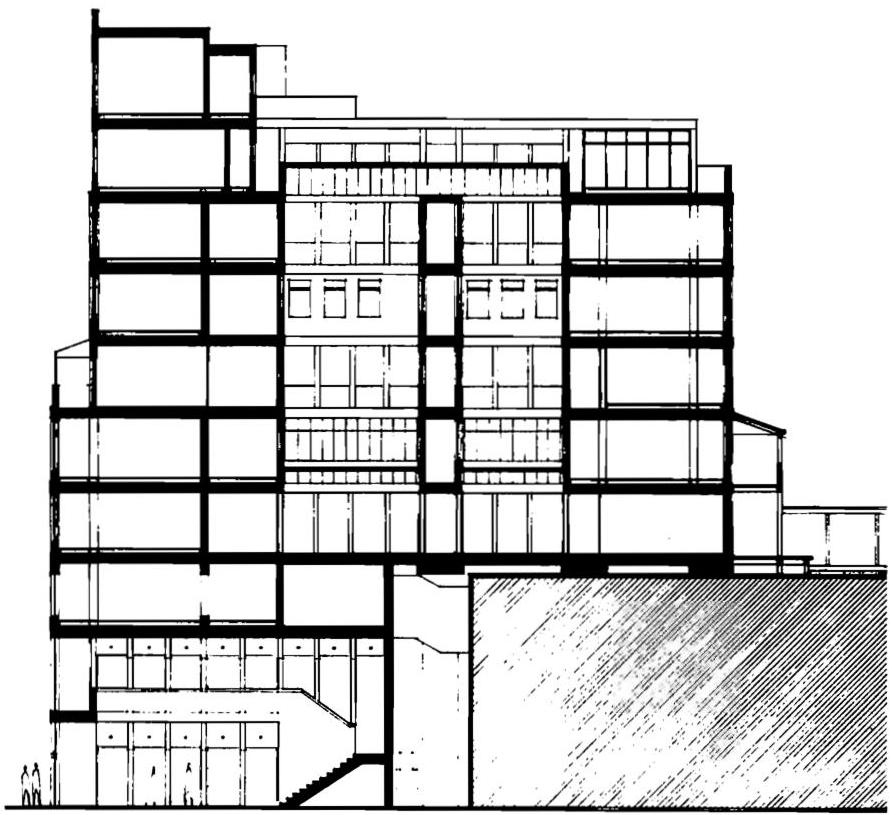
of such a larger-scale sophisticated order type, in the case of the Sapporo building: a 10-story apartment building for the northern island of Japan. In this design the load is carried by a system of 13 structural column-groups, each one itself a cage composed of four smaller columns.
All the major features of this innovative structural scheme arose from the careful unfolding of the design with respect to user requirements, the impact of surrounding buildings, coupled with the peculiar fact that there was an untouchable small clinic on the site which had to be kept intact and therefore straddled, created a series of conditions requiring ten different plans at each of the ten floors.
For example, spanning over the clinic required massive legs to support the back of the building, and a smaller plan dimension for the first three floors. The users required two floors of shops and offices in front. Attention paid to the users' needs suggested a strong need to build gar
dens or balconies at different floors, thus creating a modest (but not absurd) stepping back and releasing balconies at the 9th and 10th floors, together with a roof terrace on the 4th floor.
The demands of the street imposed a rather regular rectangular facade: with some stepping back towards the upper floors, for light and air, generated by the planning code for Sapporo.
There were also some difficulties of internal circulation, created in passing from the 4th to the 5th floor, and the access to the roof terrace at the back of the building, thus further modifying successive floors inside the building. The need for interior daylight, further imposed by size and lack of light from the perimeter, suggested construction of a central light well in the upper floors, doubling as a major source of movement.
The progressive changes from floor to floor, the progression from ground to roof, and the variations—many of them inevitable, arising from the changes in plan—are visible in the ten
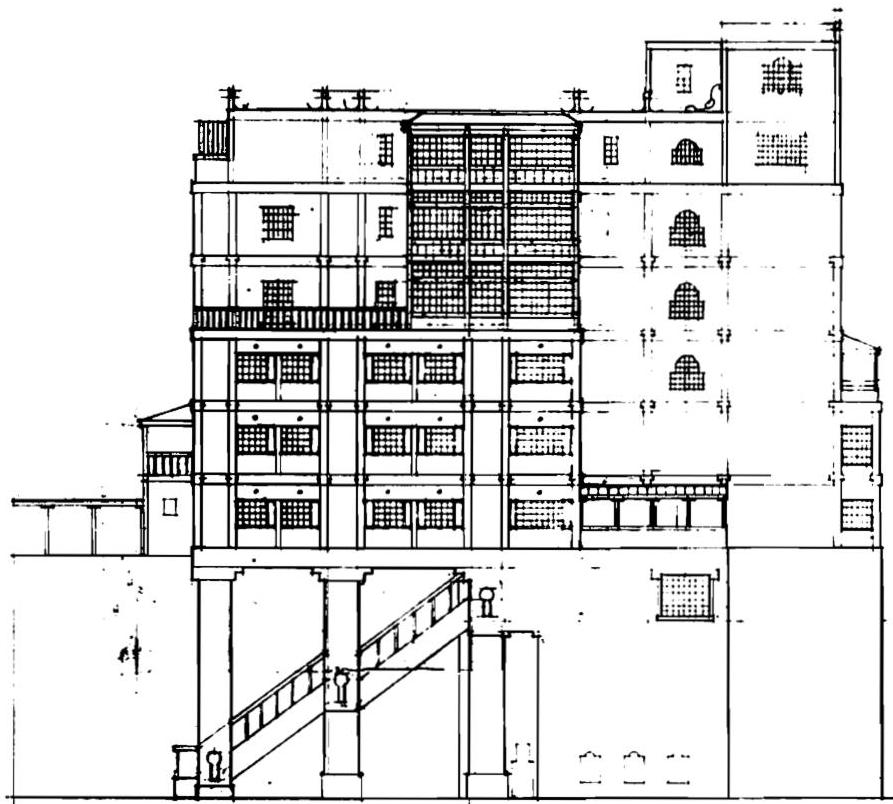
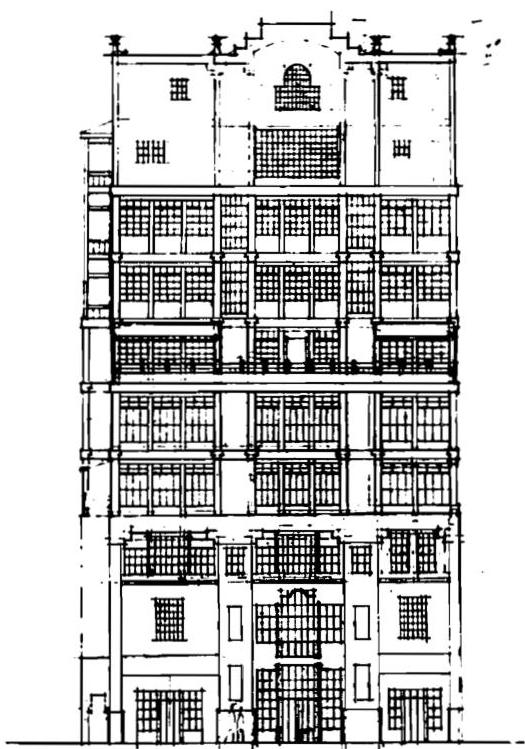
floor plans shown on these pages.
In order to make a good and coherent building, with these substantial floor-to-floor variations, we then had to invent a structure which would keep the structure coherent with the social spaces, and could accommodate the variations, without sacrificing structural continuity of columns and shear planes. Yet for reasons that are explained more fully in Book 2, chapter 15, on pages 412–16, we decided from the outset that the structure must be a true coherent structure where the material of beams, columns and walls, coincide with the architectural and social space required for the apartments and passages and rooms.
The aperiodic grid with large bays and small bays solved the problem. It came, originally, from the observation that each apartment would greatly benefit from the classic Japanese gallery, often found at the garden face of a traditional building. This kind of space, usually 3 feet (one tatami) or 4 feet wide, also coincided with the possibility of stairs and passages occurring within the grid.
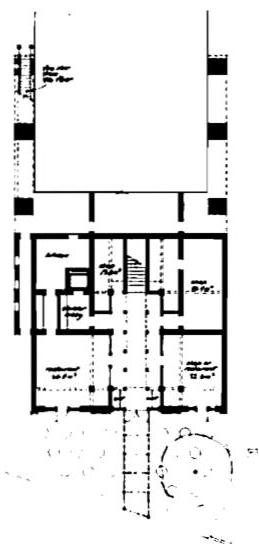
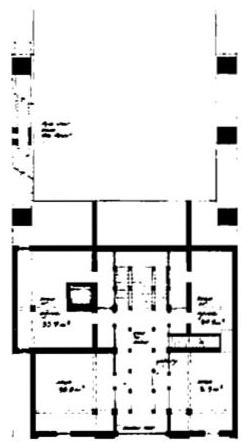
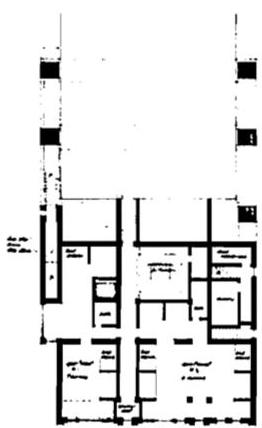
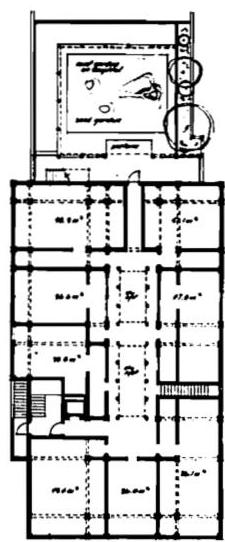
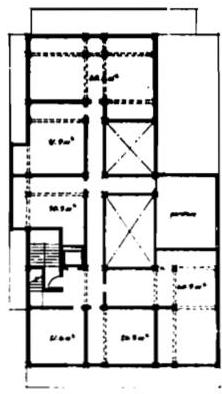
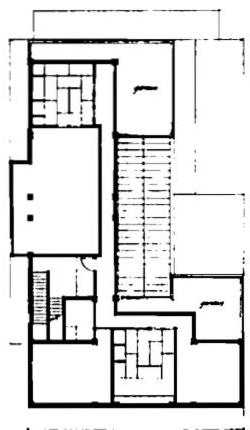
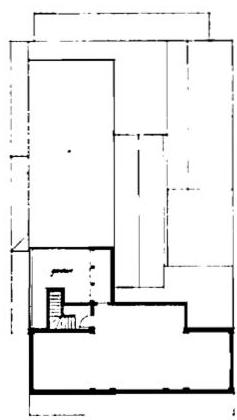
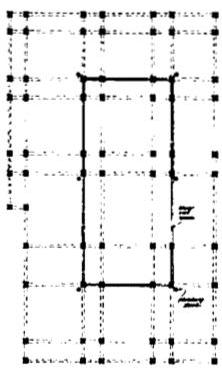
If the reader examines each of the floor plans, with respect to the underlying structural grid, it may be seen how each floor fits the same grid, but in a different way at each floor.
This building, designed to work in bending as a moment-resisting frame, with supplementary action from shear walls at the lower floors, allowed the plans to change freely from floor to floor, and allowed us to a plan a 10-story building
in which every one of the ten floors is different—yet all tied together, unified, and resolved structurally, by the continuity of the 13 clusters of 4 columns that pass through each plan in the same positions.
This example gives a hint of future structures in which similar syncopated structural arrays can make possible an underlying organic structural order in large buildings.
12 / MORPHOLOGICAL INVARIANTS THAT ARE LIKELY TO APPEAR IN AN ENGINEERING STRUCTURE GENERATED BY LIVING PROCESS
A building is an arrangement of several thousands of tons of concrete, stone, brick, steel and glass, with smaller amounts of other materials thrown in. The pattern of this solid matter, as it is distributed in space, is rarely mentioned. Yet it is this pattern of solid and void, in three dimensions, which governs everything of importance in a building, everything substantial.
When living processes guide the formation of a building structure, these are the features which will settle out. The relation of mass to space: Each is positive to the other: the spaces will be formed as good shapes by the material, and the material will be formed as good shapes by the space. The creation of the two interleaved patterns, one of matter, one of space, each coherent in its own right, the material coherent according to its structural laws, the space coherent according to human laws, when successful becomes a triumph of imagination, a kind of fugue in space.
Generally it does not work when the members are too thin, because that has a destructive effect on the space. So the centers of the material have to be made rather big and rather solid—and that usually means they must be far apart. Yet to form significant human space they have to be close together, to form the spaces themselves. The creation of a meaningful structure lies in the resolution of these opposites.
It is extraordinary how the pure pattern of space, substance, and volume, when conceived as a structure of centers in abstract geometric terms, without detailed analysis of forces, so naturally becomes a coherent engineering structure. The fundamental process, because of the geometric structure it induces, helps to create a beautiful and living engineering structure.
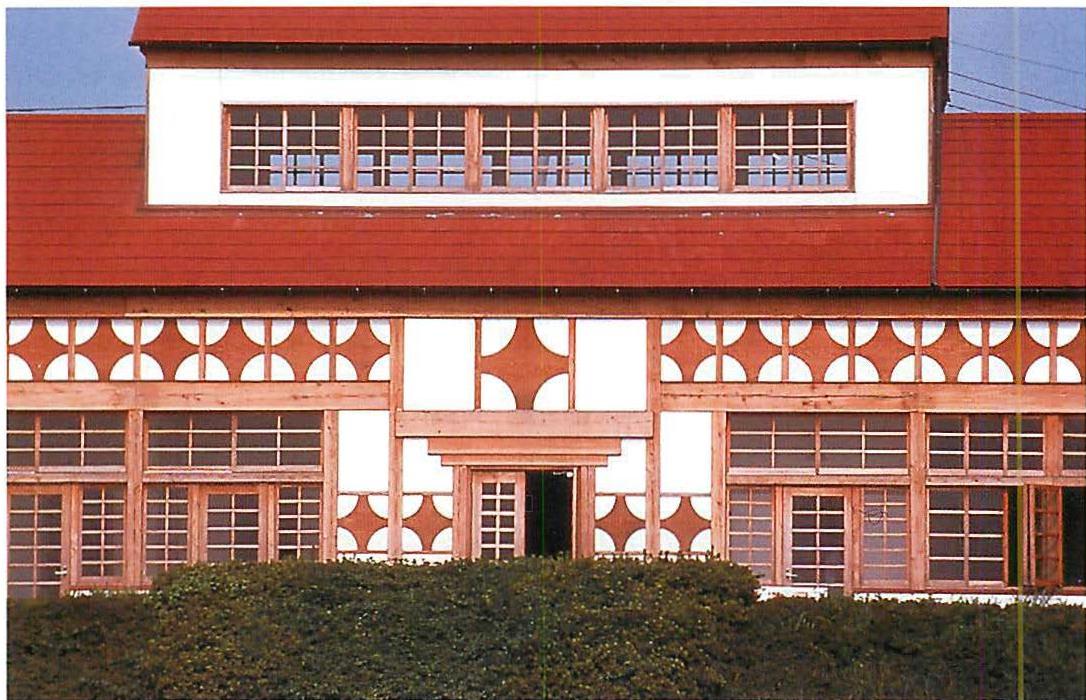
What effect does the pattern of three-dimensional solid and void have on human life? It is only when surrounded, all around, by such living structure that we begin to feel ourselves whole. The reason why one feels sanctified in Chartres is that this structure around us, together with the space, are perfectly as one and thus relate themselves not only to the body, but even to the soul. Without this structural pattern, it is nearly impossible for deep living structure in a building to occur.
NOTES
In recent years all this has been considered unimportant. Buildings of the 20th century were often made to stand structurally by whatever means are possible, and the space within the building was then cked out for human use, from the left-over space.
See illustrations and discussion of structural design in James Johnson Sweeney and Jose Luis Sert, ANTONIO GAUDI (London: Architectural Press, 1960).
The interior of the main space is about 35 feet high. At the time we started we did not know how high it was going to be, only knew that it would end up between 25 and 50 feet high.
One of the most important pioneers in the development of finite element models was Professor Ed Wilson, Department of Engineering, University of California, Berkeley. Our own finite-element work was almost all done on Professor Wilson's published SAP programs, SAP-90 and so on, and benefited greatly from Professor Wilson's help.
My student and colleague, Gary Black, extended the technique and later made it into a teaching tool. See JOURNAL OF ARCHITECTURAL EDUCATION, 1995.
Gary, who provided engineering and technical assistance in the evolution of the curvilinear plant truss, gives an inaccurate account of the process I followed in "Design of Concrete Tracery Trusses to Define Architectural Space," JOURNAL OF ARCHITECTURAL ENGINEERING (1995, vol. 1, no. 1), 9-17.
For the principle that structure should create the social spaces in a building — hence be congruent with them, not independent — see A PATTERN LANGUAGE, STRUCTURE FOLLOWS SOCIAL SPACES, pages 940-45.
CHAPTER SEVEN: HOW LIVING PROCESS GENERATES THE CHARACTER OF GARDENS
1 / THE PARTIAL, BUILT SHELL THAT LETS A GARDEN GROW
What is the effect of living process, used repeatedly, to shape exterior space? What kind of gardens may we expect to find in a living world?
Whether in public gardens, or in private gardens, the quality of exterior space which comes from living process has a particular and definable morphology. It is visible — for example — in this photograph of the bank of the Danube, at Esztergom in Hungary. Simple, and nearly crude, only the essentials are present. Nature dominates, but within a structure roughly made, by geometric centers of construction — concrete, stone — which supply the infrastructure that allows the plants, trees, bushes, water, to find their place.
That is the essence of all gardens and all agriculture: that built materials, human-made structures create a setting in which people, animals and plants can thrive. It is the geo netry of these built structures, which, like the shell of a mollusc, makes the growing of the garden, and its resulting richness, possible.
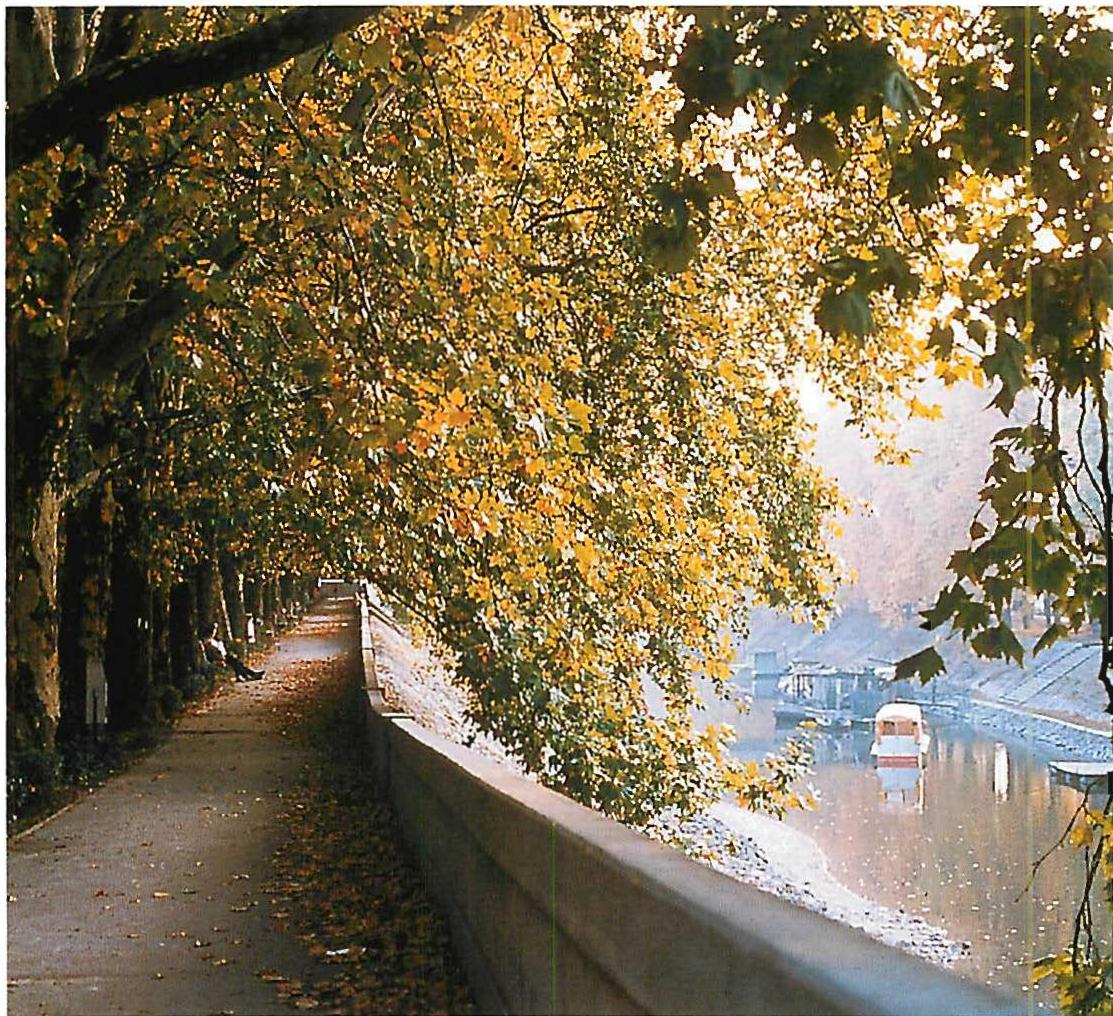
2 / A SEQUENCE OF ADAPTIVE ACTS
How does such a structure come into being? Look on page 232, at the garden where my friend and client Hisae Hosoi is walking. How did this garden get formed? Years ago, when I first saw the site, long before making a design for the campus, in the middle of the farmer's land, with vegetables and tea bushes, there stood a Kiri tree, a rare and old tree, with the most beautiful large purple flowers.
It was the most beautiful tree, the most beautiful thing on the site. From very early on I took that spot seriously; it was a major center in the land and became a major center in my thinking. It was reflected, later, as a crossing of four paths in the faculty gardens (See plan, page 232).
I urged Hosoi, during the land negotiation, on no account to let anyone touch that tree, to make sure it was preserved when the land parcels were assembled for the new campus. The school's realtor haggled with the farmers. Months went by.
One morning, long after we had made the campus plan, the school had bought the land, the tea bushes and vegetables still there — I went to the site. There was a vacuum there. I couldn't make out what was missing. I looked out over the fields, searching for what was wrong. Then suddenly I realized the Kiri tree was gone. I went to the place. There was nothing, nothing, not even a stump. Just a few handfuls of sawdust left in the mud.
I was in shock as if my legs had been cut. I went to Hosoi and found out that in Japan, a tree standing on a land is not — when considered as legal property — part of the land. When the land is bought, the tree is not bought, unless it
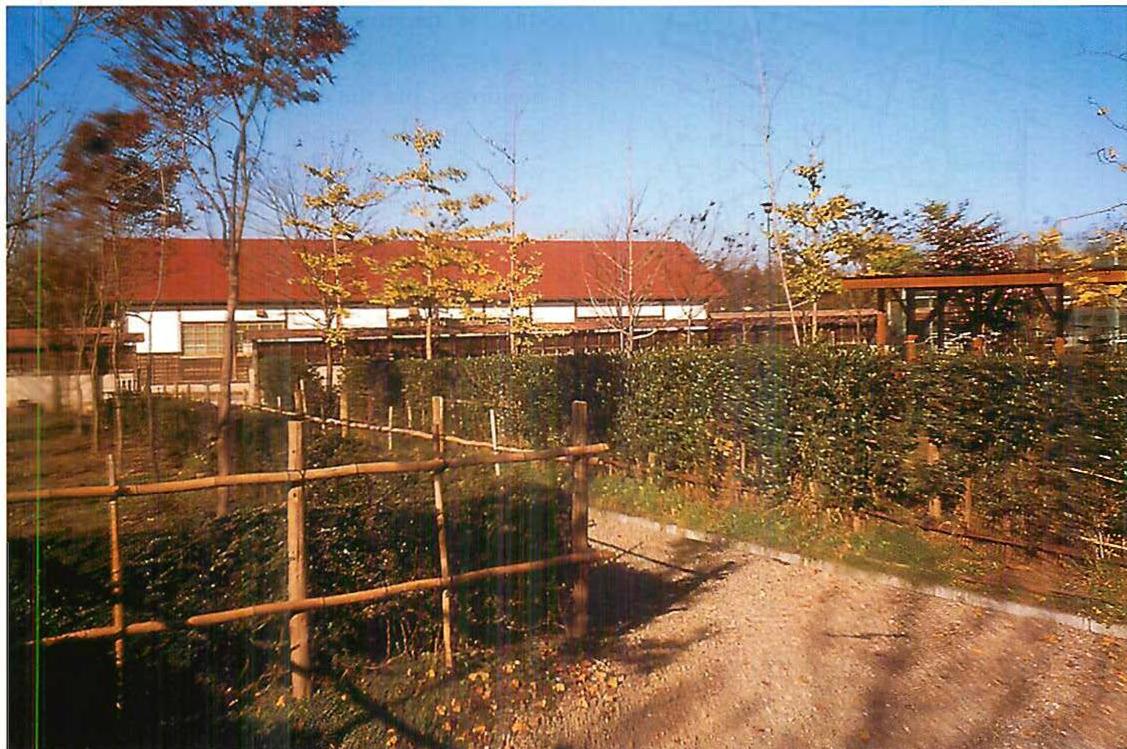
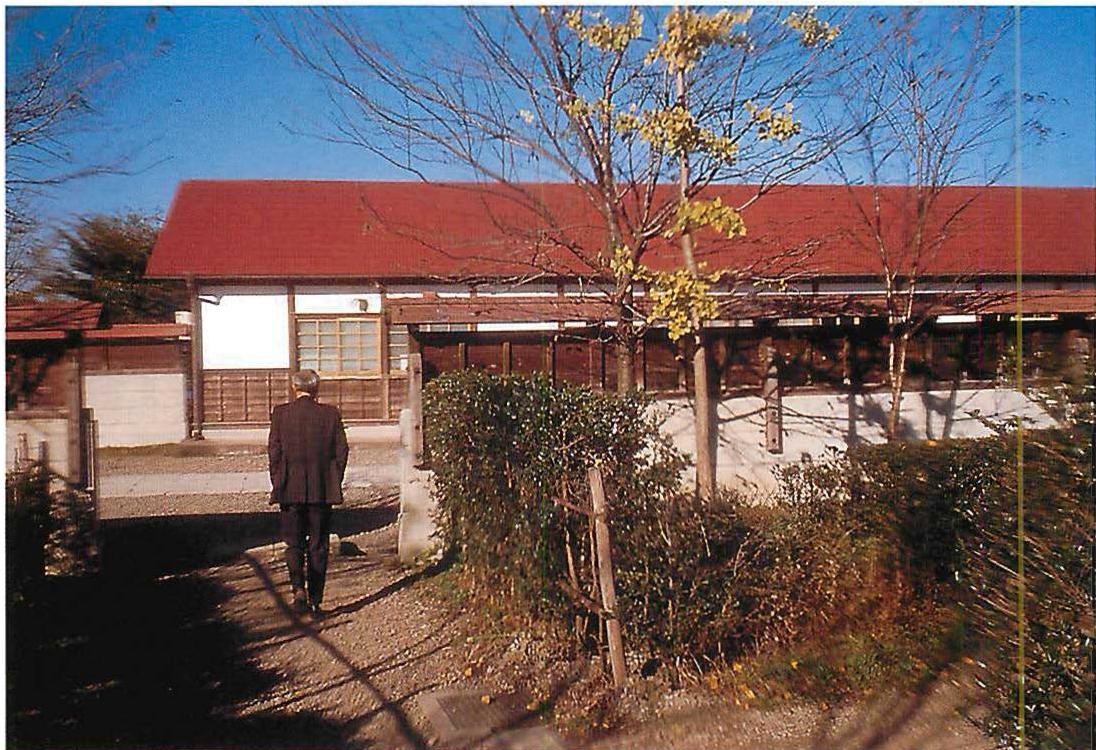
is paid for separately. A Kiri tree has valuable, and much-prized wood. The school had not paid. The farmers had cut it down.
So I had to forget the tree and the centers it created in the plan. But by now, it was too late for me to forget the Kiri tree altogether. The trace of the tree was there in the position of the four gardens, the space, the location of the buildings, and the crossing of the paths. So the buildings, determined by the special center where the Kiri tree once had stood, were going to be built anyway. Some of the tea-bushes stayed as I directed, and the faculty garden stayed there, also where the Kiri tree had been. Fences were made, to mark the paths, where once the Kiri tree had stood.
What you see on this page, in the photograph, is Hosoi walking on one of those four paths. You see here the trace of a sequence of unfolding and structure-preserving transformations, even under painful circumstances. One thing had led to another. First the tree. Then the garden located. Then the buildings located. Then the tree cut down. Then the paths still oriented, even now, towards the place where once the tree had been.
... Then the rough fences, built to enclose the paths. ... and now Hosoi is walking there.
3 / THUS THE LIVING ASPECT OF GARDENS COMES ABOUT, NECESSARILY, AS A RESULT OF UNFOLDING IN TIME
If the fundamental process is working, a garden becomes a trace of the history of the land. We try to erect structure. The structure comes from the land. Part of the story may then be forgotten. But the unfolding goes on. Another trace is made. It continues to unfold day by day and year by year.
The form of the garden, and its living structure, come from that progressive unfolding—the position of one plant continuing and unfolding from the earlier growth of another. This living structure in a garden is very different from the kind of structure typically created by zothcentury landscape design or landscape architecture. It is a kind of wildness which exists in a semi-cultivated form, backed by built material, helped by structures that entice natural life into existence. It is a state of the world in which what happens is always, and continually, in contact with what is.
The plums dropping from the trees onto the paving stones, the plums rotting, swept away by water or eaten by birds. The path, a pleasant place for people to wander, to think, arm in arm.
How different this is from the developer's commercial "paradise." The clean paving stones, the perfectly manicured place, which will keep people's confidence up as they spend money; the place which never, ever, shows something out of place; the place which avoids ordinary things like plum trees because they have the nuisance of leaves and blossoms and plums dropping, and instead goes towards special high-tech plants chosen because they look natural yet need no maintenance, because they seem almost natural yet create no debris, need no birds to look after them, and give little sustenance to lovers strolling quietly arm in arm.
What I advocate, here, is based on structure-preserving processes. There is a latent center where the tree was so that latent center appears, in the new plan, as the crossing of four crossing paths. The rudimentary fences, made of diagonally tied bamboos, were placed after the paths, because they reinforce the structure which the paths created. Then bushes grow along those paths. Of course the bushes grow unevenly. But they, too, help to extend and preserve the structure.
This unassuming, ordinary, touching quality can only be created by a living process, by unfolding. That means, by a process which allows plants, stones, water to exist, to occur, to develop and change in response to one another.
4 / IT UNFOLDS DIRECTLY FROM PEOPLE'S ORDINARY INSTINCTS
In the unfolding, the structure comes most easily from the true feeling of people themselves as they are living there.
This is one meaning of the fundamental process which is essential, and which has almost the greatest opportunity to flourish in the garden.
When we follow the fundamental process, we try to make, at each step, a real living center.
This means we must concentrate on it, and put in a center which we feel something deep about, something we really care about. If this is done, we get a trace of this real feeling in every pot-hole of the place. Then there is nothing else, only this trace of real feeling, left in every center of the structure. The structure begins to have a meaning!
I remember so well when we finished the Eishin project, and Hosoi wrote to me, at once, about the ducks the school staff had got to put on the lake. On the day the school opened, the members of Eishin school bought ten ducks and put them on the lake. They did this without being asked, entirely on their own. It showed, I thought, how far the this place was theirs, already. The staff treated the school the same way that one treats ones own garden or one's own farm. A few days later, I had this letter from Hosoi.
April 1985.
Dear Chris,
Please enjoy one good information. I forgot to tell you it on the phone.
Three days ago, I experienced a wonderful night view from the lake-side near the bridge at night. The lighted gym, homeroom buildings, arcade, the administration building were reflected on the water. It was an indescribable one. It was much more beautiful than I expected.
More than that, ten ducks have started swimming in the lake very gracefully. Mr. Kojima got them four days ago. It shows how deeply they appreciated and started enjoying this lake.
I'm very much pleased to confirm the very important meaning of the lake by these matters.
The lake has started breathing. Let's enjoy it tomorrow together.
Hosoi
The school staff put the ducks on the pond because the lake made them feel something. They responded with something of their own feeling. The feeling fills the place, they are not just "ducks." That place now has their feeling filling it.
If you do one thing at a time—just a true thing that comes from a carefully considered feeling—that means, when you do it, your own feeling is enormously increased, and you choose it because of that, and you put it there because of that . . . then something real, ordinary real life, will come into being there.
Living process in a garden depends on people following their own hearts, allowing the call of their own hearts, dreams, feeling, to become actual in that place.
5 / A COMMENT FROM THE HEART OF ZEN
So, in gardens, we come close to the heart of zen, to the contact with life which shows it to us as orderly and uncontrollable, wild and cultivated, dispassionate and unkempt.
In the greatest buildings, and in the greatest art, this quality may also be expressed. But it is in gardens, above all, that most of us have an opportunity to express it at an ordinary level, to try it, practice it, see it in the life
of the world around us, and to bring our own nature—so easily sent off the rails by an unbalanced position—into harmony with natural things.
It needs formality as a backdrop. But within formality it needs a kind of freedom, not to make things up-tight—so that they are regular, ordered, and yet open to the wild grass and the falling leaves and the blowing irises.
6 / THE BUILT SUPPORT THAT NATURAL GARDENS NEED
The example of the ducks shows something essential. The feeling of the people in the campus came forward in response to a structure of centers which we built, and we put there. Perhaps it sounds funny to say it, but they could not put ducks on the lake until we built the lake.
It is my belief that a garden is a structure—not very different from a building. It is a built structure which creates and contains living centers. That built structure is made of steps, terraces, walls, low walls, high walls, fences, paths, slopes, and bridges. It may include trellises, rails,
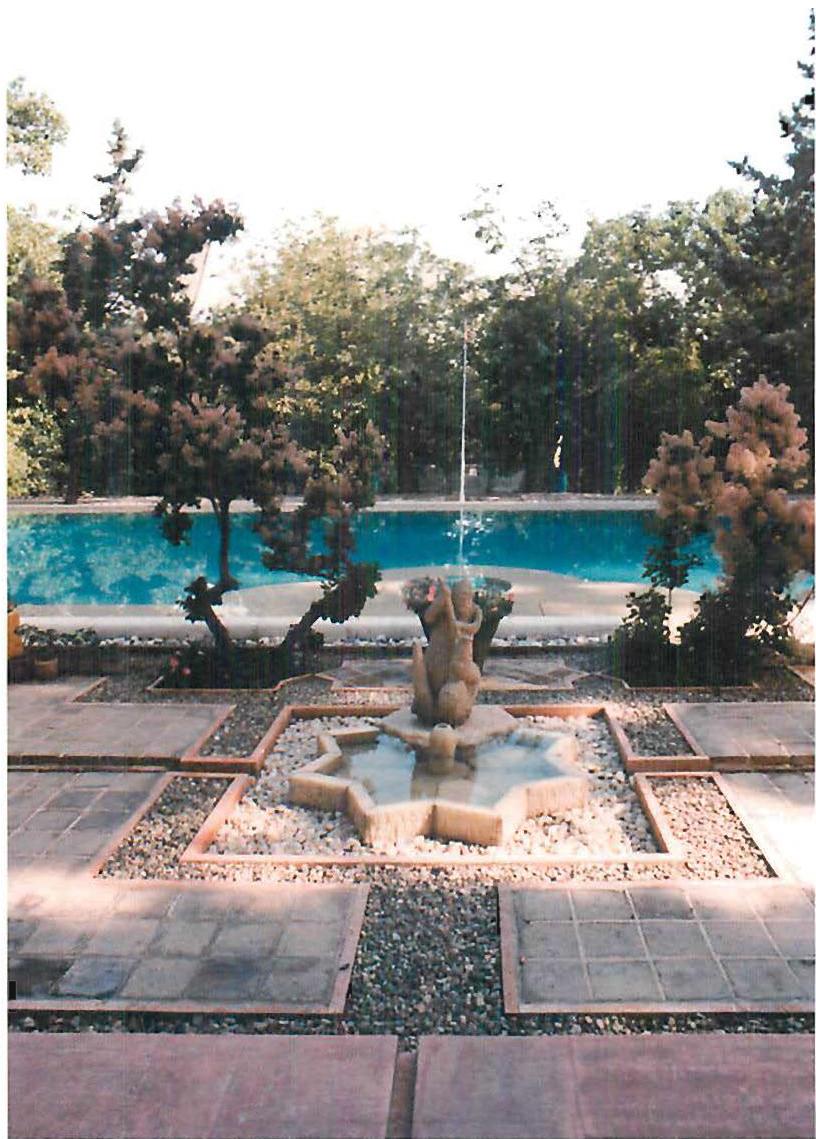
nails in a brick wall with strings. It will, almost always, include seats, pots, benches, even rooms — places that invite use.
So, to create a garden by the fundamental process, means finding a piece of land, then building an extension of the buildings which extends into and covers the land.
Of course this built structure outdoors is much lower intensity (as a building) than the building itself. It costs perhaps a twentieth as much per square foot, a tenth, occasionally a fifth. But still, it needs to be understood as an extension of the building, which extends out into the land, and is a built thing, a built structure.
In my experience the cost of this exterior structure must be included in the price of the building—or subtracted from it. So if we are asked to build a building for $100 we answer, Right, the building itself will cost $80, the part of the building which extends out into the land around the building will cost $20. This means squeezing the cost of the building to 4/5 of what you thought. But the $20 which is then spent on the land creates living structure in an area many
WEST DEAN VISITORS CENTRE
PRELIMINARY ESTIMATE, BEFORE DESIGN FEBRUARY 199
THIS ESTIMATE BASED ON THE ROUGH CURRENT PLANS AFTER DISCUSSION WITH SIMON WA AND JIM BUCKLAND, AND INCLUDING NEW AREAS FOR KITCHEN, SHOP, TICKETING FACILITIES CURRENT ESTIMATE OF BUILDING ON CURRENT ROUGH PLANS
COST OF BUILDING £769,519.13 COST OF EXTERIOR WORKS £45,786.47
PARAMETERS DETERMINING QUANTITIES
DEFINED PARAMETERS
| Main Bldg Floor Area | 174 | m2 |
|---|---|---|
| Kitchen Floor Area | 36 | m2 |
| Shop Floor Area | 60 | m2 |
| Exterior Terrace Areas | 90 | m2 |
| Main Building Wall Height | 3.6 | m1 |
| Outbuilding Wall Height | 2.2 | m1 |
| Garden Wall Length | 60 | m1 |
DERIVED PARAMETERS
| Total Roof Area | 324 | m2 |
|---|---|---|
| Exterior Wall Length | 57.40 | m1 |
| Low Exterior Wall | 46.00 | m1 |
| Balustrade Perimeter | 25.61 | m1 |
| Windows | 35 | # |
| Doors | 9 | # |
| Interior Wall Length | 51.70 | m1 |
| Interior Wall Surface | 680.08 | m2 |
| Toilets | 8 | # |
| Porch Area | 4.00 | m2 |
BUILDING DESCRIPTION
Brick wall, mixed with flint. Red flat roof tiles, on large deep roof. Extensive terrace and balustrades, garden walls, and roofed porch. Roof oriole as ornament in center of main roof. Ornamented ceilings, wood windows, tile or hardwood floors. Interior truss-work visible, window seats, alcoves and interior furnishings.
UK CONSTRUCTION COSTS
All costs in pounds sterling. Costs include material and labor, 15% contingency, 20% management, not VAT.
| UN | QTY | £/UNIT | EXTN | CONT | MGMT | TOTAL | |
|---|---|---|---|---|---|---|---|
| DEMOLITION/PREP | TOTAL COST | £5,400 | |||||
| Allow 1 | 4,000.00 | 4,000 | 600 | 800 | 5,400 | ||
| EXCAVATION | TOTAL COST | £2,675 | |||||
| Excavation | m² | 134 | 7.00 | 938 | 140 | 187 | 1,266 |
| Place Crushed Rock | m² | 52 | 20.00 | 1,044 | 1,409 | ||
| FOUNDATIONS | TOTAL COST | £17,340 | |||||
| Concrete | m² | 77 | 80.00 | 6,124 | 919 | 1,225 | 8,268 |
| Screed | m² | 270 | 12.00 | 3,240 | 486 | 648 | 4,374 |
| Underfloor Heating | m² | 174 | 20.00 | 3,480 | 4,698 | ||
| EXTERIOR WALLS | TOTAL COST | £41,583 | |||||
| Exterior Brick Leaf | m² | 273 | 90.00 | 24,555 | 3,683 | 4,911 | 33,150 |
| Interior Leaf (Block) | m² | 273 | 16.00 | 4,365 | 655 | 5,893 | |
| Dpc | m¹ | 103 | 5.00 | 517 | 77 | 103 | 698 |
| Insulation | m² | 273 | 5.00 | 1,364 | 204 | 273 | 1,842 |
| INTERIOR WALLS | TOTAL COST | £4,020 | |||||
| 4 Inch Block Walls | m¹ | 186 | 16.00 | 2,977 | 447 | 4,020 | |
| Stud Walls | m² | 0 | 0.00 | 0.00 | 0.00 | ||
| ROOF STRUCTURE | TOTAL COST | £50,107 | |||||
| Main Trusses | # | 8 | 400.00 | 3,200 | 480 | 640 | 4,320 |
| Timber Roof Structure | m² | 324 | 10.00 | 3,240 | 4,374 | ||
| Tile roof Surface | m² | 454 | 50.00 | 22,680 | 3,402 | 4,536 | 30,618 |
| Eave Work | m¹ | 124 | 30.00 | 3,722 | 558 | 744 | 5,025 |
| Gutters & Dwnspouts | m¹ | 103 | 10.00 | 1,034 | 1,396 | ||
| Flashing | m¹ | 324 | 5.00 | 1,620 | 243 | 324 | 2,187 |
| Insulation | m² | 324 | 5.00 | 1,620 | 243 | 324 | 2,187 |
Early cost plan for West Dean Visitors Centre, Sheet One
| ROOF ORIOLE | TOTAL COST | 0.00 | |||||
|---|---|---|---|---|---|---|---|
| Structure | allow | 0 | 2,000.00 | 0.00 | 0.00 | 0.00 | |
| Windows | # | 0 | 300.00 | 0.00 | 0.00 | 0.00 | 0.00 |
| Ornament | # | 0 | 2,000.00 | 0.00 | 0.00 | 0.00 | |
| INTERIOR FINISHES | TOTAL COST | £44,479 | |||||
| Stone Floors | m2 | 174 | 40.00 | 6,960 | 1,044 | 1,392 | 9,396 |
| Hardwood Floor | m2 | 96 | 30.00 | 2,880 | 430 | 3,880 | |
| Wall Plaster | m2 | 680 | 8.00 | 5,440 | 816 | 1,089 | 7,345 |
| Skirting | m1 | 161 | 8.00 | 1,286 | 193 | 257 | 1,737 |
| Door & Window Trim | # | 44 | 20.00 | 880 | 132 | 1,188 | |
| Ceilings | m2 | 174 | 50.00 | 8,700 | 1,305 | 1,740 | 11,745 |
| Painting | m2 | 680 | 10.00 | 6,800 | 1,020 | 1,360 | 9,181 |
| BUILT-INS | TOTAL COST | £51,975 | |||||
| Upholstered Lobby Seats | m1 | 11 | 400.00 | 4,4005,940.00 | |||
| Shelves | m1 | 6 | 200.00 | 1,100 | 165 | 220 | 1,485 |
| Alcoves | # | 4 | 500.00 | 2,000 | 300 | 400 | 2,700 |
| Ticket Counters | # | 2 | 1,000 | 2,000 | 2,700 | ||
| Built In Seats | # | 30 | 500.00 | 15,000 | 2,250 | 3,000 | 20,250 |
| Glass Display Cases | # | 7 | 1,000. | 7,000 | 1,050 | 1,400 | 9,450 |
| Tables | # | 15 | 400.00 | 6,000 | 900 | 1,200 | 8,100 |
| Serving Counter | # | 1 | 1,000 | 1,000 | 150 | 200 | 1,350 |
| WINDOWS AND DOORS | TOTAL COST | £27,202 | |||||
| Wood Windows | # | 35 | 400.00 | 14,000 | 2,100 | 2,800 | 18,900 |
| Exterior Doors | # | 8 | 600.00 | 4,800 | 6,480 | ||
| Interior Doors | # | 5 | 300.00 | 1,350 | 1,822 | ||
| ELECTRICAL | TOTAL COST | £10,100 | |||||
| Allow | m2 | 174 | 33.00 | 5,742 | 861 | 1,148 | 7,751 |
| Light Fixtures | # | 34.8 | 50.00 | 1,740 | 2,349 | ||
| PLUMBING | TOTAL COST | £12,744 | |||||
| Toilets | # | 8 | 680.00 | 5,440 | 816 | 1,088 | 7,344 |
| Kitchen | # | 1 | 4,000.00 | 4,000 | 5,400 | ||
| HEATING SYSTEM | TOTAL COST | £7,290 | |||||
| Heat Exchange & Pumps | m2 | 270 | 20.00 | 5,400 | 810 | 1,080 | 7,290 |
| Ducts | 0.00 | 0.00 | 0.00 | 0.00 | |||
| Outlets | 0.00 | 0.00 | |||||
| SITE SERVICES | TOTAL COST | £10,800 | |||||
| Water | allow | 1 | 1,000.00 | 1,000 | 150 | 200 | 1,350 |
| Boiler Feed | allow | 1 | 2,000.00 | 2,000 | 300 | 400 | 2,700 |
| Electrical | allow | 1 | 2,000.00 | 2,000 | 300 | 400 | 2,700 |
| Sewer | allow | 1 | 3,000.00 | 3,000 | 450 | 600 | 4,050 |
| EXTERIOR LANDSCAPE | TOTAL COST | £19,440 | |||||
| Gravel Paths | m2 | 60 | 10.00 | 600.00 | 90.00 | ||
| Exterior Steps | # | 10 | 100.00 | 1,000 | 150 | 200 | 1,350 |
| Low Garden Walls | m1 | 60 | 70.00 | 4,200 | 5,670 | ||
| Brick Gateways | # | 1 | 300.00 | 300 | 45 | 60 | 405 |
| Planting | allow | 1 | 5,000.00 | 5,000 | 750 | 1,000 | 6,750 |
| Rainwater | allow | 1 | 1,500.00 | 1,500 | 2,025 | ||
| Exterior Lights | # | 12 | 150.00 | 1,800 | 2,430 | ||
| TERRACE | TOTAL COST | £13,386 | |||||
| Earthwork | m3 | 45 | 20.00 | 900 | 135 | 180 | 1,215 |
| Terrace Retaining Walls | m1 | 26 | 70.00 | 1,793 | 269 | 358 | 2,420 |
| Flagstones (concrete) | m2 | 90 | 10.00 | 900 | 145 | 180 | 1,215 |
| Ornaments | # | 6 | 200.00 | 1,200 | 180 | 240 | 1,620 |
| Balustrade | m1 | 26 | 200.00 | 5,123 | 768 | 1,025 | 6,916 |
| ENTRANCE PORCH | TOTAL COST | £2,160 | |||||
| Columns | # | 2 | 500.00 | 1,000 | 150 | 200 | 1,350 |
| Roof | m2 | 4 | 100 | 400 | 60 | 80 | 540 |
| Benches | m1 | 2 | 100 | 200 | 30.00 | 40.00 | 270 |
| Balustrade | m1 | 0 | 200.00 | 0.00 | 0.00 | 0.00 | |
| BUILDING COST | |||||||
| EXTERIOR WORK COST | |||||||
| TOTAL PROJECT COST |
Early cost plan for West Dean Visitors Centre, Sheet Two
TODO: get the real table
times larger than the building alone. It has an enormous effect, multiplies the usefulness of the building many times. And, of course, it connects it to the other buildings near by.
I have found that people are nearly always short-sighted and want to economize on this 20%. When the going gets tough, and money becomes a problem, the red pencil comes out, and people say, let's do this later. We must have doorknobs, shelves, brass fittings, a second bathroom—we will spend the money for the garden later.
I always resist it when my clients say this to me. You have to resist it, over the wishes of the client even, because our responsibility is for the whole not for the building alone, which is a fragment of the whole. The exterior structure is as vital a part of the structure of the whole, as the building. It happens to be a little cheaper than the building cost, 20% v. 80%. But you can not forget it, or reduce it, without severely damaging the whole. This exterior structure is what brings life to the world. If this 20% is robbed from the budget, the thing will die. It is much easier to put extra bathrooms, expensive floor materials, brass fittings and so on, at a later stage. Build the building for 80%, the garden for 20%, and then the living world will start to breathe. Otherwise it will never work.
On pages 238–39 I show the preliminary calculations from our West Dean Visitor's Centre in England. This budget was made before I designed the building, just from my initial impression of the site, the size of the building, and what I thought would need to be done to be fitting to that place. As you see, even at that early stage, 17% of the budget was allocated for exterior structures: terraces, walls, arches, ornaments, gates, posts. That is because from the beginning, the outdoor structure of the building, its connection with the earth and with the land, going out into the land around, were all considered an essential part of the building. It is unusual to spend this much money on these things. Yet it is because the money was allocated this way—and because the allocation persisted with those percentages right until the end of construction—that the building now works so well, people have a good time there.
7 / TWENTY PERCENT OF THE CONSTRUCTION MONEY FOR OUTDOOR STRUCTURES
I would like to explain how I use money in a building project, whether it is a building or a garden or a huge complex. At the very outset, usually from the first day of the commission, or even the first day of preliminary discussion, before there is a contract, when I only have the sketchiest idea of what the building might be like, I already begin making calculations to see what is possible with the available money, what is the best way to spend the money.
I do this because so many details come out wrong. The balance of structure cost, size of rooms, beauty of windows, extent of construction in the outdoors around the house. All these things have an effect. If one leaves them all until the design is finished, then you end up stripping everything away, and what is left is just a bare shell—a cardboard box of the cheapest construction, with nothing but the plan left that one might call "architecture."
So instead, I try, from the start, to balance things out, and to provide them according to their importance. Thus, for instance, in the early cost plan for West Dean on pages 238–39, you see right away that windows are in there for a big number—almost a full 10% of the building budget. Molded plaster ceiling and ornament is in there: 6% of the budget. The terraces, even with garden ornaments, are there at 17% of the budget. It was my judgment at that early stage that terraces and
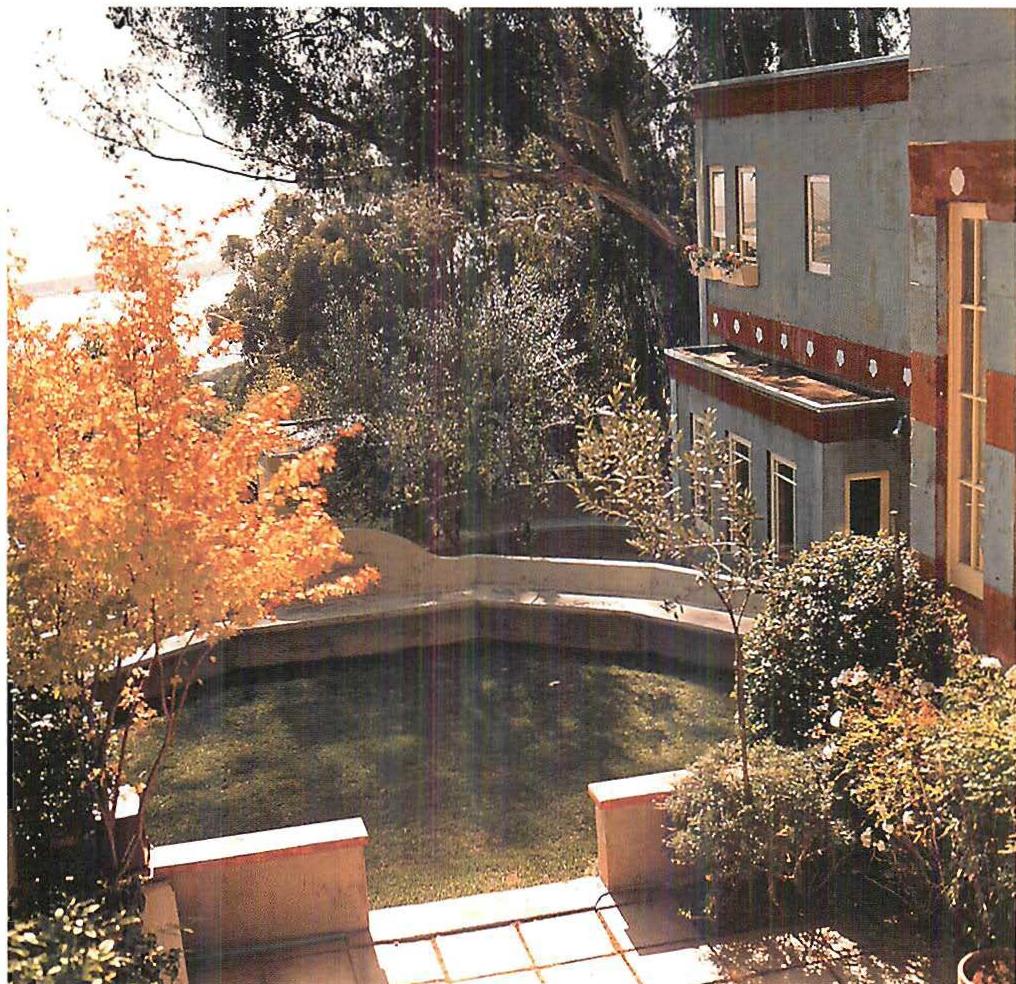
garden works were needed, at that cost, in order to make the project a balanced whole. Before even knowing the design, I put in a provision for 60 feet of outdoor concrete benches, for 1000 square feet of terrace, 50 feet of brick walls, 4 gates, garden ornaments on the stonework.
This last may sound trivial. But there is an item of £2000 for the garden ornaments. I knew nothing of what we would do, nor how we would make them — not even what they would be made of (though I assumed some permanent masonry material).
Yet in the end it is the cast concrete spheres which add a finishing touch to the building (page 245). And their cost was not far off what I allocated on this day, two years earlier, without even knowing — in detail — what I was doing. I knew that
some money would be needed for such a thing, and made provision for this money in my calculations from the very earliest moment in the process.
Going back to gardens: In all our building projects, virtually without exception, I have made a practice of spending money for walks, terraces, colonnades, low walls, retaining walls, small bridges and so on.
Most of this stuff is expensive. But you have to spend the money!
It does not have to be fancy. It is not intended to create an "effect." It is merely intended to establish, truly establish, those centers which allow living structure to increase.
For instance, the long curving seat made of brick and flint and block and poured concrete (illustrated on page 245, from the entrance to
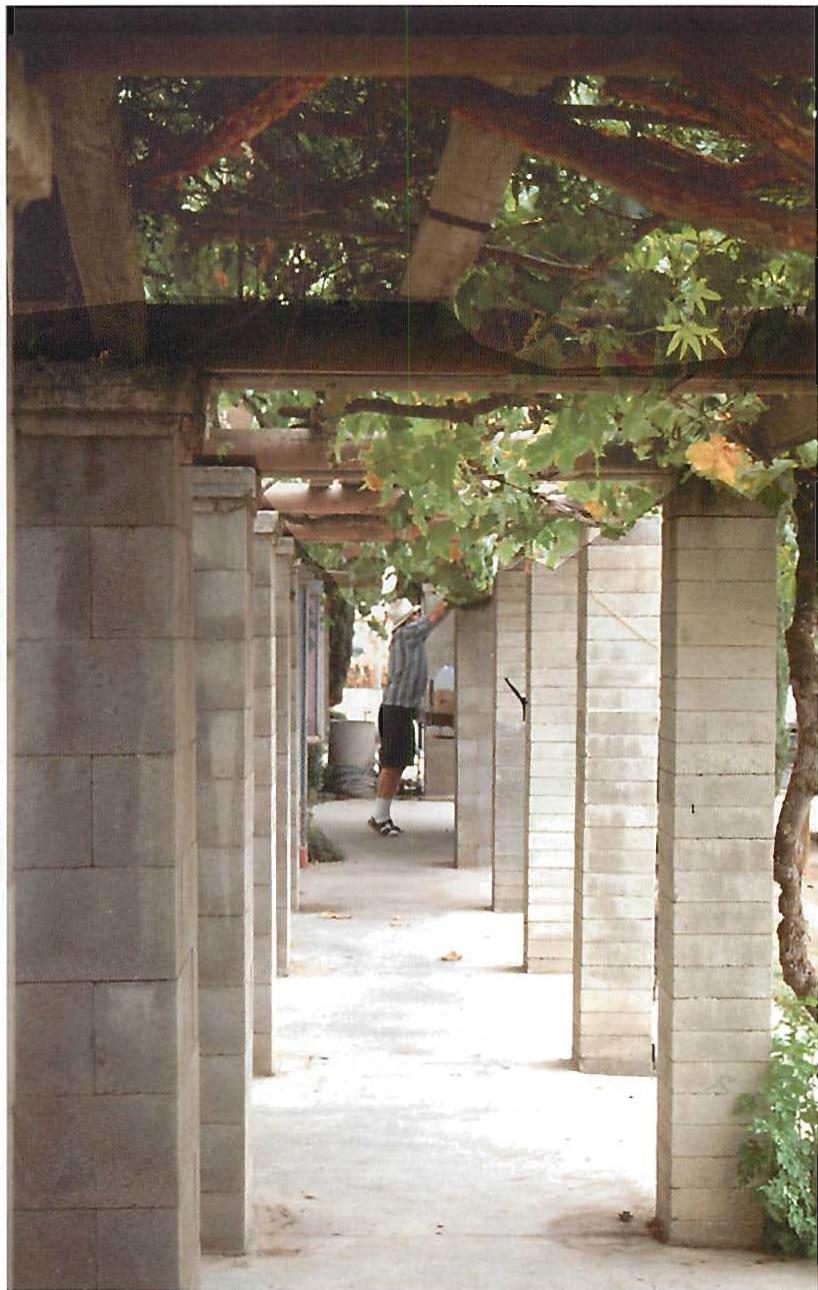
the West Dean Visitor's Centre) does something of that kind. It gently organizes the space, so that the garden, and the gardener, feel inspired for things to grow.
We were really scraping the money together at the end of that project, with what we had saved from other construction operations, and the client was unhappy that we spent it like this, not on
something else. But the effect was to create positive space between the entrance gate and the main entrance of the building. It gives people a natural place to sit. It encourages growth of plants, grass, all around it, in natural ways.
The same is true of bushes, wisteria, trees, lawns, masses of rose climbing on the shed out by the back fence.
8 / POSITIVE SPACE IN GARDENS
If we ask how to build these structures, how to arrange them, where to place them, my answer is simple. Always, you are trying to make positive space.
To treat the gardens as positive — more positive, even, than the buildings themselves — that is the first step. Each part must be composed of positive centers. And to achieve that, each of these centers which is achieved, must itself be made of positive centers, smaller centers. It is these second-level centers that are created by the structures which we build.
So we place buildings, to form positive space in the garden and outdoor areas. See, for example, the positive space shown in the plan of the Eishin campus, on page 244. Then we build structures in these outdoor areas, to differentiate them further, into smaller living centers, animated by the structures — steps, walls, parapets, railings, seats, embankments, bridges, slopes . . . that we build in them. And then we allow natural life to rip loose, the plants, the grass, the trees, the bushes — and let these form still further centers, which then animate the positive space even further. That will happen almost of its own accord, if the initial positive space has been correctly made. This is the form the living process takes, in making a garden.
9 / PRESERVE THE STRUCTURE OF WHAT IS THERE
The newly created centers — the new positive spaces — work best, if they are based on some thing, some trace, that is there already. This is the key of the fundamental process anyway, that
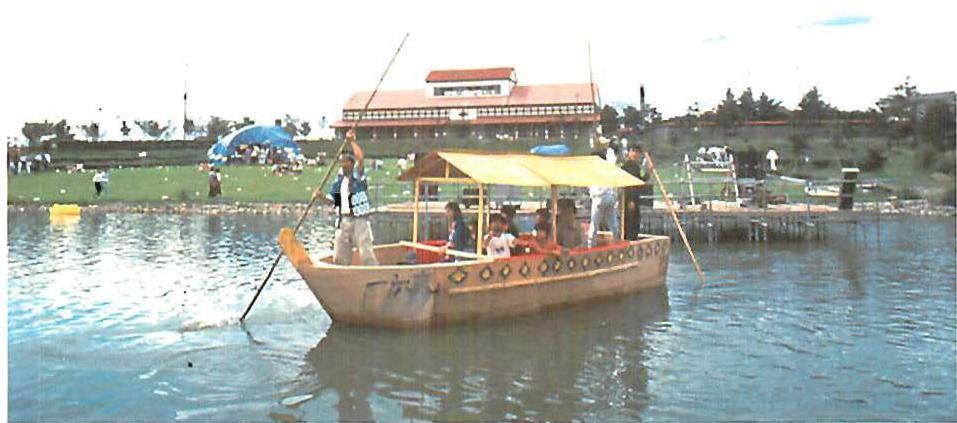
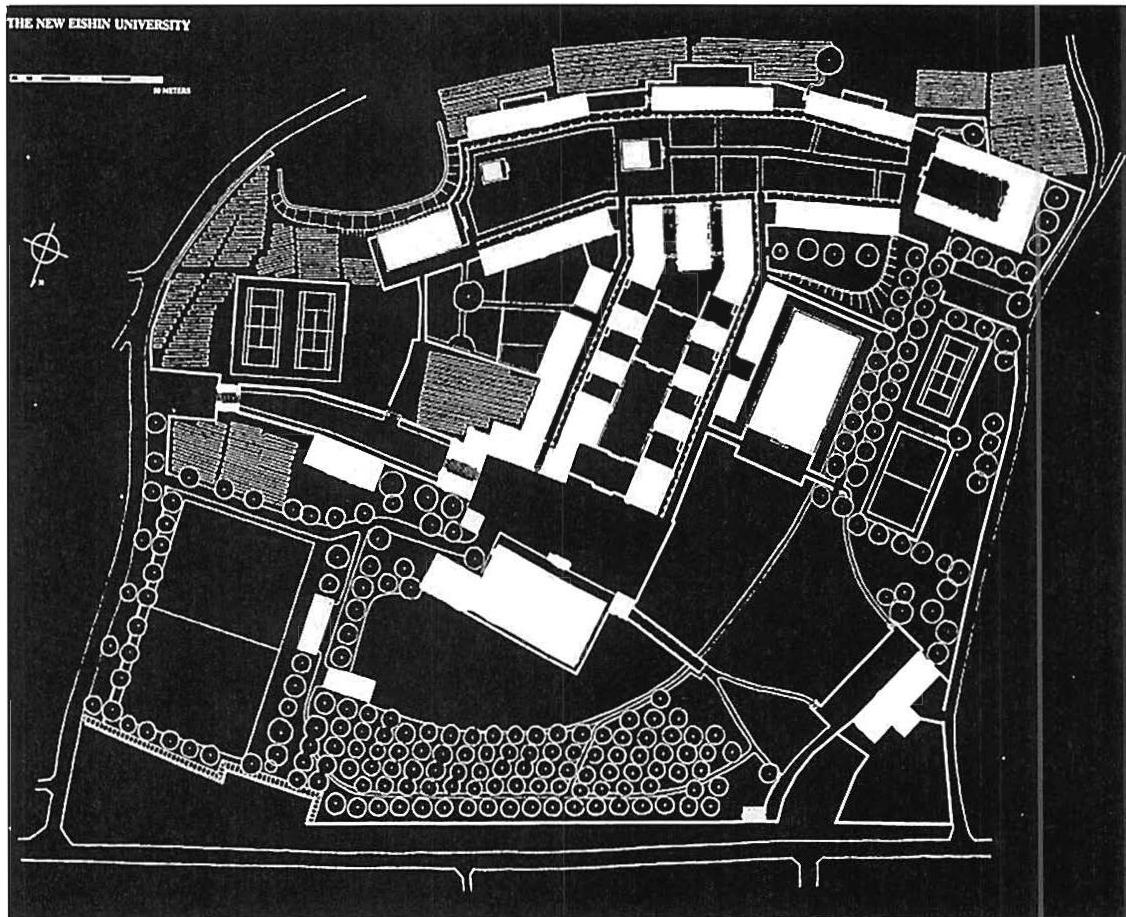
it embellishes the centers which are there. So we look for the most significant deep centers in the land, in the trees, in the flowers, in the views, and try to keep them intact, enlarged, intensified.
Leave them, and build hard structures which support them. What we build, may be formal, a
structure of symmetries, that will support the natural land. That is what happens in the lovely English laburnam walk on page 247. You keep what you can. You keep the tea bushes which are natural, you keep the bougainvillea in the Fort Lauderdale slum. That bougainvillea must stay, and the buildings must then be built around it.
10 / SMALL AND LARGE CENTERS
CONTRIBUTE TO UNFOLDING
Oddly, the wildness of an unfolded garden does not become most natural without support.
It becomes most vivid, when supported by a delicate system of small walls, edges, terraces,
trellised structure, small retaining walls, sheds, which refer to centers that are in the land and have been formed by structures built before—so that the most natural life can then emerge.
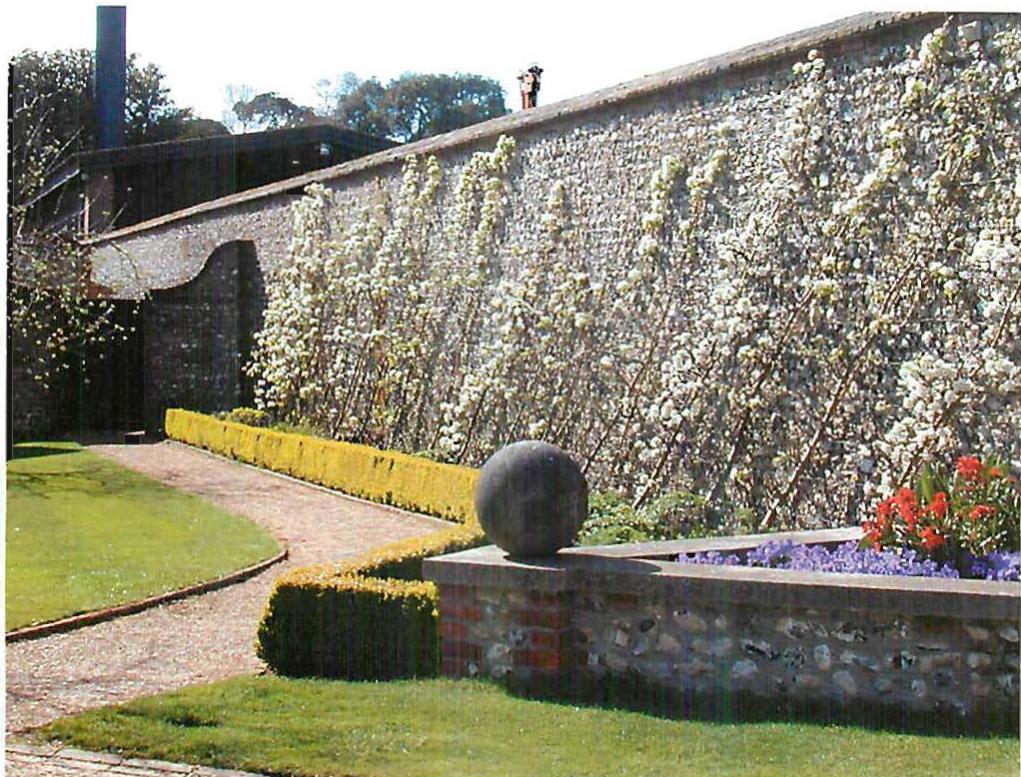
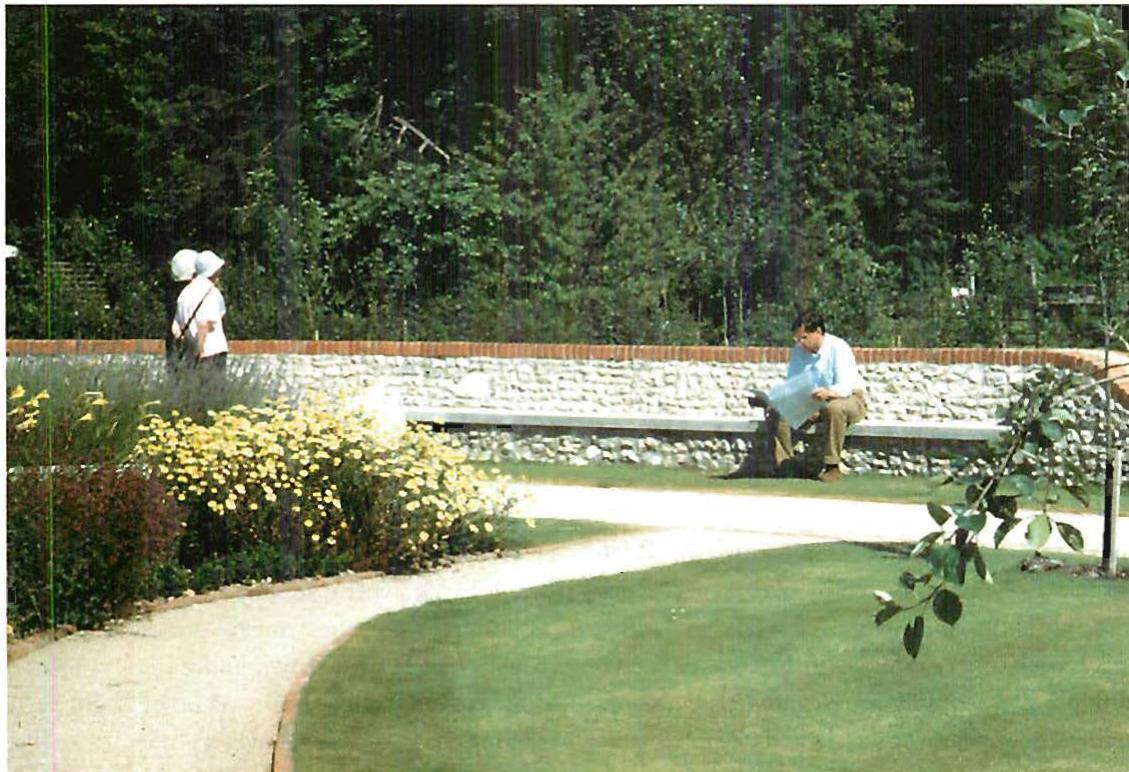
The loosely, carefully made centers are the core of our architectural work in the outdoor world because they loosen, let loose, what is seeking to happen there, as if of its own accord.
The classic English or Italian garden has this wildness too, and yet is full of centers carefully arranged in their structure just as I have described. Just so a classic Japanese garden, each rock, bush, stream placed, and yet the whole thing has an un-managed quality that makes us feel almost as we do in nature at its wildest.
In the gardens of Eishin the fences, hedges, paths are placed with very great care, and yet they are not manicured. They grow wildly, so we see the centers created by path, fence, fence post, climbing tendrils.
Our Farmer's Market in Fresno (page 242 and pages 538-39) is an elegant structure of arched, bent beams, roughly and cheaply made. It creates a large center at its core, a huge space used by the farmers on the weekends; each column is placed to be a strong center because the column- though cheap concrete block - is short, stubby, well shaped, a place to lean against, with a water spigot for watering the vines in the heat. The vines themselves grow in a riot overhead.
The bougainvillea in the Fort Lauderdale slum (this page) is largely untended, lush in its own profusion of growth, because it is on a good bit of soil, in full sun, and is not trimmed back, it has grown to enormous size with color that fulfills the neighborhood.
The small swelling terrace at the Sala house (page 241) creates a step out into the air of the hillside, enlarges that place, makes a formal curve which hits us just where we want to be when we stop in that garden: it is pure pleasure, then carried out in detail with bench, bench back, lawn, and climbing plants. The curved bench back made of segmented sloping sections, was not very easy to make; I built the structure myself for our clients. But a few extra hours of fiddling about with
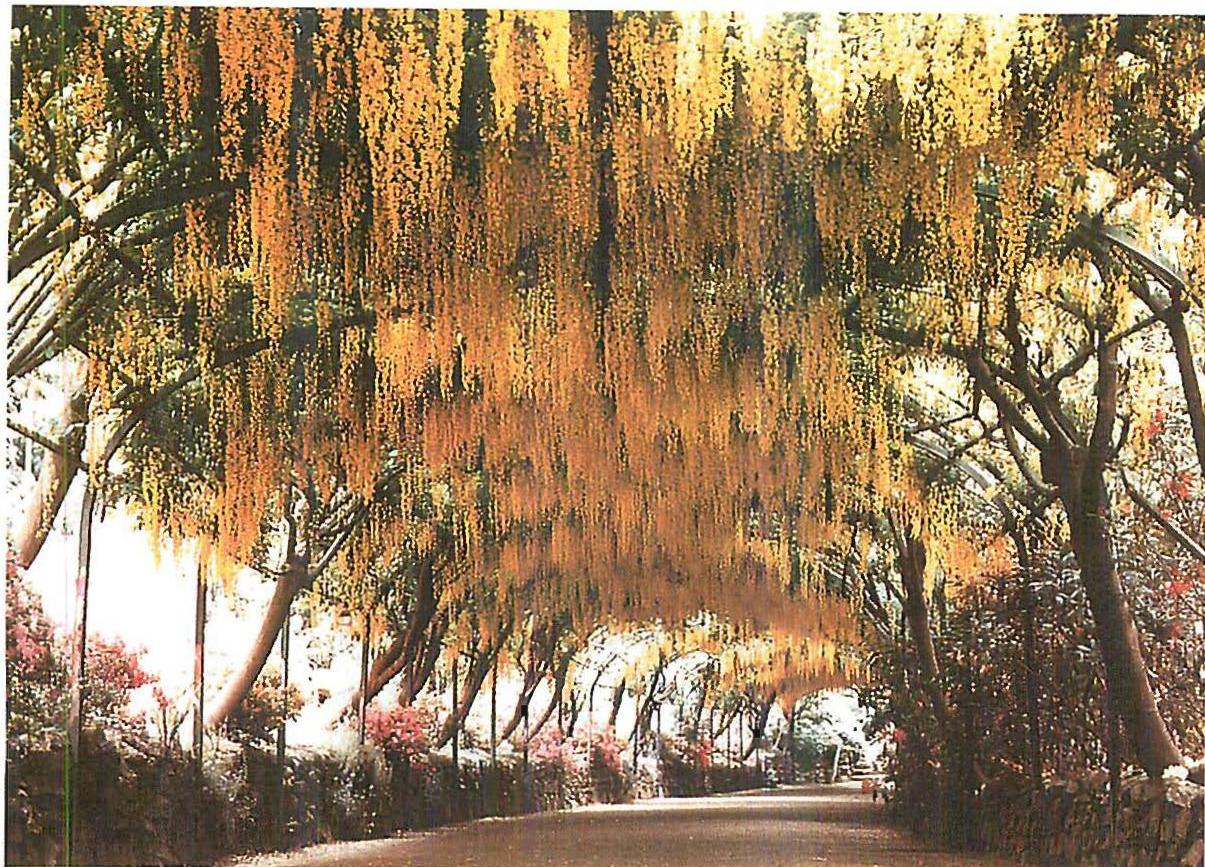
complicated angles on the formwork were what was needed to make it whole, and to give the bench it this pregnant bulge, which now sits
in the land solidly—a place where people really like to go. Its centeredness is massively in the geometry.
11 / CENTERS IN YOUR OWN GARDEN, CREATED BY YOUR DESIRE
On page 250 there is an example from a garden in Holland, part of a painter's house. She plants just what she feels like, with the intensity of placing only what she wants, where she wants it; perhaps as a painter she has a special courage to do exactly what she feels.
As a result, we find in one part of the garden an intense luxuriant color, dark reds, bright yellow, small patches of intense blue. This is quite formal, the center of each color, very carefully placed.
In another part of the garden, an old orchard, sheets and laundry is flapping; an old iron table stands under a tree, and apples are laying on the ground. Again, the table, the sheets, the clothes line, the apples on the ground even, all just where desire places them.
In your own garden, too, the fundamental process has an enormous role, and true unfolding is possible, as it emerges from the combination of your feeling for the land, and your egoless imagination.
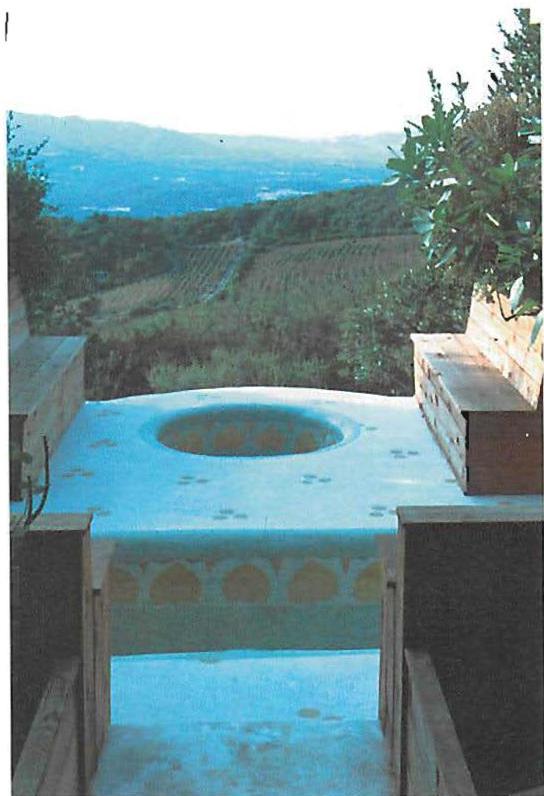
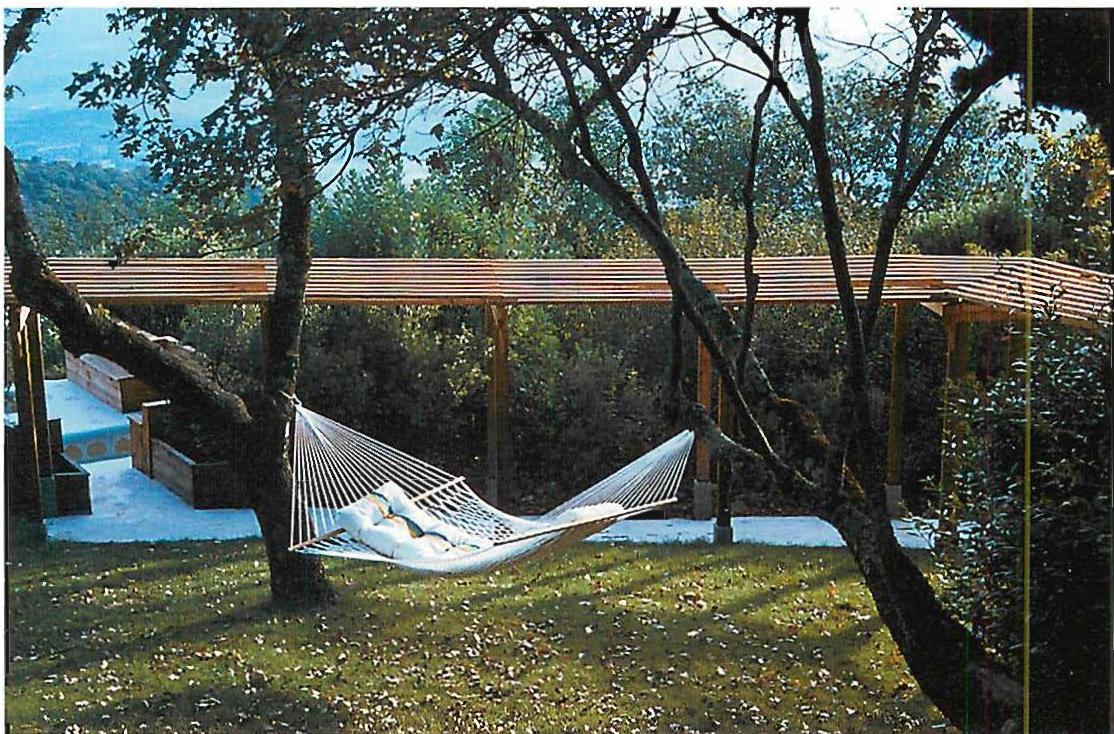
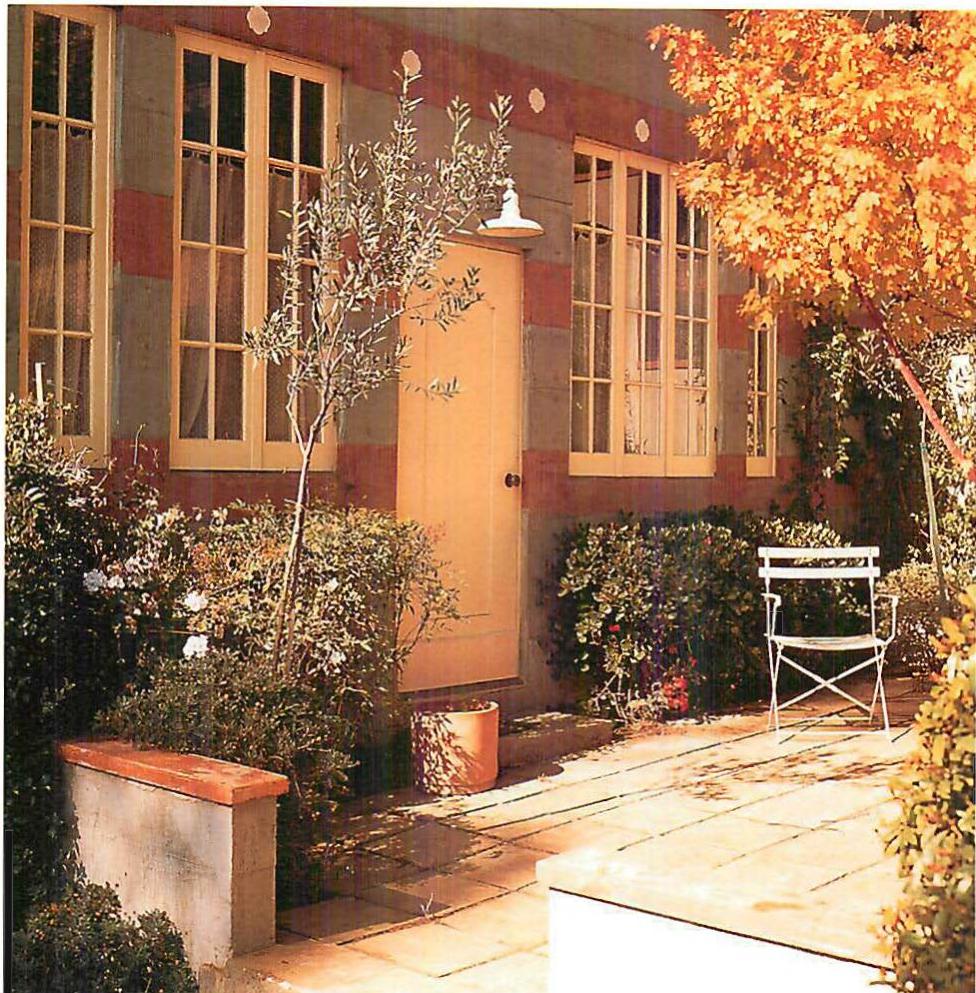
A garden with real life comes from thinking in living terms about every plant, every path, every bush, the fertilizer, the water, every little wall. To get it right (of course, this is like everything else), it has to be made gradually, each bit adapted to the others, each plant given the place and sunshine, shade that it likes best; each bit of grass protected; any trickle of running water, if it occurs, helping plants to grow.
This is something which nearly everyone can have a hand in. At one time or another in our lives, most of us do some kind of work in a garden. Gardens are therefore the easiest part of the world to influence; the most accessible of the parts of the world where unfolding with true life can be made to occur—really, by almost anyone.
The most wonderful thing about your garden is that you can do almost anything you want there. In my picture of the world, these gardens, thousands of them, reflect not only the beauty of nature, flowers, vegetables, trees. They reflect, too, our own heart's desire, a place where we may see the individuality and love of different people expressed in the most ordinary way, a million-fold. It is the least constrained part of our environment, the place where each of us is most free to do what we want. So we can express ourselves; we can have our heart's desire; we really can do what we want to do.
12 / THE WILD AND CULTIVATED GARDEN
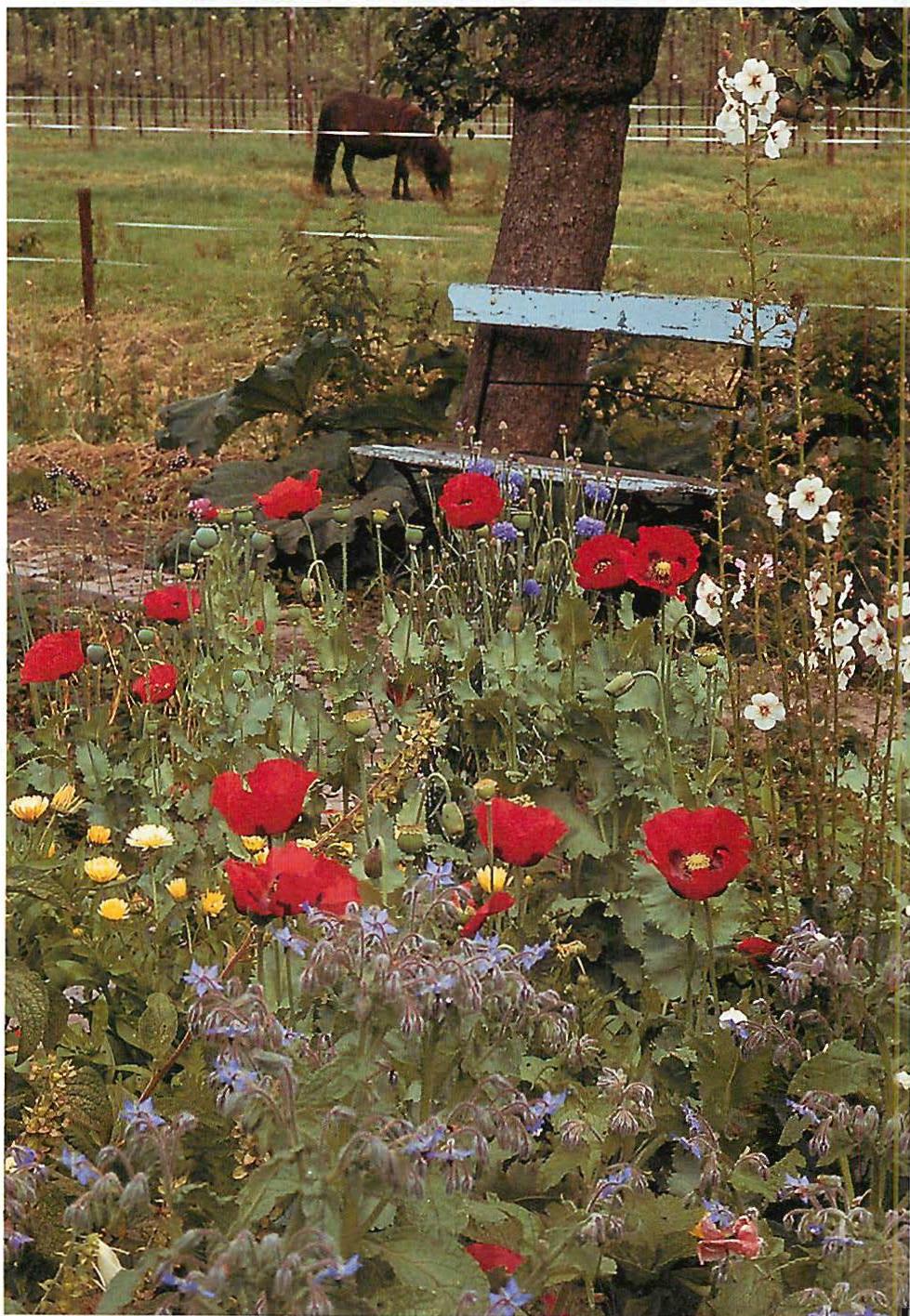
To get the wild true garden by unfolding, all we have to do, really, is what every good gardener does. Like a painter placing one color at a time, most carefully, giving each precious drop of color
its life, we must pay attention to each place, flower by flower, bush by bush, one bit at a time, and ask what its character is. One place is shady, quiet. Another is hot, by a wall which the sun pounds. In another place, I walk to the tennis court, from the house, each day, and on my way I cross the lawn.
I ask myself what is the inner character of each of these spots, what I might do to intensify what is already there, how the character now latent there can best be amplified.
Of course, I am concerned with sunshine and shade, water, drainage, soil condition, a warm wall that catches the sun for growing peaches or honeysuckle; an old tree which can carry a climbing wild rose or clematis. That is just the stuff of gardening. But—and this is less obvious, to gardeners, even—here again, in making a living world, we must above all be concerned with centers. Centers govern life. The fundamental process asks us again to see, feel the centers latent in the land.
In the Eishin project, there was a swamp in the vegetable fields. We made the lake with a hard stone edge in its most critical points: this stone edge and the bridge then allowed natural garden and plant life to attach themselves to it, just as the land required. We left the tea bushes where they were, in places, from the previous agricultural life of the land (you can see them in the photograph on page 255). The land liked

the tea bushes. The memory of the land then continued to grow, within the context of the new things we were building there.
13 / SPLENDOR IN ORDINARINESS
The beat of informality against the discipline of geometric order, can lead to the most splendid qualities — seen, for instance, in the photograph on pages 252-53. Even big public gardens need some version of this formality and wildness, the relation of the cultivated to the wild. This character, rather like ROUGHNESS and CONTRAST, comes about as a result of natural unfolding where people and nature meet. The wild growth of the grass, trees, bushes, meets
a need for order that comes from people—the lawn where the two-year-olds can play and roll around, the flattened path where it is comfortable to walk, the hard edge of a swampy pond which allows us to meet the water and stare at it.
Leaving trees intact: we make things go around them, give them the dignity of the structure the growing trees have established there. Then plant in relation to the sun and
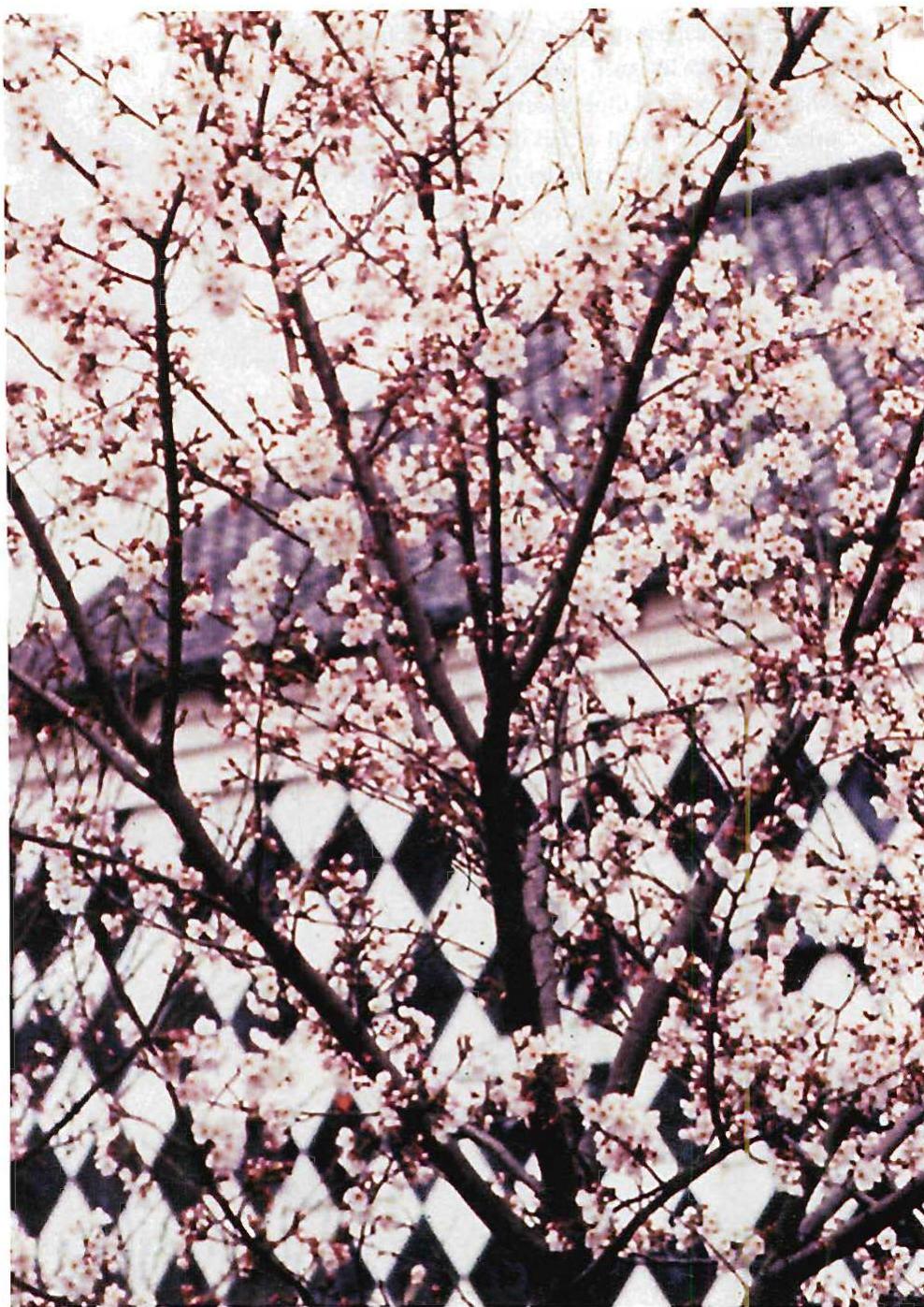
shade which is created. Allow the mess, where it wants to be, as a natural counterpart to the cultivated and pruned and tamed.
The path meanders through the landscape. Sometimes it is solidified to form part of a building. The trees stand, buildings go around them.
The meadow is cut, nettles and bushes are cleared away.
At Meadow Lodge the blackberry bushes grow, wild, straggle along the lane. The boxes, trays, seedlings, lie against the house. A toolshed stands, made up of plywood, boards, chickenwire
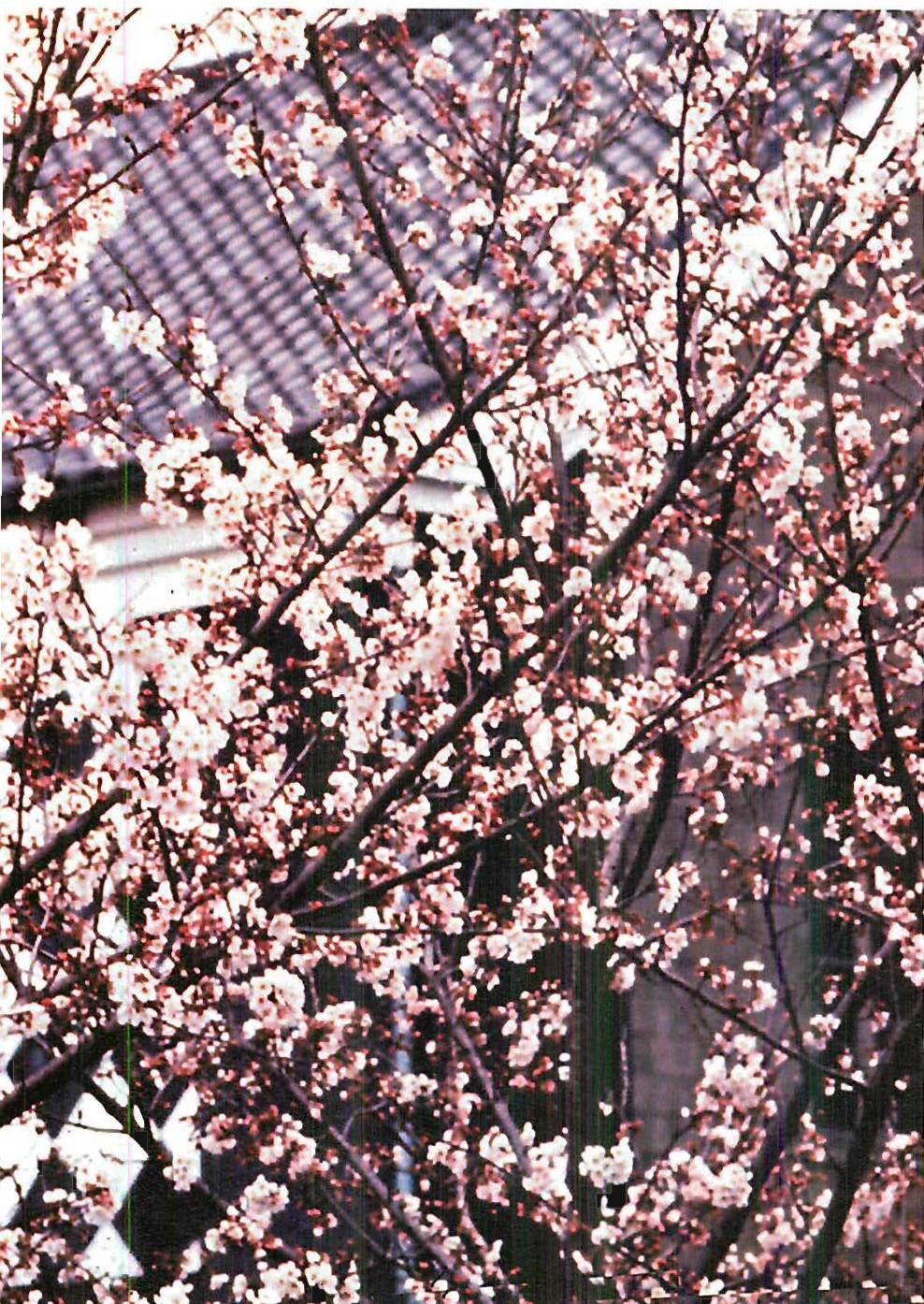
and rusty corrugated iron. It gives the touch to the garden which is there for usefulness. Lilies grow in the corner of a field.
A line of apple trees are planted to form an avenue, leading to the entrance of the West Dean Visitor's Centre. A terrace is closed off by pots.
The back garden of Eishin: hedges, tea bushes, fences, bushes, all easy, and just right like a patchwork quilt against the formal dignity of the buildings (page 236). Sitting in this back garden, not far from the magnificent gate shown on this page, among the seedlings whose boxes
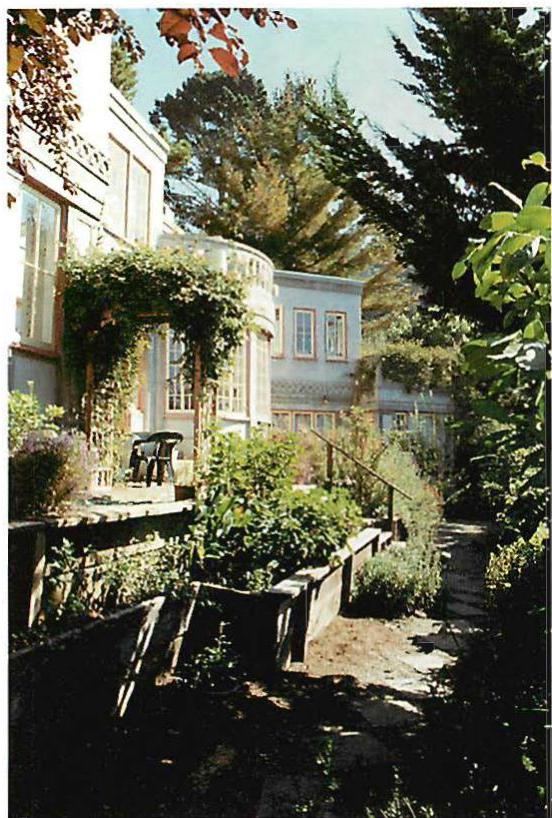
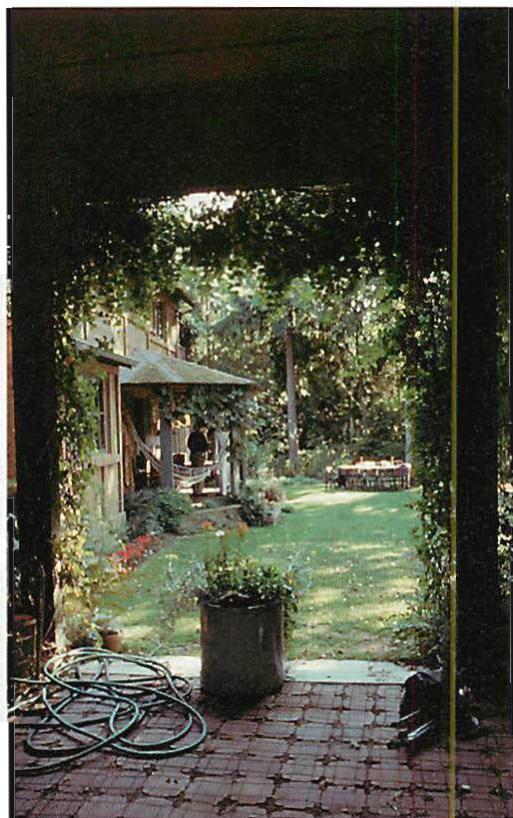
lay on the porch, Mr. Murakoshi said to me, quietly: "You have taught us to appreciate another way of life."
He was much too kind to me. But it was a very nice way for him to summarize my hopes and aspirations as an architect.
14 / I DON'T CARE KIND OF CARING
The loveliest gardens, I think, come from allowing nature to take its course very strongly, helping it to be more like nature, allowing things to be themselves.
I remember once a girl stopped on the road outside our garden in Berkeley; she spoke across the wall. "I love it here," she said, "I wish I could live here."
The garden in those days was full of rabbits, fish in the pond, straggly plants growing where they could, earth, beaten earth on the ground, boxes all over the place. But to that girl it was
paradise, "I wish I could live here," she said again. It was a very ordinary place. I don't know that it would ever make it to the pages of a garden magazine.
And yet, is there anything more wonderful?
The mass of flowers against the wall. We see the flood of red and pink roses, they establish themselves, and in relation to these roses, geraniums grow. Next to the geraniums, the feeling of small blue flowers, periwinkles and forget-me-nots: it is the red and pink which generates the blue.
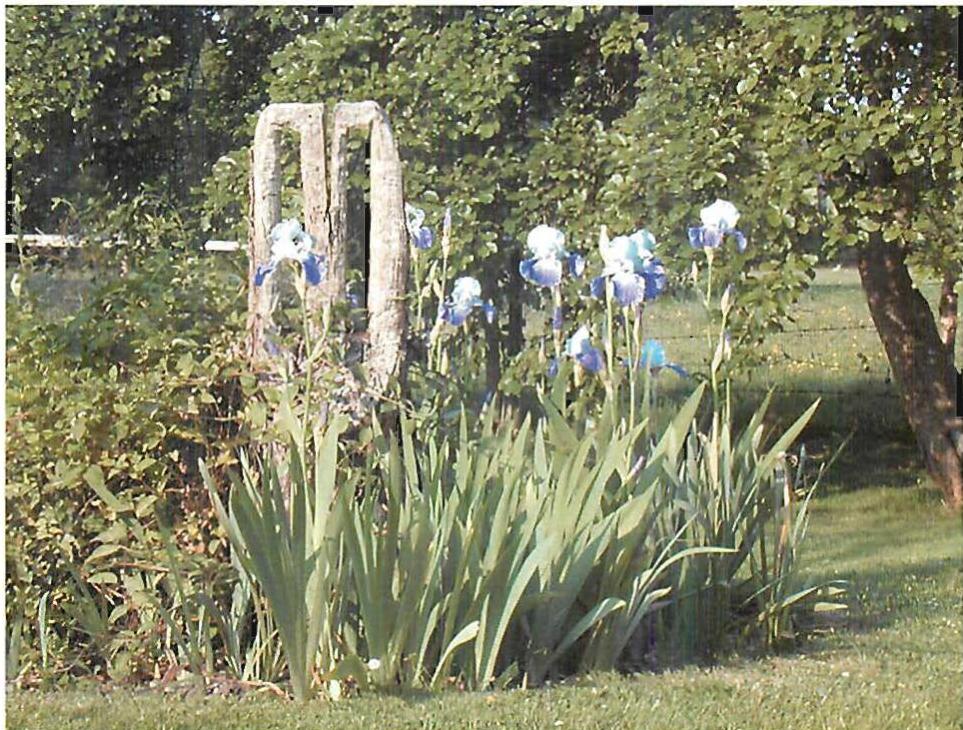
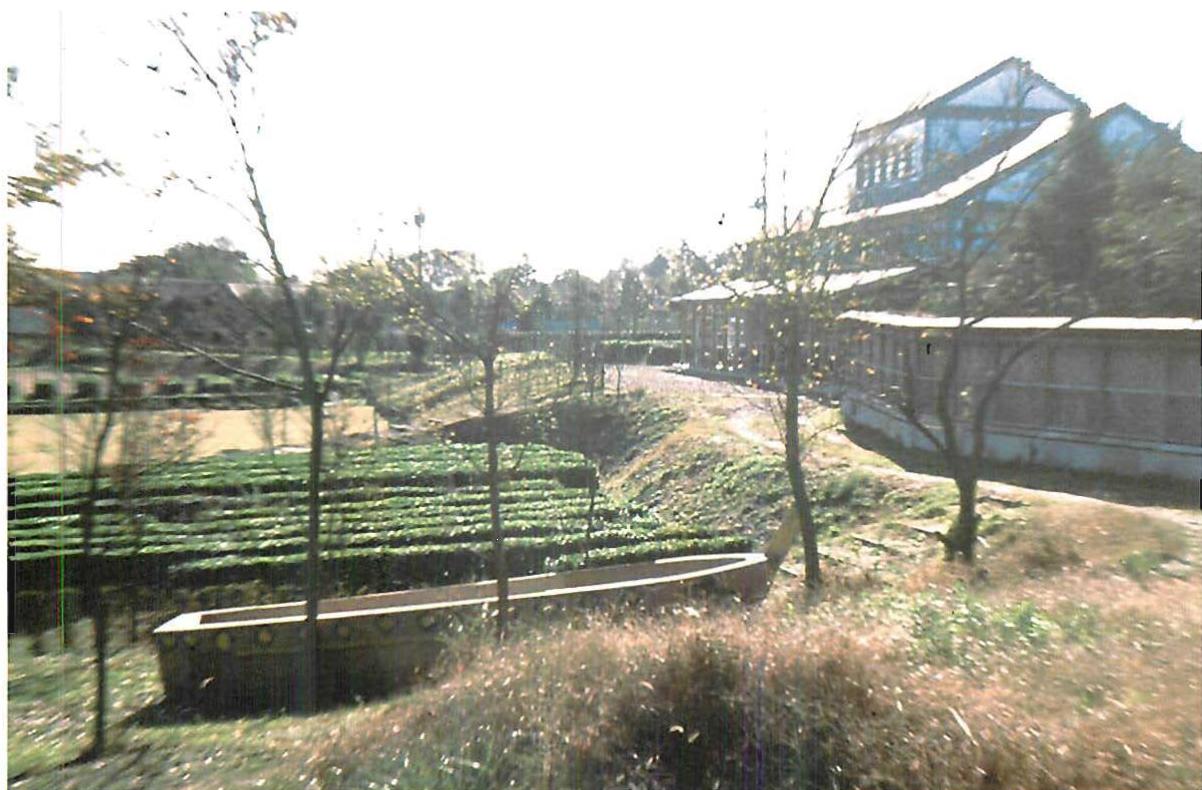
15 / THE STRUCTURE LIKELY TO APPEAR IN GARDENS SHAPED BY LIVING PROCESS
The outline of each garden made by living process, and each part of every garden, is likely to be positive space. Within the positive space of each garden, further positively spaced structures will have been placed, creating local symmetries, which then form positive space at smaller scales, so that the garden, even when it is raw and un-grown, already has positive space that one can feel at many levels in large centers and small centers.
There will be few places which do not form definite and coherent centers of this kind. We shall see an interaction of formal shapes possessing local symmetries and forming large scale centers (lawns, courts, hedges, flower borders, paved areas, a seat around a tree) with land-inspired shapes that have smaller-scale symmetries typical of grassland, forest, and rocks. And these areas themselves will often have very subtle minor centers and symmetries, like the raked sand in a Japanese sand garden, connecting them to the formal symmetries of the outline, to the smallest symmetries of nearby buildings, bushes, trees, plants, and water.
Color will probably play an important role, in flowers and flowering bushes and trees of different season—even if it is based only on the huge variety of greens. Seats, fences, and other centers, placed in the landscape to connect the garden with the buildings, will form a continuity of structure between inside and outside, and make the gardens usable almost in the sense that rooms are usable. Curved forms will enter in only rarely. More often, rectilinear structures will interact with organic contour-inspired forms. Walls, catching the sun, are likely to play a special role for climbing trees, fruit, apricots, roses and trellises. Wildness covers everything.
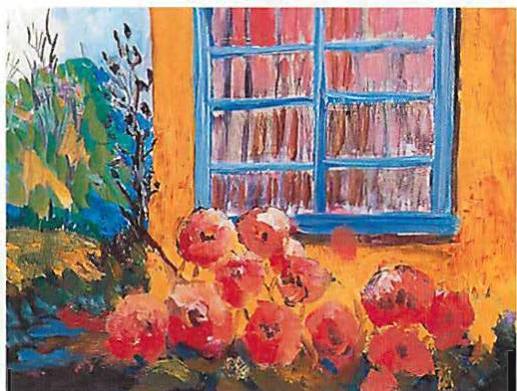
The next four chapters contain discussion of some of the ways of introducing living process into the growth of neighborhoods.
Chapter 8, FORMING A COLLECTIVE VISION OF A NEIGHBORHOOD, describes the way a few people or a few hundred people can, together, form a collective vision of their neighborhood, which can then become the basis of the processes to be applied to much of the construction in the neighborhood.
Chapter 9, THE RECONSTRUCTION OF AN URBAN NEIGHBORHOOD, describes the way that an existing slum or poor neighborhood can be repaired by means of living process. Of special interest is the stimulation of economic repair which follows modifications in the relation of pedestrians and cars.
Chapter 10, BELONGING IN HIGH-DENSITY HOUSING, describes the unique and special circumstance of very high density housing in urban areas, and shows how these areas can be made, through living process, to contain very high densities, while still giving every household direct access from their houses to private gardens and the street.
Chapter 11, FURTHER DYNAMICS OF A GROWING NEIGHBORHOOD, shows different ways that new neighborhoods can be grown, not planned, even in areas where entirely new neighborhoods are to be created, thus giving these places a similar organic quality in a short space of time, that used to be created over a longer period of time in older places when people put their lives into the emergent neighborhood.
CHAPTER EIGHT: HOW LIVING PROCESS HELPS PEOPLE IN A NEIGHBORHOOD FORM A COLLECTIVE VISION OF THEIR WORLD
Realism: What follows in this chapter may strike some as too idealistic. It is therefore important for me to emphasize the fact that although some of the descriptions of process in these pages seem to refer to an idealized process in which all the people of a community or neighborhood express their views, make their feelings felt, and add their insights to a collective vision, the case that is more interesting — because most realistic — is a different, more modest process. In this modest, and more down-to-earth version, a community of hundreds or even thousands may be represented by a small group of people — sometimes no more than a handful. These few people — perhaps leaders, planners, or members of the community with special concern — become scribes for a pattern language for the others. Provided that they keep the roots of this pattern language in the soil of everyday experience, it is possible for them to make something grounded, speaking the truth, and quite solid enough for their fellow creatures to ride upon. As you read the chapter, please be aware of this more everyday and more realistic model, as the thing which you can most easily practice and implement, while still aspiring to the ideal case if circumstance allows.
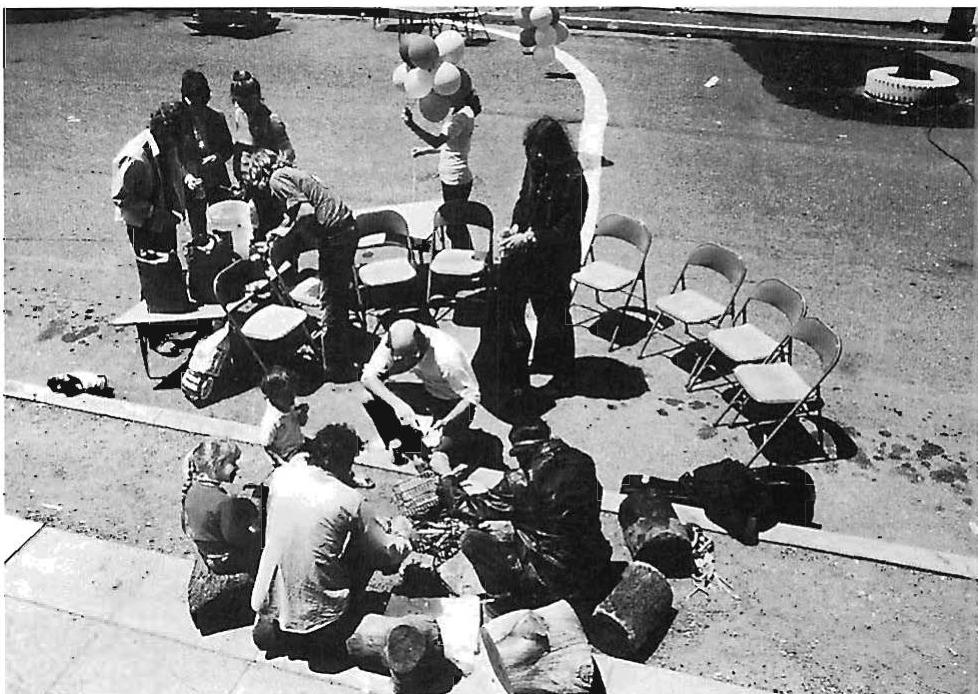
1 / A SHARED VISION
True belonging, the feeling that the Earth is ours and that the community is ours, comes—and must come, I think—at least in part according to the degree to which we have a shared vision of our community. The community is ours because we share it; and to share it, we must have an agreed-on understanding of life there, what life means, how life is embodied in that place.
This means that to have true belonging in a place, people must share a vision of the place where they belong. And what I mean by true belonging is that this vision goes beneath the surface, expresses not only the obvious practical matters that people easily agree on, but expresses, too, the inner longings, the dreamlike aspects of life and the environment which people yearn for, want around them, want as the vessel in which they might lead at least half-perfect lives. It is not only agreement about practical matters, but agreement about the deeper meaning of the place.
In modern times, such deep agreement is hard to get. Since people have different values, they have different visions of the world. Where, then, the agreement? In Book 2, and in other books, I have suggested that a shared pattern language which defines our generic centers, one by one, gives us the tool we need to reach agreement, at a profound level, about what really matters in our world. And because this tool lets us build the picture, one pattern at a time, we can discuss things slowly enough among ourselves, to get agreement.
This is something which can happen at a small scale and at a large scale. It is something which can take place on the smallest level among the members of family, or members of a business, trying to reach a picture together of what they want to do. It can happen at the very largest scale, the city as a whole—as it did in the famous case of what happened in Bologna in the 1970s (see pages 275-79).
Examples of such pattern languages are to be found in chapter 13 of Book 2 where I gave examples of a language for a high-school and university community in Japan, one for a downtown area in Samarkand, and one for a housing area in Peru. In each case we see how the emotional and cultural specifics of the place are embodied in a straightforward way for the people of the place, and how the language then became the basis for the actions, buildings, houses, and public land and streets, and the way they are built. In each case, the idea is that the language of patterns captures the essential "soul" of the people and of the place, and gets the essentials fixed in people's minds strongly enough so that it can become a basis for their dreams, and a practical basis for acts of planning and construction by any number of participants, as the neighborhood gets shaped and built.
2 / THE PSYCHIATRISTS OF LETTERMAN HOSPITAL
This fundamental right, due to the people of any community, is not always easily given. Many years ago, about 1970, I got a call from Letterman hospital, the military hospital in San Francisco. A new psychiatric ward was to be built. One of the chief psychiatrists asked me if I would be willing to come and talk to him and his colleagues about the situation.
When I arrived, I was astonished to hear from the doctors the following news. The doctors in charge of psychiatry at the hospital had approached the administrators with the idea that they, the doctors, wanted to express their views about the layout and character of the new psychiatric ward: In short, about its architecture.
To their amazement they were told, flatly, by the head of facilities planning that the facilities planners had the matter well in hand, and that they, the doctors, would be given no opportunity to comment on or influence the design of the new ward that was to be built.
It was at that moment that they called me for consultation.
Of course I helped as much as I could, told them that it was quite possible, in principle, for them (perhaps with my help) to plan the layout of the ward themselves. But the administrators refused this help categorically. In the end the hospital psychiatric ward was rebuilt, without one shred of input from the people who, in principle, knew most about psychiatry and about the way the ward had to work.
This kind of thing was common in those years, and the story has often come back to my mind as an example of the absurd. Yet even so, even with my anger at the way the legitimate interest and knowledge of these doctors was suppressed, still I can understand it. Knowing construction as I do, it is not hard to imagine the attitude of the administrators: "We have to get the building built. Let's not invite comment or discussion. We can't afford to let these doctors into the discussion: God only knows where it will end up. We will never get the thing built. Let's just go ahead and build it, so we can get it done." These administrative fears, too, would have been realistic. If you look at the task of building from a builder's point of view, or from an administrator's point of view — especially in a large and complex project — the idea of involving users in the discussion, hearing their conflicting visions, trying to reconcile opposing points of view — can become a political and administrative nightmare.
No wonder participation by users is so often refused by administrators—in buildings and in towns. The refusal makes some narrow practical sense and business sense. Yet, even so, the refusal is still wrong. Such hands-on participation—
allowing people to shape their own world as they want it to be — is a natural right of people. And
it is the only way deep adaptation (and therefore ultimately, people's satisfaction) can occur.
3 / UNFOLDING AS A SOURCE OF UNANIMITY
Suppression of people's involvement in the shaping of the environment is not only wrong, above all it is needless interference. Participation need not be threatening to administrators. It does not wrest control from the people who must have control. Rather, it is a humane process which — when done right — can allow people to consolidate their needs in a coherent fashion which helps everyone.
Although interminable discussion about values, goals, and different points of view can unseat any social process if it is done in the wrong way—when the process is a disciplined process along the lines of the process described
in Book 2, chapter 13, these problems rarely happen. The main point, I think, is that the fundamental process, when used correctly in the creation of a pattern language, allows people, one at a time and together, bit by bit, to focus on their communality, to sharpen it, make it precise. This can happen because the process allows people to establish just one pattern — one generic center — at a time. So the deep agreement which lies in people is given space, and comes to the surface. The wrangling and confusion which makes administrators so fearful, only follows from a wrong-headed approach to the process of building consensus.
4 / START OF A COLLECTIVE VISION IN FORT LAUDERDALE
When people do sit down and discuss patterns together, one by one, the remarkable unanimity which comes from these discussions is often moving and profound.
During the seventies and eighties of the last century, the then prevailing rhetoric of pluralism tried to persuade us that because we are all different, we live in a world of competing interests, and that unanimity is not available or reachable. Yet the language of "interests" "conflicts" and "compromise," discussed by planners and social philosophers came chiefly from the special interests of particular players who want to do something one-sided — usually to do with money. It is these one-sided interests which have to be balanced, or negotiated — in my view, because they are not quite legitimate in the first place.
Ordinary people, who are not pushing a special economic interest, or other special interest, rarely have such profound conflicts. The reality of daily life, even as disparate and various as people are, is largely shared in its deeper aspects, and remarkably uniform. There is likely to be far greater feeling, among them, that what needs to be done is obvious and ordinary. Ordinary people (by that I mean people without special economic interests) usually do not have the same items at the top of their individual wishlists, nor do they have such ferocious allegiance to the items. Their items are softer and can coexist more easily, often without causing difficulty in the unfolding of the whole.
In February 1996, shortly after giving a speech in Fort Lauderdale, I held a community workshop for members of the Progresso commu
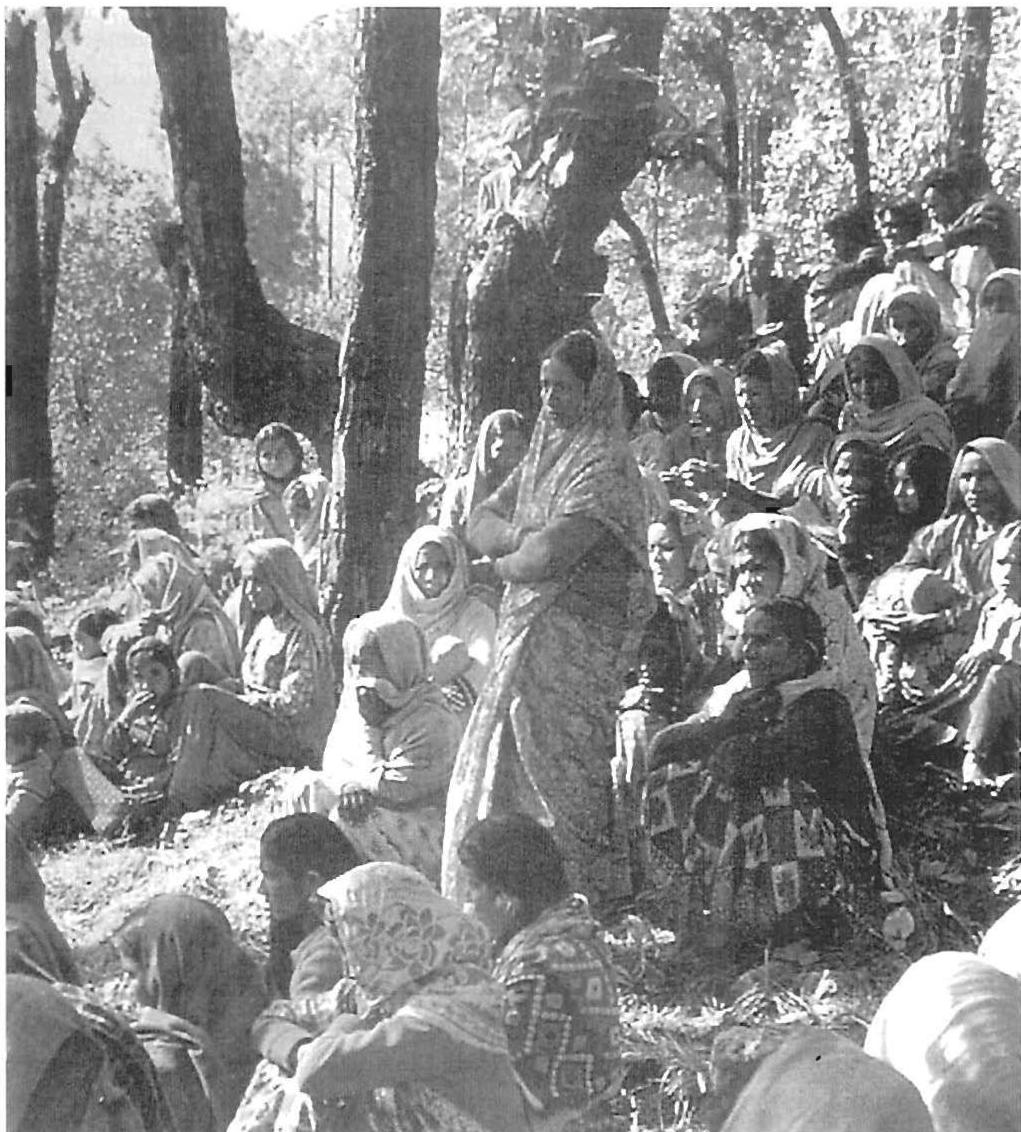
nity, one of the city neighborhoods. About fifty people from the neighborhood community came to this workshop. I simply asked them what was in their mind as a way forward, what issues were most vivid in their thinking, and which generic patterns were (in their eyes) most important to the future life of that community.
Here are my notes on the issues that they raised. They are shown in random order, as I wrote them on my notepad during the discussion:
New type of zoning.
Encouraging smaller land parcels.
New concept for the district, in terms of ownership.
Keep homeless encampment out of Progresso.
Start a connecting thread between businesses with economic success and expand this thread into a visible thread in the community.
Get Haitian community members to speak on their desire to buy.
Outreach to the Haitian community.
Mixed use with no pressure created by divergence between regulations for residential and regulations for commercial.
Do something about the exorbitant cost of land. Make it a mixed use area. Get backing to provide low interest loans in special zoning category of mixed use, if established. Provide opportunity for low interest loans. Bring down the cost of land. Change zoning to allow small lot projects to occur. Find ways to avoid federal and state regulations of code enforcement driving up the cost of projects in the area. Need for an overall plan. How to start abating the blight. Need an improved police presence. Places for children to be safe. Town houses and brownstones near to downtown for people who are in downtown and can walk to work. User-friendly code departments and planning department. See city staff as your partners who will assist you. Habitat will contribute if lots are donated by the city. Get Habitat to target the project neighborhood. Encourage development of small improvements before attempting larger projects.
These comments are transcribed verbatim from the comments made at the workshop, as I wrote them down. Of course these comments are only a sprinkling of what was undoubtedly felt by others who did not speak, but even as it stands it is consistent, one feels a consistent theme, like a gentle beat, running through these comments. It strongly suggests the beginnings of a consistent cross-sectional view, the beginnings of a common pattern language for the people of the Progresso neighborhood.
Consider the following examples of generic patterns which were then pulled, one by one, from this list which members of the community had given of themselves and their concerns:
- Smaller houses (funded by low interest loans)
- A thread of businesses and shops
- Mixture of shops, businesses and houses close together
- Many small improvements
- Smaller parcels of land
- Small projects
- Children's areas
- Town houses near the south end
These ideas—only crudely formulated here—were the first eight items on a first list of patterns that were considered by the neighborhood. Each one would merit detailed discussion; and would no doubt change considerably when subjected to careful discussion. But, going through them one by one, and thus unfolding the generic patterns from the present awareness of the community—the agreed elements that could bring life to the community—then the subsequent unfolding would gradually improve the place.
It was not hard to get these generic patterns from the discussion. And, as you can see, working at this level of detail, with discussion of geometric patterns one at a time, there is very little conflict; little argument to suggest that any of these patterns that are being brought forward, are objectively invalid.
Within a few hours, we already had the beginnings of a broad agreement.
5 / DESIGN CHARETTES
The process of taking individual generic patterns one by one, getting them right in isolation, then gradually adding them to a "bank" of good patterns, is quite different from the process that used to be followed in late 20th-century community design: the so-called design charette.. In the charette process that is typically followed, an architect enters the community and gathers people around, then people draw together on a huge piece of paper, often butcher's paper, with
colored pencils, all trying to put their ideas and visions into the process. This design charette is intended to create communal agreement, and a communal vision. Such design charettes have been used and documented widely.
The problem is, that this charette procedure creates an illusion of communality and of understanding without necessarily creating the real thing: true understanding. Because the drawing comes too fast, it is playful, creates a sense of participation. However, the actual design is then inevitably drawn by the architect in charge, and is at best an interpretation—often differing widely from what people meant—that gives enormous license to the architect to draw his/her own fantasy in place of the real intention of the community members.
At its worst, the practice of design charettes is a kind of political scam which is meant to create the sensation or impression of cooperation and collective work—but actually does not. This rather postmodern approach, in which it is the image of what is going on that matters, not the reality, can be disastrous, and I have seen cases where it is little better than disgusting. Yet important architects and socially conscious individuals nevertheless continue to promote it, as a socially constructive and valuable way to conduct community involvement.
What is still more serious, the medium does not work. A drawing is not a good medium for a process which requires serious and mature reflection, one item at a time. If, for example, it is true (as it was in Progresso, see pages 295 and 299) that people want smaller lots and smaller projects, this needs to be discussed as a topic. It needs to be thought through carefully, debated and considered, with pros and cons expressed. It is difficult or impossible for that to happen in the playful atmosphere of a charette communal drawing.
Suppose for instance, as happened in the public charette for the Santa Cruz (California) pedestrian mall in 1989, after the earthquake, a participant says that it is a nice idea to have a clock tower to walk towards. He puts it in on the drawing, and draws a nice blue clock tower, in blue magic marker. At that moment the issue moves on, someone else puts something else in. These kinds of things are pleasant, occasionally inspiring. And they may also be charming, as in this case.
But just because they are charming, they cannot be called parts of a collective vision. Consider a different, perhaps more important issue: What will make people walk up and down this important pedestrian street? This issue depends critically on the precise positions of parking lots, relative to the beginning and end of the pedestrian street. That kind of problem, simple enough to understand, yet relatively complex to get right, cannot find a real expression on a charming collective drawing. Yet getting it straight is just the kind of thing which needs to be part of the collective vision, since it is on this real matter, which is hard to implement, that the success or failure of the pedestrian street place will ultimately depend.
And even the clock tower hides a deeper, and possibly important reality: the idea that there may need to be "something to walk towards." That idea is legitimate, and may well be shared; or anyway might be shared, after enough discussion. But the clock tower (to people who have never had one) is an image, a cute, private idea, Hollywood in nature, not something truly collective. Yes, the abstract truth which lies behind it might indeed be an element in a shared collective vision, and could be captured by words and by careful discussion. But as an element in a drawing the clock tower itself is in its nature somewhat childish, not general enough and unlikely to fuel true success. It may be harsh to say it, but it is just not deep enough to become part of a mature collective vision.
In short, it is only when generic centers — patterns — are considered one by one, carefully, thought through, envisioned, that people can arrive at things which are then mutually satisfying, realistic — a genuine part of their vision of the world. And it is only then that they are likely to be shared. Although the pretty communal drawing of a charette creates the illusion that this might be happening, usually it is not really happening.
6 / A COLLECTIVE VISION GROWING IN CHIKUSADAI
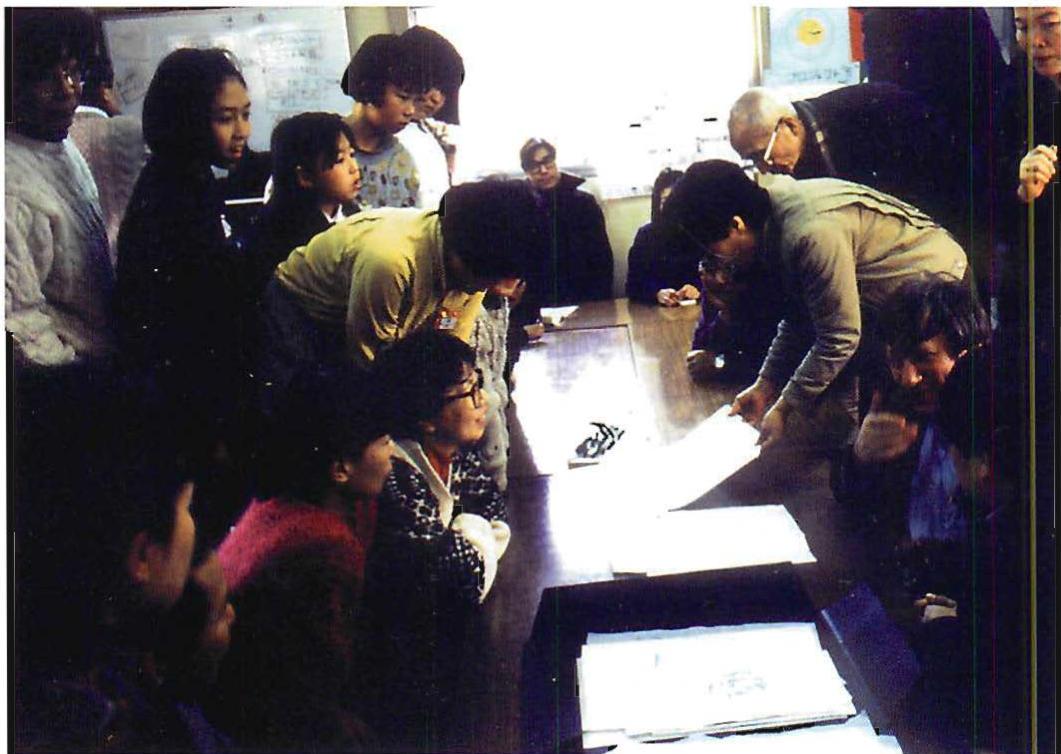
Let us go further, to see what it is like, and what happens, when we take generic centers one by one and discuss them one by one. In Hazama, one neighborhood of the Chikusadai district in Nagoya, I worked with members of a large community of several thousand people, face to face. The coherence and agreement of the community members created by the fundamental process was remarkable. As we discussed the important issues, one by one, there was strong and often detailed agreement about several quite detailed matters. Once again it was possible to cast in words the form of generic centers, which were then established as agreements, before they were acted on and put into the plan.
Some of the generic centers which were agreed upon included:
- Preservation of cherry trees.
This notation followed very fervent agreement — nearly unanimous — of the importance of cherry trees, and the preservation of these trees, since many cherry trees were planted at the birth of a daughter, and thus remain a memory of that daughter, lifelong. This discussion was in the context of proposals by the city to tear down the buildings in a crude fashion which would certainly have destroyed the cherry trees.
- Protection of insects: hence planting and preservation of those types of trees and vegetation which would support insects and cicadas
This notation followed impassioned discussion of the importance of natural life in the emotional health of the community members.
- The placement of school playgrounds on the main pedestrian paths through the middle of the community
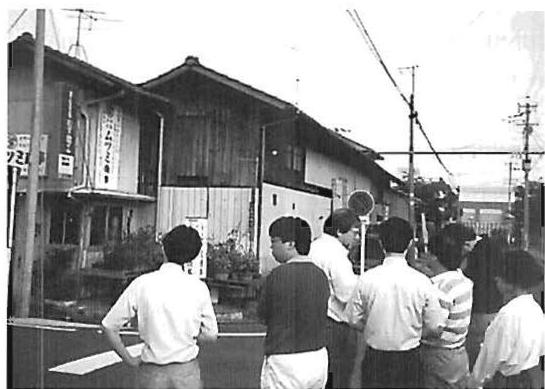
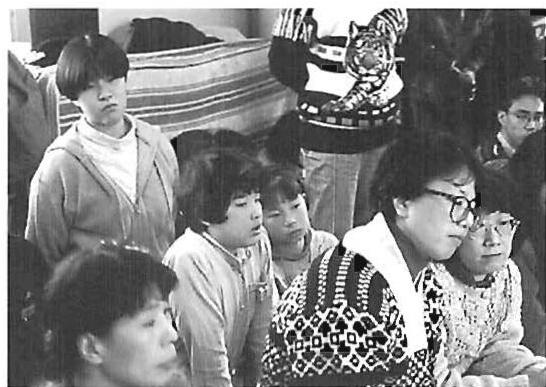
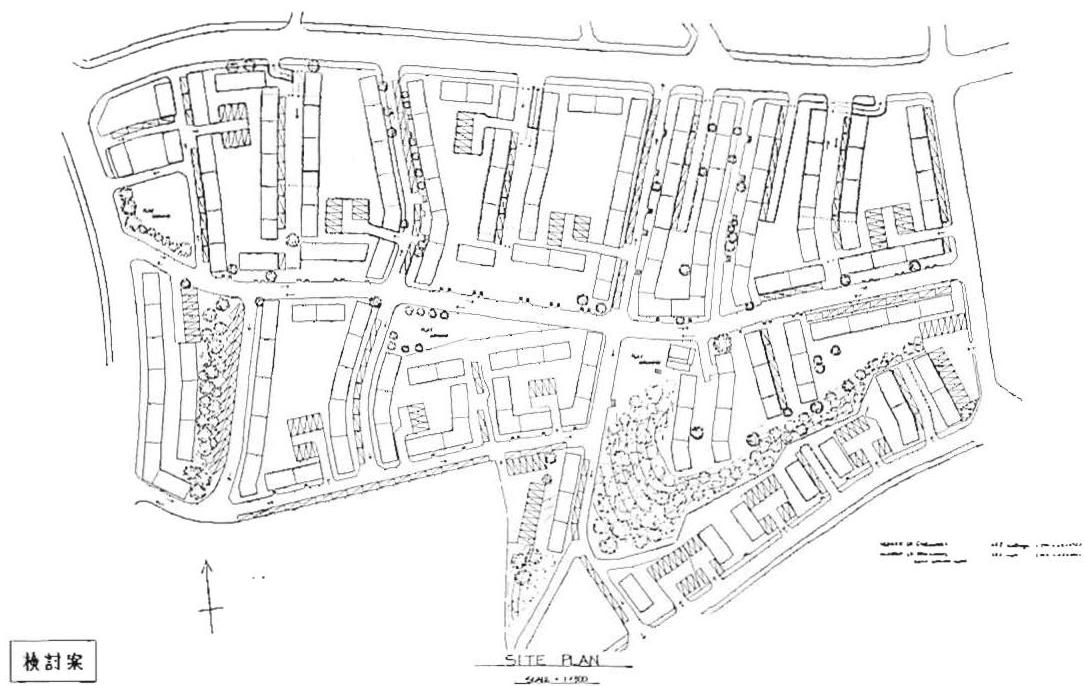
- Provision of narrow streets which would slow down traffic
- The best direction for the narrow streets, with regard to sun, wind and movement
This followed detailed discussion of the relative merit of lanes which ran north-south, and those which ran east-west, the idea being that narrow streets running north-south actually give more total sunlight into the windows of the houses.
- Location of parking at the ends of the main drag, thus creating more frequent opportunities for casual and informal encounters
I think it is clear from my description how different this material is, in depth of substance, from the kind of thing which could be sketched on a drawing in a single design charette session. This is about the aspects of layout which really make a difference to the way life can be lived. Here again, by talking through the various elements of their community, and by taking them one at a time, it was possible to get agreement one generic center at a time, from the use of the fundamental process.
7 / THE VISIONARY PROCESS
To go towards true belonging, we must also consider the deeper process by which people may draw, from their own experience, the aspects of the environment — its necessary centers — that will genuinely contribute to deep feeling in the environment.
If you ask me how to get the deepest stuff from people, the stuff which matters most, I would not have them meet all together, under conditions of imagined communality. I would rather talk quietly, to one person at a time, drawing from each individual his, her, their most important feelings, and their most authentic visions.
If I were asking a person, for instance, to describe the best treatment for the fire-prone wilderness of Claremont Canyon near Berkeley, where hundreds of acres of farmland have turned to brush and forest in the last half century, I would ask that person, first, to imagine the most realistic conditions under which he might be in the canyon — depending on where his house is. Perhaps driving through, or walking, or sitting, or visiting.
Then, once this was concrete and real, between us, I would ask him to close his eyes, "Imagine now, that you are doing this thing" — driving through, say, if that was this person's choice — "What is it about the canyon that would raise the deepest feeling in you, as you make that drive. Imagine that you have just done it, you have driven through — and for some reason — it has had a profound effect on you, you feel completed, healed, illuminated. What was the canyon like, to make you feel like that?"
"Close your eyes, close your eyes, keep them tightly closed, and imagine that drive through the canyon, and imagine coming out at the far end, with a feeling of peacefulness and illumination. What was it that made you feel like that? What aspect of the vegetation? What was the road like? Were the trees wild? Were they cut back? Was the brushland tamed? Just tell me what you see, with your eyes closed, that would put you in that state?"
Talking like this to people, persistently asking them such things, until they tell you something true, working at it, working at it, until the thing they tell you is authentic. That is the way, one thing at a time, to get the real juice, the real stuff that will make the place alive.
This kind of stuff, if real, is almost always universal. Once one reaches that level of depth, what is being said is then rarely idiosyncratic or private. It moves from that realm, enters a new realm of psychology, reality of feeling, becomes something which will raise a deep effect in all of us. At least, that is my experience.
We see from this example how much hard work has to be done. I think this work has to be done by an architect. Or, if you like, an architect-psychiatrist. A person, anyway, who cares about people, who cares about the real forces flowing in people, the real visions which people have in them, who loves those visions, and who is then willing to write those visions down, step by step, one by one, in the form of a communal language which can be used and shared by everyone in that community.
8 / A COLLECTIVE VISION ACHIEVED AT EISHIN
To pursue this idea of reaching a collective vision about archetypal matters, in greater detail, I’ll go back to the example of the Eishin campus that my colleagues and I built in Japan. I want to describe the physical and social circumstances, while we were doing our work. Then, if you will, you can extrapolate from this example to the typical urban situation in your home town or in the city where you live. I hope you will see what I am driving at.
The area of the campus we built is about 900 feet by 900 feet, roughly some nine city blocks. It was a small high school including a college extension to university education, and has some 1500 students. Originally the school had been located in Musashino Shi, near downtown Tokyo. Then in 1981, the school authorities decided to build themselves a new campus because they felt a need, as they explained it to me, for a new culture, that is, for a new way of living which they could share.
I started out to describe, with them, what would be the essence of a life worth living on that campus. The process I am talking about here is that we created, with them, a unique pattern language for a particular neighborhood — a verbal statement, shared by the people of the neighborhood, that in effect catches hold of what the people in this community, and in their commonness, have in their hearts.
So how did we begin? What was the pattern language all about? We sat with people representative of that community—must have been 100–150 people in all, faculty, students, administrators—talking. At the time of our discussions they lived and worked in an urban school that was very much like a New York asphalt jungle: a cell-block approach to school architecture, with a big building in the middle, asphalt all around, and that’s it. In our discussions we started talking about what life might be like if, instead, it was a kind of a campus that people really wanted.
They were not quick to answer these questions. It was hard for them. Sometimes I remember having to tease things out of people. They would say, “Well, what do you mean, What do we want? A school is a school. What am I supposed to tell you?” It was almost as if there was a reluctance to allow the private poetic vision that each person had within them to come out. Perhaps because it was embarrassing, or it was too soft-hearted or it was too dreamlike. I remember at one point, I noticed that I could see something in a particular person I was speaking to. It was one of those discussions: “Well, what is there to say, it’s a school isn’t it?” and so I patiently went into the thing with him and I said: “Look, try to forget about this school that you are in now, completely forget it, and just imagine a place which feels like the most wonderful place you have ever worked in. . . . and in which, for you as a teacher, it makes you happy everyday that you are there. What is this place like?” Still the answer came back, “I don’t know.” So I had to push a little further, and I said: “I really want to know, I want to know what is in your heart, and I’m not going to stop talking to you until you tell me.” And then “Look, if it’s too difficult just close your eyes — then just see it. Close your eyes and tell me what you see. Imagine that it is wonderful in your own terms: You didn’t know that it was there, and you suddenly came upon it, as if by accident. What is it that you found?” And then at some point the man I was talking to said: “Ohhh! You know, I imagine myself walking along a little stream between classes, I’m just thinking of my next class and preparing for it and so I imagine walking by this little bit of water and then sit down and have five minutes and then go into my next class.”
Now, when I finally got that from him, when I finally got to that level, then that statement found its way into the pattern language we were making up. The idea of a place with water, where a teacher could wander between classes, was now part of the collective dream. It was included,
finally, because we discovered, soon, that it spoke, too, for all the others — and they accepted that it was part of their communal dream. So altogether the pattern language for that campus is really like a poem of two hundred statements going from the very, very big things about this place all the way down to the little tiny ones about window sills and plants and so forth. It describes in almost poetic but concrete fashion what that world could be like.
Remember now, all this was written before we had designed anything. At that time, we were still trying to imagine the new campus, in our minds.
The beauty of having a verbal picture like a pattern language is its elasticity. It is easy to take its elements apart. This comes about, above all, because the picture is drawn in words. A drawing is too monolithic; even when it contains separable elements, it is much harder to take its elements apart or to discuss them separately. But with a picture made of words, you can discuss
the elements one by one, throw some out when they don't work, improve them, work gradually to a proper understanding and agreement based on debate and refinement.
We had a committee of faculty and students that was representing this process—a committee of about ten people. They used to meet with us discussing the pattern language as we gradually put it together. Finally, when there was a general agreement in the committee about an item, then that item would stay in; and if there were points that were debatable or arguable, there'd be some pretty ferocious discussions . . . until it got ironed out.
That committee knew that they were ultimately going to go back to the full community to get the pattern language, as a whole, voted upon. So they were doing their best to represent what they felt was in everybody's understanding. It didn't take all that long. It took maybe three or four or five months, not a long time.
9 / WE CREATED: THEY CREATED
I must make it clear that the pattern language, though it came from the mouths and hearts of community members, was created by us. It was hard to create, an artistic and poetic task: but although it was we who wrote it, and put it to
gether, it was their dreams, their hopes, and their aspirations and desires from which it was made. So when they saw it, they recognized it as being theirs. It was theirs. And that is what I mean by a collective vision.
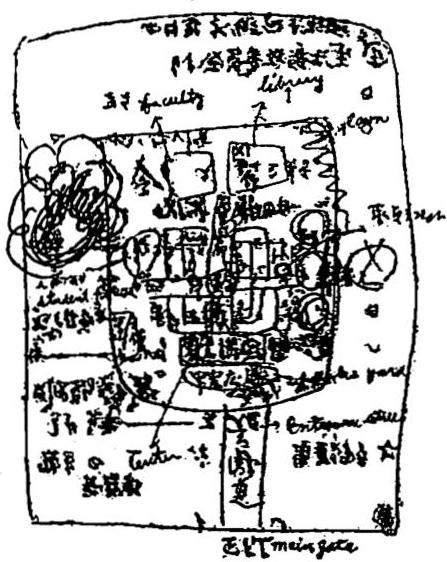
So in the end we reached an overall pattern language—a statement of the community's collective vision. To make it work, this statement had to be very physical. Even though it was all just words it really described what this campus was going to be like, to the point where after it had been created, discussed, hammered out and then finally voted upon and they said Yes. At that point I used to give this agreed-on pattern language to a particular student or teacher or somebody else in the community, and I'd say, just make me a drawing of what you think this campus is like now.
We still have some of their drawings. Each person could visualize the whole community. Of course no two people visualized it exactly the same. Often they weren't even nearly the same in detailed arrangement. But the drawings were all the same in the deeper sense that they all had the same broad structure. They all had the same main place where you came in, they had an entrance gate, and then a second entrance gate—because these were items in the pattern language. They all had a lake and a small stream because that was in the pattern language. They all had a
street where the high school part was; they all had a kind of large elongated courtyard where the college buildings were arranged, because these were in the pattern language.
So each person shared a level of communal understanding. In other words what was clear at that point were the main foci, the main buildings, overall density, juxtaposition, the nature of the buildings, how big were they, how were they related to each other, how people walked about. We knew for instance, at that point, that each classroom was essentially in a separate building (actually two classrooms per building, as we finally did it). So if people drew these things, they did so because they had already agreed that that was the way it ought to be.
So this picture, purely verbal, not very long, not much more than about ten pages long, represented the community members' collective belief about themselves, and about what they wanted that nine-block part of Tokyo to be. They knew then that it would support their life in the way that they understood it and wanted it. They felt then that it was worth going for.
Later they thanked us for building a new way of life for them, because they knew that what they had in that collective vision, and in the actual campus as we built it for them later, was indeed a way of life, and it was their way of life, the way they wanted it.
It is hard work to get a picture like this. But once you have it, it clarifies everything, it becomes a driving force, and the future layout of buildings and development of the site becomes rather easy.
In the Eishin project, once we all had our verbal picture, our collective vision, in the form of the pattern language, then we began to lay the campus out, bit by bit, on the ground. This involves a process which is quite different from the pattern language itself. You have a picture of the new community, you have a verbal picture of it, but of course it is quite another matter to fit that picture to the reality that is actually on the ground, step by step, bush by bush, there's a tree here, there's a beautiful view there, the wind blows a little bit too much over here and so on and so forth. So you are trying to set down this structure that you've understood in verbal terms — now you're trying to set it down physically on the ground.
What we did in fact, was to get a few hundred flags on six-foot poles, and then placed these flags, gradually, throughout the land until we had the structure of the public spaces: what I call (in chap-
ter 3) the hulls of the neighborhood. When we were done it almost looked like a samurai army on the move. But these flags allowed us to grasp, collectively, where one walked, which public spaces were formed in which places. We — and all the members of the community who came there with us — could imagine the public land, feel it, and walk through it. The spaces formed by the flags created the public hull, the public living rooms of society, for that community, on those tea bushes in their nine-block area. That's what we were doing with the flags.
I have come to believe in recent years that the public hull, the hull of public space, is probably best done by the builders with the help and cooperation of the individual families and businesses. But that is an act in itself, the creation of this public hull of space which is going to take the place of all those burnt-out parking lots and nowhere bits of street and asphalt and so forth that we have come to know as the open space in our modern cities. So we set that in place, too. Usually, it was the thing which we did first.
We also made a big working model of the
Eishin campus, in rough painted cardboard, at a scale of 1:100. It was about 10 feet square, and filled a whole room, yet it was quite rough so it could be changed and improved without harm. This model was there for everybody to use and work at. And we had this model in a room in the old school, where everybody could see it and look at it. Every day people used to come in and look at this thing. It made it possible to visualize the public hull, in physical substance, so that people could imagine how the individual buildings were going to help to form the public hull.
10 / THE VITAL NEED FOR A COLLECTIVE VISION
So the problem of collective vision remains: How do we get a vision of the city or of one of its neighborhoods which is a true vision, a true collective vision that is shared and held by everybody in the neighborhood?
I believe I have given the answer. Do it with the people, pulling the statements from their own lips. Make sure you ask each person, always, what is the deepest feeling you have about life, and what does THAT dictate. Go one pattern at a time, and when debate is needed, debate it, argue it out, one pattern at a time. Have someone — an architect, anyone trained like the staff members of the Center for Environmental Structure, who is not concerned to impose an egocentric image on the community — coordinating the work of putting this language together so that it can be made coherent and useful — and, if possible, poetic.
Do all this with a careful awareness of deep morphology so that — as has been explained in chapters 11 and 13 of Book 2 — the system of patterns and sequences becomes generative, capable of conjuring up a whole geometric world when it is let loose.
11 / THE ARCHETYPAL CHARACTER OF THE COLLECTIVE VISION WHICH WILL INEVITABLY EMERGE
The collective vision which emerges from a true unfolding process will not be just any vision. It would be absurd, for example, for a group of people to decide on the latest image from Time Magazine, and then to declare that this was their collective vision.
If the vision arrived at from the fundamental process is a true one — truly a vision — it will unfold from the people themselves, from their inner desires, from their own true nature. That means that it will be a real thing, a real wholeness that is expressed: and insofar as it is a real thing, a true wholeness.
That means, the collective vision will be a truthful and accurate vision of a living structure, which really is a living structure for these people in that place. It is not merely declared to be a living structure. It captures, seizes, the essence of being human there and then, in that place, for those people. It is, if you like, humanity embodied.
In Book 2, chapters 2, 7, and 13, I have discussed the fact that such a language, if real, will almost always contain supplementary to its patterns, most of the fifteen properties as transformations later used to implement the patterns, and that these properties will also be implicit in the geometry of the patterns themselves: I. LEVELS OF SCALE, 2. STRONG CENTERS, 3. ROUNDARIES, 4. ALTERNATING REPETITION, 5. POSITIVE SPACE, 6. GOOD SHAPE, 7. LOCAL SYMMETRIES, 8. DEEP INTERLOCK AND AMBIGUITY, 9. CONTRAST, 10. GRADED VARIATION, 11. ROUGHNESS, 12. ECHOES, 13. THE VOID, 14. SIMPLICITY AND INNER CALM, 15. NOT-SEPARATENESS.
These are qualities of the world embodied in any local form of the world that comes from the heart, and which leads, without artifice, to the simple forms of the heart, already discussed at length in Book I, chapter 5. It means, really, that when one of these collective languages is the real thing, it can then help people to create a world, for themselves, that is naive and sorrowful and joyful, almost childish in its essence, reaching to the heart of us, preoccupied with simple things, flowers, drinking a glass of beer in the parking lot, leaning on a wall, sheltering from the rain . . . essential things that make life more vivid, more intense.
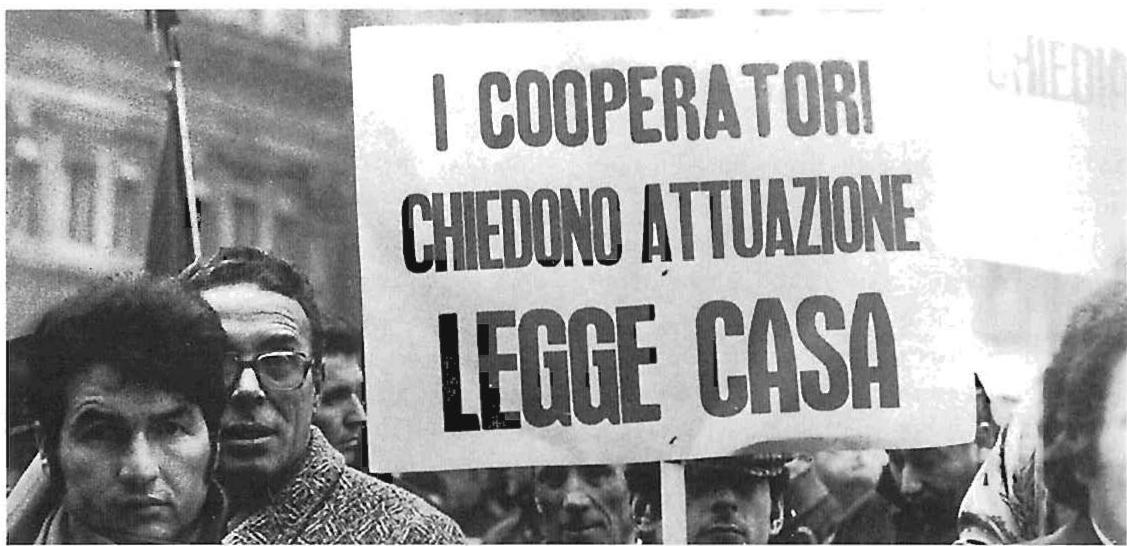
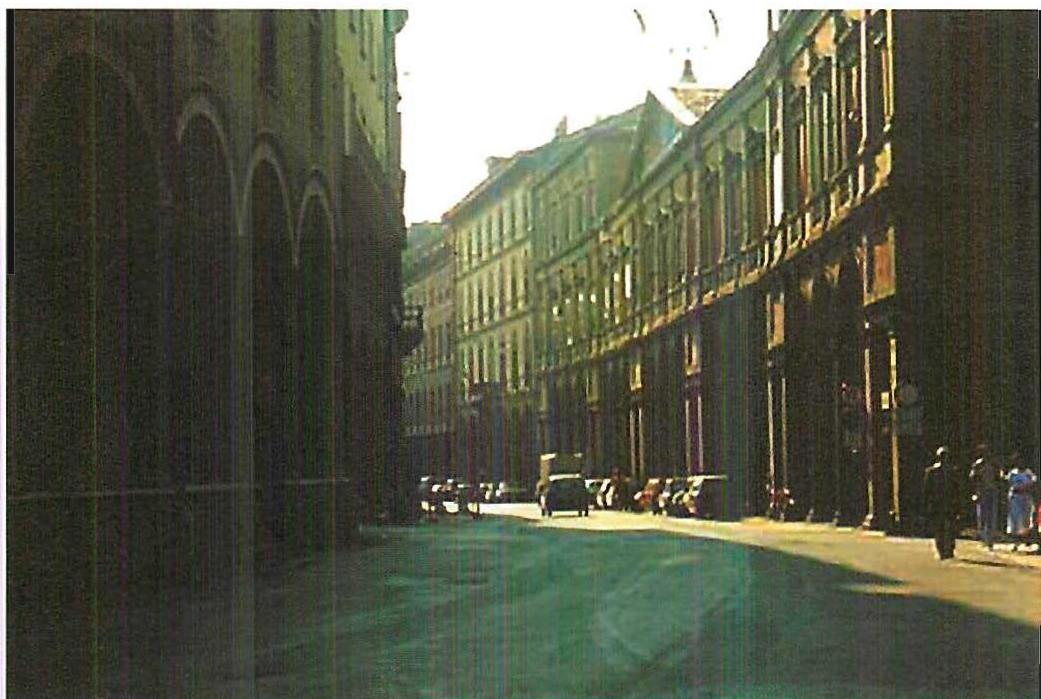
As such, this collective inspired vision will be recognizable — related, probably, to the material in A PATTERN LANGUAGE. It is more likely that it will have the truly living structure which causes people—when in the presence of this structure — to be more deeply conscious of their own lives, and of themselves, of their own feelings, of their own inner aspirations.
12 / BOLOGNA
Sometimes the creation—the demand for the creation and acceptance—of a collective vision will take massive, almost violent forms, in public arenas. Among cases that I know about, one of the largest experiments in the widespread formation of a collective vision was the movement in Bologna during the 1970s. At that time Bologna had a famous communist mayor. He was determined to involve people in the conception of what they wanted for their town.
Over a period of time mass meetings were held, enormous numbers of people were consulted, people were encouraged to express their views, and the city planning and building departments helped to build on, and implement, the consensus that was achieved.
The photographs on pages 274–79, showing this process at work, are impressive in themselves, merely from the huge numbers of people who were involved, and their evident intensity.
What the people of Bologna achieved was modest, but nevertheless impressive. It included the preservation and protection of the Bologna’s system of arcades, one of the most extensive systems of arcaded streets in all Europe. And it also led to the new construction of a housing quarter where a large number of buildings were built — apartments and shops — trying to continue the
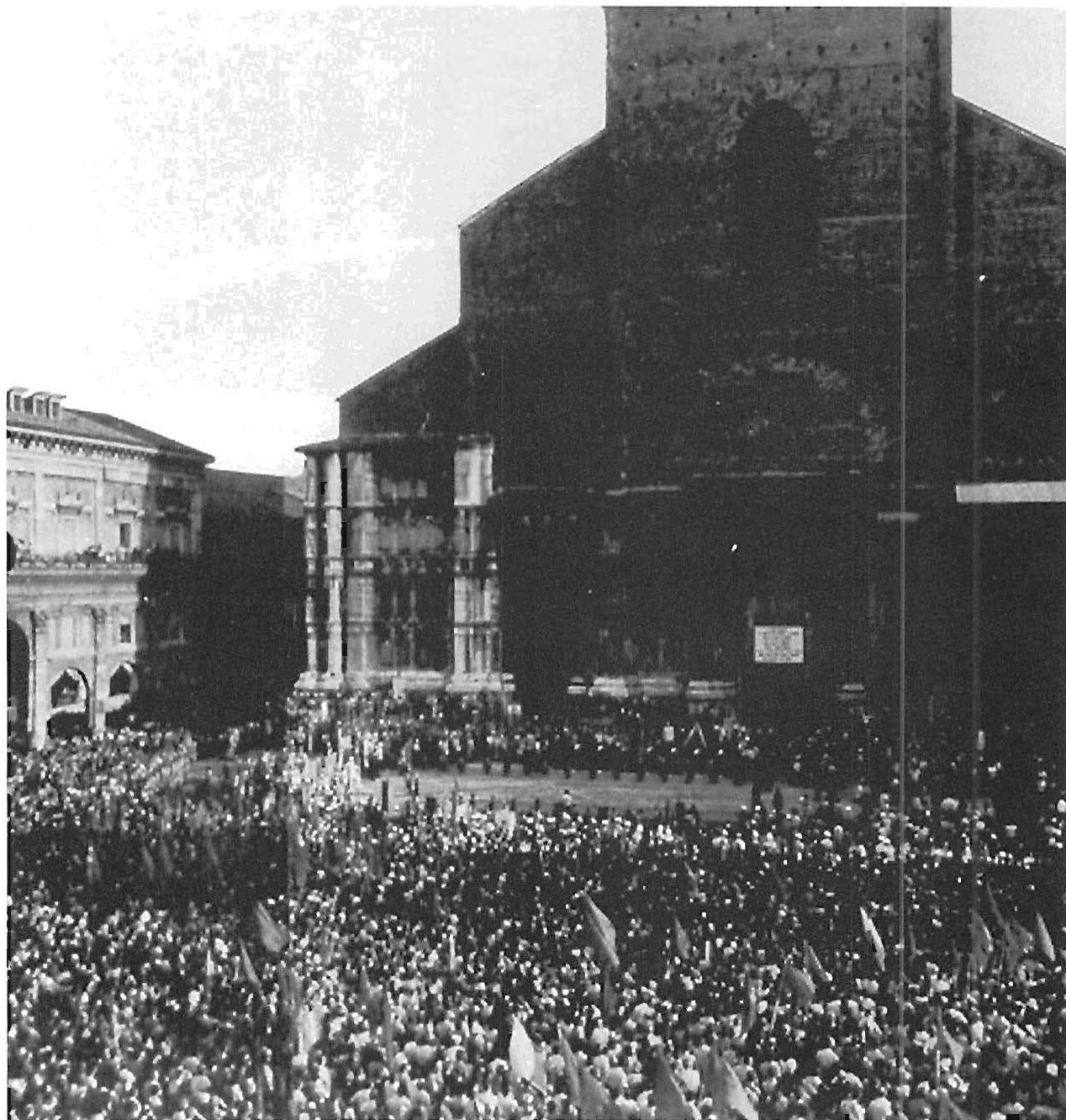
tradition of the typical volumes, walls, windows, and roofs, which form most of central Bologna.
I have not been able to find original documents containing the exact terms of the consen-
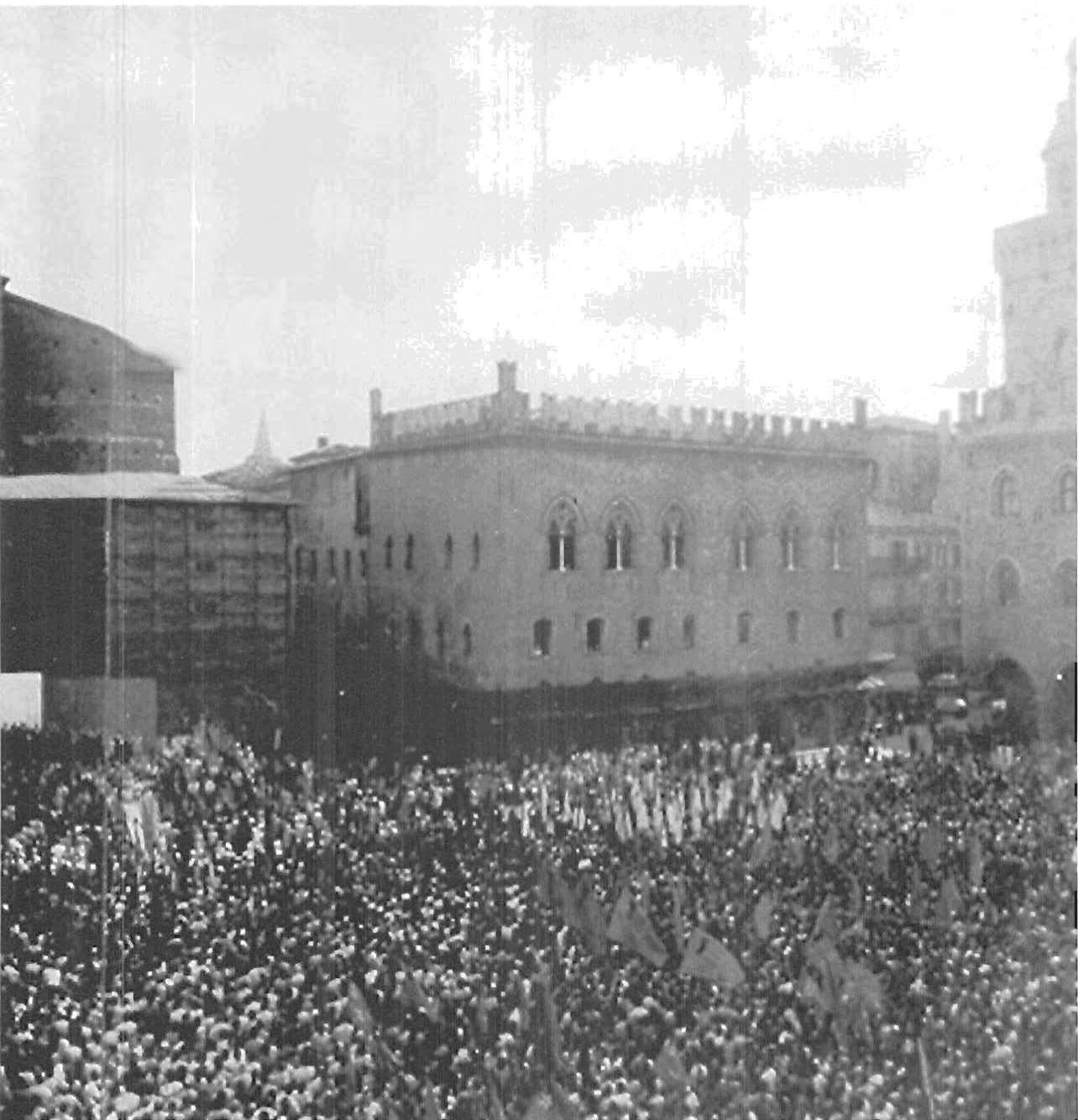
sus that was reached, but in principle, the few broad and general rules outlined on page 275
were introduced and agreed—and then acted upon. By political force, the desires of ordinary
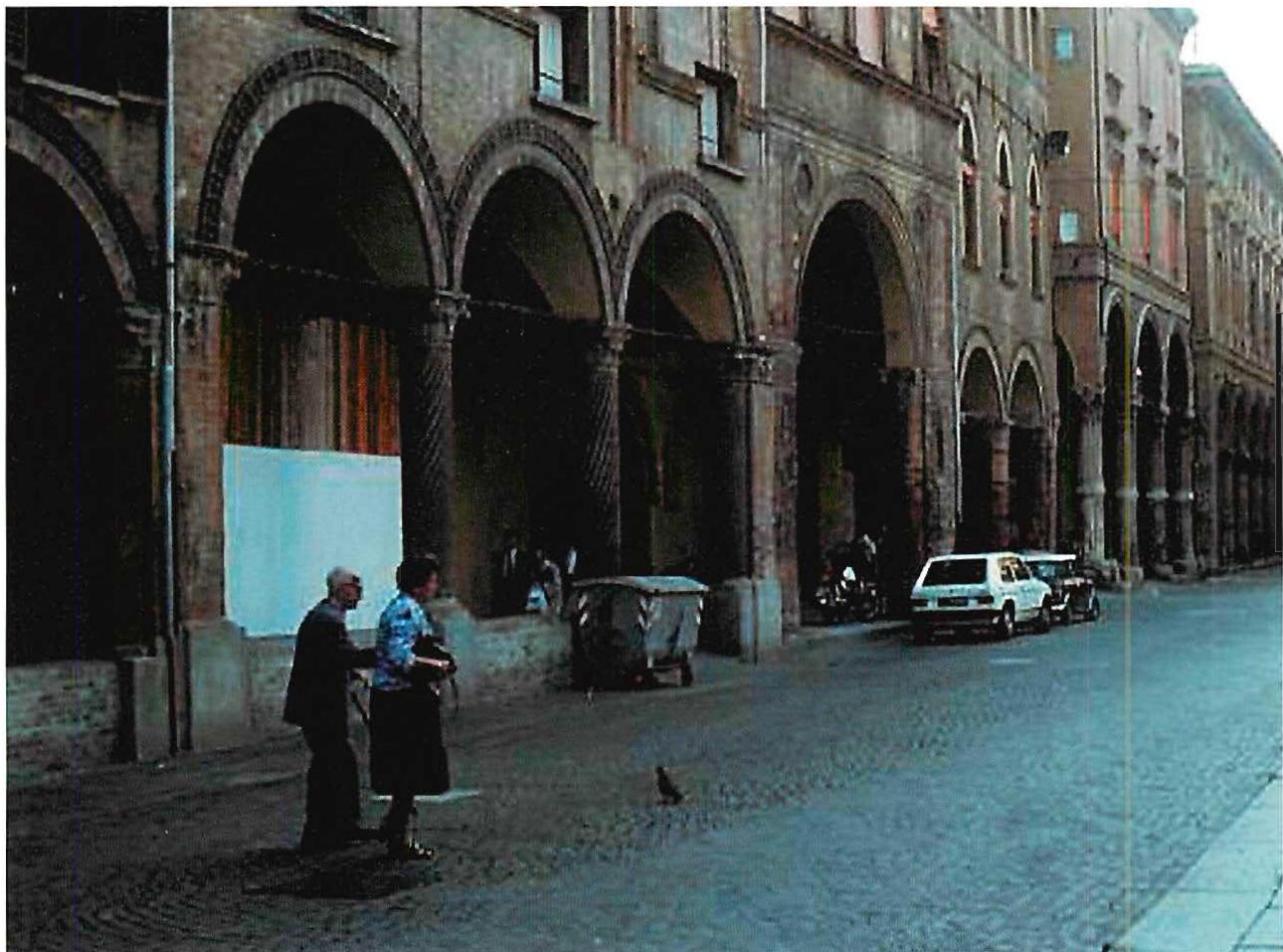
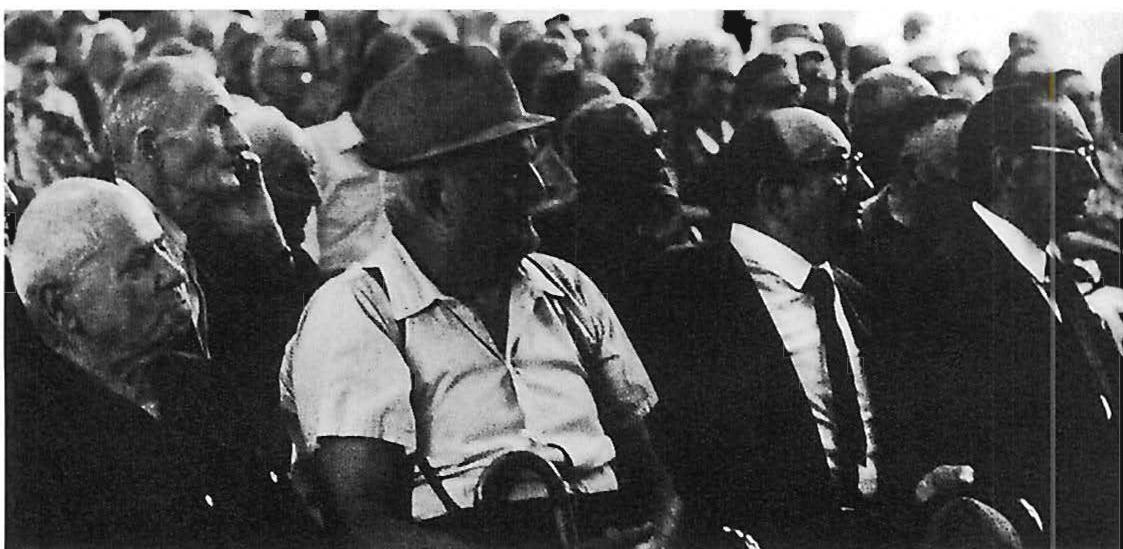
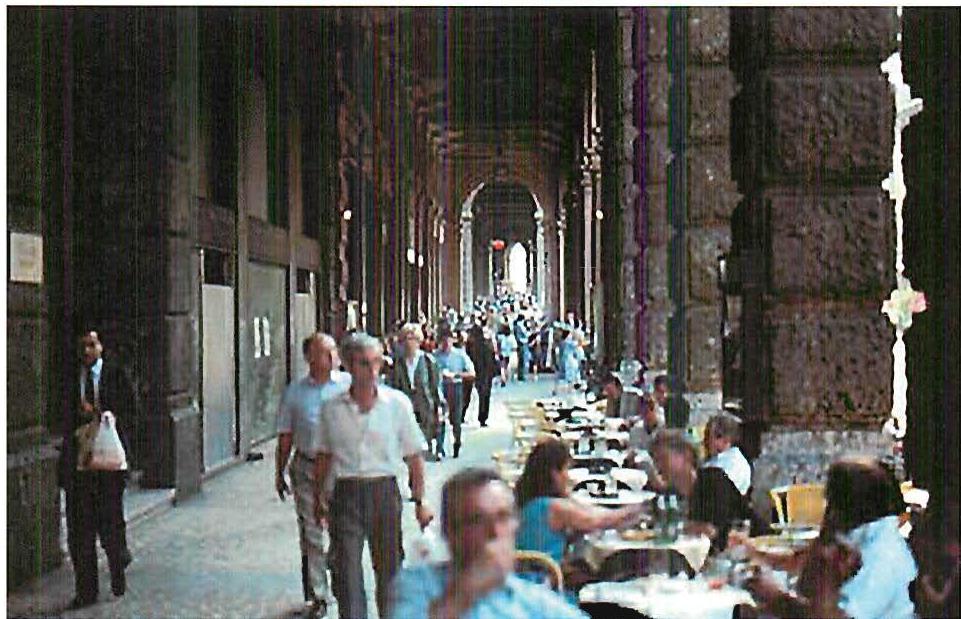
people took center stage. What happened in Bologna in the 1970s is a version of what I mean by unfolding, and of the living process the people of
Bologna used to obtain a collective vision, to agree on it, and to make sure that, at least in part, it would be implemented.
13 / THE SPECIAL CHARACTER OF EACH COMMUNITY CREATED BY THE COLLECTIVE LANGUAGE THEY HAVE MADE
How could I ever have guessed, when I began working with the people of Chikusadai in Japan, that they would, above all, revere the insects, that they wanted a world where insects — and above all cicadas — would be safe — because they felt that in such a world, once the insects are all right, then they, the people themselves — would be all right, too.
Who could know that in Frankfurt the clue to the inside of a comfortable German apartment is some kind of special entrance: a room that is near the stair and that everything opens from: living room, kitchen, studies, bedrooms — all opening off this one room; a special way that the stair comes to the entrance and that the rooms then fold off, from that entrance, not as in a conventional plan, but in a special way . . .
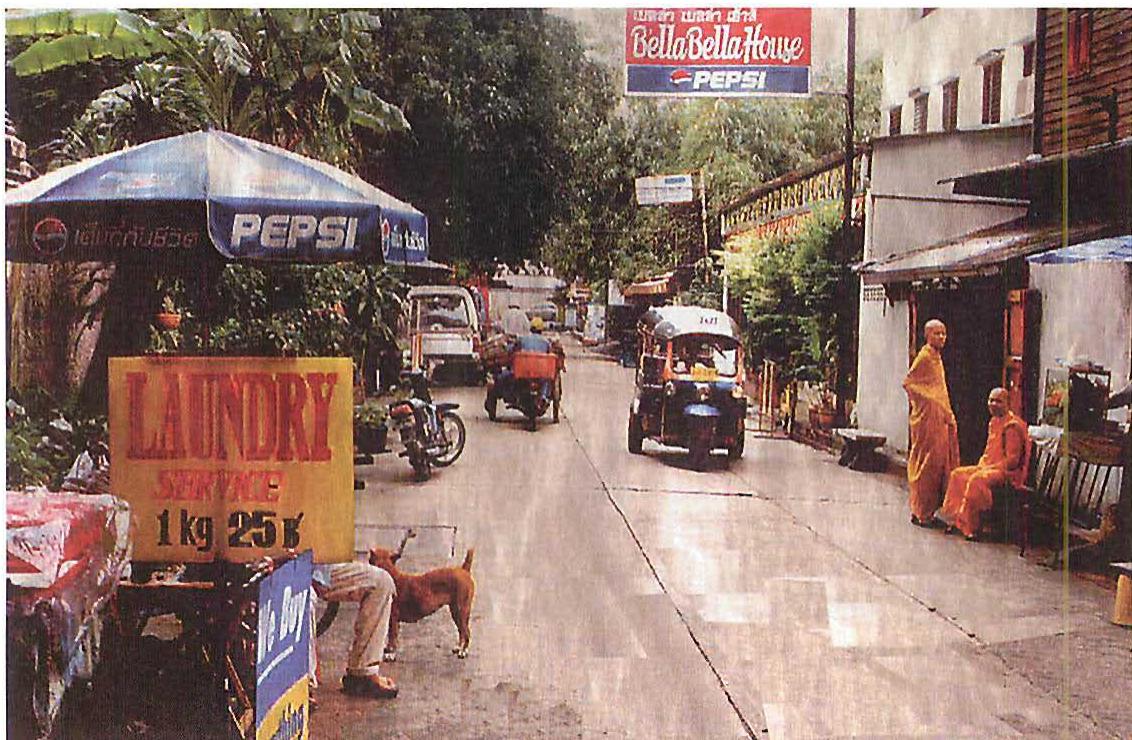
No outsider can do justice to these human phenomena. Usually, they can be described only from inside by the people who are part of them. The patterns, the idiosyncratic human reality: all this can come only from the people themselves. In many of the cases of unfolding I have initiated or been part of the quality of belonging to the world included — and often started with — responsibility, started with the dream of what it means to be part of a living world, one which satisfied desires, supported hopes, fully supported the inner necessities of life.
When people think about this, they CAN articulate it. They know what is needed to give them — for their place — surroundings in which life can be lived. And when they dream of a world, imagined by people for themselves, they come closer to a life which grants true freedom.
Using this knowledge, encouraged to say what they want and what they need, to dream about everyday life's necessities, together people have, in the examples shown in this book, worked out the rules and patterns which can then guide the form of their environment. It was their shared picture of the whole which guided them as they made decisions about the individual parts, and this — then — which allowed them to create true belonging for themselves.
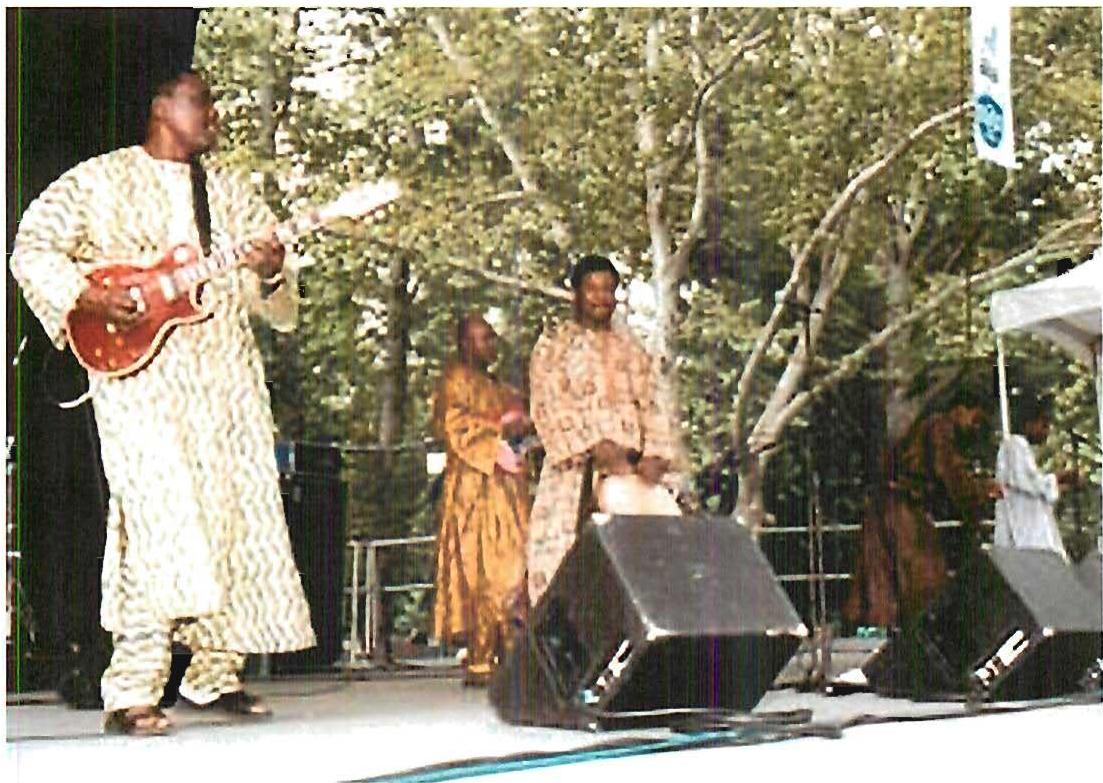
What matters — and what we must grasp, I am quite certain — is the idea that this process of working with others to obtain a collective vision of something that is going to be built is a FEASIBLE, reasonable process. It sounds difficult — like something half-unreal from the idealistic politics of Berkeley as it was in the summer of love in 1967. Yet, in fact, it is something which is not so difficult to do.
And it brings enormous rewards. Once it is done, people then genuinely have a common basis. The process of unfolding the environment, within the area covered, from then forward, has a genuine and solid foundation. Whoever you are, whatever your profession, I hope you will read this with the idea in mind that such a process is likely to be well within your reach, that you yourself, and other people you know, might undertake a process of this kind in something which is happening in your town or your neighborhood.
The collective vision which emerges from a pattern language created by a true unfolding process is not just ANY vision. When people are given the freedom to speak truly about their lives, they have an unconventional wisdom, an idiosyncratic quality, which brings forth unique centers, unique living structure in each situation. That is what we mean by their culture or their "way." It is a shared vision, not a typical one, not part of the conventional professional wisdom of architects and planners, more like the voice of Dostoevsky.
It is that differentiation among peoples and neighborhoods which, historically, has always made unique spots on Earth: Angkor Vat, the steel mills of Bethlehem, Pennsylvania, the culture of Cape Canaveral, the hang-gliders of Fort Funston south of San Francisco, the fishing and pearl-diving cultures of the China sea. Near Amalfi south of Naples there is the town of Scarpe: In that one tiny town there are 100 churches. In the horse-jumping championships held every year in Indio, in the southern California desert, for two weeks a whole town grows up crowded into trailers, people with horses, their riders, tents, small motorized buggies, and the show-jumping arenas.
It is the same extreme differentiation in each case, but always different.
Thousands upon thousands of unique human endeavors, often local, often particular to a small town, or to a neighborhood. It is this, which receives expression through the medium of a collective pattern language. It celebrates human uniqueness, the enormous variety of human effort, human desire, human aspiration.
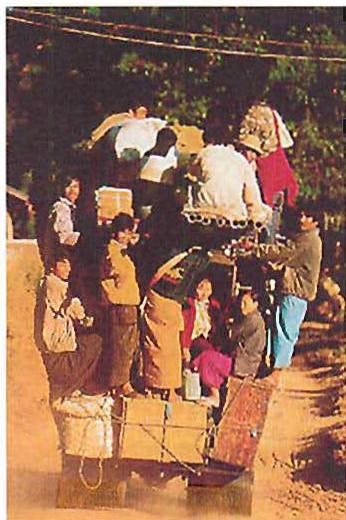
CHAPTER NINE: THE WAY THAT LIVING PROCESSES CAN GUIDE THE RECONSTRUCTION OF AN URBAN NEIGHBORHOOD
This chapter emphasizes the reconstruction of existing city blocks, not by large-scale development (which nearly always does damage) but by a process-oriented repeating generative sequence which builds and modifies the street pattern, changes density, and enhances economic life, while leaving the prospering same families and businesses intact.
1 / A GROWING CITY
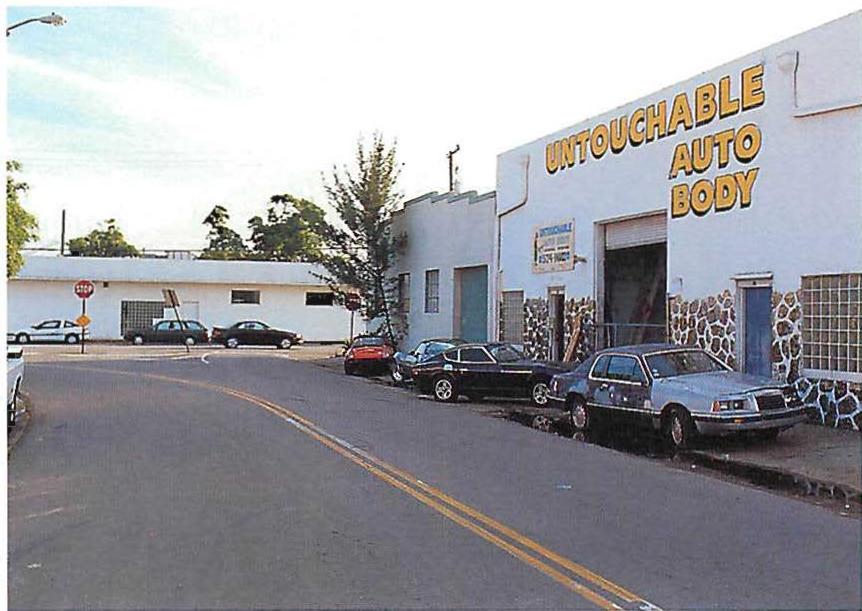
Cities today are not coherent beautiful structures. A city today is more like a rambling incoherent structure loosely placed on the surface of the Earth.
We must be concerned, then, with the way this rambling structure of development, misery, poverty, and elegance might gradually be transformed, and the process by which it might grad-
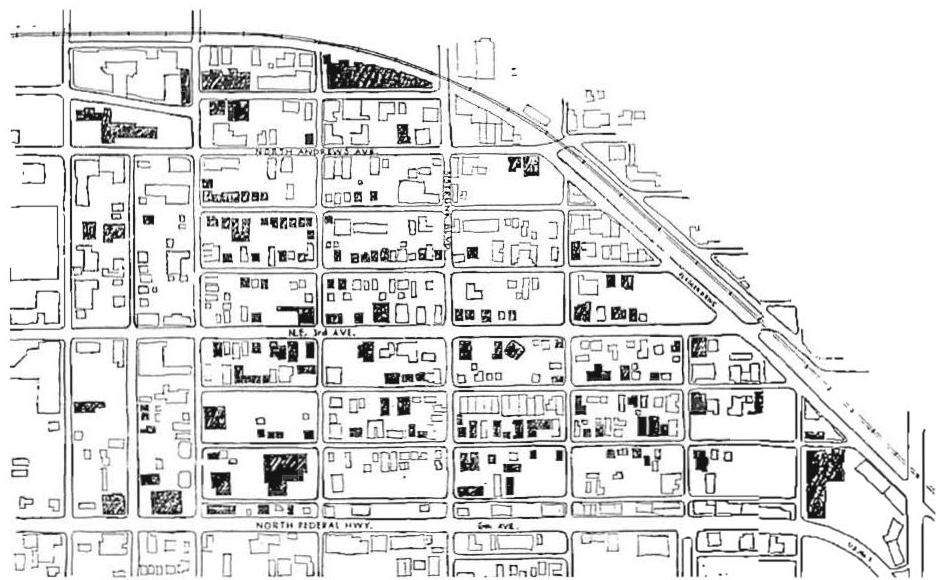
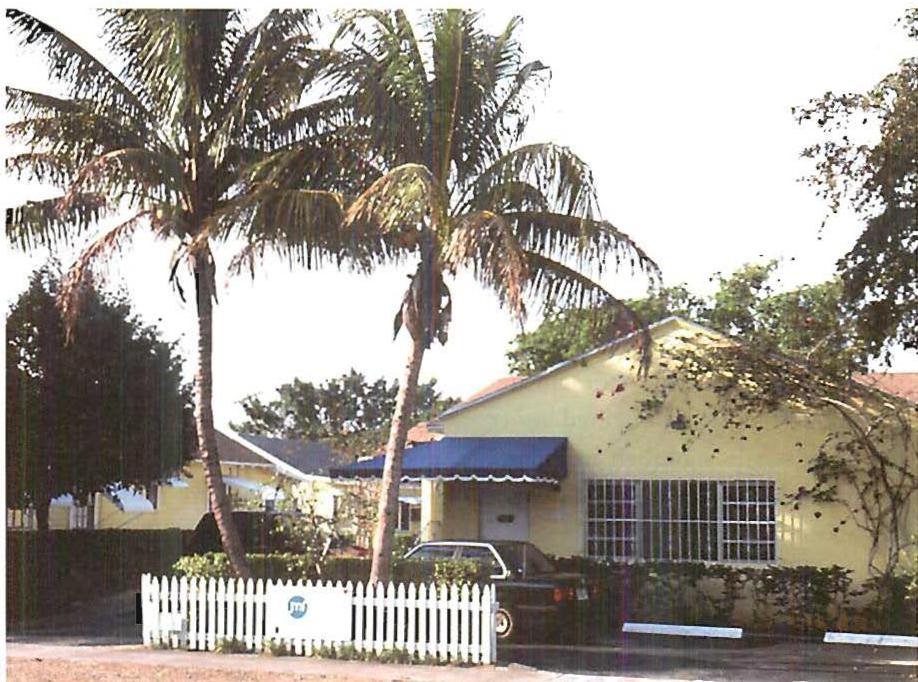
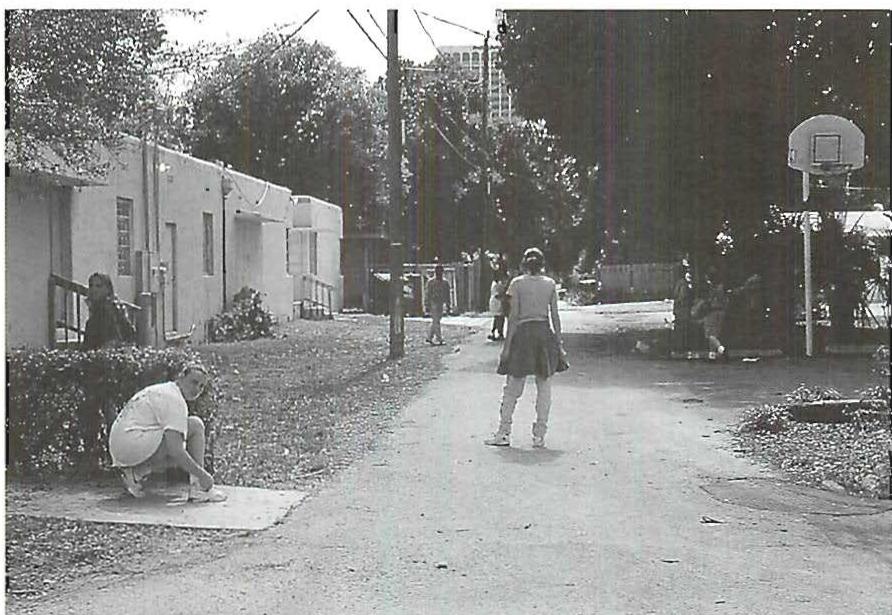
usually be reconciled with human needs, reconciled with the organic needs of plants and animals and climate, reconciled with the emergence of mass computer civilization, cars, trucks, and manufacturing.
How is this nearly random structure of the present to be transformed, gradually, to form a humane, coherent structure on the Earth?
Let us begin, now, with a neighborhood, and its capacity to nurture human feeling.
2 / ADDRESSING THE PROBLEM OF BLIGHT
In any urban neighborhood, creation of public space and private space, with a proper relationship between the two, is the critical issue. Yet in cities around the world, conventional city planning, the deterioration of public space, organization for cars, and modern methods of design and construction have left us with blighted inner cities and morbidly sterile suburban neighborhoods. What can we do to transform and rejuvenate these neighborhoods?
Even in the most blighted and congested urban slums, a suitable pedestrian structure can slowly be generated. Where it does not exist today, it can be generated step by step. A slum neighborhood can be transformed to create an economic, flourishing, safe world where pedestrian hulls (chapter 3) are growing and being strengthened and connected; where businesses are helped to support each other economically; and where building lots and land
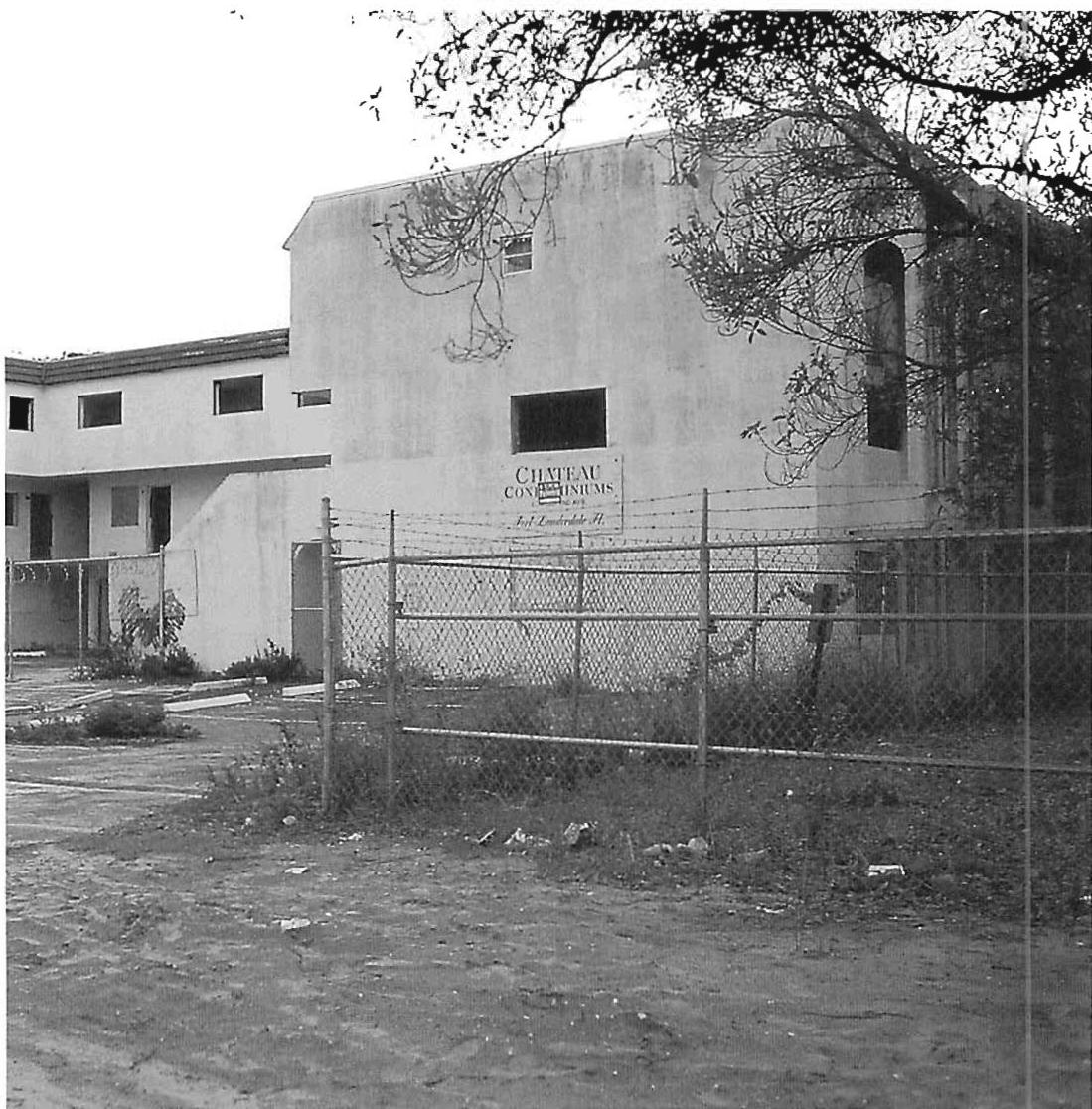
parcels have rules which encourage true human uniqueness to appear.
In the pages that follow I describe one particular way in which I have approached this problem in a plan for the rejuvenation of Progresso, a neighborhood in Fort Lauderdale, Florida.
The processes I describe are, I believe, living processes for a neighborhood, and show, I hope, a way of giving the power of gradual unfolding to a community in need of repair. They gain their strength from the repeated use of the fifteen transformations as applied to the tasks of redesigning space, building volumes, gardens, and local roads. The most interesting and important aspect of this process is the way that these transformations are made, in this instance, to work in time. My idea, essentially, is to show how the qualities we want in a neighborhood—its pedestrian structure, gardens, roads, communal life, and support for each person's private individuality—can be created step-by-step, by a sequence of actions carried out over many years, gradually, through hundreds of small steps, transforming an existing neighborhood of the type we have today into a living structure.
3 / A NEW KIND OF ZONING LAW, HELPING TO GENERATE NEIGHBORHOOD STRUCTURE THROUGH SUCCESSIVE TRANSFORMATIONS
Let us consider a dynamic system of processes which are capable of creating living structure in a neighborhood, and which work, above all, by getting this new living structure from the structure which exists today.
This program of transformation is consistent with the program of unfolding and with the living process, but it will show living process, in this case, in an unusual form which requires a few dramatic changes in the way we think of neighborhoods. It also requires, in principle, new forms of implementation which do not yet exist. For this reason I can, so far, show this living structure on paper only.
The discussion will show one way that serious thought about living processes requires particular detailed processes in a neighborhood capable of creating new configurations in land, public space, private space, property, building layout, and road layout. All this is to be achieved by new procedures.
The neighborhood geometry which results from these new procedures will be very different from the one we came to consider normal in the 20th century. However, this new geometry, I think you will agree, is a sensible structure which does address directly the twin issues of belonging: that is, belonging of a public nature to the community (which requires formation of a communal and coherent pedestrian hull), and belonging of a private nature (which requires that buildings are relatively small, standing on their own individual lots, and which may therefore be developed individually by owners, families, and businesses, seeing the world as they see it, embodying their vision of the world in the individual territory where they belong).
All this requires new kinds of zoning laws—laws which are created explicitly to permit this kind of dynamic unfolding, and which include rules and incentives that encourage the unfolding to work correctly. I shall return to this topic of the needed zoning framework on pages 295-310. For the moment, though, I ask that you get ready in your mind to imagine the events I am going to describe happening in an area which has an overlay zoning district that encourages new kinds of actions to be taken in respect to building construction, land, lots and parcels, and road development.
4 / A PROFOUND CONTRAST BETWEEN TWO VERY DIFFERENT FORMS
The plan on this page shows a four-block area in Berkeley. It is fairly typical of modern American cities. Versions of roughly the same kind of thing may be found in Africa, Australia, Russia, China, and so on.
The plan opposite, on the right-hand page, shows a simulation of the results which come from the type of living process which is described in this chapter: It has the same density, the same number of houses, the same number of cars. But it is entirely, one might say UTTERLY, different. On the right-hand plan, we see a project where there is informal uniqueness at every spot. The houses are
distributed to form pleasant spaces. The green areas to some extent work together even when they are private land. Above all, the pedestrian streets and paths (shown yellow) form a coherent center and subsidiary centers that give the neighborhood a communal quality, a heart. Cars do not dominate, they are the low man on the totem pole, and are squeezed in where they can be fitted, but are not allowed to destroy the neighborhood or its communal, living structure.
In contrast, the left-hand plan below shows a much more regimented scheme with land that is largely useless for human purposes. The roads
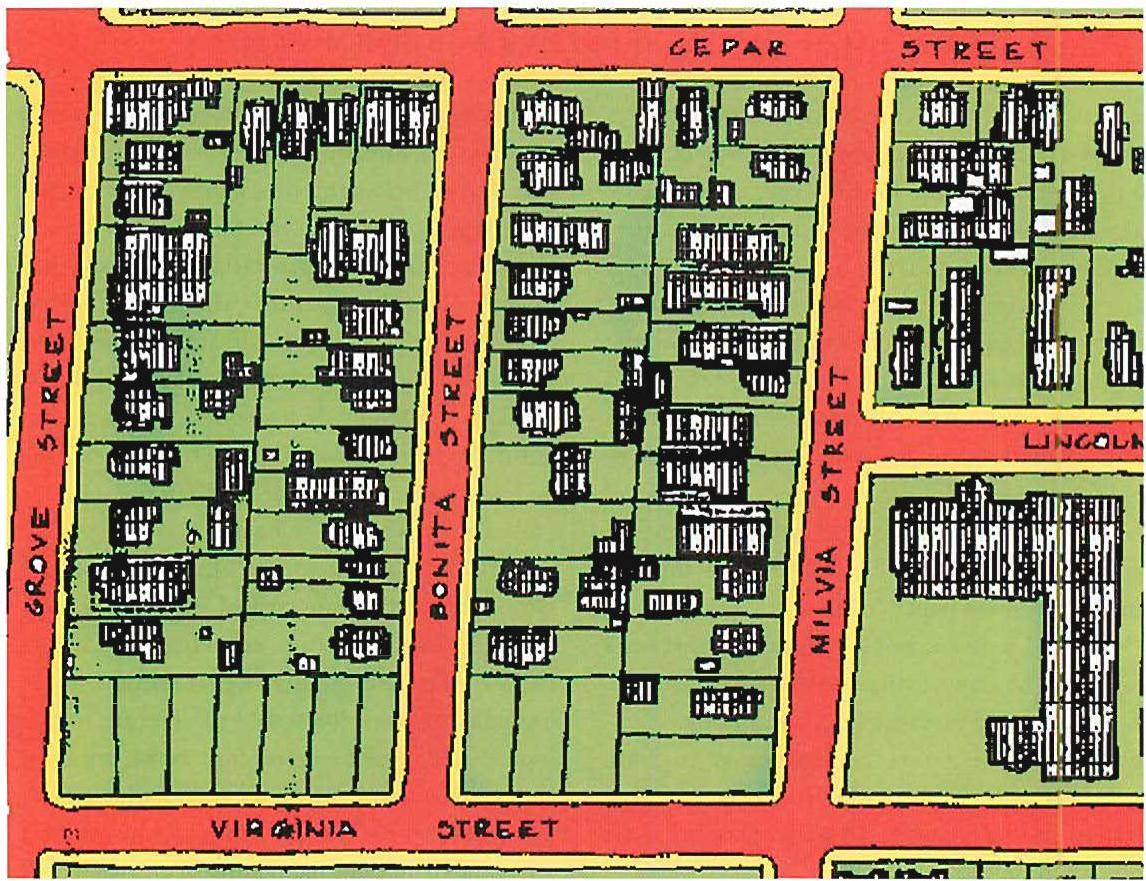
AN UNHEALTHY PATTERN: THE 20TH-CENTURY NORMA. This drawing and the one on the opposite page are drawn to the same scale. The gross quality of this drawing reflects the gross quality of the environment it portrays: a few blocks in a typical 20th-century American city. As in any American neighborhood, there are massive swaths of road cutting through the neighborhood (red); the pedestrian hull is minimal, on the thinly drawn discontinuous sidewalks (yellow). The gardens (green) for the most part are wasted as they surround the gray (bones) in areas too small to be used.
occupy the space aggressively. Cars dominate the public land. The sidewalks are tiny, as one can see from the slivers of yellow in the drawing: they provide little refreshment or opportunity for pleasure or human contact, discourse or play. The "gardens" are confined and made chiefly to satisfy a zoning setback regulation, so that even the private land is regimented, half of it useless, and none
of it cooperating to produce larger wholes of open space which might provide joy. Finally the houses themselves are regimented in straight-line rows, the only opportunity for real harmony with the land being the design of the buildings — but not their shape, orientation, juxtaposition, or their space-making character. All in all, not a very pretty sight, and not very pleasant to live in.
5 / THE PATTERN OF YELLOW, GREEN, GRAY, AND RED
In order to discuss these two cases comparatively, I want to direct the reader's attention to the overall structure of the main elements in a
neighborhood. Any neighborhood, looked at from the point of view of its global structure, may be considered as being made of four inter-
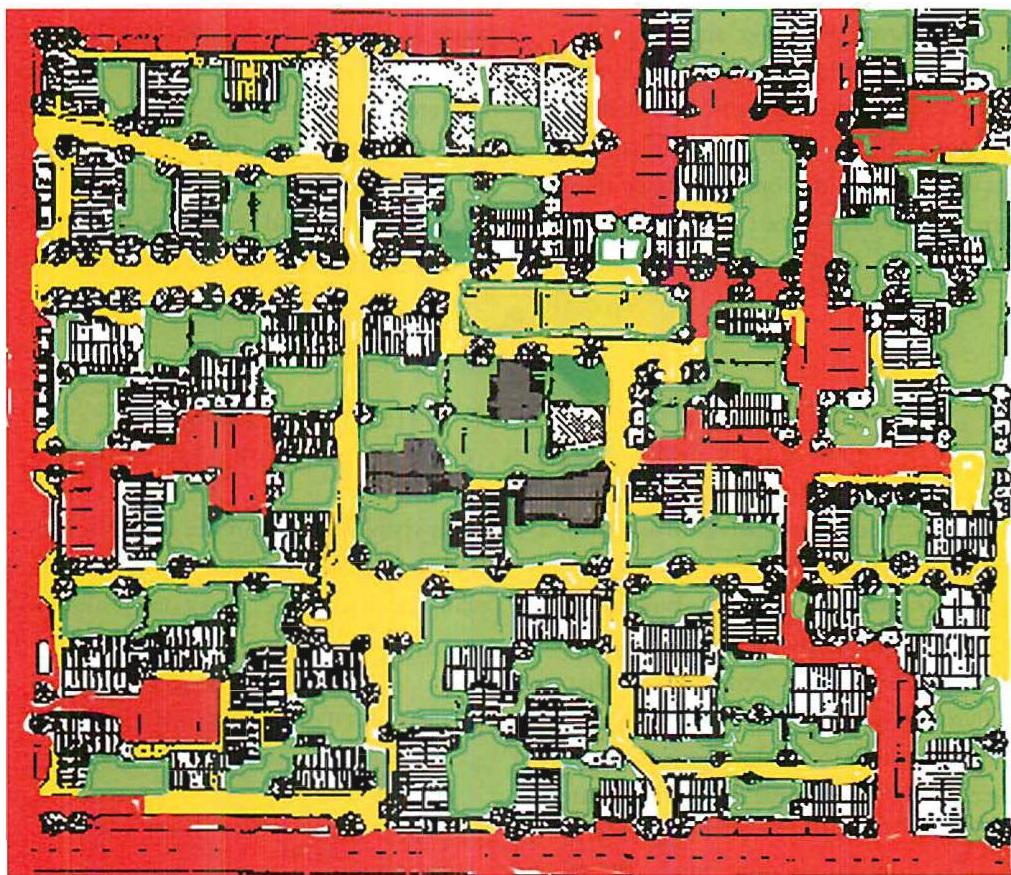
A NEW KIND OF NORME: A HEALTHY PATTERN: An imaginary neighborhood, about 450 feet by 600 feet, with some 65 houses, and perhaps 200 persons, at a density of about 10 dwellings to the acre. The drawing shows relative amounts of yellow, red, green, and gray which are quite different from the previous plan. There are large amounts of yellow, the green is coherently shaped, the red is minimized and discontinuous. In part, this plan simulates the process generated by the principles defined in the following pages. Christopher Alexander and Saul Piebardo, Center for Environmental Structure, 1996.
locking elements: Pedestrian space (including public outdoor space, paths, and pedestrian streets), Gardens (private gardens), Buildings (including houses and businesses), and Space for cars (including parking and roads for cars). These four kinds of elements more or less account for all the space in the neighborhood. They are truly fundamental, and any neighborhood gets its main character from the way these four elements are interrelated, interlocked, arranged.
The four are, in their way, as fundamental for a neighborhood as carbon, oxygen, hydrogen, and nitrogen (C, H, O, N) are the four main building blocks of all organic molecules. Just as every organic molecule is given its characteristic structure by the particular pattern and arrangement of these four elements—C, H, O, and N—so every neighborhood is given its fundamental character by its particular arrangement of Pedestrians, Gardens, Buildings, and Cars.
It is the geometry and pattern, the spatial interlock of these four elements, which defines the kind of neighborhood it is, its human character, its working or not-working. Above all, it is the arrangement of these four and their interlock which defines the wholeness of a neighborhood.
This is an unusual perspective. It is not the way we see the neighborhood from walking around. But if we want to understand the structure of the neighborhood, and want to understand its wholeness as a totality, it is the spatial pattern of these four elements that we must grasp.
To make this wholeness easy to understand, we may think of it as a pattern of four colors: yellow for pedestrians and public outdoor space; green for private outdoor space; gray for buildings; and red for cars and parking, including all drivable surfaces. The wholeness of a given neighborhood may then be described by the particular pattern of yellow, green, gray and red that exists there.
The living processes I seek to define will initiate transformations to modify the relative size and arrangement of these four elements (or colors) by changing the relative percentage of land devoted to each one, by changing their shape and connectivity, and by making each part of each one into stronger living centers. When these transformations are applied, I believe the order which will then arise from accurate unfolding will make an urban neighborhood become fresh, more viable for human life—even when it starts from poverty.
6 / WHAT SHOULD BE THE PATTERN OF YELLOW, GREEN, GRAY, AND RED?
Each neighborhood will, of course, have a different pattern of the four colors, according to density, culture, climate, location. But there are certain rather general observations we can make about the way these colors need to go together to make a living structure. The most important aspect of the pattern of four colors lies in their relative percentages, the relative quantities or areas of each color.
In today's typical neighborhoods, the relation among the four percentages is often quite bad. Usually the yellow is too small, the red is too big, the green is too disorganized, and the gray is in lumps that are sometimes too large. This is
easily visible in the plan of a four-block area from Berkeley I show on page 288. In the Berkeley plan, the percentages break down like this:
TABLE I UNHEALTHY PRESENT-DAY PERCENTAGES
| Yellow | 2% |
|---|---|
| Green | .28% |
| Gray | .23% |
| Red | .47% |
The plan, typical of many neighborhoods throughout the United States, is really quite bad: it does not create a true neighborhood. But even
before you see the arrangement of the plan, its badness is already predictable merely from the relative quantities of yellow, green, gray and red, as reflected in the four numbers by themselves. This set of four numbers largely encapsulates what is wrong with the neighborhood.
Before asking what we can do about this situation, how the structure should, or does, vary with density, let us first try to construct a better set of numbers, and visualize a better arrangement. What would a better plan look like? Essentially, we would see a much larger core of yellow structure, forming a branching and continuous hull of pedestrian space, large in the center, with large wide paths going towards the largest spaces, and with a network of smaller yellow paths, forming the branches and twigs. That would be a continuous hull of pedestrian space that gives people a safe place, gives children a safe place, gives people by their daily movement a sense of identity and continuity with the neighborhood.
Then the gray structure, reflecting the individually owned houses and businesses, would be made of more small buildings on their own separate lots. That means, if the density were to increase, these lots would be small, too. And to reflect a vital kind of mixture of work and family, the businesses and houses would be at least partly mixed so that dark gray (for businesses) and light gray (for houses) would be intermingled. Further yet, the dark gray would form some natural kinds of strands or spines so that economic synergy, allowing businesses to support one another through proximity of related interests, might be visible geometrically within the pattern.
The green structure, too, would be very different. Instead of circles of narrow green strips that occur on each lot around the buildings, as in the pattern on page 288, we would see each patch of green as a positive and constructive space, a useful shape, a substantial garden or outside yard, with its own quality of positive space, its own coherence. Thus, to put it in the simplest terms, the green would
be made up of coherent rectangles, and almost no green space would be in any other form. This is visible on page 289.
Finally, the red would exist in the form of narrow looping irregular lanes connecting small gatherings of parking spaces. Above all, this red pattern would be indirect—less direct, certainly, than the yellow which reflects the easy way pedestrians move—and would reflect, rather, an indirect pattern of movement through the neighborhood where cars, not dominating, could nevertheless approach their individual parking spaces easily.
The colored drawing on page 289 shows roughly what a neighborhood might look like with these features, and what the pattern of yellow, green, gray, and red might be like for such a neighborhood. In this plan there are nearly equal amounts of the four colors:
TABLE 2 HEALTHY PERCENTAGES
| Yellow | 17 % |
|---|---|
| Green | 29 % |
| Gray | 27 % |
| Red | 27 % |
Table 2, which shows what is needed, shows a type of structure which is virtually unknown in our 20th- and 21st-century cities.
You can see how dramatically different these numbers are from the numbers for typical contemporary cities in America (or Europe, or Africa, or Asia) as they are being built today, shown in Table 1 (page 290).
One can examine almost any neighborhood from this point of view, by studying its percentages, and correlating them with the quality of life perceived—including, of course, your own neighborhood.
Let us now consider how we might get to this kind of desirable end-result by actions in an existing neighborhood, and see how the existing Progresso neighborhood might gradually be transformed to achieve the healthy percentages for the four elements.
7 / MAKING A START IN THE EXISTING PROGRESSO NEIGHBORHOOD
Progresso, like all neighborhoods, has important, unique features which should of course be the basis of its full life. But in many ways, its problems also make it possible to see it as a generic neighborhood of our time: it is unprepossessing, often slum-like, dominated by cars and mechanically laid-out lots, disordered, fragmentary, over-run with dead space on every block. Yet it has the opportunity to grow into something live and beautiful. It has streets not always cleanly paved, houses and warehouses that are half falling down. It is above all fragmentary. It has no special beginning, no special end. It goes on and on.
The neighborhood is quite large, about half a mile by three-quarters of a mile. It is only two blocks north of City Hall. Yet it is in fairly poor condition, rather like parts of hundreds of other cities all over the world, blighted, slum buildings mixed with the occasional beautiful little garden, with businesses that have gone bankrupt,
and so on. And, in the middle of the neighborhood, there is a community of poor families who have come from Haiti. Because of that, there are all the problems that arise from fear of other people, fear that the neighborhood is collapsing, in part, perhaps because some people do not want to be near the people who have come from Haiti. There is a lack of confidence in future development, and reluctance to build.
Let us concern ourselves with the way in which this rambling structure of development, misery, poverty, and occasional elegance might gradually be transformed, and the process by which it might gradually be reconciled with human needs, reconciled with the organic needs of plants and animals and climate, reconciled with the emergence of mass computer civilization, cars, trucks, and manufacturing.
How is the disorderly and nearly random structure of the present neighborhoods to be transformed and made humane?
8 / DENSITY INTERACTIONS AND THE DENSITY THRESHOLD
Of course what is right for Progresso, or any other neighborhood—the right pattern of the four colors for that place—will be closely related to the overall building density. This is mainly because as density increases, the number of cars increases, the impact of cars on a neighborhood becomes greater, and the area consumed by cars increases the ground coverage assigned to cars as density goes up. Buildings can get higher. But land devoted to cars spreads outward and consumes more and more land, gobbling up its available percentage points, as density gets higher—except in the rare cases where garages can be built, which is feasible only with
the highest densities and the highest land-values.
There are other density interactions, too. Usable space, gardens, and courtyards are strongly affected by the height of the buildings that surround them. Except in very hot climates, where small outdoor spaces can be made cool and therefore pleasant, outdoor spaces need to be surprisingly large in order to be really pleasant and genuinely alive.
So space is at a premium. Each of the four colors needs to be bigger, to deal with needs and pressures. Ideally, then, one might hope the density could be reduced. But in fact, in most urban
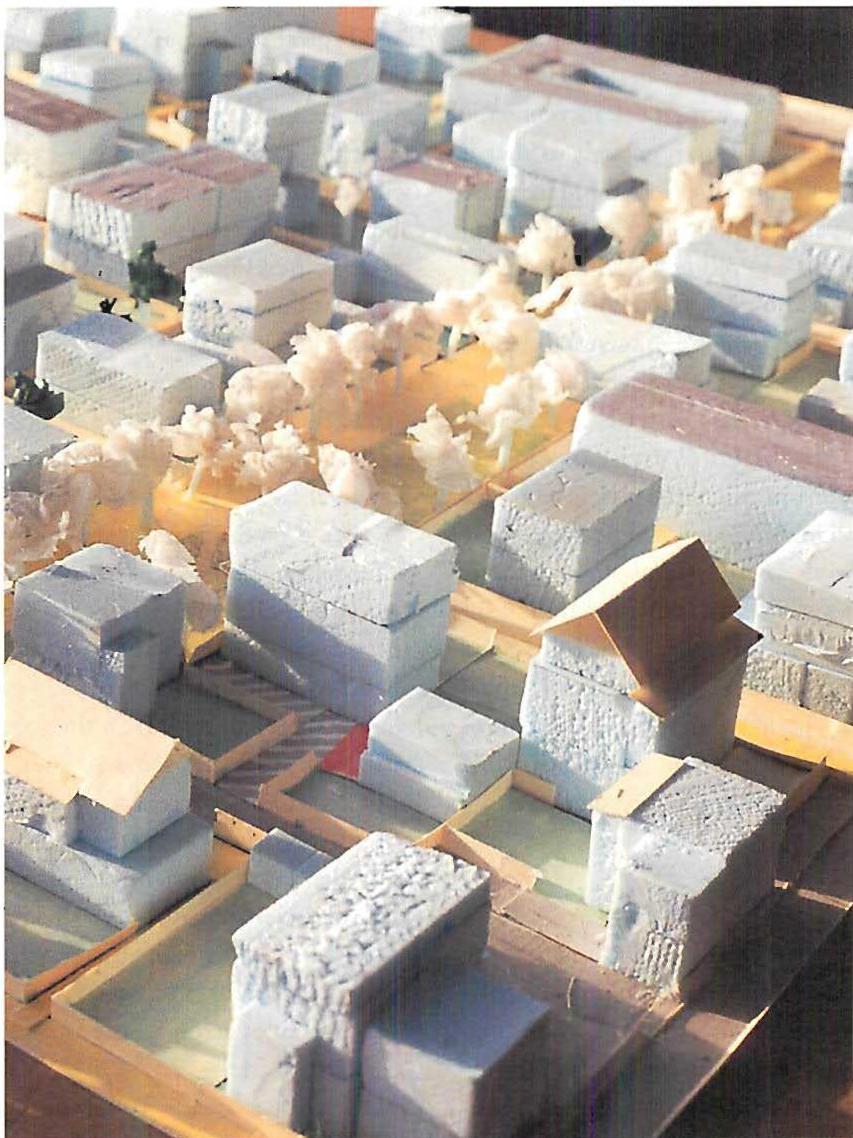
Styrofoam model showing a study of good density. This arrangement, with a net density of 22 dwellings per acre (some apartments upstairs), and an FAR of 0.54, was the highest we could go, while maintaining a good environment. In the particular case of Progresso, we made a number of scale models of half-blocks, full blocks, and several-block areas to try and judge what kind of density would be pleasant, and consistent with the evolution of the neighborhood. These models were very informative. By placing cars, trees, and buildings at the right height, the right distance apart, you can see street width, garden size, and you very quickly form an impression of the kind of density that would make for a pleasant life. The photograph shows one of our models.
areas, density is typically increasing, thus making it more and more difficult to reach a balanced state where the four colors are in effective functional harmony. In Progresso it was expressed to me that the neighborhood residents wanted the density of the neighborhood to be increased. Most of the people in the neighborhood wanted some kind of economic and social rehabilitation; they wanted the vacant lots occupied, they wanted dead places made vibrant. But, in addition, they wanted to reach a level of development which went far enough to change the economic situation. The big developers were, of course, hungry for very big increases of density. A cheap lot with a shack standing on it, only three blocks from city hall, could be worth a fortune and was, therefore, a natural place for developers to think of a 5-fold — even a 7-fold or 10-fold — increase of density. This the people of the neighborhood wanted to avoid at all costs.
So a rough consensus had grown up that an increase of about 2.5 to 3 times in density would help to repair the area, bring back its economic life, and would also be high enough so that it would undercut the pressure from the greedy and hungry developers. In short, if the neighborhood could achieve this 2.5-fold or 3-fold increase of density, they could have a vibrant living neighborhood, one in which—potentially—the beautiful small houses (once scattered among the old slums) could be kept; one in which the overall character, the beautiful trees and bushes could be kept; one in which the people who now lived in the neighborhood would be able to stay there, could—above all—afford to stay there.
What follows, here, is an outline of the kind of process which my coworkers and I believed could repair the neighborhood of Progresso, which could, gradually, build the right structure, true to people's individual and communal wishes, while increasing the density to a middle range level.
To make the increase clear I shall summarize the density statistics. In the whole Progresso neighborhood there are about 150 acres, including roads, and about 900 dwellings (1996). During my discussion with residents, a target was set of some 2400 dwellings (or an equivalent total built area containing a mixture of dwellings and businesses).
We may calculate like this. Say, for the sake of argument, that each unit (whether dwelling or workplace) has an average of 1400 square feet; the 2400 units would then occupy 1400 x 2400 which equals some 3.4 million square feet of built floor space (whether house or work). If we assume that this volume of built space occupies an average of two stories (based on our experiments of the highest density that can retain a humane and positive feeling), this implies that the 3.4 million square feet are standing on 1.7 million square feet of building footprint—some 42 acres of building in all. The area of gray in the neighborhood, then, is to be 42 acres.
Typical parking allowance for a dwelling is 1.5 spaces; and for office space the allowance is 1 space per thousand sf of floor area. On average, then, the 3.4 million square feet of built space will require about 3,400 spaces, consuming about 1 million square feet or 25 acres of land given to parking (parking garages are uneconomic at this density). In addition, the driveable surface of roads, local lanes and narrow roads for access will consume an additional 0.5 million square feet, another 13 acres, making an all-in total of 38 acres for surfaces occupied by cars. The total area of red, then, will be 38 acres.
Based on calculations drawn from the kind of model shown on page 293, and the size of the two-story building footprint, in order to make the gardens humane, there would need to be about 1.9 million square feet of gardens, just slightly more, all told, than the footprint of the buildings. All in all, some 45 acres. So the area of green will be 45 acres.
Finally, based on the model shown, together with the calculations made on page 291, the hulls of pedestrian space — all squares, pedestrian streets, and small paths — will need about 1 million square feet of public pedestrian space, hence, about 25 acres. So the area of yellow will be about 25 acres.
These four areas within the overall envelope of the Progresso neighborhood would then break down like this:
TABLE 3 PROGRESSO PERCENTAGES 16 UNITS/ACRE, FLOOR-AREA RATIO 0.54
| PEDESTRIANS (yellow) | 25 acres | 17 % |
|---|---|---|
| GARDENS (green) | 45 acres | 30 % |
| BUILDINGS (gray) | 42 acres | 28 % |
| CARS (red) | 38 acres | 25 % |
All this, taken together, can provide an overall floor-area ratio or FAR of about 0.54 (the floor area ratio being the total net area of interior built square feet divided by the area of land — not including roads — on which they sit).
The gross density is 2,400 units in 150 acres or 16 units per acre. The colored drawing on page 291 shows roughly what a neighborhood might look like with these statistics, and what the pattern of yellow, green, gray, and red might look like. Buildings are one, two and three stories high, mixed, with an average building height of two stories.
In very rough terms, there are about equal areas of the four colors (none is very far from 25%). This reflects the rule I have stated earlier, that a humane environment must have a reasonable statistical balance of the four components.
I do wish to underscore, and say again, that to understand this distribution of density, it is necessary to understand that the success and humanity of such an urban environment is extremely sensitive to small changes in density. For example, in the situation described 2,400 dwellings of the size stated can be made to work very well. However, 2,700 dwellings (an increase of only 12%) create dramatic reductions in pedestrian space, the social glue which binds the neighborhood. The reason is simple. Building
footprint goes up. Car footprint goes up. The green space, too, probably needs to keep pace with the building area, to keep up with more buildings. If anything, for higher buildings garden space needs to be bigger, not smaller. If green space is increased, too, the result is that pedestrian space gets sacrificed, and ends up far less able to carry the burden, and less able to perform the functions that public space and paths ought to perform.
TABLE 4 DRAMATIC LOSS OF PEDESTRIAN SPACE 20 UNITS/ACRE, FLOOR-AREA RATIO 0.60
| PEDESTRIANS (yellow) | 10 acres | 7 % |
|---|---|---|
| GARDENS (green) | 50 acres | 33 % |
| BUILDINGS (gray) | 47 acres | 32 % |
| CARS (red) | 43 acres | 28 % |
Because of this interaction among the four percentages, a density of 16 dwellings (or units) per acre is roughly the upper limit of what can be achieved while keeping the environment humane.
9 / THE KEY IDEA: WITHIN AN OPTIMUM DENSITY FRAMEWORK, CENTER-ENHANCING TRANSFORMATIONS OF THE NEIGHBORHOOD
Let us now begin to consider the problem of improving the neighborhood, dynamically, up to a chosen density of 16 units/acre, through living processes based on the fundamental process and the fifteen transformations. How can a healthy structure of the right kind be made to grow? How can we take piecemeal action, at different times throughout the neighborhood, in such a way as to repair damaged centers, create new living centers, and — in short — to create the right kind of structure, bit by bit, by a version of unfolding in the large?
The key issues which make this interesting are the following:
EVOLUTION OF PEDESTRIAN (YELLOW)
First, we are talking about a process of extending and recreating a spine and system of pedestrian paths and spines, opening from time to time into small squares and parks. This system is to grow incrementally.
What is interesting here is that this incremental process of growing the pedestrian structure is happening — from a practical point of view — in parallel with the process of splitting lots. The question arises how can we get the land for the path system to grow. We cannot, I think, do it by
Stages in the transformation of a small area within a neighborhood, showing how buildings are replaced, lots are amalgamated and divided, and how the four components are made to grow under the rules of transformation provided by the fundamental process
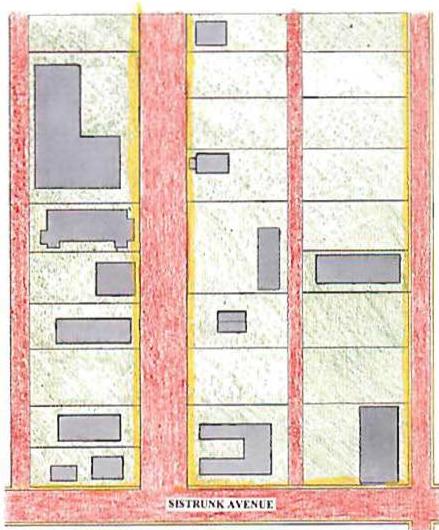
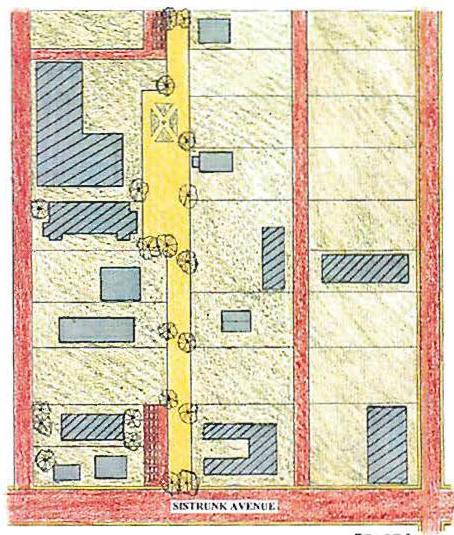
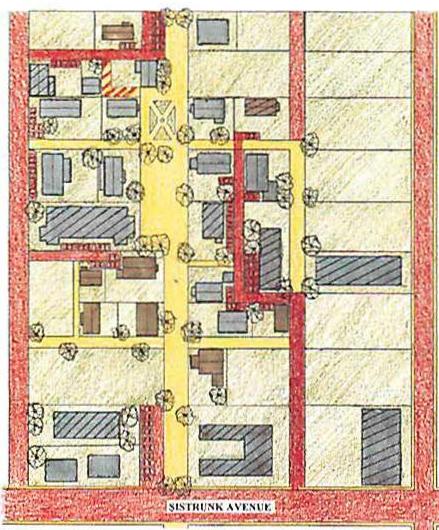
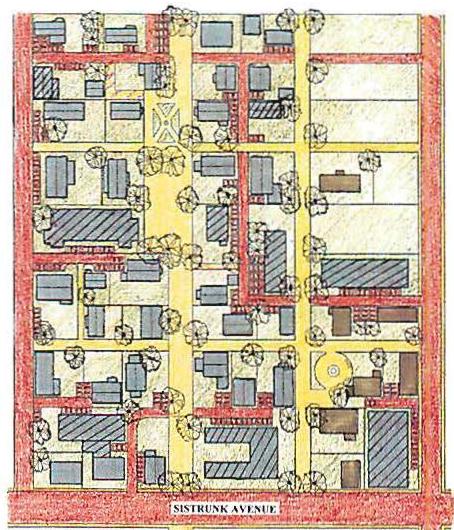
eminent domain. Though possible in theory, it would be resisted fiercely and is not really practical. But we can ask instead that every time a land transaction occurs to split a lot, or build a building, the owner is asked to make a contribution to the path system. That is practical. And on page 196 I have shown, in diagrammatic form, how it can work.
EVOLUTION OF LOTS AND BUILDINGS (GRAY)
Second, we are talking about a process in which lots are being subdivided, and becoming smaller. This follows necessarily from the increase of density. If the density is to increase and, yet, people are to retain their individuality, then lots must become smaller, so that autonomous, individually unique, and well-adapted houses and businesses can be created. So long as lots remain larger, if density trebles, the individuality of dwellings and businesses cannot be preserved. This is an enormously important point.
EVOLUTION OF GARDENS (GREEN)
Third, once again a radical departure from contemporary American practice, is the idea that green space — private gardens and private green space — is to be formed, step by step, in a way that makes only segments of POSITIVE SPACE. This is in contradistinction to the present situation where much space is in narrow slivers along the sides of lots. Instead, here, the demand says that buildings must be placed in such a way as to form positive gardens, positive green space. This rule then controls the placement of buildings, just as surely as today's system of setbacks controls the placement of buildings — but this new rule does it better.
EVOLUTION OF CARS (RED)
Fourth, and last, we are talking about incremental creation of a system of narrow lanes for cars, peppered with occasional small parking lots and parallel parking along the edges. This is to take place as a transformation of the existing road system. We start with a normal American grid and gradually close off streets, cut streets, and run lanes across blocks to create a more intricate, more convoluted, system of lanes for carrying and parking cars. That is amazing in its effect, since it would seem entirely to change the character of today's American neighborhood.
The following sections describe the transformations of the four elements in more detail.
10 / YELLOW: GROWING THE PEDESTRIAN HULL
The pedestrian hull — a linked system of pedestrian areas — needs, at least in part, to be laid down in advance and understood and agreed upon by people in the neighborhood. It will be a composite structure including some parts of existing streets, maybe including some back alleys.
In places where derelict land exists, a few small pieces of right of way may need to be bought or donated as easements. Provisions must exist in zoning so that these donations or dedications do not penalize but help the owners who are willing to do it by giving them a bonus in what they are allowed to build. There needs to be a lessening of restriction on their lots, as a reward, and certainty that they can have as much, or more, than they had before.
The picture on page 298 shows some unbuilt land now existing in Progresso. It would make an ideal park for the neighborhood, almost as it is.
The key processes are:
- Step by step, create a linked pedestrian structure that is pleasant and is genuinely owned by the people living and working there.
- Close certain streets or parts of streets to achieve this aim.
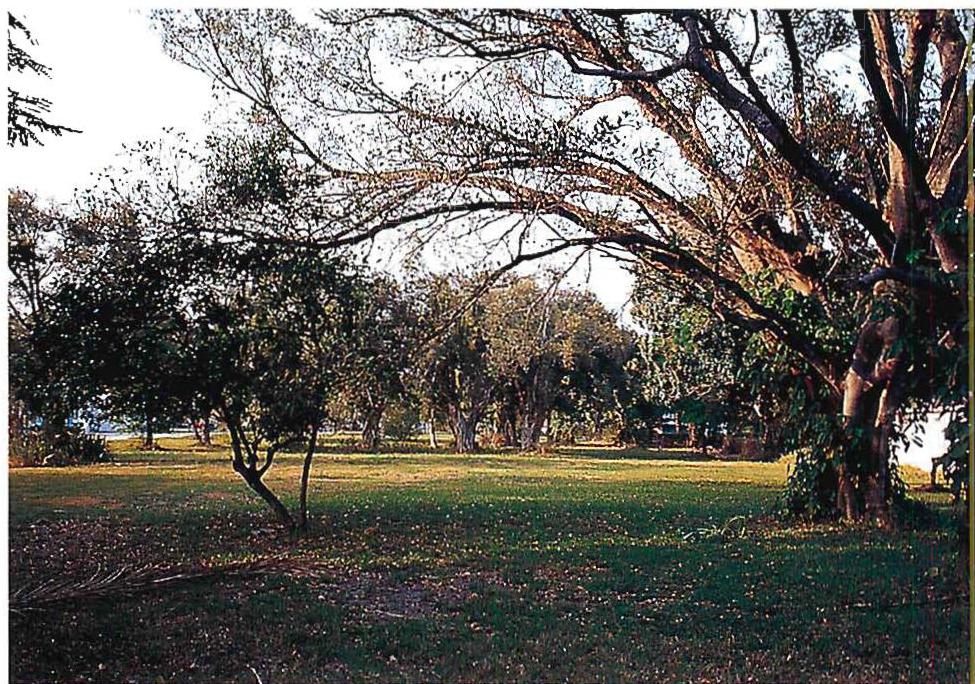
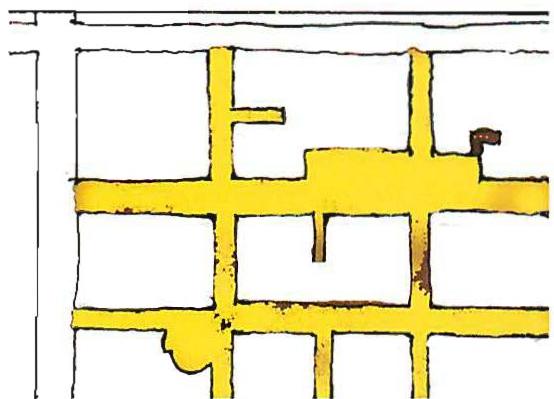
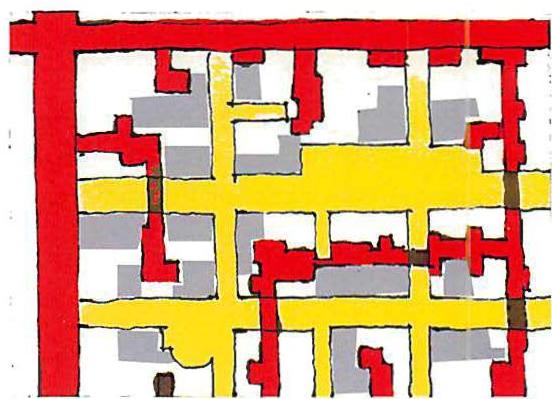
Define the front of each building (new or old) as a "wall" whose job it is to create and help to shape the public space (and hence the public good).
Whenever new construction occurs, use incentives and regulations to construct street fronts and place new buildings to help form positive space on streets and paths and alleys.
Allow the new pedestrian areas to be shaped and built, in part, by their own efforts of neighborhood residents. Award them contracts, provide materials, and encourage voluntary help.
11 / GRAY: SPLITTING LOTS AND MULTIPLICATION OF SMALLER-SCALE INDIVIDUAL BUILDINGS
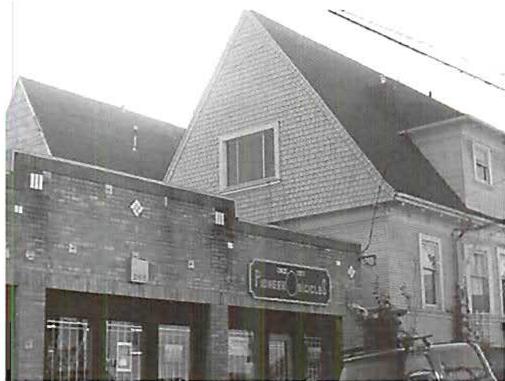
To bring life to the neighborhood, it is essential that it can be a place where people live and work, where two essential parts of people's lives can be brought together. There is a major shift in the way people live and work; every day sees more people working out of their homes. The separation between commercial and residential, made in modern zoning ordinances, drains the vitality from a city. When living and working intermingle, a place becomes more real. If we think of dark gray to designate workplaces, and light gray for dwellings, we may say then that dark gray and light gray must be strongly mixed.
Further, in order to encourage true belonging, there must be an opportunity for people to own their own houses and workshops and offices, and therefore for a progressive process of property subdivision by unfolding and transformation. I would recommend (and assume in the following process illustrated here) that a new zoning of Progresso will encourage lots to be independently subdivided when the owner wishes to do so, increasing the density and economic vitality of the neighborhood. In parallel with this process, provisions are in place for the existing property and vehicular infrastructure to be reconfigured, allowing a more livable environment
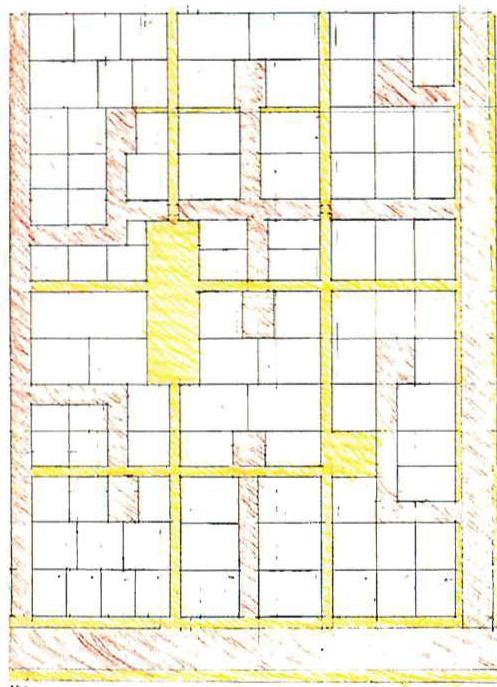
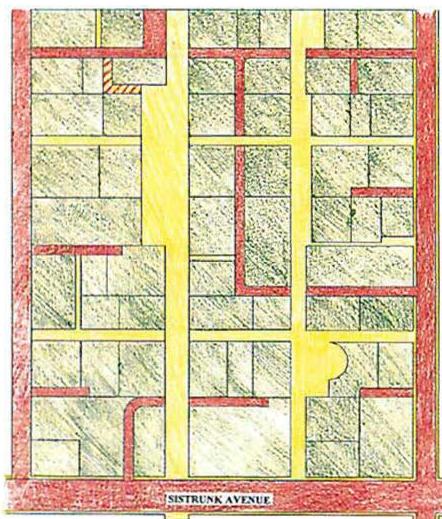
to form. Re-parceling properties, in accordance with new zoning, will produce a lively, varied, and well-adapted whole.
The most critical thing in the growth of the gray areas of our four color map is that development becomes individualized. Buildings and building projects are getting smaller, not larger. Instead of massive parking garages and condominiums which overwhelm the neighborhood's human character, on the contrary, steps are being taken, day by day, year by year, to reduce the scale and grain of construction, to make the neighborhood therefore more of a place which people can belong to, more of a place where each person's individual stamp is there, in the houses, in the offices, in the apartments, on the sidewalks, pavements, gardens, and fences.
When everyone builds his own home or business, in whatever way suits his life, then there is a chance of the neighborhood being a living place where each inhabitant, each family, and each business has an environment that belongs to them. Instead of a few big developers, Progresso will be built by hundreds of individual
property owners. Only when we make the personal decisions that go into creating a home or business can that place truly belong to us.
The process will encourage the resident owners and businesses to finance and develop their own land independently.
We may summarize the processes for buildings and lots like this:
In extremely damaged neighborhoods, care for an emerging economic core, so that the few businesses that exist become coherent together, gain gravity by their connections, and do indeed form the basis of a coherent, expanding economic core.
Gradual reduction of lot sizes so that it becomes feasible to make small, individually owned owner-occupied buildings, houses and businesses at a gently increasing density.
Give emphasis and incentives to small, individually owned businesses and houses.
Refuse permission to construction of office buildings and apartment buildings controlled by absentee owners.
Restrict heights to a mixture of 2 and 3 stories, and restrict floor area ratio to about .94.
12 / GREEN: THE GROWTH OF POSITIVE GREEN SPACE
In our vision for Progresso, every garden should create space which both holds us and connects us. This vision of positive outdoor space is almost more important than the buildings themselves.
Land is subdivided into individual properties. The best land on each property should be laid out as a garden first, then buildings fill in the space left over. Outdoor space is made positive before a building is designed. The resulting gardens become the fabric holding the neighborhood together. A public space laid out during the initial transformations may be enhanced by the addition of adjacent private spaces. Private gardens add to the life of public outdoor space. Make the following processes dominant:
Make positive space essential to the life of the neighborhood.
Care for positive space.
Use the process of locating buildings, always, to enhance positive space.
Encourage gradual emergence of positive space in all the gardens throughout the neighborhood.
Preserve those beautiful gardens and trees which are strong living places now, and do not use them as building sites.
Build and rebuild mainly in the damaged areas.
Care, above all, for plants, trees, foliage, and gardens. Strongly care for the positive space in the neighborhood at each spot where it occurs.
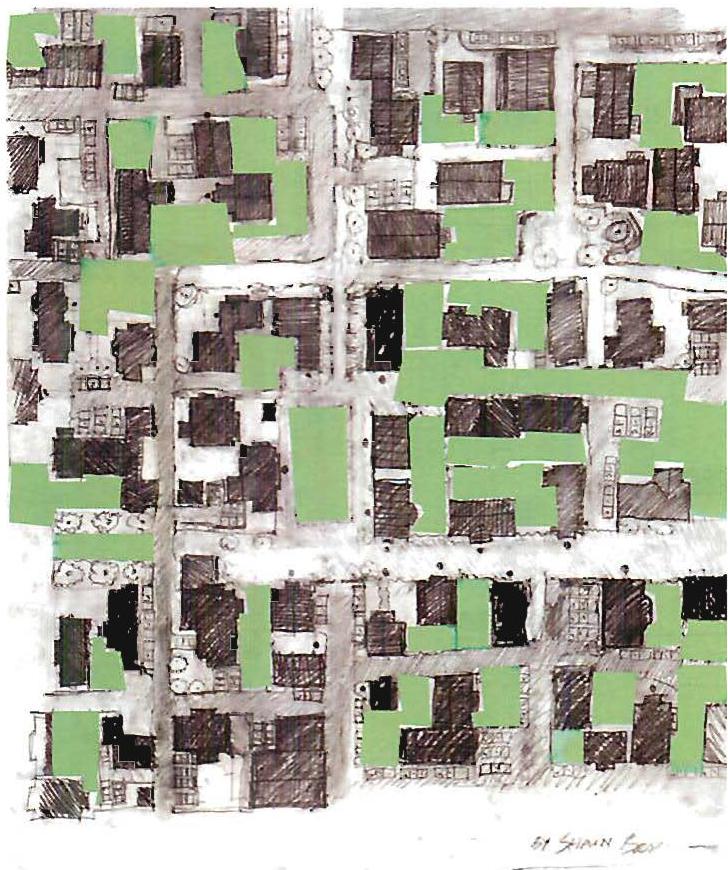
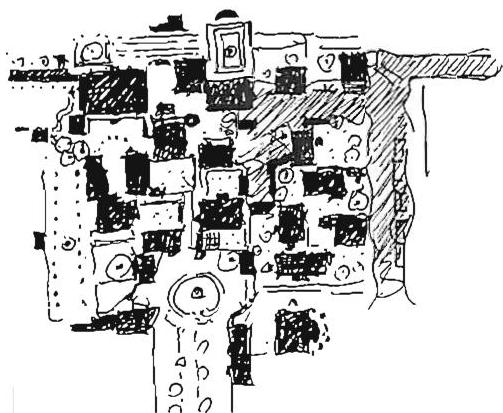
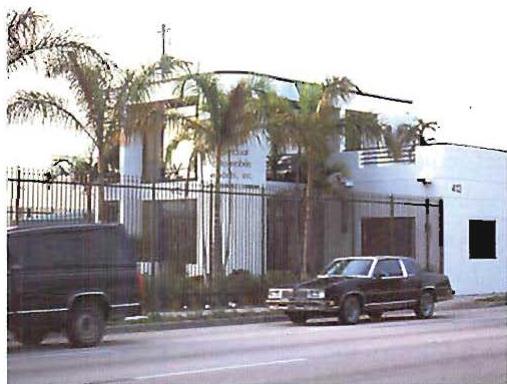
13 / RED: CARS ARE GIVEN LAST PLACE
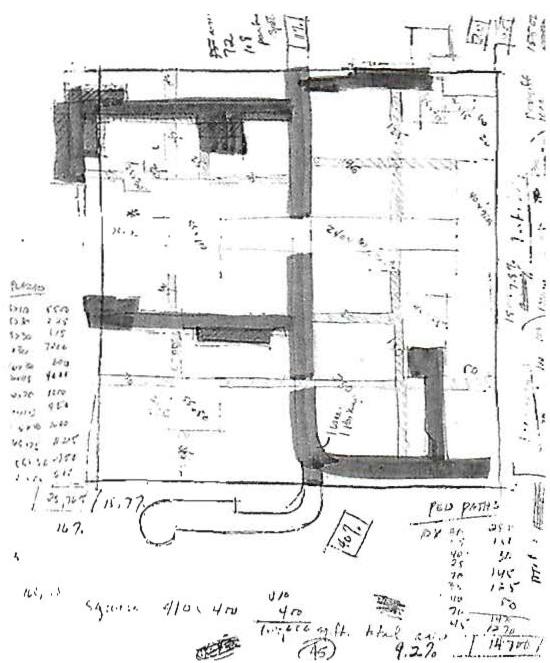
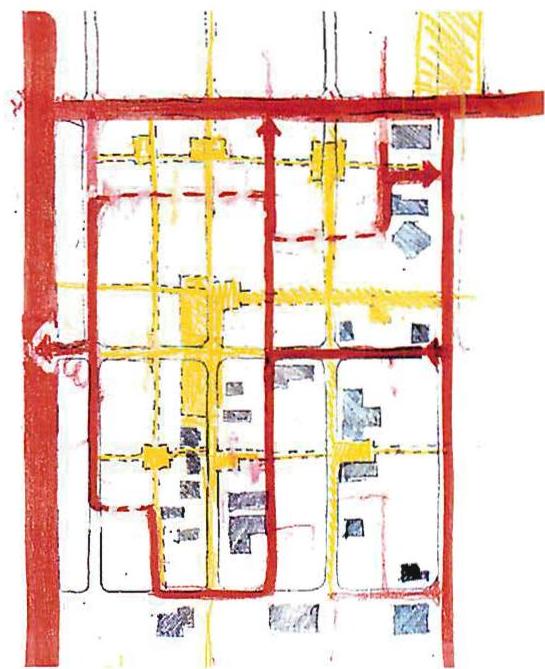
The pedestrian realm is the framework for the growing neighborhood. A neighborhood should be a place where you would rather walk than drive your car, where people feel free to walk, meet, enjoy themselves; a place where children can play safely almost anywhere; there are public spaces and walking paths throughout.
In a neighborhood modified by a living process, the car must therefore be made to play second fiddle to the pedestrian; vehicular traffic must be accommodated without dominating the pedestrian environment. The car has to play a subsidiary role. It is convenient, the car can reach almost every house, almost every workshop, but it is not allowed to dominate the situation, nor to create conditions which threaten the well-being of the pedestrian world. What this means, in practical terms, is that the pedestrian world, not the car world, must be geometrically the more coherent of the two.
To achieve this we give, in the unfolding process, priority to the process that establishes the pedestrian structure, and we expect this pedestrian structure to be coherent, dominated by local symmetries which form the land into nice pieces, and so on.
The cars and the land devoted to cars play a secondary role. The process of setting in parking, lanes for cars, alignments for cars to drive along, must always be playing second fiddle, from a process point of view. It comes later. And we expect that the paths for cars will be somewhat tortured. It makes the car slow down when it is in the neighborhood. The car can easily negotiate bends, curves, etc. On the other hand, for the pedestrian, unless there are views, and a co-
herent sense of the space, the pedestrian world will not easily be grasped. So (contrary to most 20th-century thinking) the car is given irregular streets and parking, while the pedestrian is pampered, made to feel king, allowed to feel at home.
There are also, occasionally, small lanes for cars and pedestrians together, very narrow lanes where they can coexist without danger or discomfort, lanes that are comfortable for both so long as cars cannot move fast or dangerously.
Here are some of the most important processes:
Always keep the car in second place.
Place parked cars very carefully so as not to destroy the delicate fabric.
Construct looped roads as indirect and tortuous paths, forming closed cycles for the car.
Reduce the width of these looped roads.
Make their indirectness and slowness come as a consequence of a rougher surface, even gravel if need be, and of physical narrowing and constrictions.
If a road is to be used by cars and pedestrians together, make driving surface even rougher.
14 / OVERVIEW OF ALL FOUR PROCESSES TOGETHER
These are, in rudimentary form, the transformation rules for the yellow, the gray, the green, and the red. These rules are revolutionary; they conjure up a vision of an existing neighborhood in almost any American city—indeed, in almost any city in the world—slowly transformed by step-by-step actions which grow coherent new structures—structures which are unknown today, and have never been seen before.
The combination of these transformations, taken together, slowly creates public space that is coherent, creating pedestrian hulls that are coherent; and it creates the possibility of unique individual businesses and houses and apartments, interleaved with vibrant green gardens that are also unique and well shaped between the houses, helping to form the common land.
Of course all this that I have described follows the fundamental process which creates living centers, and enhances living centers, whenever possible. If you do not see it, think of this: We are asking ourselves how the neighborhood may be transformed so that living centers are
created. Among the most vital kinds of living centers are the houses and businesses. If they are not unique, each one properly adapted to its unique family or business, then of course it cannot be a living center. So to assure a neighborhood of the growth of living centers, we must make provision for splitting the lots. Without it, we get condominiums, apartment houses, office blocks. The reason for the radical proposal I have made is that it follows directly from the simple rule of all living process: Let us make sure that every house and every business, and every garden, and every public space is a true living center.
In the same vein, we know that the community cannot exist as a living center without a kernel, a core, where people meet, play, dream. That is just the hull of public space I spoke about in chapter 3. So, to make a process which creates these centers of public space in the yellow space—the hulls of pedestrian space—we must also make these centers live. Again, the fundamental process is the engine which is doing the hard work.
15 / STRUCTURE-PRESERVING UNFOLDING OF THE FOUR-FOLD PATTERN OF YELLOW, GREEN, GRAY, AND RED
To create a coherent pattern of pedestrians, gardens, buildings, and cars step by step, by the processes described above is an immensely complex task. To understand the complexity of the task, it is helpful to look at it, almost like a board game in two dimensions. In two dimensions it is a process of covering the plane with yellow, green, grey, and red areas, bit by bit, placing patches of these colors in alternating sequence, until we build a coherent fabric.
In this process we place one fragment at a time of yellow, green, gray, or red, always following the rules for the colors. We do it, expanding outward from one or more sites where we begin.
There is no single "right" sequence. Instead, we place—at each moment—just that color which appears needed to make the pattern continue, as a whole, in the most wholesome fashion. At one moment we may need to place several patches of yellow, broken apart, then a patch of green, then two or three patches of red. The process goes on like that.
This corresponds to a real-world process in which buildings, pedestrian space, green space, and asphalt (roads or parking) are being carried forward, piecemeal, step by step, in parallel. That is, indeed, just what happens in the real-world process. Each of these four elements is constantly modified, developed, it grows, it is extended.
What is different about the process depicted here is that each of these processes goes forward in the context of the whole and contributes to the whole. Each is done, as far as possible, to make a maximum contribution to the life of the whole. The next buildings to be built are placed to make extension of the pedestrian space possible, placed to make the green space as positive as it can be made, made to allow modest penetration by cars to somewhere near the buildings.
But the aim is always to make the whole better, to make it come closer to the ideal completed neighborhood in which pedestrian space, gardens, buildings, and small spurs of roads and parking remain in harmony, and provide a continuous world of movement for pedestrians, while also allowing each building its own freedom and sway over its immediate domain.
Further, there are necessary relations between the swaths of different color. Yellow, for example, must be shaped by gray around it: that means that good pedestrian space, which is positive, arises only when it is shaped, as a volume of space, by building fronts. So that the yellow space is positive it must be largely surrounded by gray. The green must be distributed in areas which form useful and generous rectangles that also have a positive and living character. Red (roads) must come close enough to buildings, so that people do not feel it inconvenient. On the other hand, people also do not want to live too close to parking lots or vehicles. The yellow forms the hull, the red is more rambling, fitting in where it can. The blobs of red must not be too big—more than three or four cars in one place is already too big.
It is also vital that the buildings are individually owned—only then can individual character be manifested. That means that the old-fashioned European row house does not work very well. Light in these row houses is bad anyway. And, unlike old-style thick masonry wall construction, inferior modern construction with lightweight walls doesn't work well enough to give people a sense of what they can really do themselves. So, although the modern developer's condominium town house creates the illusion of individual dwellings at mass densities, it is just that—an illusion. The buildings, even at rather high densities, need to be well separated when they can be. Yet density also requires that they be close together.
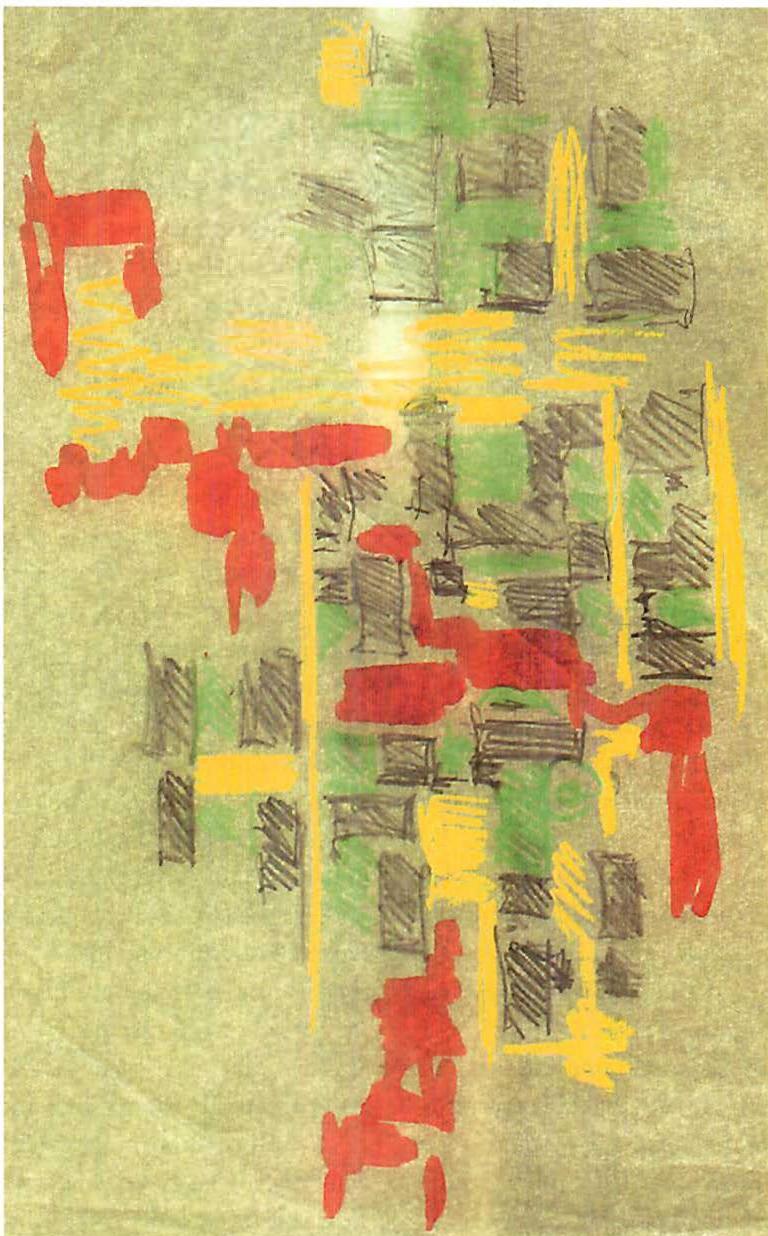
Sometimes lanes which are narrow and inconvenient for cars are fine for both cars and people — provided the lane is so narrow and bumpy that cars can't drive too fast on it. This is a case where yellow and red may be combined: we might think of this as a hatched red-and-yellow area, which must be not too straight, and rather narrow.
What do we observe in the resulting pattern? It repeats endlessly, but never repeats exactly. The rules are so complex that they create a dynamic and everlastingly interesting and complex response, and unpredictable, syncopated, organic structures.
To reach a state in which each part is full of life and coherent in itself demands a holistic eye and a syncopated, irregular treatment. It is fascinating to see the unfolding process creating such a syncopated structure.
16 / REPAIRING BLIGHT
I have tried to lay before you a way of creating an entirely different approach to the rejuvenation of neighborhoods. And as I hope you begin to see, that which starts out as a problem of urban blight—a practical problem having to do with perceived crime, a perceived problem of a lack of development opportunity—actually becomes a great opportunity and the solution to a moral dilemma that has plagued American cities and cities in nearly all countries of the world during the last hundred years.
Consider what actions are typically taken to improve such a part of a city. Streets get widened and paved. Slums are torn down and replaced with new buildings. Gradually the city becomes more dense and cleaner. But what happens in the process? The individuality is taken away. The public space is destroyed.
Instead, I have shown how we might try a process which does the opposite. It creates small-scale life from the inside, instead of large-scale order imposed by development corporations from the outside.
And it creates economic opportunity and economic wealth. At present, there is a conspicuous absence of good, usable, positive space in the neighborhood gardens next to buildings. Like most American neighborhoods the houses are in the middle of lots; space is therefore wasted on side yards and front yards which contribute little, and have too little life of their own as outdoor spaces. To bring this aspect of the neighborhood to life, these gardens need, whenever possible, to be extended, re-platted, re-fenced, so that slowly, over time, the good ones are preserved, the negative ones are over-built or combined with others to form good ones.
Obviously, this is bound to be an immensely slow process since property lines and existing buildings are involved and, in the short run, are likely to perpetuate the bad pattern. But it is possible to imagine that rules and incentives can be
put in place which will have the effect that very gradually, over time, lot-lines will be moved, new buildings will be shifted from their old footprints when rebuilt, fences will be torn down or rebuilt, and so on—until a pattern of centers is created in which every center has more profound, more living positive space.
The economic condition of the neighborhood is undernourished. The centers of economic activity—businesses and groups of businesses—are weak, not sturdy. In order to encourage economic growth in the blighted neighborhood, a self-sustaining economic structure must be created. Whatever that is, it can probably not be created by massive injection of capital or new businesses which will not, at first, want to locate there. So we need, with care, to look for the seeds, the starters. By that I mean any small businesses that exist at present and that have even a spark of life in them.
We need to plot the positions of these potential seeds carefully on a map of the neighborhood (opposite), and then we must take action to bolster the thread of life that these existing businesses already create. We began just this in Progresso. After an initial analysis we found a small artists' colony of people making some money from art who existed as a group. Tied to them were other small businesses, flourishing, albeit at a lower level. When we plotted their positions, we saw in the map a kind of thread. This thread, a latent center in the community, most urgently needed to be strengthened, supported. We proposed, therefore, that a new pedestrian line be formed to connect these particular locations, and that the line of this pedestrian walk, coupled with a road, become a spine in one part of the neighborhood.
If we can succeed in encouraging others to locate in relation to these small businesses, we can enable to community to grow its own economy, from its own bootstraps, and from what exists already. All this hinges, as you see, on the strengthening of the existing centers.
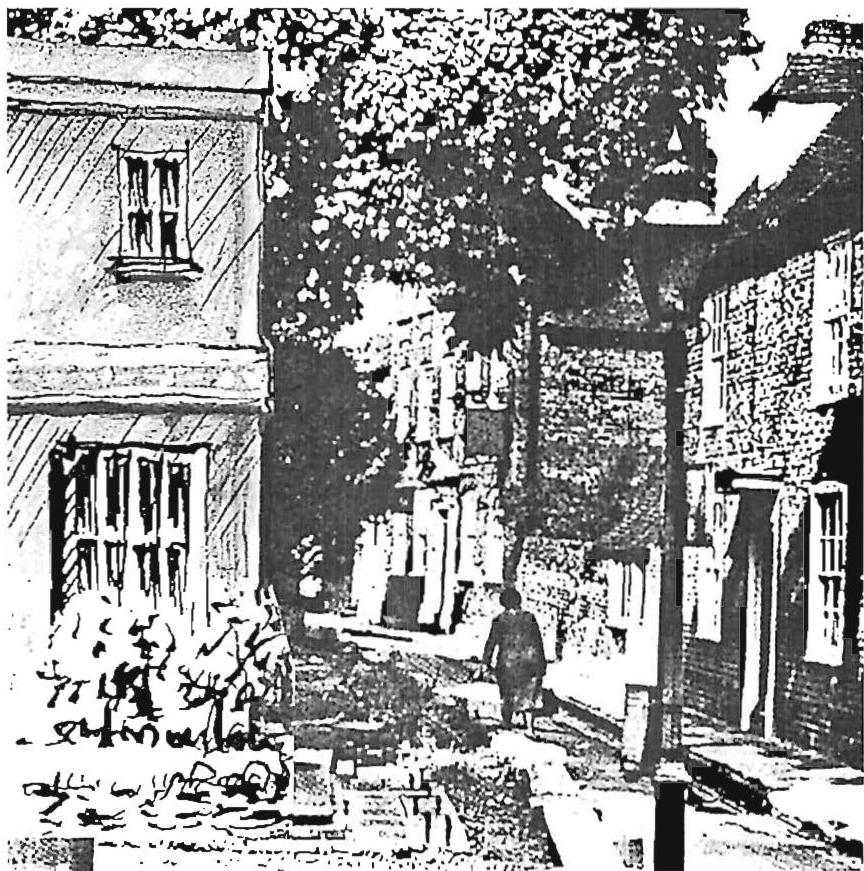
Local roads, too, do not exist as positive living centers. A local road in a neighborhood becomes living as a center when it is narrow, has occasional parking, is informal, and allows cars
to move only at a slow rate which is friendly to pedestrians. Obviously the roads in a typical block pattern are not like that. Once again, such small, straggling local roads need to be intro-
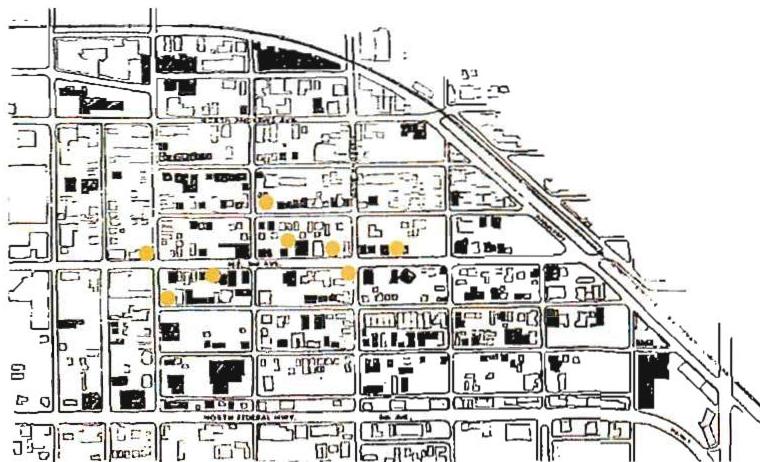
duced. In some cases old roads might be modified to create this character; in other cases, where roads are transformed to be pedestrian hulls, then new and very narrow lane-like roads need to be introduced between the buildings.
And individual buildings are not as expressive of individual need and taste as they might be. Although a dwelling, no matter where it is, and no matter what kind of thing it is, is a living center, to make it a deeply living center it must be more thoroughly imbued with the character of that family, it must allow the family to express their need, their life style, their special wishes, so that expressive uniqueness runs through the character of the dwelling, and runs, too, in the land around the dwelling.
A huge, spread out transformation of this kind cannot be made overnight. It cannot be made by administrative fiat. It is too expressive for the city to do it. And of course it would be wrong, and would lead to wrong results since making changes of this sort in the existing order would be traumatic and disruptive.
To make all this practical, a new zoning district would need to be formed. The rules in this special zoning district need only to be drafted to cause the appearance of streets, pedestrian paths, parking, and mixed-use areas in just the way I have been describing here, written in such a way as to be consistent with the rules for a special zoning district, and consistent with the equal protection clauses of the constitution. For example, the very secondary treatment of roads and parking — while maintaining their needed surface area, but giving them no priority of geometry or position — means rewriting fire-truck codes, most parking codes, and the ordinances governing road width and turning radius.
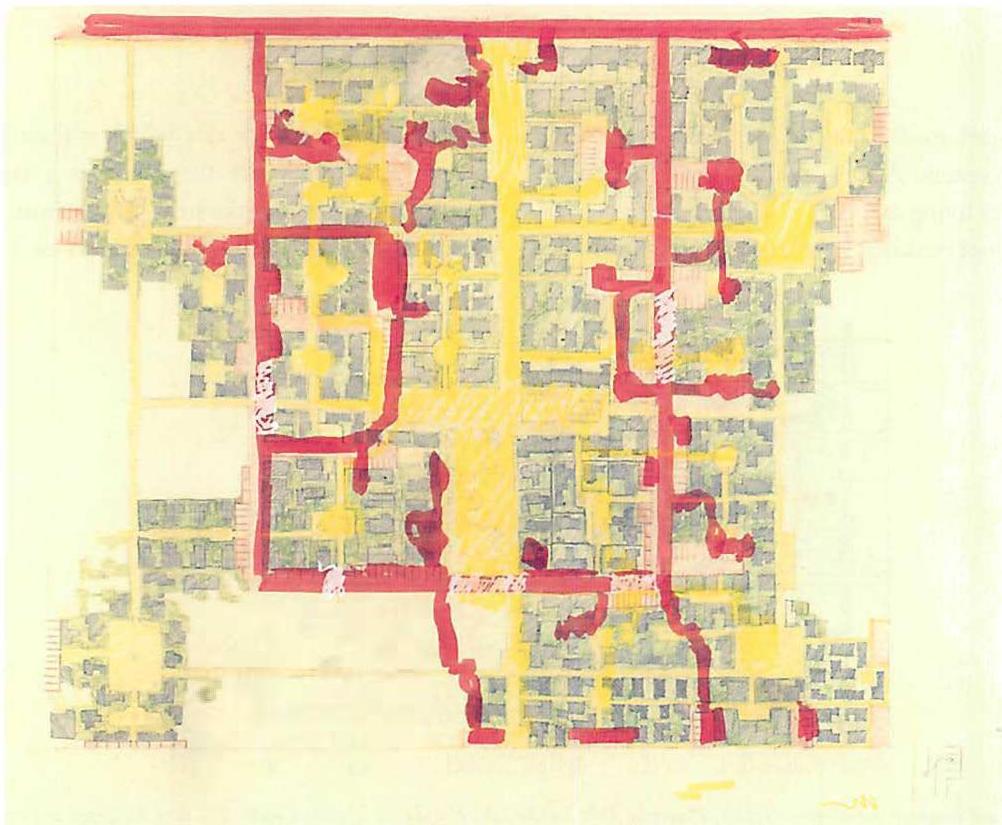
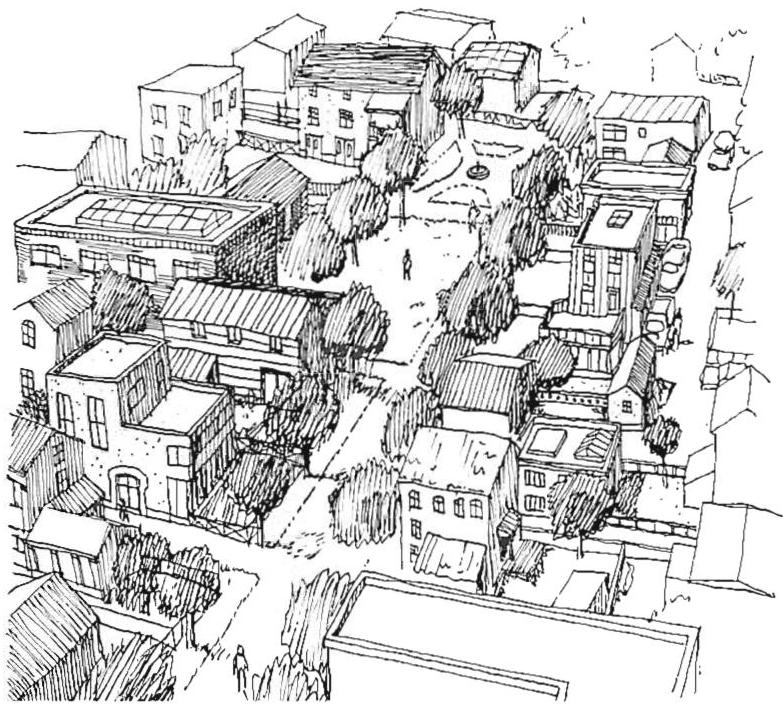
Perhaps most significant, the ordinances would have to make provision for the reduction of legal lot size. Rules and incentives must be written into the code which give people economic and density advantage if they choose to split their lots. The zoning then protects the daylight and privacy of neighbors, but above all the legal lot limits are strongly reduced to allow cottages, and small two- and three-story buildings to be built close together.
The neighborhood is steered by periodic and continuous diagnosis of the existing structure, repeated at each stage of transformation. Landowners, community leaders, and residents of Progresso would be encouraged to create diagnosis maps of the neighborhood, highlighting useful and valuable structures.
The first step in this process is to make a thorough inventory of what the existing Progresso area contains—to determine what is worth saving and what needs repair. That is repeated annually, as the whole structure grows.
In the sketches on pages 296-309 I have shown, in simulated form, how we have carried out these processes for one small neighborhood within Progresso. I have shown an area about 1,000 feet by 1,000 feet. Within this local area, I have imagined a step-by-step process which moves forward year by year, gradually improving the neighborhood. Without the oppressive crushing force of condominiums, office or apartment buildings, this growth and reconstruction would mainly be done by owner-occupiers, working within a framework that—in principle—could be provided by the new zoning district for Progresso, under the inspiration of the neighborhood association.
I have not yet had the opportunity to restore the life of a whole neighborhood in this way, and perhaps I never shall. But you may have the opportunity. The problem is everywhere and the desire to correct it, though beaten down in many of us, is almost universal.
What I suggest is this: Neighborhoods and cities can be restored to life in an infinite variety of ways if we can break free locally from the death grip of conventions and rules that block the smooth, natural, step-by-step processes by
which a life-supporting structure of any environment comes into being. And that can be done. With a little help from the Planning Department
and Public Works Department, the people of Progresso can do it. You, working in your own neighborhood, can try to do it, too.
17 / HIGHLY COMPLEX ORDER
THE KEY INVARIANTS IN A NEIGHBORHOOD
The long-range order created by this syncopated process is unusual and reminiscent of an a-periodic crystal (Schroedinger's lovely phrase for DNA, before its structure was fully known). It has a complex repeating order which comes from the fact that red, green, yellow, and gray are all positive in their own specific ways, and that at each new step of growth they are made more positive. The sketch on page 305 shows the character of this a-periodic order expressively.
The large-scale order which is created by this apparently simple local process is highly complex, and almost not describable geometrically, EXCEPT as the result of this kind of process. This may be understood in the context of the discussion in Book 2 where I asserted that the kind of order that occurs in living structure has a complexity not usually describable by drawings or by architectural images.
The primary invariant which follows proper use of living process in a neighborhood is a statistical balance of the areas of pedestrians, positively shaped gardens, buildings, and cars. Under a living process, as unfolding proceeds, the relative areas of these four components need to remain almost equal. In particular, a living process will maintain the size and coherence of the pedestrian and garden areas and severely limit unruly growth of areas for cars.
The most important secondary invariants concern the complex intertwined character of the areas devoted to pedestrian (yellow), gardens (green), buildings (gray), and cars (red). The interaction of these areas will be topologically complex, not easily described by simple geometry. Green areas will be mixed in size, and all positive; gray areas partly surround green areas. Yellow areas touch all the green areas and the gray areas; the yellow areas have different sizes and are all coherent and locally symmetrical geometrically; red areas consist of small loops of narrow roads with very small areas devoted to parking no more than a few hundred square feet at a time, and only a very small number of larger, high-speed roads, carefully placed to avoid damaging the delicate fabric of yellow, green and gray.
CHAPTER TEN: THE APPROACH THAT LIVING PROCESSES SUGGEST FOR GENERATING "BELONGING" IN HIGH-DENSITY HOUSING FROM 40 FAMILIES PER ACRE TO 80 FAMILIES PER ACRE
1 / A QUESTION
Many of the world's dwellings are now being built in the form of high-density mass housing. During the 20th century, this mass housing was typically concentrated in the very high apartment towers — six, eight, twelve, fourteen stories high — where people had to live almost like rats in boxes. The population of the world is still increasing. Creation of such high-density housing, at least for a century or two, is likely to continue.
What does living process have to say about the problem which such houses and dwellings create for their inhabitants? If we take as a given the need to house people in limited space on expensive land — with a demonstrated need to go as high as about 80 households to the acre (200 households per hectare) — what then can the repeated use of the fundamental process tell us about generating a suitable structure that has some kind of reasonable life?
2 / A VITAL COMMENT ABOUT PEOPLE'S WISHES
The idea of a living process includes the simple idea that what is built must arise in response to people's actual feelings, their actual wishes! Yet this simplest of all points is not followed often enough.
Here are a few comments distilled from interviews conducted by my friend Hisae Hosoi in Nagoya.¹ In interviews conducted with one hundred families living in high-rise housing in Nagoya in late 1990, Hosoi and I asked people these questions about their housing: What qualities do they value most in the living environment?
Specifically we asked:
The present government plan for the Shiratori area is an environment with 14-story apartments, a huge shopping center and a huge parking area.² It is typical of today's trend. What do you think of it?
To this question we received the following answers:
| Positive (including approval) | 10% |
|---|---|
| Negative | 50% |
| Others (including "it's inevitable") | 30% |
| No answer | 10% |
Then we asked:
What is the most important thing for you if you ask what makes a living environment for you? In answer to this question, we received the following answers, listed here with the number of people who mentioned them spontaneously.³
- Touching nature like tree, water, green, earth, sunshine and breeze 32%
- Formation of communication and community 15%
- Stillness (without noise, cars) 13%
- Public establishment and common place (bench in public place) 13%
- Sunshine 10%
- Convenience to daily shops 11%
- Large living room (at least 13 m²) 10%
- Traffic convenience 8%
- Ventilation 7%
- Safety 7%
Other answers included Feeling of culture, Sound of rain (nature), Tatami mat, No concrete floor, Without loneliness
Then Hosoi and I asked each family more detailed questions. The following eleven written questions were distributed to one hundred families in Nagoya. One hundred answers were received.
QUESTION 1 Do you want a private garden?
ANSWERS
a. Even if it is a tiny one, it is good to have a private garden for my family 86% b. A private garden is not necessary, if there is a playground or park near my house. 6% c. Others 6% d. No answer 2%
QUESTION 2 What floor is desirable for your house? Do you prefer to live at ground level, 2nd story, 3rd story or higher off the ground?
ANSWERS
a. The ground floor touching earth. 46% b. The second or third floor is available, if there is direct approach from the street. 34% c. The fourth or fifth floor is possible, if there is an elevator. 8% d. The seventh or eighth floor or more with nice view, and it's pleasant. 2% e. Others. 8% f. No answer. 2%
QUESTION 3 What do you think is a proper width of the front street? Do you want a big street or a small lane?
ANSWERS
a. A little narrow street with just enough width so that the car can go to front of the house (about 4 meters). 50% b. If it has two way traffic with pedestrian space, I will be worried. 36% c. Others. 10% d. No answers. 4%
QUESTION 4 What would you consider as a desirable approach to your house? Do you want the common space around your house to be a parking lot?
ANSWERS
a. It's good to go through gate from street and enter the entrance. 32%
b. It's O.K. if there is the individual private entrance or stairs with direct approach from the street. 60% c. Entering the common entrance from the street and going through the corridor or stairs to arrive at the house. 4% d. Others. 2% e. No answers. 2%
Beyond these questions, Hosoi and I asked the following further questions:
QUESTION 5 Should the outdoor common land be a place where you can feel comfortable with others?
QUESTION 6 Do you like to have children playing outside your house?
QUESTION 7 Do you want your own entrance from the street?
QUESTION 8 Do you like to arrange your own house as you wish internally, or do you feel comfortable to have a mass-designed apartment made by an architect?
QUESTION 9 Do you want an apartment which is deep with sunlight at one end and no light at the other, or do you want an apartment in which there is good light for all the rooms?
QUESTION 10 Do you want to come home to a high-rise apartment through an elevator or parking lot, or do you prefer to come to your own house off a small lane?
QUESTION 11 Do you prefer small plants and trees within view of your windows and front door, or do you prefer just concrete?
These questions almost answer themselves. In another part of the same survey, Hosoi then asked the same questions again, through in a different form of words. He asked people to state independently what they want most in their living environment. He found out that what people want most in the qualities of their dwellings are the following eight things, listed here in order of importance as rated by the families:
- Each house should have a private garden.
- It should be low-rise.
- The user must be able to design the dwelling —
exterior and interior—for themselves, according to their desires, to make their own living space unique.
- The street has little traffic, so it becomes a place for play and chatter.
- The amount of sunshine in the dwelling is more than we can typically get in a high rise apartment.
- It is possible to park very near the house.
- It is possible to enter the house directly from the street.
- There are small shops near the house.
Of course these answers are all of them obvious. Most of us would give similar answers. What is astonishing is certainly not any strangeness of the answers, but rather the fact that the municipalities creating housing all over the world, consistently and steadfastly ignore these answers, although they are obvious and although everybody knows them. That is why we took the trouble to compile these answers statistically, to dramatize their definiteness and concreteness.
These answers were compiled statistically from the answers given by one hundred families.
From these answers, we get a very definite idea of what Japanese people want. It is confirmed by common sense. It is confirmed, too, by asking yourself—for myself, for instance, by my own personal feeling of what I want for myself. Probably it is confirmed for you, the reader, by your feeling. If you or I make an informal analysis of what we would want for ourselves, in our own houses, we would choose roughly the same things that the families in Nagoya chose.
Many people might say that it is impossible to provide a high-density living environment in which these qualities exist while housing 80 families per acre. Until I undertook this work and discovered the many-parallel-lanes configuration, I would have said the same myself. Surprisingly, though, the repeated use of the fundamental process to give the design, forcing, as it does, concentration on the most salient issues, and in the proper order, led me, with Miyoko Tsutsui, a Japanese colleague, to conceive a solution—ancient in spirit—yet not tried before. The result we got is not previously known, yet it follows naturally, directly from the wishes people have expressed.
3 / A DIRECT SEQUENCE OF LOGICAL STEPS LEADING FROM PEOPLE'S WISHES TO A USEFUL GEOMETRIC FORM
First fix the height.
Then fix the daylight.
Hence the possibility of individual layout.
Then the gardens.
Then the lanes.
Hence some parking under the street.
Let us follow people's wishes, as they are expressed on pages 311-14, and take them literally, step by step, not introducing anything except what is required to meet these wishes.
We get a most unusual form. What kind of design process could take people's wishes and desire for belonging seriously at high density? Here is a process for obtaining a generic
design: Let us start with an imaginary area of 1 hectare (100 meters by 100 meters) or $10,000\mathrm{m}^2$, in which 200 families are going to live. Let us, then, go step by step, following the unfolding process, and defining the morphological characteristics one by one, just asking how people's wishes have impact on a plan to contain 200 apartments within this area.
First fix the height.
Hardly anyone really wants to live more than two stories off the ground. At high densities, what can we do? Let us say, then, that buildings have a maximum height of two and a half stories.
Now fix the area of buildings on the ground, per acre.
Assume that the total area of each apartment is 72 m² (a reasonable average for Japanese families today). The total built area for the 200 families will then be 14,400 m². If buildings have three floors, the footprint of these buildings will occupy one-third of that area or 4,800 m². The remaining 5,200 m² (10,000 - 4,800) can be used for streets and gardens.
Then fix the daylight.
To get good daylight in the apartments, much of the perimeter of each apartment must be open to the sky, not boxed into a big building. In effect this will create buildings which are long and narrow, almost like spaghetti, ribbons of long, thin buildings with open space between them forming gardens and streets. An ideal dimension for the thickness of the ribbons is about 6 meters (20 feet). This can give each apartment excellent daylight on all sides, but still create good space inside, in which people can really shape their own lives and feel that they belong.
Hence the possibility of individual layout.
Within such a apartment, a rectangle of 6 meters deep and 12 meters long, with its own private entrance, since it has two long walls with the possibility of windows anywhere along these walls, each family can lay out the interior of the apartment according to their own wishes. The building system needs to be one which allows windows to be placed, afterwards, to reflect the interior plan.
Then the gardens.
Let us now consider the 5,200 m² of outdoor space. Each family needs a tiny garden. At such a high density a large garden is impossible. But each family could have 8 or better 10 m². Then 200 families will require 2,000 m² of land devoted to their gardens. This leaves 3,200 m² for streets.
Then the lanes.
The remaining land, 3,200 m², is to be used for streets. If every house has a street outside, along its full length, and the street is 6 meters wide, then there need to be 3 meters times 200 families, divided by 3 (floors), times 12 meters of length, or 2,400 m² of street. These lanes can only be one-way with one lane of parallel parking. This leaves 800 m² for other streets not fronting on houses, for turns and so on.
Hence some underground parking under the street.
The total street length in this configuration is 650 meters per hectare. If every family is allowed one parking place, total parking length needed for 200 families is about 1000 meters of street length. Two-thirds of these spaces can be along the lanes fronting on houses and at the project perimeter. If the remaining one-third of the cars are placed in underground parking, under half the lanes, and using house foundations as retaining walls, this will dramatically lower the cost of the underground structure (see page 323).
At only slightly lower densities the whole thing is extremely relaxed and pleasant — see pages 325-29.
At lower densities of 40-50 families per acre or 120/hectare (which is still very high), the same geometry gives larger gardens, and there is no need for underground parking. At this still very high density, the environment is pleasant, beautiful, humane: and people can achieve a true sense of belonging and love for the places where they live.
What people want in their housing environment is not obscure. The families have made their wishes clear. And what these wishes lead to, if one follows a logical path, unfolding the design according to people's wishes, under the conditions imposed by high density, is also not obscure. It will be something more or less along the lines of what I have shown.
4 / SHIRATORI: A NEW FORM OF HIGH-DENSITY HOUSING AT 80 FAMILIES PER ACRE: DETAILED EXPLANATION
I will now describe this new geometry in fuller detail with all its features since the project as a whole — cars, pedestrians, gardens, windows, sunlight, roof height, everything — all together reflects on the question of what it means to create a harmonious pedestrian housing environment where cars exist but do not dominate.
Between 1990 and 1993, I worked out two versions of this archetypal project for the City of Nagoya. One, in a place called Shiratori, was at very high density. The other, in a place called Chikusadai, was at a somewhat lower density (see page 325). I was first asked by the city of Nagoya to visit an area known as the Shiratori area, where the Japanese National Housing Corporation had been planning to build 500 units of high-density high-rise housing on 2.5 hectares. Officials of the Shiratori area development group asked me to prepare a plan for this area to demonstrate how housing can accommodate new and better principles of living. The housing which I showed them exactly met the standards that were at that time being met by the city's criteria in other public housing projects (density 200 units/hectare or 80/acre, parking 1:1, average apartment size 70 m²). These conditions were given to me at a meeting with officials of the city of Nagoya in August 1989.
The new project, derived from the sequence summarized on pages 314-15, and given in full on pages 317-24, showed that even in a big city like Nagoya, high-density housing need not be built in the 14-story free-standing apartment
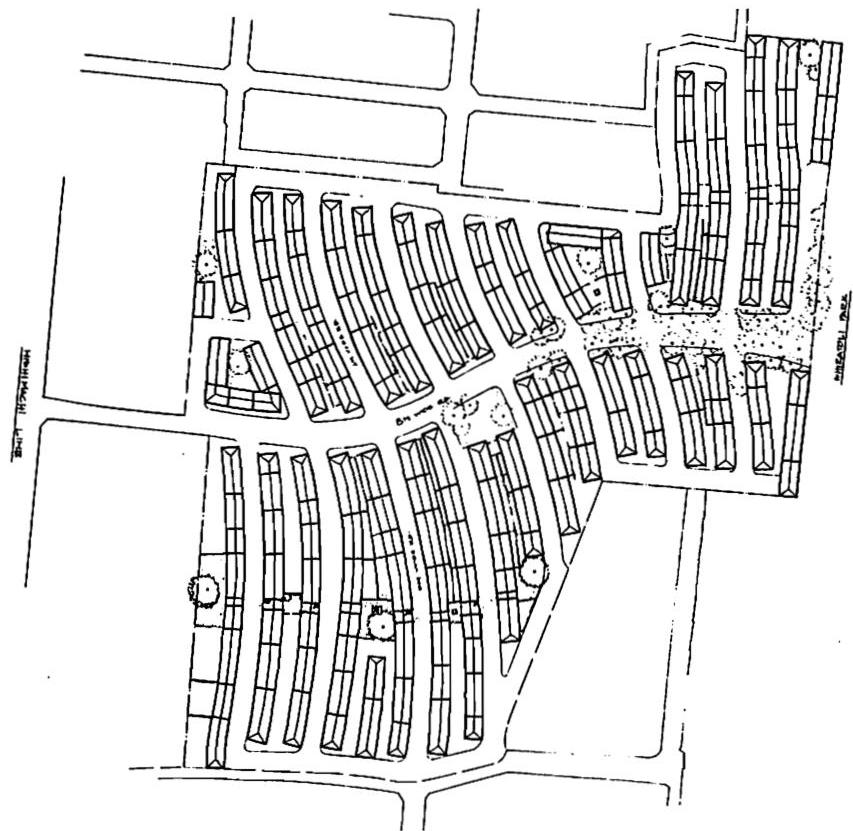
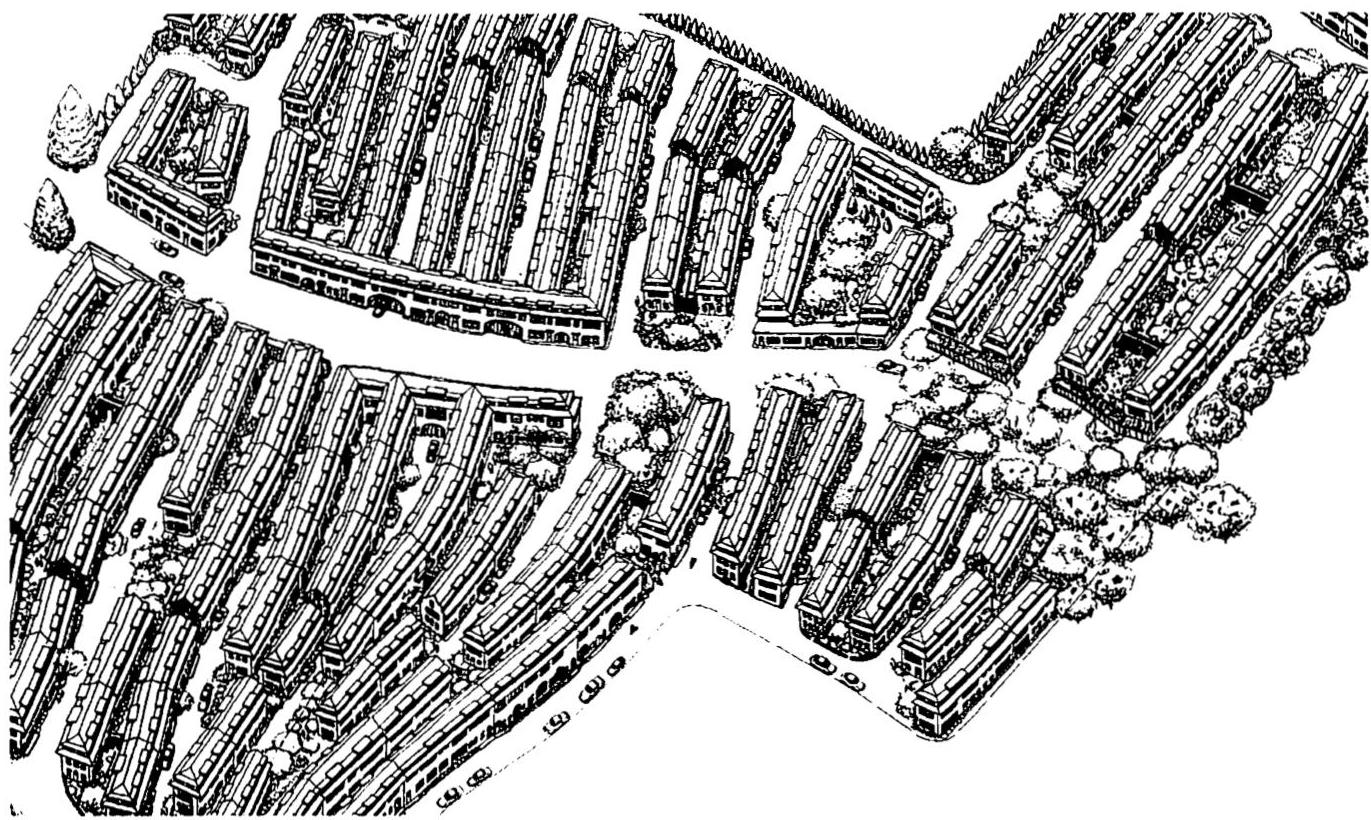
buildings which are common today, since the same 500 units, on the same site, can be built in 2 1/2 story buildings (2 stories plus an attic story), arranged along narrow lanes. Even though housing officials at first told me that they felt such a thing to be physically impossible, I demonstrated to them that it can be done at the same cost and same density.
How does the "magic" come about? Two hundred apartments need a total floor area of about 14,400 m². In the usual way of building high-rise apartments, these 14,400 m² of built space are put in a tower, and occupy only 1,440 m² of the land. The remaining 8,560 m² of land is typically left as a large open area of dead space between the buildings, good for parking, but so unpleasant that it is useless for human purposes. Emotionally it belongs to no one. But if we put the 14,400 m² in low buildings, the buildings cover 4,800 m² of the one hectare. This sounds more crowded, but what happens is that the remaining 5,200 m² of land can now be divided into small areas which are beautiful and useful. Instead of being a desert of horrible space it becomes humane because it can be composed of small gardens and narrow, winding, semi-pedestrian lanes.
1. GENERAL DESCRIPTION OF THE PLAN
The houses are long and narrow along the lanes, so that each one has its own long and unique frontage; the apartments on upper floors have individual private stairs going up to them. All apartments have far more daylight and sun than is possible in present day high-rise buildings (because of the long perimeter exposed to sun). Every family has a parking space. The tiny gardens, though small by today's standards, are the same size as many traditional Japanese gardens and give every family the chance to grow trees or flowers or vegetables according to their desire (photo, page 322).
The lanes are gently curved, so that there is a subtle human quality in the street, and the street is quiet and lightly travelled. Each lane is pleasant as a center of community and a possible place for children to play. Most important, the construction type allows each family to determine the physical layout of their own apartment. The uniqueness of each house is created by a unique plan and windows. Each one is a real home, not a cell in an egg-crate. Altogether, the environment is vastly better than that which is currently provided by typical contemporary high-rise housing developers in Japan.
2. THE HEIGHT OF THE BUILDINGS
The buildings have three floors but the eave height is only 2 1/2 stories off the ground. The top floor is partly placed within the volume of the roof. The main reason for doing this is that the very small outdoor spaces feel comfortable for people when the eave height is 7 meters from the ground, but 8 meters (3 stories) is too high and makes the outdoor space less personal, less pleasant, less usable. This seemingly small but essential difference is a key for the success of the project. It also allows sunlight to get into the narrow spaces much more easily.
3. THE BEAUTY OF THE LANES
Although the streets allow cars to move in them (slowly), each one is actually more pedestrian in character. Each street is really a small lane, similar to many small lanes that existed all over traditional Japan. It is intimate. It has a nice shape created by the low overhanging eave of the buildings. (See cross-section on page 341.) Even though the buildings have three floors, still the pitched roof and lower eave make a very good atmosphere in the street.
The lane contains cars parked informally along one side. It also contains front doorsteps, front gardens, benches, small trees, low walls, pleasant places to sit and stand. Here and there a passage goes through the building to the gardens behind. And from time to time, there is an opening to relieve the space.
The lane is curved so there is a constantly and subtly changing view. At one end, one senses a connection to the main street creating a neighborly feeling of community. Houses vary as you go along the lane. You can feel the uniqueness of each house, from the changing windows, and from subtle changes of material, color and position in the different houses.
4. THE BEAUTY OF THE INDIVIDUAL APARTMENTS
Each apartment has the opportunity to exist as a world in itself. It has excellent views, good daylight, good sun. Each apartment has its own entrance from the street. Even the apartments on the second floor or third floor have their own private stair which goes directly to the ground.
Within each apartment, there is always one beautiful room: small bedrooms and other guest rooms have their own uniqueness. Each room has good daylight and the space is carefully made, so that each room is protected and given more individual space by a bend in a passage or a thickening of a wall. This makes family life easier in a small crowded apartment, of necessity quite small. Sliding screens (shoji) are used so that rooms can be combined or separated.
5. DAYLIGHT
Daylight is one of the most important features of the place. In a normal contemporary apartment building, a typical apartment of 72 m² (say 6 meters by 12 meters), has one short wall which faces out and has daylight. In a typical high apartment building with an internal corridor, the other short wall is on the corridor on the interior of the building. This apartment has a total of only 6 linear meters of daylight-facing exterior wall surface.
The typical apartment in the Shiratori plan is oriented the other way, and has daylight on both long walls. The same apartment of 72 m²,
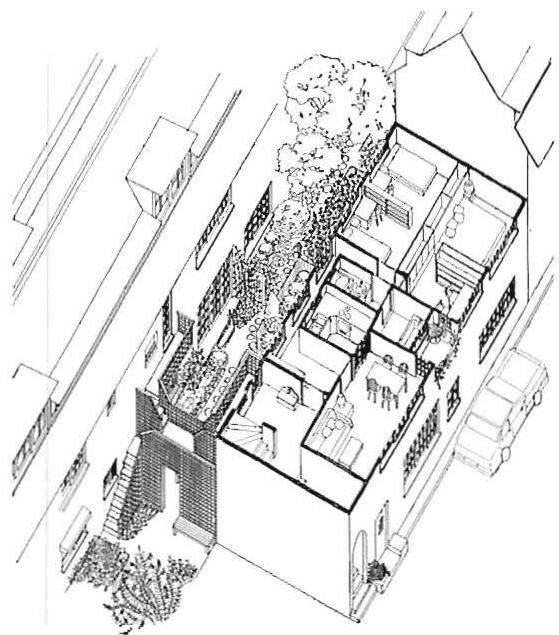
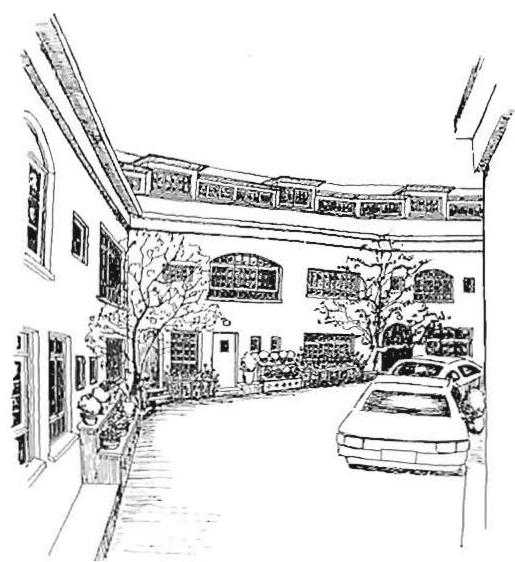
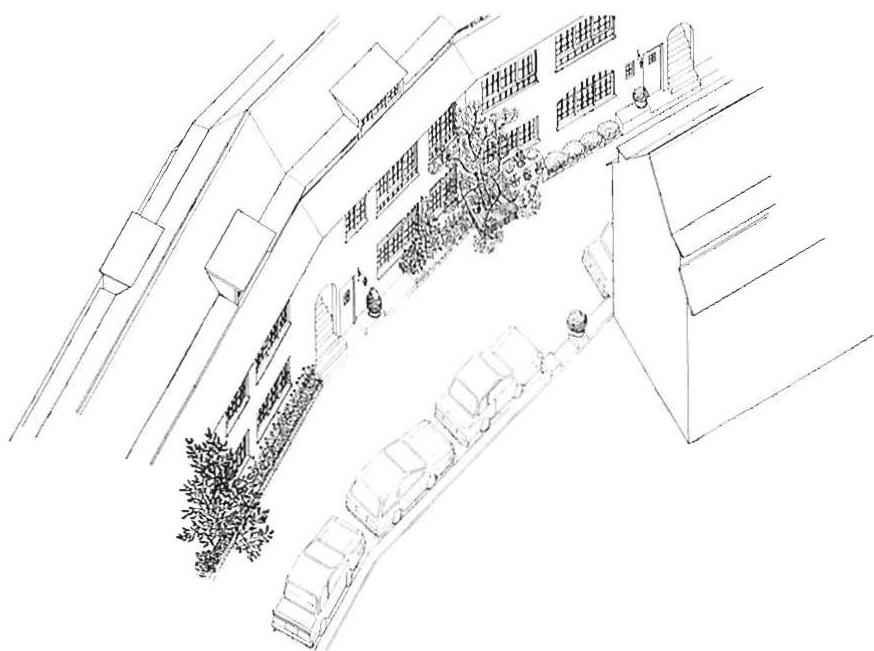
if it is 6 meters by 12 meters, has both long walls open to daylight with a total of 24 linear meters of daylight-facing exterior wall surface, four times as much daylight as the typical high-rise apartment.
There is another way to make the same calculation. Typically, in an apartment, only those
areas within 3 meters of a window are reached by daylight that is useful and pleasant. In the usual high-rise configuration, no more than one quarter of the space in any one apartment is within 3 meters of a window, so only a quarter of the apartment has good daylight. In the apart-
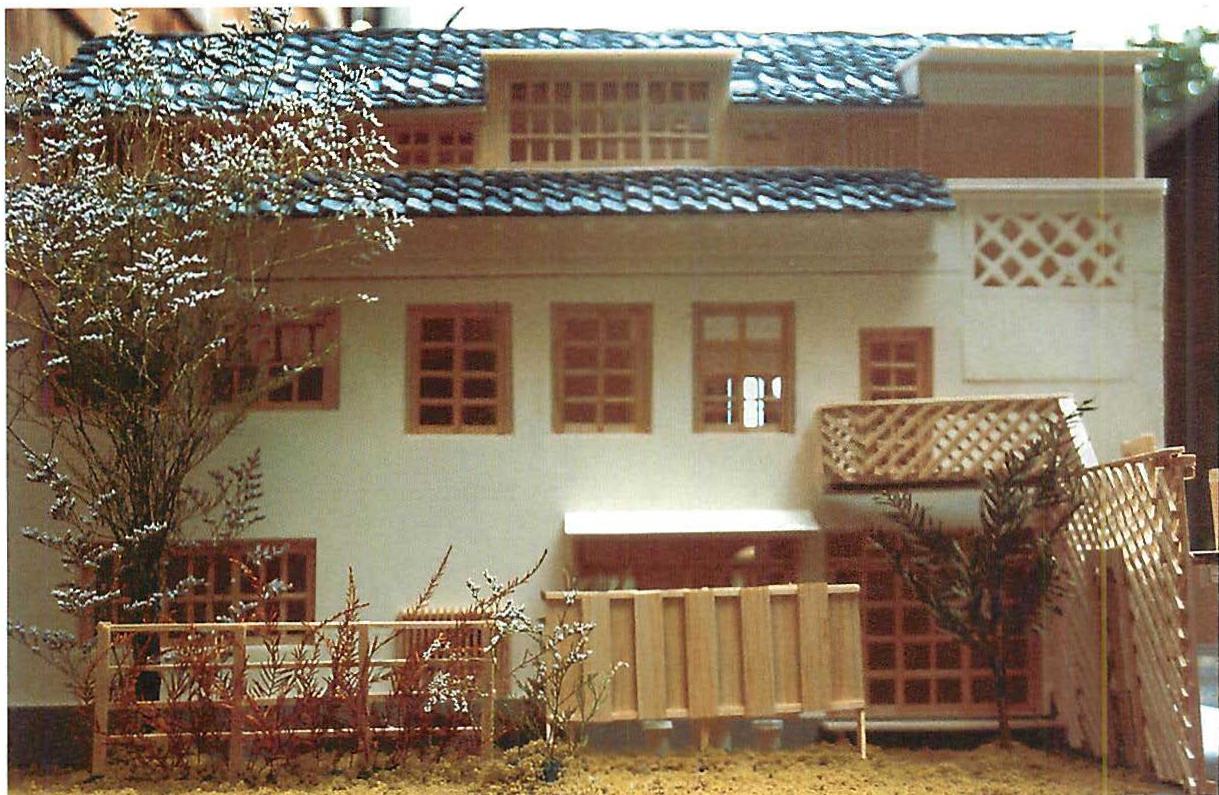
ments of the Shiratori plan, 100% of the floor area is within 3 meters of a window, and 100% of the apartment has good daylight.
6. SUNLIGHT
In the northern hemisphere, except in tropical countries, one may say broadly that rooms in houses and apartments should face south to give people as much sunlight as possible.⁴
However, this rule must be interpreted with great care, and especially at high densities one has to treat it with care. If, for example, the main wall of the long side of the Shiratori apartments were to face south, this would have two results; one, that half the apartment, by facing north, could almost never get sunlight; second, because buildings are so close together, sunshine would be obstructed when sun angles are low—yet these are the times of year when sunlight is most important.
To make sunlight work in the Shiratori configuration, one actually needs to orient the buildings so that the windows, as a group, face into the cone of sunlight from south-east to southwest. To achieve that, the buildings should face east and west, while streets and building volumes run north-south, allowing the faces of the buildings to catch south-east and south-west sun.
To measure the total effective sunshine in an apartment, we may use the measure of square-meter hours. This measures the total square meters on the floor getting sunlight, each square meter multiplied by the number of hours of sunlight it receives (using the day with shortest sun-hours and lowest sun angle).
On December 21, a typical apartment of 72 m², in a high-rise configuration building, receives a total sunshine of 70 square-meter hours. On the same day, a Shiratori apartment of the same size, oriented the way I have described, will receive 150 square-meter hours — because
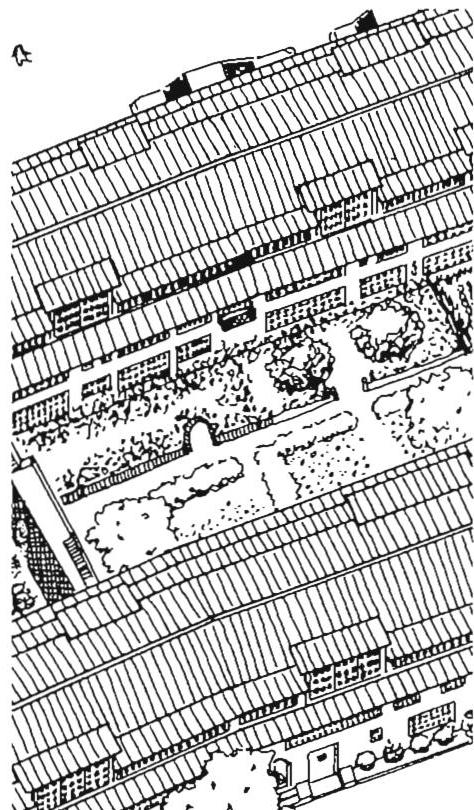
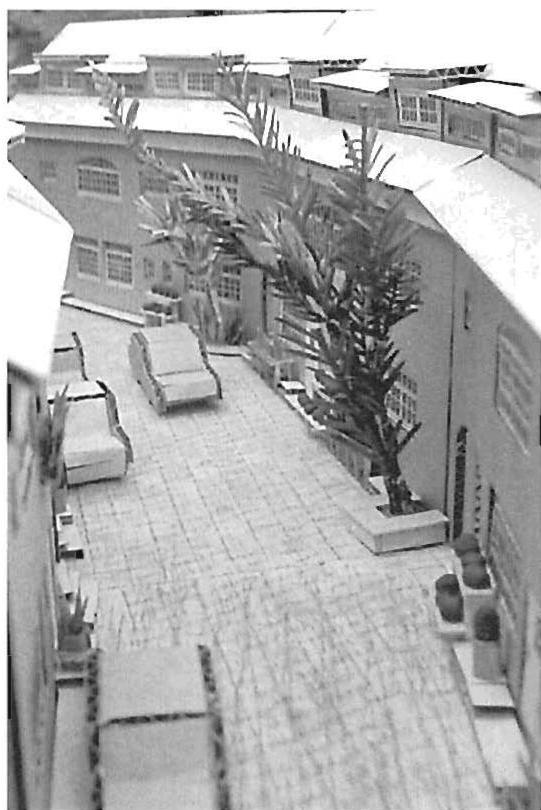
of the much longer window perimeter, and the better orientation possible in the Shiratori arrangement. Thus the inhabitants of the Shiratori apartments will, on the average, get more than twice as much sunlight as the less fortunate families who live in the typical high rise apartments.
7. CROSS VENTILATION
Summer is hot in Japan, hot, and often sticky. It needs a nice breeze to cool you down. The houses which are designed in the Shiratori plan, are only 6 meters deep — so it is very easy to open windows on opposite sides of the house and thus lead a breeze through the house.
8. THE BEAUTY OF THE SMALL PRIVATE GARDENS
At first sight the tiny gardens which the Shiratori apartments have, may seem almost ab-
surd. Each family has a garden that is 2 meters wide and 4 meters long. Further, the gardens are in a zone only 4 meters wide, between the buildings. How can these gardens get any sunlight to let plants grow? And, is such a tiny garden really useful?
It is instructive to realize that traditional Japanese town houses very often had gardens of just this size. For instance, I went into a house in Nagoya, a two-story row house, opening off just such a lane. The garden, which is pleasant, filled with plants and enjoyed by all the family, is 2.2 meters by 3.85 meters (photo next page).
Although this garden size seems small by mechanistic or present westernized standards, it is normal for the feelings of Japanese people and, for them, pleasant and useful.
Second, because of the street orientation, the gardens receive many hours of sunlight—even though the space between the buildings is so narrow. In summer (June 22) the garden gets
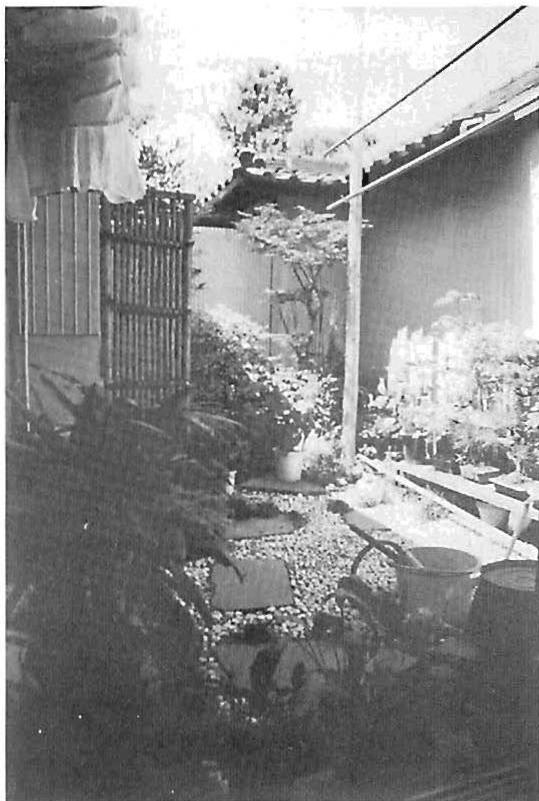
6 hours of sunshine. Even on the worst day of the year, December 21, each garden gets 3 hours of sun.
Compare Shiratori with conventional housing of the same density. In the Shiratori area, every single family has their own garden. The traditional Japanese feeling ("let me be connected to my own little bit of soil") is respected and honored here. In conventional high-rise housing where the density is the same (200 units per hectare), not one family has their own garden.
Is there really any comparison?
9. UNIQUENESS OF INTERIOR PLAN FOR DIFFERENT FAMILIES
The form of the buildings allows each family to develop a special and unique house for themselves, with unique details, inside and outside the buildings.
Thus, it is very easy for each family to install an apartment plan of their own wish, within the rectangle they are provided. This is easy because the short party walls between adjacent apartments and the long window perimeter make the planning flexible and easy, and there are few constraints.
The apartment plans shown in chapter 13 (page 383) show different possible interior plans generated by different families within the daylit rectangles provided by the housing envelope. They allow individual families greater dignity than is possible in a high-rise housing because each house is more truly unique and special to that family's character and wishes.
Physical installation of these different interiors can be done privately by individual families—or publicly by using computer-cut lumber and the computerized planning service already offered by Japanese companies in low-density suburban housing.
10. CONVENIENCE OF PARKING
Cars are easy to get to, but do not dominate the landscape. Thirty-five percent of the cars are parked in the lane itself, with your car parked outside your own house. Another thirty percent are parked on perimeter streets, two minutes walk from the house. Thirty-five percent are in underground garages, one level below the ground, at the end of the lanes where you live.
The underground parking lots are reached by small, Japanese freight elevators for cars, from the lane (drawing opposite). The lots are small and safe because of their intimacy, and also have stairs leading directly to the lane, so there is no long distance, nor the frightening quality one experiences in large underground garages.
11. BEAUTY OF CONSTRUCTION
One of the things people like about traditional Japanese buildings is their beauty of con-
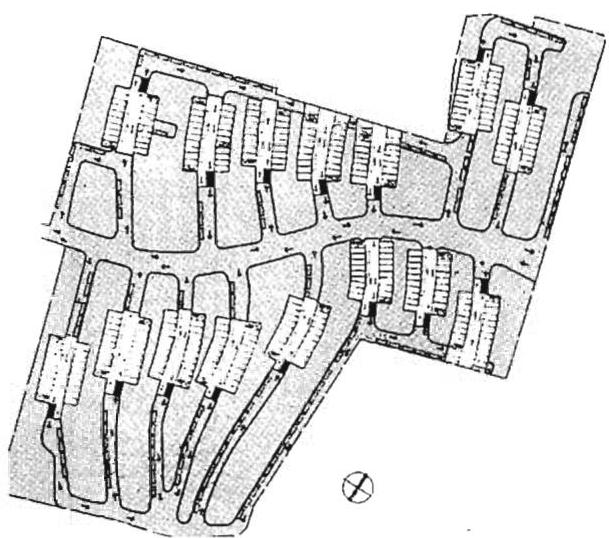
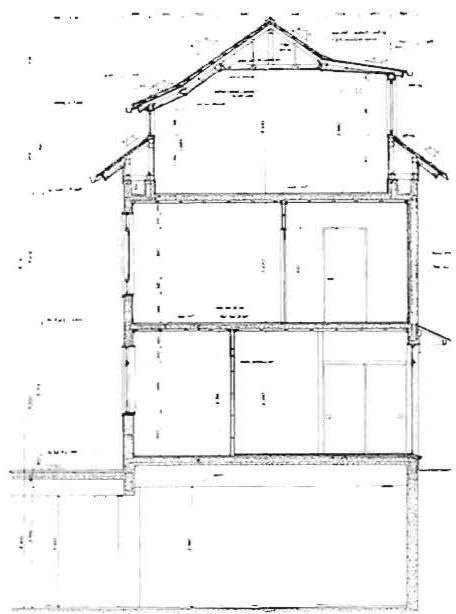
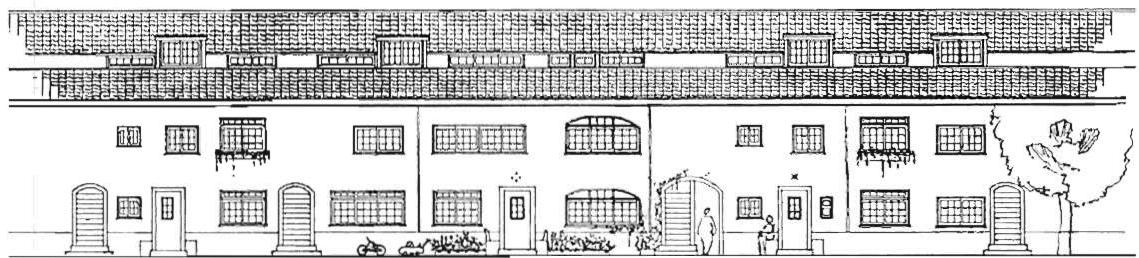
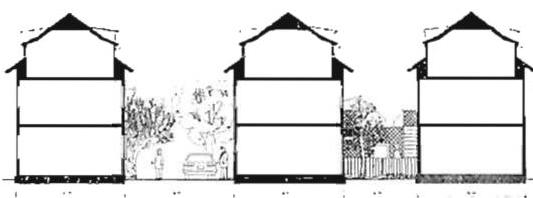
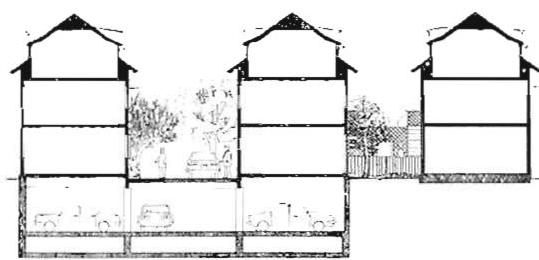
struction. This has completely disappeared from modern high-rise apartments which are most often built in extreme, debilitating ugliness.
It is commonly assumed that this is done because of economic necessity or because of some kind of special efficiency. In reality, though, it
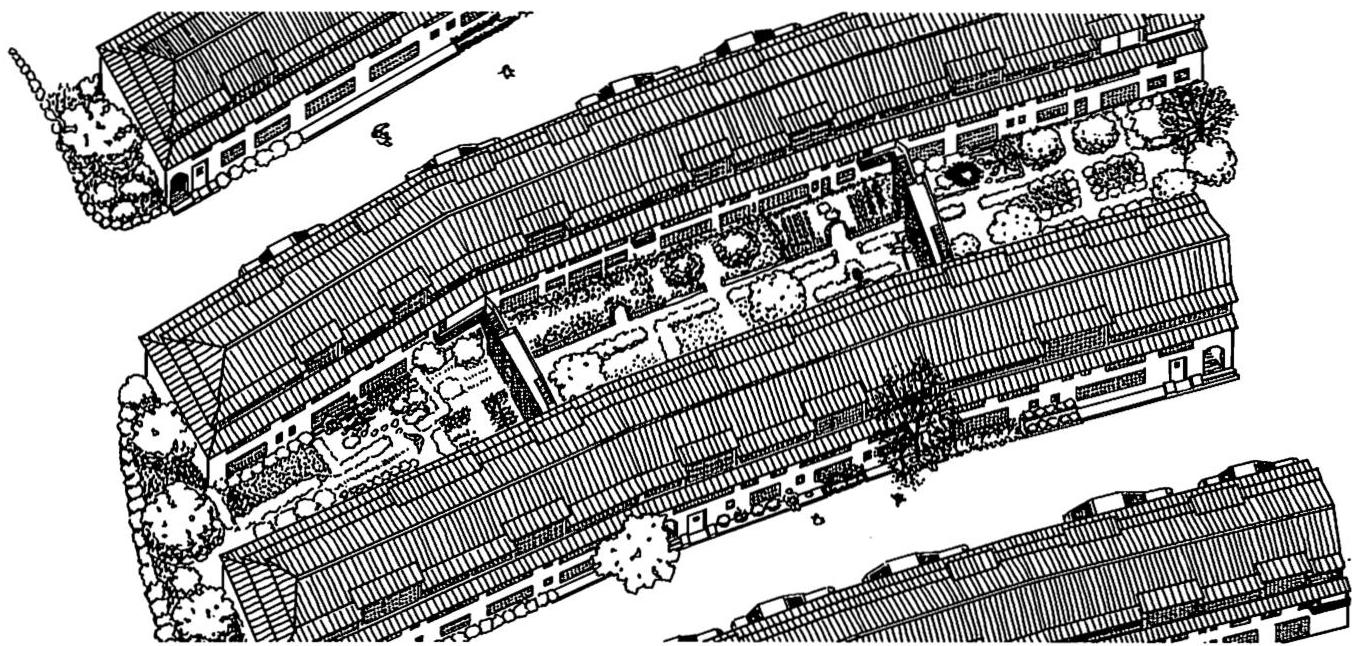
is simply a consequence of an unintelligent building form which causes the method of construction to be banal and highly unpleasant.
In the Shiratori plan, we have very simple small buildings. They can be built in masonry with wooden roofs and some wooden interiors. See illustration on page 320.
12. BEAUTIFUL BUILDING EXTERIORS
The unique character of each unique apartment interior can easily be carried outward to the building's exterior and to the boundary zone where the building meets the street. It becomes expressed, then, in the variety of windows, roofs, entrances, eaves, openings, window sills, passages, and flower-pots. Each part is recognizable, and individual, with its own life.
13. COST OF CONSTRUCTION
The cost of the construction which I have proposed for the Shiratori plan is the same or lower than costs of present-day high-rise housing. This is because high-rise housing, though often put forward with dramatic claims about cost effectiveness, has various built-in hidden costs, which greatly increase the cost per square meter (for example, more expensive foundations, elevators, air conditioners, heating systems, wall systems, crane-lifted panels, are all more expensive). In Oregon we built a sample of 3-story housing, not too different in type from the Shiratori arrangement, with no two apartments the same, and a similar average size of apartment (80 m² each), at a cost of $40,000 per apartment (1993).
Sadly, the contractor's and developer's lobby in Nagoya prevented the Shiratori project from being built. I suspect they were worried that if carried out, it would put a limit on density, from which they might never recover: and at that time, although 200/hectare was the legal limit on all multifamily buildings, behind the scenes lobbies were trying to increase this limit, so that they could make all land more profitable.
5 / CHIKUSADAI: 40 FAMILIES PER ACRE
After the reluctance of the Nagoya municipality to build the Shiratori project, I was approached by a community of several thousand families from Chikusadai, another part of Nagoya, with the request that I help them in their struggle with the city, and build housing of a similar type for them. In this case the project was at a lower density than in Shiratori (about 100 families/hectare or 40/acre in Chikusadai), though using the same general principles.
What was especially interesting here were these features:
They had an existing community dating from about 1940, which was to be torn down because it had become derelict. They wanted to preserve the feeling of the community while building to the city's desire for new housing at a higher density. The Chikusadai plan is therefore based on extensive participation with the people of Hazama-sou, one of the neighborhoods of Chikusadai.
The overall density is lower. The plan shows the same kind of housing in a context where there is much more open space, making a more relaxed and pleasant layout for the families — with plentiful large gardens and parks.
Since it was done with the people of Chikusadai, all living there at the time of our work together, the plan illustrates the structure-preserving aspects of living process and closely follows the outline defined by neighborhood groups and families.
The project had, also, this wonderful slogan from the community: OUR NEIGHBORHOOD MUST BE FIT FOR INSECTS. IT IS THE INSECTS WHICH ARE IMPORTANT. WE WANT A WORLD
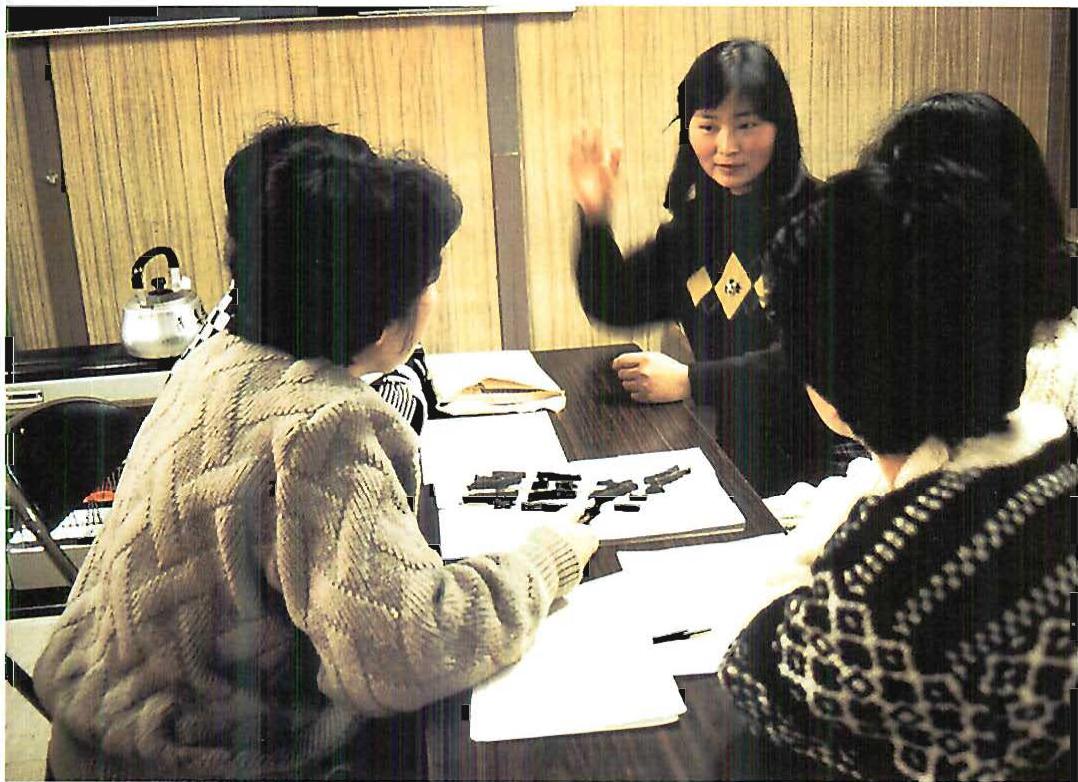
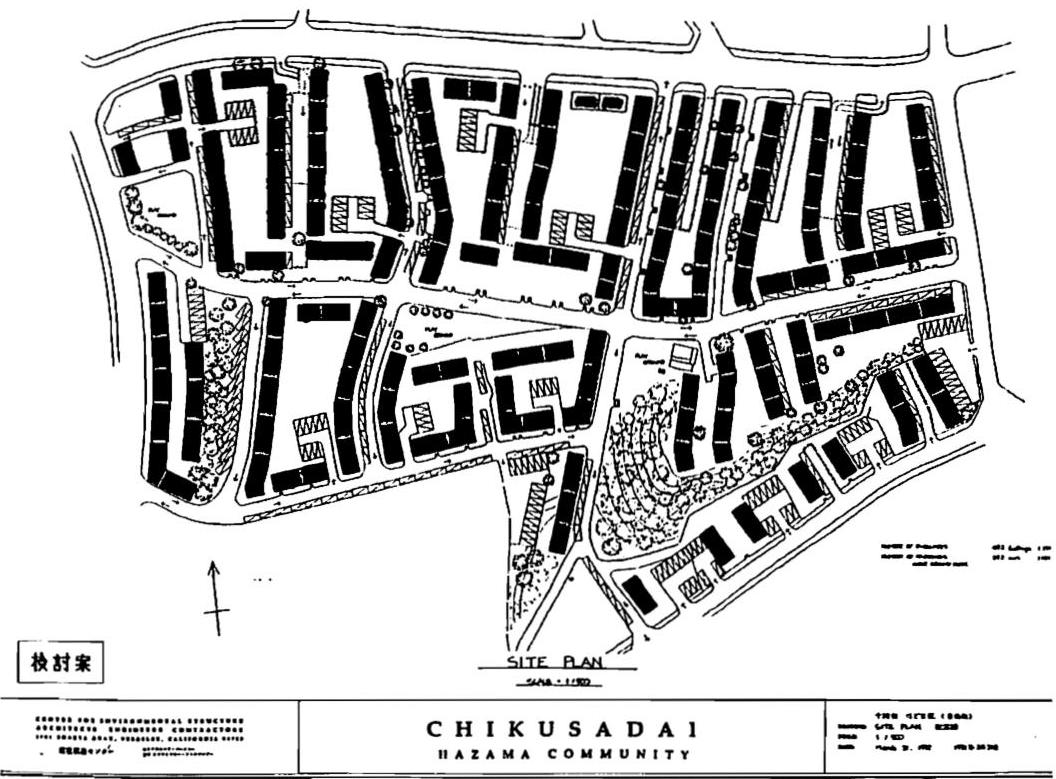
IN WHICH OUR INSECTS ARE PRESERVED. With these astonishing words, the citizens of Chikusadai launched their attack on the city, their appeal for help, and their work with me.
In 1992 I wrote some twenty letters to the 400 families of the Hazama neighborhood in Chikusadai, while we were working. Here is one of these letters:
To the people of Hazama-sou, March 7, 1992:
ON OUR WORK TOGETHER ESSAY #2: INSECTS
My dear friends and colleagues,
When Mr. Ozawa, the NHK film director, asked me what impressed me most during my discussions with you, I answered "insects". He was very surprised, and even I myself was a little surprised by my own answer to him.
When you told me about living environment, and that one of the things you cared about so deeply
was insects . . . it seems a small thing, even a trivial thing. But it expressed very strongly your deep love of trees, and sunshine, and darkness, and living things, and the reality and short moment of our own life, in a way that surprised me very much.
In almost thirty years of work, working together with families like you, I have never before heard people mention "the well-being of insects" as the most important thing in a neighborhood. When I heard it from you, and thought about it, I wondered why it moved me very much. Partly I found the answer in Matsuo Basho's poems. He also thought very much about insects and the meaning of life in small things, the sound of cicadas. I began to realize with increased respect how deep-thinking you all are about your own lives: and how this work we are doing together now, in Chikusadai, is a much greater thing than just "a housing project." It is really a work about the meaning of life in a way that almost all people in the world have been forgetting.
Christopher Alexander
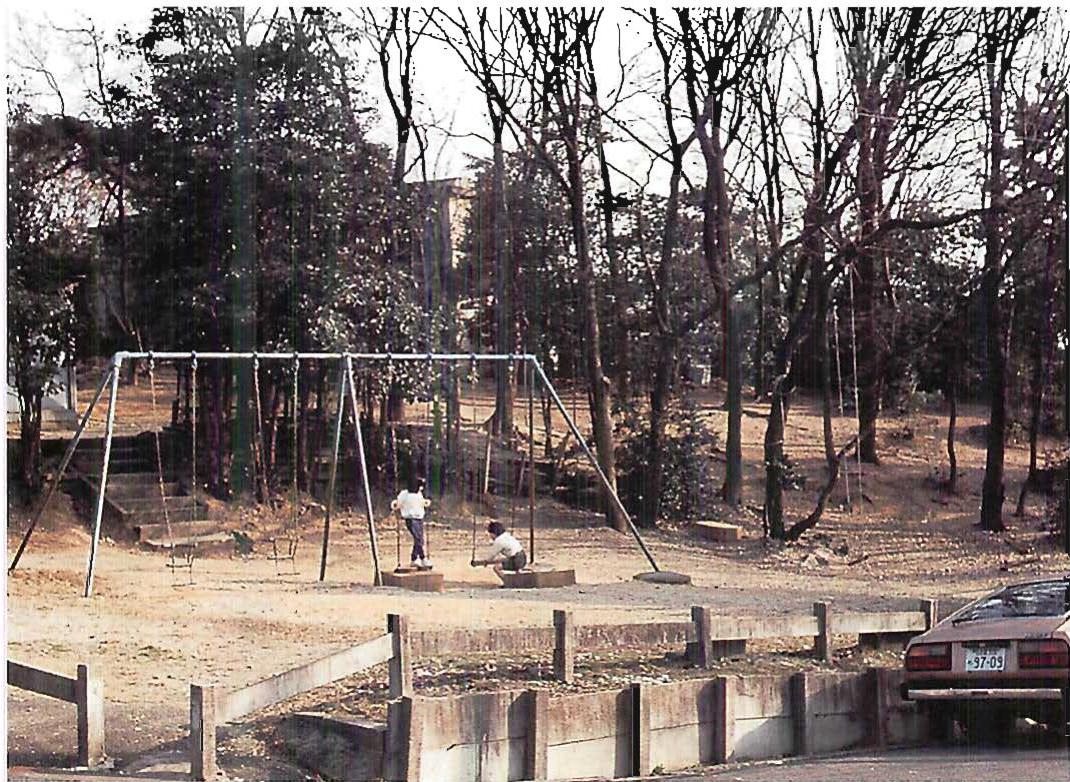
At the time when the project began, the City promised the people of Hazama-sou that if 70% of the citizens of the area would support the new plan, the city would build the design they wanted. Our work with the neighborhood was very successful. Eighty-five percent of the people in Hazama-sou supported the plan and signed a petition to the city, declaring their support. Proudly the petition was taken to the city offices. To our horror, a few days later the City issued a statement that they had refused the plan and would ignore it altogether. I wrote this public letter to the Mayor.
THE FUTURE OF CHIKUSADAI:
October 5, 1992 The Honorable Mr. Takeyoshi Nishio, Mayor, Nagoya City Hall, Nagoya, Japan
Dear Mayor Nishio,
It has been some time since you and I spoke together in 1989 and 1990. Since then I have always been remembering your statement that over-participation by the people, in the construction of
public housing, is the most important thing. I was very impressed by this statement because you said it to me so strongly, and I felt it was most unusual for the Mayor of a big city to understand this very important thing so well. I have never forgotten your saying it.
I hope you saw the NHK program on June 15 in which the work of the citizens of Chikusadai was described. I am sure you must be very proud of the people of Chikusadai, who are so firmly and so strongly insisting that their lives, their children's lives, their families lives are the most important thing. I was very impressed when the Chikusadai citizens made a formal request to the city of Nagoya to listen to their wishes and adopt the plan which they had made with my help.
But frankly, I was deeply shocked to hear that your housing office sent such a blunt and impolite refusal to the citizens of Chikusadai, especially since in 1989 you had told me so strongly that user participation is the most important thing, and I, taking you at your word, had implemented this idea with several hundred people in Hazama-sou.
Originally the Housing Department agreed that they would follow the plan if at least 70% of the families supported it. Do you realize that in Hazama-sou, a full 85% of the families in the community have declared that the plan they made together with me is their will, and what they believe must be done for the good of their families. Their request was very clear and modest. They just asked the officials to proceed with the city plan with the people
Each house at each level is different, and has a different window configuration, as a result of the different interior plans made by the families. Christopher Alexander and Miyoko Tsutsui, 1992
of Chikusadai and with me, and using our plan made with Chikusadai people as a basic draft. But as you probably know, the housing officials ignored the request, broke their promise with some impolite letter, and have now started trying to move people out of Kusunoki-sou instead, so that they can go on building the existing municipal plans which the people don't want and which destroys "green and soil" completely. Unfortunately, of course the intention of the officials' act is only to begin destruction of Kusunoki-sou, with the idea of breaking the spirit of Hazama-sou and others in Chikusadai. This cynical and shameful attitude surprised me very much, since your vision of true concern for the lives of ordinary people was so positive in 1989.
Is it not shameful that your own housing officials behave like this, in blatant defiance of the will of your own citizens? Please may I urge you, as Mayor of a great city, to take a positive view which is helpful for people's lives. Please sit with Mr. Kato and with other housing officials, and explain to them your view that user-participation is the most important thing, and that user participation must be done in Chikusadai, so that it becomes a symbol for Nagoya and a symbol for Japan. Please use your influence to explain this to the leaders of your Housing Department and your Community Department. Please tell them that they are doing wrong, and that they have the wrong understanding of a living environment. Perhaps, also, they do not realize how relatively simple it will be to
implement something so much better at the same cost, and in a way which will nourish the hearts of families throughout that neighborhood at the same density your officials originally specified. Is it not possible, too, that you could use the force of your office, and your position, to do what is right?
Please believe me, I will do anything I can to help you reach your dream of user participation, and to overcome whatever obstacles you have found to make this dream come true for some of the people of Nagoya.
Christopher Alexander
6 / EVALUATION OF THE SHIRATORI AND CHIKUSADAI PLANS
To some degree I approached — at least just began to approach — a living structure in the Shiratori and Chikusadai plans. The feeling is unique. They have an intimate feeling, an almost miniature quality. And above all they create — and preserve — the sanctity of the pedestrian world.
I believe this quality is consistent with the deep feeling of Japanese people, who have always had a unique sense of scale and size. The small size of a traditional tatami mat is what I mean. The small size of tiny stairs in traditional Japanese house illustrate what I mean, often no more than 60 centimeters wide and very steep. The small size of traditional garden is what I mean. The modest size of a traditional entrance to a Japanese house is what I mean. The small lanes of traditional urban housing from the Edo period also show what I mean.
The great beauty of Japan, in traditional times, came from an understanding that human
life is most beautiful, when many things are a little small. This emphasizes their preciousness and makes them more intense in their feeling.
Modern western standards have driven this feeling out of Japan, and replaced it with a cruder sense of scale which is just slightly too large. I believe, however, that the desire for this smaller and more intimate scale remains in people's hearts.
In the end it is this intimate and subtle feeling which may be the most important thing about the Shiratori plan. I hope that when it is, one day, built for the first time, people will feel themselves better there. I believe they will experience an intimate feeling which brings people back to the ground, back to their hearts — and allows an ordinary person of modern Japan to feel the same quiet and beautiful feeling of one-ness in the harmony of mind and body which Rikiyu felt in his small tea house that was only two mats large.
7 / A POSSIBLE WORLD-WIDE ARCHETYPE
I should say, too, that the results I have presented, although they were obtained in Japan, and although the analysis of people's wishes was studied with objective questions, only in Japan, nevertheless the results are more widely applicable. I believe that similar — certainly not identi-
cal — results will come from asking people in other cultures, to answer questions similar to those on pages 312–14. And I believe the results shown in this chapter, though worked out for people in Japan, will, in some version, also make sense (in some transformed version) in Norway,
in Jordan, in China, in the United States, in Chile, in Germany, in Kenya, in Germany, in England, in north India and Nepal.
Of course, housing is very specific to culture. An example of a generative process, specific to Colombian culture, is given in chapter 12. One for Venezuelan culture, quite different, is given in chapter 11. But when density increases to the levels discussed in this chapter, the options become more restricted, and the limitations of human need and human desire coupled with the density lead to a smaller range of possible good solutions. Just as high-rise apartments, though detrimental to people's wishes, became used all over the world, so I believe that archetypes like the one I have shown here show a partially universal form which might, in different versions, modified for culture, address the feelings and wishes people have in many, many places on Earth where building density has to be extremely high.
In most countries of the world, people are suffering from modern forms of housing. These forms of housing have, unnecessarily, gone in a direction which is inhumane, inefficient, expensive, and unpleasant. It has happened because people have assumed (wrongly) that there is no alternative. They have therefore reluctantly built the 19th- and 20th-century types of housing, regretting the necessity, perhaps apologizing in their hearts to the families whose lives they have destroyed or damaged.
In this passage, I have shown that there is an alternative, not previously imagined. There is a form of housing which achieves the maximum density permitted by Japanese law, but under conditions which resemble humane and beautiful high-density urban housing of past eras. Such new forms of housing are better in space, better in daylight, better in sunlight, better in parking, better in gardens, better in quality and uniqueness, better in planning. They also come — I believe — closer to creating real community.
8 / SOME INVARIANTS FOR HIGH-DENSITY HOUSING
What I have described in this chapter is not a universal living process for high-density housing, but rather a process which can generate one very particular type of plan for high-density housing — one that keeps extremely good characteristics even at the very highest densities of 50 to 80 families per acre — about the highest densities that housing ever reaches.
If we compare it with the form of housing arrangement described in chapter 10, where I examined the general features of housing at 10–20 families per acre, we see how extremely different the arrangement is. At 20 families per acre, the gardens dominate and the pedestrian system is very important, cars are separate from pedestrians. At 40–80 families per acre, the gardens are tiny, though still present; buildings are 2 1/2 stories high, not 2 stories; cars are partly underground and partly mixed with very narrow lanes, leaving the daylight as the all important features which, in a successful project, must dominate the form.
The general morphological features of housing arrangements that will typically come from living process, at such very high densities, are these:
Height is all important. The low eave of the third floor so that the height to the eave is 7 meters, but not 8, is a surprisingly important detail. The shape of the apartments, long and thin along the street, and garden, so that abundant daylight comes in, and windows dominate the interior. Each apartment with a tiny garden—still vitally important. Narrow lanes, able to take cars, at slow speeds, and able to allow a few cars to park, but made so that these lanes are largely pedestrian, small in scale, and parallel to each other. Design of apartments, even at this ultra-high density, by the families themselves.
The essence of any morphology generated by a truly living process for high-density housing will go like this:
The world — where children, old people, human beings walk, play, exist — is mainly pedestrian. The scale is tiny. Lanes are small, narrow, the total area given to cars is minimized. If the number of parked cars above a certain figure, some of them go underground. Everyone still has a garden, even if it is no more than a patch of sunlight with a pot of geraniums and an old chair. It is yours. The houses are arranged so that they receive a tremendous amount of light. This means that they are, as structures, necessarily very narrow, with long exterior walls. Within the houses, people can create their own living space, walls, bathroom, kitchen, as they wish. The houses are no more than two-and-a-half stories high: so that the eave of the roof is low enough to create a comfortable human scale and positive feeling relative to human beings in the narrow lanes and gardens.
NOTES
- Hisae Hosoi, interview conducted with residents of high rise apartment buildings in Nagoya
- Typical layouts may be seen all over Japan, and equally in Italy, Manila, Moscow, Sweden, Germany, Brazil. It is almost universal. Only a few countries have progressed beyond the high-rise apartments building. US and UK are two countries where it is beginning to fall off in popularity because user needs have begun to have some impact.
- Data taken from Hosoi, 1992.
- Obviously, in the southern hemisphere south and north must be reversed.
CHAPTER ELEVEN: HOW LIVING PROCESSES MUST GENERATE NECESSARY FURTHER DYNAMICS OF ANY NEIGHBORHOOD WHICH COMES TO LIFE
1 / THE STUFF OF LIFE
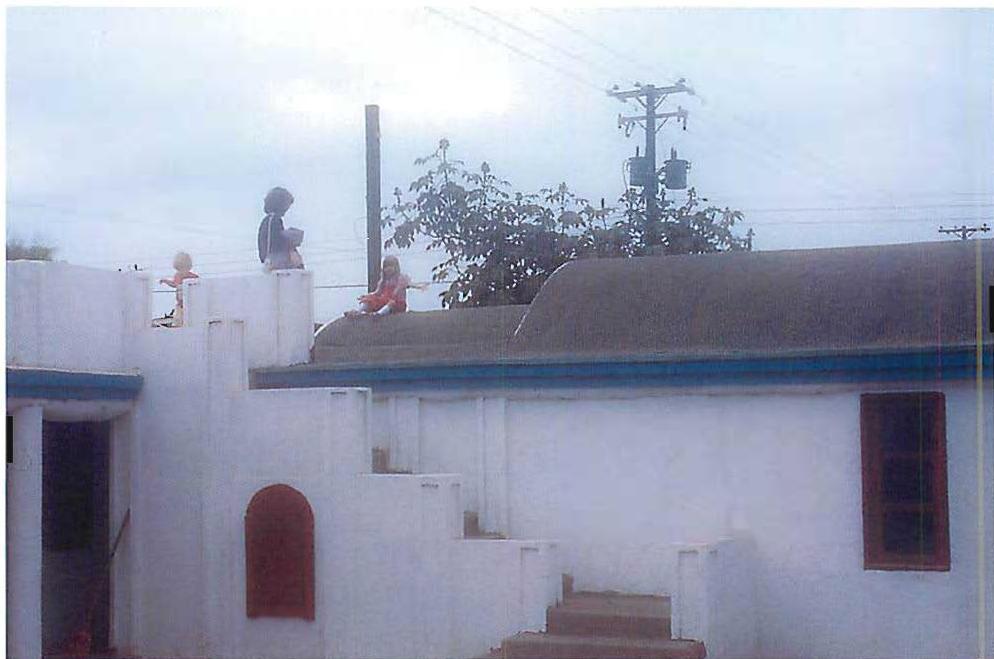
What you see in the photographs on this page and the next is an essential of a living world. It is unpretentious, ordinary. But it cannot be mistaken for the dead products of "development." It has real life, unassuming, but smooth, rough and ready, relaxed. It belongs to the world. It will support emotions and the real stuff of our lives as we live them and feel them.
In chapter 9 I described a dynamic way of thinking about the development of an existing neighborhood. The dynamic process, the system of transformations, takes existing streets, lots, paths, and parks and gardens towards a new and improved, more living state.
Now we need to go further. The same kind of dynamic thinking also applies — must also be applied — to cases where new neighborhoods are being built from scratch, and to more general cases of repair, where a neighborhood is improved daily, weekly, as part of its ongoing process of growth. Indeed, dynamic use of living process by repeated application of simple transformations applies, in principle, to all cases where something is being done from a new beginning. It is the only way to make a complex structure come to life in such a case, to do it gradually, over time. I include in these next examples cases where neighborhoods have been laid out from scratch in Venezuela and Colombia and Israel, and the new dynamic models which are capable of guiding such cases. The pictures of a Colombian neighborhood show examples of things happening gradually, over time, and show how the broad plan of such neighborhoods evolves slowly to create real life.
There are examples, too, which show how these ideas can have impact on the form and structure of the streets, flowers, trees, building fronts — everything, in short, which you might do to have an impact on the living character of space in the immediate world where you live. In one case — as a microcosm of such a process — I show how a group of people built a single bench overlooking San Francisco Bay (pages 352-56).
2 / THE ESSENTIAL REASON FOR DYNAMIC THINKING
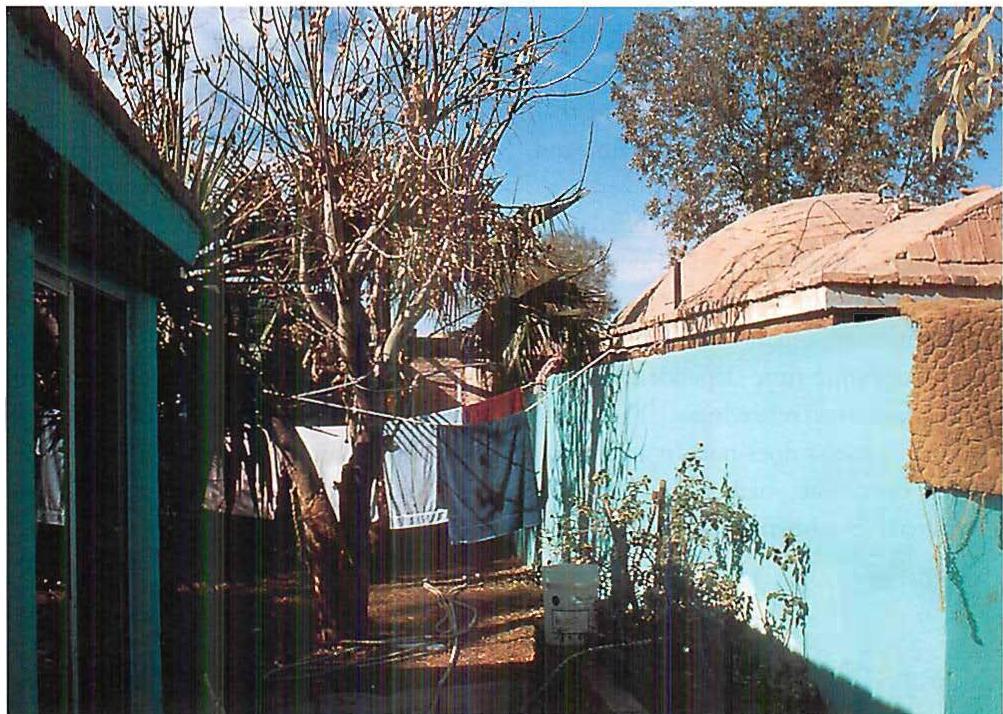
In most typical zoth-century developments, the developer laid out a plan, and then, over the next few years, the houses, shops, and offices were built according to this plan, filling it in. Not surprisingly, these "filled-in" developments were often rather dead when built. The reason is that the form, the plan of the community, did not emerge naturally from actual events in the ongoing life of the community and was therefore not harmonious with ordinary life as it would have happened if things were natural.
Think about the time-dependent process by which an unplanned human settlement grows naturally. Someone starts with the idea of building or living on a certain site. A few people build their houses there. In the natural order of things, perhaps an office or workshop is built there. Then a small café is built. That happens in response to people's needs and the press of their activities. As a result of the café and the office, and their interaction with the terrain, people start driving to that place in a certain way, parking their cars in a certain way.
Those parking places and that dirt road set up in relation to the terrain, take on a certain natural form. Then, if another person wants to build a workshop there, or an office, it goes in a certain place which is related to the existing directly aligned dirt road, to its parking, to the office, to the café and its view.
The position for the second workshop is a natural outcome of the answer "Where would I like to locate in relation to all these other things that are there already?" It is, almost certainly, a very different spot from the spot that would have been marked on an original master plan, if one existed. That is because on the master plan, someone was trying to arrange everything at the same
time. Here it is more real. It is dependent on real smells, real relationships, real practicalities. So if this second workshop were built according to a master-plan it would inevitably be unrelated to the terrain, cafe, road. If, instead, it is built in this natural spot which emerges from people's actions and volitions, it will be related—in a way that makes sense—to the road, cafe, terrain, and parking and view.
The effect of time on the process of adaptation is huge, and leads to types and styles of order quite different from any planned arrangement. Even in this first very small increment of construction, the dynamic time-dependent process creates and maintains relatedness. The static master-planned process does not. In a community growing over time, such increments will happen hundreds — more likely thousands — of
times. If a dynamic process is followed, so that each time the next step follows existing things — preserves the structure, and creates and maintains relationships — we get a harmonious living community.
If, instead, a static master-plan-based process is followed, and the 20 or 100 things are built according to the original drawing or plan, then they will exist, for the most part, without real functional relationships: the whole is unrelated in its internal elements; there has been no structure-preserving going on, step after step, and the whole remains dead.
Thus, the main problem of community development, of growing a neighborhood, is to do it in the dynamic way not in the static way.
That is the big challenge. How can it be done?
3 / SANTA ROSA DE CABAL, COLOMBIA
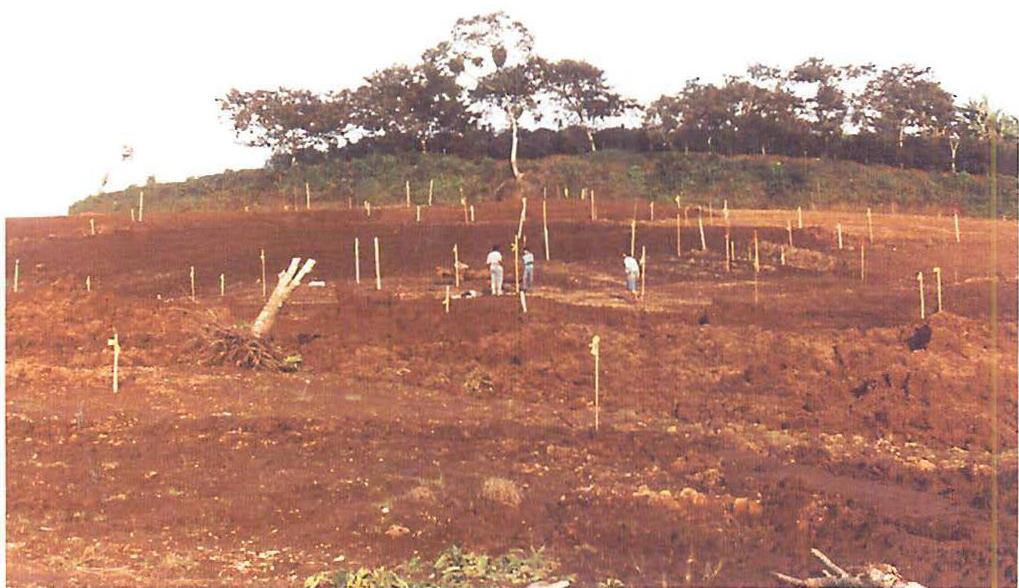
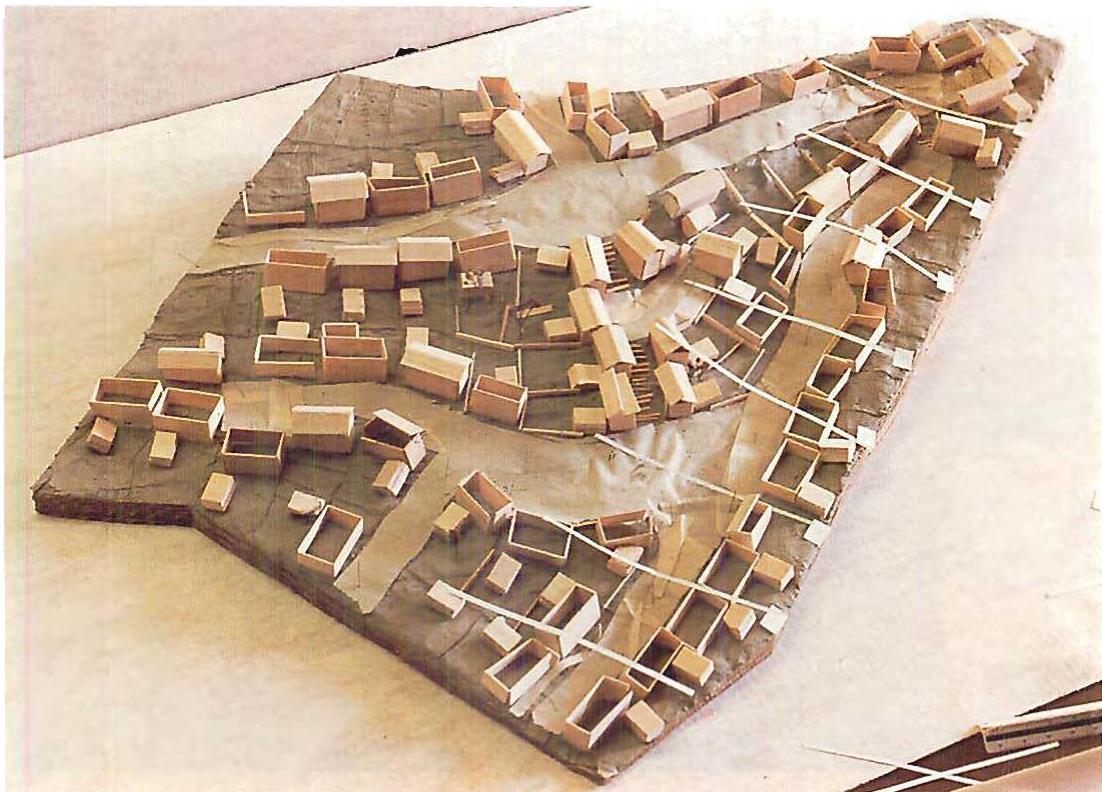
In Santa Rosa de Cabal, in the mountains of Colombia, we worked for seventy-six families. We started in 1988 and promised them they could all design their own houses, using a very simple method. First we laid out the streets of the neighborhood together, on the land. The stakes marking the layout are illustrated on page 336. The model, and the drawing for permission came from the stakes, not vice versa.
The people were very poor. They dug the trench for the main sewer themselves. Then each family laid out a house, using for the design process a sequence for a Colombian house which we had developed with them. The working of the process and the houses the people of Santa Rosa made using this process — each one unique to a different family — are illustrated in chapter 12, pages 398-408.
There were tremendous delays. The bank staff could not understand the idea that each house was different. They talked about resale value as a reason for standardizing the houses (just like an American mortgage company). The umbrella organization supporting the project, Construyamos (spanish for "let-us-build"), was one of the largest and most powerful self-help organizations in the world. Hernan Mesa, head of Construyamos, at first said that our process could only work if all the houses were identical, mass-produced by collective labor. Then he gradually began to accept our idea about the family's individual life and their dreams as the underpinning of the process.
It took time to convince him and the bank of the importance of this idea, but we succeeded at last. Yet then, four years later, one day Hernan again insisted that (in the name of social justice) every family must have an identical box. Finally, we and the family members persuaded him and the planners and the banks that each house must be different to give each family its dignity. The families, of course, already knew this and had supported this idea throughout.
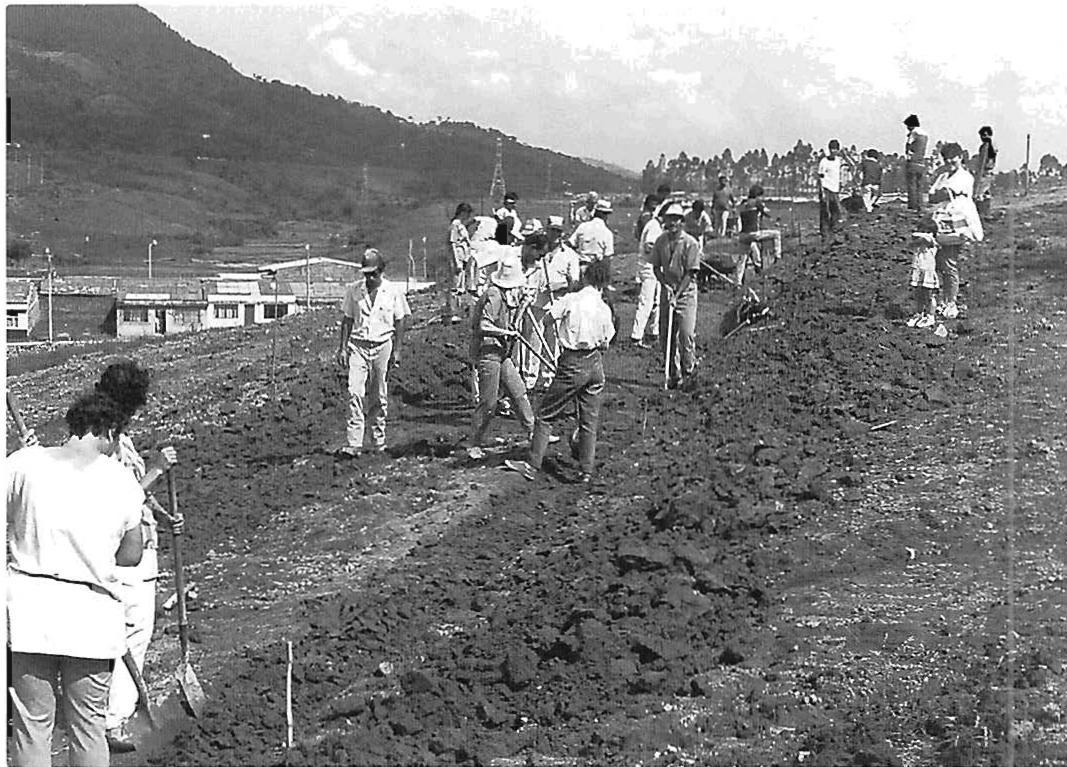
So we overcame that problem. Even in the earliest site model, the houses are visible as outlines. You could already see that every one of them would inevitably be unique, if it were carefully and properly related to the land and to its unique location in the neighborhood.
In chapter 12, we shall see how, in practice, creation of this uniqueness and the careful adaptation of each house to the land was actually achieved. There we see the differentiated subtle form beginning to appear. By 1995 the neighborhood was, in its first form, complete.
4 / FEEDBACK, DIAGNOSIS AND REPAIR
One of the most fundamental aspects of structure-preserving transformations (and belonging) is that at each moment we respond to the given environment, in its current state, and seek to move it further away from its current deficiencies and towards something which extends, enhances, its structure while preserving the essential wholeness which is there.
This is most easily embodied in the idea of “diagnosis.” We examine a neighborhood, looking meter by meter as we go along the streets, for each place that is wholesome, good, in a well-ordered state, and for those places which are damaged, unhealthy, not in good repair. This is the idea of feedback as a necessary component of all growth and all development. We look at the whole, look at whatever there is about it which detracts from the life and wholeness it could have, or seems to be reaching for—and then take the next step to repair the wholeness, to move the whole towards a state of greater life.
I am not talking about broken fences or
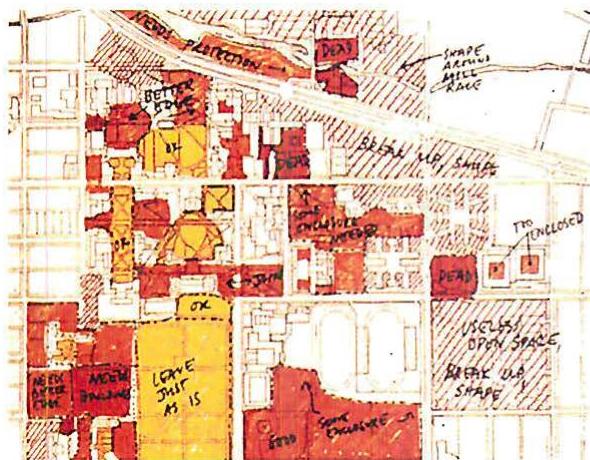
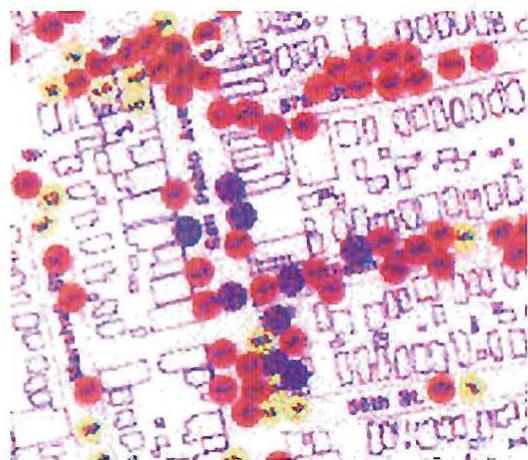
cracks in the sidewalk—although these things, too, are important, and do need to be fixed. I am talking about larger things, a great tree that has potential but the space around it needs to be taken care of—or another place, a place in the sun where everybody sits because you see the buses passing, pretty girls go by, the wind blows softly. Everyone knows such places and they need to be marked, because they are precious, and must be protected. On the other hand, there is a place which is crumbling a little, which is a dead spot; orange peel and papers gather on the ground, no one likes to be there—it may feel slightly frightening, or anyway, not very comfortable. People are hardly ever there. This, too, needs to be marked. Next time money is spent, a few thousand dollars need to be spent to make that place better, making the neighborhood better.
You may very easily say that it is all a matter of opinion. How could one ever get a firm grip on the evaluation of such places? In the political nature of the city—who is to say what is to be repaired, what is not to be done.
But it is not a matter of opinion. The health or lack of health of various places, meter by meter in a neighborhood, changing every hundred feet or so, throughout the neighborhood, is widely recognized, felt more or less the same by everyone, and is an objective reality. In his Ph.D. thesis, my student
Yodan Rofe studied just such a case in North Beach, San Francisco. He took an area of several blocks and asked people to mark the good places, the bad places, and the in-between places. The correlations between what different people saw and how they evaluated different places, when making diagnoses, was very high. Using sophisticated measures of rank-order correlation (like Kendall's rho), Yodan was able to prove what I had long suspected: the diagnosis of good and bad, pleasant and unpleasant, life-giving and life-destroying, is firmly established and objectively real, even in something as minor as the way the character changes from place to place along a street.
The way is therefore open for every neighborhood in the world to maintain an ongoing, updated diagnosis on a computer, and to refer all future acts, and all capital expenditure, to the continuous improvement of the bad spots, and the continuous enhancement and preservation of the better spots and their latent centers.
Even when a new neighborhood is created entirely from scratch, as we shall see next, such diagnosis still plays a role in its unfolding. At each moment, the next act looks to the errors, weaknesses, and strengths created in the accumulation of the previous acts, and responds to them, repairs what is weak, and keeps and strengthens whatever is already strong.
5 / LAYING OUT A LARGER NEIGHBORHOOD BY A DYNAMIC PROCESS: A FULLY GENERATED PLAN
Let us consider a similar process at the scale of a city or a neighborhood. In the following example I describe a planning scheme originally worked out for the township of Guasare in the state of Maracaibo, Venezuela. The process was designed for implementation in a new town of several thousand workers, but Corpozulia, the coal-mining corporation that commissioned the plan, moved its operations and implementation never took place.
This process is particularly strong because it makes use of the fifteen transformations very visibly, and the forms of land, street, garden, house, and courtyard are assembled to form an unusually dense and compact system of positive space-bearing centers. It is perhaps the closest model, presented in this book, to a sketch of an ideal neighborhood.
I am showing this theoretical process because it is—as a process—unlike almost any process that city planners or developers currently think about. It creates a different physical structure, one which is obviously more lively, more capable of being responsive to people's wishes. It has the capacity, on every block, to create an ambience which is truly unique.
What is unusual about this process? First, it is truly driven by the creation of living centers—in a form which ordinary people could make their own, and which creates a unique and beautiful environment. Second, the dynamical aspect of the process, the way it generates form slowly, is unmistakable and huge in its impact on the design. I show it, therefore, because it enables me to show, most vividly, just what a truly dynamic structure-preserving process is like in the way that it creates life in the morphology of gardens, streets, and buildings.
Consider an empty field in the plain of Zulia, the region of Venezuela where Guasare was to be built. And consider a process in which
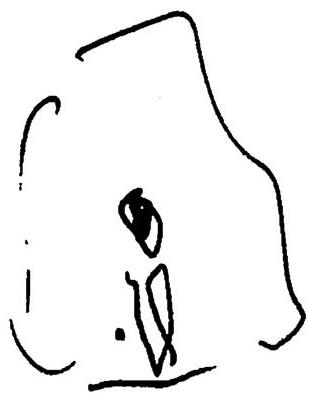
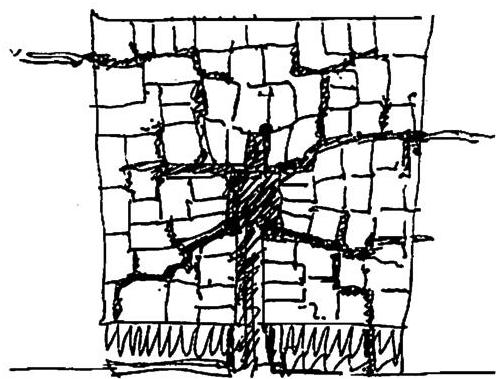
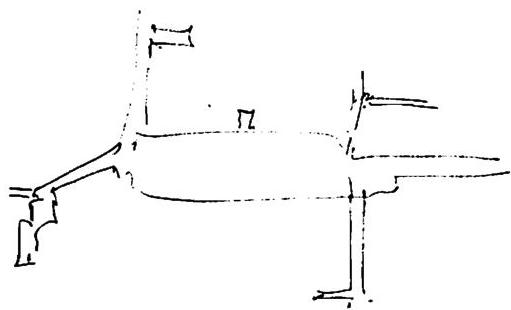
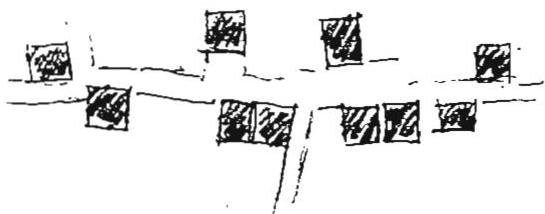
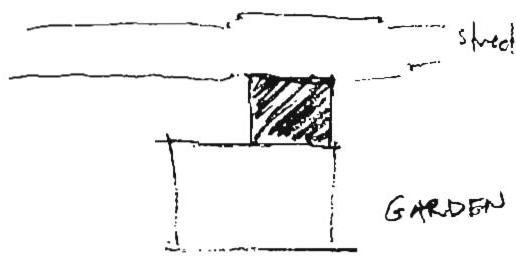
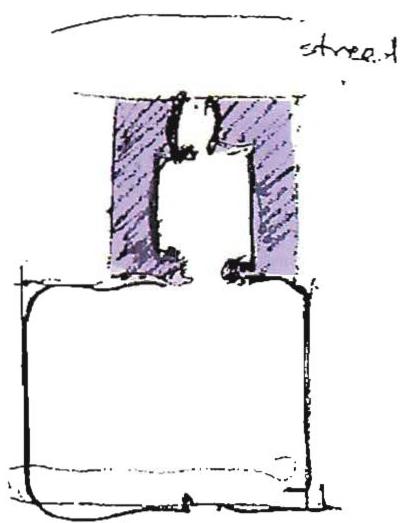
a neighborhood area is selected, and that we are to build, in that bounded area, houses for 250 families. Here are the steps which this process asks us to follow.
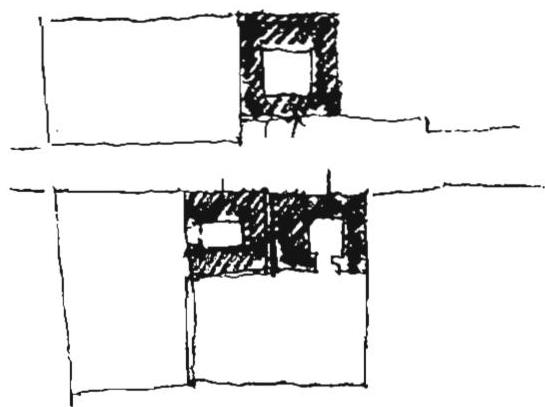
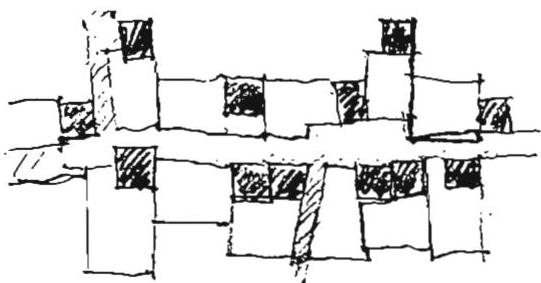
Step 1. Suppose, first of all, that the main center of the neighborhood is first established in the best "spot." It has a location — and a shape.
Step 2. Imagine a rule which allows any small street to be added, in any position which feeds into the main center, and in the center of gravity of an "empty" area. We assume that the next group of lots will always be laid out as a string, along one of these smaller streets.
Step 3. At suitable places, the street opens a little to form a swelling or local center in the street.
Step 4. Now imagine a rule which establishes a volume for each house at the time just after the street is laid out, so that the street is formed as a center by the forthcoming volumes
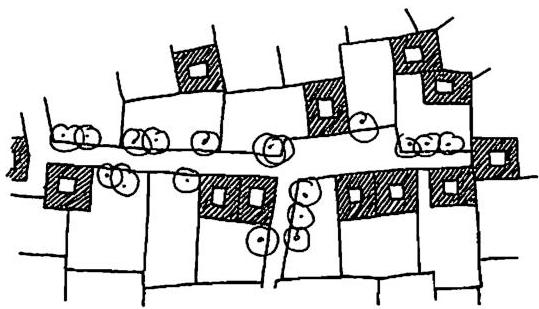
of the houses. This happens at the time of the formation of the street, long before the houses are actually built.
Step 5. Imagine, fifth, a rule which establishes the garden for each house as a positive center after the volume of the house has been established — and that this is the way the boundary of the lot is defined. The garden is given shape and coherence by its own necessities, without regard for lot lines. This happens before the lot lines are drawn.
Steps 6–9. Then the undifferentiated house volume is differentiated further to include an entrance and a courtyard. In the course of this process, the courtyard is shaped with the entrance, and later with a veranda bridging the space between the courtyard and the larger garden that it leads to.
Step 10. Only after the courtyards and gardens have been established as coherent centers, in relation to the houses, then the lot lines are laid in, because that is the necessary sequence in order to get the centers to work.
So, in summary, the process is first of all concerned with the formation of the street as a center. The street is to be formed by houses. As each street is formed, the houses which can support that street are defined as volumes — then the gardens, and then finally, after that, the lots which can support these houses and gardens are defined and established legally.
So far this is all design, done by placing stakes in the ground. Next the houses are actually built, or partly built. The actual volume of each house is given detailed shape according to other
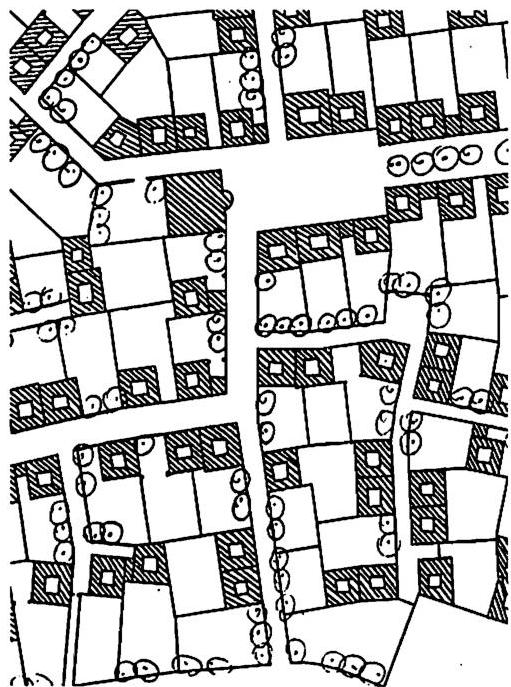
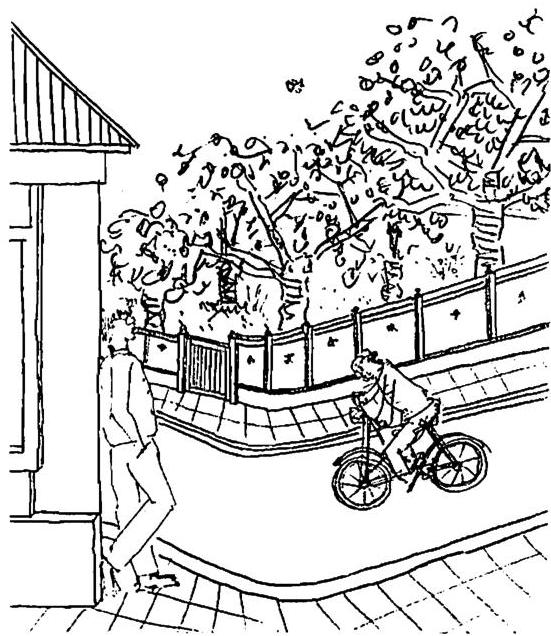
nearby houses and according to conditions on the site. The final detailed volume which emerges from each house, at the time of its construction, will never be exactly the same as was
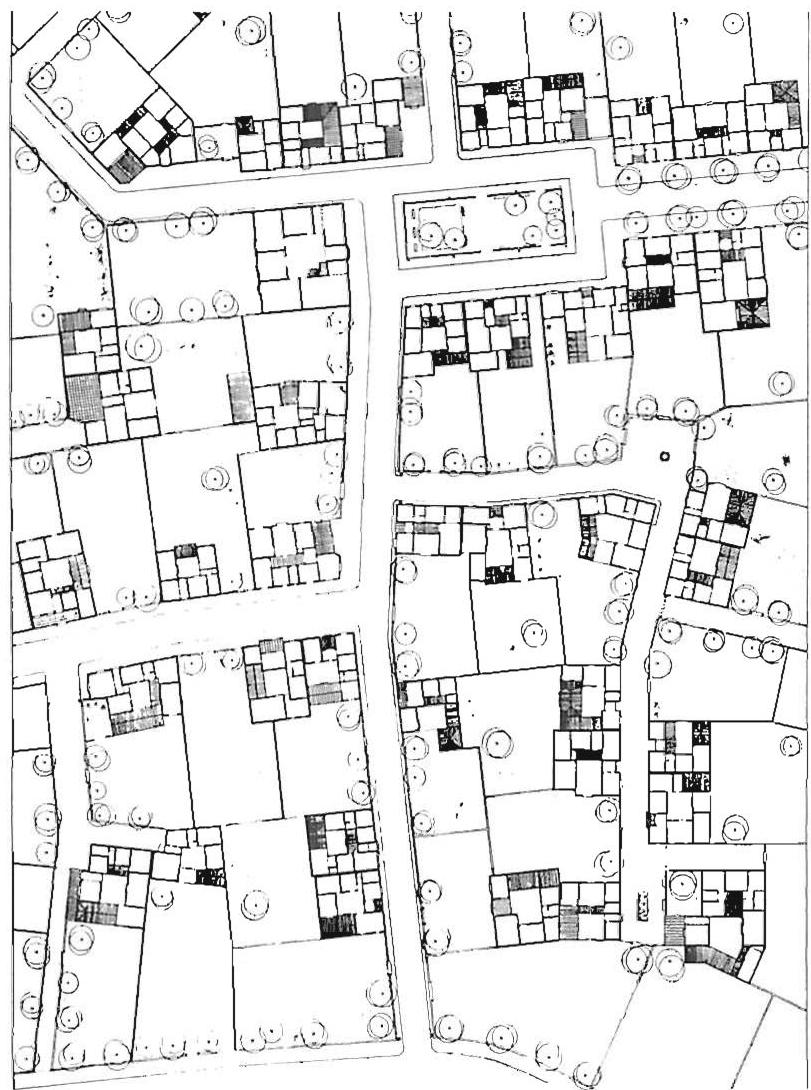
A simulation of the process for Gausare. Part of a neighborhood showing positive space of gardens. The plans of houses are shown in outline, room by room. The main room of each house and the veranda are shown darker, for emphasis. The meaning of "simulation" in preparation of a plan like this one, is discussed on page 347.
Please read the important note on page 360. Christopher Alexander, Artemis Anninou, Hajo Neis, 1986.
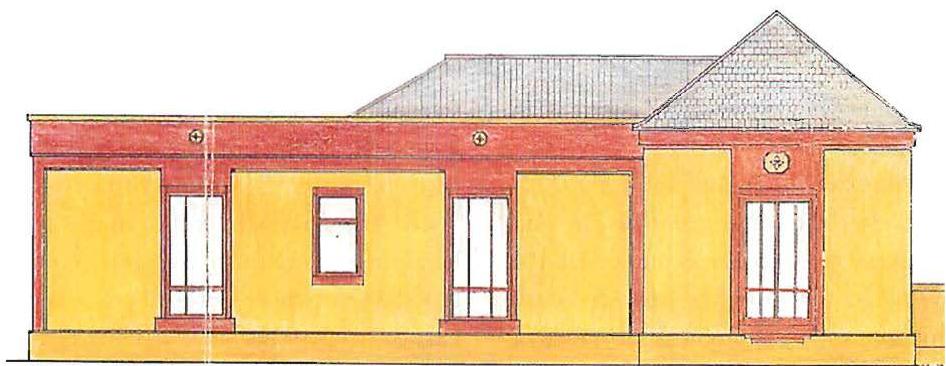
Archetypal house for Gausare New Town, Venezuela. Christopher Alexander, 1988.
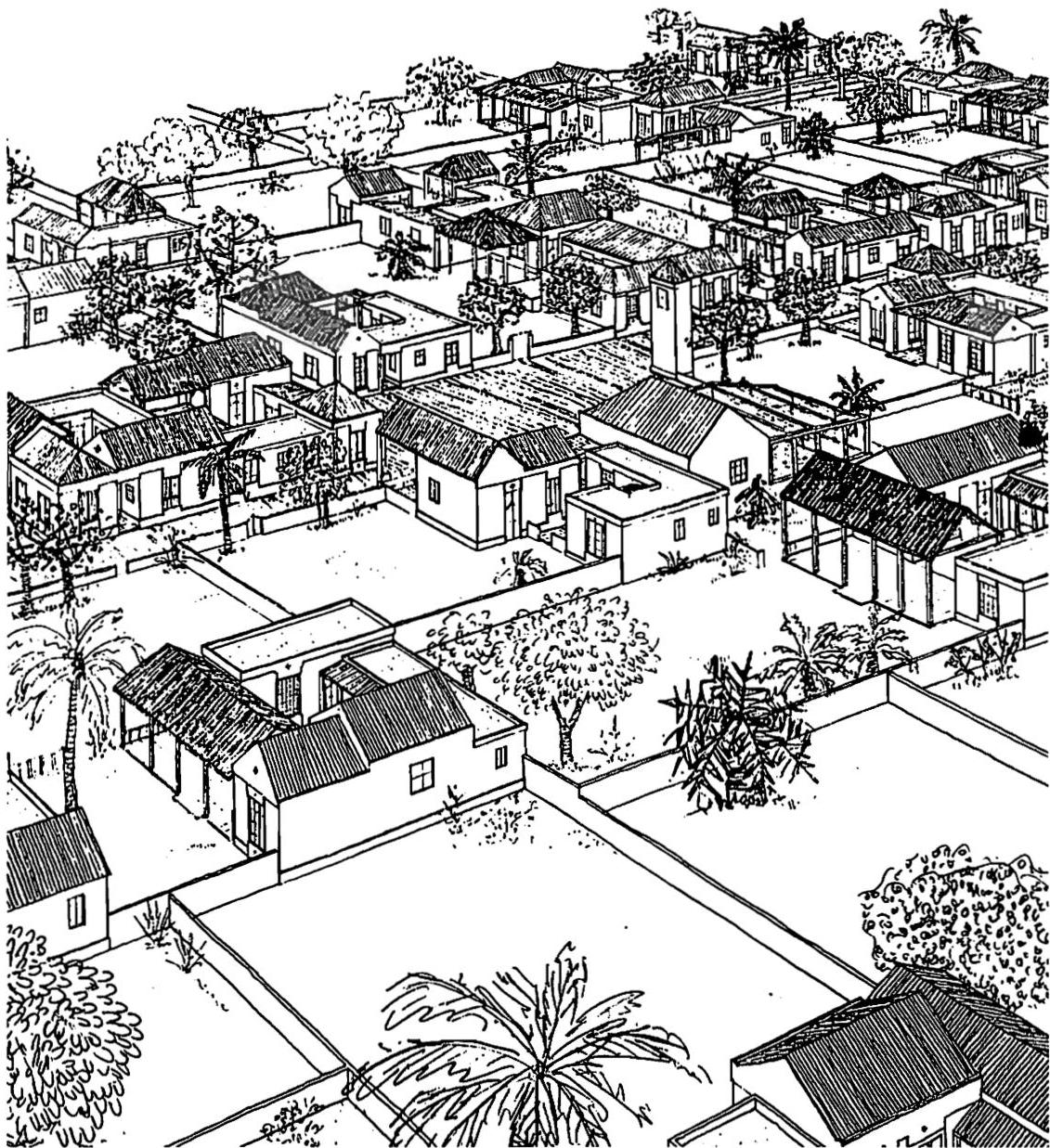
imagined when the house was first defined as an outline volume.
Finally, the street is built physically. This must happen after the houses, not before, and comes in response to the real volumes which the houses have taken on during their construction. At this time, not only the physical substance of the street—its pipes, paving, sidewalks—can be built, but also various small walls, benches,
trees, all placed in response to the realities which have been defined by the real process that has taken place. In this system of rules for neighborhoods, the dominant fact is that the neighborhood streets, lots and houses get laid out in such a way that everything—I really mean every single part of space—becomes a living center.
To grasp this result of the process, please look on page 343 and on page 347 to see the end result.
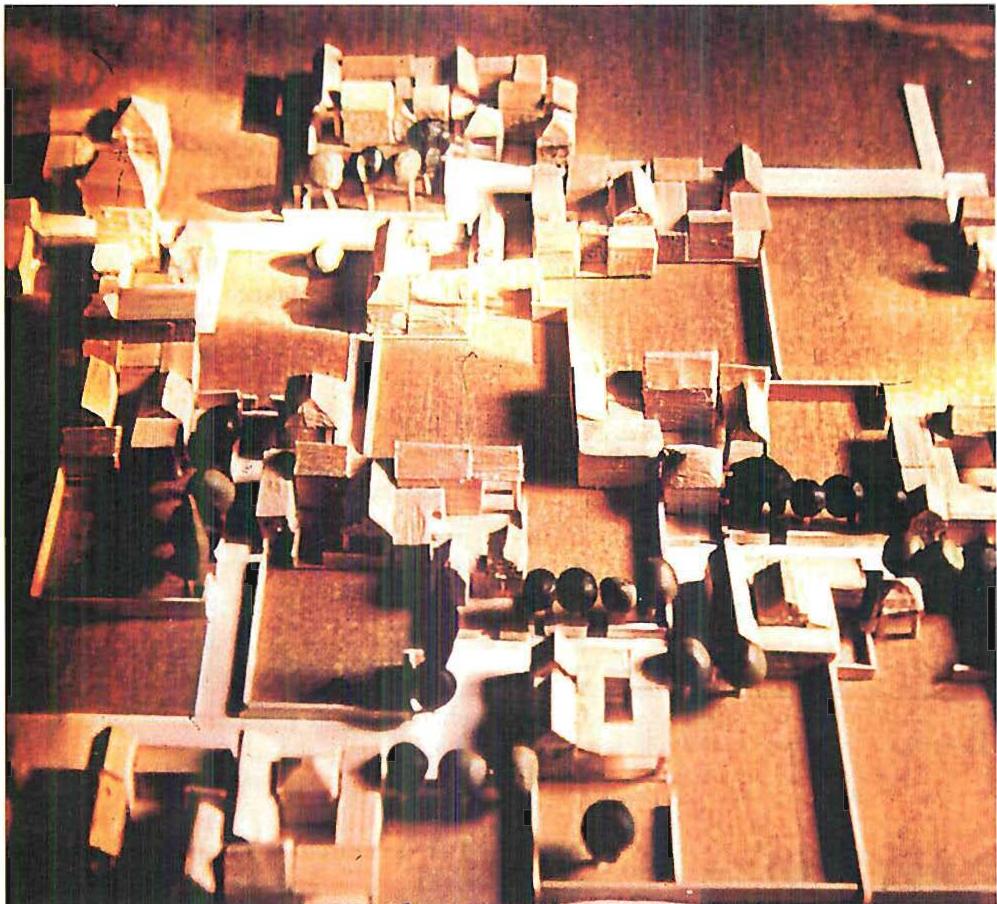
It is very different from the conventional American house in the middle of its lot with two sideyards. Instead, in the plan on page 343 we see the streets, small squares, lots, and houses. If you examine the plan carefully, you see that it is unusual by contemporary standards. Every single bit of space has the loose local symmetry which produces a center. We see the gardens, the pieces of the lots which are outside the houses, forming centers. We see that in those cases where the garden is broken into two, it is made of two centers. The house itself, as a small courtyard, forms a center in its own right. Each section of the street forms a center. Where streets meet, there is another center in the form of a small square.
In many traditional societies, such plans were commonplace because the process of placing and building was an unfolding process which produced them almost automatically. But in our
present era there are few plans built which have this dense structure in which every bit of space that exists forms a strong center.
A design which has so many centers can only be produced by a very special social process. In fact, we have to make a lot of concessions, and do things in a way that may seem unfamiliar in order to get a good result. For example, the lots are not simple rectangles as lots in a subdivision usually are. In order to make each garden a center and each house a center, we have to use a process which explicitly recognizes the way that every lot needs to be composed of these two centers. To do it, we first locate the house according to the needs of the street. Then we locate the garden in such a way as to form a center in relation to the house position. This produces an irregular zig-zag lot in many cases. It is not particularly difficult to do this, though it poses minor prob-
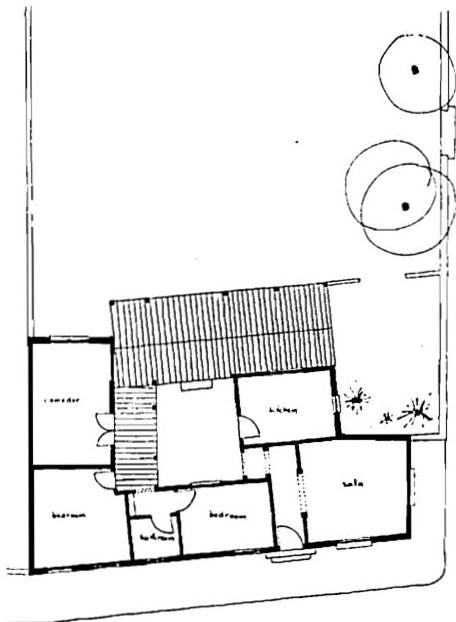
lems for the recorder's office or for the land surveyors. But one would not usually think of doing it. It is only the paramount importance of the centers and the need to have a process that generates strong living centers that will generate this kind of effect.
The same is true of the relation between street and houses. The street is laid down as a rough line. The houses are then introduced one by one to form the street. Of course, as we know, the space of a street is produced by the houses that form the space. In this sense, the street will become a strong center only if we have a process which explicitly recognizes this relation, and which "builds" the center of the street by making centers from individual houses, one by one, and placing them in such a way as to strengthen the life of the street. Again, this is an unfamiliar process. Some version of this process may have existed in traditional society (though usually more drawn out in time over many decades or even centuries). In modern society we do not yet have processes like this. Usually the street is drawn
on a plan by an engineer who is quite unfamiliar with the importance of the street, or with its need to have life, or with the fact that it will draw its life from the way that surrounding buildings are placed to form it.
We need an explicit process of street creation, where the all-important character of the street as a center is recognized by everyone concerned, and then houses are brought in, one by one, as centers, in such a way as to form the space of the street. This will require a technical process unfamiliar to present generation public-works administrators and engineers. There is nothing inherently impossible or even difficult about this process. But it is simply different from the process which most people took for granted, and considered "normal" in 1988 (the year this process was invented). The whole process is explicitly center-creating and structure-preserving throughout.
THE STRUCTURE-PRESERVING PROCESS AND THE CENTERS IT CREATES
First the land.
Then the outline of the neighborhood.
Then the streets placed to enhance the center of the neighborhood.
Then the house fronts to form the streets.
Then the gardens.
Then the houses.
Then the courtyard which forms the center of the house.
And so on.
We start with the shape of the land, and find the natural centers in the land. Then the boundary of the neighborhood. Then the most natural center for the neighborhood. Then the network of streets which does most to enhance that center and the feeling of the neighborhood.
Then the house fronts are placed to form the streets — in such a way that each street arises from the wall of houses. Thus the house as a center, starts with its main purpose in life being to create the street.
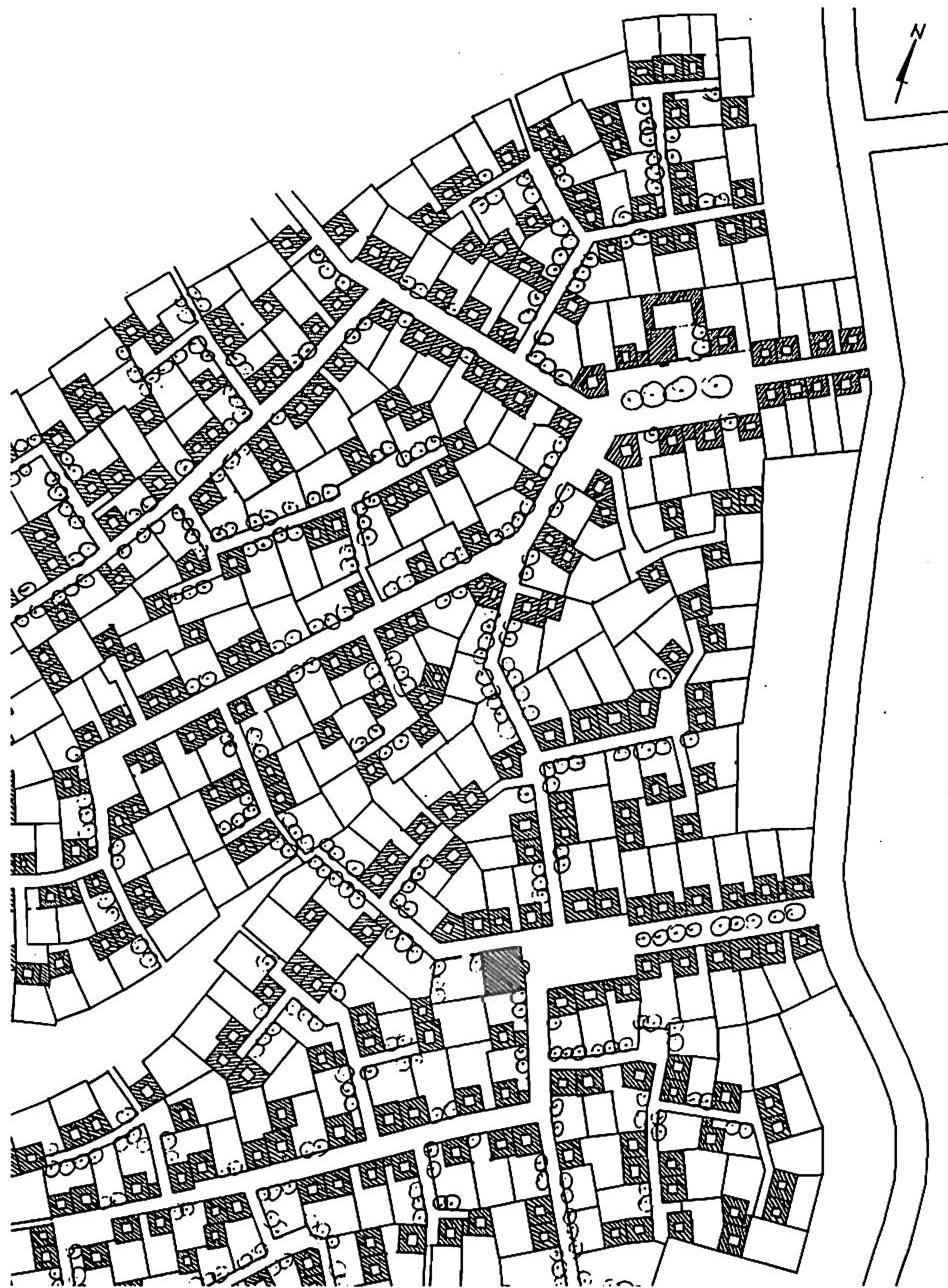
Next, we place the gardens. Each garden is a center in itself. It is placed, lazily, without regard for the symmetry of property lines — it is only by doing this that we can get each garden to be a nice center, and also make the houses as centers which help the street. Each garden is placed in such a way as to intensify the house, and to intensify itself as a symmetrical and compact rectangle.
Then we place courtyards. The courtyards will form the edge, the bond, between house and garden. Each is a center which focuses the house around it and simultaneously looks into the garden, enlivening the garden, too. Once again, the main function which this small center has is to intensify two larger centers. In the resulting neighborhood, because of the
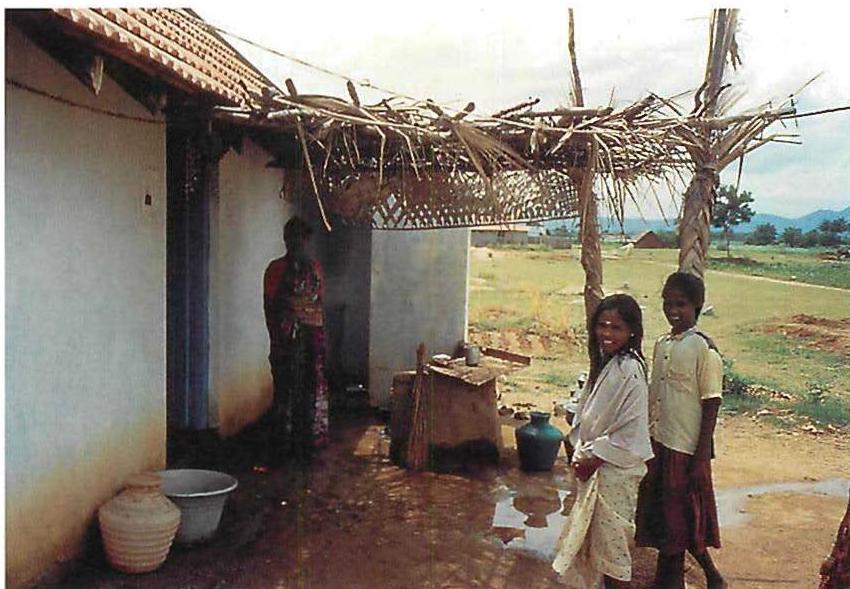
structure-preserving process, the design which has been established is profound. For instance, there is a sequence from street to house, to courtyard, to garden. Each of the centers in this sequence benefits from the sequence, and is strengthened by it.
If we think carefully about the organic, truthful and biological quality which is obvious in the drawings — especially the large drawing on page 347 — we see that the only kind of process which could produce this structure is one which does produce it step by step.
This is the kind of dynamic process which is needed to produce a living field of centers in a new neighborhood. The traditional neighborhoods which we love in various parts of the world were all produced by this kind of process (different in geometry, similar in character of process). It cannot be done any other way. To build new neighborhoods with life, we must find ways, like this, of constructing an intense (and unpredictable) field of centers to create the spaces of the neighborhood.
The essence of the process is that it generates coherent, yet quite unpredictable structure, simply by applying a few simple rules to a piece of land and
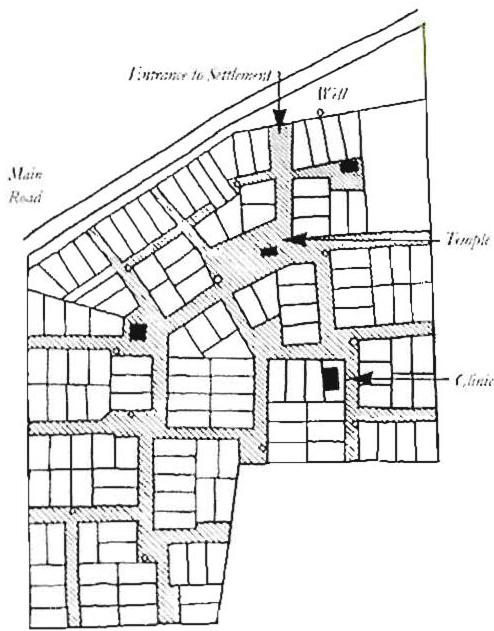
its natural idiosyncrasies. That alone, and the interaction of the process with the previous outputs of its own effects, is enough to produce the most beautiful order. I do not believe it can be done in any other way.
6 / MOSHAV SHORASHIM IN THE GALILEE
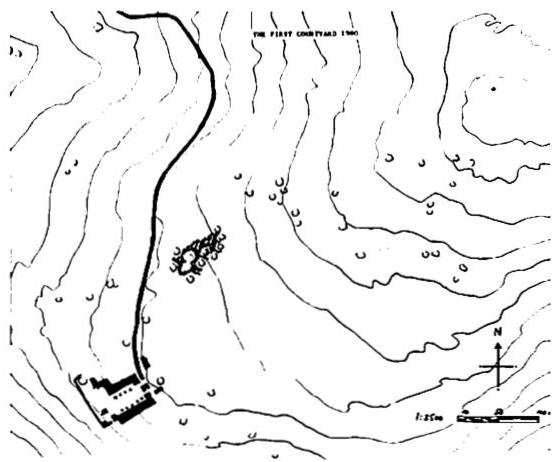
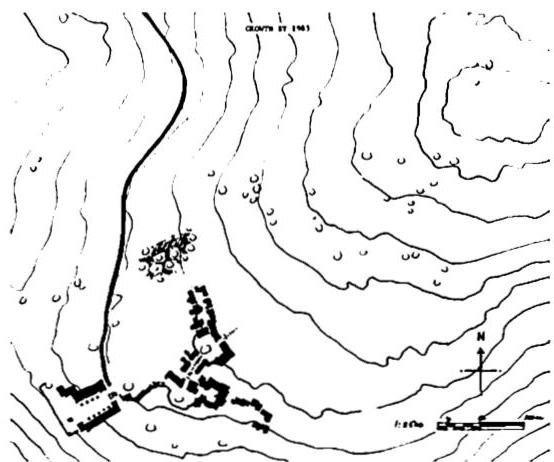
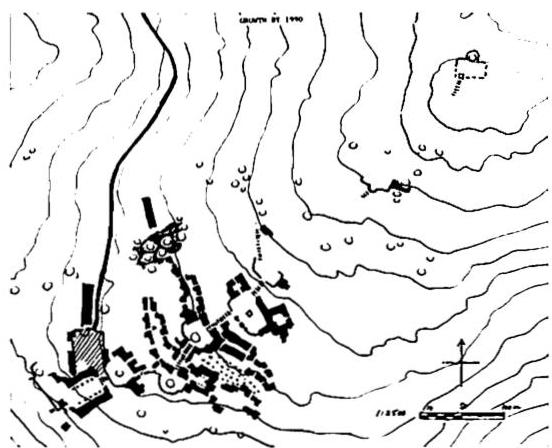
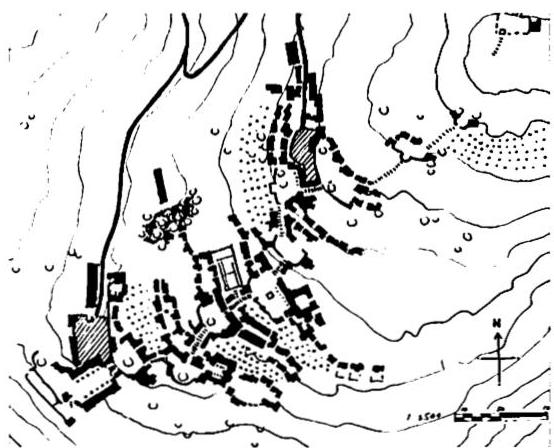
We did manage to build a community of Israeli immigrants in the mountains of the Galilee, using an early version of a generative process. Although much of the process was too difficult to implement at the time we started (about 1982), some parts of the plan were indeed designed and built dynamically and the community is thriving today. Above, you can see four phases of an early simulation of the community growing. On page 350, I show a drawing of four houses forming a cluster, with detailed drawing of one of the four houses. As you can see from the site plan, the four
houses in the cluster are very different — each one governed by the interaction of family choices and the conditions of slope, topography, and orientation. As a result each house comes out unique, though all are made with the same general rules.
Of interest is the construction of the houses, visible in the plan and section on page 350. Each house is made of simple rectangles, with modest opportunities for variation of roofs, ceilings, balconies and so on. The variation of the plans, together with the simple construction, produces a cheaply built, yet rich community atmosphere.
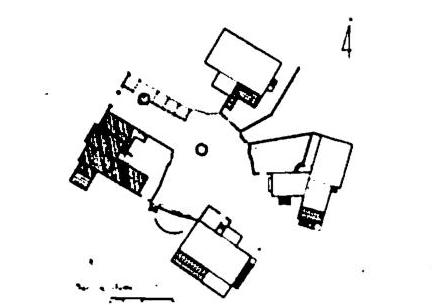
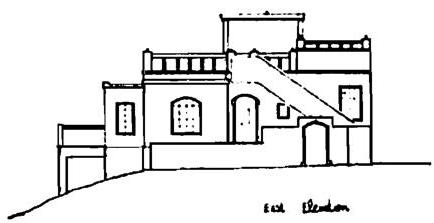
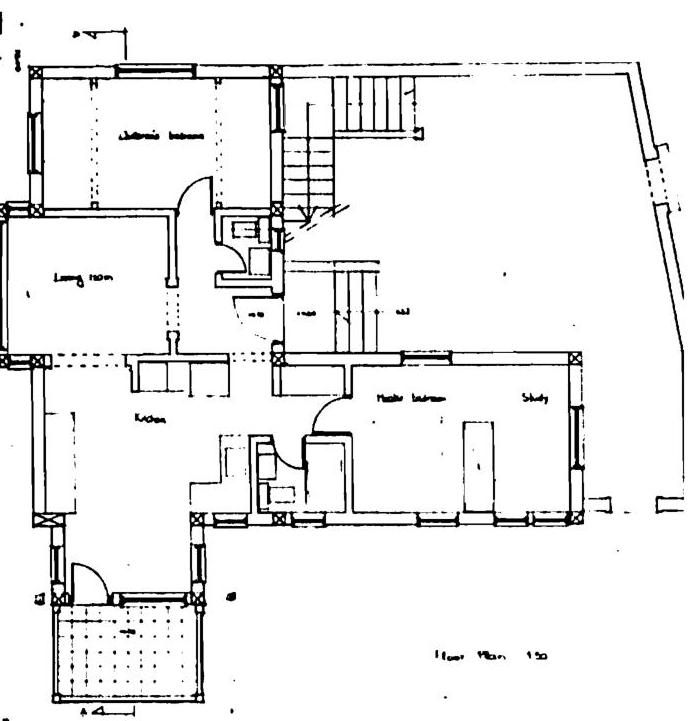
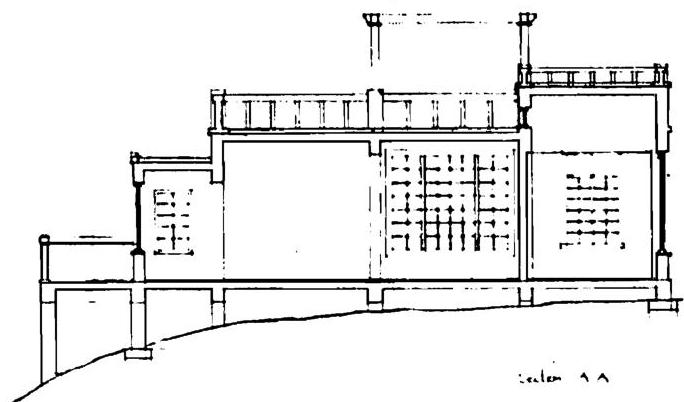
One Shorashim house designed by Amy and Yehuda Daskal for themselves, using the generative process prepared by our team at the Center for Environmental Structure. As you can see from the site plan (top left), the four houses in this cluster are entirely different, each governed by family choices interacting in a unique way with conditions of topography and orientation. The house shown here is the one at the bottom of the site plan, the sketch is seen from inside the cluster courtyard.
Sadly, about 1985 I felt obliged to leave the project in protest, since I could no longer accept my clients' painful and hostile views about the Palestinians who lived in the next door village, when they began wanting me to share these views.
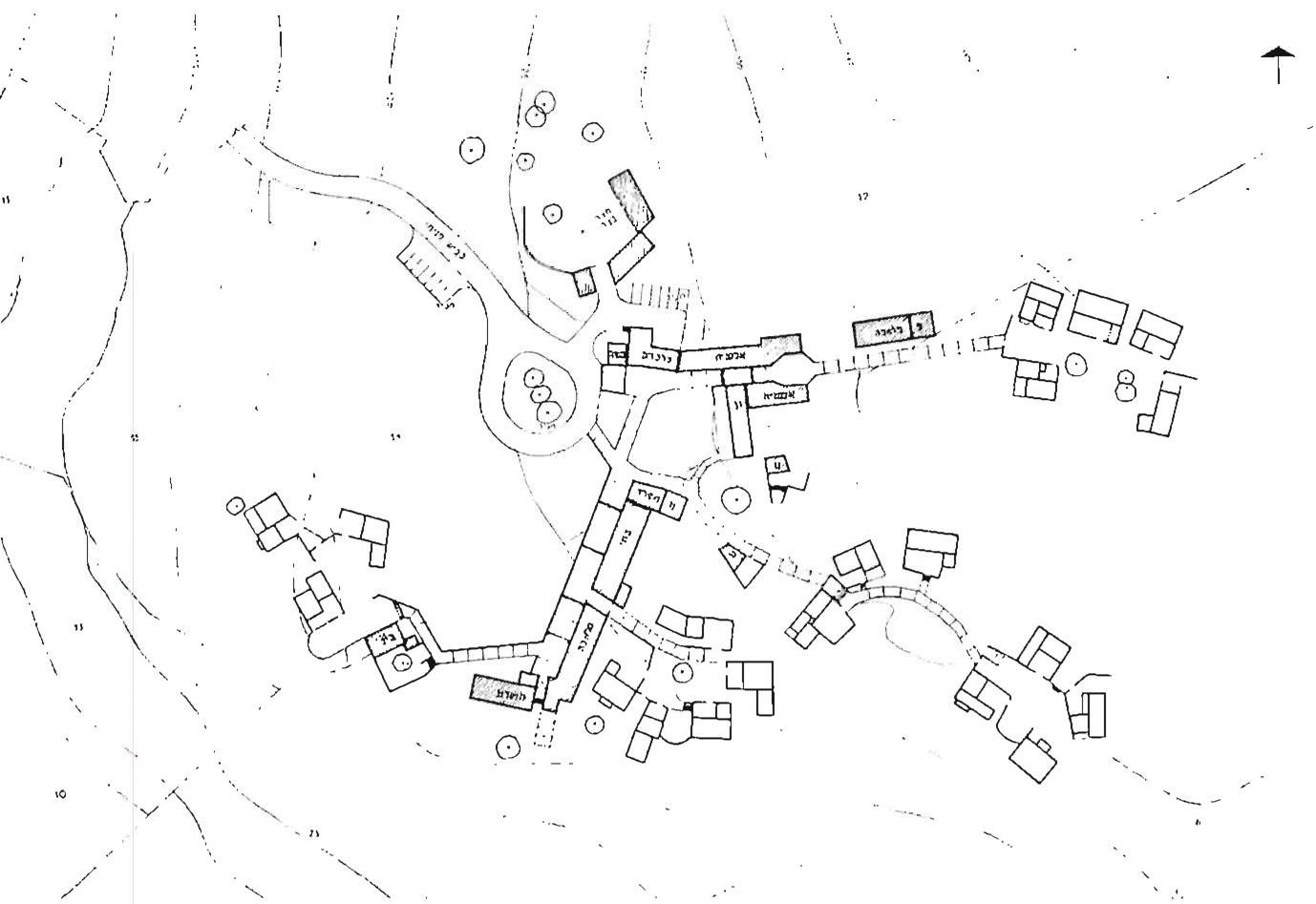
Shorashim: the result of neighborhood dynamics when Shorashim was actually laid out on the ground, and as it was subsequently built. If this drawing is compared with the earlier sketch simulations on page 349, here we see the reality of form which comes from the reality of process, building by building and family by family, each thought out on the ground itself, shaping each place precisely according to its unique conditions. Christopher Alexander, Artemis Anninou, Nili Portugali, Amos Gitai, 1982-86.
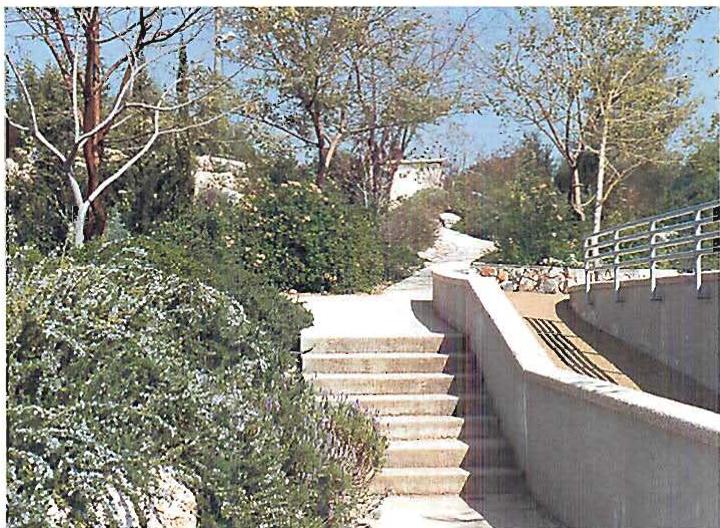
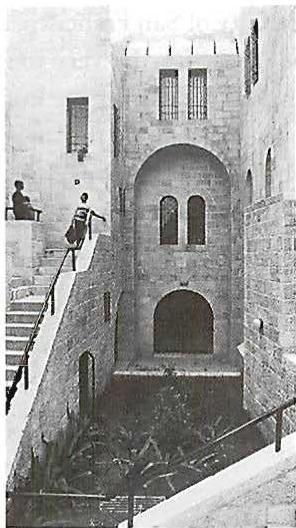
As built and occupied: Moshav Shorashim, Galilee, Israel. Christopher Alexander, Artemis Anninou, Nili Portugali. 1988. On the right, a similar more urban project: Hosh Complex built by Moshe Safdie in Jerusalem. 1978.
7 / THE FORT MASON BENCH
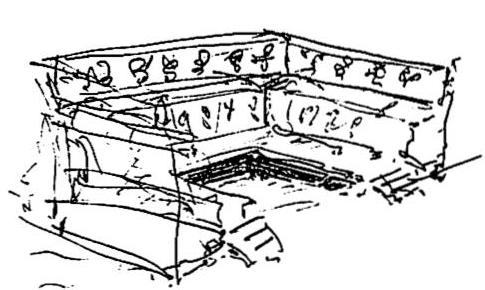
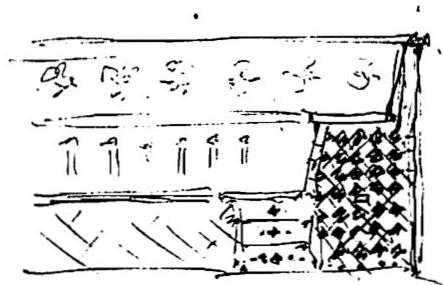
In the kind of dynamic process I have in mind, where each act that is taken, is related, in a structure-preserving way to the whole, and takes its place in a long time-line through a long sequence of events, each part, then, is carefully shaped and placed into the whole, making the whole more than it was before.
Here is an instance which shows the use of unfolding through structure-preserving transformations—in a communal building project within a neighborhood. I was asked by Stewart Brand and Irmine Stelzner to give a workshop in which all these ideas of living structure in the context of democracy would be demonstrated. I suggested that we build a bench at Fort Mason, for the City of San Francisco. After my first visit to the place, I had a very rough idea about the bench, and got clear in my mind how to build it. This is reflected in the squarish pen-and-ink sketch shown at the top of the page.
In April we began the real work of building the bench. There were about twenty student apprentices in the class. We had three-hundred concrete blocks on site, and used them, first, to make a simulation, and then to build the final bench itself.
From the very start, the fundamental process with its emphasis on centers and structure-preserving transformations, dominated every phase of the process.
Step 1. Mockup of the overall shape. I used the blocks to have people sitting around, using their intuitive common sense to find a format which was comfortable for everyone. It became clear that the sharp U-shape I had drawn was much too extreme and that the bench needed a concave format. We tried it and it was most comfortable. When we had about twenty people sitting together on the bench it seemed that a much softer feeling was the one which felt most comfortable for the people sitting there. I directed people to move blocks, keep sitting on them, until the overall shape was comfortable. It was a gentle concave C-form. See photo on page 356.



Step 2. Main curve of the bench. This concave shape then had to be fitted to the site. The site itself had the following features. First, a beautiful view of Alcatraz Island, which dominates one's feeling there. Second, a very strangely shaped railing, along the rocks, with a peculiar and awkward asymmetry. When we began to examine the way that a group of people wanted to place themselves in relation to these existing centers, we found our gently curving bench needed to be roughly oriented towards the island of Alcatraz, but slightly more pointing towards the open sea. See photo on this page.
Step 3. Adaptation to the shape of the railing. Now came the hardest part. The peculiar shape of the existing iron railing, produced a very complex asymmetrical system of centers. It was extremely hard to find a way of making the bench itself feel like a single center by being symmetrical and not weird — and also to respect the complex syncopated rhythm of centers produced by the railing. Many complicated solutions were tried and failed. Finally, a very simple one turned out to be the best. The "best" was the one which left the situation most alone. See photo on page 354.
Step 4. An additional center in the form of a small table. Once this shape was clearly established, there was one further step to take. The bench, by itself had a relationship to Alcatraz. But there was
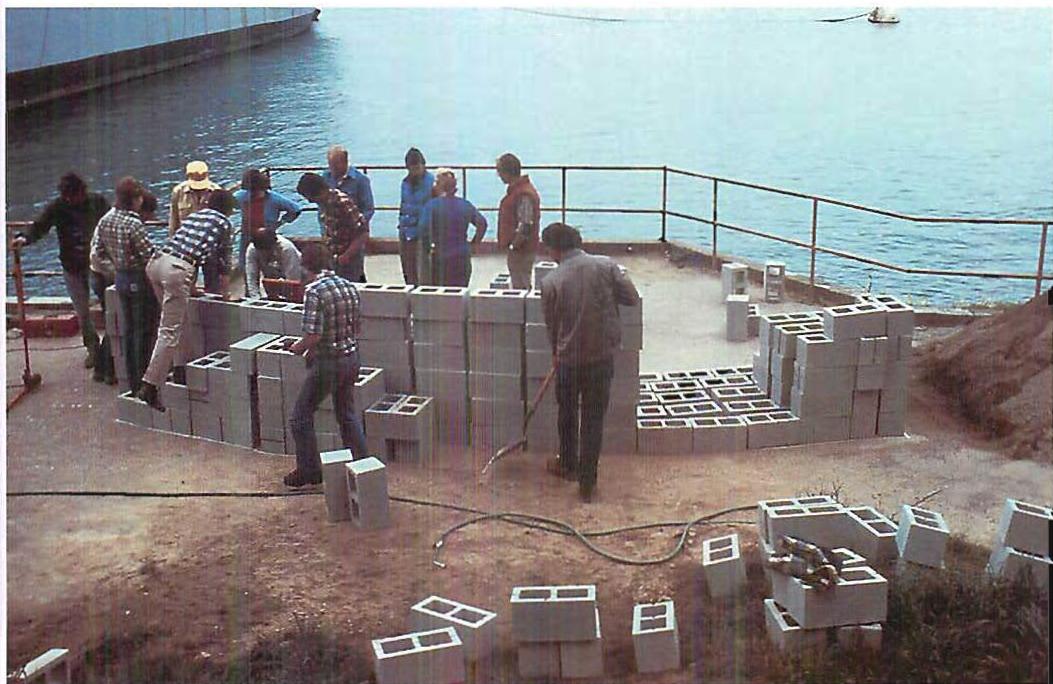
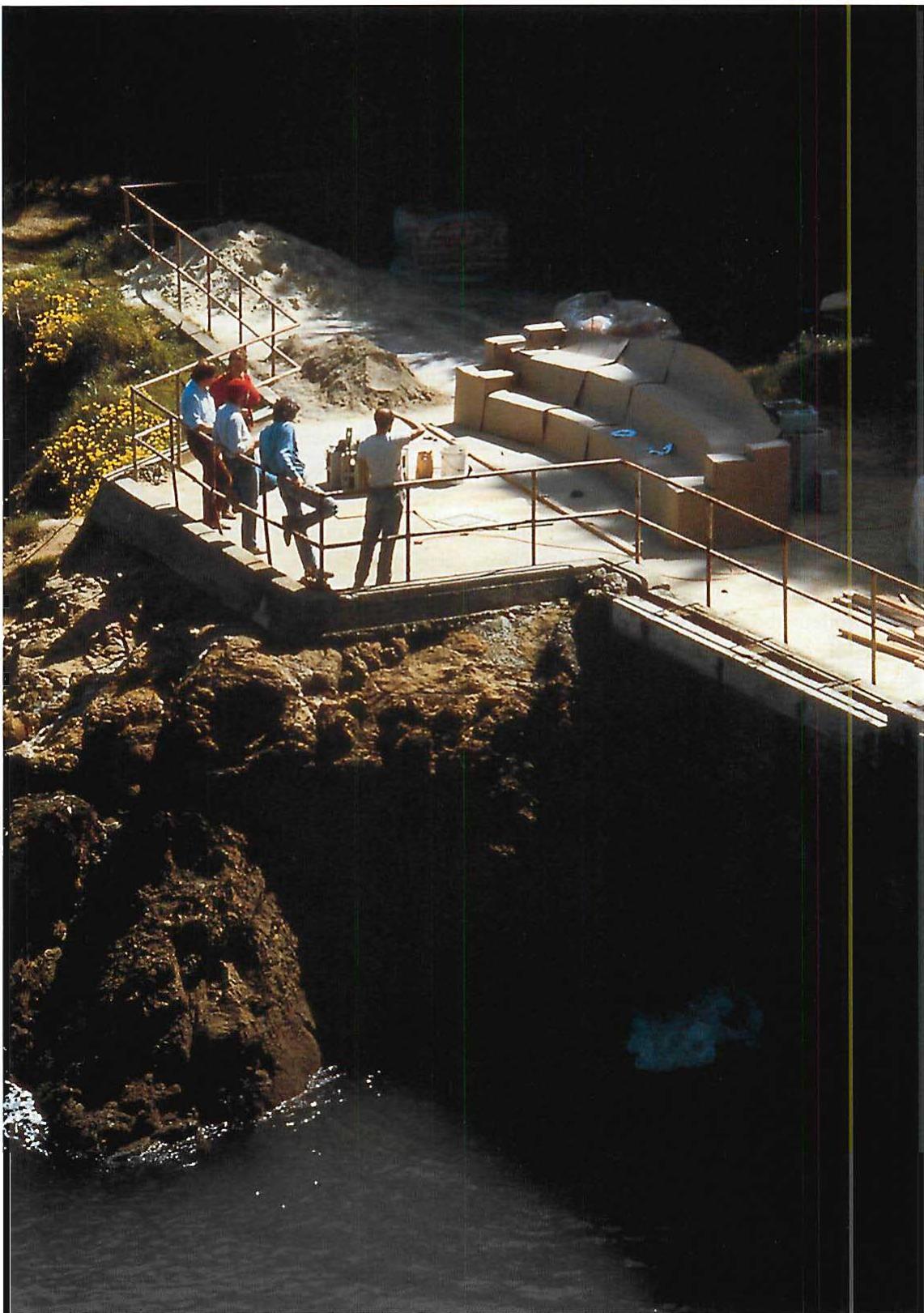
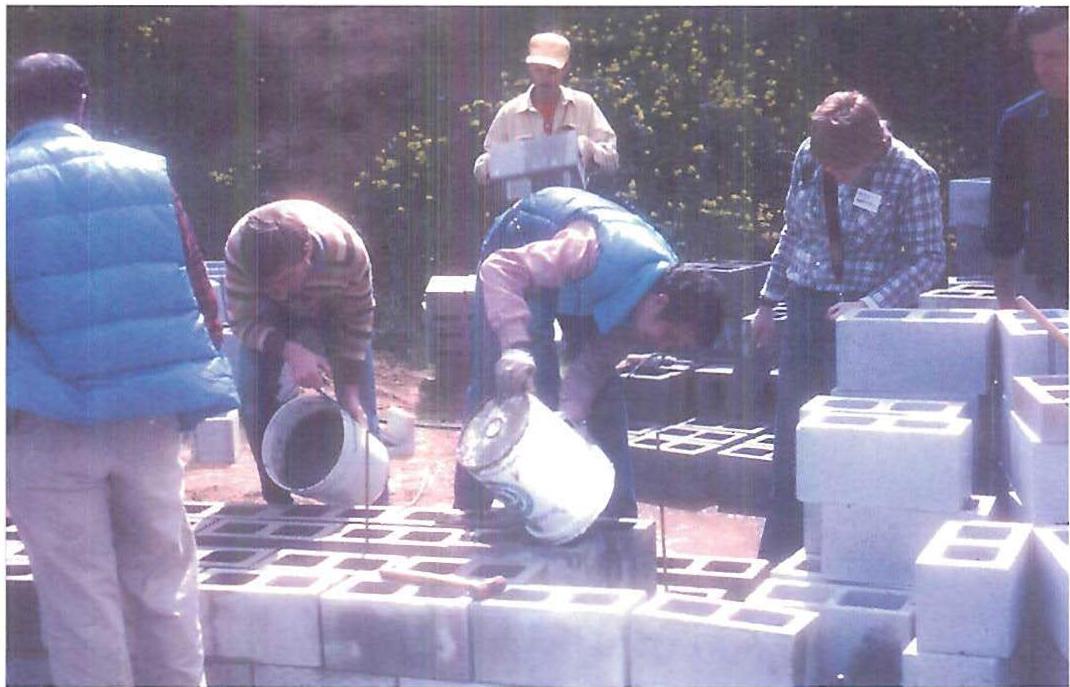
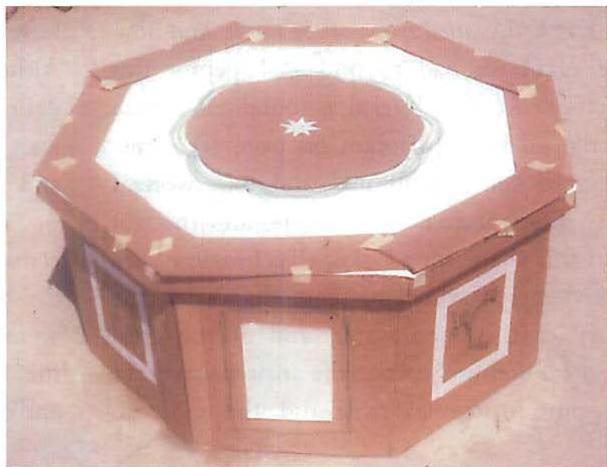
a feeling that people sitting on it, were too much oriented outward, a view-like thing, too much towards the water, towards the island. Since a group had a desire to let people talk to one another, what could be done? One of the students proposed another structure facing the bench. We tried many versions of it. In some way they were better, because they created the possibility of a dialogue among
people sitting on the bench, but these solutions disturbed the system of centers which we had already created. Then we found that a small table-like structure (above), placed in a particular position off-center, left the relationship with Alcatraz and with the railing intact — but also helped (with the bench) to focus the possibility of people sitting opposite each other.
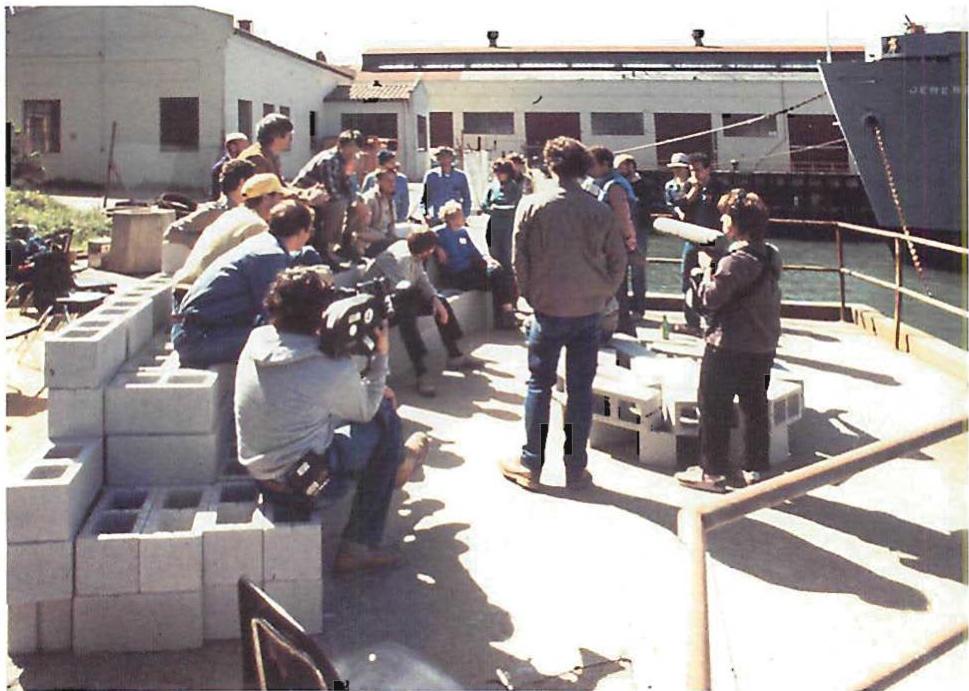
Step 5. Detailed shape of the table. And now once again we had to find a shape for this structure. At first I tried a round table with a scalloped edge (diagram on page 355). But it seemed too complicated and too sweet. I tried different shapes for hours, and thought about this shape for a whole day. Finally, when I asked myself which of these shapes left the beauty of the open water, and of the great Bay, most definitely alone, the answer was clear. The pure octagonal table did the most to
leave everything in peace (visible on page 357). Although it seems to be a stronger and more definite structure, it is the one which interferes least with the existing structure of the water, and the Bay, and the railing and the bench.
In every case, the search for the latent centers in the place, and the effort to take the next step which created new centers that were most structure-enhancing, was done as the most likely way to intensify the depth and feeling of the bench.
8 / DOING WORK TOGETHER
When people work together, in small groups, how then does the unfolding process work?
Or, stated another way: How is it possible to have cooperative, communal, decision-making of the kind that is needed to deal with decisions in a town, or in a neighborhood, or in a public building? Indeed, the same question arises even for the smallest thing. How should a group of
people work together, successfully, to make anything together, even a fountain or a bench?
In Books 1 and 2, I have spent a good deal of energy explaining that that degree of life is rather objective, that people deep down have similar instincts, that the decision about which way to build a building, place a window so that it has the most life, is an objective one!
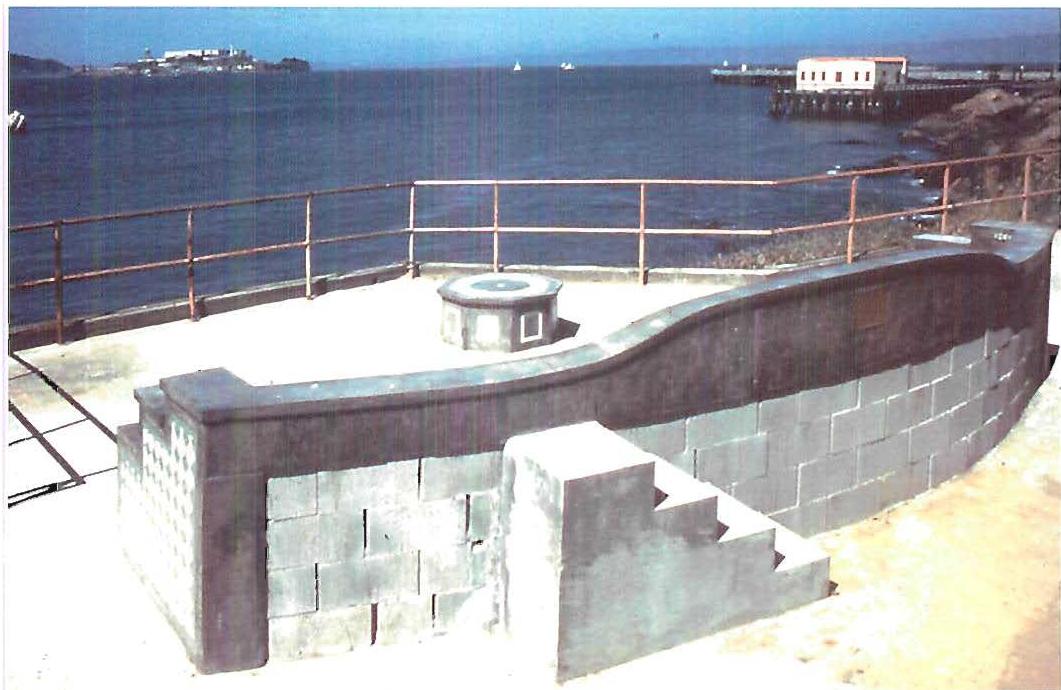
That is all well and good. But the thesis comes to the test in dramatic fashion as soon as we have a group of people designing something together. What happens when we face the classic problem of the elephant designed by a committee? Each person has an opinion. No one quite knows where to start. They want to express themselves; they want to express their own individual ideas; yet they want to work together. How to curb the bounds of individualism, when to give in, when to insist? It is extremely hard.
People who have done it know just how hard it is. Questions! Problems! The process does not easily hang together.
If, for example, we are to place a bench in a neighborhood, and say there are quite a number of people involved in it. And suppose, for the sake of example, that two alternatives are placed before us. Choice is (in theory) the classic tool of democracy. It is open-ended. It is democratic. So let us—together, perhaps thirty or forty of us—try to decide which of the two benches is better for this place, bench A or bench B.
The problem is that bench A and bench B differ in so many different ways, on so many dimensions. One bench is wood, one bench is metal. One is blue, or is black; one has a more comfortable profile than the other does, perhaps A is comfortable, B is more formal. On the other hand, A, which is more comfortable, is perhaps made with a shape not entirely pleasing to the eye; while B, less comfortable to sit on, is very delightful in its shape.
So as we, the thirty of us who want to decide this thing, set out to work together, how can we decide whether A or B is better? Of course we cannot. Inevitably some (paying attention to comfort) will choose A; others (paying attention to shape) choose B. Those who pay attention to color may be attracted or repelled in different ways by blue, and black. The material again! The difference between metal and wood will have different adherents. In this maclstrom, how can we ever get through it to a happy resolution? The difficulty comes from the size and extent of the decisions we are trying to agree on. Choice among alternatives, as a strategy, does not work realistically.
The answer, the solution to the difficulty, lies in the use of the fundamental process, ap-
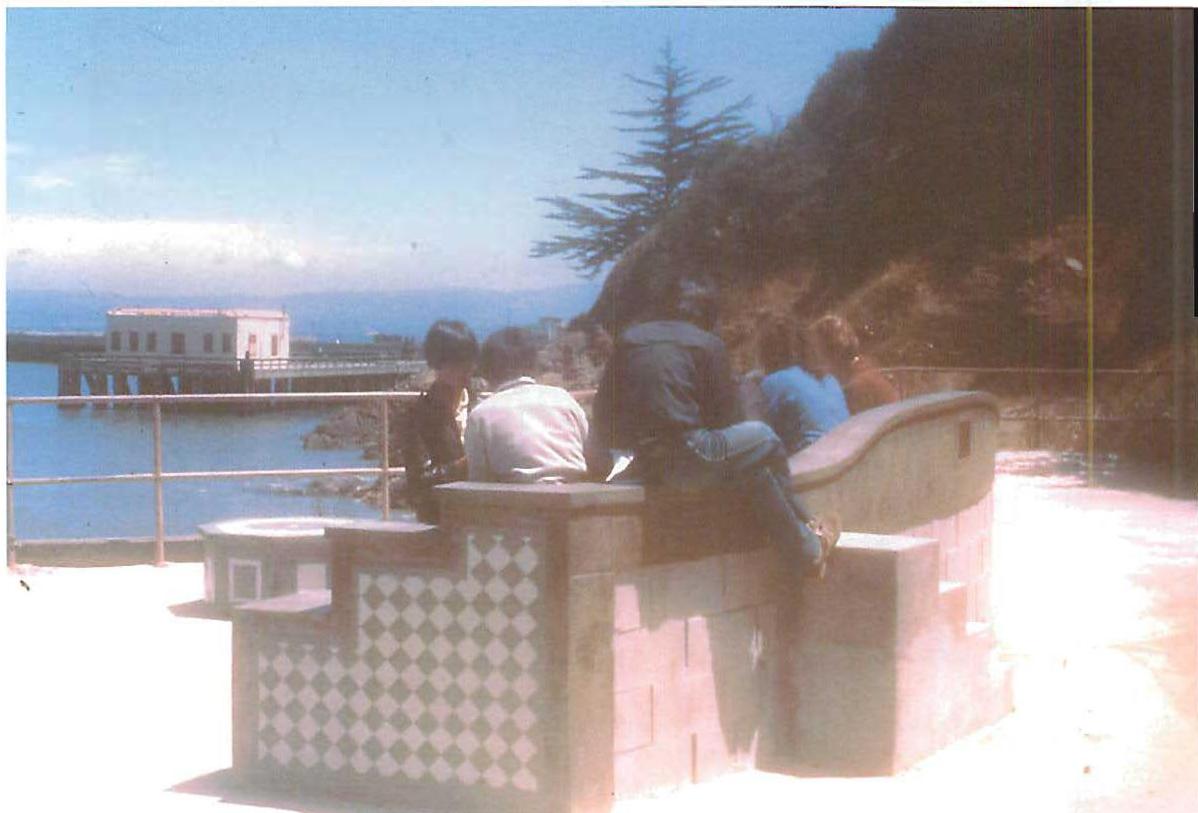
plied over and again, focusing on very limited, tiny decisions taken one at a time, in sequence. Why is this critical, and why is this different? Because when we lead the group consensus through very small steps, and try to reach decisions about these steps one by one, one at a time, the steps can be made so small and so particular that for each step the thirty of us will find it possible to succeed in deciding among the possibilities, what is best, by checking versions, testing them, trying things out.
For example, should the bench face the view or not? Well, we just try this one question by itself, until we get the answer clear. Our decision will depend on the place. But if it is a particular place, then we ask ourselves, all thirty of us, "In this place, is it better when the bench faces the view, or better when it does not?" Because this is an extremely limited subject, not now overlaid with complex extraneous questions, nor very dependent either on opinion, it turns out that we
can usually reach some kind of agreement very fast. We only need to answer this one limited question. Will the bench have more life if it faces the view in this place, or not?
This question, we can settle. We are capable of settling it. Together, we can take this question and reach a conclusion, usually (in my experience), rather fast, especially if the questions are asked in the right sequence of unfolding (see Book 2, chapter 13). We can then answer other limited questions, until in the end we generate a complex whole, communally agreed upon, without ever having to make a big choice between imponderables.
Even when the whole is as big as a building, or even a portion of a neighborhood, the complex of answers optimizing a group consensus can be arrived at by arranging the whole evolution of the form, as a sequence of smaller questions. Provided the smaller questions are taken in the right order, step by step, resolving
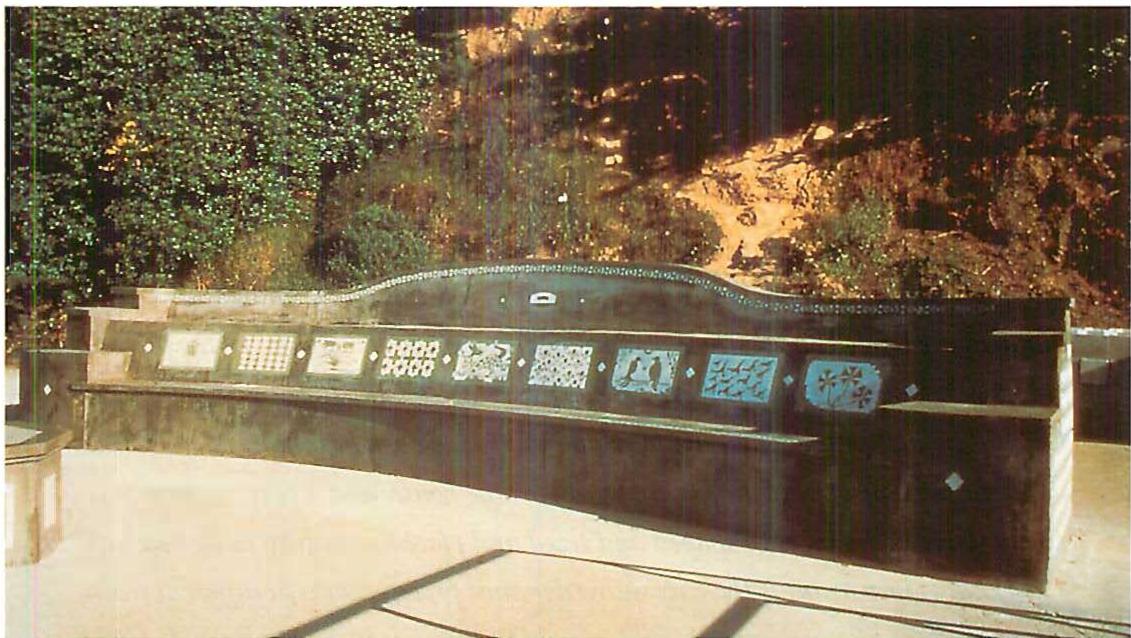
one step at a time, in a manageable way, we shall be able to reach agreement even as a group. But the end result of these limited agreements will not be a single choice among a half dozen alternatives (inevitably a phony choice). It will be a unique thing which has been generated, truthfully, as a product of twenty or fifty or a hundred true answers to unique questions — thus mathematically, a
choice among $2^{3n}$ alternatives—but generated by asking questions in a very particular order. To these questions, asked in the right order, successful group answers could be given because the questions were small enough and reasonable enough, not arbitrary, so that people could discuss them, feel them the same way, settle them, move on to the next, and thus gradually approach consensus on the emergent whole.
9 / SOME MORPHOLOGICAL INVARIANTS THAT WILL TYPICALLY BE GENERATED BY THE FUNDAMENTAL PROCESS IN AN EVOLVING NEIGHBORHOOD
I hope the range of examples in this chapter has persuaded you that the fundamental process—when it goes step by step, making transformations which enhance and preserve the structure of the land—works in practice.
Repeated use of the fundamental process, dynamically creating and recreating a new community, will generate layouts in which the following geometric features are typically present. Streets are likely to be irregular, reflecting adaptive growth, not pre-planned layout. Streets will follow lines of least effort on con
tours. Lots will typically be irregular, often polygonal, not rectangular, with some off-go-degree angles. Houses and buildings will usually be long and narrow, and APPROXIMATELY rectangular in form, but will often be adjusted to fit neatly into the lot lines, without leaving leftover bits of space. Houses will be placed along streets, forming street walls—so of course the rectangles will be imperfect, the shape of each one tempered by the next building, the dips in the land, and so forth. Gardens are likely to be positive-shaped, nearly rectangular spaces, in the position which gets best sun, shade, breeze (or whatever is relevant in the given climate). Overall lot design will often not be regular, but may even be composed of separate adjacent portions, not co-linear, a portion for the house, and a portion for a positively shaped garden, each shaped and sized and placed according to its necessity.
What is important is the way such a dynamic process works at different scales. At one scale it allowed seventy-six Colombian families in Santa Rosa de Cabal to build a whole neighborhood for themselves, each family laying out their own house as they wanted it to be, all the families together building the streets and sewers, then shaping their own front doors, and owning them.
At a smaller scale, the same process that creates organically adapted streets, lots, and houses in a neighborhood, also allows people to build a beautiful bench in San Francisco, including intricate and very detailed ornament at the scale of inches. In miniature, the bench and its ornaments, display the same morphological features as the layout of the neighborhood displays in the large.
In each case, the forms, because they are GENERATED in time, not designed at the drawing board, display qualities of life, and do HAVE life.
IMPORTANT NOTE
SIMULATION AND REALITY
I have laid emphasis, in this chapter, on the importance of reality: that is to say, on the importance of laying out streets and houses in the land itself, as a direct response to its hollows, slopes, flat places, wooded areas, trees, nearby streets, buildings, paths and watercourses — not through the medium of construction drawings or permit drawings (which are inevitably sterile).
Yet unlike most of the plans shown throughout the chapter, the plans shown on pages 340-47, are simulations of the process my colleagues and I defined for Guasare, not actual, not real — they were not done in the field, but rather in the laboratory. What is their purpose then, and what is the meaning of the apparently irregular and organic configurations which I show in the simulations?
What you see in these drawings show how the defined process, and the sequence of operations, interact
with a relatively small number of initial choices, to produce a complex and organic landscape, even without any influence from external factors such as land and topography. These simulations were made to test a new process, while we were first defining it, and we needed to show that the defined process would generate a coherent, complex, and variable morphology for houses, streets, lots and gardens, and would also show what general morphological character this generated structure would ultimately have.
Such studies are essential. After making these kinds of studies for a given process, one is then ready to apply the process to real land, through the actions of real people. That is what we did in the other processes mentioned in this chapter, which then generated the results and real configurations illustrated on pages 334, 336, 351, and 398-408.
The next two chapters contain discussion of the interior of buildings: the spaces, the rooms, what makes them living, and what makes them unique. It discusses, too, the vital importance of uniqueness, the fact that in a living process, every place generated, at every scale, will — by virtue of its special adaptation to circumstance — always be unique.
Chapter 12, THE UNIQUENESS OF PEOPLE’S INDIVIDUAL WORLDS, defines the infinite variety of building mass and structure and of rooms and offices, that is likely to arise from repetition of the fundamental process.
Chapter 13, THE CHARACTER OF ROOMS, describes the character of interior space — the special character of rooms, the importance of rooms, and the kinds of rooms, halls, passages, auditoria, small rooms — that is likely to come from the repeated use of living processes.
The vitally important physical construction processes which extend this character, and make it real through proper unfolding of the details of construction, are discussed in chapters 14–17. That is an all-important aspect of living processes. Without the support of a construction process that solidifies the individual character of a room and makes it real, adaptation at the level of arrangement only would be almost meaningless.
CHAPTER TWELVE: HOW LIVING PROCESSES WILL GENERATE THE UNIQUENESS OF PEOPLE'S INDIVIDUAL WORLDS
1 / EVERY PLACE WILL BE UNIQUE
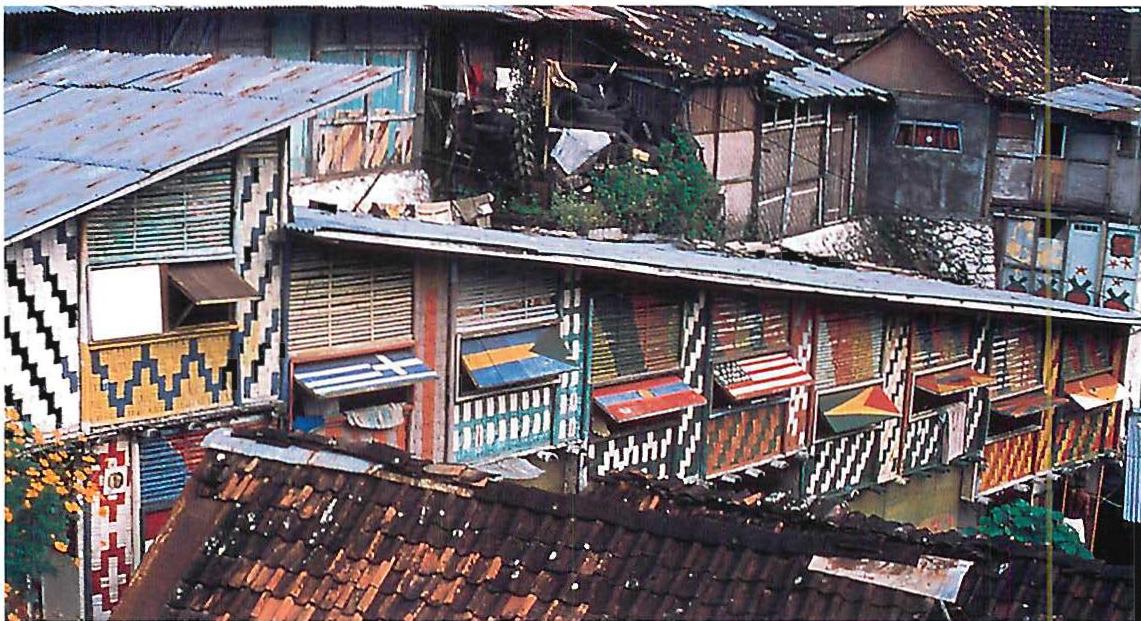
One of the most fundamental aspects of a living world is that every part of it will be unique. If we learn to use a living process well, its most essential nature will be to create structures which are unique, because they are perfectly adapted to their local unique conditions. That means, if a
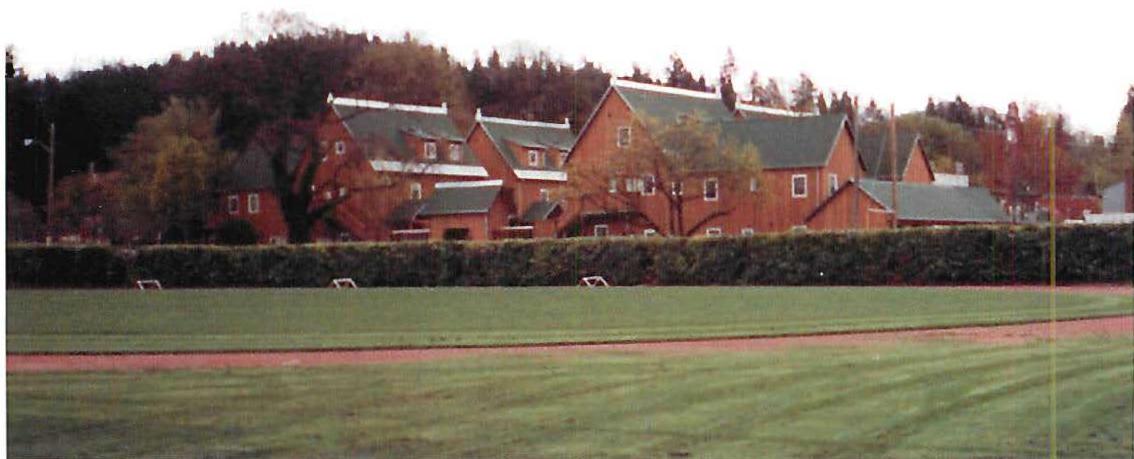
repetitive structure is to be built—a group of houses, say, or a group of offices, a series of windows, even a series of similar office buildings, or a number of private offices—the living process that is used will make each version of the repeating structure similar, if that is appropriate—but each repeated unit, each time it occurs, will be slightly different according to the unique configuration of circumstances where it occurs.
In such a result, inevitably following from a living process, each place, each part has the chance of becoming loved—or anyway, at the least it is possible to love—because it is entire, particular.
This character is familiar and obvious in nature. It happens without effort from us. And in traditional towns and villages, too, it happened without effort because of the naturalness of the unfolding. But in our era, we have yet to learn how to get this particularity, uniqueness, into every part of the built world.
If design and construction processes are living processes, as they are in my view of the world, we shall find ways of building that will allow each part to become itself, what it is, in relation to us, to who lives there, in relation to every hill, and every tree. In this chapter I give a few examples of the way that living process, properly understood, is so deeply structure-preserving that every house, every door, every apartment, each room, each corridor, becomes unique in its own terms, because it preserves the structure of the world (which is unique) at that place, and translates the uniqueness of the place into the uniqueness of the thing, the artefact.
That can be a world we love.
2 / THREE HOUSES BY TELEPHONE
In 1993 we began work on a community of houses in Austin, Texas.
Once we had the hull worked out—the overall formation of the common land and the position of individual houses in relation to this common land (see discussion on pages 82–85, and plan illustrated on page 366)—I began the design of the individual houses.
I had of course seen the site a number of times, helped each family choose their individual lots (since the land was held in common it was, more exactly, not a lot but a general area where each family was going to build) and we had, by then, a grasp of how the whole would fit together in relation to the beauty of the lake and the pattern of movement in the site.
I now asked each family to consider what they wanted in their house. Each family had already made a decision about the size of their house (governed essentially by cost). I gave them a copy of the pattern language, asked them to choose the patterns they were interested in, asked them to read through these patterns and to discuss among themselves what was going to be in the house, what would be its character.
This discussion took place by telephone, and lasted about an hour for each family. We ran through the kinds of things they wanted, we talked about the overall vision of the house that each of them had. When we were done, each family had, in outline, a picture of the patterns (the generic centers) which their house was to contain. It was different, of course, for each family.
I asked each couple, then, to visit the site during the following week and that each couple should try, together, to visualize their house as a whole. I asked that they do this, on the land, by walking through the house in their imagination, pacing it out, imagining what they could of what they hoped to see there. On the following Sundays, I arranged another phone call with each of the families. Again, each call lasted about one hour.
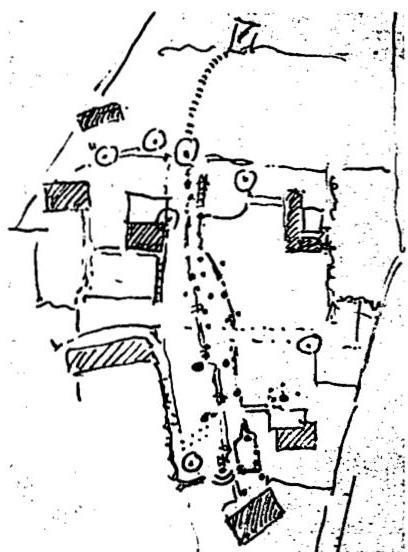
During this second phone call, I asked that they work, as far as possible, with their eyes closed, imagining themselves in the actual place that we were going to build as if it already existed. I told them I, too, would keep my eyes closed most of the time during our telephone discussion, and that, working in this way, we would be most likely to succeed in visualizing something good, and something real.
Now, to get things moving, I simply began asking them questions, one at a time. These questions were put to them in a certain order, and were a way of creating a sequence of unfolding. Each question, when answered,
would create a further unfolding of the house that had been generated up until then by the answers to the previous questions. As we went forward, we all three together built up, in our minds, a picture of the house they had in mind. Each of my questions was designed to bring forth a new feature of the emerging whole. I chose the order of the questions carefully, so as to cause the house to unfold as cleanly and smoothly as possible.
Although my questions, and the order in which I asked them, were largely the same for each family, each family gave entirely different answers to these questions.
3 / A HOUSE FOR GEOFFREY AND LINDA GIOJA
With the Gioja family, Geoffrey and Linda, I began by saying:
Q: We are walking across the site, towards your house. Now, tell me, how do we come into the house, where are we coming from?
They told me, in answer:
A: The house is pressed over against the trees. We want to be far from the common land. The
feeling of the inside of our house is enclosed and private.
When they had finished answering, and I was reasonably sure I understood what they meant, I asked
Q: So now I come to the door. What happens as I go inside, what is the first thing I see, where are we, what are we looking at?
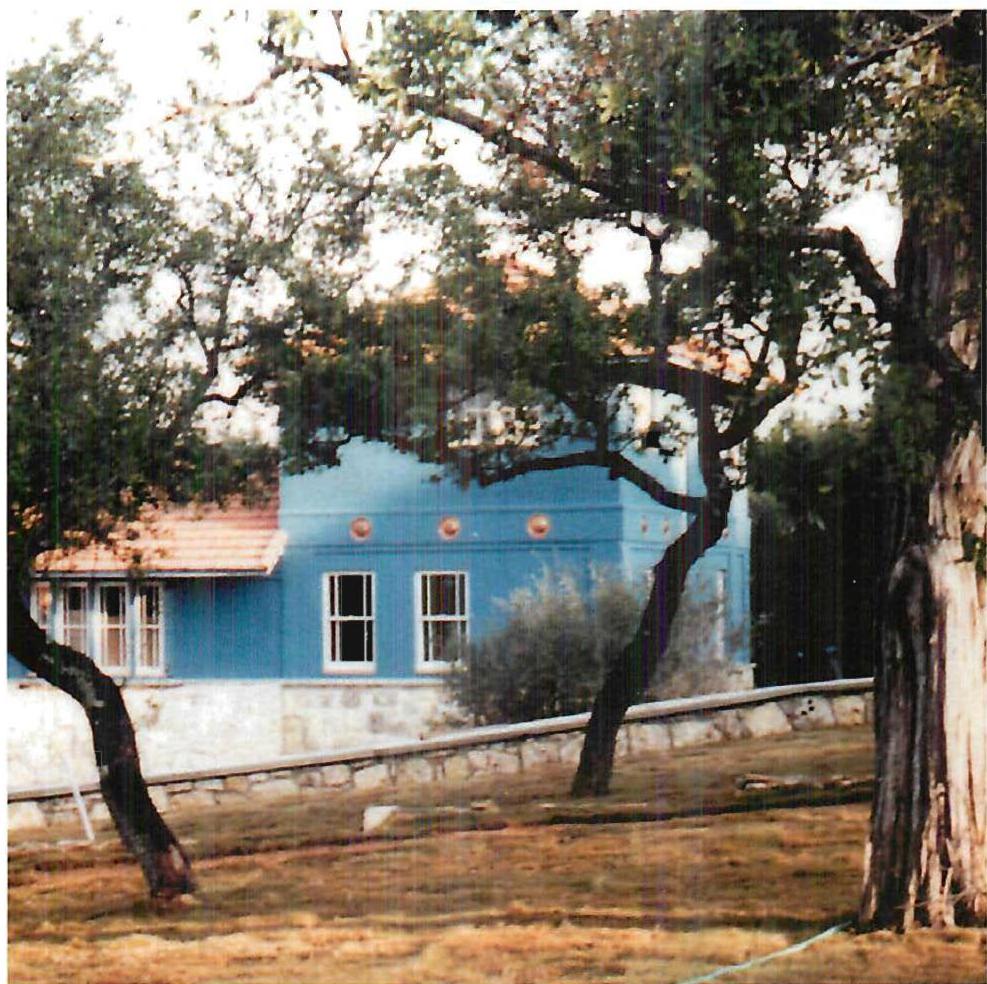
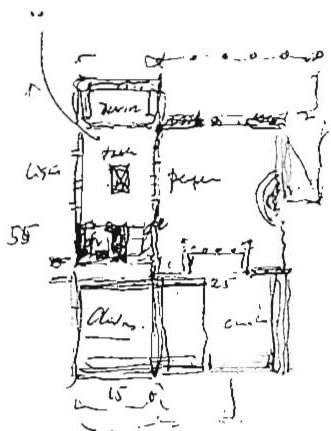
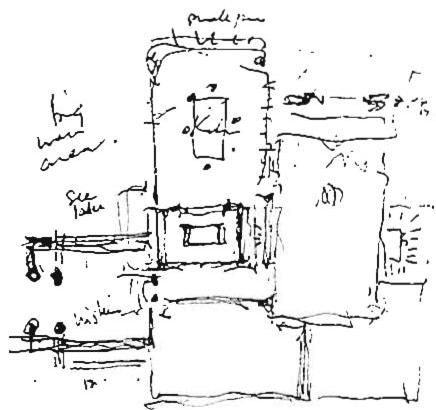
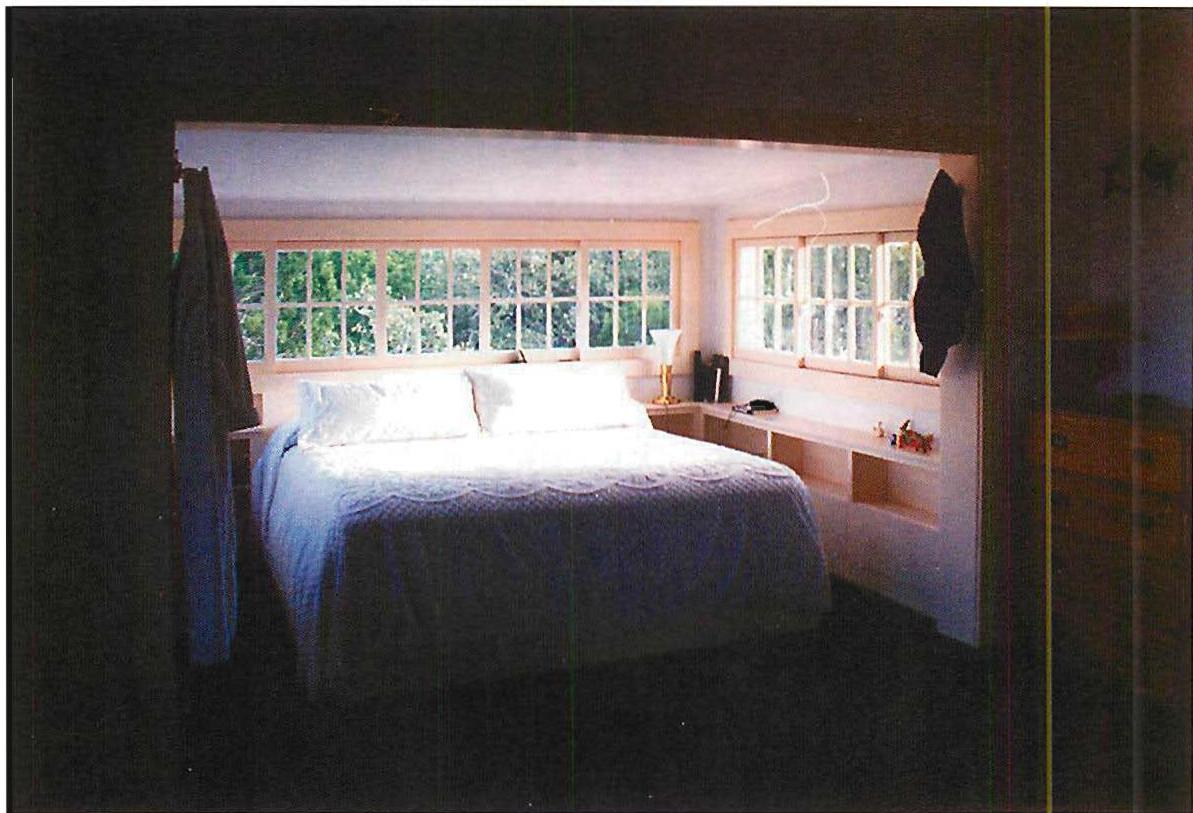
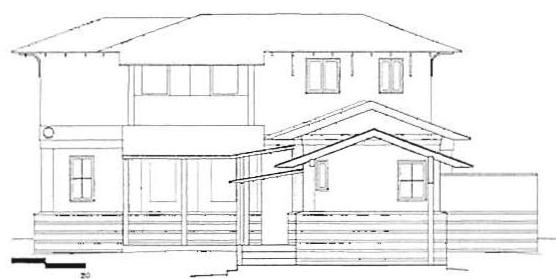
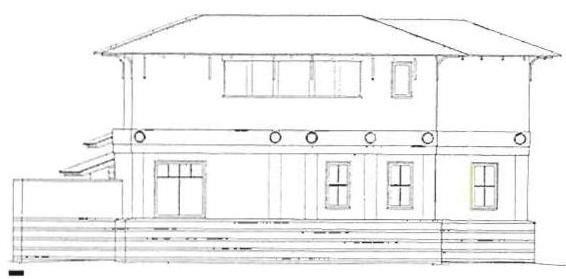
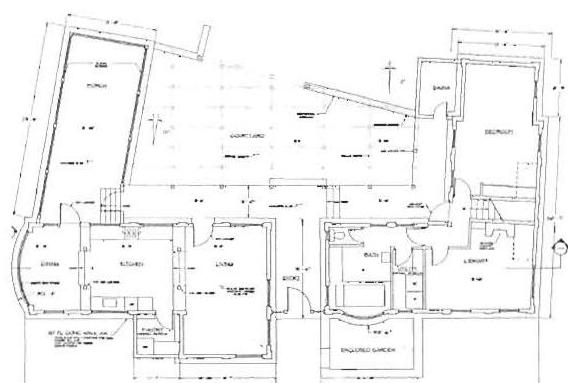
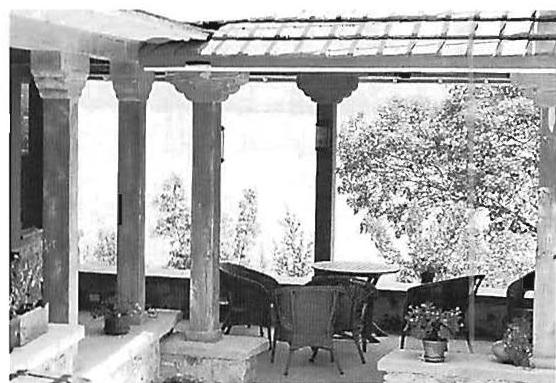
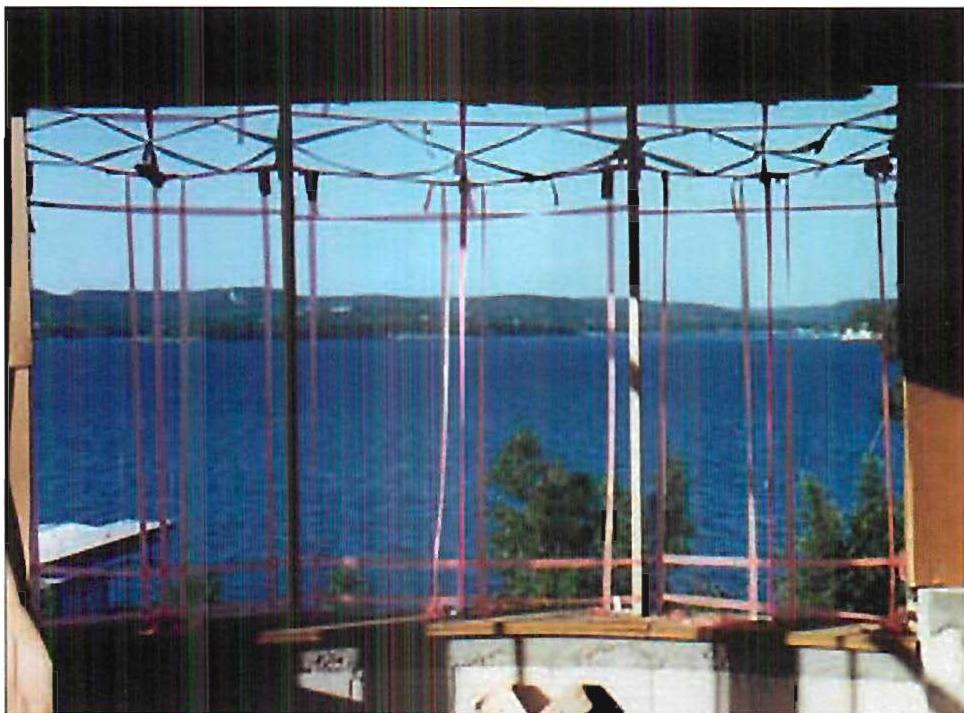
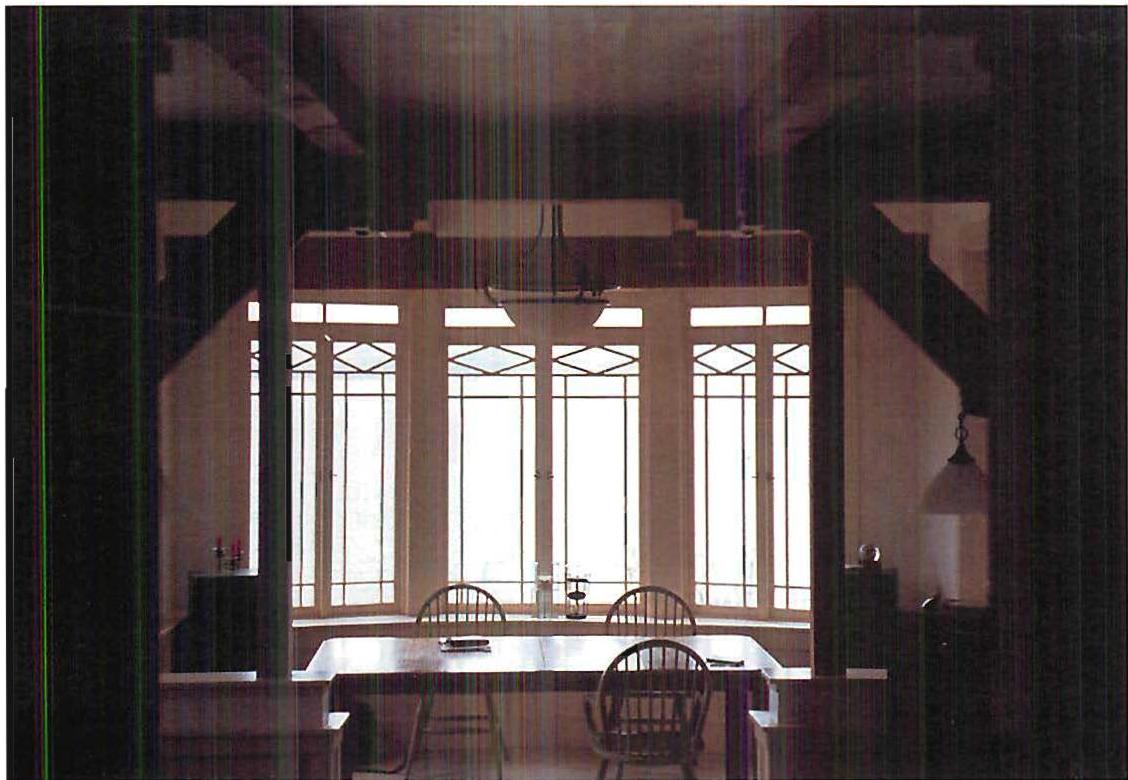
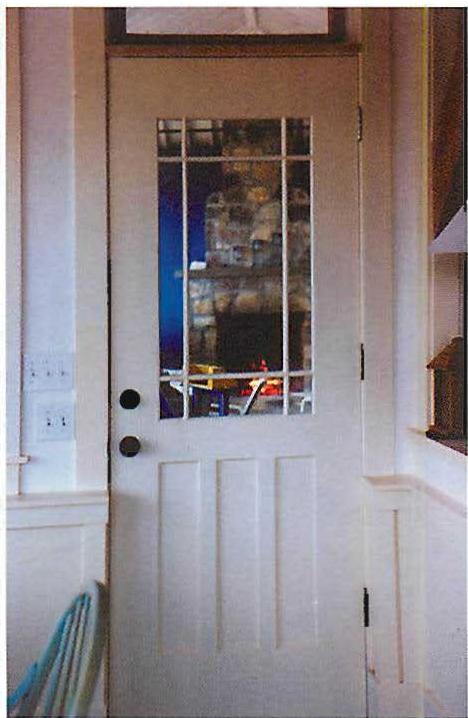
The Giojas told me, in answer to this second question:
A: We are now looking at an internal courtyard, everything opens from it. As we come into this courtyard, rooms open directly off it.
In this case of the Giojas, who had described the courtyard, I then said,
Q: But where is the main room? As I come in through the entrance, do I walk right or left to get to it? Is it to the left or to the right; how do I get there?
A: It is to the left, they said, towards the lake.
And then:
Q: What is it like when I get there?
And the answer was,
A: It has a beautiful window with a view of the lake, and another window looking on the courtyard.
The house became complicated after this initial conversation. Geoffrey, of Latin descent, and Linda, of North American descent, had a different understanding of their shared idea that
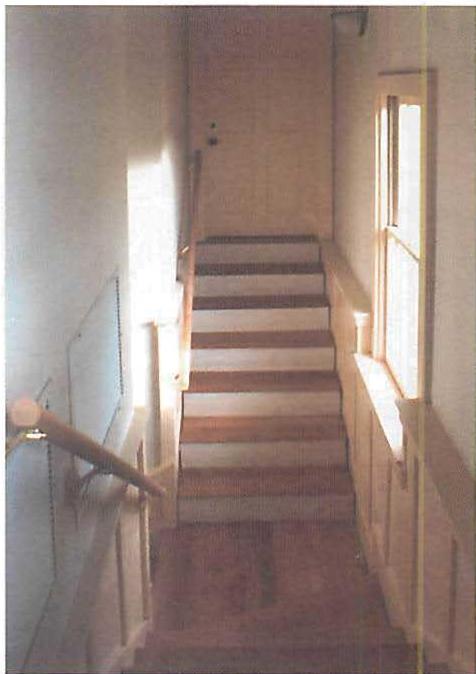
the house might open off the main courtyard. For Geoffrey this courtyard was the main living
room, it was the place where they would "live." That meant it was lockable, it really was like a room. For Linda it was an outdoor courtyard, not necessarily secure, and therefore could not truly be felt as their main living room. Did it, for example, have a ceiling of vines? As the house went from initial sketch to finished building, the question of how secure this room or courtyard was to be — how lockable, how private? — came repeatedly into focus. The chapel, which was a tiny building in the trees reached from the courtyard, took on different qualities; the path to the lake had different attributes.
Even in this slightly tortured discussion, though, the essence of the house always remained what it had been from the first day: a house built around a courtyard, which was to be their main living space. Even the fireplace, for example, is in the outdoor space. It is visible on page 370, seen through the glass door of the dining room, which leads out to the porch that closes the courtyard and overlooks the lake.
4 / A HOUSE FOR JIM AND SYLVIA HEISEY
With Jim and Silvia Heisey the process began quite differently! The most important thing in the area the Heiseys had chosen for their house, was a stand of small, beautiful, old oak trees, just towards the lake from the place where they wanted to put the house. This was in their minds from the beginning. The very first thing they said to me, when I asked:
Heisey house plan after one-hour telephone discussion and visualization by Jim and Silvia Heisey.
The massive porch is the rectangle visible in the lower part of the drawing: the entrance is to the right.
Christopher Alexander, 1994.
Heisey house, upstairs plan after one-hour telephone discussion and visualization.
Q. What is the most important thing in your house?
was:
A. The most important thing is the massive porch — a porch which looks towards the lake, mingles with the trees, looks out into those oak trees. We want to spend a lot of time on the porch, looking at the lake and the trees.
Q. And is there a living room connected to the porch?
A. Yes, it looks at the trees and the lake, through the porch. It is a long room, the room you first come into when you come into the house. It has a long window seat all along the porch side; and the fireplace, on the uphill side, is dark and warm.
Q. So, how should I understand the way everything fits together?
A. You come off the commons and the entrance is right in front of you. After passing through the entrance, you come to this living room, the long window seat is on the left, the fireplace is
on the right. In the far back corner of the living room is the stair, going up to our bedrooms.
Q. And where is the kitchen?
A. The kitchen is all the way to the back — with a dining seat looking out onto a patch of grass and flowers that lies on that side, towards the light green pine trees.
Q. And where is the porch, then, in relation to the living room and the kitchen?
A. Well, the kitchen and the living room both look out into the porch. The porch is really massive. It is so hot here in the summer months, we want to spend most of our time on the porch, and living there.
The sketch drawings on this page, made right after I got off the phone with the Heiseys, show disposition of entrance, living room, kitchen, and the massive porch at the bottom of the drawing. The position I had for the main stair was abandoned soon after. The position of the house entrance was changed, too, long after the beginning of construction.
The most extraordinary thing about the Heisey house story was what happened when I went to Texas after the foundations, stone stem walls, and slabs had all been built.
I arrived on site to start the fine-scale tweaking of the house plan. As I came towards the house, from the common land, I saw, instantly, that the place I had put the entrance, in the drawing, was not a good thing at all for the real house. It was not the best way to go into the living room, it made the living room too much like a passage—in short, it was a big problem. What to do? The slabs were in. The lower walls were in. I hardly dared mention it to the Heiseys; I thought there might really be a serious problem, sparks flying, and so on. But I could not leave it alone. The house would have been ruined if I did not mention it. And what if I did mention it and they did not agree? Just as bad, the house would suffer terrible consequences.
I got my courage up; they had arranged to meet me at the site about an hour after I got there. Very delicately I started to broach the subject . . .
"I am a little concerned about the entrance . . have
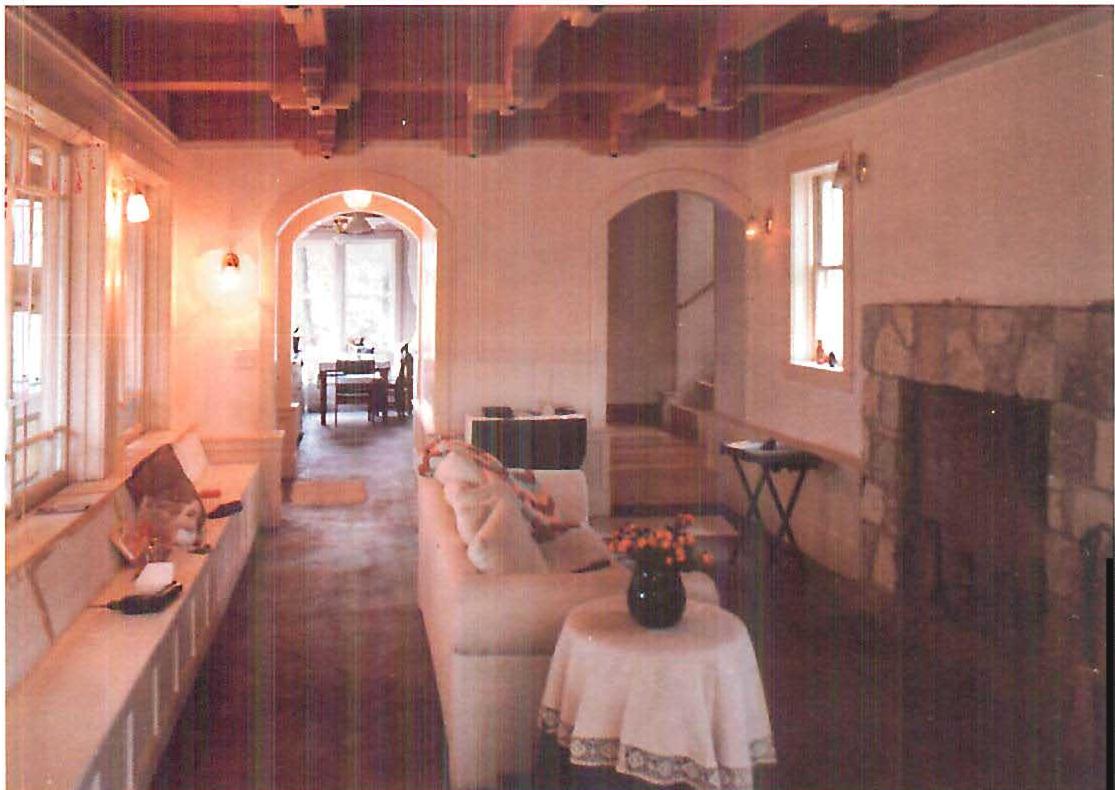
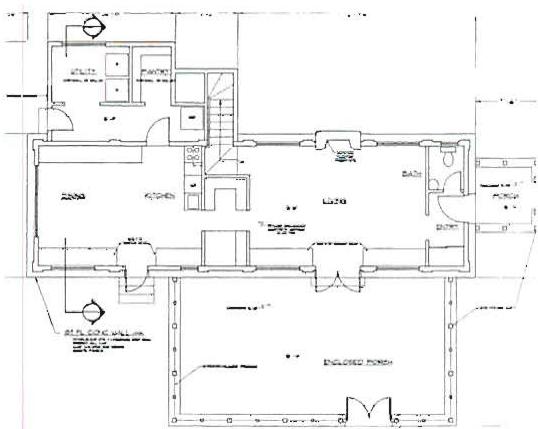
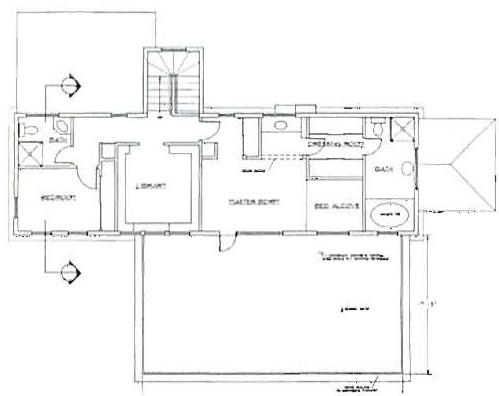
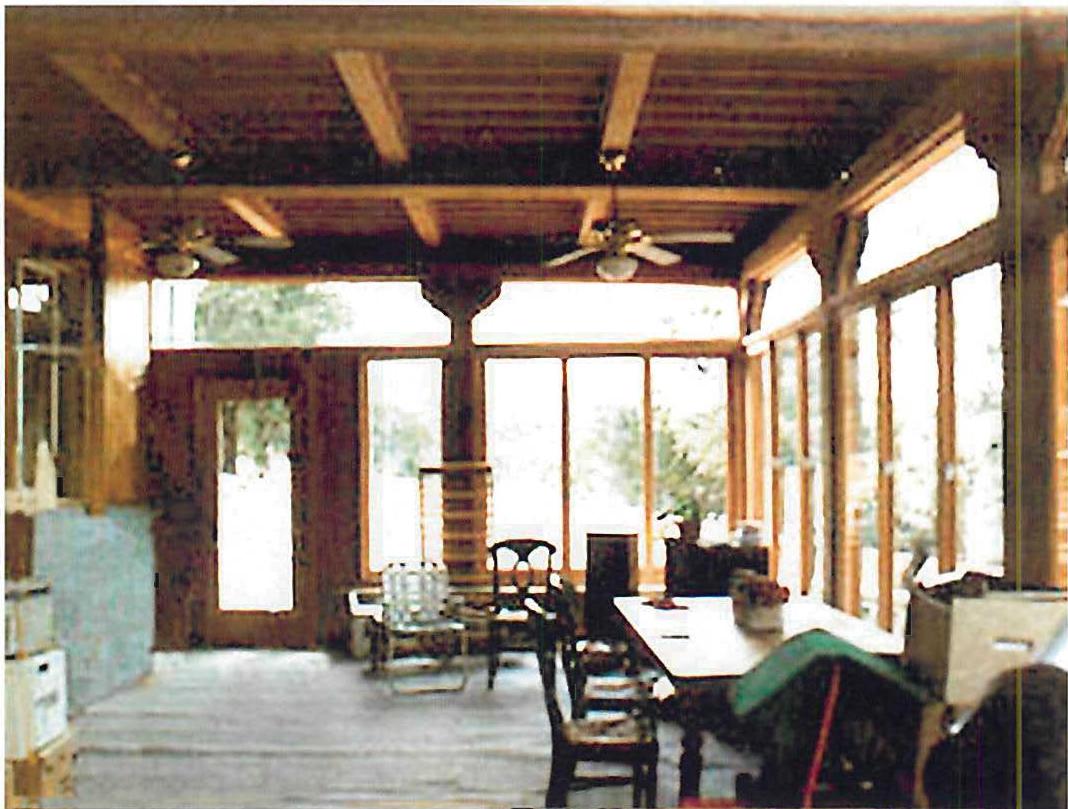
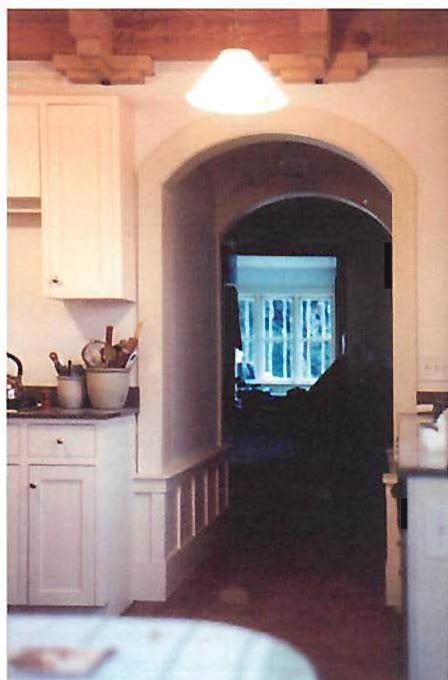
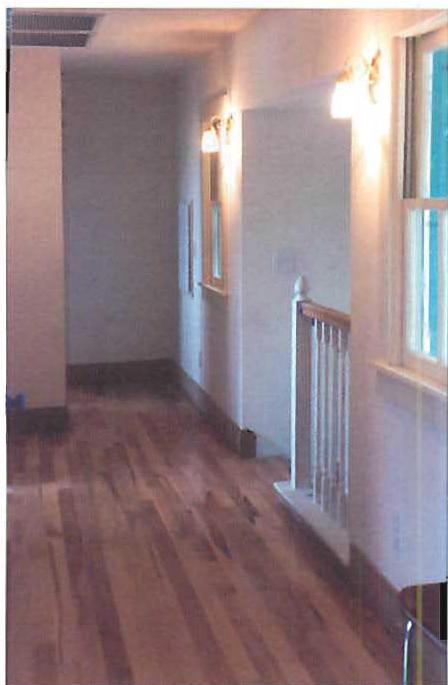
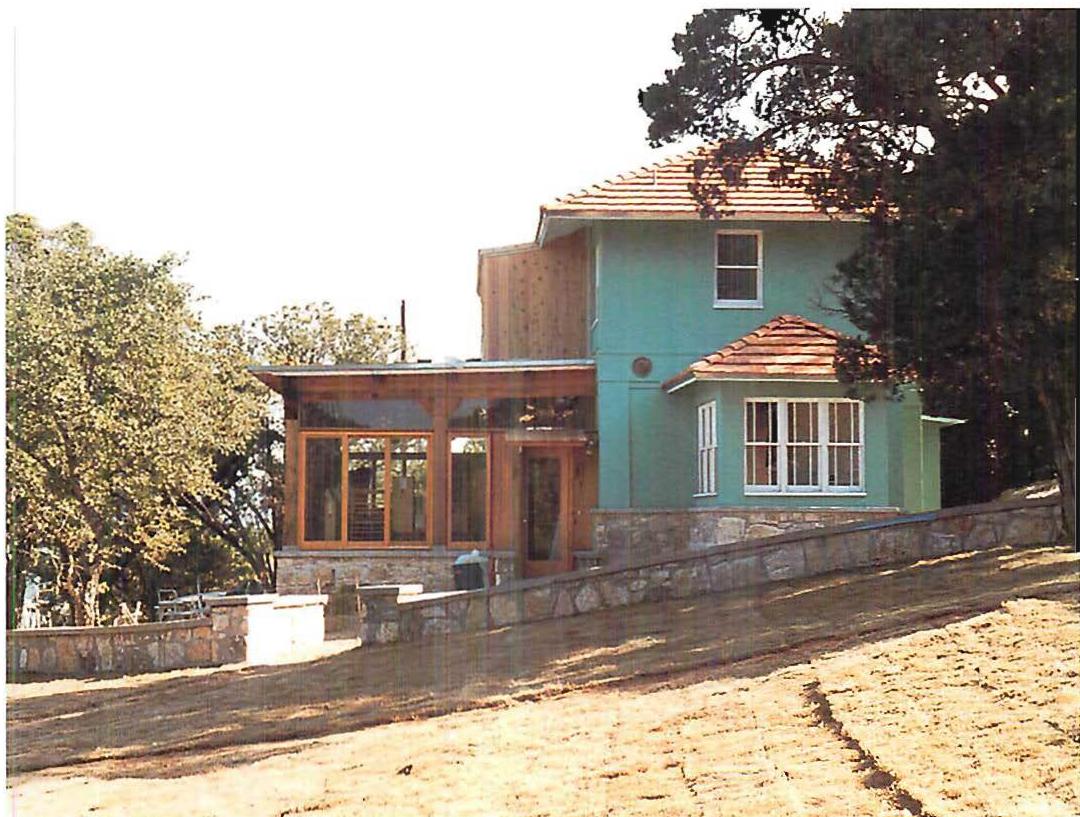
you noticed any problem..." in that tone...serious but gentle...Almost at once, Sylvia burst in with "Oh yes, we were wondering how you would react when you got here...do you think we have the front door in the right place...?"
So they had seen the very same problem I had seen, and, as it turned out, we had the same idea about how to solve it, too...go in through the great porch...but tuck the door into the corner nearest the building, so it would not disturb the beauty and peacefulness of the porch, when people were doing things. It was not a problem.
I mention it in part, because it is SO interesting to realize that when one is looking at these questions from the right perspective, so many questions turn out to have objective answers!
As you see from the house plan that was submitted for the building permit (page 373), the entrance is shown in the old (wrong) position, and was corrected only in the building itself.
And what did we do with the space of the old entrance, which was already there in concrete when we decided to move it? We made it into a library niche. It is a lovely place to sit, looking out at the oak trees in the commons. You can see it in the far distance of the lower left-hand photograph on page 374.
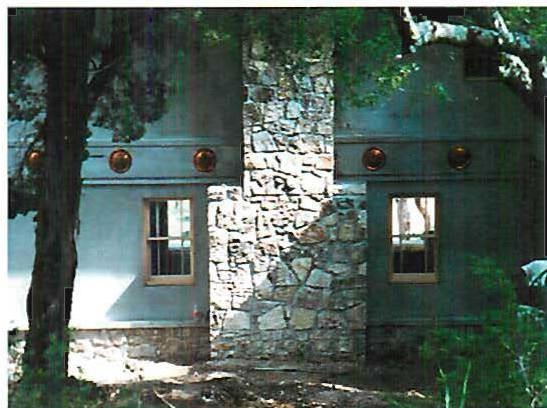
5 / A HOUSE FOR MIKE AND PATRICIA GODDU
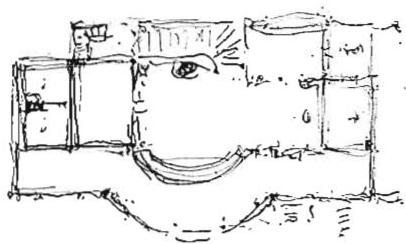
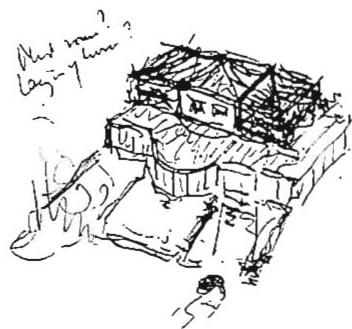
With Mike and Patricia Goddu it was different again. The first picture that the Goddus had of their house came from the fact of its being at the top of the hill, and seen from underneath. When I asked them,
Q. What is the first vision you have of your house?
They answered:
A. As you approach the house you come through a small garden. Then, around the whole front of the house you see a huge and massive porch, curved, looking out over the lake... we see a great curving porch, from below, the whole front of the house.
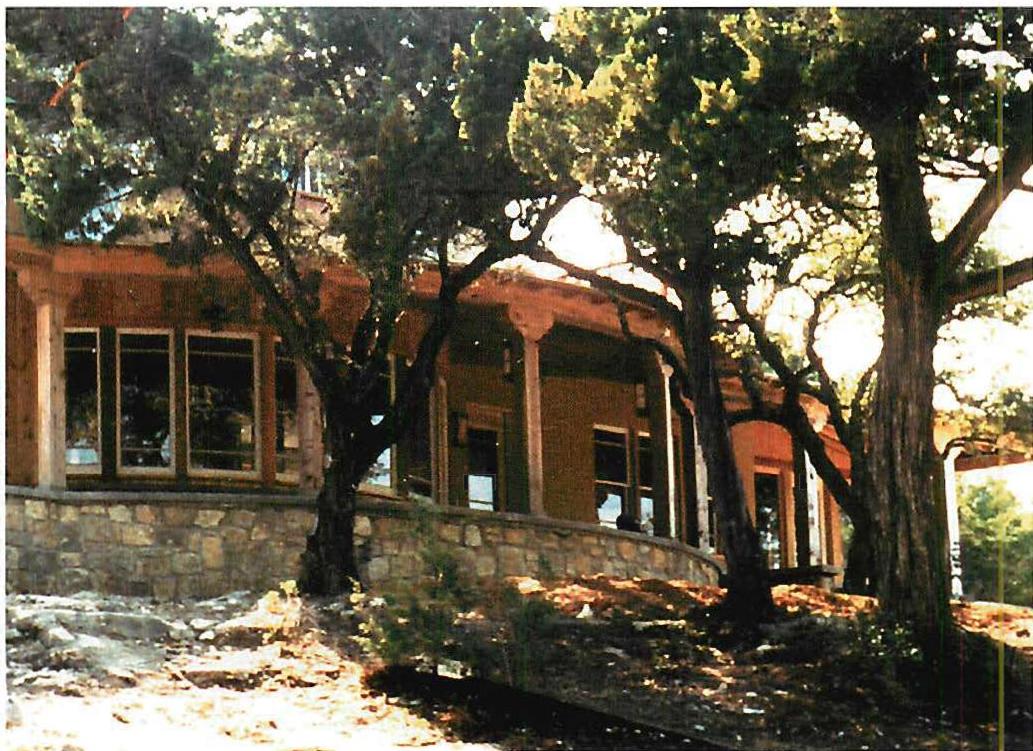
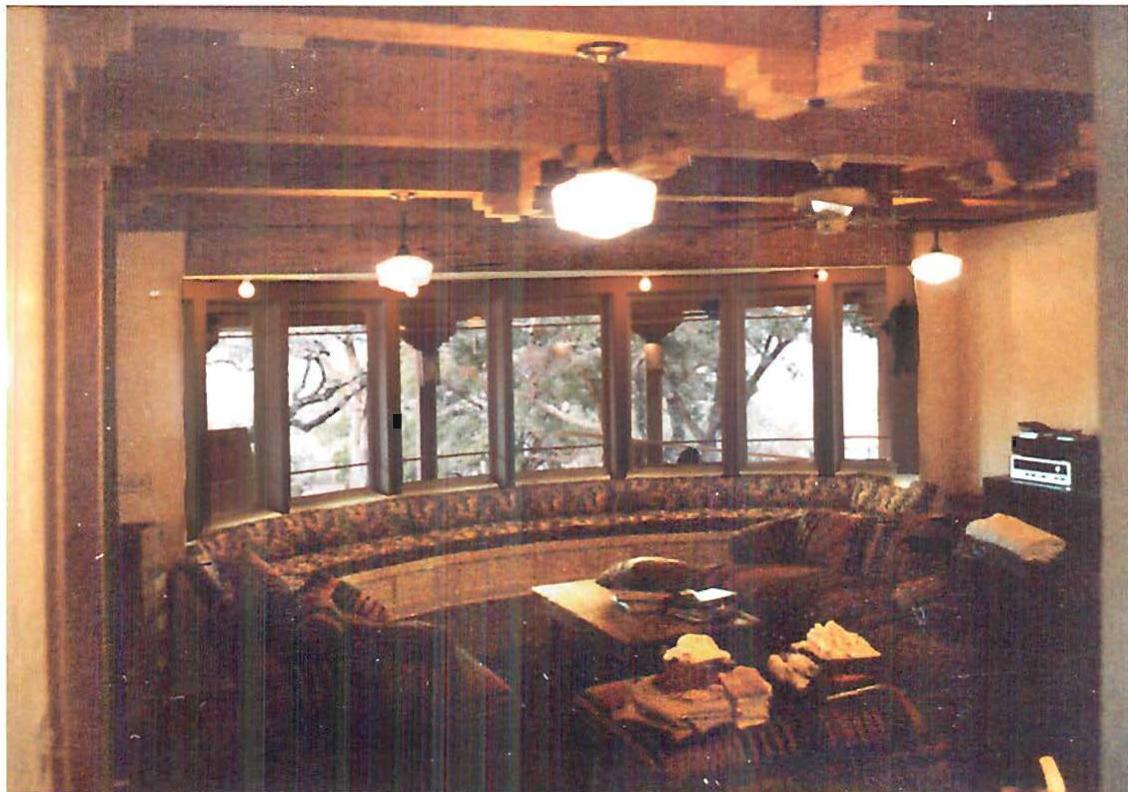
I felt, from my experience on the site, that this was a genuine "vision"—something truly felt and seen spontaneously, in the mind's eye.
Next, once we had this curved porch established, Mike and Patricia then moved into a detailed picture of the inside of the house.
Q. What happens when you come in off the porch?
A. You come in from the porch—and the moment you come in, you have the kitchen in front of you, a counter there, so it is welcoming for a visitor, or for one of us in the family; the moment you come through the door you are home.
A: You come in and right ahead of you is the kitchen. It is a place where Patricia can be cooking and talk to guests and see who comes into the house right away as they come in.
A. Then, to one side of the kitchen, to the left, there is the living room, following the curve of the porch . . . with a fireplace at the back . . .
Q: So, what can we see from this place?
A: You see the living room, dark and elegant. Other interesting things that happened in the course of that one-hour talk with the Goddus included the idea that because of their children, there might be two staircases in the house—the main stair going up from the living room, essentially going to the master bedroom—and a back stair, going up from the playroom (downstairs and connected to the garden) to the boys' bedroom. This small stair, side by side with the big one, is already visible in the small sketch that came from the telephone call.
The connection from the kitchen straight out to the sleeping porch, the fact that the porch was not only large in front but also wrapped around the house and was to be (and is) the major communication from all the ground floor rooms, as well as including a sleeping porch for guests, outside the kitchen area—all this was established in the first 60 minutes of discussion simply by going straightforwardly through the steps of placing one thing, and another, and an-
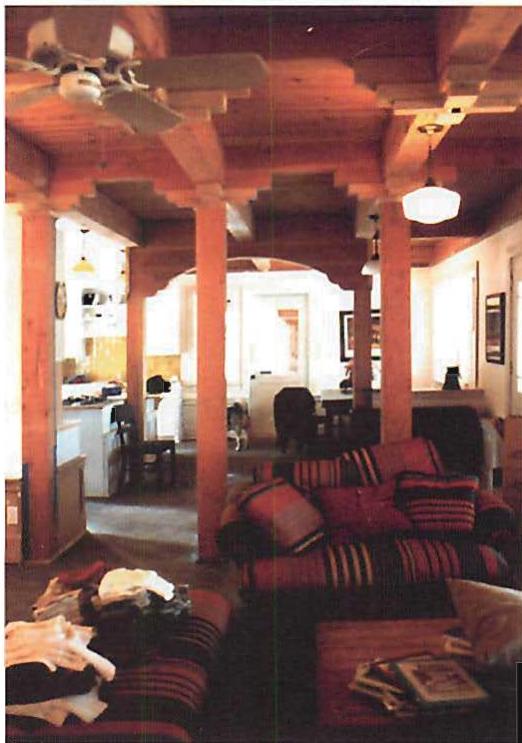
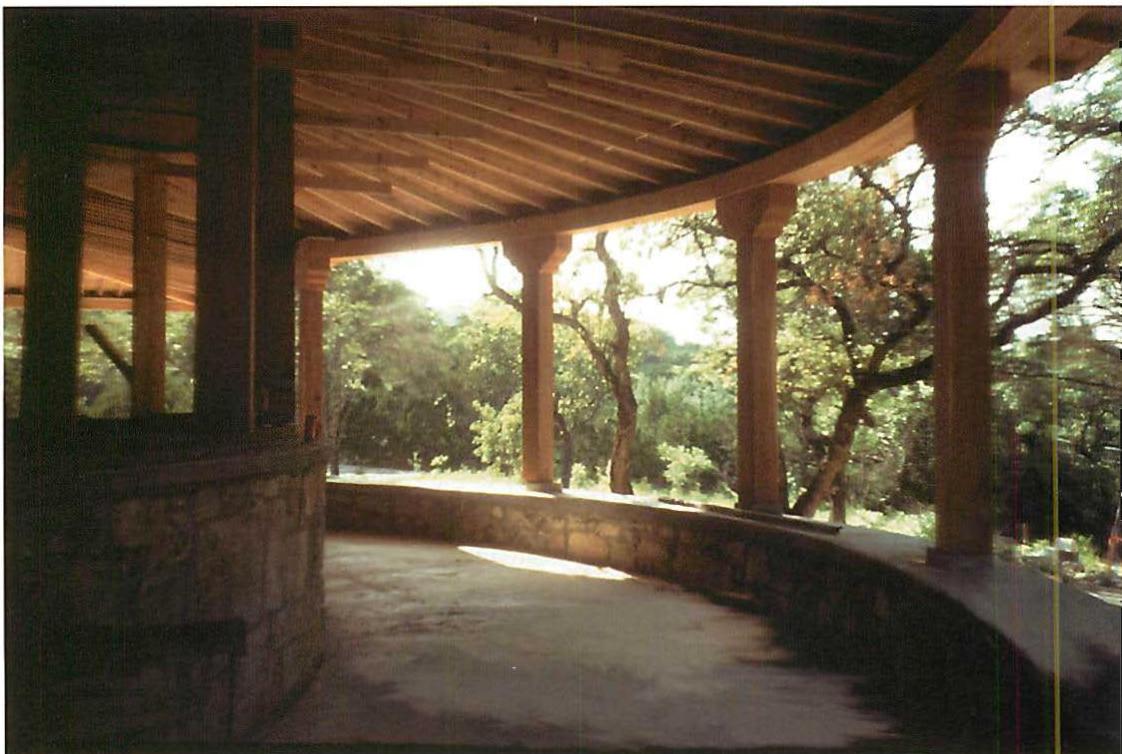
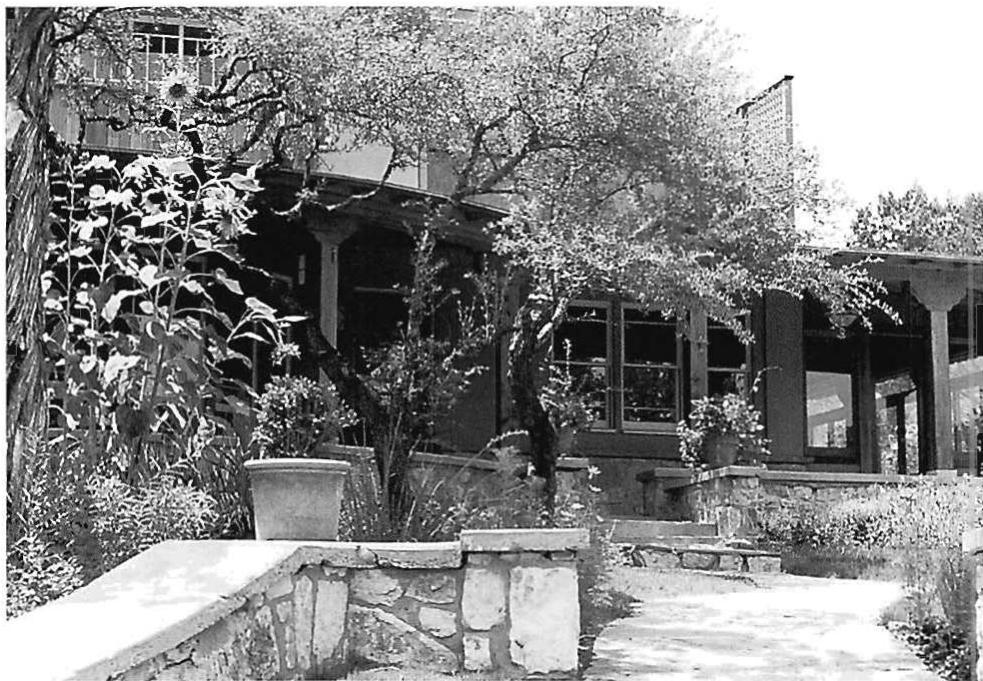
other, in uncomplicated serial order. The process continued far enough so that we had most of the
detailed organization worked out: rooms, doorways, windows, porches, stairs.
6 / OVERVIEW OF THE UNFOLDING PROCESS FOR THE THREE HOUSES
With each family, by the end of a one-hour conversation, I had built up a fairly complete picture of each house, both in my own mind and in the minds of the two people I was talking with
As you can see from this process, the design, in each case, came largely from them. Certainly, the inspiration came from them. But I asked the questions and it was my way of putting these questions, in the order that I asked them, which made sure each house really did unfold in a nice orderly fashion. That is what made it a living process. The unfolding was smooth. Each time it was my questioning (both my persistence, and the sequence of my questions) which brought all of us three (the two family members in Austin and me in Berkeley) to the point that we had a
coherent structure emerging, in each case, and that we could, all three, visualize the same emerging whole.
If the questions had been different, and I had been less experienced, we might easily have spoken for an hour, reached some ideas, and then, I would have had to go away and "design" the house. But instead (because I really managed to get the house to unfold in this question-and-answer process) by the time the hour had passed, we all had a grasp of the same fairly coherent whole: a plan that worked, founded on an emerging inspiration that came from them.
After the phone call, in each case I was able to sit down and make a quick freehand sketch
at 1/16th inch scale (1:200), which showed a complete and coherent house. I did not do any design while making this sketch. It was simply a record of what I (and they) had visualized while on the phone.
For anyone else who would like to try this, I would emphasize the following points:
You need to have at least a rough a pattern language worked out ahead of time—that means you have discussed the generic features which the house will have, and have written them down in a set of patterns you want in the house.
You do the whole thing with your eyes closed.
You must help your clients to concentrate on the emerging WHOLE while it is going on, and always be alert to what it is about the quality of the whole, as a whole, which is most in need of clarification as the whole continues to unfold. It is chiefly this alertness and concentration which allows a coherent house plan to come out of it.
7 / A PARADOX ABOUT UNIQUENESS
The intense feeling of uniqueness in these houses comes, in part, of course, from the fact that each house was generated, uniquely, by the family who lives there and according to the demands and character of the particular bit of land where they placed the house. But it comes no less—I may say that it comes even more—from the fact that all three houses were built the same way, with the same rules of the game, the same construction details, the same approach or feeling in the way that they were built.
The uniqueness of the houses, the sensation that they are like nature, different leaves off the same tree, comes in large part from the way these houses were later built.
All three houses used a common form of construction. All have stem walls of stone, heavy stud walls (2 x 10), open ceiling beams with double corbels where the beams intersect, floors, stone in the courtyards, wooden windows, slat work, real plaster walls downstairs and painted sheetrock upstairs, massive column corbels on exterior porches.
One might make the mistake of thinking that if each house had its own unique system of construction—as it would have in a typical group of "custom" homes, they would be more individual, more particular, and therefore more unique. But this is not the way it works.
Imagine an oak tree on which there was a fig leaf, a hazel nut leaf, a willow leaf interspersed among the oak leaves. This would not create a feeling of uniqueness in the different leaves. It would merely be bizarre and chaotic. The quality of uniqueness is a quality of particularity which stems only from necessity. Because the houses are all built in the same way—each has the rounded copper plaques, used as ornaments; each has enormous wooden corbels on exterior beams; each has plaster outside and inside—because of this, we see the differences more clearly, the differences stand out more sharply. Only because of this are we truly aware of the differences. It is because we all have noses—essentially similar in shape and structure—that we recognize a certain person's nose, mouth, eyes. This sameness provides the ground against which we see their uniqueness.
And just so with these houses. They are more particular, more unique, because they are all made within the same process of formation and construction—and the differences that come from place, person, and temperament are made more visible, stand out, are there to be loved—because they "beat" against the shared samenesses.
That is where their uniqueness comes from.
8 / MASS-HOUSING WITH UNIQUE APARTMENTS
On several occasions I have designed apartment buildings where families could design their own apartments, and where each apartment is unique. One project of this kind, the Agate student housing at the University of Oregon, is shown on pages 182–86. Another is the Frankfurt project described on pages 86–92. Yet another, unfortunately not built, was the housing project whose design was commissioned by families in the Chikusadai community in Nagoya. It was designed at 2 1/2 stories (two stories with a pitched roof above, a third habitable story halfway into the roof space, but the eave of the building only just above the two-story level). The buildings are described in more detail in chapter 10.
All the buildings are about 6 meters wide. There are many windows because the building is long and thin. Each family gets a rectangle 6 meters wide and 12 meters long, an area of 72 m².
Within this rectangular area each family may design their space as they wish; the rooms, partition walls, windows, bath, kitchen are then placed according to the desires which that family has. Technical innovations make it possible for the bath and kitchen, too, to be placed wherever the family wants them.
I invited many of the family members who commissioned the project to a preliminary discussion of their housing project. To show them what was going to happen, I gave each person a piece of graph paper (in scale, 6 meters wide and 12 meters long) and asked them to draw the apartment they wanted for their family. I told them to put whatever they wanted in there, that we were not going to constrain them at all; and that when the project started we would have the necessary contractual and construction power to put their plan into the building, without increasing the price.
On the page opposite, the left-hand drawings show apartments which they drew for their families. The right-hand drawing is the formal
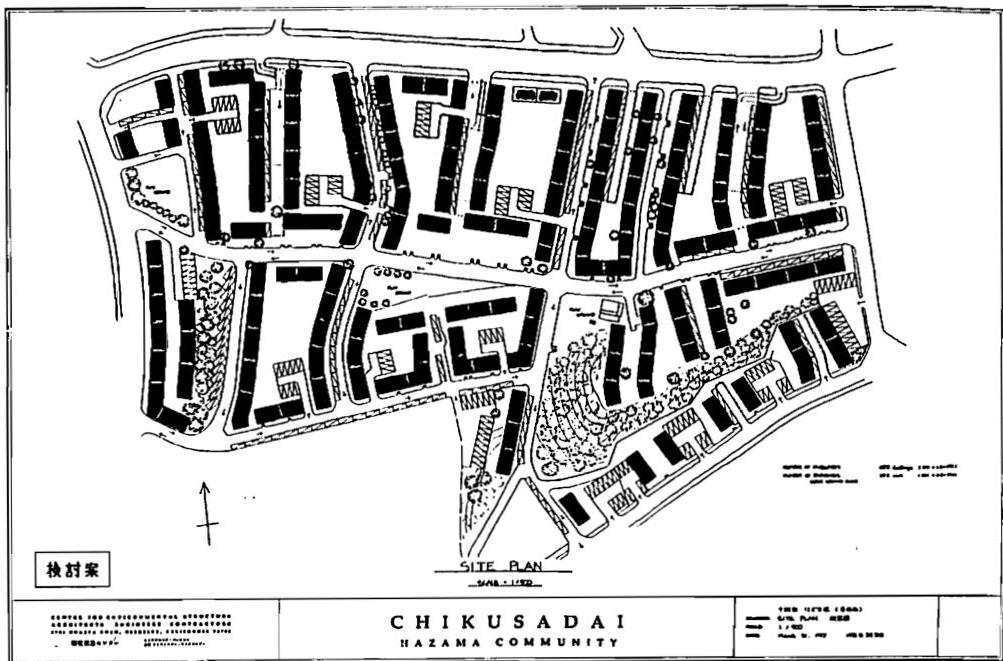
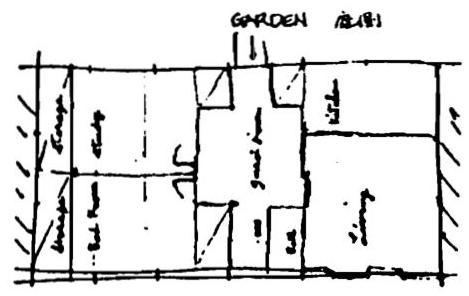
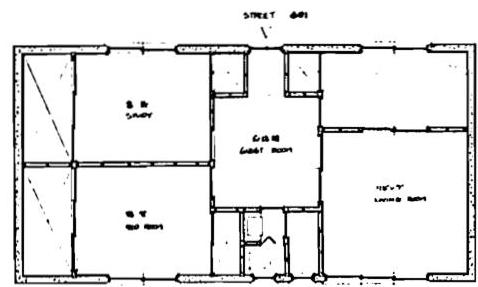
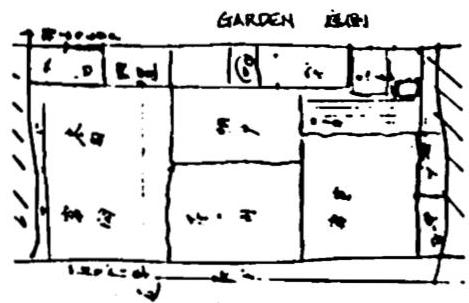
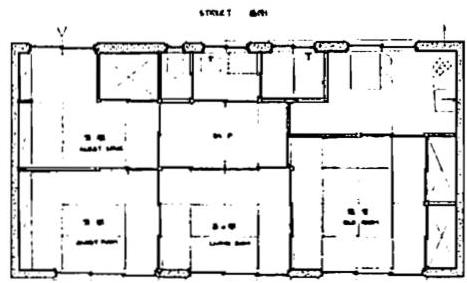
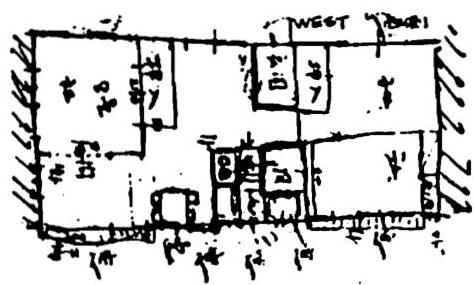
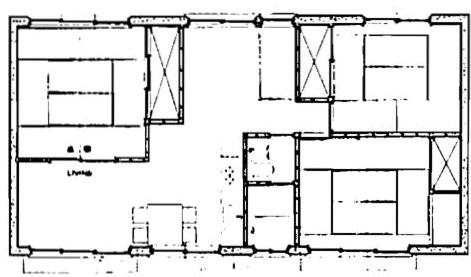
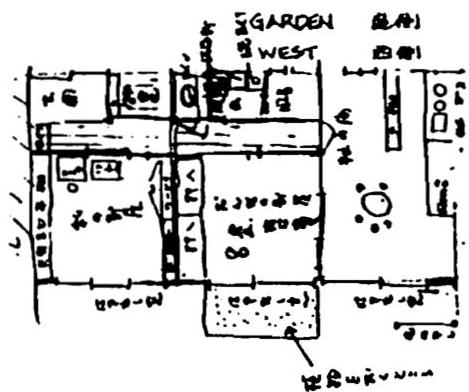
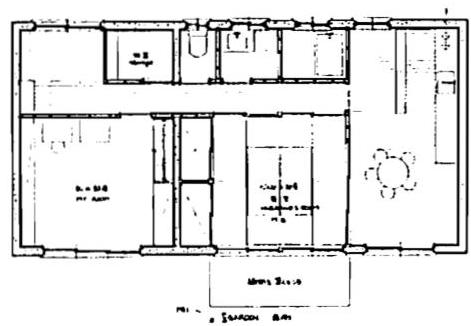
On the left, apartment plans drawn by families. On the right, the same plans redrawn as architectural drawings.
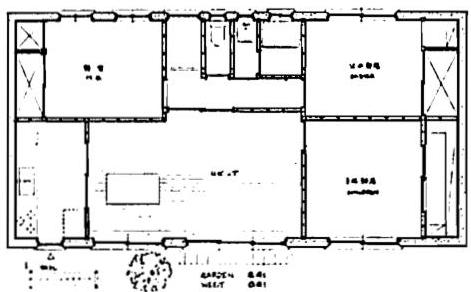
architectural drawing that came from their sketch. The plans are immensely different from family to family. There were very particular qualities, problems, life experiences, expectations, and desires, in each individual family. It is that, above all, which I wanted to protect and encourage.
I have found that people who are used to today's standardized apartments are sometimes skeptical about the importance of this kind of thing. Is it really helpful or necessary? Is it worthwhile?
The real importance is strongly underlined by something that happened in one of the early sessions. As usual, I had given a group of about seven or eight men and women a piece of paper and asked them to draw the apartment they wanted for their families. Put what you want in it.
It did not take very long for them to put down what they thought would be an ideal apartment for their family.
To my great surprise, two of them were openly weeping while they did it. I asked them why they were crying and received this answer: "We are people who have been living in mass housing in Nagoya. It was almost unthinkable, almost unimaginable to us that our ordinary necessities could be put into a building in such a
direct way. Therefore we are upset, because it is so beautiful, the possibility of real life, such a freedom, for our children, is almost too much to bear!"
What an extreme comment on the state of the world: that people should weep, merely because they are allowed to sketch on paper the apartment layout that they wanted for their family. Their tears came long before any implementation. They wept, not because this was the practical realization of a dream ... but merely because someone was taking them and their family seriously enough, to allow this possibility to exist, even in their minds, and on a tiny square of paper.
Even I, with my assumptions about the importance of this kind of thing, was astonished that the process had such a direct impact. There were tears in other people's eyes, too. Nearly all were overcome with emotion, just at being able to draw what they thought might be the ideal apartment for their family.
But the story has a tragic ending. Finally, although 84% of the families voted to have this project, although costs were the same or lower than the standard highrise buildings of the municipality, and although the city of Nagoya had promised to meet their wishes, in the end the officials of the municipality refused to complete the work, and the families were forced to live in standard mass housing after all.
9 / A FACTORY AND ITS INDIVIDUAL WORKSPACES
In 1987, my company built offices and workshops for a small children's clothing factory, Sweet Potatoes, in Berkeley, California. The part of the factory we built was the research and development section where new designs and methods of fabrication were tested.
We started by using a layout process in which the factory team — about fifteen people — worked together to divide the area into groups according to the centers that were needed; each area for a work group was then laid out by three or four
people, within these general area designations; and within those roughly worked out work areas, each individual sketched out the workstation which was most comfortable to them.
We then built the workrooms directly from these on-site sketches, using an advanced system, similar to the system we later developed for Herman Miller (see pages 386-97). In this process the workspaces were built cheaply, custom-tailored to the configuration as a whole and to the needs of the individuals who worked there.
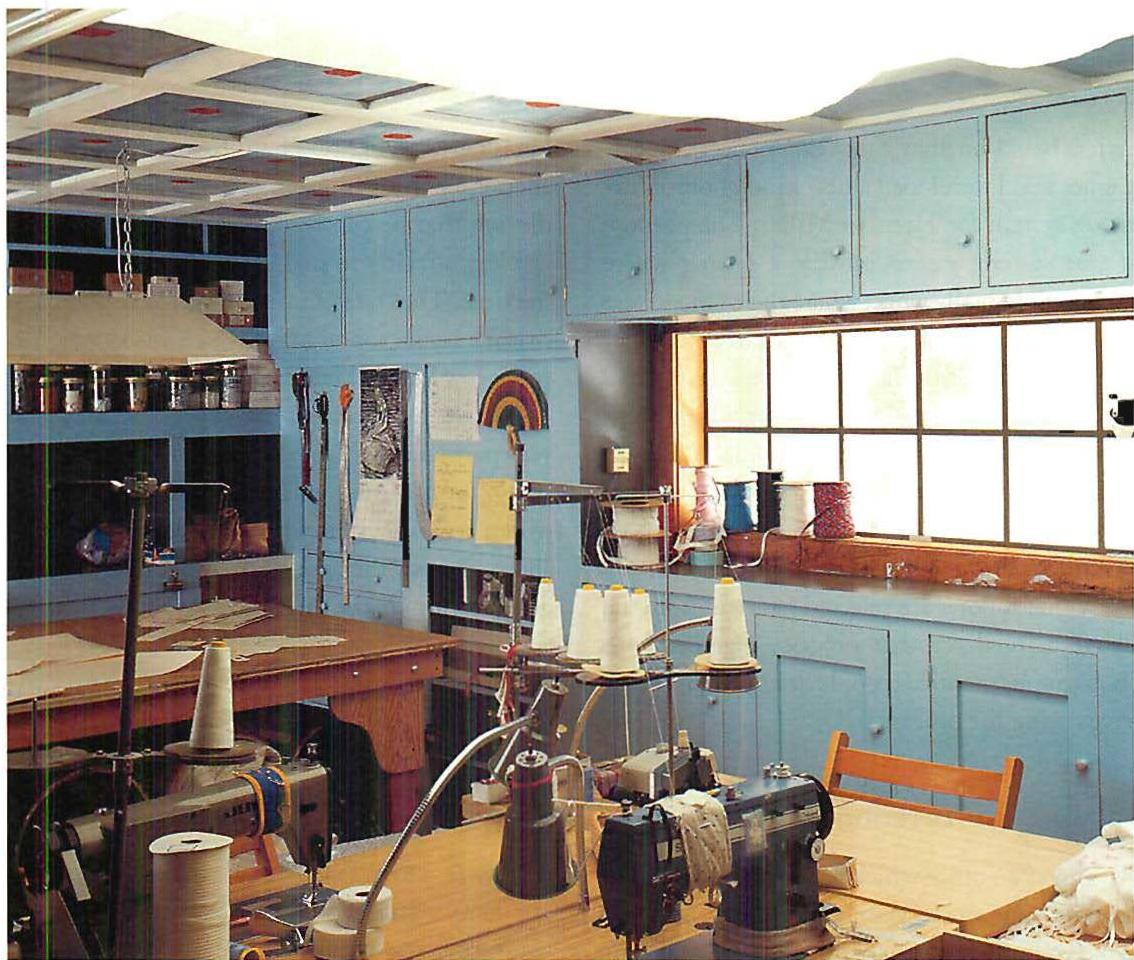
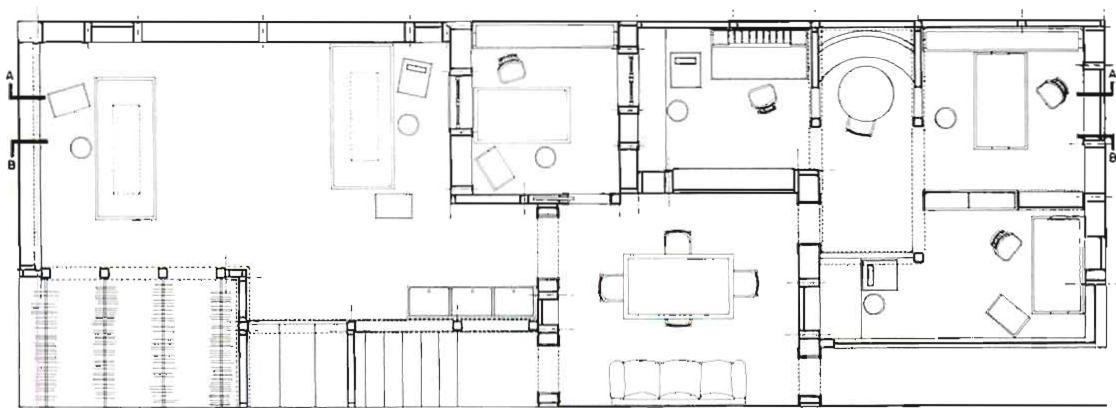
10 / OFFICE LAYOUT PROCESS
Later, based on that early experience, my colleagues and I developed a new kind of office furniture system for Herman Miller. The purpose of this system was to provide a setting where people could really work, where their offices were really personal, and where the "dead landscape" typical of modern office furniture systems had disappeared. We provided the user with a step-by-step generating sequence, which allowed each person to work out the ideal layout for his/her own office step by step, then to realize it, by building it in the movable cardboard model.
What follows are selected passages from the layout manual for that process, together with photographs of offices people designed for themselves using the process.
1. INTRODUCTION
We aim at an office which is perfectly adapted to you and your work. We should like to help you make your office as finely tuned to you and your work habits as a classic carpenter's workshop. In the carpenter's workshop, each piece is gradually built and fitted, over many years, until each tool fits just where it belongs, and each surface is just the right size and height for the carpenter's work.
Many modern offices do not have this quality. Typically, there is a more haphazard arrangement of available pieces of furniture. The process of work is not reflected in the layout of the office. It is not a truly comfortable place to work. And, certainly, it is not a deeply efficient place to work.
In this manual we shall try to help you discover, for yourself, what it takes to make your own workplace completely comfortable and efficient in this way.
The carpenter's workshop referred to above is the end product of years and years of gradual, painstaking adaptation. It is important to recognize that the state of mind in which the carpenter is able to achieve this is a very humble one.
He is never trying very hard to make a "perfect" environment for himself. He is never under the illusion that he can reach anything perfect. He just keeps trying to make it a little bit better all the time. The state of mind in which you can arrive at a layout for an office which works well for you is low key and rather slow.
As you will see, this "easy" process requires a very particular set of tools to get you there. The system of furniture which we call "the personal workplace" is a system whose characteristics come about, the way they are, entirely because we have designed it to make this process work for you.
2. AVAILABLE FURNITURE AND THE MAGIC LIGHT PEN
The items of furniture available in the system are:
WALL LIGHTS AND REFLECTORS REAL CEILING CUTTABLE WORK SURFACE EXECUTIVE DESK MANAGER'S DESK LIBRARY BOOKSHELVES LOW BOOKCASE FLAT FILES COUNTER WITH SHELVES AND FILES CONFERENCE TABLES PERSONAL CHAIRS WORKING SOFA WORKING ARMCHAIR JAPANESE SILK PANELS WINDOW PLACE COMPUTER SETUP RECLINING CHAIR STORAGE BENCH CURTAINS SIDE TABLE ROLLING TABLE WHITE BOARD FILE BOXES ROLLING FILE CABINET
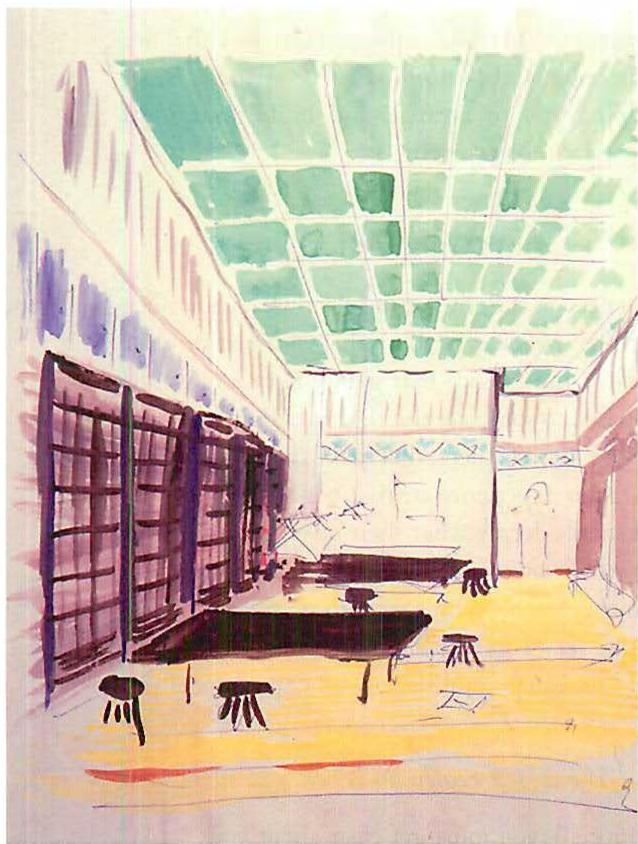
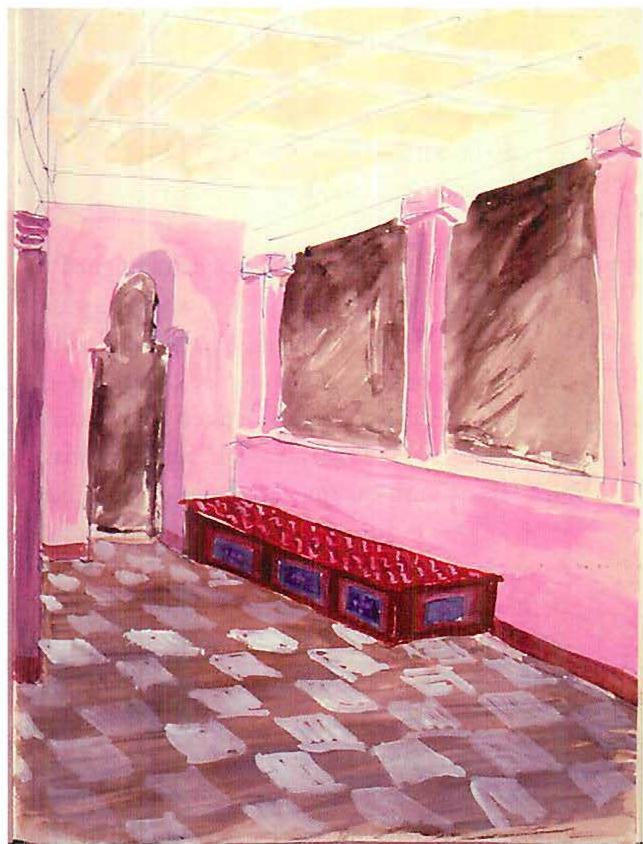
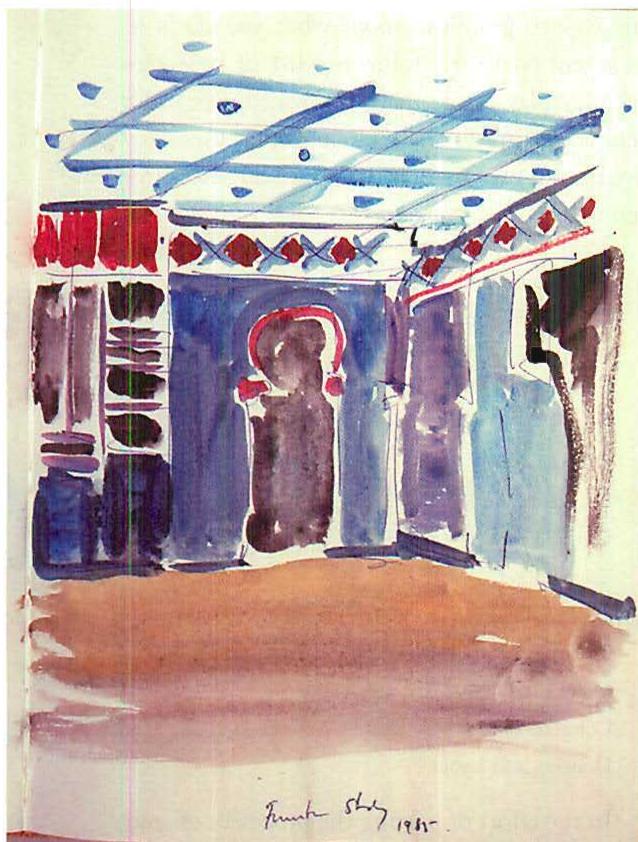
Sketches from my notebook: Watercolor sketches for the Herman Miller office furniture system. 1985.
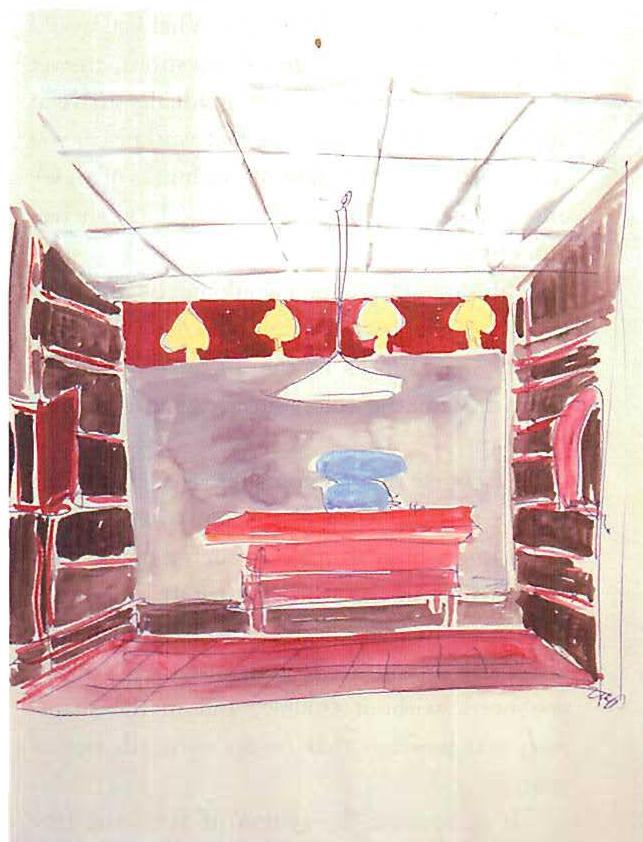
PAPER PILE ORGANIZER
DESK LIGHT
HANGING LIGHT
WALL SHELVES
PATTERNED CARPET
These items of furniture have been designed to allow you to make your office just what you want.
In theory, any physical system could allow you to lay out your own office. You can go through the layout process defined below, arrive at a good layout for your work, and then have this layout built by any carpenter, or assembled from any set of furniture made by any manufacturer. In practice, though, it is easier to make the layout, from a system of furniture-making which is specifically designed to do just this. In order to explain just what it does, and what has to be done, it is helpful to imagine a kind of "magic light pen."
Suppose you had a magic pen, and that with it, you could make desks, chairs, counters, shelves appear wherever you wanted, in space, just by waving the pen and clicking it. What you would do, then, is to go through the questions, answer them one by one, and as you gradually arrive at an understanding of the perfect workplace, you would use the light pen to mark chunks of air — and make them into desks and tables, shelves and chairs.
This magic light pen would not be restricted in any way. You could simply make any thing, of any size, appear in the air, just where you want it, with the color, surface, and geometry you want.
Of course this is impossible — at least today. But the personal workplace system comes as close as we know how, to making such a magic light pen possible in the 20th century. It is a system of pieces which are designed to be available, in just the size you need, with just the character you need, without trouble, and in the shape, size, and position that comes naturally out of your process.
It is because the system of furniture (the furniture items themselves in their variability and adaptability) is like a magic light pen that we believe it is the most useful tool there is, in helping you to arrange and build your ideal workplace for yourself.
3. HOW YOUR OFFICE WORKS
You need to start by getting clear what your office is. What we mean by this is that you must get clear what is the essence that makes it your office (as opposed to someone else's), that will make it easy for you to work there, that makes it unique to you.
Our experience is, that when someone understands deeply what their own needs are, and how their own office works, then this office will almost always become something special, something very comfortable, and something which is — probably — unlike any other person's office.
What you really do when you work
Above all, you must get clear about your actual work habits, that means the way you really work. One way to get clear about what you do is to pay attention to the following list of processes that may play a role in your work. Rank order them according to the relative importance they have in your own work by writing a number after each one.
| rank | |
|---|---|
| Use of desk | — |
| Files, filing and storage | — |
| Computer use | — |
| Conference | — |
| Clients | — |
| Discussion | — |
| Concentration | — |
| Using library | — |
| Telephoning | — |
| Access to records | — |
| Overview of projects | — |
| Other machines (FAX, xerox etc) | — |
| Connection with your staff | — |
| Drawing and layout | — |
In the effort of putting the processes of your work in rank order, you may have some surprises.
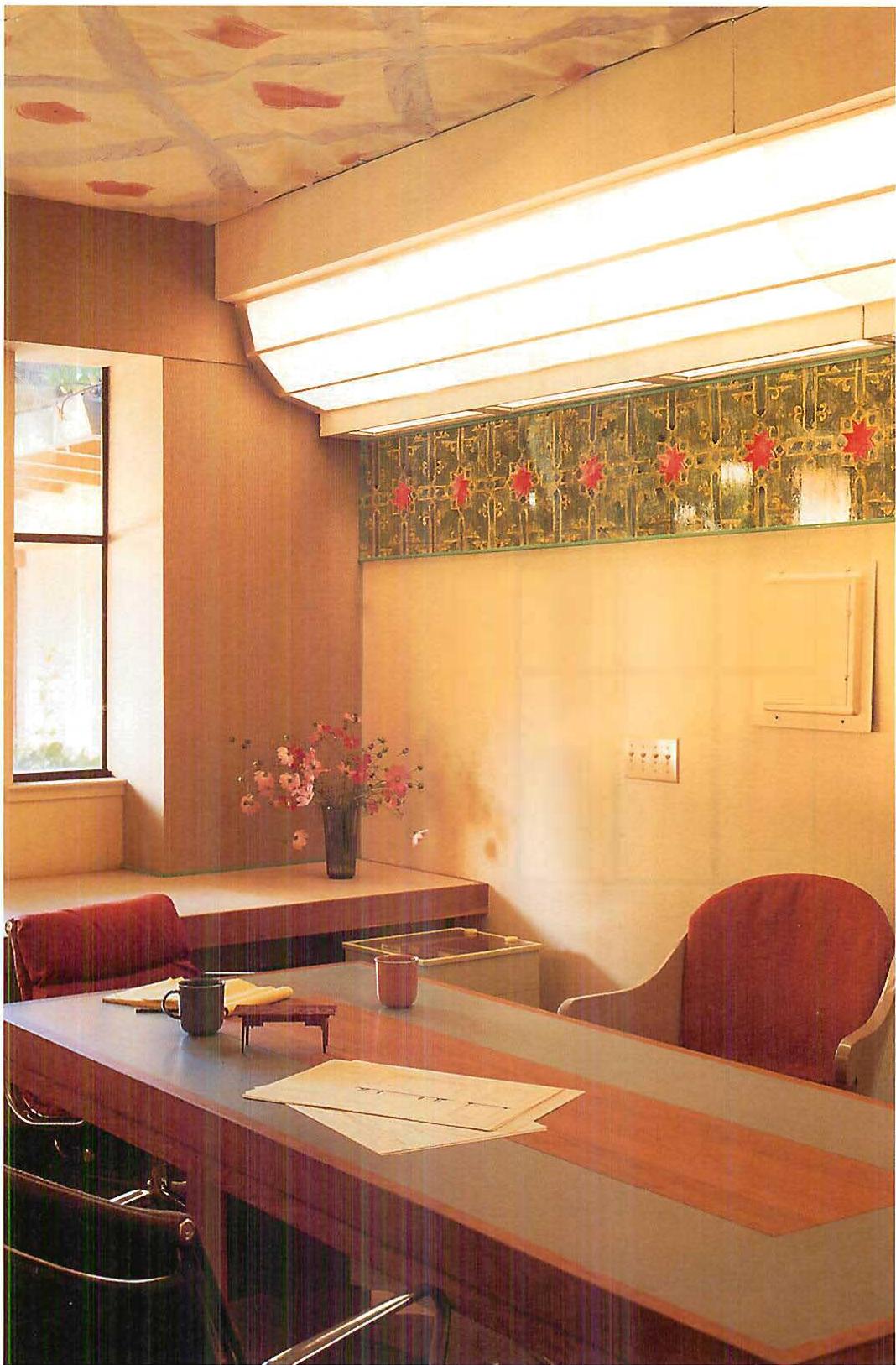
Interior office for one person, from the variable office furniture system developed for Herman Miller. Christopher Alexander, Artemis Anninou, and Gary Block, 1988.
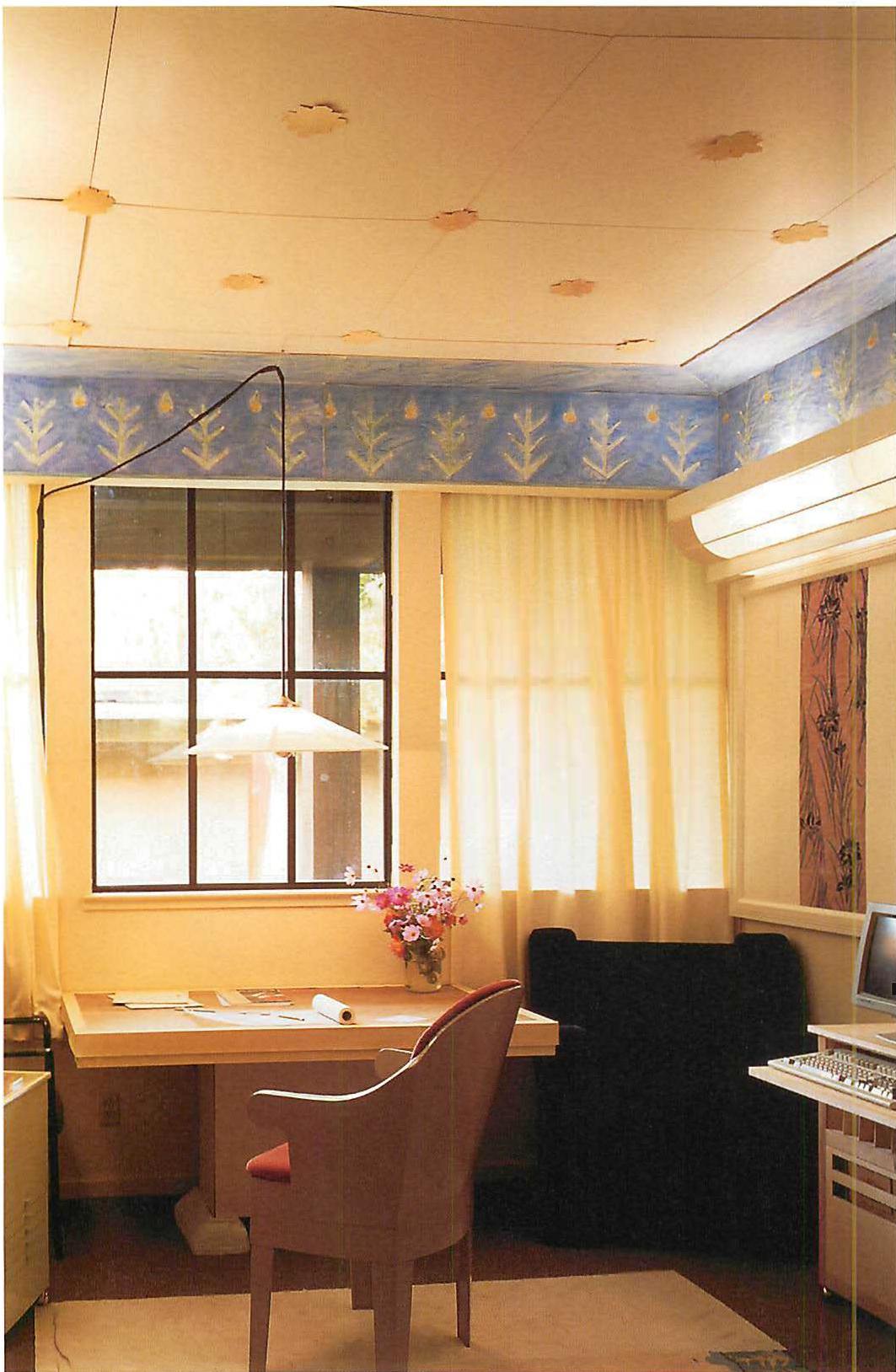
For example, if you ask yourself whether the last office you had, or the present one, really does these things as well as possible, you may be surprised to find that it does not.
Dream about your ideal working conditions
Now start going through the short list of key processes, one by one, in the order you have ranked them. Start with the first one. Ask yourself which place or occasion you can remember where this particular kind of activity was working most beautifully. It is important that you do not stick to any stereotype but that you honestly ask yourself which place you can remember where this activity was really working most comfortably for you.
The result may be quite surprising. For example, if you have identified discussion, and you then ask yourself to remember some place where a really good discussion happened—the best that you can ever remember—you may find that it was in a cafe by a river bank, or that it was in the window seat of an old bookstore, or sitting on a packing case in the attic with your friend. The main thing is that you are very honest and accurate about this, because we are dealing with an empirical problem here. You did actually experience a wonderful atmosphere in such and such a particular discussion. You therefore have the greatest chance of recreating a similar quality of process if you can identify the actual circumstances in detail, and reproduce them.
Of course this runs counter to all "normal" thought. It doesn't matter. Do it. Dream as much as you want and identify the most idyllic and best circumstance you can remember and that you wish was happening in your daily life every day.
Define the essence of the dream condition for each process
Now, if you have a vision of the dream condition for each process, write down the key essential elements which made it happen. This is hard to do. To do it, you must construct the essential elements in the form of a center. What this means is that you identify the key physical elements which made that circumstance what it was, and describe their arrangement as a "center."
For example, suppose I am trying to visualize a perfect place to draw. I remember an ideal place where I once very much enjoyed drawing. It was a large, high table with a very big window to the right, with lots of panes, and my brushes to the left away from the window.
This "thing" which I remember is a center. It is a center which lets me draw as nicely as possible. The elements which make this center are the following: the table, the window, and the brushes. And, in addition, the essential thing is the space on the table, between the window and the table and the brushes, which makes this space alive.
Every center always has the same format. There is a center—which is always a space—created by some elements which surround it. The structure of this situation is fundamental. There is a center—the space which is the heart of the whole thing. This is always space. Then there is a crust or boundary around this center, which forms it. The crust or boundary is always made of solid elements. In the case of this example, the boundary is made of a window, a table, and a place where brushes and paints are on the left of the table.
Each part of what you do when you are working is essentially a center. For example, if you spend a lot of time talking one-on-one with a single client (attorney-client relationship for example), then it is the space which the two of you form together which is the principal center. It may consist of two chairs, perhaps a table or a desk, perhaps associated stuff you need to talk about. In any case, the efficiency of the way you can talk with your client depends on the extent to which this center is a concentrated focus, and really works "as a center."
The same is true of the computer in your office. If it is important, then your workstation,
the chair, the keyboard, the discs within easy reach, a surface for the mouse—all this forms a center. Once again, the center is comfortable and efficient to the extent this center really is a center.
In the list of activities which you have put in rank order, it is probably the top three or four which play the key role in the way your office needs to work for you, and which therefore create the essence of your office.
One point is very important in your use of the hierarchy of key centers. There is one main center, the first one, and a number of secondary centers—the remaining ones. However, you should be aware that even though there usually is one center that you experience as the "main" center for your office, still, your work changes from day to day, and you may make the rounds in your office. One day the so-called main center may indeed be your main focus of activity. Another day a second one may play the main role. Another day it may be a third one. You need to visualize all these centers as part of a small group of centers which give you your arena for work—and among which one is, often, but not always, the "main center."
The system of centers which you have defined should give an accurate and general picture of the way your own office really needs to be. It should be a complete map of the essential character of your work habits, and your ideal office.
Now write down your most important centers.
4. THE LAYOUT PROCESS
You are now in a position to start visualizing the way your office really needs to be. To help this visualization, set up the cardboard model so that it is like your own office. It is important that walls are in the right places. Dimensions must be fairly accurate. Use the special rule to get lengths to the nearest foot. Make walls the right height. Place windows and doors in the right positions.
Now use the model to do the following steps one at a time. Important note: if any of the following steps are not consistent with the dream centers you have defined up until now, just leave them out.
Position of the major centers
Step 1: Identify the natural centers of the room. Use the small red markers to identify the natural centers in the room which is to be your office. Remember that there is probably a natural center somewhere near the window. There may be another in the physical middle of the room, or towards the back. The actual centers depend on the particulars of your room. It is up to you to get them by "feel." Use the red stickers to mark these naturally occurring centers.
Step 2. Window place.
Mark the spot near the window which is most likely to develop as a window place. Put a white sticker there.
Step 3. Entrance transition.
Mark the zone inside the door which needs to be a transition area, so that your room feels protected emotionally from the open doorway. Put a black sticker there.
Step 4. Locate the main center of your work. Now decide in which of the naturally occurring centers you will put the process you have defined as $C_1$ , the main center of your work. Use the red spot to mark this main center.
Step 5. Locate the secondary centers of your work.
Decide in which of the naturally occurring centers you will put the processes you have defined as $C_2, C_3, C_4$ , the secondary centers of our work. Use the green stickers to mark these secondary centers.
Step 6. Overlap.
Note, in what you have just done, and in what you are going to do next, it is essential to remember that different centers may overlap each other.
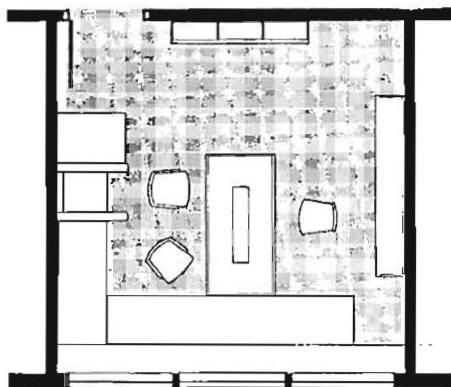
A particular piece of furniture may be part of two or three different centers, and the different centers may occupy the same space or different overlapping areas of the same space. There is no reason why the centers have to be sharply distinct.
Layout of the major centers
Reader, please note: The items listed in small caps on the following pages 394–97, are indeed centers or center-forming items of furniture, but they are also specially designed items of office furniture which my colleagues and I designed in 1988 for Herman Miller. The particular sequence of layout that is described in these next pages is intended for the use of these specially designed items: a modified form of the same sequence could easily be done with other items, too.
Step 7. Discussion and conference.
If your main activity is meeting or conferences, to make your room suitable (for meetings and conferences), it may be very helpful to make the main center a conference table. It may be large, or small, or circular. The space which this table commands would then be the principal center of the room. In other cases, it will be one of the secondary centers. Any of the following items may be useful:
CONFERENCE TABLE DESK WITH PIGEON HOLES WORK SOFA WORK ARMCHAIR STORAGE BENCH
Step 8. Your main work surface.
Choose the main center in the room where you are actually going to work. Imagine yourself standing or sitting there, and decide which way you want to face. Mark it on the model with an arrow and begin to get a rough idea of the physical elements which will form this center. Fix the main work surface of your work place. It may be any of these:
EXECUTIVE DESK CUTTABLE WORK SURFACE
DESK WITH PIGEON HOLES COMPUTER SETUP
Step 9. Secondary horizontal surfaces.
Along with your desk or main work surface, you may need secondary work surfaces. These can be at right angles to the main one. It usually works best if the second surface is lower than the main one. Many people like a second layout surface near their main work surface. This can be a second
CUTTABLE WORK SURFACE or a SIDE TABLE
Step 10. Sparkling daylight.
Place wall lights along one or two walls in positions which help to define the area you have designated as the main center of the room. Beautiful light is crucial to your comfort. Place reflectors below the wall lights, or above them, them so that the lights illuminate these reflectors and create a cheerful light in the room. Use:
WALL-LIGHTS AND REFLECTORS DESK LAMPS HANGING LAMPS
Step 11. Window place.
Fix the window as a definite place, and make the window place there by making something which is framed and has depth. This can be done either with the
WINDOW-PLACE or CURTAINS
Step 12. Comfortable sofas and working chairs.
If you want a comfortable chair for your visitors or for yourself, put in a work sofa chair: a comfortable chair designed for upright working and for comfort. It can be a
WORK ARMCHAIR STORAGE BENCH or a WORK SOFA if the room has room for it.
Step 13. Real ceiling.
Put in a solid ceiling. The light and comfort of your room depends critically on the presence of

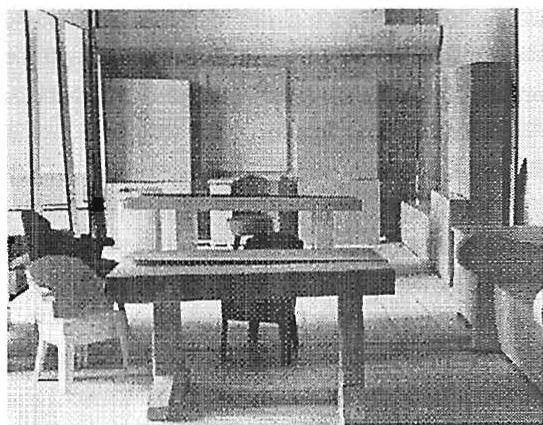
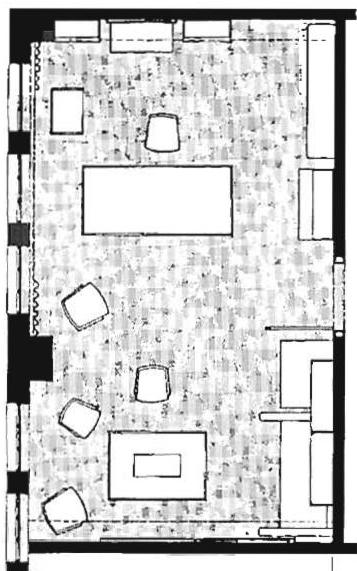
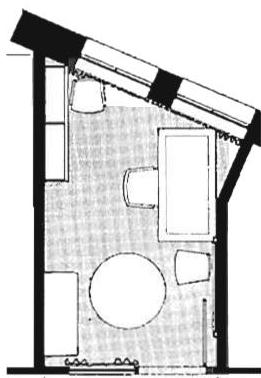
a real ceiling with its own design and color.
REAL CEILING
WALL LIGHTS AND REFLECTORS
Secondary furnishings needed to complete the space
Step 14. Computer setup.
The computer setup is a multipurpose computer-specific trolley, which can take almost any make of computer inside and has room for all kinds of connections and subunits.
On it, you have only the screen and the keyboard, which goes away when you don't need it. Some people like to use the computer table from an armchair, on a board, or on their conference table where others can see it too.
COMPUTER SETUP
Step 15. Reclining chair.
If you do a great deal of computer work, you may want a special reclining chair, as the main workplace for your computer.
RECLINING CHAIR
Step 16. Different chairs.
Informal discussion around the conference table, or in the office, is helped by a variety of different chairs including task chairs, sofa, armchairs and benches. These chairs can be the individually fitted upright chairs.
PERSONAL CHAIRS
ROLLING BENCH
WORK SOFA
WORK ARMCHAIR
Step 17. Wall surfaces and pin boards
Walls will be most comfortable if they have spots of color and ornament. The japanese silk panels provide color and harmony from handmade textiles, and the whole surface of this panel is a pin board where papers and messages can be kept.
JAPANESE SILK PANEL
WHITE BOARD
Step 18. Thick walls
Besides the thick walls, bookcases, counters and
files, surround some parts of the office wall with built-in furniture, thus helping to form the cozy and comfortable feeling in the center of the room. Some of the main ways to make a thick wall come to life may be with
LIBRARY BOOKSHELVES
LOW BOOKSHELF
FLAT FILES
COUNTER WITH SHELVES AND FILES
WALL SHELVES
Step 19. Filing
Small groups of files can be conveniently kept in file boxes, in the small rolling file cabinet, or in specially constructed files in the storage bench. For closed bulk storage use the files built in under the counter or the cuttable work surface.
ROLLING FILE CABINET
FILE BOXES
STORAGE BENCH
COUNTER WITH BULK FILES
CUTTABLE WORK SURFACE
Step 20. Entrance transition
To maintain a good feeling of privacy and individual territory in your room, use the elements of the thick wall to make an entrance transition space inside the door where you have marked a black spot earlier.
LIBRARY BOOKSHELVES
LOW BOOKSHELF
FLAT FILES
COUNTER WITH SHELVES AND FILES
WALL SHELVES
Minor furnishings to fill in the gaps and make up details
Step 21. Flat files.
If you store a lot of papers and need to get them easily, install flat files which are specially made for storing piles of papers. These can be a
FLAT FILE
PAPER PILE ORGANIZER
Step 22. Occasional tables
Place various smaller side tables to create minor centers to help the major centers you have established. These smaller tables are most helpful in different positions and at different levels, so they give you the widest possible variety of work surfaces and surfaces to pile things on. They can be
- ROLLING TABLES
- SIDE TABLE
- ROLLING FILE CABINET
- COMPUTER SETUP
- STORAGE BENCH
Step 23. Desk lights
Place individual lights to spot those centers which are most important.
- DESK LAMP
- HANGING LIGHTS
Step 24. Patterned carpet
To mark a special center which you want to give emphasis to, and to increase the comfort of your room, use a patterned carpet of the right size. Color must be carefully chosen. Use the color process.
- PATTERNED CARPET
6. GETTING THE SIZES RIGHT
The size of things is critically important, and will affect the feeling and usefulness of your office in a way far beyond what you imagine. Some things can be bigger than you might think. Other things can be smaller than you might think. All that matters is that it is practical.
Present-day office furniture tends to make everything homogeneous in size, and this contributes to the dead and unpleasant feeling one gets in many modern offices.
The personal workplace items are specifically designed to take a wide variety of sizes, and the paper model you have, also reflects this capability. Take full advantage of it.
It is very important that sizes are just the way you want them, without constraint from what anyone might consider "normal." Everything that matters about your office, and the way the centers work, is always affected by the actual size things are. It is not only the efficiency of the space which is affected by sizes of things, but also the feeling of the place is significantly altered by the size things are as well. This is not only true for the size of the spaces, but also for the size of the elements. One of the most important things about the personal workplace system, is that it lets you make things just the size you want them — so you can control the feeling of your office, and make it personal.
Use the flexible sizes available in the model to get each piece of furniture exactly the right size.
It is especially important that things all fit together nicely and harmoniously. You should adjust the sizes, until you like the smoothness and comfort of the space you have produced.
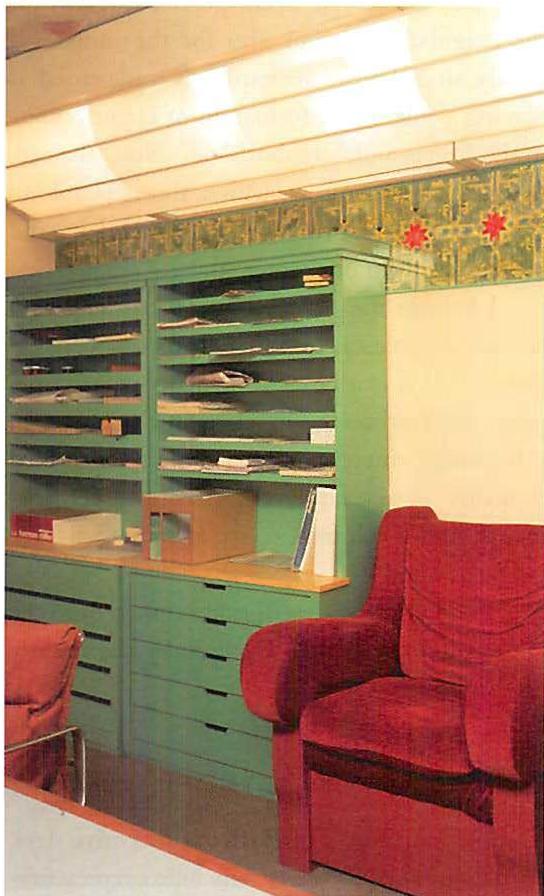
11 / MASS-HOUSING WHERE EACH FAMILY MAKE THEIR OWN HOUSE PLAN FOR THEMSELVES
I finish the chapter with excerpts from another process we defined (and used) for the construction of houses for seventy families in a neighborhood in Santa Rosa de Cabal, Colombia.
The process starts with operations that fix positions, shapes and sizes of the main house volumes, the verandas, the secondary house volumes, and the gardens. Houses in Santa Rosa were often on steep sites, were nearly always two stories, with bedrooms above the main rooms, or, in some cases, below them when on sloping sites where principal access and entrance to the house came from the upper level. Each house has a major volume and a minor volume, and these volumes play a vital role in the process not only for the neighborhood, but also for the individual family, since houses are explicitly understood as playing a role in the formation of larger centers in the streets and neighborhood. (Note: the earlier part of the process, which allows people to create the neighborhood structure and its streets, is shown in chapter 15).
I believe the Santa Rosa process creates a fair approximation of a living process. What is nice is that it can be used by many people, in a poor neighborhood as much as in a rich one. In this process emerging strong centers are formed explicitly at several levels: streets, street segments, house volumes, courtyards, gardens, verandas . . . and so on.
The following description is taken from the CES handbook which was used by the seventy families.
HOUSE VOLUMES, LOTS, AND STREETS
Completion time: Thirty-five consecutive days. Participants on the site will include a representative of CES (the Center for Environmental Structure), a representative of Construyamos (the Colombian self-help cooperative), all the families, at the rate of two per day, and one surveyor. The overall sequence of steps runs as follows:
Step 22: Define sequence of main street segments and secondary streets.
Step 23: First street segment: lay out lots in detail and locate house volumes, lot after lot.
Step 24: Start layout of first house lot of street segment by completing steps 24a to 24g.
Step 25: Continue layout of all houses contained within street segment, one after the other, by repeating steps 24a to 24g for each house.
Step 26: Embellish street segment.
Step 27: Survey lot boundaries after the completion of each street segment and prepare drawing.
Step 28: Continue detailed layout of all street segments, one after the other, by repeating steps 24, 25, 26 and 27.
Step 22: Define sequence of main street segments and secondary streets.
By this stage of the larger process, the main street has already been laid out in the form of identifiable segments, and each secondary street, too, has been laid out to contain one or two segments (see chapter 15).
Now, define a sequence of street segments. Start with the main street segments: complete the main street centers and the main street connecting segments. Then, continue with the secondary streets, one after the other. Make a list of the street segments in the sequence they will be developed; specify how many houses each segment contains.
Step 23: First street segment: lay out lots and locate house volumes, lot after lot.
Start the detailed layout of the first street segment. It is to be completed incrementally,
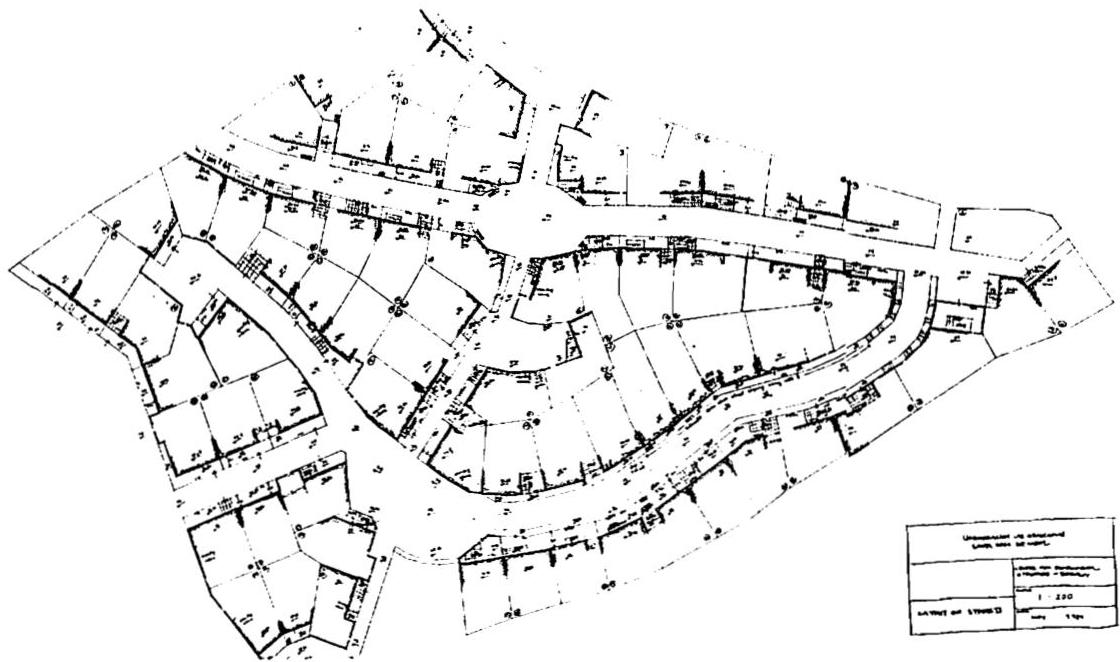
one house at a time, the CES rep working with the family.
The process of lot layout includes the first steps of house layout. For each house, the process must establish garden areas, house volumes, and verandas, giving position and size of these components. These must be located and defined for all houses of the street segment to create the good space of the street. The process also includes fine-tuning adjustments to the shape of lots.
CES and Costruyamos reps will organize and conduct this part of the layout process. Each day the detailed layout of two lots will be completed, one in the morning and one in the afternoon. Every family will be informed in advance of the exact day and time they will have to be on the site. It is important to arrange the schedule accurately so that the next family comes on the site after the previous family has completed its work. This allows each house to be laid out and designed in relation to the adjacent already-existing ones.
Step 24: Start layout of first house lot of street segment, by completing steps 24a to 24g.
Each lot will be laid out in seven steps:
Step 24a: Define the total house volume, and prepare the site.
Step 24b: Place main house volume adjacent and parallel to street, to help form street.
Step 24c: Define size, position and volume of the veranda.
Step 24d: Define secondary volumes.
Step 24e: Define garden area.
Step 24f: Adjust final lot boundaries.
Step 24g: Prepare volumetric house model and place it on the site model.
Now, start the detailed layout of the first house lot.
Step 24a: Define the total house volume and prepare the site.
Before coming to the site, the CES rep and family members have agreed on the maximum house volume this family house can have, expressed in $\mathrm{m}^2$ (square meters) of built space. This is derived from the loan maximum for each family (established by the bank, on the basis of each family's circumstances, and different for each family). A
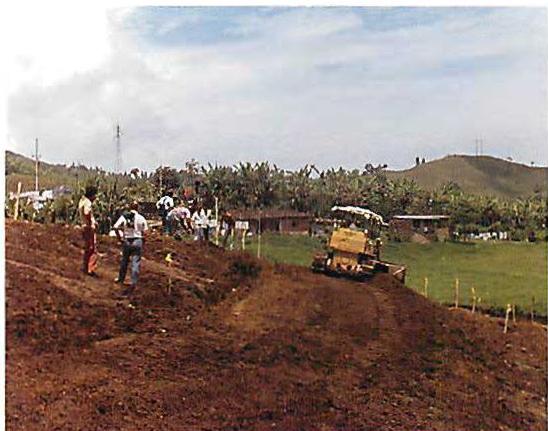
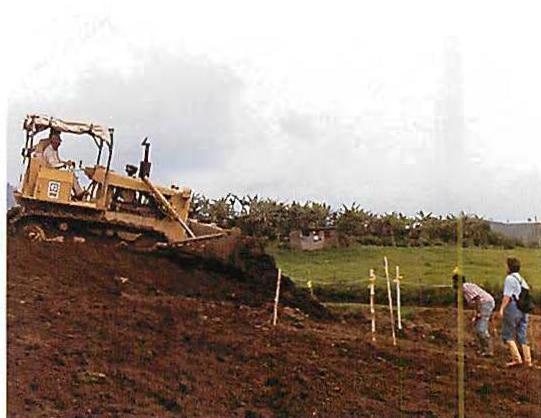
typical house may have 70 m². Among the seventy families in Santa Rosa, houses range in size from 35 m² to 108 m².
On site, the CES rep prepares the site as specified in the preliminary lot subdivision map, placing a yellow flag at each corner of the lot. The rep shows the family the stakes, and helps them to locate themselves and understand the site model (shown in photographs on this page and on page 337) so that family members get a clear picture of:
a. Rough boundaries and extent of their lot. b. Shape, size and character of adjacent streets so that the family will be in the position to take them into account, and respond to them in a positive way. c. Existing situation on adjacent lots, including houses that have already been laid out.
Also, the rep provides a stock of additional stakes, orange paint and string. Before starting, one thing is made clear to the family members. They are told that as nearly as possible the house volume (as they are now going to determine it) should run the full length of the lot frontage along the street. They are told, too, that once settled, volume must be maintained during all subsequent layout steps though side and back lot boundaries can be adjusted and slightly modified, so long as the total lot area they define is the same as the lot area given to them in the preliminary lot subdivision.
Step 24b: Place main house volume adjacent and parallel to street to help form the street.
The main volume of the house is always placed on the street so that it contributes physically to the formation of the public space of the street. It should respect what has already been laid out, and help to substantiate and improve it. The main volume may be either one or two story; families are encouraged to decide the height on the basis of what will best contribute to the shape of the street and feeling of the lot. For example, the wider parts of the main street may call for houses where two stories predominate; the narrower parts of the main street and secondary streets may call for houses in which there is more of a mixture of one- and two-story volumes.
The main volume should generally be long and thin, with its width chosen at some dimension between 3 and 6 meters. It has a simple shape (approximately rectangular) and should contain about 60% of the total house volume.
On main streets, the main volume should be placed to run the full length of the lot frontage, or along as much of it as seems feasible without stretching the house volume too thin. On side streets the main volume may not need to occupy the whole lot frontage length, thus allowing for a glimpse of the garden in the back.
Once its position is decided, drive orange stakes in the ground to identify its corners.
The floor level of the main volume also has to be decided. While deciding it, families should
bear in mind that intensive site excavation is not feasible within cost limits, because it leads to expensive foundations. There are two main alternatives: either, raise the ground floor level of the volume to the highest point of the lot area it occupies, or, sink the ground floor level 0.5 to 0.6 meters maximum below the highest point of the area it occupies.
Choose to do whichever one helps the situation more, given the height of volume and its relative location on the slope of the lot. Finally, re-examine and check the height of the main volume in relation to the street width and the ground level where it sits.
Step 24c: Define size, position and volume of the veranda.
The veranda is the most important part of the Colombian house in Santa Rosa. Size calculations of the veranda should be based on the assumption that the construction price for the veranda is one-third that of the rest of the house. So, for example, a veranda of 30 m² will count as 10 m² of built space in the total of the three house volumes (main volume, secondary volume, and veranda).
The veranda is a large outdoor room: it functions as the heart of the house. Family gatherings and dining often take place on the veranda, when the weather allows for it. The veranda is at least 3-4 meters wide and at least 4-6 meters long. It is attached to the house volume; should be enclosed on two sides, either by the house volume or a wall; and is covered with a roof.
The veranda can either be on the first or on the second floor level of the house, depending on view and orientation (when on the second floor it should be placed to become part of the house volume, preferably the secondary house volume). For two-story main volumes that are on lots with pronounced slope, on the uphill side of the street it is preferable to place the veranda at the second floor level. With a pronounced slope on the downhill side of the street, or on a flat piece of land, the veranda may be either at the first story or the second story, whatever feels best.
To locate the veranda, first identify the best part of your lot, the one that has the best view and gets the breeze coming up the hill. Pin down the center of this space. Think of this as the place where the veranda—the center of your house—will be. Then, define the volume of the veranda while carefully considering the following four points:
First, pay attention to its shape and size. Make it comfortable for everyday activities.
Second, place the veranda facing the view and open to the direction of the breeze.
Third, pay attention to the shape of the land directly in front of the veranda. This part should have a good shape as well and feel comfortable. It will be the part of the garden most intensely used, level, and most probably paved.
Fourth, make the veranda private, shielded from the street. On uphill houses, the veranda may extend into the second floor of the front volume to get maximum breeze and view. If downstairs, it has to be quite deep in order to feel private.
Drive orange stakes into the ground to define the corners of the veranda.
Step 24d: Define secondary volume.
The secondary volume of the house is usually attached to the main volume and is placed on the part of the lot left over after the placement of the main volume and the veranda. It should be in that place where you can least imagine having a garden or being outside. If the main volume of the house is one-story, then the secondary volume has to be one-story also (unless the slope of the lot allows for a two-story secondary volume that does not exceed the height of the one-story main volume). If the main volume is two-story, then the secondary volume may be either one- or two-story.
In houses where the veranda is on the second floor level, the secondary volume should extend under the veranda. Drive stakes to define the corners of the secondary volume.
The total built area of the three elements, which = The main volume (counted twice for two-story portion) + the secondary volume
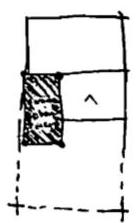
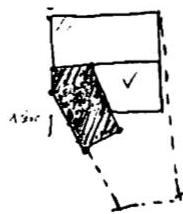
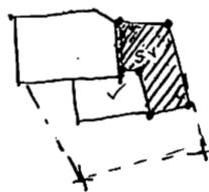
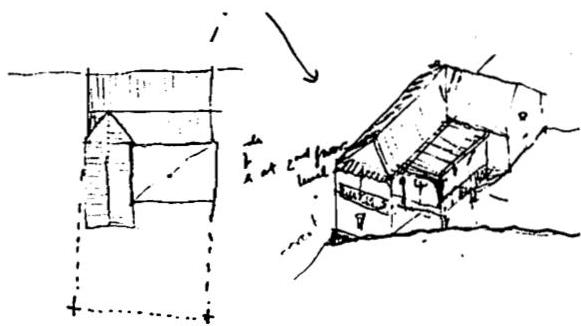
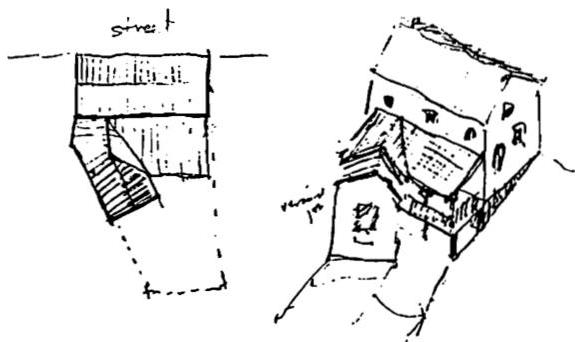
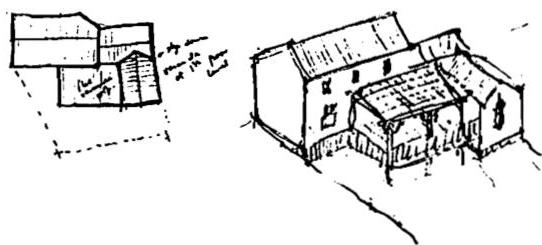
(counted twice for any two-story portion) + 0.33 times the area of the veranda, must equal the total built area which is allowed by the bank.
Step 24e: Define positive garden areas.
The garden should include two parts, (1) one part just below the veranda, which may be paved and onto which the activities of the veranda may spill out, and (2) another part, slightly further from the house, following the natural slope of the land, for vegetables and fruit trees. Make these garden areas feel comfortable and open and give them a positive shape; typically each should have roughly rectangular shape.
Drive orange stakes at each corner of each of the positive garden areas.
Step 24f: Adjust final lot boundaries.
Although the layout of house volumes and garden has been done within the perimeter of the lot boundaries originally marked on the subdivision plan, and marked in the field by the yellow stakes, the volumes and gardens, if positively shaped, may have qualities which are better for the environment, and which do not perfectly match the original lot boundary lines. At this stage, the lot boundary lines are therefore settled finally, according to the work of staking out which has been done.
Take a piece of string and stretch it around the stakes at the outer perimeter of what you have just done—steps 24a to 24e. Examine the relationship between the new (orange) stakes and the old yellow stakes. Adjust the orange stakes and string, as needed, to conform to the lot boundary, roughly, and to maintain the house volumes and positive garden areas. These orange stakes define the final boundaries of your lot. Make sure that the discrepancy between the yellow stakes and orange stakes are minor, and that the total area they define is within $2%$ of what has been initially assigned to your lot. This will guarantee negligible impact on the lot areas of neighbors' adjacent lots. Have the stakes surveyed to define the final lot boundaries.
Step 24g: Prepare volumetric house model and place it on the site model.
The CES rep should spend half an hour with the family deciding the volumetric configuration of the house. Two major things have to be decided:
a. Configuration of roofs. The house will usually have two or three roofs, depending on whether the veranda has its own roof or is contained under the roof of the main volume. The roofs of the main and secondary volumes are large gable roofs, extending considerably beyond the walls. The ridge of the roof is parallel to the length of the volume. If the veranda has its own roof, it will either be a shed or a flat roof.
b. Relationship between volumes. The relationship between volumes and roofs has to be such as to create a harmonious whole. Transitions between volumes and roofs at different heights should be smooth.
Prepare a small wood and paper model of the house at 1:200 scale. It should show volumes, relationships between volumes at different heights, shape of roofs. Glue it on the site model so that it can be used as a point of reference for families on adjacent house lots.
Step 25: Complete the layout of all houses contained within the street segment.
Do the houses, one by one, with the different families, repeating steps 24a to 24g, again and again, until all houses of the street segment have been laid out.
The accompanying sequence of drawings shows the evolution of the lot-layout process along a street.
Step 26: Embellish the street segment.
At this point all the houses of the street segment have been laid out. Simultaneously, the street has taken its concrete shape, and it has been defined
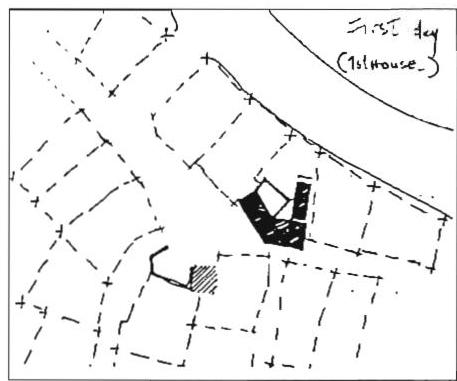
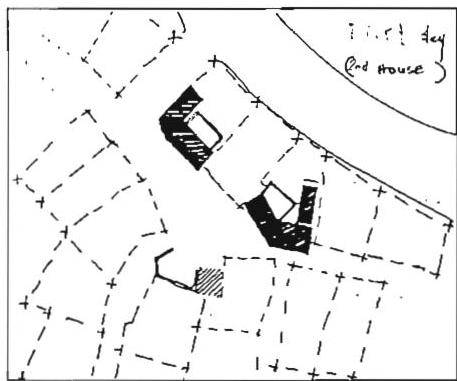
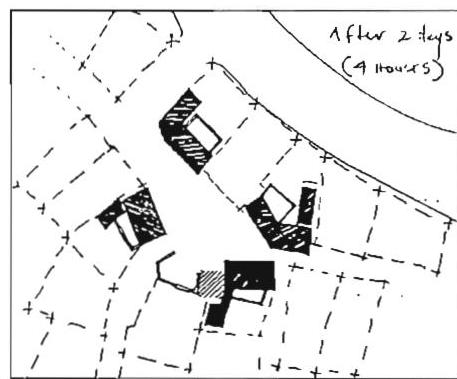
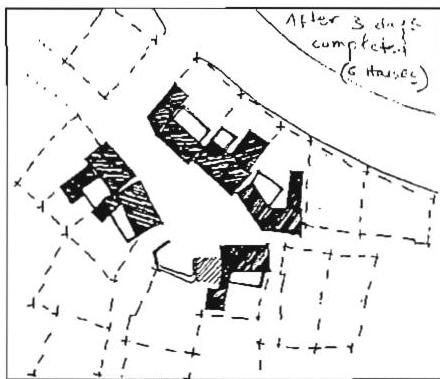
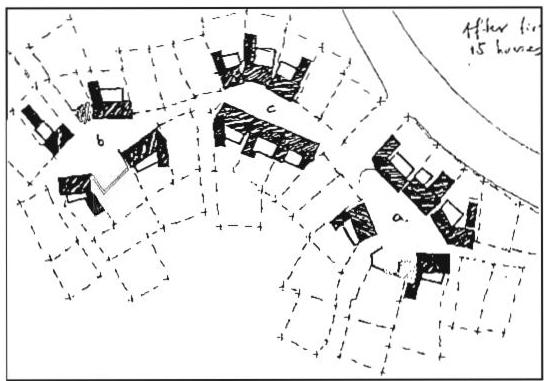
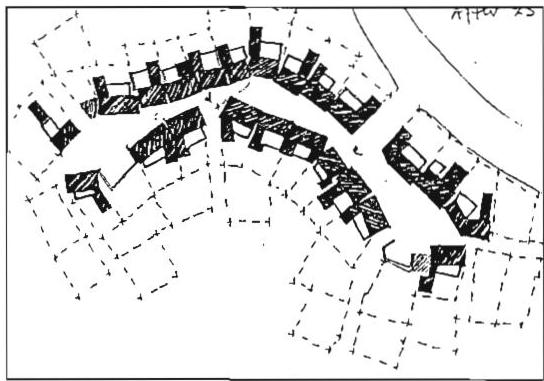
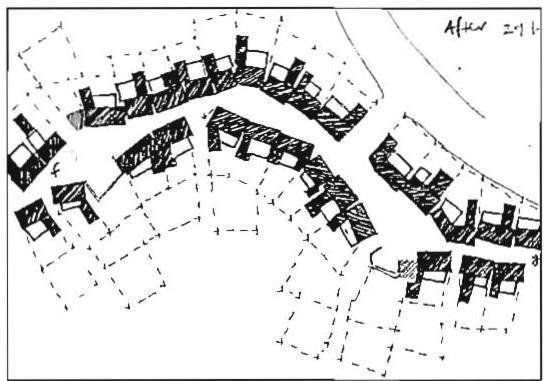
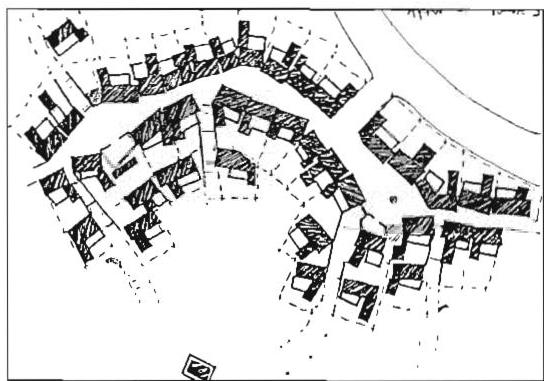
by the house volumes. Now the CES and Costruyamos reps, together with members of families who will live on this part of the street, must spend about an hour discussing the character of the street segment.
Each segment of a street should be regarded as contained open space, and should be brought to completion in the same way as houses will be, by concentrating on the space of the street as a positive space made of strong centers. In addition, minor centers — a tree, a low wall, a couple of benches, some steps, paving or a small fountain — will add to the liveliness and comfort of the street enormously. Spend some time considering the needs of the just completed street segment; think which ones of the above-mentioned items will contribute to this part of the street. It could be something really modest; a small touch to the street which will bring it to life.
Step 27: Survey lot boundaries after the completion of each street segment and prepare drawing.
Finally, it is time to survey each lot of the street segment, each one in relationship to the others. This task should be done by a professional surveyor who will have to record each house lot, with all its stakes as placed on the site, and the shape and boundaries of the street segment as a whole.
On the basis of this survey, the CES rep will prepare a final drawing that can be used for excavation and foundation work.
Step 28: Complete detailed layout of all street segments, one after the other, by repeating steps 24, 25, 26 and 27.
The above drawings show the evolution of such a layout process, in four stages:
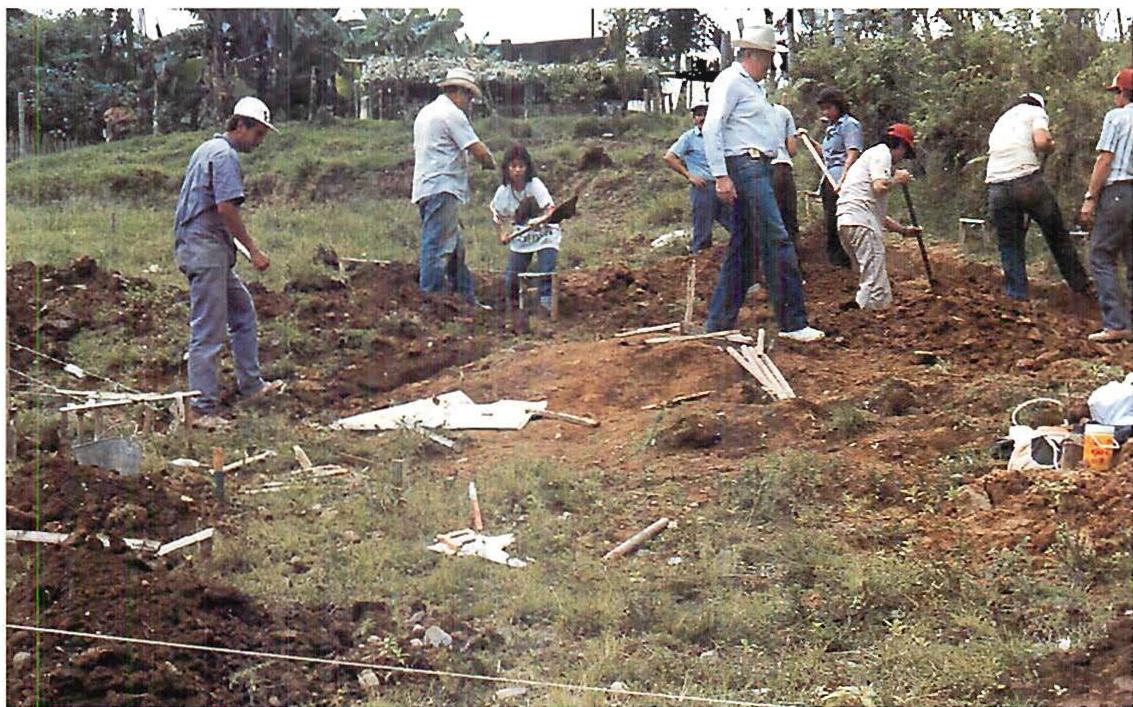
INTERIOR HOUSE LAYOUT
At this point the volumetric configuration of each house and its location are on the site and on the site model. Each family knows where the main volume, the veranda, the secondary volume and the garden of their house are located, and how large each part is.
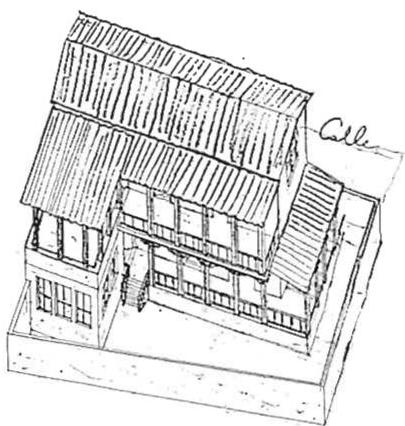
The next and final thing to accomplish is the interior layout of the house, on the basis of the volumetric arrangement decided during the previous steps.
Each family will spend half a day on the site together with CES rep to complete the interior layout of their house. They will complete the interior layout of their house on the basis of the following sequence:
Step 29: Locate the comedor (dining room)
The main room of the house, the dining room, enhances the family character of the veranda. It is the largest room of the house, 20–30 m², always placed next to the veranda, and is wide open to the veranda.
Step 30: Fix entrance
Choose position and make a front porch or landing to give transition from street to house. The front door then opens into a small entrance hall.
Step 31: Create mysterious path of entering
There is a path from front door to veranda to garden. The path is not direct. The veranda cannot be seen from the front door. The path moves
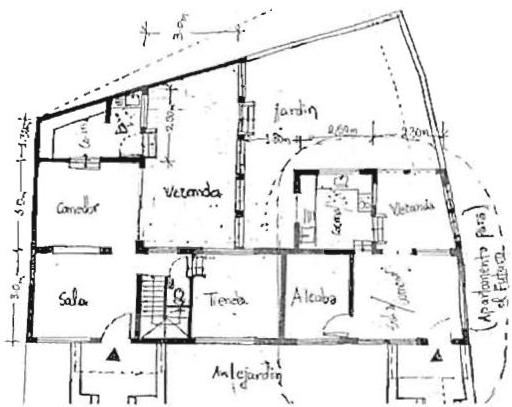
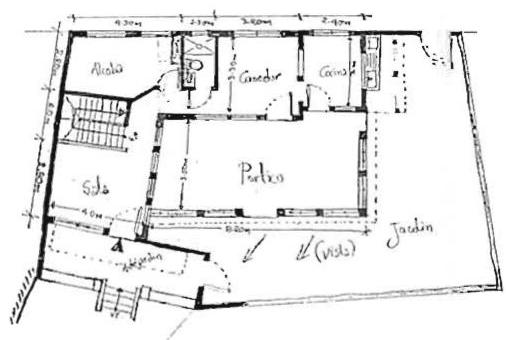
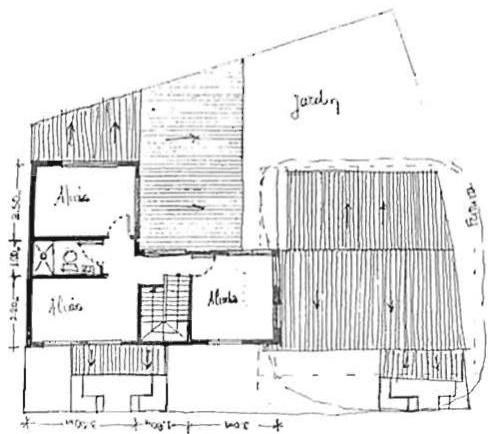
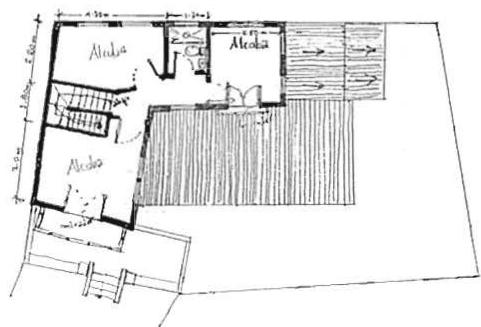
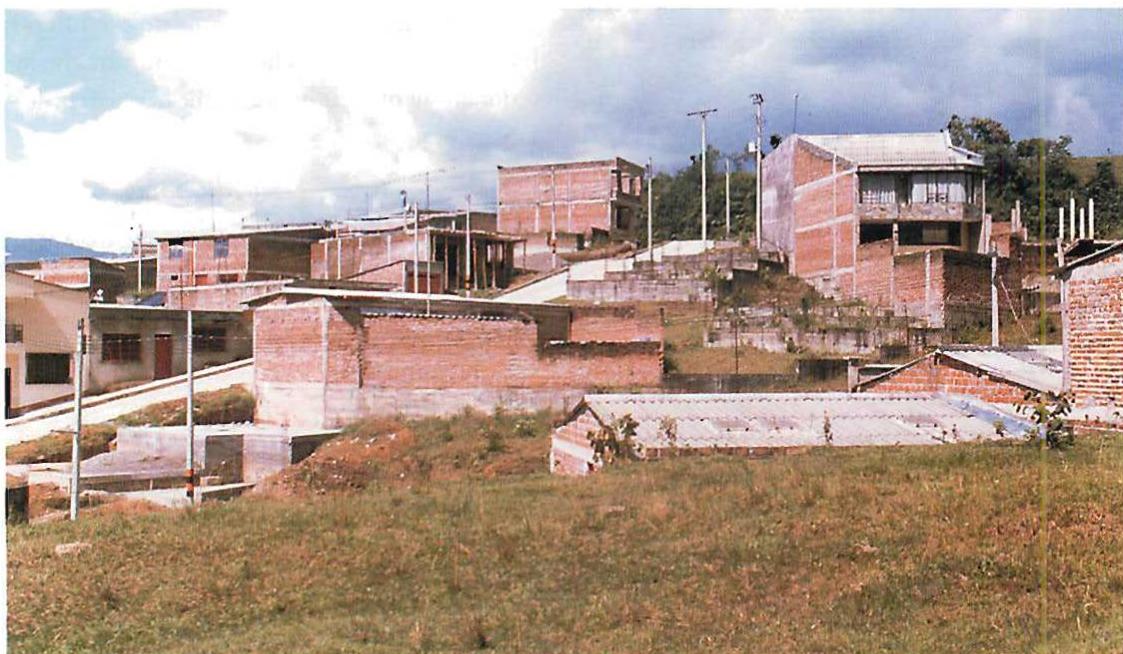
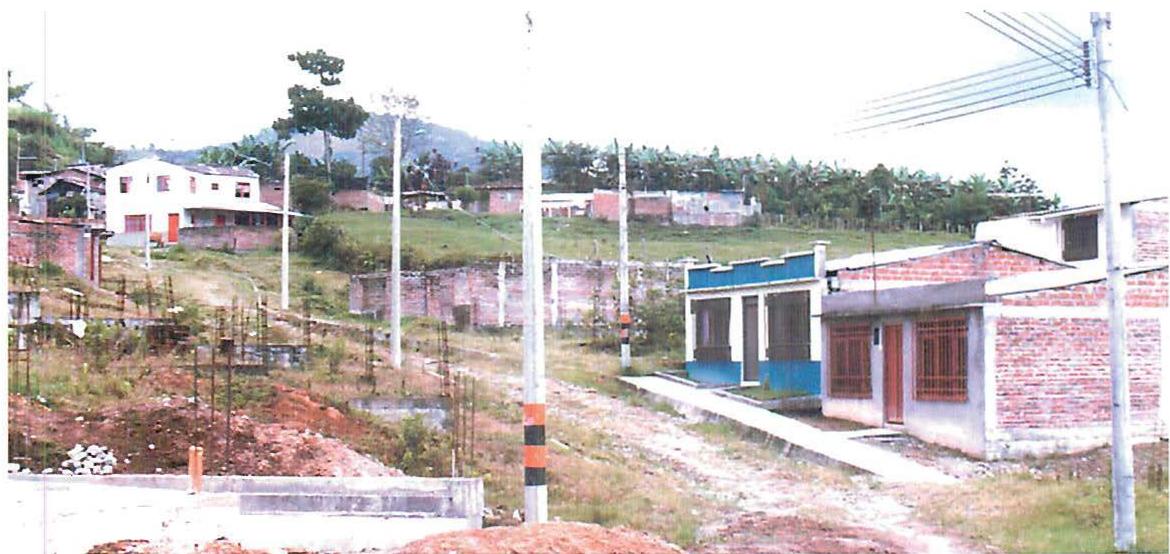
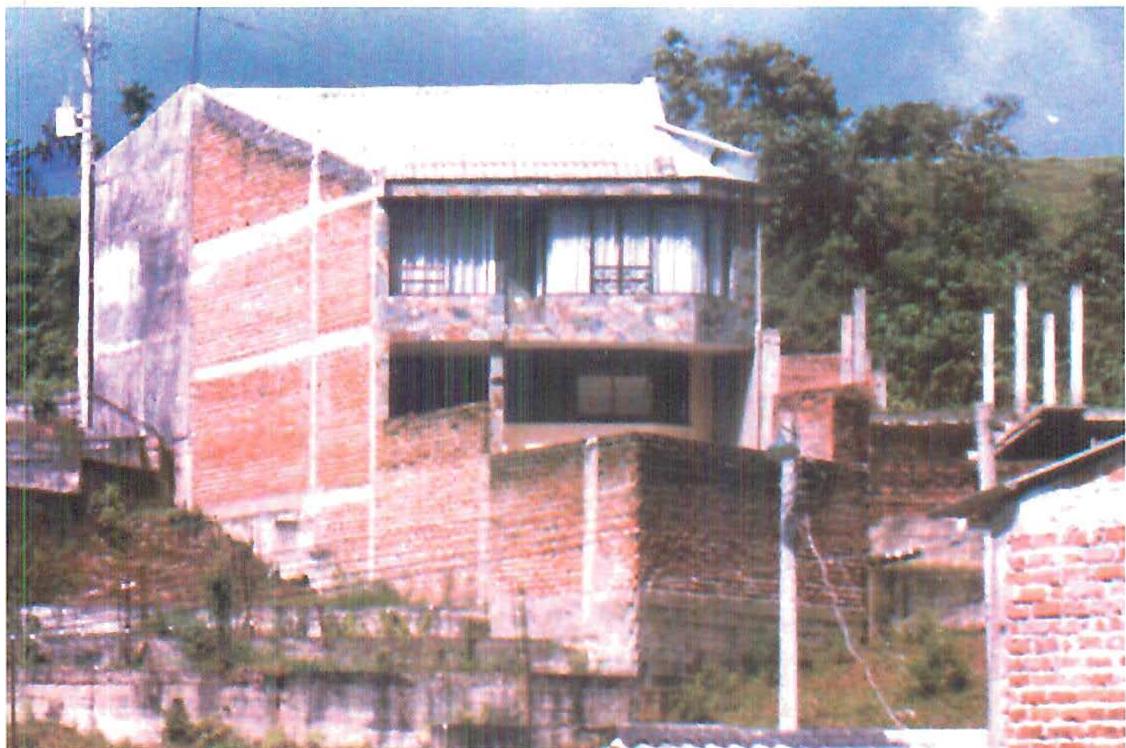
from dark towards light. The source of light is not revealed until you get there.
Step 32: Locate the kitchen
The kitchen to 15 m² is on the same level as the dining room, but not necessarily adjacent to it.
Step 33: Locate the sala
The sala, a formal room for receiving guests, has its door just inside the main entrance of the house. It is roughly square, about 10 m², with a window looking to the street, almost never to the garden.
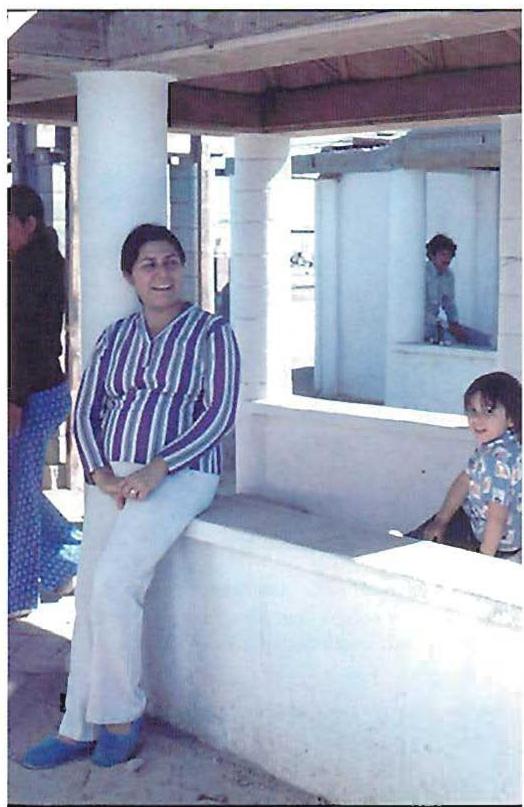
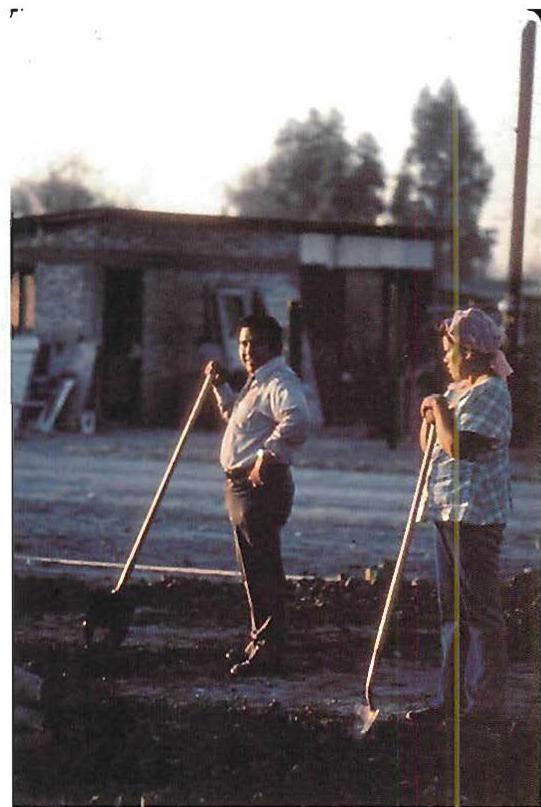
Step 34: Locate main staircase
The main stair connects first and second floors and is located in the private part of the house, not visible from the main entrance. The stair case is always attached to the veranda and should be connected to the path that leads from entrance to veranda. The volume of the staircase is either a simple rectangular volume, or L-shaped for a dog-leg stair.
Step 35: Define minor passage
Movement among the rooms of the house is loose, and happens in one of four principal ways: (a) through the veranda, (b) directly from room to room, (c) through the path connecting entrance to veranda, (d) by means of a minor passage open to outdoors (like a gallery) and upstairs.
Step 36: Locate bedrooms and bathroom
Put bedrooms in any areas of the house volume not yet used up, mostly upstairs.
Step 37: Locate minor connecting stairs
Small stairs are placed to connect front door with street, veranda with the garden, different levels within the house volumes.
12 / HOW SYMMETRIES AND ASYMMETRIES GET CREATED
Dimensions are created in the attempt to fit each differentiation, positively and simply, into the spatial shell of the previous step in the unfolding. For example, in a house with a front door and a window on each side: if the width of the houses vary from case to case, the exact posi-
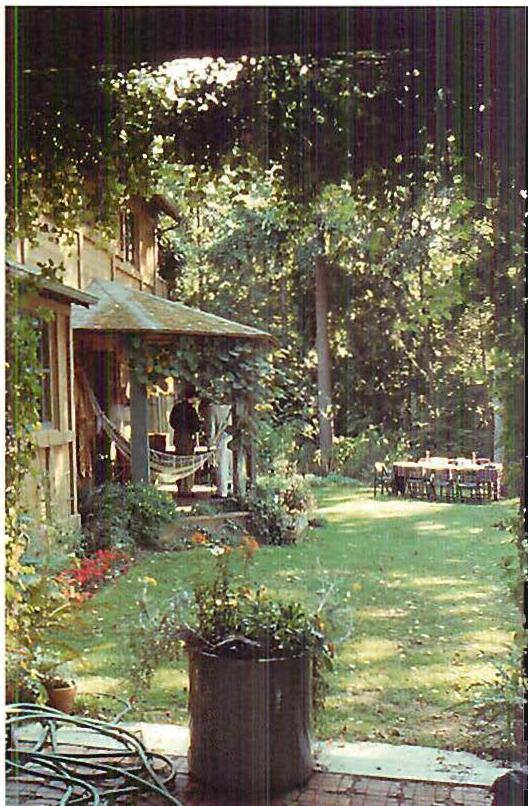
tion of the door within the width is bound to vary (it will not always be exactly the same, because different rooms and passages inside will force a slight adjustment according to overall width), and the windows which fit into the remaining space will then be different in size and different in side-to-side position, even though they appear in roughly the same generic positions every time.
We may express all this in terms of symmetries. Given an arbitrary starting point (site, enclosed space, designated area), when we apply to this site, a sequence of differentiating operations, each of which introduces one further local symmetry into the structure which has evolved, the end product which appears—the result of these superimposed local symmetries—will have a unique dimension associated with each symmetry, that is a result of making that symmetry appear within its
particular spatial shell. So, even though the symmetries themselves (as operations) may be the same for each house, the dimensions of each symmetry will be unique. Further, it is often the case that the symmetries themselves may be rearranged by minute subtleties. For example, if we shrink a house by 3 inches, it may be that one of the rooms inside then falls below some threshold of comfort or convenience, the passage therefore moves further to the left, and the room on the other side of the passage then changes shape and character altogether (for example by getting much longer), thus forcing a taller window in an attempt to keep good daylight.
The overall effect is that when each house unfolds under the laws of its own uniqueness, the local symmetries of each house then come together in different spatial combinations, making each house progressively more and more particular.
13 / MORPHOLOGICAL INVARIANTS LIKELY TO APPEAR IN INDIVIDUAL REALMS WHEN GENERATED BY LIVING PROCESS
Individual houses, individual apartments, workplaces, gardens, rooms, when made living, are adapted to individual conditions and to individual people. They have a character that allows people's individuality to be lived through. Each place is unique, personal to the individuals, "unique in all the world"—and because of all that is a place which people can love.
This uniqueness of every part, like the uniqueness of leaves on a tree or roses on a rosebush, is a necessary part of a living order.
In any mass situation which requires repetition of houses, or repetition of apartments, or repetition of offices, it is good to bear the following in mind. Once generic patterns have been established, it is relatively easy to generate local individual variations in a genuine and practical way. You can do it by inventing processes, like those I have illustrated, which give each individual the power to create the configuration of their individual house or apartment or office. Such a process can easily be constructed so that silly mistakes will not occur, and so that the process virtually guarantees that each person will be able to make a coherent design.
In general, the geometry will be created by differentiation, not by addition or accretion, the parts given their dimensions by differentiating operations within the space of the land, or within the space of the room where the thing is being made.
CHAPTER THIRTEEN: HOW LIVING PROCESS GENERATES THE CHARACTER OF ROOMS
1 / WHAT MAKES A GOOD ROOM?
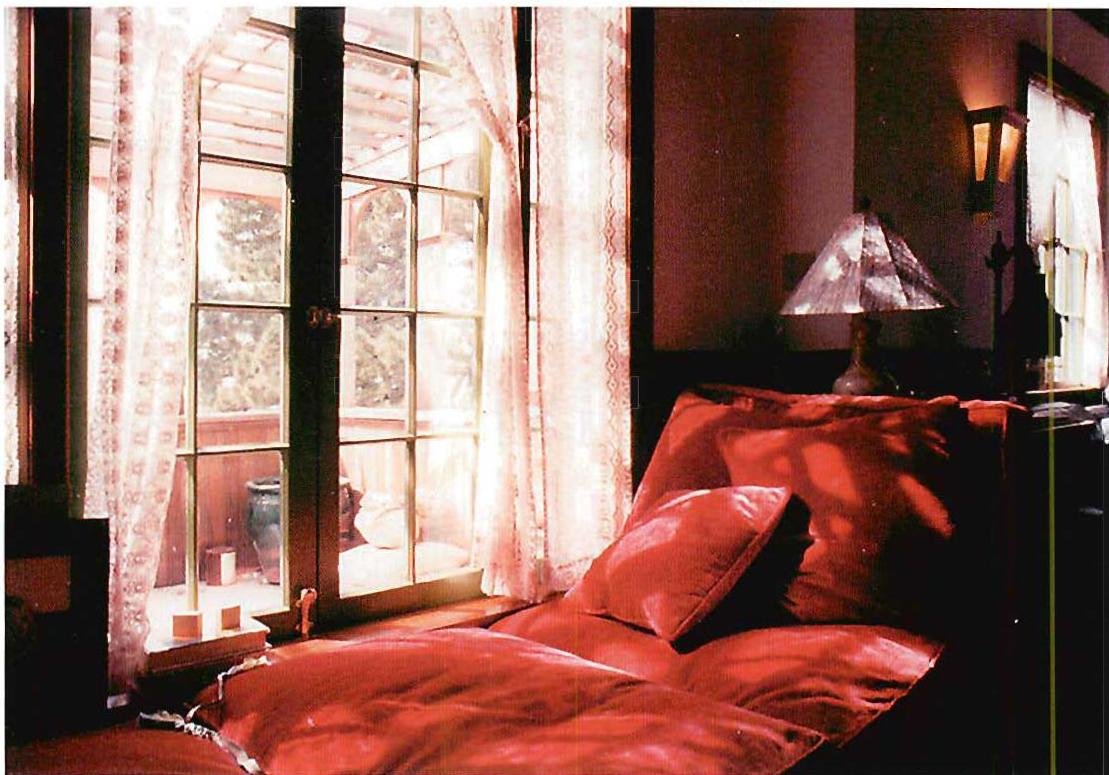
When we are indoors, most of the time we are in a room. The peacefulness, the ordinary comfort you feel, your ability to work, to love, to be well — these are all affected by the calmness and beauty of the room in which you are. You could reasonably say, therefore, that the rooms where we spend our time, the character of these rooms represents the single most important thing about the built environment. The environment affects us, and it is perhaps through our rooms that it does it most.
This can have an astonishing effect on human lives. There are some four thousand million rooms in the world. At present, many of them are ugly. Many are made for money or from ignorance or poverty of spirit. Yet, ideally, each one of these individual rooms could be (and should be) a living center. That means, there would be a unique relationship of the room to outdoors, to the light, to the doors and movement, and to the smaller spaces inside the room. It would leave each room as a special place, taken seriously, with dignity enough to support a living soul.
Each room has four main stages to its unfolding. The first concerns its position, the second concerns its contents and main centers, the third concerns its fine structure (its smaller centers), the fourth concerns its tranquility. In a room where true unfolding occurs, these four stages will give the room its life.
In this chapter I would ask that the reader first look at the pictures, just browse them and look at them, for the quality they describe. Then come back and read the text after looking at the pictures.
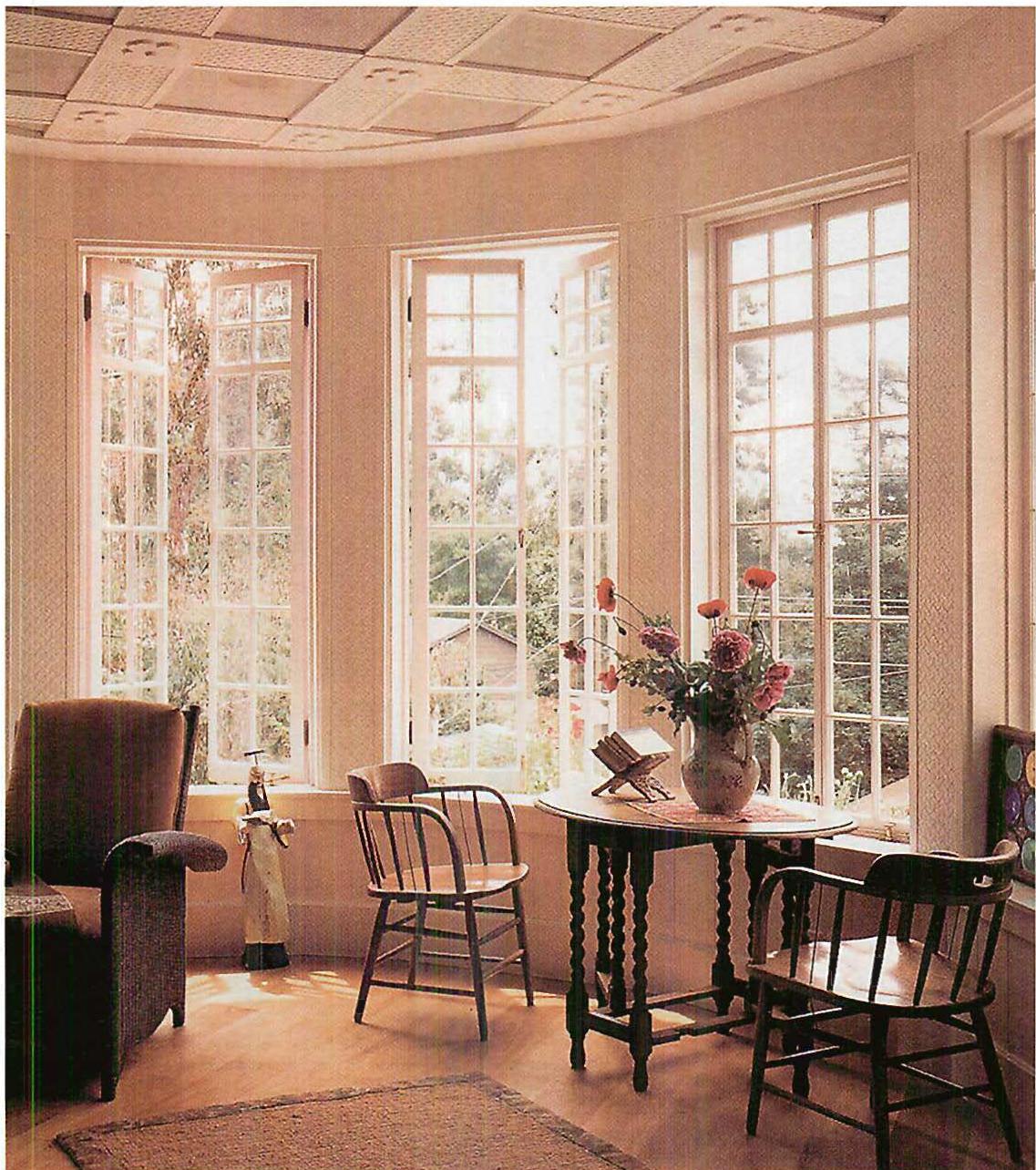
2 / POSITION: HOW LIVING PROCESS MAY BE USED TO SHAPE A ROOM THROUGH ITS POSITION
At an early stage in a building design process, the rooms are first established in position: usually, to start with, by name, size, and rough position. At this stage, conceptually, we may say that the rooms are (usually) rough rectangular volumes of space which have yet to be made "good."
In theory, one might argue that once position and dimensions have been established,
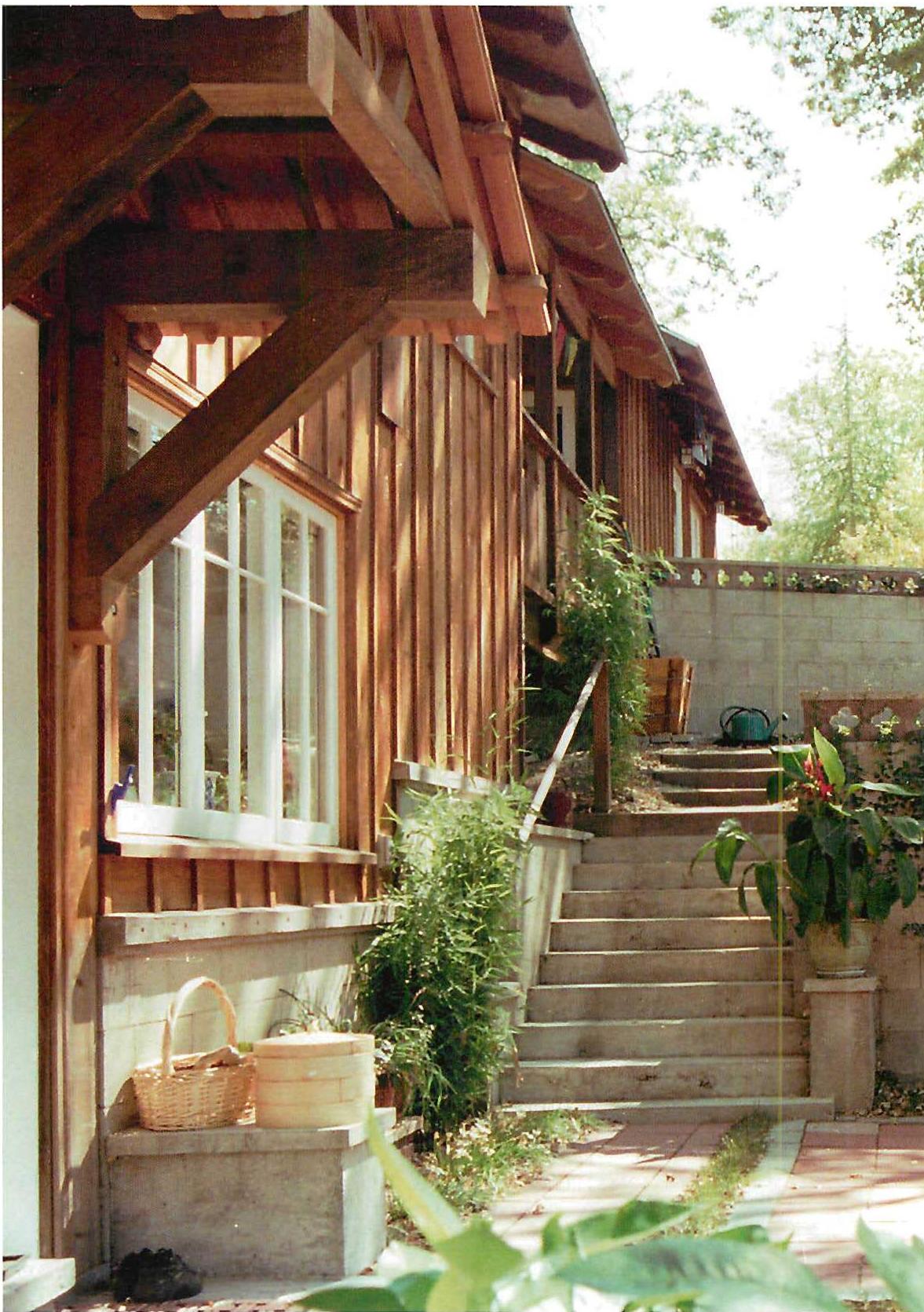
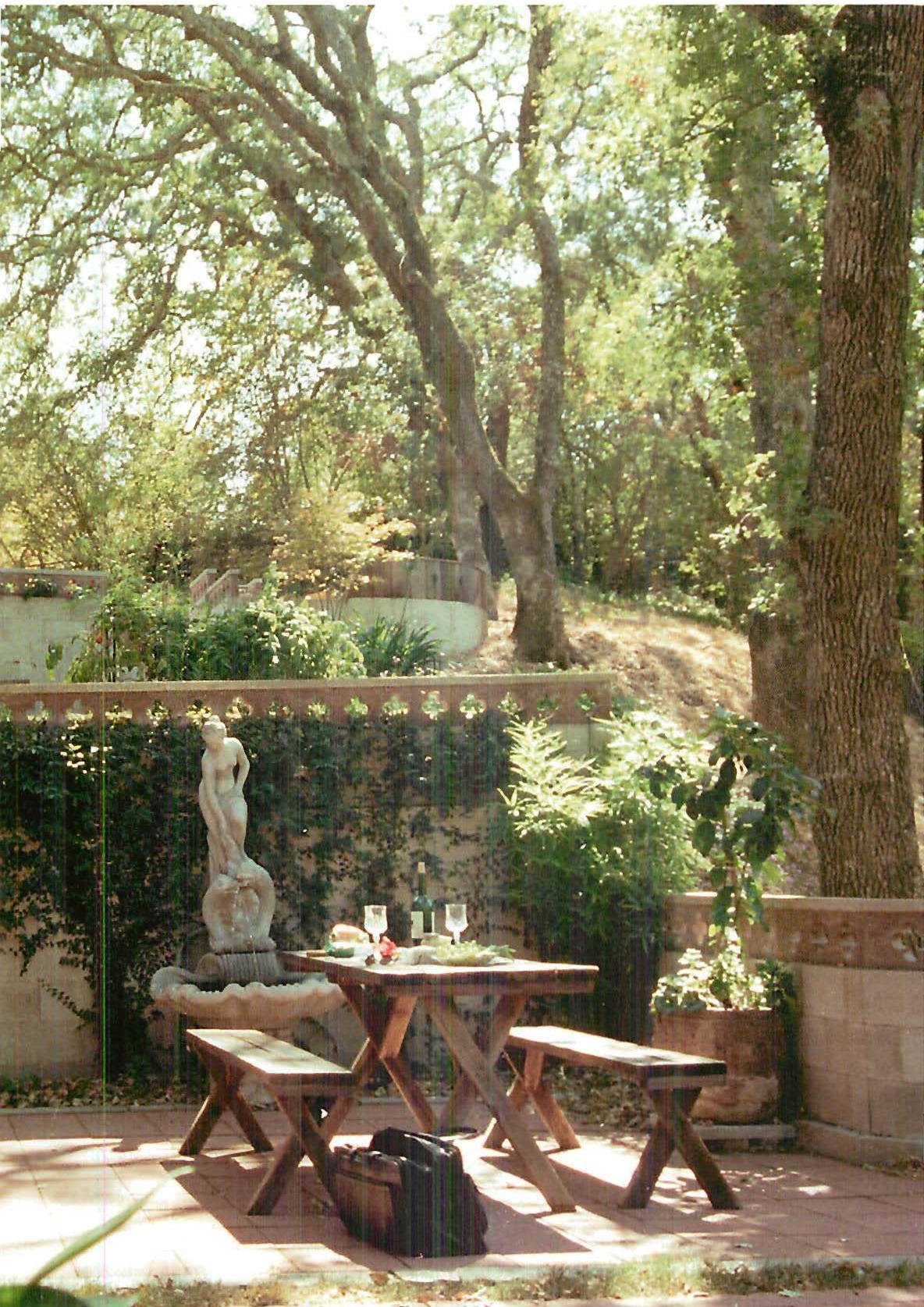
it is a natural point of confluence for movement through the site. The steps, the walls, the kitchen window, the balustrade, the place under the biggest tree, are then derived from the room's position to establish contents and fine structure.
rooms can be given life later on by choosing the material of walls, windows, door, carpets and furnishing. Then the rooms will be complete. Is that the right approach?
It is not. The centers which bring life to a room are larger features which lie beyond the boundary of the room. Rooms are given their life, first of all, by their position in the flow of people's movement through the building, the light in the room, and their connection with the outer world beyond the windows — those are the three most salient. By the nature of these things, they can only be settled early on, not later — before rooms have their position — before even the building has its overall ground plan fixed.
It is, above all, the light and relation to movement and relation to the whole which give quality and character to a room. So, if the fundamental process is being used, each room must
be chosen to be a strong center in itself—and that will require that it occupies a definite position with respect to movement and a definite kind of light. And that—once applied to all the rooms—has profound effect on the building envelope—its perimeter. These relationships to the world beyond, which extend far from the fabric of the room itself, are settled at the outset and are dominant in determining the success or failure of the room.
Once a room is in position, with its size and location fixed, it is too late to give that room real feeling or true meaning if it does not already have it because of its position in the whole. Thus the life of the important rooms in a building must be decided at the very outset—much earlier than we imagine—very early in the design process when major rooms and building volume and perimeter are being fixed.
3 / POSITION: STARTING WITH THE MOST IMPORTANT ROOM
Start with the most important room (often the biggest, but not always). It seems almost silly to state this so naively, but it really is true: Most buildings have a "most important" room. It might be a hall or a living room of a house, or the main room of a museum, or the meeting room of a conference center, the lobby of an office. The ultimate feeling of the building as a whole will depend greatly on the effect and beauty of this main and largest room. It is this which you remember.
In the town hall of Viterbo in Italy, for example, there is a simply magnificent room. All this room has is a beautiful shape, beautiful wall-paintings on all four walls, and a row of wonderfully large windows. But the room is unforgettable. It affects your feeling for the town. Speaking for myself, when I am in that room, I can feel it modifying my sense of the whole town of Viterbo.
In any building, one may say as a general rule that the main room of the building—in size, position, light, volume, character, and structure—must be unforgettable. You must not constrain it with other thoughts; you can let everything else go. If you try to make this main room "fit in" or be part of some system, you will almost certainly make it less than it could be. What you have to do is concentrate, concentrate, concentrate on just this one room. Make sure that you place it where you want it, that it has the most profound character you can get hold of, and let everything else go to hell—for the moment.
The main room of the Tokyo Forum (page 417) is huge, nearly the size of a football field. It completely governs the way that building works. Once that room was clear in my mind, like a pinnacle, high on the artificial mountain, the next most important room was the great seven-story high lobby which reaches to it with
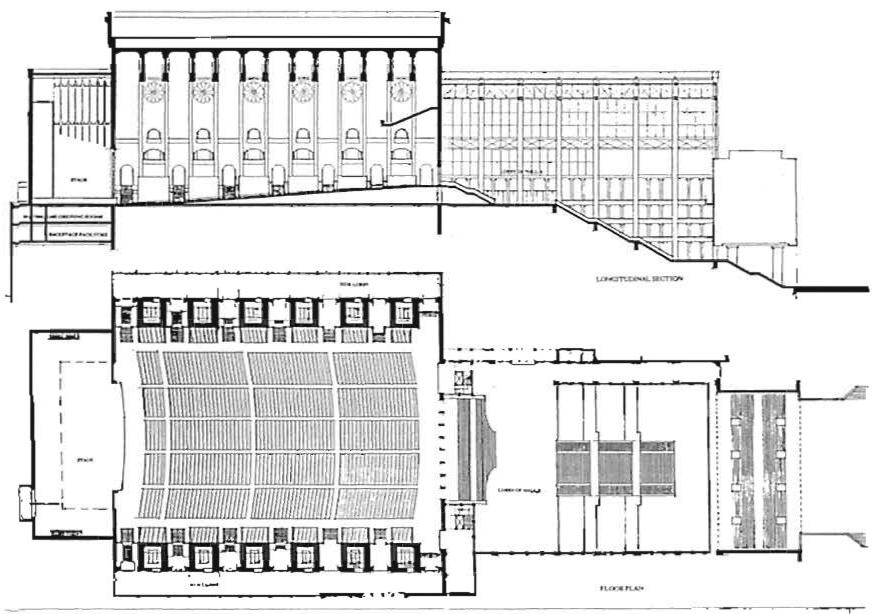
its enormous grand staircase. The sequence of these two rooms defined almost the whole building in its essence.
Something similar can happen equally in the smallest house, even in a tiny apartment. In every building — whether museum or church or cottage — what matters first, and before you do anything else, is to get one really beautiful room in the place you want it, with beautiful light — a main center which will bring the building to life.
It all hinges on being able to make a main room which is really beautiful. Everything else should come as secondary.
4 / POSITION: THE LIVING ROOM OF THE MEDLOCK HOUSE
Next, perhaps most crucial in trying to understand what is to become of a given building volume — as it has manifested on the site — is to form a vision of the inside of the building, a vision of moving through it — where the open places are, where the stopped, quiet, places are, where it is light, where it is dark, where you stay in, where you go out.
This vision can be had, usually, only by closing your eyes, allowing yourself to walk, in your mind's eye, through the building. To do it effectively, I recommend something like this: Go into your mind's eye pretending to walk through the building, as if it existed already, but you are seeing it for the first time and are stunned by its beauty. You are genuinely surprised. You find yourself stunned by the beauty of the rooms. And you ask yourself, then, Which features of what I am seeing, are making it so beautiful?
That is what you are trying to find out. Usually, in my experience, when you do it like this, you do see things you had not thought of, or were not aware of. Thus you find out, for the first time, by examining what has autonomously presented itself to your own mind's eye, what it takes to make the rooms as beautiful as you want them to be.
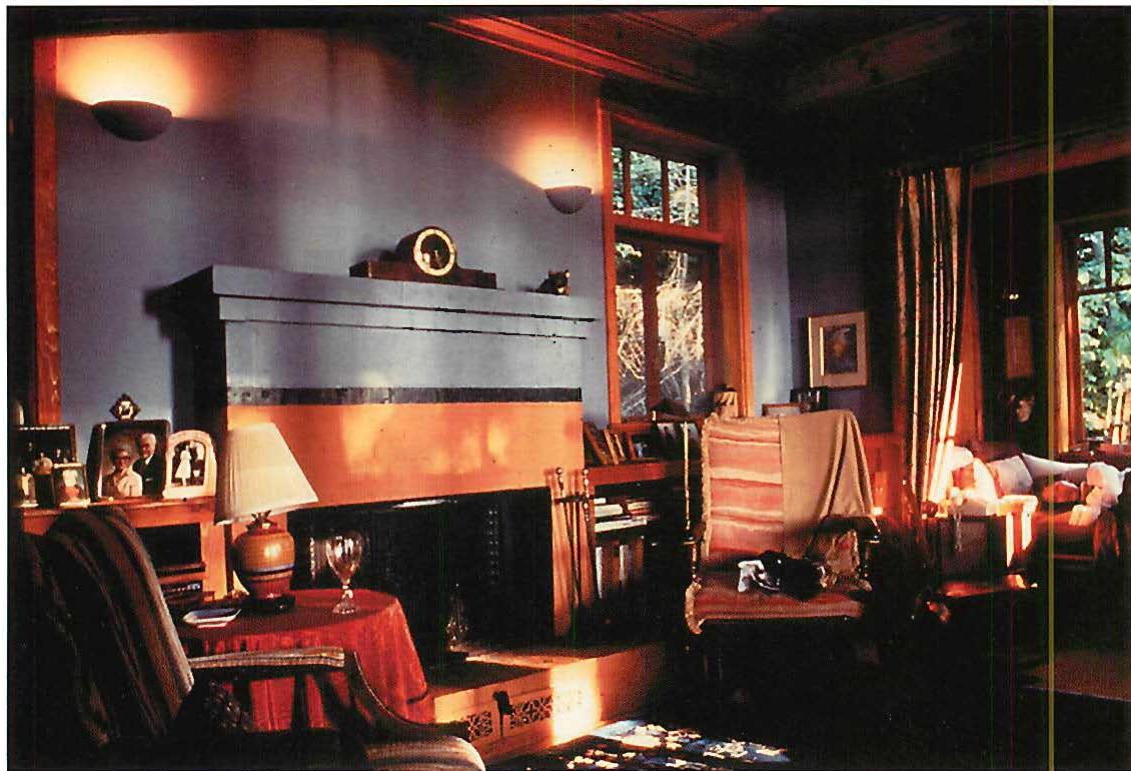
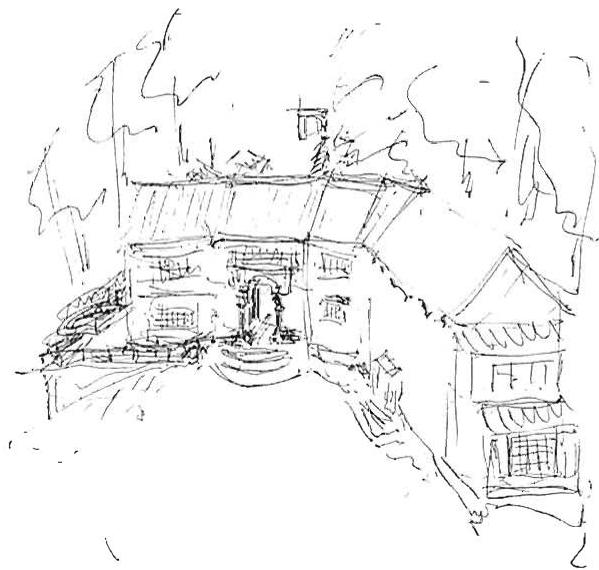
But you must ask yourself these questions as if you had come to the building for the first time: Where do I go? What do I come to? What do I see next? If you start by making your mind a blank, and then ask yourself these questions, with your eyes closed, you can see what is needed, what is going to happen. It comes to you directly, without effort, as if you know it already.
I give as an example a process of this kind which I used with Ann Medlock and John Graham when we were building a house for them, on Whidbey Island, in Puget Sound, near Seattle. The site is a knoll, looking towards the Olympic Peninsula and its snowy mountains. On the knoll there is a grove in thick deep forest.
At one stage in the process, we were trying to find out what the house was going to be like inside. We had the volume of the house clear by then, its position on the site, the views, the direction from which one approached the building. My first vision of the house was of its position. In order to maintain the feeling of the grove, the house was to be placed slightly off the knoll, so that it leaves the knoll itself intact. Thus, it intensifies an existing center instead of destroying it (the existing grove). In addition,
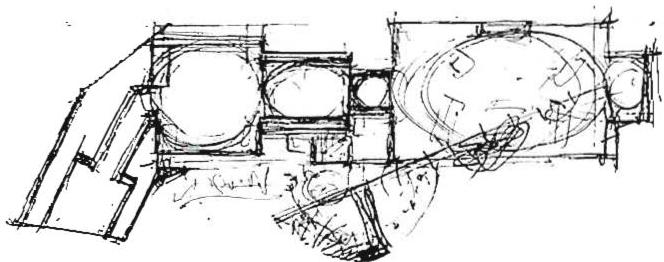
the plan creates a system of centers approaching the house—leading from the car, too feet away, along a roofed fence, to the main gate.
Inside the house, the essence of the plan was created by a system of centers, too. I sat one evening drinking wine with Ann and John, and with Gary Black, who was working for me on the project. I asked Ann and John to close their eyes, walk through the building, and find out what they saw. They described a feeling of a long chain of rooms where one saw through the whole
house, from the kitchen, to the dining table, and through to the living room beyond.
As we listened I began to see what they were describing as a sequence of beads, almost like beads on a necklace—each bead a clear and beautiful center, half open to the next.
Then an interesting thing happened. I asked them how many beads were in the chain. They said three: kitchen, dining, and living room, in that order. But when I tried to visualize the chain, looking from one end to the other with
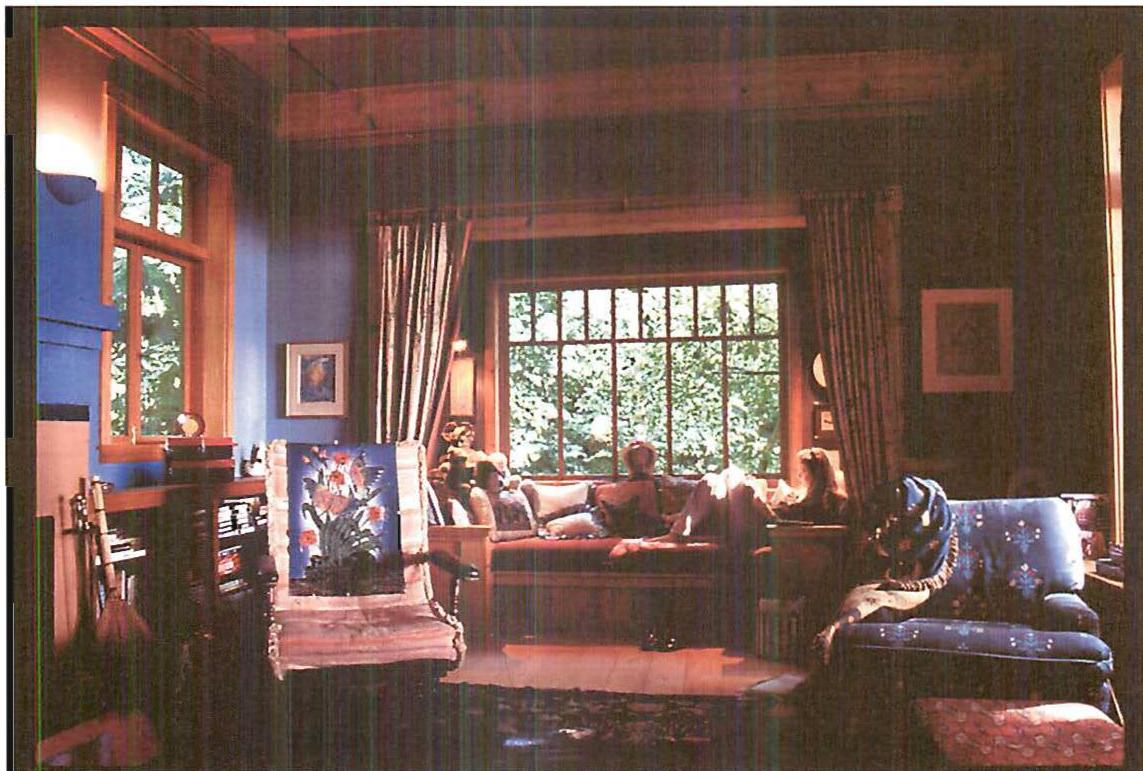
the end at the beautiful view into the forest, I saw four spaces, not three — four beads, one after the other. As I closed my eyes, and focused on the experience of looking down the chain, it seemed more profound to me when there were four rather than three; it seemed a more serious "chain" leading to a more profound climax at the end. But when I asked them, they said, no, there are really only three rooms.
I did not let go of my contribution to the evolving communal vision. In order to make this sequence valuable as a structure, I insisted that a sequence of four beads was more profound than three. They asked me what is the function of the third one—the small one. I told them I did not know and that we might have to find a function for it—but that I believed its existence was essential to the wholeness of the structure. That is what we did.
Finally, when we started to work out the plan (this was some days after the evening session when the vision first materialized), it turned out that the third "bead" became the natural place for the stair to come down and for the entrance to the garden porch. In fact, as it turned out, the plan would have been impossible without it, since this small anteroom (with an inlaid compass rose in the floor) finally became absolutely necessary as the meeting point of staircase, porch entrance, dining room and living room. But it was very curious that this space, so essential to the final design, arose for reasons that came from the field of centers itself, not from so-called functional reasoning.
The key, then, was the vision of the magnificent room which was to form the end of the sequence. The whole house is oriented towards it, the last bead on the necklace (illustrated on page 419, as we later built). The room was finished and painted by the owners. It has the intensity which comes from its minor centers. Ann Medlock and John Graham did it; they were brave enough to put into it what they wanted and what they had always dreamed about, not what would work on the market, or what they could get back from the bank if the mortgage foreclosed.
The design of the room started with its position at the end of a string of beads, at the end of a long path through the house, the tranquil spot, looking into the forest, with windows on three sides. Then a focal point at the end, an alcove, which made a place to sit.
Then the main fireplace, in the middle of the eastern wall, forming the focus of the middle of the room. Then beautifully proportioned windows on the west, wide to make the center in front of the fire its substance, and a seat under these windows, strengthening this center even further. Then lesser windows on the east, which do not interfere with the fire.
Then bookcases at the end where one comes in: you walk through a hole in the bookcases, and the bookcases seal the room.
Finally, the ceiling, a regular grid, with a small flower in the middle of each panel. Not trivial. A system of centers which complete the largest center, calm it, and make it whole.
5 / THE MAIN CENTERS OF A ROOM: INTERNAL ELEMENTS WHICH CREATE THE ROOM'S LIFE
Now we come to the internal organization of the room, and the creation of the interior centers which define the room. This is the most subtle aspect of room design. It is extremely hard because, in many cases, the centers which have to be created, and which define the room, are almost invisible.
Here we encounter a special version of the fundamental process. The vast majority of rooms are roughly rectangular. Each one has a door, windows, a floor. Where, then, should it get its life? The vital centers which govern the life of the room are nearly invisible pieces of space which exist as centers, yet usually have no clear boundaries,
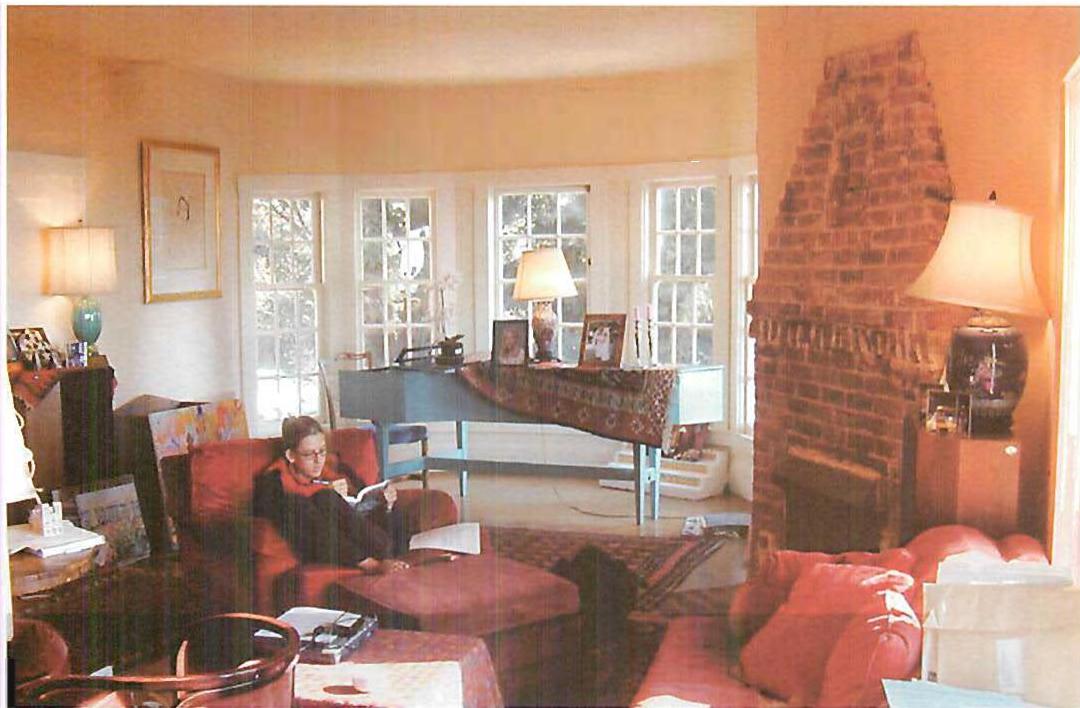
sometimes no obvious defining marks. Like still places in a stream, they are nearly imperceptible in the configuration, yet all-important.
So the secret of making a room with life depends more mysteriously on centers than the structures we encounter in other parts of the environment. It depends on our ability to make living centers appear, almost without seeming
to, within the very simple structure of a nearly featureless rectangle of space.
For each room, we must first learn which are the crucial spots in the room: then, with a combination of movement and light, make that spot become a living center.
Usually the main center of a room is defined by two things: (1) it is a quiet spot in the pattern of movement and (2) it is a place near the light. A room has a good center when such a place, a place quiet with respect to movement, a quiet backwater in the flow of moving people, and the intense oriented place towards the light, are one and the same and embellished, when possible, by other features (ceiling, floor, furniture, built-in furniture, a focal point).
I have given a more detailed explanation of some of these issues in Book 1. But let us now talk a little more about the process, and the way we can get the right centers from the room by unfolding.
Human beings are naturally attracted by light, move towards light. That means, as a room
begins to find its shape, the sources of light are — whether pre-planned or not — as a matter of fact latent centers in the emerging construction. If the building is able to unfold, it is these latent centers which will dominate our understanding of the wholeness in the newly forming room.
The fundamental process therefore takes these latent centers (to begin with, really just
places which seem that they will be foci of light in the room) and makes them into "something."
On pages 412 and 413, we see two rooms dominated by their light. In each case, the place where the light comes from is expanded, embellished, made more real, made into something. What starts as a latent center that has potential becomes, under the impact of the fundamental process, a more developed complex center that includes a window and the space that it creates.
Of course, to make it a strong center, the fundamental process then takes this center through further steps which develop it with detail, sills, bays, glazing bars, in order to make it a significant living center in its own right.
In both cases, the window is not a hole in the wall but a definite volume of space: a very large volume in the Upham's living room (page
413), and a rather large one, too, in the Sullivan's living room (page 412). In the first case the space formed is then strengthened by the architecture—the shape of the room, its light, and so on. In the second case, since this window naturally fell in the middle of a long wall, otherwise unarticulated, I made a very deep, red corduroy sofa: we built it as a piece of furniture for lolling, reclining, sitting, together with a group of other
red corduroy chairs to form a circle next to this window—but permanently built in as part of the architecture of the room.
Once the center formed by the light is a coherent space in its own right, as in these two examples, the shaping of it then creates the space which animates the room.
Consider, now, a case where there is a room whose size and position are defined—say a large
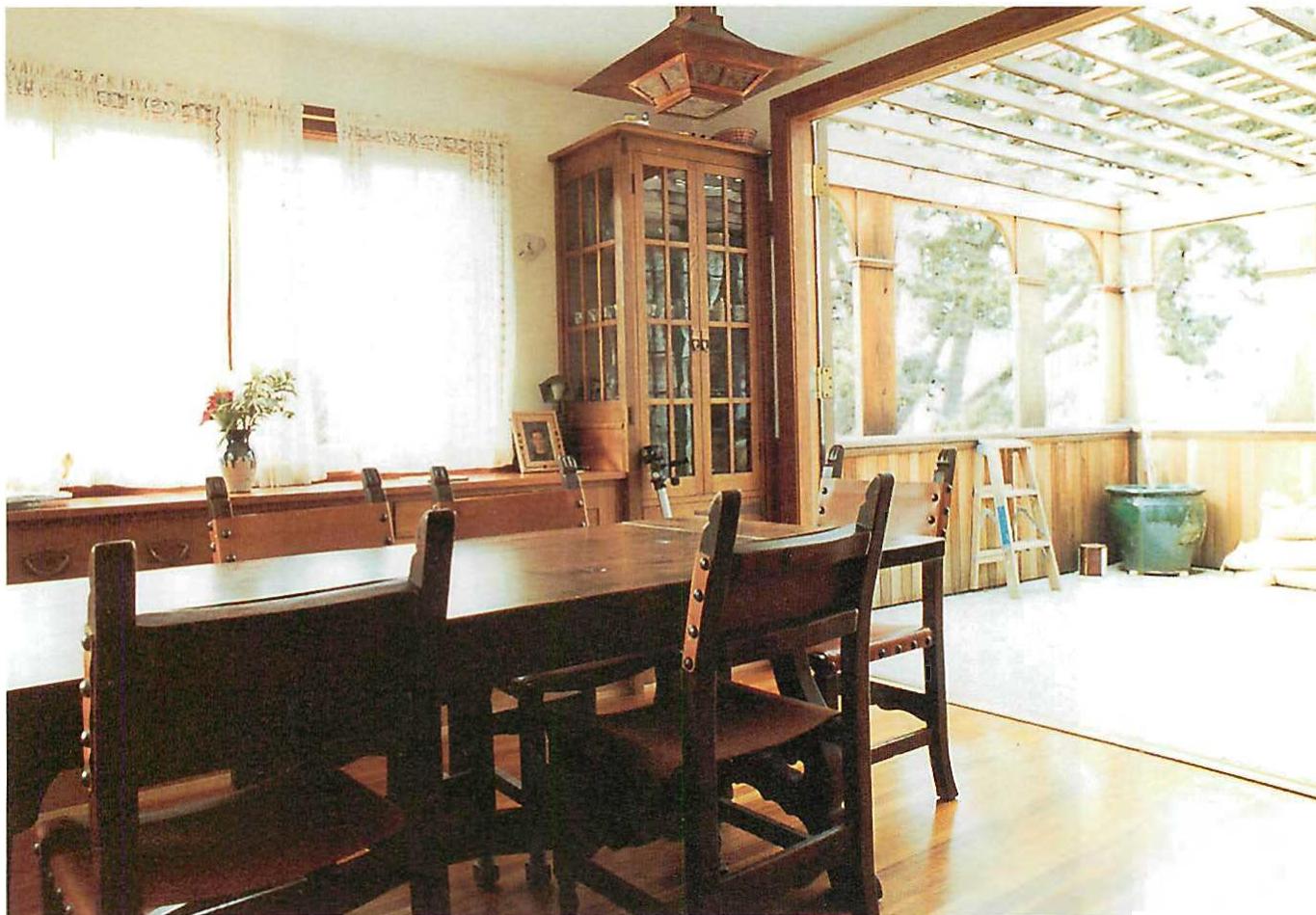
rectangular room with access and windows already determined. What now, when we consider the interior volume, will create some focus in the room, a real feeling of centeredness, within the space itself, something I can relate to when I am in the room? We have to find a space within the room, which, of itself, creates orientation and focus. Some of this may be done by providing a window that is a beautiful center in its own right, with deep walls, a big sill. We see that in the Sullivan living room. Or it may be done by giving a smaller space, a niche, alcove, or other substantially and defined place, opening into the room or within the room. That again may be seen in the Sullivan living room.
But the most difficult — and the most typical — problem is the plain rectangle, without embellishment, not done by a window, not done by an alcove. Here the key center that gives (or does not give) life, will be a still spot which paths pass but do not go through, a place which is oriented towards light, perhaps oriented towards a natural focus like a fireplace or television or a desk or a computer. But for these things to work there must be a comfortable space — the most comfortable in the room — the natural oriented spot of the room which can hold a television, or a desk, or a computer. In certain cases even a picture or a hanging can create such a focus; but if so a niche or a particular marked bit of wall has to be provided which has just the right tranquility. Above all, the vital thing is that one can be clear from the beginning where the focus of the room is, and that it is a strong center in its own right.
6 / THE MAIN CENTERS OF THE CARPET GALLERY AT THE SAN FRANCISCO MUSEUM
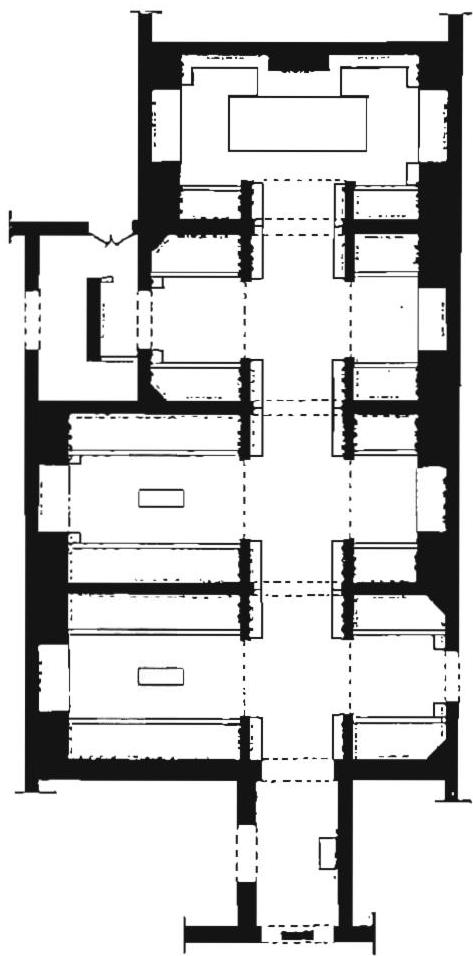
In the carpet gallery built for the San Francisco Museum, the aisles form such centers. The ends of each aisle have a niche for a specially important carpet. Each side aisle strengthens the central aisle. And each end niche strengthens the aisle which it ends.
The impact of light, and the basic importance which light has in shaping all rooms is
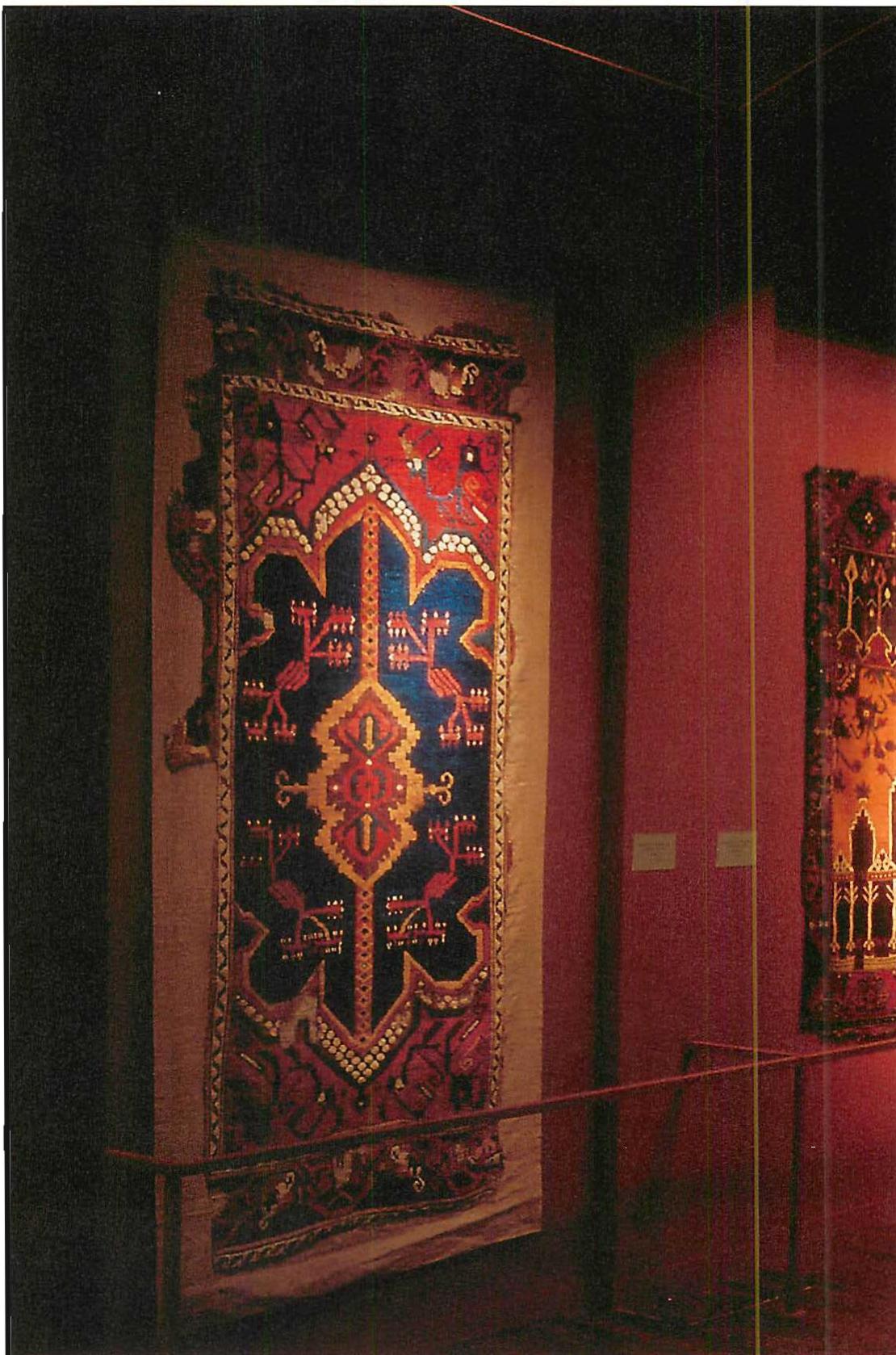
underlined in the carpet gallery at the San Francisco Museum (pages 426–27). This very large and highly complex room has no windows. It was built to exhibit 88 ancient Turkish carpets. We start, in this case, with the carpets themselves as the latent centers, and the movement of the people walking around looking at them. From these ingredients, the centers of the room, in plan and section, then come into being. In this instance, because the room is so big, it is powerfully made of smaller centers, about a dozen of them . . . strongly articulated, each one powerful as space in its own right. As you see from the plan of the gallery (page 425), each wing of this very large room is given a focus and an orientation, too: the most important carpet in each group, is placed at the end, so that one walks towards the most imposing, most serious, most electrifying and most grave center.
Then the deep gray (almost black, touched with red) color of the walls allows the carpets, each one, to function as a source of light, hence as a center; and the room itself is made of wings which allow you to focus on these spots of light, glowing in the darkness.
We see here, in an exceptional case, how a room is formed by the centers which draw one in, and which draw one towards it. In each room, one has to ask not only what centers form the source of light, but which most important centers lead me on, focus me, orient me, while I am sitting or standing in that room.
7 / FINE STRUCTURE WHICH DETERMINES THE INTERNAL COHERENCE AND FEELING IN THE ROOM
In this work, the room is to the house as the house is to the land. Just as you have tried to make the volume of the house sit in the street or in the land to complete its wholeness and extend it, so now you must make the rooms of the house sit within the house and land together, completing them, extending them. And as you do this, you must also start the unfolding of the physical structure of the building too, so that its columns, beams, walls, arches complete the volume of the
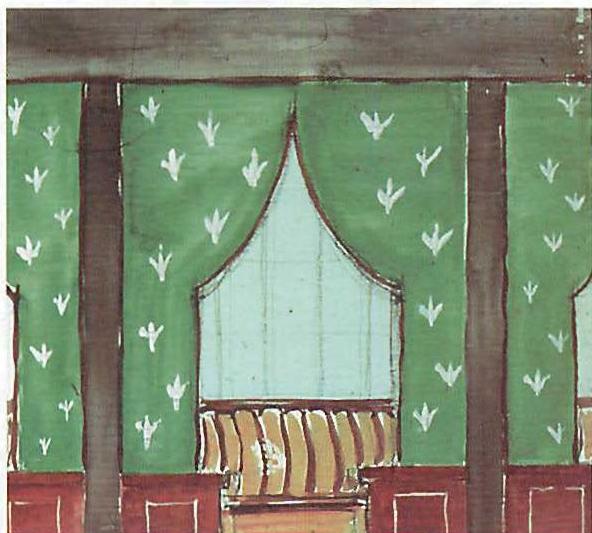
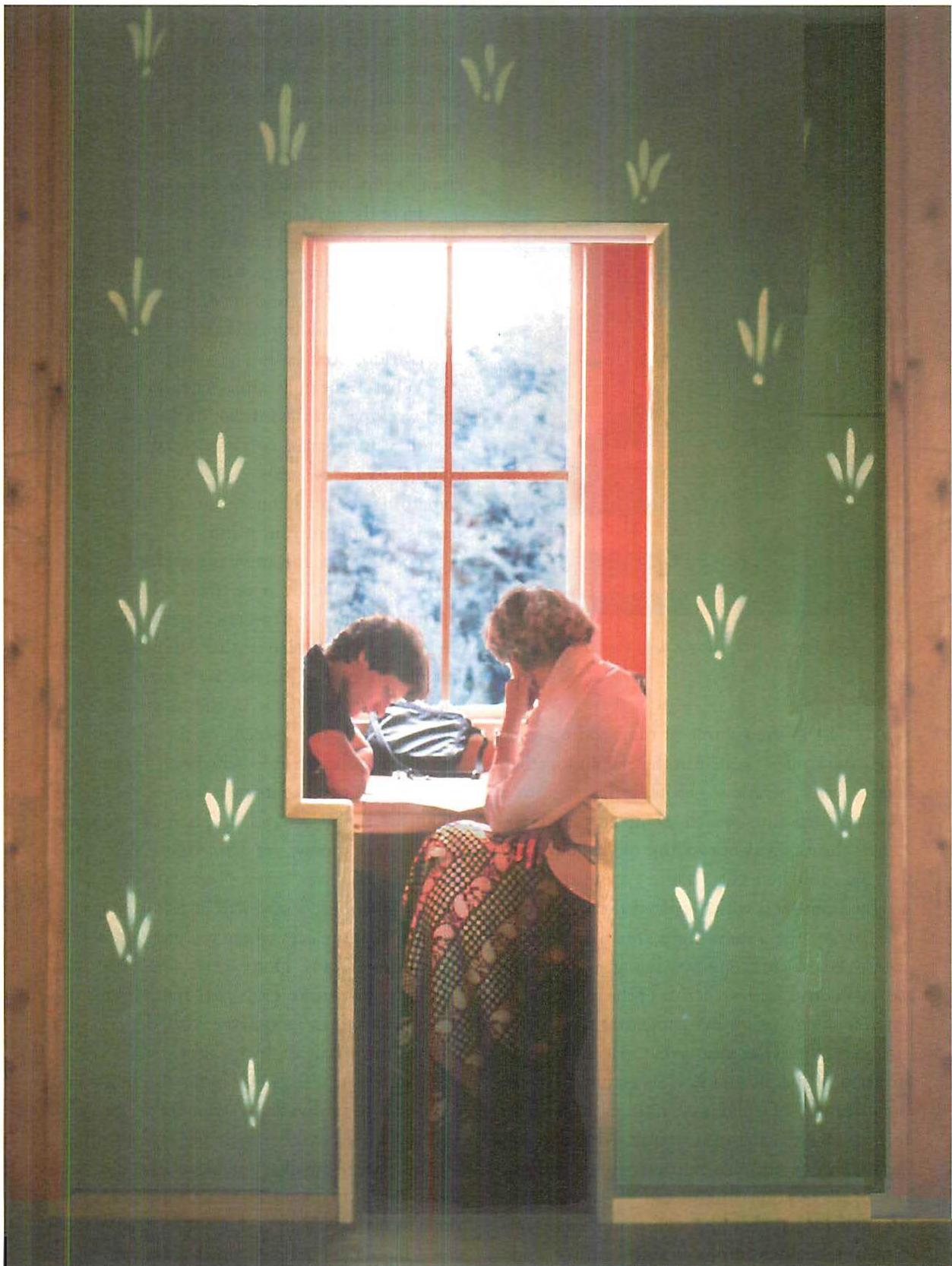
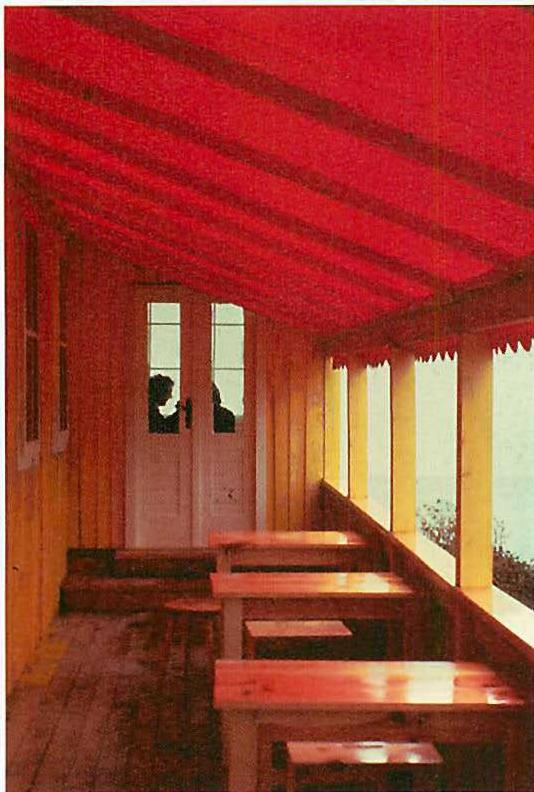
rooms, just as the volume of the building completes the land — so that in the end all together, rooms, walls, windows, roofs, terraces, form a physical structure which completes and enhances the roughed-out volume of the house, just as the roughed-out house completes the roughed-out land which existed there before it.
To get the rooms right, finally—a place whose centers are themselves living—the physical, geometric, built structure of the room and its interior organization must together form living structure, too. That means that spaces, the organization of spaces, and now its counterpart, the organization of solid material, must together form a coherent living structure. Although this seems obvious, and although it is part of the classic core of all traditional architecture—it is surprising how this has been almost lost and almost forgotten in the maelstrom of 20th-century work.
Here, once again, the fundamental process has a massive role to play. But in this case, the process of forging living centers, when it is focussed on the space and volume interaction of the structure, asks us to carve space, as if from rock, until the counterpart of space—the solid material structure that we think of as its physical container, its engineering structure—also comes to life to make each room alive.
Here the fundamental process obtains space and structure—the entity we may think of as "space-surrounding-structure"—from repeated application of the fundamental process to the volume of the building and to its emergent rooms and corridors and halls.
What I mean is this. The way you now start working out the interior of the house—its overall plan, rooms, entrances, walls, ceilings, columns, window seats—at each step you do something to some conception of the building that is growing in your mind.
For instance, it is more important to get the rooms right, one by one, than it is to have a coherent "plan." Don't worry about trying to arrange the overall plan—that is not unfolding but manipulation. Instead, start with the most important room. Put it in the most important place, towards the garden, or the sunlight, or the river, or the street—whichever is most appropriate. Let it take its own form. Don't worry about the rooms around it. Then do the same for the next rooms, get them right. When you do things this way, some places will be a little bit of a shambles. There will be left over spaces, funny bits and pieces where you can put closets, toilets, storerooms. Don't worry about the plan so much. Just make each part really beautiful, in its position, in its quietness (at the end of a passage for instance), in its light.
What you want most is for the individual rooms to be individually wonderful, glorious.
It is useful to see, concretely, how this focus on fine structure works to create a room. Suppose, for instance, that we have determined or a site, the best place for a certain major room. We have stood in that place, determined, from the inside, so to speak, that this is a good place, a beautiful spot, with a significant relation to the land. In the fundamental process we then take a next step to
strengthen and embellish this center we have formed as a decision in our imagination.
Obviously, we want the light of that room to be beautiful. We must therefore clear away enough space around the edge of this room so that it will be possible to allow light in the room to be beautiful—we must make beautiful windows. Inevitably, then, the room has now taken a certain prominence in the emerging plan. It "sticks out," it has a substantial part of its perimeter exposed, and that begins to shape the building around the room.
In similar fashion, if there is some part of the land which is to be approached from the room, again, this is already clear at a very early stage—and we begin to visualize another strong center, perhaps a terrace, or a lawn, with steps, and with a french door.
So, even before the building is fully designed, we have rather substantial ideas about several major and emerging centers in the room
and connected to the room. That is, for instance, how the big bay window of the Upham house living room appeared. To start with, before the house was conceived, that spot was already a meaningful place on the site. Then room and house were shaped — their perimeter defined — to make this center as strong as possible from the inside.
But now all these are understood as transformations on the physical material of the room—its walls, columns, ceiling, beams, floor, their thickness, their substance, their relief and depth.
The same effect of light, and the role played by windows, is shown in the classroom from the Eishin campus (page 422). The soft quality of the light, the friendly, open atmosphere of instruction—the easy-going learning atmosphere—all of them come essentially from the way the windows are made. These windows form the center in the room. The focus on the windows gives the room its dreamy atmosphere; the hard
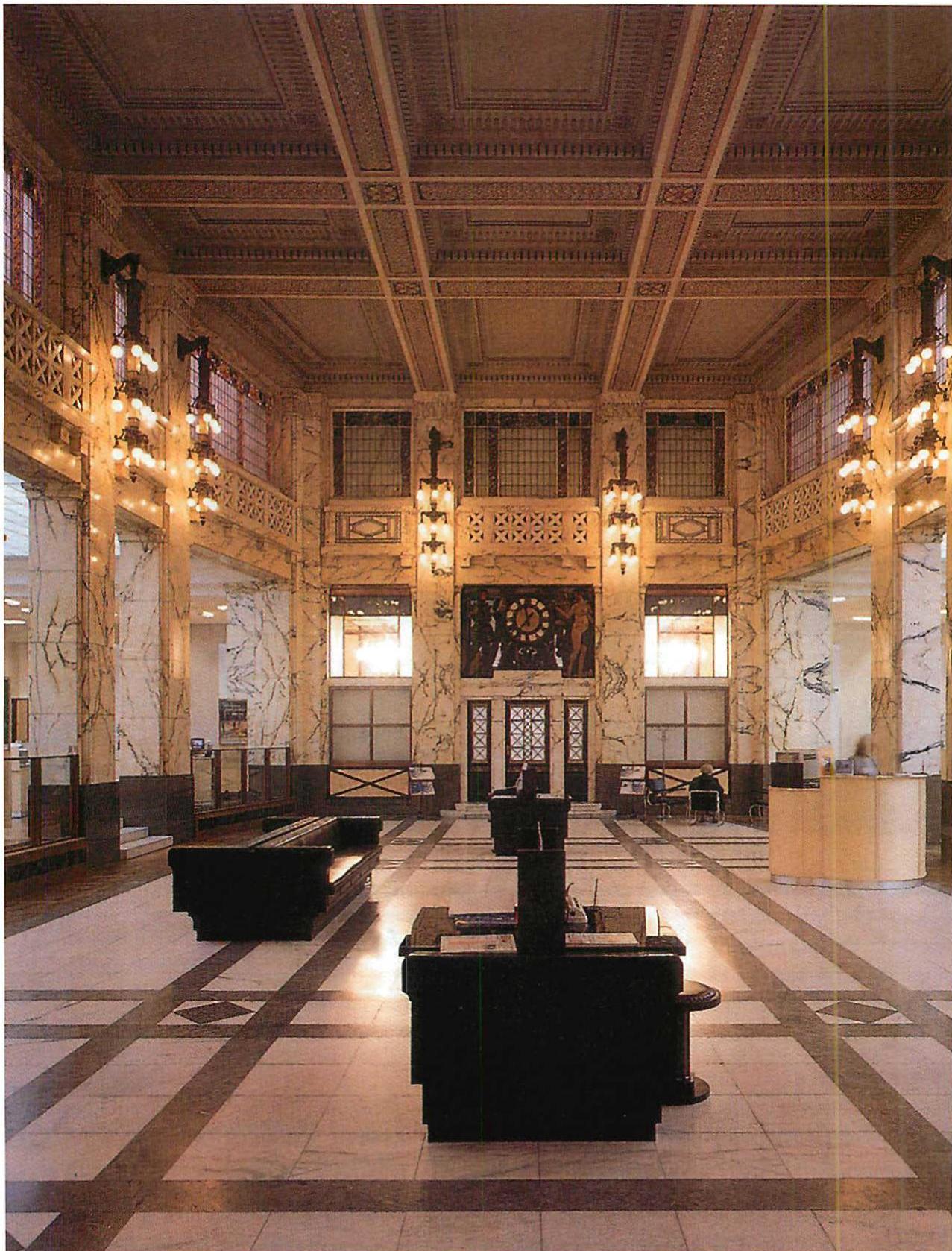
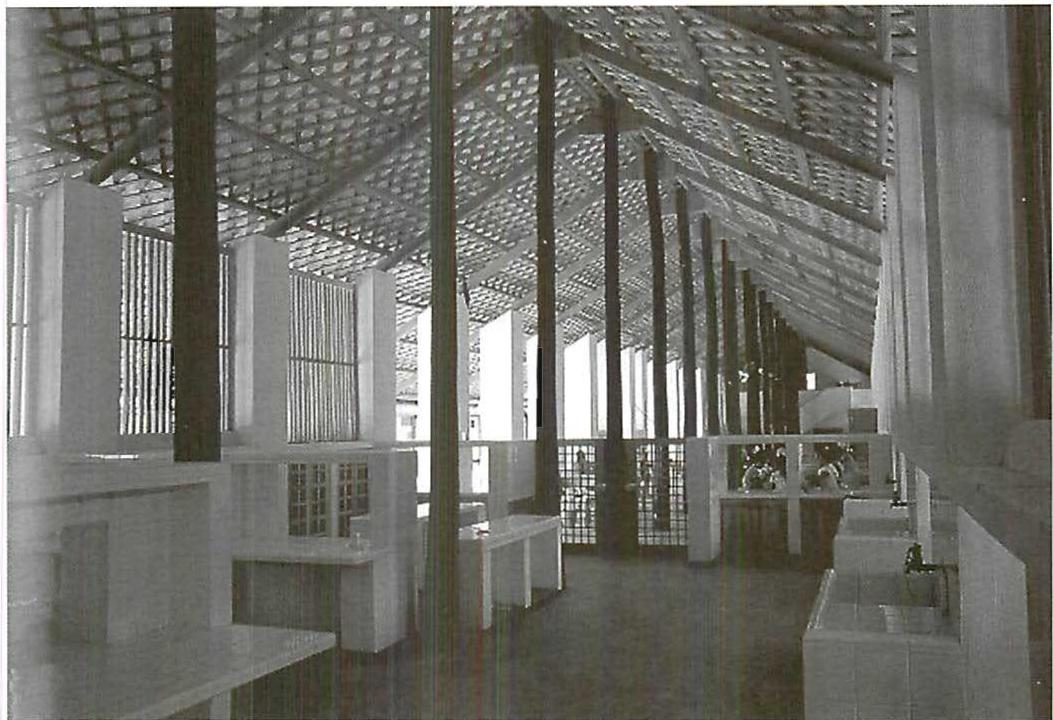
concentration of the blackboard and the teacher's platform is reduced. Again, the main life-giving centers in the room are those made by the windows and its subdivisions.
In the arcade of the college (page 423) the same continues, in a different form. Here again, the principal centers are (1) the volume itself, formed by the square cross-section (intentionally made a bit low to intensify it as a center); (2) the openings which are square bays between columns, letting in light; and (3) the columns themselves, rather substantial and reflecting light (yet again), thus contributing their impact on the luminosity of the place. Likewise in the three examples on these pages. The attention to living structure—the need for articulate centers to be formed at many levels, and in useful ways, shows its appearance in these two projects by Hermann Czech and by Geoffrey Bawa, once again generating the characteristic structure we are beginning to recognize.
In the office of the Martinez house we see it once again. The windows form centers which create a 'target,' hence a center, in the far wall and
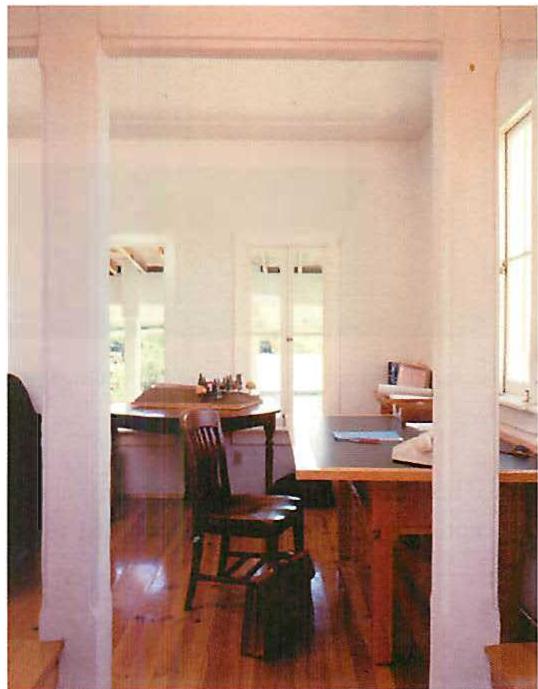
in the side wall. With them, the pair of columns with the three-dimensional center in space that is
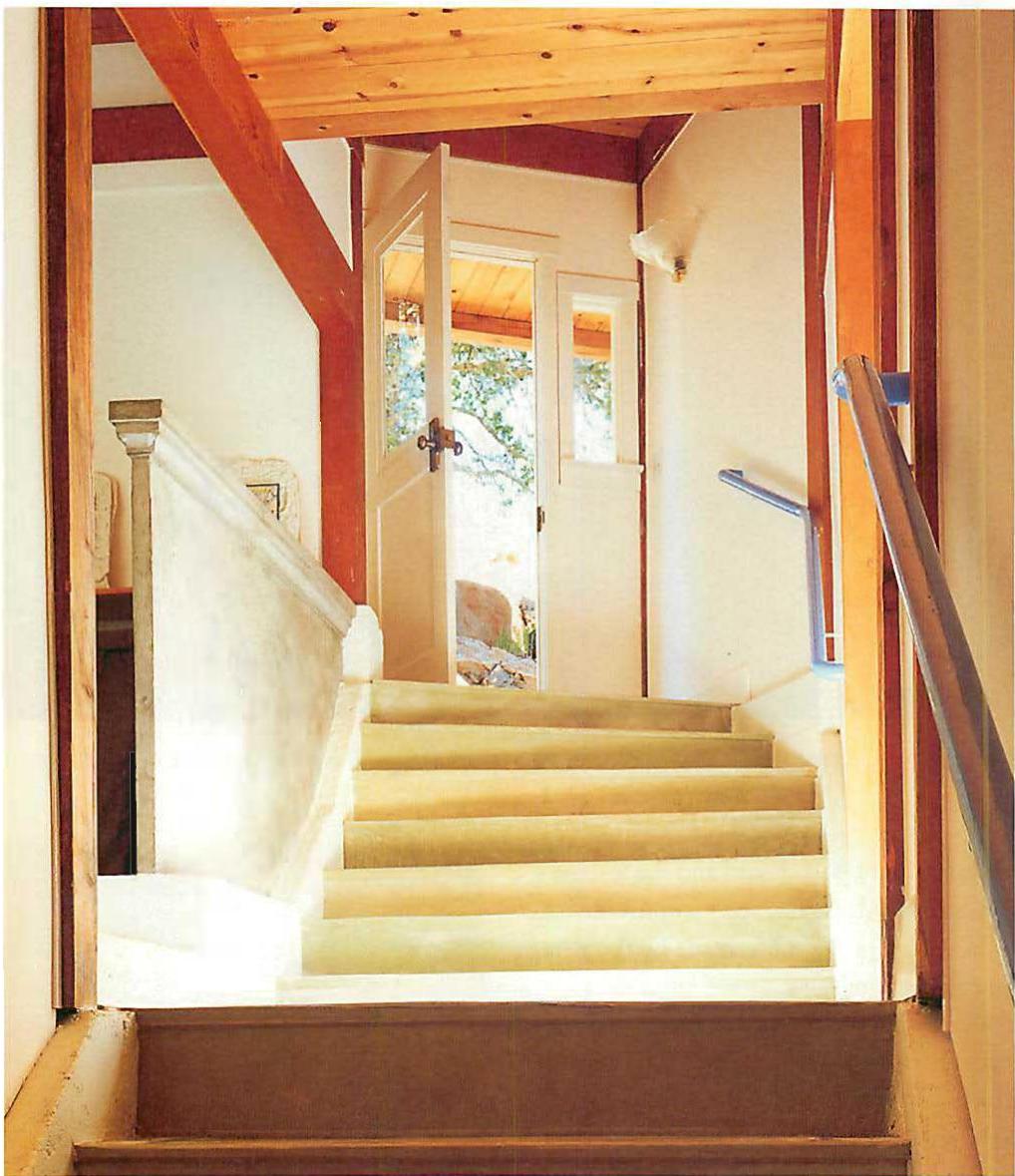
formed between them, generate the room's ancillary centers which make the light-filled room
truly a center, in the sense that we can feel its life and centeredness throughout the space.
8 / FINE STRUCTURE: THE BERRYESSA STAIRCASE
The two highly irregular configurations of the Berryessa staircase, are worth some discussion, too. It happens inevitably, from time to time, that an important volume has an unexpected
and slightly awkward shape. The volume of this staircase which leads down into the house from the entrance on the hill above, is shown here in plan. To make the space, I simply
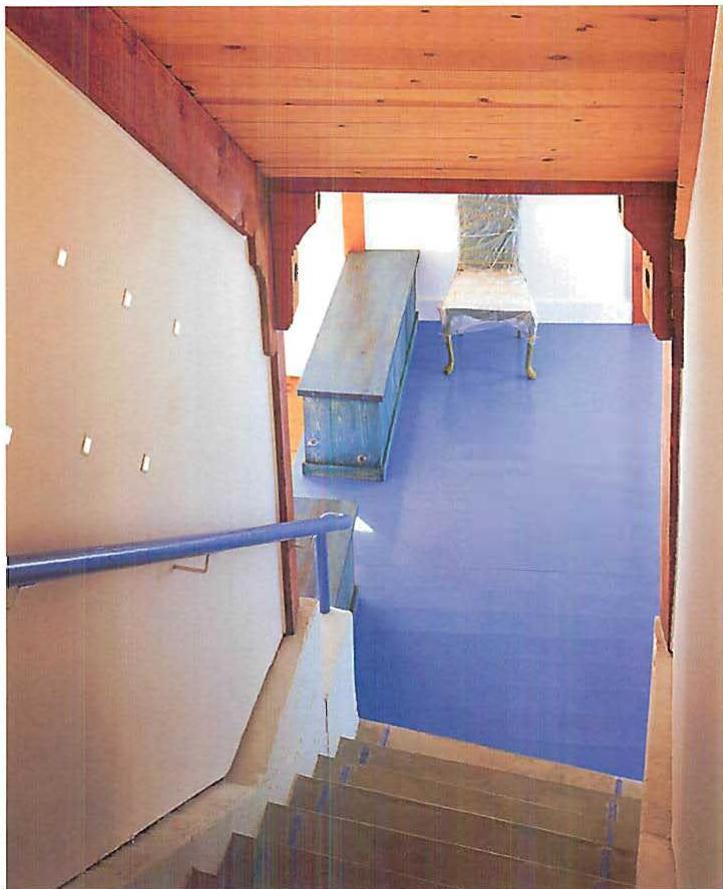
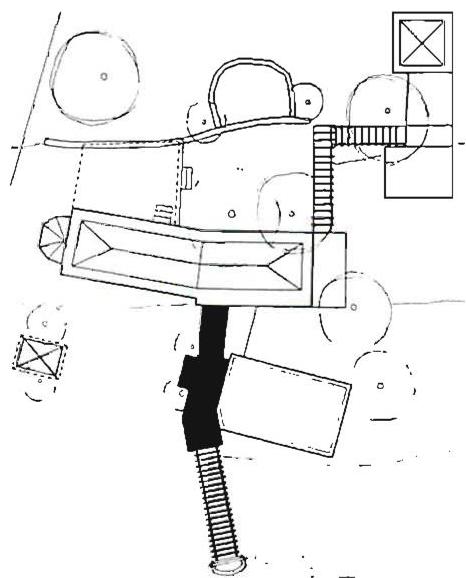
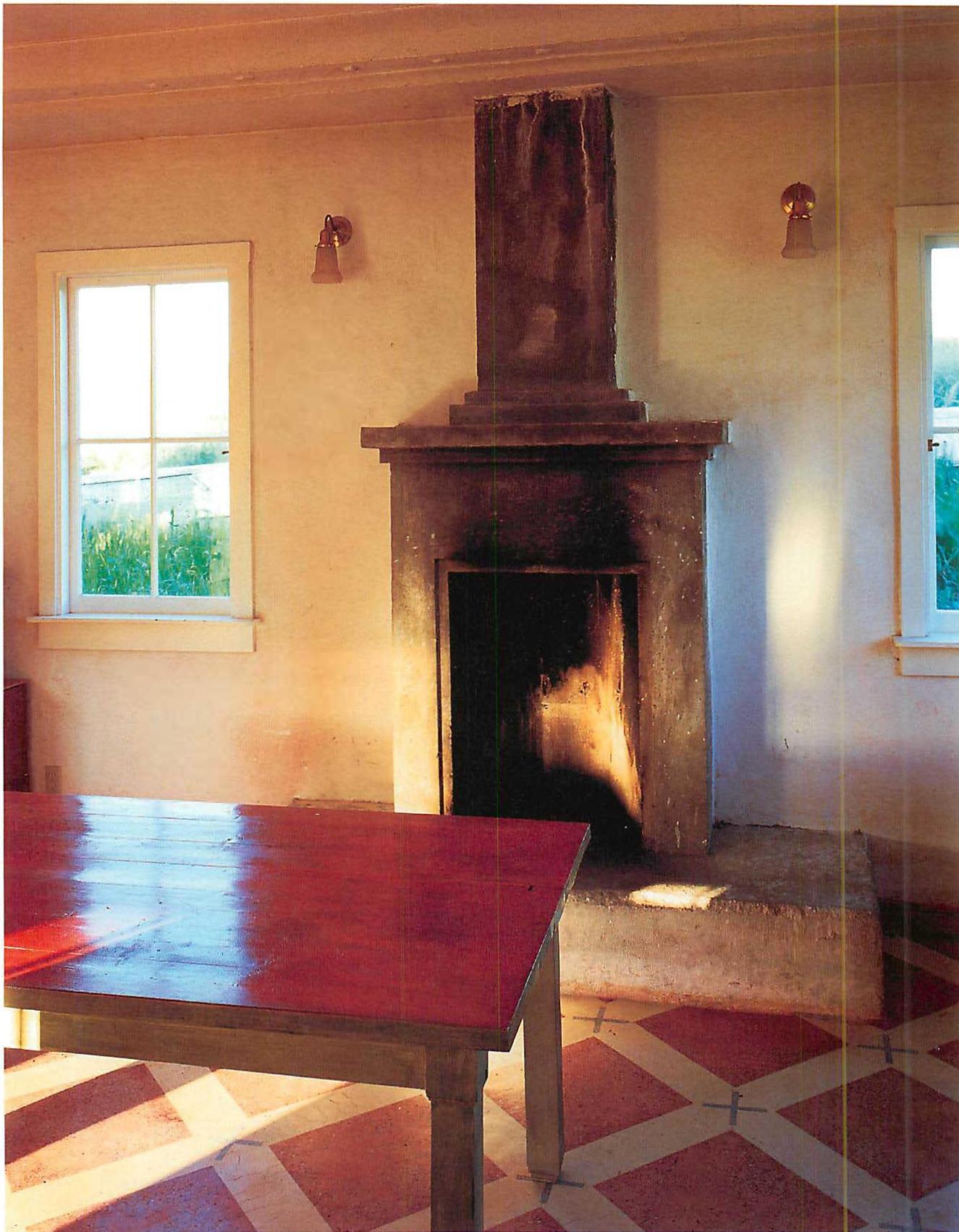
modified the space again and again, during construction, until each part was, as nearly as possible, a perfect volume; but of course, since the site is extremely irregular, this volume, composed of near perfect volumes, then
achieves the most remarkable composition of spaces, because each one is trying to be as simple as possible under irregular constraints. This is an extreme example of ROUGHNESS at work.
9 / TRANQUILITY
Tranquility: quiet, stillness, peace, joy, simplicity. Here (left page 436) the inside light comes from the fact that the windows, and the fireplace, even the bits of wall between the windows, are all being-like. It is rather ordinary. And it is made
quite roughly, out of very good materials. It is not expensive. But the fireplace, especially, has a being-like character. It is a very strong center. And this center dominates the room, gives it the soul-like savage character which allows us to relax.
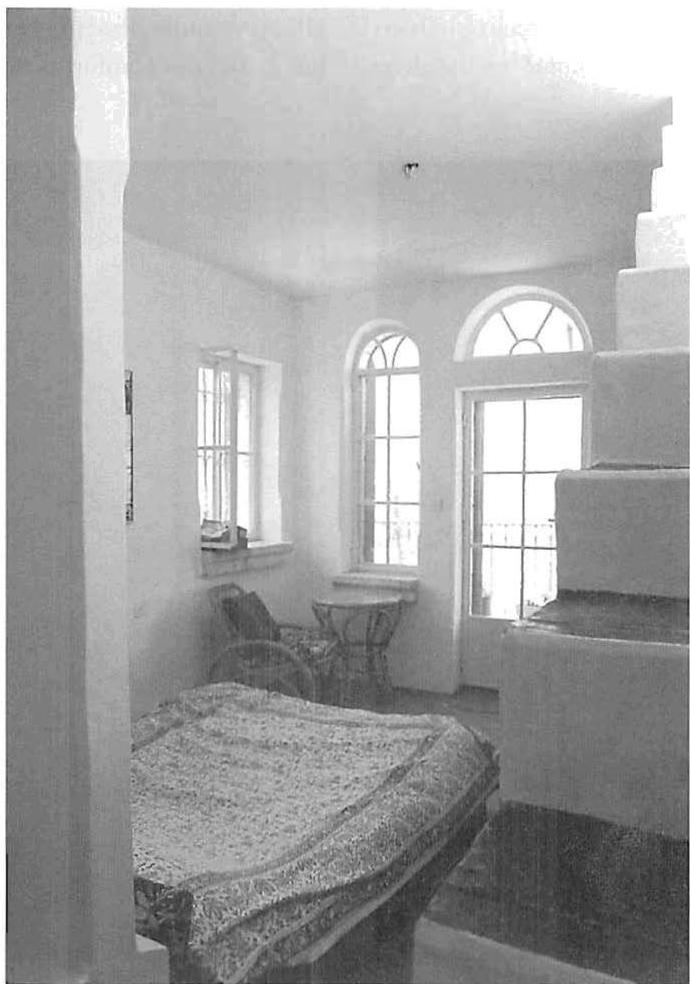
In principle, a room is the sanctification and illumination of a life. It is your life made manifest. The room itself, like a cradle or a gathering together of a life, is, in its essence, the place of a thousand joys and sorrows, the receptacle of your life and your children's lives, the embodiment, in physical order, of what your spirit has been and has become.
That is, perhaps, the true purpose of a room. It is comfort, but true comfort, an inner spiritual comfort. When I describe it as spiritual it sounds ascetic, and too much connected with self-awareness. A good room is utterly comfortable. It is the real comfort, the comfort of the soul: but also the comfort of pillows, soft light, sounds just right for the ear, birds singing, a solitary vine running up the front door and bearing one, two, then three blossoms, the comfort of the paint outside on the building, the feeling of happiness I feel when I come home to the deep reddish rose of my own house, the cages with hamsters stuck all over the house, and the way my children squeal and play with those cages, the oil paints all over my studio, the voice of my dear wife singing, coming up from the rooms below. That is real comfort.
Too many people have lost all sense of this ordinary comfort.
On page 440, a dark room that is suffused with light. It is a room, not yet built, for the Waldorf School, Altadena, California: the auditorium and theater. Here the room was to be dominated by frescoes of angels, full height, on the walls, illuminated by a very dim light indeed, and darkly glowing stained glass windows. Here, I had hoped to make conditions for true "meeting."
What do you think? The environment is almost meaningless if exterior comfort exists but its interior comfort is not there. In a period
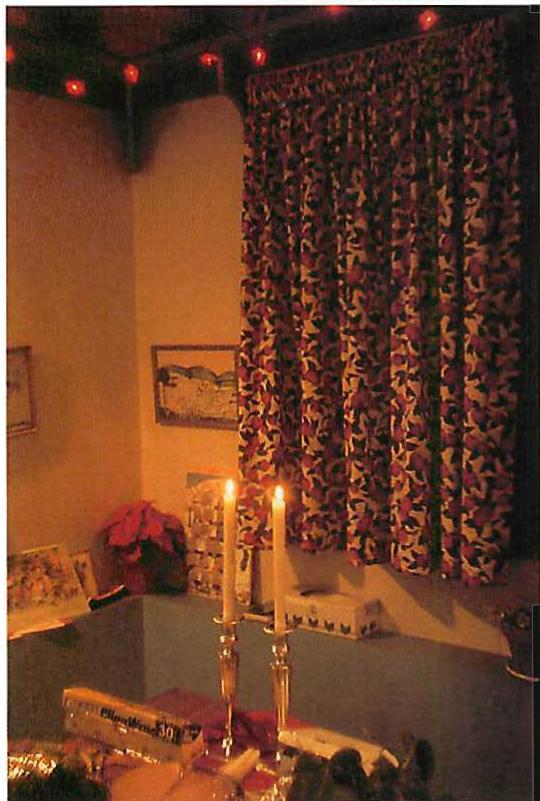
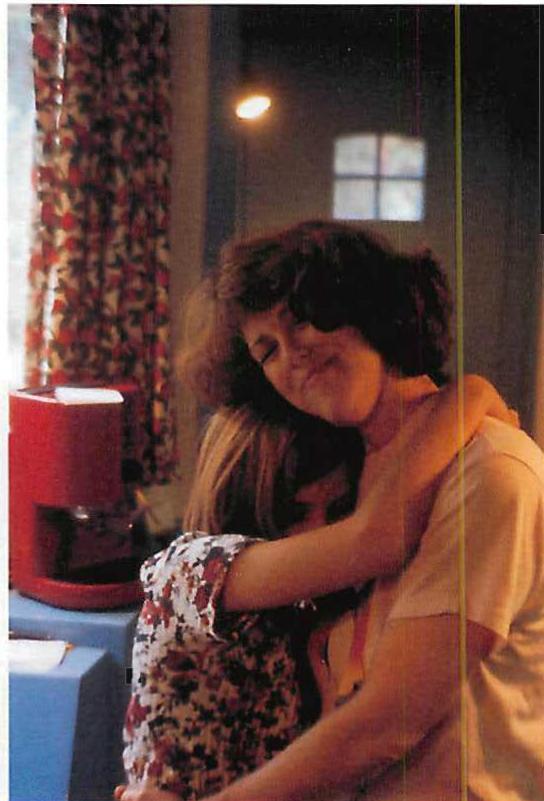
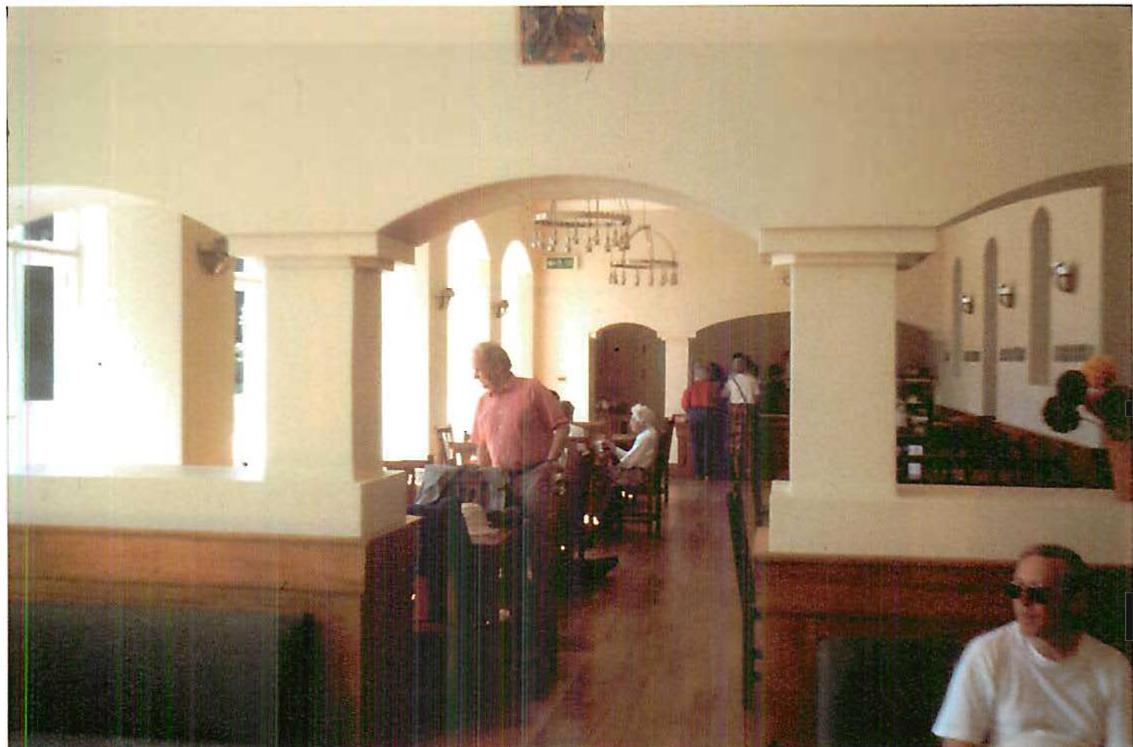
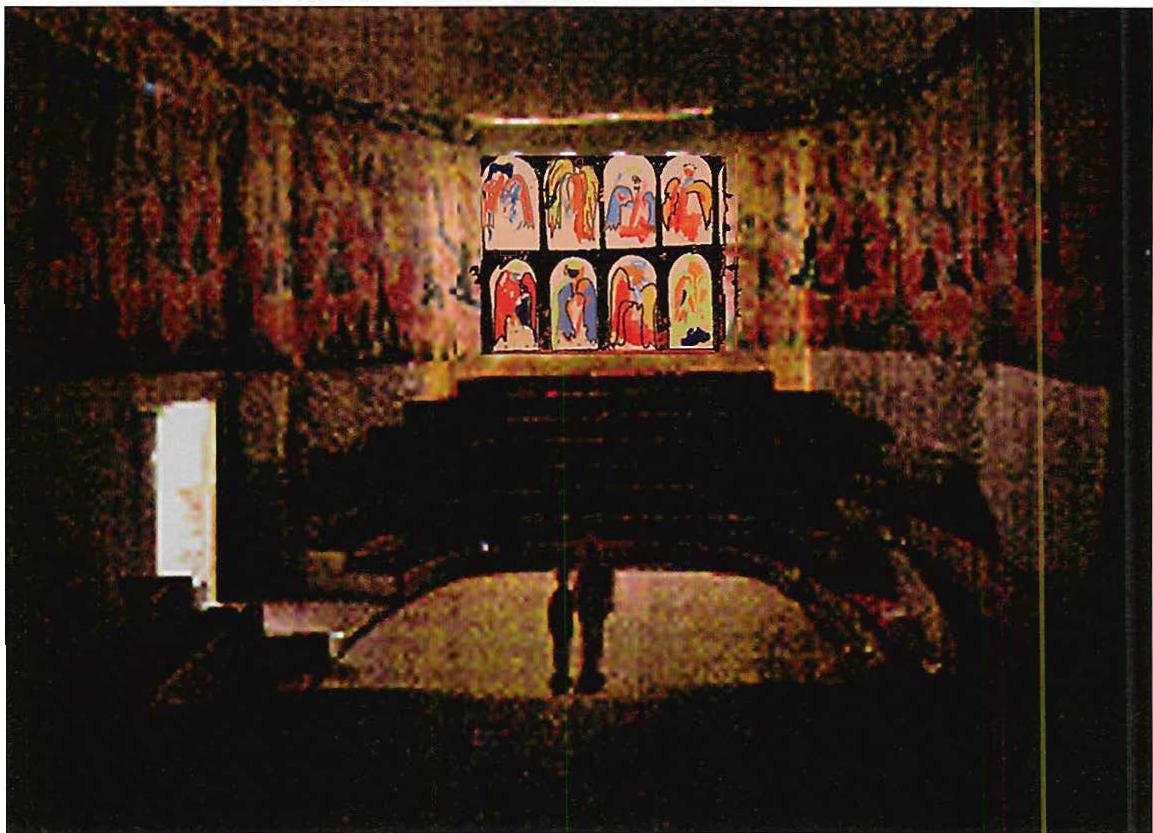
of image consciousness, there are many places where developers or corporate clients are prepared to spend money outdoors (to impress people)—yet often not indoors where people live and work. I would like to suggest to you, therefore, in your work in buildings, to make
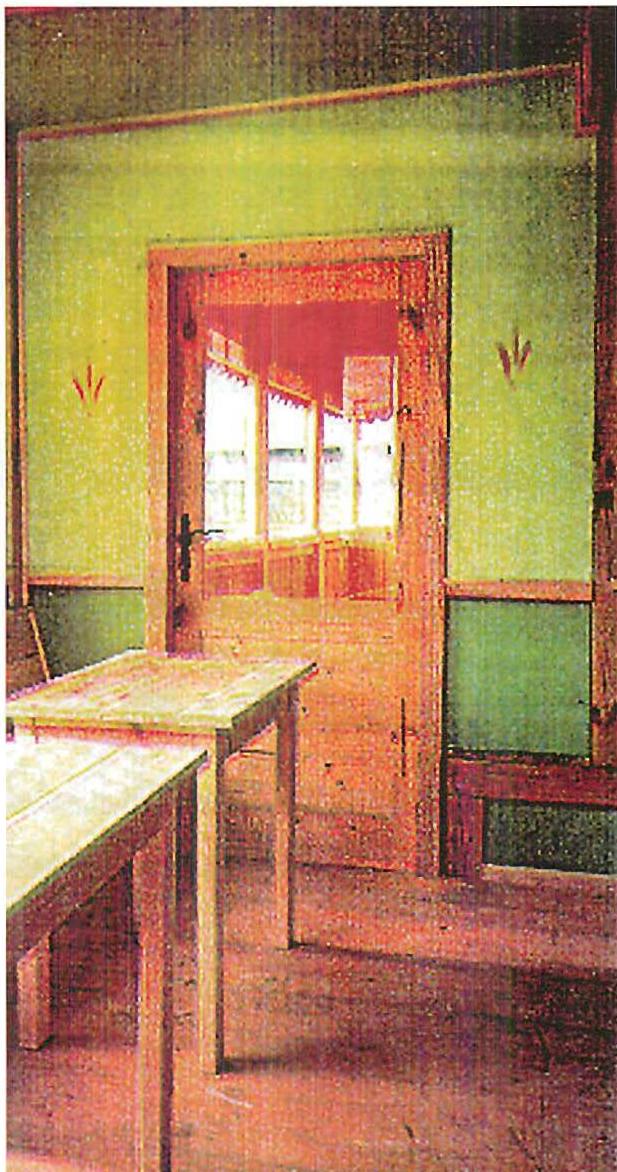
every effort to allow the value of the indoor space — the rooms themselves, their tranquility, their geometry, their peacefulness — as much weight, as much money, and as much effort, as the outdoors.
Various hints have been given in this section: How to create tranquility? Where does it come from? What will generate tranquility? The essence of it is pretty simple, but requires much concentration. Stand in the place. Ask
yourself what you should put there — a certain stone on the mantel, a color on a piece of wall, the shape of an opening. For any one of these, you ask, does it generate greater tranquility in me? If it does, keep it. If it does not, reject it. Keep on doing that, for everything around you.
And then, get rid of everything else. Get rid of everything that does not create this sensation of tranquility in you.
10 / TRANQUILITY EVEN IN THE HUGE
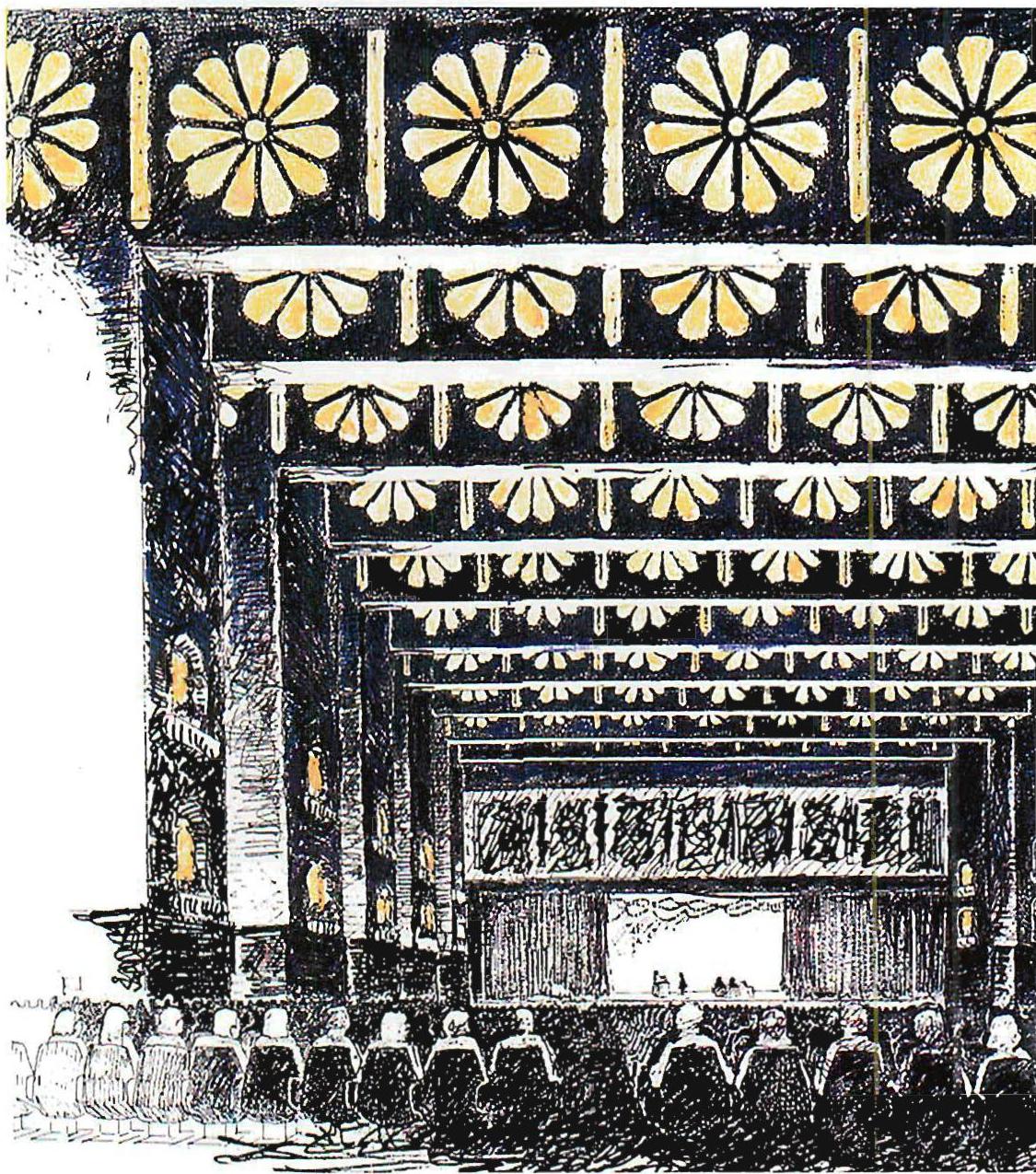
Tokyo Forum, interior of the Assembly Hall, a massive room, 50 meters by 70 meters, the columns so large that they each contain rooms at different levels. The giant chrysanthemums are pierced in the precast Vierendeel box beams, and illuminated. It is hard to imagine such a gigantic space as being tranquil at all. However, I believe the very simple repetition of the shining, highly symmetrical, and simple, huge blossoms pierced in the steel with soft yellowish light
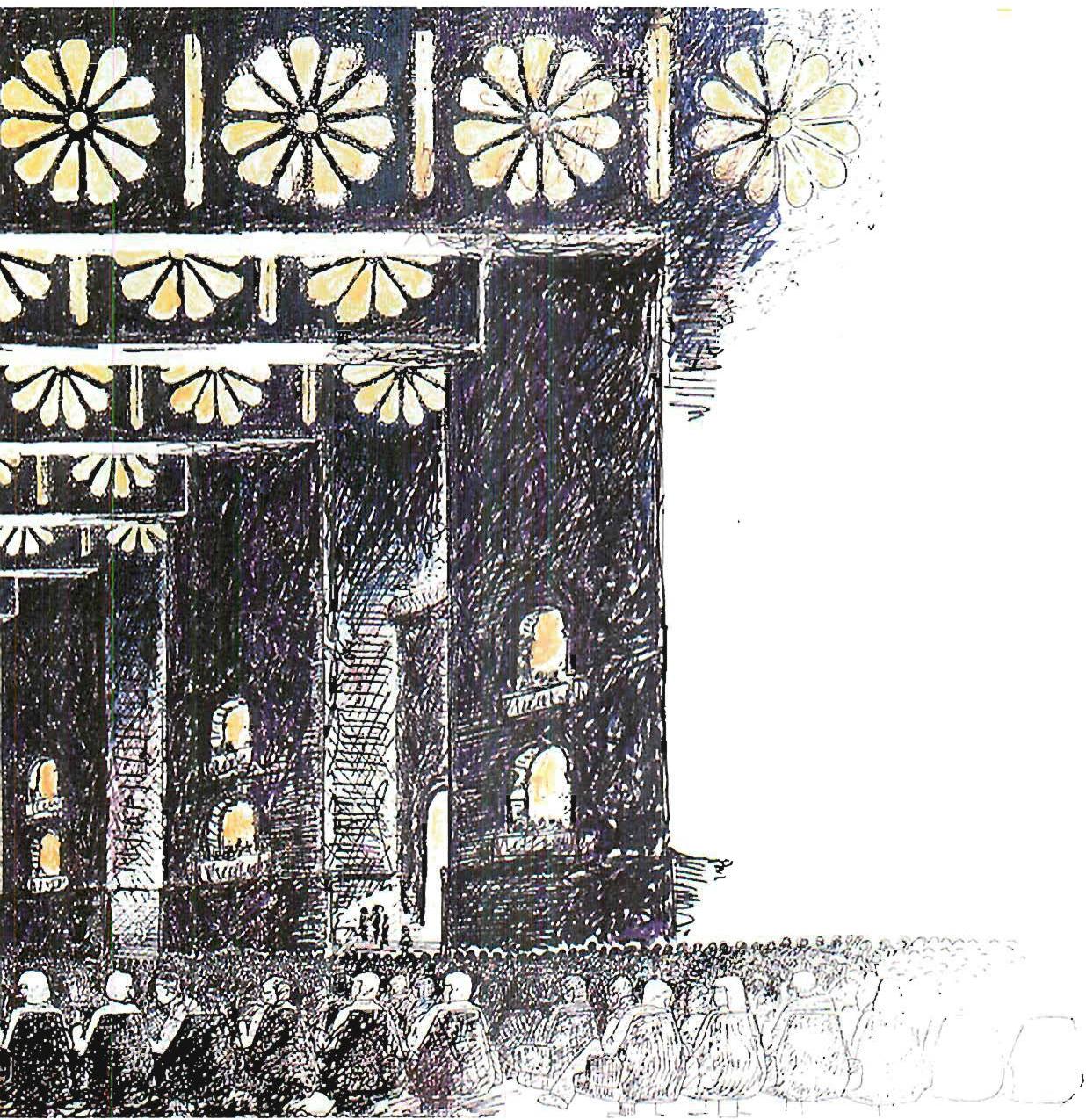
shining through them, the very slight butter on the massive columns, the blue tones in the blackness of the finish, and the rooms and arched openings within the huge columns themselves, all create a series of scales of fine structure, increasing detail—yet made so simply that with care in the working through, they might indeed become tranquil.
Christopher Alexander, Artemis Auninau and Annie der Bedroszian, 1989.
A FEW INVARIANTS OF ROOMS THAT HAVE BEEN SHAPED BY LIVING PROCESS
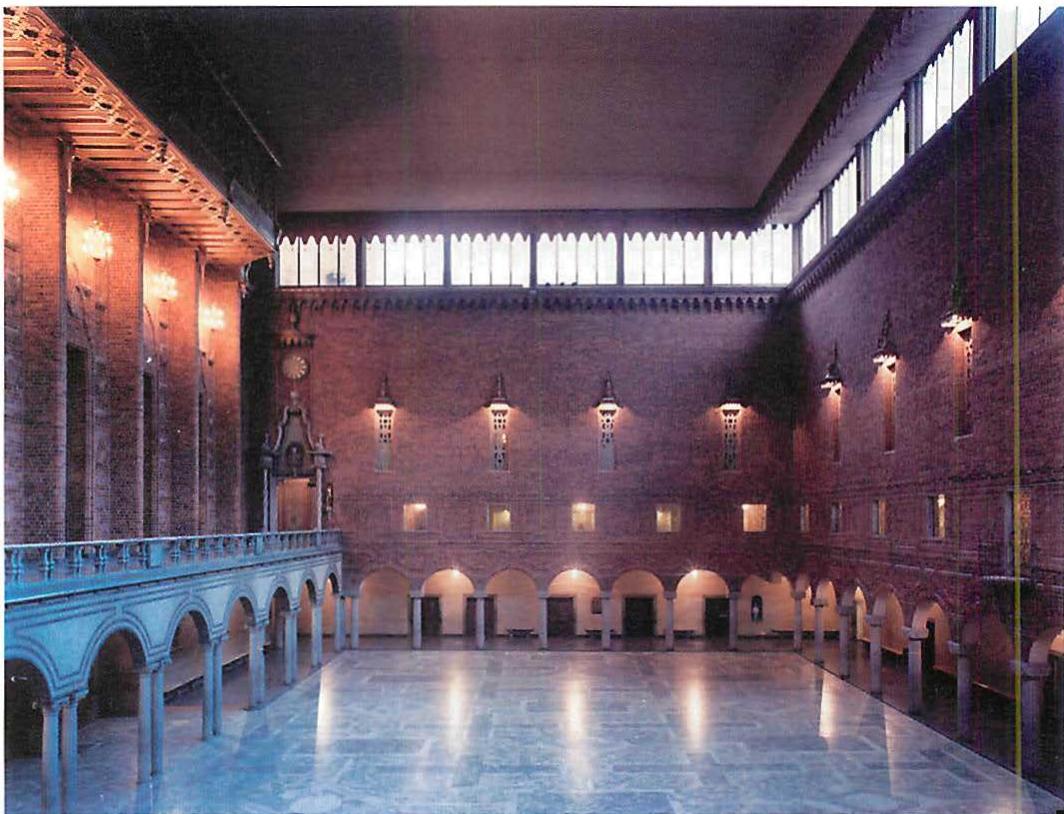
Individually, each room will most often be simple in shape, most often rectangular. If things are being done well, the odd-shaped rooms familiar from mid-20th-century designs will only very rarely appear. And when a room is indeed not rectangular, it will usually turn out to be a rectangle modified by the addition or insertion of other centrally symmetric components — a half octagonal bay, a small rectangular alcove, or a second rectangle combined with the first but retaining its existence as a center.
In the few cases where a room contains a major asymmetry, even then the composition of space will be such as to create a combination of locally symmetric centers combined to work within the overall asymmetry.
Most critical is the appearance within the room of a dominant, coherent center formed somewhere in the room by the positions of exterior, view, space, ceiling, and windows, so that there is a focal entity in the room: a place, a spot, a volume
space perhaps roughly as broad as it is tall, spherical in shape, of our own dimension, that makes a person want to be there.
The appearance of this invisible and useful center at the core of every room is the most subtle invariant of all since it depends on the presence, too, of other nearly hidden centers which make or break the structure of the room.
Many good rooms will, therefore, also have minor centers of a similar kind, supporting the main center and placed near windows or near other focal points.
In summary, four major process steps are needed to bring life to a room:
Choose the position so that room exists, beautifully, in relation to exterior garden, trees, to the entrance of the building, to the light.
Standing in the space which has been created by its position, conceive the main center and minor centers which will make this room alive for people who are in the room. These centers are primarily centers of space. They should be very concrete things: bay windows, seats, fire, bookshelves, a table, a protected spot, a beautiful window that draws you to it.
With the room volume fixed, attend to the filigree of wall surfaces, ceiling surfaces, visible structural elements that make the surface pattern of the room.
Finally simplify everything: simplify shape, simplify surface, simplify light, remove every non-essential, and choose each simplification carefully, to bring tranquility.
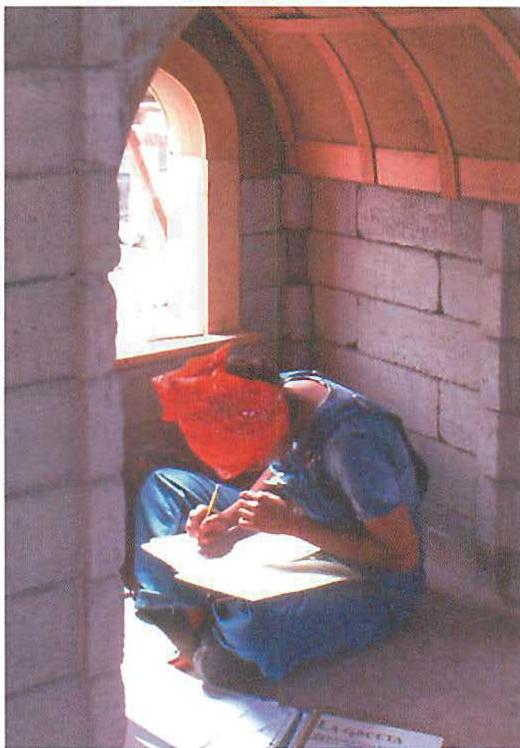
The next four chapters contain discussion of the fine structure of buildings. Fine structure is perhaps the most forgotten aspect of architecture. The vast majority of 20th-century buildings and engineering works existed almost without fine structure. Yet without fine structure, life cannot exist.
Chapter 14, CONSTRUCTION ELEMENTS AS LIVING CENTERS, first describes the fine-structure elements in any building, bridge, house, road, room. It describes the way that building elements in a living structure must themselves be things with life — building elements which have their own living character, force, and substance.
Chapter 15, ALL BUILDING AS MAKING, then shows how the fine structure can only be brought to life by a kind of process very different from the ones we have become accustomed to: a process that allows continuous, subtle adaptation of every building element, and allows human feeling to enter the production.
Chapter 16, INVENTING NEW TECHNIQUE, emphasizes the need for continuous evolution of new techniques which encourage adaptation and creation of well-adapted fine structure — a new branch of technology, necessary to the future of a living world.
Chapter 17, PRODUCTION OF GIANT PROJECTS, shows how, with invention, living processes can be kept going even in dealing with the most enormous multi-million dollar projects under today's conditions. Even enormous-scale, low-cost limits, and high-speed construction schedules are compatible with living process.
CHAPTER FOURTEEN: HOW LIVING PROCESS GENERATES CONSTRUCTION ELEMENTS AS LIVING CENTERS
1 / THE MOST DECISIVE, MOST TELLING ASPECT
What comes next is perhaps the most telling aspect of a building, that determines decisively whether it is any good or not.
The walls, are they living centers? Is the roof a living center? Is the roof edge a living center? Are the columns living centers? Are the windows living centers? Is every door a living center? Is the window sill a living center? Are the floors living centers? Is each ceiling a living center? Is the base of the main wall a living center? Is each beam a living center? Is the space between two beams a living center?
In the context of an awareness of living structure, these questions are natural, appropriate, necessary. Yet when one examines the buildings of the 20th century, it was in these aspects of their material construction that they failed most lamentably. During the 20th century construction itself—the making of buildings—was treated as something mainly mechanical and the intrinsic life of the building elements was almost forgotten. But with too little feeling in the details, a building cannot be a living structure.
2 / PHYSICAL SUBSTANCE ITSELF
Here we come finally to the actual substance of the building: the made building, the material fabric of the thing. In Book 1, I spoke about the abstract nature of a building: the centers which form it. Then in Book 2 and the first chapters of this book, I discussed the way in which the geometrical conception of the building is formed: first its volume as an enhancement of the site; then the internal organization, rooms, and engineering structure. Now we come to the materials and detail.
Assume that we have a geometrical conception of the building — on paper, or in the mind's eye. Now the building is actually to be made. We need to get a conception of the building as a real made thing: an assembly, a creation of material. It is in this phase, the conception and making of the building, where the building finally takes shape as something solid and worthwhile.
The essential question that must be posed at this moment in the evolution of the building, is whether the building details—the bits and pieces we touch, put together, and form—are themselves living centers. By the end of the 20th century this had become especially hard to do. We had lived through a period, in the last seven decades, where buildings were conceived on paper, and then built without regard for centers — often from cheap fast materials that are largely insubstantial. In California, for instance, in tens of thousands of tract houses built every year, the building is now most often conceived as if it were made of cardboard: the walls are then carried out as wood frame construction (a phrase that does not do justice to the extreme insubstantiality which occurs). Really, two-by-four construction is a glorified large scale kind of cardboard. It treats the building as if what matters is merely the plan and room layout — and then finds a way of making this room layout as if from enormous sheets of cardboard — replicated by two-by-four construction with plywood or sheetrock on it. This form of construction, invented about 100 years ago, is very efficient. It is fast to do. It provides easily for insulation and plumbing and wiring in the spaces between the layers. From a mechanical practical point of view, this form of construction is therefore natural, efficient, and
sensible. Yet part of its nature, too, is that the centers needed to bring life to space barely exist.
The building can only amount to something as a living thing when the various physical elements which appear in the building are profound centers. That will only happen when every wall, column, beam, capital, base, seat, window, door, board, tile—every part of the physical material and every connection—takes on its character as a profound center. Indeed, in the realm of building, that is the essence of the making art.
That is what I shall now address. It requires something entirely different from studs and plywood and sheetrock, different from prefabricated panels or concrete blocks. It requires that every part be thought of as a beautiful thing in itself, where the physical material of which it is made is shaped and treasured as a thing. Only when
that feeling is carried through, throughout the building, will there be something in the building that is worthwhile.
I may express the idea simply with the observation that the field of centers does not stop at any one level of scale. In a thing which has life, the wholeness goes through all levels of scale, and must go ultimately even to the crystalline and molecular levels. For life to occur, even at the larger levels, the microstructure must also be wholesome and well organized. This can happen only when we have the same level of control and carefulness in the realm of the construction entities as we do at the scale of rooms and buildings. It cannot happen otherwise. In short, the wholeness of a building cannot be fully understood only as a matter of color and geometry. It must have physical substance too.
3 / MICROSTRUCTURE OF A BUILDING
The importance of detail in a building has been apparent since the Middle Ages when masons shaped every piece of a cathedral stone by stone. In the 20th century it was recognized in Mies Van der Rohe's famous epigram: "The eye of God is in the detail." A hundred years earlier it was clear, intellectually, to John Ruskin, who discussed incisively the impact of detail in something as seemingly unimportant as the coping of a wall.
But during the late 20th century, in the years of modernism and post-modernism, when buildings more and more came to resemble cardboard stage sets, the fabrication of real building details as real centers began to seem like an unattainable dream to many architects. Some architects turned their backs on details altogether, perhaps on the grounds that real details are unimportant to the "image."
The cycle of the fundamental process, and the conditions which necessarily underlie any living process, give an entirely different view
point, which explains from first principles why the details of a building are so important, and why they must be carefully shaped.
The field of centers is a convenient way of representing the substance in our minds. It is the substance itself which actually creates the field. Life will not exist in a building unless it exists in the actual physical fabric of the building, in all the details of the way the thing is made. The actual physical geometry of the foundation, walls, windows, roof edge, boards, tiles, plaster, paint work, moldings is itself crucial to the existence of life. The sensuous quality of the building comes from its detail; substance is fundamental to beauty. Wholeness will not exist in the large unless it also exists in the small . . . and for it to exist in the small, it must be made.
This view is very different from the one typical of most contemporary architecture. According to the predominant mode of thought in late-20th-century architecture, it was enough to improve the design of buildings. "If the major
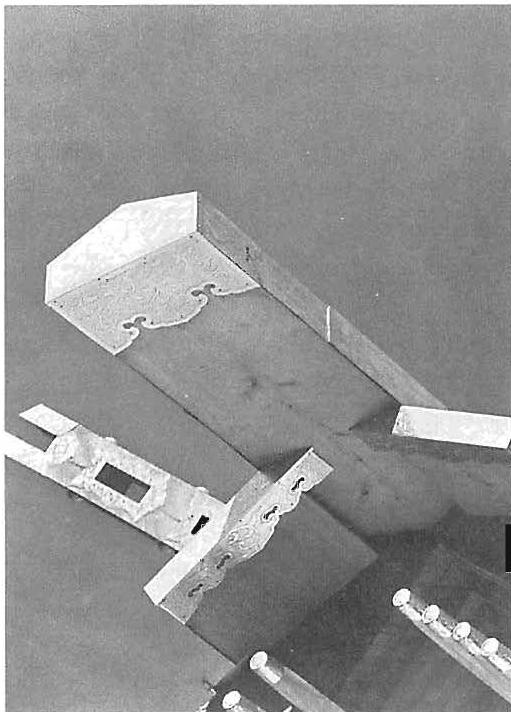
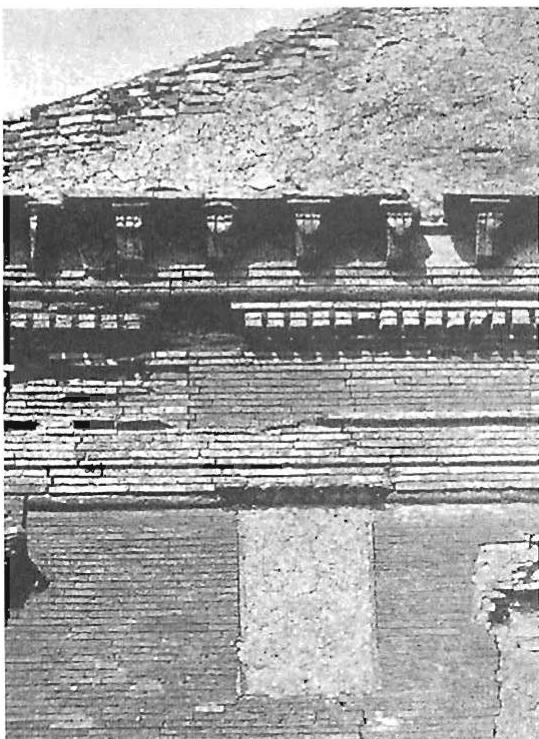
shapes and colors are right, it doesn't matter how the building is made: it can be made of any material, so long as the forms are right"—a caricature, but a reasonably accurate depiction of late-zoth-century architecture. Or, less cynically, at least it was assumed that any prefabricated modern form of construction would "get by" as a way of implementing the design of the architect.
To put it bluntly, that is all nonsense. The coherence of a field of centers cannot "stop" at some arbitrary dimension and be faked from there on down like a Hollywood stage set. The big field of centers will only be coherent if the microstructure which supports it is coherent too. This means that the field of centers must continue down, all the way from the large scale to the scale of the very small, even to the atoms and molecules in the construction materials.
Thus the proper construction of a building, the actual making of the elements of a well-
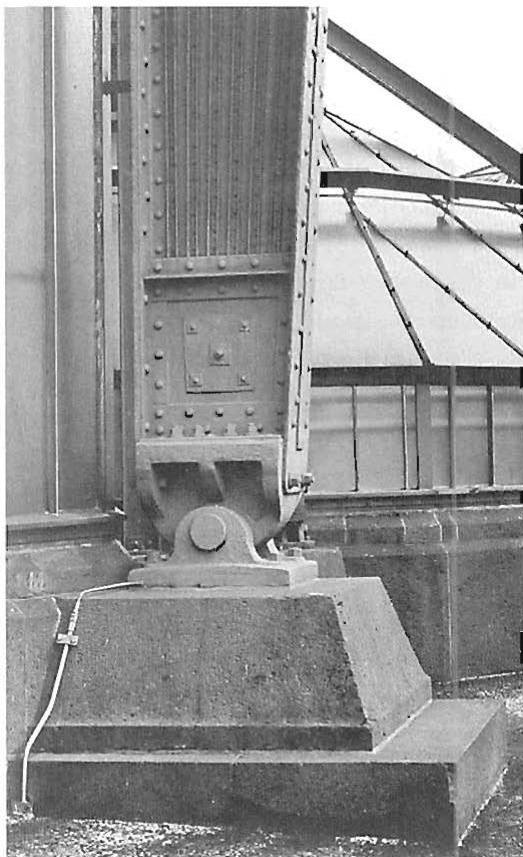


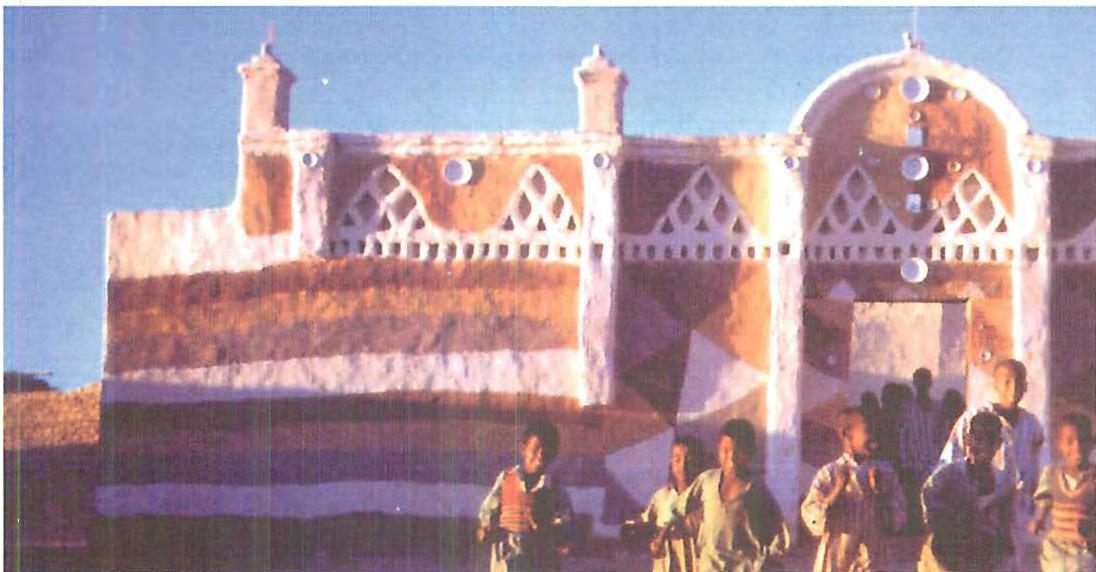
made work, cannot merely be the implementation of a design which is already clear down to the smallest detail. It is, necessarily, a living process in which the microstructure of the field of centers gets created, formed, imagined, adapted, and produced.
4 / MICROSTRUCTURE AS A NECESSARY PART OF ALL PHYSICAL ORGANIZATION
Before we try to understand this process of making every building detail as a living center, it is necessary to make some general remarks about the intimate relation between microstructure and macrostructure in any physical system.
Physicists have always recognized that throughout the universe, there is a relationship between the very large and the very small. It is now known that there are various ways in which minutely subtle details of particle behavior, if
changed in a minutely small degree, would utterly change the large-scale structure of the universe, its rate of expansion, the distribution of galaxies, and so forth. A change of one part in a million in the magnitude of the unit of electric charge would have created a universe without galaxies.
The metallurgist Cyril Stanley Smith has shown how the shape of ancient swords and the sharpness of their wonderful blades is related to the tempering patterns within the steel, which are in turn strongly related to the fine microstructure of the crystals—even of the atoms. In this case, the arrangement of the large is meaningless unless it is accompanied by a corresponding and correct arrangement of the very small.
The same is true for organisms. We take their larger structure for granted. But the larger structure depends, entirely, on the exact and
proper disposition of the fine structure of cells, DNA, and so forth. If the smaller structure isn't whole the larger structure cannot exist.
There are millions of cases like this. It is the rule of construction in all living systems. Again and again, the large scale order is absolutely interwoven and dependent on the tiniest details of microstructure. The large scale order depends for its existence on the most subtle ordering of details at the smallest subatomic scale.
And the same is true, and must be true, in architecture. If we are trying to construct a field of centers in a building, we must realize the field will not be whole, cannot even sustain itself as a structure, unless it is carried through from the larger scale structure to the fine structure. The macrostructure of the field is dependent on the microstructure of the field. If it is ignored or treated without respect, the larger field will fail.
5 / MIRRORS OF THE SELF IN EVERY BUILDING DETAIL
When a field of centers is completed all the way down to its atoms and the building truly comes to life, it begins to get a special sensuous quality, which is not predictable from the intellectual idea of the field of centers.
The substance will then speak directly to our feelings, and create an atmosphere of sensuous harmony quite different from the abstract representation of the larger field. The floor of the Baptistery in Florence is not only beautiful in decoration, it is also cool, smooth marble, made of many small pieces. The beams of a stave church are not only beautiful in shape and position, they are also made of massive pieces of wood whose grain, age, carving, and color are essential to their beauty. In ancient Seljuk tiles, it is not just the design, but the glaze, sheen, color, and clay which make the thing. In Shaker furniture it is the pine, glue, planing, joints, and paint which make it perfect. In a Romanesque church, it is the way that stone is laid on stone, the way that individual stones are cut, carved, and set, which brings the thing to wholeness.
Microstructure comes about from careful adherence to the unfolding process. This process, if it is followed faithfully all the way down in scale, will lead to a system of building details that is special to local circumstances and adapted to the whole.
This knowledge correctly places the emphasis on what wholeness really is. Wholeness is not something superficial which makes good design, or nice layouts, or ecologically satisfying buildings. It is a thing which is global, enormous in its extent, and nevertheless penetrates every microscopic aspect of a building, and connecting the
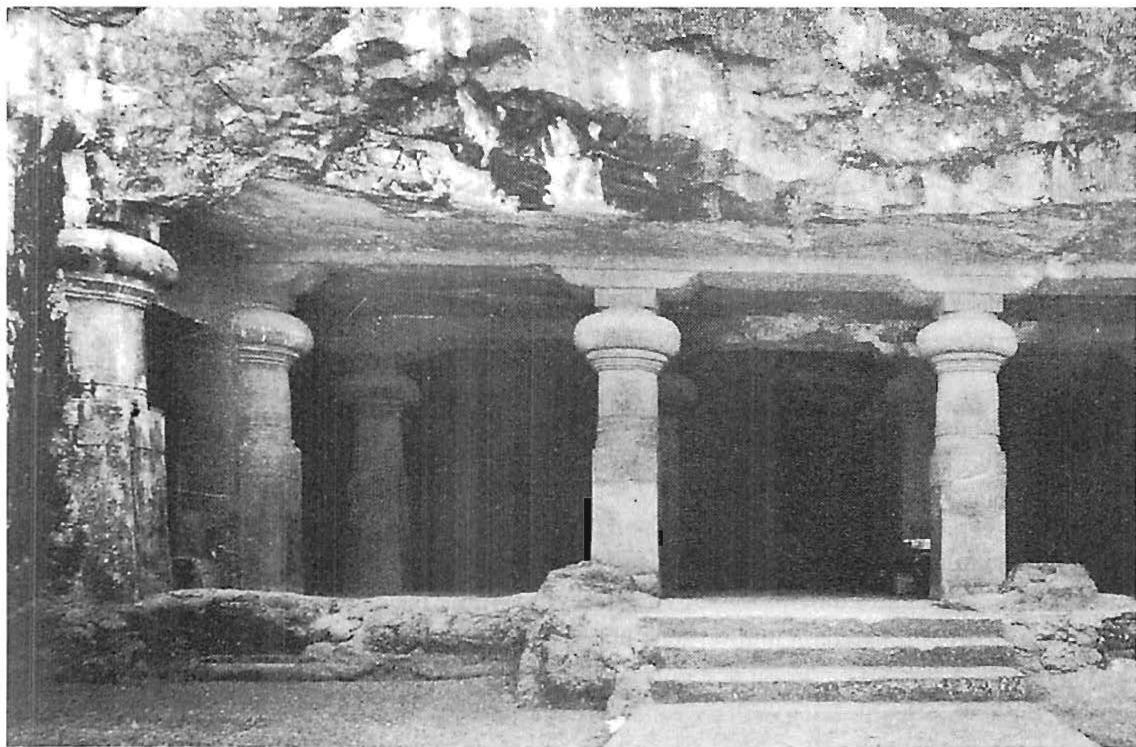
large, the middle-sized and the very small in a life-supporting unity.
In any building which is whole, the material substance out of which the thing is made is fundamental to its beauty, fundamental to its wholeness. The reason that these "extras" must be just right is that the field of centers simply cannot exist unless the material conditions are appropriate. This is not a new idea beyond the field of centers. It is the same idea. The wholeness still lies in the existence of the field but this field requires very definite conditions in its microstructure simply in order to exist.
The material substances a thing is made of and the detailed procedures of fabrication that control the microstructure, if they are wrongly chosen, can destroy the field. If they are chosen correctly, then the actual substance of the building begins to come to life.
When it is done right, each part of the building begins to take on life as it is formed because each part is, I have suggested elsewhere (Book 4, chapter 4 and throughout), a mirror of the self.
Even the columns and beams, hidden or not, are chosen to have this quality. The window sills are chosen so that the actual board, in width, thickness, substantiality of the seat which is created, have "self" in them, remind us of our own person and our wholeness (Book 1, chapter 8).
The individual panes of glass have the same quality. Each one has a shape which is related to the human person. The capitals on columns are shaped, cast, or carved to make a thing that, once again, contains and embodies the human person. Even the glazing on the door has the same quality. The most ordinary bit of concrete forming a path is made to have this quality. A row of stones, with gravel in between, begins to embody the human person, and to have its being in it.
In traditional forms of architecture, the creation of details which put the mirror of the self in every part was commonplace. The photographs presented on these pages show this. Other similar photographs in Books 1 and 2 have shown it repeatedly.
6 / UNFOLDING BUILDING DETAILS FROM THE FUNDAMENTAL PROCESS
Let us now consider, in more detail, why appropriate, beautiful, and self-like building details — though uncommon in the 20th century — must inevitably emerge from any living process.
In a natural unfolding of a building, the configuration of the building—the wholeness of that configuration itself—generates centers at various key points, and these centers break out from the unfolding process itself. This follows from the logic of the unfolding process. Centers which exist in a building configuration start by existing in a weak form. They are at first only latent. During a smooth unfolding with the fundamental process it is these latent centers which get sharpened and intensified and strengthened.
Consider an imaginary process in which a generalized building is conceived, in outline, as a hazy volume, its shape roughly known but not yet considered as a substance of physical material, brick, concrete, wood, plastic, steel and so on.
The hazy volume, even without knowledge of its material substance, already has certain latent centers which exist, just in virtue of the configuration. These latent centers occur most typically at the joints of the whole thing, but also in the major lines and planes and volumes which form the building. For instance, if it is a rectangular volume, there are latent centers at the corners. If it has a flat roof, there are latent centers where the roof meets the wall. If it has a pitched roof, there is an additional latent center
along the ridge, and at the eave. If the building has columns, these arise as latent centers. Where a line of columns meets the building roof or floor, there is a base, or a capital, all latent. If a wall exists, a low flat wall, then there is a latent center along the top of the wall. A wall, in itself, has latent centers, just by virtue of the wall plane; a roof surface or a ceiling surface, these, too, are latent centers. If a ceiling meets a wall, there are latent centers there.
In most traditional cultures these latent centers become strengthened to form natural "traditional" elements. Thus the latent center in the zone of the eave is intensified by construction detailing which strengthens this center and makes it more alive. Some of this development is function-based (gutter, ventilation, change of slope), other is what we would traditionally call ornament-based (cornice molding, special edge tiles, change of profile or material). But in any case, what is sure is that in almost every traditional culture, patterns evolved for elaborating the latent center of the eave.
In traditional cultures most building elements exist as traditions because they have been elaborated thousands of times in just this way. The particular way these elements are elaborated is what gives rise to the typical character of any one building style. The "style" is a set of details which have typically evolved at some place in time to deal with the further unfolding of the latent centers in the evolving building.
The window, the head of the window, the doorstep, the eave of the building, the ridge of the roof, the ends of the ridge—these are all places which have emerged as latent centers during conception of the building and its construction. As structure is preserved through unfolding, these weak latent centers were made into strong centers, one by one.
These centers which I speak about exist merely because of the configuration. They are there, whether we like it or not, latent in the geometry of any building's preliminary form. If we now apply the fundamental process to any of these latent centers, the corner of the building gets reinforced by a column, by a mass of strong material, by a buttress. The eave of a flat roof gets embellished to form a nicely shaped, strongly shaped, parapet; the eave of a sloped roof gets embellished and strengthened to form a coherent cornice or a coherent eave.
Thus we get a strong base to a column, where the column meets the ground. We get a pronounced ridge where the roof planes meet; we get a strong edge, or eave, where the roof meets the wall. We get a strong, often striking, head to the window, where the top of the window and its structural treatment are resolved. At the base of the window we get a sill, again, made strong, as a strong center, in order to carry out a structure-preserving, unfolding process. We may get reveals on the windows where the window meets the wall and then this place, too, is developed as a strong center.
In this fashion, all the typical elements of traditional architecture will get built—must be built—as a direct consequence of the repetitions of the fundamental process which make up every living process.
In a building formed under the impact of living process, we shall therefore find all these elements made beautiful. When I say beautiful, I mean that each of these elements becomes a substantial living entity in its own right—it really does become a living center.
So as a direct result of an unfolding process, each of these major categories of latency in building form will get a coherent type of living center associated with it.
IN THE FOLLOWING NINETEEN PAGES, I SHOW EXAMPLES OF LIVING CENTERS MADE IN THE BUILDINGS AND EXPERIMENTS OF MY CONSTRUCTION COMPANY, DURING THE LAST THIRTY YEARS.
UNFOLDED CONCRETE CORNER ON A BUILDING: A concrete building with a strengthened corner formed in concrete, marked and shaped so that the corner becomes a beautiful center. The technique of making this building is so fluid, and each step follows from the previous ones so smoothly, that the strong, marked, shaped corner has unfolded merely from the existence of a latent center at the corner, and the capacity of the building process to intensify this latent center.
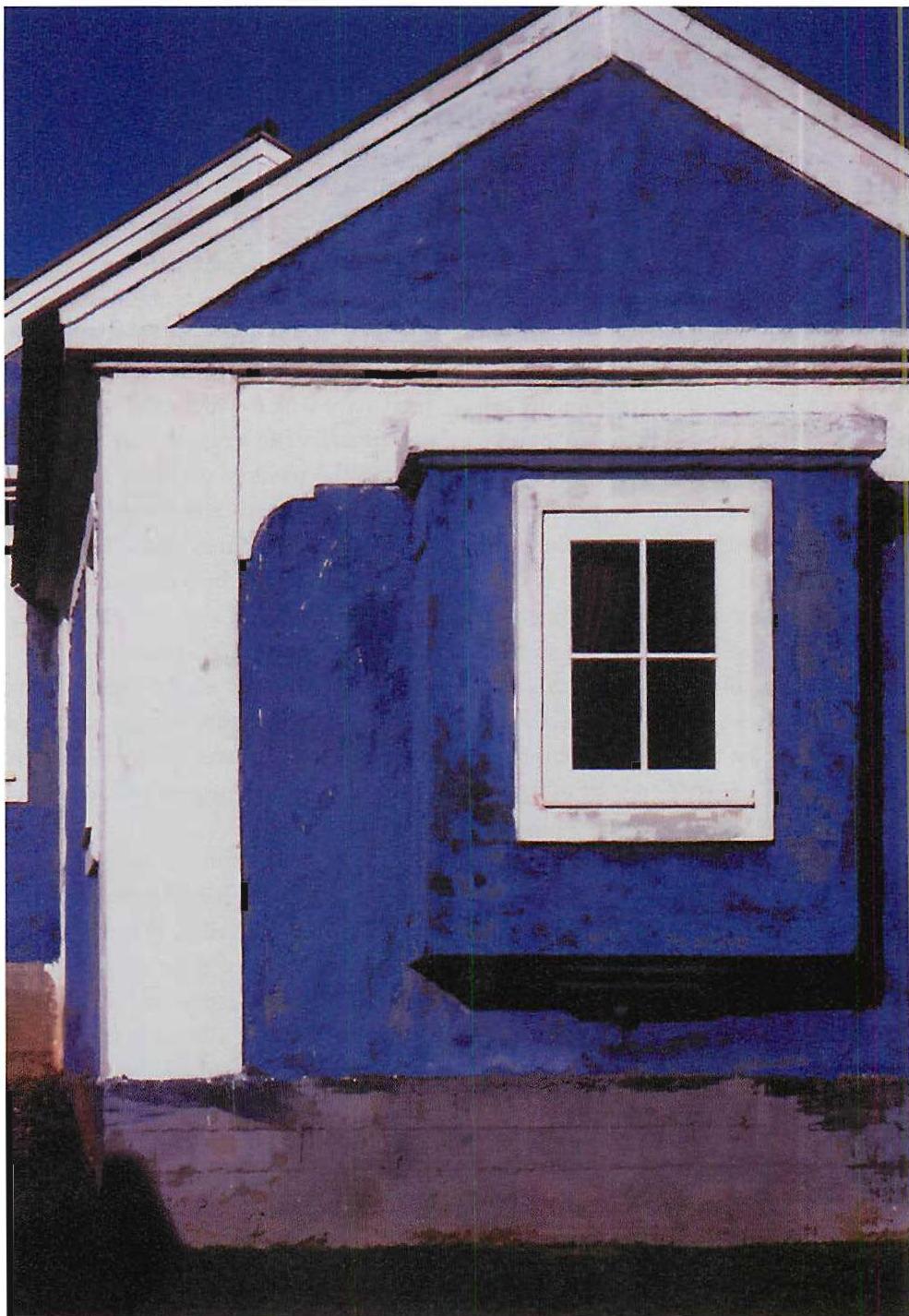
UNFOLDED STAIRCASE, MOLDED TO A COMPLEX SHAPE: A wooden stair, made in fir and pine boards, cut and fitted to complete and fill the complex shape, so that light, position, and gradients all play their role in making it a perfect thing. The shape is unfolded because each board is cut, at the time of its making, to fit the positioning and character of the previously placed boards.
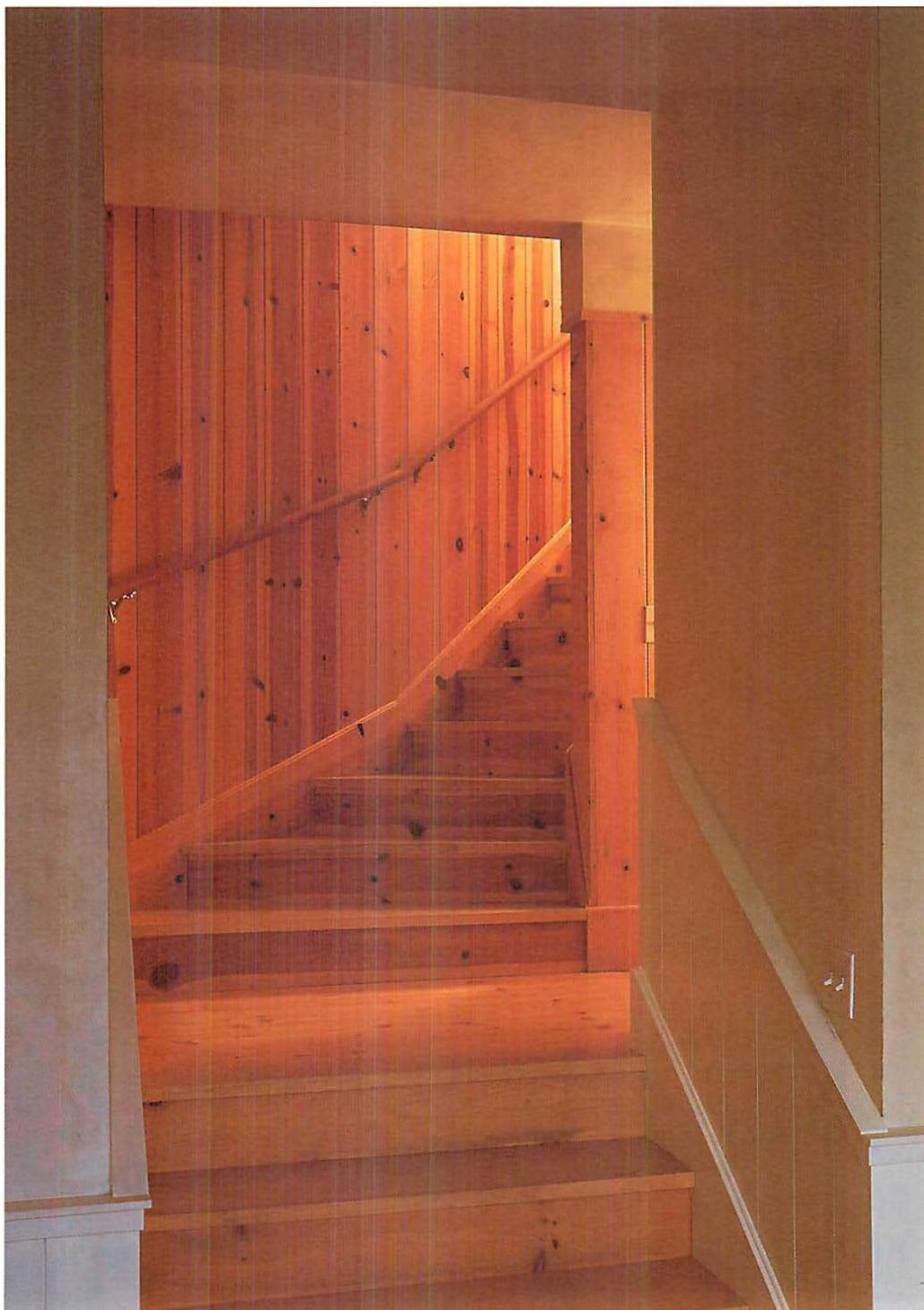
UNFOLDED STRUCTURAL PANELING IN A WALL: A paneled wall of brick and stone and concrete. The individual panel separators are made in limestone; the bricks inset in herringbone are two-inch bricks, fired scarlet: the whole thing set in a mass concrete conglomerate with elements interlocking structurally in three dimensions, so that flints, bricks, and stones are united by concrete poured above and between them, over a concrete base. There is a real interlock in construction so that the flints and bricks are unified with concrete poured below and between.
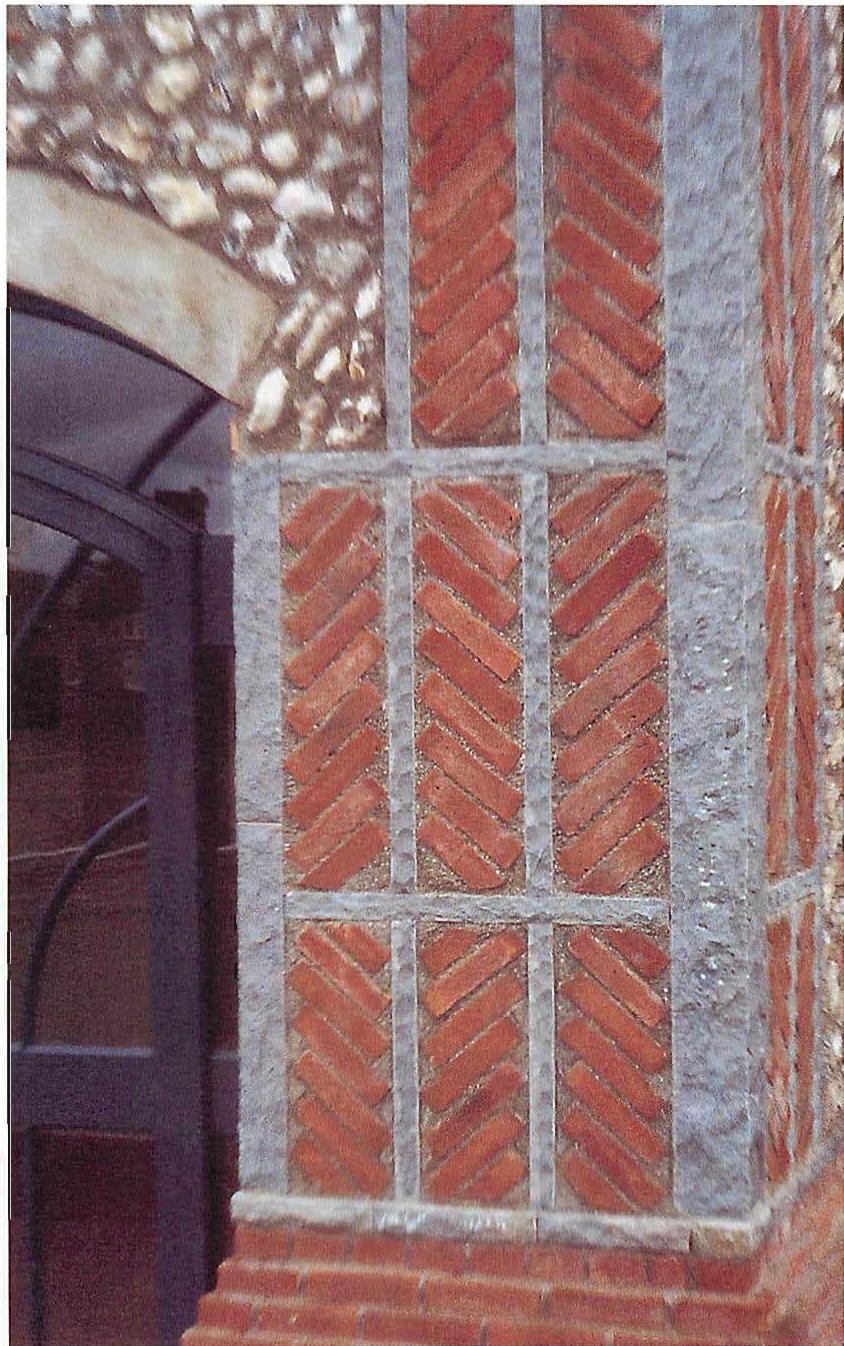
TWO UNFOLDED COMPOUND WALLS: In the upper illustration, a wall made of massive concrete columns with recessed bays and tiled surface walls above. The unfolding was from bays, to columns, to capitals, to windows, to tilework alternating with a concrete plaster. In the lower illustration is a wall in an early experimental stage: it was made of large, cast, nearly black concrete blocks with white marble inlays. Each of these blocks has life in its own right as a center; here we were testing the ways these blocks could be used to form the wall integral with the marble inlays.
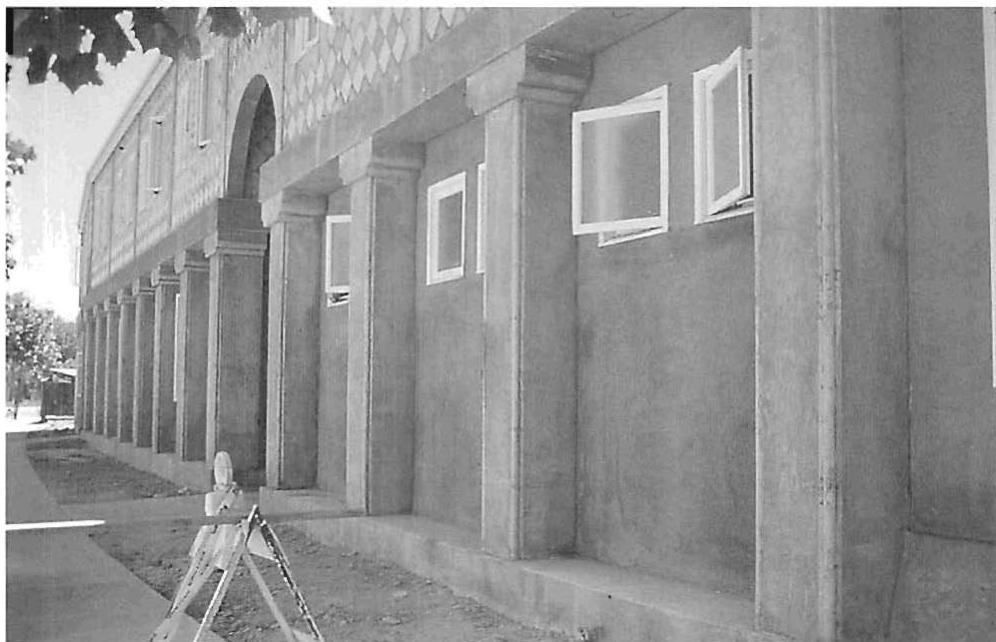
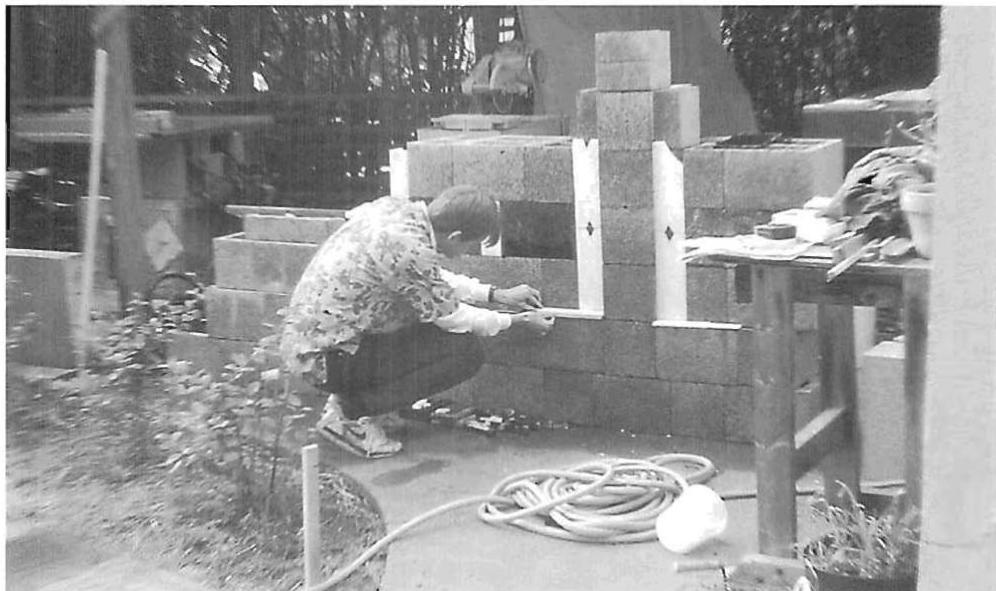
UNFOLDED ORNAMENTED CONCRETE SURFACES: These designs were unfolded from an endless plane, starting from the most basic repetition of symmetries inherent in the plane, then elaborating the formation of repeating forms. The two surfaces show different methods which allowed the design to be unfolded in material substance from the actual casting and working of the concrete.
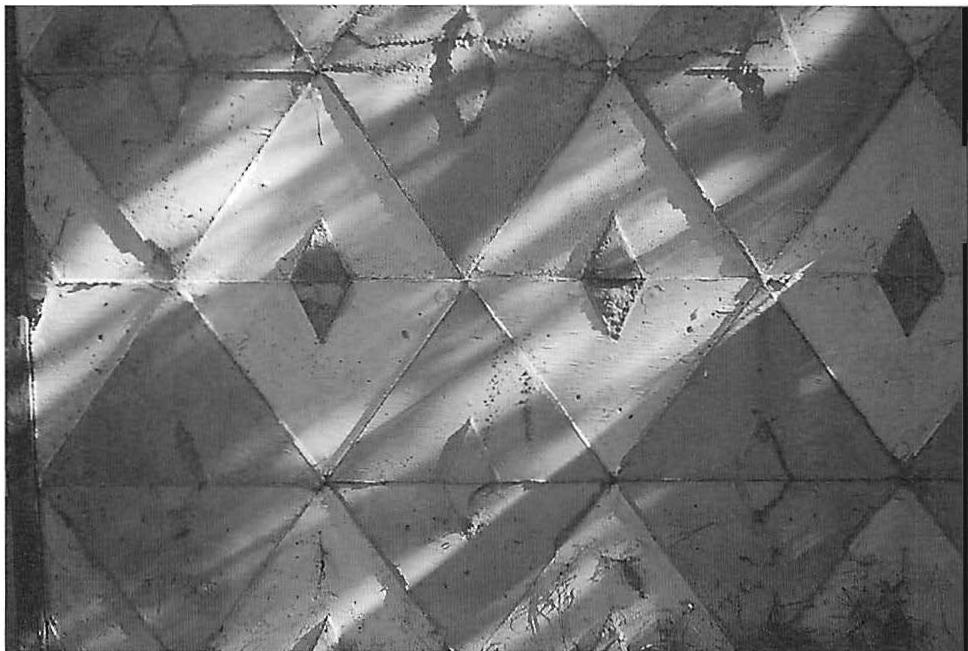
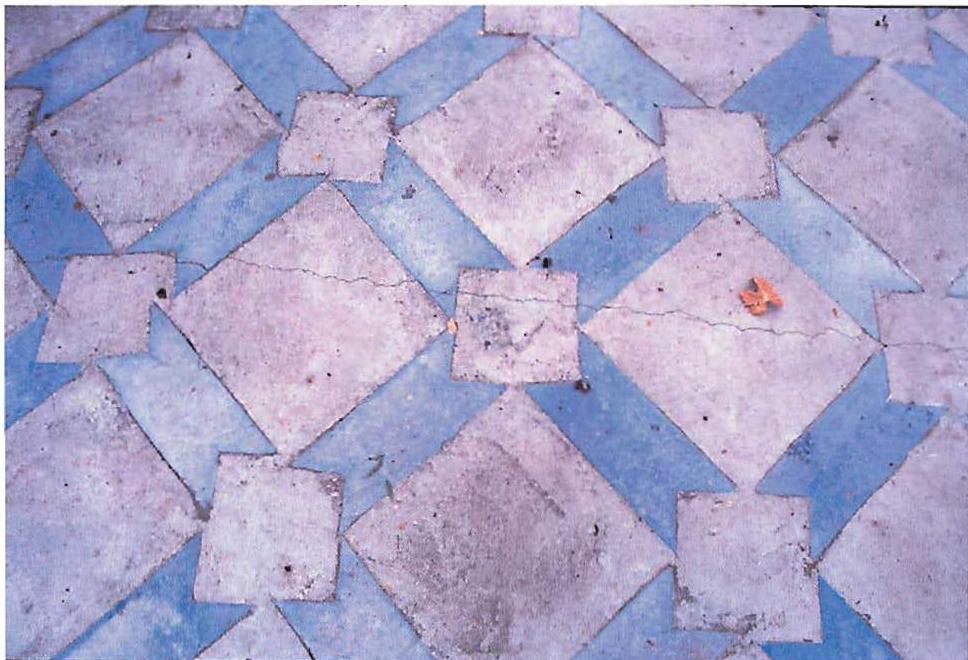
UNFOLDED COLUMN BASES: Free-standing heavy timber columns, 11 inches by 11 inches, and about 11 feet long. Each column is machined so that a steel plug and concrete shaft go into a deep mortise in the column forming a beautiful connection, which, though invisible, gives the building its emotional weight.
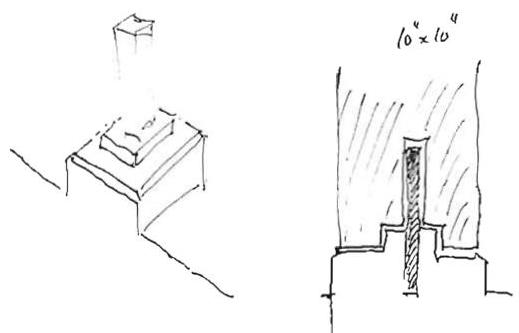
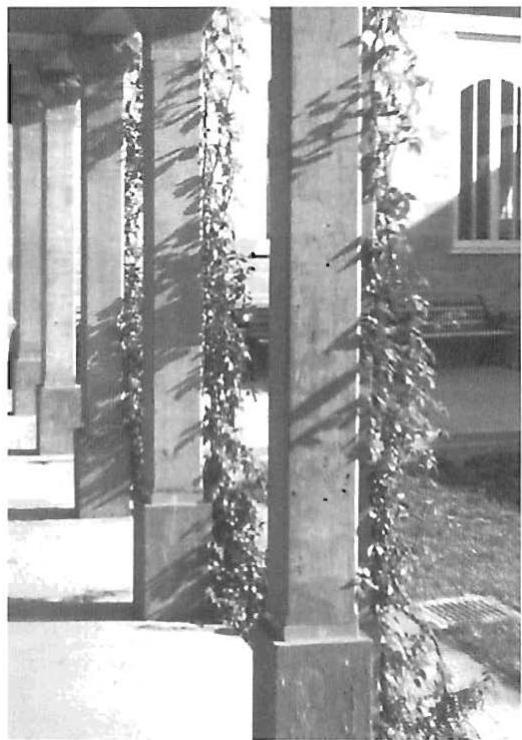
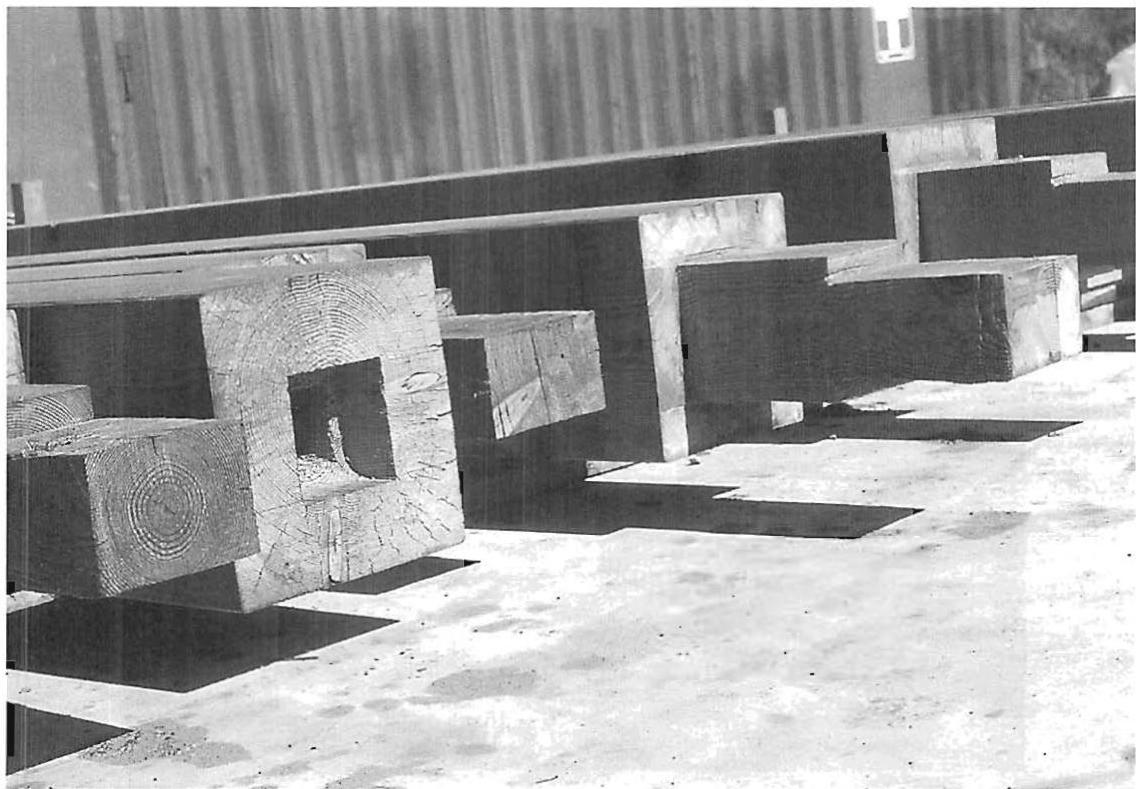
UNFOLDED LOW-BUDGET COLONNADE: Free-standing columns made to be entities which have some significance because the columns are large enough and well-shaped. Those on the opposite page have received careful shaping through the use of low-cost guidework and a concrete gun. Those shown on this page are cheaply made from special cylindrical earth-cement blocks, fabricated in our own molds.
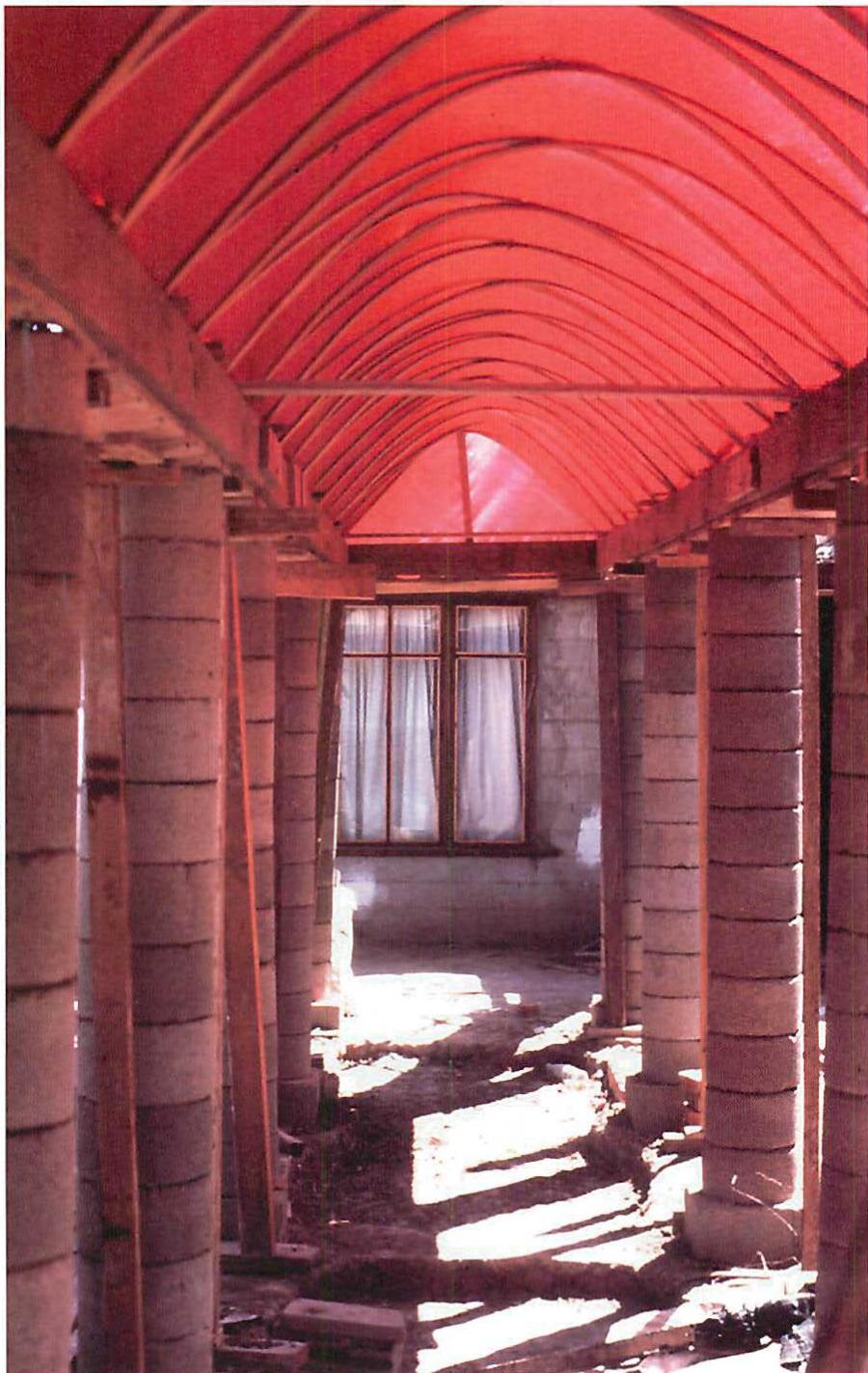
UNFOLDED COLUMN-SHAFTS AND BEAMS: In the case shown below, the column and the beam and the point of intersection of the two all form coherent centers. The sections of beam between the columns have a good shape, yet the beam is structurally continuous from column to column and within the columns.
These columns and beams are able to unfold from the situation and take the necessary shape, replete with centers, because they are made by shooting gunite into lightweight, low-cost, open formwork.
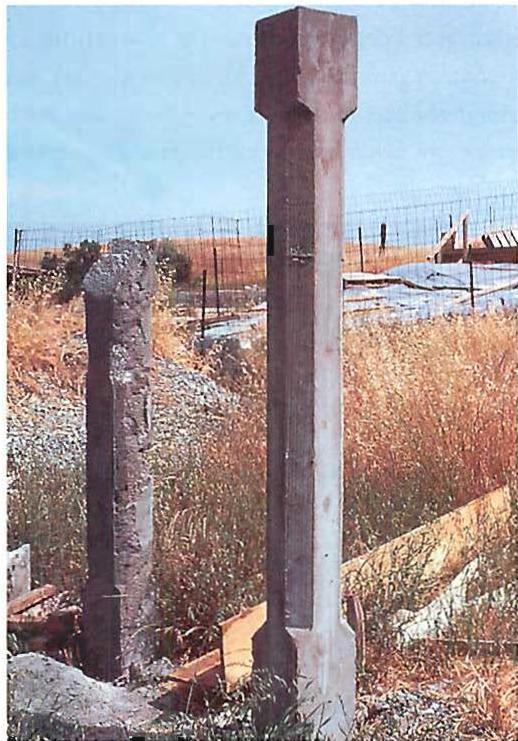
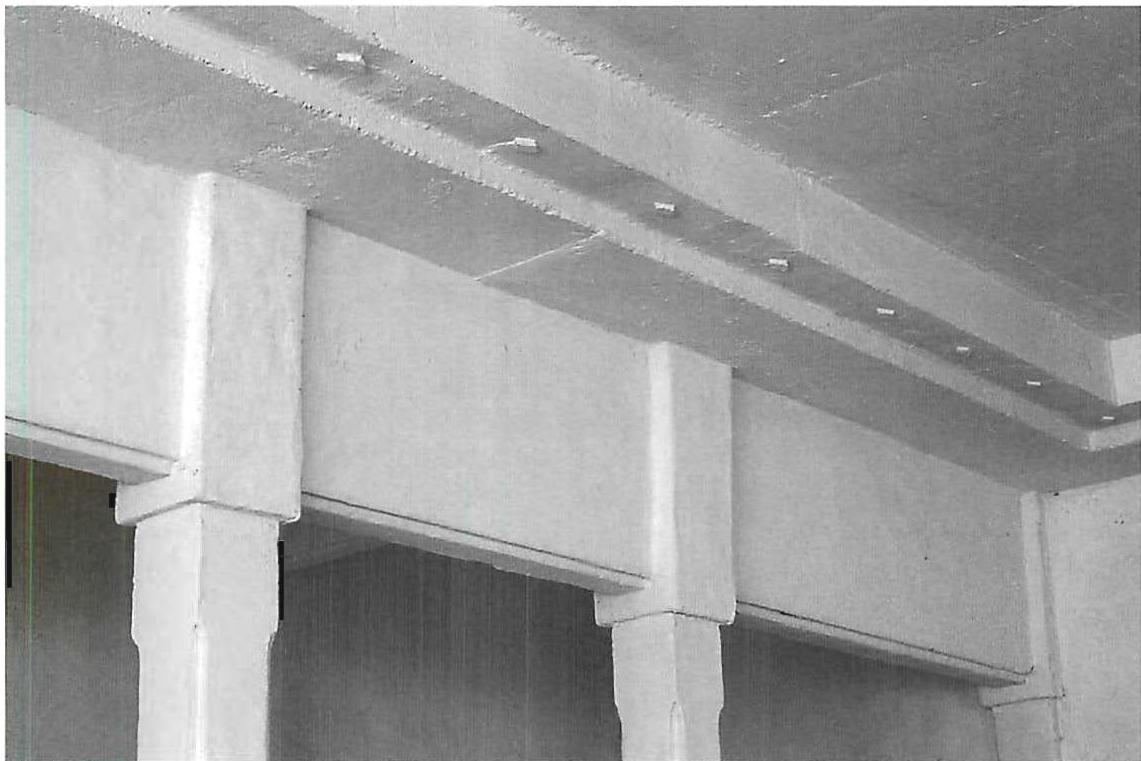
UNFOLDED CONFIGURATION OF A WINDOW AND SURROUNDING WALL: A window as a center. The window itself, beautifully shaped and specially made with curved sash. The window surround, cast concrete. Beyond the cast concrete is the herringbone brickwork. Below the window, emphasizing the center even further, are bands of alternating flint and stone and concrete and brick.
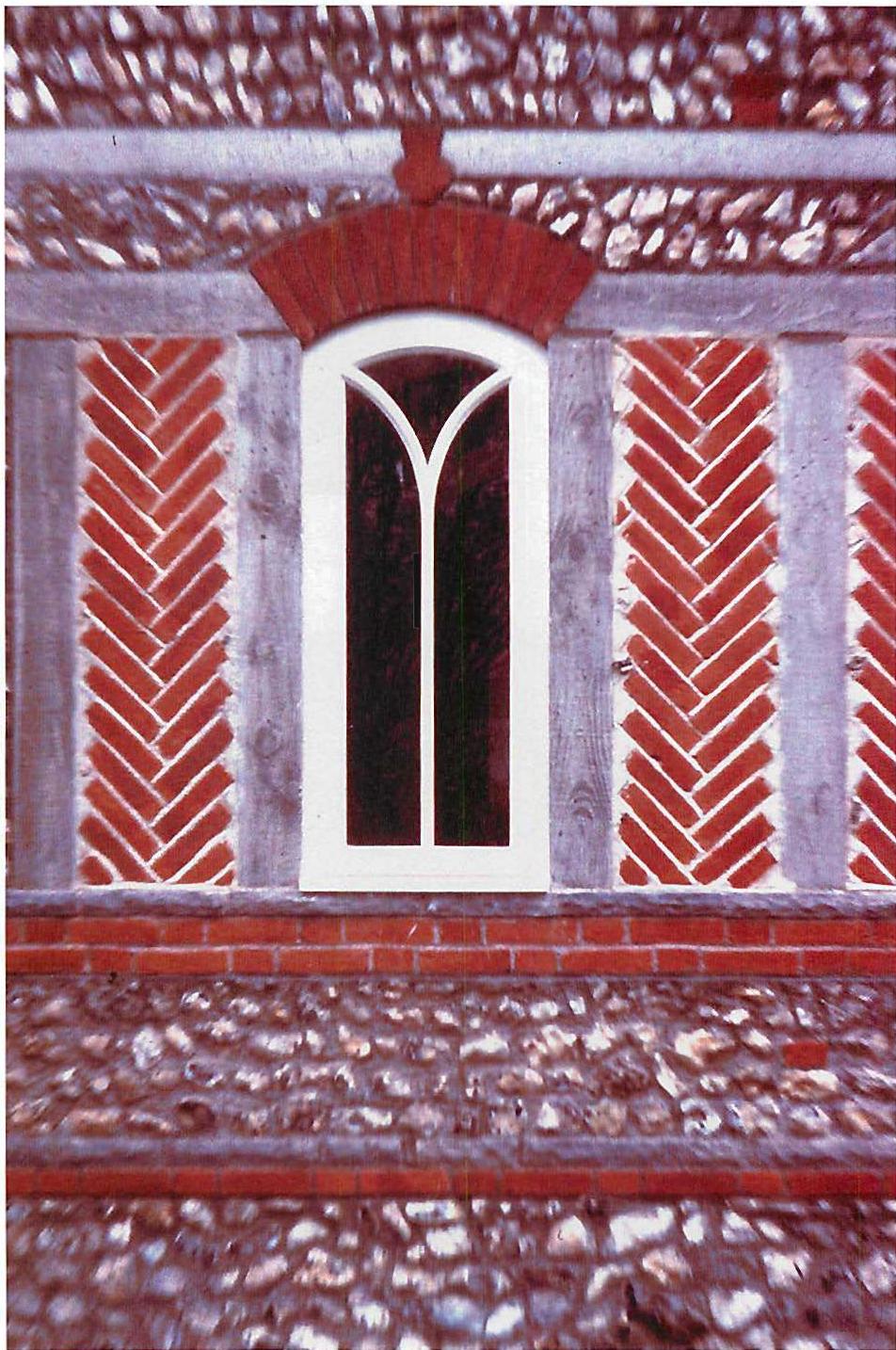
This wall segment, part of the construction of the West Dean Visitor's Centre, West Sussex, England, shows a fully integrated masonry structure in which brick, stone, concrete, tile, and wood cooperate structurally, and in a way that permits individual shaping and sizing of all the elements without compromising structural integrity. 1996.
UNFOLDED BEAUTY OF WINDOWS: The window, its shape, its internal organization and glazing bars, all made to be things of beauty in their own right.
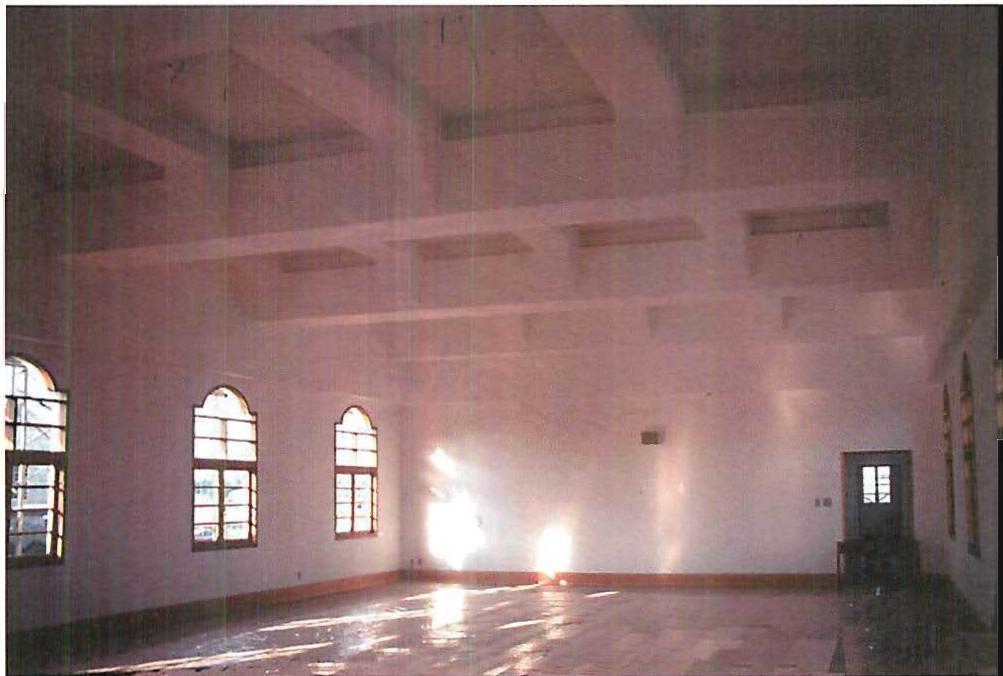
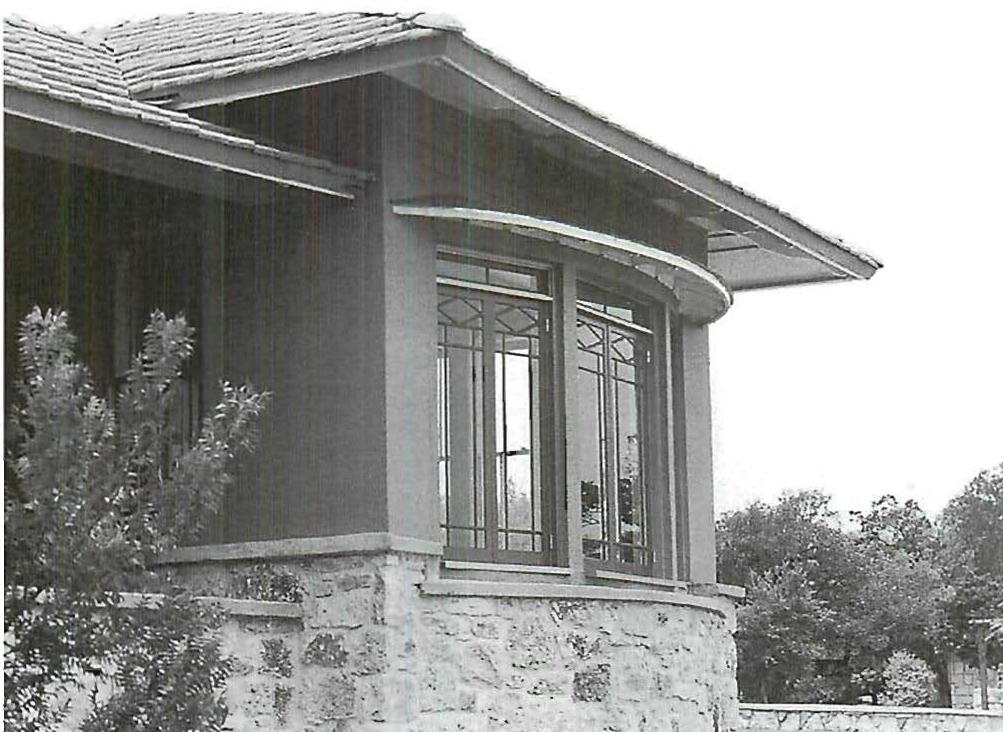
UNFOLDED ROOF EAVES, THREE CASES: You see how the latent center at the meeting of wall and sloping roof forms, and then requires some substantial center to be formed there by the unfolding process. This principle is expressed diagrammatically, and discussed, with the drawing on page 497. On this page we see three different versions of it: a heavy concrete cornice on a building in Japan, a light rafter and sub-rafter structure in Texas, and steel brackets holding the roof rafters of the gymnasium.
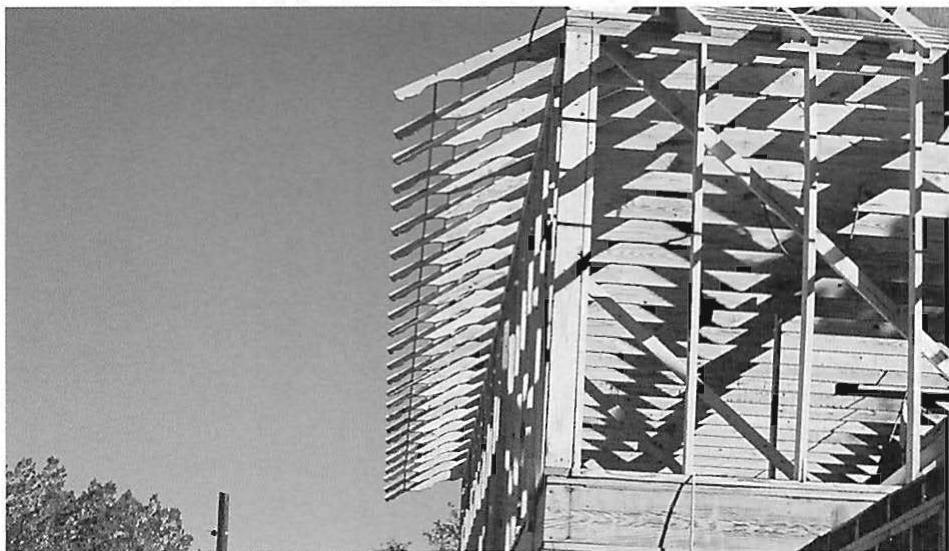
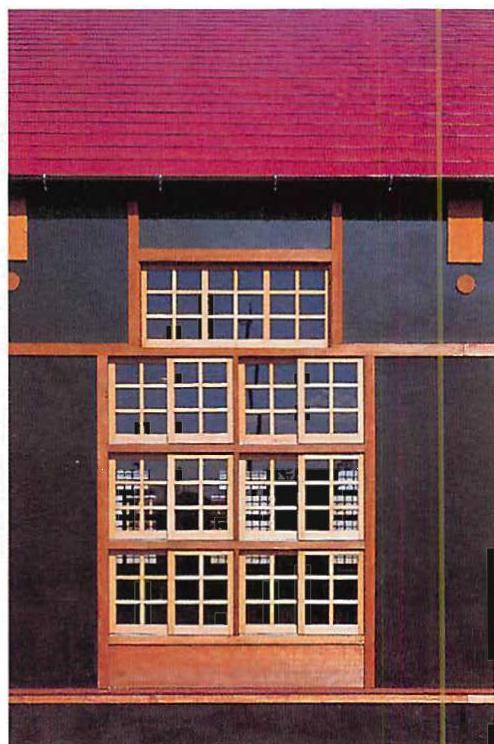
UNFOLDED ELEMENTS OF A GREAT BRIDGE: A system of prefabricated, precast, thin concrete shell elements, assembled to form the east span of the San Francisco Oakland Bay Bridge. The elements at different sizes — cantilevers, bases, arches, towers, smaller arches of a pedestrian walkway — all follow naturally from the unfolding of the original structural idea — the chain of double cantilevers — which itself unfolded from the weak foundation clay, and the need to avoid long spans and to reduce cost.
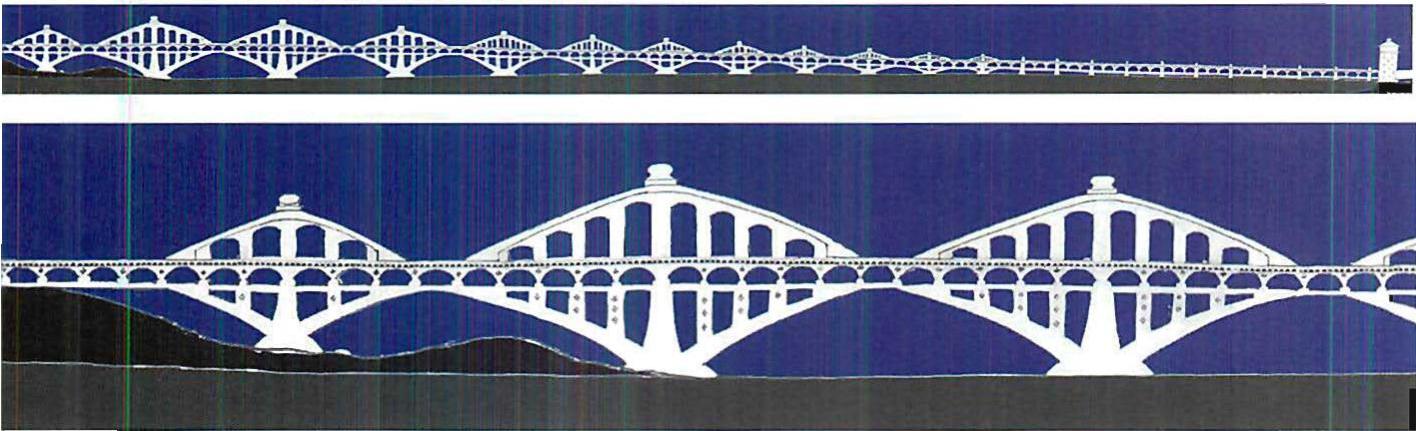
UNFOLDING OF A ROOF SURFACE: Consider a sloping roof. It is a uniform surface. But it contains some structure; the ridge and the eave are defined. These centers then induce a system of latent centers within the wholeness, and these latent centers may be thought of as lines running down the roof slope, parallel to one another. What, then, is the most direct way of intensifying this latent structure? It is to create a system of alternating elements which run the water off the slope. I show here an example of the "Russian" roof which I have used several times. There are two layers of long boards running from ridge to eave. In each layer, each board is milled to contain two grooves. The grooves lie in such a way that a drop which falls between the grooves gets into one groove and flows to the eave. A drop that falls outside the two grooves in the top layer flows to a point between the two grooves in the bottom layer, again then flowing to the eave. Mathematically, the uniform system of centers that is latent in the roof is replaced by a system of ALTERNATING REPETITION in the boards. Each board, by virtue of its two grooves, is made a STRONG CENTER; and what we see is a system of wide boards, with BOUNDARIES, and just visible, a narrow bit of the lower board, between each two boards. The pattern of boards which forms the roof is a direct, uncomplicated, embellishment of the structure of centers already latent in the situation.
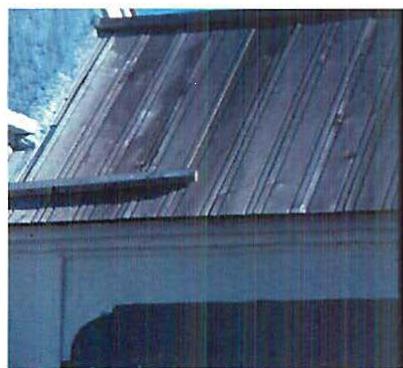
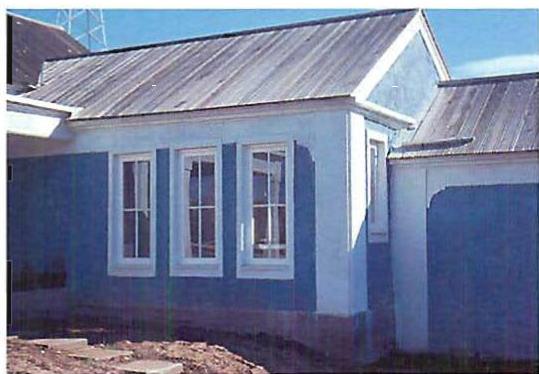
UNFOLDED FLOOR SURFACES: In this floor, we made each tile in the shape of a fleurs de lys so that the tiles fit together and yet give you the luminous impression of a floor made of beings. The red color of the tiles, against the gray stone, is remarkable.
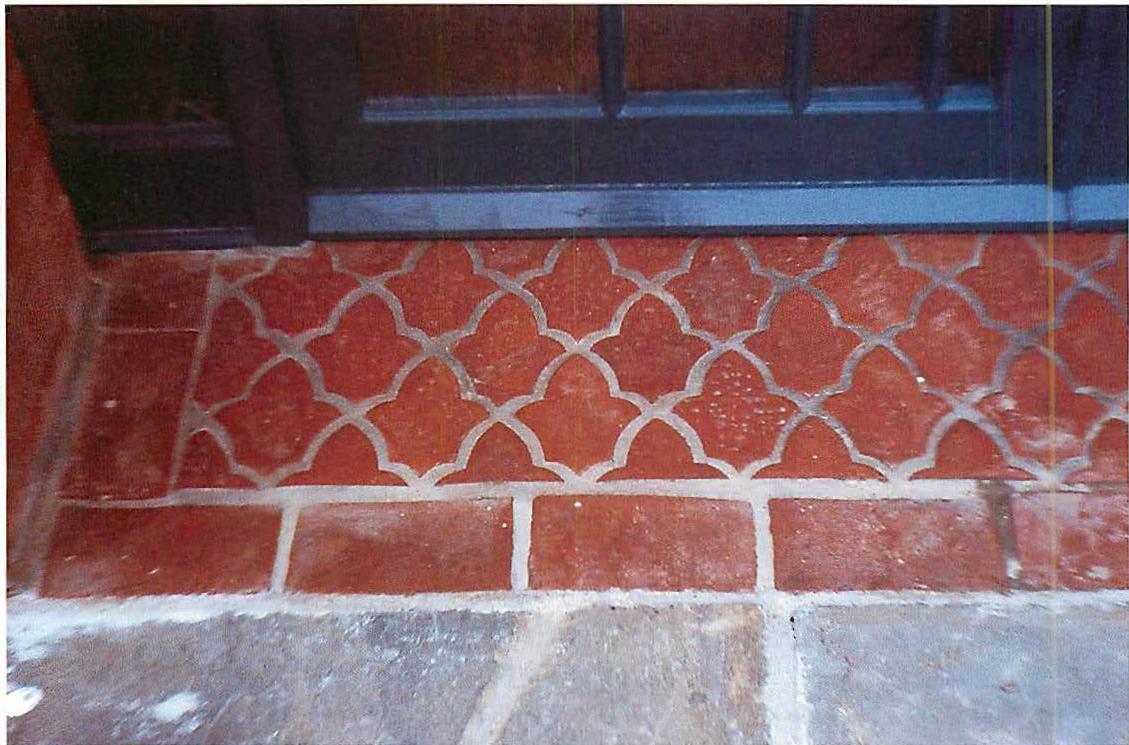
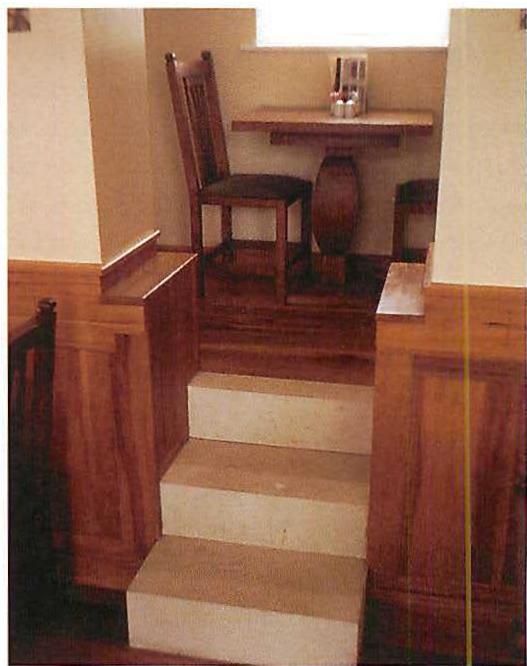
UNFOLDED CONNECTION BETWEEN WOODEN COLUMNS AND BEAMS: On this page, two types of capital that we used. Both are made of the same heavy material as the columns and beams: bolted through, to take the weight and to take shear forces, keeping a beautiful and positive shape, which intensifies the connection of the members.
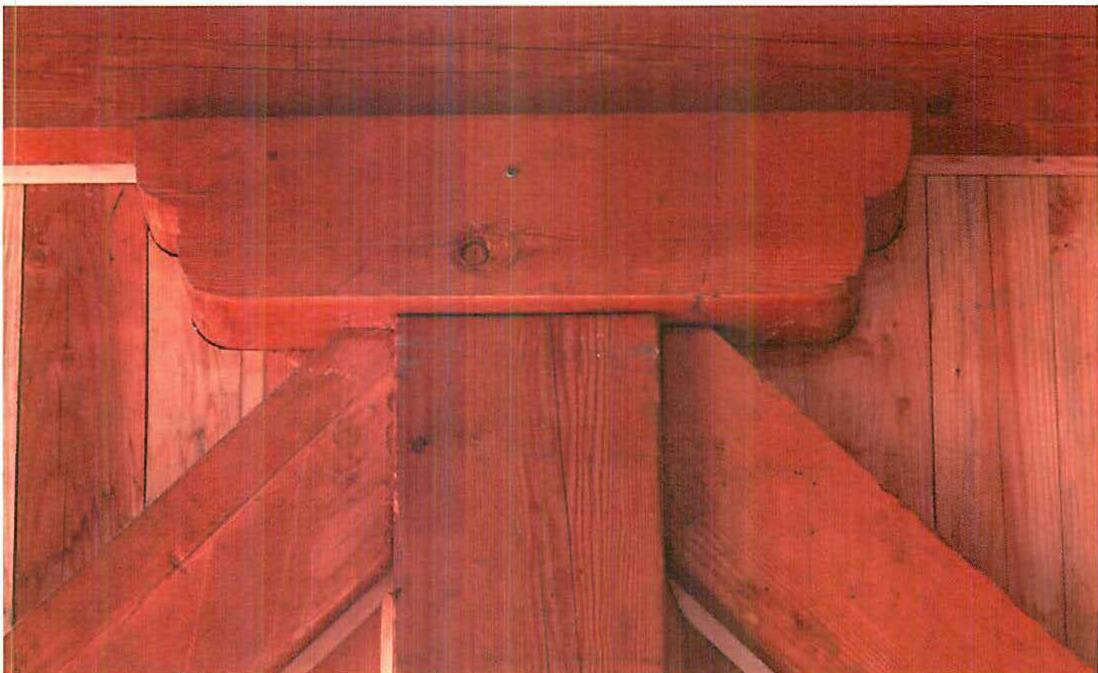
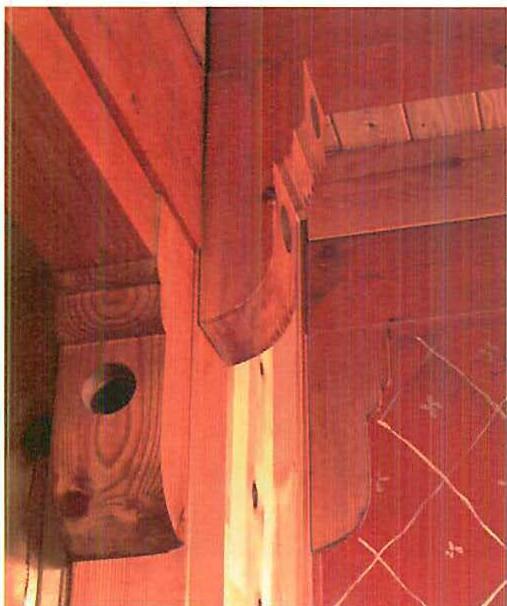
MISCELLANEOUS UNFOLDED DETAILS: A WINDOW OPENING, A DRAINAGE CHANNEL IN A PATH, AND AN ARMREST IN A BUILT-IN SOFA: The window shows its centeredness rather clearly and was specially made: the curved glazing bars were drawn on a full-size drawing of the arch and came naturally from watching how the lines fell. The gutter in the path—gravel, brick, stone, easily made—was composed to be a living center just by judging the relative proportions of the areas of brick and gravel and stone.
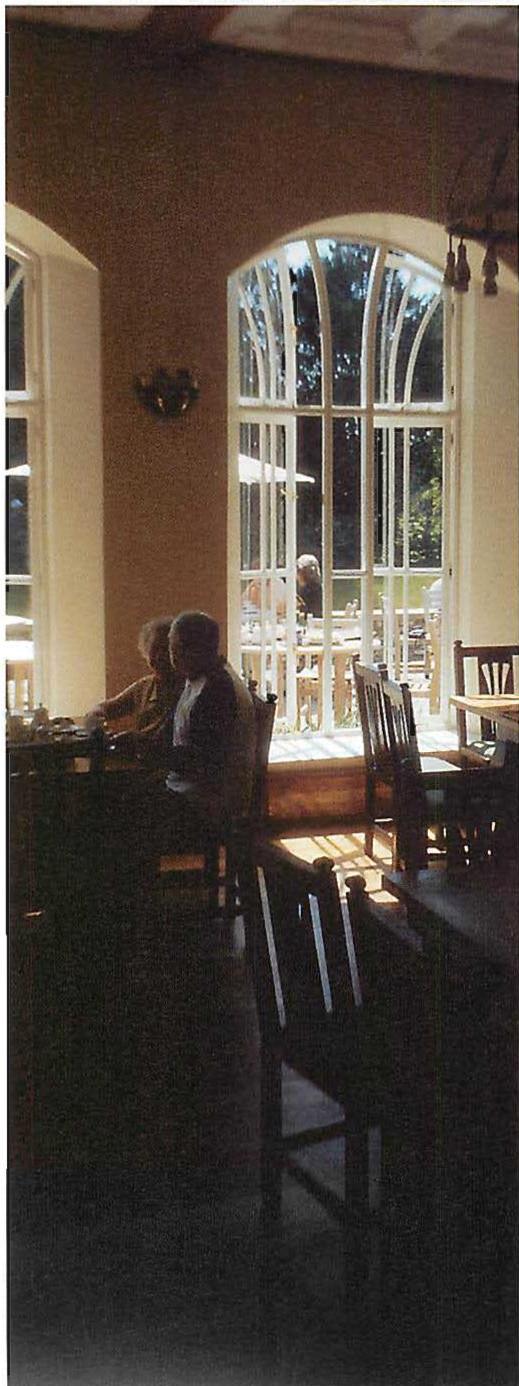
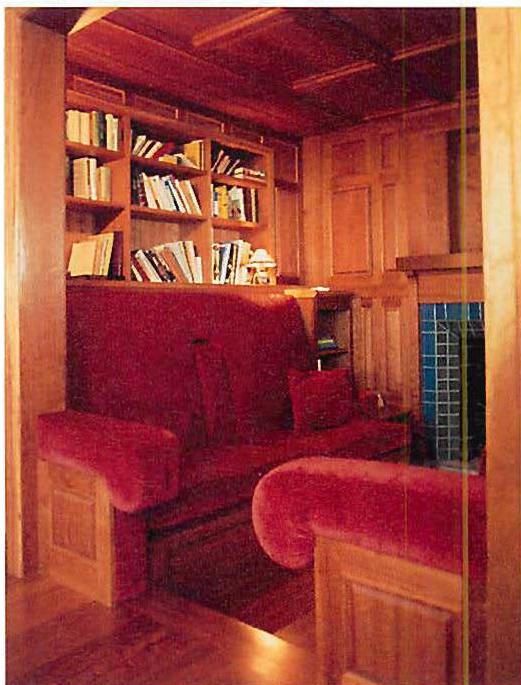
UNFOLDED ELEMENTS OF FURNITURE DESIGNED FOR HERMAN MILLER: Each element shaped to be a living center, both a practical and efficient thing, and also something which will nourish the person using it just by virtue of its shape
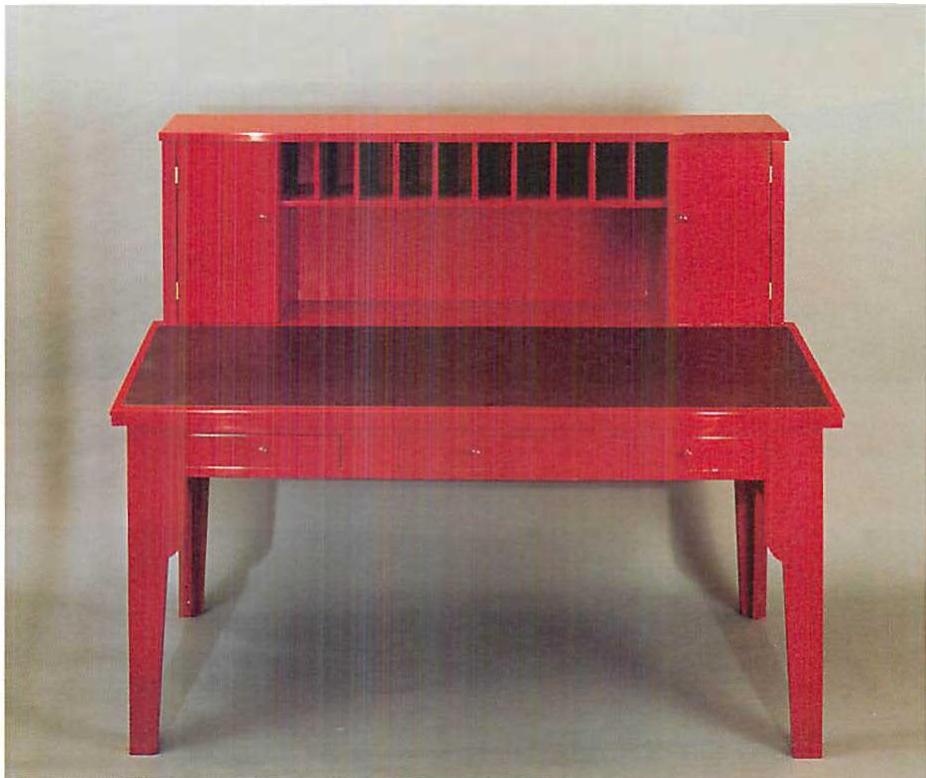
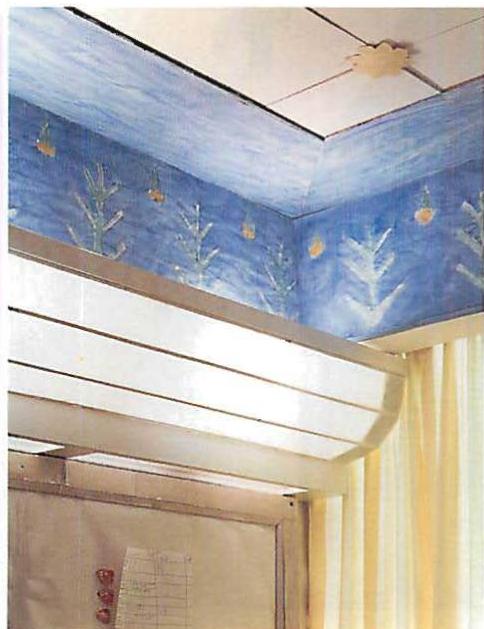
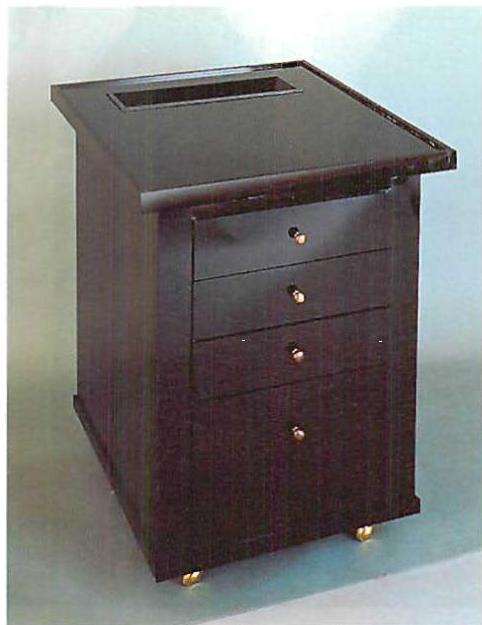
UNFOLDED OUTDOOR WALLS AND BALUSTRADES: These walls and balustrades are themselves living entities, simply made. The wall is even rather rough.
Very robust garden wall made from old hardened-up cement sacks, with a poured concrete cap; the surface of the hogs was shot in low-budget shotcrete. See discussion in Book 4, pages 130-31.
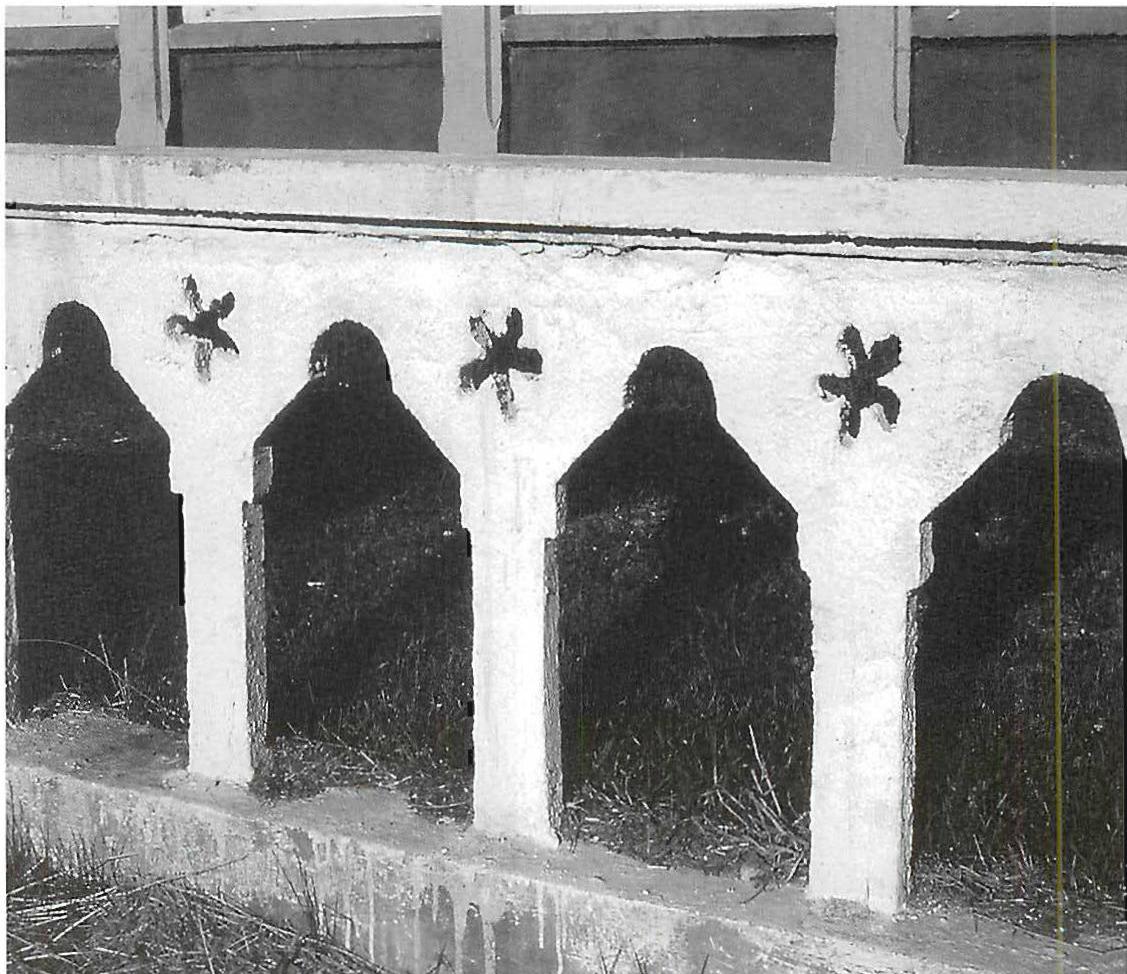
Balustrade in which arches, columns, and flowers are formed with cheap foam inserts, pinned onto a sheetrock backing, and shot with gunite. Christopher Alexander and David Davis, 1980.
AN UNFOLDED WALL FOR A TEMPLE COMPOUND SURROUND: Ten foot high, the wall started from a vision of giant eyes along the top of the wall: that vision led to a sense of the height of the wall; that, in turn, to the battered shape; and that to the details of its practical construction.
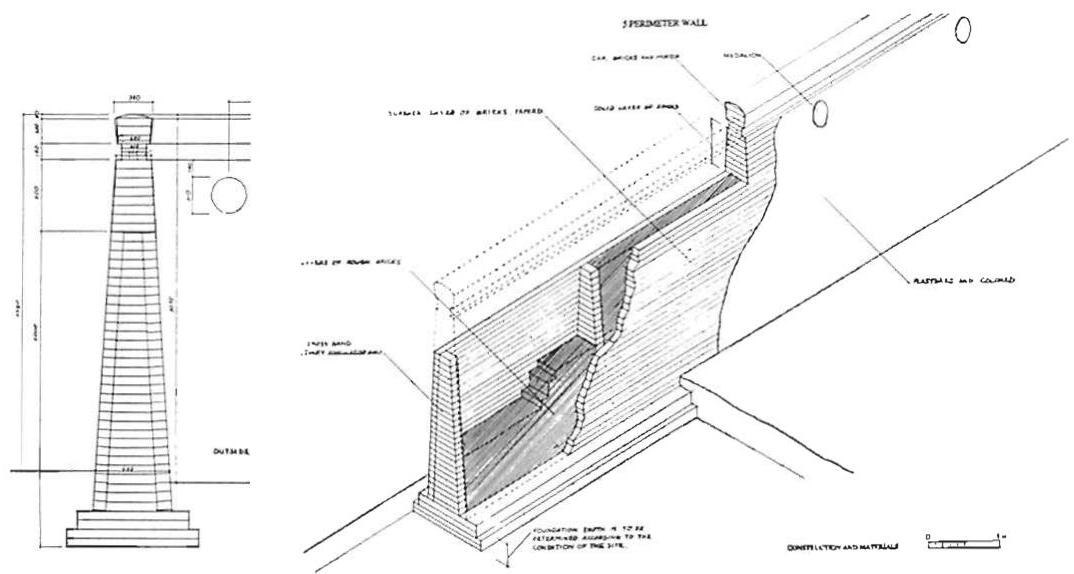
A ten-foot compound wall to enclose the Nyingma Monastery, Katmandu, Nepal. Christopher Alexander with Keiko Inoue and Iimet Khamhatta, 1990.
UNFOLDED BOWL OF A DRINKING GLASS: In this instance the glass itself, only tiny, embodies the same principles. The glass, even the thick wall of the blue glass, and its clumsy foot, all embody the quality of living centers so that here, even the rim of the glass, the part you drink from, fills you with its presence; you can even feel the centers with your lips. This glass embodies the character of living, building elements, even though it is but a tiny detail.
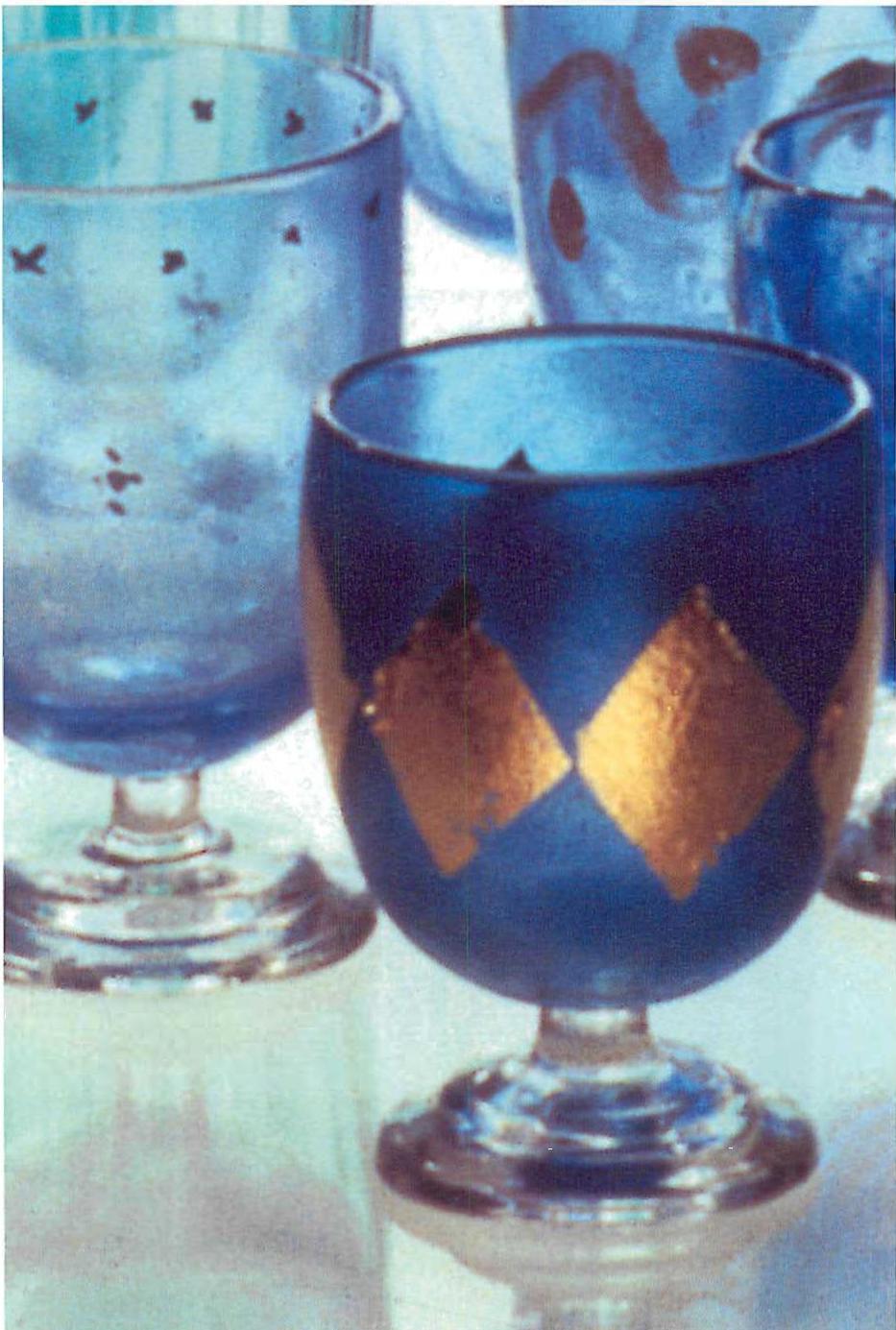
A drinking glass: here even the glass is a being-like living center. I include it because the heavy colored glass shows, in its attitude, the approach which all living centers in the building need to have. Christopher Alexander with Katalin Bende, Henk Werweg. One of a series of drinking glasses made for the Royal Dutch Glassworks, 1997.
7 / FOR LIVING ELEMENTS LIKE THESE, A NEW FORM OF MAKING IS REQUIRED
I do not believe that living centers of the type that I have illustrated can ever be made by the indirect mechanical, technical process that architects accepted in the 20th century. Although it is possible, in theory, to invent and put on paper what has to be done, the emotional energy of creating a living thing comes, in my experience, only—and necessarily—from an intimate connection with the making of that thing.
Just as one can hardly make a vibrant painting unless the paint and paintbrush are in one's own hands, so I cannot imagine how to make a concrete component in a building unless the substance of the concrete, the mold, the forming, the conception, the sizing and shaping—and the sheer love of doing it—are in one's own hands. You can draw something for someone else to build. But the life blood of the material, knowing what it means to hold a plane, or how to move a piece of wood through a table saw, how to cut and machine a piece of plastic—unless one has the experience and knowledge of the thing in one's own fingertips, I do not see that it is possible to transform material into a living center.
Thus the question of living centers in the construction material of a building does not touch only choice of physical material and design of geometry. Living centers cannot be created merely by design. For the centers (and physical components) of a building to be truly alive, they must be made in a way that draws on deeper emotional resources. To be clear about reaching this, we must define a new, modern process that we may call "making," as opposed to production. What I mean by "making" is the physical process of creating the building, which does not call for it to be assembled by a mechanized process, but unfolded by a living process.
Only this will allow the details to be shaped by human feeling, and to be governed by the whole. It is a nearly biological process where construction elements unfold, take shape, fall into place in a fashion that lets them grow out of the whole and enhance the whole.
For these reasons, I believe, firmly, that the creation of a building—not only the invention of the building elements, but the whole process of building itself—must—absolutely must—be understood as an act of making. Even when one runs a company in which crews are working to build individual buildings, the responsibility and feeling must flow from you, the leader, so that those men and women are working as extensions of your own fingers, in their acts of making—the acts that they do for you, and that you do through them.
This is an entirely different process.
8 / A LETTER TO THE READER
I should like to emphasize my conviction on this point by writing you, the reader—whether you be architect, contractor, developer, or artisan—a short letter of advice. If you want, at a single step, to make the biggest difference in the life of a building, it is through the building elements that you are most likely to come to it. You MUST make sure that the building, as a made thing, is an object with beautiful meaning which has weight, substance, and feeling in its details. Then it can begin to be something. This task, so easy to define, is, in practice, often immensely hard. There is no modern tradition to support it, so one is on one's own, trying to invent, create,
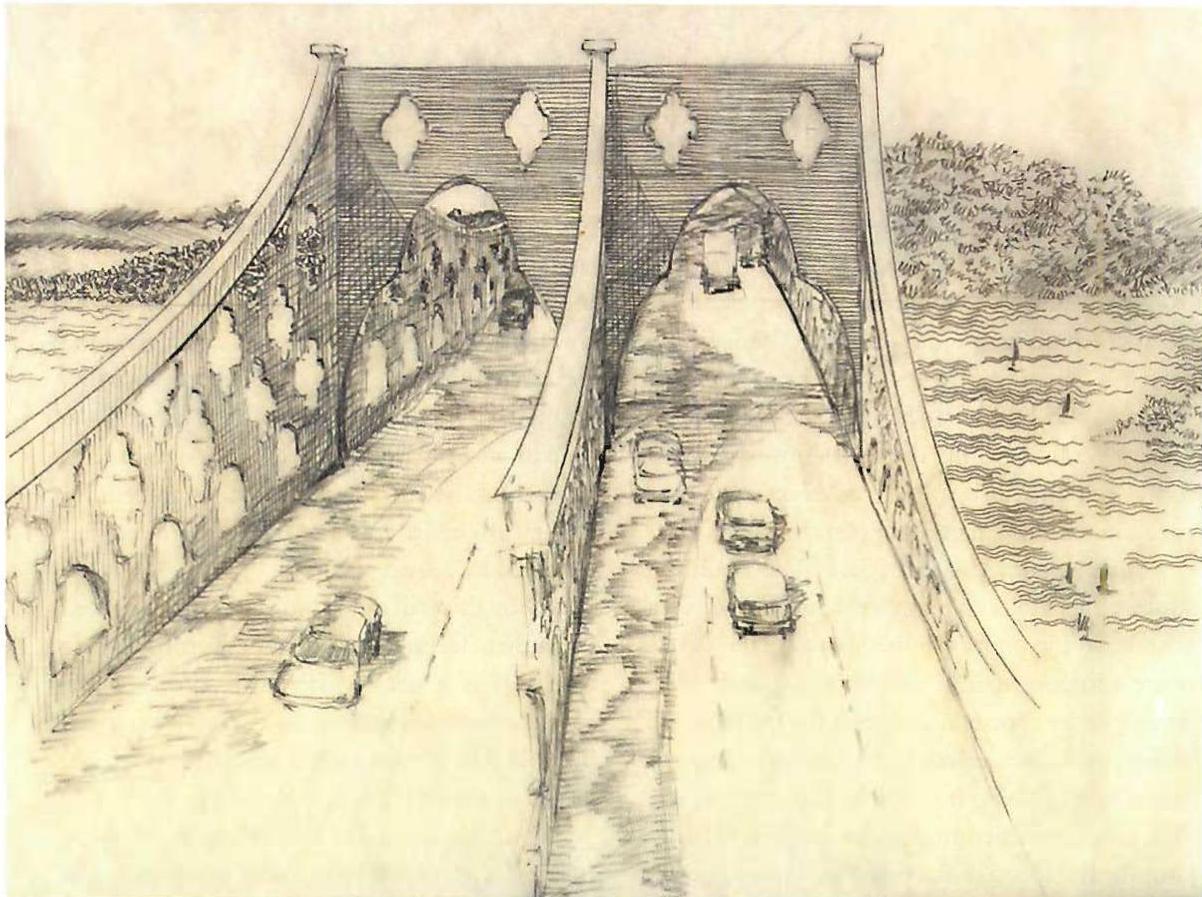
make living centers out of materials and structures conceived and sold to be not-living but mechanical.
I must be clear. THERE IS NOTHING OLD-FASHIONED ABOUT WHAT I AM SAYING HERE. IT HAS NOTHING TO DO WITH ARCHAIC TECHNIQUES. Indeed, it is likely that the ways this is most likely to be done successfully, will be new techniques, ultra-modern techniques, that make use of the most advanced, subtly controllable processes. If Mozart were alive today, you can be sure he would be using the most advanced computers to make music, and somehow, would infuse joy and love into that process. Just so, the advanced forms of control, which allow human beings to shape matter directly, and which allow us to to fabricate, shape, and adjust material, on-site, to make a building beautiful — all this belongs to the future.
It order to do this in the 21st century, one has to be extremely inventive. For example, suppose I say that I want to make a column which means something, which has weight and value as a living center. Almost at once I must ask myself the question; how can I make a column twice as thick as a normal one without making it four times the price — because typically it will contain four times as much material, hollow perhaps, but it must be a true thing, solid, too. This poses technical and financial questions of a serious order. I have to be prepared to tackle these questions, think about them, perhaps invent new ways of making beautiful columns at a reasonable and normal price.
It is because these problems are so difficult to solve that 20th-century architects failed so often, did not know how to solve them, and were perhaps even unaware that they should try. But
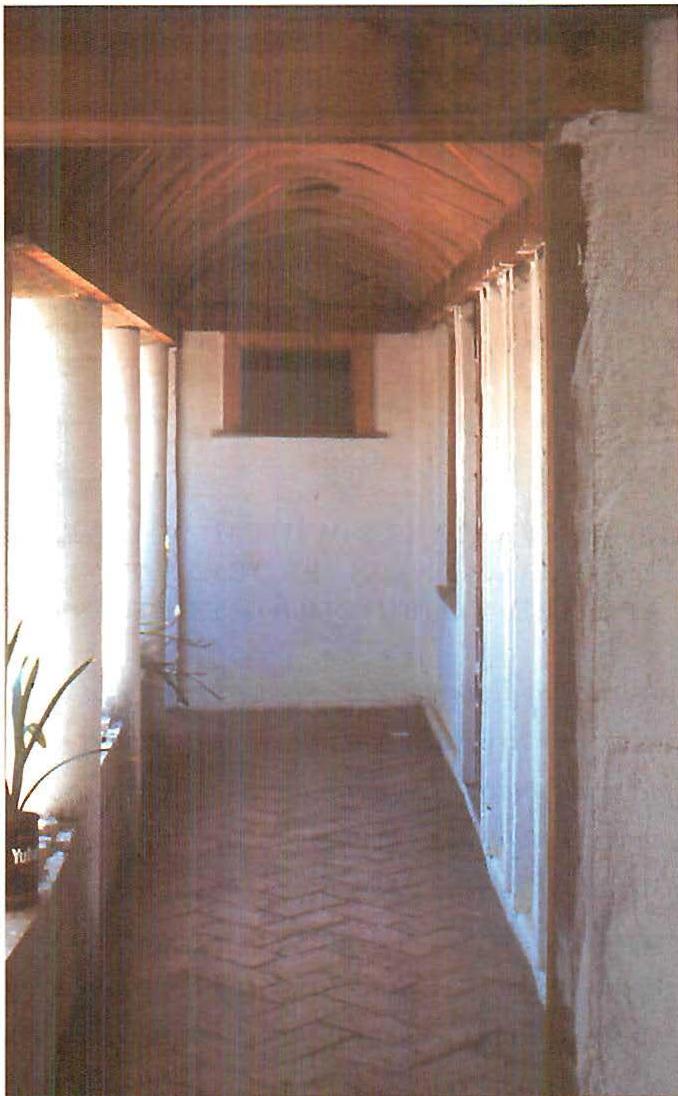
that — I believe — came about because they did not ask themselves — never perhaps acknowledged — how drastic the effect on the building, how miserable a building must be, when its building elements are not living centers.
What this means is simple to state: No matter the cost in effort, if you are an architect, you must solve this problem. Without solving it, there can be no architecture. Well, what a situation! For in this particular first era of modern times, it has been extremely difficult to get building details with the quality of living centers. For reasons having to do with distribution
of money and lack of understanding, the construction industry has moved away from this sort of thing altogether. My own efforts in the last thirty years, even though modest, have often encountered obstacles of absurd and trivial kinds, only because of trying just to accomplish this one particular and rather simple thing.
This occurs partly because building details have moved out of the province of the architect. During the 20th century, many construction details were considered as given, coming from "the construction industry" or from "Sweet's Catalog." The construction industry developed details
which were in no way connected to the issues raised in this book, but supportive, instead, of mechanical ideas of efficiency. So the motive of even seeking to make building details with substance, spirit, life was largely missing.
At the same time, the new kind of process needed to re-create such conditions is not yet widely accepted. Nor does the kind of process exist as a part of normal construction operations which could create these kinds of details as a matter of course in the construction industry.
It is the need for this combination of events which creates the almost superhuman nature of the task of reintroducing “making” into architecture, yet doing this in a way which emerges from the technology of our time. How this may happen is discussed in the next three chapters.
9 / SOME INVARIANTS WHICH WILL EMERGE WHEN THE FUNDAMENTAL PROCESS IS REPEATEDLY APPLIED TO BUILDING ELEMENTS
In a regime governed by living process—hence by repeated application of the fundamental process—every major building element becomes strong as a center.
For example, walls and wall segments are strong living centers; columns are strong living centers; a column base is a strong center; wall bases are strong living centers; interior wall surfaces are strong living centers; ceilings are strong living centers; window frames, door frames are strong living centers; windows are strong living centers; doors are strong living centers; roof members are strong living centers; the eave is a strong living center; parapets are strong living centers; the roof ridge, or roof top, is a strong living center; garden walls and garden fences are strong living centers; paths are strong living centers; steps are strong living centers.
The shape of all these centers will be strong, each in itself, and each center, being a strong shape, is itself made of smaller centers which are strong; to the side, in the gap between this and the next element, there is a strong shaped center, too.
Generally, the elements will be large in dimension compared with the dimension of the space between adjacent elements. The space between columns only a little bigger than the thickness of the column; the space between windows often only a little bigger or a little smaller than the size of the windows; the space of a building wall between cornice and plinth only a little bigger than the plinths or the cornices themselves.
The most important elements will then exist as centers so STRONGLY that they appear to be shaped, powerful, “being-like.” I shall explain what I mean by that, in Book 4, chapters 4 and 5.
CHAPTER FIFTEEN: HOW LIVING PROCESS GENERATES THE PROCESS OF CONSTRUCTION — ALL BUILDING AS MAKING
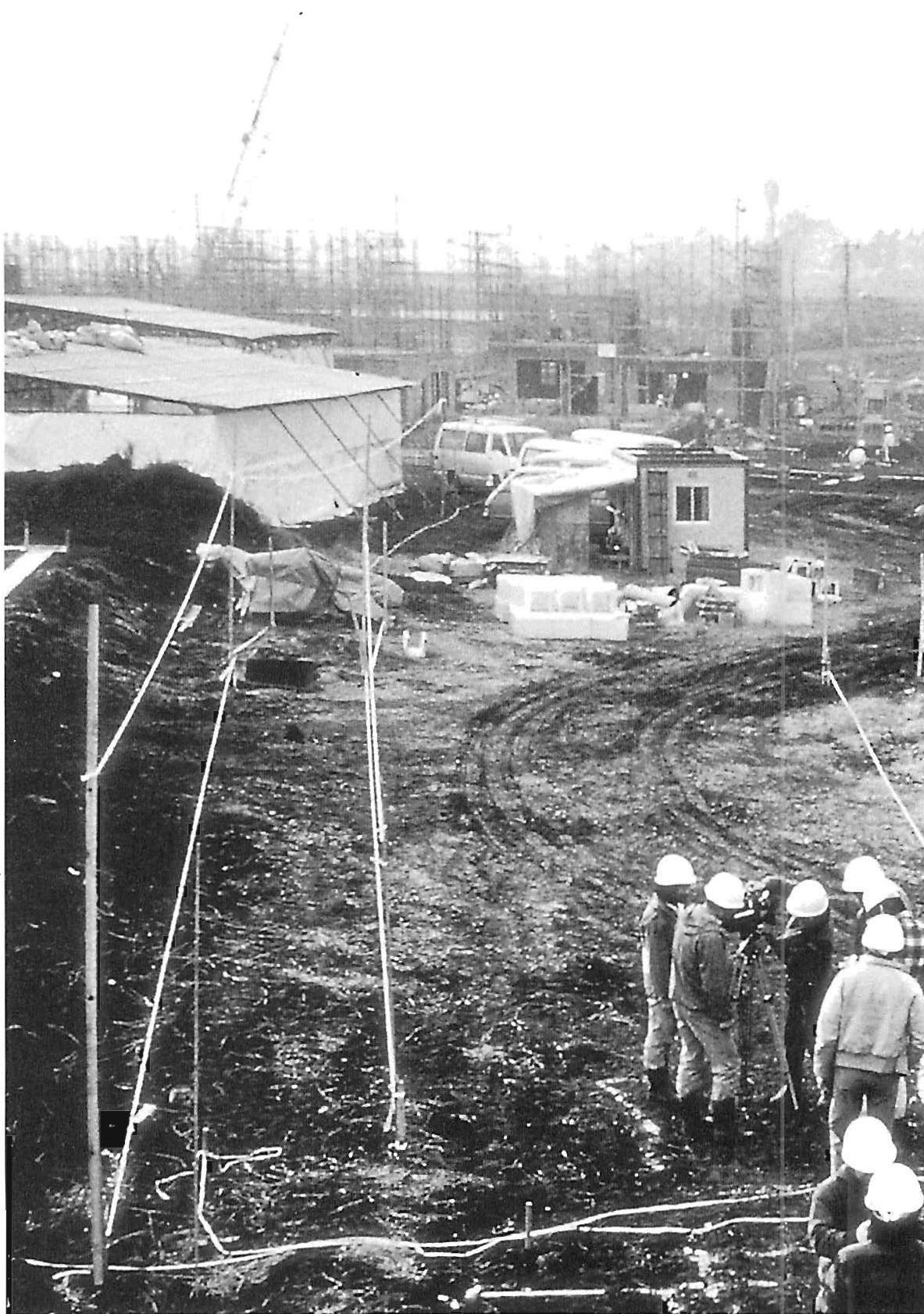
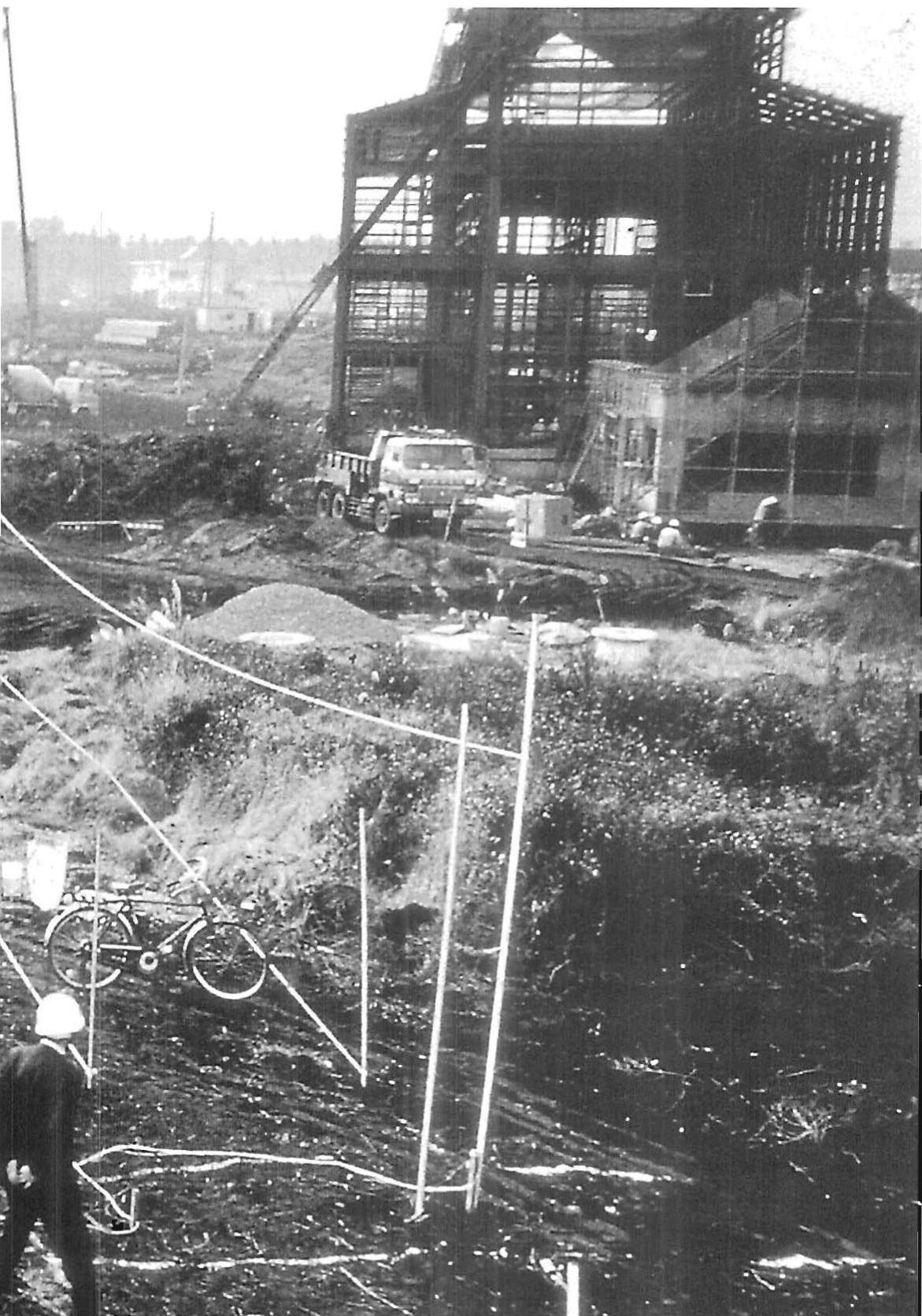
It is very unusual to see a large scale construction site where decisions about size, position and dimension are still being made. Here we see decision-making with bamboos and tapes, on the entrance street near the Great Hall at Eishin, while heavy construction was going on.
1 / A PERSONAL NOTE
For me, the intellectual path which I began describing in chapter 14, and now continue in this chapter, started in a rather simple way. As a young man, I did not like the idea of drawing buildings which I could not visualize or make myself because—honestly—I did not know what I was drawing. My colleagues and fellow students in the architecture school at Cambridge did not know either. I was taught architecture in a tradition which required us, often, among other things to draw full-size sections—yes, one inch to one inch—of various important building details in our projects. We pretended we knew what we were doing. But actually we were simply copying details out of books or published plans, and reproducing them in modified form. Our drawings were beautiful (as drawings). But none of us had the least idea what they meant, whether they worked, whether they fit, and made whole, or extended in a living fashion, the part of the building where we were using them. Most often we did not even understand why the details were shaped as they were, nor certainly, how to go about making those details, physically, with our own hands.
We were never asked to admit that we did not understand these things. Indeed, many architectural students of that era became architects, continued the pretense that they knew what the details meant, drew them up religiously, gave them to the builder (or contractor) to build, were not present to hear the chuckles or see the shaking of heads as builders on site examined the drawings. They deceived themselves, and their clients, into believing that the art of building was profoundly known by them.
Yet all this was a charade. Shall we call it a polite lie? Is that too much perhaps? Well, at least we must say that during that period architects engaged in a monstrous self-deception, and that much of the silly building of
the later 20th century followed directly from this fabrication.
I do not know that this problem has changed even now. I do know that my colleagues at Berkeley were annoyed, not pleased, by the fact that I was a general contractor. The potential that the widespread ignorance about making—in wood, concrete, and steel—might be revealed by a builder among the faculty, the danger (as they saw it) that this harmful self-deception and the accompanying emperor's-new-clothes revelation might undo the fabric of our profession was too great, the threat to the stability of an artificially pumped-up scheme of things in which architects pretended that which they should not pretend, was far too great. Better to have tight lips, sealed and pursed.
That is why I say that I could not accept the situation. The architectural drawings which I learned to do in school in most cases had an empty quality. It made me almost sick trying to draw something that I could not build, while pretending to myself that I understood it. For myself, I cannot understand something in a building, truly, unless I know how to do it with my own hands, or unless I am actually building it.
Also I felt—naively perhaps—that it was only if I made it myself that I could really make it the way I wanted it to be. More significant, I felt it was only if I made it myself that I could get it to be the way it had to be, so that the fine structure, the fine adaptation, came out right!
So I began, about 1965, making small things. At first it was an achievement for me to make even a column capital, a tiny piece of wall, a seat, even a tea-tray.
What follows in this chapter—and it is an intellectual conclusion, not only an emotional one—originates with this intuition, and then goes beyond it to become a major theoretical foundation stone of living process.
2 / MAKING
So now we come finally to the making of the building itself, the art of it.
I do not know if you, reading this, are a builder or a craftsman. When I set out many years ago as an architect, I was neither. I began to realize, though, that making a building really had to mean “making.” Not designing. Making.
In the period when I first learned architecture, architects often had this attitude: “Draw the building. Let someone else worry about how to build it.” There was a tendency for 20th-century architects to treat the actual making of a building as a great unmentionable which had to be left to others, not understood through their own hands.
But of course that doesn’t make sense. It is only when you treat the raw material of the building as the stuff being shaped, and take control of it—either with your own hands, or at least
only asking other people to do with their hands what you yourself know how to do with your hands—that you can make a real thing, something which has worth.
I taught myself many techniques—brick, bamboo, concrete, wood, furniture, tilework, plaster, glass, metal, brick, plastic. I learned hundreds of techniques, in many cases more or less without skill to start with, just inventing them myself, because I wanted to be able to make beautiful buildings and, as far as I could see, the means for doing it just were not at hand.
I suppose the single thing which I most want you to understand is that in the making of the building you must be involved yourself—and you must view the art of building as an act of making in order to get the right results.
3 / TECHNICAL DEFINITION OF “MAKING”
What I mean by making, in the case of buildings is illustrated in the appendix of Book 2 where I have given a detailed account of the design and construction of one building. That example shows clearly how the unfolding process requires that design and construction are interlinked and interwoven.
At each step in the unfolding, we see a certain state, and it is that state, together with the feedback we get from that state, which then allows us to shape the next items well. The material, its organization, the sequence of making and placing require that it be malleable, plastic, amenable to change, amenable to modification and refinement while the building evolves.
Making, then, is a theoretical idea. It has nothing to do with ancient craft. It is not a
medieval concept of building production. It is a conception of the construction of a building which allows that the feedback, obtained constantly from the actions and experience of shaping the whole, provide feedback and guidance to the builders who then modify what they are shaping in accordance with the feedback just received. In this definition of making, it is theoretically impossible for a successful building to be built from a set of drawings which specify every detail, because that would cripple the capacity of feedback to help shape the elements and details as they are built.
Making, in this technical definition, is necessary to the creation of living structure. I believe it is true to say that there can be no alternative to this fundamental rule.
4 / THE MOST BASIC FEATURE OF LIVING STRUCTURE
Let us examine the evolution of the building elements in a building to see why they must be made.
If I draw a cat, I make the cat's eyes while I am making the drawing. The particular way I draw the eye comes from the way the picture
is developing. It is unique to this picture, it fits this cat. It has to fit this cat, otherwise it is not a picture. I cannot use a prefabricated eye to make my cat.
The reason is that the eye, as it appears in this drawing, is unique according to the way the
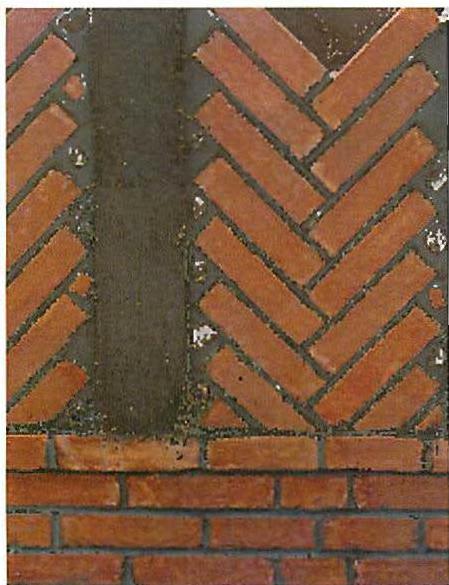
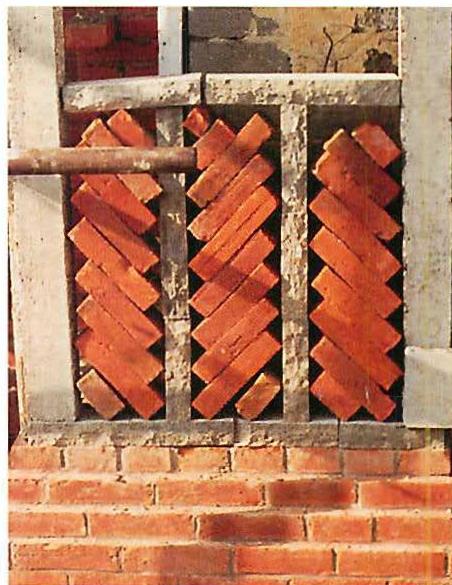
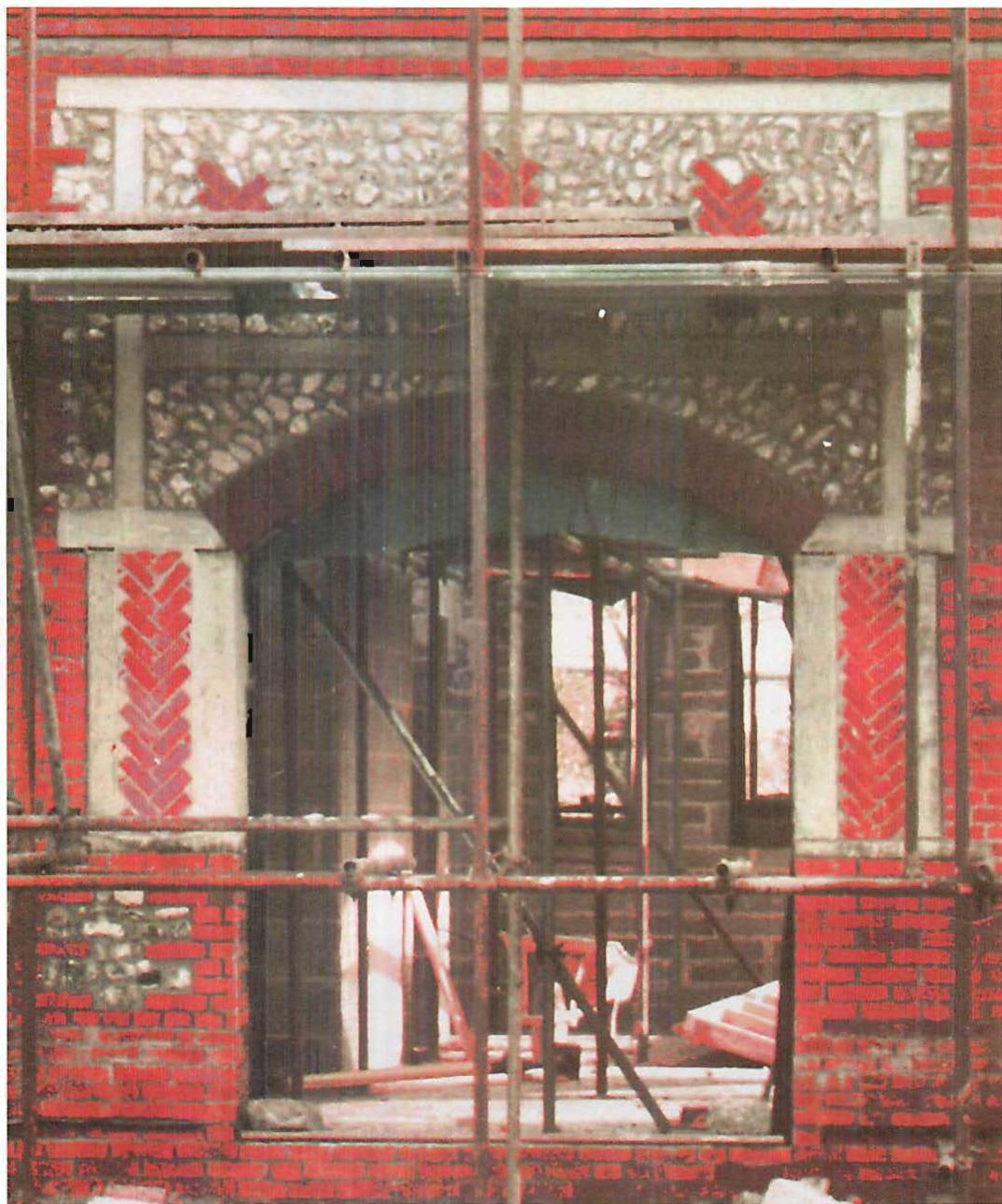
head is drawn, the size, the angle, the black and white. These areas fit this drawing and fit this cat in this drawing.
When I make something in this fashion, this is the unfolding. It is the way that nature works. It is guided by the fundamental process. That means it is guided by a process which creates centers in continuous feedback from the system, and according to the centers which are al-
ready appearing there. Since the whole changes constantly, continuous feedback is needed while something is made in order to give it life. That is the essence of all "making"—it is a creation in which the maker responds with feedback, continuously, to the whole that is emerging.
Now, how do I get that quality into a building. If I make this wall, I cannot use a prefabricated wall. I have to make this wall according to
its unique presence in this building. It is unique in character, in dimension.
So, basic to all unfolding and basic to the fundamental process is that I make each character according to its situation. Each element will be unique; each part will be shaped according to the whole where it appears.
Of course this is different from the architecture we were used to in much of the 20th century. We were used to a system of production in which parts were not shaped according to their context, were not shaped according to the whole where they appear. But still—this is the meaning of unfolding and the meaning of the fundamental process. If we are to have true living structure, it cannot be avoided.
I must make the wall just as I must make the eye of the cat.
I make the eye of the cat so that it is a strong center. But to make it a strong center, to make it expressive, powerful, to have feeling and meaning, I have to shape it according to where it appears. This follows also from the formal
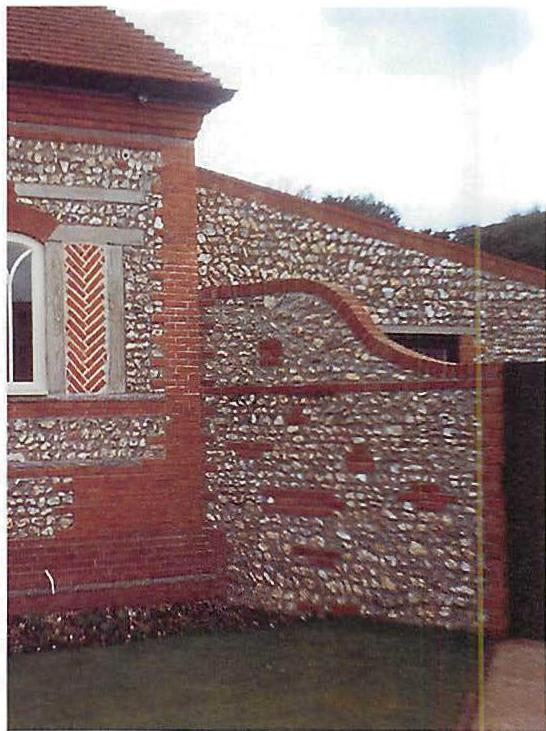
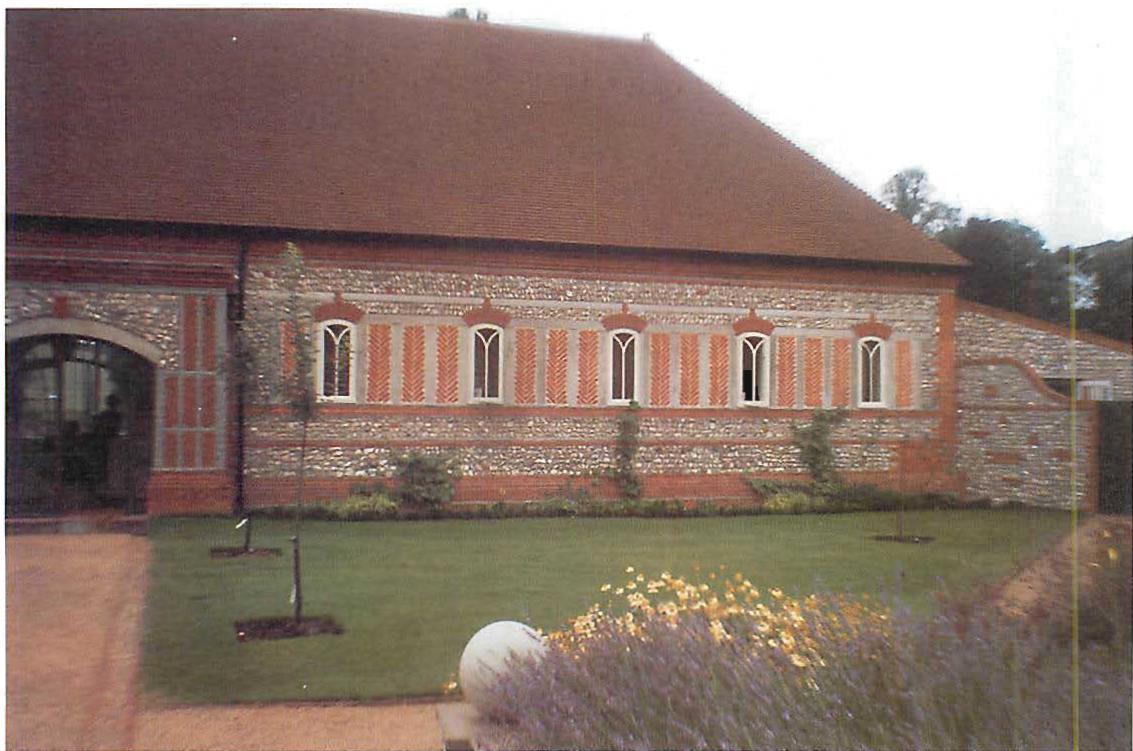
definition of the fundamental process. I have to make this center in such a way as to create a strong living center which is larger; the cat's head for instance. But the cat's head is unique. So, to shape the eye so that it makes this head more alive, I have to make the eye specific to this life of this head; and it is that which makes it necessary to make the eye unique, to shape it just to have that effect.
Let us apply this thinking to the wall of a building. For instance, in the West Dean building, the brickwork of the pier at the corner of the main building volume (page 488). It has a particular context, the window at 3 feet from the corner, the buttressed effect of the kitchen building ... and to make the corner pier effective, strong, and alive, within that particular context, I have to shape it just right. John Hewitt and I spent days looking at the way to make those bricks work for that particular corner. If there had been a standard post at the corner, we could not have achieved this specificity you see at the corner.
It is this making, this attention to the uniqueness of every part of every building, which we shall now explore, and this whose consequences I will now try to define.

5 / THE TECHNOLOGY OF MAKING
Let us now look at the problem of making from a theoretical standpoint. In chapter 14, I have explained why every building element in a living structure must itself be a powerful center—a living structure in itself. I have shown many examples.
But there is more to it than that. As in the case of the cat's eye, each building element needs not only to be coherent and a living, positively-shaped structure. For the whole to be truly a living structure, to make the building truly alive, each building element also needs to be finely adapted to its detailed position. And this needs to be true of every building element.
Thus in a living structure, the microstructure of the building must work in two ways. It is the microstructure which creates the possibility of living structure in the elements. And it is the microstructure which allows the whole to become well-made and well-functioning, because this (and only this) allows each element to be adapted—in dimension, shape, color, detail—to its position in the whole so as to support that particular unique place within the whole.
Thus architecture entirely depends for its living character on the congruence, harmoniousness, and completeness of the micro-structure, the fine structure, the details. In other sciences a similar observation would be almost commonplace. We know this very well in the case of organisms. We know that a leaf, a tree, or a human body could not work at all if the fine structure—the cells, proteins, molecules, and cell microstructure—were not in order. That goes without saying. And it is clear that the fabrication of these elements must follow a process which allows fine-scale adaptation to occur.
In a building the same is true. A building can have real life only when the building details have life and are adapted, in their fine structure, to the life of the building.
Much contemporary architecture has lost sight of this point. Buildings are made of prefabricated panels, two-by-fours, sheetrock boards, concrete panels, steel joists, sheets of glass. All of these are practical and wonderful inventions, from a point of view of cost, time, and efficiency of erection. But they are not practical or wonderful when looked at as elements capable of adaptation or fine tuning, which contribute to the living microstructure of the building.
We seek, therefore, a technology in which each part can be shaped according to its position in the building: and this shaping cannot be
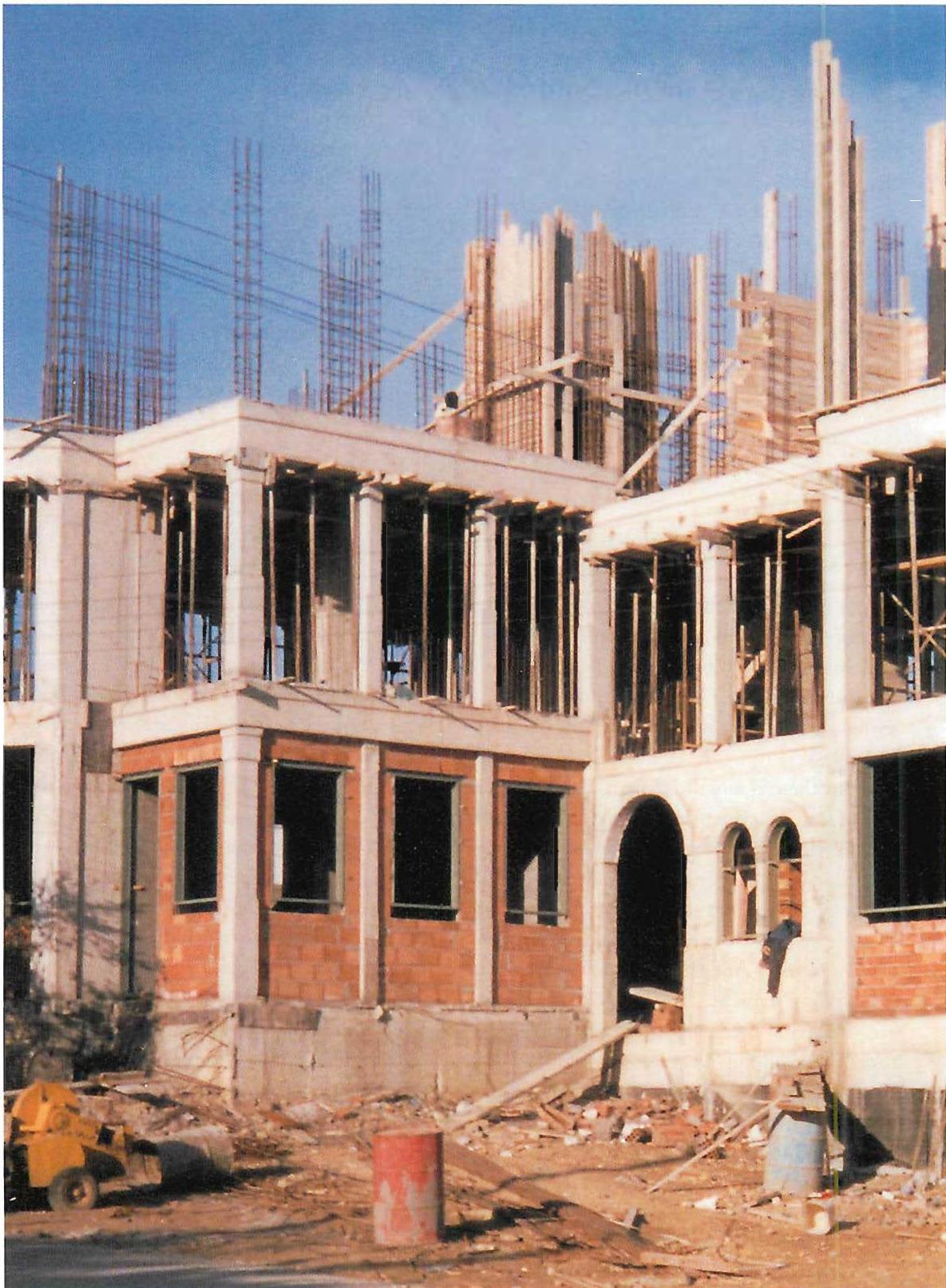
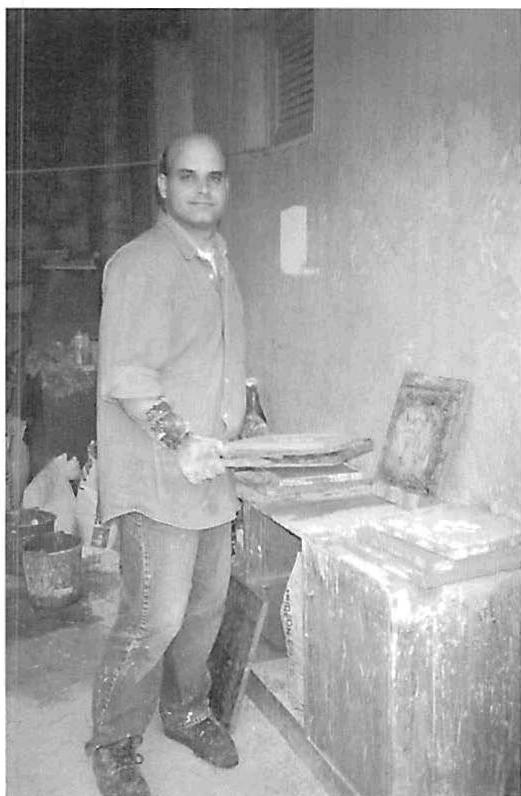
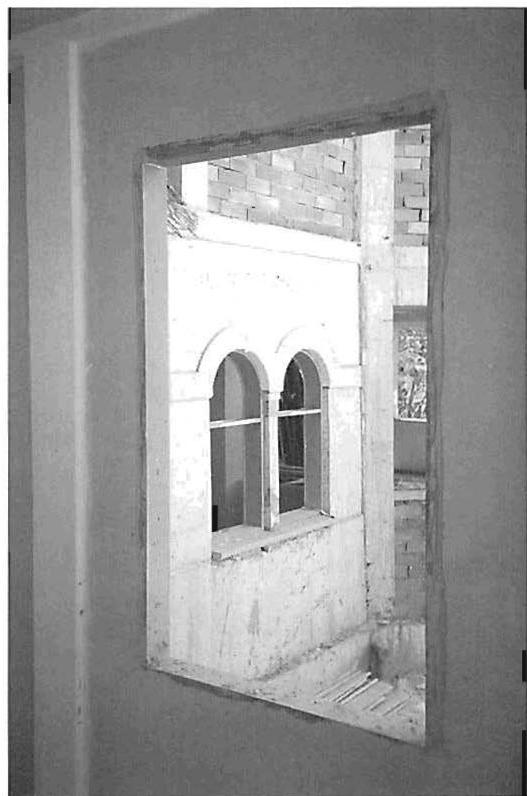
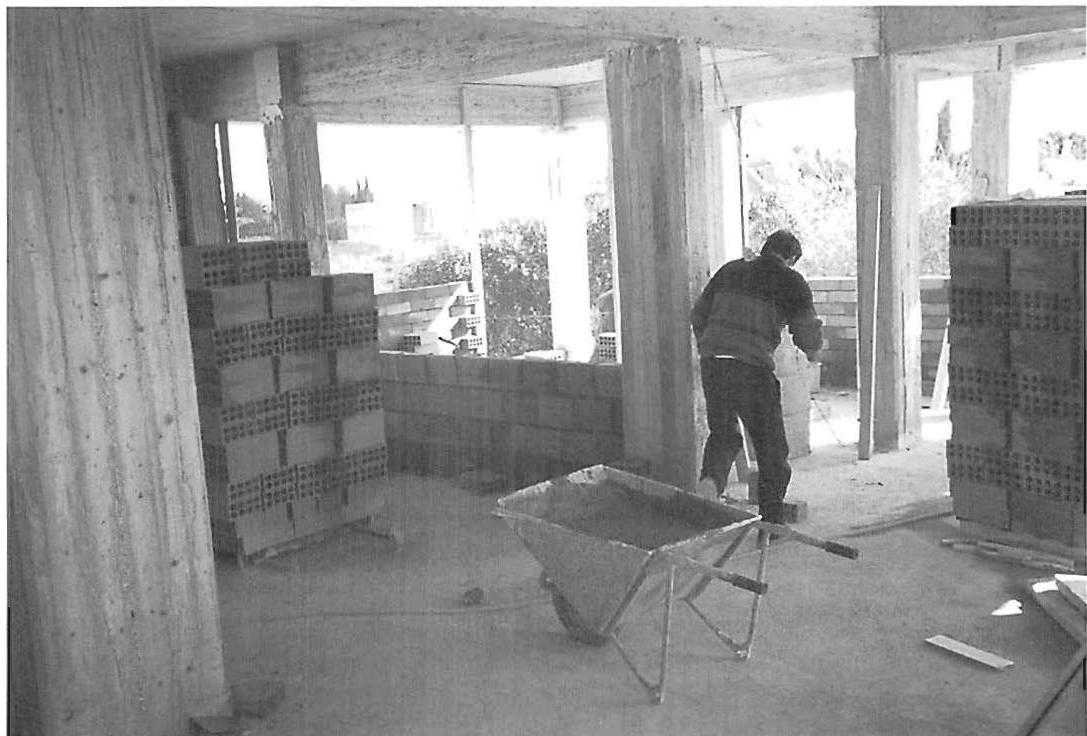
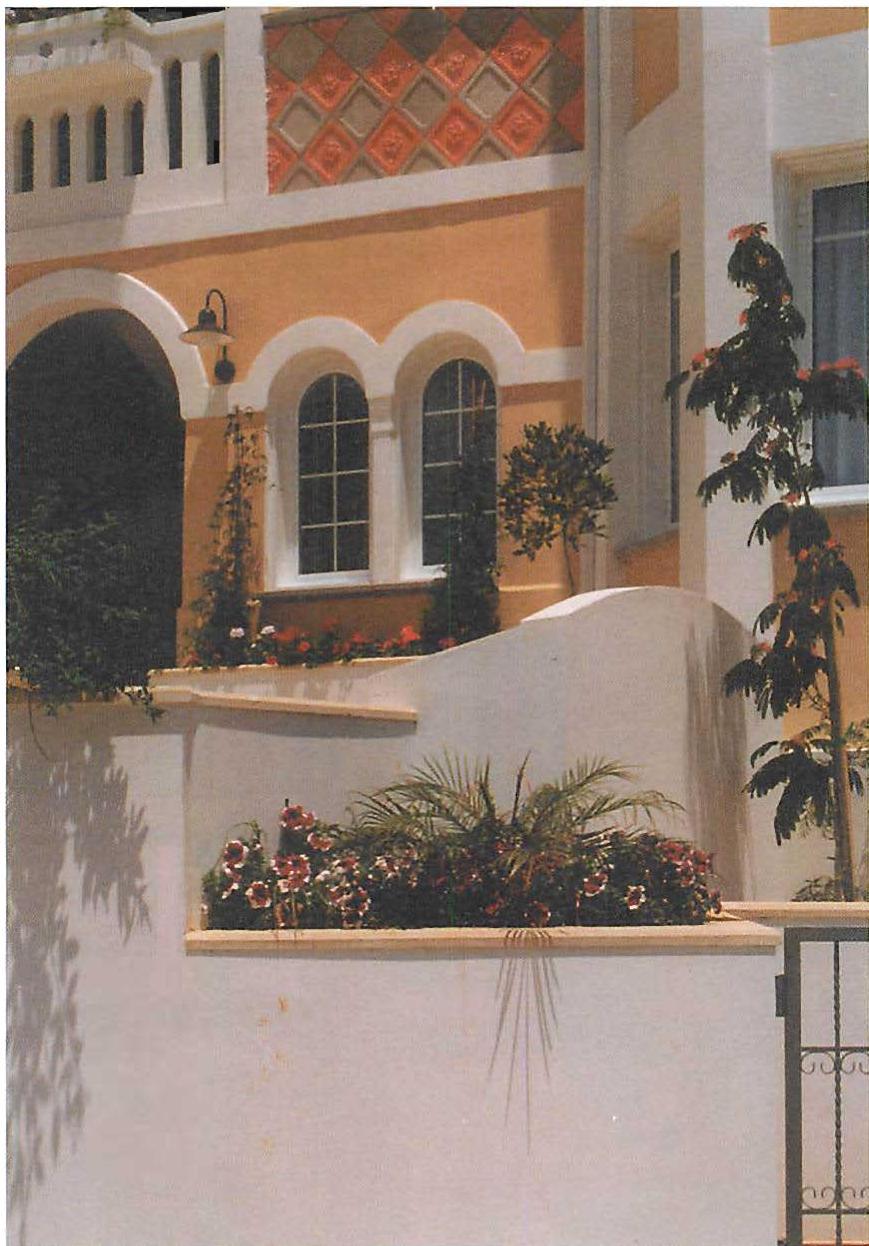
known ahead of time but only as a result of the process of unfolding. Such a technology of making is a theoretical idea which has its roots in hand-craft, but extends far beyond hand-craft to apply to the largest buildings. It is a philosophy, a way of organizing and managing the relation of control, decision-power, craft,
and technique so that a large building, as much as a small one, can be viewed as a biological process in which each component is able to find its right shape and its right dimensions according to its position in the whole and according to the contribution it makes to the whole — something not predictable at the time of drawing or design.
6 / THE SOCIAL PHILOSOPHY OF MAKING
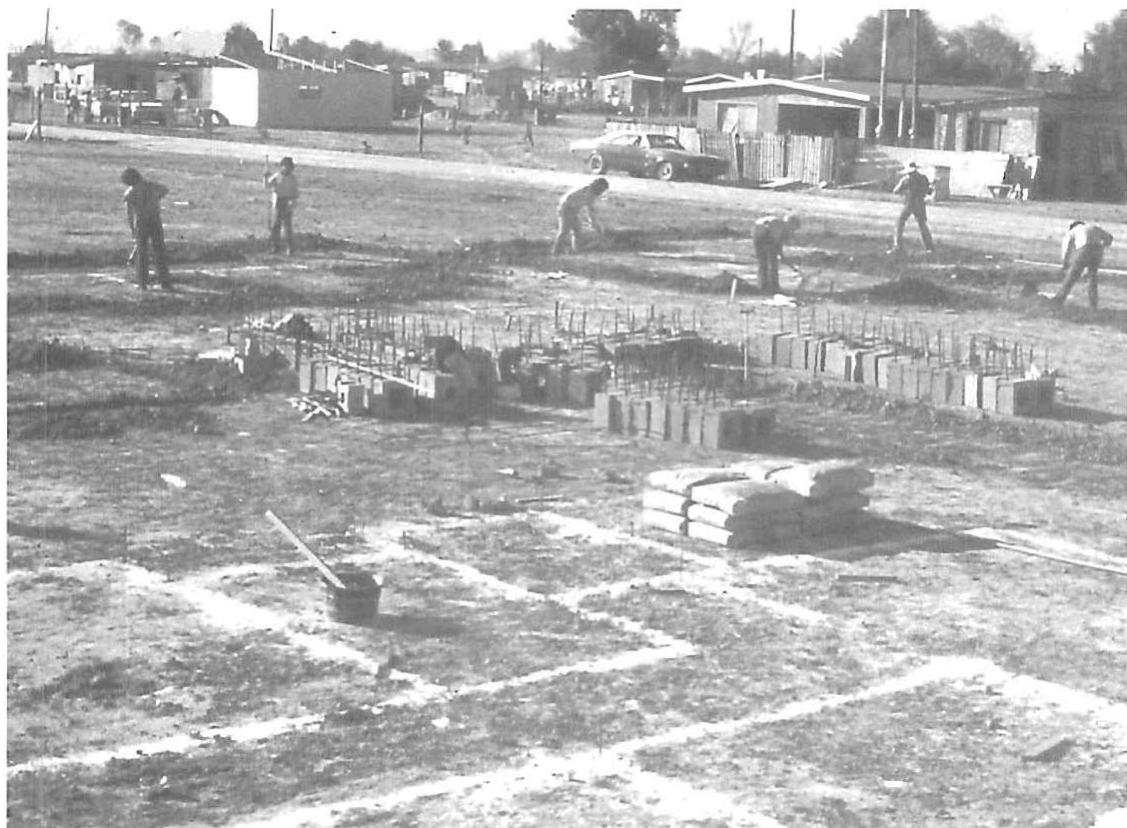
It is possible that architects or other professionals could object to what I am saying on the grounds that crafts, and the lowly construction trades, are not on the same "level" as the professional standing architects have. Indeed, a person concerned with such distinctions might misjudge the intellectual necessity of what I am saying about making only because he could not tolerate the social consequences for the profession of architecture. It is therefore necessary to speak briefly about the intellectual weight of craft and about the artificial blue-collar white-collar rift which was maintained by 19th- and 20th-century society.
In Book 1, I have shown many examples of truly great works, buildings, carvings, glass, tilework. They were made—conceived by their makers, who then made them with their hands. It is my belief that these works reached levels of significance equal—intellectually—to the intellectual works of artists and philosophers and scientists. In my eyes, the Persian craftsmen who made the great Safavid tiles of the 16th century were doing something at a level of intellectual difficulty and attainment at least as great as the intellectual and spiritual attainment of the work done by scientists or the highest ranking manager-architects of our era.
Yet today, this is rarely acknowledged. In our era, a work of carpentry is not considered to be on the same level as a work of physics. The thing made by the carpenter is, in relative value, considered lower than a minor paper written by a physicist and deposited in a minor journal. So long as one
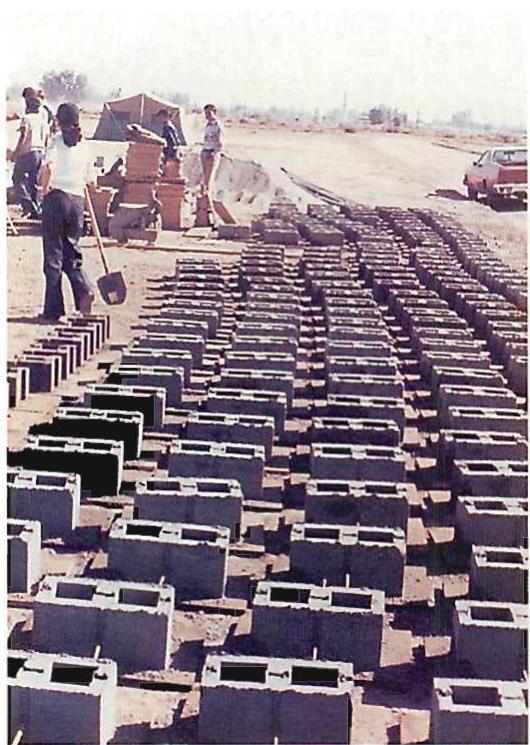
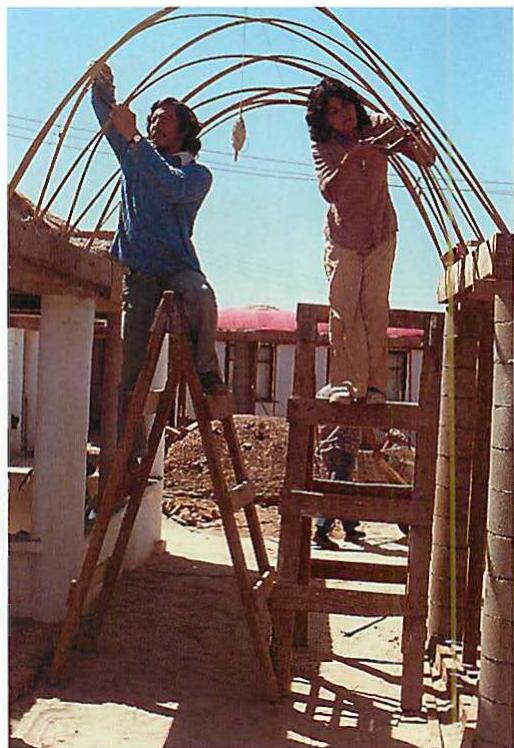
maintains this split attitude and this negative attitude towards the "blue-collar" art of making, it is unlikely that architects could willingly change course. Yet this is profoundly wrong-headed.
I remember when I was interviewed, many years ago, for the Chair of Architecture at Cambridge. During my interview, held at an enormous round table in the Senate house chamber in Cambridge, I was asked, "Professor Alexander, if you were given this chair, and were then head of the Cambridge School of Architecture, what would be the first new appointment you would make as head of the school?" After a moment's thought I said: "A carpenter." There were expressions of disdain and mild shock around the Senate house table when I said this. I had violated an unspoken ethic which stated implicitly that a carpenter could not be a respectable academic. Only Lord Adrian, a biologist, who was then Vice Chancellor, gave me some support. He said
that he could understand my comment because as he put it, "In biology, too, you must have hands-on knowledge of what happens in the test tube to be a good biologist." After some discussion, which gradually and reluctantly allowed that appointing a carpenter might not be frivolous, my questioners settled in again and said, in effect: "Alright, Alexander, you have had your fun, now let's get serious. Let us assume," they said, "that you have appointed your carpenter. Now, whom would you choose for your second appointment?" I answered, truthfully: "A mason." At that, the interview was over. They felt that I was playing with them, or that I was, at best, an idiot.
I tell this story only to illustrate how the arrogant assumptions of the 20th century mistakenly assumed that the carpenter or mason are in the blue-collar class, while the professor, physicist or whatever are in a higher intellectual sphere, much more elevated.
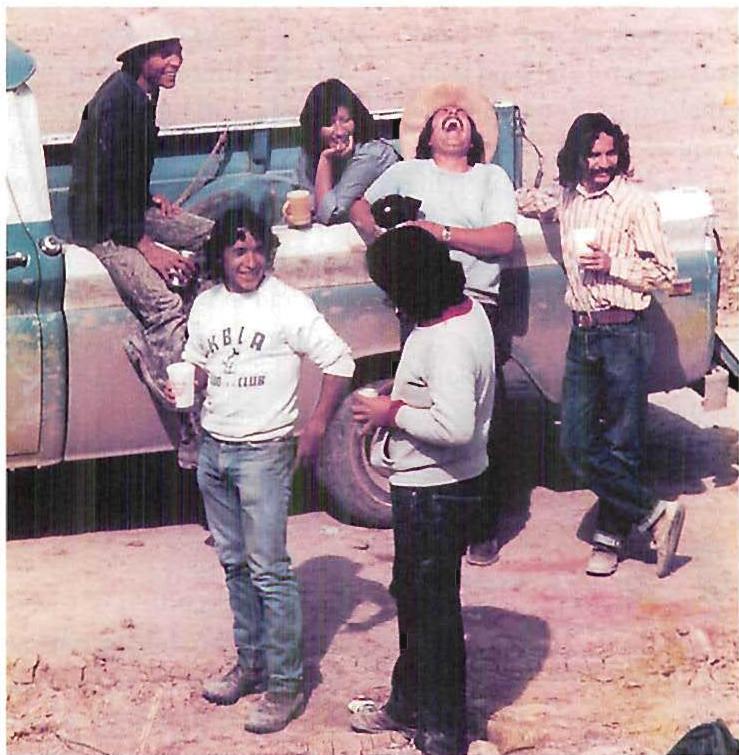
The social snobbery inherent in this view is not my point here. I simply believe that it is factually wrong, and that the works of creation made by a carpenter, or by a tile-mason, or a tile-maker, or any other maker or craftsman do have a level of difficulty, intellectually, and a level of attainment—which is potentially as great as the greatest works of theoretical physics, sometimes perhaps far greater. Thus an intellectual view which establishes making as a foundation has the potential for respectability—artistically and intellectually—which is the equal of the most profound and most elevated sciences and is not something of which we ought to be ashamed.
7 / THE NEAREST TENTH OF AN INCH
In most traditional buildings, the building details have a quality of shape, each one being shaped to fit where it belongs. If it is stone, the stone is cut to fit the cornice or the balustrade. If it is brickwork, bricks are cut, placed, to make whatever variety of wall, opening, ornament, and coping that is needed. If logs, the logs are carved to fit. If plaster, it is shaped according to the situation. If it is tile, it is painted, glazed, cut, and installed to order. If it is built-in furniture, it is made by hand to fit the niche. If windows, the window panes, sash, glass, glazing bars are made to order, usually by hand. The door is cut, carved, painted. The statues on the Eryctheum by the Acropolis were carved as columns to fit their circumstance, again by hand. In the Mycenae vase shown on page 605, even the vase has hand-painted lilies on it to fit the vase which was itself thrown, very likely, to fit the situation in the building.
One had, in other words, an array of handmade, specially-sized, designed and built items. Each one took on the character of a center according to its situation.
All these shaped details had the quality, like the cells of a plant, or of the human body, that they are created, shaped, according to context, according to need, in such a way as to enhance the larger whole. None are prefabricated.
This is technically essential for unfolding, though it was difficult to achieve in the late 20th-century world. But the technical difficulty
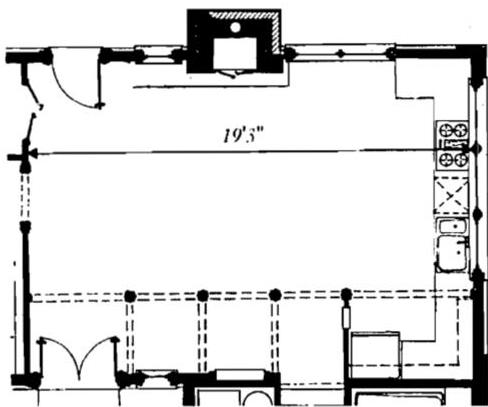
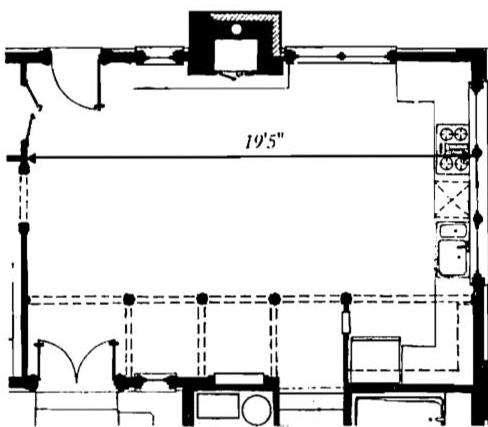
does not make it any less necessary from the point of view of life in the fabric of the building. Its life depends on its variability, on its flexibility, on the degree to which it can be shaped, and adapted, while it is being made. To understand the importance of "making" buildings in the technical sense I have defined, it is necessary to grasp fully how and to what extent the life of a living field of centers depends on getting small dimensions exactly right.
During the course of their work with me, the one thing which all my apprentices have to do is to make judgments in real things — while these things are being made. And the one thing which astonishes them all is the extent to which life — the deep field of centers — is created, or destroyed, by minute subtleties of dimension, shape and color. If you move a line a tenth of an inch to the left the thing is good; a tenth of an inch to the right and feeling evaporates. The shape of an arch drawn in pencil on a board may be exactly right — it has a beautiful feeling. A copy of the shape, made by someone else who does not understand the centers, even if his copy is accurate to within a half inch all along the line — often has no feeling left in it at all.
I remember a case where we were placing the end wall of the main room in a house (the Martinez house in California). The room was about 16 feet wide, 19 or 20 feet long. On the site, we were trying to decide the exact position of the endwall. The house perimeter and walls were already built: the interior walls were being adjusted. We used lines, planks, and finally, a person holding a sheet of cardboard, to decide the best place for that wall. Finally, when we had it almost right, the length of the room stood at about 19 foot 3 inches. But even then, when one lengthened it to 19 foot five inches, or shortened it to nineteen foot one inch, it made a strong difference in the feeling of the room. The three lengths, though each one differed by only two inches from the next, gave three entirely different rooms. We finally chose the longest one, nineteen foot five, but it was only possible to settle it after an exhausting session, looking at each
Generic sketch of the kind of feeling desirable at the eave, to separate and connect the wall and the roof. Four different possible moldings for the roof edge: A, B, C, D. A is awkward and the steps a little too crude to be helpful. B is rather too strange to be helpful at all. Both C and D are more helpful: they make the transition and connection and gradient. Of the two, C looks to be a little better.
one, going back and forth between them, until we were sure we had the one which had the greatest depth of feeling.
Color is equally sensitive. A shade of color may be critical at a level so fine that it can only just be identified, and yet be critical. In one case, I tiled a floor in two shades — a deep green, and a pale, whitish-yellowish green. I worked out the tile arrangement, glazing the tiles with glazes from my stock, until the field of centers in the room was fairly harmonious. Then, when I had got it just right, I found out that the light yellowish green glaze I had used was no longer available — and, after a few phone calls, found out that the manufacturer had even thrown away the formula of that glaze. There was no way I could get any more of it.
I tried to match it with other greens. One was too white. One was too green. One had a slightly harsher yellowish cast. None of them worked. The green I had found originally was almost perfectly harmonious with the room where it was going. But not one of the other available glazes made a tile which preserved the living structure which this tile pattern created in the room. People who looked at the different sample tiles in my workshop, and compared them with the original sample, said, "They all look more or
less the same. Surely one of them will be OK." But when one put the samples on the floor of the room itself, the one green worked and the others didn't, and everyone could see it.
To understand the same point geometrically, consider a simple building detail: a cornice molding at a roof edge, for example. People now sometimes say that moldings make sense only in classical architecture, that they are a matter of style. In fact they are more fundamental. They have to do with smooth transitions connecting center to center in a field of centers.
If we have the edge of one material (a roof edge, say) and another material coming up to it (the wall, say), then we need a certain definite geometry at the boundary to make sure that the two centers meet and melt in order to be whole. The roof is a center, and the wall is a center. To make these two centers meet and connect may require a geometrical transition of two or three steps. That is the thing we traditionally call a cornice molding. But the cornice will only work if its proportions have a very fine and subtle structure of smaller centers which really does preserve and intensify the big centers.
The sketches (above) give an idea of how it is supposed to work. You can get a feeling for the transition at this edge. As I have drawn it, the
edge helps the roof to be a center, helps the wall to be a center, and helps the two centers to intensify each other. Now look carefully at the four possible cross sections of the cornice molding at the edge. You can see easily that A is not very helpful. B is slightly strange, also not very helpful. Both C and D are helpful. C looks to be a little better.
You can explain this effect by looking at the centers in detail. If we look at A, we see two more or less equal smaller centers. They do not create any kind of gradient, and as a result the two centers do not connect with or intensify the center which is the roof, nor the center which is the wall.
Looking at B, we see a long line of small steps. This creates one homogeneous gradient—but the gradient does not "point" towards the roof, nor towards the wall. As a result, B still does relatively little to support either of the major centers.
C has two centers, a large one and a small one. The two centers together create a gradient which points upward. Thus it connects the wall to these centers, and then connects this further to the roof. C is fairly successful.
D has a similar gradient, but is more complex. The gradient is caused by four or five centers which form a curve. Again the structure points upwards and downward and connects both to the wall and to the roof. Looking at the section, D looks less successful than C. Nevertheless, it is difficult to be sure which of these structures really does the most to connect and intensify the wall and roof. Note that D actually resembles the perspective sketch more closely than C. This could mean that although C looks better, D might be better in reality. My analysis may be faulty. It would be hard to choose definitively between C and D without building a full-scale mockup, holding it up against the real roof, and looking at it up against the sky. Then, in a particular case, we could be sure which one is really better.
The example of these four alternative cases shows how subtle and difficult it is to be sure about such details at a level of great finesse. But
the main point is clear. Tiny fractions of an inch have a large effect on the relative proportion of the parts and therefore define entirely different fields in the nearby space. Sometimes a center no more than a quarter of an inch across may support another center which is fifteen or twenty feet in diameter.
This is the typical case, not an exception. The same thing happens everywhere in a building. Every single line you draw has, in its microstructure, the potential to have a critical effect on the presence or absence of centers in the large. If we don't get the proportions exactly right we don't produce the centers and the whole thing falls apart.
No center is alone. The smallest centers therefore play a key role in the intensity of the medium-sized centers—and these, in turn, play a crucial role in establishing the intensity of the largest ones.
It will not be possible to get life in a structure unless the actual method of making is capable of responding, step by step, to every subtle variation in the wholeness which exists. Two rooms which are more or less—but not exactly—the same, may need different-sized windows. Each will then require a different handling of the window trim because the window butts up against the wall differently in one case or in the other.
It is therefore inherently impossible to make a successful building by a form of mass production or prefabrication which relies on identically repeated details with no possibility of modification. This is true because the necessary adaptations of shape and size in every detail cannot be made if the components are standardized. It cannot be done because the minute adaptations which are needed to get the field of centers just right at each point has to be "on its toes." It has to be capable of responding to large changes and small changes, and these are not predictable.
The essential idea, then, is that every building part and every detail must have the capacity to form centers. That means, first the details must be of a type which is able to form a strong center; second, they should be made in a way
that allows fine tuning so that once it is being built, it can be adjusted in size, shape, and character to make its existence as a center more deeply felt. Then the detail can come to life, and the larger centers made of these details may themselves be intensified.
It is only possible to do all this by means of a method of construction in which we gauge the wholeness which exists while the building is laid out, room by room, and then modify it gradually to get the living structure right in its microstructure, too.
8 / DETAILED SHAPE AND SIZE OF CAPITALS AT BACK-OF-THE MOON
Let us look at a concrete example: the process of sizing and shaping the column capitals on the three houses at Back-of-the-Moon in Austin, Texas (see pages 365-81).
After deciding that the porch columns were to be eight-by-eights, knowing their height, I had a rough idea of the shape and size of the capitals. Drawings, however, did not really provide the necessary tool for deciding how big, how thick, how long, to make these capitals. The feeling created by such a capital, after all, comes from a direct experience, standing in front of the thing, and it is in this position that the capital must make its impact. The bay spacing is a critical variable too, since the capital looks right, or not, according to the spacing of the columns, since it is the positive space in the hole made by base, columns and beam, which has to come out
looking right before you know the capitals are OK. That depends on the centers. And the state of the centers can only be determined by looking at them in a real situation with real dimensions.
So, to test the feeling created by different shapes and sizes, we made a cardboard beam, a pair of cardboard columns in the yard (cheaper and easier to move around than full-sized eight-by-eights). We made a series of capitals (also in cardboard) of different height, thickness and so on, and looked at them. Within a matter of about half an hour's work, we were able to settle which one was best, which carried the most feeling—and, of course, which was the strongest and most powerful living center, especially because it also made the space between the columns strongest, and it made the space next to the capital (the "negative" space) strongest. The one
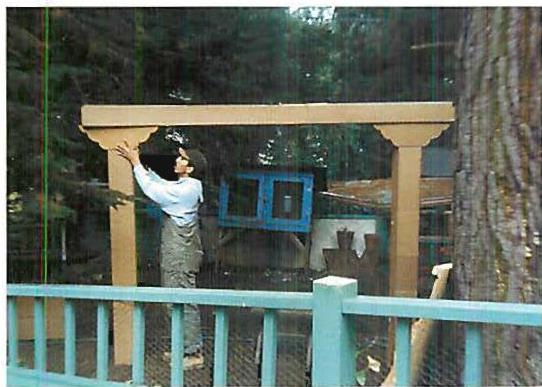
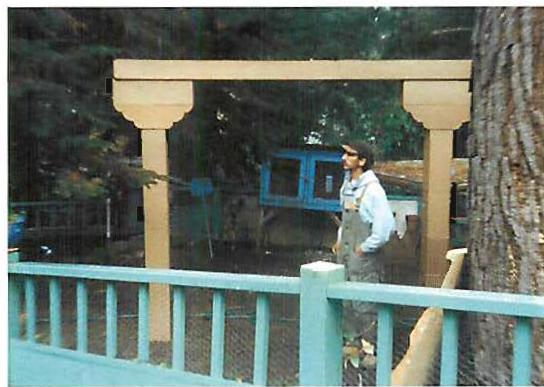
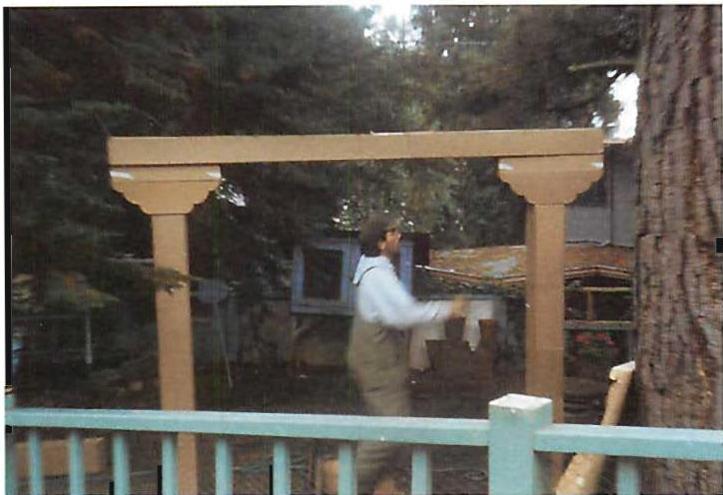
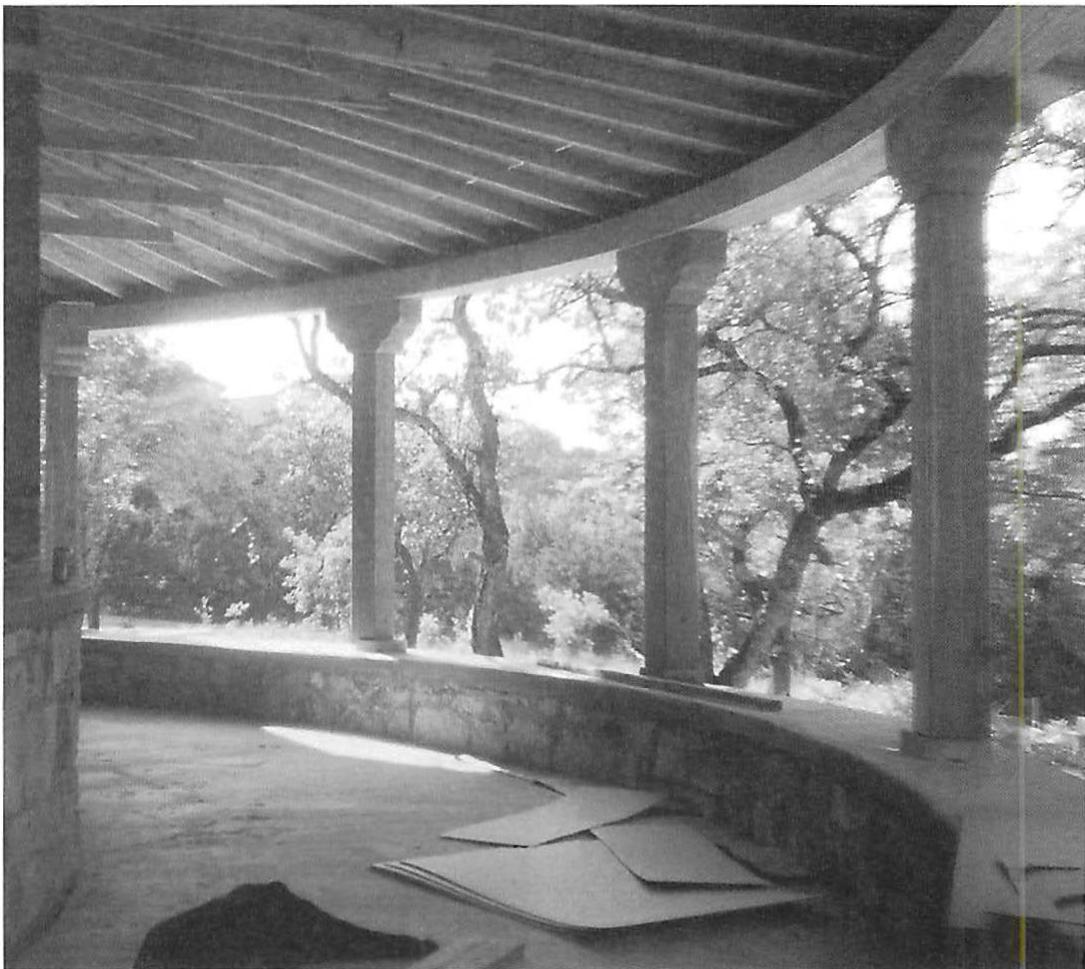
we chose is shown in the larger picture at the top of page 500.
If we ourselves had not been the contractors—hence the makers of the buildings in the true sense—it would have been inordinately expensive to follow this process. It would have cost immense time and effort to get the changes made, to persuade the contractor to do it, then to pay for the change orders, and so forth. In practice it would have been wholly unfeasible.
Since we were makers—since we were building the buildings ourselves, and had responsibility for both money and construction—it was possible for us to do it.
9 / MONEY AND CONTRACTS
The main point is this: The idea of the architect as a maker has to be backed by a new kind of contract in which he is recognized as the maker, and has the expertise, experience, and desire to work every day with money and to take actual responsibility for pouring concrete, placing steel, building the structure, and so on.
The key issue in the contract needed to create life is control over money. Within the normal construction contracts common in the 20th century there were two fundamental problems. (1) The typical contract has a contractor making a bid, on a set of architectural drawings. The contractor makes a bid of say, $1,200,000 for the building. He has to deliver according to the contract and specifications. This means that the architect has to tie down millions of pointless details (which cannot possibly be known in a true way, at this early stage), only so that the contract is legally binding. The contractor makes his money according to how cheaply he can meet the specifications and get away with it. If he can build the building for $1,000,000, he puts $200,000 in his pocket. If he can build it for $850,000, he puts $350,000 in his pocket. This is the craziest conflict of interest, but it is the basis of nearly all modern construction contracts. The less the contractor can put into the building, and satisfy the architect's drawing, the more money he puts in his pocket. (2) Second, in this system, it is difficult to make changes. The changes can only be arranged by change orders. Since the contractor already has the contract, he can make the cost of the change orders high (and nearly always does so). Effectively, this discourages changes from being made and bleeds the client.
What is needed as an underpinning for a kind of construction which is truly based on making—hence is responsive to feedback, and allows shaping to occur dynamically during the making process, consistent with the fundamental process. This requires a new form of construction management contract. The construction manager is not paid by profit, but by a fixed amount of money (we typically use 20% of hard cost, or about 17% of the contract). The rest of the money, 83% of the construction contract, is also a fixed sum. It is the manager's responsibility to do the most he possibly can to make a beautiful building, within that money. The system has
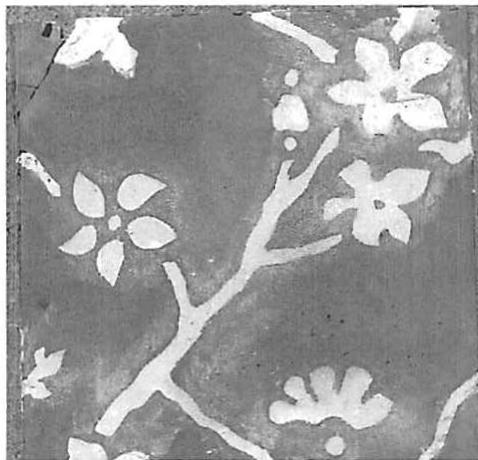
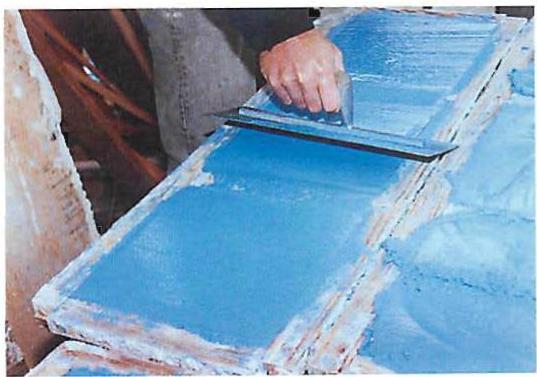
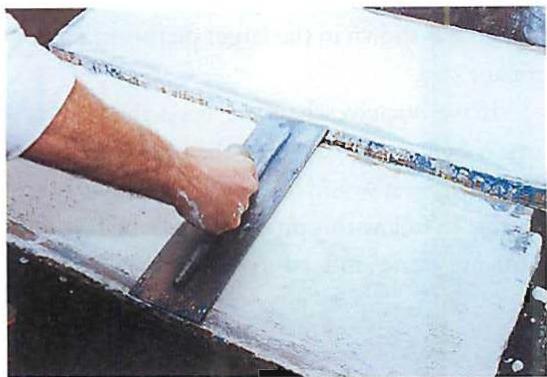
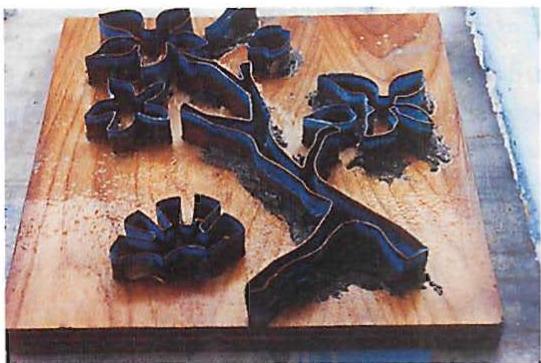
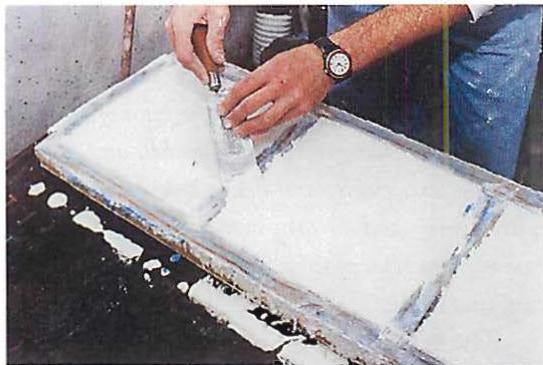
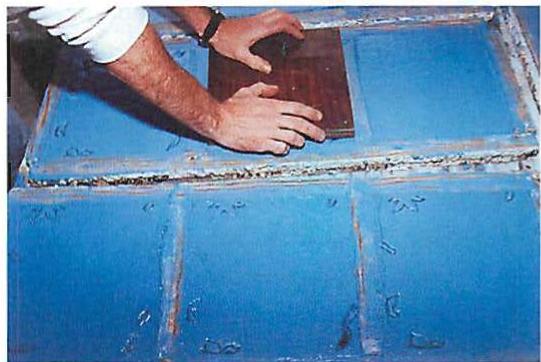
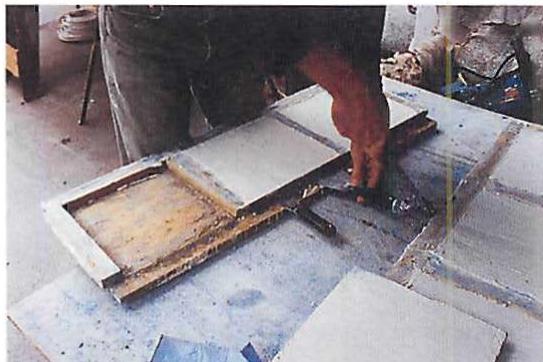
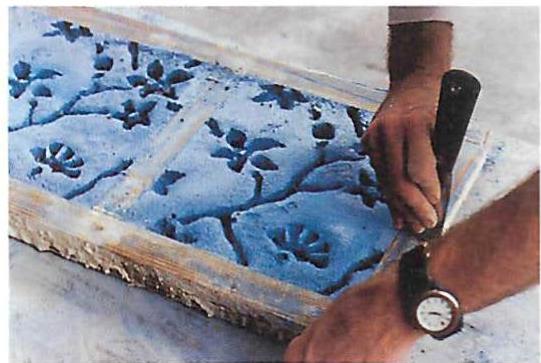
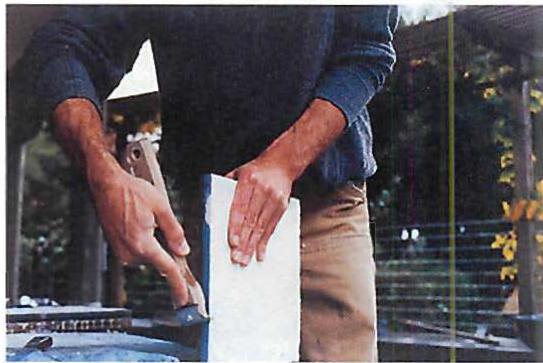
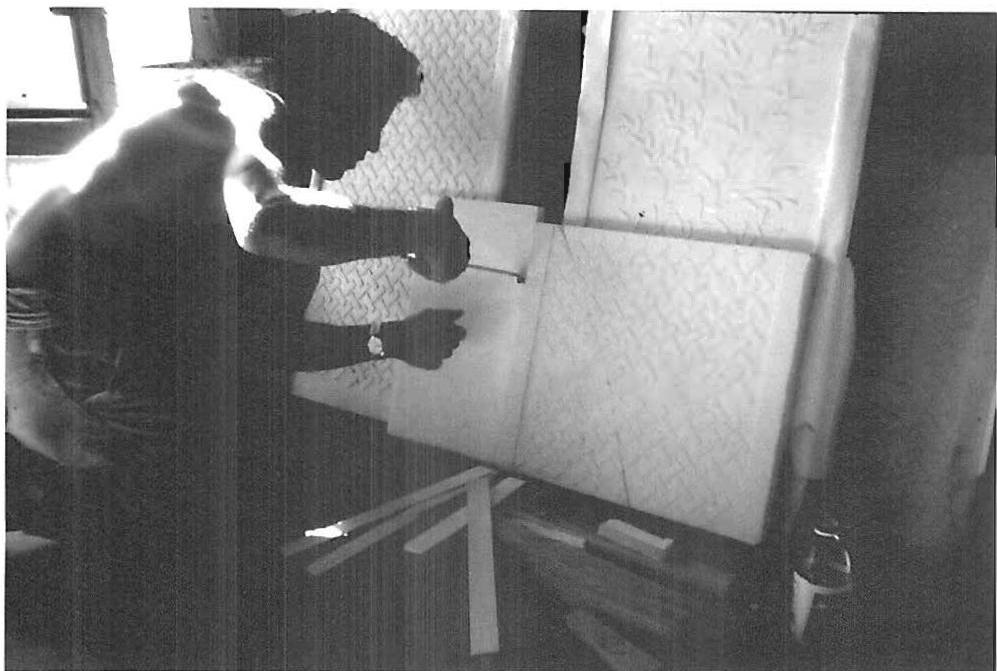
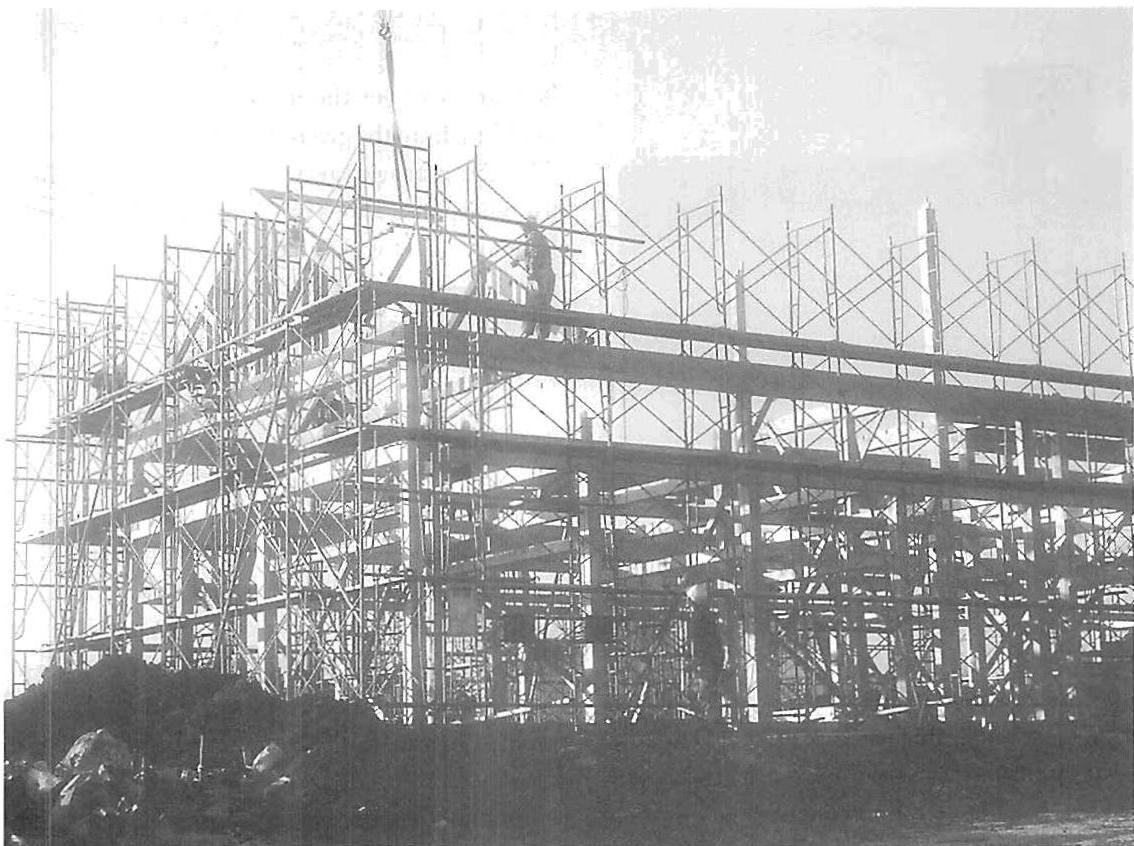
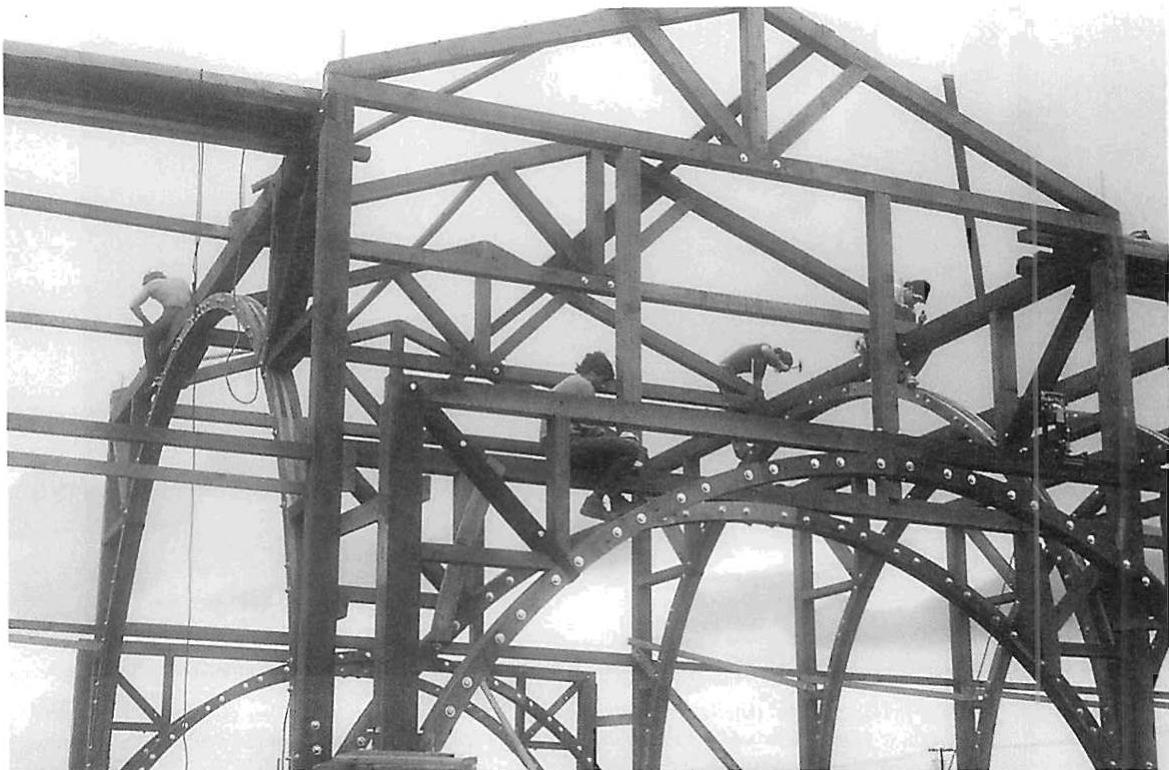
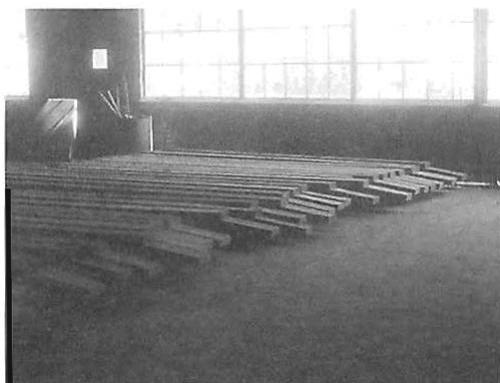
open books. Clients are able to see the checks, payments, of every penny. Changes can be made (and are expected) inside the total of the 83%, without change-orders. Any time a change is made, within the total of the 83%, and the money needed is obtained by economizing on some other part of the contract. The construction manager's job is to juggle the money within the
83% so as to get the most and best quality of building from the given sum. To make this possible, the manager also has the right to reduce certain specifications in the building to compensate for others which have been increased. Thus there is a trust relation. The client knows that he will get just what this money can be stretched to pay for. But he has to be realistic about his expectations, and cannot take the conventional adversarial approach to the construction manager.
My colleagues and I have invented (and used and tested) several types of contract which work like this. The contract type I have used most frequently is the one published on pages 92-98 of THE MARY ROSE MUSEUM. Many others have also been tried in our company and worked. These contracts are downloadable from natureoforder.com, and patternlanguage.com. All deliver a building for a fixed price and leave the architect/construction-manager as much freedom as possible to do the best job he can do with the available money.
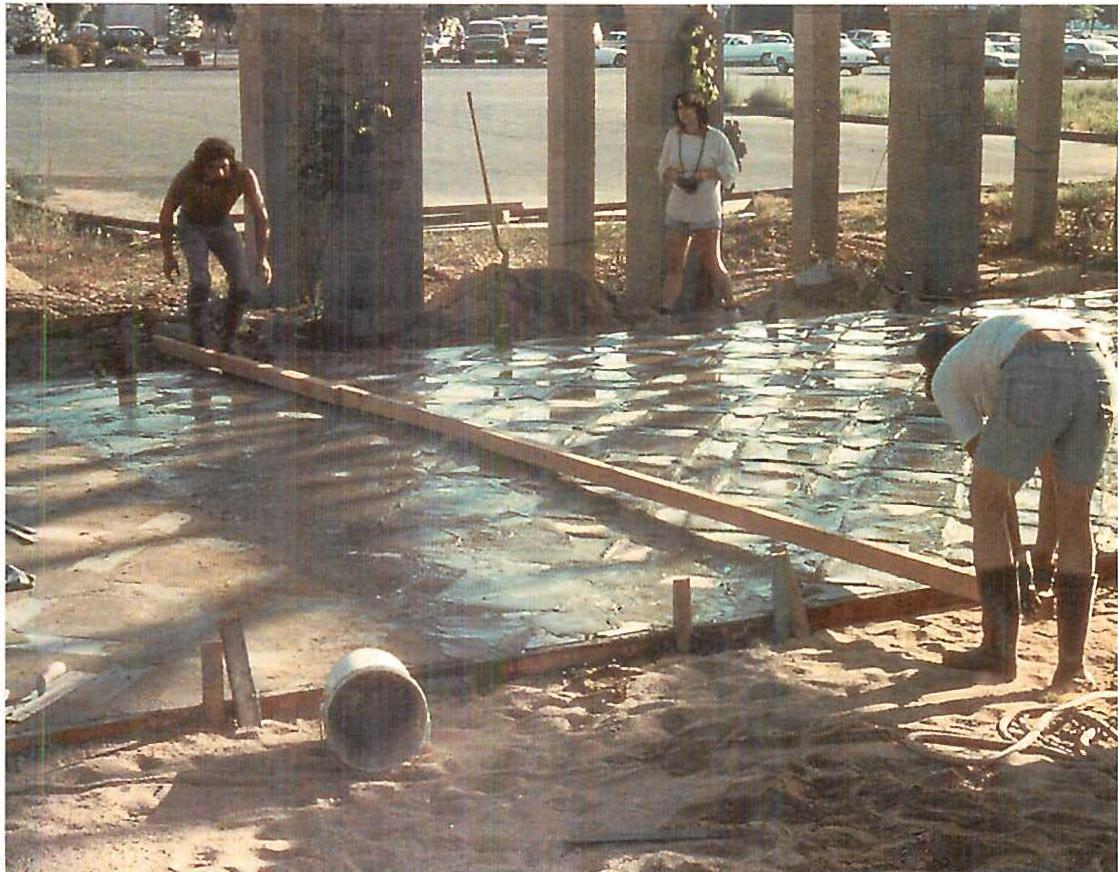
Working the slab of our 6000-square-foot floor in the Fresno Farmer's Market. Here we dropped prefabricated indented polygons of blue concrete, half an inch thick, into the wet slab and made them integral with the whole. Each took its position according to the wetness of the material, the time it was worked, and the setting of the concrete. The resulting uneven surface, like a fish's scales, shimmers in the sun.
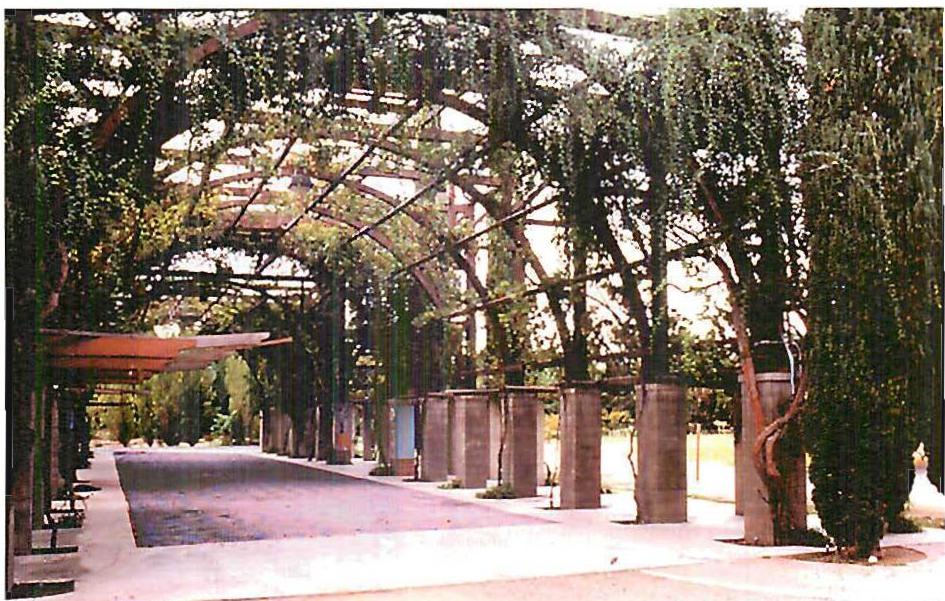
The finished Farmer's Market, as it is now, 15 years later, with the vines fully grown. Also pages 538-39.
10 / WORKING ON INTEGRATED WHOLES
If one had to give an exact definition of making which distinguishes between "making" (viewed as part of an unfolding process) and "construction" (viewed as part of production), it would perhaps go like this: the operations of making and construction are distinguished by the way they handle the wholes and centers which are being formed. During the process of construction, the operations that are performed must be congruent with the wholes that are being formed. This sounds almost like a tautology, but it is not.
In much 20th-century construction, the building process was torn apart into subspecialties, subcontracts. The plumbing was done by the plumber, the electricity by the electrician. The concrete forms were built by form builders, the steel was placed by steel placers, the concrete then poured under the supervision of the general contractor. All this was done partly because of the influence of Taylor's ideas on time and motion, from about 1900. It fits, too, the specialization of trades, the power of unions, and it fits with the analytical conception of an efficient contract.
The problem with this approach is that the actual construction process then goes forward as a series of disjointed operations, which have no natural connection with the naturally occurring wholes — centers — in the building. The carpenter does stud work but has no satisfaction in the creation of a wall as a completed thing; the roof framer installs trusses and the roofer lays the roof surface, but neither one of them has the satisfaction in the creation of a roof as a completed whole. A natural process in which new centers appear and are strengthened and elaborated has no relation to these divided specialties. The men and women who do the work have no natural satisfaction when their particular job of work is finished; naturally occurring wholes and centers do not develop smoothly; the building goes up as a series of fragments. All this makes the appearance of life in the building most unlikely, indeed virtually impossible.
In order to achieve good results in my construction operations I found that I had to take an integrated approach in which — for example — forms, steel, concrete and tile were done (all together) by a single team; or in which carpentry, rough plumbing, and electrical were done by another single team.
The essence of a successful construction process — I have discovered over the years — is that the team working on a given part of a building have the satisfaction of working on a psychological whole and making it complete. When they are finished with a particular phase of work, they have created a visible, palpable whole.
I do not mean by this that they have necessarily reached a completely finished part of a building. Indeed, that is the opposite of what I mean. What I mean is that at each important step, some new whole has been sufficiently delineated, and sufficiently filled in, so that one feels
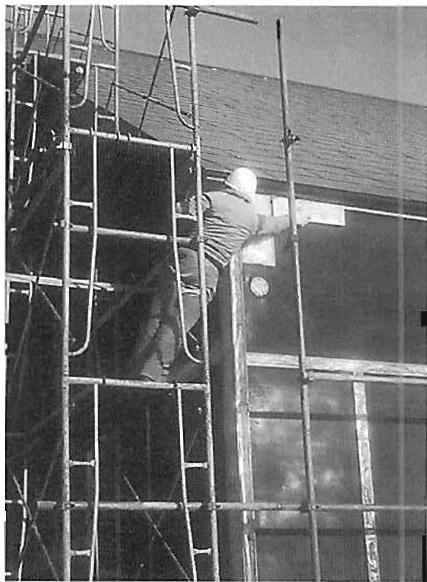
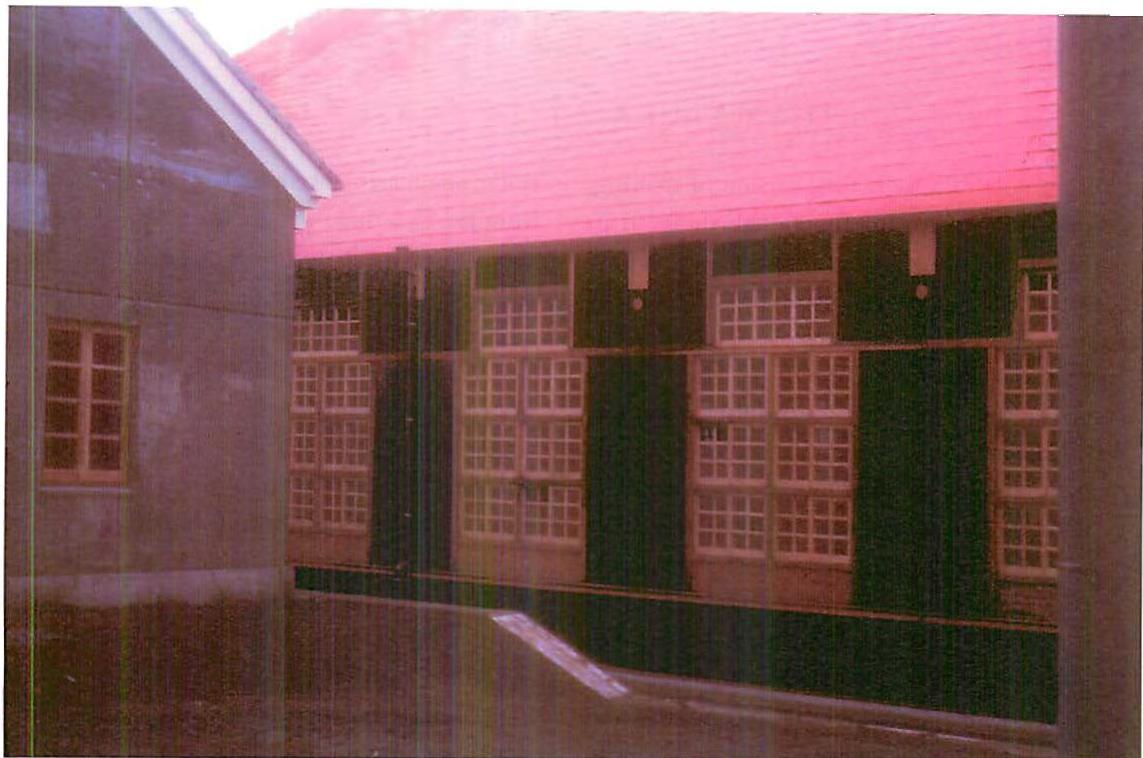
the new whole and grasps the way in which it contributes to the wholeness of the larger building. It is in this all-important psychological sense that an achieved whole which intensifies a given center is brought far enough along, so that its impact on the entire building, and its successful injection of more life into the building, becomes clear. That is where the team's satisfaction and the craftsmen's satisfaction comes from. They feel satisfaction because they have completed a whole. And they have been able to achieve this because their job description, or craft, gives them the leeway to have impact on the details of what they are doing, are therefore able to control the whole, in all its details, and can therefore create the subtle adaptations between the parts that are necessary to create a living whole.
To accomplish this kind of thing, I have had to hire people who understood several disciplines, who knew how to place steel, build forms,
pour concrete, place colored tiles within concrete, were willing to do all these, and were competent to do all this, together.
Often I had to hire teams of people who — from the outside world — looked almost inexperienced, because their ability to integrate these many trades in one holistic operation was more significant to me than their degree of skill in any one operation.
I remember at one time we tried to hire a foundation subcontractor and told him that we (not he) would be placing the string lines for his batter boards because we had to control the position of the top edge of the foundation in relation to the ground. He refused to do the work, because he saw placing lines as part of his trade and could not conceive a construction process which was divided up differently. So we finally did the boundary-crossing foundation work ourselves.
11 / MATURA AS AN EXAMPLE
An example of a high-tech version of making, oriented to the focus on functional wholes in an emerging building rather than to segmented trades, was the approach taken by the company Matura in Holland and Germany for the construction of apartment interiors. The Matura company, founded by Professor John Habraken, was dedicated to the proposition that two parts of an apartment building must be separated:
(1) the shell of the building, containing foundations, walls, windows, roof, floors and (2) the interiors of the apartments.
The company developed an integrated process through which they began with the rough construction of an apartment building and treated it as a shell which was then to be filled in. The infill consisted of a sub-floor with all drain lines, water lines, heating, partition walls, cabinets, and built-ins, plaster, paint, and electrical systems.
The apartments laid out (for instance by the process described on pages 382–84 of chapter 12) were then transferred to a detailed schedule of preformed materials and components for each complete apartment interior: the interior construction being an integrated system consisting of foam (to raise the floor), precut plastic pipes, walls, connections, plaster, sub-flooring, and floor surface. In this new apartment interior, all drain lines were to be laid within the subfloor. Once the layout of the apartment had been specified, all that followed was worked out in computer form, the parts needed were precut and numbered, and the entire assembly was then shipped to the site in a single 20-foot container. The interior of one apartment could then be assembled and installed by a three-person team. It usually took about three weeks to finish one apartment, and was done at a finished price of about $47 per square foot.
The men doing the work were highly skilled, but they were skilled in this complex combination of operations including placing electrical fittings, laying hot and cold water pipes, installing heaters and heating pipes, installing and connecting subfloor, and plastering preparation. Thus this team cut across the conventional trades which would separate all these skills, and instead provided a single high-speed, high-skill, operation for the construction of the apartment interior as a whole. The key point was that this unit of the construction process dealt with a whole. The process deals with a whole. The teams undertook a completed whole. Their satisfaction and their efficiency are all connected to the creation of a whole.
Such experiments, which represent the dawn of a new era of post-industrial “making,” point the way to an entirely different organization of the construction industry.
Interesting though it was, Matura was flawed. The need to prefabricate all the components and then finally, “assemble” them, left too little room for fine tuning and adaptation at the smaller scales. We have now adopted a process in which details are specified by process descriptions, allowing each part to be formed uniquely, according to its context, without drawings, using only specification of procedure.
12 / WABI-TO-SABI: THE BALANCE OF ROUGH AND SMOOTH
To get exactness of adaptation, there is a price to pay. The price is roughness. To get the perfect adaptation which is required by the unfolding of a field of centers, you cannot avoid a certain
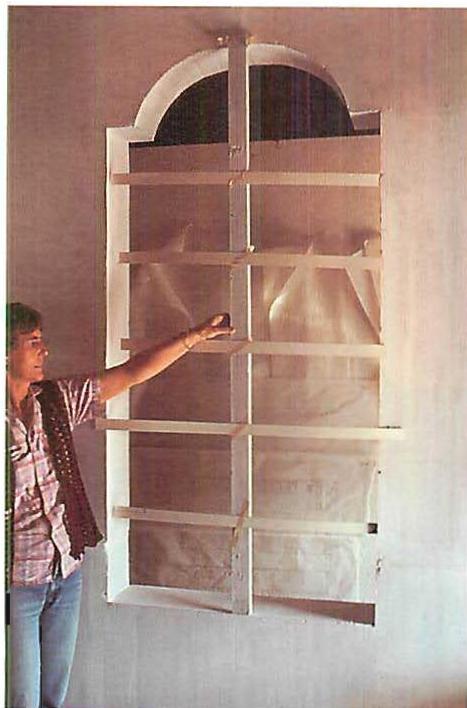
roughness in the results. That is because, to make each center come to life, there needs to be give and take that permits the needed complex superposition of relationships: hence uneven, unequal spaces, lines, straightness, curvature and so on. It is not possible to get perfection in the field of centers — true life — and also have the shallow mechanical perfection which 20th-century people often seemed to demand of buildings.
In present-day construction, especially in America, people in general—and contractors too—have become accustomed to buildings with an almost fanatical level of finish. For example, the tiles of a wall must be flat, square, coplanar, and equally spaced—all to within a few hundredths of an inch. They conform to a mechanical ideal of perfection. Why? Not for any practical reason.
Indeed, the attention needed to achieve this mechanical perfection drives out the possibility
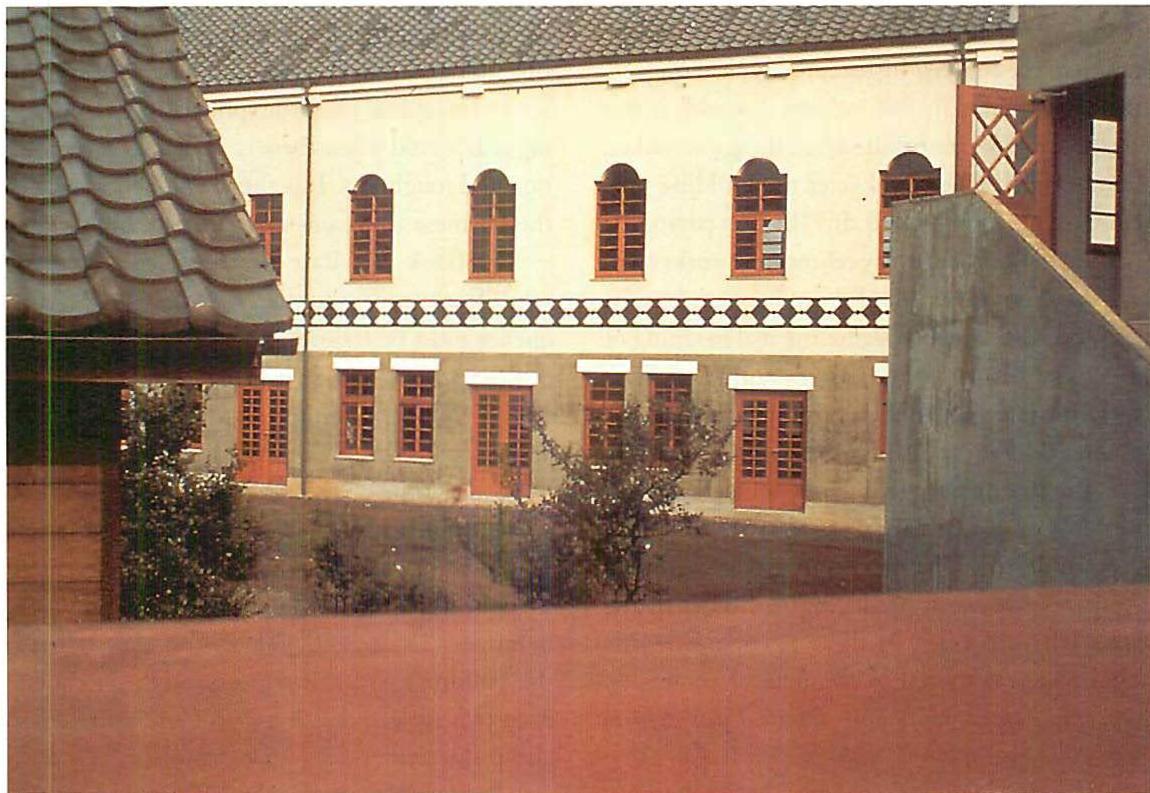
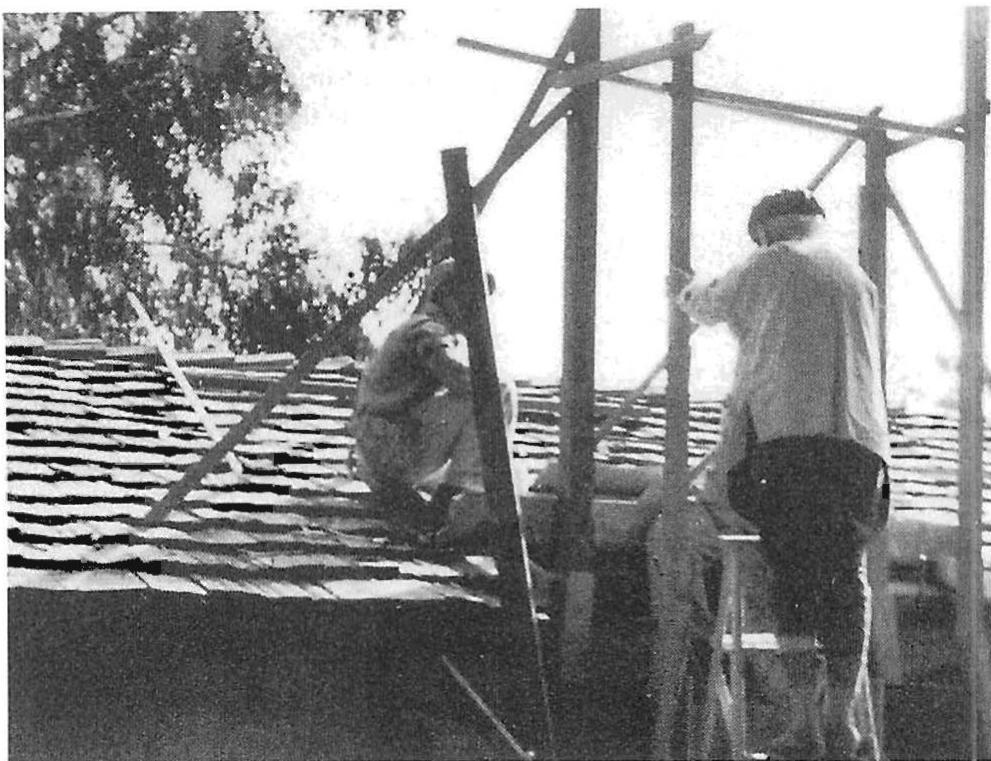
of paying attention to real perfection or real adaptation in the centers. Instead, the typical tile-setter or carpenter in the industrial world, is not aware of life as an attribute of the things he makes, nor aware that he could steer the building processes in his care towards this "life" by paying attention to the life of every center as he works on it.
I believe this kind of thing happened in the 20th century largely because the real meaning of order and beauty had been lost — and craftsmen therefore maintained their pride of workmanship by appealing to a meaningless perfection of detail.
But this meaningless perfection of detail had nothing to do with the beauty of the wall. Indeed, it destroys the process of producing order. And the process of producing real order of the kind I have defined in these four books — the kind which is rooted in the field of centers — can only happen when this fanatical attention to trivial and mechanical detail is abandoned.
Unless there is a balance between those things which are done with great care and those
things which are done more roughly, it is impossible to build order of the kind described within any ordinary budget. True spirituality in a building is achieved when there is a balance of perfection and roughness. It is the phenomenon which the Japanese call wabi-to-sabi: rusty beauty.
In Book 2, I have described the essential role of sequence and the way that proper sequence must be followed to allow the unfolding of life or wholeness in a thing.
What this amounts to is that we must always allow the essential thing to lead the inessential. We concentrate on the essential and let the inessential trail behind.
In the Eishin project in Tokyo, we wanted to use real shikkui—a soft shining plaster which is moving to see and touch—on the walls of the buildings. I felt it was essential. Of course it costs a little more than "ordinary" plaster or cheap substitutes.
I arranged to pay for the difference in cost by simplifying the low retaining walls in some of
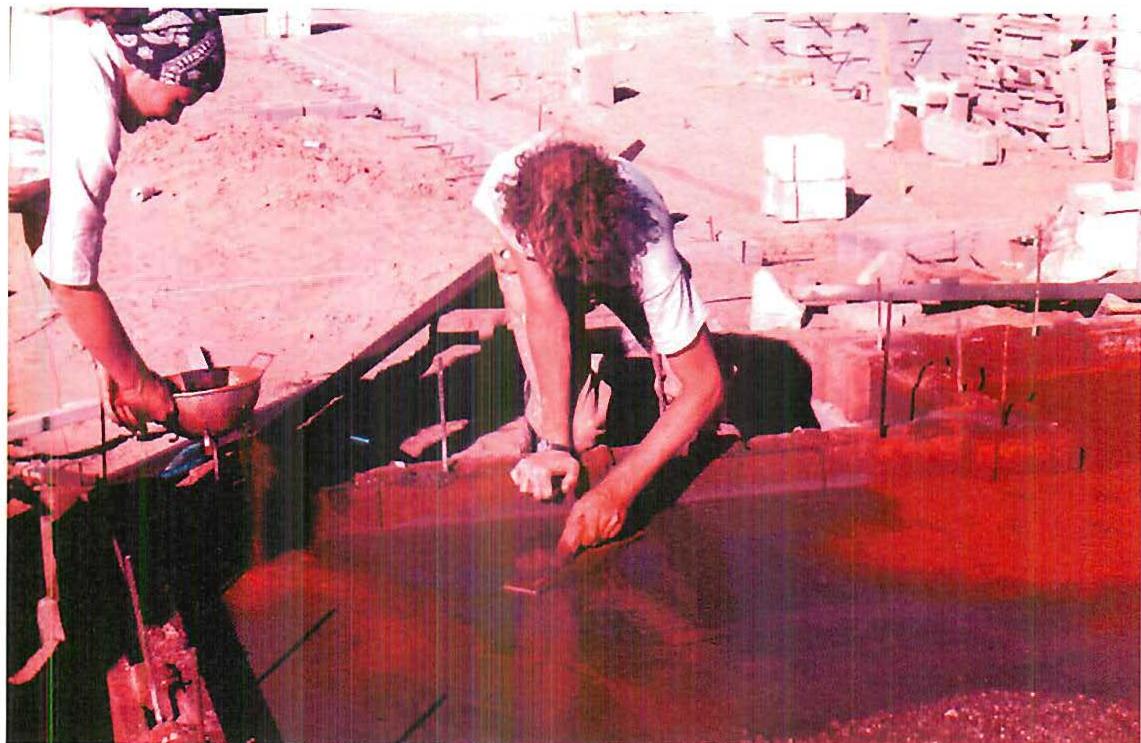
the site works. I asked Mr Nishida, our site-work construction manager, to make sure that these retaining walls for tennis courts, gardens, etc., were made very cheaply with wooden forms using lowest grade one-inch wooden boards and widely spaced stakes.
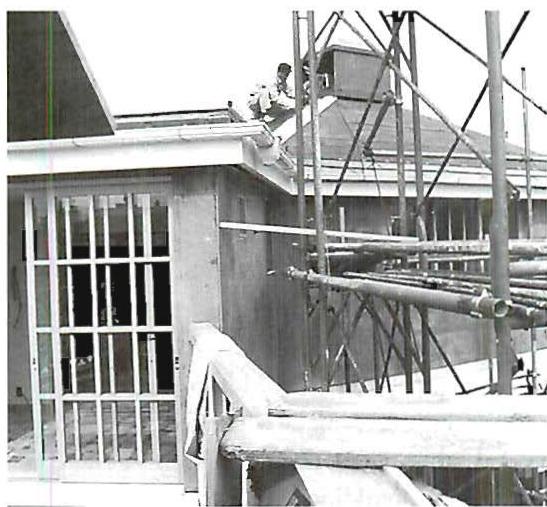
"But the wall will have a bad surface, and the boards will warp out of plane." "I know," I said, "but I want them to be cheap, so that we can save money towards the shikkui for the important places. Also, there is no reason for these low retaining walls to be fancy. No one will look at them. All they have to do is to keep the earth in place when the rains come."
"But, but, but . . . my men will refuse. They will not allow themselves to do such poor work." Then I tried another argument. I asked Mr. Nishida, "How would a farmer make this wall? He would just get the 1 inch boards and make the cheapest formwork he could, then pour a low grade concrete. He would do nothing inessential . . . In spirit, our small retaining walls are just like a walls a farmer would make. Why do something fancier when it is not essential? It is disturbing to the spiritual quality of work to make something more fancy than it needs to be." It took me almost two hours of discussion to convince Mr. Nishida that this was the right thing to do.
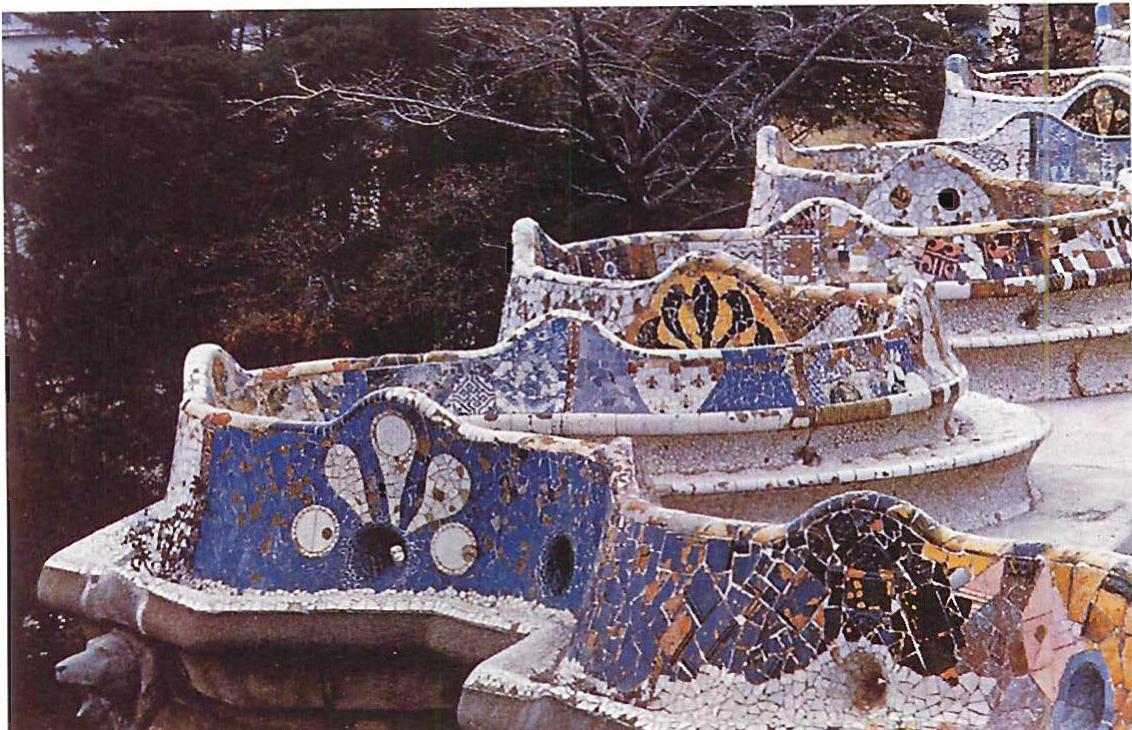
The spirit is essential. It is in the nature of spirit to make a beautiful and special thing where a beautiful and special thing is required, and to offset it with a simple inexpensive thing. That is the most humble way to make it, and the beauty then shines out because of it.
And, of course, this has its counterpart in money, too. You cannot afford to make careful, expensive things everywhere. It is necessary to choose, to divide up the money in the best way, to make one part glorious, and make another part humble to pay for it.
The key lesson in all this is simple and extreme. The field of centers cannot be created as a by-product of some existing process. It will come about only when the entire process of making is organized and concentrated on just this one thing: to create a living field. If you concentrate on something else, you get something else.
One more example may help make this clear. In the center of Mexico City there is a beautiful house called the House of Tiles. It is a huge house, more of a palace really, built by Count Sanborn about 1800. The outside of the house is almost entirely covered with hand-painted tiles, mainly blue. From a distance, the house shimmers with the flickering color of these hundreds of tiles.
When I was there, I decided to go and have a closer look at the tilework and found something amazing. The tiles are about nine inches square, handmade and hand-painted. They cover the exterior walls. But the way they are laid is astonishingly crude. There are ridges between tiles, huge valleys, the tiles aren't all in the same plane, many of them are not even vertical. They meet, at their edges, in the roughest possible way. By modern American standards, this tilework would not be even remotely acceptable. Yet the House of Tiles is widely known as one of the most beautiful palaces in Mexico City.
We have become accustomed to a wrong-headed, almost fanatical, precision in the construction of buildings. Our tilework, for instance, is required to be perfectly aligned, perfectly square, every tile cut perfectly, and the
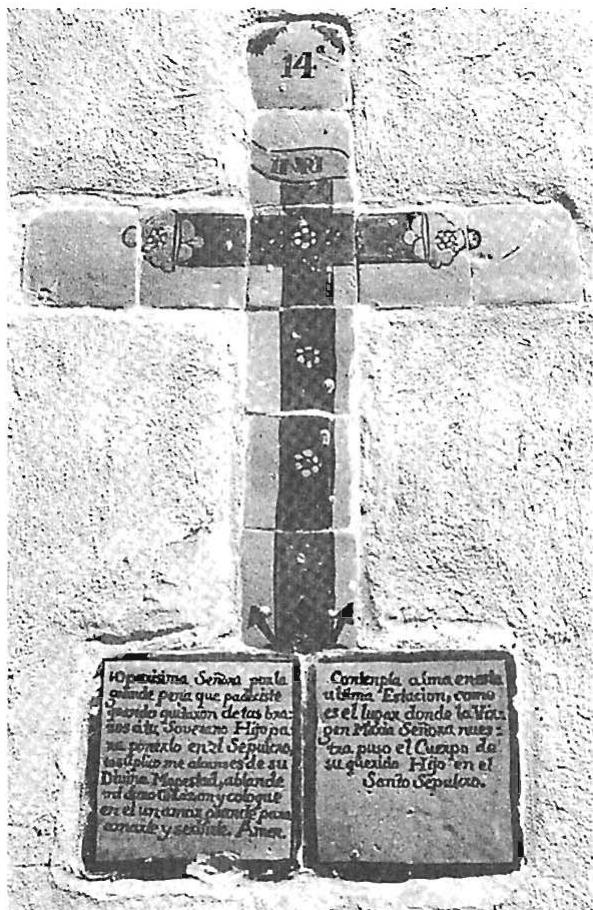
whole thing accurate on a grid to a tolerance of a sixteenth of an inch. Yet our tilework is dead and ugly, without soul. A modern American tile-setter who has learned to get his satisfaction from the perfection of squareness, the perfection of plumb, and the perfection of the regularity of the tiles, can never achieve the same result as the old Mexican tile-setter did on that shimmering blue house. He cannot achieve it even if he knows the field of centers and understands it. The reason is that so long as the tile-setter's mind is occupied with technical perfection, he cannot concentrate on the field of centers—and so the living field will not spring to life in his work. There is not room for both. This is not because they are inconsistent. It is simply because you cannot concentrate on two goals, both so big, yet so different, at the same time.
In our era, many of us have been taught to strive for a meaningless perfection. To get wholeness, you must try instead to strive for a perfection where the things which matter less are left more rough, and the things which matter more are given deep attention. The result seems imperfect. Yet, in fact, what seems like roughness is a deeper kind of perfection.
Why is it that in the Mexican house, the tiles are rough, they are cut roughly, the wall is not perfectly plumb, the tiles don't even line up properly? Is it because these Mexican craftsmen didn't know how to do precise work? I do not think so. I believe they simply knew what is important and what is not, and they took good care only to pay attention to what is important. In this case it was the color.
So, when they made a wall of tiles, they
paid attention to the color, to the design, to the feeling of one tile, and its relationship with the next — these are the important things that create the harmony and feeling of the wall. As for the plumb, the alignment, these can be quite rough without making any difference to the essential color and therefore should be left rough — because it puts things in proportion and leaves the marvelous color shining out as visibly the most important thing.
They spent their effort in the way which made the most difference, and they produced a wonderful quality, this harmony, simply because that is what they paid attention to and what they tried to do.
13 / SUMMARY
I have said repeatedly that if you hope to create life in a building, the unfolding process must occur in your hands in the real world, in the actual construction of a building, not only on paper. In my view, this works best when an architect takes full contract responsibility for making the building, or as close to this ideal that he can achieve, via some form of direct management and control over money and over craftsmen and subcontractors. I am asking you, really, if you are an architect, to be a builder, to take the craft of building seriously as part of your work.
There is a profound reason. Your building will have life to the degree that every center in it has its life. When you succeed, there is a living quality in every center. This is true not only of the larger design elements: rooms, buildings, volumes, roofs. To make the building real you must strive to make it true, also, in the actual shape and size of individual pieces of wood, of the bottom of a wall, the edge of a roof, each pane of glass, even the surface of the paint.
Since each center is in a field of centers, the larger centers of the building can't have substantial life unless they are themselves made of smaller living centers. This means that ideally, all the individual elements — even nails, pieces of wood, joints, tiles, sills — should themselves all be living centers. They must themselves have emotional substance and actual substance, and you must give it to them. But such solidity and person-ness can be brought into these material construction elements only through actual physical experience and adaptation which is done by you, and by the people who work for you.
It means that each detail must be shaped within the context of the construction; it must get its form from its surroundings, be shaped in response to a larger whole. Above all, the elements cannot be fully planned on paper ahead of time, or prefabricated, and only then given to a general contractor to assemble. They must be thought out, felt, by an adaptive physical and human process in which you — the builder — experiment with the real materials, allow the construction details to emerge from your experience with the real materials, from the real context of the building.
This requires a level of involvement between the men and women making the building with you, and the individual physical materials of which the building is made. It makes an unbroken line of connection and control going on continuously throughout the construction — something which just is not possible when the professions of design and building are separated.
I appeal to you to understand this.
To make a living world, we MUST find ways of making details, shaping each one in relation to the whole. And for this to be possible, we need ways of making them, the actual ways of building them, fabricating them, which allows each one to become unique within the whole. That requires a new way of thinking about construction. In this new way, we shall judge building details not only according to their cost
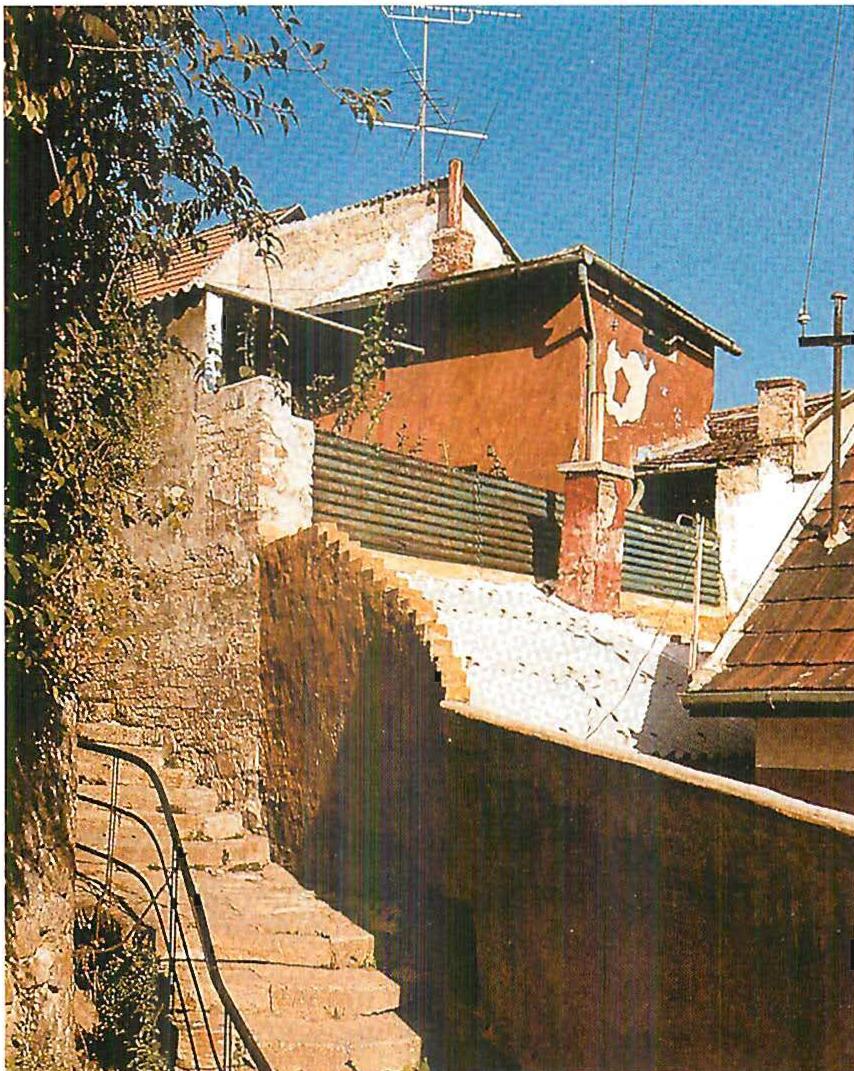
and their efficiency—but also, and perhaps more particularly, according to the degree that each component allows itself to be shot, carved, shaped, molded by its position in the greater whole, to become identifiable, unique, a living thing.
14 / MORPHOLOGICAL INVARIANTS CREATED WHEN MAKING GOES ACCORDING TO A LIVING PROCESS
All dimensions and shapes of every element are perfectly adjusted.
In a repeating series of details, the individual elements expand and contract according to location in the series. There are not perfect constancies of dimension.
General dimensions are repeating. But because elements are placed exactly right, dimensions of location are also unpredictable and variable.
Perfection, in the sense of repetitive exactness, accuracy of line and so on, is not sought. Rather, the perfection that is sought is accuracy of feeling in the centers that are made.
In a technical sense, everything is specially cut and shaped as if it were hand-craft. In practice, though, this hand-craft will often be done by ultramodern, high-technology techniques which allow making in a new technical sense, because our 21st-century techniques allow details to be fitted exactly to their positions in the whole through some new form of almost "biological" process.
Even if a building is made with the most sophisticated high-process technology, in every inch its character will always feel hand-made.
The love of the material will be visible in every inch.
CHAPTER SIXTEEN: HOW LIVING PROCESS SHOULD INSPIRE CONTINUOUS INVENTION OF NEW MATERIALS AND TECHNIQUES
1 / THE SEARCH FOR NEW MATERIALS
Achieving the qualities described in chapters 14 and 15 is not entirely simple. What materials and building techniques are needed for construction of buildings in a living world?
Even if someone were to accept the arguments of chapter 14 that require building materials and elements from which living centers can be made, even so present-day technology does not always allow it. Indeed, the materials and techniques in present-day commercial use more often actively prevent the formation and elaboration of profound living centers in the material fabric of a building.
The same goes for the techniques and processes described in chapter 15. Even if one accepts the need for making and the need for patient, hand-guided adaptation of shape and dimension to each unique condition in the building, that does not mean that available materials will make this possible. Indeed, current norms of material and technique often make it impossible, or difficult, or too costly. Yet, as a practical matter, fine tuning and adaptation cannot become widespread unless the process of fine tuning is both economical and easy.
How is all this to be done? We need new types of materials and techniques which have the following two functionally necessary attributes of the construction process.
We need to be able to shape materials rapidly and carefully so that the process of shaping, which produces a wall, or a column, or an opening, easily creates living centers, and can be accompanied by thought while it is happening. In short, we need materials and techniques which re-establish building as an art.
We need these materials and techniques to do more than form natural, beautiful centers in a building almost by themselves. We also need the process of shaping and forming centers to be adaptable, so that subtleties of dimension can be accommodated easily and can be made cheaply.
In virtually all societies of the preindustrial era, these two properties of building process existed for all materials in common use. Brick, snow, mud, reed, plaster, paper, tile, glass, stone, timber, were all of this kind, and the way that these materials were inherently labor-intensive was congruent with a labor-intensive production process that was widespread throughout society. Fine tuning and adaptation therefore presented no special problem.
In modern society the situation has changed greatly. While preindustrial society often had a labor-material ratio of 5:95 or 10:90 for building construction (materials being far more expensive than labor), in modern society more than 50% of the cost of building now lies in labor. Labor-material ratios of 50:50, 60:40 and even 70:30 are nowadays common in building construction. Labor is the expensive item. Since we can no longer afford labor-intensive ways of making beautiful details because this will drive a building into being a luxury process, we need, instead, ways of achieving the two functionally necessary attributes, but by new means which are not labor-intensive. A seemingly impossible task, but one that must be accomplished if we are to have a living architecture in the modern epoch.
The materials and components of the first industrial era have so far provided us with components that are often elegant, highly efficient, and often cheap to produce in factories. But they tend to create just that deadening environment to which these four books are mainly directed. To supplement our present-day materials, we have to find others which allow rapid shaping and adaptation, using new techniques which are machine-assisted, computer-assisted, and highly flexible so that the shaping can be controlled by human hands and human thought without massive and expensive investment of human labor.
That is the trick we must perform.
2 / GREEN MATERIALS AND ADAPTATION
We know from the green movement, and from current thinking about sustainability, that building materials are a matter of major importance in maintaining life on Earth. There is, for example, a green index which aims to describe those materials that have long life, least energy drain during production, that use renewable resources, are biodegrable, energy efficient, and capable of playing a part in energy conservation through inherently good insulation capacity.
Does this mean that using green materials is the secret of life? Absolutely, it does not! The assumptions in the "green" analysis are too limited. Solar panels, for example, long touted as a way of providing solar energy to buildings, have a high-tech quality which is not merely visual. These panels, as presently produced, are damaging because, geometrically rigid as they are, they cannot easily
be re-sized or adapted, so cannot play their role in an adaptive process which makes buildings harmonious, structure-preserving, and internally well-adapted as each element is shaped and fitted to neighboring elements. Similar things can be said of many present-day high-technical elements.
For example, the use of straw bales illustrates perfectly how wrong-headed technical thinking can turn a good idea on its head and make what was potentially valuable into something almost meaningless.
In its original form, the use of straw bales for walls had wonderful attributes. It is a renewable resource; it is cheap and easy to cut. It has the wonderful quality that you can lay out a house, then get a feel for the room sizes, and openings, then move them around and adjust them until the house is really comfortable. Only then, plas
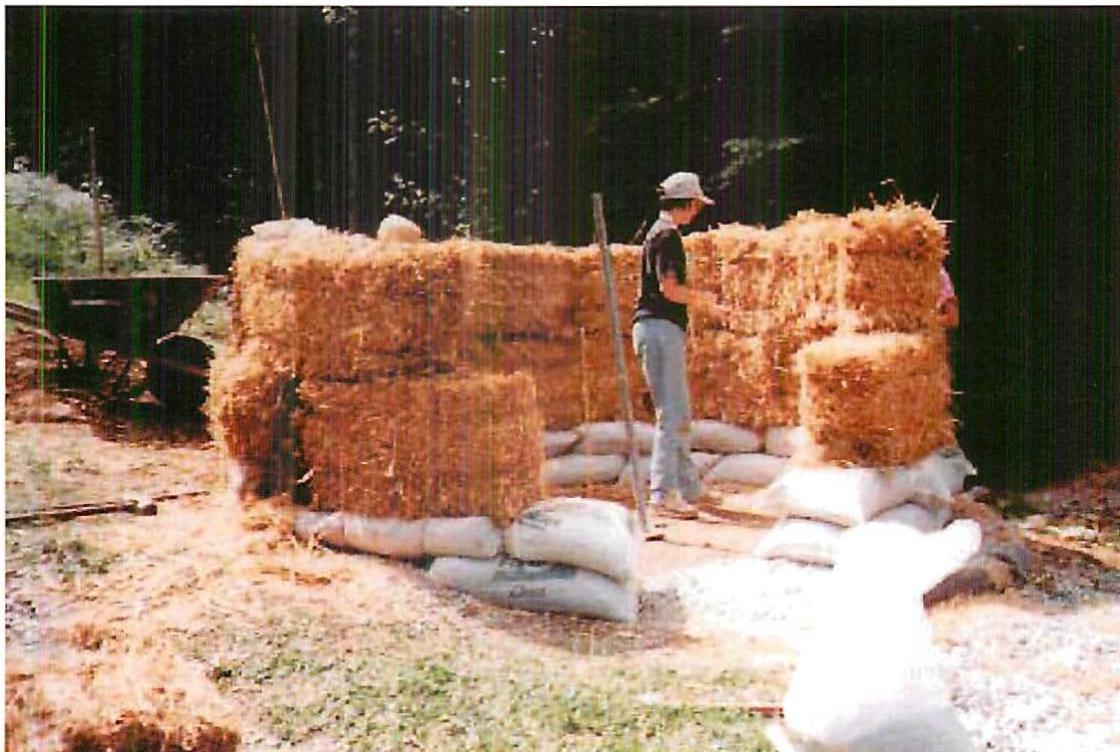
ter it. All this is hugely positive. But as implemented in its evolved high-tech version, because of earthquake problems, and for various other structural reasons, another way of using straw bales has evolved; this adds an inserted standard timber frame—usually four-by-fours about six feet apart—and ties the frame together with a beam and braces.
In this new form, now widely used throughout the United States, the earthquake problem is solved, but the high-tech straw bale technique has lost nearly all the adaptive qualities of the original straw bales themselves. They have now become merely infill panels in a frame which is drawn, fixed, and built to building department specifications, and is far more rigid than the idea behind the original use of bales as highly flexible building blocks. The straw bales have become cumbersome infill panels that are bigger and more expensive than conventional infill—with some good quali
ties—but losing altogether the beauty, the ability of a straw-bale wall to be determinative as a structure in its own terms, thus losing altogether the possibility of fine tuning and adjustment which made it so attractive in its original form.
The supposedly "green" attributes of the material are still present. But the essential thing—that the material is able to take its place as part of a living process—has been lost. It has been turned into yet another dead, technically perfected and specifiable system component in a non-living process.
The essential thing about a living architecture is not the greenness of its materials but the capacity of its materials to form living structure in the complex, geometric, life-affirming sense that has been demonstrated in this book. That requires a different kind of thinking, a determination to focus without wavering on this aspect of their adaptive performance.
3 / WHAT MATTERS IS THAT WE HAVE TECHNIQUES OF CONSTRUCTION WHICH HELP US MAKE LIVING CENTERS
The biggest issue is adaptability. Materials and methods of construction must be of such a kind that they can create details freely enough to intensify the field of centers at every point. And the materials must allow builders to have direct human control over every evolving center and thus to make each one, in some sense, "by hand."
In recent years there have been some efforts to find materials which allow all this. Certain architects and builders, inspired by the natural building movement, try to use materials which are plentiful, easy and cheap to get in many parts of the world. Some of these techniques, almost as an extra bonus, tend to create walls which are more profound as centers (rammed earth walls, for example, are thicker, more natural, and create masses that have more feeling), and are able to incorporate more adaptation, naturally, almost
without effort. It is important that the growing use of such materials should continue. As the Earth's population grows, and resources dwindle, these techniques will increase in importance.
However, there is a slightly dangerous, nearly archaic aspect to such ideas and experiments which is not consistent with advances in strength, technology, durability and performance. We need to look for those new materials which have superior performance, are truly "modern" as materials, and yet have the character needed to support fine-scale adaptation and unfolding.
To this end, there needs to be emphasis on materials and processes which can bring life into the building. We need a continuous program of invention, then, aimed at finding new materials and physical techniques which support living character and beauty of buildings. In any case,
some kinds of building technique allow the unfolding of living structure, while others do not. Historically, traditional building techniques—wood, brick, stone, plaster—all did it. But most of these techniques are gone. They cannot be resurrected easily, since for the most part the cost of labor has made them impractical today.
But the need for adaptation does not necessarily require a return to hand-craft. For reasons stated earlier, that would often be completely impractical, given modern methods of construction, and changing the ratio of labor cost to materials cost.
What is needed is a range of physical techniques—the most modern methods of fabrication and invention—which allow adaptation and hand fitting of details to individual circumstances without the labor-intensive hand-craft methods which were typical in ages gone by.
The processes must allow each center freedom to develop according to its context, in a fashion which cannot be predicted when the construction starts. To achieve this, we have to use methods which allow the gradual formation of centers, one by one, under conditions which allow each center to become whole according to its place within the field.
Not all material systems can do this easily. For example, stud-wall construction and concrete-panel construction make adaptation difficult. In these techniques the builder assumes too readily that he knows what he is going to build, pretty much down to the last detail; and then he goes ahead and does it, without thinking or looking carefully while he is doing it. Concrete panels make adaptation all but impossible. Stud walls allow adaptation, but do not encourage the creation of living centers.
On pages 521-22, I show an example that naturally invites adaptation and special shaping. This is a column made by shooting gunite into a low-cost open form. The form allows elegant shaping; the process of the Reed gun (the first gunite gun) is sophisticated and produces a high-strength concrete very rapidly which stays in position when it is shot. This is capable of producing
an infinite variety of forms and shapes by high-strength, high-performance technique, while allowing maximum flexibility in the builder's hands, at relatively low cost.
More generally, in order to produce the field of centers in simple, economical, and normal ways which can become everyday for millions of people in today's society, I would argue, that it will require, primarily, process-based methods—methods which use high technology to give us processes, not components, and processes which can create sophisticated elements and members, fast and cheaply, yet fitting local circumstance and the eye of the person doing the work. Technology itself is perfectly capable of defining new techniques to help create a living field of centers: fast methods of cutting, shaping, pouring, forming. It is capable of using computer-controlled processes and processes where we investigate and create a far richer array of shapes than could be done in the first machine age.
Creating living structure in the environment, therefore, requires that we actively invent materials, methods, building systems, and ways of building, which have these characteristics — and which make it easy to encourage the creation of living structure.
It may strike you as unusual, that we should be required to invent so much. In the last hundred years, architects have, for the large part, been used to a fairly passive role as far as invention of new construction technology is concerned. Architects in the 20th century were routinely taught to assemble components specified in Sweet's catalogue, to use only available techniques and materials. But existing and available techniques from Sweet's catalogue, in the majority of cases, do not permit—and certainly do not encourage—creation of living structure.
Those few architects and builders who believe that they are somehow helping to make things more human by going back to stone, mud, thatch, and other materials used in primitive cultures, are—I believe—deluding themselves that this could ever enter widespread mainstream building processes. No matter how wonderful a
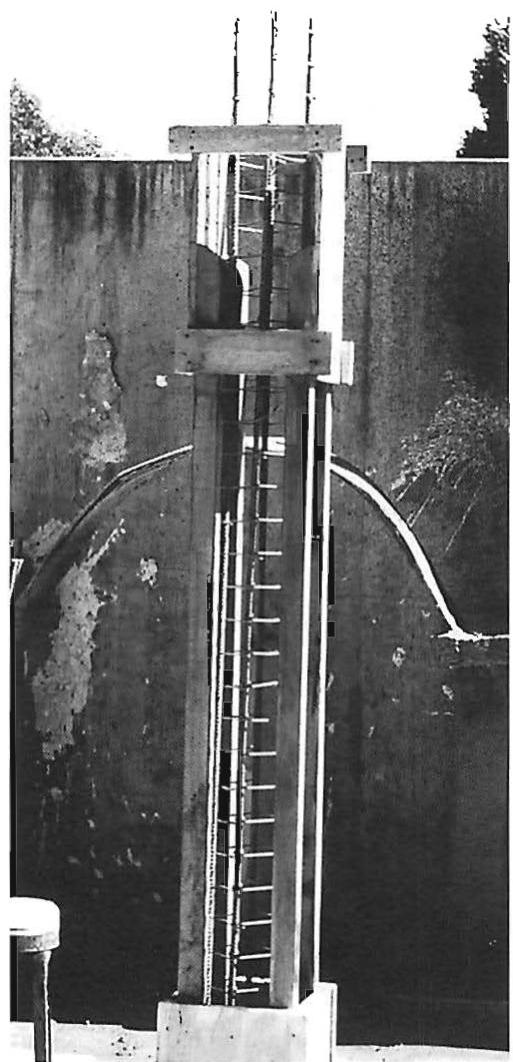
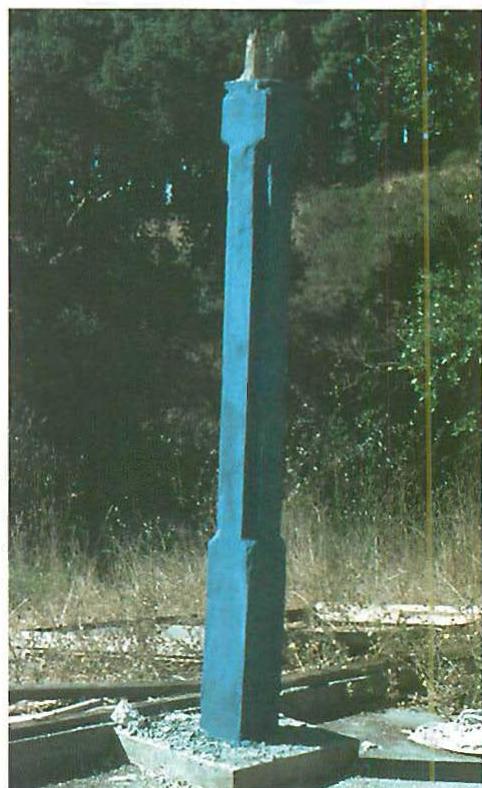
A recently invented, process-based technique. Left: Guidework for a column that is to be shot in gunite. Upper right: The jig I made so that I could cut compound curves on a two-by-two to build the corners of the form. This curve, cut off the plane of the diagonal, allows a flare to be created, making an elegant (and cheap) transition from the column shaft, to the capital and base (the finished shape that comes out is visible in the lower picture). Lower right: One of the first experimental columns, showing the result of shooting gunite into such an open form. The flare created by the cut two-by-two is visible on the corner of the column, where shaft meets base. In the picture on page 523, you may see columns of this kind in one of our building projects. Christopher Alexander, 1979.
stone wall might once have been, if you cannot afford to build a stone wall now in a house of ordinary price, it is wasteful and foolish to dream too much about stone walls. Stone walls were part of the technology, economic life, and social life of another era. Primitive technologies are unlikely to work for us because, so often, they just don't work economically.
We therefore need to invent altogether new construction techniques which in new ways make it possible to unfold a building so that every part becomes just right, and so that every part has its life.
Since we have had, during the last 100 years, almost no modern tradition of such building techniques, architects must now, necessarily, play a major role as inventors of new techniques.
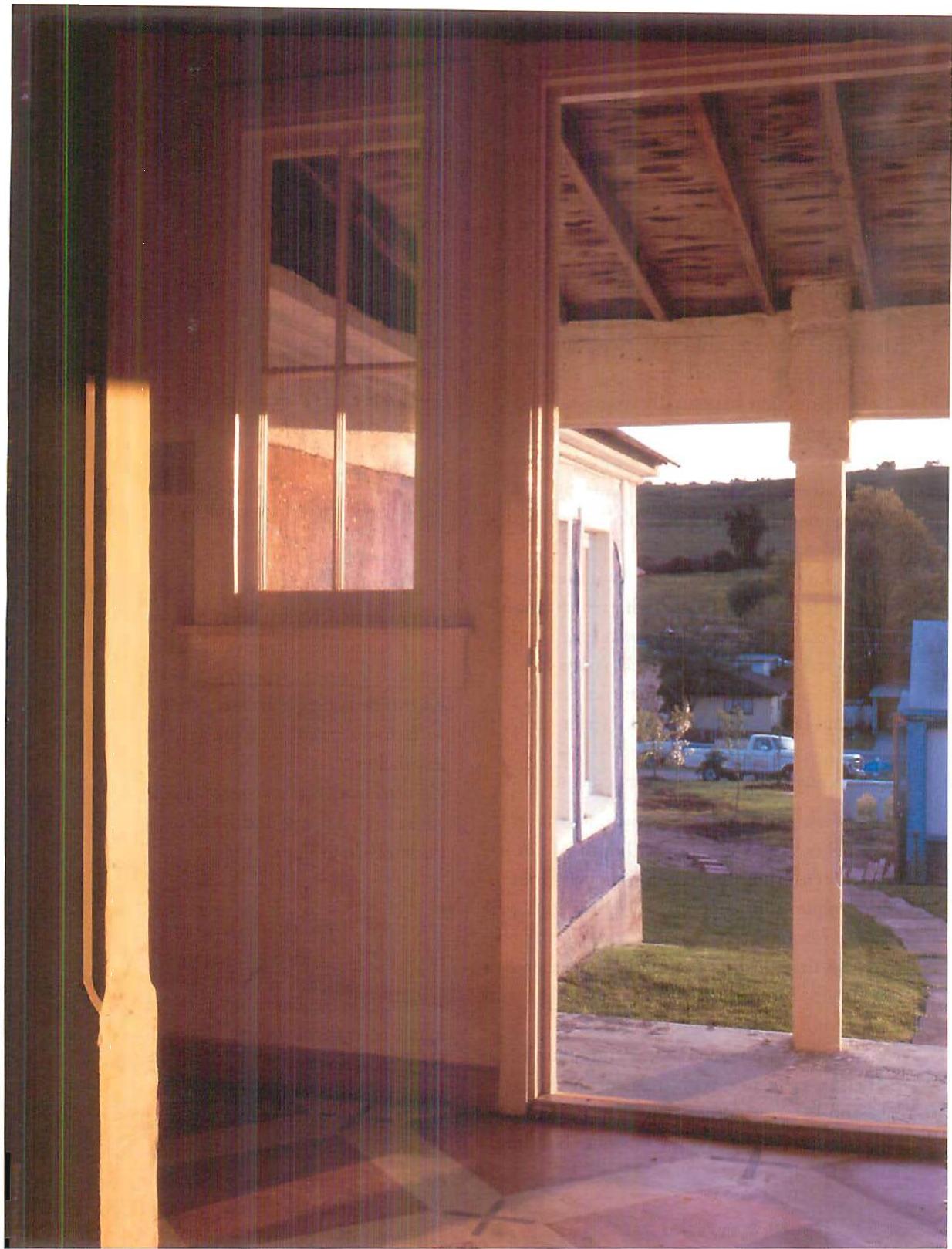
Evening: a view from the porch of the Martinez house. The concrete walls, beams, and columns are all made with ultra-low-cost formwork, shot by the new techniques which are described in the text.
We built this house (which later became one of our offices) over a period of time, and various CES staff at different times worked on it with me at different times, including Harissas Tsiringas, David Docus, Gary Black, Obasheni Agbabioka, Jonathan Fefferman, Carl Lindberg, Eleni Caramoli, Seth Wachtel.
The following partial list of inventions made at CES during the last thirty years makes it clear that such efforts can give rewarding results even in a tiny organization like ours. In the picture opposite you see a photograph of one of my earliest experimental construction yards at the University of California, where we tried and developed new ways of building. Over the thirty years 1967 to 1998 we have had half a dozen of these yards scattered across three continents.
SOME ULTRAMODERN TECHNIQUES
NEW TYPES OF MASONRY WALL
Massive composite brick, concrete, and block wall in which concrete interlock allows the whole to function structurally (pages 544-45). Dry-stacked concrete block wall with offsets and inserts to create more vivid building form and mass to strengthen space (pages 546-47). Earth-cement interlocking block wall (page 551-53, Mexicali). Slab-locking foundation blocks (not illustrated). Concrete foundation blocks, with rebars embedded and ready to receive slab mesh (page 549). Castellated earth-concrete blocks (page 554). Composite poured sand-cement concrete columns and beams with brick infill (page 540).
NEW TYPES OF WOOD STRUCTURE
Use of eight-inch and ten-inch stud walls creating thickness and strength with only minor increase in cost (not illustrated, Medlock House). Monocoque construction: a lightweight wall made of ribs of one-by material covered with plywood so that the whole wall acts together as a box beam (not illustrated, early design and model for Medlock House, Seattle). Massive hollow plywood beams and columns, 24 inches by 24 inches, with frequent interior collars and exterior corner design to protect plywood end grain (page 554, Clubhouse building, Eishin Campus).
NEW TYPES OF VAULT
Domed vault made from layers of cone-tile stacked and riffled to form arches, and laid together to form a spherical vault (pages 526-27, Bavra school, Gujarat, India).
Basket vault with layers of ultra-lightweight concrete laid over burlap (pages 547-48, Etna Street cottage). Heavier basket vault, with pumice concrete laid over basket and burlap and chicken-wire (pages 547, 552, Mexicali).
NEW TYPES OF ROOF STRUCTURE AND ROOF SURFACE
The Russian roof: a two-layer lapped plank roof system in which each board has two rills to take water from ridge to eave (page 469, Martinez house, Martinez carpentry workshop). Lacework concrete trusses: shot concrete truss with curved members (page 533, San Jose homeless shelter). Cast lacework trusses (pages 139-40, Mary Rose Museum; page 478 and Book 4, pages 294-96, Puerto Rico bridge).
NEW TYPES OF CABINETS AND FURNITURE
Automobile lacquer over MDF (page 473, Herman Miller furniture). New reflectors for office lights (pages 389-90, Herman Miller furniture). Furniture made of one-by material. Mass-produced, individually fitted chairs. A client sits in a chairlike jig with moving parts (easily manipulated blocks of wood), and from the parameters the client establishes for his own comfort, a unique plywood-shell chair is generated with a complex three-dimensional curve not created for any other client. Yet it is all low-cost (not illustrated, Herman Miller furniture).
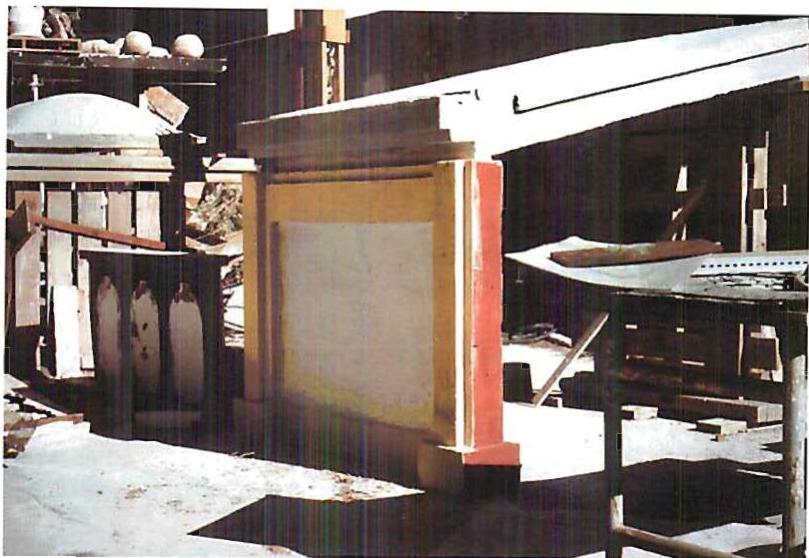
Plastering lath as a base for sofa (not illustrated, Haworth furniture).
STRUCTURAL INVENTIONS
Short pieces of steel bar (reinforcing bars) are used as pin-connectors in heavy timber connections (Sala House, Berryessa house and others). Plywood box beams and columns (not illustrated, Peru houses).
Two-inch shell concrete floor slabs (not illustrated, Mexicali).
Gunite walls and columns (pages 522-23 and 530-32).
1.5 inch thin wall concrete (pages 534-36).
Bamboo-urethane beams (not illustrated, Peru).
Thin concrete shells for shear reinforcement in post-and-beam structures (pages 534-36, Sala).
Shot concrete trusses: trusses with complex configuration shot in the air (San Jose Shelter for the Homeless).
Curved member wooden trusses (page 541, Central Building, Eishin campus)
INNOVATIONS IN BLOCK FABRICATION
Rammed, vibrated and compressed molding of earth-cement blocks (page 552, Mexicali).
Cylindrical concrete blocks (page 552).
Self-centering wall blocks (page 552).
CONSTRUCTION INNOVATIONS
Dry-stacked block structural walls and columns (pages 536-39, Fresno).
Use of one-by material as guidework for shot concrete (page 530).
Interlocking multi-masonry wall with poured connectors (Book 4, pages 118-23).
Low-cost formwork with foam fillers for shaping poured concrete (pages 528-29).
Pre-cast concrete girder-arches (Bay Bridge; page 469).
Marble-dust floors made with a new styrofoam forming techniques that allow wide variety of form and color and pattern (pages 586-94).
In the pages which follow, I describe a few of these techniques to give the reader a sense of the amount of effort needed to invent such things.
The effort needed is not prohibitively great, but it requires attention, mental concentration, and a real love of physical materials.
4 / AN INNOVATION FOR VILLAGE CONSTRUCTION
STACKED TILE VAULTS 1961
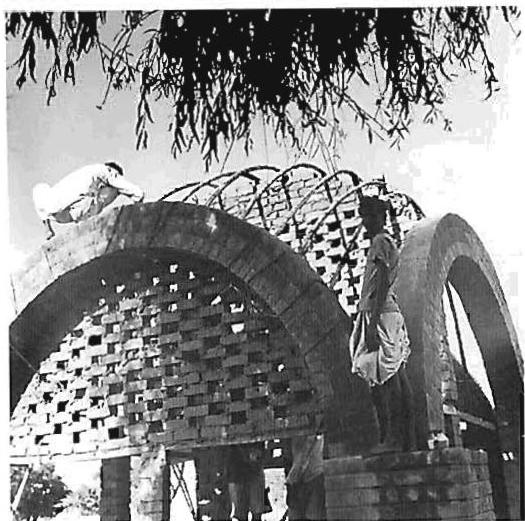
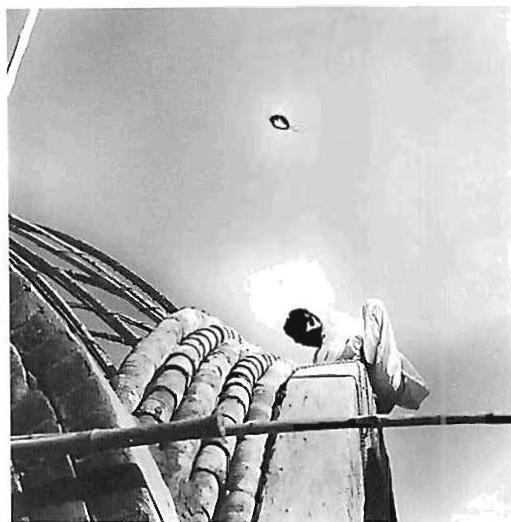
In 1961, at the age of 24, I lived in a village in Gujarat, India, for seven months. While I was living there, I felt I must be useful and after discussing with the villagers, we decided that a school would help them most. The four-room building is very basic. I did nothing except to try and make something useful that had a feeling like the village. This was my start in architecture. It was the first building I ever made and the first time I invented anything in construction. I had 5000 rupees (less than 1000 dollars) to build the school. Couldn't import materials. No wood to speak of available. The village was five miles from the nearest road. What to do?
I asked the village potter what he could do. He showed me something he was used to making in the course of making roof tiles, a thing called a "guna" tile — a hollow truncated cylindrical tile with one end smaller than the other, about 16 inches long with a six-inch diameter at the base and a four-inch diameter at the top. In the normal course of events, it was split in two, down the middle, to form two roof tiles.
This fit perfectly into the situation. Mud and clay were abundant. There was virtually no wood available but small sticks and twigs sufficient for firing a rudimentary kiln were available in the scrubland around the village. I asked Shankarlal, the potter, to make 3000 of these conical tiles for me just using mud from the village and then baking them but leaving them as cones, not splitting them down the middle.
Then I made the domes for the village school like this. Each dome had four brick arches on its four sides. Now imagine making a stack of these conical guna tiles by sticking one into the other, thin end into wide end, one after the other. Then imagine riffling these stacked tiles like a deck of cards, to get a curve. That is how we made the near-spherical vault. We laid one row of these next to the brick arch. Then the next one on the first row of tiles, and the next row on those. Because of the other brick arch, the riffled tiles rose higher and higher as they followed the curve. In those places where there was too much pressure we filled them with earth so they didn't crack under their own weight.
Finally we plastered the whole thing. And, to make a tension tie that would resist outward thrust in the dome, I used cotton-baling strap —
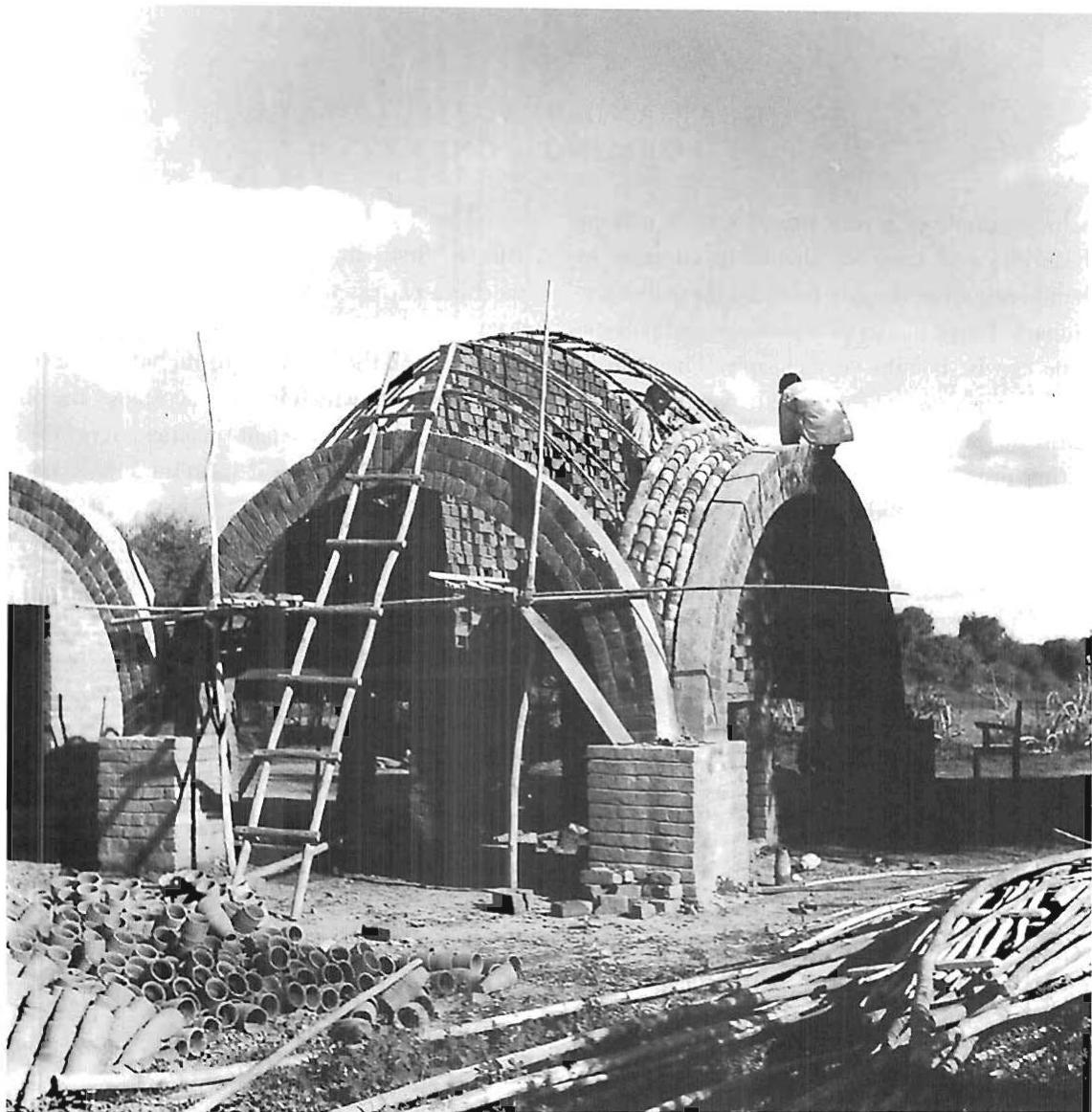
a thin tensile steel strap used for tying up cotton bales and something we could get for nothing in the cotton-producing fields. Then plaster over the cotton-baling strap. That was all.
Even then, at the very beginning of my life as an architect, I knew instinctively that to build a building, one has to invent ways of making.
And, throughout my life I have always tried to invent ways of building which could easily, cheaply, make life and living centers in building forms. This was one of the first things I ever invented.
At least forty or fifty people from the village helped to build this building.
5 / CHEAP AND BEAUTIFUL WAYS OF FORMING CONCRETE
One example of a very simple way of making beautiful and complex shapes in concrete by hand and rather cheaply relies on the use of styrofoam. Large blocks of styrofoam and polystyrene can be bought very cheaply. They can be carved far more cheaply than wood, and the form of a very complex object can be built up rather fast. The styrofoam is then placed, as a liner, into a plywood box which is built around it and the concrete is poured into the styrofoam mould.
I have used this technique to make brackets, arches, balustrade shapes, windows with beautiful shapes; it has enabled me to make things which could never have been done by conventional techniques without great increases in cost.
The technique has two important side effects: first, it does not easily create the machine-perfect finish which we have become accustomed to in the 20th century. It produces the form and the beauty of form, but with a certain roughness which is more typical of the objects made in more ancient societies. In my eyes, this is positive because it is an automatic side-effect of life anyway, and is to be expected. But for people who are used to smoothly finished things, the roughness is slightly unusual and takes getting used to.
For that reason, some craftsmen and construction workers may turn up their noses at it. In the construction of the giant capitals in the Great Hall in Eishin, the carpenters wouldn't do
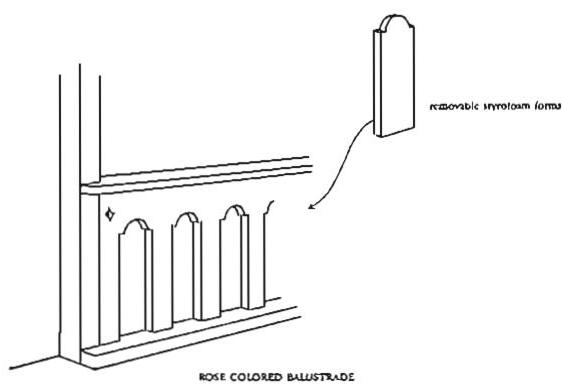
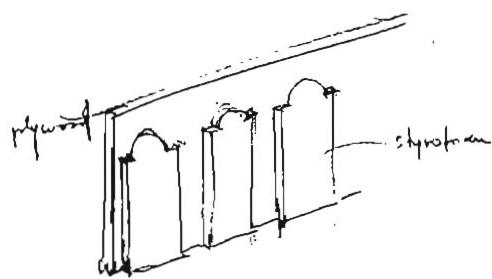
Left: Diagram of formwork. Right: Concrete balustrade made from this kind of form by pouring concrete into low-budget assembly of two sheets of sheetrock, braced, and with hand-cut styrofoam fillers.
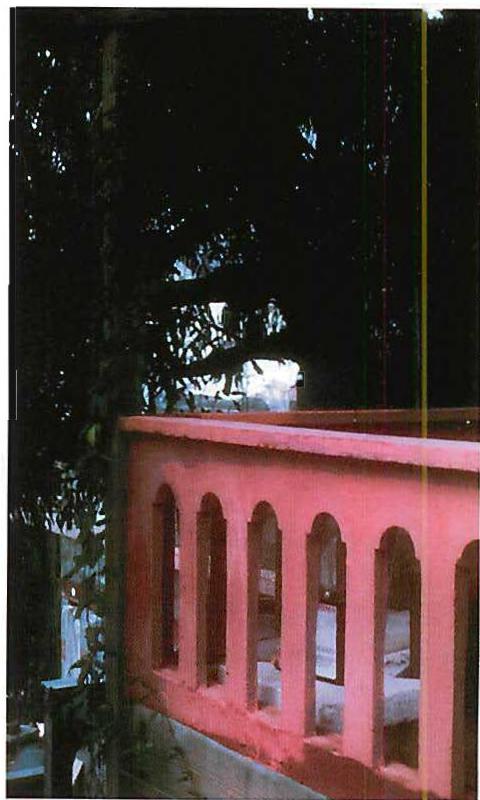
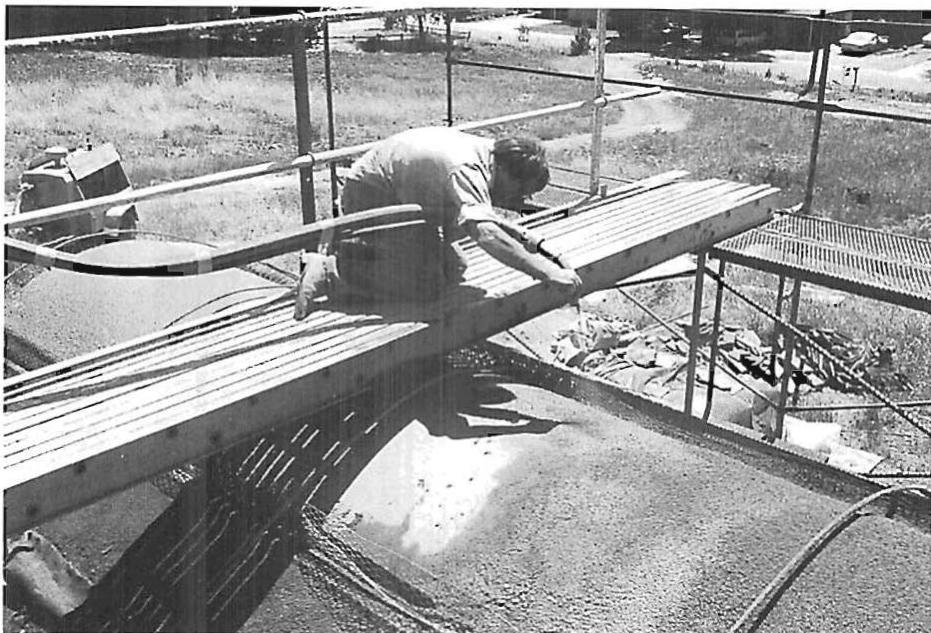
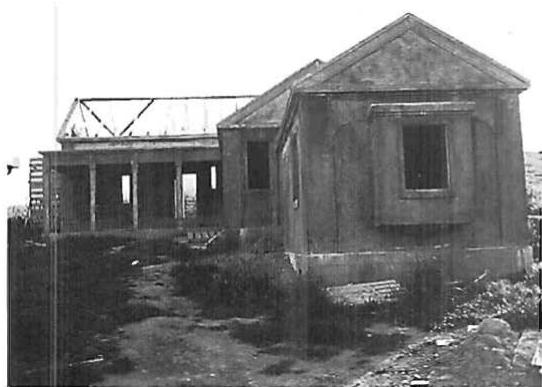
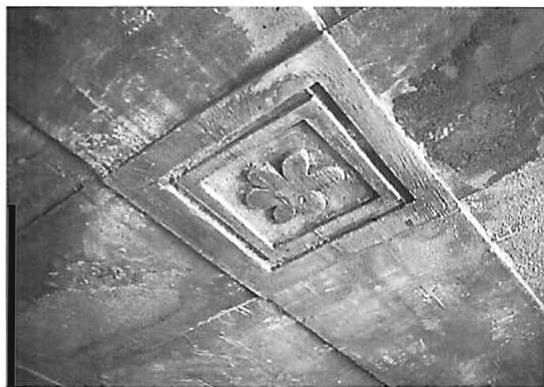
within the hose, just at the mouth of the hose, at the last minute before the material leaves the hose. The concrete which comes out of the hose in this technique is immensely stiff and strong. It has no tendency to slump. One can shoot walls, columns, vaults, ceilings. It stays where you put it.
Ordinary poured concrete is controlled (in shape) by its formwork. Because the formwork must withstand huge hydrostatic pressures of the wet concrete, formwork is usually massive, crude, and not easily susceptible to subtle modification
of the kind which the field of centers needs. Formwork for intricate shapes is almost impossibly expensive.
The formwork also makes the shapes hard to "see." One sees the reverse of what is being made, and it is therefore difficult to modify and adjust to get the proportions right and thus very hard to make the field of centers come out right.
Gunite, which doesn't require formwork, is different. It is often used for construction of dams, warehouses, and tunnels where the form
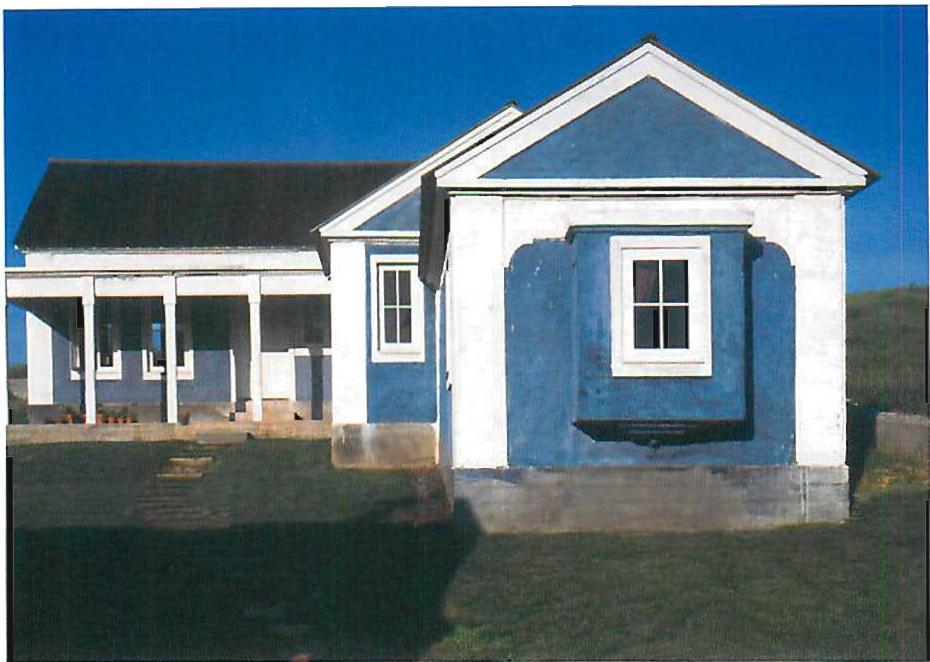
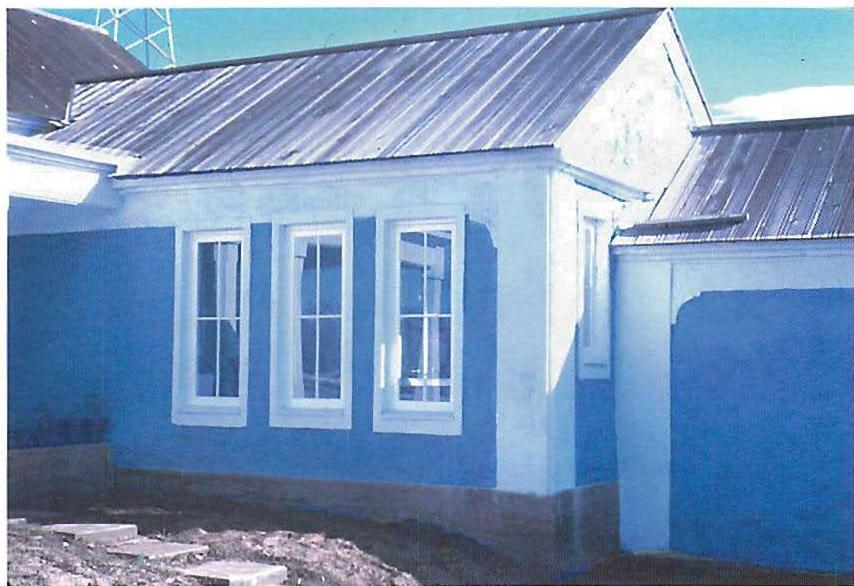
is uncomplicated. Experiments were also made in the 50's and 60's to use it for making houses. It was often shot over inflated balloons and then produced an amorphous architecture of ice-cream-like shapes. These kinds of shapes cannot produce positive space easily and rarely produce a living field of centers.
However, I realized that the technique of gunite would make it possible to produce complex, beautiful guide-work easily and cheaply. It is possible to form beautiful and complex shapes with cheap, lightweight guide-work made of foam, masonite, and light-weight cheap wood, one-by-twos, one-by-fours, and so on.
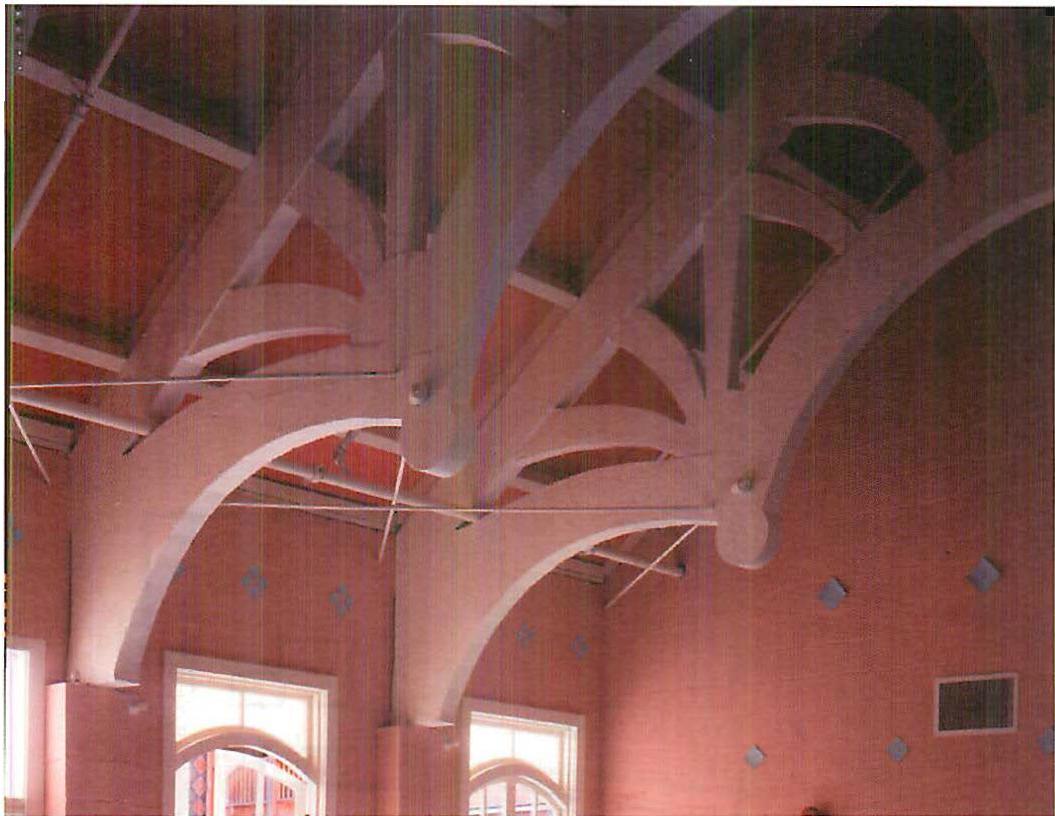
This guide-work is also easy to see, so that it can be modified as one sees the shape emerge. This is perfect for the construction of the field of centers since it allows one to maintain a continuous process of judging and changing, judging and changing.
We began experiments using gunite in late 1977. It took almost seven years of experiments to make it work smoothly. Now we know how to do it, simply, cheaply, and effectively. Illustrated above is a large concrete truss, shot in place against guidework in the air.
5A / WOOD AND CONCRETE COMBINATIONS
Conventional wisdom of the construction industry says wood structures and concrete structures should not be mixed in a single structure.
But in many cases, the centers you need to make on the outside of the building, and the centers you need to make on the inside are rather different, in scale, pace, and emotional quality. For this reason, my colleagues and I have often used combinations of concrete and wood.
In one technique we make centers, flexibly, by forming and pouring concrete: shapes, beams, columns, capitals, edges, bases. On the inside, at the finer scale which you want near your skin, wood and plaster—carved, shaped, finely molded, smoother—are more suitable.
So in order to have a single way of building which allows the cruder more massive centers on the outside and the finer centers on the inside,
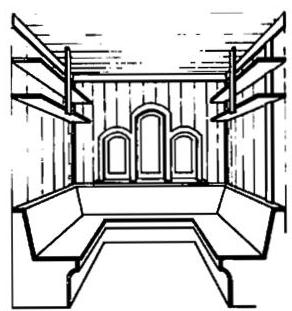
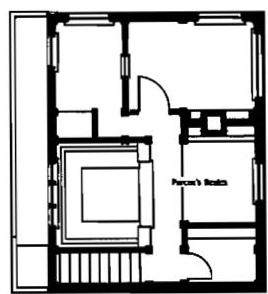
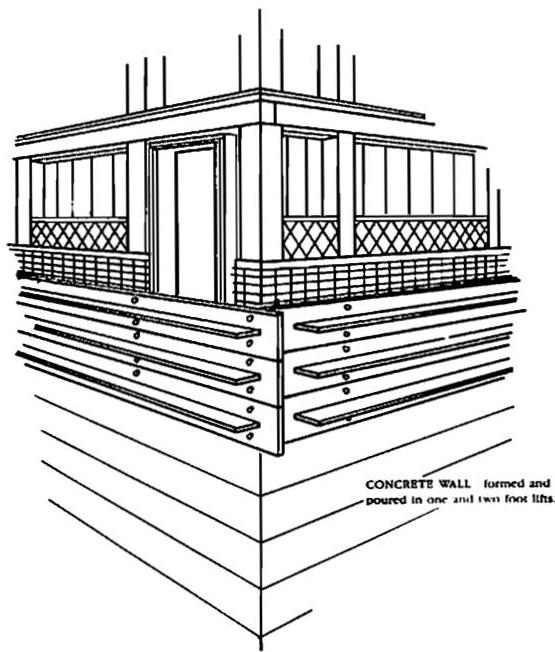
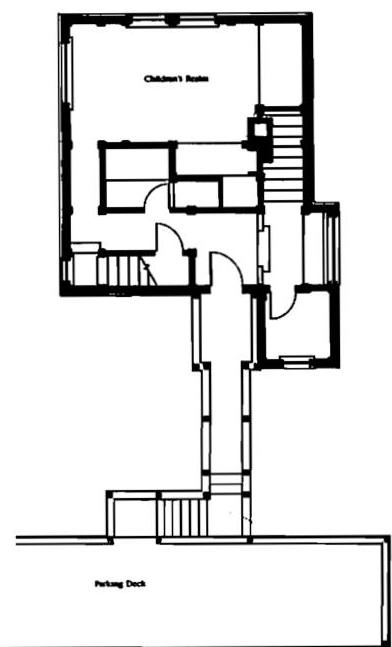
yet within a single coherent system, we have developed ways of building which combine wood and concrete structurally—allowing the two to work together. A single system, with poured base, post-and-beam wood members, and plaster or wood paneled in-fill enables us to make centers flexibly, at each scale, and in the right order. The construction is done, concrete first, then wood, then plaster. The centers follow the natural sequence of the making.
In a similar way, we have used structural combinations where wood is used for vertical forces, and thin concrete shells are used for horizontal and shear forces. We have done this in a number of different cases. The accompanying drawings show how it works in the Sala house in Berkeley. The interior structure of the building is wood post and beam: the exterior wall is a thin-shell concrete structure which ties the building together as a shear-resisting shell enve
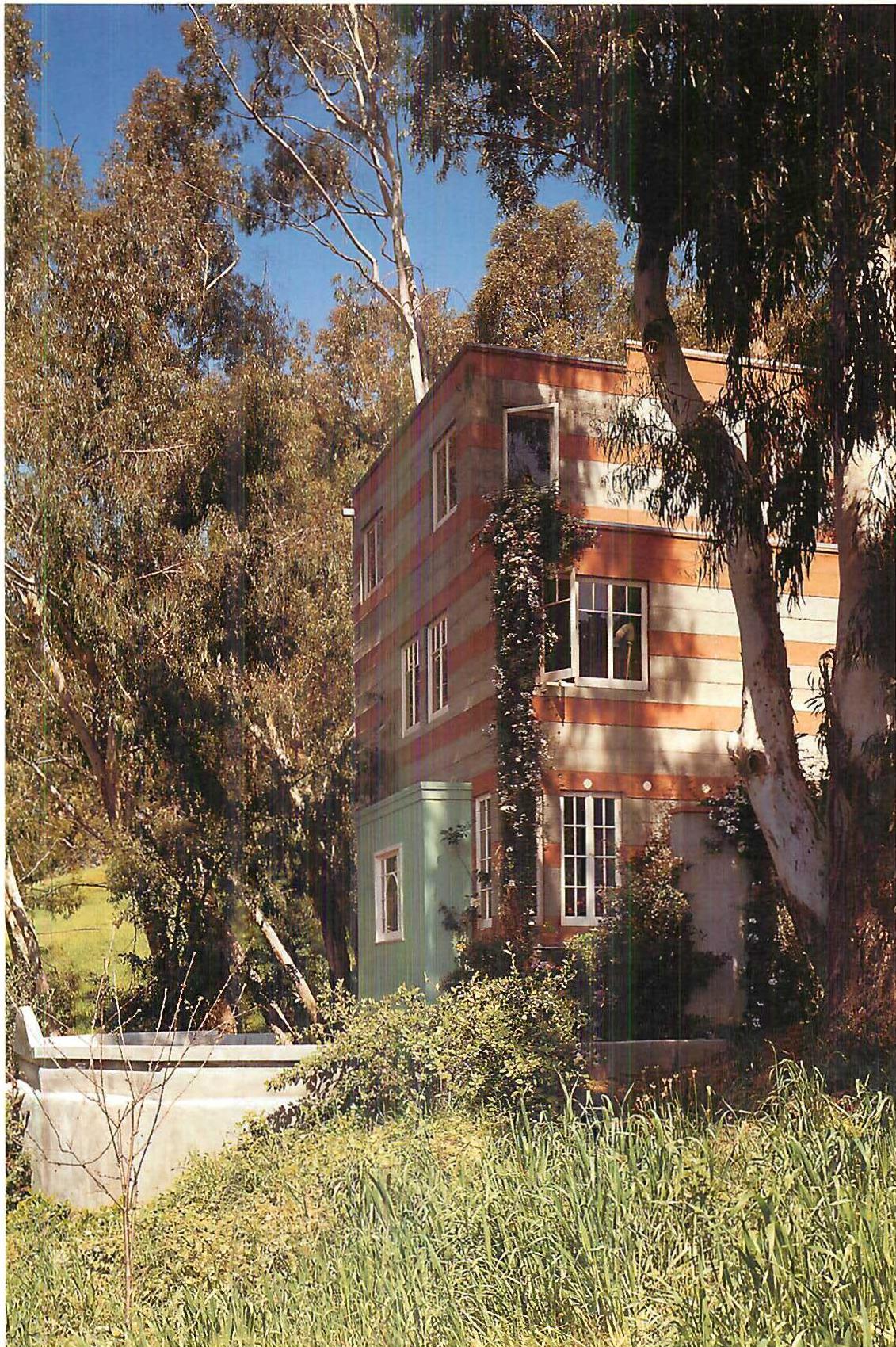
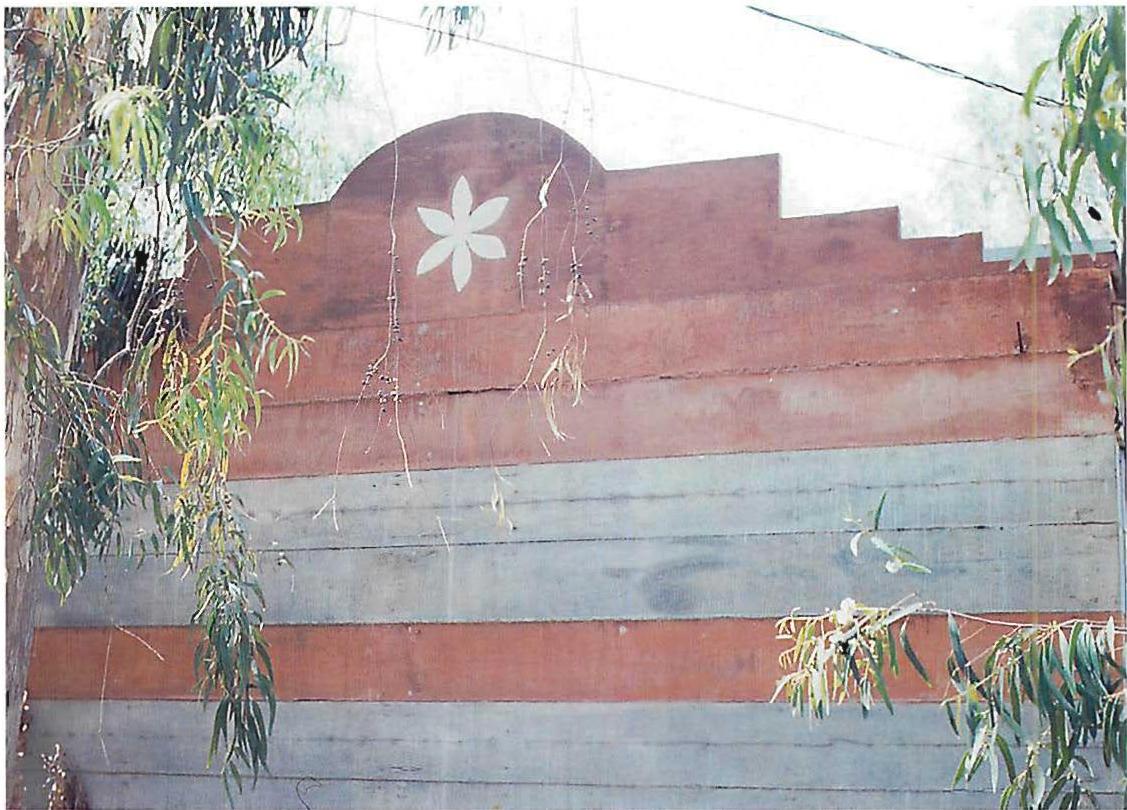
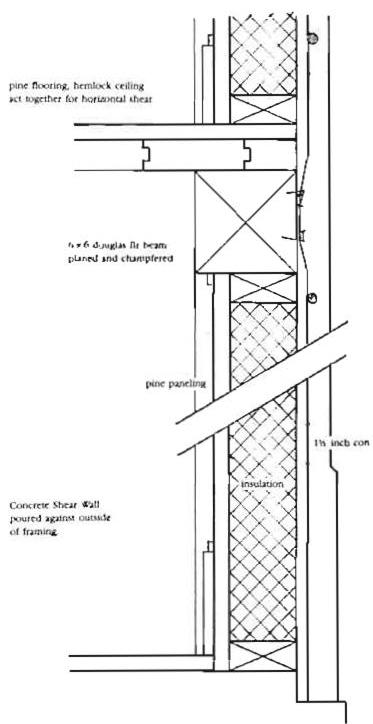
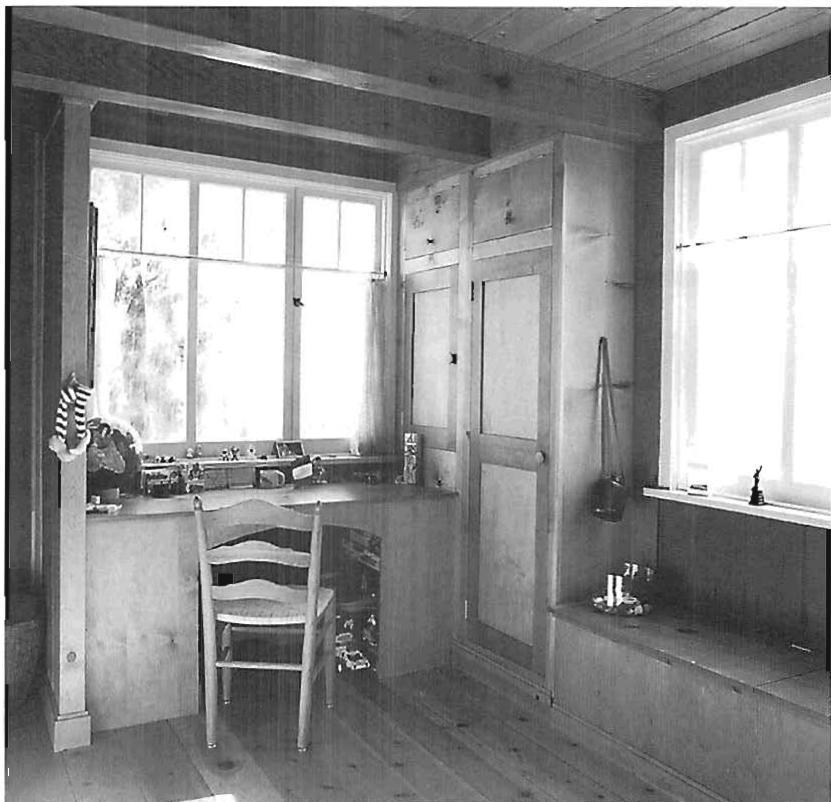
lope. The vertical forces come down through the post and beam. The horizontal forces, roughly speaking, are taken up by the very stiff thin concrete tube that is braced against the columns.
In the Sala house, for example, exterior details are concrete, interior details are wood. There are concrete brackets on the exterior, a poured concrete parapet to form the front of the building. These exterior surfaces are inlaid with marble inserts and the pours are made in alternating colors. The interior post-and-beam work include beautiful corbels, cut out of six-by-six fir; these are bolted to columns, and receive the beams. Main beams are six-by-twelve and six-by-eighteen. The floor is two-inch hemlock spanning directly from beam to beam. Again the beams, bays, corbels are chosen in such a way that each structural bay is felt as a center, and so that the corbels themselves are especially beautiful.
6 / HEAVY WOOD CONSTRUCTION
After years of experimenting with concrete, I also began trying to use wood in a way which made more profound sense than stud construction. My first experiments in wood, the Linz café and the Albany house, were nice but fairly simple-minded. We used six-by-six columns with corbels, beams, wood panelling and wooden ceilings.
In these cases, the field of centers began to exist simply through the structure — because the structural elements — columns and beams — themselves formed centers which supported, am-
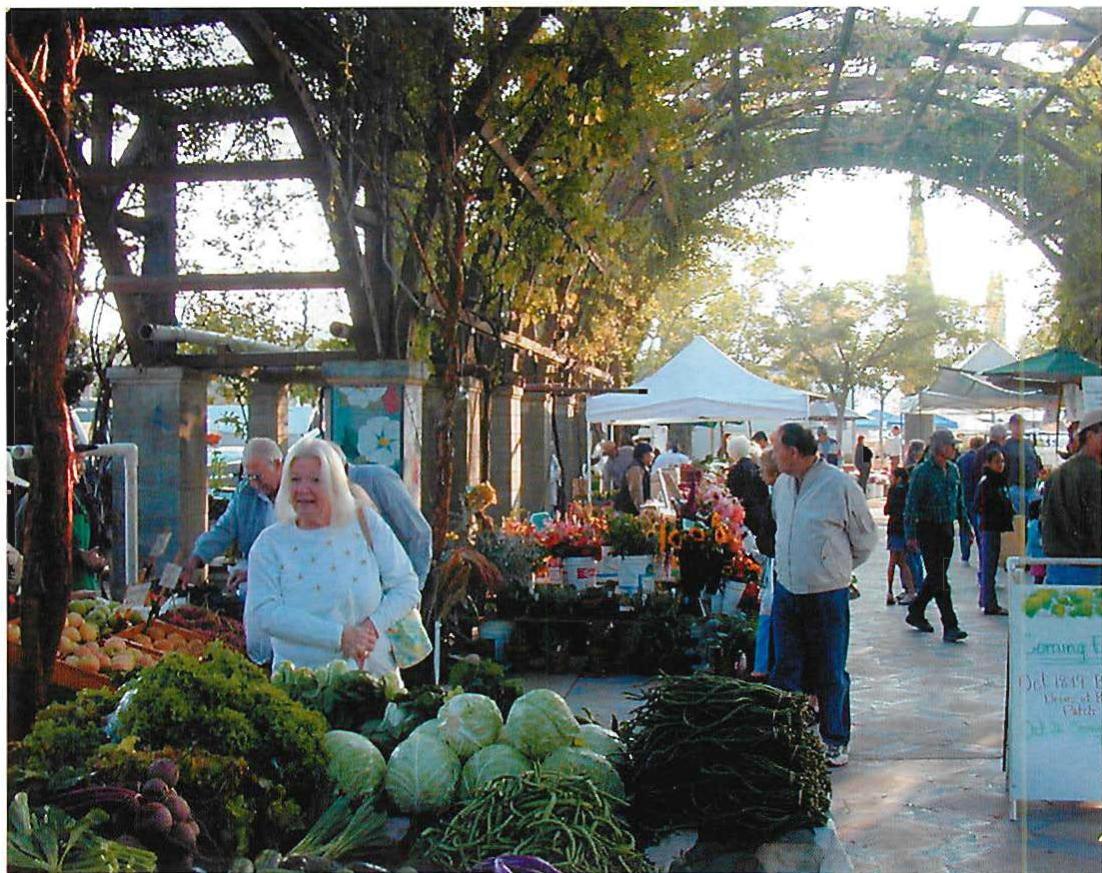
plified, the spaces. As a result the field of centers which was created in the space was amplified and deepened by the existence of smaller centers in the wood itself—and that made the large centers even stronger. This is easily visible in the Linz café (Book 2, pages 408–12).
However, although the simplicity of structure made it possible to create elegant systems that one could easily feel in the spaces they created, in the end the wood itself often still seemed like a bunch of sticks, with planes strung between them. There was not enough deep feeling in the wood itself. I began to ask myself what it would mean to make something out of wood, where the substance of the wood—the elements of the wood, the actual pieces of wood themselves—had feeling, and a living field of centers appeared in the very wood itself.
I realized, too, that although I had worked with my own hands in the gunite method for
about five years before I began to understand it, all of us together at the Center had spent no more than a few weeks actually making and erecting wooden columns. The direct, physical experience we had working with heavy wood was simply insufficient to tell us what it would mean to create serious substance in a wooden building.
In answer to all this, I began looking very carefully at old Norwegian buildings—stave churches and storehouses, and at certain Japanese temples. In these buildings one feels the wood as a living presence because it has been worked as a three-dimensional substance in very much the same way that is possible in stone—or that I myself had achieved to a small extent in the gunite construction of the Martinez houses.
We first began using very heavy timbers. Luckily we had access to lumber suppliers in Oregon who could cut big members at a rather reasonable price—twelve-by-twelves at the same price
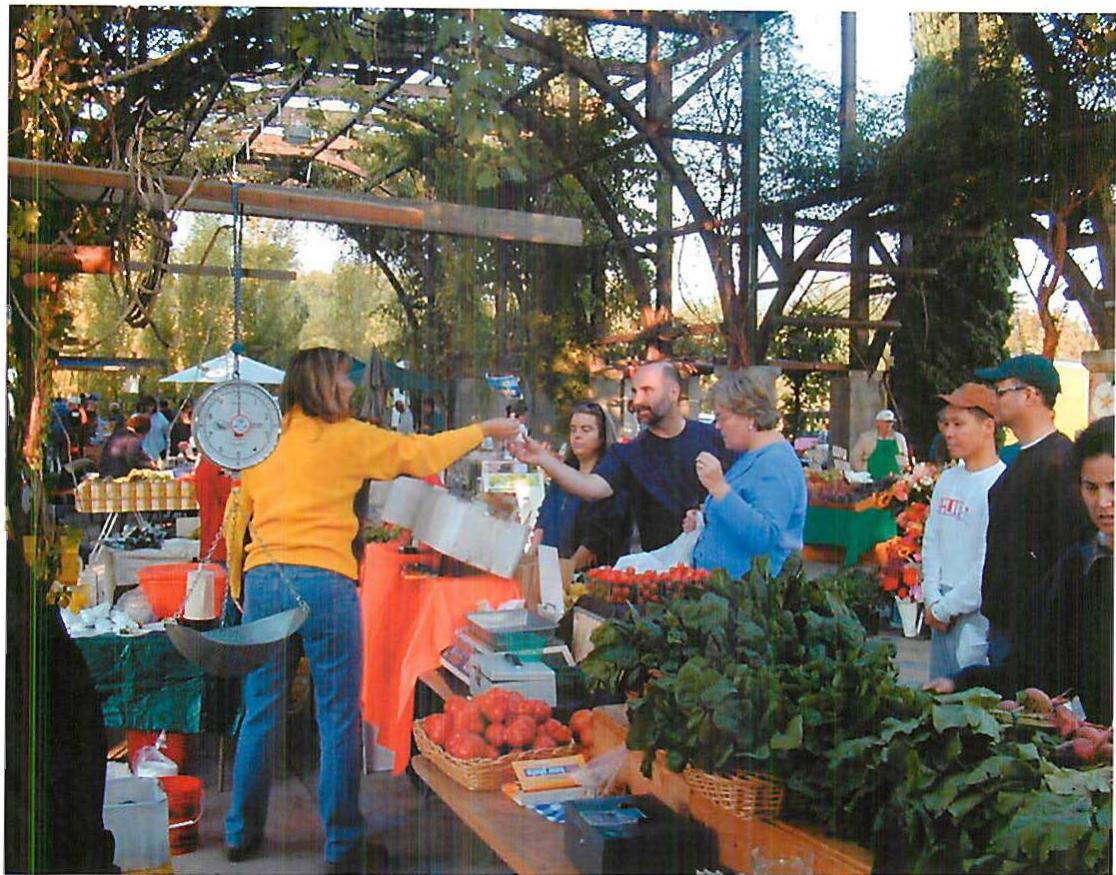
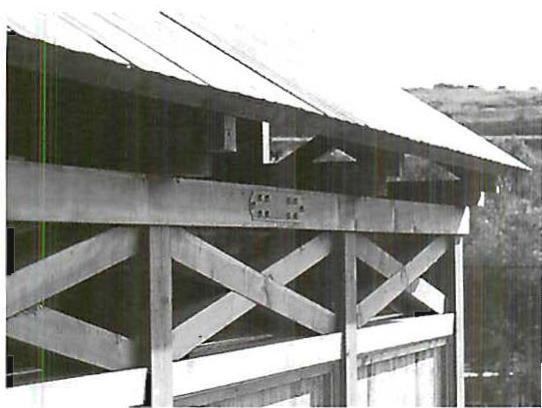
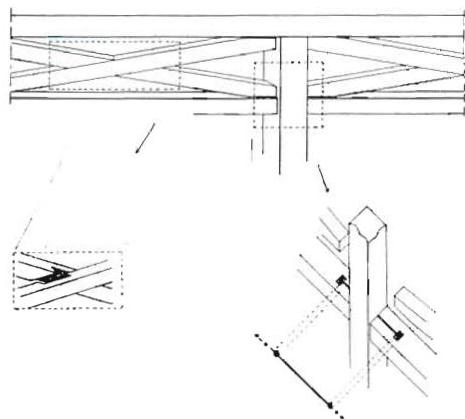
per board foot that we paid for six-by-sixes. We soon began to realize that a building made of heavy timbers would have a life of perhaps several hundred years, compared with 30 or 40 years for a stud house. The apparent cheapness of the stud house was false; the cost of wood in a heavy timber house would actually cost less per year, if calculated per year of its expected lifetime — and would put less of a drain on timber reserves than continued use of small timbers. A similar kind of thinking led us, more recently, to make massive columns and beams from plywood and an inner braced core of small members (page 556-57). In both cases, the most salient issue is the feeling of
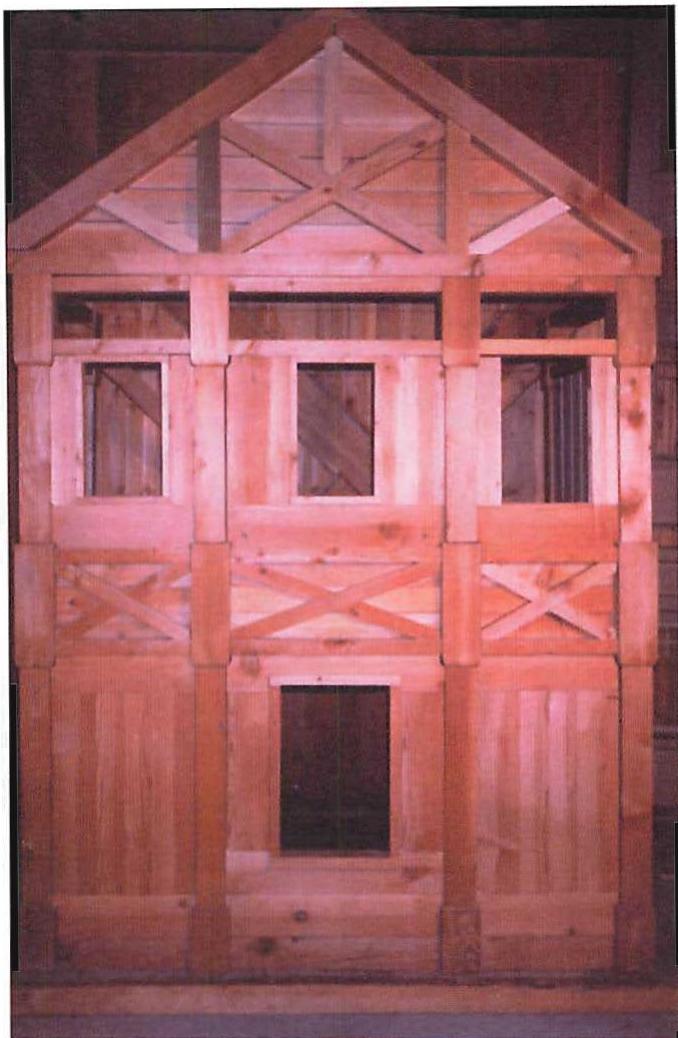
the members, and their lifetime, and the extent to which they are experienced as living centers.
Not only material was inspired by the search for living structure in wood. In the Eishin School in Japan, we developed entirely new methods of analysis in order to create wooden trusses. The beauty and efficiency of a truss depends on subtle matters. Placing members in a roof truss in such a way as to create the field of centers quickly leads to beautiful and ornamented trusses containing a variety of subtle forms. For instance, the Gymnasium trusses (pages 542-43) has a stepped form. The Central Building trusses (page 196, page 541, and Book 2, page 428-29) have curved
members. The Judo Hall trusses are stepped in form, and follow the line of a stepped flat ceiling.
When we began these works, I sketched each of these trusses intuitively, in response to the latent field which existed already in the building design (most visible in the cross section). Using finite element methods to work them out, these sketches were almost at once confirmed, and encouraged use of unusual and sometimes startling configurations as structural designs. Even the designs intuitively sketched were efficient — because the intuitive placing of members to create a field of centers produces results in which the forces are beautifully distributed.
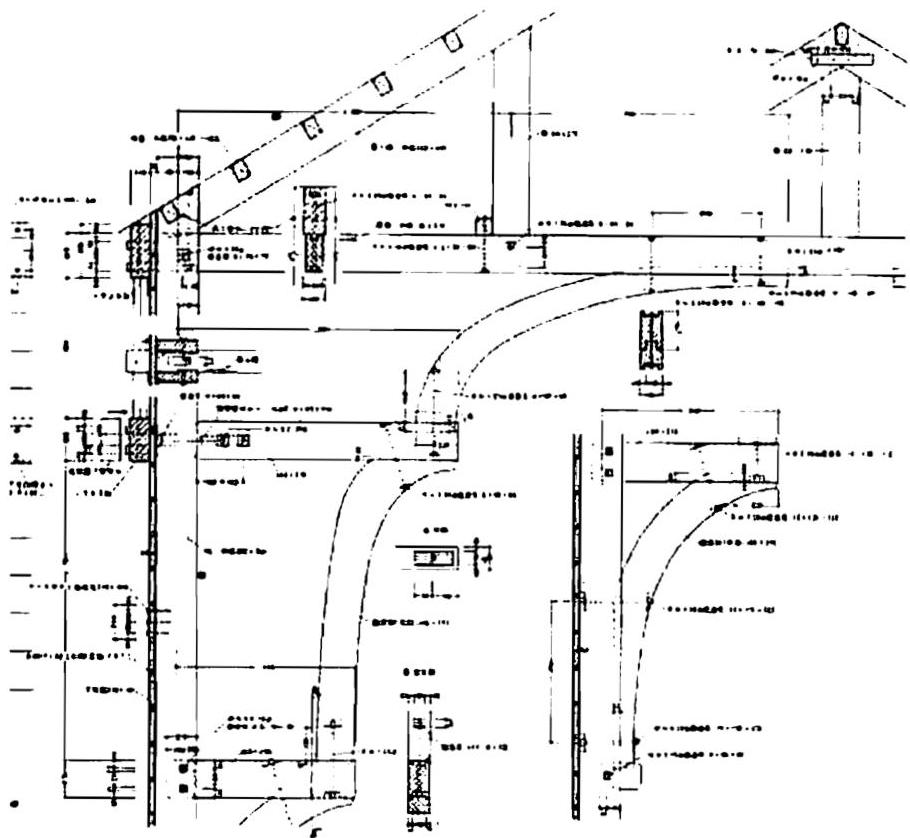
The combined effect of the members is more complex than can be analyzed by traditional methods. In traditional arithmetic methods, a truss used to be analyzed as if it were made up of a series of sticks, each one of which is either in compression or tension. But in the trusses I have sketched over the years, their more complex behavior is similar to that of a basket — where member-to-member interactions are more significant, and where several of the key members get their efficiency from the fact that they work in bending, not only in compression or tension.
In order to design these trusses, we used finite element analysis (as described in chapter 6), a simple method in which the forces are studied directly as a by-product of the geometric distortion of the members. This technique, which was put onto microcomputers in the late
1970's, revolutionized the analysis of structures. First we make a computer model of the truss. Within minutes we can watch its behavior when we put forces onto it. As we watch its behavior, we see that some members are carrying too much force. Others are not carrying any significant force. Then we modify the arrangement of the members. Each time we go through this process, we understand the global behavior of the truss more deeply and have a better idea how to bring the forces into balance. Within a few hours, we can go through several modifications and reach an extraordinary level of balance in the arrangement of the members.
This technique allows us to build wooden members which create a significant field of centers: and it allows us to get building permits relatively easily even for complex configurations, because we can accurately predict the real forces.
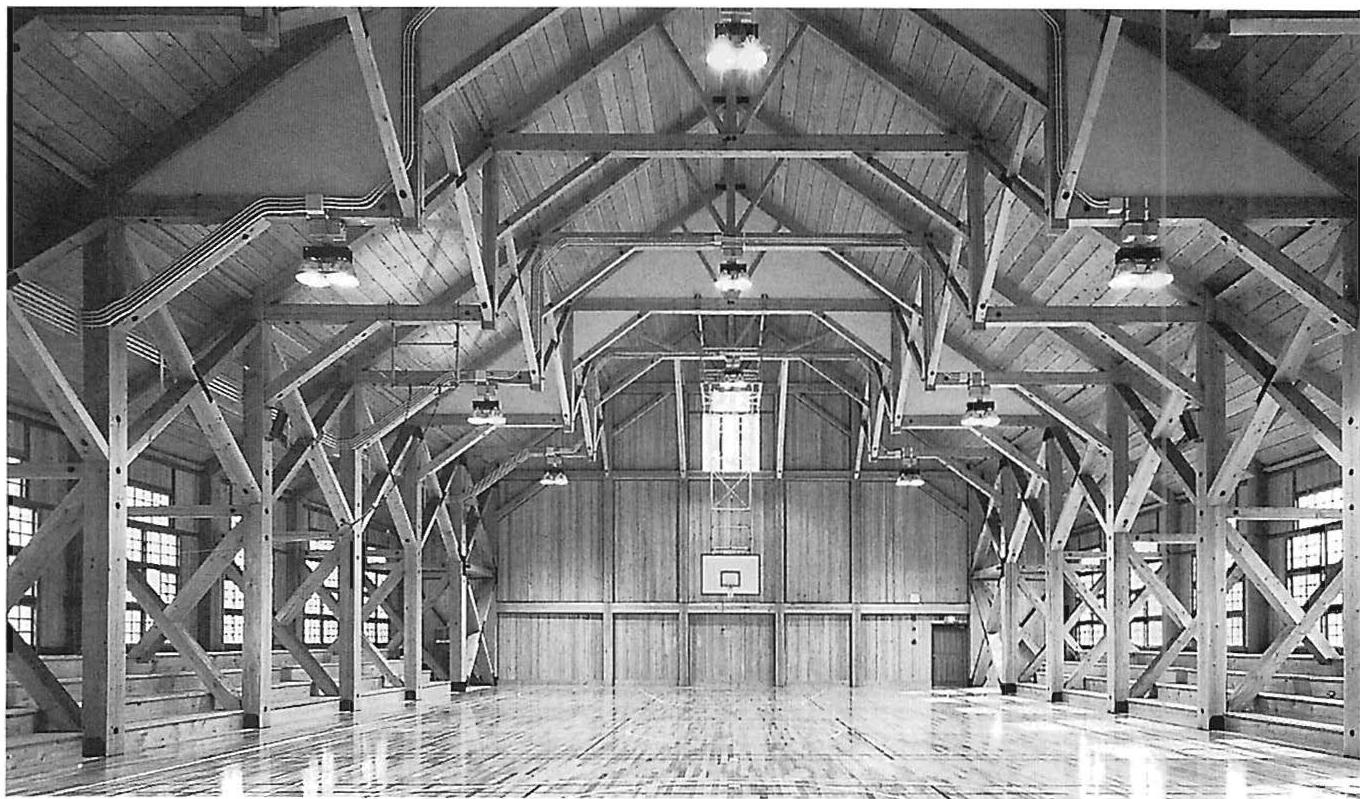
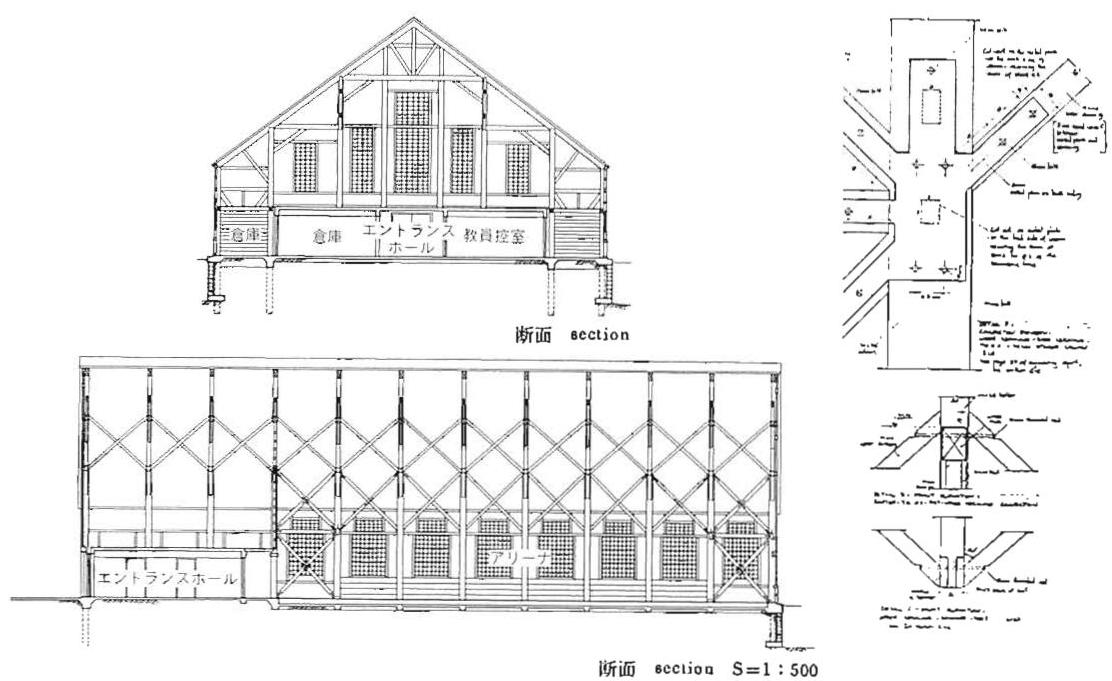
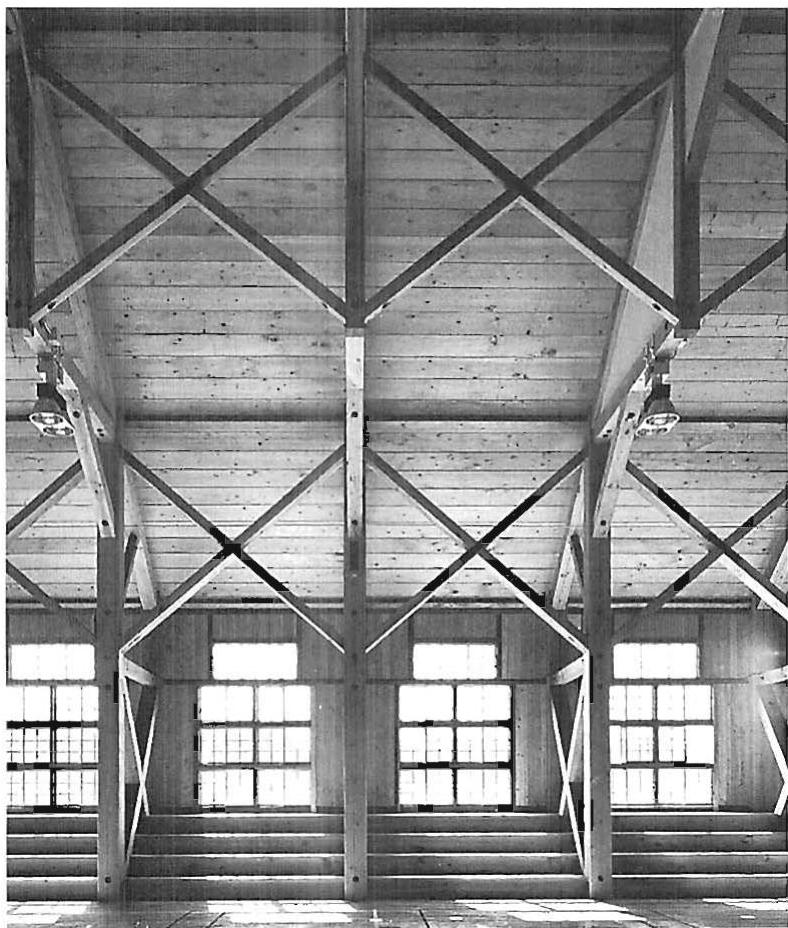
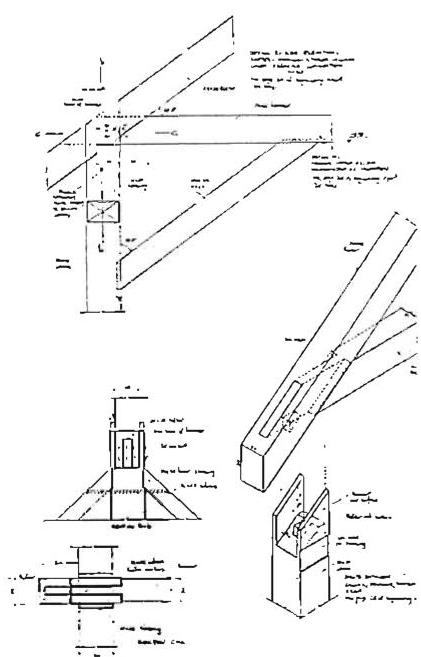
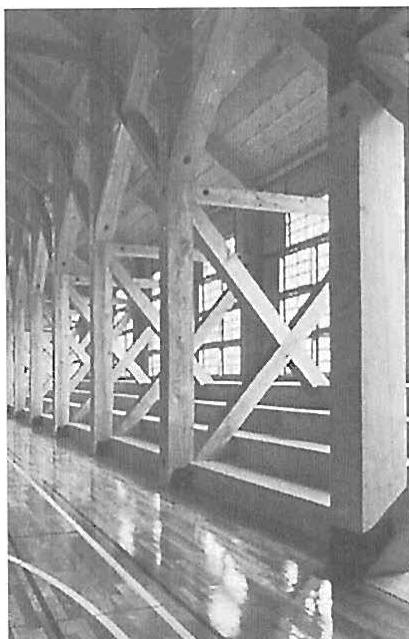
7 / NEW FORMS OF BRICK AND BLOCK CONSTRUCTION
One of the most obvious ways to make buildings is out of block and brick. It is one of the oldest methods. It is cheap, easy, easy to play with, easy to modify—and sturdy when it is done. Unfortunately the concrete blocks of our own era are efficient but ugly and dead; they are, also, hard to
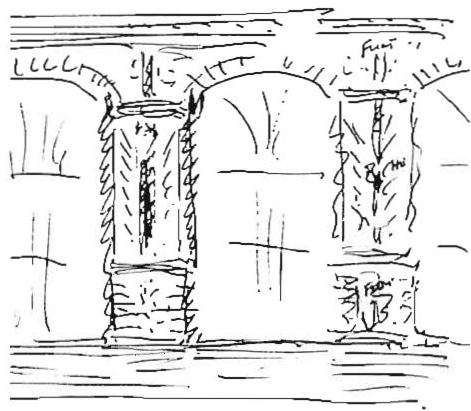
modify partly because they are hard to cut, and the modularity of the cells (at least in US cell-cored blocks) makes it necessary to line the blocks up in modular fashion so that the cells can be reinforced with bars and filled successfully.
During the last years I have tried many kinds of experiments which use modified block. We made construction in which we used ordinary H-block but allowed the blocks to move around. We did this in experimental walls built for the Fresno project (page 547), and we did a more experimental version, in which we used beautiful marble strips, in chases, in combination with blocks that we ourselves had cast (page 461). One of my students has tried casting huge blocks with beautiful ornament in them (page 546). We have tried a system of lightweight blocks (sold publicly as Itong or Hebel, page 548) which are large, nice to touch, can be cut with a hand saw and fitted to almost any shape. They are mortared together not
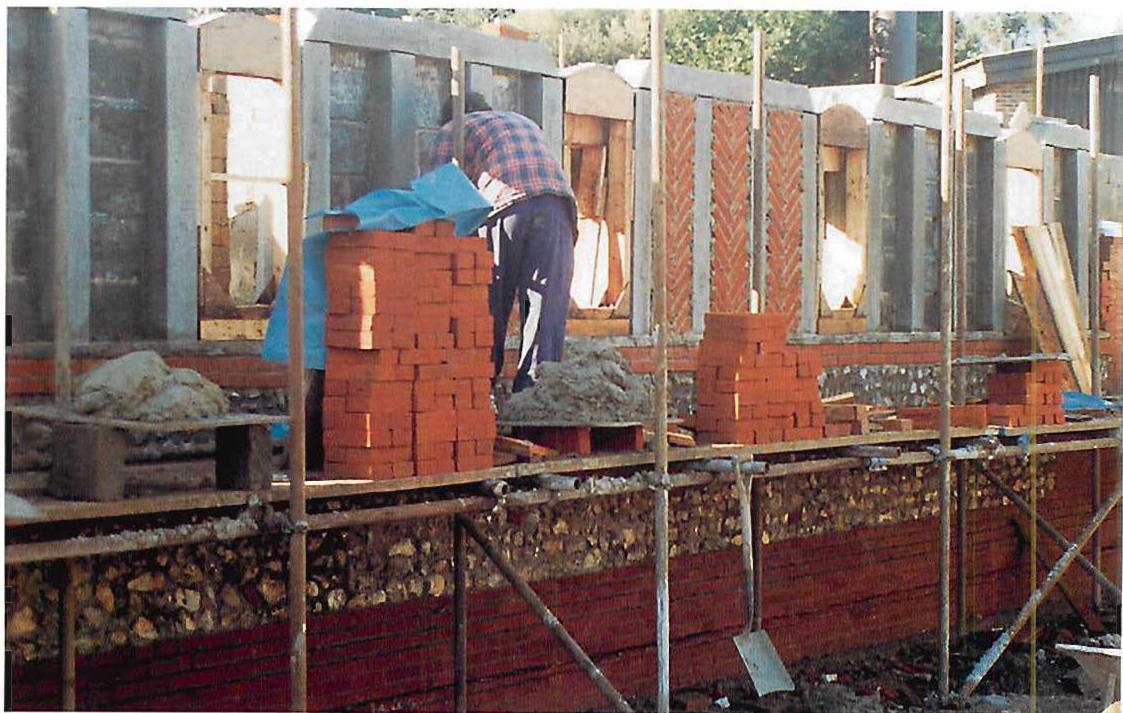
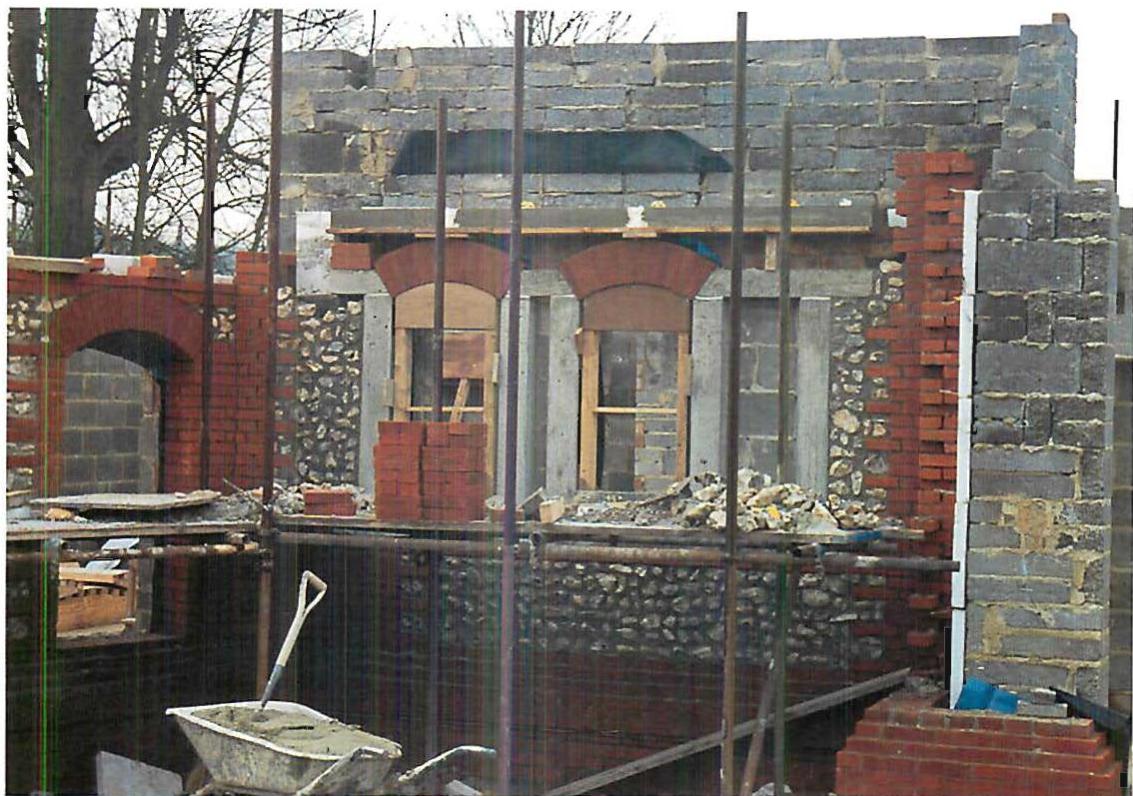
with conventional mortar, but with a kind of polymer glue-mortar like tile-setting compound.
And in West Dean (these two pages) I tried making enormous walls with an integrated poured combination of bricks, concrete, flint, stone, and massive blocks and insulation work-
ing together as a single structural wall because of the interlock of the different elements with the poured concrete. I like that one very much; it is almost two feet thick, all works together, looks beautiful, and is built like a tank. All these are experimental but not too hard to try.
8 / SOPHISTICATED MAY MEAN ADVANCED OR IT MAY MEAN PRIMITIVE IN APPEARANCE BUT ADVANCED IN CONTENT
I hope you see from these few examples the idea which I am putting forward. The necessities of the fundamental process ask us to change construction techniques, profoundly.
If we are to build a living world, we need a way of building that allows centers to be shaped and locally determined by the whole; that means that materials and techniques are chosen so that
components can vary subtly in infinite but not extraordinary ways to fit the living structure of the context.
Ways of doing this can be very advanced. In some cases they may also be nearly unknown or newly invented and of necessity ultramodern. Many of the examples I have given are techniques that are technically sophisticated,
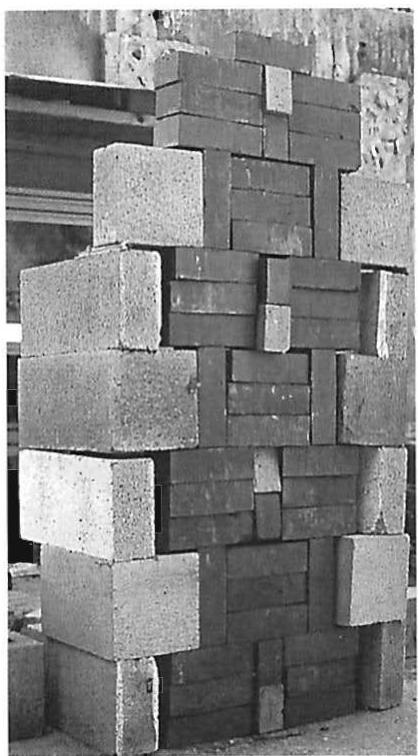
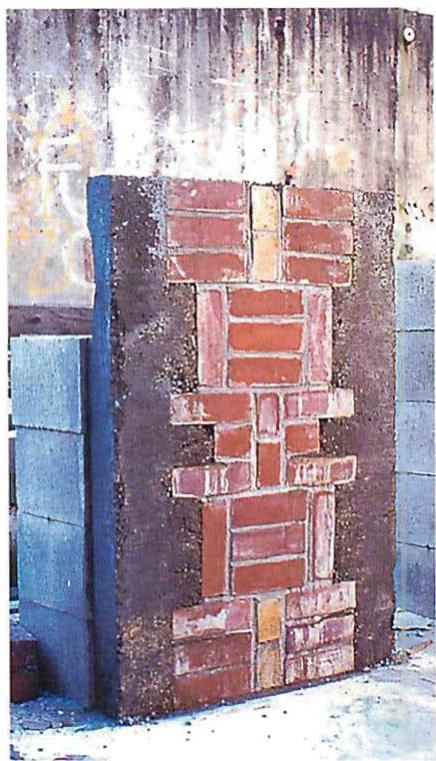
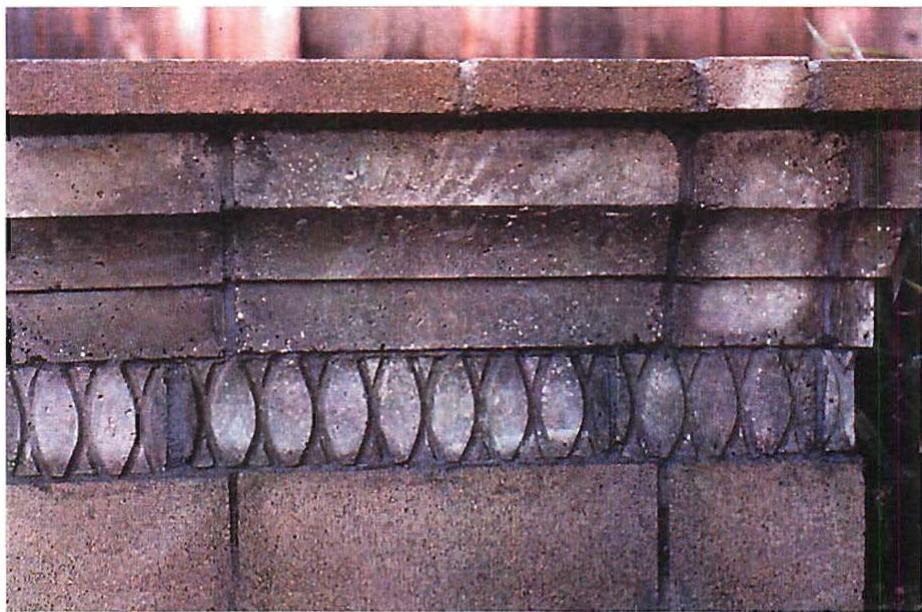
purely of the late 20th century. It is not feasible in this age to re-create old building techniques of another age. The problem with such recreation is that it usually has the wrong labor
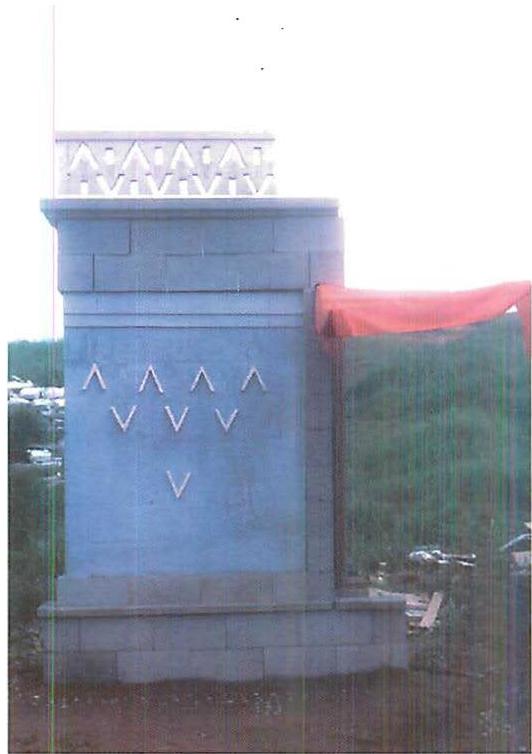
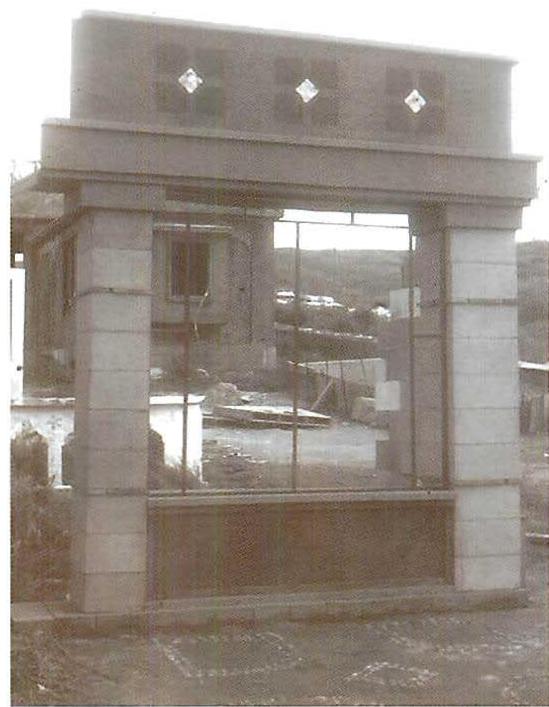
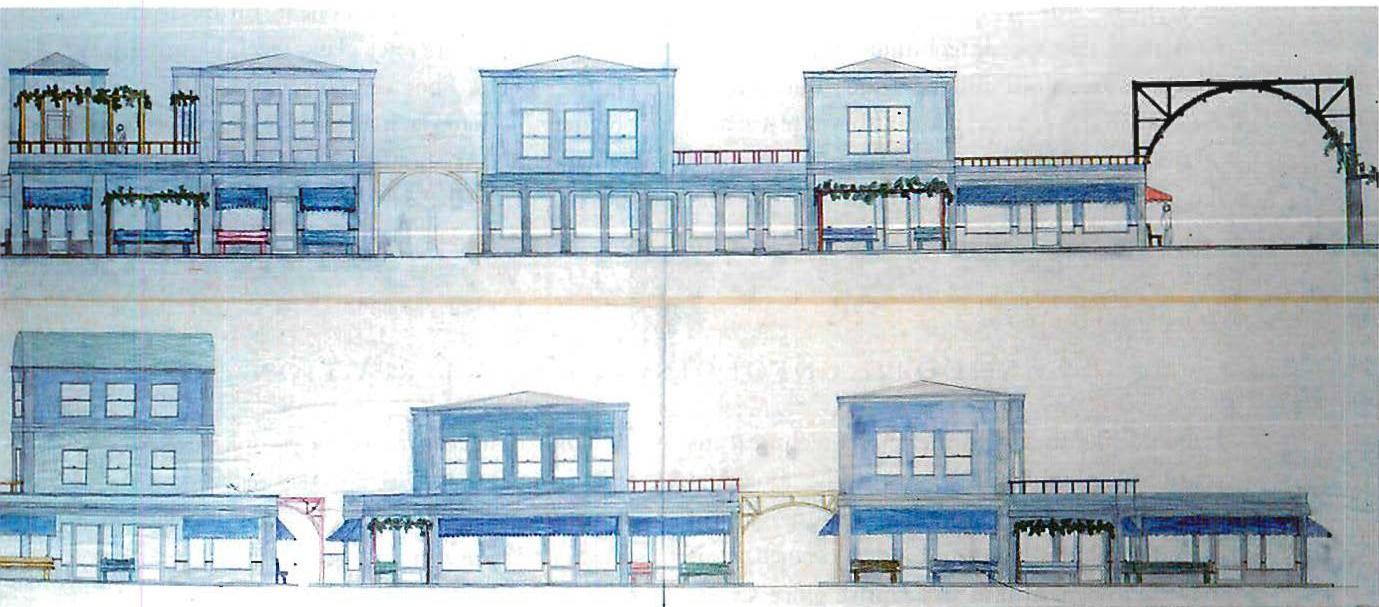
factor (the percentage of construction cost spent on labor). It may require labor-intensive methods which were suited to one economic era, but are impossible in ours; costs do not make
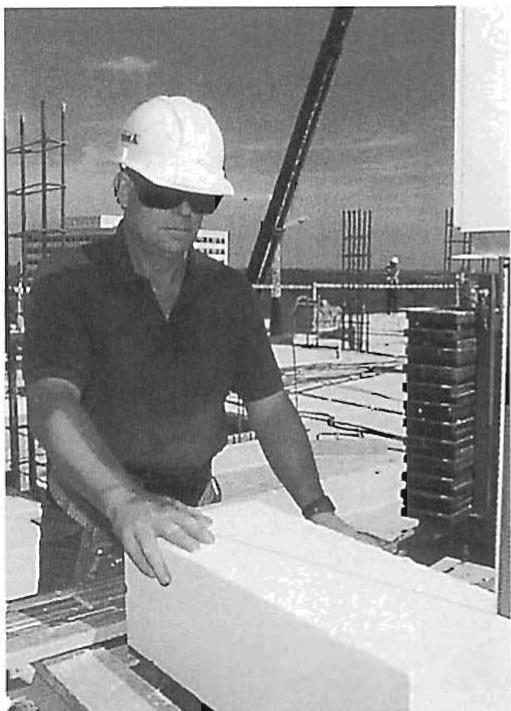
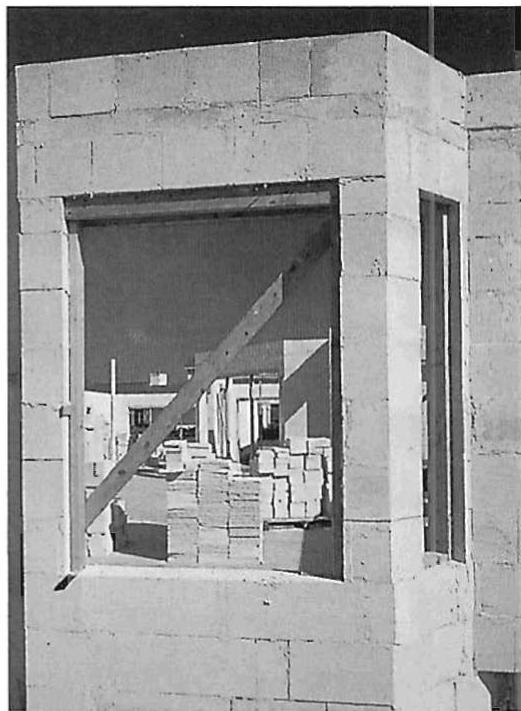
sense; it is not appropriate to our era. The techniques will therefore have to be ultra-modern so that speed, technique, type, material all come from our unique time. But what is done with these materials, if they are capable of making parts that are beautifully fitted to the whole, will be unlike the insensitive and
mechanical repetition we mainly knew during the 20th century. In the near future it may include use of concrete, glass, steel, aluminum, plastics, fibers, fiber cements, mud, sand, and polymers. Whatever it is and in whichever era it may come, it should be truly something of the 21st or of the 24th century.
9 / SMOOTH UNFOLDING OF CONSTRUCTION
I should like to add to the purely technical inventions embodied in many of the foregoing pages by drawing attention to a feature many of these techniques have, and indeed must have, if they are to be useful in an adaptive process.
In present-day building techniques, the process of construction is not smooth. One works with a drawing of the building, a drawing which shows how each part fits together, and this shows where each component, and each contractor, are supposed to fit in.
One of the reasons for the complex drawings of our time is that these different techniques and subcontracts need to be coordinated. It is vital to coordinate them accurately. If the drawings do not show where each part goes, it cannot be done.
But unfolding—the unfolding of a living process—is not like that at all. If one makes a traditional mud hut in the Cameroon, the sticks are placed in the ground in a circle; then they are bent towards the center and tied. Then wattle is woven to make a basket for
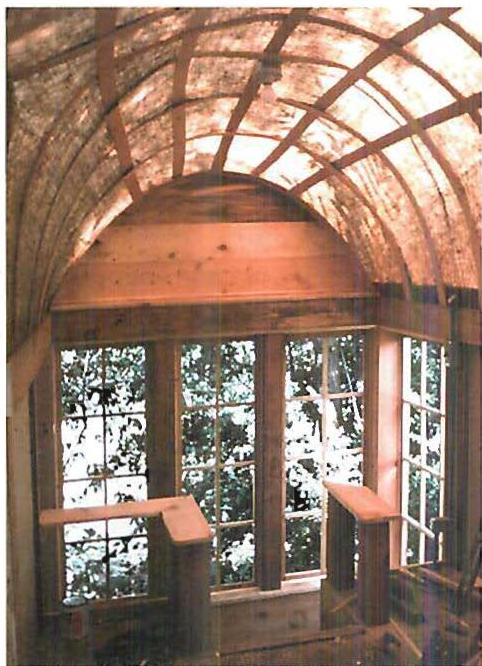
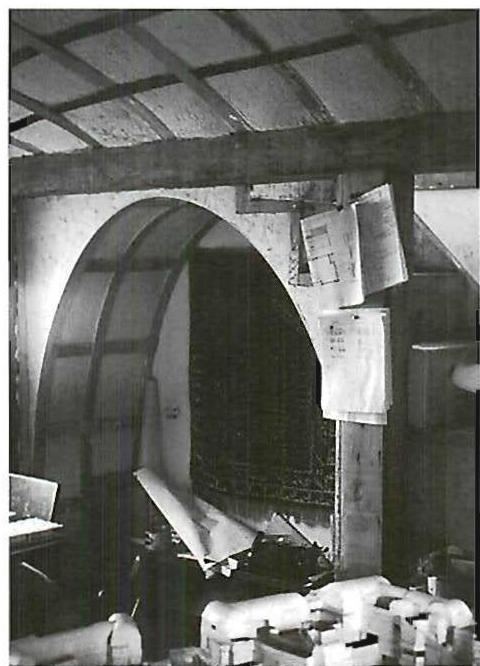
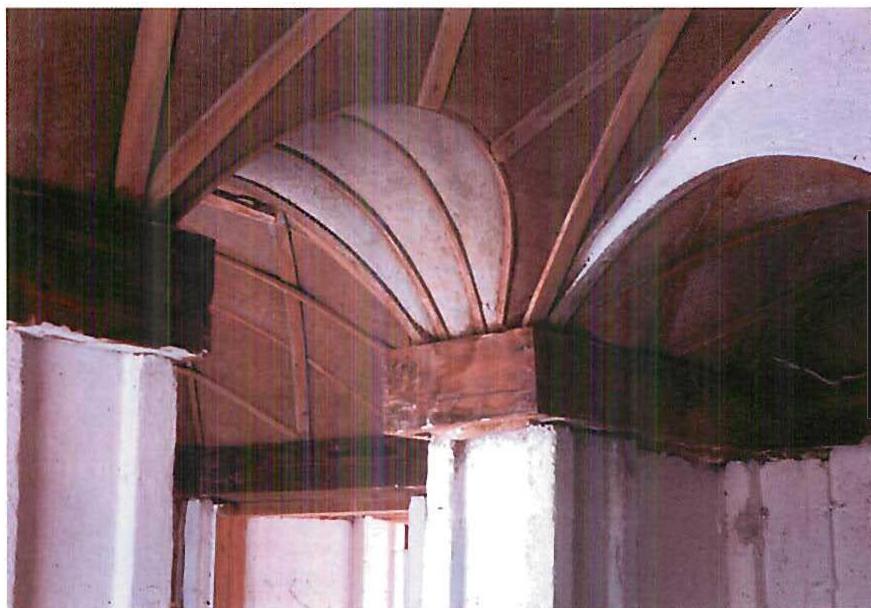
the house as a whole. Then mud is plastered onto the wattle. The process goes from one step to the next, and the final result is determined by the process, not by a drawing. This is what allows the smoothness of the adaptation, the
excellence of the unfolding, and the beauty of form.
In the photographs on this page and on the next, we see a small building that was built by an unfolding process based on hollow
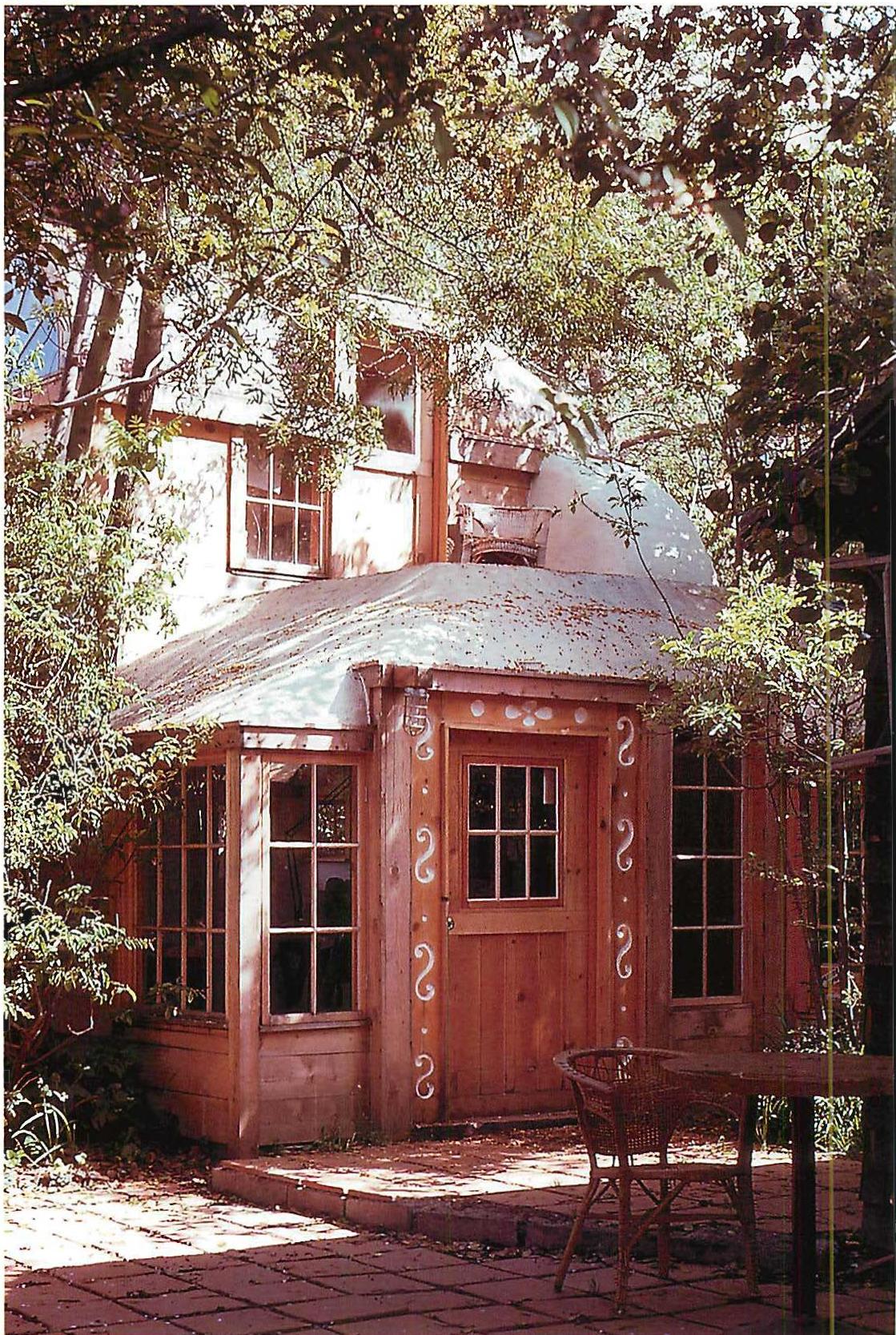
The Etna Street Cottage, a structure of an ultra-lightweight concrete vault, built over a hollow wooden structure filled with lightweight concrete. 400 square feet, built for $3,000.
wooden columns, hollow beams, and lightweight concrete basket vaults. This early version was built about 1973. In 1976 we began a
more carefully worked out process, described in the next few pages, where this kind of thinking was tested on a larger scale.

10 / THE PARADIGM OF SMOOTH UNFOLDING AS A TARGET FOR EVERY CONSTRUCTION TECHNIQUE
One of our greatest tasks for the 21st century — I believe — is to invent high-technology versions of such an unfolding process, so that it is easier to specify buildings cheaply, while giving each one the chance to be adapted uniquely to its conditions. You start with a set of points in the ground, hardly more than that, and everything is generated from these points, but with attention and with adaptation, so that as it unfolds, each building becomes unique, and its adaptation works out naturally.
I have only rarely succeeded in such a beautiful unfolding using ultra-modern materials. One of the purest systems I invented that did have this quality was a system for the construction of houses in Mexicali. We developed (and fabricated) spe
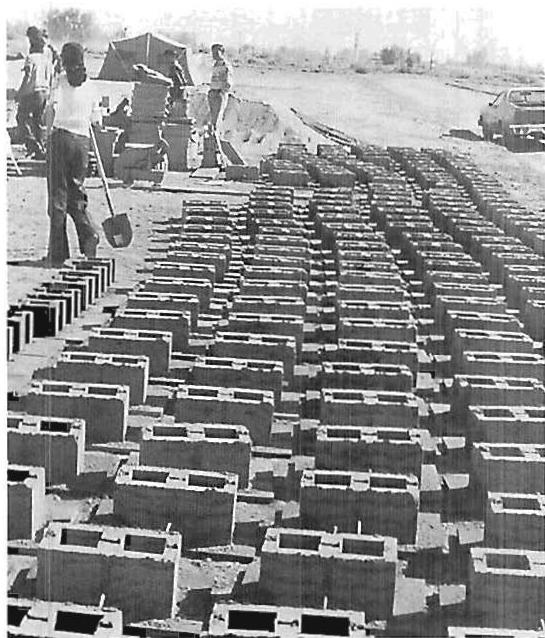
cial interlocking blocks which could be used initially to lay out the building, and then cast in with the slab that was poured over them to form the foundation. These blocks were cast with protruding reinforcing steel which stuck out and could be connected to slab reinforcing next to them. The blocks were placed on the ground and the protruding steel was tied to the slab mesh. Then one could simply pour the slab.
The walls came next. In the walls, the blocks which formed the corners were special corner blocks. These blocks, castellated like a four-sided turret, fixed the corners. Then the ordinary wall blocks were fitted into them, stretching from corner to corner.
The perimeter beam on the top of the wall was made so that one could "wind-in" the basket lath to curve the vaults. Once the wall top was made, two two-by-ten boards were placed. The vault strips were trapped between the two boards, curved over the room, and then trapped between the two boards on the other side. As each vault basket was woven, it took its shape from the weaving process. Each basket took a different three-dimensional curve according to the shape and size of the room.
Next burlap was stapled onto the basket laths, then chicken wire was stapled over the burlap. Then an application of a thin, very lightweight, frothy concrete went over the burlap to form a half-inch shell. That thin shell became the formwork for the second, heavier concrete vault. Then the two boards which had anchored the basket edge became formwork for a beam that was now poured along the top of the wall and held the vault in place.
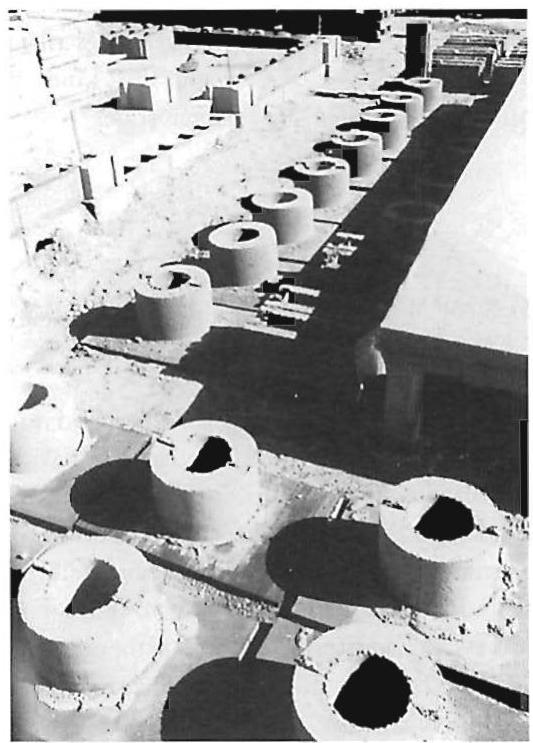
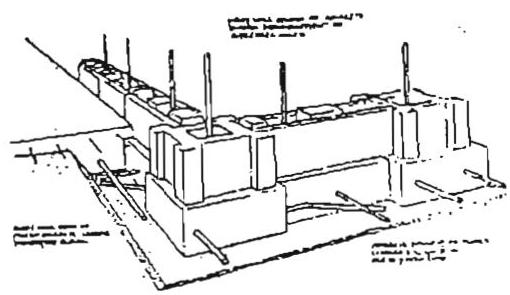
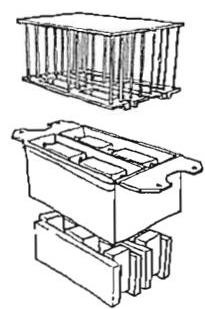
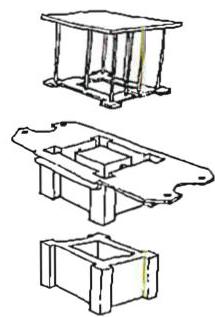
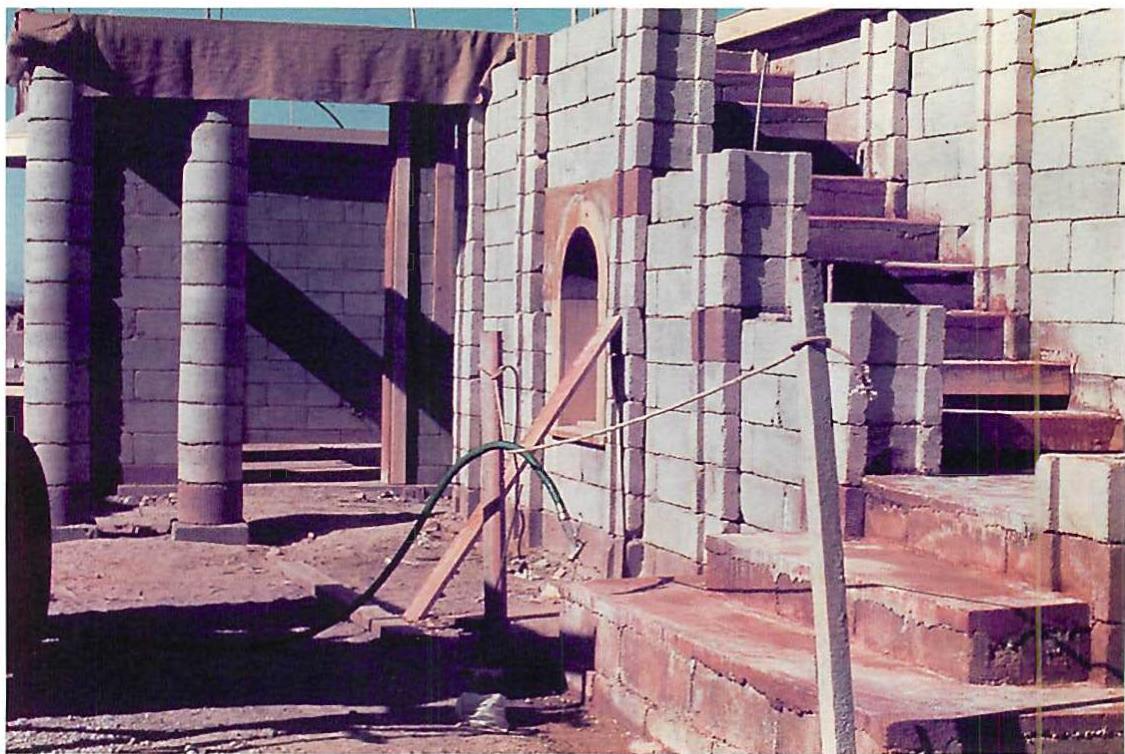
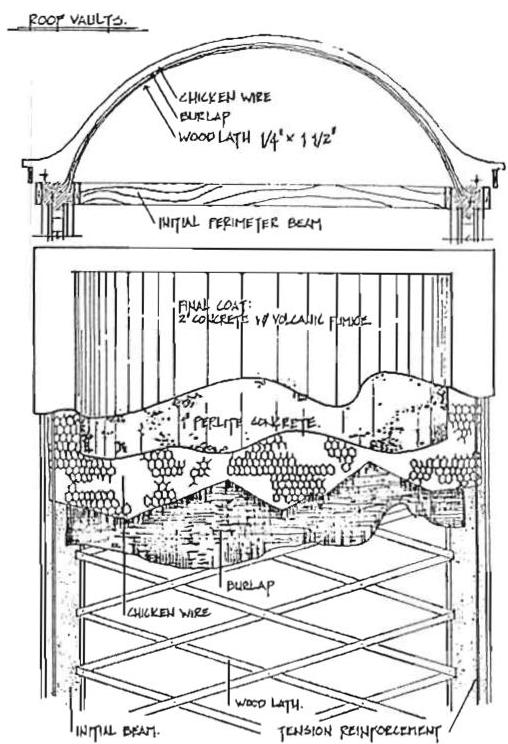
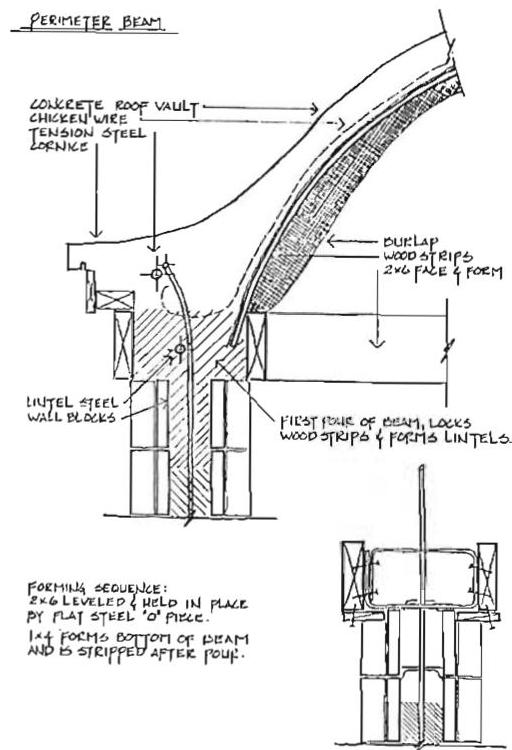
So the whole house grows. To start things off, one merely fixes the outline of the house by laying down corner foundation blocks. From there, each act follows the previous one, step by step, allowing a unique form to emerge.
SEQUENCE OF CONSTRUCTION OPERATIONS
- Stake out the house with rebars driven into the ground to mark the corners.
- Place corner rebar-blocks over each corner re-bar.
- Place a line of bar blocks between each corner block.
- Place steel and mesh, then pour the slab.
- Place corner turret blocks to form corners.
- Place wall blocks fitting into corner blocks.
- Locate windows and window sills as the walls are going up.
- Place a pair of two-by-tens to form perimeter beams.
- Place reinforcing steel in the beam, place conduit and plumbing lines, and pour the beams.
- Use the perimeter beams to place lattice strip to weave baskets for vaults.
- Once the baskets are woven, fix each crossing of lattice strips with one fine nail to stabilize the flexibility of basket.
- Staple burlap and chickenwire over basket.
- Pour a thin, ultra-light-weight frothy concrete to form a one-inch shell (aggregate is perlite and insulation fiber).
- When the one-inch shell is hard and cured, place a second shell of about three inches in a heavier and denser lightweight concrete.
- Fit window frames and door frames.
- Using special simple sash construction made out of two-by-two material, build sash and doors to fit the openings.
- Place finish material on floors.
- Whitewash the interiors.
- Complete plumbing and electrical fixtures.
We have invented several high-tech versions of this kind of unfolding process. They are cheap.
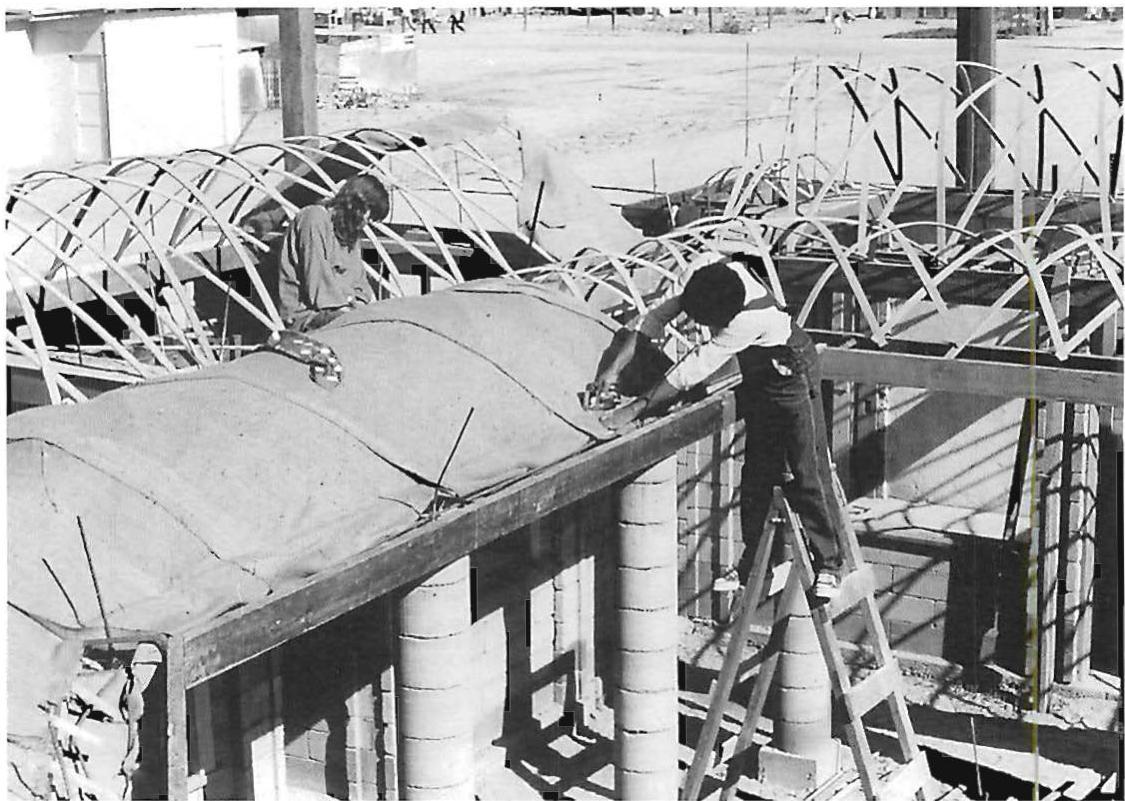
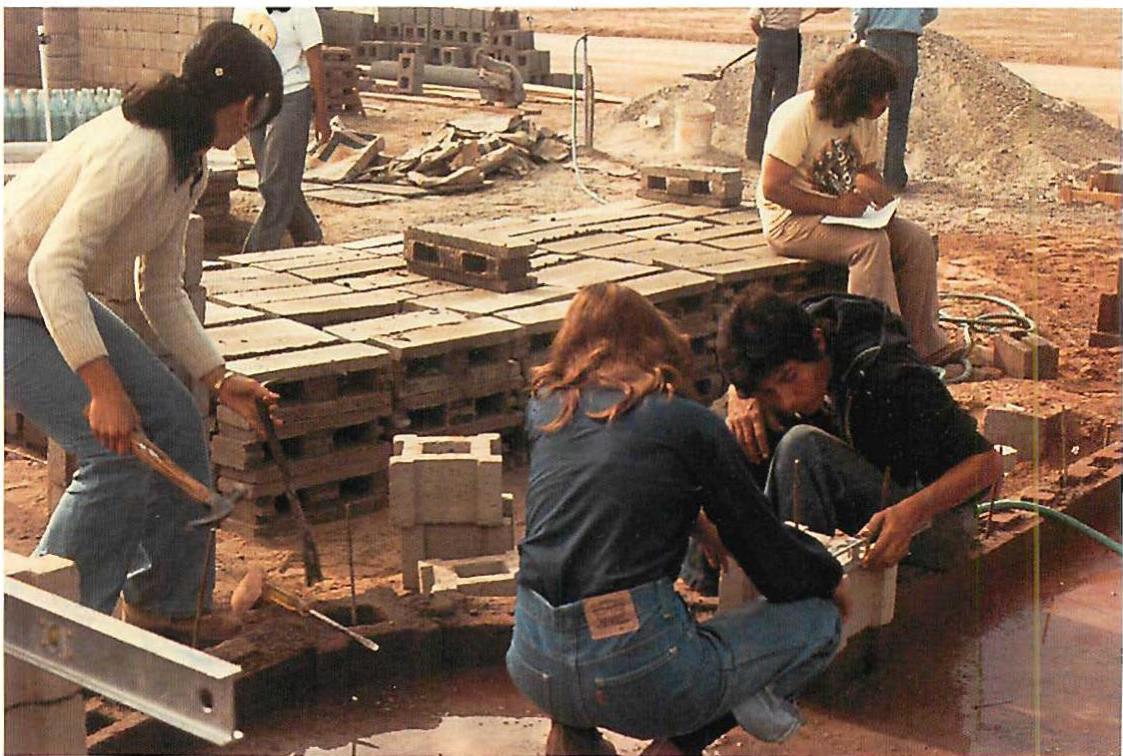
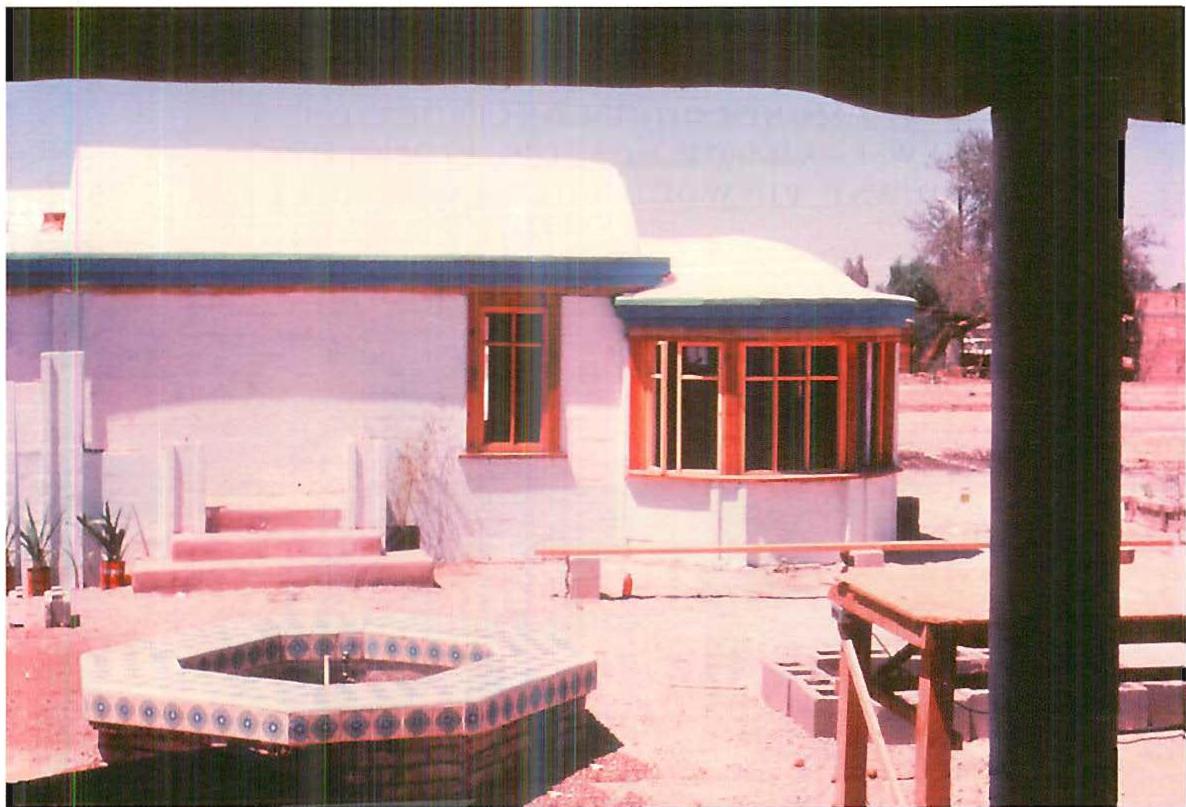
They allow houses to be different. They require no drawings. They are technically sophisticated. In general, I believe that the most sophisticated building techniques of the future, will be those where each operation modifies, without backtracking, the
product of the previous operations. Such processes can generate well-adapted variety, cheaply and easily. There is no need for complex drawings, because each operation is sufficiently well-defined by the context of the previous operations.
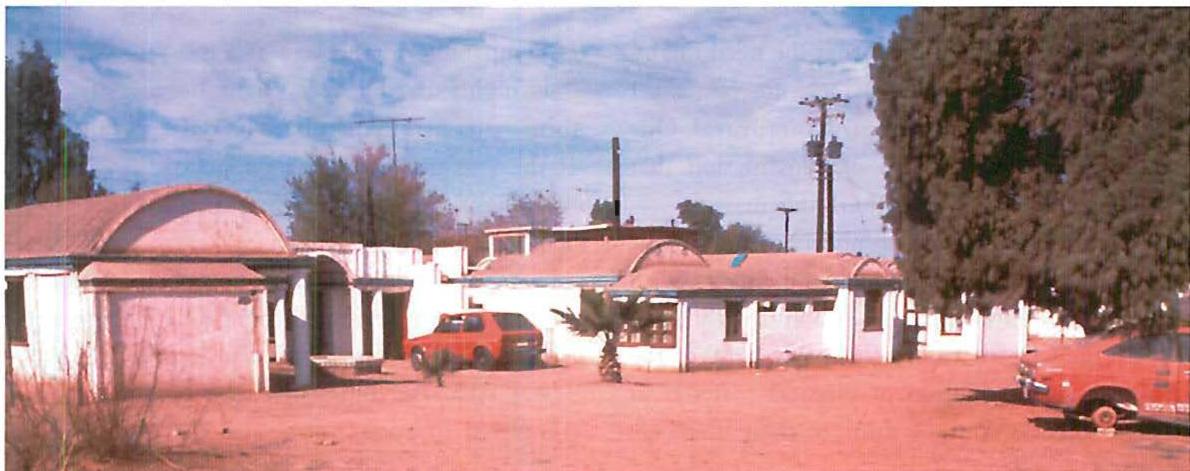
11 / MONOCOQUE CONSTRUCTION
NEW FORMS OF HOLLOW, COMPOSITE, WOOD AND PLYWOOD COLUMNS AND BEAMS
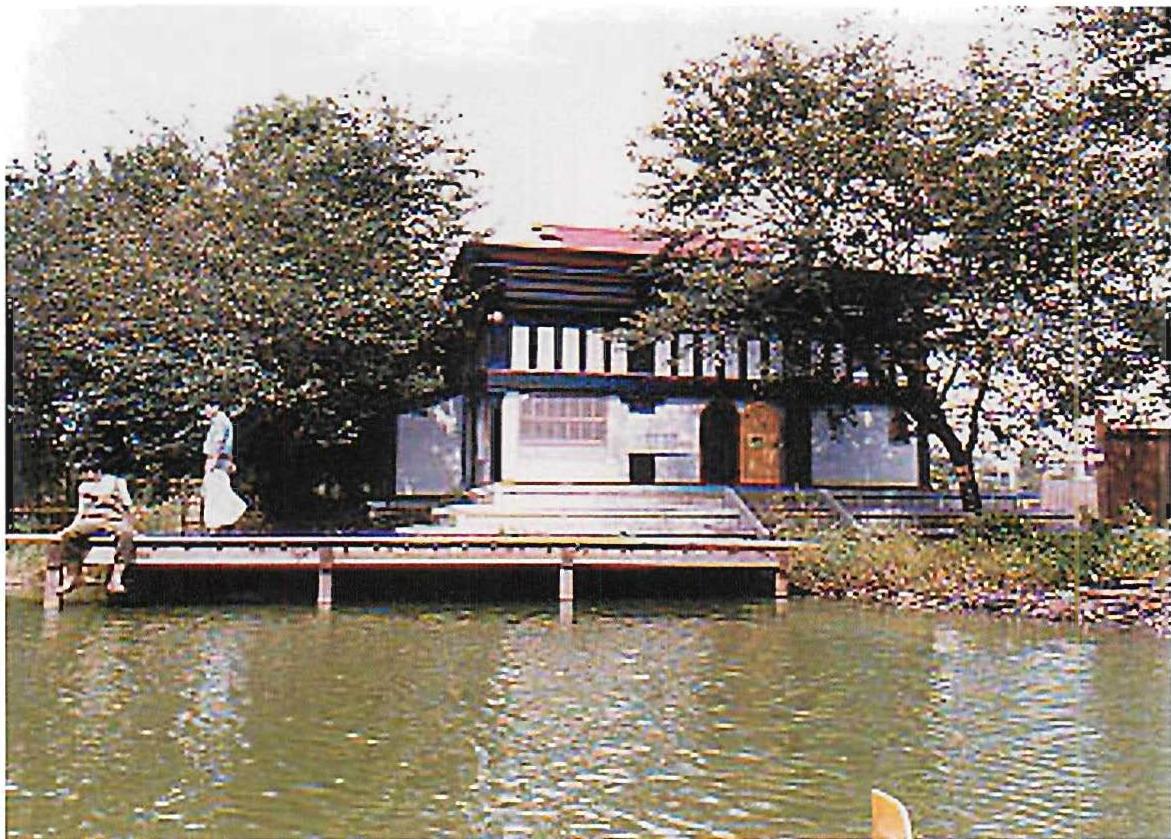
On page 478 I mentioned that the need might arise to make members which are large, yet lightweight, efficient, and structurally real. One example of such a form of construction that we invented is a way of building massive columns and beams out of plywood and small-section lumber, yet producing members with a very large moment of inertia and with high-performance structural behavior because of the innovative distribution of physical material in the members. We may think of these members as comparable to the way a grass stalk works: it is highly flexible, very light because it has thin material all distributed at the perimeter of the section, yet huge moment of inertia for its weight, and outstanding performance in bending and shear.
A grass stalk is largely hollow. The columns and beams we developed for the Clubhouse at Eishin, outside Tokyo, are also largely hollow. The Clubhouse, built in this technique, was completed in 2002.
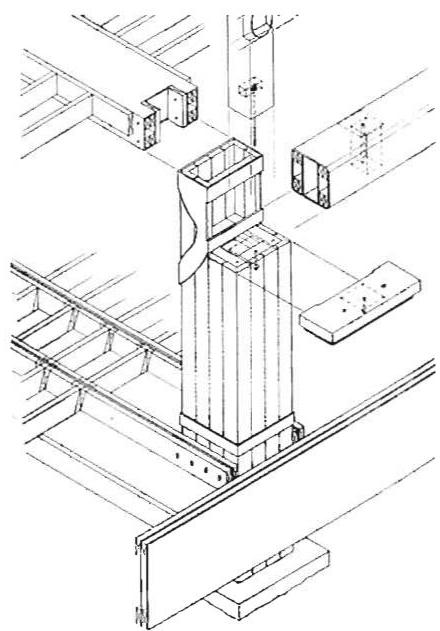
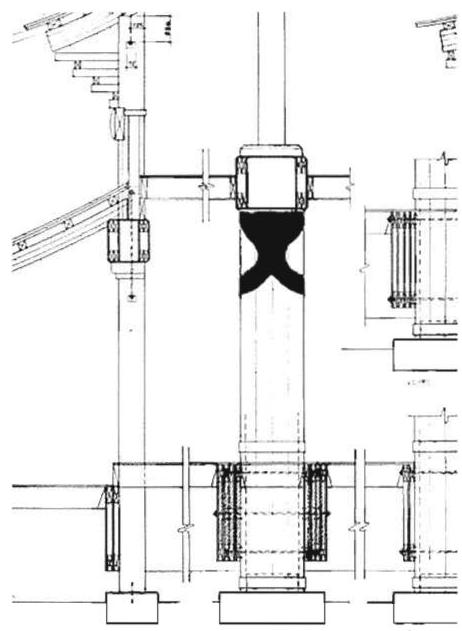
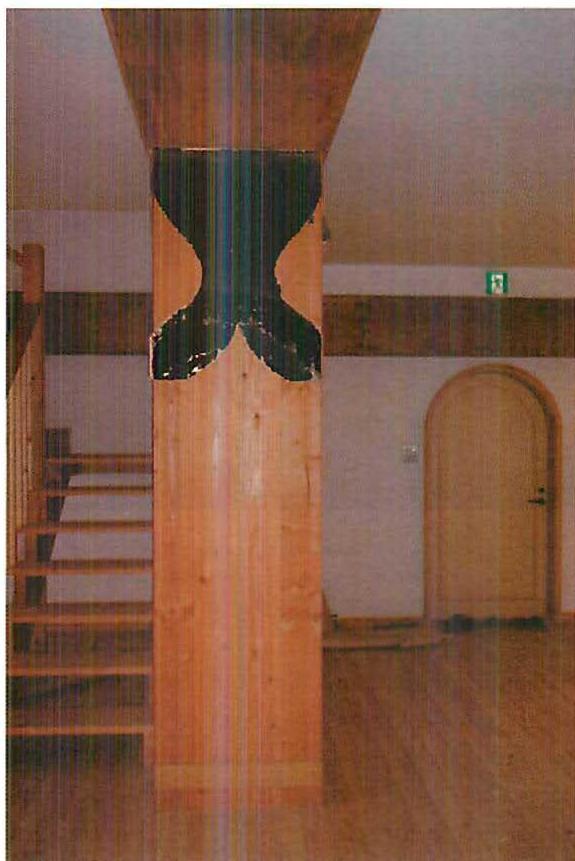
12 / CONCRETE MONOCOQUE CONSTRUCTION A CURRENTLY EMERGING STRUCTURAL TECHNIQUE
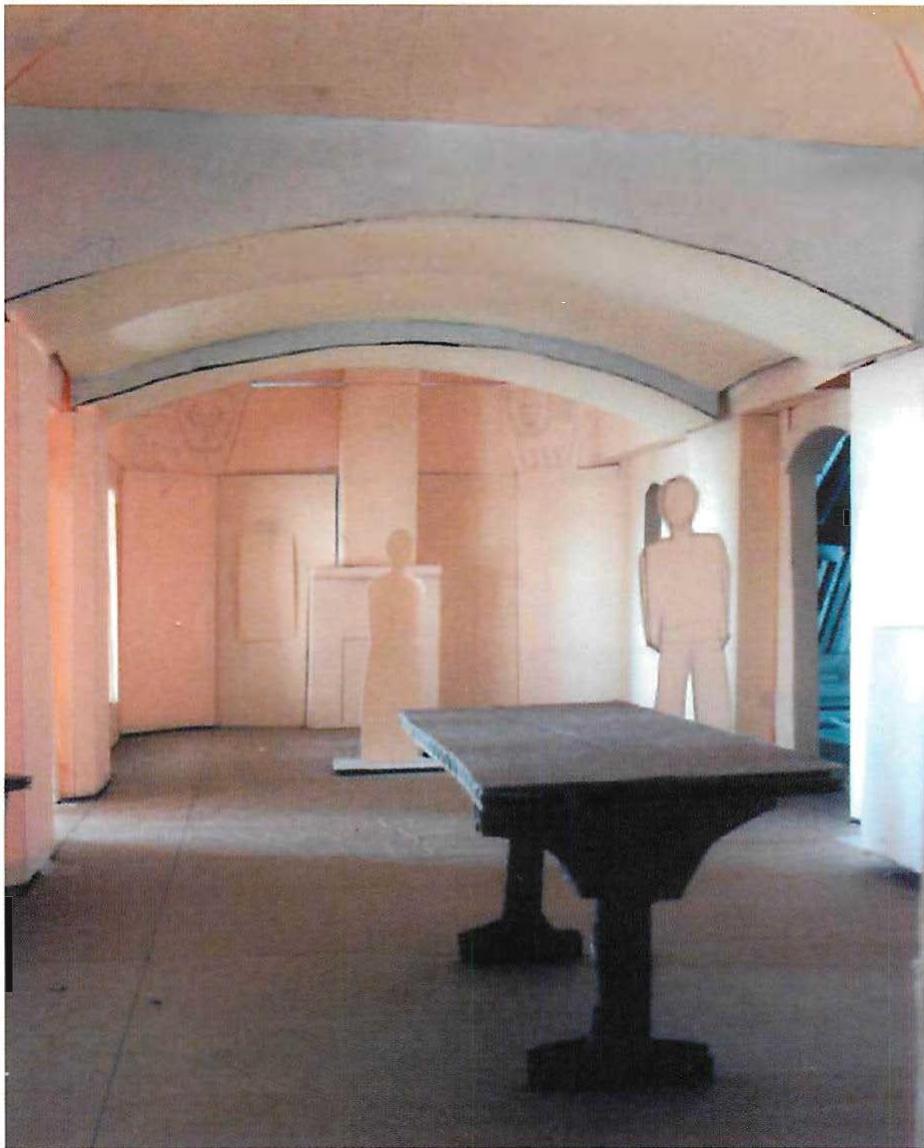
We are also currently experimenting with a similar monocoque formation of concrete hollow members — columns, beams and arches — all shot over a welded wire fabric base, and once again getting high moments of inertia for relatively light-weight use of material, yet providing solidity, mass, and emotional solidity.
At the time of going to press (October 2002) we are about to begin construction of an estate house in Sonoma County, made largely in this technique. There are many ways of making the monocoque shell, using gunite, hand-applied plaster, or shotcrete. In the configurations contemplated, shotcrete will be the
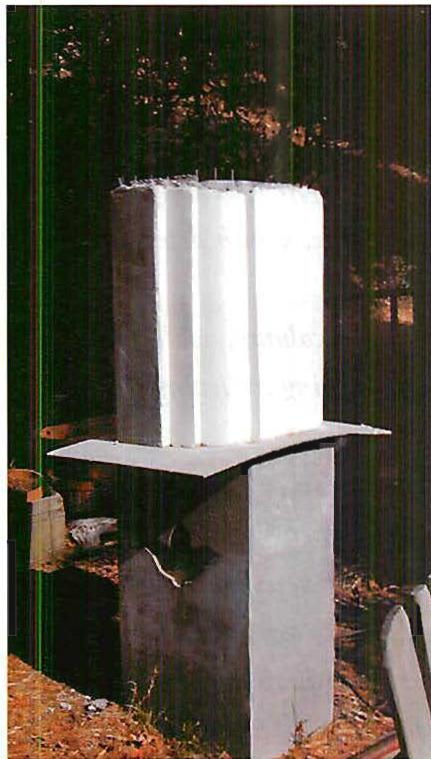
cheapest and fastest way of getting a high volume of material with a good degree of control over the details.
We shall see if it works. This is one of the
most recent of our experiments in new technique, that go on almost daily, part of a long line of experiments and tests that have been going on for more than thirty years.
13 / FEATURES OF NEW BUILDING METHODS THAT ARE LIKELY TO APPEAR IF THE TECHNIQUE IS GENUINELY ABLE TO SUPPORT A LIVING PROCESS
Materials and technology change from era to era. It is in the nature of human society that these things evolve and will be different with each period of history. But within the enormous variation of materials and technique which inevitably change from age to age, we may identify certain invariants that must arise repeatedly, from the fundamental process.
Ultimately, when all is said and done, a building is made of material substance. It is this substance—the walls, floors, steps, windows, roof, and the con
figuration of the way these things are MADE — which governs the character of the building. And it is this substance which permits — OR DOES NOT PERMIT — the emergence of living centers in the material, and the adaptation of fine structure that is needed to bring the larger whole to life. It is therefore the living character of these materials themselves, their material substance, which determines whether the larger centers in the building can come to life.
This then gives the material techniques for making — column, wall, base-wall, foundation, floor — very great importance in determining the living structure, or the lack of it, in every building.
To create living structure in our time, both to create the living centers in the building elements, and to allow the fine adjustment of dimensions that living structure requires, we shall need a nearly endless series of new generations of building details arising from materials and techniques which can easily be made to form beautiful centers, which allow local adaptation, thus allowing larger living centers to form in the space and in the material fabric of the building.
Especially, one may say three things:
Invent techniques that allow cheap formation of basic lines, corners, and element positions which set up the configuration of the whole, and then allow the material to reinforce these positions with mass and weight.
Invent materials which are solid and long-lasting for the base structure, with shorter-life materials in between for more temporary structures.
Invent materials which allow very easy cutting, shaping, and change of dimension while making is going on.
CHAPTER SEVENTEEN: HOW LIVING PROCESS WILL HELP THE PRODUCTION OF GIANT PROJECTS THROUGH HIGH-SPEED ADAPTIVE PRODUCTION
1 / HOW MAY WE APPROACH TRULY GIGANTIC CONSTRUCTION PROJECTS
The intricate and context-specific adaptation that shapes every detail differently is a necessary structural feature of all life. You cannot have a single organism or a forest without it. You cannot have a living building without it.
But even the sympathetic reader will have asked himself if this adaptive care, described in many of the foregoing chapters, can actually be implemented at reasonable cost and at reasonable speed and in reasonable quantities. Can this be done today? How are we to have this quality in the modern industrial world?
In the traditional world, labor was cheap, time was elastic. Craftsmen could spend weeks, months, years patiently shaping each stone, or brick, to fit a wall, and could make each part with loving care so that it fit, perfectly, into the harmony of the whole.
In the modern world, labor is expensive, money is all-important, and time whizzes by; speed is most essential of all. Much building production hinges on mass production and assembly of millions of identical components. How then—realistically—in the modern world can we get the subtle fine detail of adaptation, variation, and harmony which makes every component slightly different, and yet do it at the break-neck speed of modern giant projects and in the colossal quantities required for the largest projects? Can there really be living structure in this modern world?
A person reading the overall approach to design and construction described in THE NATURE OF ORDER, especially the approach described in this volume, may say to himself, "Well, all this is fine for small buildings, intimate neighborhoods, and so on . . . but it is, in principle, inconsistent with the scale of airports, massive downtown high-rise buildings, museums, opera houses, and so forth. It has too little to say about the mass production of components and the production of giant buildings which especially characterize our modern age."
In this chapter I shall therefore describe a new form of production which we may call high-speed adaptive production, and discuss some of the conditions which may allow us to obtain beautiful and intimate results, even in the most gigantic projects. We shall aim to achieve this goal by careful harvesting of high-speed mass-production techniques, personal technique, computer-aided technology, new ways of managing and dividing items within a giant project to create the best effect—all ways, in short, which are economically feasible in our time and will be in the future, as ways of creating things with a depth and intimate relation to ourselves that seemed impossible in the 20th century.
2 / HIGH-SPEED ADAPTIVE PRODUCTION: TECHNICAL PROBLEMS THAT MUST BE SOLVED
I shall show in this chapter that it is possible — I do not say easy, but I do say certainly possible — to conceive new forms of on-site fabrication which allow every part to be just right, without upsetting the enormously high-speed production that is today considered necessary for giant projects.
To grasp fully the significance of the concepts which have been described in Book 2 as they have impact on giant projects, it is necessary to develop altogether new production processes especially for the largest building projects. These need to be based on concepts of production able
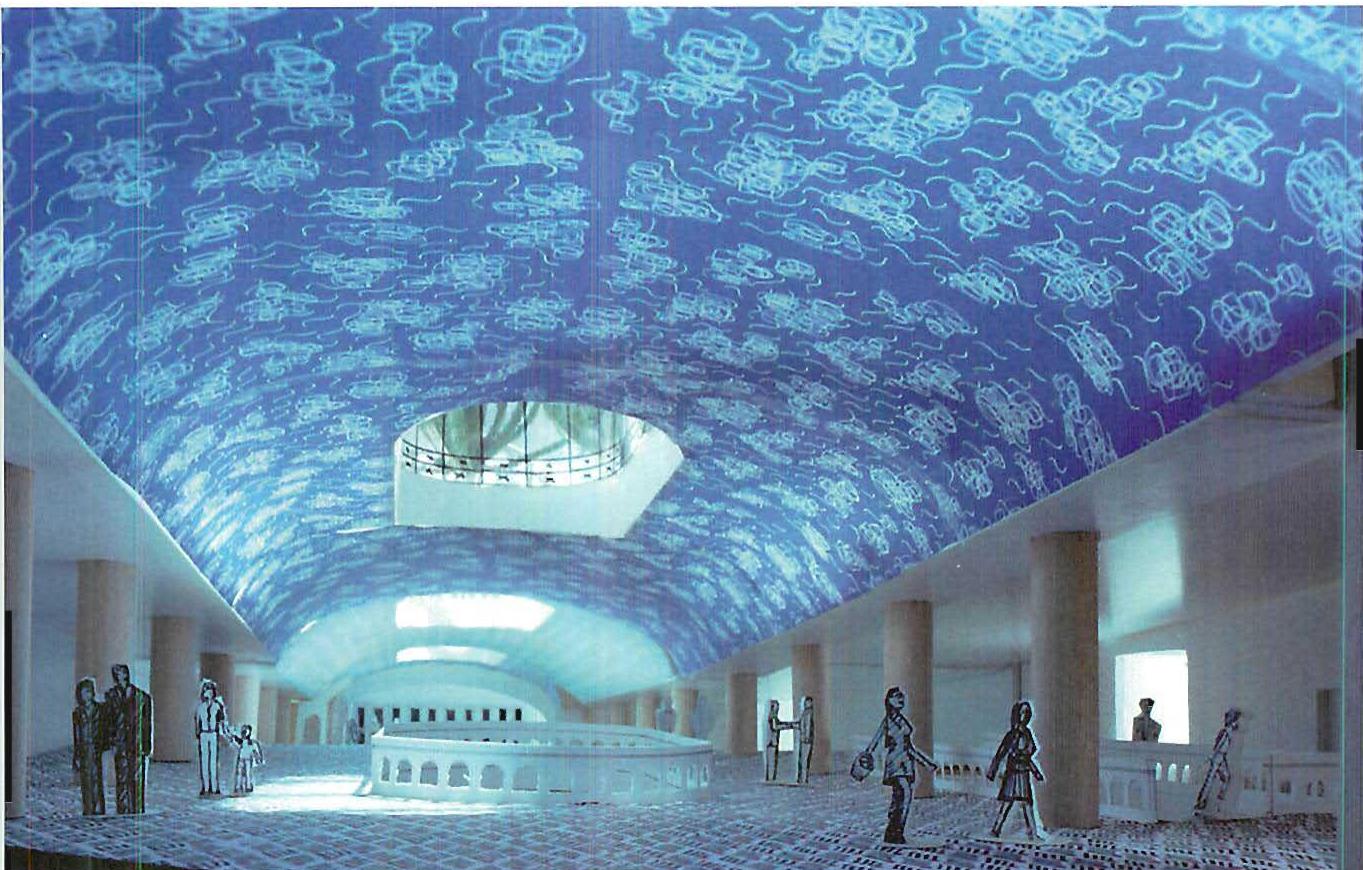
to deliver the multiple adaptations and uniqueness promised in Book 2, while maintaining standards of speed, cost accounting, high quality, efficiency and time control.
The processes must deliver high-volume, high-efficiency production that were typical of 20th-century mass production while also delivering a new standard of uniqueness, love of art and craft, and careful adaptation of detail and variety which was common in the production of the pre-industrial, pre-literate centuries a thousand years ago.
To accomplish this seeming tour-de-force, it will not be sufficient to try for some kind of mixture of the two systems of production. Rather, what will have to be provided is a new form of process, a uniquely 21st-century and ultra-modern form of process, different from those of
the 20th century, and also vastly different from those of the 12th century: a new kind of process, altogether new, in conception, detail, execution, and conceptual structure.
We are to witness the idea, therefore, of an entirely new, ultra-modern form of process and production not seen before in human society.
Some of the key features of the new process configuration which are to be discussed include the following:
- Extensive use of computers.
- Extensive use of handcraft and hand-eye sensitivity translated to component manufacture through computer-intense technology linkage.
- Partial prefabrication undertaken to allow detailed on-site adaptation and adjustment.
- Off-site production.
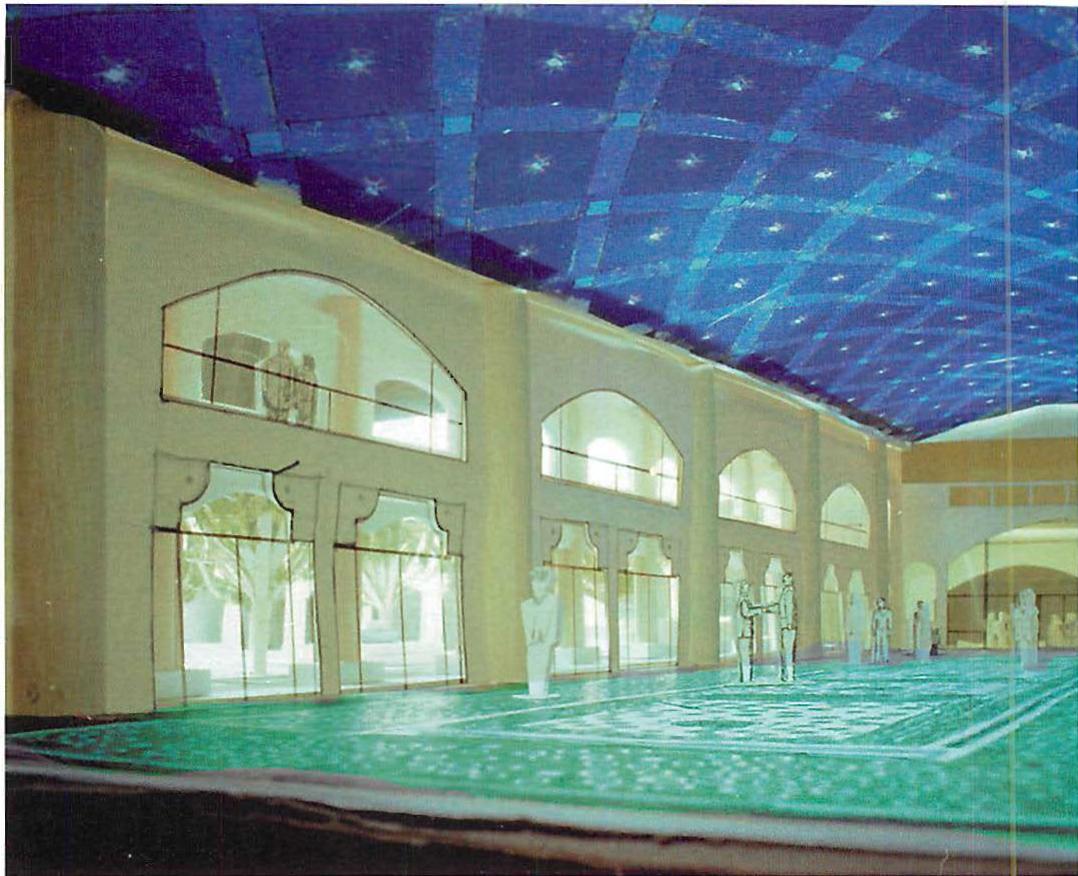
- Off-site testing of partially completed configurations.
- Use of ultra-high-technology cutting and forming equipment.
- Further adaptation on site at time of installation.
- On-site modification of pre-formed components.
- Adaptation in off-site mockup facilities.
- Subtle adaptation of shape, color, geometry, and form of components as the on-site space develops in shape and degree of completion.
In the next few pages, I shall consider this kind of new adaptive process in a form worked out for a specific project, a huge underground complex of public spaces in Athens involving more than two acres of floor area in the public concourses alone.
The existing Megaron of OMMA (the Or-
ganismos Musikis Megaron Athini) is the largest Concert Hall in Athens, and was to be extended further by a vast extension including underground opera house, concert hall, conference center, library and so on. I was approached by the president of OMMA, and was told that he had a personal passion for the marble floors of the early medieval Italian churches and wanted to do something similar for the floor of the new Megaron. I was introduced to him as someone who understood these early Italian floors, and who might conceivably be able to make what he wanted in a just-century form. I wrote to Mr. Lambrakis and described something of my own passion for the Italian floors and my experiments over the years in making comparable marble floors by ultra-modern means. I told him I would make calculations and preparations for production by high-tech means, spanning both California and Greece.
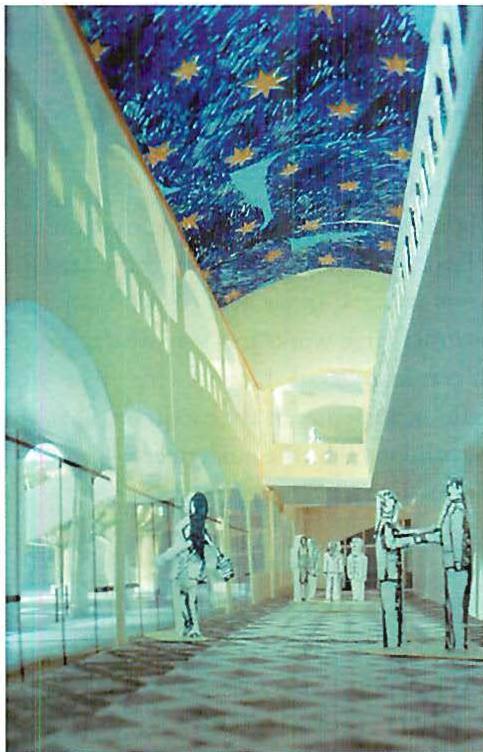
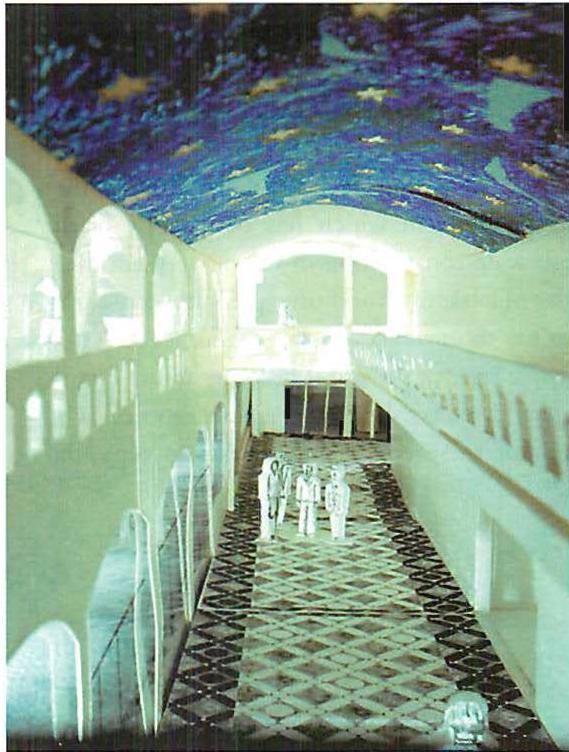
3 / SLOWLY CREATED HARMONY IN A MASSIVE PROJECT: THE EXAMPLE OF THE ATHENS MEGARON
The techniques we developed relied extensively on our collaboration with marble cutter Larry Berk, Watsonville, California. As we entered the project, I was astonished to find out that the total area of the floors OMMA wanted in the building was about two acres: some 8,000 m² of multi-colored marble floor, many times what had ever been built in a medieval example, yet still including thousands of tiny pieces, each adapted in shape, form, and color, to its particular circumstances.
In very preliminary calculations, knowing the level of detail and number of pieces, I calculated that this floor would probably contain some 400,000 pieces of various colors and shapes.
In the original Italian floors made in the 12th century such floors were made laboriously, each piece cut and laid by hand, even a very small floor taking months and years for the craftsmen to make. It was this slowness, the slowly created harmony and painstaking care, which made the floors so beautiful. Built today, anything made that way would be prohibitively expensive since labor rates (relative to materials) have increased so much (from 10% of the job cost in the 12th century to about 60 or 70% of the job cost for a project of this kind in modern times). It would also be prohibitively time-consuming; this new floor we were asked to make for a major concert hall in Athens had to be made under economic conditions of modern labor rates and under the pressing conditions of our modern attitude to time.
Indeed, when I asked how long we would have on the job to lay the floor — recognizing that the building was a $150 million project with four huge general contractors and massive efforts going into place every day — I was told that we would be allowed continuous access to the slabs for only two
months to complete and install our part of the work. The whole floor, all two acres of marble and all 400,000 pieces, had to be completely laid, ground, and polished in two months.
We were thus facing, in microcosm, the massive problem which has persistently faced large-scale construction in the modern era. Because of labor rates and time pressure, construction has to move in very large volumes and at a massive rate, otherwise it becomes too costly in time and money. During the 20th century, as a result of these conditions, work was typically crude, governed only by the capacity to go fast and cheap — and this led to the devastating loss of personal quality and of local order and adaptation which the four books of THE NATURE OF ORDER are all about.
The question is, under our modern conditions where labor rates are high, and where the need for speed is pressing: Can we hold cost constant and yet construct large works in a way which is profound, personal, detailed, and loving — yet still respectful of these necessary conditions that are nowadays imposed by the modern era?
4 / THE CORE OF THE SOLUTION: A COMBINATION OF LARGE NUMBERS, HIGH SPEED, MINUTE ADAPTATIONS, CRAFT, AND COST CONTROL
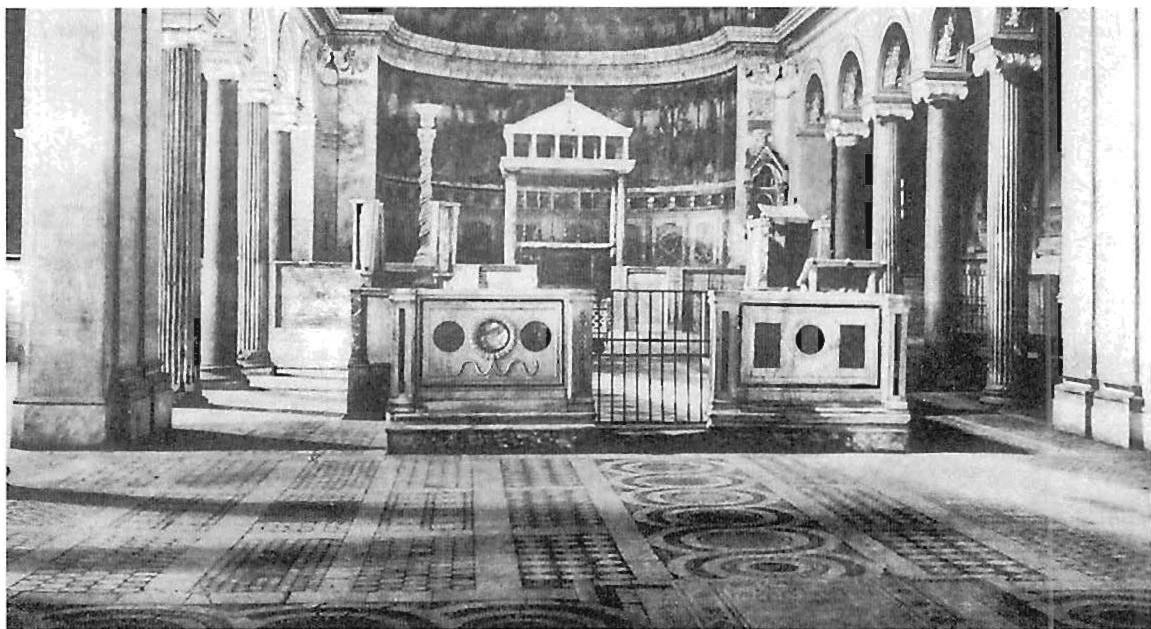
In conventional late-20th-century methods, a problem of this kind was typically solved by using mass-production components and trying to get variety and complexity by random arrangement and combination of these mass-produced components. However, this sort of technique, though it did occasionally create an impression of something lavish, was not able to capture the stunning beauty of the medieval floors, simply because that beauty relied on inch-by-inch vari
ation and adaptation—with the result that every stone felt just exactly right. An example of the true beauty of the ancient floors, showing its reliance on subtle adaptation, is shown opposite, in a 12th-century stone floor from Rome. The idea that one could create a comparable level of beauty in a high-technology environment had simply not been tried in modern times. But, using living process, the problem can be solved.
The solution to the problem is an interlocked pattern of action in which we use resources for speed and efficiency, allowing them to perform what they can perform, rapidly and cheaply, yet interleaving with them, smoothly and cunningly, the personal qualities and procedures needed to create genuine fine-scale adaptation. In addition, there must be a set of procedures where (using electronic means, computers, and a variety of sophisticated but apparently naive simulations) one is able, at high speed and in very short time span, to make just those kinds of detailed artistic adaptations which were possible in the 12th century, but in a new (and now partially simulated) form which can be transmitted to the real project through high-speed electronic means. The two procedures—the fast of the modern and the slow of the old—are united to form a new kind of process, one which would have been unrecognizable in the 12th century and unrecognizable in the 20th century. It is something, in principle genuinely new.
To describe what had to be done and how we arranged to do it, I start with some statistics for the floors. The total area to be covered was about
8,000 m². In making an assessment of the overall statistics of the design, number of pieces, and cost of fabrication, we made a small sample about 18 inches square (shown on page 571). This sample, containing 116 pieces in 50 cm by 50 cm (464/m²), was imagined in part as a 1:5 scale model of a larger area and in part as a 1:1 full size model of certain more detailed areas. On average this model suggested an overall statistic of about 50 pieces per square meter, the pieces having a mean diameter of 15 cm, and mean edge length of 60 cm, requiring a total length of 30 meters of cuts needed for every square meter of floor. This gave the project as a whole about 400,000 pieces for the 8000 square meters of floor, with a total length of cuts that would have to be made of 240 kilometers.
Let us consider the design and production aspects of this enormous task. Just the pure production alone is a huge task because of the need for colossal speed that OMMA required. The 400,000 pieces had to be laid and polished in two months. One might judge that only mass production could hope to manage the huge number of pieces which have to be cut and installed under such a time constraint. This reflects the general pressure that used to be felt throughout the 20th century as builders asked themselves how they could build—fast enough—the offices, roads, airports, houses, furnishings, windows that were needed all over the world to meet the needs of 6,000,000,000 people in the world. The Athens floor is a microcosm of the massive production problem we face daily in the modern world of building.
5 / ADAPTIVE DESIGN EMERGING WITHIN THE WHOLE
But beyond the need to cope with production and speed, there is a far more complex problem: the scale and complexity of the design problem itself, and of the needed adaptations to reach harmony. This is the massive design aspect to the whole thing: the desire to make a living unity. In
this respect, too, the Athens floor is a microcosm of the entire world of building. We know buildings are better when made with love and care and time and patience. But in the world of mass production, high labor rates alone seem to make it impossible, so we have come to accept the steril-
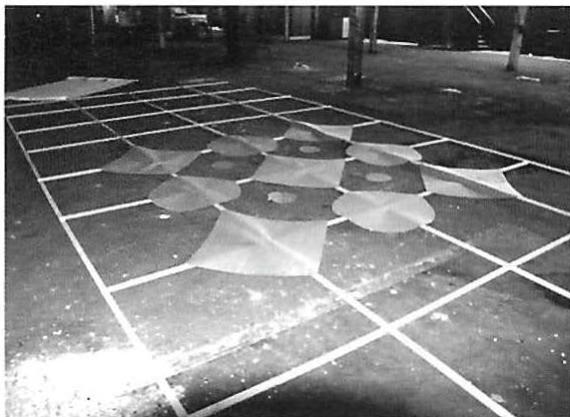
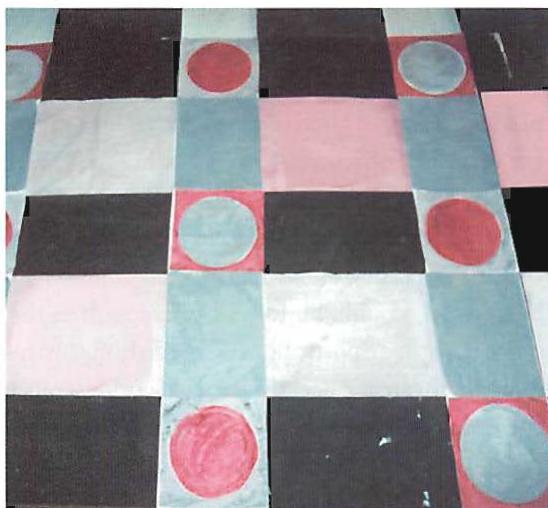
ity of mass production as an inevitable result of the modern era. Yet we are wrong to have done so; the argument of these four books makes that thoroughly clear. And in the Athens floor, too, it seems that a mass-production approach to these floors would deny their very purpose—which was the client's expressed wish to create something with the same depth and beauty as was encountered in the 12th-century Italian church floors. That can only come from time and love and patience.
If a man can cut one piece of marble in five minutes (a very short estimate for the average), he could cut 12 per hour, or about 100 pieces per day. This one man would take 4000 days, eleven years, to cut the pieces for the Athens floor. Of course, you will say that we can use an army of marble cutters, twenty, let us say, so that we may cut the pieces in half a year. But the moment we visualize that, we have to imagine not craftsmen, but workers, slave-like worker ants blindly cutting as fast as they can go. And, anyway, the artistic skill to make a beautiful floor does not even exist any longer in that environment. Only the technical cutting and laying skills remain.
So in our epoch, we have come to imagine a floor which is designed in an office and where the pieces of the design worked out on the drawing table are transferred to the hands of the twenty worker-ants who will cut exactly according to the blueprint, and their counterparts among the floor layers who will lay the floor exactly as it shows on the blueprints.
It is a fantasy, of course, to imagine that something beautiful can be made this way. This whole approach is a disaster. It cannot create life or harmony.
So here we have run into a very big problem—not in cutting, but in the design process itself, as it relates to high speed craft and production. It is a fact, repeatedly verified by experience, that the feeling of such a floor cannot be accurately judged from a drawing made in advance. In order to understand what looks right, feels right, is right on the floor, one can only judge by actually drawing on the floor, by changing and modifying the pieces and their shape and color, while one actually makes the floor. Scale, above all, is vital. The exact size of pieces matters and the right size only becomes clear when one is standing looking down at them. And, for a repetitive pattern, the way it looks at an angle as it disappears makes a sharp difference. Even twenty or thirty feet from where you are standing, what works and does not work are obvi
ous—but entirely different from what one might have predicted on a drawing board sketch.
For this reason, as I told our client, it would be necessary to work out the whole design on the ground while looking at it in a real context. And further, one can only do such a huge thing bit by bit. One's emotional and mental concentration cannot simply take in two acres of 400,000 pieces as one design. I estimated (working, for the sake of argument, on one hundred separate sections and doing one section every two weeks) that it would take a year merely to design the floor.
Even the simple-looking marble panel shown on page 571, represented the effort of four people working for nearly two weeks making different versions, sketches, mockups, adjusting them, trying them. It seems a lot of time to take, but the effort shows in the result. The final product is a harmonious thing.
The problem is, then, how such a slow process can be fit together with some kind of ultrafast process, to produce results fast enough and efficient enough to be sensible in today's world, and do-able at a reasonable price?
6 / THE WATER-JET CUTTER
In order to make the creation of the floor feasible at reasonable cost and in reasonable time, we decided to use an extraordinary instrument. This instrument, invented less than ten years ago, is a very thin jet of water, about 1/16th inch wide, at enormously high pressure. The pump operates at 60,000 psi. In some cases a small quantity of very fine silica dust is added to the water jet, increasing its cutting power.
Amazingly, a water jet of this type can easily cut a three-inch solid stainless steel plate at about the speed a bread knife moves through bread. It cuts marble sheets easily and at high speed, with great precision and control. The cutting head is controlled by computer instructions originating in a CAD drawing and is automated to cut configurations of almost any size and complexity.
Using water jet cutters, we will be able to cut the pieces of the Megaron floor at reasonable cost and in a reasonable time. Using three machines in continuous operation, the 400,000 marble pieces and their 240 kilometers of edge length to be cut, can be cut in about six months. This is to be compared with eleven years of cutting time needed for a single craftsman using conventional masonry saws) to cut the same marble pieces.
Additional facts in favor of water-jet cutting are the following:
- Dust-free cutting
- No thermal stress on materials
- High flexibility thanks to integration of water jet into two- or multi-axis guide systems
- Little swarf due to narrow width of cut
- Minimum reaction forces
- Minimum mechanical stress on material
- No deformation of material surface
- Commencement of cutting at any point
- No need to start cuts at the edge of marble sheet
Ability to transfer a complex computer drawing directly into a cutting operation, without any intermediate process.
7 / PREFABRICATION OF MARBLE ON FIBERGLASS MATS FOLLOWED BY ON-SITE MODIFICATION AND CONTEXT-DETERMINED DESIGN ADJUSTMENT
The next question concerns assembly: the process of laying the marble. As mentioned, in this particular case, the industrial and production conditions of the job required that it be laid in two months, and that our access to the slabs could be no more than two months.
Since the character of the floor, its design, its beauty, and its subtlety, require a long time for looking at the floor, pondering its effect, possibly modifying pieces or small portions of the design, it was clear from the outset that this could not be done in situ on the actual site itself.
On the other hand, for other reasons already given, it was also clear that we could not expect to have success by making drawings at a drawing board and working from them.
We therefore decided to do the next phase of work—the on-site adjustments—in California, not too far from our offices, where we could have daily or weekly access over a period of six to twelve months. We arranged to have a large warehouse area, larger than any one segment of the Athens floor, in Watsonville, California, near the shop of our water jet cutter.
We divided the 8000 m² floor into about one hundred sections, each section typically about 100 m² (1000 square feet) in area, and each section with its own adjustment process. These sec-
tions were made roughly on the basis of work on a 1:50 model of the whole project. As each section became sufficiently well-defined, detailed design could then take place on the warehouse floor, allowing the opportunity to shape form, color, and size of pieces so that they make sense emotionally, and so that the right amounts of adaptation and variation occur naturally. As each section is finished as a full-scale design made in paper on the warehouse floor, its pieces are then transformed into CAD, and made ready for cutting.
The segment of 100 m² was itself divided into about a hundred smaller sections, each about two feet by four feet. Each of these two-foot by four-foot sections would be assembled on a fiberglass mat, the marble pieces being glued with epoxy to the mat. Each mat, then, about two feet by four feet, would hold, on average, about 50–100 pieces of marble, some large, some tiny. Each such mat weighed about 20 lbs, fairly easy to lift. The mats for each section of the floor would be shipped to Athens in a container and carefully numbered and laid on the floor where they were to go.
Before shipping, the roughly one hundred fiberglass mats, with marble pieces cut, placed and glued, were first to be laid together in the warehouse floor which was our staging area and experimental "adaptation zone." While the floor was in this preliminary demountable form, various adjustments were to be made, including larger scale adjustments where feedback from the full-size floor told us that certain pieces of color should be modified to increase the harmony of the whole. They also included small-scale adaptations in which individual pieces could be modified until everything fit together better, aesthetically.
Whatever changes were needed would then be made on the mats, and the mats for that section would then, finally, be made ready for final shipment to Athens. Transportation cost from
California to Athens was relatively small and played little role in overall cost.
But here again, the danger inherent in mass production reared its head. If the production of the mats was too mechanical (even though the design, as first cut, was based on real world experiment on the floor of the warehouse, and done in paper) there remained the possibility that design, dimension, dark and light, any number of things—might be not quite right.
In a traditional process, because it was going so slowly, there was always plenty of time to adapt to discoveries that there was too much of one color, or that one of the pieces or designs was too big, or that the border was too dark.
In our more highly mechanized process, this aspect of living process had to be accommodated. So, as the mats were cut and glued, one by one, they would be laid out together, in position, in our warehouse, always coming as close as possible to the design and the reality of the finished floor. The moment we saw problems developing, we could jump in and make corrections—changing the design, the color of the material, the relative proportion of field and border, the relative frequency of animals or geometric elements, the appearance of large figures in the floor as one begins to see large extended areas.
In performing such a task, as the floor of each section is being cut one has to watch carefully how it is going, always keeping an eye on the whole. All needed corrections, adaptations, improvements, changes, could then be communicated directly to the cutter, and the final modified mats could then be prepared.
Final adjustments—borders, for example, to take up the dimensional slack of the design—could be cut on site after they are in position on the final floor in Athens itself. This provides the last level of adaptation in the building, but is a level of work consistent with the high-pressure installation schedule.
8 / REPETITION AND VARIATION
Let us now survey what has been discussed. We have seen patterns, both in highly complex floors and in complex illuminated ceilings (page 576). The scale of these floors and ceilings is immense. Production time—and, in particular, on-site available time—is very tight indeed. Yet in order to make these floors and ceilings beautiful, to have even a hope of achieving the infinitely subtle adaptation of floors in 12th-century Italy, the pieces must be minutely adapted to circumstance. Each piece must be hand cut and hand laid; variation of color, shape, and design must all move subtly and continuously, from place to place, as the process of making the floor "right" goes forward.
And all this has to be done with numbers of elements, and at speeds which would have made a medieval mason dizzy, and would make any mason dizzy today. Then and now, such a huge task would have been considered almost impossible.
The essence of the problem is the repetition and variation which must be present to make a
floor or ceiling successful. Similar elements must be repeated—the repetition however, must be subtle, so that, without exaggerating one may almost say that among the 400,000 pieces, no two pieces are the same; the same size, shape, and color will never repeat.
And this uniqueness of the parts cannot be phony. The adaptation must be specific. We are not talking about a stochastic trick in which random variation creates an illusion of variety and repetition. We are talking about the real thing, as in nature, as in the scales of a fish, or the leaves on a tree. Each similar piece is to be generated, with the appropriate
variation, to make it fit just where it belongs, with the particular size, shape, color, edges, and design needed so that each part takes its place in a harmonious and well-constructed, seamless whole.
This is quite an undertaking! Yet it is this which the foregoing techniques do begin to achieve. Slowly, the machine age, coupled with handcraft and with computers, reaches a new promise. The beautiful balance of endless repetition and endless variation, typical in almost all of nature, and typical of the greatest of the ancient artefacts, may be coming within our grasp once again.
9 / HUMAN BEINGS AND TECHNOLOGY: PERSONAL FEELING INTERACTS WITH FAST, EFFICIENT, HIGH TECHNOLOGY TO CREATE A UNIFIED ARTISTIC AND ADAPTIVE PROCESS
What are the essential points of the solution? First, the use of computers. The design is sketched out on computer, which allows very great variation to be directly created, without effort, as easily as one can sketch it in Photoshop or Paintshoppro. Second, the computer allows a flexible and free configuration to be created and then provides the means by which this can be transferred to machine control of material. In this case it cuts or configures real marble, real glass, to match the roughly drawn configurations.
As in the marble floors shown earlier, for the first time since the great craft periods of the 8th century to the 14th century, human beings can make complex, intricate, and beautiful variation, in a thousand different pieces, under the same looseness of control we experience in a freehand drawing, but in actual materials that become part of buildings!
Thus, under circumstances of multimillion dollar, high-speed production, we are able to envisage a new era where human sensibilities are magnified through the use of modern instruments. Where an old-time mosaic setter might make a section of floor in days or weeks, or an old style glass maker might make a hand-drawn glass ceiling in weeks or months, a new-style craftsman, or mosaic maker or glass maker, using the computer tools I have described, can make hundreds of square feet — all equally painstakingly adapted and caressed in every detail — in a few hours.
Where an old-time marble cutter and setter might cut and place a few dozen pieces of an intricate design in a day, in modern era, using the right instruments, this process is replaced by a person who can draw an intricate design in which each piece is shimmering, and just different according
Another marble floor from the entrance of the new south Concourse to the old concert hall. Freehand drawing of a semicircular marble floor about 20 feet in diameter, which can be fabricated from the drawing, just as it is, by the techniques outlined in this chapter, at high speed and relatively low cost. It contains some two thousand separate pieces, no two the same, each with the marks of hand-drawing and subtle adaptations of form and shape. Christopher Alexander, 2001.
to its place; but the drawing is transferred to a computer which cuts the marble for hundreds of square feet in hours; this material is epoxied to a mat which allows dozens of similar mats to be placed side by side in a mockup warehouse. Examining the pieces, the artist makes changes and adjustments that are inspired by his awareness of the whole and the way the whole is working. These corrections are made before the marble mats have left the shop where they are being made. The adjusted mats, with marble in place, are sent to the building site—which might be hundreds or thousands of miles away—and they can be installed in a matter of days.
What is so remarkable about all this is that the subtlety, humanity, and artistic refinement—which was commonplace in the 12th century, and which seemed completely out of the question in the 20th century—in the 21st century now comes once again within our grasp in a new form, never dreamed of by the ancients.
But what matters, what is most vital, is that these subtleties, in which living structure is created by living processes—albeit living processes of entirely new kinds—can be achieved and living structure attained on a massive scale.
10 / FABRICATION OF LUMINOUS GLASS CEILINGS
In the Athens project, the colored glass ceilings too were to have been fabricated by similar methods. Each ceiling was hand drawn, first in a very small pencil sketch. Using Photoshop this ceiling was then drawn and colored; a paper print of it was pasted in to our working 1:50 model, where it sat mounted on an acetate backing with real light shining through it (pages 563–65). Under these circumstances, a real physical simulation—the luminous quality of the ceiling and the effect of its color on the floors and space—could be observed directly, then assessed, modified, and perfected within a few rather rapid cycles.
Under these conditions the simulation (note: this was a real three-dimensional simulation, with real lights; the subtle light showing through the ceiling would not have been accurately simulated in any present-day computer program) allowed us to achieve very rapid closure to the adaptation process. A degree of harmonious adaptation that might, a thousand years ago, have taken years of trial and error, could here be successfully achieved in a matter of hours or days.
Once we decided on a particular ceiling, we then turned that design over to a process through
which the small, sketchy drawing itself could then be turned directly into fabrication. At first the Photoshop drawing itself, on a file no bigger than 2 megabytes, was handed over to our fabricator who enlarged the drawing, and used a photo-mechanical technique to put the design photographically, onto a two-layer sheet of glass. The first layer of white glass, a few microns thick, had been fused to the glass surface. A second similar layer, in blue glass, was then generated on the glass surface with the design showing through. The whole sheet of glass, together with its white and blue layers, and showing every detail of the original rough sketch at the appropriate scale for the real ceiling, was then fired in a kiln and slumped over a stainless steel form to the right radius curve. In the same kiln it was then tempered, in sections. The process is fast and cheap, and is capable of representing all the subtlety and adaptation which the artists who made the drawing in the first place, and the model makers who made it right in the luminous model, could achieve . . . in no more than a few hours. Thus the final ceiling was made directly by a computer-model-mechanical-fabrication technique from the simplest hand-drawn sketch.
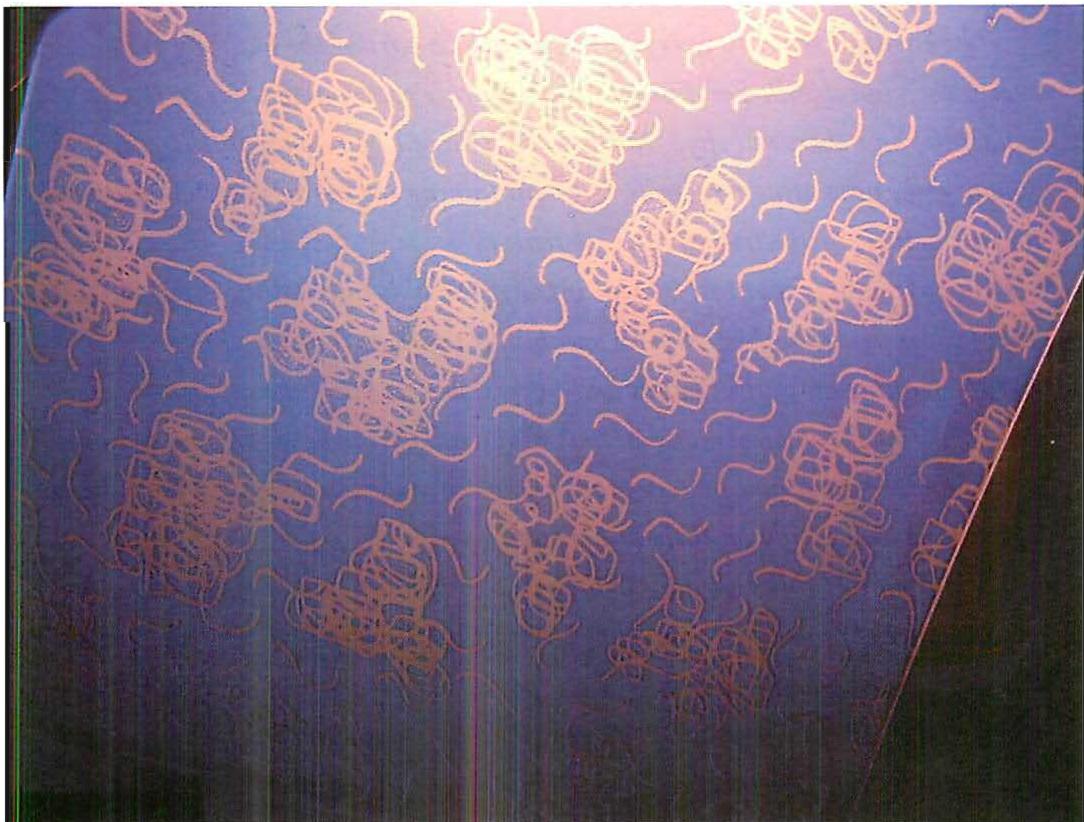
Once again, in this example something which would have taken months or years of painstaking craftsmanship a thousand years ago, could be made cheaply, and almost in a
matter of hours — yet showing the hand-drawn quality and art which would have seemed impossible in the earlier industrial age of the 20th century.
11 / EXTENSION OF ULTRA-MODERN TECHNIQUES TO ALL FORMS OF INNOVATION AND CONSTRUCTION
I hope the examples of this chapter make it clear how, in our second modern era, even the most intricate adaptations that can be conceived in a building, and at scales of speed, size, number and intricacy which stagger the imagination, become possible through a combination of computer techniques, unusual technology that is linked to the computer, and forms of management which break projects up in unfamiliar ways.
The essential issue, in every case, is that each part of the building is able to receive the same detailed and intimate artistic care that was possible in the era of handcraft, and that, as before, this is to be achieved by human intelligence and human skill, now using new tools, but maintaining the subtlety, detail, and care of great artistic production in the 14th century.
What is new is that this human intelligence and craft-agility is to enter the world of construction through very unfamiliar methods. The use of hours of time and the reliance on skillful hands and fingers may in future be supplemented by ways of acting on physical material that allow each part to be given soul, or being, in its fabric—ways and processes that allow the maker to infuse the parts with soul, even while acting on them at a distance.
The essence of this procedure will lie in a combination of (1) very high speed fabrication techniques; (2) control of these techniques through computer screens that are under human control; (3) the possibility of mockups and adaptation where the craftsman interacts with the place and with the emerging building while also having control over fabrication through the kinds of computer methods, relying on fitting and adaptation of every part; and (4) immense speed and efficiency in the operation so that the artist or craftsman manages to control very large areas in extremely short periods of time, making production of massive volumes of material possible at low budget and in short periods of time.
We may say, when contemplating such entirely new procedures, that we human beings will have achieved, then, the structure-preserving unfolding which is achieved by the beautiful flowers and grasses on a hillside. By then, we may have the capacity, truly, to act as nature does.
The next (and last) two chapters continue to emphasize discussion of certain geometric aspects of living structure which lie beyond pure function. These chapters talk about the final elaborations of structure, as a matter that inheres in form itself. They deal with wholeness and its creation from the fundamental process in the purest form.
Chapter 18, ORNAMENT AS A PART OF ALL UNFOLDING, shows how ornament—too often considered (or allowed to be) arbitrary—is the natural and necessary way in which fine structure unfolds to its smallest detail, and how the structure of the ornament that is created completes a living structure.
In chapter 19, COLOR WHICH UNFOLDS FROM THE CONFIGURATION, we see how in a fully and properly unfolded world—each point, each space, each building—will inevitably be suffused with light and color, and that this is not an arbitrary decoration, but a necessary end product of the full and most subtle unfolding.
CHAPTER EIGHTEEN: HOW LIVING PROCESS INEVITABLY GENERATES ORNAMENT AS PART OF ALL UNFOLDING
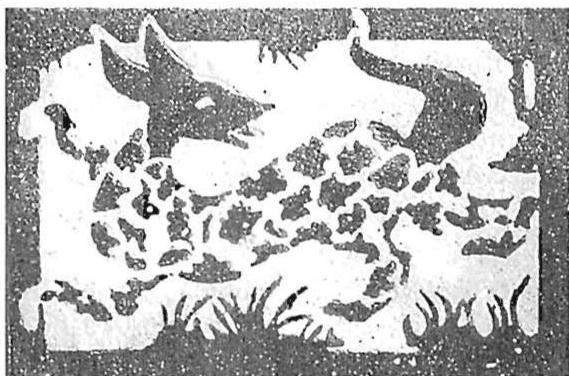
1 / ORNAMENTS AS PRODUCTS OF UNFOLDING
Ornament arises, naturally, when a person is making something and seeks to embellish this "something" while making it. The embellishing is spontaneous. It comes from the continued unfolding of the whole, going naturally from the broad wholeness of the thing to the microstructure where the chisel, hand, brush, and trowel make patterns in the thing, in order to continue and extend its wholeness. Most concretely, it arises as a result of the latent centers in the uncompleted thing requiring still more centers, requiring still more structure, in order to be complete. That requirement, when followed faithfully, creates ornament that grows from the whole.
This is a natural process, whenever the thing is being MADE. But if a building is "produced"—not made—in a technically divided situation where making is severed from design, the process of ornamentation cannot occur naturally. There, when an architect tries to draw the ornament or specify the ornament "within" the technical process, what happens becomes awkward, stilted, too stiff, not fundamental—and also not profound—because it does not arise from the joy of the making process itself. It cannot be profound because the maker is not reacting to the whole in its state as an unfinished thing, which may then be completed by the ornament. For the ornament to be profound, the
motifs and disposition of the ornament must arise, naturally, from latent centers which are felt within the uncompleted thing.
Since (in any living process created by repeated application of the fundamental process) we understand that the creation of a building is in every case the creation of a system of centers which emerges naturally from the field which surrounds it, this understanding of the task of embellishment no longer distinguishes between "function" and "ornament."
The task of building is to produce a field of centers which makes itself complete. This gives us a clear and sensible way of understanding ornament precisely, one which tells us exactly what to do. At a certain stage in the making of the building we have produced a field of centers there. But the field still contains rough spots. It is not perfectly resolved. Some parts are not intense enough; the centers are not distributed to produce the most perfect field. At this stage, some additional "smaller" structure is necessary.
The so-called "ornament" is simply this smaller stuff. It is the stuff we have to create at this last stage, to complete and perfect the field of centers. Thus it is not something extra or extraneous; it is a continuation of the same process we have followed in creating the field up to this point. It is necessary in order to complete the field.
2 / ORNAMENT AS DETAIL WHICH EMERGES DIRECTLY FROM THE PROCESS OF MAKING
In a living process, the generation of ornament in the building goes hand in hand with its construction. It is simply the detail that forms as a result of a process which is constantly trying to refine the centers which are there.
In 20th-century architecture and construction, ornament—perhaps for the first time—
became something separate, something applied, which came after the main job of design was finished. Of course artists and writers have often said that "good" ornament is somehow organically related to the building; that in the best cases the motifs arise naturally from the material and circumstances of the design. But in spite of this
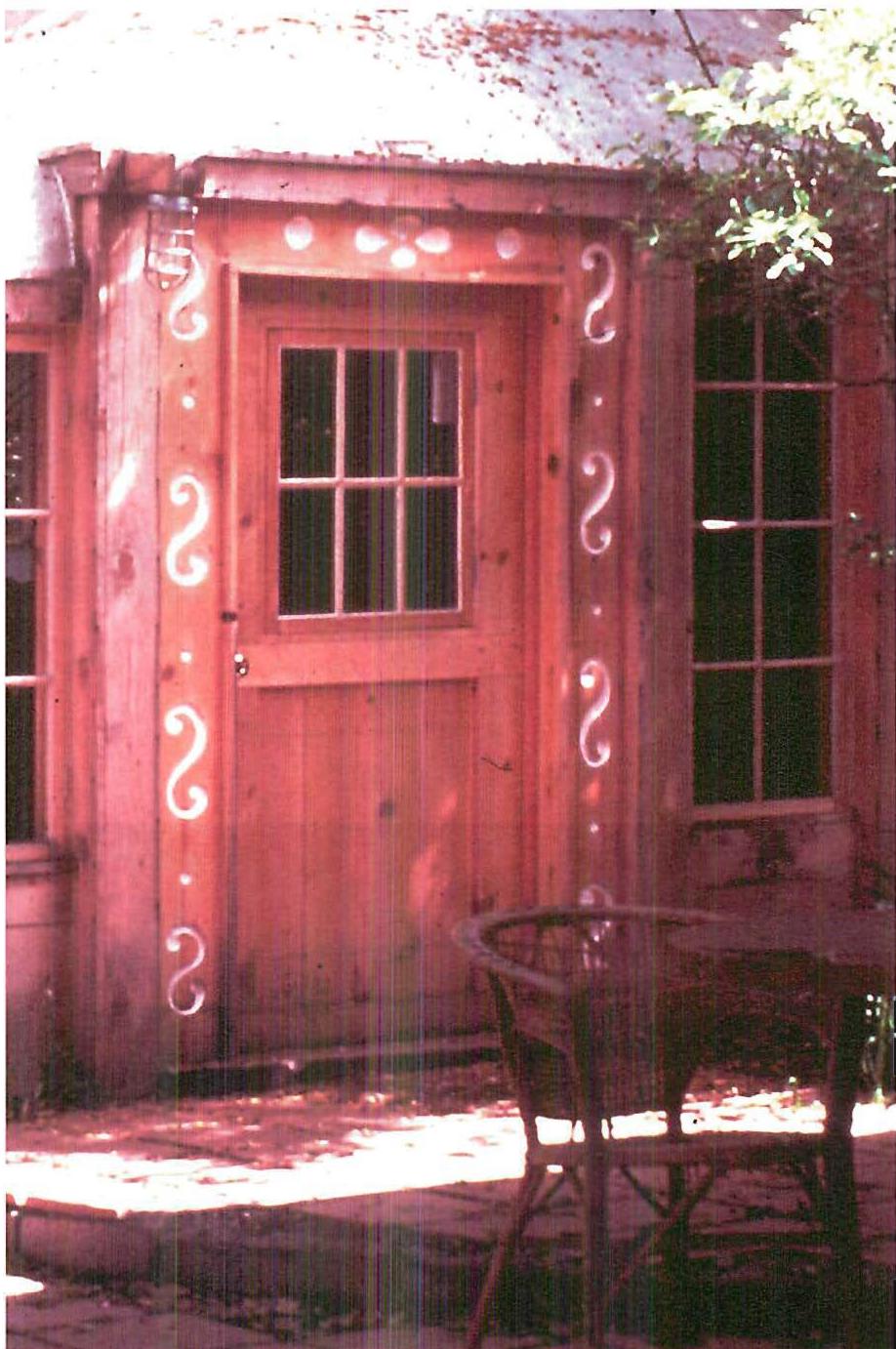
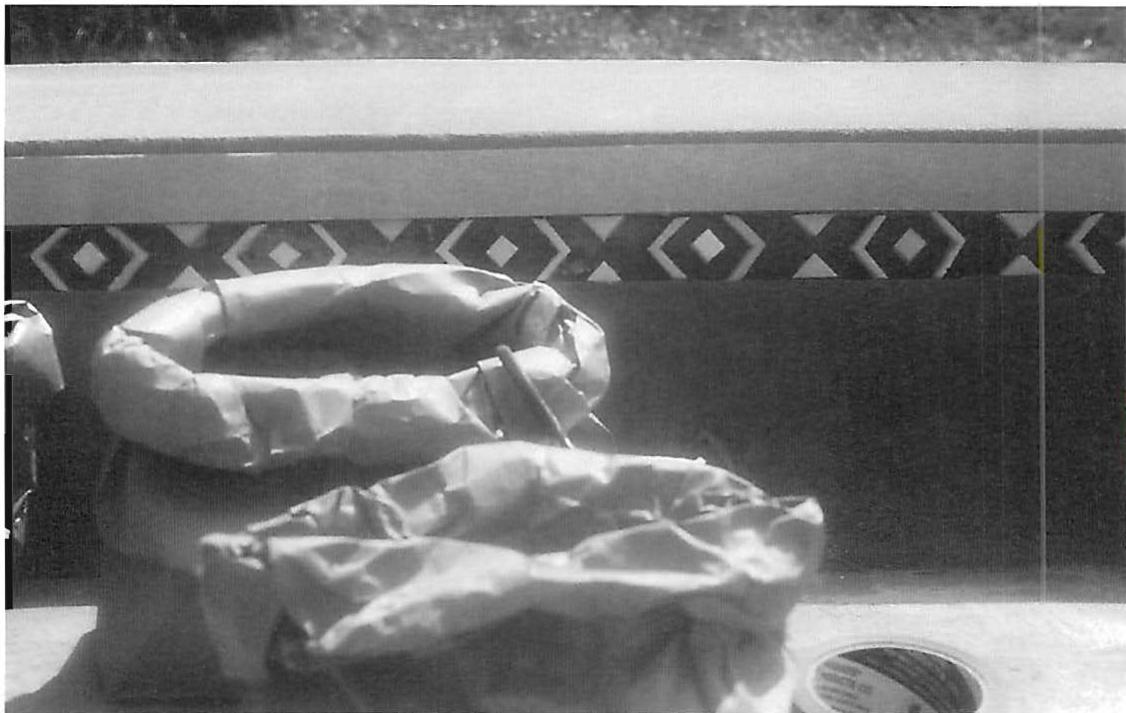
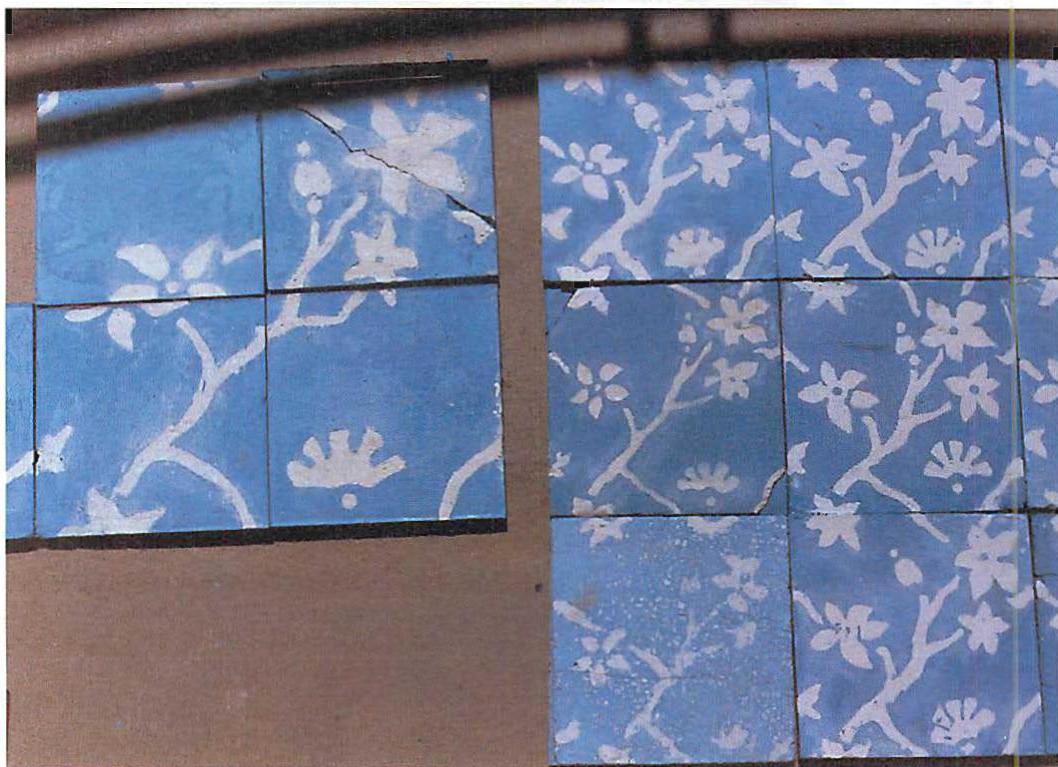
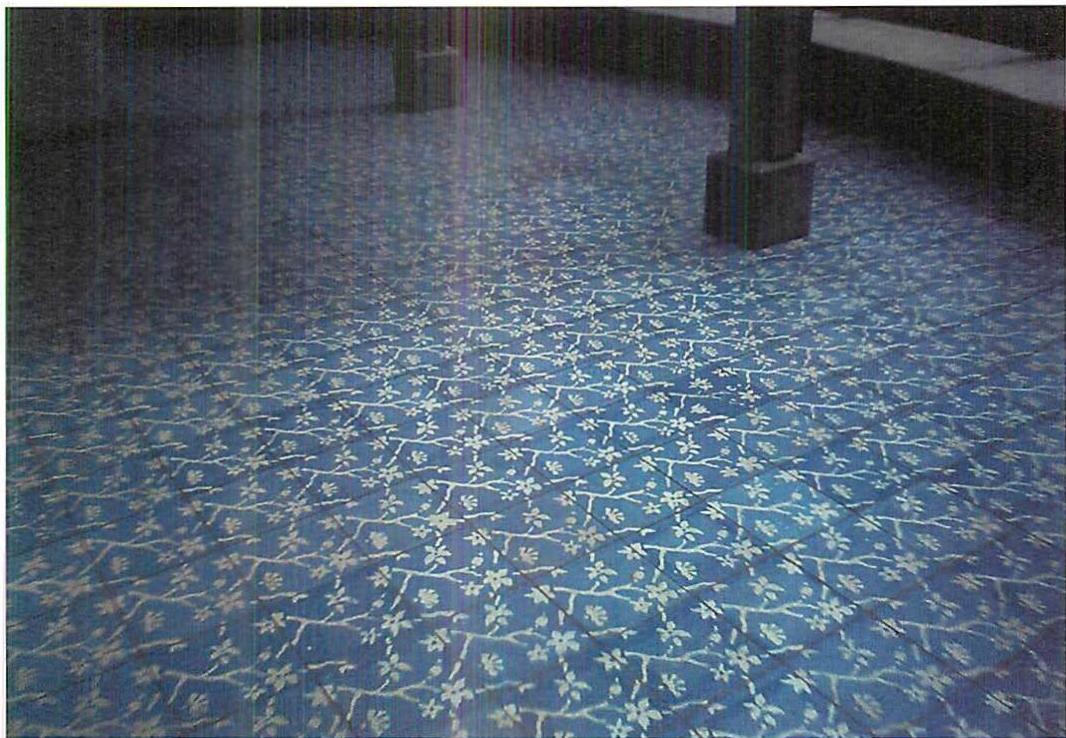
theoretical philosophy, in practice, the ornament of the 20th century was most often separate, prefabricated, and applied—because, within the framework of 20th-century thought about architecture, it was never clear theoretically, how ornament should, or could, be part and parcel of the design and construction process itself.
That is because within the drastic separation of design and construction that was current in the 20th century, the very process of ornamentation was upset.
The architect, being the designer, is supposed to specify every aspect of the made thing, the building. The builder—that is, the contractor—is supposed to do what is on the drawings which have been specified by contract and by working drawings. The contractor is therefore not free to undertake this kind of embellishment—and besides, it doesn’t arise naturally in
relationship to money, either. The contractor gets no extra for doing it; indeed, he would be in violation of the contract, often, if he did do it. In addition, because of the effects of the machine age, it is quite likely that the technicians and builders in a construction company have lost all natural sensibility that would allow them to make graceful, profound, ornament.
The machine-age architect, on the other hand, who may have the intuitive ability, or the desire to make beautiful ornament, is often too removed, has no connection with the tools, materials, or actual processes, so the natural ornament does not flow naturally from his hands. For such an architect, the very circumstances of his existence dictate separation, so that ornament almost cannot be made to flow naturally from the centers which exist in the plan, the rooms, the walls of the emerging larger structure.
3 / BLACK-AND-WHITE MARBLE FLOORS AND SURFACES
I now begin to describe a series of experiments from the 1970s onward, to invent ways of making which would allow ornament to appear in a building as an integral part of the making process.
A first example. In 1980 I spent a few hours in Florence, and was astonished by the intense beauty of the very simple black and white marble floors in the Baptistery, in San Miniato, and in other churches. These floors, laid by opus sectile work, small chips of black and white marble, shaped and close packed together to make the floor, achieved a depth and simplicity quite out of proportion with the difficulty involved. They stayed in my mind and when I came back to Berkeley, I decided that it must be very simple to find some modern way of producing a similar kind of ornament. We began a series of experiments in our yard.
Since I was already doing all kinds of experimental concrete work, I decided that some form of colored concrete would be a suitable way of doing it . . . and I soon found that ordinary terrazzo — a mixture of colored cement and marble dust and fine marble chips — could give us the material we needed. This material is laid wet, then ground to a first finish about twenty-four to forty-eight hours after it is laid, while still green, and then finally polished with a high-speed sander a few days later. This first experiment became the forerunner of a series of floors and marble surfaces we later made in projects all over the world.
The question was how to get the pattern to be beautiful without creating enormous labor cost. I did not want to produce something which was inherently so expensive that it could only be a luxury. My goal, from the outset,
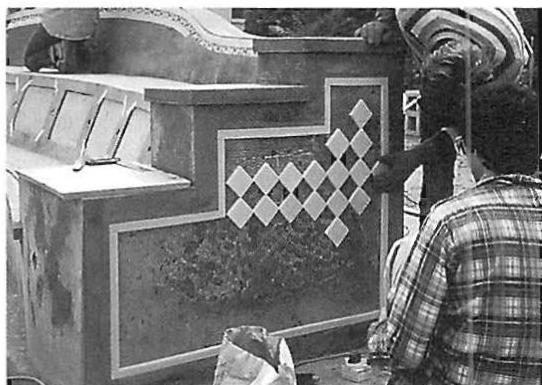
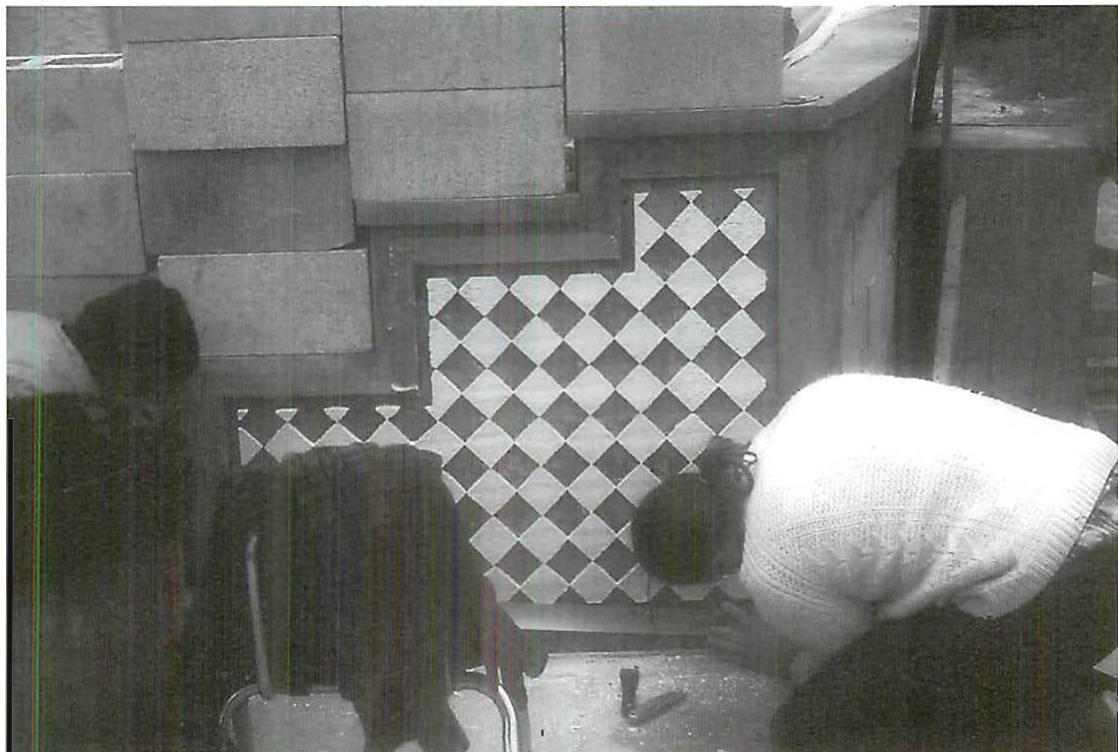
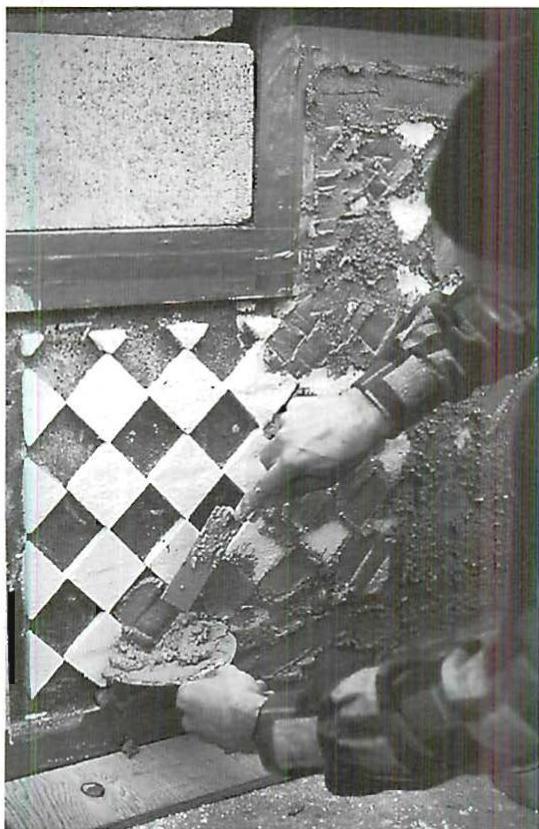
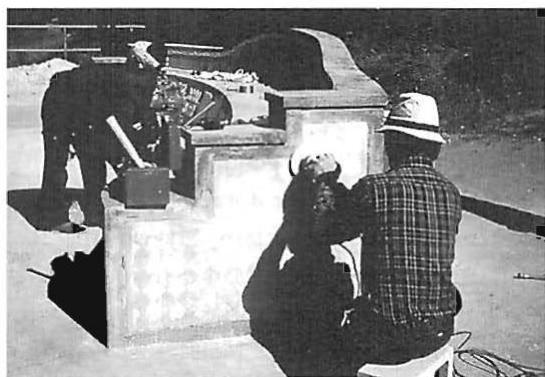
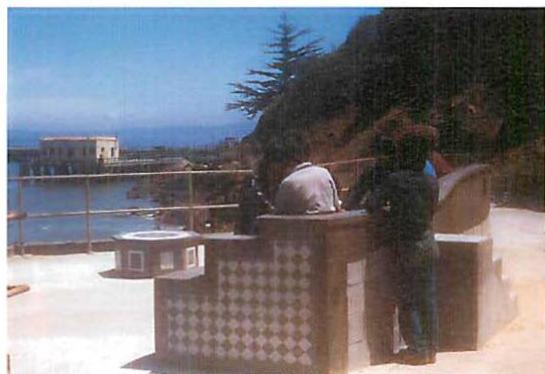
was to produce a kind of floor which would be reasonable in price, so that we could build floors of this kind easily in different buildings and yet provide a process which can allow the kind of personal feeling which is inherent in this kind of work.
In our first experiment, we began by making a simple brass mold that would allow us to fill first the black material by using half the cells of the mold, and then, after this had set twenty-four hours later, to fill the remaining space with white material, then grind the two together and polish the result.
The first result was good, but tearing at the edges as one pulled the form off the half-set terrazzo disturbed the pattern. My fears that the result would be too mechanical were allayed. We then built a larger mold of the same type, with a very complex negative "spider" that kept the material pressed down while the mold was lifted
up. This mold allowed us to make a larger area of the same design, which you can see in the upper photograph on page 586.
However, the needs of the material are much more fluid. In order to follow the centering process, it is necessary to have extreme liberty in creating new designs that are just right for the place they go into. In a second experiment, the design of the upper step (again page 586), we first played with black-and-white paper to find the right design, and then used an entirely different technique to make the physical thing. We left a narrow chase in the concrete. Then, inside the chase we made the white part of the design in thin styrofoam, leaving gaps for the black. The styrofoam was glued down on the concrete step. Then we filled the black terrazzo around the styrofoam. Then, after twenty-four hours, we burnt out the styrofoam with a torch, and then back-filled with the white terrazzo,
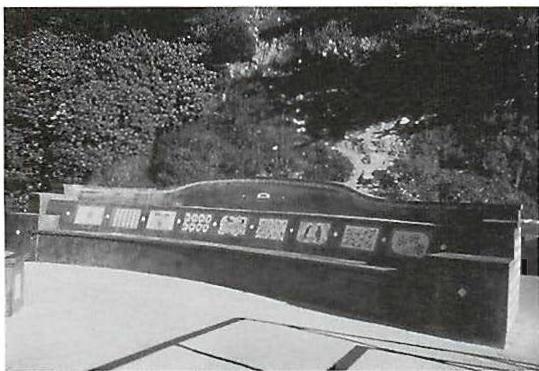
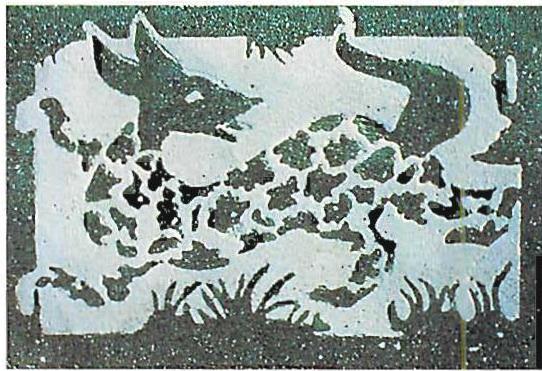
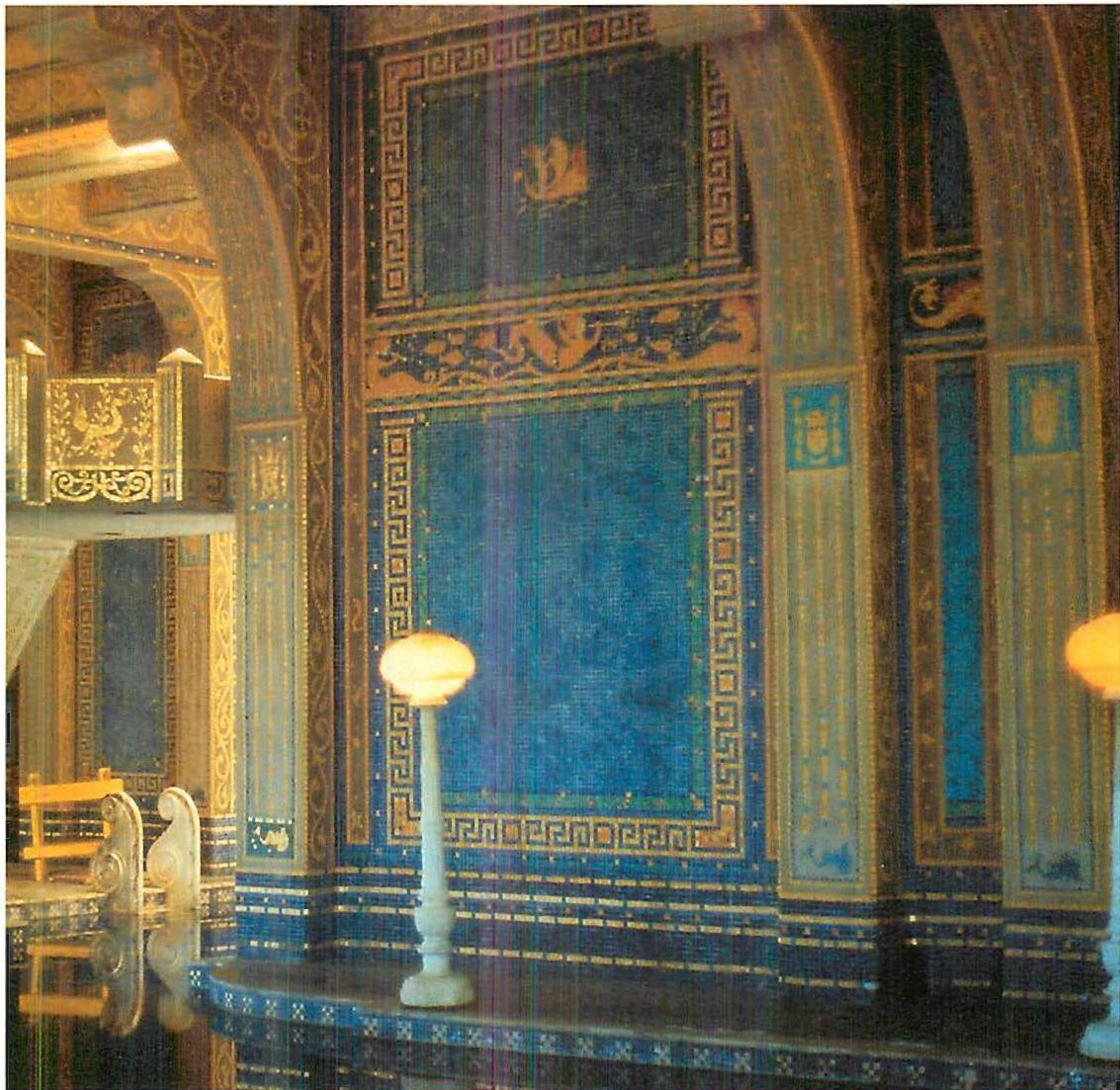
twenty-four hours later ground it off, later polished and sealed the surface with a shiny sealer.
The new technique is far better than the old. Even though the first experiment had a roughness which is not really mechanical, it was still impersonal and mechanical when you compared it with the second, smaller design on the upper step, which does somehow reach a spiritual quality, because it is so personal. The styrofoam allows the exact shape which the personal vision of the place has in it, to be produced, to the
nearest millimeter, exactly as it is felt to be right—and it is this which brings the thing to life.
A neighborhood process of making a highly ornamented bench in San Francisco has been described in chapter 11 (pages 352–59). On that bench I used the same technique, in more complex fashion, to make geometrical ornament with animals and birds, all in green and white. The ornamenting part of the process is shown on pages 586–88.
4 / MAKING A COLORED, ORNAMENTED, FLOOR
How does ornament unfold from the situation where it occurs?
Let us consider an example, in depth, to see how the process of getting the ornament from the space works in detail by structure-preserving transformations. The terrazzo floor we made for the main room of the Martinez building shows the extraordinary subtlety of the relationship between ornament and color and geometry. The room is about 16 feet by 24 feet.
This floor was laid at a time when the building was complete, and closed in, and we were working on the raw slab of the main room of the building. At the very outset, I "saw," in my mind's eye, that some kind of red and yellow were called for by the building. This feeling originated as a response to the blue-green of the outside, and to the bright white plastered walls inside (see text on page 616). The red and yellow formed light with the blue-green and the white.
As far as pattern goes, my original instinct was for a rather simple checkered pattern; I had a vague idea that big squares would alternate with smaller elements. This again came as a response to the rectangular space, the whole, the positions and shapes of columns where they meet the floor. To find out what kind of pattern would be best for the building, we got hold of thirty or forty long, thin wooden lattice-strips (thin strips of wood, 15-20 feet long, half an inch by one-and-a-half inches). Laying these strips on the slab, to arrange and rearrange different repeating patterns, we could see which patterns arose naturally from the room, which made sense in the room, which were obviously at odds with the room, which ones seemed most subtly related to the room.
The point of what we were doing was, of course, to find which pattern was most structure-preserving to the room. Surprisingly, we found out quite fast that grids which were parallel to the room's walls did not fit well. No matter whether large or small, they had a jarring quality. Diagonal
patterns, on the other hand, seemed to work well (see diagrams on page 591). This surprising discovery, fine in that particular room, is obviously not a general rule. It is something that was true for that floor, in that building, with those windows, and those columns and fireplace.
Having established the diagonal nature of the pattern, we tried to find out what we could about further detail of the pattern. We found that alternation of squares and rectangles was better than a simple checkerboard. And we found that the pattern worked best when the squares were about 16-18" in dimension, and the rectangles were about 5-6" wide.
At this stage, we had a growing, and by now rather specific, idea of the kind of patterns which made sense in the feeling of the room.
Now it was time to identify the colors themselves. We began by painting swatches of color on pieces of paper to find out which color combinations felt most harmonious in that place. It was clear right away that red and yellow, by themselves, were too different from the blue exterior. Some blue was needed to bring the floor together with the outside.
We made a rather good middle red, a very pale yellow, and then tried two kinds of blue — a strong dark blue and a weak blue. The strong blue was the better of the two — more harmonious with the red and yellow. Then we began the crucial experiment to test color proportions. We laid the three colored papers (middle red, pale yellow, strong dark blue) on the floor of the room. Then we started sliding them over each other so that the amounts of each of the three colors which were exposed could vary in size. We kept on rearranging them, leaving different amounts of each color open until we found an arrangement for which the balance of the three colors was just right in the room.
The swatches we were working with were no more than a few inches across. Yet it is im-
portant to record the fact that each time we slightly changed the relative amounts of the three colors, the feeling of the whole, and the feeling of the room, changed completely.
After studying the different possibilities for a long while, it gradually became clear that there needed to be large amounts of red, almost as much but slightly less yellow, and very tiny amounts of blue. In the version we liked best, the exact proportions were these:
Middle red 57%
Very pale yellow 40%
Rather strong blue 3%
It may be useful to record a strange fact. When I first saw this beautiful color combination, I didn't have the nerve to do it. Eleni Coromvli, who was helping me, felt the same. These three colors in the room, in these combinations, had a sweetness that was almost overwhelming. We felt it might be too "dangerous," too "sweet." Our lack of experience with colored floors made this one seem almost indecent. But gradually I realized that the only thing making it strange was the fact that we weren't used to having floors which were so beautiful.
In the end, it was obvious that if we did use these three colors, in these proportions, then the floor would have a freshness, and a beauty, which would delight our eyes every single day—not just be nice or well designed, but a constant source of inspiration, something to draw life from every single time you looked at it.
We tried more subdued and "normal" colors, but they never had any of the wonderful freshness and spring-like quality which this one combination had. So we decided to go ahead. At this stage, we had the color quality of the floor quite clear. The fact that the yellow, active among the 3 colors, was a rather pale almost primrose yellow, was the clue to the subdued but beautiful light the floor gives out. A "thicker," more clogged yellow would have ruined it.
Now we came to a major geometric problem. What kind of pattern could be invented which had three colors, in exactly these three proportions, and had a diagonal emphasis? It was not
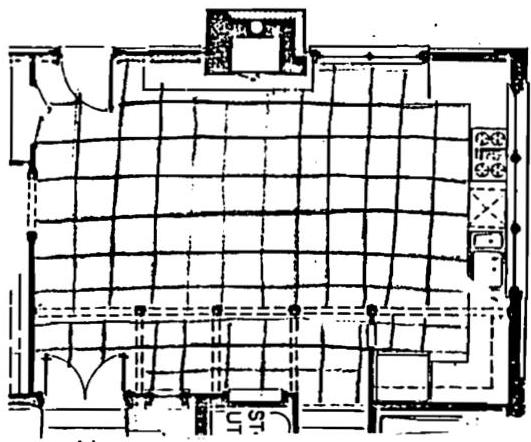
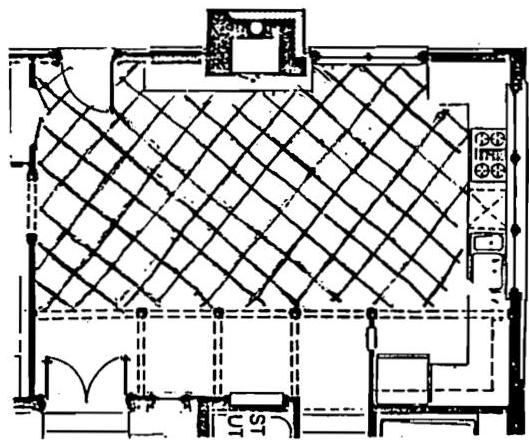
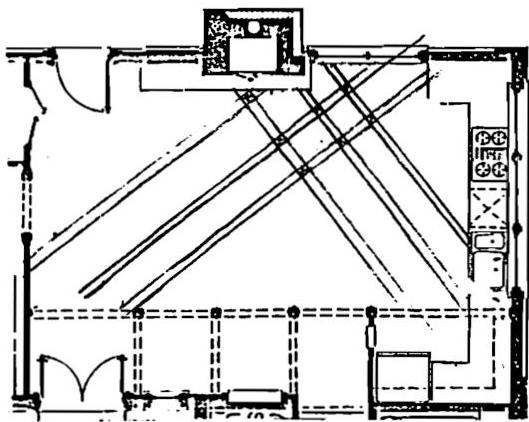
good enough to have a pattern which had roughly these proportions. My experience showed that once one had discovered something like this combination, it hinged on absolutely correct proportion; even minor changes would destroy the feeling. So I knew we had to find a pattern which followed this proportion with exactness, 57:40:3—not more, not less.
It is not very easy to find a three-color pattern, with these proportions among the three colors. Conventional checkerboard patterns don't have three colors in these proportions. Indeed there was no ready-made pattern that we could use. Instead, we had to invent one. More exactly, it could be said that we had to let the color proportions generate a suitable pattern. This again may be understood as a structure-preserving transformation. We had a bit of global
information; the proportions needed to be 57:40:3. Now we had to find a way of obtaining, from that structure, the structure of a repeating diagonal pattern which could extend and enhance that global statistic among the colors.
We tried various possible patterns, some shown on this page. As you can see, only a relatively small number of different types with the exact proportions 57:40:3 can be created. Of the ones we found, it was not difficult to see which one was best in the room. This is shown below.
We then did a fine adjustment on the size of squares, first with sticks, and then by painting full-size mockups on paper and laying them on the floor. The exact size of the final pattern has a 17" square.
Next we began work on the construction itself. We found the correct combinations of pig-
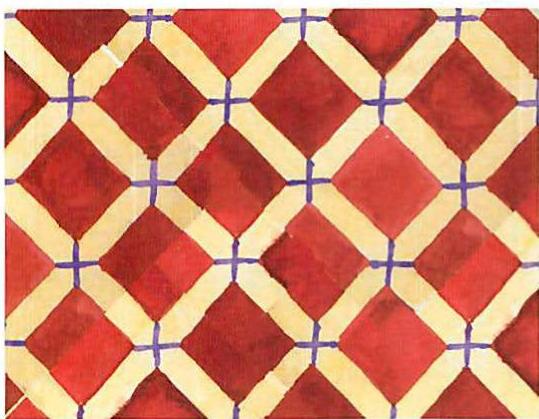
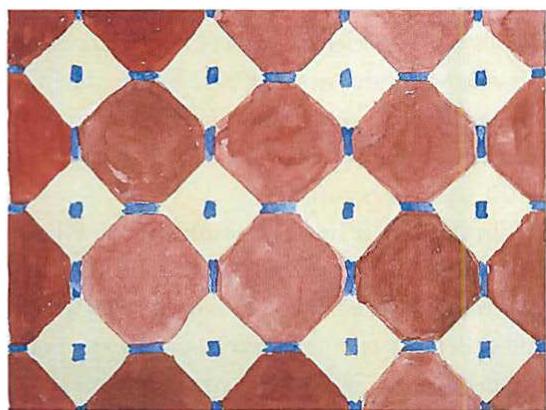
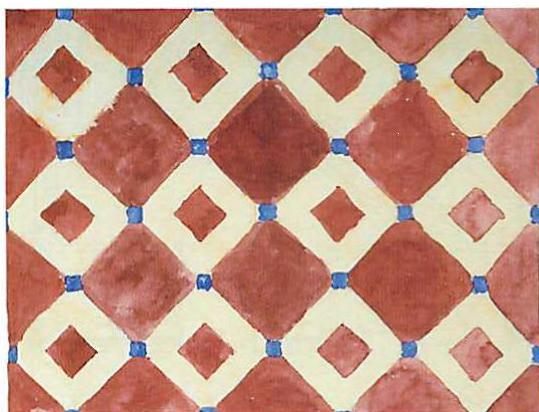
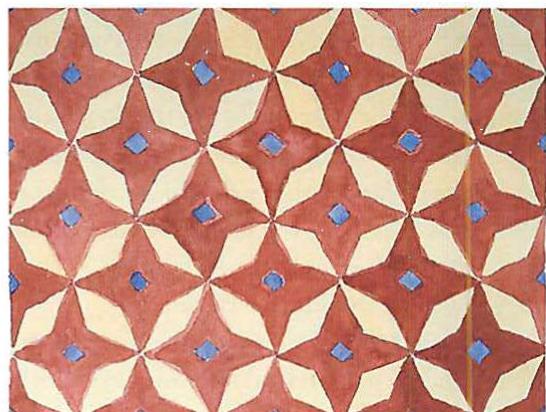
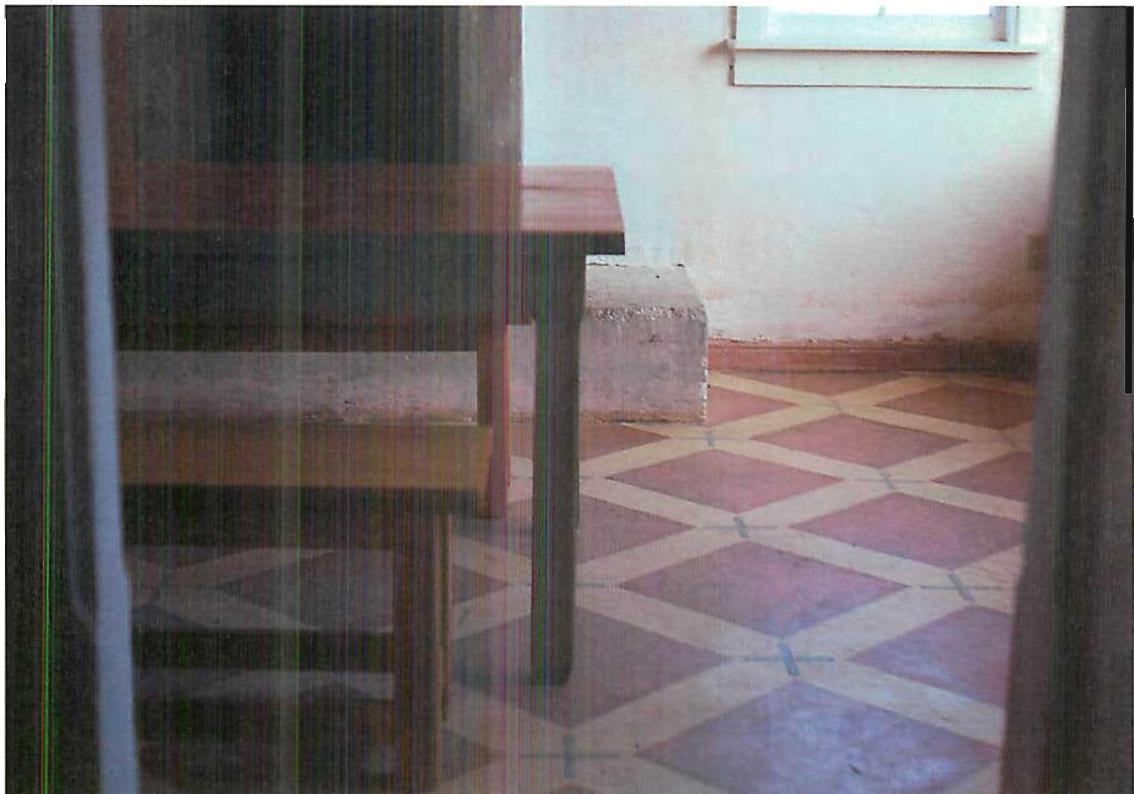
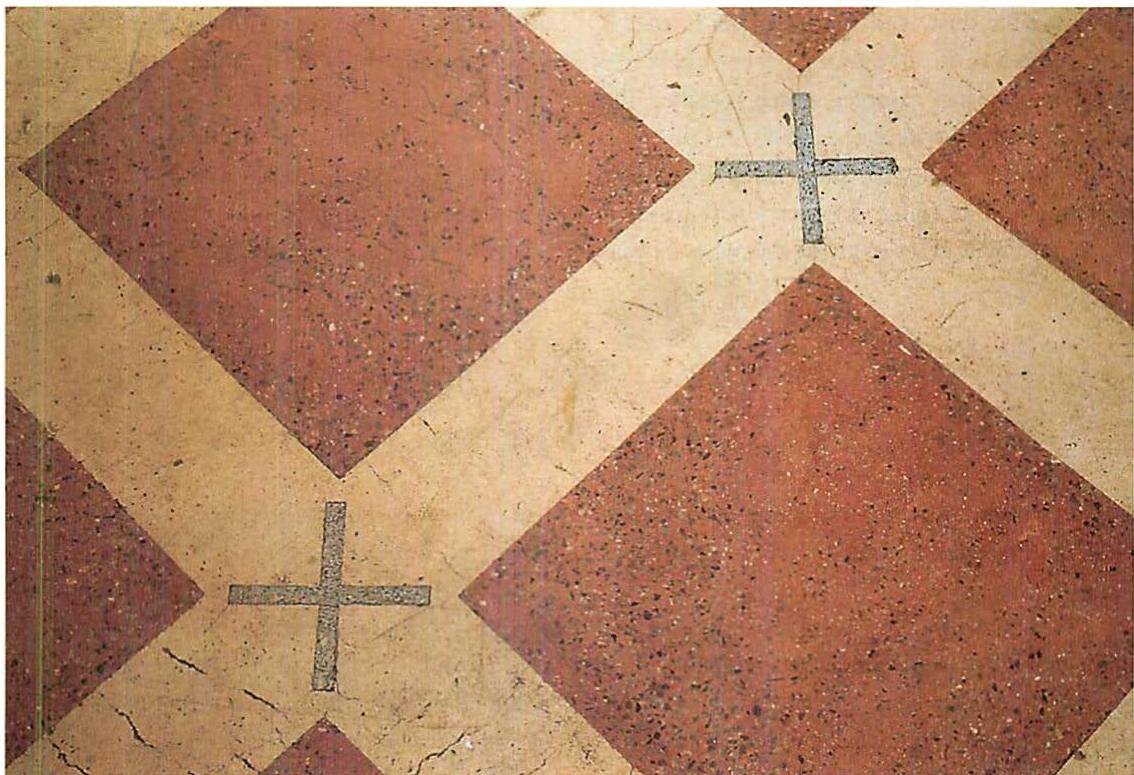
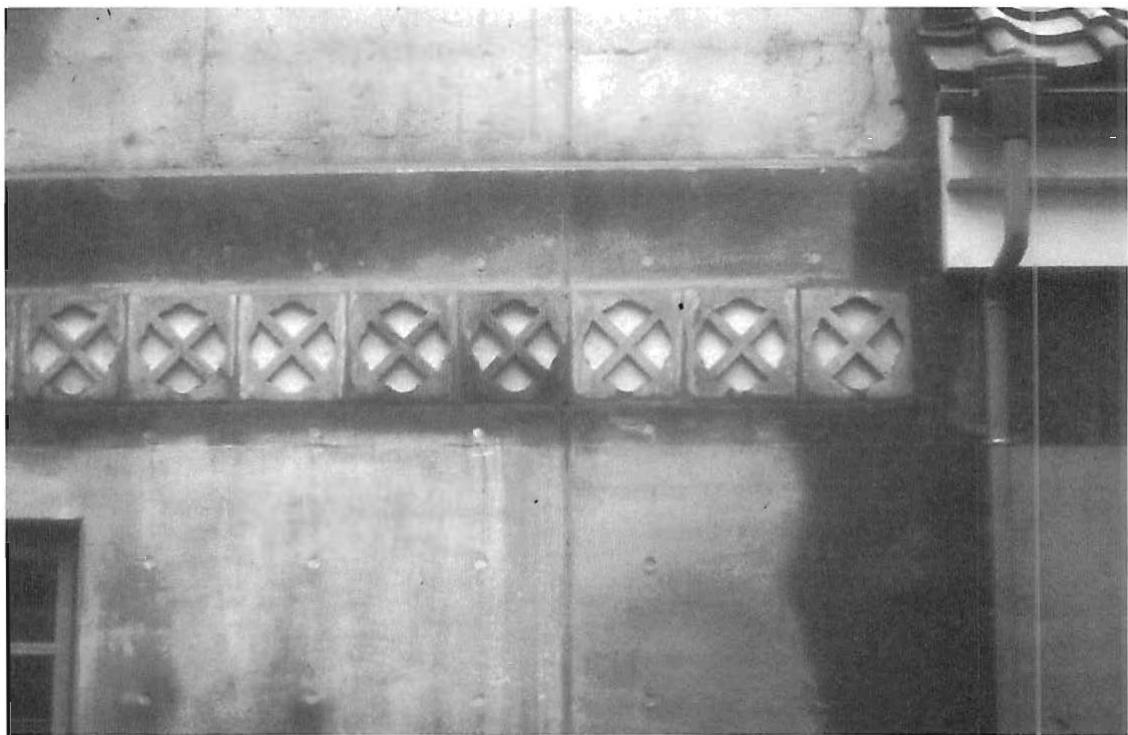
ment, marble dust, and marble chips to match the three colors on our painted paper samples — and when we had samples which matched the colors correctly, we went ahead and laid the floor.
In this example, the color and geometry are inseparable. The rough geometry first inspired the color. Then, exact study of the color showed
us a set of crucial proportions which had to be maintained for inner light, and these proportions directly generated the pattern.
We see how the design of the floor, the color, and the geometry all arose as a result of the structure-enhancing transformations in the place where the floor was to be built.
5 / OTHER KINDS OF ORNAMENT
The ornamental structure most often comes from the material, and from the way a thing is being made.
In the floors for the Sweet Potatoes clothing factory, I made a series of designs, all out of pine boards that could be cut and fitted with a chop-saw. The only precondition for this series of ornaments was that the client could accept minor inaccuracies in the way the boards met. If they
had to meet perfectly, the process would be very expensive, both in the cutting and fitting — virtually prohibitive. But by getting the clients to agree that minor cracks might occur between the boards and then be filled with beeswax, the range of different floors and designs that could be made was quick and easy — and charming.
The cast concrete ornaments on the classroom buildings of the Eishin campus (above)
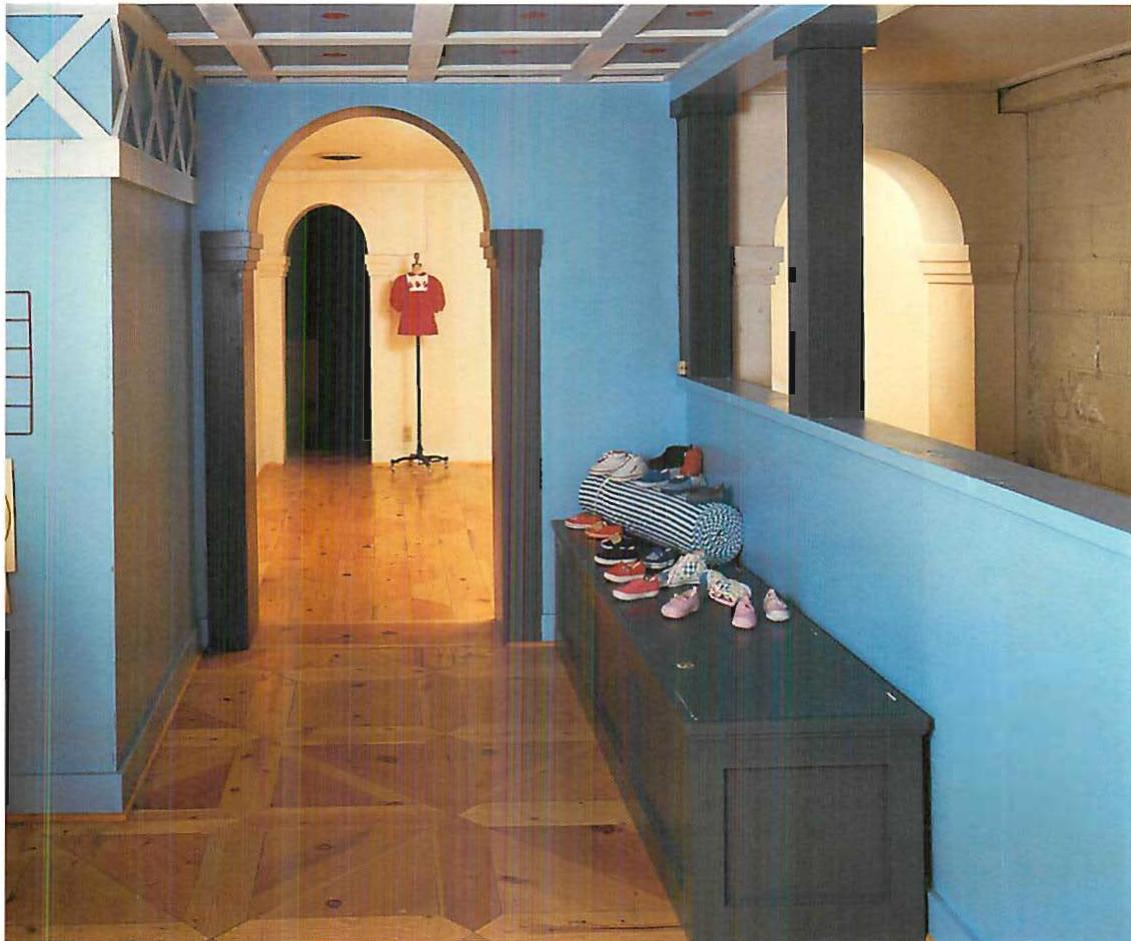
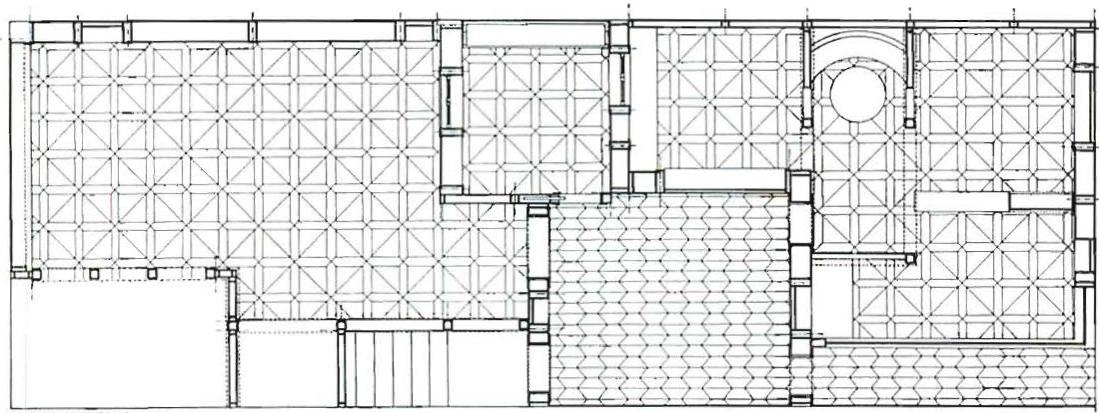
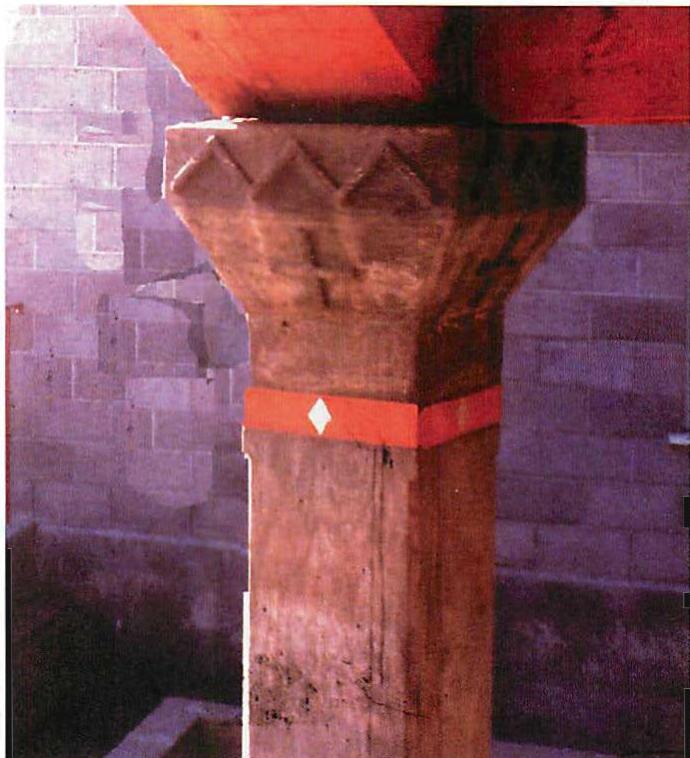
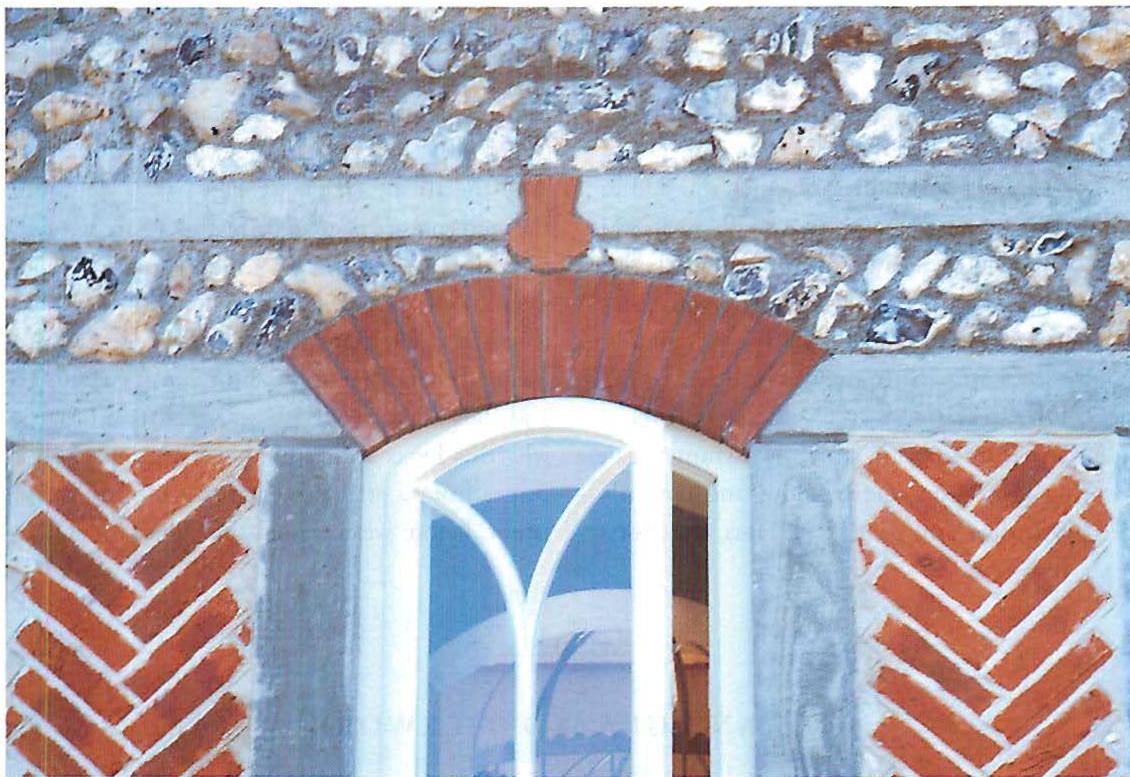
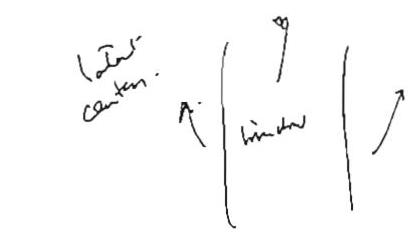
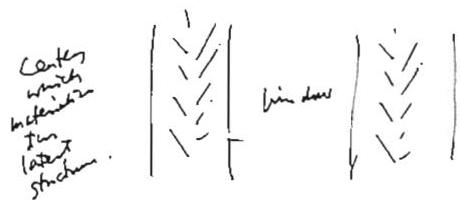
have a similar quality. We made molds for a small segment of ornament and then inserted these pre-cast molded concrete blocks into a
chase left in the main poured concrete wall. It was not expensive because, again, the technical perfection was left rather free-and-easy.
In a third example, an ornamental panel I put on the exterior walls of the Martinez house, I cut a simple piece of plywood as a form for the curved end and then used this, in combination with a straight board, and a fine nozzle on the gunite gun to make the ornaments. What I did was to shoot a half-inch layer of fine concrete in the area above the form-board, making an ornament which stands out proud from the surface by about half an inch. All in all, to make eight of them on eight walls of the house took only about half an hour. Cheap and elegant, easy to do — and fun!
In the north wall of the West Dean building we see many ornamental methods. The entire way the building materials are used is ornamental. Bricks, flints, cast-concrete columns, a brick arch, a specially cut ornamental thistle-shape cut from soft brick material, and bands of stone.
This was done very much by trial and error: we laid it up dry, as we went, to see what would complete the existing structure in the most harmonious way. However, it is worth paying attention to a couple of details. The brick was laid in a diagonal herringbone pattern. This is an old traditional method. But the fundamental idea that an ALTERNATING REPETITION of this kind is a natural way to embellish a flat rectangular panel comes straight from structure-preserving ideas. On either side of the window opening a latent structure appears which is asymmetrical, pointing away from the window, and upwards (see upper diagram, page 597). Thus, the morphological field which is there, before the bricks are laid, already points to a structure of this kind. The bricks just implement, embody, that structure. That is why they look harmonious. And the thistle shape we had cut to go above the arch (photo, page 597). That is an archetypal center, it has GOOD SHAPE, and many smaller STRONG CENTERS within its own perimeter. That is why it strengthens the arch shape, ties it into the horizontal bands of stone and concrete—and thus makes POSITIVE SPACE. Again, that is why this looks so harmonious there, because it comes from a structure that was already there, latent, before we invented this embodiment.
6 / HAND-GLAZED TILEWORK
Elsewhere (chapter 19) I have made it clear that color is an essential part of building. Paint, which is our modern way of making color, has a very short life. The very use of paint already implies that color is not being taken seriously.
If we put the amount of effort into color, which is required—days and days of concentration—to get the light to shine just right, it is discouraging and impractical to accept that the paint might have to be repainted after a few years. It would in any case be difficult or impossible to get exactly the same colors again. The very use of paint, too, somehow implies a short-lived building—once again, at odds
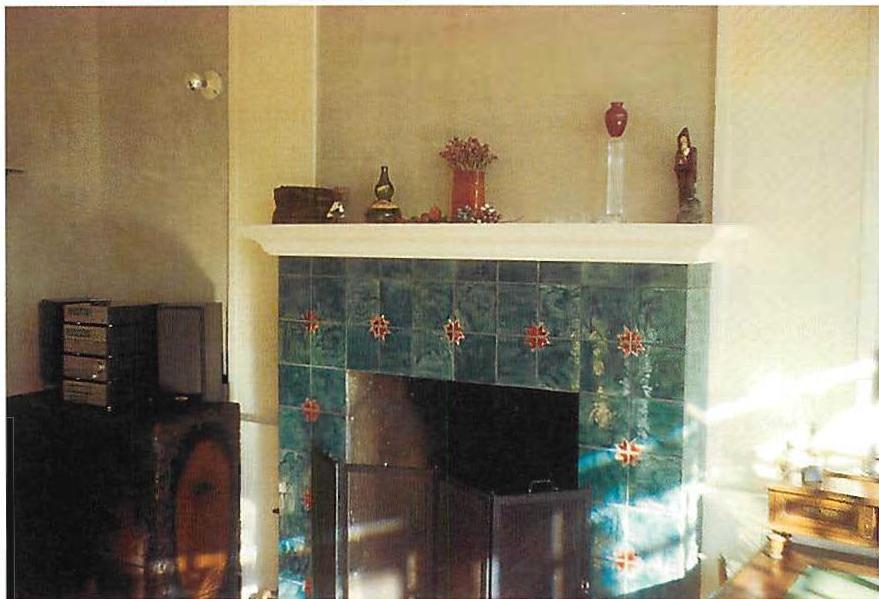
with the seriousness of intent that I have described.
So the question arises, How can color in a building be given a lifetime of centuries? The use of marble dust, which I have described already, is one way. Gouache, mixed with egg and worked into plaster, is another. The most obvious, and the longest lasting, is tilework.
How can we get the necessary tiles? Modern, mass-produced commercial tiles are often almost obscene. Also, their modular and standard commercial colors and patterns are in most cases at odds with the possibility of creating a field of centers.
Even at the level of ornament, the field of centers is very sensitive, both to variations in color and to variations in shape. It is necessary, therefore, to have direct control over the tiles, and for this reason, to paint and glaze the tiles by hand.
For myself, I have found, at least for the moment, that it is not necessary to make the tiles themselves. I buy unglazed blank tiles, which are already bisque-fired, and glaze them in my own workshop. But the color work is very complex. We have two test kilns, tiny kilns, in which we can fire one tile at a time, and one large production kiln, where we can fire as many as 80 tiles.
It may take five or ten experiments to produce a new tile. First the design doesn't work right. Then the colors aren't right. Sometimes an old glaze color is no longer available. Then, once we have the tile in production, it is still necessary to make variations for the center of the work and for the borders. As the tiles are laid, it is easy to see how simple variations will intensify the center and the edge, or how an occasional, slightly different tile, inserted into an array of similar ones, will give it life.
All this can be done, as needed, in our own workshop. We find that we can produce beautiful handmade tiles for about $4 each—the same price as ordinary mechanical tiles imported from Mexico or Portugal.
In tilework, the most beautiful patterns often come about because of repetition. Here we see alternating repetition come to life in the most wonderful way. First, I make sketches of an endless repeat with color. Once it seems promising, the question arises, How can this endless repeat be created by repetitions of a simple tile?
The individual tile which creates some of the most beautiful repetitions is often very surprising and not like the actual pattern at all. For example, the individual tiles which produce the patterns on pages 599 and 600 are very surprising.
In order to study the individual tiles as I produce them, I have invented a little box with four mirrors. When you put the tile in the box, the mirrors reflect it endlessly, like a kaleidoscope, and you see the pattern for the first time. I wonder if the old tile makers in Persia had something like this.
The biggest difficulty in making the field of centers in tilework lies in the colors. Raw glazes, when you apply them, are quite different from the finished glaze. You can't see what you are doing while you do it, and therefore can't correct and improve immediately as the process of making the field of centers requires.
To make up for this problem, I put a finished tile which is not yet quite right in my mirror box. Then I paint on it in gouache, trying different modifications of color, on top of the existing glazes. When they are wrong, I just wipe them off and keep trying till they come out right. This is fast, and doesn't take several hours of effort to get each new combination the way experiments with real glazes do. I use gouache colors that correspond to real glazes which I know how to produce. Then, when the color balance of the tile is right, I make another one with the real glazes.
This sounds simple. But it has powerful effects, which make it quite different from the normal process. It is almost like computerized truss design. The process lets you get to the right answer so much faster (by a factor of ten or even a hundred), that it becomes possible to probe more deeply and get much more profound results.
7 / MAKING LIFELIKE ANIMALS AND PLANTS IN THE FABRIC OF THE BUILDING
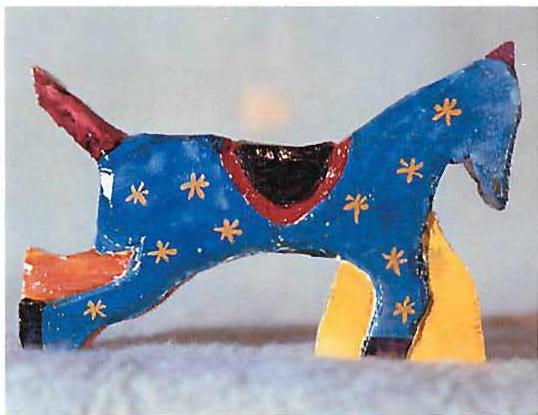
I want to go now, to a possibly surprising example: the process of drawing an animal or a plant, and its incorporation into a building. Such a thing may occur within a building—from time to time. That is immediately relevant. But what I have to say now, applies even to a case where the drawing is not part of a building.
When you begin to have a feeling for the unfolding process thoroughly, I think you may find—as I have done—that even the drawing of a single animal is an example of unfolding. The fundamental process has something to teach you, or to give you, even in the drawing of the space between a dog's legs, or the shape of the leaves of a lily, or in the shape of a human eye in a carved head, or in a human breast, or in a fold of cloth since each of these—the breast, cloth, eye, leg, leaf—are centers, and will be shaped most profoundly when you make them centers in their own right, and when you make the space between them centers, too.
The essence of the idea is this. If we want to make a lifelike animal, the usual idea is to draw it as accurately as possible, to try and copy from nature as exactly as you can.
But the strange thing is that making a lifelike bird, in a drawing, has nothing to do with copying exactly. To make a lifelike animal, in a
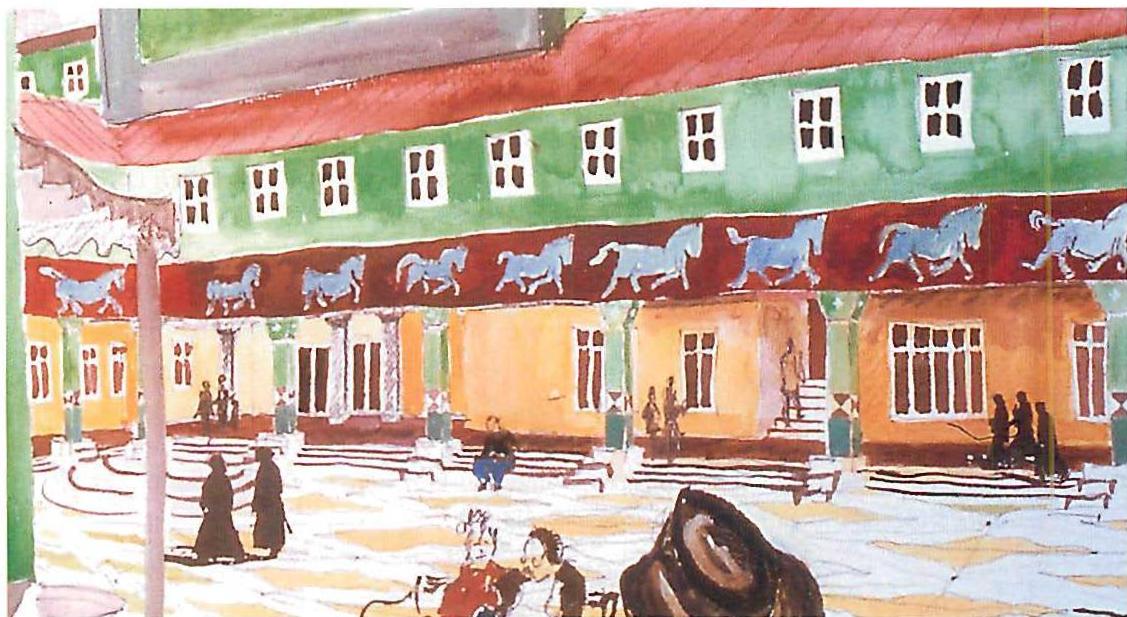
drawing or an ornament, we have to make the animal out of centers. If the centers are good centers, then the animal starts to get life. The greater life in the animal comes from the field of centers which is created there, not from copying or "realism."
This has a strange and paradoxical result. If when drawing a bird, I concentrate on the centers only, not so much on the bird, I may get a bird which is highly stylized, even abstract. Yet it is just this kind of stylized or abstract bird which can sometimes have the penetrating life we admire in works of art.
Look, for instance, at this bird I made for a frieze in a school building. I made it by trying to assemble the bird from bits of tile set in concrete. I cut, shaped, fired, the bits of clay, and I made the whole drawing of the bird work so that the
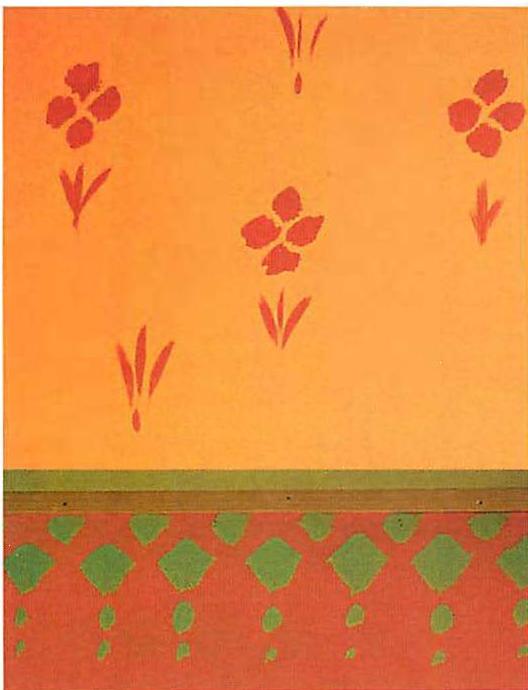
concrete surfaces between the bits of tile also had life, also existed as centers. As a whole the bird is completely unrealistic. It is what some people would call a stylized bird. But it is a bird which has at least touches of intense life, only because it was made by someone who was paying attention to centers.
Copying a real bird is invaluable, if it inspires an understanding of the deep centers from which its life is made. In that sense, being near a real animal is always inspiring. But then building a living structure out of centers is an entirely different process from simply trying to draw a realistic or naturalistic bird.
Thus even in this case, which seems so remote from the theory of centers or from the theory I have presented, it is the centers and the process of creating living centers which give life to the bird.
The real bird, the bird that flies in the sky, gets its life from the centers it is made of. The clay bird, made in tile, gets its life from its cen-
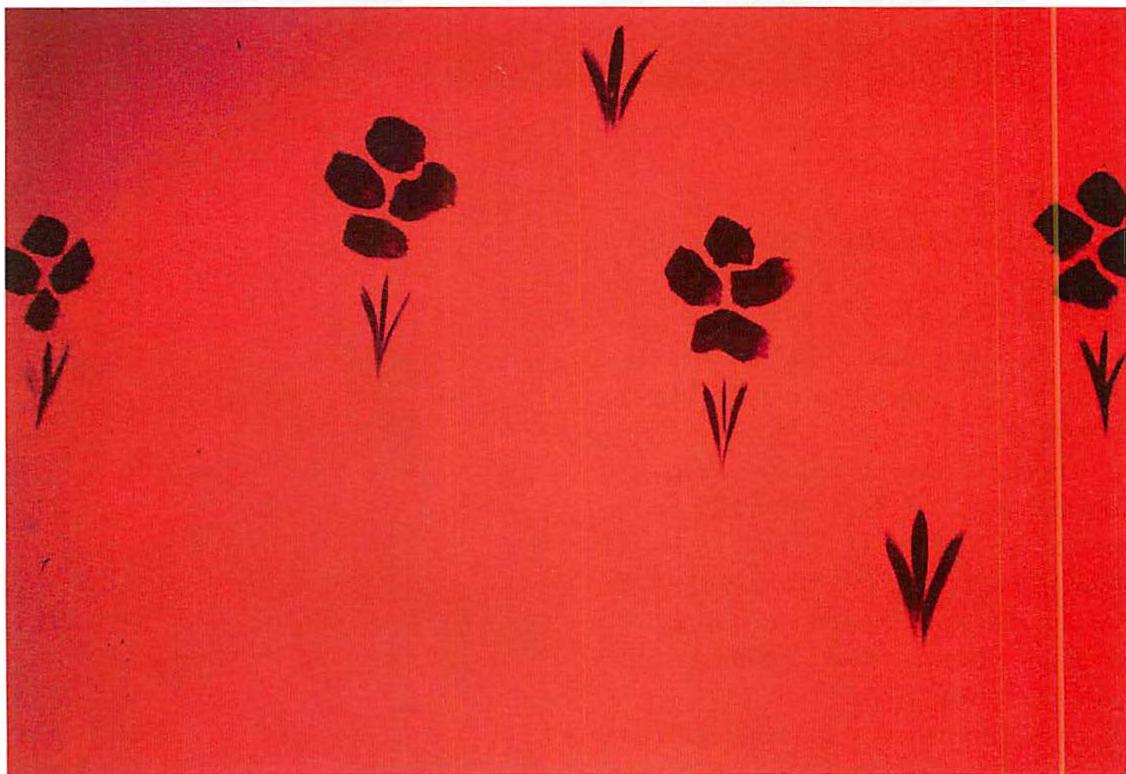
ters, too—not when it imitates the real bird, but when, like the real bird, it is a profound and intense field of centers in its own right.
In the history of art and architecture, the great periods almost always have something which we may call stylization in their animals
and figures—not naturalistic ones. The superrealistic animals and people we are used to as "normal" come mainly from the nineteenth century when a wrong-headed sophistication made people begin thinking that super-realistic drawings were somehow more true to life.
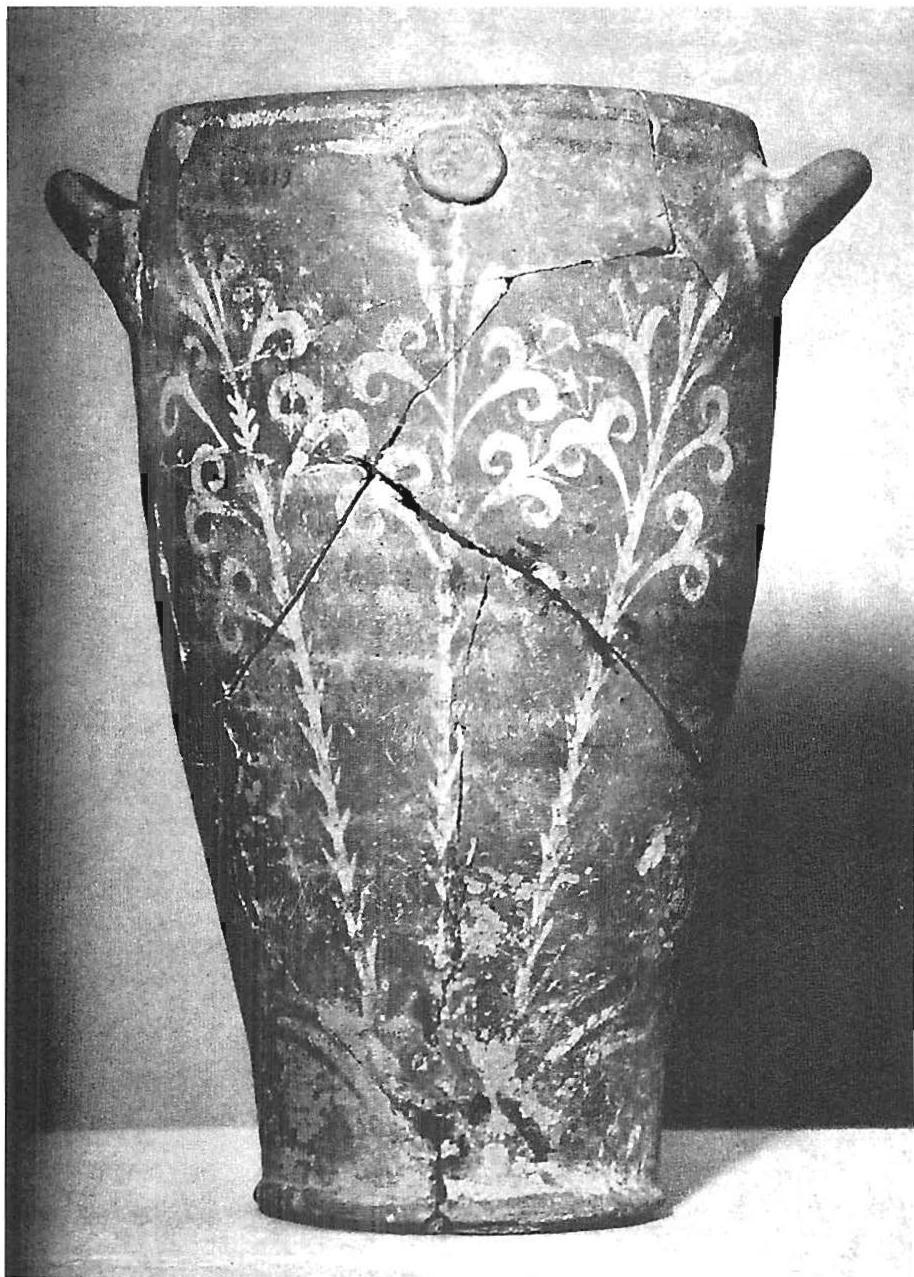
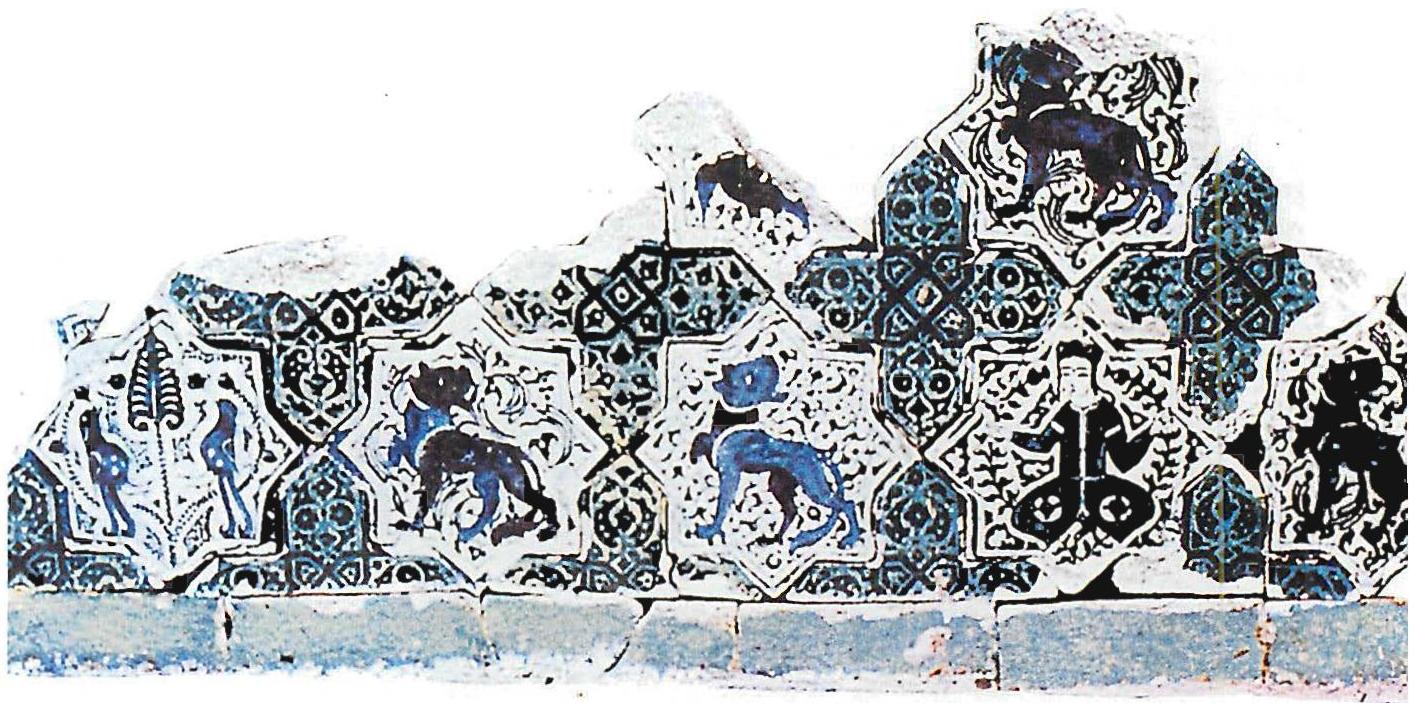
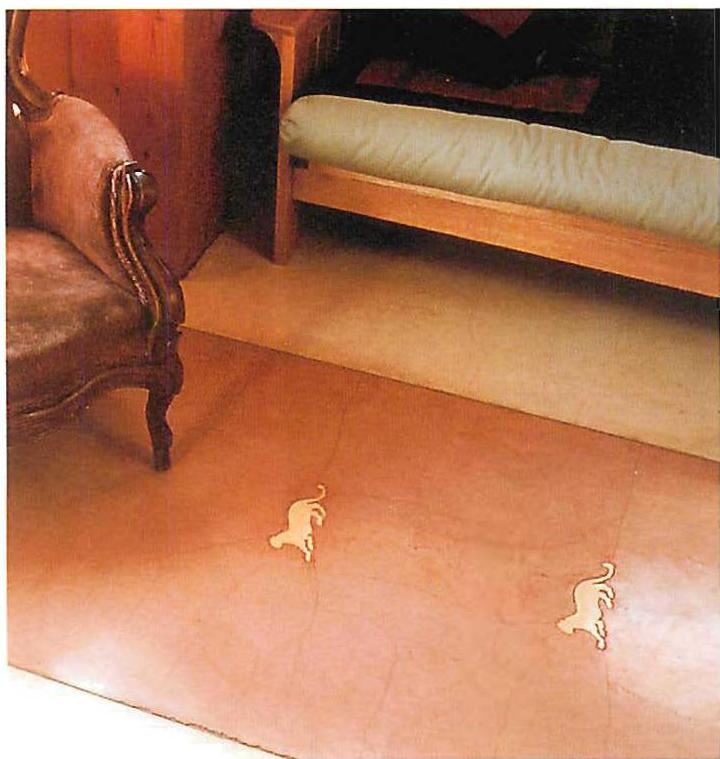
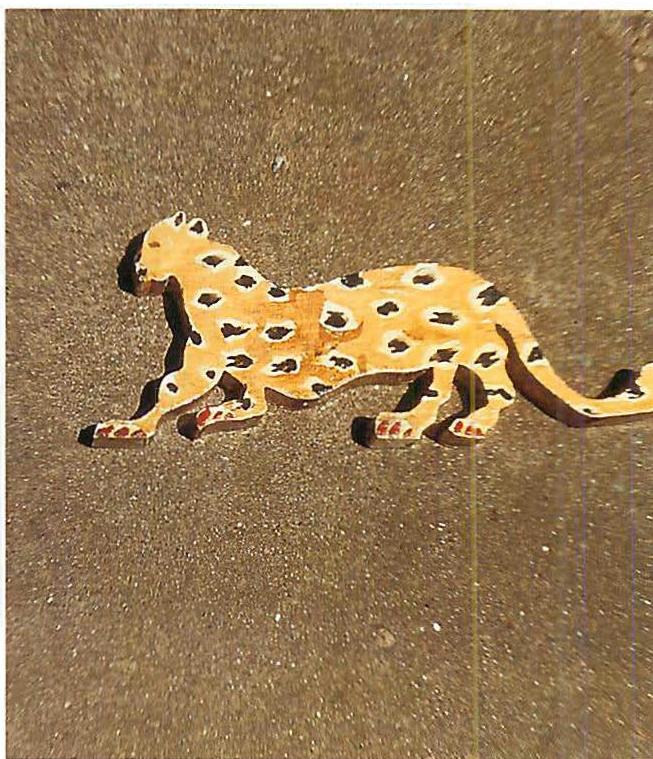
8 / SIMPLICITY OF ORNAMENTAL HUMAN FIGURES
When my daughters were little, I used to carve wooden dolls for them. Even in the simple task of making a wooden children's doll, the process of making centers must still govern.
First, at the stage of carving. What matters is not if the doll is lifelike. What matters is the definite arrangement of centers and the disposition of parts, to make a powerful center. For example, in the doll below, it is the definite shape of the hat, and the tuck of the waist, which make the centers. Really, even as a carving, the thing can be viewed quite abstractly, as a system of centers, and nothing else — not as a lifelike thing at all. And then the feeling which it has, and its feeling of life, comes from the fact that there is a beautiful system of centers there, not from the fact that it "resembles" a human figure.
Then, when it comes time to paint it, the same thing. I start by putting gesso on the doll.
Then I use gouache to paint it. But the colors can be wild, unrelated to the colors of real people or real clothes.
For instance, in the first doll, my daughter Lily said she wanted it to have blue hair. It seemed very strange. But we gave it blue hair. And then the next color, a purplish pink, was chosen to produce as much of the inner light as possible. And the next. And the next. And the next (page 663). Just as the carving is, the coloring, too, is completely abstract — intended only to create the field of centers as sharply as possible, in a way which melts. And these dolls do have feeling in them — almost a deep feeling. You feel something from the heart. You experience the feeling in the doll almost as if it were a person. It is a real feeling, not like the feeling you might have towards the picture of a person, but more like the feeling you have towards the person himself.

You get it, because the field of centers produces such a feeling in you. And it is to produce that feeling that the system of centers was created.
From the examples I have given, you may recognize that the drawing of animals, flowers, human beings are different when they are done in the framework of unfolding. The life in the carved animal, akin to the real life of a real animal, makes the drawn or carved animal different.
More surprising, I think you will find—as the primitives did—that it is natural, even necessary, for animals, plants, flowers, to appear in buildings. I believe that this itself occurs—not from a primitive symbolic idea about ornament, nor because of animistic superstition, nor even just from the love of animals and plants. Rather, I think you will find, the more deeply you have experienced this process, that the impulse to make animals, people, faces, flowers, trees—on the surface of the building walls, carved into the columns, scratched on the surfaces, molded into the materials—follows naturally, and inevitably, from the process of making.
It is a natural outgrowth of the fundamental process with its emphasis on centers—the true unfolding process—and it will play a profound role, ultimately, helping to reconcile you to the land and to our origins.
9 / STRUCTURAL QUALITIES CREATED BY THE FUNDAMENTAL PROCESS IN ALL ORNAMENT
The ornaments which follow from the fundamental process can take an almost infinite variety of forms, yet — because of the way they arise from the embellishment of latent centers in the whole — will have a certain restricted structure in common. They are, most often, space-filling geometric structures of repeating symmetries. In traditional architecture, we see these kinds of things on Nigerian panels, Japanese textiles, on medieval stone-carved ornaments, on Islamic plasterwork, on Turkish tiles, on Russian and Norwegian woodcarving.
Of course there is no reason why one should copy any one of these particular traditions. Our
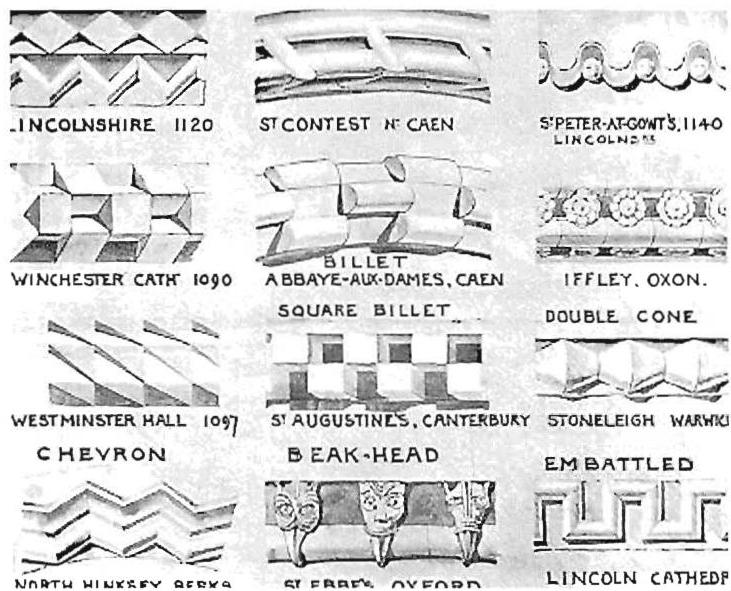
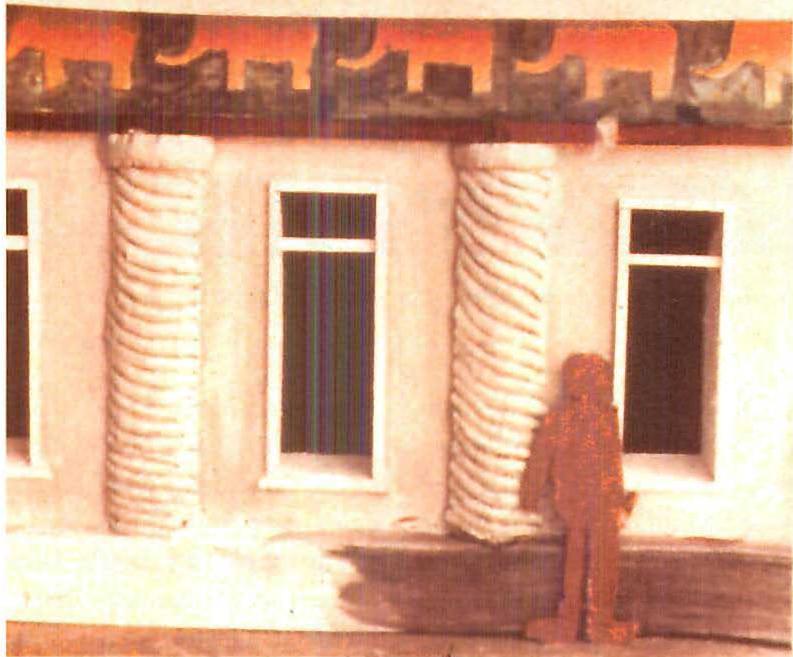
own ornaments of the 21st century and of the 25th century when it comes, will be whatever they are, appropriate to their time, made with our tools, using our motifs.
But if the fundamental process is followed, it is inevitable that ornaments will have certain things in common and a certain profound quality in common. An empty space will be filled with some kind of space-filling form, and one which
leaves positive space between the repeating ornament in two dimensions. We shall see octagons, repeating triangles, repeating squares possibly filled with crosses or diagonals, wavy lines, parallel systems of wavy lines, circles, and so on . . . all of them spaced, at every level of scale, so that the space between them becomes positive.
All the ornaments which I have shown have squares, triangles, stars, crosses, blossoms, lines,
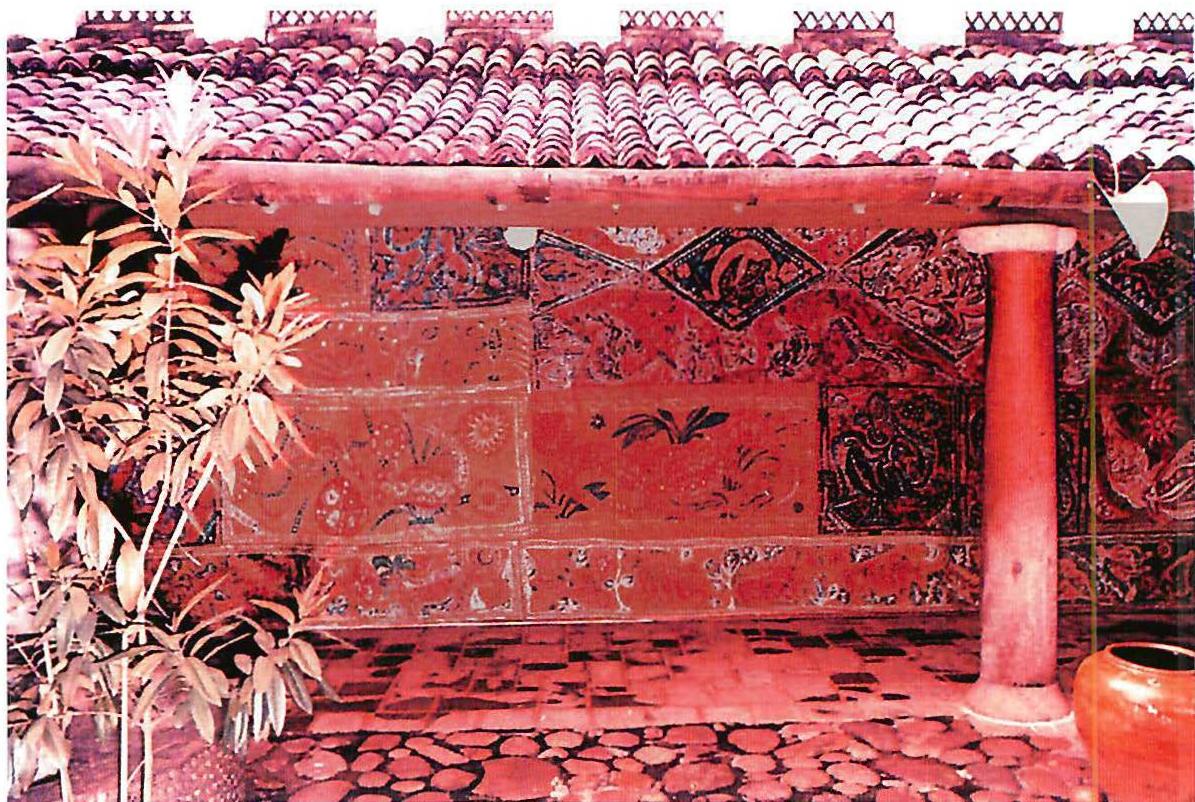
bands, flowers, animals . . . the elements that arise most naturally from the fifteen transformations. Ornament, when viewed with proper respect, summarizes everything about living structure within its laws. If we understand ornament properly, we understand the principles of living structure, and we understand how to make—
in geometry—something which fully embodies living structure, that means the fifteen properties as they arise from the contingencies and accidents of a particular context, and thus enhance the structure of a particular larger configuration in the world. Ornament is not trivial. It is most profound, and covers everything.
10 / IN A LIVING BUILDING, EVERYTHING IS ULTIMATELY ORNAMENT
The principles that govern ornament, govern land, volume, and building structure. The very same principles, which have to do with positive space, alternating repetition, powerful centers forming and breaking out from the varying shimmering mass—all of them apply at every scale.
It must be understood that ornament is not something which is imposed to finish things off. It is, in itself, of the essence.
If we look at the gate, or the gymnasium, or the orchard, shown on pages 612-13, it is plain, first of all, that they are all very practical. The gate is well made, sturdy, gives access to the meadow, is light enough to push easily, has a nice fastener to prevent the sheep getting out. But in addition it is also beautiful. It has five bars evenly spaced. It has a cross made of two diagonals. It is almost exactly square. Of course
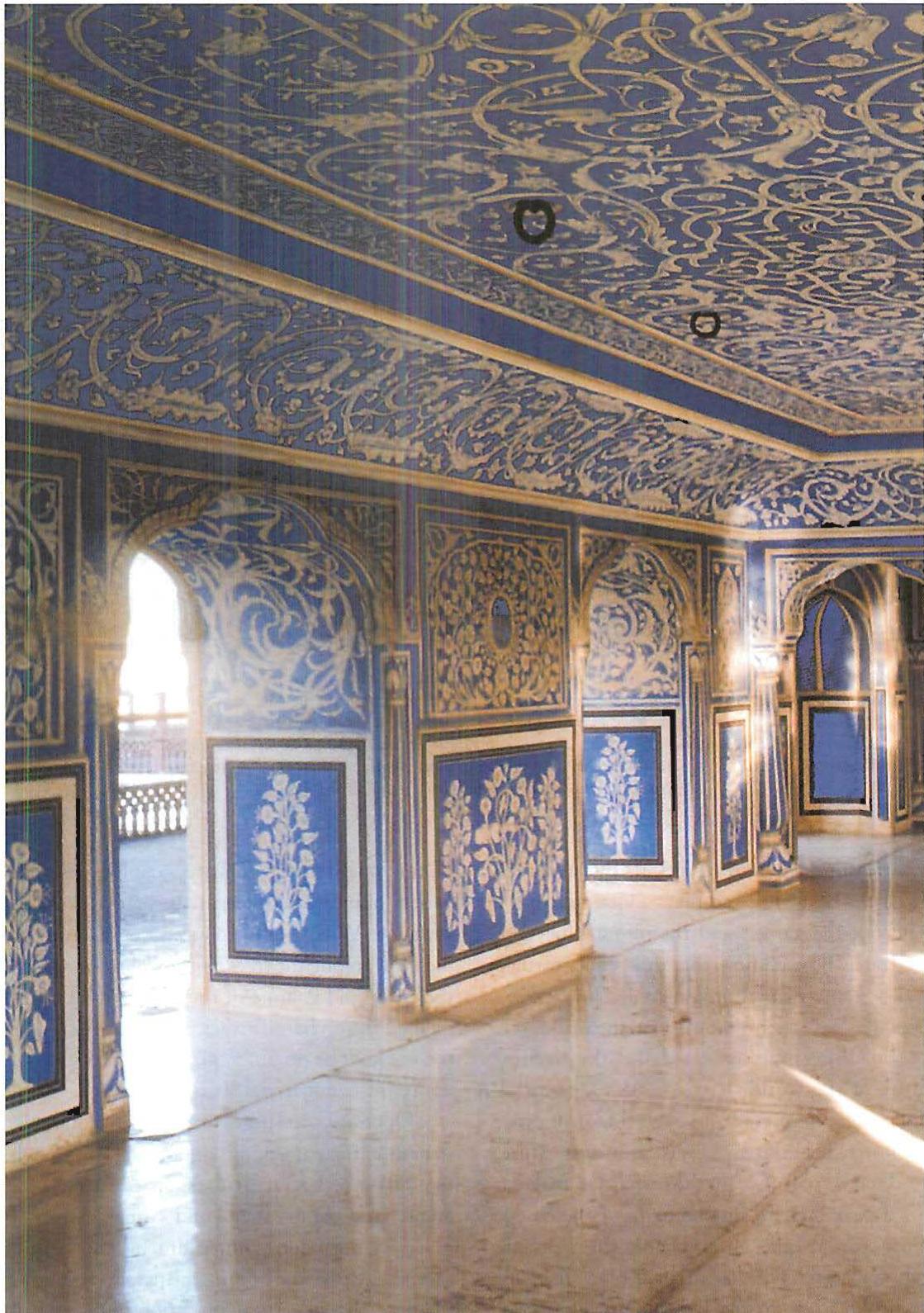
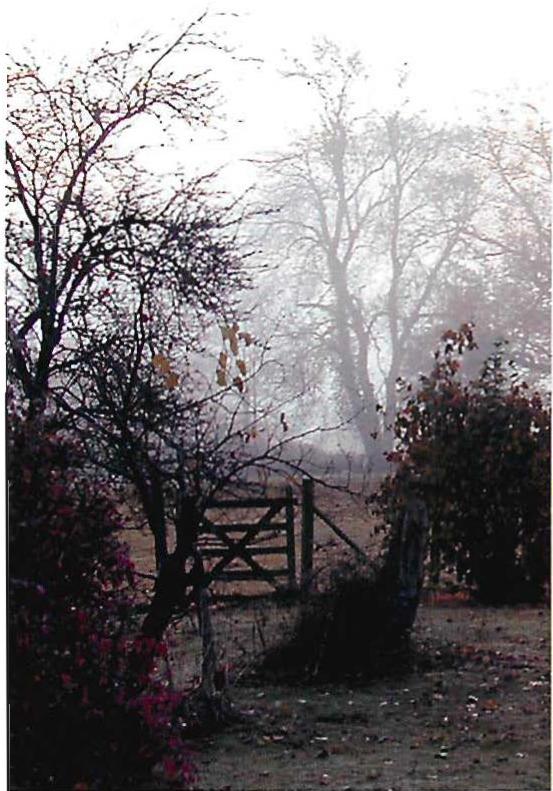
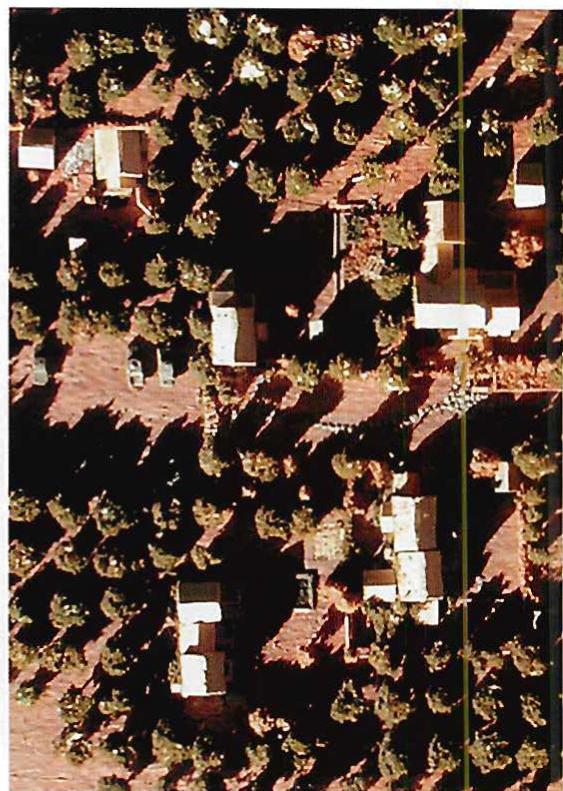
these features, too, are practical. But above all the gate is beautiful, and plays a vital role in the beauty of the garden and the meadow beyond.
It may be said, first, that this beauty formed by the geometric and ornamental character, is a necessary feature of what we do in the world. It is not something gratuitous, added to the practical nature of the world. It is something essential, which must be present, in everything, in order that it may heal the world, just as it is in nature.
That is true, also, for the orchard illustrated. It is a pear orchard on the bank of the Sacramento River. Like any orchard, the trees are evenly spaced. This is, in part of course, for practical reasons: to give light, to provide access, allow picking, allow vehicles to pass down the rows of trees, and so on. But in part, the ornament formed by the regularly repeating trees, is lovely, just because of its repetition. It is because
of this quality of regularity, coupled with the variety of individual trees, that we love orchards so much. When we introduced houses into the orchard, among the trees, as shown in our model, the space and volume of the houses itself ornamented the orchard further, and so further heals the world. The ornamental, geometric aspect of the result is not trivial. It is essential.
Opposite, on page 613, there is another structure: the pattern of windows, seen through the lattice of beams, trusses, space, major elements, and minor struts and corbels, which I made in the huge gymnasium on the Eishin campus. Again, the guiding principle—and, by the way, the structural invention and detailed design, too—came from the way of looking at this truss, not only in the manner suggested by chapter 6, but also from its existence as an ornament; something beautiful in the ordering of
space, positive space, and coherent individual centers, small and large. It is in this sense that everything of beauty, everything natural, is itself an ornament. A person's face, in the eyes of God, is an ornament to the world; the eyes ornament the face; the face ornaments the body.
But there is a second, and deeper issue. The function of a thing, and its ornament, are not two separable features: they are inseparable. When a
thing is well made, and takes its place in the world in a way that is beneficial, then this thing is always at once practical and at the same time an ornament. The fact that a beautiful thing is, in its totality, an ornament, is what cements it to the world, and makes it necessary. And we must be conscious of this necessity, as we build the world.
This issue will be taken up, more deeply, in Book 4.
11 / EVERYTHING IS JOYFUL ORNAMENT
For me the joy of building is that, in a profound sense, I feel the WHOLE building as an ornament. It is not a question of putting ornaments on a building, or INTO the walls and floors and columns, but rather that the whole building is an ornament—whose rooms, passages, staircases, windows, ceilings, paving, benches, lamps are all extensions, pieces of that ornament.
You have seen, I hope, that this is an inevitable result of the theory which I
have laid before you. If the field of centers comes to life when it is endlessly differentiated and extended, then that same field of centers — which is after all a pure structure of geometry in space — will find its most living state when all creation, everything in the world, really is an ornament.
In this way of thinking, the walls are extended by structure-preserving transformations to be ornamented as they become part of the greater ornament which is the room. The eaves are ornaments, extensions of the wall and roof; the bosses on the intersections of a panelled ceiling, the decoration on a wainscot, window panes themselves, are all ornaments, all part of some larger ornament.
I know that I am using the word ornament in an unusual way as I say this. But sometimes, thinking in this way, seeing the field of centers (living structure) as a pure geometric structure, I think of animals, and plants, and human beings, too, as ornaments in this sense: ornaments which have unfolded out of nature, and which might for this reason then truly be seen, as if in the eyes of God, as ornaments.
In any case, I hope that you will get the same joy that I have, from seeing each building in its microstructure as an ornament from the largest to the smallest detail — and that this joy can extend to the making of every part and window-sill, to every ceiling, to the color of the plaster, even in the end to the animals and plants you may feel inclined to place here and there within the structure, as its embellishment unfolds continuously, in your hands.
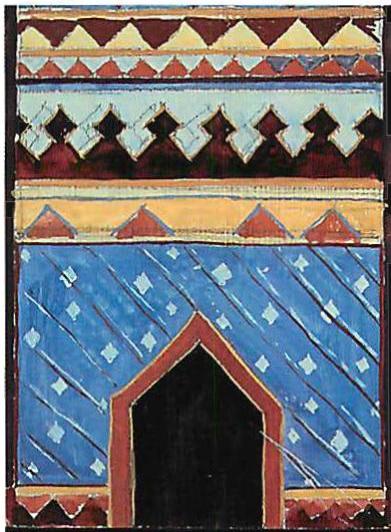
CHAPTER NINETEEN: HOW LIVING PROCESS HELPS TO MAKE COLOR WHICH UNFOLDS FROM THE CONFIGURATION
1 / THE UNFOLDING WHICH PRODUCES INNER LIGHT
Color is a necessary part of living structure and a necessary part of the harmonious adaptation in the world. It goes to the root of life and wholeness. Often, in conceiving a building, before I even have the outline of the volume clear, I look, in my mind, for a vision of the color. The color, in a holistic way, appears as a product of the forces on the site. One sees what kind of overall color structure may be most harmonious in that place. One can feel the harmony. One gets an idea, a glimpse, of the quality of color, hence the quality of structure which will help that part of the world, fit into it, so that it becomes more whole, more dazzling, in a quiet and unassuming way.
And, once the building exists, months or years later, the importance of light continues. Even the paint on the building, on the walls, on the furniture, on the garden fence, this is all essential.
In Book 4, I shall go to great lengths to describe something I call "inner light" in the color of a situation (see chapter 7, pages 157-240). In what follows here, I shall briefly describe what it is like—as a practical matter—trying to get this inner light to appear in a building.
Imagine the process in which we visualize color in some place, and then try, step by step, to create the inner light we feel. In effect, we follow a process very similar to the general scheme for a living process I have already laid out in Book 2 (chapter 7). But now, at each moment, instead of focusing mentally on "wholeness" or "life" and intensifying wholeness or life at each moment, we concentrate on the idea of light: that is to say, on the way that color illuminates and enhances the structure of a given wholeness, in a given place. I concentrate my attention on the need to increase the light in the field, step-by-step, continuously.
In doing this I am consciously trying, at each moment, to make the thing before me penetrate more and more deeply into the realm of light. I am trying to reach the ground described in Book 4, THE LUMINOUS GROUND. I do not need to be ashamed, to worry that this is too high-flown as an aim. It is a simple aim, though very difficult. Trying to reach it, it is useful for me to be humble and to recognize my inability. Then the task becomes more straightforward, not so pretentious, more likely to work. Again, the steps are governed by the idea that the color must be structure-preserving and structure-enhancing for the surroundings. This will determine the overall choice of color, the combinations of color, and the particular shades that we mix.
In the following discussion with Gernot Mittersteiner, my apprentice from Austria who worked with me in 1984, we are talking about the process of finding the right colors for a building in Martinez, which we were painting while he was working with me.
Gernot How have you come to the conclusion that color "studies" on paper are not helpful enough?
Chris A matter of experience. A sketch can work very successfully as a way to study the general idea of color, the overall feeling projected by a particular group of colors in a particular arrangement. Examples of such sketches are given on page 618, on page 633. But the actual colors that must then be put on the real building, even when inspired by such a sketch, even when aiming at the color feeling that a chosen sketch reveals, can only be worked out in the place itself, under the influence of nearby and surrounding color and light. And when colors are done this way, they will always come out different from the colors in the sketch.
Gernot Why is that? What is it that you actually do?
Chris Well, throughout, I try—hope—to find a combination of colors which has "inner light" ... which enhances the structure of the
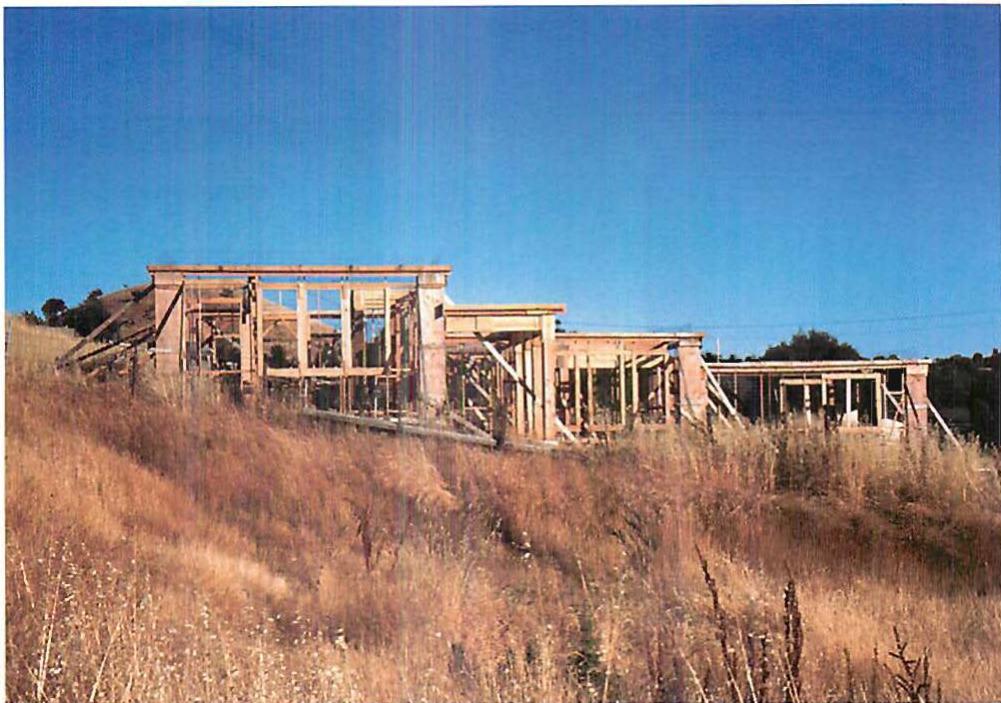
building ... and which increases the NOT-SEPARATENESS of the building, its unity with its surroundings. All this hinges to an extreme degree on the color interactions which actually happen on the site itself.
What we do on paper, working out the color combinations, can help us get a rough idea of what might work. But it falls short in two ways. First, it does not adequately recognize the way that real colors fit into the landscape of an actual place. Second, the colors which are formed on a drawing or painting are never like the colors which we actually put on the building ... because the areas and intensities are so different.
Gernot So what do you do to work out the colors?
Chris First, I try to see it in my mind's eye while I am in the actual place. I try to get an inkling of the general feeling of color which will work. In Martinez, the main things about that place, which is rather hot, were the yellow of the grass—dry, burning—and the light white-blue of the sky. I looked at it, I sat there, then
closed my eyes trying to imagine a color in the building which would create an inner light in that place, with that dry yellow grass and with that light blue sky. Slowly I began to see a deeper, greenish blue, rather strong, with the blue tones more pronounced than the sky, but also somehow softer.
Gernot But you don't put this on paper.
Chris No, I don't usually test it on paper, only occasionally, because a drawing or a painting of a
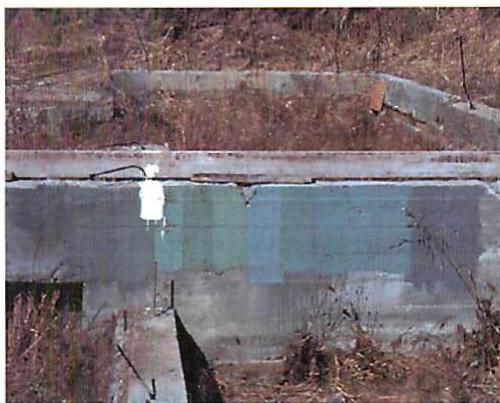
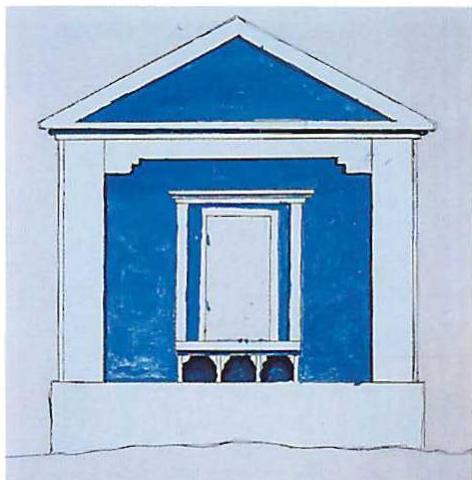
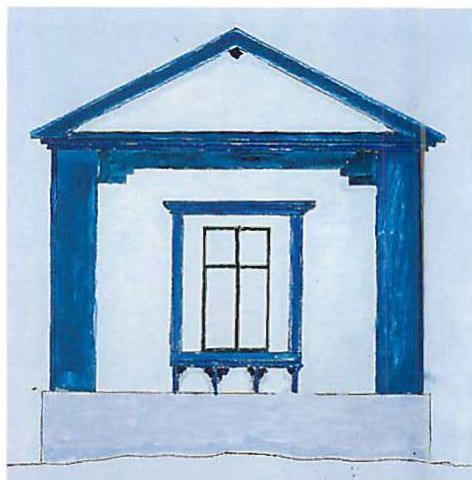
building only gives a very rough idea of the real (and more complex) color phenomenon. Instead, I keep it in my mind. And then I go to the site and simply start mixing colors and painting them on test areas of the building until I see it come out right.
Gernot So you are mixing colors on the site itself.
Chris Yes. (You can see this on page 617, in series of test colors painted on a foundation wall, to help us see which colors would work best for the building's main wall). This is the crucial aspect of what is going on. If I work on the exterior of the building, I have cement, white and gray, and all the necessary pigments in the raw state . . . I can mix any color I need, directly, from these raw pigments and the cement . . . I make up a cement wash and paint it on the building to see how it looks. If I am working on the inside of a building, I do the same with flat water-based colors. . . . I have flat white and enough pigmented colors so that I can mix almost anything I want . . . and I have dozens of little cups where I mix test batches, a few spoonfuls at a time.
In both cases I start by painting—usually for two or three days—simply putting different
colors there, intently looking for this inner light ... and modifying the color gradually until it goes in the right direction.
Gernot Do you work one color at a time, or with a whole group of colors?
Chris No, I gradually develop the whole sequence of color harmonies which are to be in the building . . . so I develop broad areas of major colors . . . and then, while these are in the places where they will actually be in the finished building, I work out smaller quantities of smaller colors.
So, for instance, in Martinez, I first began to see a blue for an outdoor octagon seat (not shown). I tried blue after blue . . . bright blue, gray-blue, smoky blue . . . with the white of the balustrade . . . and the pale green of the base. The best one was a subdued grayish blue. Then, when this became reasonably clear, I began to place colors of the building itself . . . a blue-green on the panels . . . and a gray-blue on the columns. . . . To work with the blue of the seat, the blue of the columns had to be subdued. . . Finally, when this color was right on the columns, the blue of the octagon seemed too bright . . . did not quite work . . . so I went back and added a touch of green.
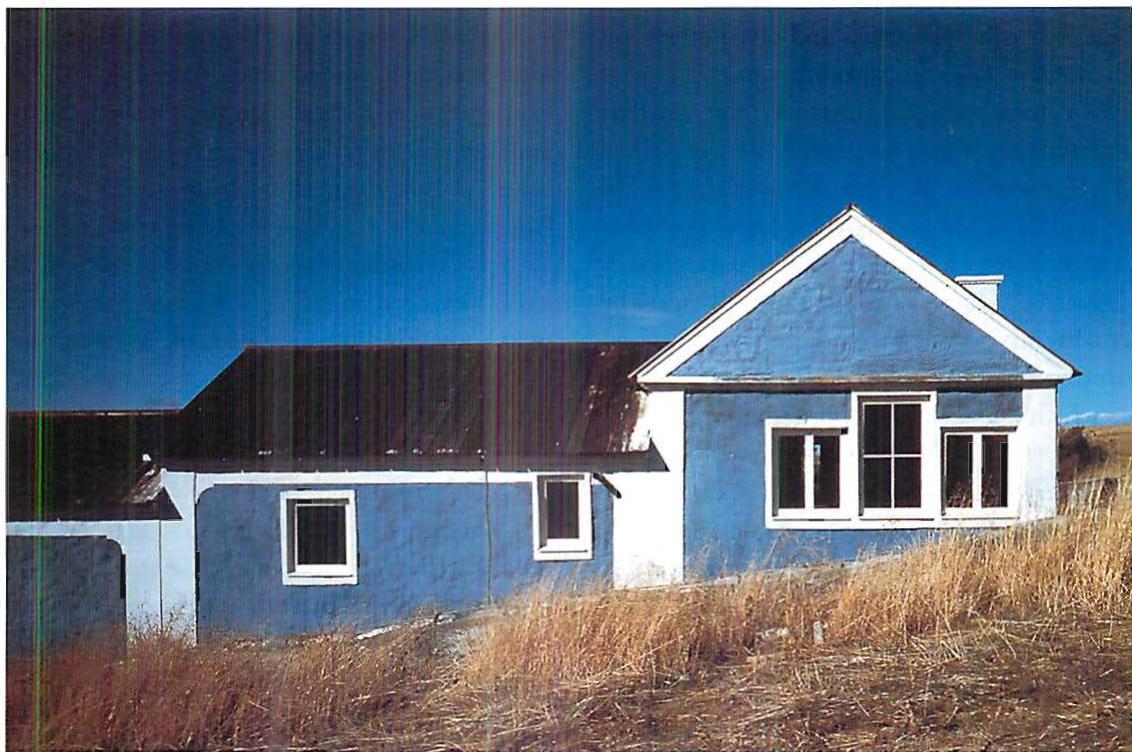
The interactions are extremely sensitive. For instance, while mixing the blue of the columns, there were two versions which differed in the amount of gray they had in them . . . one slightly grayer than the other. Either one seemed ok, but the one which was slightly grayer was alright with the green-blue of the panel . . . and the other, just a tiny fraction bluer, was not . . . and required either that it move, or that the panel color move slightly.
Gernot I still don't really understand why this could not be worked out in sketches on color samples.
Chris Because the differences, the nuances, which actually bring the building to life, depend on the colors all around in the surrounding buildings, earth, trees, sky. The right colors stem from relationships with all these things, and these relationships are far too subtle ... and above all unpredictable. So working on the color swatches, and on color samples, in a sketchbook ... just does not give accurate enough informa
tion for us to predict when this inner light will actually appear. And you have to walk close to the building, and then walk down, far away . . . so that it works from all angles, with the light changing . . . at different distances . . .
Gernot I am beginning to see how difficult it is. But I do not yet see how it helps us understand what we have to do . . . why the fact that this must be done at the building itself, tells us something basic about the phenomenon of color.
Chris Well, consider the next point. Once the blues, and grays, and blue-greens are working all right . . . and they are working from the point of view of DARK-LIGHT CONTRAST . . . from their MUTUAL EMBEDDING . . . from their connection to the surrounding light and landscape (COLORS CREATE LIGHT TOGETHER . . . then we still have to get the sequence of the colors right (SEQUENCE OF LINKED COLOR PAIRS). These are all hard to do; they all require that we are looking at the whole — something almost impossible on a sketch, except as a first approximation. (Note:
these four color properties and seven others are described in Book 4, pages 157-240.)
In this case, for instance, the smallest amount of color goes to a very pale straw yellow which appears in the form of tiny diamonds, in the middle of the panels. This straw may have a touch of red in it . . . or it may have a touch of green . . . Once again, you can't tell except by actually mixing these colors, very rapidly, and painting small diamonds on the building . . . to see which one creates the inner light.
Gernot But I still don't see how this helps to understand the theory of the subject.
Chris Because, again and again and again, you realize that what works, what creates life, is an empirical phenomenon. The only thing which matters is whether the light actually does occur or not . . . whether the building does have the quality of a being . . . whether you really experience NOT SEPARATENESS in the building and the land. And this is a palpable empirical fact which you appeal to over and over again . . . it is the only thing which you appeal to.
On the other hand, the idea of color can get in the way constantly. One theory says you should try more detail, or a fine hairline of some lighter color . . . you try it, and it is hopeless. Another image of Greek houses tells that a beautiful clear Greek powder blue should be used . . . and you try it, and it is beautiful, but it does not have this wonderful peace and harmony in it . . . it is too garish, too brilliant, too sugary.
But it is your actual eyes, what you see, the empirical real facts about the way the colors work, and the real presence or absence of inner light . . . or not-separateness which is guiding you all the time.
If you try to anticipate, to mix the colors in a sketchbook . . . you cannot so easily be guided by this reality because it exists or does not exist in the real place only. . . . So it is necessary that you roll up your shirt sleeves, take some buckets and some brushes, be daring, paint and paint and paint on the real building . . . not caring who is watching or what they think.
While I was doing the work in Martinez, Gernot came by several times. At first he saw the experiments as if they were the finished thing, and very politely he kept saying in one way or another . . . this is very difficult (meaning "I don't like it much") . . . you are having troubles here . . . these remarks, of course meant kindly, could easily have been upsetting . . . because they invite exactly the kind of inner fear, the attempt one makes to please one's inner voices, inner critics, which constantly deflects the mind from the real task in hand . . . and tries to make the design, or the color, by reference to taste.
But again, it was all right so long as I could hold onto the facts . . . because the reality of the inner light being there or not being there is enough, so it is unnecessary to be confused or disturbed by whether someone is liking the experiments or not.
On the right, I show the interior of the Linz Café, a building built in 1981, in Austria, where every bucket of paint was mixed by hand and every surface was painted by hand. Here the sense of daring, even danger, in doing something so big, live, was very strong. Yet every bucket of paint was mixed in relation to the feeling that was there.
Gernot And why do you speak of daring?
Chris Because when someone comes by like this, as you are doing, it is so easy to be influenced by the thought that he thinks you are an artist, you must live up to his expectation of you, therefore to try and do the things he suggests, or sees, or mentions . . . and it is frightening to be out there, naked, looking only at the presence or the absence of light, and having to endure his bad opinion . . . it is frightening to endure this opinion, and to rely only on what you see.
But this is the only way. The real work of color cannot be done except in this way: painting every detail in a test. And for the same reasons, I always mix my own colors . . . even the ones which will be used in the production batches . . . because those are the only ones I can rely on. Once I have mixed
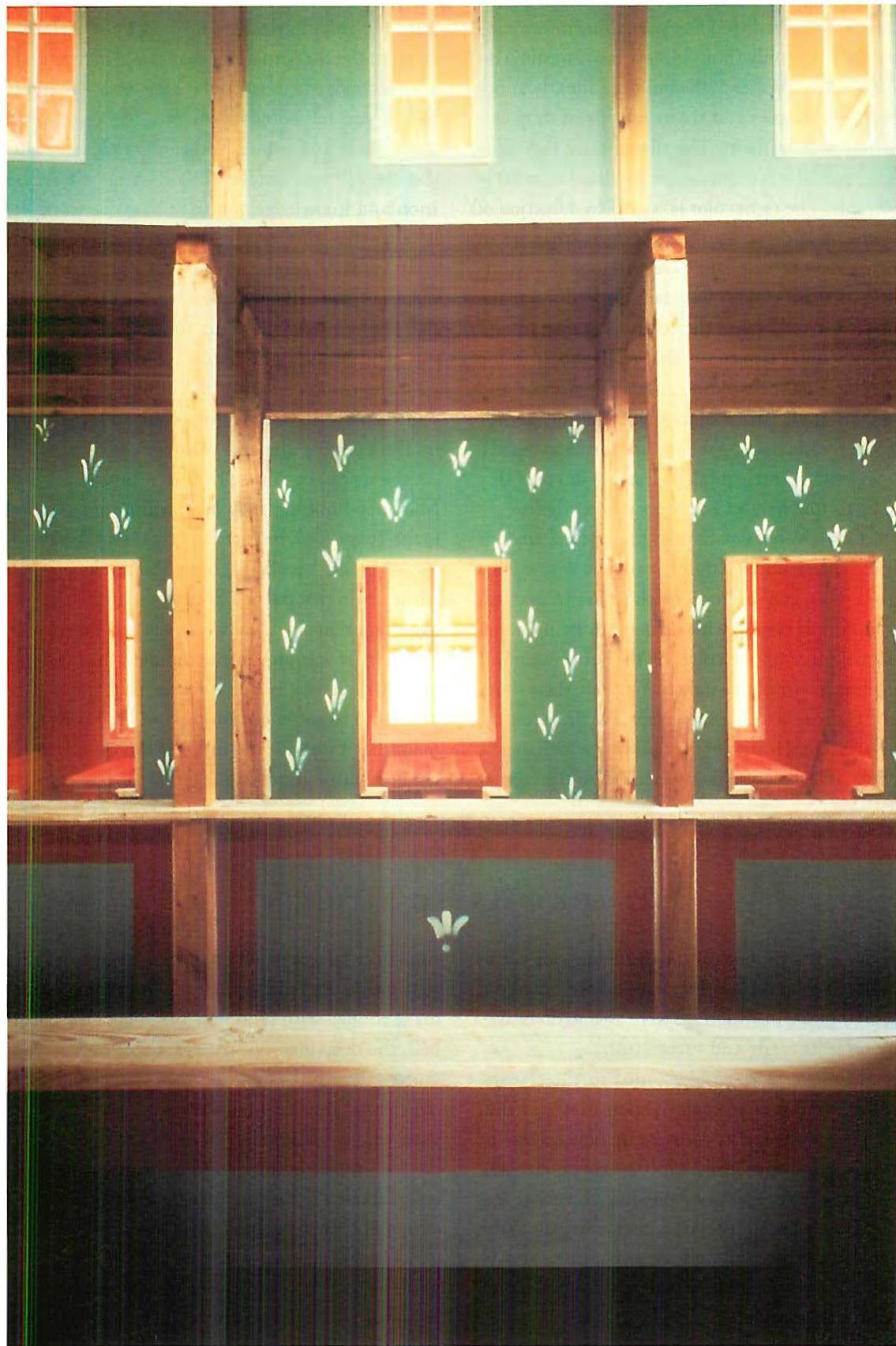
the colors which do produce something towards inner light (the only thing I know is my formula on some scrap of paper at the building site), I cannot then take samples and try to get a paint shop or a factory to mix them. The discrepancy they produce, even if it is quite tiny, is greater than what is tolerable. The right color is "right" by a fraction of a percent of the amount of pigments that are in them. Most attempts to have a factory or a paint-shop mix the same colors, fail. So I always make the tests myself, paint the colors, and then when I have a sequence of colors that really works in the real places on the building . . . then I go ahead and mix the actual batches of the paints that are used for production, according to the same formulas exactly.
Gernot And just tell me once again how this helps to understand the theory as a whole.
Chris What you have to understand are two things. First, understand that anyone who says he can do this, at a distance, by choosing color chips from sample books, without actually being there, painting and mixing colors on the building, at full life-size, is simply mistaken. You must do it yourself. There is no other way to achieve these results. It is the actual reality of the building which speaks to you. The color — its connection to the eternal
self—is an empirical thing. It is only trial and error, in the real situation, that can achieve it.
Second, you must do it with your own hands. When you tell someone to mix the color, and stand there and watch, you can get close—but you are still too removed to allow the real intuition and knowledge you have to go to work. It is when you mix the paint yourself—mix the color yourself, move the color on a bit of scratch material gradually to where your eye tells you that the wholeness is being fulfilled—then you can achieve the right result.
The completeness of the building, if you finally achieve it, comes from your own presence on the building site and your own reaching this completeness in yourself. The columns on the Martinez building may look white in a photograph (page 619), but actually they are the palest green. It is a beautiful green, that looks almost white . . . in that particular place, with that burnt grass and that sky. Real white was too harsh, too dazzling. It was only at the moment of standing there that it was possible to see that the white needed to be softened, and to find out by experiment that it was just this milky green which made the blue harmonious in the land.
2 / THE PAINTED KITCHEN
In the 1980s we began to consolidate our CES efforts as general contractors, and we entered a normal phase in which we were able to do building projects easily and successfully.
My love of color blossomed in these years. Color was always an essential part of what I did, but I began to see it, consciously now, as one of the essential ways in which life may be reached. The most extreme case, possibly the most extreme case I ever built, was a kitchen in which the whole room was viewed as a painting, and in which the whole interior wall surface was hand-painted in gouache.
I believe that color, like music, holds the key to life as it appears in art; it is, perhaps, the most
fundamental way in which things in geometry—that means real physical things in the world—make contact with God. It is the blue of the bluebell, the deep green of the sea, the yellow of the crocus, the white of the snowdrop, the awesome darkness of the mountains at night, which reveals their wholeness, and lets us reach God.
As a maker of things, I found that it is through color, above all, that one has the chance—however slight—of reaching this domain.
Once again, unfolding. When the room was getting near to completion, the plaster was on the walls, I began to think that color—more exactly sunlight and joy—needed to fill the walls more completely.
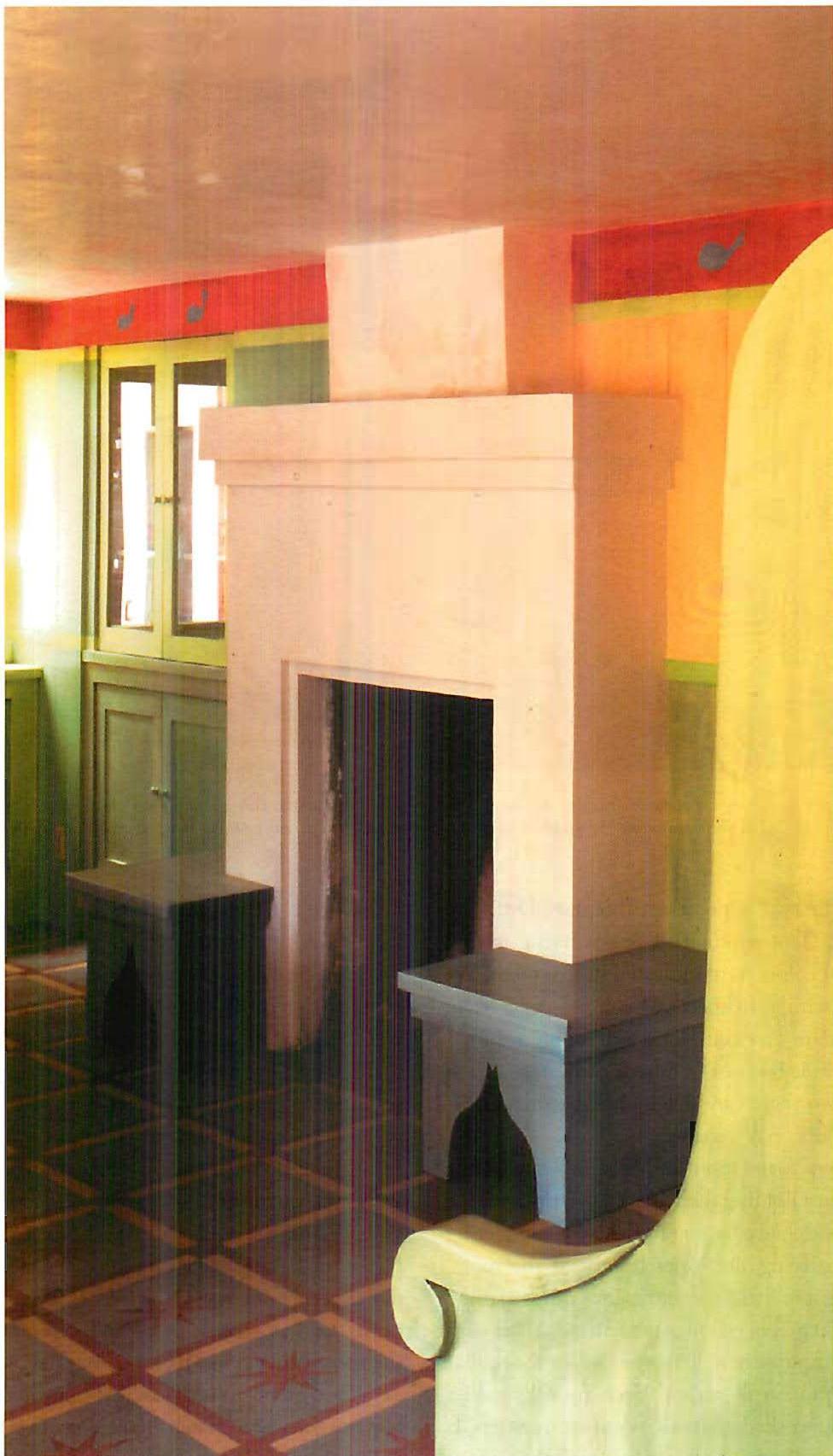
With two apprentices (Stephen Duff and Kleoniki Tsotropoulou), I began trying to find out what colors were indicated in this room. We started with tiny sheets of colored paper from Amsterdam Art (our local art supply shop). I had a whole book of hundreds of swatches, each about two inches by five inches, beautiful brilliant colors, every shade.
I went to the room and held up swatches one by one, just holding them in mid-air, trying to see which ones had a feeling of the color completing or intensifying the inner beauty of the room, bringing it to life. I got four colors; it was a spring day. Light green, yellow, a reddish red, a blue with a little turquoise in it. This was already the fundamental process in action. Each time I found a color that worked, that said yes to the question "Is this color enhancing and intensifying the spirit of the room?", I laid it aside.
Once I had a feeling which individual colors were called out by this place, I took the small swatches and laid them over each other, like cards, so that different amounts of the four colors were visible. I nailed them on the wall to look at them. Each different arrangement (50% greenish yellow, 30% green, 10% red, 2% turquoise-blue, and so on), each combination looked different, felt different. When one took the group of colors with their quantities and nailed the overlapping swatches on the wall, you could tell if it completed the light of the room, more or less. So, we did experiments, trying different combinations until it was as good as possible. I still remember the feel of that color, like a spring day.
Then Stephen and Kleoniki began mixing big bowls of gouache to match these colors. They mixed in huge batches and painted large pieces of butcher's paper.
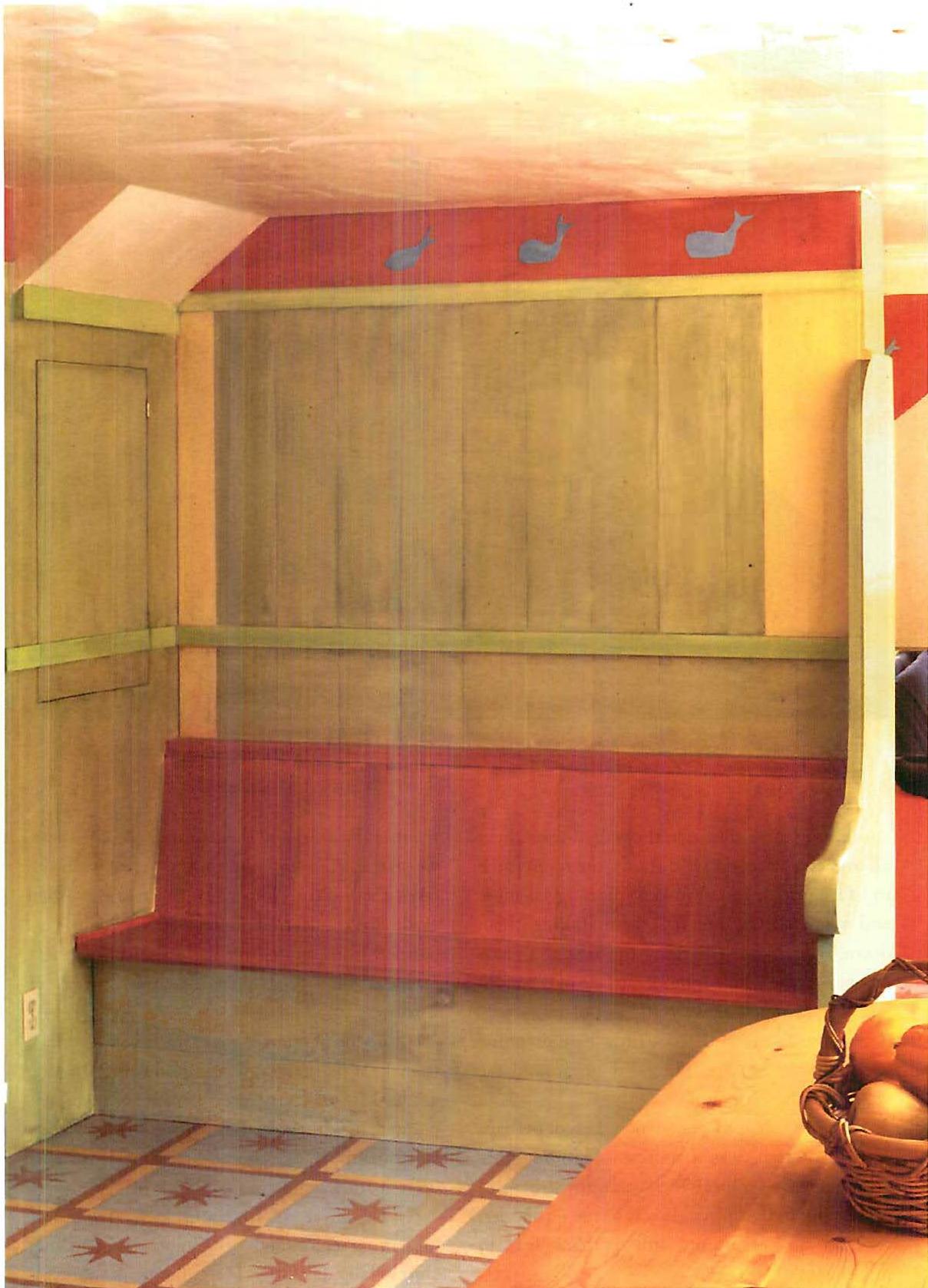
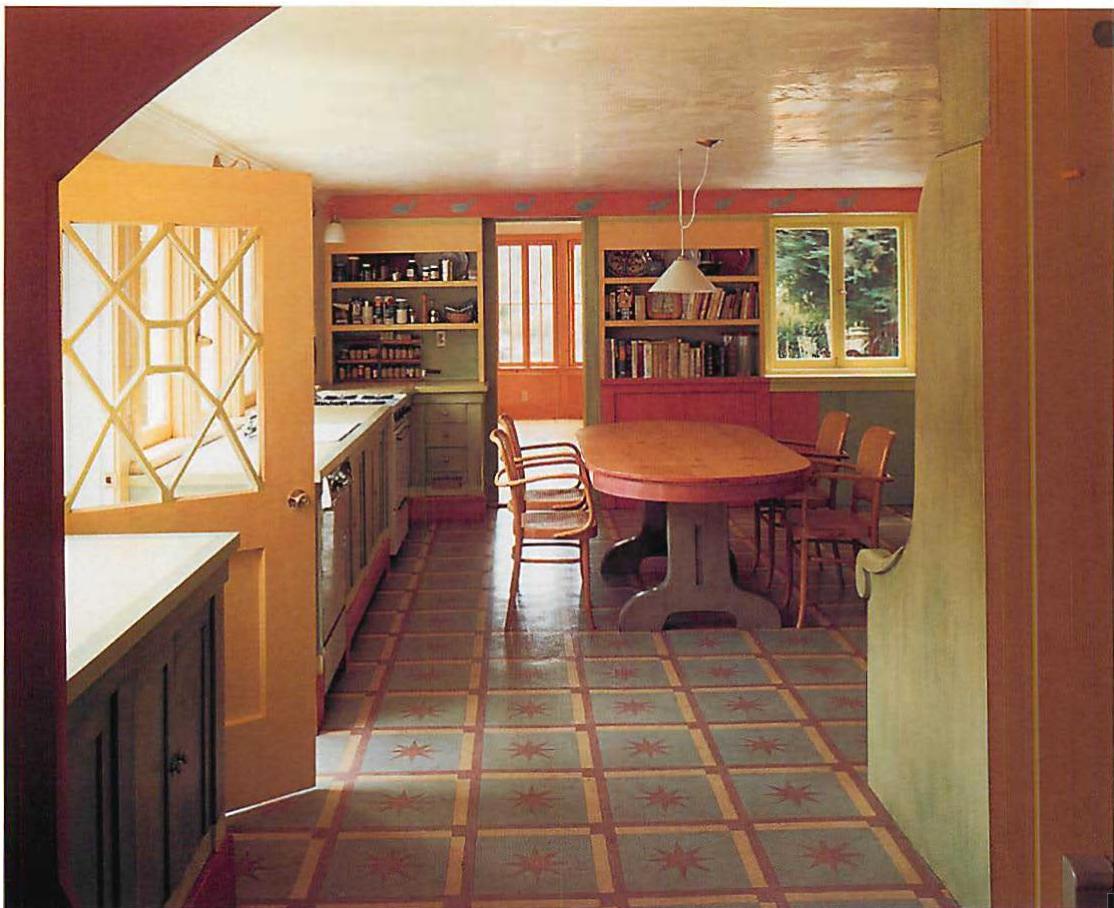
I hung these sheets on the wall, draped them all over the place. As we did this, the room came to life, more or less. We kept pinning up more and more sheets, moving them, taking them down, reducing or enlarging the area of a given color until the whole interior surface of the room had life, as much as we could get of it.
Towards the end I cut little blue dolphin-whale figures out and pinned them around the wall near the ceiling.
The whole process, which lasted perhaps a week or two, was a process of finding that arrangement of colors which was most structure-preserving in that place. It was a true unfolding, we had no constraint, only perhaps fear to fight against.
The whole interior wall surface was first mocked-up in paper painted in gouache. Once the room worked and the painting was complete, we started all over again on the actual wall surfaces themselves. The gouache color was then gradually transferred in real gouache, and repainted from scratch on the actual plaster surface, and on a gesso-prepared surface wherever there was wood.
Finally, of course, we varnished the surface to make it permanent. I had used this technique a number of times on furniture I made—painted it with gouache, over gesso, and then varnished it. This was the first time I had ever done it for a whole room.
The effect of the unfolded, structure-preserving color and ornament was dazzling, emotionally dazzling. The fundamental process works. Ornament and color are part of what is needed to complete a room.
3 / PAINT AND COLOR MATERIALS
To get the color right in a building, even the paint materials must be chosen correctly.
The present-day norm for paint is this: You go to the paint store with a sample of the color you want. The people in the store match it by mixing drops of dye with a white base paint. Then you put these premixed paints on the building. There are two problems. First, the actual paints themselves that you can buy commercially today have terrible colors. Second, you don't (and cannot) know what colors you need until you are in the middle of the work, so premixed colors don't work anyway.
The first problem (quality of color) is fairly easy to solve. Present day commercial paint uses a white base mixed with tints. This produces pastel shades, but cannot get saturated colors except with difficulty. To get pure colors, you have to use pigments, not tints. In the United States, for exterior use I often mix pure pigments or concrete pigments in a lime or cement base, myself. This way you can get it as saturated as you want. In any case, the color must be of a type which you can mix yourself and which uses pigments, not dyes. We sometimes use automobile enamels, which have very good pigments, and do not suffer from the pasty quality of commercial house paint for interiors. I have also used artist's gouache or oils, painted directly on a gesso base. Here the color is as subtle as you want. In Austria, in the Linz Café, I used something unknown in the United States called dispersionsfarbe, a pigment-based, vinyl-based paint. Again the pigments and saturations were excellent. I got colors by mixing different paints, not by tinting a white base.
The second problem (knowing the color that is needed) is more serious. It lies in the fact that you must have direct control over the colors while you are painting in a room, to get inner light there. This means you cannot use swatches, then have the color mixed in a store to match the swatches (the conventional commercial paint-store process), and then
expect to get good results in the room, or on the surface you are coloring. Usually I do literally dozens of experiments mixing my own colors, and experimenting with the actual colors in the real place, before knowing exactly which ones will be just right. Once you find these colors, you must reproduce them with the exact formula you used in the first place. You can't give a sample to someone else afterwards to match. More important, you sometimes need to vary colors as you go, when you see that a color needs a lighter or darker shade, or a slight change of hue to make it whole.
It is therefore absolutely necessary to use a type of color which allows you to do experiments, test colors, change colors, experiment again and again with gradually changing formu
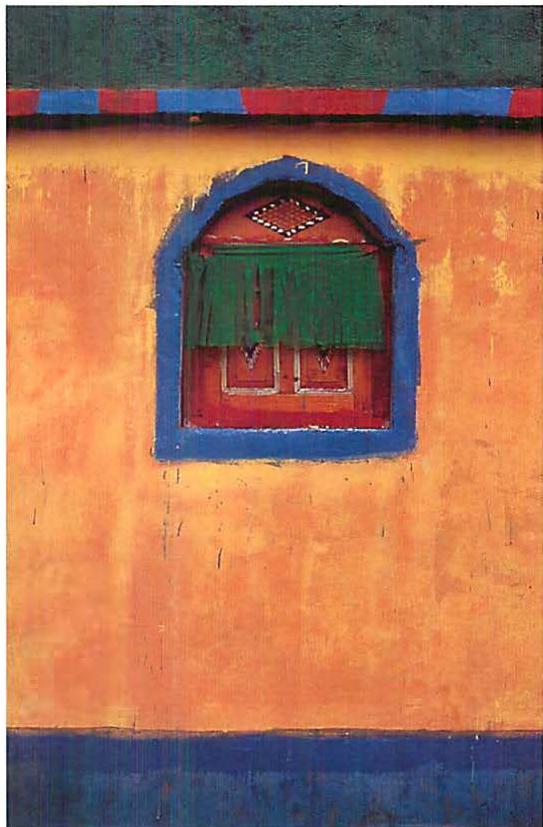
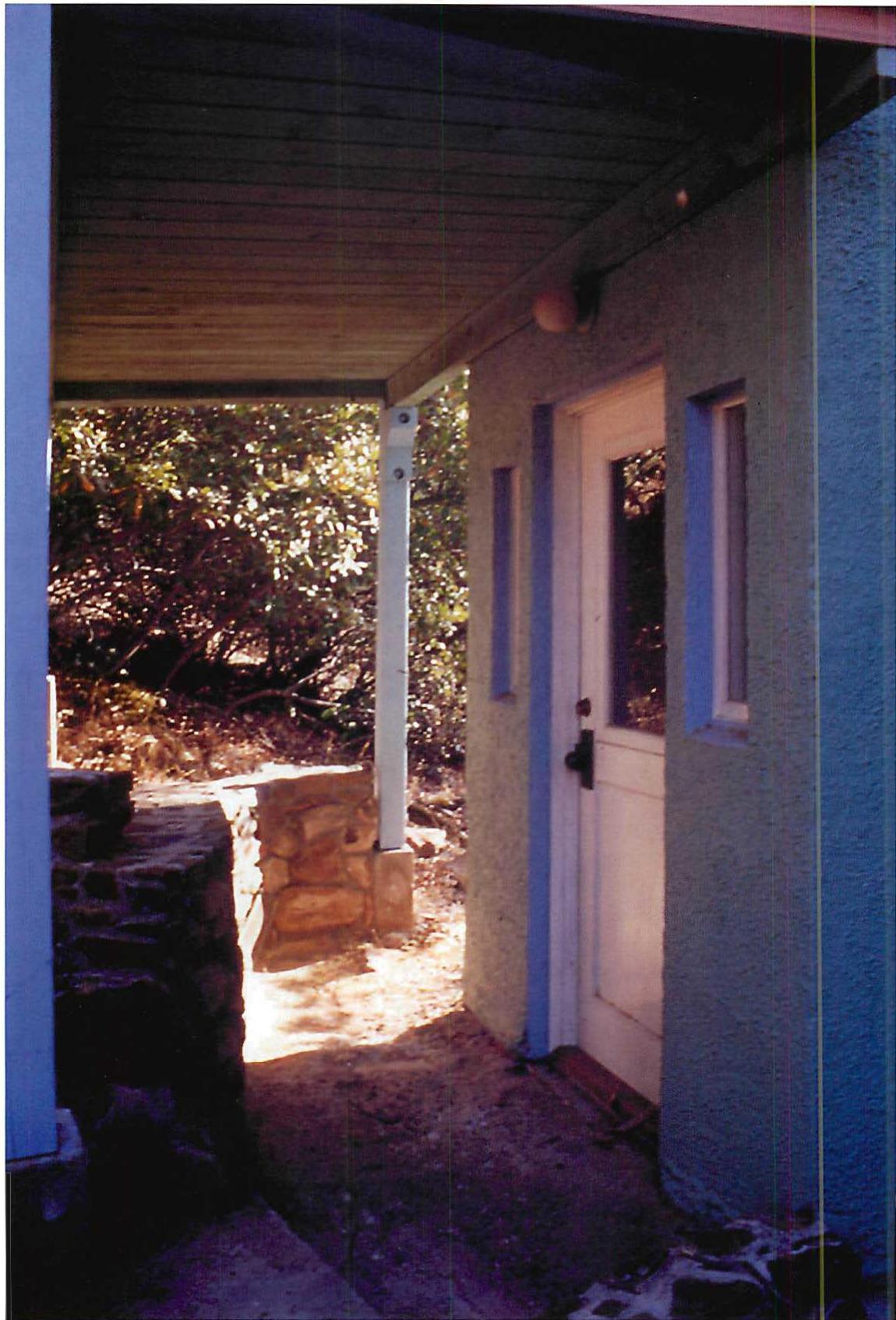
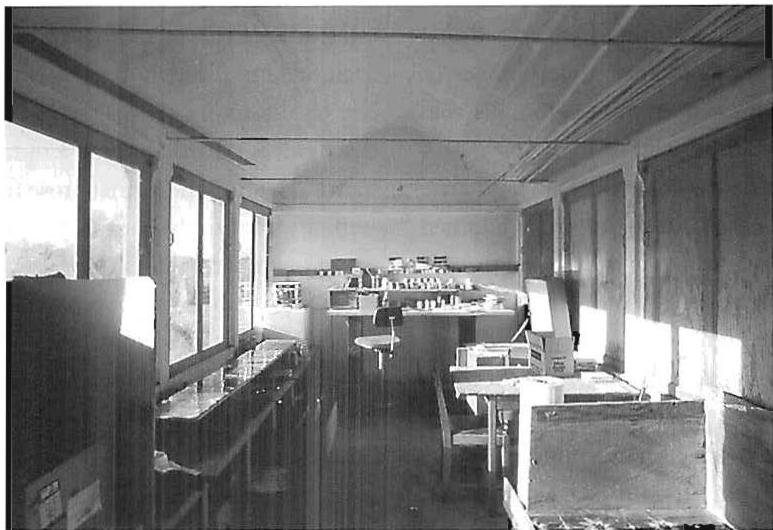
as, and then finally, once you hit what you need, have control of mixing the final colors. Again, the pigment mixing with the pigment-based paint is OK—provided that you mix your own. Lime or cement based washes, with pigment mixed in, are OK. On furniture I use gouache on gesso. When it is finally OK, I varnish it with clear, glossy spar varnish. This gives you almost complete control.
Terrazzo is all right, too. Marble dust and chips mixed with pigments provides permanent color in a building. We have also used lime plaster in which pigments are mixed directly in the
same way. Tile glazes are all right, too—provided that you glaze your own tiles. Once again, you can't get it right if you buy pre-glazed tiles. We keep our own tile workshop, and glaze the materials we need for the building.
It is surprising to realize that in the present day even something as simple as painting materials are inadequate to support true unfolding well. The techniques and materials that are used by 95% of building industry painters today cannot attain the right color quality because they just do not allow the gradual fine-tuning of the colors to get them exactly right.
4 / THE SURPRISING NATURE OF THE COLOR THAT UNFOLDS
In the search for color, when you really pay attention and try to find out what produces inner light, step by step, the result is often very surprising.
I will give three examples. In two of them, I started out expecting to find blue, but it turned out that something else—in both cases unexpected—was the right color.
The first happened during construction of André Sala's house. On the second floor there is
a children's room with two alcoves for the children. From the beginning, André had been telling me how he had been wanting to paint the room a beautiful light blue. He described it to me—a soft, milky blue, almost transparent, that he had once seen in a house in France.
I was worried. It sounded beautiful, but it had nothing to do with this room, in this house. I had lunch with André and told him that I
could only work well with him if we agreed that together we would pay attention, very honestly, to the color which came from that room. I told him, too, that I had no way of knowing if this milky blue would be the color which would arise naturally from the light in the room. We talked for two hours, a long lunch, complicated discussion, but very interesting. André is himself a painter. Finally he agreed.
What he agreed in essence, was that the room would be determined by the room itself, not by any idea — neither from him, nor from me.
We went back to the room, with paper, paints, and brushes, and began testing different colors. As it happens, that room has a lot of strong light. It is a small room with big windows that face south and west, and the light in the room bounces around and is startling in its brilliance.
We tried André's milky blue first. It looked strange, almost white, because the room itself is so bright. André, as much as I, recognized that it was hopeless in that place. Then we started trying
all kinds of things on bits of cardboard that we painted and pinned up as we went along. When we finally found the color that put the room in harmony, and made some kind of comfortable, natural feeling there, that arose from the room itself, it was entirely unexpected, a darkish red, almost one might call it an over-saturated darkening red with qualities of pink. When we found it, together, we agreed that that color was the one. André saw this as much as I did, but he was amazed. And I was, too. I would never have imagined that this room would be best in red, especially such a deep, strong red.
Then, when we began fine-tuning the harmony in the room, I discovered a purple with a touch of turquoise in it, connected with the red — and painted small diamond flowers of this color all over the red.
The harmony of the room became good, now. But, altogether, it was totally unexpected. One would never have guessed that these were the colors which were required to produce light in that room.
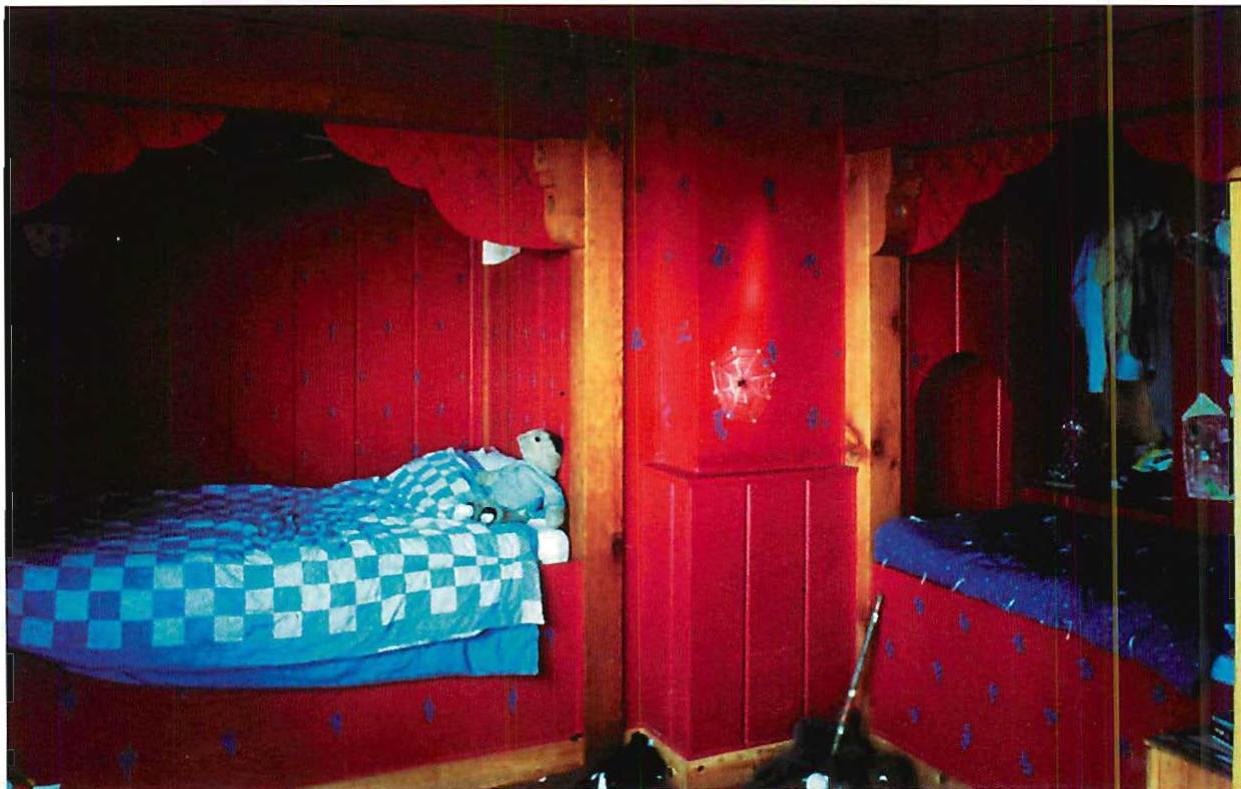
5 / THE BLUE OF THE KAISER HOUSE
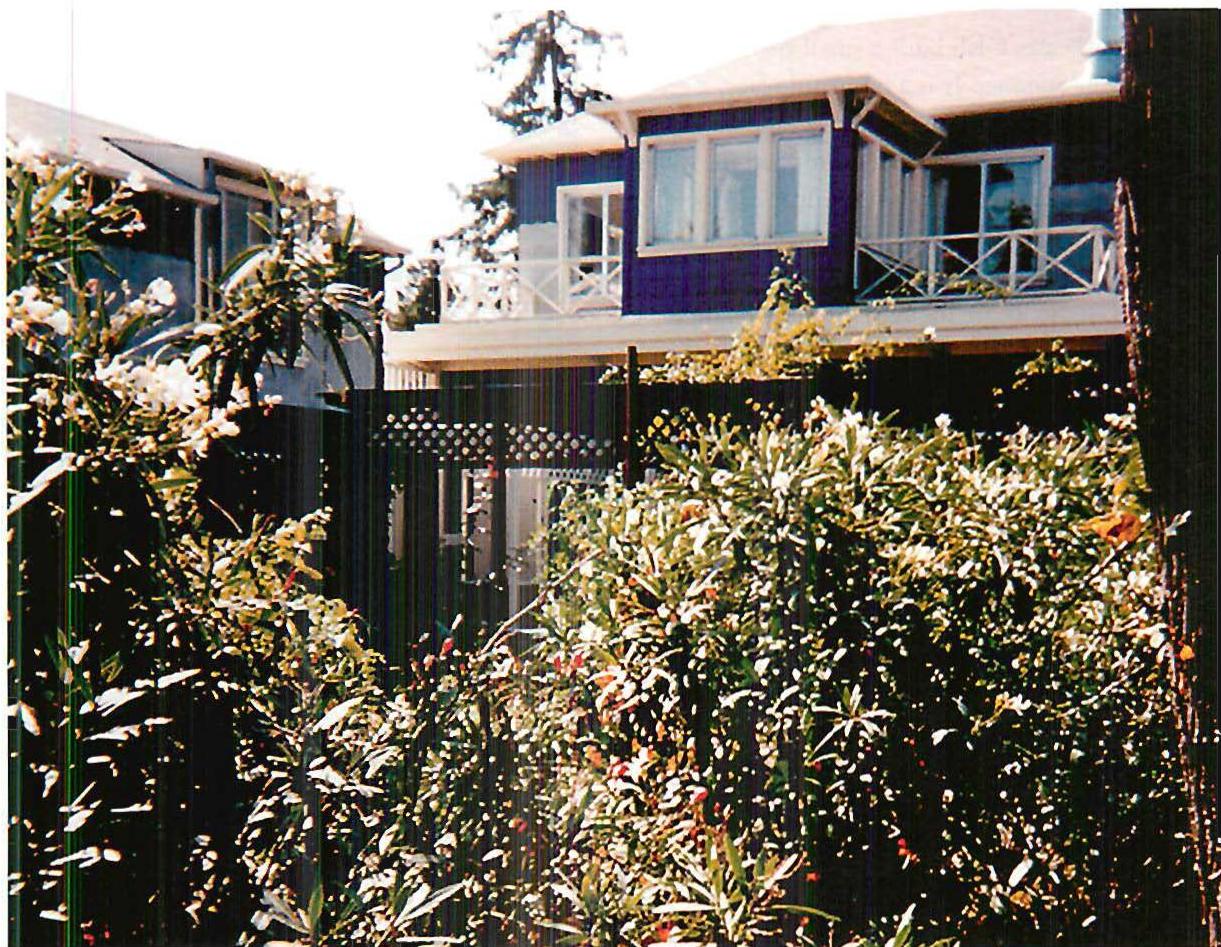
The process of getting this rather intense blue for the Kaiser house in Palo Alto was interesting. I was unsure what color would work best. Indeed, it was so difficult that it did need work on paper. I had several xeroxes of a color photo (before the house was painted at all), and I painted the house walls in gouache on the xerox copies. I made a green one, one turquoise, one heavy green, one light blue, one intense dark blue with a touch of green in it. The light blue was not good.
Strangely, and to my great surprise, the intense dark blue had by far the most harmonious life. I suggested this to Gail Kaiser. She hated it and wanted a more conservative pastel blue. I really did not want to ruin the house with that pastel color. We argued for several weeks. Finally, a godsend, her mother came to stay and told her how beautiful the deep intense blue was, that it was better for the house and brought more life to the street. She accepted her mother's view. We painted the darker blue tinged with green.
6 / ANOTHER CASE OF THE SURPRISING NATURE OF COLOR THAT UNFOLDS
A third case. CES built a small spa for George Sarlo in Sonoma. It is a beautiful place, a green lawn on a hill with big oak trees, and below it a shrubbery, looking over vineyards and the valley. Out in the shrubbery, we built a platform of white marble with two pools, one hot and one cold, overlooking the vineyards.
Originally, we thought the pools ought to be blue. George wanted them blue. And we too thought they ought to be blue. But once we had built the tubs in rough concrete, we began doing experiments and found a different thing.
Blue looked artificial, too strong and crude in that place. It did not have the subtle harmony of the place. It was all right as an idea, but not as a reality.
Eleni Coromvli and I began trying different colors. First we tried yellow. The yellow had very good interaction with the white. Small amounts of yellow had a harmony there.
But then, to subdue the yellow and to complete it, we needed green. We found a blueish green, very pale, for the tubs themselves.
So in the finished place, the white platform has yellow dots on it, in groups of three. And the tub is surrounded by a frieze of yellow leaves on white, with a wavy line of green above it, and a solid zone of green below.
Once again, we had started out thinking blue was right. Convention would have said so. But careful experiment—paying attention to what was needed to extend the life of that place and its actual structure, to make a harmonious unity—showed us pale green and yellow.
Again it was something quite unexpected. This unexpectedness often impresses itself on us
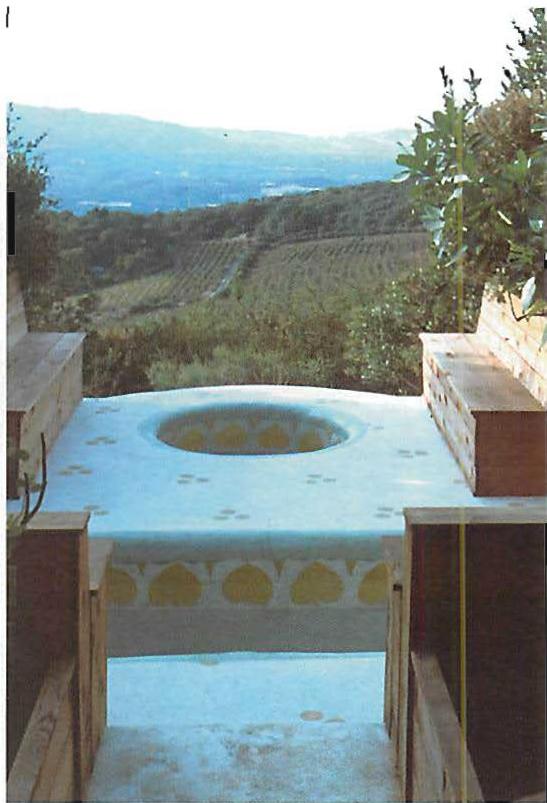
clearly and autonomously. Especially clear in the case of color, this is typical of all structure-preserving transformations. The fundamental process, with its emphasis on structure-preserving transformations sounds conservative. To some people it may even sound as if you don't "do" anything. But the real process is quite different. It almost always produces beautiful, yet startling and often highly unexpected, results.
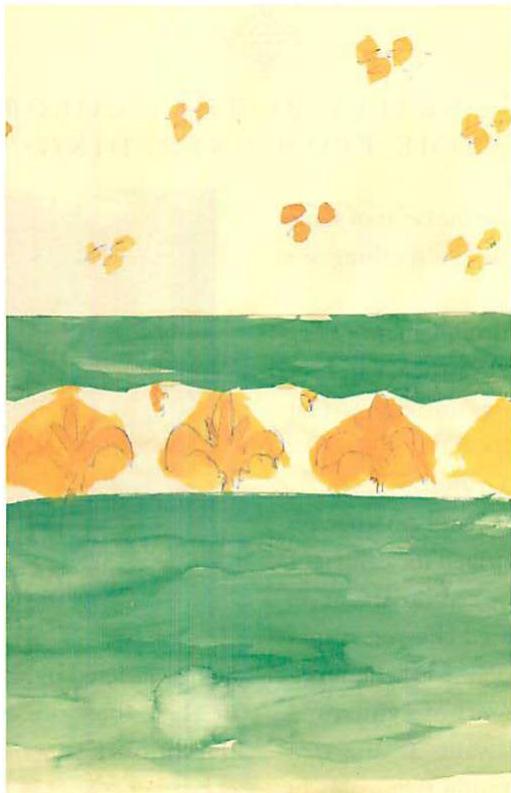
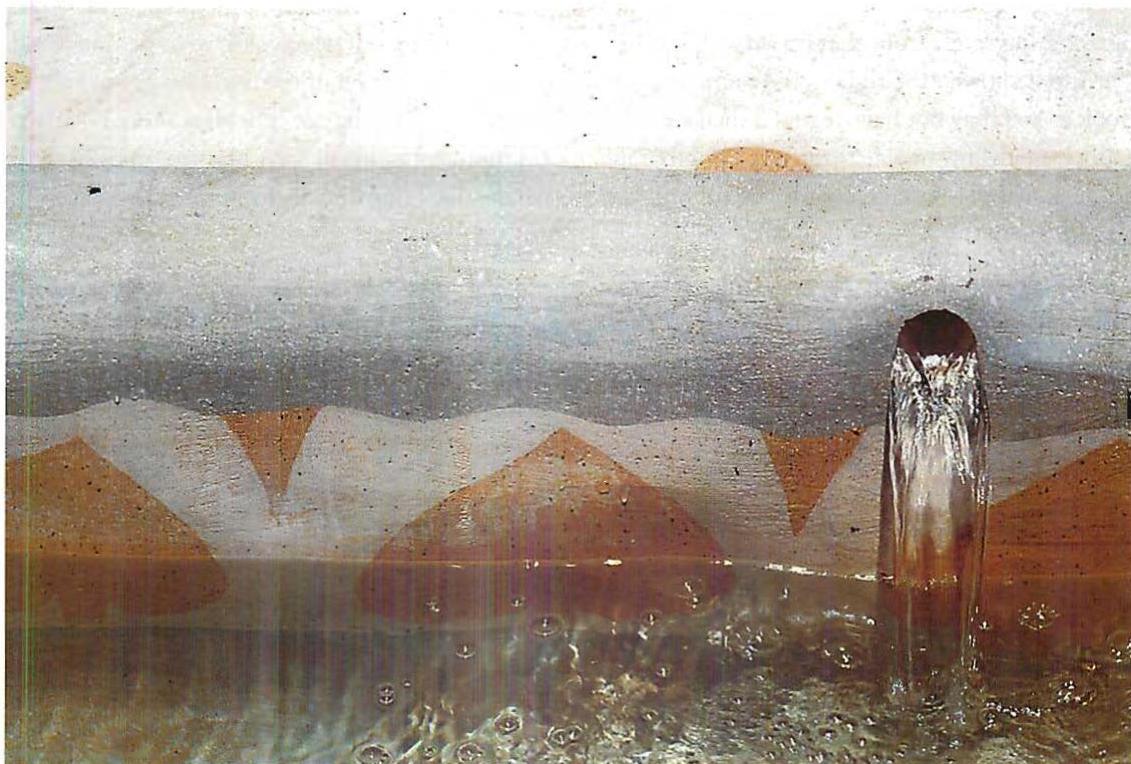
7 / HOW CAN IT REALLY BE THAT COLOR AND DESIGN COME FROM UNFOLDING?
I finish with an example where the color of some part of a building is complex, something we would normally call a design.
Normally we ascribe this refinement of design and color to the artist. How then, can I really claim that this comes from "unfolding," that is to say from autonomous acts within the object and not from the will of the creator.
You have seen the right-hand photograph before. In Book 2, I have described the capital of the Great Hall at Eishin, the red ornament on the blackish plaster, and the red chevron stripes (Book 2, pages 378-82). I explained there, how this too, though it has the quality of a vision and therefore is artistic (if one wants to use that word), really comes from a vision that arises in the mind's eye as a result of painstaking, energetic, and unrelenting pursuit of the right feeling in the thing, the feeling which is there, then following and enlarging the thing, and the design coming solely from that activity.
I first showed the right-hand photograph in Book 2. You may not have realized then that it is a mock-up. Many people think it is a photograph of the actual plaster taken while the column was
being plastered in black and red. Actually, it is a mockup, three stories tall, with full scaffolding. But the black paper, and the red, are huge sheets of butcher's paper, which I painted on the ground, and which my assistant then hung, clambering around in the scaffolding, while we tried to decide which color was best, how much of it there should be, how dark the red should be, and so on.
I asked myself what color, what design, could provide articulation of the bays and unification of the columns in the space. The black, heavily-drawn columns, formalized, seen massive, marked with red details, came directly from that question.
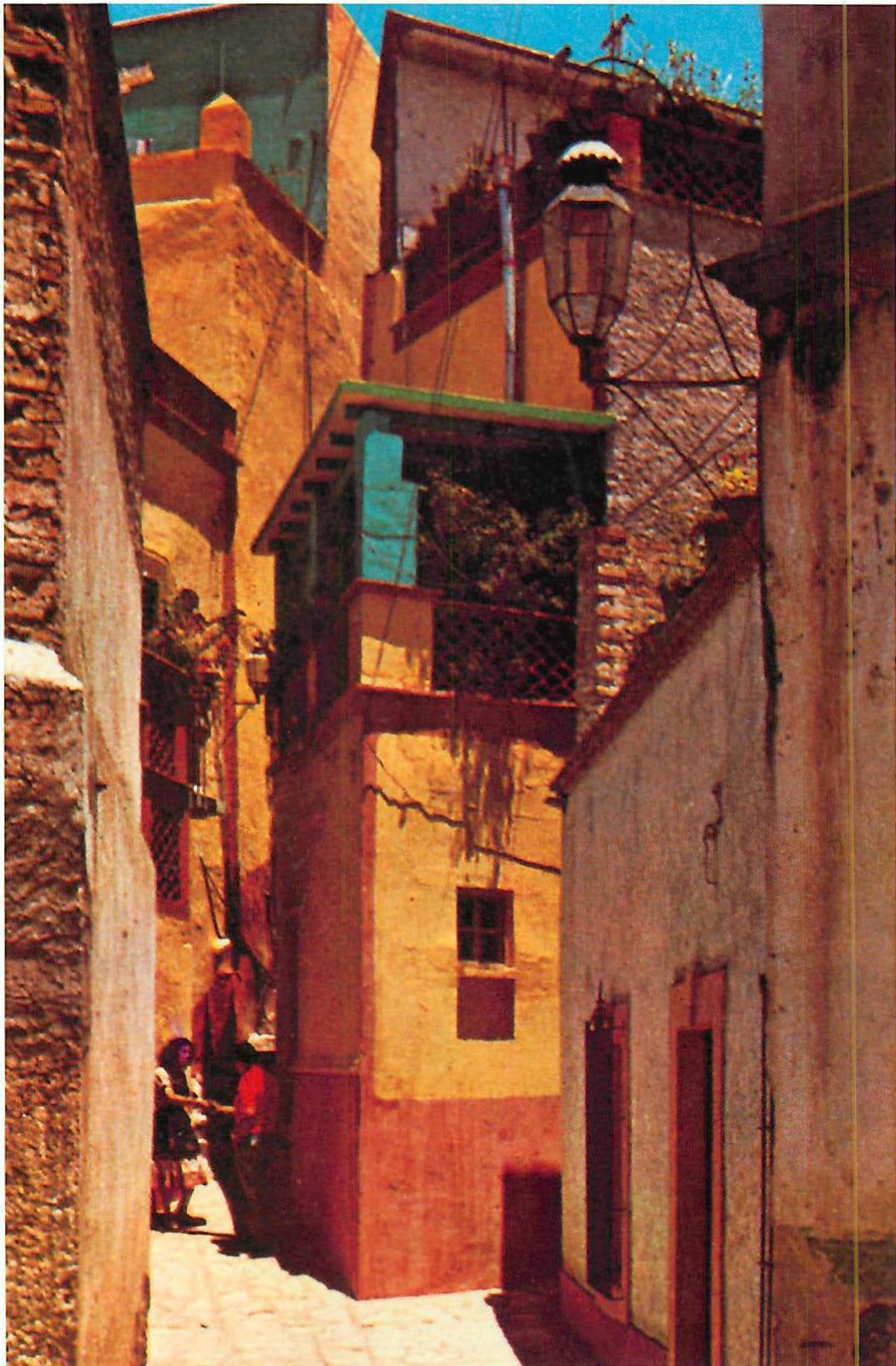
And then, within a black-and-white drawing of this structure, I asked what color qualities would bring this column to life.
First we got the reddish black of the columns themselves. And then, at that stage (with the blackish red in place), once again, I asked myself which red color would now create the most intense and harmonious light. The rather deep red touched with lilac on the ornaments presented itself, then, as the color which would do this most.
What looks like a wilful or created design by the artist really just arises almost by itself from careful pursuit of that simple question, over and over again.
8 / COLOR IS SO EFFORTLESS
Color is a fundamental human experience. It is natural to put color on things, and to make things out of colored material. It is, for many people, the most natural thing: in Africa, in Turkey, in Greece, in Jordan, in Venezuela, in Mexico. To emphasize the ordinary naturalness that comes from color, I show (opposite) an example of a building painted by someone (who knows who it was!) making a street beautiful.
9 / MORPHOLOGICAL INVARIANTS WHICH APPEAR AS LIVING COLOR UNFOLDS
What characterizes the color and color combinations which are created by the use of the fundamental process? More precisely, what typical structure follows from the continuous, step-by-step attempt to create life in the color of a building by unfolding it experimentally?
The experimental method—starting with a vision in the mind's eye, then creating color by conceiving and adding color in such a way as to create life in the centers—has certain predictable results. These results (eleven invariants which resemble the fifteen properties) are summarized briefly here. They are described fully in chapter 7 of Book 4, where the life that can happen, through color, is rather carefully analyzed as "inner light." The eleven are: I. HIERARCHY OF COLORS, 2. COLORS CREATE LIGHT TOGETHER, 3. CONTRAST OF DARK AND LIGHT, 4. MUTUAL EMBEDDING, 5. BOUNDARIES AND HAIRLINES, 6. SEQUENCE OF LINKED COLOR PAIRS, 7. FAMILIES OF COLOR, 8. COLOR VARIATION, 9. CLARITY OF INDIVIDUAL COLOR, 10. SUBDUED BRILLIANCE, and 11. COLOR DEPENDS ON GEOMETRY
First, the structure-preserving process, in relation to the surroundings, points to an overall color in which COLORS CREATE LIGHT TOGETHER—something like a complementary color of the surroundings. This color, like the blue of the Kaiser house, is occasionally startling and surprising. In other instances, like the yellows and greens of the Sarlo spa that mirror and complement its landscape, the color can be an echo of the FAMILIES OF COLOR visible in the surrounding hills.
As a result of further efforts to make the color come to life, the colors may then be supported by smaller areas of different colors forming a HIERARCHY OF COLORS). In finer detail, an overall glitter of tiny amounts of contrasting color may begin to show—HAIRLINES, SEQUENCE OF LINKED COLOR PAIRS, MUTUAL EMBEDDING. Finally, the effect, when successful, can be a quiet harmony: the grays and reds of the West Dean Visitor's Centre (Book 4, pages 288-89), or the interior blackish red of the San Francisco Art Museum (pages 426-27), a SUBDUED BRILLIANCE made more subdued by COLOR VARIATION.
All these qualities of the color are likely to emerge from use of the fundamental process in the sphere of color. They are described in great detail, with many examples, in the 86-page chapter of Book 4 called "COLOR AND INNER LIGHT."
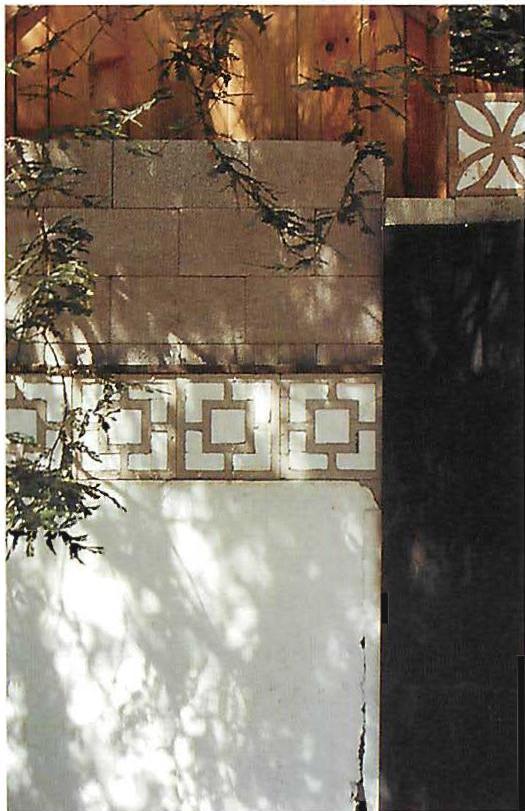
SUMMATION: THE MORPHOLOGY OF LIVING ARCHITECTURE — WHAT WE MAY CALL ARCHETYPAL FORM
IN A BUILDING WHICH HAS LIFE, WHATEVER IS MADE IS ALWAYS THE SIMPLEST THING CONSISTENT WITH ITS NECESSITIES OF FEELING AND WITH THE CLOSE AND CONTINUOUS ATTENTION TO FEELING WHILE IT EVOLVES INTO FORM. THIS, I THINK, IS THE CLOSEST I CAN COME TO DESCRIBING THE CORE OF ARCHITECTURE.
1 / EMERGENCE OF AN ARCHETYPAL CORE
When everything is going right, when the fundamental process is used well, what comes out is not only natural, not only simple, not only living structure. It has, too, an archetypal quality—something savage.¹
Many 20th-century artists have been aware of this savage core, and have, in one way or another, searched for it, looked for a path that leads to that door. In music, Stravinsky, Bartok, Prokofiev, all of them searching for folk origins transformed to a deeper substance. It is not The Rite of Spring that I am talking about, not the conventionally savage. It is the music of The Soldier’s Tale, something that strikes to the core of a person — simple, everyday, rhythmic, persistent, anguished. In Prokofiev, it is not the Classical Symphony, but Alexander Nevsky and certain passages from A Love for Three Oranges. In these works something everlasting came from our time. In the domain of carving, African masks and sculpture have inspired us. In the domain of painting it was the savage color of Dérian and Vlaminck which perhaps came closest to it; also some of the paintings of Rouault. In building, it is the massive wall, the carved ornament — spontaneous, crude, not manicured.
Throughout, I have tried to show how such life can come about, naturally, by unfolding from the fundamental process. But what I also know is that works of building come closest to something truly valuable, when they reach this savage core. It is this savage core which will arise naturally from unfolding and from the fundamental process, when they are most purely used.
I myself have sometimes — a few times — managed to reach the archetypal form which follows from true unfolding — just a few times, not many. The Judo Hall (page 659) is one place where it did come out. Possibly the gymnasium on the lake was another place like that (pages 684-85). It is hard to do more than reach fragments of this quality. I can show one part of a building which has it, even when another part of the same building does not have it, or does not have it to the same extent.
Many examples of the way my projects have arisen by unfolding have been given throughout the last few hundred pages. I shall repeat pictures of a few of these examples now to underline exactly what I mean by their “archetypal” form. It is as if, when something is successful, it reaches the same deep underlying form again and again; it is always one form, that one form which can take a thousand faces. One learns it, in the end, by feeling it, and by example. Mixed with my examples, I have shown other examples of this archetypal core from other places and times in history.
It is always the same substance. Technology changes continuously as society changes. Through the changing technology, the eternal forms are continually refreshed and given new character, new implementation. That is the temporally changing part we know as style. But the core, the unchanging core, is the expression of ancient and eternal truths of unity.
Later, in Book 4, I shall describe that core in a different, even more specific way.
2 / A COLLECTION OF EXAMPLES
What follows is a summary: a pictorial essay to illustrate the class of living structures
Towards the end of the chapter we shall begin to see the gradual emergence of archetypal form, and what it means. The text continues on page 655.
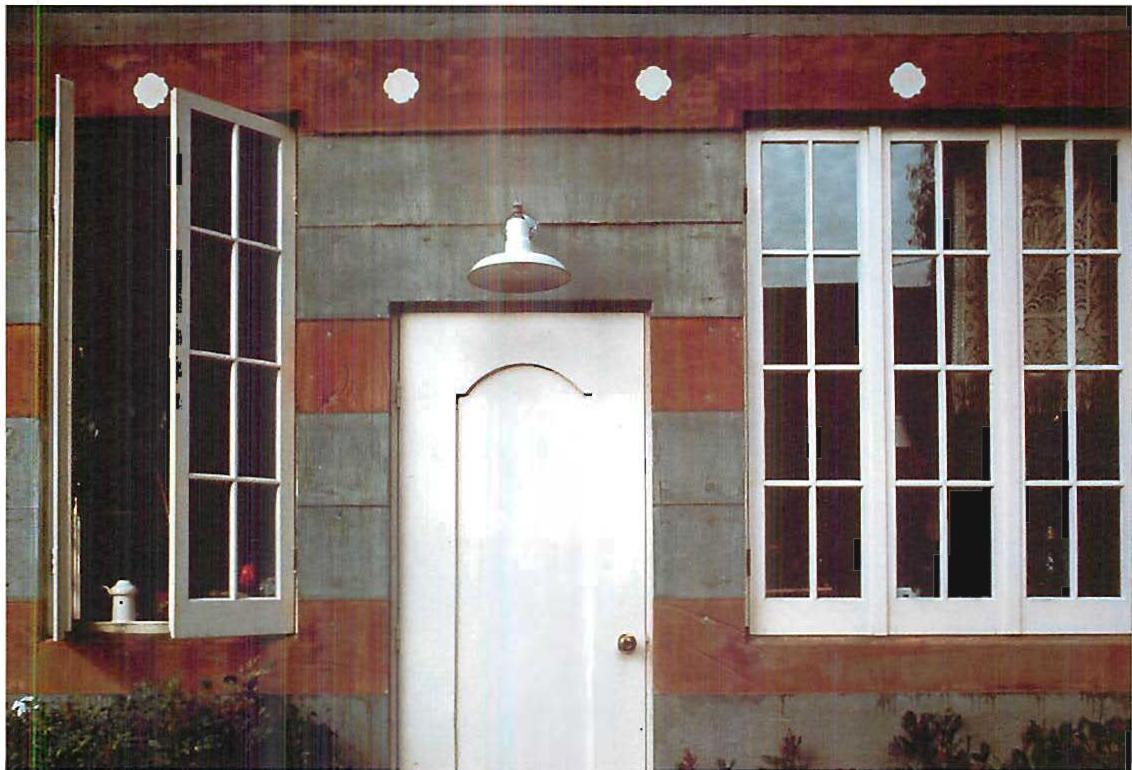
Throughout this book I have taken a certain amount of care with the pictures. When I began work on the book, I tried to write material that would show the results of the fundamental process, give examples of a living world. Although I wrote material that was, in itself, interesting, I was not really managing to catch the whole spread of it, the broad picture. So, at a certain stage my assistant Katalin Bende and I began to make a huge board in our office. I asked her to put hundreds of pictures of my built work on this board. Some were large, some small, some tiny, a few were very large and impressive; some were plans or sections, mainly photographs, some drawings. Some were in color, some of the most vivid were in color, others were in black and white. Once we had the collage started, we looked at it every day for a while, changing and improving it. I used to look at the board, and say, “No we need more of this, or less of that. Let’s take this one away. Let’s have a really big one of that building, you know, the long picture with the sky showing,” . . . and so on. Gradually, we came closer and closer to building a single picture, a single collage of plans and photographs that, taken all together as one thing, showed the invariant character I am driving at. By the time we were done the collage had about 500 pictures. In my eyes, it worked beautifully. One came in, looked at it, and could say, “Yes, I see that thing, I see what is common to all these pictures. This is about a single character.” Those 500 pictures form the basis of the illustrations in Book 3; they are intended to present that character. And what lies in this chapter is my attempt to distill the character still further, into a few images.
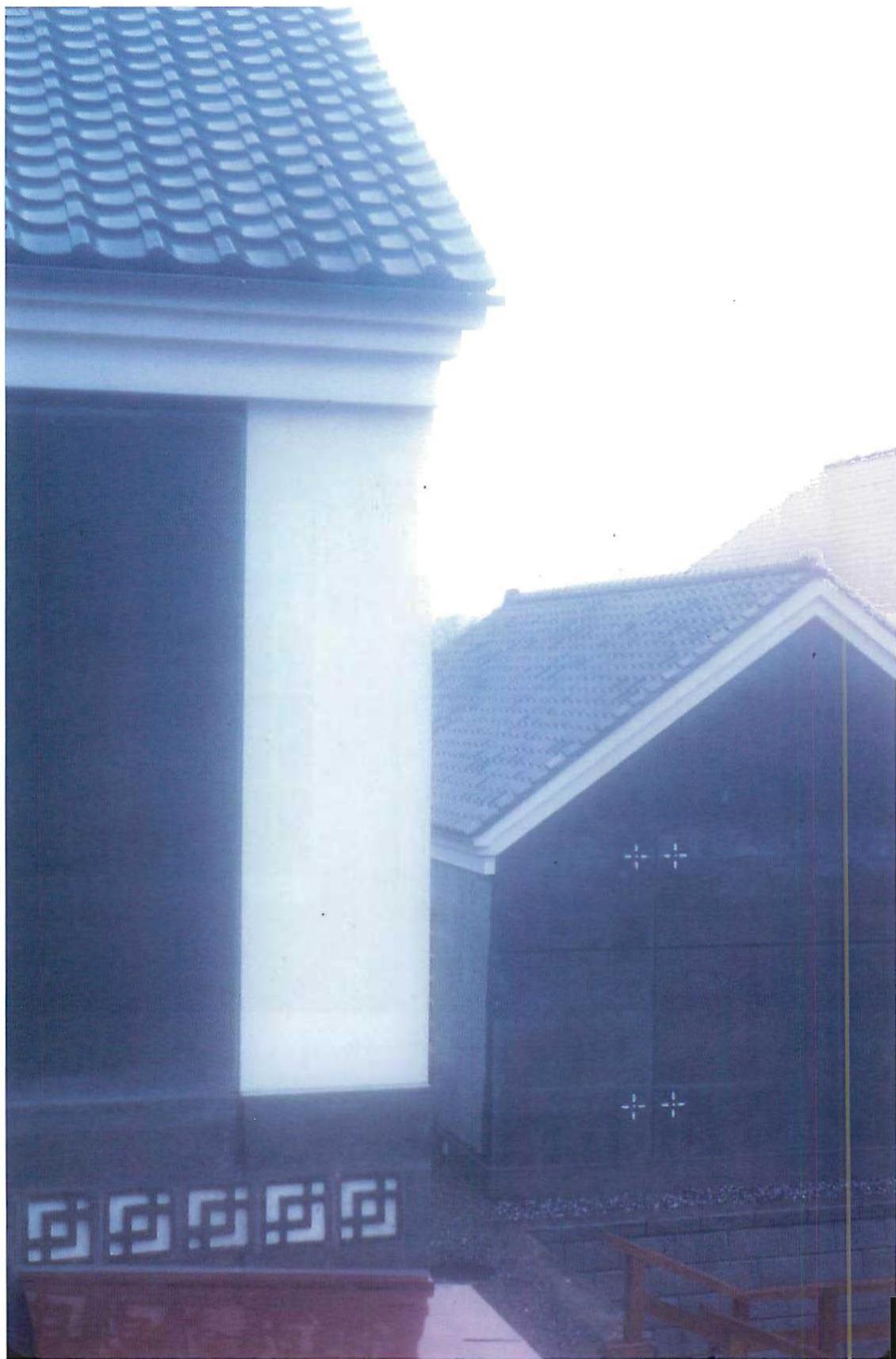
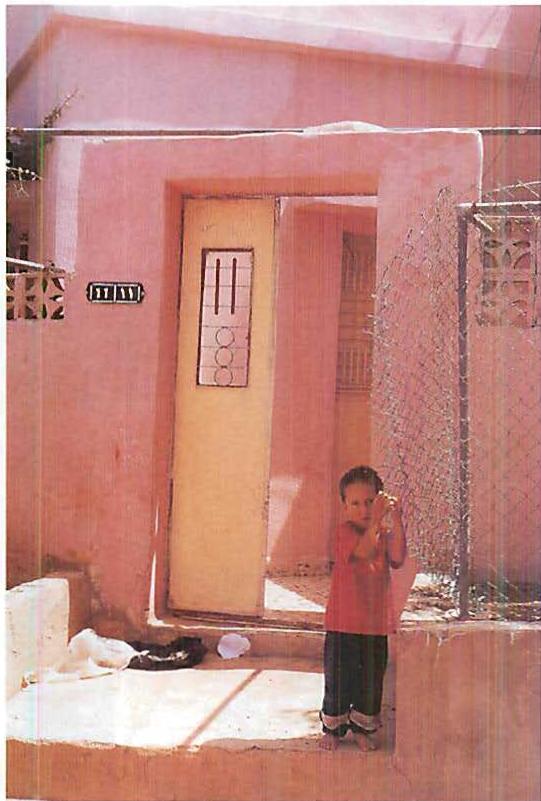
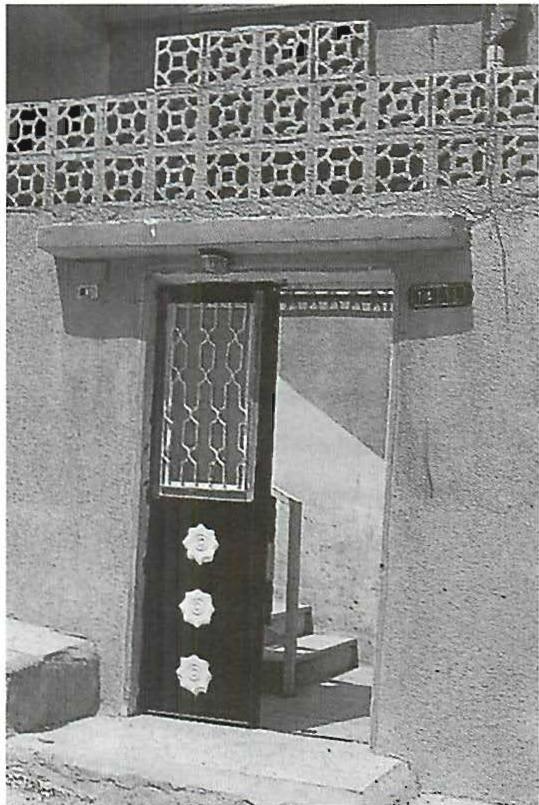
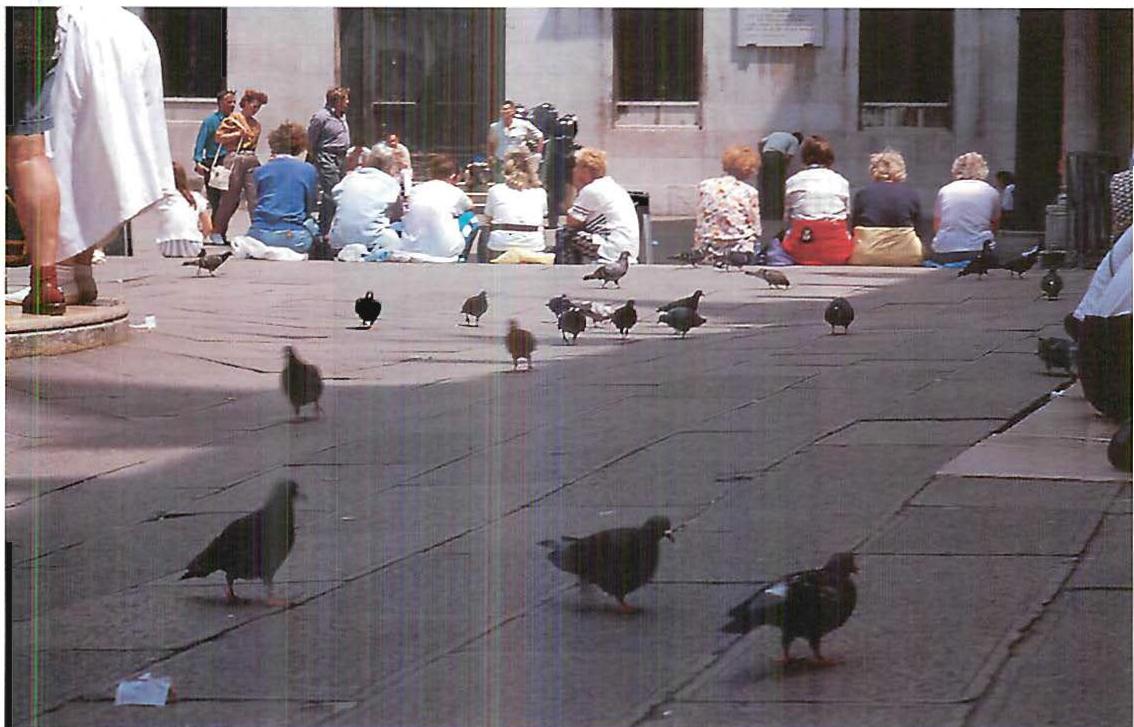
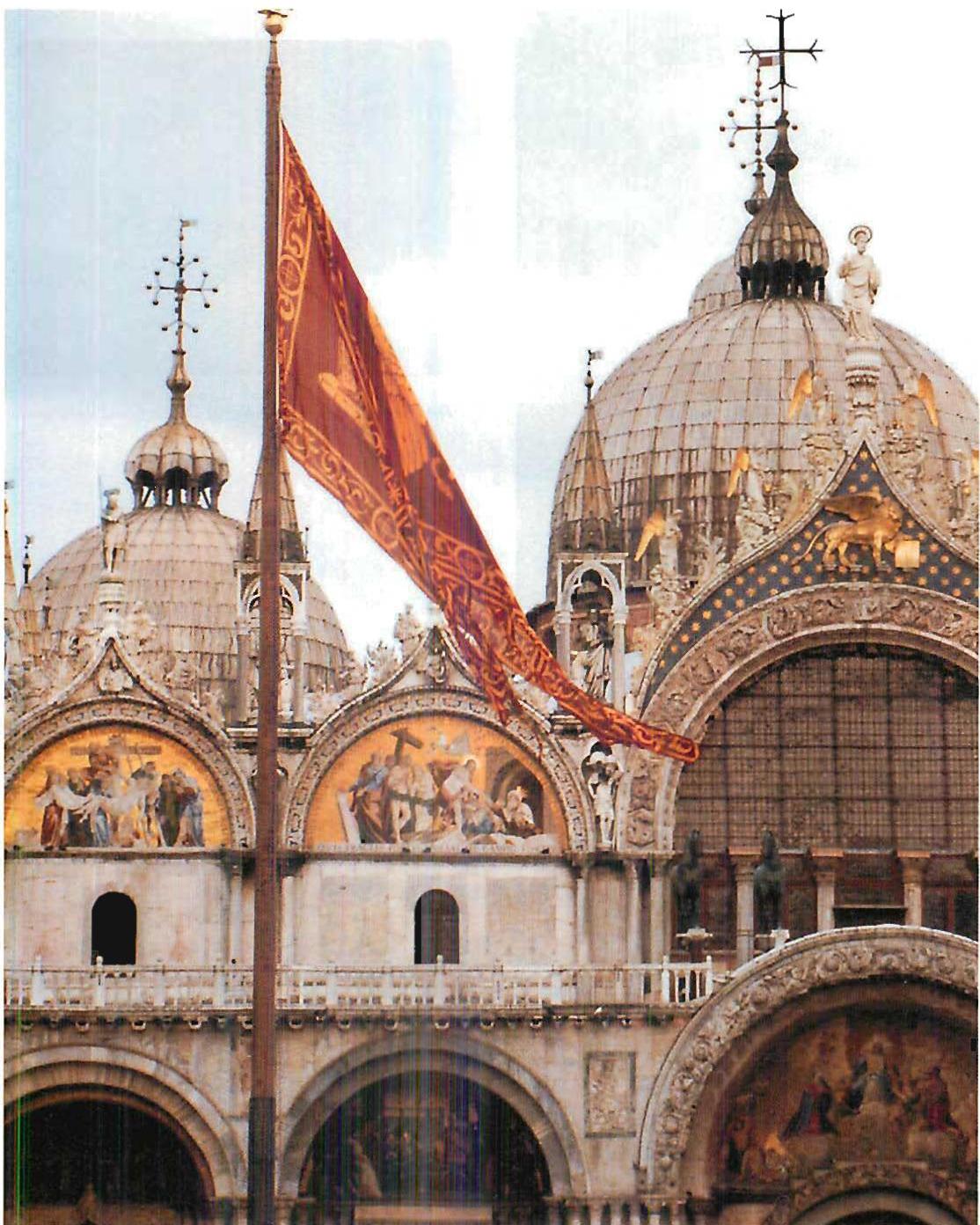
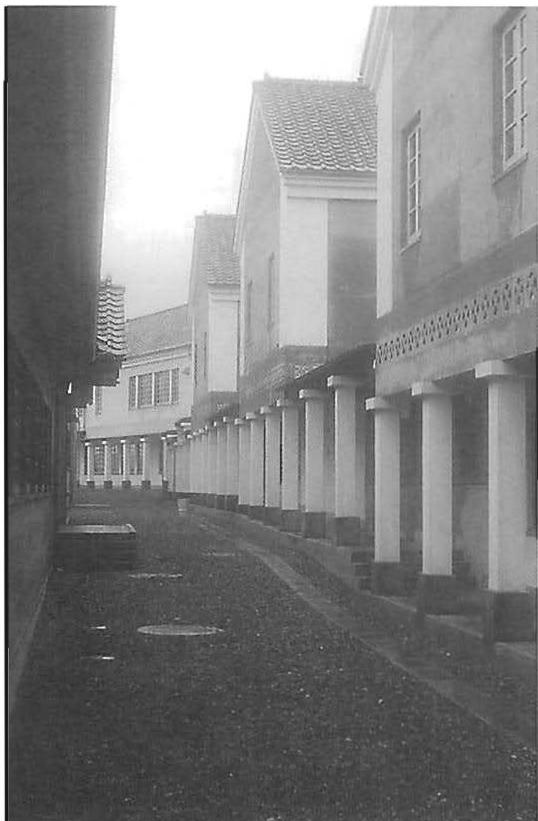
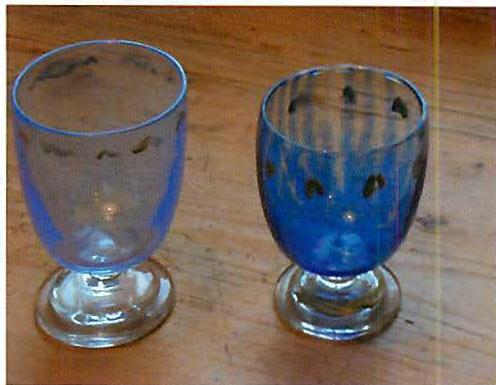
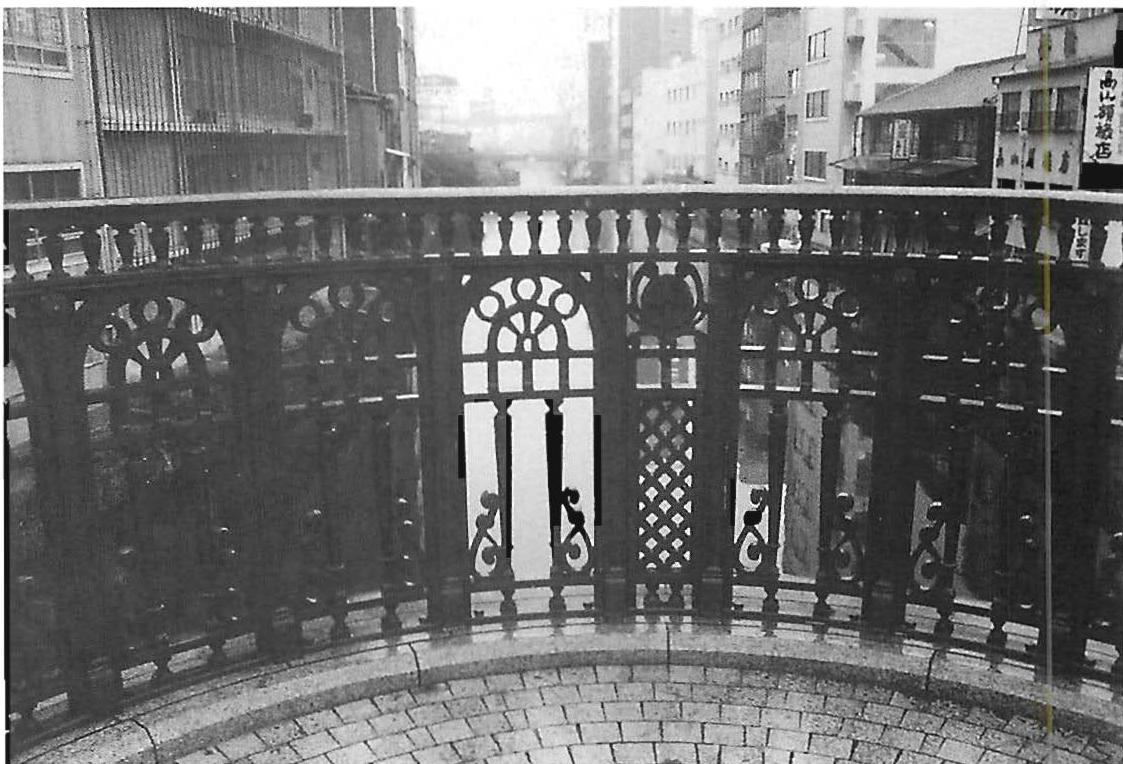
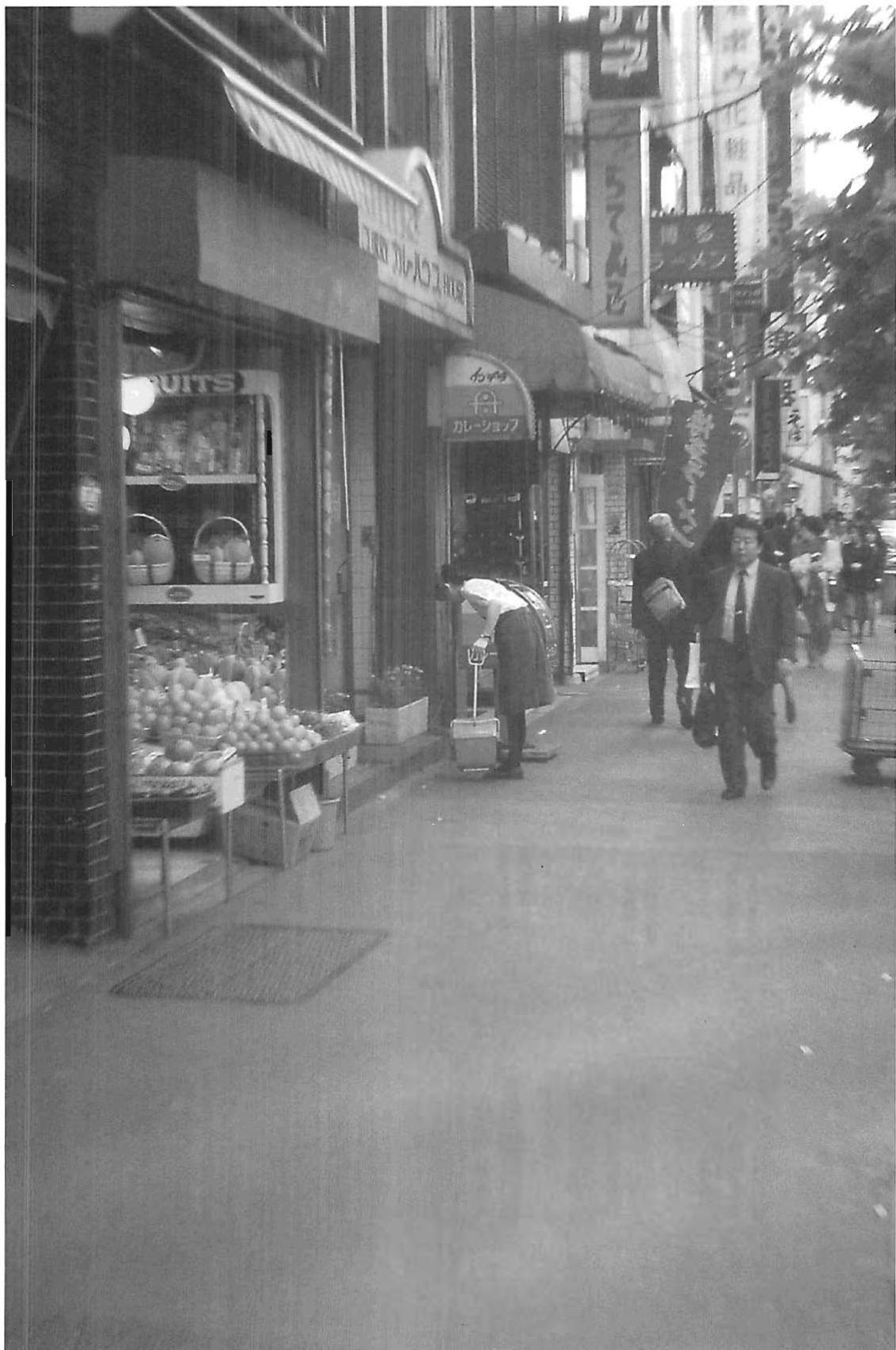
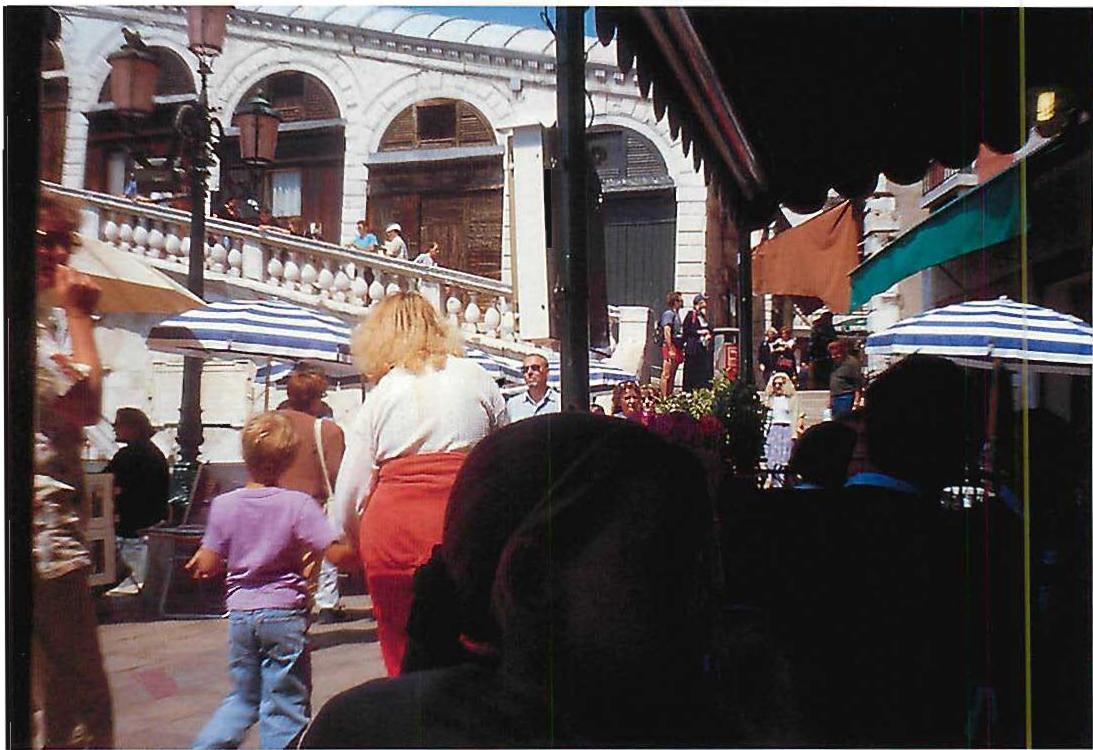
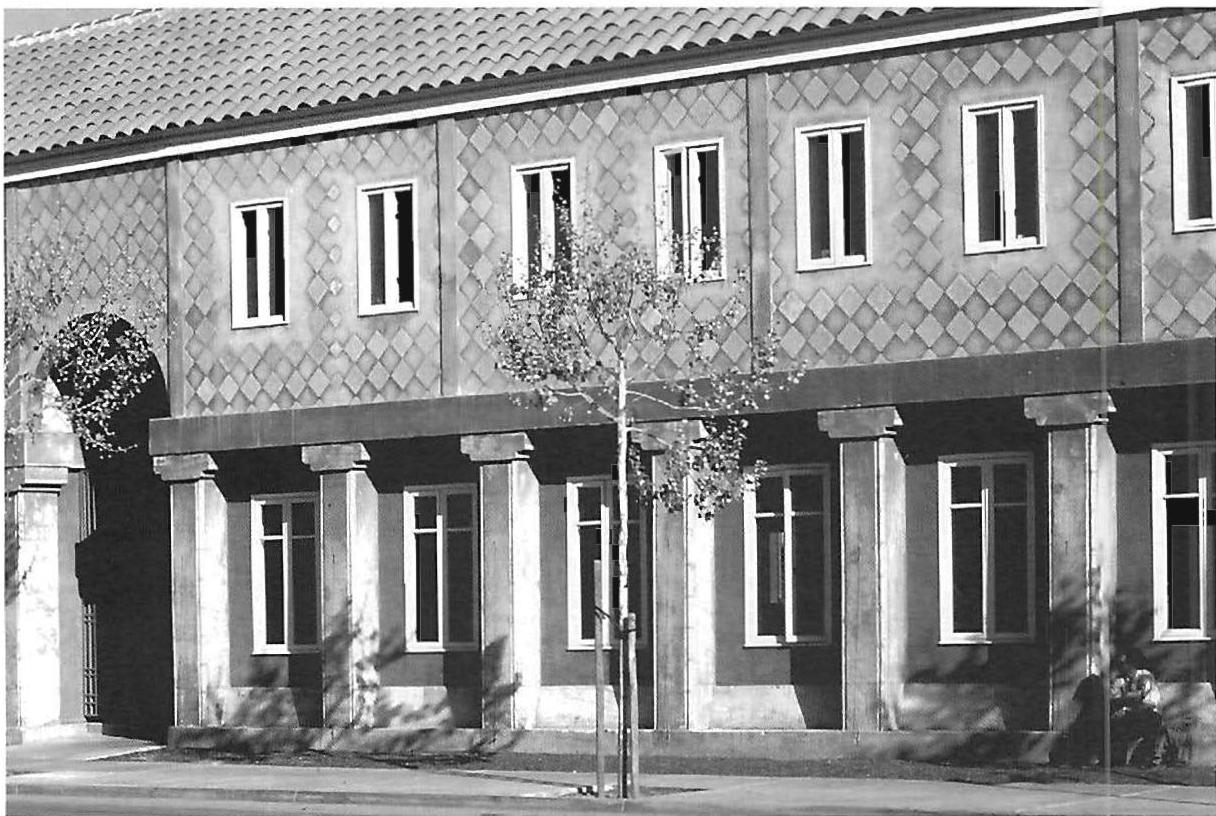
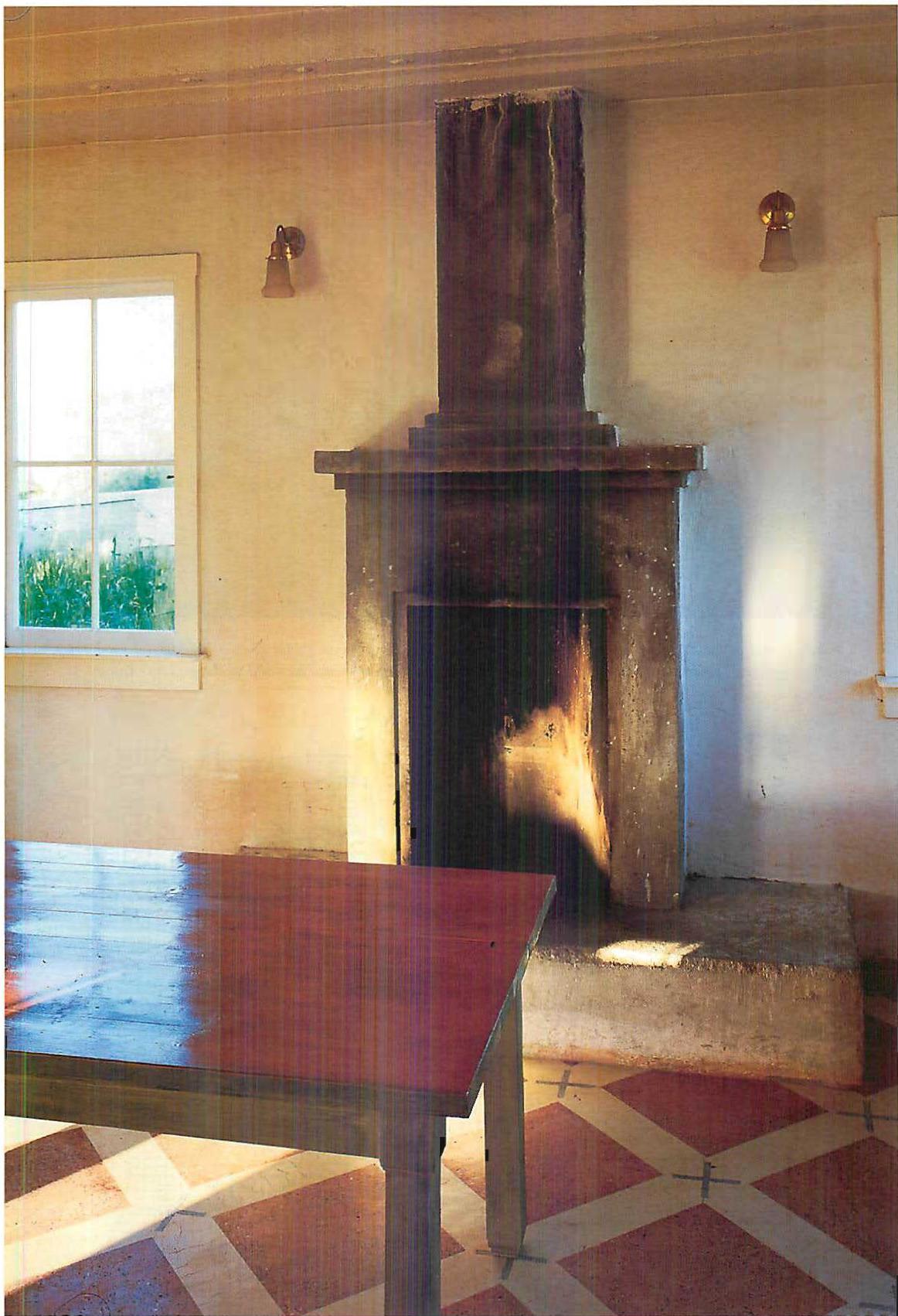
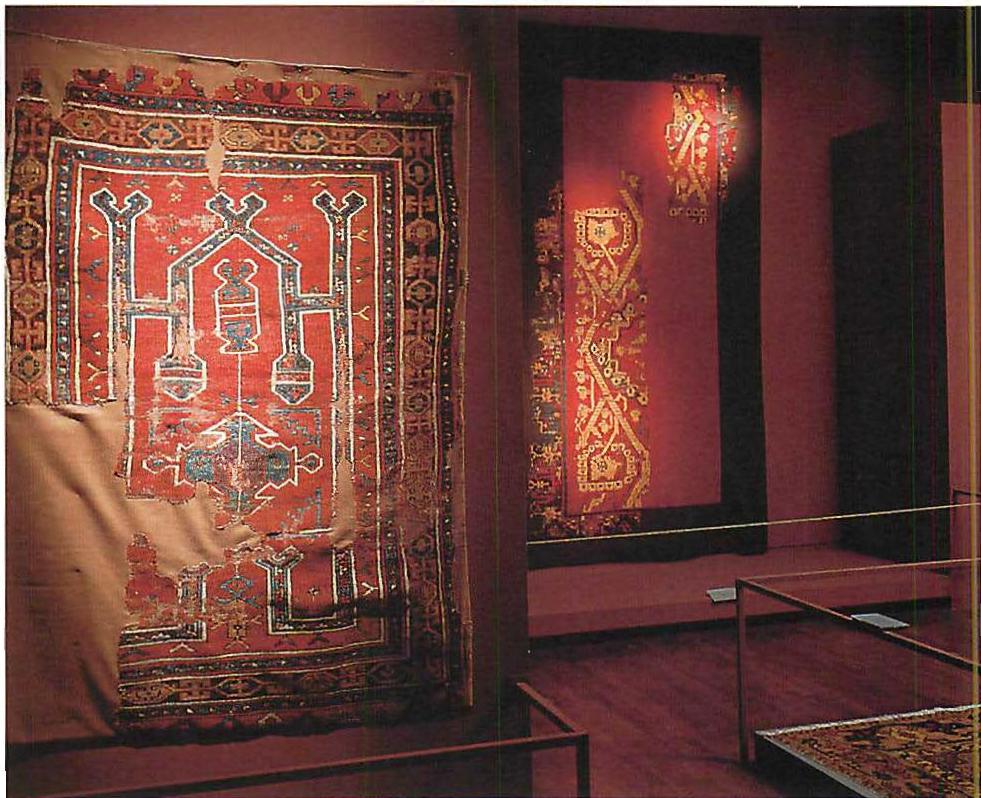
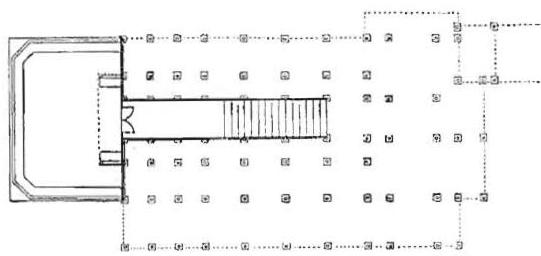
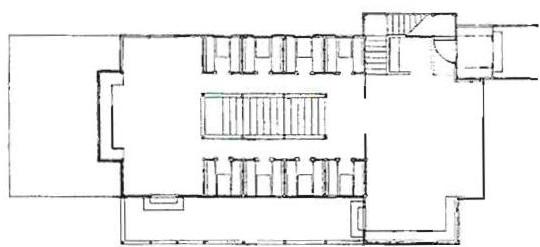
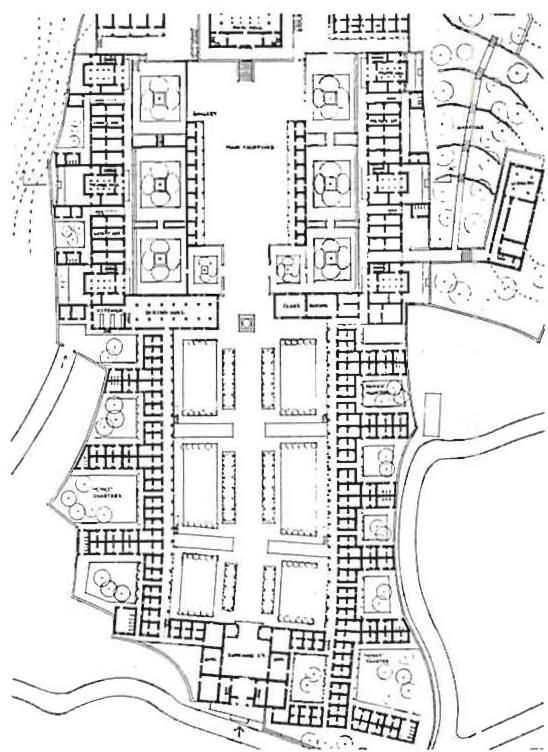
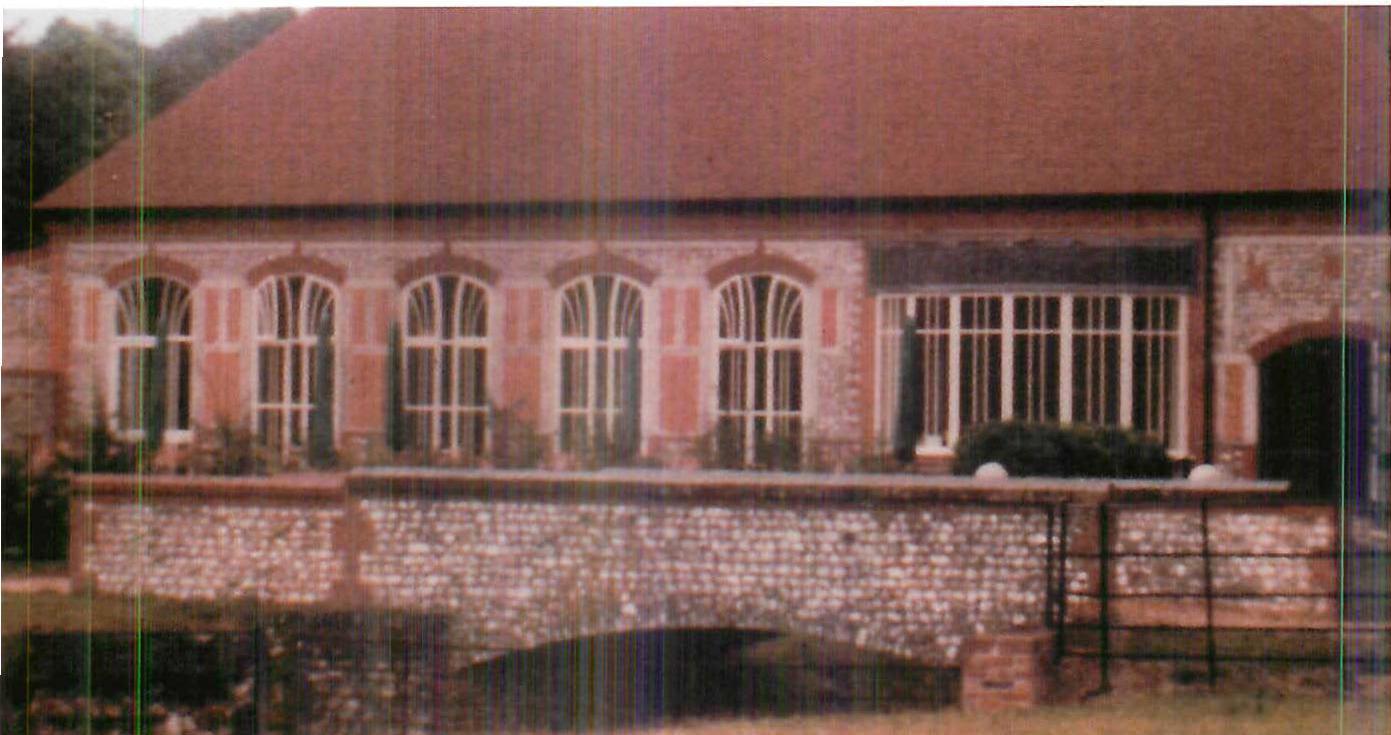
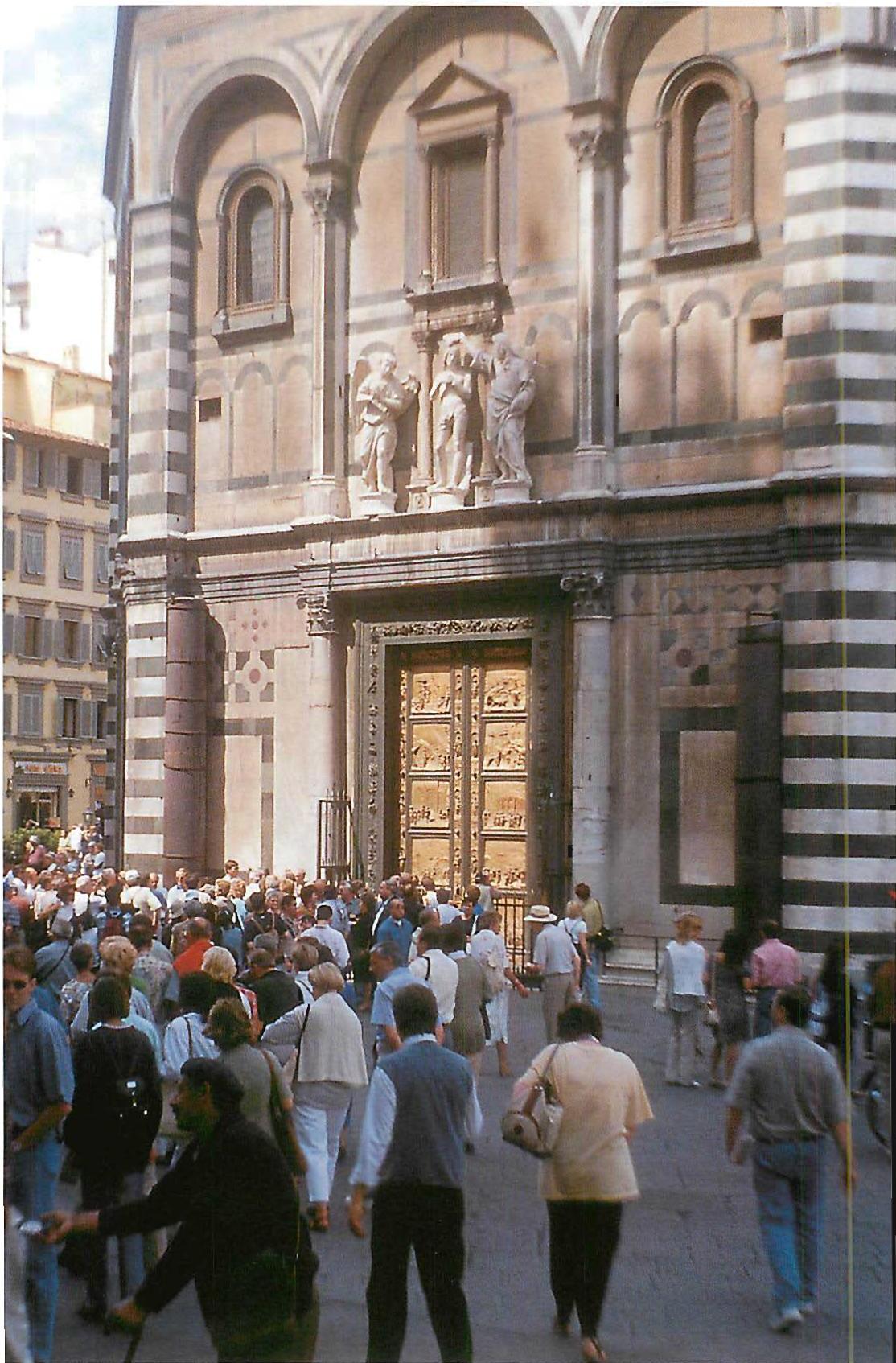
3 / PROCESS AND GEOMETRY: THE ORIGIN OF ARCHETYPAL FORM
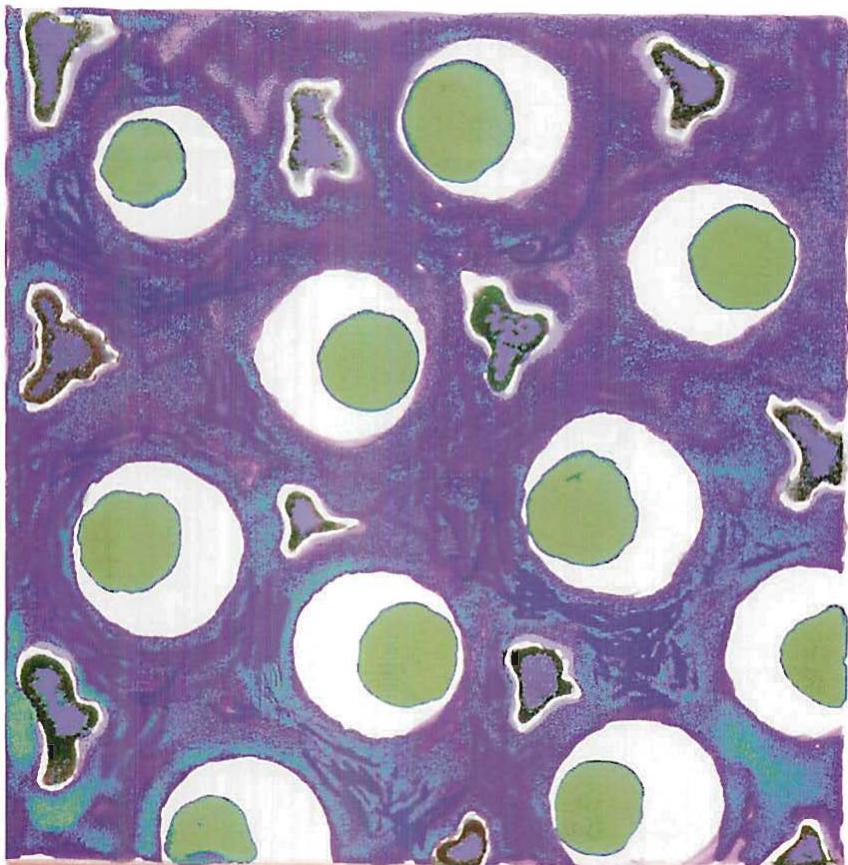
I have called these four books THE NATURE OF ORDER. By this I mean to say that all living structure in the domain of buildings, as in other domains, will have a recognizable order, a certain way it looks.
We cannot hope to create such living order in buildings merely by concentrating on the way our buildings look. We also cannot hope to generate true life in buildings and streets unless what results from our efforts does have the structural and geometric marks of life and living order in it.
It is therefore important to discuss the actual geometry that comes from living process — what used to be thought of as style. What style of buildings should we expect to find if we construct a living order?
The question is profound. If we want to make living structure in the world, we need to be able to characterize architectural geometry so
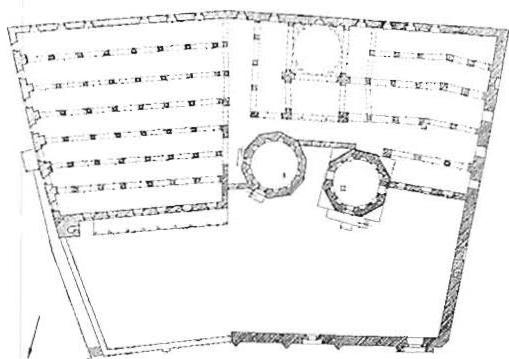

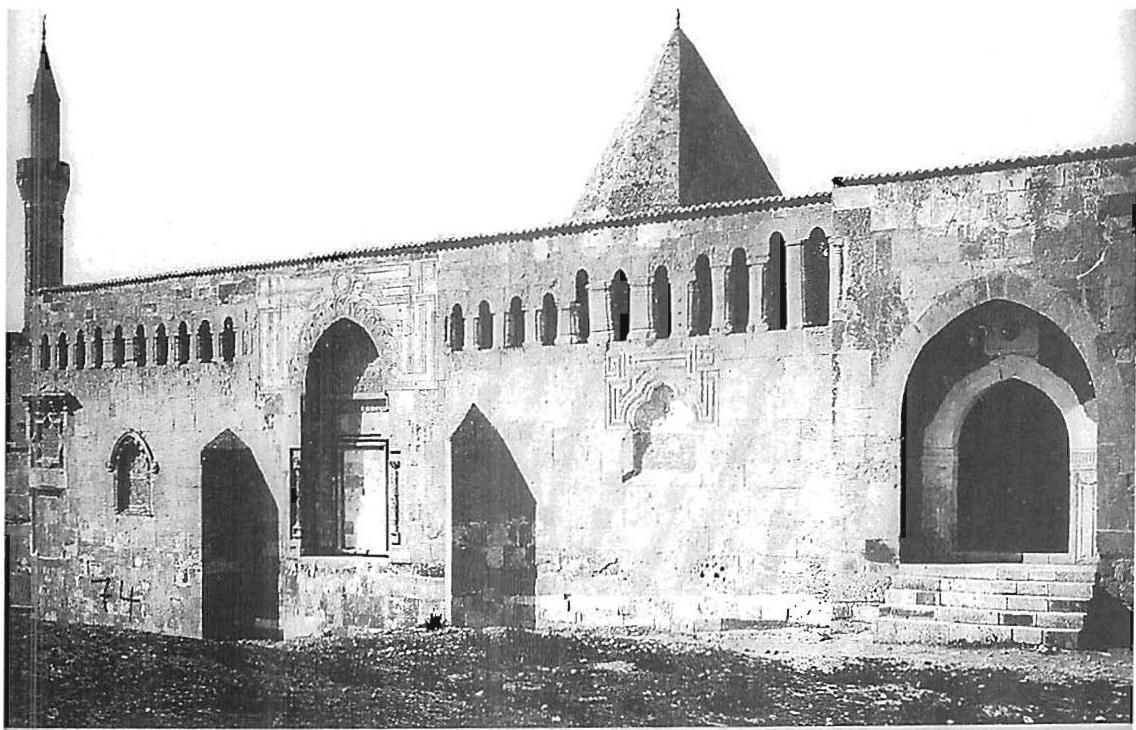

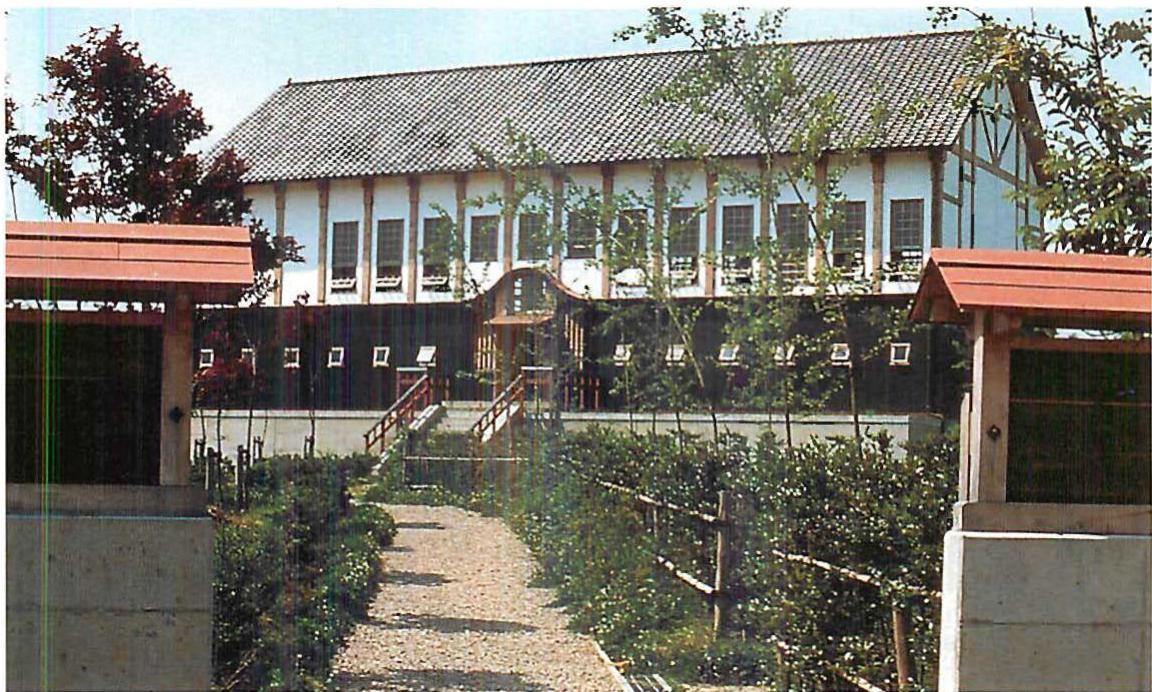
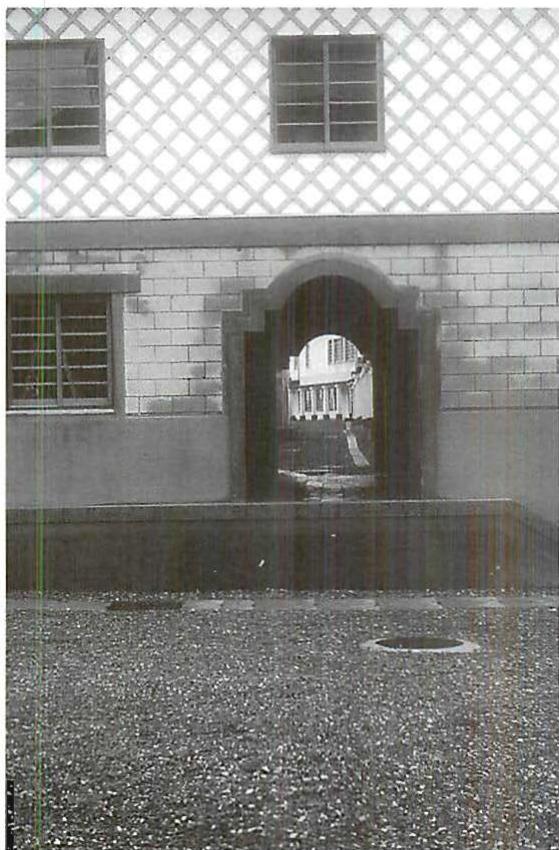

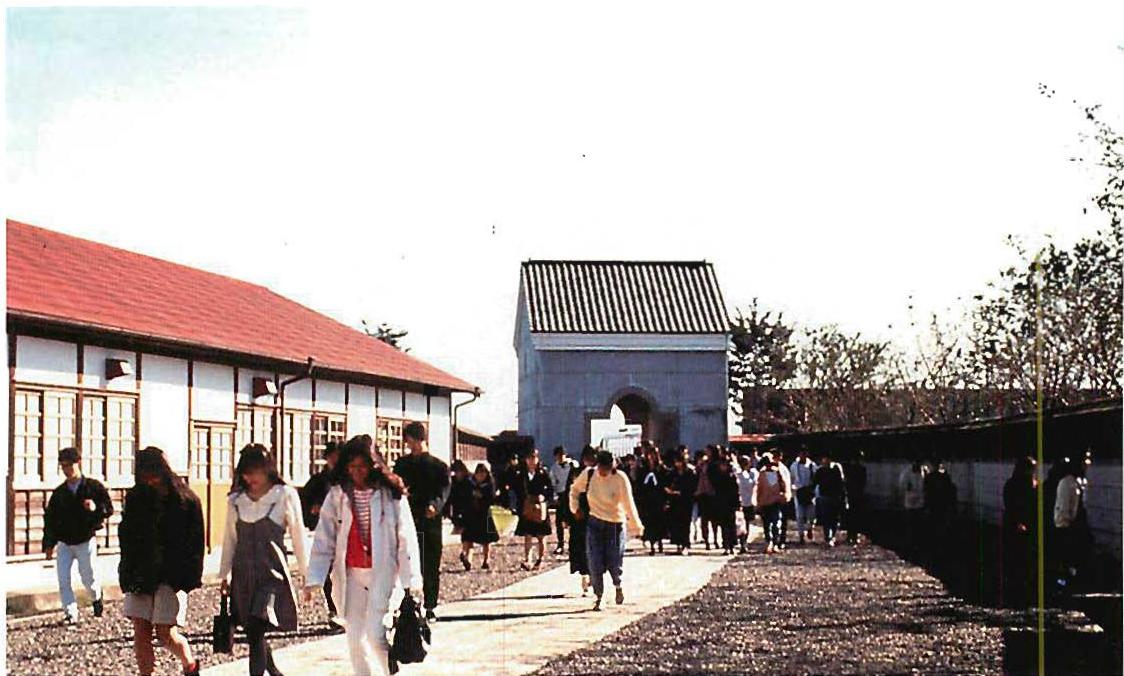
that we can use the characterization to check our work constantly while we are working, to see if what we are doing measures up to the standard of living structure and has the kind of order it must have.
In the vision I have been trying to portray, the structure always originates from structure-preserving process, even when archetypal form is generated from a vision or a dream. Throughout Book 3, I have tried to show, by example, how every living process must necessarily go forward step-by-step, must be an adaptive process which creates unity in the structure being made by adapting, shaping, pushing, pulling, gently easing the structure into harmony with the structure that exists.
I have also tried to show how a living process, by its nature, will always create something unique at every point. For each of the human beings in the world, the local environment created by unfolding will be individual, particular—never mass-produced, never cheap psychologically, never too-simple
in the alien mechanical sense, never mechanically bound to mass conceptions of the individual human being.
And this same respect for the individual, for the uniqueness of every person and every place will extend, too, to the broader structure of human society, to the richness of cultures and the richness of place. According to the description I have given, it should follow that each place will, in its broader character too, be unique in the world, simply because each place is different in its conditions within the whole.
This process invites a wholesome relationship between people and the earth: not exploiting the earth for gain, or for the egocentric satisfaction of invention, but rather steadily bringing forth the new from the old, drawing an everlasting fountain of new creation from the structure of the present and of the past. It also creates wholes, wholes of remarkable and robust character. Perhaps most profound of all, the forms—the wholes which are created—are in themselves of a certain nature. There is something so profound, so solid, and so
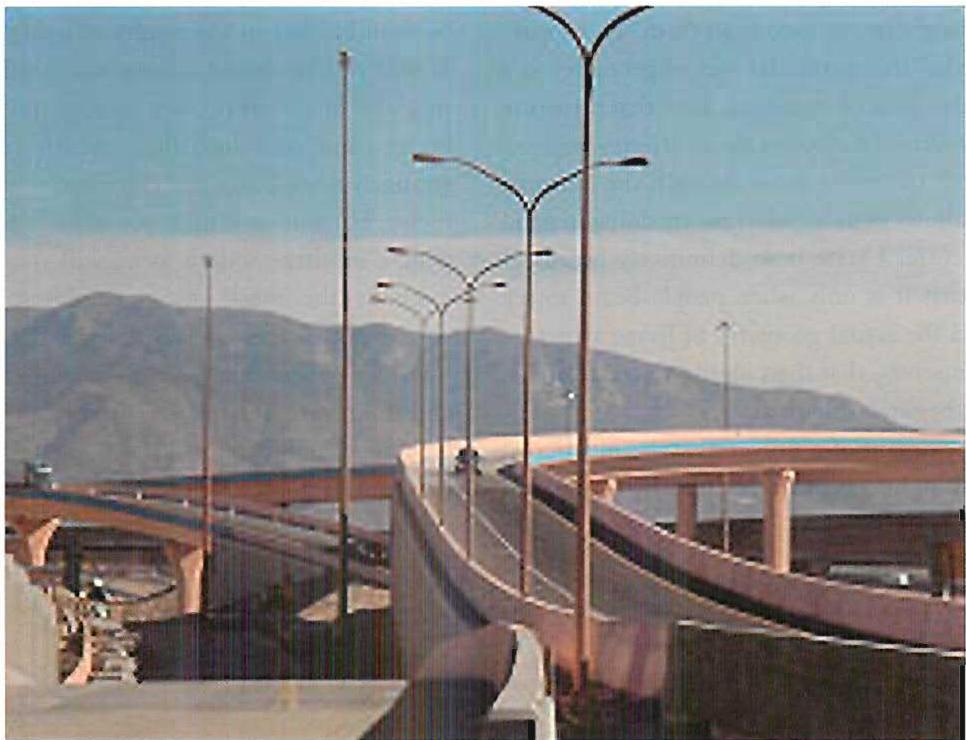
recognizable, about these wholes that it might almost be called a style. Yet it is not a style.²
The living processes are remarkable, because they are at once very simple and yet also deep and surprising. Perhaps most surprising of all, these processes are based—necessarily—on deep feeling. This would have been commonplace to people of earlier times and of other cultures. But for us, living in an age largely bereft of reliance on deep feeling, it may come as something of a shock.
In addition, the living processes which follow from combinations of the fundamental process will necessarily be generative processes—that is, processes in which the sequence of what is done follows a vital rhythm in which large precedes small, in which the whole creates the conditions for the part and shapes the parts according to their positions in the whole. This virtually rules out the oversimplified kind of mass production of components that was common in the 20th century. The uniqueness which is the most trenchant mark of life will occur and will be supported deeply, at every stage.
Finally—and here we come to the subject of this chapter—all living processes will be governed by the emergence of a special recognizable geometry, a style, an "architecture." I hope this geometry has become at least partly recognizable in the examples I have shown. It is a geometry which shows feeling; it is a geometry which shows life. In the last six hundred pages, you may see that there is something common to the examples. In some fashion they all look alike. The style—if there is one—of the many varying examples in the last 600 pages is not an incidental quality
which might be removed from them. This apparent "style," this particular sort of geometry, is a particular kind of structure. It is that structure which follows directly from the use of living processes.
That statement is, in the end, the talisman which allows us to see what we are doing in good architecture. I state it so definitively because I know that it is only when people begin to see and feel the actual geometry of living structure for themselves, that their ability to create architecture begins to flourish.
The dream of a universal style, mentioned often by architects of the early 20th century, can
be found at last in the results of living process. It will not be found among the machine-age products of the world, not among the gigantic image-conscious buildings which resemble strangely made boxes and commercial advertisements, but among a quite new class of buildings which, in ultra-modern form, will very slightly resemble the most ancient buildings of the past—not in their outward style, but in their inward essence. They are new, and dramatic, and unknown. Yet they are part of the human archetype, and therefore known, even when they have not been seen before.
4 / CENTERS AND SYMMETRIES
In the preface, describing the evolution of centers in St Mark's Square, I referred frequently to the fact that each local center, as it was being created, was, in effect, caused by the creation of local symmetries. Many (not quite all) of the local centers in the finished St Mark's Square are also local symmetries (pages 6-7). Similarly, each step in the process of creating the archway of the Mexican low-cost housing project created one or more local symmetries (page 10). Each step that created the drinking glasses created local symmetries (pages 8-9).
If you look over the examples of this book, you will see that most of them have the character that their evolution was accompanied by step-by-step creation of local symmetries. And this is true in general. When centers are being created, a high proportion of them are locally symmetrical. Living process is, in part, a process of creating local symmetries.
This is typical in nature; and it is typical in architecture. In the early part of Book 2, I have commented on the unfolding which occurs typically, in nature. This unfolding, associated with bifurcations and sequences of bifurcations in morphological theory, often consists of a process which establishes local symmetries one by one. But the
question is, of course, Which symmetries — and which centers — do the most to extend and preserve the living quality of the evolving structure?
In architecture we may ask this question in a highly personal way. Faced with any particular moment in the evolution of a building form, which next action will most intensify the feeling? Differently stated, we may ask, Which new local symmetry that may be introduced into the emerging whole, does the most to intensify the feeling of the whole? The unfolding of a building form is to be understood as a sequence of local symmetry-creation in which each symmetry is introduced, injected into the emerging whole in a careful way that creates the maximum feeling, creates links to the whole, makes the larger structure more harmonious and more connected, internally, in its feeling.
As we have seen, that is the origin of living process. The production of feeling is the origin, even in nature, of all living structure. The shortest statement of what one is trying to do in architecture is to obtain the field of centers by introducing one center at a time into the whole, so as to extend the whole and preserve structure. I may restate it. We are always trying to get the maximum feeling from
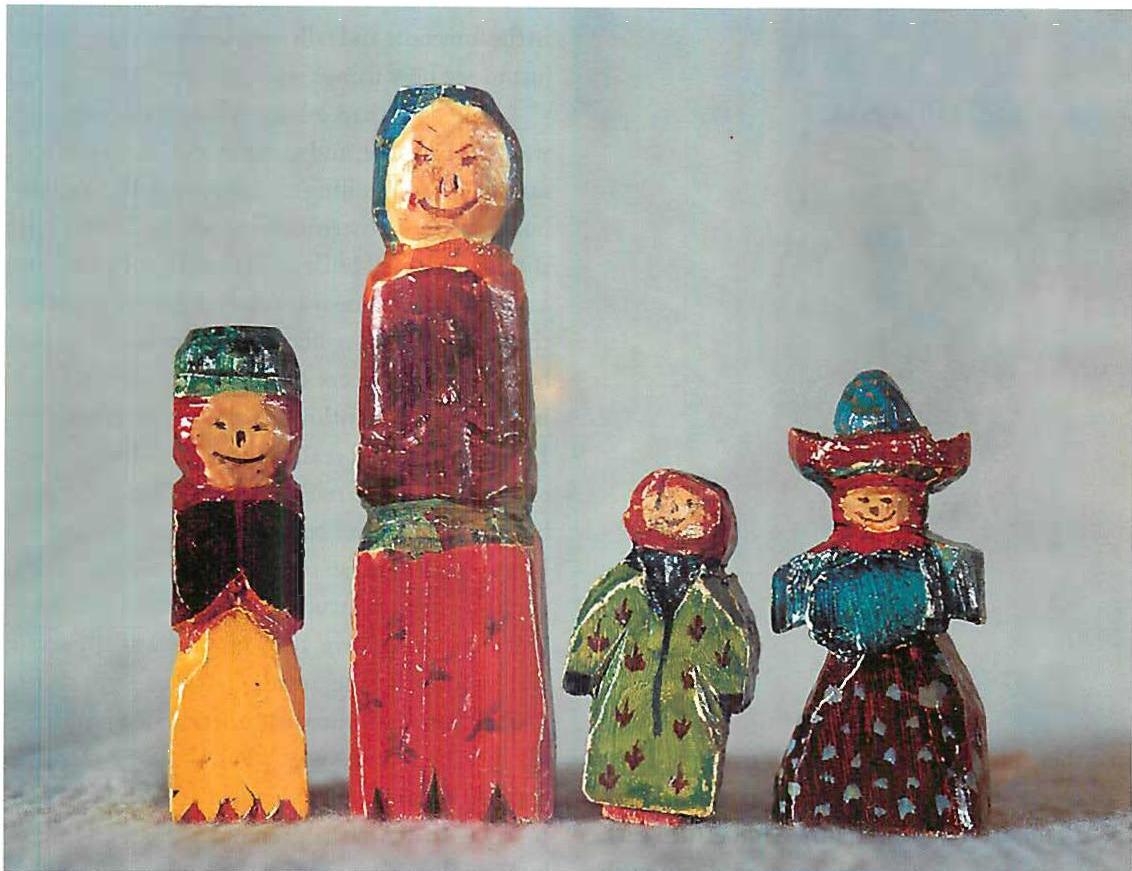
the thing as we design it. To be making centers, our simplest path is to be making symmetries. Thus we may imagine a process of making a series of symmetries, one at a time, always the most profound symmetry that is consistent with the wholeness that exists, but do it in such a way as to create the greatest feeling possible in the emerging thing.
When done right, this is not only going to create living structure. It will also generate the unconscious, archetypal character that emerges from the directness and lack of sophistication present in the process.
SYMMETRY PRODUCTION EXAMPLE 1, DOLLS
I remember once working with a journalist who was interviewing me about my buildings. I found it hard to talk to her, not easy to explain things, and difficult to answer her questions.
At a certain stage I picked up a small green doll that I had carved. A tiny doll, no more than about two inches high, only the rudiments of a head, a skirt, feet, arms. It was painted green with, as I remember, small red spots. I told the interviewer, "Everything I know is encapsulated in this tiny doll."
She took the comment as too off-hand and did not take it as a serious comment about buildings. But I did mean it seriously. The doll is rudimentary. But what is in the doll is only what is needed to make it have its feeling, and nothing else. There is nothing else there. I started with a bit of stick. First I made some cuts to separate and shape the head — just a slight rounding near the top of the stick so that it has a flat top. That made two symmetries. Then two notched cuts

on either side to make the dress a triangle. Then a notch cut between the feet to separate the legs. Then a bit of wood (internally symmetrical each time) cut away above each foot, to distinguish the foot from the leg. Then a very slight cut to make the arm stand away from the body, a shallow groove on each side. A very small series of symmetries, introduced one by one, to make the doll.
Nothing more. A small series of symmetries made by the carver, each act as intensely chosen as possible to project the image of inner feeling which the carver has. It is made just to create, to project that feeling, that intense personal feeling. And it does work. The rudimentary head and arms, the green dress, and its red spots—these are just the things needed to create a feeling in that piece of wood as it began to unfold. No matter how small and unimportant, it came out with the intensity of a real thing.
SYMMETRY PRODUCTION EXAMPLE 2, SAN JOSE
I had the habit, at one time, of going to visit the Julian Street Inn, the Shelter for the Homeless I built in San Jose, California. I used to go and sit
in the forecourt and talk with anyone sitting there, just to see how things were going.
One day I had a long talk with a man who was staying there, and in the midst of our conversation he began telling me how much he liked the building. After listening for a while, I asked him if he knew I had built it. He said no, he had not known that, that he was amazed. He told me that the story was going about that the building had been built 200 years before by an elderly black lady, a great philanthropist. When he heard that I had built it, and realized that it had been built recently, he said to me suddenly: "This is the only building I have ever been in where everything — I mean really everything — is necessary."
The remark struck me as odd at first, since there are decorative tiles on the walls, carved cast capitals on the arcade columns—in short, it is far from a minimalist functionalist building. He brushed that away. "Yes, I know that, of course I mean to include all that. What I mean to say is that what is present in this building is just exactly what is required . . . and nothing else."
He simply meant, I think, that each symmetry was put there because, for some reason, it had to be there. For instance, the seat, it is just what is needed to be a seat, to sit on, to lean back, there is no crudeness to take away from it, no extra detail that is not needed to make you comfortable. The fountain has just what is needed to be a fountain: sparse ornament, but a plain concrete basin, just in the place where the fountain needs to be.
He told me, too, that he had at one time been in a difficult state (many of the homeless who came to the shelter in those days were people who had been mentally ill). The fact that what was there was only what was necessary—nothing more and nothing less—made him feel grounded, more able to become whole. Of course, because in nature, too, there are just the symmetries which are required and no others. Is it too much to say that a building which has this quality is like the long grass of a meadow, and therefore has the same power to make us well?
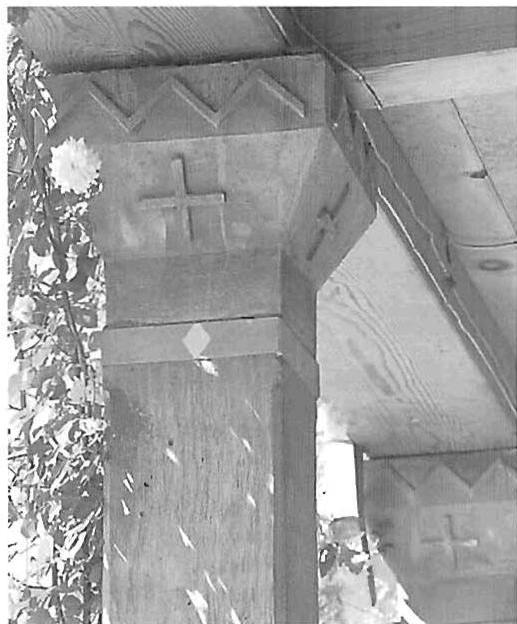
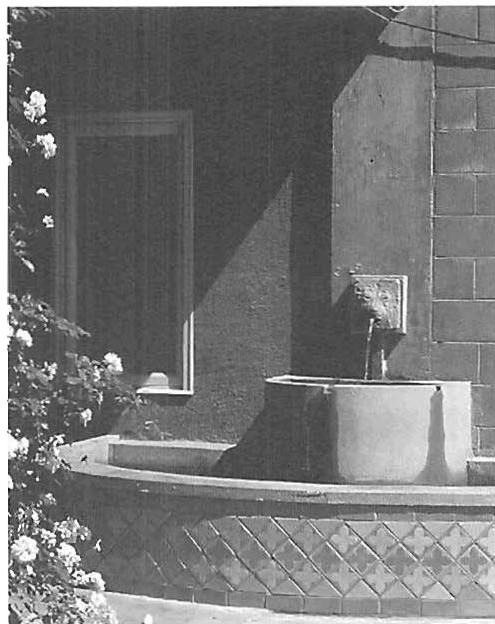
SYMMETRY PRODUCTION EXAMPLE 3, WEST DEAN
One of the most successful things I did in the West Dean Visitor's Centre was something that may seem hardly noticeable to a casual observer. It is the long curved bench that forms the sweep of the entrance and leads the visitor from the gate towards the entrance porch (page 666).
Originally, there was no idea of such a bench. Certainly it was not in my mind at the beginning. We had the gate at a certain angle coming straight in from the parking lot, and we then had the path leading towards the building entrance.
The entrance of the building was built and in position by the summer of 1995. By then, too, we had a rather clear picture of the curve that the path made, a curved sweep. Plotting this curve—walking it out according to the path that felt most natural to walk—had given us the position of the gate to within a meter or so, also by that summer. A month or two later, we had the gate dimensions clear to within a centimeter or two. At that stage we went ahead and built the gateposts.
I began thinking that we should build two walls, one on either side of the curve, to lead the curve in towards the building and hold the space fixed, making the space more defined than it was at that time.
Our client did not like us spending money like this even though it was not an "extra," but was provided by us within our fixed budget, at no cost to him. He tried to argue that we should build a cheaper fence—a wooden trellis—on the outside of the curve. The more I heard this, the more I kept feeling its wrongness, the more sure I became in my own mind that what was needed was something really solid.
The more I thought about it, I became convinced that what was needed was a long, solid, flint structure with a seat, and behind it a very solid wall of brick and flint. Of course I felt it would be nice to sit there. It is a very obvious place, near the entrance, by the gate, an obvious place from which to see, and be seen—and it is in the sun, too. But far more important than that, I also knew that this solid mass was needed to contain and hold together the drop of space between the gate and the building, a space almost like a water drop which was formed be-
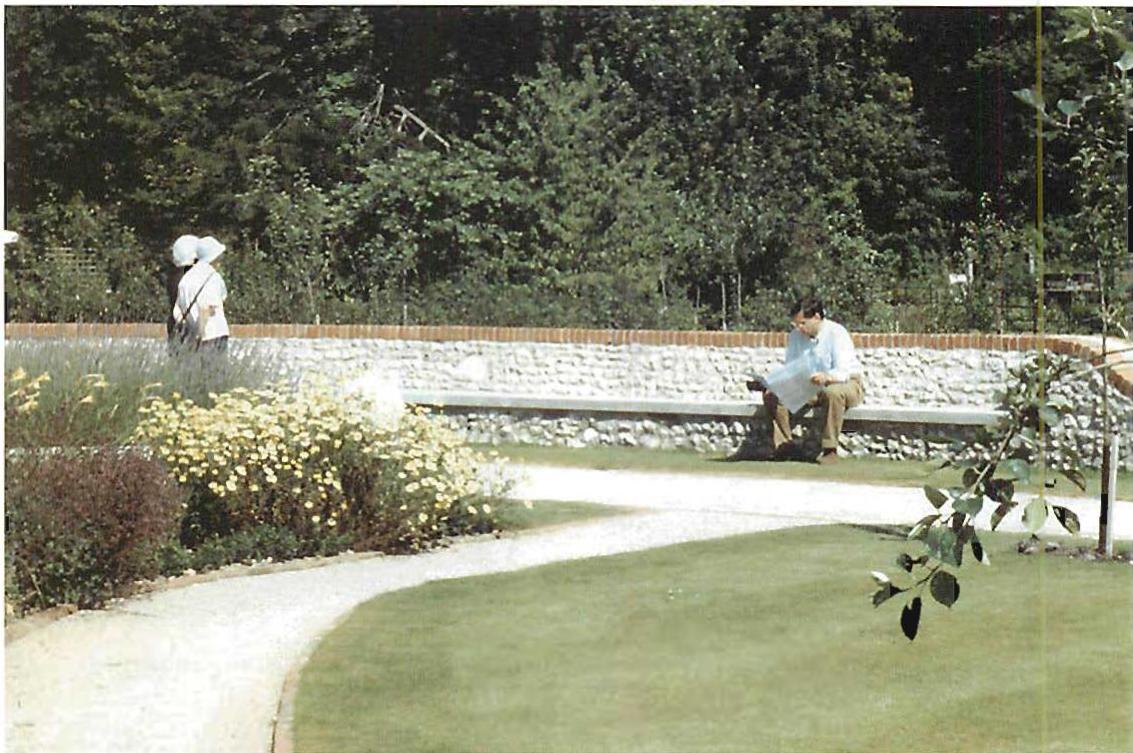
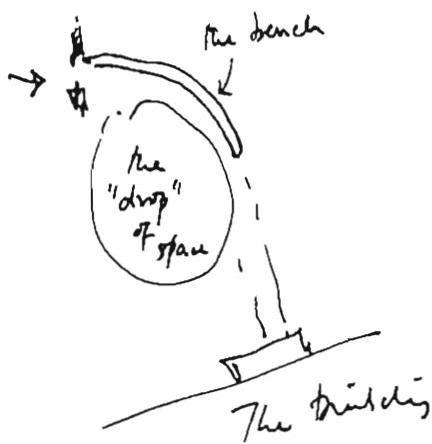
tween the entrance with its curving path and the building itself.
So I insisted. As built, now, this bench is soft yet dominant, it is one of the best things about the outside of the building, and yet so unobtrusive that no one remarks on it. But I
know that the building works and that the space comes alive because this long, curved seat holds the space, defines it, orients it, comfortably.
What are the symmetries which generate the feeling? The small gate leading into the garden. The bench. A long, egg-shaped space between the bench and the building front door. The bench shaped to curl around this egg-shaped space. The form of the bench, the simplest possible consistent with this curve. The curve holds the space and makes a peaceful feeling, connecting someone sitting, both to the gate, and to the building door.
SYMMETRY PRODUCTION EXAMPLE 4, THE LINZ CAFE
While I was building the Linz Café, I made a row of alcoves inside the building. The form, the intimacy, of these alcoves was very important. To get them right, we set up a few chairs, some plywood, a table, some bits of cardboard, in the middle of our office in Linz where I was doing the design work. I adjusted the table, adjusted the
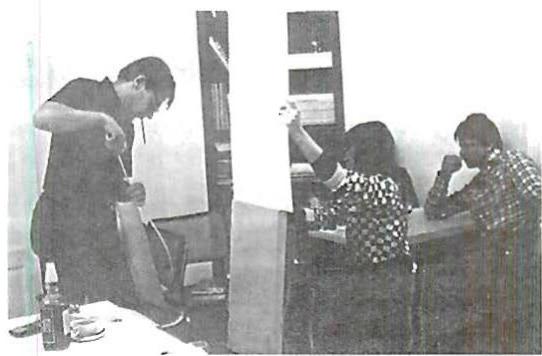
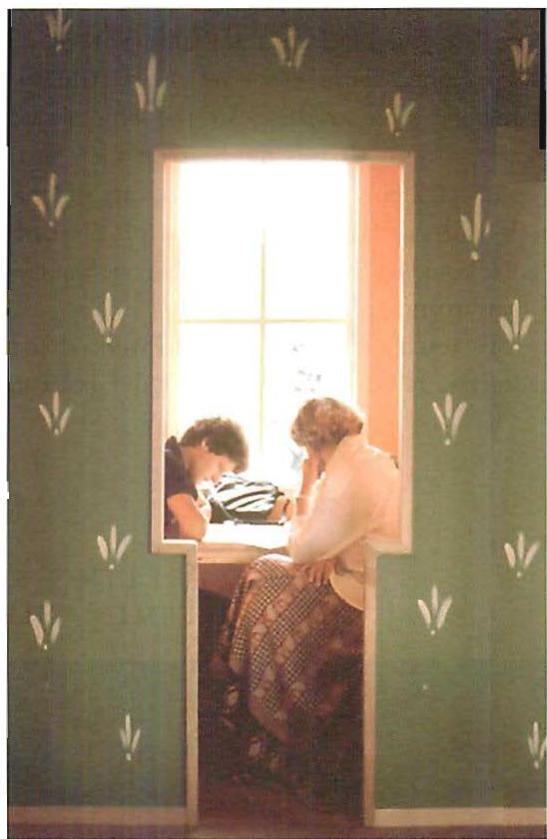
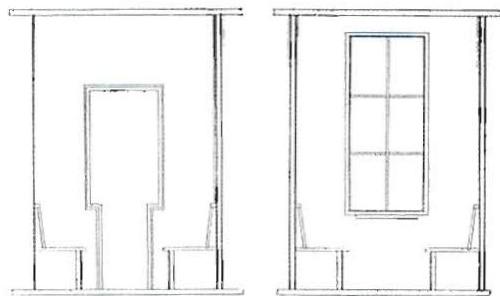
chairs. I made the table a little narrower, a little longer. I made some kind of rudimentary entrance to the alcove, so that once in, one was protected. I played, using plywood scraps, with the angle of the back of the seats, to make it comfortable to lean against.
All the time I was working with one aim in mind: to make the alcove as comfortable as possible. Not the comfort of the body, but the comfort of the soul (if I may put it like that without exaggerating). I tried to make it so that one felt at home, truly at home, one had a place for one's soul, leaning there, elbows on the table, with a cup of coffee from the small galley that the office kept.
When I was done, I knew I had been reasonably successful, because no one wanted to leave
that place (the mockup, I am talking about, as photographed above—not yet the real thing). People—people working in the office—sat there for hours. It was the heart of the office, even though only a temporary mockup, so long as it still existed there. It was a place where people could sit, and sit, and sit. No one wanted to get up and go away from it.
To reach that state, I had to work at the geometry. It was all empirical. I did not use
theory. I just kept on, by trial and error, till it had this effect — on me, and on the others. Then once we had it right, I transcribed all the dimensions — of seat, table, seat-back, angles, lengths, heights, window-sill position, entrance, entrance width, all that — to the nearest centimeter or two — and then used these dimensions in the actual building when it came time to build it.
In the finished building, the alcoves did work very well.
5 / THE FEELING-SYMMETRY PRINCIPLE WITHIN THESE EXAMPLES
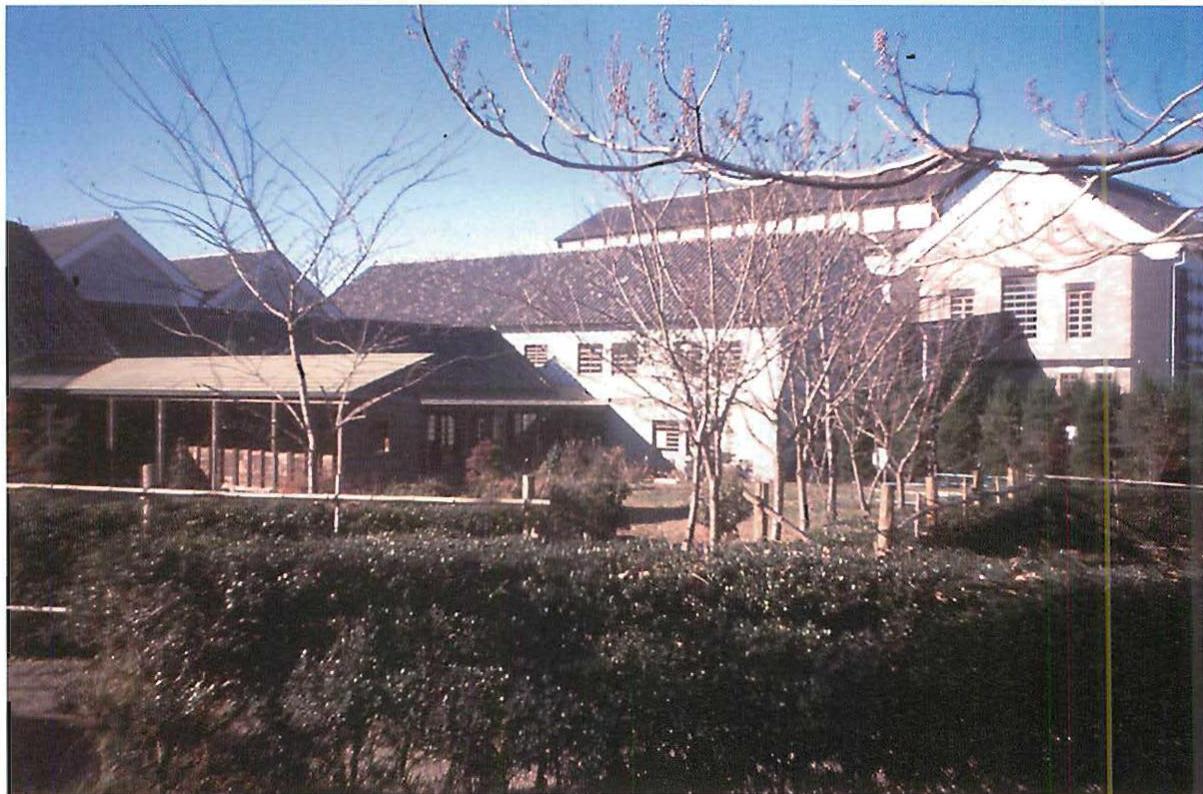
Each of the four examples has a carefully worked geometry which creates a profound and subtle form of ease. And precisely that, too, is the morphological character of living structure—it
is always the simplest thing it can be. It is that which creates the ease.
Each of these four examples has at its core the creation of some degree of feeling. Each one


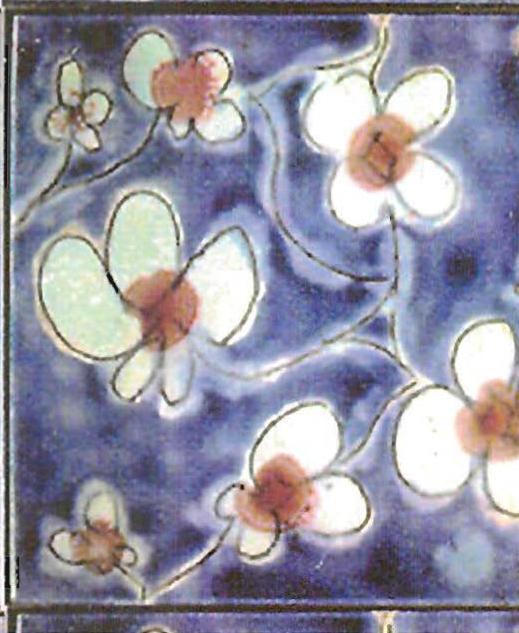
depends on a process which asks questions about the geometry, then establishes the geometry, step by step, in such a way as to intensify the feeling people experience from it.
It worked in each of these examples, because in each case I asked the questions in the right order. I got one symmetry after another from the emerging thing, from the building form itself as it was evolving. Each time the newly added symmetry made the feeling deeper.
Yet what I did in adding local centers and symmetries did not conform to a preconceived plan. I only asked questions about centers and symmetries, and so unfolded the form. What that means is that I made these symmetries appear in the right order to extend the wholeness which was visible at any given moment in the unfolding process—and what that meant, effectively, was choosing the ones which generated the most feeling. As a result the form which was created had the simplest and deepest feel-
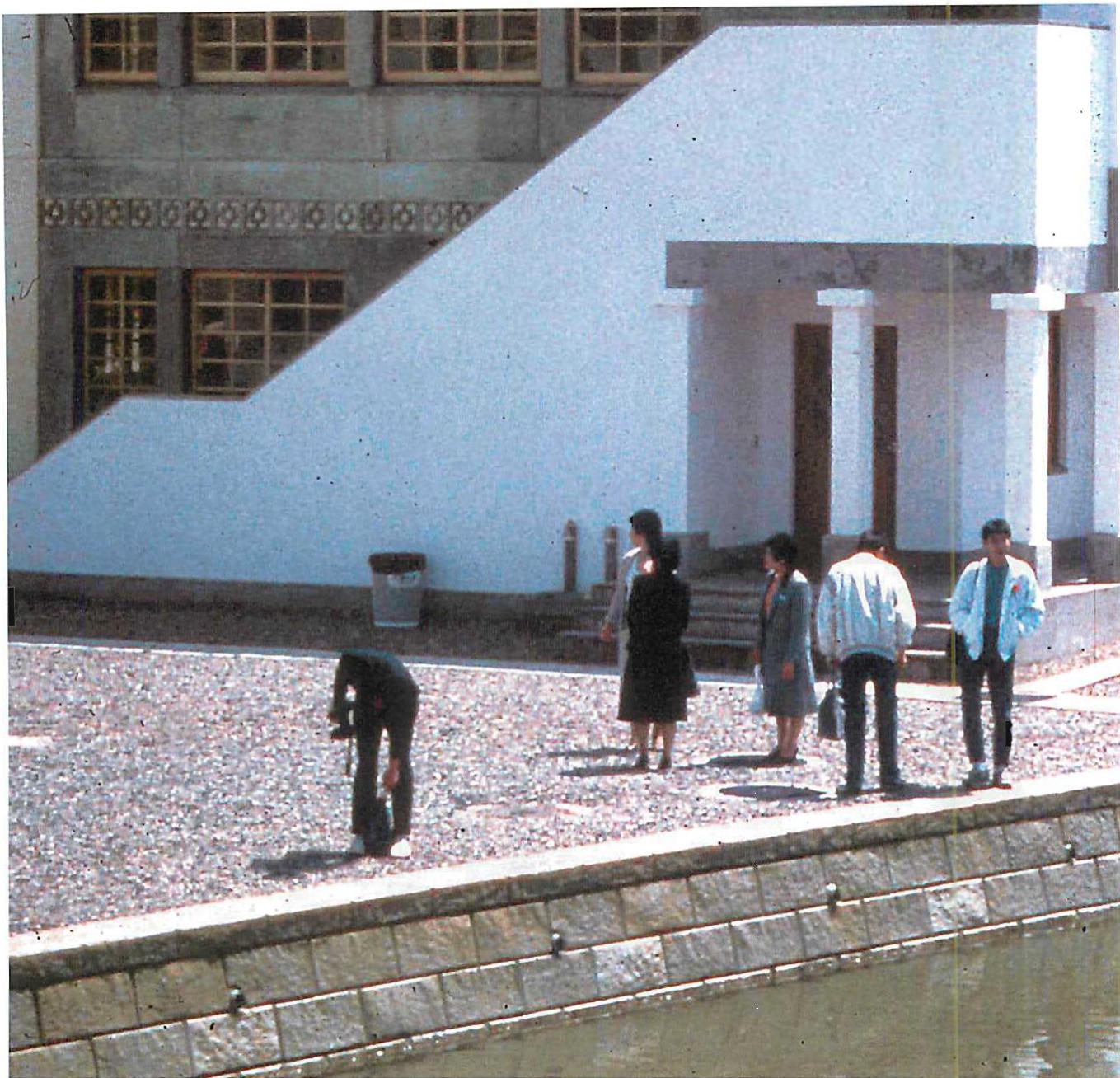
ing—and thus took on, one might almost say, the form of human life itself made manifest—the character of human experience and humanness made visible. This did not come from an idiosyncratic style. It came only from an attempt to do the simplest thing that could create true feeling.
Each time I worked at it to find what was the simplest new symmetry I could introduce
that was structure-preserving to the emerging whole, this had the effect of intensifying the feeling. In hundreds of examples (many shown throughout this book), I tried again and again and again to reach that goal. I did not always do it decisively. I did not always succeed. But still, that is what I was trying to do and that is the essence of the morphology which gradually emerged from my experiments.
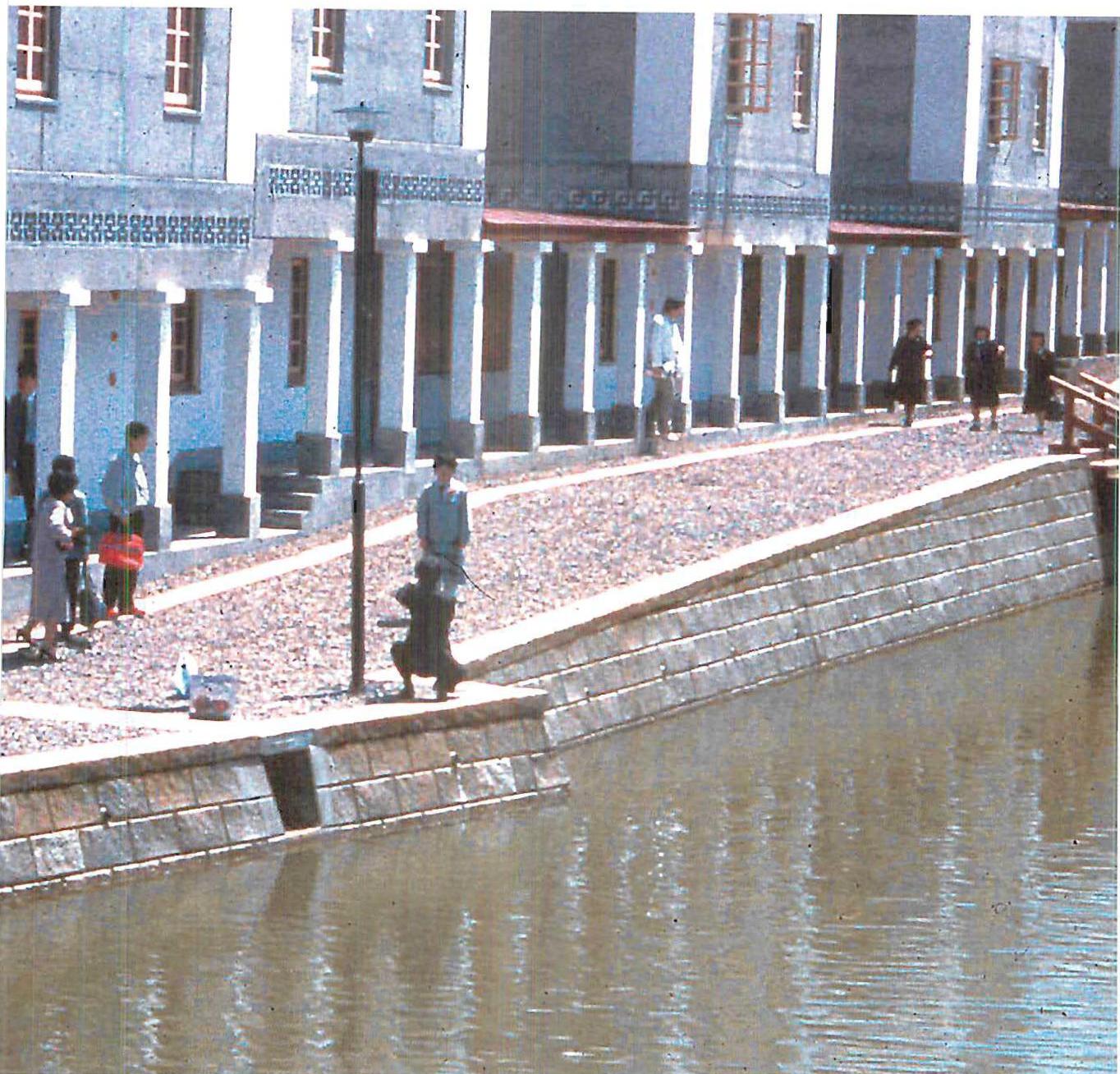
What the four examples cited just now have in common is their simplicity. Each of the examples has the minimal structure for its situation that carries weight of feeling. It has some sweetness. It is not costly. It is not complicated. It is simple. Sometimes it is crude. But in each of the examples I have given, it was calculated by experiment to be as intense as possible in its feeling (both in its sweetness and in its bitterness). That was
established, in each case, experimentally. And from that the building or made thing got its form. That is how the symmetries were judged.
It is this process which generates the class of living structures. It is this which generates the living, growling, archetype. It is this, when carried out fully, that leads to the emergence of the archetype which lies at the core of living form.
6 / THE ARCHETYPE UNDERLYING ALL
In the nineteen chapters of this book, I have described many different parts of a living world — towns, neighborhoods, streets, houses, big buildings, small buildings, rooms and so on — showing how they might be made. At the end of each chapter I have tried to summarize the character of what will typically be generated in each category of action. I have tried to show how, common to all the examples of things generated by living process in that category, there are certain common features. I have called these features invariants of living process, the invariants of the fundamental process.
As we look at the examples, we may also see that these invariants themselves have certain common features from one to another and from category to category. In other words, the invariants of the underlying structure created at all the different scales themselves have something in common. Among all living structures, whether large or small, whether indoors or outdoors, whether space or solid, whether function or ornament, there is a deeper structural quality which appears again and again and again. There is a common thread, a deepest invariant, underlying all the invariants.
It is possible to characterize this deepest invariant of all like this: Every time the fundamental process is used, no matter at what scale, we get a structure in which local symmetries are so densely packed that the highest possible density of local symmetries occurs, but without having an overall symmetry.
This, I think, characterizes all human-based architecture — at least the most profound. And it is this, too, which characterizes the archetypal forms I am trying to point to in this chapter.
This deep structure arises for the following reason. Every time we have a local symmetry we get something: we get one strong center. Usually this local center plays some practical or functional role. Since there are many things to be accomplished in a living structure, and since there is not much "room" in three-dimensional space for all the different things which have to happen, these local symmetries have to be very densely concentrated, packed, so that the space can get as many centers as possible per cubic inch. But the larger conditions of almost any structure — at least in the general case — are asymmetrical. It is rare that a circumstance occurs where there is a pure spatial symmetry in the external conditions. Thus, to be well-adapted to the local conditions, the global structure must also be asymmetrical in the large — just like its conditions.
On the one hand, then, the resulting structure will be asymmetrical to fit the local conditions. On the other hand, it will contain as many local symmetries as possible, as densely packed as possible, so that within each part there are as many centers as possible, and so that the structure "does" as much as possible in a limited compass. And, in addition, for reasons fully expressed in Book I, these centers and symmetries will be accompanied, necessarily, by the fifteen properties: I. LEVELS OF SCALE, 2. STRONG CENTERS, 3. BOUNDARIES, 4. ALTERNATING REPETITION, 5. POSITIVE SPACE, 6. GOOD SHAPE, 7. LOCAL SYMMETRIES, 8. DEEP INTERLOCK AND AMBIGUITY, 9. CONTRAST, 10. GRADIENTS, 11. ROUGHNESS, 12. ECHOES, 13. THE VOID, 14. SIMPLICITY AND INNER CALM, 15. NOT-SEPARATENESS.
That, I think, is why this archetypal structure comes about in every case where we have living structure.
So it will always be. The archetypal forms, what we think of as the forms of human-based and traditional architecture, are drawn from a class of profound living structures which have the deepest symmetries and the most complex form. They are entirely unlike the designed forms of modernism, postmodernism and de
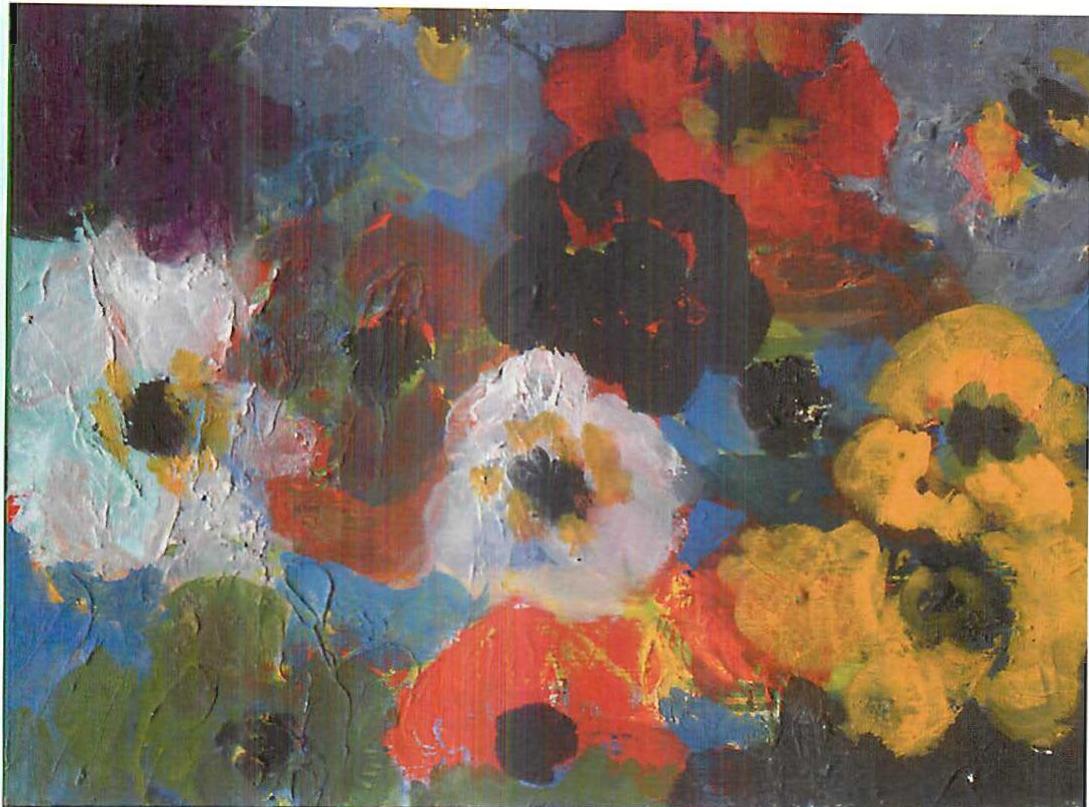
constructivism. The core of the class is an inexhaustible stock of building form which will appear, I believe, in the same root character, for as long as human beings will exist on earth, even in
future time when profound materials and as-yet-unimaginable new technologies have been discovered. These forms belong to a deeper realm, and cannot be replaced.
7 / WEAK ARCHETYPE, STRONG ARCHETYPE
In the best cases, when the symmetries come forth unconsciously from adherence to the feeling of the whole, and from the process of symmetry-production in the small, then something almost awe-filled occasionally comes into being. This is a thing which strikes fear into the heart, yet creates a peacefulness and solidity that we can rest upon. It gives us nourishment because it is so strange and so definite and well-found in its uniqueness—which we did not create.
It is possible to use the word archetype in two different ways. On the one hand, there is the weak archetype. What I mean by the weak archetype is really just the whole class of buildings that have living structure, the class which, in the appendix, I call $C_{\text{living}}$ . It is, if you want, the class of all traditional building forms. It includes all those which existed so far in the history of building in traditional society. It includes much of what I have shown in the last 600 pages. It includes the range of all that will
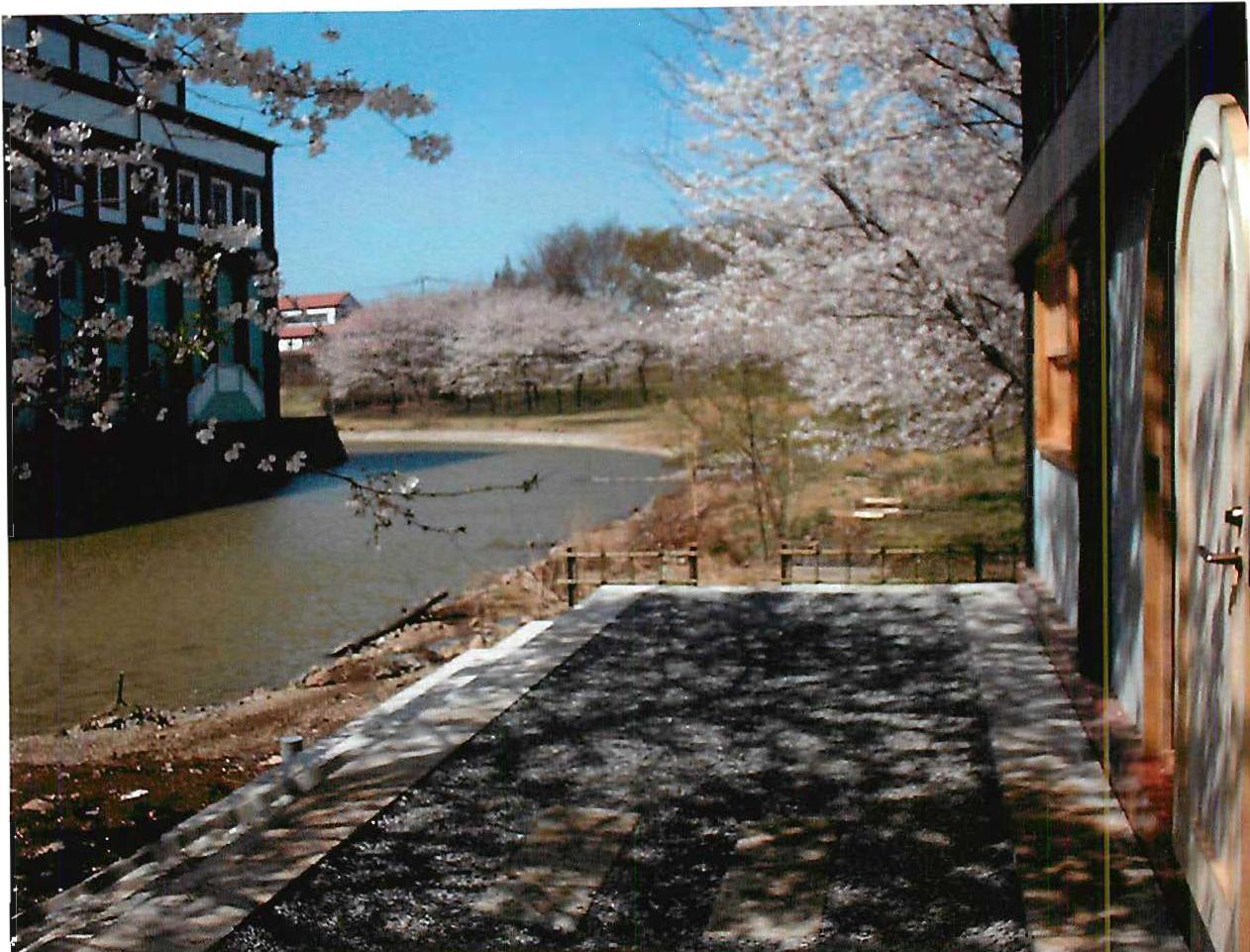
come in the future, under new kinds of technology, but still within the working of the fundamental process. It is the range of forms which arise, directly, from the fundamental process. These forms have living structure. They have discernible structural features.
But there is a narrower class, a class of more archetypal, more awe-filled forms which go to the root, forms which effect us powerfully, which reach, somehow, the core of what it is to be a person. I have shown a few examples of such things. The Mosque of Alaeddin is such a place (page 657). The primitive prehistoric vulture found on the walls of prehistoric settlement of Catal Huyuk, near Konya, 7-8000 years old (page 658)—that vulture, too, is from this core of the strong archetype. Many African masks
are of this second kind, too. The forms of this class are more raw, still more powerful.
This second archetype, this core, exists in a much smaller group of things. It is narrower than the range of living structure. It is deeper, more rare. It is harder to find, harder to reach. The forms are prized, respected, treasured. In many cases, the maker knew that he, or she, was about something special at the time of such a making.
It was this second class of forms which Prokofiev was after in the music for Alexander Nevsky or in The Love for Three Oranges. This is perhaps what Rouault was after in some of his most powerful paintings. It is something that has preoccupied many 20th-century artists and architects, the search for this second core. Le Corbu
sier was searching for it, surely, in the interior of Ronchamp. And on a few occasions, I myself have consciously tried to reach this core. Very rarely, when trying least, I may have managed to reach it.
This takes more. This does not come about merely from the fundamental process. I believe
that this second, strong archetypal core comes when the search for living structure, the use of living process is combined with a conscious desire, and a half-conscious search, for the origin of all things.
That topic is taken up in Book 4, THE LUMINOUS GROUND.
8 / A LAST REMARK
There is one more thing to say, about the morphology of living structure as it may appear in buildings and in works of art.
In the best cases, in the cases which have the most life, the building form will most often be interwoven in some fashion with nature itself.
In the best cases, it will seem, almost indistinguishably, to be part of nature, thus forming a seamless whole.
The clearest way I can say this, is to point out that it will—in this case—seem extremely ordinary. It will appear normal, and be normal.
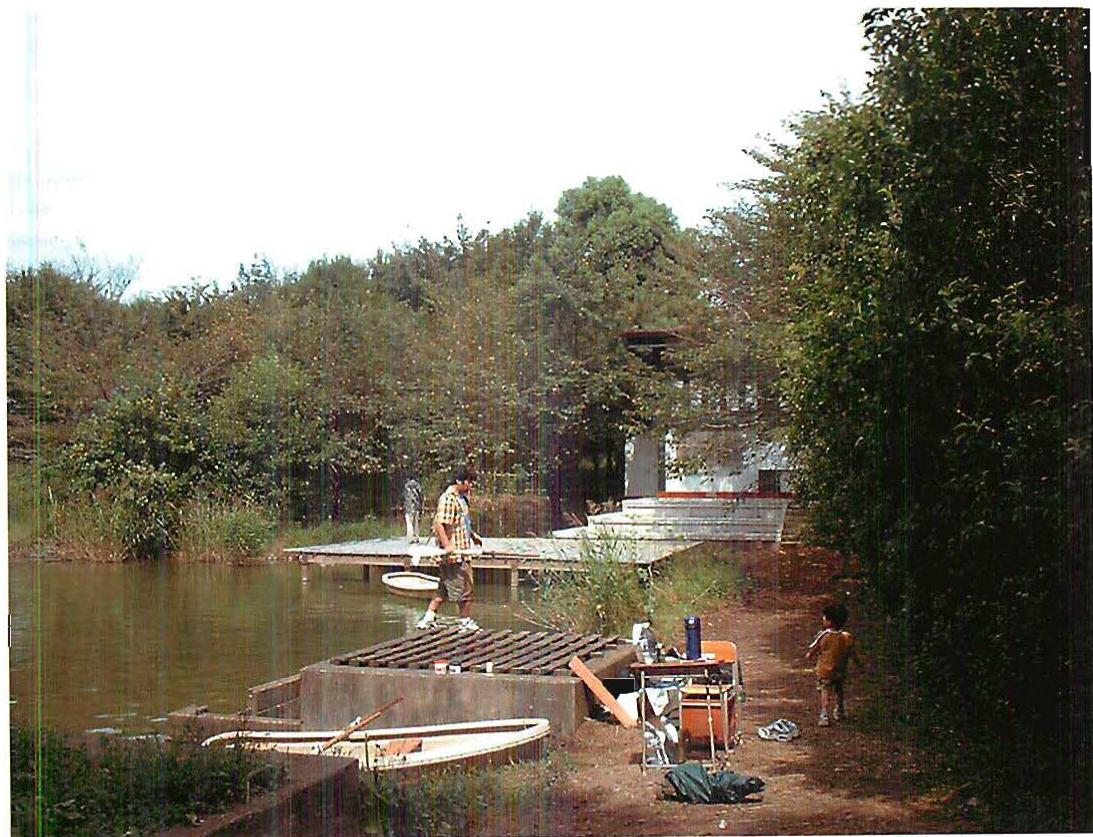
It will, not at all, then, seem like the work of an architect's hands. Look, for example, at the photograph on the previous page. We see the approach to the Eishin clubhouse. It hardly looks like 20th-century architect work, at all. It is ordinary life—yes, perhaps at its best—but not remarkable in the way that architectural magazines, and our image-conscious mentality have presented architecture in the last one hundred years. This is a different thing altogether.
Thus the morphogenesis of what is truly living, will have a character that, in our present way of thinking, will hardly look like architecture at all. It will have the structure I have described so many times, the deep morphological and geometric structure—yes. But, we must remember, it is achieved through painstaking attention to the ordinary. It is a precision of fit and harmony in things that comes from intensity
of observation. But, still, it will be very ordinary, as here, in the photograph on page 675. A boat, a ventilator, some random pieces of material, a little boy playing with his dad, Bermuda shorts—a place where you are comfortable in yourself, and without show—just the way you dress at home, to be comfortable, when no one is looking. And this, it will be the output from an unfolding of morphogenesis, just as nature, trees, grass, and bushes are in their way, also, an outpouring of morphogenesis.
The naturalness, the ordinariness will then place before us, a target, an aim, which is very different from the things that architects have worshipped today and yesterday.
Something truly relaxed, truly made for human comfort, truly arising from an egoless and unencumbered wish to make things right, and nothing more.
NOTES
A few readers have been startled by the sudden appearance of the word "savage" in this final chapter. I do not mean ferocious or aggressive, as the modern use of the word suggests, though it is occasionally helpful that it does perhaps carry a very tiny part of that quality. Rather, the word, as I use it, is meant more in its original English meaning, closer to the modern French word "sauvage," meaning wild, untamed, original, direct, "as it comes forth," or "like the thorn of a wild bramble," unweakened by sophisticated thought or culture. The word was also used by Ruskin in this sense. I find the meaning of this last chapter cannot do without it, and the word does capture, or hint, at the core of a successful building which, in its austerity, touches closely to our untamed nature.
I have been told, too, that the word "style," as it appears in multiple meanings in this chapter, is hard to understand. The reason I cannot avoid its use is twofold. Originally, as in the style of Georgian architecture, or the style of Doric Greek temples, the word style was a word with a meaning not different from the idea of form language, as it is expressed in chapter 16 of Book 2, pages 432-39. In that usage, the word is neutral, and reflects the geometry and inward and outward geometry of a class of buildings. This is a useful meaning, because it focuses attention on the purely geometrical, and emphasizes the fact that we cannot get away from this purely geometric, morphological character of things. Indeed the concept must be referred to, just as I have had to refer to it, in order to capture the scientific, morphological meaning that I intend.
It is most unfortunate that the word "style" also carries a second meaning, the modern and postmodern meaning associated with such words as "stylish," which reflect an arbitrariness, even a wilfulness, that is entirely opposite from my intention. Nevertheless, since the word does capture the outward surface, what we see and experience when we first encounter a building, it is the only word which, in our modern era, can direct a reader's attention to the configurational details and expressive power of the building—which is precisely what I do intend. Thus, the word cannot be avoided.
CONCLUSION: THE WORLD CREATED AND TRANSFORMED
1 / ARCHITECTURE AS THE CONTINUATION AND COMPLETION OF THE LAND: HOW CONTINUOUS UNFOLDING OF WHOLENESS MAKES AND REMAKES THE EARTH
We have a vision, now, of buildings taking their form continuously through a smooth step-by-step process in which each step preserves the structure of what was there before.
In this visionary process the land—the Earth—gets differentiated continuously to develop and increase its harmony. We reach a view of architectural structure in which gradually, painstakingly, step by step, the world is created in a way that millions of people can take part in it and each small process adds one tiny bit of structure, deepens the structure.
We see each building as an extension and enhancement of the land. We see each fence and stair rail as an extension of the building. We see each part of every building, too, as an extension of the town in which it sits, as an enhancement of the street and neighborhood. Each street is an enhancement of the land. Each public building is an enhancement of the growing city—which itself becomes more harmonious, more deeply rooted in human experience and in the ability to nurture human well-being. Each center is added to increase and deepen harmony. The land solidifies. The community deepens.
In concrete detail, the process goes like this:
Everything comes from the whole.
It starts as a continuation of the land.
It embraces nature, and makes nature, and is nature.
Nature is not merely moss and rivers and trees: What we should properly call nature, is all that which follows from an unbroken sequence of unfoldings, each unfolding from the wholeness that preceded it.
As such, of course nature can include buildings, and roads and bridges: together with rocks and soil and watercourses, in their multi-variagated geometry.
Within a building, the rectangles, the rectilinear order, also comes from a disciplined unfolding of the whole.
What seems like stark geometry, also arises from this unfolding.
The complex and curved forms of natural organisms arise naturally from the wholeness of a natural site.
The more austere forms of buildings, colonnades, rooms and windows, also arise from the wholeness that comes from buildings that are near rectangular, and that have to pack in near rectangular forms, to make positive space between them.
The totality, a complex of rectilinear and curvilinear, level upon level of scale, arises naturally, from unfolding and paying attention to the whole.
The adherence to the whole, is what we experience as feeling.
It is our birthright to surround ourselves with this natural world, to be skilful at doing it, to enjoy the benefits of living among these forms, which, in every detail, reflect our own longing, and also what we are.
Hand in hand with these events, the care of nature is structure-preserving, too. The world will then call for a new approach to ecology which goes beyond the conservation approach, in which it is understood that the environment can only be healthy when all of it, both "natural" and "man-made," is understood as nature which is created. Like the great historical examples such as Southern England, Japan, or, in more recent times, huge areas in China, it allows us to anticipate a new "created" land, all over the surface of the earth, which has the characteristics of nature, preserves the aspects of nature which are profound, and yet integrates human beings, our
buildings, our gardens, our roads, our walls, and our activities into nature, so that the man-made and the natural interpenetrate and support each other.
In this new balance four kinds of things will occur.
First, the natural is preserved in a new version of its wild state which is a managed and protected ecology. The land area given over to buildings and roads is concentrated so that it leaves a relatively large percentage of land in the more wild and natural state.
Second, the urban or developed part — the part containing most of the roads and buildings — is treated in a fashion which is more respectful of ecological and natural requirements. Roads are more modest, road surfaces are less aggressive, buildings and gardens are more interwoven.
Third, the landscape which extends out from houses and downtown building complexes, reaches out into the land immediately surrounding the buildings so that buildings, gardens and lanes are seen and experienced as one integrated structure.
Fourth, the natural wild land beyond the
buildings is itself modified so that it does not exist in a state of pure original nature, but in a state which is also natural, a new, even improved nature in which ecological requirements, wild life, wild plants are cultivated in a balanced fashion. Even this last category of land — the largest — is man-made. This is not done in an effort to preserve a wilderness, but in an effort to create a new balanced state of existence in which nature is maintained, sustainable, and exists in balance with the human habitat that connects to it, exists near it, and interpenetrates it.
The overall conception of this integrated habitat/wilderness may be compared to the zones created in ancient England or China where not only towns and villages, but also hedges, coppices, stone walls, terraces, streams, bridges, paths, fields, meadows, forests, glades are all part of one managed system which is under human control and human cultivation in a way that allows people to exist in balance with nature.
And it is made by processes which, also, are part of nature. The process itself is to be part of nature.
2 / ALL URBAN BUILDING VIEWED AS PART OF NATURE
In addition, the great thing is that our urban habitat, towns too, also become a part of nature. And this process, widespread though it is in the hands of hundreds, thousands, millions of people, goes forward as a whole. There is no need for emphasis on individual creative personality as a source of life in things. The process itself fosters wholeness and life. Each person plays a role in it. The result does not need to be governed by ideas, or by conceptions of what might exist; indeed, conceptual ideas are often harmful. The whole is governed, at each stage, by what is.
This “what is” leads, then, to what might be. The future emerges from the present, without
ideology, solely by paying minute attention to the structure present in the underlying situation.
In this process there is a basis for agreement in the mere fact of the effort to pay attention to the land. The land emerges as a single unity, nature, ecology, buildings, and culture, all one. The inventions which make the future, the most far-sighted designs, arise out of painstaking attention to the present, and to the wholeness of what is, and to the wholeness of what lies sleeping in what “is.”
The question might be raised: how is it possible that one process - nature making itself and being made - could both give rise to the natural -
shapes of trees, hills, watercourses - and at the same time give rise to the more rectilinear shapes of buildings, rooms, roofs, and the hard edge of a river made for people. Are there not two distinct morphologies here? How is it possible to claim that one process - nature unfolding - gives rise to both?
The reason is relatively simple. In the realm of the built, we have a variety of forces - the positive space on both sides of a wall; the relative flatness of a foundation, or of a wall; the necessary straightness of a column; the structural balance and stability inherent in a regular array of supports. All these introduce rectangularity. Buildings which are natural, are not buildings which look like cabbages. That is only mannerist, and usually fake. When we act as nature does, we take step by step, a sequence of decisions, allowing the unfolding to occur. In a river meander, or in the phylotaxis of a plant, this generates the loose kinds of rounded geometries typical in the plant world and in geomorphology. When we act as nature does in buildings, making step-by step unfolding-like decisions about building form, we receive regular spacing, straight lines, vaults, window opening, and we obtain just the rectilinear order that has been described throughout this book, and is visible in the majority of traditional building types.
The two — rectilinear forms for built structures, and more complex rounded forms for biological structures — both arise from the same process, and interact, in juxtaposition, to create the architecture which respects nature, grows with nature, and arises out of nature. And, in addition, the rectilinear character of these buildings is more soft, woven into nature, not harsh, but in its own way complex and forgiving and receptive, just as nature is.
What is remarkable in all this is that the process which can extend the Earth's surface, make a field harmonious, repair and extend and make whole a stream or a bridge, will also make whole and extend the Champs Elysees, or Picadilly Circus, or Times Square, and will also — surprisingly — make whole and deepen a painting of a chair. Over and over again, it is the single process which looks for the whole, looks for its feeling, and thereby extends the structure which exists. It creates great art, and simultaneously creates great comfort and ordinary practical harmony. It is the harmony of all, which governs even the smallest act.
And yet this apparently self-effacing process which pays attention always to what is, allows each person to create something fresh and marvelous which is individual, personal, profoundly felt, and ever-present.
3 / THE WORLD ORIGINATING FROM ITS PEOPLE
In all of this, the process which creates is a continuous process. Like the unfolding of nature — indeed, it is part of the unfolding of nature — the process draws its future from its present. This process is not idiosyncratic. It is not merely a theory. What I have tried to show in Book 3 is that the creation of living structure cannot be done in any other way. It is a necessary process which must be followed under any circumstances where life is to be created.
If we wish to have a world in which life exists, and is sustained, we must find social ways in
which these life-creating processes can be encouraged and made possible. This "must" is not a social or political "must." It is a categorical and mathematical "must." The structures where life occurs just cannot be made in any other way.
The possession of the world, our relation to it, the creation of a world in which we feel ourselves to belong, where we feel truly at home, which we "own" in an emotional and psychological sense — all this depends on our ability, and on our willingness, to forge — and put in place — these necessary kinds of processes.
On the positive side, it is also refreshing and wonderful to realize that when the process is correct—when the process is one of the relatively few which is life-creating—the creation of life then follows almost automatically, without effort. Thus, although this is difficult in society as it is today, it is in principle a situation which is relaxed and without difficulty.
When the processes are correctly arranged, we may look forward to a kind of golden age, a biological future, in which creation of a living structure in the world around us is as natural and as effort free as it is in the blackberry bushes at the end of the garden.
Thus life, in profusion, is there for the asking. Creation of living structure is a natural process, available to all, and available with a limitless creative energy to all human beings who share in the production of environment.
It is amazing to see that the complex and profound structure of life—understood with considerable difficulty in Book I, because of substantial intellectual changes required even to understand its very existence—is nevertheless a simply attained and almost automatic by-product of correctly defined society-wide processes that are ego-free and concept-free.
But, on another level, we may also see how profoundly difficult the concept of a "proper" process is. It has one requirement only: namely that the existing wholeness of the land, or of a town, or of the Earth itself, be allowed to unfold truly and without distortion. And this rule is, for human beings of the modern era, the most difficult rule imaginable. It requires that we do not distort the unfolding with our concepts, that we abandon ideas and concepts. We need to pay attention to the wholeness, that is, to the feeling which lies dormant in the land, and awaken and consolidate this feeling through the presence of our buildings. It is more mathematical, more rational, more deeply steeped in feeling than what we do today. In the process, the wholes which are created are those wholes which awaken archetypal feelings in ourselves. Coming from the land, they stir what lies in ourselves.
Conceptual art—fascinating though it appeared to some in the late 20th century—is the very last thing which can attain life, because it directly contradicts this rule. The profound teachings of Zen, or sufism, or medieval mystical Christianity, or of many tribal cultures were able to induce the ego-free process into daily life and into the daily creation of the physical world. The deepest forms of art, and the most ordinary life-enhancing comfort of a window seat or a cushion by a fire—are all attainable together, within a relatively simple process.
4 / OUR BIRTHRIGHT
I should like to make one last comment on the buildings I have shown, the processes, the forms. Throughout, in all this material, we touch on a birthright. Yet this birthright that I speak of, it is in the mind, in people's minds. And it is almost gone.
During the years that I have been writing this book, and especially in these last five or six years of intense effort, I walk about the world, I am in touch with people struggling to create, or to protect, their environment. Often people are trying to protect their world, trying to make it comfortable, lovely, but fighting against an enormous wave of indifference, of the juggernaut seeming to bring the crushing load of development, roads, high buildings, profit-oriented buildings into the world, destroying much that is beautiful, bringing people almost to despair.
And in all this that I observe, when I talk to politicians, to townspeople, to developers, when I watch the reaction in the newspapers, when I observe the studied (and to me frightening) neu-
trality of the journalist preparing to write his story, the most frightening thing of all is the loss that people have of their own feeling.
They no longer know what is inside them, they no longer know what they do know. That is the birthright I refer to, that is the birthright which is being lost.
The birthright being lost is not only the beautiful Earth, the lovely buildings people made in ancient times, the possibility of beauty and living structure all around. The birthright I speak of is something far more terrible; it is the fact that people have become inured to ugliness, that they accept the ravages of developers without even knowing that anything is wrong. In short, it is their own minds they have lost, the core, that core of them, from which judgment can be made, the inner knowledge of what it is to be a person, the knowledge of right and wrong, of beautiful and ugliness, of life and deadness.
And since this inner voice is lost, stilled, muffled, there is no possibility—or hardly any possibility—that they can cry out, "Oh stop this ugliness, stop this deadness which floods like a tide over the land." They cannot do that successfully, too often they cannot even cry out, or let the cry be heard, because the source of such a cry has almost been stilled in them.
That process, it seems to me, is nearly irreversible since, at least to an extent, this knowledge is culture-borne. If there were ever to be a generation of 6 billion of us on Earth in which this voice was permanently stilled, the awareness would be gone forever. How could a later generation ever wake to it again, if it is once gone?
Yet we are not far from that state.
I see people, almost lost, like zombies, in the night hours at giant warehouse stores like Toys'R'Us. I watch the vacant stare of people playing computer games. I speak with computer programmers who are aware of something, some trouble, but are unable to tell what is troubling them. I have seen, so often, people gather around a table, in a council chamber, preparing themselves for the passage of some latest ravage: a
building or a mass development which will destroy. And, often, there are more people who have uneasy feelings of doubt about that development than there are voices of certainty who want to push it through. Yet the voices of doubt are muffled, a little quiet, because they do not quite know how to express their fears. They do not quite know if they are right. They do not quite know if they are morally justified in pushing, when the issues are so cloudy. And those who propose, and push through the horrible developments, with monster parking lots, with steel clad warehouse buildings, with machine-based sales—they go forward blindly, they seem so sure, they seem to know what to do. So, the more timid, perhaps more humane doubters who are not so sure that this is really a good thing, lose the initiative, allow the horrors to go through, to pass—because they are not quite, quite, sure enough of what should be.
Unsure as they are, they vote for it. Sometimes they vote by silence. Sometimes they vote positively, actively, because "who are they to stand in the way of progress." And all this is caused because the inner certainty, the knowledge of what is living structure has been taken from us, has been diluted, has been rendered nearly ineffective.
That is what I mean by the loss of our birthright.
In Book 1, I showed how the knowledge of living structure is connected to our knowledge of our own self. I showed that the living structure in things may be recognized by the way it seems to reflect our own true self. But this idea is obscure. It seems hardly appropriate—hardly responsible, even—to insist on something so refined when matters of money, food, roads, cars, parking are at stake. How can one be so self-indulgent as to insist, publicly, on something that touches the heart, when the practical matters of time, and money, and development—always the precious money-driven "development"—when these are at stake? So people subdue their voices. They keep quiet. They do not know what to say.
That is what I mean by the loss of birthright.
And there is, too, the enormous difficulty of practical process, of the certainty that this can be done, in practice, on a large scale. I have shown in hundreds of cases throughout this book that these things can be done right, that our society does have the capacity to create living structure, that it can be done, that unfolding, like nature, can be maintained in human society as a natural process.
But, faced with a decision about a huge complex of eight multiplex cinemas on the edge of a beautiful bit of land, threatening the environment yet again, when people need entertainment—who has the stamina to insist that it can be stopped, that it can be done right, that it must be done, we must not go forward until it can be done.
No one wants to look like a fool. If you stand up and insist that this can be done, will you not perhaps look like a fool with your weak tender arguments, while money, time, permissions, and the planning processes are marching on. Perhaps someone will lose money they have invested because of your gentle voice. Is it not then far better, gently, to drop out of the discussion, stay away, allow the developer to make his million dollars without too much protest?
After all, there really is no way to say it that quite clinches it. No way to be sure. No way to assert it positively, so that you can be sure not to look like a fool.
That is what I mean by the loss of birthright.
What has been lost is the inner language which connects you to your own soul, which makes you know, with certainty, which way is likely to be right, and which way is likely to be wrong. To be more clear about it. To feel it, as a real thing. To know, listen to, the voice that is in your own heart.
But that is becoming harder and harder. Even as people are becoming more and more sophisticated, and education is increasing, this inner voice is falling further and further into the background.
That is what I mean by the loss of birthright.
IS THERE SOME CHANCE—NOW THAT THESE MATTERS HAVE BEEN BROUGHT INTO THE OPEN AND THAT LIVING PROCESS HAS BEEN PARTIALLY DEFINED—THAT THIS BIRTHRIGHT MAY BE SAVED, AND THAT WE CAN COME BACK TO WHAT IS OURS AGAIN?
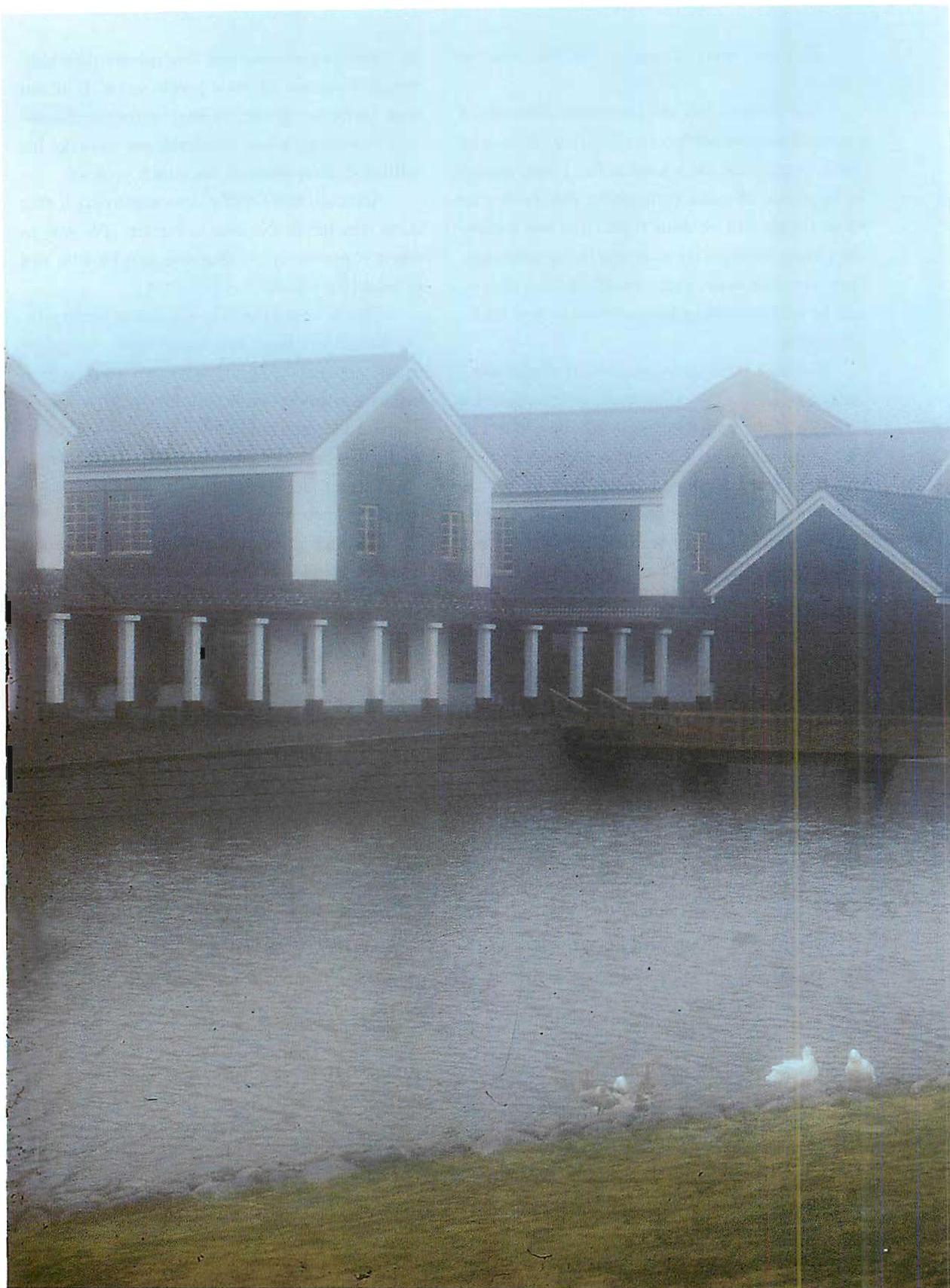
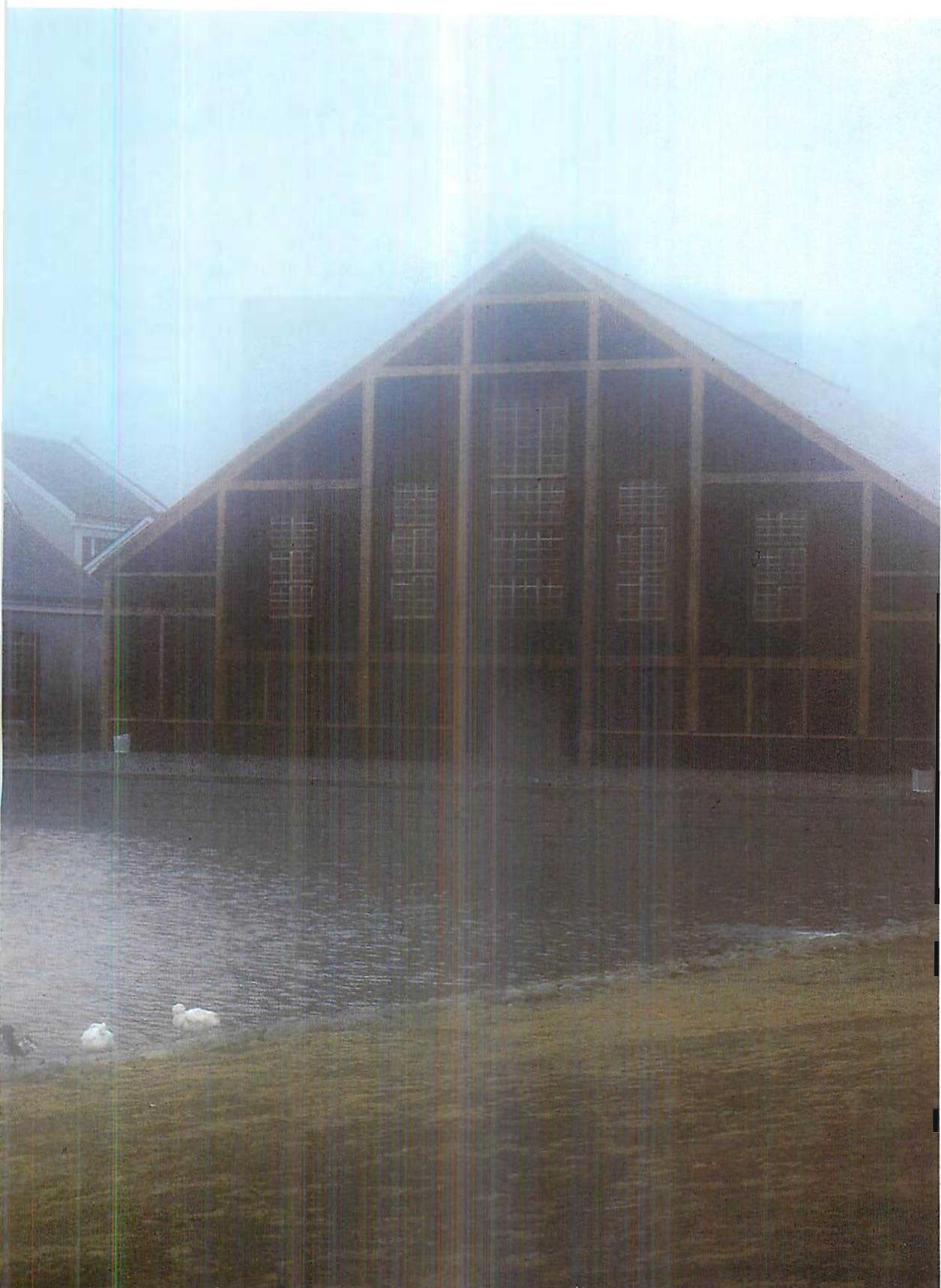
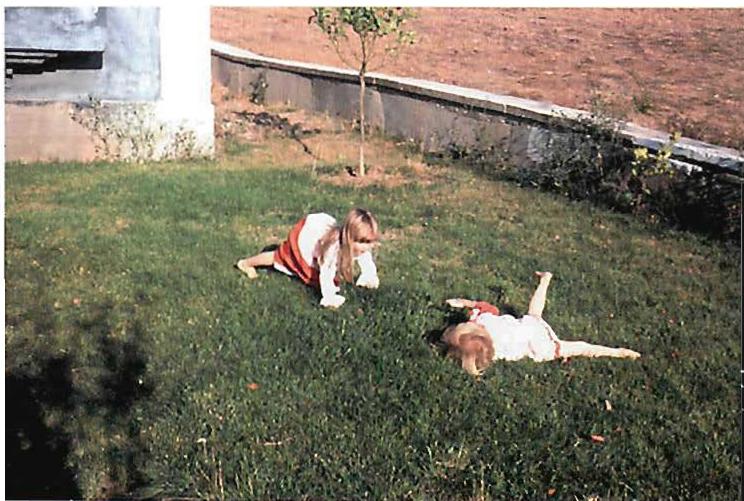
APPENDIX ON NUMBER
THE CLASS OF LIVING STRUCTURES
HOW MANY POSSIBLE LIVING STRUCTURES ARE THERE?
Does the concept of living structure, in any realistic sense, limit the creativity of architects? The idea that living structures are restricted — members of a narrower class thus perhaps making it more difficult for an architect to engage in wild fantasy and wild creativity — should this strike fear into the heart of an artist?
The known essence common to all living buildings, described throughout this book, and emphasized on pages 639-74, on MORPHOLOGY, is not a style. It is not an expression of nostalgia. It is the defining attribute of the class of those structures which arise, necessarily, when living processes are applied to buildings, towns, neighborhoods, building details, because of the character of all living process.
How may we characterize this objective essence? In Book I, I introduced the idea of two imaginary mathematical classes, each containing a huge number of possible configurations, one the class of all possible configurations, and the other, the smaller class of all living configurations. In a similar vein, I now define $C_{all}$ , as the class of all possible buildings, and $C_{living}$ as the smaller class of all those buildings which have living structure.
Of course the artificial division of all configurations into just these two classes is a convenient fiction only. As I have said repeatedly throughout these books, the degree of life in things is a matter of degree, and the degree to which a particular building is living, is always a matter of degree, to be placed somewhere on a continuum in relation to the life of other buildings.
But we need this simplifying fiction, only so that we can count and compare the relative number of possible buildings in these two classes. Both $C_{all}$ and $C_{living}$ are unimaginably huge. They are so huge that it is almost strange to talk about how many possible configurations each of these classes contains. In calculations given in
the notes at the end of this appendix, you will find a rough suggestion that $C_{all}$ contains about $10^{2,000,000,000}$ possible configurations compared with $C_{living}$ which contains only a tiny fraction of this number, about $10^{1,999,988,000}$ . Both are huge numbers, but the second is very small indeed, compared with the first. (Non-mathematical readers, beware: these two numbers seem close in size, but they are not.) The second class, $C_{living}$ , no matter how large it is, is only $1/10^{12,000}$ of the size of the first. It is only a pinprick, far smaller than the tiny dot I use to represent it in the diagram below, when compared with $C_{all}$ . Indeed, the actual area of this dot, if it were to scale, would be only about $1/10^{12,000}$ of the area of the larger circle, a nearly infinitesimal fraction of the larger circle.
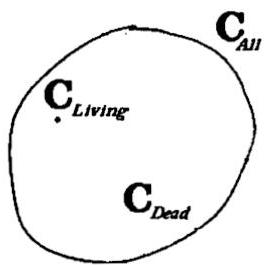
I wish to emphasize that although these two classes are both almost unimaginably huge, one is much larger than the other, and they are real classes with very roughly identifiable numbers of configurations in them. More important is the relative size of these two classes. It is vital to see that $C_{\text{living}}$ is many orders of magnitude smaller than $C_{\text{all}}$ , possibly as little as $1/10^{12,000}$ of $C_{\text{all}}$ . The class $C_{\text{dead}}$ , on the other hand, the class of buildings which are dead, is very large, essentially the same size as $C_{\text{all}}$ , as we may even see in my diagram, since it is the area of the whole disc,
less only the tiny dot. Most of the possible building configurations are dead ones; they do not have life. Compared with the much huger number of all possible building configurations, there are only relatively few living buildings.
What we usually call "design" then, is the task of finding instances of $C_{\text{living}}$ , while looking around among the elements of the much larger class $C_{\text{all}}$ .
But this is fiendishly hard, not only because the living structures are so rare, but also because they are scattered and hard to find like proverbial needles in a haystack. The haystack is what biologists and complexity theorists call "configuration space"—the ensemble of all possible configurations, including buildings and designs that are incomplete, embryonic, half finished, and complete—and most important, including, too, paths that allow one to move around, going from configuration to configuration.
Given the dispersal of very widely spaced, rare and precious living structures in configuration space, how then, can one ever hope to find them? How does one move around the solar-system-sized haystack, to find the few dust-sized specks which represent well adapted, living structures?
The answer relies on structure-preserving paths in configuration space, ways of moving from one configuration to another within the space of all possible configurations, which home in gradually (but reliably) on "good" and well-adapted, living ones.
That is, in essence, how nature too is able to generate living structures in the world (chapters 1 and 2 of Book 2). That is also how home-grown farming and agricultural processes, invented and improved and used for centuries, helped people to find paths towards living structure—and made them able, gradually, to create huge living structures like the landscape of Southern England—a structure of buildings, fields and watercourses, roads and villages 300 miles long and 150 miles wide, that was created over the more than thousand-year period from 800 A.D. to the present.
And that is, also, how living processes of the kind described in Books 2 and 3, enable builders to make beautiful buildings that belong to the class of living structures. It is done by taking particular kinds of paths through the configuration space, knowing that these paths will lead to the necessary, yet rare and hard-to-find, and nearly isolated specks of living structure in the vastness of configuration space.
It works. It is how nature manages to create structures that are members of $C_{\text{living}}$ , and it is also the only way that architects can do it in the realm of building. But architectural "design," the 20th-century process typically used to generate building shape on tracing paper or on the computer screen in the 20th-century drawing office, does not work, and cannot work, in principle. If we reflect on it, we see that finding living structures by design (without the aid of structure-preserving transformations acting on the context of the whole), is likely to be almost impossible—far, far, more difficult than looking for needles in a haystack. One is trying to find something smaller than a pinprick in the vastness of a configuration space bigger than the solar system. Doing this by hit and miss, without the help of structure-preserving transformations is virtually impossible. On the other hand, for a natural process to find its way toward $C_{\text{living}}$ by means of structure-preserving transformations is relatively easy. This happens because of the way structure-preserving transformations work (see Book 2, chapters 6 and 7).
The idea that the majority of all possible buildings do not have living structure had, perhaps, never even occurred to people before about 1980, when my colleagues and I first raised the issue. In traditional society, most traditional methods were structure-preserving. No one ever identified the huge class $C_{\text{dead}}$ , because nearly all buildings actually made, or even imagined, up to about 1900, were part of $C_{\text{living}}$ . The discovery that human beings have the option to choose — and the capability to make — ugly, strange buildings which do not preserve the structure of the Earth, is new. It is really only recently, in the late 20th century, that
we discovered that the class $C_{\text{dead}}$ exists, and that we can not merely conceive, but actually build such buildings. We discovered it during the manic gyrations of the 20th century when absurd and horrible buildings first became known. Such unnatural things had hardly ever been created before. But all of a sudden, during the 20th century, for the first time it became obvious that architects could build absurdities. This became all too obvious with the huge corpus of 20th-century building work, and finally prompted me to ask these questions:
(1) What is the difference between living structure and non-living structure?
(2) More specifically, what is the difference between those buildings generated by living process (unfolding and structure-preserving transformations) compared with those buildings created wilfully by arbitrary design moves?
These topics have been thoroughly discussed in Books 1 and 2. Once we understand the concept of living structure, together with the concept of living processes (which, alone among processes, are capable of generating living structure), it is easy to recognize that the buildings in $C_{\text{dead}}$ are not good for the Earth and not good for us. The buildings in $C_{\text{living}}$ are better for the Earth, and better for us.
Let us add something further. The buildings of $C_{\text{living}}$ form a visually recognizable class. We should not fool ourselves, by thinking that the buildings in $C_{\text{living}}$ can be made to look, any way we want. That is a fallacy, committed by too many architects. If you want to build buildings with living structure—that is, buildings with real life—then they will have definite, distinctive, recognizable morphological character. Primarily, they will have this character because they have unfolded truthfully by unfolding from the wholeness of their contexts and because this unfolding introduces the fifteen properties again and again in a definite and recognizable patterning, even though the pattern of the whole is different each time that it occurs.
By an odd quirk of social circumstance, in the 20th century there were violent taboos in the architectural community, social pressures created by architectural in-groups, which made
it seem, in the late 20th century, justifiable to build almost anything EXCEPT the buildings in $C_{\text{living}}$. You were justified as a professional architect as long as you demonstrated your membership in the club of proper modern architects (a quaint term used in the 20th century), by avoiding $C_{\text{living}}$ at all costs, and by, instead, selecting or creating something unexpected from the class $C_{\text{dead}}$.
Of course, no architect would ever have admitted this. Instead, the questionable dogmas of 20th-century architecture were supported and propagated by incomprehensible verbal mumbo-jumbo that passed as "art criticism." The taboo was so strongly established by architecture schools and magazines, that it needed great strength of character to withstand it. That is why I began to believe it so important to develop a clear idea of the class $C_{\text{living}}$, and a picture of the kinds of buildings it contains.
Now my claim can be rather simply stated. The seven hundred pages of text and pictures in this volume, may be considered as a very partial and very rough first approximation to a contemporary portrait of the class $C_{\text{living}}$. The pictures convey a partial sense (of course, very incomplete) of what the members of the class $C_{\text{living}}$ are like. When unfolding occurs and when living processes guide formation of buildings, the structures which emerge will always have a certain recognizable character. This character is the "something" which is visible and shared, through the examples in this volume.
Thus I dare to say—and it is intellectual truthfulness I hope for, not what I am afraid might seem merely an arrogant claim—what I have shown here does give us a first very rough approximation to a necessary morphology, a necessary morphology of architecture. If there is to be a living world in future eras, this, in some degree, is what this world will look like, what it must look like.
There is a very important point I would like to make in closing. To make it, I wish to return to the question asked in the very first sentence of this appendix. Does the concept of living
structure place unreasonable limits on an architect's creativity? Architects, understandably, are concerned about their own creativity. They want to create something beautiful, but, also, in some degree, they want to create things that are original, simply so as to keep their love of work alive, and to keep their self-esteem high. This is natural enough, and reasonable.
The moment one says anything which even seems to reduce the number of possibilities that are open to an architect, he/she can sometimes tremble, become annoyed, or anxious, even hostile to such a theory—because it seems as though their love of life, or of design, is going to be reduced, or stamped out, or shrivelled, by the annoying and restrictive theory. Once again, perfectly reasonable, in principle.
It becomes unreasonable, though, to worry about it, once we grasp the truly enormous size of $C_{\text{living}}$ , the class of all possible living buildings. I have spent some time describing the fact that this class is very much smaller than the class of all possible buildings. This observation, taken by itself, might add to an architect's fear that by trying, only, to build from within the class of living structures, he would indeed be reducing his creativity, his opportunity for fame, delight, and inventiveness.
But even though the class of all possible living buildings ( $C_{\text{living}}$ ) is smaller than the class of all possible buildings, $C_{\text{living}}$ is still almost UNIMAGINEABLY huge. It is, to put in visualizable terms, like this. If each person on Earth was to make a living building once a second, and went on doing it for a million centuries, the total number of different buildings would not exhaust even a billionth of a billionth part of all those which are possible. What is there to worry about? In a lifetime of drawing a different living building every second of every day, and even if every single person on Earth were to do this, and if this activity were to go on for a million centuries — even then, the totality of what been drawn would still only be a minute fraction of all the living buildings that are possible.
There is nothing about the size of $C_{\text{living}}$ that should give an architect anything to worry about—in terms of limits on his, or her, inventiveness and creativity. There are, effectively, no limitations. But what we do need to worry about, is the much larger size of $C_{\text{dead}}$ , the much larger number of possible dead buildings that are not structure-preserving to their places on Earth, and which infect and destroy the beauty of the Earth, every day, now, in this era, because people have not yet understood this simple point.
NUMERICAL ESTIMATES OF THE SIZE OF DIFFERENT CLASSES
To give the reader a numerical handle to hold onto in the foregoing discussion, I now give crude estimates for the sizes of the three classes mentioned in the text: $C_{all}$ , $C_{living}$ , $C_{dead}$ .
- Estimate of $C_{all}$ . Let us, for the sake of comparison, consider a cubical volume of space about 20 meters by 50 meters by 50 meters. This cubical volume can contain a middle-sized building and its immediate surroundings. The volume contains 50,000 cubic meters of space.
Let us now imagine this volume as made up of arrangements of cells. To get a numerical
estimate of the number of cells we may say that very roughly, and on average, the pieces in a building are on the order of a piece of wood or brick which might be 1 centimeter by 10 centimeters by 10 centimeters. Some will be larger, some smaller, but this is a reasonable average. All in all, the cells will have an average volume of about 100 cubic centimeters, $10^{-4}$ cubic meters. This means, then, that in our volume of 50,000 cubic meters, there are $5 \times 10^{8}$ , say $10^{9}$ of these cell-sized pieces.
For the sake of argument, let us say that each of these cells might have any one of 100 possible materials in it—including, of
course, empty space or air. Each arrangement of the 100 possible contents, creates a possible configuration. (Of course, the real number of possible contents for a cell is vastly bigger than 100—indeed, is itself astronomical. However, the following calculation will not be materially altered if we became more finicky about this issue, since what matters is the ratio of living to non-living structures, and in this respect the idea of the calculation laid out below will not be hugely altered by choosing a larger number of possible contents. For this reason, and for convenience of calculation only, I use the low figure of 100 different possible contents for the cells.) We may then calculate that the total number of possible configurations is $100^{10}$ which may be more conveniently written as $10^{2,000,000,000}$. Bearing in mind that the number of particles in the universe (the whole known universe) is estimated to be $10^{80}$, we see that this is a very large number indeed.
- Estimate of $C_{\text{living}}$. In order to obtain a rough guess at how many of these possible configurations are living configurations, we go back to the idea of structure-preserving transformations. A living configuration must unfold by differentiation. To visualize this unfolding process, we may conceive it as a series of forks, or decision points, along a path through the space of all possible configurations. At each decision point, we might guess that there are a thousand possible branch points or paths to choose from. Among these
1,000, let us guess that there might be perhaps fifty paths which are structure-preserving ones. And let us contemplate a process in which three people are each making one decision per hour, 8 hours per day, the process extending over eighteen months of design and construction, all in all including about 9,000 decisions taken one at a time (a fairly realistic figure for a building). The total number of possible configurations which might be reached by this process is then $1000^{9,000}$, or $10^{27,000}$. Of these, $50^{9,000}$ (about $10^{15,000}$) are the ones which can be reached by making a structure-preserving choice at each branch point, and are thus likely to be living structures. In rough terms, then, we may estimate that among all possible configurations, about one configuration in $10^{27,000}/10^{15,000}$ or about one in $10^{12,000}$ is a living configuration.
If we take this roughly-estimated number as the ratio of $C_{\text{all}}$ to $C_{\text{living}}$, and apply it to the number of all possible building configurations using the estimated ratio of $10^{12,000}$ to 1, we may infer that the total number of possible living configurations is likely to be about $10^{1,999,988,000}$.
- Estimate of $C_{\text{dead}}$. The number of possible configurations in $C_{\text{dead}}$ is, to within an infinitesimal error, exactly the same as the number of all possible configurations ($C_{\text{all}}$). The error is one part in $10^{12,000}$. The two numbers are equal until the twelve-thousandth decimal place. In short, almost all of the possible configurations that exist are dead ones.
The previous very crude estimates of astronomically gigantic numbers, are only intended to draw attention to three vital points.
FIRST, the number of living buildings is a tiny, tiny, tiny fraction of the class of all possible buildings, far too tiny and hard to reach by what we nowadays call "design."
SECOND, the rare and hard-to-find living structures are easily reachable by the structure-
preserving-processes method that nature uses millions upon millions of times per day, to generate instances of the equally tiny class of living structures in nature, throughout the natural world.
THIRD, although there are few living buildings compared with the much larger number of dead buildings, nevertheless the number of all possible living buildings is still unimaginably
huge, far larger than all human beings on Earth could ever use up, even if every one of them was to make billions of new living buildings every day, and if they wanted to go on doing it for a billion centuries. In short, staying inside the class of living buildings, and staying away from the class of dead buildings, is no restriction on an artist's creativity, at all.
That is all. That is what really matters.
Instead of worrying about our creativity, we had better worry about the difficulty of finding the tiny scattered specks in configuration space that we call $C_{living}$, and about managing to make living buildings at all. For that we need to pay attention to the kinds of structure-preserving, stepwise methods described in Book 2, chapters 6 and 7, and throughout this book.

PICTURE CREDITS
My gratitude for all the help I have received with the content, ideas, discussion, and production of these four books from many, many people during the last twenty-seven years has been expressed on pages 345–52 of Book 4. In addition, I gratefully acknowledge the use of pictures, photographs, and illustrations owned by the following persons and institutions. All illustrations not mentioned belong to or are the work of the author and are reproduced by permission of the Center for Environmental Structure.
I would like to say a special word of thanks to Maggie Moore Alexander and to Randy Schmidt. Book 3 has been especially arduous, and the choices that had to be made in this book, the nearly endless color proofing, picture editing, fine text adjustments, decision-making, and sheer hard work keeping everything in order while we were doing it, day after day after day, fell on their shoulders. This work alone lasted a full year and a half. Maggie and Randy did it beautifully, and I could not conceivably have managed without their constant support. Their tenacity and dedication was extraordinary.
Preface
p. 6 all Edmond Bacon, Design of Cities, A Studio Book, The Viking Press, NY, 1974, p. 104; p. 7 all Edmond Bacon Design of Cities, A Studio Book, The Viking Press, NY, 1974, p. 104; p. 8 A Dutch photographer, unknown; p. 10 left Mark Darley/Esto, right Howard Davis; p. 12 Hajo Neis; p. 17 Demetrius Gonzalez.
Chapter 1
pp. 28 and 29 James Nachtwey; p. 30 source unknown; p. 32 source unknown; p. 33 top source unknown; p. 37 all Bilal Hammad and Jacques B'etant, Aga Khan Trust for Culture.
Chapter 2
p. 44 photographer unknown; p. 46 Ken Heyman; p. 48 top: source unknown; p. 48 bottom, Kura No Aru Oedu Kawagoe Tewni with Fireproof Storehouses; p. 49 top Pamela Alexander; p. 51 all Pamela Alexander; p. 52 both Pamela Alexander; p. 54 Pamela Alexander; p. 55 top Pamela Alexander; p. 55 bottom Katherine Winn; p. 56 Pamela Alexander; p. 57 Pamela Alexander; p. 60 Mark Darley/Esto; p. 63 Magnum photos, Inc. © 1946 Henri Cartier Bresson; p. 65 John Lighty.
Chapter 3
p. 71 all M. J. O'Brian and Miranda Waugh, LIFT; p. 72 bottom source unknown; p. 74 bottom Olof Hultin, Asplund, New York, Rizzoli, 1986; p. 78 Hajo Neis; p. 79 top Hajo Neis; p. 80 bottom unknown Eishin student; p. 81 source unknown; p. 83 bottom Randy Schmidt; p. 84 Randy Schmidt; p. 85 Randy Schmidt; p. 86 top left Hajo Neis; p. 88 Hajo Neis; p. 92 sources unknown; p. 93 source unknown; p. 95 top Gina Corrigan; p. 96 top David Soffa; p. 96 bottom Mark Darley/Esto; p. 97 Dennis Gilbert.
Chapter 4
p. 108 Dan Oshima; pp. 110-11 left Hiroshi Kobayashi; p. 111 top right Roland Michaud; p. 111 bottom right Hajo Neis; p. 119 Yves Broncard, Revue de l'Association Francaise des Amis du Chemin de Fer, no. 428, 1994; p. 121 Mark Darley/Esto; p. 122-123 Mark Darley/Esto; p. 124 Mark Darley/Esto; p. 132 Mary Rose Trust; p. 148 Brian Brace Taylor, Geoffrey Bawas, Singapore and New York Concept Media Pte. Ltd, 1986.
Chapter 5
p. 155 Franco Borsi, Ezio Godoli, Vienna-1900-Architecture and Design, Rizzoli, New York, 1986, p. 20; p. 162 James Givens; p. 165 Demetrius Gonzalez; p. 166 Hajo Neis; p. 170 Miyoko Takeda; p. 179 top left and right Hiro Nakano; p. 180-181 top Japan Architect, 1985-6, vol. 60, p. 166; p. 181 bottom Nikkei Architecture, Japan, 1985, 5-20 Issue, Nikkei-McGraw-Hill, Inc.; p. 186 bottom Bill McClung; p. 187 bottom unknown Eishin student.
Chapter 6
p. 192 Dr. H.P. Berlage, Berlage en zijn werk/door K.P.C. deBazil, Rotterdam, W.L. & J. Brusse, 1916, p. 47; p. 194 Otto van Simpson; p. 195 Debbie Rusch; p. 197 Max Plunger, with thanks; p. 220 Mark Darley/Esto; p. 222 James Maguire.
Chapter 7
p. 230 Andras Balla; p. 237 Kamran Safmanesh; p. 243 James Maguire; p. 247 source unknown; p. 248 top and bottom Mark Darley/Esto; p. 249 Mark Darley/Esto; p. 250 Marijke Heuff, Gardens Illustrated, March 1997, p.75; p. 252-53 unknown Japanese student; p. 254 top left and top right James Givens.
Chapter 8
p. 260 source unknown; p. 263 British Broadcasting Corporation, Brian Swimme and Thomas Berry, The Universe Story, Harper, SF, 1992; p. 266 Miyoko Takeda; p. 267 top left and right Miyoko Takeda; p. 272-273 Hiro Nakano; p. 274 Commune di Bologna: Galleria d'Arte Moderna. Bologna: Grafis industri grafiche, 1974. Bologna Palazzo di Re Enzo, Oct/Dec 1974, p. 67; p. 275 City of Bologna; p. 276-7 Commune di Bologna: Galleria d'Arte Moderna. Bologna: Grafis industri grafiche, 1974. Bologna Palazzo di Re Enzo, Oct/Dec 1974, p. 67; p. 278 top City of Bologna; p. 278 bottom Commune di Bologna: Galleria d'Arte Moderna. Bologna: Grafis industri grafiche, 1974. Bologna Palazzo di Re Enzo, Oct/Dec 1974, p. 67; p. 279 City of Bologna; p. 280 Mick Elmore/ Lonely Planet images, for The New York Times; p. 281 source unknown; p. 282 source unknown.
Chapter 9
p. 284 top Tony Abbate, p. 285 both Tony Abbate; p. 286 Tony Abbate; p. 298 Tony Abbate; p. 301 bottom right source unknown.
Chapter 10
p. 320 Miyoko Takeda; p. 325 Miyoko Takeda.
Chapter 11
p. 335 Mark Darley/Esto; p. 338 Kleonike Tsotropoulou; p. 339 right Yodan Rofe; p. 342 bottom Artemis Anninou; p. 344 Artemis Anninou; p. 348 top and bottom Howard Davis; p. 351 bottom right Moshe Safdie and Associates, Process: Architecture, 1985/3, no. 56, p. 59; 351 bottom left Nili Portugali; p. 354 Jim Shipsky; p. 356 Jim Shipsky.
Chapter 12
p. 364 top Gregorius Antar/Aga Khan Trust for Culture, Architectural Reviews, Oct 1992, vol. CXCI, no. 1148; p. 364 bottom Bill McClung; p. 367 top Randy Schmidt; p. 368 top Randy Schmidt; p. 368 bottom right CES; p. 369 both Randy Schmidt; p. 370 all Randy Schmidt; p. 371 Randy Schmidt; p. 373 top Randy Schmidt; p. 374 all Randy Schmidt; p. 375 all Randy Schmidt; p. 376 bottom Randy Schmidt; p. 377 Randy Schmidt; p. 378 both Randy Schmidt; p. 379 both Randy Schmidt; p. 380 CES; p. 389 Mark Darley/Esto; p. 390 Mark Darley/Esto; p. 393 top right and left Ismet Khambhatta; p. 393 bottom left and right Ismet Khambhatta; p. 395 top left and right Ismet Khambhatta; p. 395 middle left and right Ismet Khambhatta; p. 397 Mark Darley/Esto; p. 400 both Kleoniki Tsotropoulou; p. 405 top Kleoniki Tsotropoulou; p. 406 bottom: Kleoniki Tsotropoulou; p. 407 all: Kleoniki Tsotropoulou; p. 409 left James Givens.
Chapter 13
p. 412 David Soffa; p. 413 Mark Darley/Esto; p. 414-15 Randy Schmidt; p. 418 top James Givens; p. 419 bottom James Givens; p. 424 David Soffa; p. 426-27 Mark Darley/Esto; p. 432 Margherita Spiluttini, Architektur Aktuell, November 1997, p. 77; p. 433 top Brian Brace Taylor, Geoffrey Bawas-Architects in the Third World, Concept Media Pte Ltd, 1986; p. 434 top Mark Darley/ Esto; p. 435 Mark Darley/Esto; p. 436 Mark Darley/Esto; p. 437 Jonathan Fefferman; pp. 442-43 Annie der Bedrossian; p. 444 Max Plunger, with thanks; p. 445 Herman Czech; p. 446 Howard Davis.
Chapter 14
p. 452 top left Yoshio Watanabe; p. 452 bottom left Brickwork in Italy: A Brief Review from Ancient to Modern Times, editor G.C. Mars, American Face Brick Association, Chicago, 1925, p. 38; p. 452 bottom right Georg Kohlmaier and Barna von Sartory, Das Glasshaus, Prestel Verlag, 1981, plate 487, p. 543; p. 453 top Bannister Fletcher, A History of Architecture on the Comparative Method, New York, Charles Scribner's Sons, 1963, p. 157, fig. 87-88; p. 453 bottom Georg Gerster, Robert A. Fernea, Nubians in Egypt:
Peaceful People, University of Texas Press, Austin, 1973; p. 454 The Trustees of the Wallace Collection, London, Cyril Stanley Smith, A Search for Structure, MIT Press, Cambridge, MA, 1981, p. 72; p. 455 American Institute of Indian Studies, Gurgaon, India; p. 458 Mark Darley/Esto; p. 459 Mark Darley/Esto; p. 467 bottom CES; p. 468 top: Randy Schmidt; p. 471 top Mark Darley/Esto; p. 473 all Mark Darley/Esto; p. 476 Royal Dutch Glassworks; p. 478 Katalin Bende.
Chapter 15
pp. 482-83 Hajo Neis; p. 486 bottom left and right John Hewitt; p. 487 John Hewitt; p. 490 Kyriakos Pontikis; p. 491 top left Ellen Georgiov Pontikis; p. 491 top right Kyriakos Pontikis; p. 492 bottom Kyriakos Pontikis; p. 492 Kyriakos Pontikis; p. 493 Howard Davis; p. 495 Howard Davis; p. 501 Katalin Bende; p. 502 all Katalin Bende; p. 503 bottom Hajo Neis; p. 505 bottom: James Givens; p. 509 bottom Hajo Neis; p. 510 Leslie Mandelson Freudheim, Building with Nature, Santa Barbara: P. Smith, 1974, p.1, fig.1; p. 512 Robert Descharnes, Gaudi, The Visionary, New York: Viking Press, 1971, p.147; p. 513 Arturo Horiuchi, Licenciado Gonzalo Obregon et al. Tepotzotlan, Instituto Nacional do Antropologia e Historio, SEP, and Artes de Mexico, Mexico, 1965, vol. XII; p. 515 Andras Balla, Esztergom, Esztergom, Hungary, 1991, p.89.
Chapter 16
p. 519 internet source unknown; p. 523 Mark Darley/Esto; p. 531 top Harissos Tsiringas; p. 532 top Mark Darley/Esto; p. 533 top Mark Darley/Esto; p. 535 Mark Darley/Esto; p. 536 top Mark Darley/Esto; p. 537 Mark Darley/esto; p. 542 all The Japan Architect, 1985/6; p. 543 top Kenchiku Bunka, 1985/6; p. 543 bottom right The Japan Architect, 1985/6; p. 544 bottom John Hewitt; p. 545 John Hewitt; p. 546 bottom Eileen Tumlin; p. 548 both Hebel USA catalog; p. 549 bottom source unknown; p. 556 top Miyoko Takeda; p. 557 bottom Miyoko Takeda; p. 558 Demetrius Gonzalez; p. 559 Demetrius Gonzalez.
Chapter 17
p. 563 Hiroshi Takama; p. 564 Hiroshi Takama; p. 565 both Hiroshi Takama; p. 566 Bannister Fletcher and B.F. Fletcher, A History of Architecture On the Comparative Method, B.T. Batsford, London, 1897; p. 570 both source unknown.
Chapter 18
p. 589 Richard Barnes, Sara Holmes Boutelle, Julia Morgan, Architect, Abbeville Press, New York, 1988; p. 593 bottom Mark Darley/Esto; p. 595 top Mark Darley/Esto; p. 605 Max Hirmer; p. 606 top Prof. Dr. Gonul Oney, Turk Cini Sanatani, Turkish Tile Art, Yapi ve Kredi Bankasi'nin bir Kultur Hizmetidir, Istanbul, 1976, p.37; p. 608 Bannister Fletcher and B.F. Fletcher, A History of Architecture On the Comparative Method, B.T. Batsford, London, 1897, fig.76; p. 610 Brian Brace Taylor, Geoffrey Bawa, A Mirmar book by Concept Media Pte. Ltd; p. 611 Deidi von Schaewen.
Chapter 19
p. 618 top Harissos Tsiringas; p. 623 Mark Darley/Esto; p. 625 Mark Darley/Esto; p. 626 Mark Darley/Esto; p. 627 Jeffrey Becom, Lonely Planet Images, photo 20-20 from Maya Color: The Painted Villages of Mesoamerica, Abbeville Press, New York, 1997; p. 628 James Givens; p. 630 Kevin Gilson; p. 632 Mark Darley/Esto; p. 636 source unknown.
Morphology
p. 641 Mark Darley/Esto; p. 643 top left and right Bilal Hammad and Jacques B'etant, Aga Khan Trust for Culture; p. 646 bottom source unknown; p. 648 bottom Mark Darley/Esto; p. 649 Mark Darley/Esto; p. 650 top: Mark Darley/Esto; p. 653 inset Mark Darley/Esto; p. 657 top left Oktay Aslanapa, Turkish Art and Architecture, Praeger Publishers, New York, 1971, plan #12, p.108; p. 657 bottom Oktay Aslanapa, Turkish Art and Architecture, Praeger Publishers, New York, 1971, plate #117; p. 657 top right Andreas Feininger, The Image of Woman, Dumont Schauberg, Cologne, Germany and London: Thames and Hudson, 1961, p. 28; p. 658 James Mellaart, Catal Hayuk, A Neolithic Town in Anatolia, McGraw-Hill book Company, New York, 1967; p. 659 top Sara Ishikawa; p. 660 Ruth Landy; p. 661 Steve Harris; p. 665 both Mark Darley/Esto; p. 667 top left Pamela Alexander; p. 667 middle left Pamela Alexander; p. 674 Miyoko Takeda; p. 675 Miyoko Takeda.
Although every effort has been made to trace and contact copyright holders before publication, this has not been possible in a few cases. If notified, we will be pleased to rectify any errors or omissions at the earliest opportunity.